Dean Baker co-founded CEPR in 1999. His areas of research include housing and macroeconomics, intellectual property, Social Security, Medicare, and European labor markets. His blog, Beat the Press, provides commentary on economic reporting. His analyses have appeared in many major publications, including The Atlantic, The Washington Post, the Financial Times (London), and the New York Daily News. Dean received his BA from Swarthmore College and his PhD in economics from the University of Michigan.
Dean has written several books, including Getting Back to Full Employment: A Better Bargain for Working People (with Jared Bernstein, Center for Economic and Policy Research, 2013); The End of Loser Liberalism: Making Markets Progressive (Center for Economic and Policy Research, 2011); Taking Economics Seriously (MIT Press, 2010), which thinks through what we might gain if we took the ideological blinders off of basic economic principles; and False Profits: Recovering from the Bubble Economy (PoliPoint Press, 2010), about what caused — and how to fix — the 2008–2009 economic crisis. In 2009, he wrote Plunder and Blunder: The Rise and Fall of the Bubble Economy (PoliPoint Press), which chronicled the growth and collapse of the stock and housing bubbles and explained how policy blunders and greed led to catastrophic — but completely predictable — market meltdowns. He also wrote a chapter (“From Financial Crisis to Opportunity”) in Thinking Big: Progressive Ideas for a New Era (Progressive Ideas Network, 2009). His previous books include The United States Since 1980 (Cambridge University Press, 2007), The Conservative Nanny State: How the Wealthy Use the Government to Stay Rich and Get Richer (Center for Economic and Policy Research, 2006), and Social Security: The Phony Crisis (with Mark Weisbrot, University of Chicago Press, 1999). His book Getting Prices Right: The Debate Over the Consumer Price Index (editor, M.E. Sharpe, 1997) was a winner of a Choice Book Award as one of the outstanding academic books of the year.
Among his numerous articles are “The Benefits of a Financial Transactions Tax,” Tax Notes 121, no. 4 (2008); “Are Protective Labor Market Institutions at the Root of Unemployment? A Critical Review of the Evidence” (with David R. Howell, Andrew Glyn, and John Schmitt), Capitalism and Society 2, no. 1 (2007); “Asset Returns and Economic Growth,” with Brad DeLong and Paul Krugman, Brookings Papers on Economic Activity (2005); “Financing Drug Research: What Are the Issues,” Center for Economic and Policy Research (2004); “Medicare Choice Plus: The Solution to the Long-Term Deficit Problem,” Center for Economic and Policy Research (2004); “Professional Protectionists: The Gains From Free Trade in Highly Paid Professional Services,” Center for Economic and Policy Research (2003); and “The Run-Up in Home Prices: Is It Real or Is It Another Bubble?,” Center for Economic and Policy Research (2002).
Dean previously worked as a senior economist at the Economic Policy Institute and an assistant professor at Bucknell University. He has also worked as a consultant for the World Bank, the Joint Economic Committee of the US Congress, and the OECD’s Trade Union Advisory Council. He was the author of the weekly online commentary on economic reporting, the Economic Reporting Review, from 1996 to 2006.
All from Dean Baker
Mostly Economics – Episode 42
Dean Baker sits down with CEPR climate analyst Matt Sedlar to unpack how Trump’s cuts to FEMA and NOAA are leaving states, especially poorer Republican ones in Appalachia, dangerously exposed.

May Trade Deficit Jumps to Highest Level Since March 2025
The May trade deficit surged to its highest level since March 2025, driven in part by AI-related imports and undercutting Trump’s goal of reducing the trade gap.

The Sanders-Trump Plan for an AI Sovereign Wealth Fund: Don’t Buy It
An AI sovereign wealth fund would concentrate political power, reinforce the AI bubble, and divert attention from more effective industrial and corporate tax policies.

If Your Financial Adviser Recommends Putting Money in a Trump Account, Fire Them
While families should accept the government’s one thousand dollar contribution, almost everyone is better off saving for their children through a 529 plan rather than adding money to a Trump account.
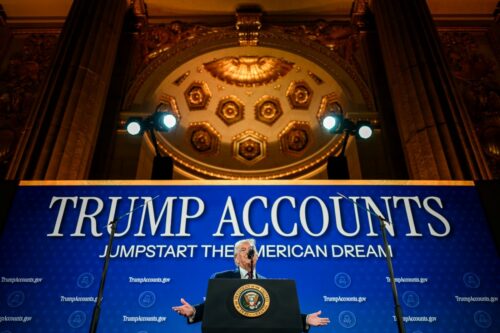
New York Times Badly Misleads Readers on Trump Accounts
Trump’s proposed baby accounts rely on unrealistic investment assumptions, obscure the effects of inflation, and lock up funds while cutting programs that help low-income families.

Five Takeaways from the June Jobs Report
The June jobs report points to a cooling labor market, with slowing wage growth, job gains concentrated in health care, declining prime-age employment, and no evidence that AI is boosting productivity.
Economy Creates 57,000 Jobs in June, as Unemployment Edges Down to 4.2 Percent
While this month’s job growth numbers are fine, wage growth remains weak and the continuing concentration of jobs in the health care and social assistance sector does not suggest a strong economy overall.
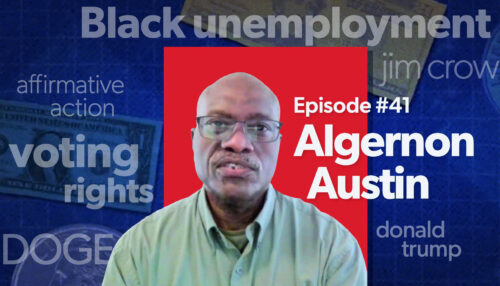
Mostly Economics – Episode 41
Episode 41: Algernon Austin, director of CEPR’s Race and Economic Justice Program, joins Dean Baker to examine how the Trump administration is reversing black economic progress through DOGE cuts, military purges, weakened affirmative action, and the Supreme Court’s assault on voting rights. They also discuss solutions, including a national jobs guarantee.
Trump’s Factory Boom Keeps Going in Reverse
Despite Trump’s claims of record investment, factory construction has declined sharply since its 2024 peak, following a surge driven by Biden-era industrial policies.

The Folks Who Invented Pet-Eating Migrants are Yelling Fraud!
The Trump administration’s claims of widespread ACA fraud are unsupported by evidence and overlook the insurers that would profit most from fraudulent enrollments.