After Guaidó’s DC Circuit, Trump Admin Earmarks More Money for Regime Change in Venezuela
Juan Guaidó’s high-profile trip to Washington earlier this month seems to be paying off.
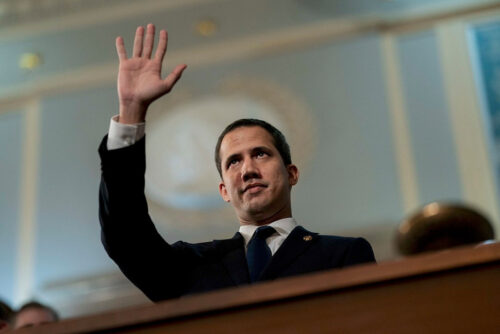
Juan Guaidó’s high-profile trip to Washington earlier this month seems to be paying off.
September 23, 2019
In our paper, “Sanctions as Collective Punishment: The Case of Venezuela,” we looked at some of the ways in which the sanctions on Venezuela imposed by the US government curtail access to essential and life-saving imports, and some of the data on impacts

April 2019, Mark Weisbrot and Jeffrey Sachs

The New Republic: The Trump administration’s sanctions and push for regime change in Venezuela mirror past U.S. interventions in Latin America, causing massive civilian suffering and revealing that the effort is about power, not democracy or human rights.
On January 23, the United States recognized Juan Guaidó as president of Venezuela. As CEPR Co-Director Mark Weisbrot has pointed out in The Nation, this is not a merely diplomatic maneuver:
On January 23, the Trump administration announced that it was recognizing Juan Guaidó, currently head of the Venezuelan National Assembly, as “interim president” of the country. By doing so (together with politically allied countries), Washington basically imposed a trade embargo against Venezuela. This is because any revenue from oil sales to about three-quarters of Venezuela’s export markets?the United States and its allies?would no longer go to the government but to the “interim president.”
On Tuesday, the International Crisis Group’s Ivan Briscoe wrote in Foreign Affairs that around 90 percent of the Venezuelan population receives food aid from Maduro’s government, a crucial lifeline currently endangered by US policy:
The state now provides citizens with monthly boxes of subsidized rations that offer high-carb sustenance—pasta, rice, and flour—along with a few tins of tuna. According to a recent independent social survey, these boxes are now provided to more than seven million households, or around 90 percent of the population; a high-level government source estimates the cost at more than $400 million a month.
But the state’s food supply is now in peril. At the end of January, the United States sanctioned Venezuela’s state-run oil firm, PDVSA, which until then had been the Maduro government’s single largest source of hard currency. By freezing the proceeds on its purchases of Venezuelan oil, the United States hoped to starve the regime and convince factions within the government to abandon Maduro, making way for Guaidó and free elections.
In the Financial Times, noted Venezuelan economist Francisco Rodríguez wrote that humanitarian aid was inadequate to make up the shortfall resulting from Venezuela’s economic collapse:
The Nation: The humanitarian crisis will get rapidly worse if the most recent sanctions continue.
Last week, humanitarian aid was at the center of discussion of the Venezuela crisis in the US, and evidently at the center of Juan Guaidó’s plans to challenge the Maduro government’s hold on power in the country. The New York Times noted that:
The battle over the legitimate leadership of Venezuela — which has included rallies of thousands, international diplomacy and oil sanctions — is now focused on a single heavily guarded shipment of humanitarian aid.
Venezuela’s opposition, which has relished a month of victories in its effort to challenge President Nicolás Maduro and take over as the country’s legitimate government, brought the donated supplies of food and medical kits to the country’s border with Colombia.
Its goal was to bring the supplies into Venezuela, forcing a confrontation with Mr. Maduro, who has refused the help. This would cast Mr. Maduro in a bad light, opposition leaders said, and display their ability to set up a government-like relief system in a nation where the crumbling economy has left many starving, sick and without access to medicine.
Last week, the US formally adopted sanctions on Venezuelan national oil company PDVSA, as well as on CITGO, its US-based distribution arm, as part of its press for regime change in Caracas. National Security Advisor John Bolton estimated the actions would affect some $7 billion in assets and would block $11 billion in revenue to the Venezuelan government over the next year. The State Department was quick to add, “These new sanctions do not target the innocent people of Venezuela…” But of course
The Los Angeles Times: If Russia, China, and North Korea decided to recognize Nancy Pelosi as the president of the United States, would Americans go along with that?