
Article
US Escalation in the Caribbean and Latin America – Live Updates

Article
Posting on the tracker will be sporadic through July 12, apologies for the inconvenience.
The Wall Street Journal reports on efforts by right-wing opposition leader Maria Corina Machado to return to Venezuela in the aftermath of last week’s earthquakes:
Exiled Venezuelan opposition leader María Corina Machado accused the ruling government of blocking her from flying home from Panama to help with earthquake relief but said she would find a way to return, setting up a showdown with the U.S.-backed administration.
“The regime closed our country’s airspace to try to stop me,” Machado said Monday in a video posted on social media from Panama. The twin earthquakes that rocked Venezuela on Wednesday have killed more than 1,500 people and left tens of thousands missing, making her return “impossible to postpone,” she said.
On Friday, Machado took off in a private plane from Virginia to Curaçao, an autonomous Dutch island 40 miles from Venezuela, on a flight authorized by U.S. authorities, people familiar with the trip said. She and aides had made it as far as North Carolina when U.S. officials asked her to turn around, and she did.
The New York Times reported over the weekend that Trump administration officials were frustrated with Machado’s attempts to return:
U.S. officials say they are frustrated with María Corina Machado, the exiled Venezuelan opposition leader, for requesting help facilitating her return to Venezuela in the aftermath of two devastating earthquakes, according to two White House officials.
They said Ms. Machado’s multiple requests were ill-timed, and one official called them a “political stunt.” The United States, as well as dozens of other countries, has been focused on giving aid to Venezuela on Saturday.
Bloomberg provided additional details:
Machado tried to travel to Curacao from the US last week with the help of private security contractors with the intent to reach Venezuela, according to the people, who asked not to be identified in order to speak publicly. The security team was already preparing for her on the tiny Dutch island off the Venezuelan coast, but she called off that attempt after President Donald Trump’s administration made clear she would be traveling at her own risk and without US support, the people said.
Several US officials have told Machado and her team that they’re worried her return could cause a confrontation with the current regime and distract from rescue efforts, the people said. But she received encouragement from at least one high-level official within the Trump administration, they said. It’s unclear whether the concerns among the majority of Trump aides involved on Venezuela policy and the failed attempt to travel will delay or cancel her plans.
Grieving relatives are still seeking justice for loved ones killed in US boat strikes despite waning public attention, The Guardian reported:
It has been more than four months since Ricky Joseph left his home for the last time.
His partner, Lucille Charles, and their chidren were still asleep at home on the Caribbean island of St Lucia, when Joseph, 35, set out to sea early in the morning on 13 February to fish for tuna, ballyhoo and snapper.
When Joseph failed to return hours later, Charles grew increasingly worried, calling and messaging his phone with no answer.
“I started calling people and asking if they had seen him. I kept trying to reach him,” she said. “I sent messages. I kept telling myself he would come back, but then I began to feel that something had happened to him.”
The truth emerged in bits and pieces: media reports, rumours of an explosion – and then the news that the boat he was on had been blown up in the Trump administration’s military campaign against vessels allegedly transporting drugs to the US.
For Joseph’s family – who knew him as a son, a brother and a father, a man who made time to play with his children at the beach – the reports were as confusing as they were devastating. Joseph had no criminal record, said Charles, adding: “I never knew him to be involved in anything like that.”
…
Although the family was told that Joseph’s remains had been found, they still do not have his body. Without a body to bury, without a clear explanation of his death, and without a trial to contest the accusations against him, they said they were suspended in raw grief.
The family is asking for clarity and support.
“I had to tell [the children] that their father was gone,” said Charles. “That was very hard … they never got the chance to see him, to say goodbye, or to have closure.”
…
In St Lucia, an investigation was launched, said the prime minister, Philip Pierre. But in May – three months after the attack – he said he had yet to receive further information from Washington.
“We cannot insist that the US gives us answers … And the sad thing is that we have had no further information on this matter,” Pierre said.
…
Taliam [the owner of the boat that Joseph was on] said he did not feel St Lucia’s prime minister was to blame. “He wasn’t the one who did anything to my boat,” Taliam said. “The world just needs to realise that we have a psycho on the loose … Trump is a psycho.”
Since the boat strikes began in September, the US military has bombed 67 vessels and extrajudicially killed at least 221 people (CEPR’s tracking of the boat strikes is available here). Last week, a New York federal court heard arguments in a case brought by the ACLU and the Center for Constitutional Rights “seeking the immediate release of an Office of Legal Counsel (OLC) opinion that the Trump administration is using to justify and govern its illegal campaign of lethal strikes on civilian boats in international waters.” The ACLU noted in a press release:
“People across the country, politicians across the aisle, and the families of victims have been demanding answers as to how our government is justifying the cold-blooded murder of civilians,” said Jeffrey Stein, staff attorney with the ACLU’s National Security Project. “The Trump administration has murdered over 210 civilians with no sound legal or moral basis. At a minimum, the administration must disclose to the American people why it thinks this killing spree is lawful.”
The groups are suing to force the disclosure of a legal opinion authored by OLC — a part of the Justice Department whose opinions are generally treated as binding within the executive branch — that supposedly validates the ongoing strikes as lawful acts in an alleged “armed conflict” with unspecified “drug cartels.” Reportedly, the memo also purports to immunize personnel who authorized or took part in these unlawful strikes from future criminal prosecution for what would otherwise simply be homicides.
“The Trump administration is displacing the fundamental mandates of international law with the phony wartime rhetoric of a basic autocrat,” said Baher Azmy, legal director of the Center for Constitutional Rights. “If the OLC opinion seeks to dress up the obvious illegality of these serial homicides in legalese in order to provide cover, the public needs to see this analysis and ultimately hold accountable all those who facilitate murder in the United States’ name.”
…
“The public deserves to know how the Trump administration is rubber-stamping the killing of civilians in the Caribbean,” said Ify Chikezie, staff attorney at the New York Civil Liberties Union. “By claiming that these attacks are legal while refusing to provide any evidence or rationale, President Trump shows once again his disdain for basic transparency, human rights, and the rule of law. The court must step in and order the administration to release these documents immediately.”
In an article for Real News Network, Michael Fox writes about the devastation in Venezuela following the earthquakes last week and argues that the US bears a certain responsibility for funding the country’s reconstruction:
Many countries have pledged solidarity and support, including Iran, Mexico, Brazil, and Cuba. Even Spain, France, and the United States. US Secretary of State Marco Rubio said the US Department of War would play a “big logistical role” in the response to the earthquake. The United States will likely swoop in and play savior amid the crisis, having already announced that it is deploying warships, planes and helicopters to support search and rescue operations in the country. Given recent events, however, fears remain that the United States could try to use the tragedy as an excuse to place troops on the ground, permanently.
That is a major concern. Venezuela has reason to be wary. For centuries, the United States has taken advantage of tragedies and wars to push its agenda abroad.
Meanwhile, the United States has still not fully lifted its sanctions on the country. Experts say this could block others from helping in the relief efforts.
…
The United States and Donald Trump, in particular, should not just lift the sanctions, but also foot the bill for the emergency operations and rebuilding of Venezuela. President Donald Trump has a unique responsibility for the suffering unleashed across Venezuela over the last decade.
Beyond his blustering suggestions and jokes that he should run Venezuela, Trump has actually played a prominent role in ruining Venezuela, devastating the economy, and reaping the benefits over the last decade.
U.S. President Barack Obama first levied sanctions on Venezuela in 2015. But once in office, during his first term, Trump accelerated them.
Those sanctions ran the country into the ground—as I have reported on in depth for TRNN in the past (here, here and here). They ground the economy to a halt. Blocked the country’s sale of oil. Banned other countries and companies from trading with Venezuela. They forced US companies to pull out of the country. They halted the import of medicine and essential parts for cars, industry, and even the country’s water system. The disastrous impact on the economy pushed millions of Venezuelans to leave their homes and flee the country, many heading for the United States.
…
“The US carries a huge responsibility: sanctions have a devastating impact on infrastructure and the healthcare system has been severely weakened over time,” a resident of El Panal Commune in Caracas wrote to independent press abroad. “Please let this be known, and demand that the US release all retained Venezuelan funds and lift sanctions. Also, let it be known that the government is acting effectively and that there is grassroots mobilization and solidarity is flowing.”
On Friday, Colombian media outlets reported on three amendments to the National Defense Authorization Act concerning Colombia. Two of the amendments were submitted by Rep. Chuy García (D-IL), while a third was co-sponsored by Reps. Alexandria Ocasio-Cortez (D-NY) and Greg Casar (D-TX).
Both of Rep. Garcia’s amendments are so-called “sense of Congress” provisions, which are measures intended to express the legislature’s findings and views on a particular issue. The first states that US security assistance and cooperation “should be carefully reviewed and reassessed” if it is directed at governments whose “prominent officials are credibly linked to individuals or paramilitary forces currently or formerly associated with the United Self-Defense Forces of Colombia” (AUC). Notably, Colombian President-elect Abelardo de la Espriella, whom President Trump publicly endorsed, previously served as a lawyer for this right-wing paramilitary group and has maintained close ties to its former leaders. Writing in the Los Angeles Times earlier this month, CEPR Co-director Mark Weisbrot notes:
De la Espriella first achieved prominence as a lawyer for the AUC but has also been close to its leaders and worked for them in other ways. For example, he led significant efforts to rebrand people who committed massacres and other crimes against humanity as political actors who should not be prosecuted.
Not surprisingly, De la Espriella has advocated against the 2016 peace accords in Colombia, as well as their implementation. He favors more military deployment and “megaprisons” for mass incarceration, on the model of El Salvador’s Nayib Bukele — another member of Trump’s Shield of the Americas — who has tripled the country’s prison population.
Relatedly, Rep. García’s second amendment focuses on Colombia’s peace process. It expresses Congress’s view that the country’s 2016 peace accords “were valuable, landmark measures toward peace” and emphasizes that the “United States has invested considerable resources in support of the implementation of these accords.” It further warns that “the reversing of progress” in their implementation “would threaten both Colombian and United States national security interests.”
The amendment introduced by Reps. Ocasio-Cortez and Casar, meanwhile, would require the Secretary of State to submit a report on US cooperation with the Colombian military and its human rights record between 1980 and 2010. This period was defined by a highly militarized, often bloody security partnership aimed at combating drug cartels, guerrillas, and paramilitary groups. This cooperation intensified with the launch of Plan Colombia in 2000, which made the country the third-largest recipient of US security assistance globally, behind only Israel and Egypt.
However, Plan Colombia became associated with widespread human rights abuses — including the infamous “false positives” scandal during President Álvaro Uribe’s administration, where Colombian soldiers extrajudicially killed thousands of civilians to frame them as enemy combatants and inflate battlefield body counts. During his presidency, Uribe also allegedly supported right-wing paramilitary groups responsible for massacres and other human rights abuses. Last year, he was convicted of bribing a former paramilitary member to alter incriminating testimony regarding those ties, though an appeals court later overturned the conviction.
Within this context, Reps. Ocasio-Cortez and Casar’s amendment mandates that the Secretary of State’s report cover:
The report would also have to include “an overview of the United States—Colombia military partnership during 1980—2010, specifying periods of deepened collaboration and coordination,” in addition to the Colombian military’s compliance with the Leahy Laws during that period. The Leahy Laws prohibit the US from providing security assistance to foreign security force units that have committed gross human rights violations.
Secretary of State Marco Rubio wrote a letter to Brazilian presidential candidate Flavio Bolsonaro this week. Flavio Bolsonaro, after a trip to Washington, DC late last month, had written to Rubio, expressing his appreciation for the US designation of two Brazilian gangs as Foreign Terrorist Organizations (FTOs), something the Bolsonaro family has been lobbying in favor of for many months. The candidate wrote:
As I have said, I am confident I will be elected President of Brazil this October. Should that be the will of my people, I am prepared to place my transition team immediately at your disposal, so that we may conclude, as soon as possible, a broad trade and investment agreement beneficial to both our nations — one built on free markets, mutual respect, and the strategic alliance our two peoples deserve.
In his response, Rubio thanks Flavio for his support for the FTO designation, adding:
Thank you for your letter and your recent visit to Washington. I share your conviction that the enduring friendship between the United States and Brazil must remain anchored in shared values, mutual respect, and a unified vision for the security and prosperity of the Western Hemisphere.
…
The United States remains steadfast in its desire to see a prosperous, secure, and economically stable Brazil. We note your optimism regarding the upcoming October elections and your generous offer to place a transition team as our disposal should you be elected. The United States stands ready to work cooperatively with the leaders chosen by the Brazilian people to pursue a broad, fair, and mutually beneficial trade and investment framework.
As we noted earlier today, Brazilian officials are increasingly concerned about the potential for US interference ahead of October’s elections.
The US Treasury issued a general license allowing “transactions related to earthquake relief efforts in Venezuela.” However, the Treasury Department clarified that the license does not authorize “the unblocking of any property blocked.” El Pais reported:
Meanwhile, as human‑rights groups and governments such as that of outgoing Colombian President Gustavo Petro called on Washington to lift sanctions on Venezuela, given the scale of the disaster, the Treasury Department announced the suspension, until October 23, of some U.S. sanctions on Venezuela to allow it to make payments and other financial transactions, provided they are related to relief missions. Otherwise, the department said, the government led by Delcy Rodríguez would have been prohibited from completing them.
The Treasury made clear that the general license authorizing these operations does not include the unfreezing of sanctioned assets, nor does it apply to other transactions or activities prohibited under Washington’s punitive measures against the Venezuelan government. Despite effectively taking control of the country and installing Rodríguez — Maduro’s number two — as president, the United States has maintained most of those restrictions. It has, however, granted permits and licenses for the production and sale of oil, the engine of the Venezuelan economy, which the Republican administration has put under U.S. oversight.
There are also concerns that the US will use the disaster, and its control over the country’s finances, to extend its influence in Venezuela. Al Jazeera reported:
While the partial lifting of sanctions – including on Rodriguez, who served as vice president under Maduro – allows Venezuela to transact more freely with US companies and financial institutions, experts said two concerns dominate discussions about the aid operations.
“On the one hand, that aid will not be able to reach those in need,” said Sarah Schiffling, deputy director of Finland’s HUMLOG Institute, which researches humanitarian logistics and supply chain management at the Hanken School of Economics in Helsinki.
“On the other, that this disaster will be used by the US to gain more influence in Venezuela.”
…
The US-based Center for Economic and Policy Research (CEPR) has warned that international donors, including foreign governments and humanitarian organisations, will face significant restrictions when attempting to send funds and aid to Venezuela because of the economic curbs.
“We have seen in previous instances how US sanctions have restricted and hampered earthquake relief efforts,” Alex Main, the group’s director of international policy, said in a statement.
“The Venezuelan government must be free to receive and allocate earthquake relief and to send humanitarian support to those who need it. Current US and other sanctions threaten to hobble the overall earthquake response.”
Schiffling, who lectures on supply chain management at Hanken, said sanctions can have serious secondary effects that limit the flow of humanitarian assistance.
“Financial sanctions can make it difficult for NGOs to send money to the affected country to pay staff or suppliers,” she said. “There can also be additional administrative burdens that slow down the operations and make it more difficult to import goods and bring staff into the country.”
Additionally, aid agencies may be wary of inadvertently falling foul of limitations and consequently halt or slow down deliveries.
“Most importantly, we need to consider the effect sanctions have already had on the Venezuelan domestic market,” Schiffling said.
Sanctions imposed by the US, Canada and the EU on the oil and financial sectors in Venezuela have exacerbated the country’s economic crisis. Nearly eight in 10 Venezuelans live in poverty, according to United Nations figures for 2024, and many people have inadequate access to food and essential medicines.
Commenting on X, CEPR Senior Research Fellow Francisco Rodriguez added:
The evidence shows that limited humanitarian licenses fall far short of what is necessary to allow resources and relief efforts to be adequately channeled to dealing with natural disasters. The basic reason is that while these licenses authorize specific transactions, financial institutions still tend to block or significantly delay any transactions for which they see a potential risk of being found to provide material assistance to sanctioned entities.
This is the well-known problem of overcompliance. Financial institutions need to devote significant amounts of resources to carry out the required due diligence in the context of a sanctions regime, and in many cases they decide that the cost isn’t worth it and therefore end up blocking all transactions with a particular country. There is still the memory of the infamous case of GoFundMe, which suspended accounts that attempted to collect funds for relief efforts in the wake of the serious 2023 earthquake.
Given the strong evidence that sanctions regimes significantly slow responses to humanitarian emergencies, it is worth asking what the rationale is for still maintaining such a sanctions regime in the case of Venezuela, especially given that the Trump administration claims to have a good working relationship with the interim government of Delcy Rodríguez.
Brazilian officials are “monitoring the possibility of American involvement” in the country’s upcoming election, Valor reported. Earlier this week, following the victory of the Trump-endorsed, far-right Abelardo de la Espriella in Colombia’s election, US president Trump shared an article on social media about “a sweeping pro-Trump ideological realignment that is transforming the Western Hemisphere.” The article, which also compares Trump with South American independence hero Simon Bolivar, described Brazil’s election as “the most consequential contest in the hemisphere.” It continued:
The election is already generating intense debate over the integrity of Brazil’s electoral system and whether the contest will be conducted in a manner viewed by all sides as free and fair.
The Valor article pointed to two recent remarks to the press concerning Brazil from President Trump. At the G7, Trump was asked by a reporter about his relationship with Lula:
I spent a lot of time with him, actually, and it’s become a little rough country, right, politically. It’s been a little dangerous politically. You’re talking about Brazil? It’s been nasty. I heard they arrested somebody that’s running for office today, I found that out after we left. I just said goodbye to him, and I heard that they arrested Bolsonaro, Jr. He was doing well in the polls, and they arrested him.
Because he made a statement in Texas they arrested him, or they want to arrest him, they have something out for his arrest. They play pretty tough. But nobody plays tougher than the United States. Look, our elections are totally rigged, we have rigged elections.
Trump appears to have confused Flavio Bolsonaro, who is running for the presidency, with his brother, Eduardo, who was expelled from the Senate after moving to Texas to lobby the Trump administration. Earlier this month, Brazil’s Supreme Court sentenced Eduardo “to four years and two months in prison after finding him guilty of courting US interference in his father’s coup plot trial last year.”
The day after the G7 remarks, Trump was again asked about Brazil in an interview with Axios’ Marc Caputo:
Caputo: You’re not a fan of Lula, if I’m not mistaken.
Trump: I’m not a fan or not a fan. I don’t think about him to be honest with you. I don’t really think about him. I couldn’t care less. But he’s a different kind of a person now. Very volatile. I watched as he made a speech. It was a very volatile and it’s fine.
Following yesterday’s twin earthquakes in Venezuela, CEPR issued the following press release calling for full sanctions relief:
The Center for Economic and Policy Research (CEPR) is calling for the US and other countries to lift all sanctions against Venezuela in the wake of Wednesday’s devastating earthquakes. The ability of governments, civil society, and individuals to provide funds and humanitarian support to Venezuela will be severely hindered while these sanctions remain in place, CEPR experts warned.
“We have seen in previous instances how US sanctions have restricted and hampered earthquake relief efforts,” CEPR Director of International Policy Alex Main said. “Most immediately, the Trump administration can avoid the kinds of mistakes made by the previous administration in response to the Syria earthquake in 2023, when lives were lost due to the Biden administration’s belated and limited sanctions waivers. The Venezuelan government must be free to receive and allocate earthquake relief and to send humanitarian support to those who need it. Current US and other sanctions threaten to hobble the overall earthquake response.”
While the Trump administration has issued a series of general licenses to allow foreign businesses and banks to operate in Venezuela in spite of US sanctions, the continued existence of these sanctions significantly discourages international economic and financial actors from expanding operations there.
Research by CEPR economists and other international sanctions experts has shown that overcompliance leads to sanctions having a harsher and broader impact than policy-makers may expect, as aid groups, corporations, and other foreign actors pull back out of fear of running afoul of sanctions. Despite the changed nature of the US-Venezuela relationship following the US abduction of President Nicolás Maduro amid a military raid on Caracas, the Trump administration maintains many sanctions that could hinder foreign aid and relief efforts. Similarly, the governments of the United Kingdom and Portugal should act immediately to secure the release of billions of dollars of Venezuelan assets held by the Bank of England and Novo Banco so that these financial resources, which are the property of the Venezuelan state, can be deployed to support humanitarian and reconstruction efforts.
“We must remember that Venezuela suffered the worst depression in the history of the world, without a war, due to illegal US economic sanctions,” said Mark Weisbrot, CEPR Co-Director. “IMF data shows a loss of 74 percent of GDP in eight years. This deadly destruction was not a mistake, but an expected result that would happen to any country that was cut off by sanctions from the international financial system, and also from the vast majority of its foreign exchange earnings from exports.
“Tens of thousands, and more likely hundreds of thousands, of Venezuelans died as a result of those sanctions. The United States is therefore obligated to help prevent further loss of life in Venezuela,” he said.
Meanwhile, Nick Turse reports for The Intercept on how the US is responding to the earthquake:
After abducting Venezuela President Nicolás Maduro, U.S. President Donald Trump declared that America would “run” Venezuela. When asked in January who was leading Venezuela, Trump said, “We’re in charge.”
Yet after back-to-back earthquakes rocked multiple Venezuelan cities on Wednesday, toppling scores of buildings and killing at least 188 people and injuring at least 1,520, Trump merely offered assistance.
…
One U.S. government official told The Intercept that Trump’s offer doesn’t go far enough since Venezuela is now a U.S. “vassal state.” “Don’t we run that country?” the official asked, speaking on background and referencing Trump’s comments. “That’s an obligation that exceeds friendship.”
Turse also reported that a number of progressive foreign policy organizations are circulating a letter calling on the US to provide massive humanitarian assistance and sanctions relief:
At the same time, Venezuelan American organizations and progressive foreign policy groups are about to circulate a letter calling on the Trump administration to provide massive, unconditional humanitarian aid to Venezuela in the wake of the 7.2 foreshock and 7.5-magnitude quake, as well as long-term economic damage from U.S. sanctions, according to details of the letter shared exclusively with The Intercept by Just Foreign Policy, one of the groups that drafted the letter. The organizations argue that the United States bears a unique obligation to Venezuela and that U.S. aid “must match the scale of the harm the United States has played a role in creating.”
This all comes after Trump seemed to suggest earlier this week that the U.S. has reaped billions of dollars of Venezuelan oil wealth in the last six months.
…
But the letter being drafted by the Venezuelan American and progressive groups cites a recent economic analysis by Venezuelan economist Francisco Rodríguez showing that U.S. policy has failed to produce the economic recovery Trump has claimed. The letter notes that sanctions have left Venezuela operating at a “diminished capacity,” that “the buildings that collapsed were not maintained,” and “the hospitals that must now treat nearly a thousand injured were not adequately supplied” as a direct result.
…
But disaster aid is inadequate, according to Just Foreign Policy and the other groups. “Emergency relief alone will not be enough. Venezuela’s recovery will require access to its own financial resources and the ability to import the equipment, construction materials, medicine, fuel, spare parts and other goods needed to rebuild homes, hospitals, schools, roads, ports and critical infrastructure,” they wrote.
Even before the earthquakes, almost 8 million people in Venezuela were in need of humanitarian aid, according to the United Nations. The letter from Just Foreign Policy and others calls on the Trump administration to “provide immediate, massive humanitarian assistance with no political conditions attached,” to release Venezuelan oil revenues currently held in U.S.-controlled accounts, and to suspend remaining sanctions impeding disaster response and reconstruction.
The Guardian’s Dan Collyns and Jakub Krupa reported Monday on the death of Monika Silva Koniusze in Ecuador. Silva was a Polish human rights and anti-corruption activist who had lived in Ecuador for more than a decade. She was found dead in her home on June 8 with a noose around her neck. Silva had been investigating alleged corruption involving Ecuadorian President Daniel Noboa’s family company, Noboa Trading. Following news of her death, Ecuador’s interior minister quickly stated that Silva had likely taken her own life, citing text messages that he appears to have misrepresented to the media. However, an autopsy later concluded that she was likely murdered. The Guardian’s article states:
A day after her death, and before autopsy results had been released, Ecuador’s interior minister John Reimberg said that the initial hypothesis was that it was a suicide: “The necessary evidence to reach that conclusion was found at the scene,” he told local media.
However, on Friday, a postmortem in Guayaquil found that the cause of death was a blow to the head and strangulation.
…
Colleagues say Silva Koniuszek had begun to investigate Noboa Trading, the fruit conglomerate belonging to the family of the rightwing president, Daniel Noboa. They said she had been pursuing allegations that several tonnes of cocaine had been seized in Noboa Trading banana containers, but high-ranking Ecuadorian judicial officials were stalling the investigations.
Shortly before she was killed, she told friends that she had delivered a dossier of allegations to the US embassy in Quito.
While the EU mission, the Polish embassy, the UN Special Rapporteur on human rights defenders, and the IACHR have called for a transparent investigation, the US Embassy has yet to comment on the matter.
At the same time, Ecuador’s newly appointed foreign minister, Roberto Kury, held a bilateral meeting this week with US Deputy Secretary of State Christopher Landau on the sidelines of the Organization of American States’ annual general assembly, which was held in Panama and ended yesterday. According to the Ecuadorian foreign ministry, the purpose of the encounter was “to strengthen bilateral cooperation on security, trade, and investment.”
Regarding the state of US-Ecuador relations, CEPR’s latest Ecuador News Round-Up, published this week, notes:
Despite mounting concerns about human rights and democracy in Ecuador, the Trump administration has expanded its security cooperation with and political support for President Noboa, whose top foreign policy priority has undoubtedly been positioning his country as a key US ally in the region.
…
On June 15, one month after his last visit to Washington, Noboa returned for a meeting with Secretary of Defense Hegseth at the Pentagon. During the encounter, Hegseth praised Ecuador as an exemplary ally in regional security efforts, saying that Noboa had “been a model partner with us to counter these networks that threaten your homeland, that threaten our homeland and the security of our shared hemisphere.” For his part, Noboa emphasized the importance of US support and stated, “if we have … your support, the investment of the United States and joint operations, I’m sure we can solve the security issue very quickly.” Noboa later met with Stephen Miller, a senior Trump advisor who has played a central role in shaping the administration’s immigration policy and its so-called “war on narco-terrorism” in the hemisphere, to “strengthen bilateral cooperation on security matters,” according to an Ecuadorian presidency social media post.
The Round-Up also covers the joint US-Ecuadorian strikes in March on an apparent dairy farm with no known links to criminal activity. The incident prompted 20 members of Congress to sign a May 13 letter demanding an investigation and a suspension of joint operations.
Since then, congressional scrutiny has continued. Most notably, Representative Alexandria Ocasio-Cortez (D-NY) introduced an amendment to the National Defense Authorization Act late last week that would condition military aid to Ecuador on human rights grounds and on an investigation into the US role in the joint strikes. The amendment stipulates that funds for security cooperation with the Ecuadorian government may not be authorized unless the Department of Defense certifies, among other things, that:
Commenting on the amendment in Spanish yesterday, CEPR Research Associate Pedro Labayen Herrera, author of the Ecuador News Round-Up, told Ecuadorian outlet La Defensa:
The amendment serves as a message… to the US and Ecuadorian governments that members of Congress are paying attention to, well-informed about, and concerned with the shape that US-Ecuadorian bilateral security cooperation has taken, and that they are willing to act.
While Trump administration officials have consistently touted the success of its Venezuela intervention, the reality on the ground remains far more subdued, the New York Times reports:
But beneath the narrative of success, Mr. Trump’s Venezuelan partners face growing difficulties meeting the clashing expectations of the Venezuelan people, foreign investors and U.S. officials.
These tensions expose the fundamental challenge of Washington’s heavy-handed plan to create a resource-rich protectorate in Venezuela after capturing its previous leader, Nicolás Maduro, in January.
The article notes two significant factors that have likely limited economic growth in Venezuela: US control over the country’s oil revenues and the fact that broad economic sanctions remain in place. The article notes:
Taking control of Venezuela’s finances has, for now, ended up concentrating the flow of dollars to a smattering of Venezuelan companies and their owners with bank accounts in the United States. Most of those dollars end up sitting in those accounts, rather than being put to work in the Venezuelan economy, people familiar with the money flow said.
…
The Trump administration has scrapped personal sanctions against Ms. Rodríguez, but has largely kept broader economic sanctions on Venezuela. It has instead issued special exemptions for companies interested in doing business there.
The strategy has helped the Trump administration keep Ms. Rodríguez in check and avoid a backlash from her opponents in the U.S. Congress. But uncertainty over sanctions has made investors cautious. Six months after Ms. Rodríguez took over, several large corporations have signed preliminary investment deals, but no company has publicly committed to bringing significant capital into Venezuela.
…
Behind the scenes, Ms. Rodríguez has been making concerted efforts to improve her political fortunes.
She has conveyed to U.S. officials the risks of keeping her government on a tight economic leash, arguing that financial restrictions slow investment and growth, according to people familiar with the discussions.
Ms. Rodríguez has pushed for fewer restrictions on how her government receives and moves oil revenues. She has also lobbied for the elimination of U.S. sanctions, the people said.
While “$5.5 billion entered Venezuela’s economy in the first five months of this year” — a significant increase over last year — the Times writes:
Yet only a fraction of Venezuela’s oil money actually stays in Venezuela, let alone filters to ordinary citizens, according to economists and people close the Venezuelan government.
The reasons are complicated, but ultimately stem from Venezuela’s decades-long policy to control its currency exchange rate.
At its simplest, well-connected individuals and companies that receive scarce dollars at the low official exchange rate can reap profits by reselling those funds at the higher unofficial rate to people excluded from the formal currency system.
The ease of this speculation diminishes the incentive to make investments like building a factory or hiring workers.
The gaps between the different exchange rates helps explain why the billions of dollars that have flowed into Venezuela since Mr. Maduro’s downfall have, so far, brought relatively limited economic benefit, according to people close to the Venezuelan government and several corporate executives in the country.
Under the current model, oil traders send money for Venezuelan crude to a Citibank account in the United States that the U.S. Treasury maintains on behalf of the Venezuelan government.
Those dollars are disbursed to Venezuela’s largest banks, which sell the hard currency to clients. The banks then give the proceeds in bolívares to the Venezuelan government, which uses the national currency to pay wages and debts.
But the bolívar’s collapsing value makes it attractive for the firms and people that receive dollars to keep them in bank accounts abroad, or resell them at the unofficial rate.
In a thread on X, CEPR Senior Research Associate Francisco Rodriguez added additional context, noting that while export revenue had increased, Venezuela had actually reduced imports in the first quarter of 2026. Overall, economic growth in the first quarter was the lowest it had been in multiple years, he noted. Rodriguez continued:
So the bottom line is quite simple. Venezuela did not grow more rapidly despite increased oil revenues in 1Q26 because the US didn’t transfer to the Venezuelan government the totality of its increased oil revenues.
Is this likely to continue into the second quarter and the rest of the year? It’s not clear. We have very little transparent information as to how much money the US is keeping and how much is being transferred to Venezuela.
What the data does tell us is that to the extent that the United States continues holding on to some of the resources from Venezuelan oil sales, Venezuela’s recovery will take time and may be much slower than anticipated.
The US issued a joint statement with 16 other nations yesterday expressing deep concern over the effects “of violent road blockades on democracy and the rule of law in Bolivia.” The statement continued:
The continued efforts to undermine and overthrow the legitimate and democratically elected government of President Rodrigo Paz represent a serious threat to constitutional order and democratic stability in the country and the hemisphere.
Curiously, the statement came just hours after Bolivia’s public works minister announced that all road blockades in the country had been lifted. AFP reported:
Since early May, workers and Indigenous communities have been protesting Bolivia’s worst economic crisis in decades and calling for center-right President Rodrigo Paz to resign.
The embattled leader has held on so far, however, and on Saturday declared a state of emergency that allows him to deploy the army and outlaw demonstrations.
The measure also authorizes security forces to clear roadblocks that had caused severe food, medical and fuel shortages in several cities.
There were none left by Tuesday — down from a peak of some 100 — according to Public Works Minister Mauricio Zamora.
“US puts out a statement on road blockades a day after they’ve all been lifted. A day late and a dollar short, again. Interesting to note that strong repeated US condemnation did little or nothing to lessen the protests,” Kathryn Ledebur of Andean Information Network commented on X.
Separately, AFP interviewed former president Evo Morales and asked about the lifting of the blockades:
Q: Is the end of the blockades a victory for the government?
A: The government saved itself by providing benefits (to certain sectors) which were negotiated behind closed doors. The only blockades left are here in the Tropics of Cochabamba, which is highly disciplined. We declared an intermission (a pause), but we did not negotiate.
Q: Do you think the government will intervene in Chapare?
A: There is no reason to intervene, there are no blockades. They know that there are going to be problems, we’re well organized. They know that our comrades will defend themselves, and defend us. We don’t want any deaths or injuries.
Q: What will you do if they try to intervene?
A: With all the neoliberal politics and the colonial state, they are stoking a civil war. Those who negotiate for their survival are not worthy. I never negotiated. Defending the coca leaf is defending the sovereignty and dignity of the people. The coca war is much more than the war over water or gas. Whatever military or police intervention, (the public) will resist.
…
Q: Do you support the demand for President Paz’s resignation?
A: That demand has become widespread. I said that maybe a politically sound, constitutional way out is to call an election. But we have never demanded his resignation. The point here is to prevent the privatization of electricity, water, telecommunications, natural resources, healthcare, education. That is the demand.
Following Abelardo de la Espriella’s razor-tight victory in Colombia’s June 21 presidential runoff, sectors of the Colombian right are seeking to recast Iván Cepeda’s electoral gains — more than three million additional votes between the first and second rounds — as evidence of alleged voto fusil (“gunpoint voting”), or votes cast under the coercive pressure of armed groups in conflict-affected regions.
High-profile figures on the right, including Senator María Fernanda Cabal and De La Espriella’s running mate, José Manuel Restrepo, are among those promoting this thesis. The argument turns fragments of truth — armed conflict, coercion risks, and some atypical polling stations — into a broader claim that millions of votes for the left were illegitimate.
Colombia’s election did take place amid real risks of violence, intimidation, and territorial control: a national “electoral risk” map published by the Colombian NGO Electoral Observation Mission identified 170 municipalities with combined risks to the voting process related to potential electoral fraud and violence, including 81 in extreme risk. But risk is not proof. The presence of armed groups in a territory, or a strong result for one candidate there, does not mean that voters were coerced — much less that millions of voters were. It also oversimplifies Colombia’s armed landscape: Fundacion Paz y Reconciliacion (PARES), a Colombian NGO focused on conflict monitoring and peacebuilding, has argued that illegal armed groups are fragmented and don’t have a unified interest in securing the victory of either Cepeda or De La Espriella.
Several analyses suggest that the public voto fusil narrative is selective and overstated. The fact-checking organization Colombiacheck found that earlier versions of this narrative relied on partial pre-count data, an outdated map of armed-group presence, and a simplified reading of Colombia’s electoral geography. Independent news outlet La Silla Vacía cross-referenced 2026 first-round results with 2022 results in the 147 municipalities classified by the Defensoría del Pueblo as having a high “risk of criminal control,” and found that both the left and the right increased their vote shares there compared with 2022; De La Espriella, in fact, obtained a higher average vote share than the left in those municipalities. In a separate first-round analysis, La Silla Vacía identified 334 polling stations in municipalities with criminal-control risk where Cepeda received 100 percent of valid votes, but these totaled about 25,000 votes — roughly 0.3 percent of his first-round vote — and fell to 159 stations and 6,911 votes after excluding stations that had shown the same pattern for Petro in 2022. Michael Weintraub, director of CESED at the University of the Andes, similarly tested the core logic of the voto fusil claim by examining whether armed-group presence affected changes in vote preference or turnout between the first and second rounds. After comparing more similar municipalities and controlling for sociodemographic and geographic differences, he found no measurable effect of armed-group presence on voter preference for either candidate or on turnout.
A municipal-level analysis of the first round also found that the pro-Cepeda vote correlated more strongly with municipal populations with households in the lowest income category (estrato 1) than with armed-group presence or high homicide rates, and that participation was lower in municipalities where Cepeda won. The broader point is simple: the presence of armed irregular actors may be an indicator of electoral risk, but it cannot, on its own, explain how people voted. Claims of voto fusil require specific evidence — complaints, testimony, observer or official reports, abnormal turnout relative to historical baselines, and a transparent estimate of the votes plausibly affected. Without that, the voto fusil narrative risks turning Colombia’s long-standing problem of territorial violence into a tool for delegitimizing votes from peripheral and conflict-affected regions.
Nine Democratic members of Congress, led by Rep. Jim McGovern (D-MA) wrote a letter to Secretary of State Marco Rubio and Secretary of Homeland Security Markywane Mullin to demand the “immediate release” of detained Colombian activist Beto Coral — which we highlighted last week. The members wrote:
He is an asylum seeker with the right to reside and work in the United States. His arrest, detention, reported treatment and possible deportation implicate at least four categories of human rights violations on the part of the U.S. government.
The members noted that US actions against Coral violated his freedom of expression, constituted physical abuse, raise concerns over the possibility of being tortured if deported, and constituted transnational repression — given that “Abelardo De La Espriella, then a candidate and now president-elect of Colombia, had foreknowledge of the arrest of Mr. Coral.” They continued:
For the U.S. government to deprive Mr. Coral of his fundamental rights of freedom of expression and bodily integrity on U.S. soil at the request of a political actor who is seeking to become the head of state of a foreign country would constitute the abetting transnational repression by the United States and a violation of human rights.
The New York Times reported last week that Rubio had “issued a memo determining that [Coral] was deportable from the United States.” The article continued:
In the memo, Mr. Rubio noted that Mr. Coral arrived in the United States in 2015 on a tourist visa and has a pending asylum application. But “Coral Garrido has used his presence in the United States to conduct political activity in support of the Petro government” and has advocated against a candidate for president, Mr. Rubio wrote, according to a copy of the memo obtained by The New York Times.
“Allowing Coral Garrido to remain in the United States,” Mr. Rubio continued, “undermines U.S. foreign policy interests in Colombia’s democratic processes and signals that foreign nationals may use U.S. platforms to conduct politically motivated disinformation campaigns and litigation targeting foreign democratic actors without consequence.”
The memo comes after a year in which Mr. Rubio has used his power as secretary of state to target individual immigrants. In previous memos, he has recommended specific individuals be deported by the Department of Homeland Security, arguing that their continued presence in the United States undermined foreign policy. Most of his memos have centered on immigrants who had protested Israel in some form, including Mahmoud Khalil, the Columbia University student arrested by immigration authorities last year.
The latest memo appears to be the first time Mr. Rubio has used this authority to recommend the deportation of an activist related to a foreign election.
…
Gimena Sánchez, the Andes director at the Washington Office on Latin America, said the move was a brazen escalation by the Trump administration. “The message is you cannot oppose, criticize or protest someone who the U.S. government considers to be a close friend,” she said …
Defense Secretary Pete Hegseth congratulated Abelardo de la Espriella, who came in first in this past weekend’s presidential election in Colombia based on preliminary results. The margin between De La Espriella and Iván Cepeda was less than one percentage point, far closer than most polls predicted in the run-up to the vote. Hegseth wrote on X:
We invite your incoming administration to work with the Department of War and the Americas Counter Cartel Coalition (A3C) to reinvigorate the military alliance between our two countries to end the production of deadly narcotics and eradicate the narco-terrorists that plague our hemisphere.
De la Espriella responded and said that Colombia would join the “Shield of the Americas” coalition on August 7, when he would be set to officially take office if the preliminary results are confirmed.
The New York Times reported that with De la Espriella’s apparent victory, the US administration’s regional “War on Narco-Terrorism” has found a new ally:
Now, Mr. Trump will have an enthusiastic ally at the helm of Colombia, the world’s largest producer of cocaine and a key player in the U.S. president’s increasingly militarized battle against drug trafficking.
Mr. De La Espriella’s presidency raises the possibility that U.S. forces will become more deeply involved in fighting Colombia’s illegal drug organizations as Mr. Trump clamors to send American troops to combat cartels in places like Mexico. Though Mr. De La Espriella has spoken out forcefully about preserving Colombia’s sovereignty and has ruled out a U.S.-led “incursion,” he supports increased intelligence sharing and operational support.
The new push has been welcomed by many disillusioned Colombians but has raised concerns among critics who worry that a purely military approach would lead to more bloodshed without making any meaningful dent in drug flows.
…
Following El Salvador’s lead, Mr. De La Espriella has promised to build remote megaprisons and has called for an all-out military assault against drug trafficking groups, raising concerns that his iron-fist approach could erode civil liberties and lead to civilian casualties.
…
Mr. De La Espriella has hailed the joint strikes in Ecuador as a potential model. He wants Colombia to join a recently created coalition between the United States and other Latin American countries to combat cartels.
And Mr. De La Espriella has celebrated the U.S. military strikes against suspected drug smuggling boats that have killed more than 200 people in South American waters, and which a range of legal experts say are illegal, extrajudicial killings. Mr. De La Espriella has said that his own military would shoot down planes and boats carrying drugs off Colombia’s coast.
Speaking to reporters yesterday, President Trump was asked about De la Espriella’s apparent victory and what it meant for US-Colombia relations:
Q: Mr. President, on Colombia, the candidate –
POTUS: Oh, El Tigre.
Q: Yeah, El Tigre. Yeah, Abelardo De La Espriella.
POTUS: El Tigre.
Q: We know that you had a phone call –
POTUS: I endorsed him. He was in 10th place. I endorsed him and he won the election. [Laughter]
Q: Yeah.
POTUS: I was surprised.
Q: Yeah. We know that you had a — you had –
POTUS: No different than this country. [Laughter]
Q: You had a phone conversation with Abelardo De La Espriella –
POTUS: I did. I had –
Q: In the last hours.
POTUS: A great call.
Q: What can you tell us about that phone conversation? And what did you see –
POTUS: Yeah.
Q: What do you anticipate in terms –
POTUS: You’re from Colombia?
Q: Yes, sir, I’m from Colombia, Cartagena –
POTUS: So, he called –
Q: A great city.
POTUS: He called me last night and he thanked me for the endorsement. He won. He won the election. It wasn’t — he wasn’t anticipated to win, but he won and he won handily. It’s just an honor. He was just a good man. I’d watch him a little bit speak, and he always speak — you know, when people like me, I like them.
It’s very simple. It’s a very simple formula. And I liked him. He said really nice things about me and the job we’ve done in the United States, and very, very powerful. And he won an election in Colombia that, I don’t know, some people were surprised because he was a little bit further down the pack. But he won easily last night.
He won by — he called me at 8:30 in the evening just to thank me very much. And I — I said you ran a great campaign. He’s El Tigre, right?
Q: Yeah, he is. And what do you anticipate for the relation with Colombia? Colombia is –
POTUS: Much better. It’ll be better. He’s going to be a great president.
The Washington Post reports on efforts by the right-wing in Guatemala to push for further US intervention in the country. While Guatemalan president Bernardo Arevalo was not invited to the Shield of the Americas summit earlier this year in Doral, Florida, the Post notes that a number of influential Guatemalans were present:
For many attendees from Guatemala, whose leader wasn’t invited to the summit, the event was an opportunity to advance their push for a Trump administration crackdown on the government of leftist president Bernardo Arévalo. An anti-corruption reformer in what has long been one of the most corrupt countries in the hemisphere, Arévalo’s agenda has threatened powerful economic and political actors.
Day-after photos posted on social media by Rodrigo Arenas, editor and publisher of Republica, a conservative Guatemalan media outlet, pictured Arenas with Deputy Secretary of State Christopher Landau and Michael Jensen, then the National Security Council director for the Western Hemisphere. If Arévalo didn’t change course, Arenas wrote beneath their smiling faces, his remaining time in office “will be very cold and uphill.”
Arenas and other influential members of the Guatemalan right-wing opposition have sought access at the highest levels of the White House and State Department under Trump, employing lobbyists, attending events frequented by administration officials and political figures, and reaching out directly to those with proven access and influence in the Oval Office.
The article notes that Arenas, the conservative newspaper owner, is a client of Corcoran Partners, a lobby shop where Esteban “Steve” Bovo is a partner. The article continued:
Corcoran, Arenas said, has “good access to the State Department,” where Bovo’s wife, Viviana Bovo, a longtime aide to Rubio from his days as a Florida senator, is now his senior adviser on Latin American affairs. Other clients of Steve Bovo — a longtime Florida politician who joined the firm shortly after Trump took office — include former South American officials seeking to reverse pre-Trump U.S. visa bans for alleged corruption and human rights violations.
Those efforts appear to be bearing fruit, the Post notes:Yet in recent months, following intense criticism of Arévelo’s government by former Trump aide Roger Stone, influencer Laura Loomer, former Trump national security adviser Michael Flynn, right-wing media outlets and GOP lawmakers from southern Florida, Trump removed both U.S. Ambassador to Guatemala Tobin Bradley and his deputy, Patrick Ventrell.
In articles on his website, Stone described members of Arévalo’s administration and progressive political movement as money launderers and fronts for Mexican drug cartels. He charged that Biden-appointed Bradley and Ventrell, career foreign service officers with extensive Latin America experience, had maneuvered to put Arévalo in office as part of a socialist plot to promote drug smuggling. Arévalo, one Stone headline asserted, was the “Maduro of Guatemala.”
In 2024, the two diplomats had been widely credited with helping avoid a right-wing coup in Guatemala and ensuring Arévalo would be sworn in.
Nonetheless, Bradley and Ventrell soon became enemies of Trump’s MAGA warriors.
“We cannot let the remnants of the Biden Administration push their socialist priorities in our conservative allies’ countries,” Rep. María Elvira Salazar (R-Florida) wrote in a November letter to Rubio that urged the two diplomats be removed.
Loomer accused them of “potential treasonous activities.”
Most directly, the pressure campaign accused Bradley and Ventrell of using the power of the U.S. Embassy to keep right-wing candidates — some under U.S. sanctions for corruption — from selection for top judicial and law-enforcement jobs.
Despite pleas from the Guatemalan president, both the US ambassador and his deputy were removed from their posts in December:
As word began to spread in Guatemala that the two top diplomats would be recalled from the embassy, Arévalo telephoned Landau, the U.S. deputy secretary of state, with an appeal, according to three people familiar with the call. Both Bradley and Ventrell were steeped in Guatemalan politics and integral to keeping democracy intact, he argued. It was important that at least one stay until a new attorney general was chosen in May.
Landau agreed, the people familiar with the calls said, telling Arévalo to “consider it a done deal” that Ventrell could stay until the court selections were over at the end of May. But Landau later called back to say it was out of his hands.
Both diplomats were recalled in December, with the State Department couching their removals as part of a larger mission to align representation with the “America First” agenda.
After their departures, Paredes — the right-wing judge whose visa was revoked — was elected president of the Supreme Court.
In March, Trump nominated Juan Rodriguez to be the new US ambassador in Guatemala. The Post notes:
At the end of April, the Senate Foreign Relations Committee held a hearing for Trump’s newly nominated ambassador to Guatemala, Florida lawyer Juan Rodriguez, a Cuban American with no diplomatic experience but a long career representing Guatemalan business clients.
“With this appointment, President Trump is only doubling down on his agenda toward Guatemala,” Arenas posted on X. “Guatemala is now left with a 100% MAGA team — no more half-measures, just in case there were still any doubts.”
The Trump administration imposed sanctions on five Cuban entities today, including a bank and a mining company. These are the first new sanctions since the Cuban government approved a sweeping package of pro-market economic reforms late last week, seemingly aimed at stimulating the island’s sanctions-starved economy and appeasing the Trump administration. Per AFP and Reuters:
The plan would expand opportunities for private enterprise and create measures to attract additional foreign investment, including from Cubans abroad. It could also set the stage for private real estate development on the Caribbean island and the transformation of state-owned businesses into private commercial ventures with shares and equity stakes. It would also allow private banks to enter Cuba’s once state-dominated finance sector.
However, as AP notes:
What is likely to pose a significant barrier are U.S. sanctions on Cuba, said Lee Schlenker, a research associate at the Quincy Institute in Washington.
“With these new measures, along with others that are likely on the table, they will only have a true effect if complemented with the gradual lifting of U.S. prohibitions and sanctions more broadly,” he said.
Without sanctions being lifted, Schlenker and other analysts said many of the presented measures will be inapplicable, especially due to the limitations and prohibitions imposed on potential investors, who are penalized in the U.S. financial system if they do business with Cuba.
Meanwhile, the Trump administration’s escalation of economic warfare continues to take its toll on Cuban civilians. A new report by the state-run Cubadebate aims to quantify the impacts of the energy blockade on childhood health outcomes. The Associated Press reports:
The survival rate for children with cancer has fallen to 65% from 85% before the energy restrictions began in January, according to the report released by Cubadebate. It also said 100,000 children younger than 7 are no longer receiving the daily liter of milk previously provided by the state and that the country’s 16-vaccine immunization program for infants is “at risk.”
Additionally, it said, another 100,000 Cubans are on waiting lists for surgery and the treatment schedules of nearly 3,000 patients requiring kidney dialysis have been disrupted. Regarding medication, 300 of the 395 essential medicines produced on the island are unavailable due to a lack of chemical components required to manufacture medications.
The energy blockade is not only impacting childhood healthcare, but also education, reports the New York Times:
A U.S. oil blockade has set off an increasingly agonizing energy crisis that has brought transportation largely to a standstill. Fewer cars and buses are on the streets, and, as a result, fewer students and teachers are in school.
“My children rarely go to school. They go, but the teachers don’t come,” said Sergio Alfonso Vásquez, 33, a farmer and the father of Axisa and Arona. “I’m afraid because they aren’t learning anything.”
To save energy, the Cuban government in February cut school to half-days and resorted to Covid-era remote learning for college students.
Then Cuba decided to end the school year two weeks early and scrapped college entrance exams for high school seniors after acknowledging that sleepless nights without electricity and a lack of school meals were exhausting students and teachers alike.
The country’s economic crisis has also forced the Catholic clergy in Cuba to ration communion wafers.
Mexican President Claudia Sheinbaum announced plans to resume oil shipments to Cuba despite the Trump administration’s pressure. While past shipments had been made to the Cuban government, these would be directed at the country’s limited private sector and would thus have less immediate impact on public goods such as healthcare, education, or the public energy grid.
Finally, the US Supreme Court ruled today that Exxon mobile can sue state-owned Cuban oil companies over property confiscated after the country’s 1959 revolution. The decision, per CNN, follows a May ruling in which “an 8-1 court allowed a lawsuit to proceed against the world’s largest cruise ship operators that had docked at Havana’s pier amid a thawing of relations during the Obama administration.”
US SOUTHCOM announced yet another bombing of an alleged drug trafficking vessel, this time in the Caribbean, bringing the total number of strikes to 66. (A complete list of the illegal US boat strikes is available here). The US extrajudicially killed two people in the strike, while SOUTHCOM reported six survivors. Another strike earlier in the week left two survivors, however CBS reported that the US Coast Guard “suspended its search for survivors of the June 16 strike a day later with ‘no signs of survivors or debris.’” The total number of civilians extrajudicially killed in US strikes now stands at at least 221.
There has only been one other strike in which the alleged drug trafficking vessel had been carrying eight or more people. That other such strike occurred in early September, and as The Intercept reported earlier this month, US defense officials have privately acknowledged that it is possible the strike killed victims of human trafficking.
Tomorrow, the ACLU and Center for Constitutional Rights “will argue before the U.S. District Court for the Southern District of New York in a Freedom of Information Act case related to the Trump administration’s ongoing illegal boat strikes in the Eastern Caribbean and Pacific Ocean,” the groups noted in a press release. It continued:
The groups are asking the court to order the Trump administration to immediately release a still-secret legal opinion authored by the Justice Department’s Office of Legal Counsel (OLC) that administration officials have repeatedly invoked as the purported legal basis for its ongoing lethal strikes campaign, which has killed over 200 civilians. Judge Paul A. Engelmayer has ordered the parties to discuss at the hearing whether he should personally review the OLC legal opinion in his chambers to inform his decision.
The groups filed the lawsuit in October. They are also representing two Trinidadian families, whose relatives were killed in a US boat strike in October. “The men — Chad Joseph and Rishi Samaroo — were headed home after working as farm hands in Venezuela when the U.S. bombed their boat, killing them and four other people,” the ACLU noted in its press release.
Three weeks after having voted in a first-round presidential election, Colombians are returning to the polls today to choose between two starkly different candidates: left-wing senator and human rights advocate Iván Cepeda, who has committed to deepening the progressive social and economic agenda of outgoing president Gustavo Petro; and hard-right lawyer and businessman Abelardo de la Espriella, who has promised to adopt Argentine president Javier Milei’s libertarian, “chain-saw” approach to economic policymaking, and Salvadoran president Nayib Bukele’s iron-fist approach to security policy. CEPR published a backgrounder – Colombia’s Presidential Election: What You Need to Know – ahead of the May 31 first-round election.
De la Espriella’s relative victory (43.74 percent) in the first round sent shock waves rippling through the campaign of Cepeda, who had been widely expected to win the most votes, but ended up almost three points behind the rightwing candidate (with 40.9 percent). Cepeda recalibrated his campaign – abandoning written speeches for more unscripted and energetic performances – and made significant changes to his platform, abandoning a constituent assembly proposal and suggesting an alternative approach to the Petro government’s “Total Peace” pacification strategy. Through these adjustments he is seeking to appeal to the approximately 1.2 million Colombians who voted for centrist candidates in the first round, and is also marking further distance from President Petro, who was seen by many as playing an overly dominant role in the campaign.
In a short video message shared on social media last night, Cepeda leaned into his long record of human rights advocacy:
Hello, I’m Iván Cepeda. I have dedicated my life to fighting for people’s rights. On June 21, our destiny will be decided, so I propose that we vote for life, for rights, for peace, for ending social injustice, and for not returning to Colombia’s past of violence and lack of freedoms. So vote for life, always for life.
De la Espriella, who is also attempting to win over centrist voters, has sought to cast himself as more moderate in the last phase of his campaign; at times expressing a more conciliatory message after having previously vowed to “disembowel the left.” Nevertheless, he also recently appeared to be following through with plans to castigate opponents in the US, with the support of the Trump administration, following last week’s controversial ICE arrest of Beto Coral – a US-based Colombian influencer and leading De la Espriella critic.
Fears that De la Espriella, if elected, may target, potentially even violently target, his opponents were compounded by a statement released late last night essentially threatening Colombia’s incoming congress – where his hard right allies don’t have a majority. Entitled “Congress members must decide whether to stand with the Colombian people or turn their backs on the nation,” the statement says
Members of Congress will have a historic responsibility: to decide whether to support the reforms Colombia needs or to put their own private interests ahead of the higher interests of the nation.
Abelardo De La Espriella was clear in stating that, if some sectors of Congress abandon that responsibility and betray the mandate of the people, they will face a government born of popular will, backed by popular force, and directly connected to millions of Colombians who are no longer willing to be ignored.
In this final phase of the campaign, De la Espriella has also secured strong endorsements from President Trump – who has published three Truth Social posts lauding the candidate – and other Republican politicians, including Colombian-born senator Bernie Moreno (R-OH) and Florida House members Maria Salazar and Carlos Gimenez.
On June 12, 20 Democratic House representatives denounced these endorsements as “an insult to their sovereignty and integrity, and wholly inconsistent with long-standing U.S. principles of non-interference in foreign elections.” A few days later, 11 House Democrats sent a letter to the US administration asserting that the endorsements “appear to run counter to U.S. interests and potentially to U.S. laws.”
Earlier today, Illinois Congressman Jesús “Chuy” García and 11 other members of the US House of Representatives sent a letter to the Secretaries of the Departments of State, Justice and Treasury expressing “grave concern about the brazen interference of senior U.S. officials, including President Trump, in Colombia’s presidential election.” The letter focuses in particular on the “profoundly troubling record” of the Trump-endorsed far-right candidate Abelardo de la Espriella, and asserts that the administration’s support for the candidate “appears to run counter to U.S. interests and potentially to U.S. laws.”
The letter first discusses De la Espriella’s ties to paramilitary leaders:
Mr. De la Espriella has also maintained close relations with multiple leaders from the paramilitary drug-trafficking organization known as the United Self-Defense Forces of Colombia (AUC). The AUC, which the U.S. government designated as a foreign terrorist organization in 2001, was responsible for numerous massacres, assassinations and forced disappearances, as well as torture, forced displacement, sexual violence, collusion with state/security and political actors, and large-scale drug trafficking to the U.S. and other countries.
Along with providing legal counsel to a variety of paramilitary leaders, Mr. De la Espriella has acted as an outspoken public advocate for their interests. He founded and led an organization that was reportedly financed by the AUC to broaden its social and political influence, campaigned to block the extradition of paramilitary leaders to the U.S. where they were facing drug-trafficking charges, and pressured the Colombian government and congress to push for pardons for AUC leaders in order to promote impunity for paramilitary crimes.
The letter also calls for an investigation into the origin of the funds that De la Espriella used to finance major investments in the US, noting that
Several of [De la Espriella’s] former clients have accused him of having pocketed funds allegedly intended to be used for bribing key judicial actors, and some of his associates have been credibly implicated in wire fraud. Moreover, he and his spouse are connected to at least 14 Florida-based apparent shell companies and a number of multi-million-dollar Florida real estate purchases involving funds whose source is not clear. There is evidence that at least one of these transactions may have been funded in part by [Alex] Saab, who is currently under indictment for money laundering.
In an article on the Garcia letter, the Spanish daily El Pais provides further details regarding the Saab-De la Espriella connection, citing research by CEPR’s Jake Johnston:
In addition to being a frontman for Nicolás Maduro — the president of Venezuela, who is now in a New York prison along with his wife, Cilia Flores, awaiting trial in the United States after its military captured him in Caracas in January — evidence links Saab to the origin of the money with which De la Espriella bought a piece of real estate in Florida: an apartment in Miami’s exclusive Brickell neighborhood.
It was the first of seven properties that he has acquired, either directly or through companies, over the years. His mother-in-law owns another one. After reviewing public records, Jake Johnston, of the Center for Economic and Policy Research, concluded that since 2014, the current far-right presidential candidate has bought and sold four properties and currently owns three. In 2021, two companies linked to the criminal defense attorney sold the Brickell apartment, a house in Doral, and another in Coral Way; that same year, the attorney and his wife bought a house in Pinecrest, Miami, for nearly $3.5 million.
In 2023, his company SGS Investments Global acquired another home in Doral, near Miami, and in 2025, De la Espriella and Pineda bought another house in Boca Raton for $1.6 million. Regina Arauchan, Pineda’s mother, owns one more property in the residential neighborhood of Country Walk.
Along with García, the letter is signed by Representatives Greg Casar (TX-35), Maxwell Frost (FL-10), Jonathan Jackson (IL-01), Pramila Jayapal (WA-07), Summer Lee (PA-12), Mike Quigley (IL-05), Delia Catalina Ramirez (IL-03), Jan Schakowsky (IL-09), Rashida Tlaib (MI-12), and Nydia Velázquez (NY-07).
Bolivia’s foreign ministry announced Monday night that it has signed a bilateral agreement with the United States, under which Washington will “channel up to USD $20 million in technical cooperation, training, and equipment to strengthen the fight against drug trafficking and organized crime.” Reporting on the agreement, the BBC’s Vanessa Buschschlüter writes:
The US embassy had confirmed that the “United States will work closely with the Bolivian government to provide training, equipment, and other forms of support”.
The agreement marks a significant step in the restoration of security and diplomatic ties between the two countries after 18 years of strained relations under the administrations of Evo Morales and Luis Arce. It follows the election of right-wing President Rodrigo Paz last year and adds to other measures aimed at rebuilding bilateral cooperation, including Bolivia’s participation in the Trump administration’s “Americas Counter Cartel Coalition” initiative and Paz’s decision to resume coordination with the DEA.
The announcement comes amid protests that have paralyzed Bolivia’s capital for more than a month, fueled by grievances over inflation and cost-of-living pressures. Analysts have, in part, attributed the unrest to the Paz administration’s austerity measures and broader economic reform agenda aimed at securing a new IMF loan that is reportedly expected to be signed in the coming weeks. As CEPR’s Andrés Arauz recently noted in The Nation:
Grassroots activists argued that Paz had forfeited his legitimacy by imposing sweeping economic changes through an undemocratic and unconstitutional decree while responding to protests with militarization, arrests, and human rights violations. Indigenous organizations, miners, transport unions, and labor federations formed the backbone of the mobilizations, reflecting not merely partisan opposition but a broad coalition convinced that democratic consent had been bypassed.
Many voters felt betrayed by a government that campaigned on stability but embraced IMF-style austerity just six weeks after taking office. Internal political fractures only deepened the crisis. Vice President Edmand Lara publicly distanced himself from aspects of the proposed IMF loan and signaled sympathy for the anger in the streets, reinforcing perceptions of a government losing coherence.
Throughout the protests, the United States has echoed the Bolivian government’s framing of the unrest as being driven by organized crime and so-called “narcoterrorism.” Earlier this month, on X, Secretary Pete Hegseth stated:
The Department of War and the Americas Counter Cartel Coalition (A3C) reject all attempts to overthrow the legitimate government of President @Rodrigo_PazP in Bolivia.
The United States is watching. Bolivia must not allow itself to fall prey to the old status quo of narco-terrorist dominance in the region.
We will continue to support our A3C partners like Bolivia to ensure that narco-terrorists are deterred from profiting on death and destruction in our hemisphere.
The death toll from the illegal US bombing campaign targeting alleged drug boats has reached at least 208. The US military announced its 62st such strike yesterday, extrajudicially killing one more civilian in the Pacific and reportedly leaving two survivors.
Earlier this month, Secretary of State Marco Rubio testified before the Senate Foreign Relations Committee (SFRC), where Senators Kaine and Paul noted that neither the presence of arms nor narcotics on the boats is used in the official criteria that justify the strikes. These criteria have been shared with members of SFRC and the Armed Serviced Committee, but are classified and can’t be publicly divulged by US Senators. Senator Paul said:
I’d like to revisit for a moment the, uh, boats that we’re blowing up in the Caribbean and the Pacific that [are] referred to as drug boats. I think it’s interesting that the three secret criteria [we’re using to blow up the boats doesn’t include whether they have drugs on board. I would like to add that the statistics from the Coast Guard also say that when we interdict, um, alleged drug boats in the historic way, the way we’ve always done it about one in four don’t have drugs, we make mistakes. We see something suspicious about the boat, we stop them and they don’t have drugs on board. I would also like to add that drugs is not a criteria for blowing up the boats, the boats that are called drug boats, but neither is arms. So in order to blow them up, we don’t have to say that they’re armed or have drugs.
USA Today reported that US service members have been calling anonymous hotlines seeking legal advice about the strikes:
Steve Woolford, a resource counselor with Quaker House and the GI Rights Hotline, said he spoke with about four service members involved in the operation who were seeking legal and ethical guidance. One discussed helping plan a strike, and two others were ordered to execute strikes, he said.
“I think this is exactly what was described as a war crime,” Woolford said one caller told him.
1:30 PM:
On June 17, 2026, ICE agents detained Colombian lawyer and U.S. asylum seeker Beto Coral in Phoenix, Arizona. Coral, a prominent critic of Colombian presidential candidate Abelardo de la Espriella, told Colombian media that an agent informed him that the order for his detention originated with Secretary of State Marco Rubio.
In a short video that Coral recorded as he was being detained, he hugged his son and said:
At this moment ICE is at my house — federal agents. They are taking me away. A hug to everyone… I knew this could happen at any moment, and we cannot back down, under any circumstances, absolutely not. We are not going to back down, ever.
The detention comes shortly after Coral had traveled to Miami to file a lawsuit against the candidate for recording him without his consent and to publicly demonstrate against De la Espriella, suggesting that the US government may have targeted Coral for having publicly attacked the Trump-endorsed candidate.
Hours before the detention, De la Espriella posted a message on X that appeared to suggest he had prior knowledge of the detention:
Good news for Colombia and for patriotic Colombians abroad. Dura lex, sed lex… Coming soon. (A.D.L.E).
In response to the news of the detention, Senator Bernie Moreno, who has repeatedly endorsed De la Espriella, alleged on X that Coral was operating as a “foreign agent” and therefore deserved to be removed from the US:
You can’t come to the United States, claim asylum, and then act as a foreign agent to that very government while simultaneously undermining our foreign policy.
Have a nice life back in Colombia Beto!
Exactly one month after his previous visit to Washington, Ecuadorian President Daniel Noboa has returned to the United States to attend a World Cup match and meet with Trump administration officials. Under Noboa, Ecuador has become a key US ally in Washington’s so-called “war on narcoterrorism,” with joint operations on Ecuadorian territory launched in March. During this visit, Noboa met with Defense Secretary Pete Hegseth at the Pentagon on Monday. According to a statement from the Department of Defense:
Hegseth told Noboa that the War Department is committed to operationalizing capabilities and countering threats that both the U.S. and Ecuador face by eradicating narco-terrorist drug trafficking and destroying their networks in Ecuador and throughout Central and South America.
“You have been a model partner with us to counter these networks that threaten your homeland, that threaten our homeland and [that threaten] the security of our shared hemisphere,” Hegseth told Noboa.
…
Noboa said his country is not only worried about carrying its own weight, but also about influencing the region and helping others, adding that, while all the nations throughout the Americas are never aligned at once, those nations continuously trying to work together is essential.
…
Additionally, [Noboa] said that it’s important to be mindful of how such security operations will be funded, adding that, “Since Day 1, I haven’t been a fan of aid, but I’m a big fan of trade, investment and the things that we can do together to have profitable operations … that will support and will finance security operations in the region.”
Noboa said if his country has that, in addition to the support and investment of the United States and joint operations, he is sure it can solve the security issue and also protect the hemisphere.
Noboa also met with White House Deputy Chief of Staff for Policy Stephen Miller, although few details about the meeting have been made public. The only official information released so far comes from a social media post shared by Ecuador’s presidency, which stated that the purpose of the encounter was to:
Continue joining forces in the fight against transnational organised crime, strengthen bilateral cooperation on security matters and open up further opportunities for the well-being of Ecuadorians.
Miller is widely seen as one of the chief architects of the Trump administration’s “war on narco-terror” in the Western Hemisphere and, in March, told Latin American and Caribbean military leaders that drug-trafficking organizations are “the ISIS and the al-Qaeda of the Western Hemisphere” and “should be treated just as brutally and just as ruthlessly.” Miller also told these leaders, assembled at a conference at the headquarters of US Southern Command in Florida, that these groups can “only be defeated with military power” and that they had his “permission not to listen to” their lawyers as they pursued these groups.
Noboa’s visit follows a June 11 congressional letter — signed by Representatives Joaquin Castro and Bill Keating — demanding that Secretaries Hegseth, Rubio, and Mullin provide “a full accounting of U.S. government involvement in three incidents” where US drones reportedly struck Ecuadorian fishing vessels on the high seas. They write:
On January 20, 2026, the fishing vessel Fiorella lost communication approximately 270 nautical miles off Manta, Ecuador. According to reporting, the captain’s final call home and a message sent via satellite equipment described a U.S. aircraft, a UAV, and a blue patrol ship following the vessel from January 17 to January 20. The boat has never been located, and eight crew members remain missing.
On March 17, 2026, the vessel Negra Francisca Duarte II was struck by a UAV between 170 and 235 nautical miles from the Galápagos Islands in Ecuador, according to different reports. Survivors reported being hooded, handcuffed, and held for over 18 hours on the deck of a blue patrol ship bearing the word “Spear” on its hull before being transferred to El Salvador and repatriated to Ecuador on commercial flights after being issued emergency passports. All 16 crew members are accounted for.
On March 26, 2026, the vessel Don Maca was struck by a UAV approximately 700 to 800 nautical miles north of Manta, Ecuador. Survivors alleged they were hooded and held for eight days by U.S. forces before being transferred to El Salvador and repatriated to Ecuador.
This is the second congressional letter on US-Ecuador security cooperation issued in the past month. On May 13, as Noboa began his previous visit to Washington to meet with Vice President JD Vance and members of Congress, 20 Democratic lawmakers sent a letter to Secretary Hegseth requesting an investigation into, and information about, the US role in human rights abuses committed during joint military operations.
On Friday, President Trump and Secretary of Defense Pete Hegseth announced that the US military had conducted strikes in Venezuela earlier during the week, killing the head of Tren de Aragua, a Venezuelan prison gang. Reuters reported:
President Donald Trump said on Friday U.S. forces carried out a strike that killed Hector Rusthenford Guerrero Flores, also known as Niño Guerrero, the leader of Venezuelan prison gang Tren de Aragua.
[According to President Trump], “This action was coordinated closely with our friends in Venezuela, with whom we are working very well.”
…
Venezuela’s information ministry said that during the operation in the country’s Bolívar state, there were clashes with members of criminal groups, in which the leader, Guerrero, was neutralized.
The operation involved specialized technological support and was carried out through cooperation and intelligence sharing between authorities of both countries, the ministry said.
The Trump administration has repeatedly targeted Guerrero and other leaders of the Tren de Aragua organization with sanctions over alleged involvement in criminal activities such as illicit drug smuggling, human trafficking and money laundering.
The State Department has designated Tren de Aragua a foreign terrorist organization.
Venezuelanalysis noted that the Tren de Aragua has long been a target of the Trump administration, although there is scant evidence that the gang poses a real threat to US security:
Dating back to his election campaign, Trump consistently talked up the threat posed by Tren de Aragua in the US as part of his anti-migrant crackdown and alleged that it acted in collaboration with the Maduro government. In February 2025, the State Department designated Tren de Aragua as a foreign terrorist organization (FTO), having previously announced a US $5 million reward for information leading to the capture of Guerrero.
However, despite repeated rumors of crimes attributed to Tren de Aragua, US intelligence agencies found no evidence of the organization having any coordinated activity on US soil or ties to the Venezuelan government.
The operation that killed Guerrero may well have violated Venezuela’s constitution, and was seemingly the first ever recorded joint Venezuela-US military operation. Venezuelanalysis again:
According to the Venezuelan Constitution, the deployment of foreign military missions in the country’s territory requires approval from the National Assembly.
…
The reported execution of Guerrero is the first recorded joint US-Venezuela military operation on Venezuelan soil. Since September 2025, the Trump administration has struck dozens of small boats in the Caribbean and Eastern Pacific, killing over 200 civilians. US authorities have claimed to be targeting drug trafficking operations but have not put forward any evidence.
In 2025, Washington likewise ramped up “narcoterrorism” accusations against the Nicolás Maduro government while setting up a large-scale military deployment near Venezuelan shores. Caracas denounced the charges as a pretext for foreign intervention, pointing to United Nations and DEA reports that repeatedly showed the South American country to play a marginal role in global narcotics trafficking.
Last week, Senators Corey Booker (D-NJ) and Tim Kaine (D-VA) wrote a letter to Secretary of State Marco Rubio inquiring about the US-backed “Gang Suppression Force”(GSF) in Haiti. A press release explained:
In the letter, the senators request information from the Administration about the United Nations Gang Suppression Force (GSF) to ensure that U.S. taxpayer dollars are used effectively and in alignment with international human rights law. They also urge the Administration to ensure GSF is part of a larger strategy that addresses the collapse of institutions and significant security, humanitarian, and economic challenges in Haiti.
…
“The Administration’s focus on maximum lethality while transitioning U.S. resources away from a U.S. backed Multinational Security Support Mission for Haiti (MSS) and absent a broader strategy to address converging development and humanitarian challenges which fuel gangs’ reach and legitimacy, risks plunging Haiti into a fresh cycle of horrific violence and further collapse.”
“We urge the Administration to consider developing an integrated, holistic strategy to address these interrelated priorities. Haitian-led solutions guided by the people of Haiti are vital to the country’s future. U.S. diplomatic and programmatic support—including by forging partnerships with the international community, Haitian civil society, Haitian Diaspora and the private sector—is essential to addressing Haiti’s myriad needs,” the senators continued. “Further, a holistic strategy avoids repeating the mistakes of past decades of interventionism in Haiti and ensures that U.S. taxpayer dollars are used effectively and in alignment with international human rights law.”
“We remain committed to working with you, including to ensure that U.S. backed and funded efforts do not risk exacerbating an already horrific and untenable situation,” the senators wrote.
Earlier this year, CEPR’s Director of International Research, Jake Johnston wrote about the GSF and the necessity of developing a more holistic approach focused on peacebuilding and transitional justice.
Following a reported deal for Vanguard Energy, a Coral Gables-based energy firm, to provide Cuba’s private sector with fuel, the US State Department threw cold water on the news. The Miami Herald, which first reported the arrangement, added to its story later yesterday:
A State Department spokesman told the Herald that “Vanguard Energy has not received any U.S. license for this transaction. The Trump Administration’s sanctions remain in effect absent specific guidance or licensing to the contrary.”
After the Herald story was published, a Trump administration official further clarified that “the company needs permission to contract with designated entities and state-owned enterprises covered by executive order 14404,” which President Donald Trump signed on May 1. The order prohibits transactions with all Cuban government entities. Under the new executive order, the State Department designated GAESA, the military conglomerate that owns CUPET.
Today, Secretary of State Rubio announced sanctions against CUPET directly in a post on X, adding:
For decades, the regime has stolen and hoarded available fuel — using it for the Castros’ private jet, the security services forces used to repress the Cuban people, to keep empty tourist hotels lit up, and to bus people in for fake protests and political stunts — all while the Cuban people have suffered blackouts and waited weeks to fill their cars.
President Trump wants a new future for the Cuban people with greater economic and political freedom and opportunity. Until then, we will continue to target the Communist regime’s ability to leverage its energy trade to further its corrupt agenda and violently repress the Cuban people.
Of course, the US is actively imposing an illegal fuel blockade — an act of war — that has caused widespread harm. As we noted earlier this week, the UN High Commissioner for Human Rights Volker Türk called for the US to lift sanctions:
“The fuel restrictions imposed since early 2026 and recent tightening of extraterritorial sanctions, taken together, are directly harming Cubans, especially the most vulnerable. Children are dying because doctors lack access to essential medical supplies and medicines. This is unacceptable,” said Türk. “These sanctions must be lifted immediately.”
The US Treasury updated a number of general licenses related to Venezuela in an attempt to facilitate increased investment, Bloomberg reported:
The Treasury Department’s Office of Foreign Assets Control on Wednesday modified a provision requiring contracts to be governed exclusively by the law of a US state or jurisdiction, allowing terms that also recognize certain aspects of Venezuelan law and regulations.
At the same time, Treasury expanded the international jurisdictions for dispute resolution to include not only the US but also the UK, France and Singapore.
The changes were issued as oil companies from the US and other countries start to negotiate production contracts with state-owned Petróleos de Venezuela SA, or PDVSA, which had pushed back on the US-related legal provisions.
The amendments also cover contracts related to natural gas, petrochemicals, mining, electricity and other economic sectors with state entities, including CVG Compañía General de Minería de Venezuela CA, or Minerven.
Last week, Secretary of State Rubio faced questioning from Congress over the administration’s Venezuela policy. The Miami Herald reported:
“First of all, I remind everybody — what’s today, the 2nd? So it’s literally been five months,” Rubio said when asked about developments in Venezuela. “I know it seems like it was 10 years ago, but it’s been five months.”
Rubio said Venezuela today is “in a better place” and on a “better trajectory” than it was before Maduro’s removal, while stressing that democratic normalization remains incomplete.
“Ultimately, in order to truly transition, they have to have multi-party, free and fair elections,” Rubio said while answering questions from Florida Sen. Rick Scott.
According to Rubio, that would require major institutional changes, including reforms to Venezuela’s National Electoral Council, guarantees for opposition political parties to organize freely and the existence of an open media environment in which independent journalists can operate without fear.
…
The secretary of state also pointed to what he described as unprecedented oversight of Venezuela’s oil revenues.
“For the first time,” Rubio said, “certainly since the post-Chávez era, the oil wealth of the country is not being stolen.”
Instead, he said, oil revenues are now being directed toward paying public-sector workers and purchasing medical equipment under auditing mechanisms overseen by accounting giant KPMG.
Rubio acknowledged that the current arrangement may not be permanent, but described it as a significant departure from the corruption and patronage structures that dominated Venezuela during the Chávez and Maduro years.
While the Trump administration prioritizes economic stability in Venezuela, there has been pushback from some Florida Republicans as well as some Democrats. On June 8, Gregory W. Meeks, Ranking Member of the House Foreign Affairs Committee, and Senator Jeanne Shaheen, Ranking Member of the Senate Foreign Relations Committee, sent a letter to Rubio “demanding answers on the administration’s lack of progress to push a democratic transition forward in Venezuela.” They wrote:
We understand that elections and a true democratic transition cannot happen overnight. But neither will happen at all if the Trump administration fails to exercise its leverage to insist on the necessary institutional changes that would make a democratic transition possible.
Notably, the Trump administration’s “leverage” over Caracas comes from its illegal military intervention and a crippling fuel embargo — which legal experts consider an act of war. Calling on the administration to use this “leverage” risks legitimizing the Trump administration’s extraconstitutional use of force.
Colombian president Gustavo Petro, who traveled to New York yesterday to preside over a meeting of the UN Security Council, was scheduled to meet with New York mayor Zohran Mamdani during the trip. However, the Washington Post reports that the meeting was spiked by the Trump administration:
But the Colombian government quietly called off the event following a meeting between U.S. and Colombian officials in Bogotá in which State Department officials made clear that this week’s engagement was unacceptable, a move Colombian officials interpreted as a threat to arrest Petro on site if he proceeded, said two people.
A State Department official told The Washington Post that the visit would violate visa restrictions the U.S. imposed against Petro following his comments last year criticizing U.S. support of Israel’s war in Gaza and imploring U.S. soldiers to disobey presidential orders to kill.
“A visa is a privilege, not a right,” said the State Department official. “Any individual’s U.S. visa is at risk of revocation if they visit America and outrageously implore U.S. soldiers to disobey orders of the duly elected president of the United States.”
Yesterday, Trump once again endorsed the far-right Abelardo de la Espriella in the upcoming June 21 run-off election in Colombia, implicitly threatening that continued US support would be conditional upon De la Espriella’s victory. Petro, who was sanctioned by the US last year, met with Trump earlier this year in an attempt to calm tensions. The Post continued:
The Trump administration took its strongest action after Petro addressed a group of pro-Palestinian supporters outside U.N. headquarters last September and criticized U.S. policy in the Middle East.
“I ask all the soldiers of the army of the U.S. not to point their rifles at humanity,” Petro said. “Disobey the orders of Trump. Obey the orders of humanity.”
In response, the Trump administration imposed sanctions on him under “counternarcotics-related authorities,” though critics have said the U.S. has not brought forward credible evidence.
The State Department official said Trump had made a good-faith effort to “find common ground,” during his White House meeting — but Petro “continues with this kind of behavior.”
“Under our U.N. headquarters agreements, we allow diplomats to the U.N., but Office of Foreign Assets Control and visa sanctions remain in place,” the official said.
Meanwhile, Colombian outlet Revista Raya reported on growing pushback in Washington on Trump’s intervention in Colombia’s electoral process:
A source close to Democratic circles told RAYA that they were concerned about Washington’s growing interference in Colombia. “De la Espriella’s actions suggest he is in constant contact with U.S. officials (…) but it also raises the question of who he works for. If he has evidence of vote buying, he should go to the Colombian authorities, not the U.S. ,” the source stated.
And he warned: “Republicans will lose at least one chamber, and maybe both, in the November elections. Then the Democrats will investigate this administration’s abuse of power. So the Republicans won’t be in power forever, and those who engage in these abuses will be under scrutiny.”
Several Democratic members of Congress also publicly rejected Trump’s interference in Colombian politics. Democratic Congresswoman Delia Ramirez of Illinois, a leader of the Good Neighbor movement opposing the Donroe Doctrine, told X: “U.S. intervention in free and democratic Latin American processes must end! Donald Trump and the U.S. government must respect the voice and vote of Colombians and must cease all efforts to interfere in their elections. Colombia’s future belongs to Colombians.”
Congressman Gregory Meeks of New York, Senior Democratic Member of the U.S. House Foreign Affairs Committee, said: “The Colombian people must decide the future of Colombia. Not Donald Trump or any other foreign government.”
Adelita Grijalva, a Democrat from Arizona, said: “What happened to ‘America First’? While families in the US barely have enough money for groceries, Trump is supporting a far-right candidate in another country. Colombians should decide their own future, not politicians in Washington.”
US president Trump again endorsed the far-right candidate in Colombia’s upcoming second round vote, Abelardo de la Espriella, in a post on Truth Social today. The message is nearly identical to the one he posted after De La Espriella’s first-round victory last month, however with one additional sentence:
if Abelardo wins, and because of his competence and love of his Country, [he] will have the total support and strength of the United States behind him.
The language mirrors Trump’s endorsement of Nasry “Tito” Asfura in Honduras last year, when he wrote:
If Tito Asfura wins for President of Honduras, because the United States has so much confidence in him, his Policies, and what he will do for the Great People of Honduras, we will be very supportive. If he doesn’t win, the United States will not be throwing good money after bad, because a wrong Leader can only bring catastrophic results to a country, no matter which country it is.
The implicit threat in Trump’s endorsement of De la Espriella is that Colombians will be punished — through reduced aid, tariffs, sanctions, etc. — if they vote for a political leader not backed by the United States.
A top US military officer admitted that strikes on a boat off of the coast of Venezuela in September 2025 possibly killed victims of human trafficking, the Intercept reported. A boat carrying 11 people was targeted, initially leaving two survivors among the wreckage, whom the US military then killed in a double-tap strike. The Intercept explained:
During a classified briefing on Capitol Hill last fall, Rear Adm. Brian H. Bennett — a military officer overseeing Special Operations for the Pentagon’s Joint Staff — was asked if any of the people aboard the boat on September 2 could have been human trafficking victims. “They could be,” Bennett replied, according to two people present at the briefing.
One of the government officials at the briefing explained that questions arose about the few boats targeted by the U.S. with greater-than-expected numbers of people on board; the September 2 strike was singled out due to the especially large number of passengers.
…Six current and former government officials briefed on the boat strikes or with experience in counter-narcotics smuggling efforts said that while the vessel struck on September 2 might have had cocaine on board, the sole intent of its voyage was not drug trafficking.
“No one would smuggle cocaine with 11 people on board their drug-running boat,” said one of the current officials, noting that it was a waste of space, fuel, and created security risks. “It just is not done. Full stop.”
The boat was traveling along a common route for human trafficking, according to the Intercept’s investigation. The article continued:
In recent testimony before the Senate Armed Services Committee, Bradley confirmed significant involvement in the boat strikes by the National Security Agency. He has also reportedly told lawmakers that U.S. intelligence officials had verified the identities of the 11 people on the boat on September 2 and validated them as legitimate targets. But Special Operations Command would not confirm what Bradley told lawmakers about the identities of the 11 people killed. And numerous government officials who spoke to The Intercept said that claims that intelligence “confirms who these people are” — as Pentagon press secretary Kingsley Wilson asserted in December — is a rhetorical sleight of hand, if not an outright lie.
Since September, the US military has conducted more than 60 strikes targeting alleged drug-trafficking vessels in the Caribbean and Eastern Pacific. The strikes have killed more than 200 people in what legal experts say amount to extrajudicial executions. USA Today reported this week that US service members have been calling anonymous hotlines seeking legal advice about the strikes:
The U.S. military has killed more than 200 people in strikes on boats in the Caribbean and Eastern Pacific in the last nine months in what legal experts and former military lawyers broadly agree constitute illegal military orders that service members should refuse to follow.
While there is no record of troops refusing to follow these orders, at least a handful of service members grappling with these questions have sought legal advice, according to anonymous hotlines for U.S. military members.
…
Dan Maurer, a retired Army lieutenant colonel and former military lawyer, said he hoped the boat strikes would serve as an example for future generations.
“It’s going to be a shameful episode in the history of American military operations, and I hope it becomes a case study in what not to do,” he said.
…
Two organizations that provide anonymous legal advice for military members grappling with orders they fear are illegal said they had received calls from service members concerned about the legality of the boat strikes, some from people directly involved in them.
Steve Woolford, a resource counselor with Quaker House and the GI Rights Hotline, said he spoke with about four service members involved in the operation who were seeking legal and ethical guidance. One discussed helping plan a strike, and two others were ordered to execute strikes, he said.
“I think this is exactly what was described as a war crime,” Woolford said one caller told him.
A Florida firm has struck a deal with the US and Cuban governments to send fuel to Cuba, the Miami Herald reported yesterday:
Vanguard Energy signed a contract last month with a Cuban importing agency to lease facilities owned by the Cuban government company CUPET for fuel storage. The Coral Gables company will ship gasoline and diesel in oil tankers, not ISO tanks, and store it in Cuba, allowing a larger volume of fuel to reach private businesses and bringing fuel prices down, according to Matthew Aho, a policy advisor with Miami-based law firm Akerman, who helped broker the deal.
“We’re looking to bring a reasonable-sized vessel, over 250,000 barrels of diesel fuel and gasoline, regular 87 gasoline, to put into a tank” once a month or every 40 days, Matthew Klann, the president of Vanguard Energy, told the Miami Herald.
Klann said the company will hold the title to the fuel and will not transfer it to the Cuban government. The company plans to begin selling fuel to customers who have already been vetted for sales via ISO tanks, including the U.S. Embassy in Havana.
“Then, as the process rolls out, and it looks like it works, and it’s auditable, and both the U.S. side and the Cuban side see the benefit of privatization in their fuel market, you would hope that they go further, and more private companies can come in, and gas stations can potentially be sold to the private sector, and then an energy market, a gas market starts to flourish again,” Klann said. “This would be the first process to start doing something in Cuba like this, to show both sides that privatization of the fuel market is how this business should be done.”
Cuba has faced an illegal fuel blockade since January, resulting in the island’s worst humanitarian crisis in decades — if not ever. On Monday, Volker Türk, the UN High Commissioner for Human Rights called on the US to lift the blockade and associated sanctions:
“The fuel restrictions imposed since early 2026 and recent tightening of extraterritorial sanctions, taken together, are directly harming Cubans, especially the most vulnerable. Children are dying because doctors lack access to essential medical supplies and medicines. This is unacceptable,” said Türk. “These sanctions must be lifted immediately.”
The U.S. declaration of a national emergency in January disrupted fuel shipments to Cuba, severely reducing the country’s fuel reserves by mid-May. This depletion has led to daily blackouts that now frequently exceed 20 hours. Additional sanctions were imposed in May, including some with extraterritorial effect on private entities, such as traders, insurers, tourism or shipping companies, financial institutions, and others involved in fuel supply or engaged with the country’s energy, defence, mining, finance, and security sectors.
These measures, combined, are significantly affecting the population’s human rights, notably their access to essential supplies and services, including water, food and healthcare.
Critical medical services such as oncology, dialysis, and maternal health are under severe strain. Recent public health data shows alarming trends, including a doubling of infant mortality to 9.9 per 1,000 births and a decline in childhood cancer survival rates from 85 per cent to 65 per cent, since the fuel restrictions were imposed. Essential medicines are in critical short supply, with supply levels down to about 30 per cent. Fuel shortages are disrupting the agri-food chain, leading to a reported 60 per cent decrease in food production and spikes in the costs of basic food items.
“Such severe sanctions packages that target entire sectors of an economy and produce broad, indiscriminate, and harsh effects on populations are incompatible with basic principles of international human rights law,” said the UN Human Rights Chief.
Rather than lifting the blockade, the Trump administration is using the leverage gained from the siege to benefit US commercial interests, as the Herald article noted:
The deal is the first of its kind and could pave the way for more U.S. companies to participate in Cuba’s energy sector, a goal the Trump administration has been pursuing. It would also give the private sector greater leverage amid an acute energy crisis on the island. And it would allow religious organizations like the Catholic Church and other humanitarian organizations to secure fuel to deliver aid to the public.
However, the announced deal will not be a panacea for the Cuban people. While Vanguard Energy said they hope to send one ship every 40 days, Bloomberg noted that the estimated amount is only “enough gasoline to supply almost 11 days of typical demand.” Given the existing restrictions on the sale of fuel to the Cuban state, it is also unclear to what extent the fuel shipments will alleviate ongoing blackouts or the ability of state-run hospitals to maintain services, for example.
Today, Defense Secretary Pete Hegseth will reportedly travel to Guantanamo Bay, Cuba, Bloomberg reported:
Hegseth’s Cuban visit marks the third in recent weeks by a prominent US official as the Trump administration continues a virtual blockade of the island nation. On May 29, Marine General Francis Donovan, the leader of Southern Command, held an unusual meeting with Cuban commanders at the edge of the Guantanamo Bay base.
In mid-May, Central Intelligence Director John Ratcliffe led a delegation to Havana for talks with government officials. People familiar with the matter said then that the US had grown frustrated over a lack of progress on getting the island to free up its economy and political system.
AFP reports on the possibility of the Trump administration interfering in Brazil’s upcoming elections, set to take place in October:
Given Mr. Trump’s track record of throwing his weight behind his Latin American allies — like Argentine leader Javier Milei, Colombia’s presidential hopeful Abelardo de la Espriella, and Nasry Asfura in Honduras, to name but a few — a similar intervention in Brazil appears likely.
“It can be expected that Brazil will also be the target of a U.S. attempt to influence the elections,” given Mr. Trump’s past “partisan interventionism,” according to Oliver Stuenkel, a professor at the Getulio Vargas Foundation.
The article notes the recent meeting between Trump and Flavio Bolsonaro, who is expected to face Lula in the country’s upcoming vote, and the US designation of two Brazilian gangs as Foreign Terrorist Organizations (FTOs), adding:
On a trip as a pre-candidate, we did more for Brazil and the safety of Brazilians than the Workers’ Party and Mr. Lula did in 17 years in office,” [Flavio Bolsonaro] boasted.
…
“The U.S. measure benefits Flavio and wears down Lula, who has always been against it,” pro-Bolsonaro lawmaker Sostenes Cavalcante told AFP.
Cavalcante views the American leader as a “decisive factor” in the campaign, but said the Trump card must be used prudently.
“We must be very careful, because he has a positive side that benefits us but also a high disapproval rating,” he said, alluding to polls showing that Brazilians are divided over the U.S. president.
Just days after the FTO designation, the US announced that it was planning to impose 25 percent tariffs on Brazil following an investigation by the US Trade Representative, the AFP article continued:
Mr. Lula blamed the increased tariffs on Mr. Bolsonaro’s whisperings in Washington, calling the right-wing candidate a “traitor” to his own export-reliant country.
Although Mr. Bolsonaro denies the allegation, “the tariffs canceled out the advantage Flavio had gained from the U.S. decision regarding the PCC and the CV,” said Ms. Stuenkel.
The US also took aim at the popular payment system, Pix — which, as we’ve noted, has been under US scrutiny for some time. Stuenkel posted on X at the time of the announcement:
The US decision to target Pix, Brazil’s beloved and technologically sophisticated payment system, is likely to produce an anti-American backlash and damage Flávio Bolsonaro’s chances of getting elected in October.
In an article for The National Interest, military scholar and former NATO analyst Hal Philip Klepak argues that the Trump administration’s Cuba policies are harming US national security interests.
In a region plagued by criminal networks and narcotics trafficking, Cuba has long been a remarkable outlier. The US government-funded Global Organized Crime Index ranks Cuba 168th out of 193 countries in terms of criminality. For comparison, Haiti, right next door, is 35th. Jamaica is 53rd. And the United States itself is 60th…
Cuba has worked intensely not only to control the spread of illegal narcotics use within the country but to cooperate actively in the Caribbean region and on the world stage to stymie the trade in these substances. Its success has been remarkable, and the country has dozens of active cooperation agreements with other countries to combat the scourge…
The Cuban government is responsible for its own share of crimes. Still, its long-term stability, strong institutions, and commitment to law enforcement have made it an island of order in a region rife with criminality. That’s critical for US national security.
If President Donald Trump continues to destabilize the country through economic strangulation or launches a war that few US voters appear to want, this [security] bulwark could give way to something far worse for US interests.
Meanwhile, the island’s sanctions-fueled humanitarian crisis continues. The Guardian reports:
The doctor called from the darkness, a shadowy figure sitting on the stoop of his apartment building. “I want to tell you we’ve been four days without light,” he said. “And without electricity, water is also a problem. And there are mosquitoes everywhere.”…
The state electric company is fighting to provide even a few hours of power a day. Petrol stations have been empty for months. And for those who use gas canisters to cook, charcoal and even wood are now the only options.
Martha Pérez is a resident of the poorer Havana neighbourhood of Bahía. “I can buy gas in an online supermarket,” she said. “But the price is US$29 a bottle when it used to be just a few cents when I bought it from the state.”
Her monthly pension, destroyed by hyper-inflation, is worth less than $10. Some of her neighbours had taken to the streets in protest, she said; some of them were later taken away by police. Meanwhile, temperatures are creeping into the mid-30s [Celsius], with 75% humidity. Without power to drive fans, few are sleeping.
Finally, a ship carrying 1,700 tons of humanitarian aid provided by Mexico and Belize arrived in Havana this weekend.
Voting in Peru ended yesterday at around 5 p.m. local time. Since then, electoral authorities have been uploading results to a public on-line dashboard. While right-wing candidate Keiko Fujimori was initially ahead of left-wing candidate Roberto Sánchez by a margin of several percentage posts, her lead has been progressively receding as more votes have been processed.
As of this post, with 93.65 percent of tally sheets counted, Fujimori is leading Sánchez by less than 0.038 percentage points or just 6,561 votes out of a total of 17,546,843 that have been tallied so far.
While a final result may still take days, a quick count conducted by Ipsos in collaboration with the National Democratic Institute suggests that Sánchez may ultimately win the vote. The quick count projects Sánchez at 50.4 percent and Fujimori at 49.0 percent. However, with a margin of error of 1.9 percentage points, the race remains statistically tied. A separate quick count by Datum International similarly projects a Sánchez victory, with 50.14 percent to Fujimori’s 49.86 percent, though those results also fall within the margin of error.
Peruvian electoral authorities have up to 30 days to certify the official results. Even after the public results portal shows 100 percent of tally sheets processed, the outcome is not yet final, as authorities must still review requests for revisions and adjudicate legal challenges to specific results, as is standard procedure.
So far, neither candidate has declared victory. Responding to the Ipsos quick count, Keiko Fujimori — who alleged that fraud had taken place following her loss in the 2021 presidential runoff— said last night that she would accept the final results, while acknowledging that the race remained statistically tied and that there was no clear winner. Roberto Sánchez has not declared victory either, similarly noting that early results show a statistical tie and stating that “we are in a position of unrestricted respect for the official results.”
That has not stopped political figures from abroad from making premature and unfounded assertions about the results. US Senator Bernie Moreno — who participated as an electoral observer in Colombia’s recent elections and publicly backed right-wing candidates there — reposted a tweet enthusiastically declaring Fujimori the winner, adding:
Another victory for freedom, liberty, and prosperity in Latin America!
Could there be a direct correlation between the end of USAID and this move towards market based economies? Was the US tax payer funding socialist movements in Latin America? The evidence seems pretty clear.
Meanwhile, Colombian President Gustavo Petro announced this morning that “progressivism has won the Peruvian presidency.” Colombia is holding its own presidential runoff on June 21 and Peru’s runoff results are being seen as a bellwether for whether the region’s recent rightward momentum will continue or whether left and center-left forces can still hold ground in key contests.
In an interview with the BBC last night, CEPR’s Francesca Emmanuele, who has been on the ground in Lima observing the election, said:
What is most important right now is to remain calm and avoid rushing to judgment. Every vote must be counted, and the electoral authorities must be given the [necessary time] to complete the process.
In a press conference an hour ago, the acting head of the National Office of Electoral Processes (ONPE) announced that all voting centers nationwide have received their electoral materials. He also stated that 98.43 percent of these materials have been delivered to poll workers. The head of the National Jury of Elections (JNE) said that 86 percent of individual polling stations are up and running; that figure has since increased to over 94 percent, per the JNE’s live election dashboard. CEPR’s observer on the ground, who has visited several voting centers in Lima, reports that election day is proceeding normally, although some polling stations opened shortly after the official start time due to the late arrival or absence of polling station workers (who are selected by lottery from among registered voters assigned to each voting booth). Indeed, the European Union electoral observation mission stated moments ago that delays in opening polling stations are due mostly to these personnel issues, and that “we have not seen anything worrying, everything has gone very well.”
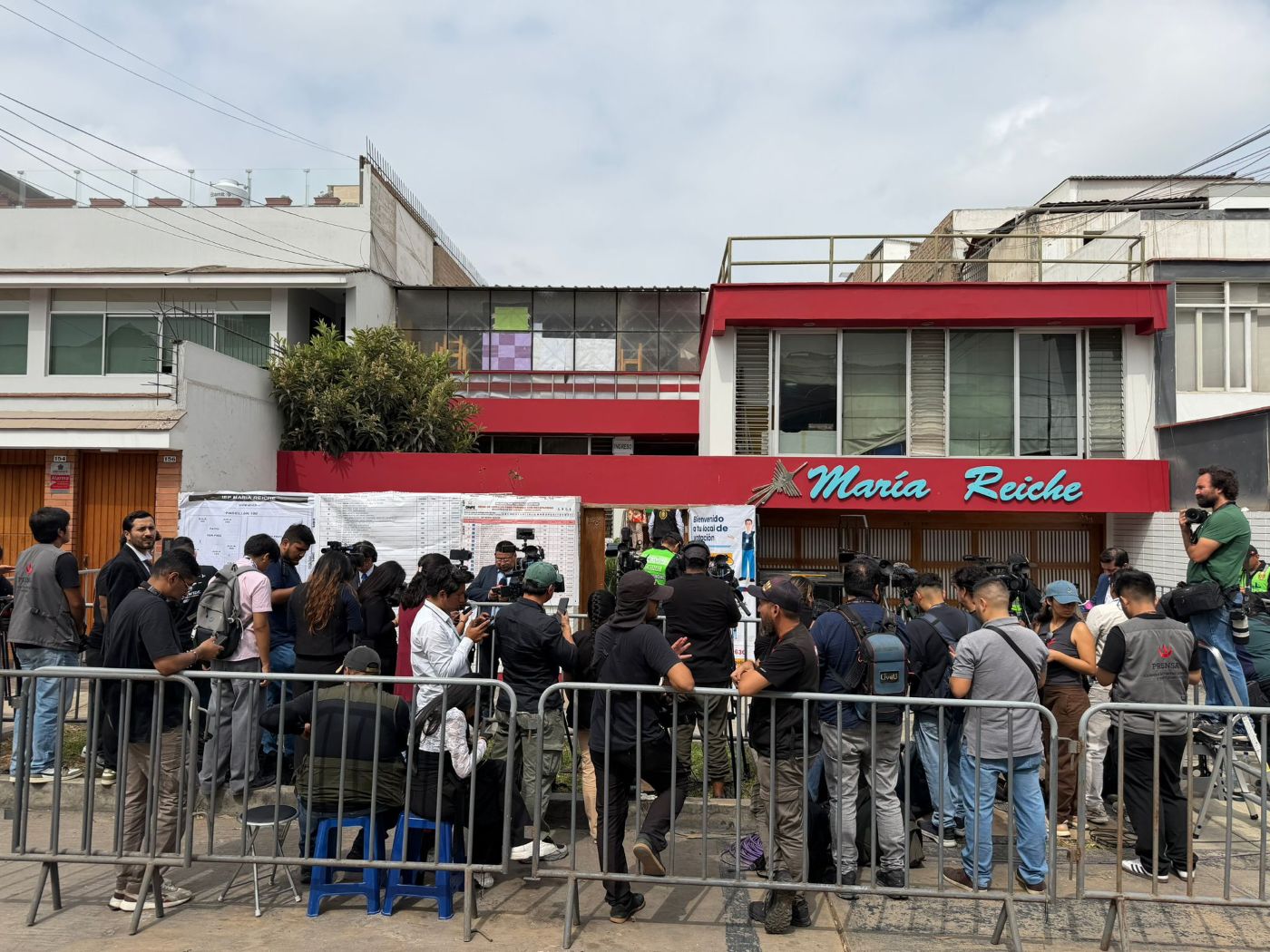
Both candidates have held their election-day breakfast with family members and key staff, as is the tradition in Peruvian elections. During her breakfast event, right-wing candidate Keiko Fujimori said she would seek greater regional cooperation to combat organized crime and drug trafficking, adding that “Colombia, which will have a change of government,” would be among the countries involved. Fujimori has received the support of Colombia’s right-wing presidential candidate Abelardo de la Espriella, who will face off against leftwing candidate Iván Cepeda in a runoff election on June 21.
Electoral officials have said that because of logistical and security issues, Peruvians in Venezuela, Ghana, Iran, and Beirut (Lebanon) will not be able to vote, as authorities have not established polling stations in those countries.
A cloud of distrust hangs over Peru’s electoral authorities as they oversee today’s presidential runoff between left-wing candidate Roberto Sánchez of Juntos por el Perú and hard-right candidate Keiko Fujimori of Fuerza Popular.
Following a series of logistical problems during the first round on April 12 that affected the opening of 0.2 percent of polling stations—representing 52 261 votes, primarily in Lima—public confidence in Peru’s electoral institutions declined. An Ipsos poll found that around 68 percent and 79 percent of Peruvians disapproved of the heads of the country’s two electoral bodies, the National Jury of Elections (JNE) and the National Office of Electoral Processes (ONPE), respectively. Disapproval of the National Office of Electoral Processes (ONPE), which is responsible for administering the electoral process, was particularly high in Lima, where 88 percent of respondents expressed a negative view of its National Chief.
While the logistical issues did not affect the outcome of the first-round vote, and international observers such as the OAS and the European Union certified that there was no evidence of fraud, sustained pressure from sectors of Peru’s political and judicial establishment—including the National Board of Justice (JNJ), right-wing political parties, and especially the far-right party Renovación Popular, whose leader Rafael López Aliaga repeatedly made unfounded allegations of fraud—ultimately forced ONPE chief Piero Corvetto to resign.
Corvetto became the target of an intense campaign of harassment. Prosecutors and police raided his home, and confidential information regarding his underage children was made public on national television. Although Peruvian law prohibits the resignation of the head of ONPE during an electoral process, his resignation was accepted immediately by Peru’s National Board of Justice
Corvetto had long drawn hostility from sectors of Peru’s political and economic elite because he oversaw the 2021 presidential election, in which Pedro Castillo defeated Keiko Fujimori. In those elections, Fujimori alleged widespread fraud and assembled a large legal team to challenge more than 200,000 ballots, primarily from rural and Indigenous areas. Despite months of legal challenges and extensive scrutiny, no evidence of fraud was found, and Castillo was ultimately certified as president.
Unlike ONPE chief Piero Corvetto, who was forced to resign, Roberto Burneo—the president of Peru’s other electoral authority, the JNE—remains in office. In recent days, however, Burneo has faced growing scrutiny following an OjoPúblico investigation that found his inner circle includes former employees of municipal administrations linked to the far-right party Renovación Popular, which has been at the forefront of promoting unsubstantiated claims of electoral fraud in these elections.
Yet despite the shortcomings of Peru’s electoral institutions, repeated efforts by some political actors to discredit the electoral process, and the unequal conditions under which candidates often compete as a result of broader social and political inequalities within the country—inequalities that tend to disproportionately disadvantage left-wing candidates and those with fewer resources—international observation missions have consistently found that the results of Peru’s presidential elections reflect the will of the electorate. In the 26 years since the fall of former dictator Alberto Fujimori, observers have not documented major election-day irregularities that would cast doubt on the integrity of presidential election outcomes.
Peru’s runoff has reconfigured the political blocs around finalists Keiko Fujimori of Fuerza Popular and Roberto Sánchez of Juntos por el Perú (JPP). The third-place candidate, Rafael López Aliaga of Renovación Popular endorsed Fujimori, joining the right-wing bloc that also includes first round candidates Carlos Espá of SíCreo, Roberto Chiabra of Unidad Nacional / PPC / Unidad y Paz, José Williams of Avanza País, Rafael Belaúnde Llosa of Libertad Popular and endorsements from former presidents Pedro Pablo Kuczynski and José Jerí.
In contrast, Sánchez’s camp has assembled an anti-Fujimori and center-left coalition that includes Ricardo Belmont of Partido Cívico OBRAS, Alfonso López Chau of Ahora Nación, Marisol Pérez Tello of Primero la Gente, Ronald Atencio of Venceremos, Rosario Fernández of Un Camino Diferente, Yonhy Lescano of Cooperación Popular, Armando Massé of the Partido Democrático Federal, as well as Partido de los Trabajadores y Emprendedores, Todo con el Pueblo, Nuevo Perú, Voces del Pueblo, Unidad Popular, Adelante Pueblo Unido, Resurgimiento Unido Nacional, and former presidents Pedro Castillo and Martin Vizcarra.
In an effort to show that he is prepared to govern Peru with this coalition of parties and movements, Sánchez has presented a second-round program entitled “Strategic Priorities for the Governability and Equitable Development of the Peruvian Nation: 2026-2031,” and an expanded 124-person technical team that includes professionals from other parties and political movements. Peru’s highest electoral authority – the National Elections Jury (JNE), has stated that only the original first-round JPP plan is formally valid, despite the longstanding practice in Peru of presidential candidates revising their policy programs between the first and second rounds, particularly when they expand their coalitions and incorporate new political allies.
Key names involved in developing the new plan include: Pedro Francke for economy and employment; Óscar Dancourt on macroeconomic policy; Sinesio López for state reform; Rosendo Serna for education; Hernando Cevallos for health; Andrés Alencastre, Jorge Manco Zaconetti, Enrique Bissetti, and José De Echave in agriculture, mining, energy, or environmental policy; José Domingo Pérez for justice-system reform; Manuel Rodríguez Cuadros and Miguel Palomino de la Gala in foreign-policy; Ernesto Zunini for youth and sports; César Guarniz for agriculture and environment; Gustavo Guerra-García for infrastructure, regional development, and decentralization; and sociologist Anahí Durand.
On May 31st, Sánchez held a press conference with these and other members of his technical team in which he announced his second-round program:
The future of Peru is here. This is the proposal, the consensus program, that brings together not only JP, but all those of us who today feel called upon to show the maturity needed to build a broad consensus, seeking areas of agreement in order to solve Peru’s main problems. This is the plan with which I will govern during the 2026 constitutional term.
Meanwhile, Fujimori has been touting endorsements from hard-right politicians in the region, including through video calls with Venezuelan politician María Corina Machado, currently based in the U.S., and Colombian-American presidential candidate Abelardo de la Espriella. She has also received last minute endorsements from Republican representatives from Florida María Elvira Salazar and Carlos A. Giménez, both of whom endorsed de la Espriella ahead of Colombia’s presidential runoff on June 21 and have previously been accused of “interventionist actions” in that country.
This morning, at around 7 am local time, voting centers opened in Peru for the country’s runoff presidential election. Far-right candidate Keiko Fujimori — daughter of former dictator Alberto Fujimori and leader of the Fuerza Popular party — and left-wing candidate Roberto Sánchez — a former minister in the short-lived Pedro Castillo administration and leader of the Juntos por el Perú party — will face off in what appears to be a tight race. Many Peruvians hope this election will bring an end to Peru’s decade of political instability, which has seen four presidents in the last four years and eight in the last 10 years. But the vote faces several challenges and concerns, many stemming from the logistical failures of the first round, which fueled fraud narratives and legal challenges to the results. For further context, see our scene-setter from Friday: “Peru’s Run-Off Presidential Election: What You Need to Know.“
Throughout the day, CEPR — including an international electoral observer on the the ground in Lima — will be posting developments about the election to this page, in addition to further background on the candidates and the general context in which these elections are taking place.
Protests in Bolivia have surpassed the one-month mark, with journalist Joseph Bouchard writing in the Latin Times today:
Bolivia has reached over 30 days of nationwide blockades and protests, ignited by President Rodrigo Paz’s neoliberal reforms, proposed privatization of indigenous lands, and judicial actions against workers’ unions and former socialist presidents Luis Arce and Evo Morales.
The social conflict has had immense repercussions for the country’s democracy, stability, and endurance. Paz has said the country is at a “breaking point.”
So far, seven people have died, dozens injured, and hundreds arrested. There are now 94 blockade points throughout the country, effectively cutting off the Department of La Paz, and with it the capital, from essential goods and services. Almost no food, fuel, or medicine is entering, and inflation has skyrocketed as a result.
Although the protesters come from a broad, loose, and grassroots coalition of Indigenous communities, small-scale farmers, labor unions, miners, teachers, coca growers, and other social movements — with demands centered on subsistence issues and inflation, political exclusion, and the defense of their rights — the Bolivian government and its allies in the United States have portrayed them as terrorists and criminals, at times falsely claiming they are being led by former president Evo Morales. Yesterday afternoon, the United States continued this pattern, with Defense Secretary Pete Hegseth posting on X:
The Department of War and the Americas Counter Cartel Coalition (A3C) reject all attempts to overthrow the legitimate government of President @Rodrigo_PazP in Bolivia.
The United States is watching. Bolivia must not allow itself to fall prey to the old status quo of narco-terrorist dominance in the region.
We will continue to support our A3C partners like Bolivia to ensure that narco-terrorists are deterred from profiting on death and destruction in our hemisphere.
Secretary of State Marco Rubio also spoke to President Paz yesterday, telling him:
the United States is ramping up emergency assistance and logistics operations support in Bolivia to help those facing acute food and medical shortages due to illegal roadblocks intended to destabilize Bolivian society. Secretary Rubio reaffirmed that the Trump Administration will continue to stand with Bolivia as it works toward stability, security, and a better future for all Bolivians.
Paz’s government is on shaky ground. His vice president — whose grassroots appeal played a key role in electing him — has been sidelined since the new administration’s inauguration and has since come out in support of the protests. Several lawmakers from Paz’s party have followed suit, and multiple ministers have resigned. At the same time, powerful actors on his right, including former president Jorge Quiroga, billionaire Marcelo Claure, and violent far-right para-state groups, are putting pressure on the president to more forcefully confront the protests. Although security forces are present and violently engaging protestors, Paz has so far resisted calls to impose a full state of emergency, even though Congress has cleared the way for him to do so. Instead, he has offered limited concessions and engaged in what appear to be bad-faith efforts at negotiation, as Bouchard writes:
On one hand, the government has prioritized “dialogue and negotiation” with various social sectors. It has issued decrees, repealed laws, and introduced bills to meet their demands.
…However, not all of the government favors this approach. Paz himself has said he will prioritize dialogue only “with those who wish to comply with the law,” warning of legal consequences for those who refuse to negotiate.
His foreign affairs minister, Fernando Aramayo, threatened media reporting “false information” or participating in blockades with legal reprisal. Arrest warrants have been issued against leaders of the Bolivian Workers’ Center (COB) trade union federation and the Tupac Katari Federation, an indigenist political movement. The government coalition in Congress repealed law 1341, thus authorizing Paz to declare a state of exception.
…Facing this heavy-handed approach, some groups, including the COB and the Katarista Federation, have refused negotiations entirely, committing to continue blockades until Paz resigns, and warning that any splinter group negotiating will be considered “traitors.”
On Wednesday, Paz called on “all of Bolivian society, those who want the Bolivia of the future, to mobilize alongside our Armed Forces and our Police to unblock the country.” This appeal prompted para-state groups, which assisted authorities in violently repressing protests against the 2019 coup of former president Evo Morales, to call on their members to take to the streets. The Andean Information Network, a local human rights organization, reports:
Illegal para-state group, the Cochabamba Youth Resistance, urges #Bolivians to “defend their homeland..clear roadblocks and capture those blockading.” They affirm that they won’t be “kidnapped by terrorists.” They continue to be in close coordination with police. The international community should take action.
Colombia’s president Gustavo Petro criticized President Trump for his support of Abelardo de la Espriella, the far-right candidate in the upcoming Colombian presidential election, “accusing Washington of allying itself with the ‘narco-traffickers’ it professes to combat,” France 24 reported:
The famously outspoken Petro was reacting to Trump’s full-throated endorsement of tough-talking lawyer Abelardo de la Espriella over a leftist senator in Colombia’s presidential election.
De la Espriella, 47, made a fortune representing drug-trafficking paramilitaries, fraudsters and soccer stars.
…
Trump on Tuesday backed De la Espriella, citing his “tremendous accomplishments in life, and his political support for me, personally.”
Petro, Colombia’s first left-wing leader, has criticised Trump’s meddling in the campaign.
“Their (US) allies in Colombia come from the narco-paramilitary regime; they are genocidal and drug traffickers,” he told AFP in an interview athr the presidential palace.
Trump has sought to influence several recent elections in Latin America by backing right-wingers who talk tough on crime and migration against leftists he dismisses as Marxists.
De la Espriella has a long history of defending paramilitaries, especially from the AUC — which was designated a Foreign Terrorist Organization (FTO) by the US in 2001 and has long been involved in drug trafficking. Following the first-round vote, De La Espriella has encouraged further US interference, accusing the Petro administration of a vast “vote-buying” scheme and calling on the US to monitor the second-round vote. On Wednesday he wrote:
I request that the U.S. Government review visas and include on the OFAC list all those who are part of the largest vote-buying and selling chain in our history: the one planned by Petro and Cepeda from the Government.
On Thursday, Christopher Landau, US Deputy Secretary of State, took to social media and threatened to pull visas of Colombian officials:
.@SecRubio testified before Congress this week that the US is committed to protecting Colombia’s democracy. He has also explained on many occasions that a US visa is a privilege, not a right, and that visa denials and revocations are powerful tools for advancing our foreign policy. To safeguard the integrity of Colombia’s upcoming elections, we are closely monitoring the situation along the Caribbean coast and elsewhere. Those tempted to undermine or manipulate the democratic process—whether by BUYING VOTES or otherwise—are therefore on notice that they are putting their visas, and those of their families, at risk. ¡Por algo me llaman El Quitavisas!
De la Espriella answered: “I have the list, dear Deputy Secretary.”
The State Department announced new sanctions against Cuban officials and entities yesterday, including President Miguel Díaz-Canel and his family, the son and grandson of former president Raúl Castro, a Cuban-Australian joint mining venture, and the Cuban Institute of Friendship with the Peoples (ICAP). In announcing the sanctions, Secretary Rubio claimed that the Cuban government “has recruited, trained and backed violent Marxist and third-worldist movements across our hemisphere and beyond.” He added that “Anyone providing services to these sanctioned actors is at risk of sanctions themselves. Foreign banks and other companies that provide services to these entities should freeze those activities.”
As the US escalates its economic sanctions, a slew of foreign businesses — including hotel operators Iberostar, Meliá, and Blue Diamond — have pulled out of the already struggling country. The New York Times reports:
The increasing exodus of businesses from Cuba will lead to increased unemployment and fewer financial resources for Cuba’s government, aggravating an increasingly untenable economic crisis.
While the United States has long prohibited most American companies from trading with Cuba, these new regulations, called “secondary sanctions,” are a major escalation, because they target foreign companies and financial institutions.
Cuba’s Central Bank announced Wednesday that a bank that processes Visa and Mastercard transactions had withdrawn to comply with a recent executive order from the White House that threatened sanctions against foreign companies doing business in Cuba…
“In the last 30 days, there has been more commercial, economic and financial destruction in Cuba than in any period since 1959,” Mr. Kavulich said, referring to the year of the Cuban revolution that eventually ushered in Communist rule.
In an interview with journalist Andrés Gil of ElDiario.es, Cuban president Díaz-Canel said:
The blockade today is brutal, criminal; it’s something the Cuban people don’t deserve. The most cruel aspect of the blockade is its duration—more than 60 years—and the greatest cynicism is how this blockade is accompanied by a narrative that tries to make the true culprit invisible and attempts to transform reality by blaming what they call the failed state…
This accumulated escalation has also led to a policy that tends to seek suffocation in order to create a rupture within Cuban society, to provoke a social explosion and a pretext for intervention with a narrative that makes the true culprits invisible…
We have always had an infant mortality rate comparable to that of the most developed countries. That infant mortality rate, which at other times was around four, even reaching 3.6 [per thousand live births], has now doubled, standing at just tenths above nine. And it remains a competitive rate internationally, but it is not the one we are used to.
The New York Times reported on Flávio Bolsonaro’s visit to the White House last week:
The meeting between President Trump and a son of his jailed Brazilian ally, former president Jair Bolsonaro, lasted just a few minutes. Still, it was enough to derail months of efforts to mend ties between Brazil and the United States.
Just days after Flávio Bolsonaro, who is now seeking the presidency himself, visited Mr. Trump at the White House last week, the American leader designated Brazil’s two biggest drug gangs as terrorist groups.
Mr. Bolsonaro had lobbied for months for such a move.
Then, this week, the United States threatened punishing new tariffs on the Latin American nation and signaled it did not view the government of the leftist president, Luiz Inácio Lula da Silva, as an ally.
And, in a gesture that supporters of Mr. Lula read as a snub, Mr. Trump then posted an Oval Office photo with the younger Bolsonaro. “A smart young man who loves his Country, Brazil, very much!” the caption read.
…Now, in subtle and not-so-subtle ways, Mr. Trump appears to be again propping up a right-wing ally in Brazil, this time giving rise to worries that he may be looking to put his thumb on a highly unpredictable presidential contest between Mr. Lula and another Bolsonaro.
…Yet the possibility of new U.S. tariffs could bring political costs for Mr. Bolsonaro, analysts say. On Tuesday, Mr. Lula and his allies rushed to blame the new levies on aggressive lobbying by Mr. Bolsonaro and his brother, Eduardo, in Washington over the last year.
On Tuesday, Mr. Bolsonaro was quick to distance himself from the new tariffs. Instead, he blamed Mr. Lula’s handling of trade relations and said that, during his visit to the White House, he had asked Mr. Trump not to tax Brazilian products.
On Wednesday, President Lula da Silva rebuked the new tariff measures. Al Jazeera reported:
Brazilian President Luiz Inacio Lula da Silva has decried newly proposed United States tariffs, saying he could “not accept the treatment” his country had received.
…
Lula said he had left a May meeting at the White House with Trump optimistic that relations were improving.
…
On Wednesday, Lula said he was surprised by the newly proposed tariffs, adding that US-Brazil trade talks were still ongoing. He added that Brazil still wanted to build institutional relations with the US but would seek other trade partners if needed.
The death toll from the illegal US bombing campaign targeting alleged drug boats has reached at least 207. The US military announced its 61st such strike yesterday, extrajudicially killing two civilians in the Pacific.
During a senate hearing earlier this week, Sen. Rand Paul, who has been highly critical of the policy, noted that neither the presence of drugs or arms were required to conduct such a strike. “In order to blow them up, we don’t have to say that they are armed or have drugs. I think a lot of people would have questions, which I still do,” the Senator said.
Former Mexican president Andres Manuel Lopez Obrador (AMLO), who has remained largely on the sidelines of the country’s political affairs since leaving office, posted a letter on social media condemning US interference and in support of President Sheinbaum. El Pais reported:
López Obrador, who retired from politics after leaving the presidency in 2024, has given his full support to his successor Claudia Sheinbaum against Washington’s interference and its attempt, as he put it, to weaken Morena, the leftist political party and movement he founded and which the current president continues to lead.
López Obrador’s gesture comes just a few days after Sheinbaum voiced her strongest protest against Trump’s pressure and threats to Mexican sovereignty. The former president expressed surprise at the Republican’s attitude, which he says differs from the one he had during his first term in the U.S. presidency, when both politicians were serving in their countries’ executive branches. “Why has President Trump changed so much?” López Obrador asks in the statement he posted on his long-dormant X account.
AMLO said that the reason the US was targeting Mexican officials over alleged ties to cartels was not truly about combatting drug-trafficking, the article continued:
López Obrador rejects this as the real motivation, and sees instead a massive political maneuver aimed not only at the November midterm elections in the United States but also at consolidating the far right in the Americas. “To be clear: some U.S. officials are plotting to weaken Morena and strengthen the right-wing opposition in Mexico with the aim of reinstating a submissive, corrupt, mafia-like, and cruel government—and, by extension, one that is vulnerable, subordinate, and loyal to their interventionist agenda,” he wrote.
López Obrador attempts to explain Trump’s dramatic about-face and attributes it to “false friends and advisors, both domestic and foreign, who have been leading him into vile and sinister adventures.” “I hope he returns to governing as he did before, with enthusiasm, in a personal manner, not delegating what is essential, trusting his practical judgment and his sure instinct, and that he tells the leeches surrounding and goading him to go to hell,” the former president wrote. He also expressed confidence that the Republican president will backtrack: “A person like Trump cares more about history than the office, and he would not want to be remembered as being responsible for an economic and social welfare crisis that also caused his party to lose elections and, above all, for being identified as a reckless leader who fought with almost everyone, including the Pope and even his neighbors in Canada and Mexico.”
… López Obrador recalled that, during Trump’s first term, he personally managed to convince the U.S. president not to classify the cartels as terrorist organizations—a label that would, he says, amount to a license to commit abuses and atrocities in other countries. Ultimately, Trump did just that—designating the cartels as such—shortly after beginning his second term. López Obrador notes a final wish in his letter: “For the good of all, may the other Trump return.”
Following a report earlier this week in the Los Angeles Times that the US was investigating two additional Morena governors, Sheinbaum pushed back yesterday:
“What is the intent behind revoking the visas, and, furthermore, making that information public?” she asked. “What is the underlying motive?”
…
“When those abroad dictate who is guilty and who is not, when there are attempts to pressure our institutions … we are no longer talking about cooperation, we are talking about interference,” she said. “We do not accept interference.”
Secretary of State Marco Rubio testified before the Senate Foreign Relations Committee yesterday. While most of the questions posed related to the US-Israeli war on Iran, Senators Shaheen, Kaine, Paul and Van Hollen brought up hemispheric affairs including Operation Southern Spear and the oil blockade on Cuba. Reuters reported:
Senator Jeanne Shaheen of New Hampshire, the top Democrat on the foreign relations panel, blasted Rubio for providing too little information about the administration’s plans.
“When I talk to my constituents, they asked for economic relief at home, not regime change in Havana or Caracas or Tehran,” she said.\
…
At both hearings, Rubio defended Trump’s policy in Venezuela. Troops removed Venezuelan President Nicolas Maduro in January but left much of his administration intact and former Vice President Delcy Rodriguez as head of the government.
Rubio told the House hearing that Venezuela does not yet have the conditions for a free and fair election.
Senators Kaine and Paul spoke on the targeting criteria used in the extrajudicial boat strikes in the Caribbean and Pacific, known as Operation Southern Spear, noting that neither evidence of arms nor narcotics on the boats is used in the official criteria that justifies attacking them. Senator Paul said:
Drugs is [sic] not a criteria for blowing up the boats – the boats called drug boats. But neither are arms. In order to blow them up, we don’t have to say that they are armed or have drugs. I think a lot of people would have questions, which I still do.
Sec. Rubio confirmed knowledge of the criteria, but stated that those were “largely legal decisions” carried out by the military.
On Cuba, Senator Van Hollen stated:
…the President is preventing Cuban political refugees entering the United States even as you have imposed a near oil blockade on that repressive regime. The stated goal is to change the government there, but the only real change is humanitarian crisis inflicted on millions of people, not members of the regime.
He also asked about the US’s designation of Cuba as a state-sponsor of terrorism:
The previous administration did a thorough review with the intelligence community and concluded there was no evidence that Cuba was engaged in ongoing state sponsor [sic] of terrorism. Did you find new evidence to support that conclusion?
Sec. Rubio did not answer the question, but said:
Cuba has sponsored terrorism. For example, virtually every left-wing radical, violent terrorist group in the Western Hemisphere has at some point relied on support from Cuba. The ELN, the FARC, the FARC dissidents have been involved. We know Cuba continues to host a pretty substantial collection of intelligence sites on behalf of the Chinese and the Russians. You look at the region and you look at these leftist, Marxist terrorist organizations, all of them, in many cases, got their money from the Cubans.
The Los Angeles Times reports that the US is investigating two more Mexican governors, both of whom are members of the governing Morena party:
Alfonso Durazo, the governor of Sonora, and Américo Villarreal Anaya, the governor of Tamaulipas, have both been stripped of their U.S. visas amid criminal probes, according to people familiar with the cases.
Both are members of Mexico’s ruling Morena party and allies of President Claudia Sheinbaum, who has criticized a recent spate of U.S. investigations into sitting Mexican leaders as electoral interference and a violation of her country’s sovereignty.
…
Durazo, 71, the governor of the border state of Sonora, is one of the highest-profile leaders to date believed to be under investigation. He previously served as Mexico’s security minister, helping implement former President Andrés Manuel López Obrador’s controversial “hugs, not bullets” strategy, which emphasized addressing the root causes of crime instead of military confrontations. Sonora is a major drug trafficking transit route to the U.S.
People familiar with his case, who spoke on condition of anonymity to discuss internal matters, said Durazo’s visa was canceled last year, and the U.S. is investigating him for alleged ties to organized crime.
Speaking over the weekend, Mexican president Claudia Sheinbaum rejected US interference, asking an audience of supporters: “is this really a legitimate, genuine interest in helping Mexico? Or are we perhaps seeing sectors of the US far right positioning themselves ahead of their 2026 elections?”
The US Ambassador to Mexico, former CIA officer Ron Johnson, responded on X:
The fight against cartels should unite us, not divide us.
…
Every moment spent turning this shared security challenge into a political dispute is a missed opportunity to strengthen our partnership and protect the people we serve.
The Guardian added:
Mexico’s president, Claudia Sheinbaum, on Tuesday appeared to chide Ron Johnson, the US ambassador, for interfering in the country’s politics amid rising tensions between her country and Washington over efforts to tackle drug trafficking.
“It is also very important, and I say this respectfully, to remember that ambassadors should focus on coordination and collaboration,” Sheinbaum said during her regular morning news conference. “Ambassadors must respect the internal political affairs of their countries.”
Last week, Mexico’s congress passed a bill that would allow the highest electoral court to invalidate any election results deemed to have been influenced by foreign powers,” the New York Times reported, adding:
The legislation seems to be aimed, at least in part, at the United States.
President Trump has intervened in the elections of other countries in the region. Last year, he warned Argentine voters that a $20 billion economic bailout package for the country depended on the victory of President Javier Milei’s party in legislative elections. And in Honduras, President Nasry Asfura won this year’s election after Mr. Trump endorsed him.
As we noted earlier, Trump has also endorsed the far-right candidate in Colombia’s presidential election.
Following Colombia’s first round presidential elections, US president Donald Trump posted on Truth Social endorsing the far-right Abelardo de la Espriella, who surprised with a first place finish in the vote. Trump wrote:
Abelardo will face off against a Radical Left Marxist in the Runoff on June 21st — The results of this Election are very important to the future of Colombia and its relationship to the United States. Because of his tremendous accomplishments in life, and his political support for me, personally, it is my Honor to give Abelardo my Complete and Total Endorsement.
De la Espriella, who is a dual US citizen, has previously donated to Trump’s presidential campaign. In a post on social media responding to the endorsement, De la Espriella thanked Trump before adding:
In you, I see a leader of true strength and conviction—one who refuses to yield to passing ideological trends or the enemies of freedom. You have paved the way for the people to defeat the entrenched powers that have long held sway. In Colombia, we have now begun to follow that same path.
…
We stand together in the sacred defense of private property, free enterprise, productive growth, and the well-being of our citizens as the highest purpose of government. We defend liberty, we present a united front against the communism that seeks to poison our republics, and we will join the Alliance of the Shield of the Americas so that the light of freedom never dims in this hemisphere.
Bloomberg provided additional context:
Trump’s backing dovetails with a more interventionist posture toward South and Central America, in which he has sought to reestablish Washington’s dominance over the Western Hemisphere under the so-called “Donroe Doctrine,” a modification of the 19th-century approach to foreign policy by James Monroe.
He has previously praised, and at times actively assisted, other Latin American leaders aligned with his agenda, including El Salvador’s Nayib Bukele and Argentina’s Javier Milei. The US has also placed sanctions on current Colombian leader Gustavo Petro, a close ally of Cepeda, while examining the nation’s first leftist president as part of ongoing probes into drug trafficking.
The New York Times noted the candidate’s questionable past as a lawyer working with paramilitaries, drug traffickers, and others — as well as the strong support De la Espriella has received from Republicans in Florida:
Mr. De La Espriella, who once boasted of a lavish lifestyle abroad, has in the past been scrutinized by Colombian journalists over the source of his fortune and his links to Colombian clients embroiled in controversies. The most flagrant of these is Alex Saab, a billionaire tycoon and fixer for Nicolás Maduro, the Venezuelan leader taken into custody by the United States. U.S. prosecutors accused Mr. Saab of laundering millions of dollars intended for Venezuela’s poor.
As Mr. De La Espriella rose in the polls, he gained the backing of U.S. Republican lawmakers on the right, from Representative Maria Elvira Salazar of Florida to Senator Bernie Moreno of Ohio. On Tuesday, before Mr. Trump posted his full-throated endorsement of Mr. De La Espriella, Mr. Moreno held a call with reporters in which he said U.S. officials had “vetted” Mr. De La Espriella and found him to be “impeccable.”
Mr. Moreno, who is originally from Colombia, traveled to the country over the weekend to monitor the election. He said it had gone smoothly, remarking on the transparency and orderliness of the process.
As we noted last week, De la Espriella and his wife have donated nearly $100,000 to Salazar’s campaigns for Congress in recent years. Responding to Trump’s endorsement, current Colombian president Gustavo Petro wrote:
When a country interferes in the decisions of another country. Freedom dies.
I invite all of Colombia to vote in full freedom and not become either slaves or a colony of anyone.
An entire young generation of Neogranadinos and Neogranadinas fought alongside Bolívar and Nariño to give us Freedom and Sovereignty.
If the heart of the world loses its freedom and sovereignty, the hope of the world and of Colombia fades away.
The Intercept’s Sam Biddle reports that the Pentagon is funding an AI-fueled “content mill” targeting Latin American audiences with praise for US military action. Biddle writes:
La Tilde quietly began development early this year and appears to still be a work in progress, pitching itself as a modern media brand for Latin American audiences with articles published in both Spanish and English. Its name references the accent mark emphasizing vowels in Spanish; “news with an accent” is the site’s catchphrase.
…
So far, La Tilde’s coverage amounts to an unusual blend of personal finance tips (“Why instant payments matter so much for your business and your wallet”) and articles extolling the value of U.S. military operations in Latin America (“Operation Absolute Resolve: The mission that captured Nicolás Maduro and set a new standard for precision and coordination”).
Its article on the U.S. abduction of the Venezuelan president praises the mission in Trumpian prose, calling it “The Perfect Operation – Coordination, Timing and Precision at an Unprecedented Scale,” and “a military operation of coordination and accuracy never seen before.” Citing “information obtained exclusively by La Tilde,” it describes the operation’s tactical brilliance, flawless execution, and incredibly precise coordination of military assets in the air and on the ground.
If this reads like Pentagon a press release, that’s because it is. An explanation for its glowing coverage of the U.S. military can be found after clicking a small link tucked at the bottom of the site. “La Tilde is a product of an international media organization publicly funded from the budget of the United States Government,” its About page reads.
This easily missed disclosure language is identical to two other Pentagon-sponsored propaganda sites recently revealed by The Intercept.
A defense official explained to Biddle that the site is “operated as a military messaging platform for U.S. Special Operations Command South, or SOCSOUTH, which executes special forces missions throughout South and Central America as well as the Caribbean.” Biddle quoted Emerson Brooking with the Atlantic Council’s Digital Forensic Research Lab:
“The intent is probably to fill these sites with generic material, build an audience base, and then slip in more pieces of explicit propaganda, like that rather fulsome recounting of the U.S. attack on Venezuela,” Brooking said. “This is how you build these sorts of networks. But the content is lazy, the AI is bad, and the required disclosures make the whole thing a farce.”
The Brazilian presidency released a statement responding to the proposed tariffs on the country, announced yesterday by the US Trade Representative (and highlighted here earlier today):
The Brazilian government expresses outrage at the preliminary conclusion announced yesterday (June 1st) by the USTR regarding the Section 301 investigation into alleged unfair trade practices by Brazil.
This investigation began on July 15, 2025, at the instigation of the Bolsonaro family and is associated with attempts to interfere in our country’s internal affairs, as demonstrated by Senator Flávio Bolsonaro’s recent trip to Washington. These actions have been aided by false patriots who use public positions and functions to conspire against national interests.
It is regrettable that all the work of dialogue and coordination that the Brazilian government has been doing, including the personal involvement of Presidents Lula and Trump, is being sabotaged by purely electoral and family interests.
There was and is no justification for these unilateral measures against our country or against Brazilian assets such as PIX, explicitly mentioned in the preliminary recommendations. According to statistics from the Bureau of Economic Analysis, the US accumulated a trade surplus of US$424.5 billion in goods and services with Brazil over the last 15 years (2011-2025). Last year alone, the US trade surplus in goods with Brazil totaled US$14.46 billion. Considering goods and services, the figure rises to US$40.52 billion.
In 2025, 76% of imports originating from the United States entered Brazil without paying import tax. Eight of the ten main products imported from the United States by Brazil had a zero effective tariff, including oil and derivatives, aircraft, natural gas, and coal. The average effective tariff rate charged on American products in Brazil was only 3.1%.
The main effect of the unilateral, politically motivated tariffs applied to our country has been to damage the national economy and the generation of jobs and income, in addition to diminishing the role of the US as our trading partner. In the first quarter of 2026, the US share of Brazilian exports reached the lowest value in the historical series, totaling 9.4%.
Nearly 20,000 tons of food aid is sitting idle in Cuba as a result of the US fuel blockade, says the United Nations. Without access to fuel, the organization has faced difficulties unloading aid from ports and distributing to Cubans in need. Spanish-language news site EFE reports:
Several sources familiar with the situation, who requested to remain anonymous, explained to EFE that the World Food Programme (WFP) currently has some 11,000 tons of food stuck in Cuban ports and another 8,000 tons distributed throughout the country, facing serious difficulties in being distributed.
Other United Nations agencies , including UNICEF, which focuses on children, and UNDP, dedicated to economic development, have dozens of containers in those same ports, which they are managing to extract and distribute with enormous slowness.
Meanwhile, the Trump administration’s efforts to force countries to end their relationships with Cuba’s medical missions continue to take their toll on the healthcare of ordinary citizens. Earlier this year, Honduras, Jamaica, Guyana, and Guatemala terminated or announced plans to terminate their contracts with the Cuban medical workers. Today, Bloomberg reports on how Venezuela has been effected:
Many patients arriving at a medical center in eastern Caracas at the end of April were turned away. The services they needed were no longer available. The specialists were gone …
Cuban health professionals, including pediatricians, obstetricians, gynecologists, ophthalmologists and physiotherapists are leaving this and other facilities across Venezuela as US pressure mounts to shut down Havana’s overseas medical missions …
“Expelling Cuban doctors will not lead to political change in Cuba, but it will set back healthcare in Venezuela,” said Miguel Tinker Salas, a historian at Pomona College in California. “The populations that depended on those services will bear the brunt.”…
At the Salvador Allende center, the impact is immediate. There is no longer a Cuban traumatologist. No Cuban sonographer either. Key equipment is broken or only partially functioning after years of underinvestment amid a broader economic crisis. Patients are referred elsewhere, often to facilities facing the same shortages, after lining up before dawn for one of roughly 30 appointments for the next day.
Finally, a major hotel chain has shut down its operations on the island in response to the tightening of sanctions. The local subsidiary of Royalton Hotels — previously known as Blue Diamond Resorts — “operated 62 hotels under 10 different brands in Cuba,” writes Bloomberg.
The US proposed imposing a 25 percent tariff on Brazilian goods following an investigation by the US Trade Representative (USTR). The New York Times reported:
In a news release, the United States Trade Representative, Jamieson Greer, said the investigation found that Brazil had failed to adequately enforce intellectual property rights and had not taken sufficient measures to combat corruption and bribery. The administration also cited Brazil’s restrictions on access to its ethanol market, and what it described as inadequate enforcement of anti-deforestation laws.
The investigation was conducted under Section 301 of the Trade Act of 1974, which authorizes the United States to impose tariffs and other penalties in response to unfair foreign trade practices.
Mr. Greer said that he and President Trump had “several constructive meetings” with the Brazilian president, Luiz Inácio Lula da Silva, over the past year, but that “substantial differences” remained over issues identified in the investigation. The United States Trade Representative is scheduled to hold a public hearing on the proposed measures on July 6.
Brazil has until July 15 to take what Mr. Greer called “responsive action” to address the issues raised in the investigation.
The press release announcing the action quoted US Trade representative Jamieson Greer:
“I launched this Section 301 investigation at President Trump’s direction to address longstanding and pervasive U.S. concerns with certain of Brazil’s trade policies and practices. Over the past year, President Trump and I have had several constructive meetings with President Luiz Inácio Lula da Silva and his cabinet, which have accelerated in recent weeks … However, we continue to have substantial differences in resolving the issues identified in this investigation. I look forward to continuing engagement with the Brazilian Government in advance of the July 15, 2026 statutory deadline for taking responsive action.”
Last year, the US imposed tariffs of up to 50 percent on Brazil and sanctioned Alexander de Moraes, a supreme court judge. However both were later rolled back following a thaw in relations between Trump and Lula and the US supreme court’s ruling against Trump’s ability to impose tariffs. In recent months, tensions have again ratcheted back up even after Lula met with Trump at the White House in early May.
In addition to the issues cited in the Times article, the USTR also highlighted Brazil’s regulation of social media companies, adding that Brazil has “unfairly disadvantaged U.S. companies engaged in competing electronic payment services, including by policies that favor its national champion.”
Last month, Lula signed two decrees “that add to the pressure on big tech companies by increasing their liability for illegal content shared by its users and paving the way for investigations by a government body into their responses to such cases,” the AP reported. The comments about the payment system refer to PIX, which has been under US scrutiny for some time. Last month, the AP reported:
Brazil is a politically divided country, but there’s one thing that those on all sides of the political spectrum love: PIX, the country’s instant payment system that allows users to pay for everything, from ice cream on the beach to clothes in a shopping mall and even a car.
Unlike payment apps run by private banks, PIX is governed Brazil’s Central Bank. Its massive popularity drove $7 trillion in transactions last year, though now it faces scrutiny from the U.S. government over claims of unfair trade practices for bypassing traditional credit networks like Visa and Mastercard.
…
Launched in 2020, PIX allows anyone with a Brazilian individual taxpayer identification, registered companies or government entities to transfer funds in real time. The only requirement is a Brazilian bank account.
PIX also works with QR codes. Individuals pay zero fees for PIX transfers, and while some banks charge companies a fee for transactions, they are significantly lower than regular bank transfers in Brazil, which could also take hours to be completed.
In July, the Office of the U.S. Trade Representative (USTR) of U.S. President Donald Trump opened an inquiry into PIX, alleging it imposes unfair competition to U.S. credit card operators because it offers an alternative to transaction fees.
Yesterday, the Trump administration nominated Cuban-American Daniel Perez to be Ambassador to Brazil. Perez was most recently speaker of the Florida House of Representatives. With elections coming later this year, concerns over US intervention are growing. The USTR announcement comes just days after the US designated two Brazilian gangs as Foreign Terrorist Organizations (FTOs). The designation came after President Trump met with Flavio Bolsonaro, who, along with his brother Eduardo, has been lobbying for the designation for months in an attempt to undermine Lula. The AP noted:
The U.S. decision to classify two Brazilian gangs as terrorist organizations is a political one aimed at boosting an ally of President Donald Trump, the son of former Brazilian president Jair Bolsonaro, politicians and analysts say.
Al Jazeera reported on Lula’s response:
“We remain fully prepared to develop joint solutions that yield mutual benefits for all nations involved,” Lula wrote.
“However, we will not tolerate the imposition of arbitrary measures from abroad, nor will we accept their use as a pretext to undermine our sovereignty or our economy. Unilateral, non-negotiated measures can undermine the fight against criminals and trigger actions that endanger the lives of people who have absolutely no connection to crime.”
He added:
“I am very sad today, after the news that the secretary of state of the United States, a certain Marco Rubio, said that our criminals here are terrorists and that the Americans can intervene … We will not accept being treated like children. We will not accept being treated as if we were a banana republic.”
Mexico’s Claudia Sheinbaum accused “far-right” sectors in the US of trying to undermine the bilateral relationship. The leader’s comments come after she denounced ongoing US interference over the weekend. Reuters reported:
“I believe it is sectors of the far right in the United States who want a bad relationship with Mexico” because of “ideological” differences, Sheinbaum told a press conference.
The leftist president said she does not believe the attacks are being orchestrated by her U.S. counterpart, Donald Trump.
…
Tensions escalated in April after the U.S. Department of Justice indicted 10 Mexican officials, including Sinaloa Governor Ruben Rocha of the ruling Morena party, for alleged ties to drug trafficking.
Following the U.S. indictments of Morena politicians, Sheinbaum has intensified her calls to protect national sovereignty.
“Who decides in Mexico, foreign agencies or the people?” Sheinbaum told supporters on Sunday, at an event to commemorate the second anniversary of her 2024 presidential victory. “We are going to defend Mexico’s sovereignty and independence.”
Bloomberg added:
What had been a recurring theme in her recent speeches became on Sunday a rallying cry to stir up her supporters at a rally in Mexico City, where she claimed that since the deaths of two CIA agents on April 19, efforts by US authorities and far-right groups to destabilize her government have intensified.
The most serious attempt at intervention to date, according to her, came days after that incident when the Department of Justice indicted 10 Mexican officials — including Rubén Rocha Moya, the governor of Sinaloa state — on charges of alleged drug trafficking offenses.
“An incident of this magnitude is unprecedented in our bilateral relation,” she said. “Is this really a legitimate, genuine interest in helping Mexico? Or are we perhaps seeing sectors of the US far right positioning themselves ahead of their 2026 elections?”
…
“We’ll continue to collaborate to avoid drugs crossing the border, because it’s our humanist conviction and because we understand the pain it causes,” Sheinbaum said.
…
“When pressure is applied to our institutions from outside, when it becomes accepted that another country can intervene in matters that are the responsibility of Mexicans, we’re no longer talking about cooperation; we’re talking about interference,” said Sheinbaum.
Recent reports by major news outlets reveal just how far living conditions have deteriorated in Cuba under the illegal US fuel blockade. The New York Times describes how many Havana residents have been forced to skip meals, or cook with charcoal or firewood, due to the lack of fuel:
“I shouldn’t be cooking with charcoal,” said Ms. Castellano, 58, who has asthma and lately has been short of breath and coughing constantly. “But if I don’t cook, I die.”
Residents are sleep-deprived. Because nobody knows when the power will come on, people leave lights and fans on. If the electricity kicks on, the sudden glare or cool breeze will wake them so they can do their chores before another outage.
At the same time, the Associated Press writes that “Nearly 3 million Cubans experience water shortages every day because of a severe oil shortage that government officials blame on a U.S. energy blockade.” The article continues:
Many neighborhoods in Havana receive water deliveries by tanker trucks, but they remain inconsistent.
“It’s been five days since the water came in,” Magaly Ribial, a 60-year-old teacher, said Thursday as she collected water for her home from a tanker truck parked near her house in Old Havana.
Meanwhile, 95-year-old Dayse Izquierdo struggles to carry water and obtains whatever her neighbors bring her when the tanker truck, which Cubans call a “pipa,” arrives.
Some residents even said they walk from other parts of the city when they hear that water trucks are arriving in a specific neighborhood.
“The water situation is widespread,” said 55-year-old Carlos Molina. “I come from another municipality to collect water because there is none there.”
And the New York Times describes how fuel shortages have led to trash piling up in the streets of Havana:
“Sometimes the garbage overflows so much that it covers the entrance to my house, and I can’t get out,” he said. “I have to clear a path through.”
Mounting heaps of trash have become one of the most visible signs of crisis in Cuba as the government says its oil reserves have run dry. With little gasoline to run garbage trucks, piles of rubbish — some four feet high and half a block long — have increasingly become part of the landscape in Havana, the Cuban capital.
To cope, people have started setting garbage on fire.
“There is too much trash,” Mr. Fernández said. “I don’t know where it comes from.”
Meanwhile, the Trump administration has sent 1,300 more Marines and sailors to the Caribbean, seemingly to continue to militarily enforce the blockade and, likely, to be present in case of military action against Cuba.
Finally, a Rhode Island businessman and Republican candidate for Congress reportedly met with Raúl Castro’s grandson — who, despite not holding an official position of power, appears to have become a prominent figure in the Trump administration’s strategy of selecting interlocutors in Cuba — to discuss potential business opportunities on the island.
The US military announced that it had undertaken two separate strikes targeting alleged drug trafficking vessels in the eastern Pacific over the weekend. The latest strikes bring the number of civilians extrajudicially murdered by the United States to at least 205. As a number of reports have noted, most recently in the New York Times last week, the illegal US combing campaign does not appear to have done anything to actually stop the flow of drugs into the US.
Last week, Tracey Begley, Benjamin R. Farley and Sarah Harrison wrote in Just Security about “accountability for the U.S. government officials and military commanders involved in these unlawful killings.” The authors note:
The core legal issues implicated by the strikes are not up for debate. Contrary to the administration’s claims, the United States is not engaged in an armed conflict with a secret list of cartels and transnational criminal organizations (see here, here, and here as well). That means international humanitarian law (the law governing armed conflict) does not apply, and the use of lethal force as a first resort is not lawful. Plainly speaking, the killings are unjustified summary executions—murder. This systematic killing of individuals (at least 193 people across 57 incidents, to date) may even constitute crimes against humanity.
Less certain is whether anyone will ever be held accountable for these crimes. As a general matter, States are first and foremost responsible for holding individuals and institutions acting on the State’s behalf and within its jurisdiction to account for their actions, including for conduct that violates their own domestic laws or international criminal law. While States are expected to police actions within their borders and by their personnel, if they fail, foreign or international courts may sometimes step in.
For the U.S. boat strikes, there are at least two paths for domestic accountability. As previously discussed, servicemembers who participate in the boat strikes may be exposed to domestic criminal liability under Title 18 of the U.S. Code and the Uniform Code of Military Justice. And, on Jan. 27, the families of two victims filed a lawsuit in federal court in Massachusetts under the Death on the High Seas Act and the Alien Torts Claims Act. We believe the United States can and should hold its own personnel accountable, and that failing to do so further entrenches a damaging precedent for the rule of law – that the most powerful can commit grave crimes with impunity.
That said, the prospect of near-term justice and accountability in the U.S. federal or military judicial systems is extremely remote during the more than two-and-a-half years remaining in President Donald Trump’s second term. And the general, long-standing culture of impunity in Washington, even for the commission of grave violations of international law, would need to change to improve the prospects of justice even after he leaves office. But the United States is not the only actor in the international system capable of investigating and prosecuting these acts.
To read the full analysis on Just Security, it is available here.
Polls have closed in Colombia and the CNE has begun to release results from today’s vote. With 62 percent of the votes counted, De la Espriella leads with 44.2 percent while Cepeda is in second with just over 41 percent. A candidate must exceed 50 percent to avoid a second-round run off.
Esteban González, vice president of the European Parliament and head of the European Union’s electoral observation mission in Colombia, said that the EU’s more than 150 observers reported an “orderly, calm, transparent, and fluid” electoral process. “Colombian democracy has reached cruising altitude… this democracy can be very proud of itself,” he added. Similarly, the head of the Organization of American States’ electoral observation mission has “highlighted so far a calm and orderly process,” as of 4:43 pm Colombia time.
Meanwhile, the Misión de Observación Electoral (MOE) — the country’s largest electoral observation mission in which CEPR staff are participating — has released its second observation report, based on the findings of its observers as of 3:00 pm Colombia time, an hour before polls closed at 4 pm. It makes 6 main points:
(1) Public order disturbances — In the department of Nariño, citizens have reported mobility restrictions imposed by illegal armed groups. The Attorney General’s Office has announced that criminal investigations have already been opened into these practices in several municipalities in the department. The MOE calls for security to be reinforced in these areas.
(2) Be careful with your vote — The MOE identifies 242 reports of possible electoral irregularities. These include alleged irregularities in public service — including the use of mobile devices at polling stations, restrictions on electoral observers, and behavior from electoral and public officials that could affect the normal course of election day — irregularities in advertising — including the presence of electoral advertising near polling stations, mass promotional texts, and the wearing of clothing associated with electoral campaigns, in violation of campaign regulations — and irregularities affecting the freedom to vote — including alleged pressure, offers of benefits or incentives in exchange for votes, and interference by third parties in the ballot-marking process.
(3) Electoral observation with a differential approach— Regarding the rights of trans people and people with disabilities, there were seven cases in which trans individuals received or were subjected to disrespectful treatment or comments, and nine cases involving a shortage of electoral materials, such as braille ballots and voting booths with reasonable accommodations.
(4) Social media monitoring — The MOE has identified the circulation of videos from previous elections that highlight issues with pens and other disinformation.
(5) Attempts to impersonate the Electoral Observation Mission — In response to attempts to impersonate the MOE, the organization publicly reiterates that its personnel are properly identified with official credentials and clothing bearing its logo.
(6) Dissemination of electoral results — “The MOE calls on citizens, political organizations, and the media to await and receive the results of the electoral process calmly and with restraint. It also reminds everyone that the preliminary count bulletins (preconteo) are strictly for information purposes and that, due to logistics, they tend to report data first from voting stations with lower turnout or where no recounts took place. Therefore, these initial reports do not necessarily indicate a trend, meaning their interpretation demands the utmost caution and responsibility.”
4:15 PM: Cuestión Pública, an investigative media outlet, published an investigation on election day alleging that Abelardo de la Espriella’s campaign has maintained an online database of supposed supporters that contains the personal information of 1.4 million Colombians. The report, shared by outlet director Diana Salinas Plaza and later published by Cuestión Pública, says the database was publicly accessible without passwords or other security protections.
According to the investigation, the campaign’s registration form collected names, ID numbers, phone numbers, emails, addresses, age, municipality and gender, without identity verification or email confirmation. Cuestión Pública says two independent experts verified the accessibility of the database and notes that Colombian data protection laws require such information to be safeguarded.
Researchers cross-referenced the database with public records and identified more than 17,000 entries that could correspond to public officials from institutions including a public vocational school, the Office of the Prosecutor General, the tax authority, the Army, the Comptroller’s Office, the Office of the Inspector General, and the National Police. The report found 208 records using the @policia.gov.co domain, reserved for active police officers. It also identified six records with official police-related emails that allegedly referred others to the campaign. Colombia’s Constitution prohibits active members of the public security forces from participating in politics.
Separately, former Energy minister Andrés Camacho reported on X that police officers stationed at voting centers were allegedly telling voters “firmes por la patria”, Abelardo de la Espriella’s campaign slogan, as they entered polling locations.
The Cuestión Pública investigation also alleges links between registered public officials and contractors under their supervision, unusual referral networks involving mayors and local political figures, and patterns of mass data uploads that researchers say are difficult to reconcile with voluntary individual registrations, suggesting that many of those registered as De la Espriella supporters may not be aware that their information was submitted to the campaign database.
3:55 PM: CEPR observers report relatively low voter turnout in four polling places that they visited today. But media outlets are reporting long voter lines at locations such as in Antioquia; in Manizales, the capital of the Department of Caldas; and in some areas of Bogotá such as Corferias where, RTVC reports, more than 270,000 people are eligible to vote.
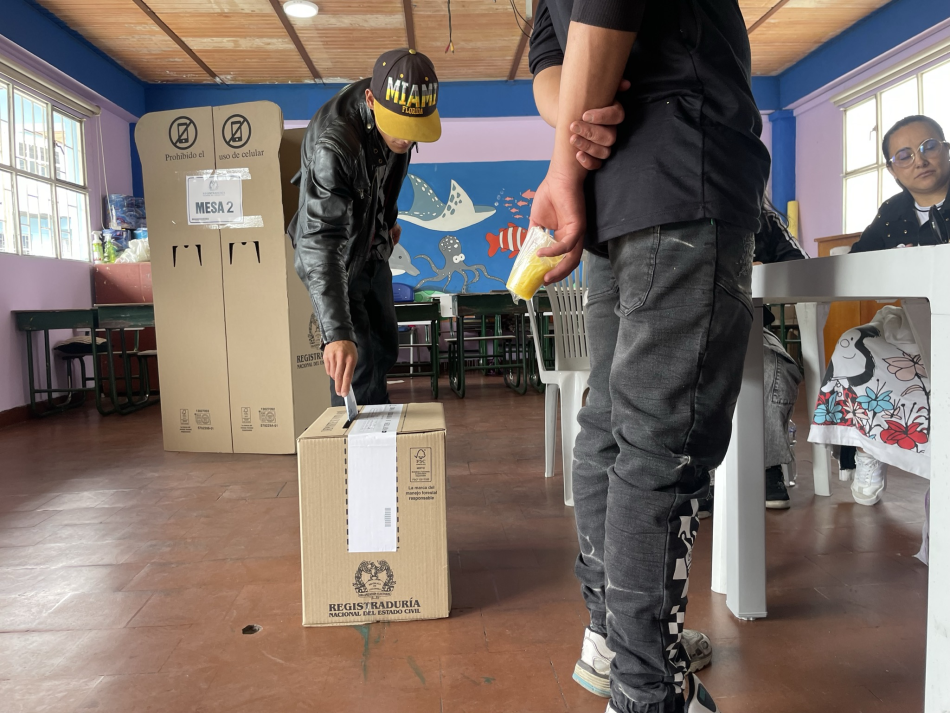
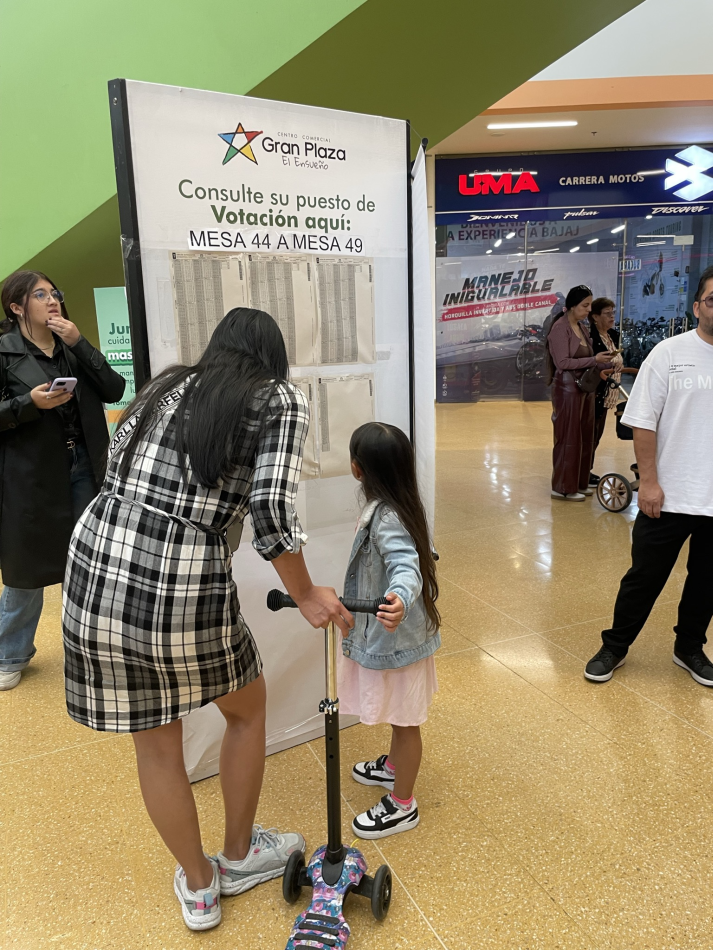
Meanwhile, turnout is higher than in the last, 2022, election among Colombians who live abroad, according to Blu Radio, which reports “record turnout” in the US and Spain, where “the presence of [Colombian] citizens was constant from the early hours of the morning.” The media outlet notes that “more than 300,000 [Colombian] citizens [are] eligible to vote” in Spain, and “More than 405,000” Colombians in the US are eligible to vote in these elections. Colombians in Spain were able to vote beginning Monday, May 25, and by May 28 turnout was 89 percent higher over the 2022 election, EFE reports.
Votes from Spain favored Petro in the 2022 election over his right-wing opponent, Rodolfo Hernández, while voters in the US heavily supported Hernández.
3:30 PM: In his latest foray into Latin American politics, controversial former Trump advisor and lobbyist Roger Stone has published a piece extolling Colombian presidential candidate Abelardo de la Espriella, who he says “captures the fury, the fear, and the hope of millions of Colombians who want safety restored, national sovereignty reclaimed, and prosperity to finally be unleashed.”
In his piece, featuring an AI-generated image of a middle-aged politician (bearing no clear resemblance to De la Espreilla) in a messianic pose, Stone asserts that Colombian voters face a stark choice in today’s election:
This election is far larger than Colombia alone. It is a hemispheric test of whether Latin America will continue its drift toward ideological experiments that weaken sovereignty and empower criminal empires, or finally reject them by electing a leader with the force of personality to stop them dead in their tracks. Voters are faced with three options: institutionalization of Gustavo Petro’s left-wing project in Iván Cepeda, the restoration of a stale political class with Paloma Valencia, or the genuine anti-establishment renaissance that De la Espriella represents. It is a moment of truth for the Colombian people. Will they accept genuine transformation or instead choose the same old failures wearing fresh slogans and slicker advertising.
Stone was in the news late last year after successfully lobbying President Trump to pardon the right-wing former president of Honduras Juan Orlando Hernández, following his 2024 conviction for his central role in a massive cocaine-trafficking conspiracy. Stone himself is a convicted felon who also later received a presidential pardon from Trump. Social media influencers and media outlets that have been supportive of De la Espriella’s candidacy have amplified the significance of Stone’s piece, and in some cases appear to have leapt to the conclusion that it signified an endorsement from Trump (the US president hasn’t, to date, endorsed a candidate in this election, though he has done so in recent elections in Honduras and Argentina). The online outlet Expediente posted a translation of Stone’s piece, with the headline:
“Roger Stone, the historic strategist of Nixon, Reagan, Bush and Trump, expresses his support for Abelardo de la Espriella”
Stone and Abelardo share a number of traits. Both have highly provocative and theatrical public personae, and both espouse hard-right populist politics. They also seek to project themselves as anti-establishment, outsider figures, although both have close, longstanding connections to traditional political elites. In their professional lives, they appear to have had few scruples regarding who they take on as clients, with De la Espriella having provided legal counsel to paramilitary leaders, drug traffickers, and corrupt politicians, and Stone having been a paid lobbyist for dictators and authoritarian governments, most recently the military regime in Myanmar, which has been involved in massive atrocities. Stone has clearly had the ear of President Trump on Latin American politics in the recent past; the question is whether he — and other US political actors, such as US Senator Bernie Moreno — will succeed in getting Trump to endorse De la Espriella if he advances to the second round of the election.
3:15 PM: The Misión de Observación Electoral (MOE) — the country’s largest electoral observation mission in which CEPR staff are participating — has released its first observation report, based on the findings of its observers as of 10am Colombia time. They make 7 key points. (1) Public order disturbances — Citing minor disruptions of public order, as well as the detonation of an explosive device in a rural area, the MOE calls for the reinforcement of security in particular areas. (2) Right to free and secret voting — The MOE “reminds citizens that in Colombia, they have the right to a free and secret vote. Therefore, no one can force or coerce another person to reveal their vote.” (3) Be careful with your vote — The MOE identifies 60 reports of possible electoral regularities. These include alleged irregularities at polling stations — including delayed openings and long wait times — irregularities in advertising — including the presence of electoral advertising near polling stations and mass promotional texts, in violation of campaign regulations — and irregularities in public service — including the use of mobile devices at polling stations and restrictions on electoral observers. (4) Disinformation in digital environments — The statement cites a number of instances of potential digital disinformation regarding, among other things, alleged early results and irregularities. Two “particularly concerning” examples include incorrect instructions for citizens who are not registered to vote, and false or outdated news about disturbances of public order. (5) Regarding election observation — Observers cited several concerns related to the neutrality of poll workers: in 12% of the observed polling stations, poll workers were identified wearing political campaign insignia. Furthermore, 37% of the observed polling stations experienced problems with the use of the digital voter ID card. (6) Electoral observation with a differential approach — Regarding the rights of trans people and people with disabilities, “In 59% of the polling stations observed, there was no evidence of informational posters with QR codes that refer to the protocols to guarantee the rights of trans people and people with disabilities.” (7) Attempts to impersonate the Electoral Observation Mission — Finally, the MOE notes that it has received reports of people attempting to impersonate MOE observers, and reminds voters that “observers are fully identified” with caps and t-shirts with MOE logos.
2:45 PM: Likely paid X/Twitter accounts have been posting various AI-generated videos and images attacking Ivan Cepeda and supporting, sometimes alternately, De la Espriella and Valencia. Spanish digital disinformation investigator Julián Macías Tovar posted a tweet thread examining many apparently fake Twitter accounts that he writes are likely paid to post content in support of right-wing candidates and against Cepeda and Petro.
Tovar notes that accounts created in 2011 in other countries ― some of which had been entirely or mostly dormant since then ― were reactivated in the past month to post such content, some of it in the form of identical posts. One video promoted by multiple accounts depicts Cepeda being arrested by De la Espriella.
He explains that some of the accounts have likely been paid first to promote Valencia and then De la Espriella. The account @CamilaSantaRr, for example, posted an AI-generated video on May 28 attacking both Cepeda and De la Espriella, with the pro-Valencia hashtag “#PalomaResuelve” before, on the same day, posting a pro-Espriella tweet with the hashtag “#TigreEnPrimera.” The profile picture associated with the account today, Tovar writes, is of a different woman than an image that the account had claimed was a self-portrait in 2012. He writes: “Another common feature of these accounts is that they have around 300 followers, almost all of whom are from African or Asian countries.” Some, he notes, were posting content in foreign languages such as Japanese or French when they were first created, but have switched to English or Spanish in recent days to post about the Colombian election.
Tovar writes that various of these accounts created in other countries in 2011 are now being managed from Colombia. He created a list of hundreds of such accounts that he alleges may be part of a troll farm operation.
1:40 PM: All three of the major candidates have cast their votes, and each issued a statement to the electorate this morning. In his, left-wing candidate Iván Cepeda outlined his priorities, saying:
I invite you to vote for the future, for the elimination of poverty and inequality, for the protection of our natural wealth, for a modern, productive, and diversified economy, for a Colombia that fully unlocks its potential as an agri-food, environmental, cultural, and tourism powerhouse.
I invite you to choose hope over fear, unity over division, and the future over resignation.
Let no one stay home. Let no one give up their voice.
Because the future of Colombia is in the hands of its people, and I am certain that tomorrow our nation will take a new step toward a more just, more free, more humane, and greater society.
…
I have received a mandate from you. That mandate is unequivocal: to move toward a second progressive government that consolidates the social, economic, and political transformations that Colombia needs in order to become a more equitable, prosperous, and democratic nation. To achieve this, there is a fundamental task, which is to definitively overcome poverty and end social inequality. This will be the essential priority of our second government.
Uribista candidate Paloma Valencia’s statement framed the election as a choice between two paths:
One is the path of improvisation, of constant spectacle and of resignation in the face of the deterioration of security and institutions. It is a path where armed groups grow stronger, extortion becomes the norm, drug trafficking regains territory, and the state gradually relinquishes its authority. It is a path where fear once again dictates the lives of millions of Colombians.
The other is the path of hard work, of difficult decisions, of the experience, character and integrity needed to get back on track.
She also highlighted the historic significance of the fact that she would be Colombia’s first female president:
For the first time, we can elect a woman to the Presidency of Colombia.
First times change history. Not just because a woman reaches a place where no woman has gone before, but because it paves the way for many more. Because it expands what young girls believe is possible. Because it proves that leadership, character, and the capacity to serve have no gender.
The other right-wing candidate, Abelardo de la Espriella, urged his supporters to vote early in case the electoral system breaks down, citing the likelihood of high turnout among what he called the “defenders of the homeland.” He also encouraged them to vote for him by “putting a stripe on the tiger,” in reference to his nickname and campaign persona.
This is the most important election in the history of our country, in which our freedom, our democracy, and our institutions are on the line.
I urge you to vote early for the “Miracle Homeland” (Patria Milagro) to prevent polling stations and the system from potentially collapsing.
Let’s defeat the usual suspects once and for all! Put a stripe on the Tiger.
El País published a profile of Abelardo de la Espriella — the right-wing candidate that the article describes as “the devil’s advocate who wants to be president of Colombia” — tracing his early career and political trajectory:
At 47, “the defender of the homeland” has never held a single public office, though he has spent more than two decades in public life. He is known as a criminal defense attorney who enjoys taking his courtroom strategies into the media: he has represented politicians, mobsters, the owners of a pyramid scheme, and even Alex Saab, Nicolás Maduro’s frontman. He likes confrontation, guns, attention, and, above all, provocation. He once confessed on television, laughing, that as a child he used to tie cats to bottle rockets to watch them explode. “I was terrible, but I enjoyed it,” he said.
The article describes how de la Espriella comes from a well-connected family with ties to former president Álvaro Uribe. He got his start in local radio, where he began building connections with influential figures. After studying law, he went on to represent and defend paramilitary leaders before expanding his client base to include a wide range of celebrities and controversial figures. The article continues:
“I remember hearing about him for the first time at that RCN radio station, at the beginning of Álvaro Uribe’s presidency,” says José Obdulio Gaviria, a former advisor to the then-president. “We noticed him because his participation was positive in relation to the government’s line. But then came his advising of the paramilitaries, and that’s where we had serious disagreements: De la Espriella wanted them to be treated as political leaders.” The man who is now a hardline candidate was then a proponent of much more lenient justice measures for criminals.
…
In 2002, he opened De la Espriella Lawyers, and shortly afterward, his first big break arrived. President Uribe opened a path for the demobilization of paramilitary groups, and the lawyer decided to defend the top leaders: he argued that they were not drug traffickers, but rather groups with political status. In 2004, he created the Fipaz Foundation to prevent his extradition to the United States, and his firm’s revenue jumped from 11 million pesos to 2 billion pesos, nearly a million dollars at the time, as reported by journalist Daniel Coronell in 2006. He went from being a novice, middle-class lawyer to a high-profile one.
“The paramilitaries were used by many who today deny and disown them,” he said at the time. He then also defended politicians accused of colluding with those same paramilitaries, some of whom he had known since childhood, such as former congresswoman Eleonora Pineda from Córdoba. “She was a friend of my mother,” he said of Pineda, who in 2008 was convicted of ties to paramilitary groups, as were Dieb Maloof and Rocío Arias, all of whom were his clients.
Several former clients have alleged that he solicited money to bribe judges and politicians, and that he sometimes abandoned or mistreated those he represented. He also has a complicated relationship with the media, especially critical outlets:
One group De la Espriella has failed to convince is independent media, which has spent years scrutinizing his ties to paramilitary groups and to Saab. In addition to calling those who ask uncomfortable questions ignorant, he has filed lawsuits against more than 20 journalists for libel and slander, according to a count by La Silla Vacía, in a strategy that reveals his irritation whenever he cannot control the narrative of his own show.
… On the campaign trail he rarely grants interviews to critical outlets and has called journalists who question him liars, while freely appearing before friendly ones like the magazine Semana.
De la Espriella closed out his campaign last night with an interview with Westcol, one of Colombia’s most prominent influencers. Reporting on the interview, journalist Mauricio Romero writes for Colombia One:
Perhaps the most uncomfortable exchange came when De la Espriella defended one of his flagship proposals: the construction of 10 megaprison complexes across Colombia. As the candidate outlined the plan, Westcol responded with a remark that quickly went viral: “That sounds like a school representative proposal.”
…
One of the most controversial topics discussed was gun ownership. De la Espriella argued that citizens who can demonstrate psychological and physical fitness should be legally allowed to carry firearms.
He claimed that the overwhelming majority of crimes are committed with illegal weapons rather than legally registered ones. The proposal aligns with his broader argument that law-abiding citizens should have greater tools to defend themselves in a country facing persistent security challenges.
The candidate also stated that, if he lost, he would remain in Colombia to lead the opposition:
Another significant moment came when the conversation shifted toward a controversy involving his wife, Ana Lucia Pineda. Recent comments suggesting that the family could comfortably live abroad if De la Espriella lost the election had generated criticism among voters.
During the interview, the candidate attempted to clarify the situation, saying his wife’s statements had been taken out of context. He stressed that, if defeated, he would remain in Colombia and serve as a leading opposition figure rather than leave the country.
On May 29, El País published a profile of Iván Cepeda that discussed his decision to run for the Colombian presidency:
Iván Cepeda had never wanted to govern Colombia. With Gustavo Petro’s term nearing its end, many people urged the left-wing senator to take the step. They asked him half-jokingly and in earnest, and he would cut them off with, “Don’t keep on about that.” Then a letter arrived. The mothers of Soacha [Mothers of the False Positives of Soacha and Bogotá (MAFAPO)] — women who lost their sons, husbands, and relatives, murdered by soldiers who presented them as guerrillas — told him it had to be him. And Cepeda, despite everything he dislikes about campaigning and knowing that governing will require him to compromise on things he never believed in, eventually said yes. He, who had spent his whole life as a man of opposition — a defender of victims, an accuser of the state — agreed to become the head of the state.
On May 30, CEPR met with leaders of MAFAPO, the movement of women seeking justice for those who were disappeared and murdered by the Colombian military and falsely recorded as enemy (guerrilla) combatants. Thousands of these “false positives” were perpetrated by the Colombian armed forces in order to show ever-greater “results” during the intense US-backed military offensive against insurgent groups in the mid to late 2000s. The MAFAPO lideresas — Jacqueline Castillo, Blanca Monroy, and Doris Tejada — confirmed that in August 2025 they sent Iván Cepeda a letter urging him to enter the presidential race — an appeal they believe played a decisive role in his eventual decision to run. The letter, also delivered publicly through a video message, highlighted Cepeda’s longstanding commitment to victims of state violence and his role in advancing their demands for truth and justice, both inside and outside of the Colombian Congress, where he has long been one of the leading figures of the Congressional Peace Commission:
“We have spent years walking in search of justice. Throughout that journey, Iván Cepeda has stood by our side when few others dared. In Congress, he did more than open doors for us — he placed our struggle at the center of public debate with respect, seriousness, and integrity. He stood with us in our recent defense before the Supreme Court when others sought to silence us and subject us to further victimization. He has carried our voice to national and international forums, helping transform our struggle into a symbol of ethical and political resistance.”
The letter concluded with a direct appeal:
“For truth, justice, and a dignified life. For the memory of our children, for the dignity of our people, and for a country founded on truth, justice, and life, we invite Iván Cepeda to become a candidate for the presidency of Colombia.”
Also present at the meeting with MAFAPO, which was organized by the Chicago Religious Leadership Network on Latin America (CRLN), was Margarita Restrepo of Women Walking for Peace (Madres Caminando por la Verdad), another collective of victims’ relatives that joined the effort to persuade Cepeda to run. Doris Tejada, whose son was disappeared by the military in 2008 and whose remains were only recovered in 2024, presented the CEPR delegation with a pair of small hand-knitted shoes that she had made herself. “The shoes represent our journey and our search — all the ground we have covered in our effort to find our loved ones,” she said.
Over the years, Tejada has knitted and distributed 6,402 pairs of miniature shoes, each representing a documented victim of the false positives scandal. In 2026, however, Colombia’s Special Jurisdiction for Peace (JEP) raised the official number of victims to 7,835, prompting Tejada to continue knitting until every victim is represented. Next Tuesday, she will participate in a hearing involving more than 600 victims and relatives of victims, as well as 55 military personnel accused of responsibility for the killings and disappearances. She plans to hand each of the soldiers one of the knitted shoes. “I want to tell them that this is a symbol filled with memory. I hope it will open their hearts and encourage them to tell the truth, no matter how painful or difficult that truth may be.”
Writing in Responsible Statecraft, the Washington Office on Latin America’s Gimena Sanchez-Garzoli analyzes what tomorrow’s election in Colombia means for US-Colombian relations amid overt US interventionism in the region:
Both Valencia and de la Espriella propose including Colombia in the Shield of the Americas, created by the Trump administration, and have engaged with administration officials and Republican members of Congress.
The results of Colombia’s 2026 presidential race will have a significant impact on U.S.-Colombia relations and the Trump administration’s strategic goals in Latin America. Since Petro took office in 2022, the long-standing bipartisan strategic relationship between the two countries has faced growing strains, driven in part by tensions between Petro and a group of Republican lawmakers, particularly from Florida, who have used anti-Petro rhetoric to appeal to conservative Latino voters.
…
The Petro administration’s decision in May 2025 to join China’s Belt and Road Initiative further widened the rift with Washington. In response, the Treasury Department sanctioned Petro and others, and the U.S. decertified Colombia for failing to meet its counternarcotics commitments. (Decertification can lead to U.S. foreign assistance suspension, the U.S. blocking Colombia from obtaining international loans, and visa cancellations.) Things came to a head last December, when Trump warned that Petro “could be next” after the U.S. overthrow of Venezuela’s Nicolas Maduro.
Tensions cooled off after the two men met at the White House on February 7. But no sanctions were lifted, Colombia remains decertified, and no new aid for Colombia has been announced. (Colombia saw a massive reduction in U.S. assistance as part of the elimination of USAID and overall foreign aid cuts in 2025.)
The Trump administration and Republicans in Congress are looking to the Colombian elections in hopes that the next president in Bogota will restore the strong strategic relationship with the U.S. that existed before Petro. This includes creating alliances of like-minded conservative leaders from Latin America and the Caribbean, as was reflected in the Shield of the Americas Summit held in Doral, Florida, in March. While framed as a way to build a multinational military partnership against drug cartels and transnational criminal organizations, the summit excluded leftist governments in the region, including Colombia — where most of the world’s cocaine is produced.
The Trump administration’s 2025 National Security Strategy advances a “Trump Corollary” to the Monroe Doctrine aimed at restoring U.S. primacy in the Western Hemisphere through an “enlist and expand” approach focused on curbing irregular migration, weakening cartels, and nearshoring manufacturing. The strategy also reorients the region toward competition with extra-hemispheric powers such as China and Russia, using economic pressure, tariffs, and expanded military engagement to secure supply chains and strengthen regional partnerships.
…
Given Colombia’s regional importance to the United States, the Trump administration may try to shape Colombia’s elections, as it has in Argentina and Honduras. So far, the administration has presented its role as one of monitoring and promoting transparency. At the U.S. Embassy’s request, the National Electoral Council authorized a U.S. election observation mission of 86 government officials, who will be deployed across 15 areas to assess transparency, security, and voting in high-risk locations during both presidential rounds.
Colombia’s foreign ministry accused Ecuador of “deliberate interference” in the country’s upcoming election, Reuters reported:
Ecuadorean President Daniel Noboa on Friday said his country would remove bilateral tariffs on June 1 after reaching an agreement with right wing Colombian presidential candidate Abelardo De La Espriella.
Noboa said on X the move would take place after “confirming (De La Espreilla’s) willingness to promote a real and joint fight against narcoterrorism.” He also said that they had agreed on the handover of Ecuadorean criminals who are in Colombia.
The Colombian foreign ministry rejects “the misleading presentation of the decision to remove the tariffs as a measure of good faith by the Ecuadorean government,” it said in its own statement, though it added it would remove measures adopted to mitigate Ecuador’s tariffs.
The foreign ministry statement noted that Ecuador’s decisions followed a ruling from the Andean Community of Nations that the tariffs had to be eliminated. The statement continued:
The measures adopted unilaterally by Ecuador are contrary to the principles and obligations that govern the Andean legal order, and, therefore, affect the normal development of intra-community trade, the legal security of economic operators and the productive and social dynamics of the border populations of the two States.
The Government of Colombia also considers it pertinent to point out that the decision adopted by Ecuador comes in a context in which various international organizations, including the International Monetary Fund, made observations to the Ecuadorian Government about the economic risks associated with the permanence of restrictive trade measures, as well as about their possible effects on productive activity, competitiveness, the well-being of border communities and the proper functioning of markets.
…
For all the reasons stated above, the Government of Colombia categorically rejects, firstly, the misleading presentation of the decision to repeal the tariffs as a goodwill gesture by the Ecuadorian government, when, as has been stated, it is a response to the coercive orders of the Andean Community (CAN), and secondly, the deliberate interference in the ongoing electoral process in Colombia. This meddling by a foreign leader in the democratic process of another state constitutes a flagrant violation of the principle of non-intervention in internal affairs, a threat to national sovereignty, and an attack on the democratic system.
Consequently, Colombia reaffirms that trade and integration issues must remain outside of political and electoral considerations and be managed with strict respect for the sovereignty of States, the principle of non-interference, and compliance with international commitments.
Ahead of tomorrow’s election in Colombia, Al Jazeera looked at the significant social gains achieved during the administration of Gustavo Petro:
But his most significant achievement came from the labour reform approved in last June, which raised the minimum wage by 23 percent, much higher than the usual increases which ranged from 5 percent to 10 percent. The same law stipulates that overtime be better paid and starts at 7pm, two hours earlier than previously. In Colombia, the legal workday is eight hours.
…
With the approval of the labour reform, unemployment was expected to rise as many employers were unable to adapt. However, unemployment has been falling in Colombia: it reached 10.9 percent in January — the lowest rate in 25 years — and down from 11.2 percent in 2022 when Petro came into office.
But some economists say increased purchasing power among workers from wage rises stimulates the economy, especially as the pay rise outpaced inflation.
The report echoes some of the findings from CEPR’s recent issue brief. However, the Al Jazeera article cited increased debt from Petro’s social initiatives as a significant cause of concern moving forward:
“This administration has increased the debt by 400 trillion pesos ($109bn). So the key question is, beyond its focus on equity, what was its strategy for growing the economy and attracting more investment? Because whatever it was, the data shows it isn’t working. The government has been relying on increased debt,” he said.
Some economists blame the heightened debt on the pandemic during which governments the world over undertook social spending to help cover the sudden, and prolonged, loss of income as businesses shut down overnight.
Some argue that Petro inherited hefty levels of debt to begin with – it stood at least at 57 percent of GDP under his predecessor, Ivan Duque.
In fact, as we showed in the issue brief, external debt has actually decreased in recent years. Further, as the article notes, most of the budget deficit in recent years can be explained by rigid commitments made by prior administrations. Petro also completely paid down the country’s debt with the IMF. Al Jazeera noted that a number of the Petro administration’s revenue increasing measures were rejected by Congress, adding:
They blame Congress for failing to pass a value added tax that would have helped government finances by taxing petroleum-based liquid fuels, online gambling and businesses associated with churches.
“Petro sought to promote an economic model in which the recovery of workers’ share of national income demonstrates that an unequal economy is less prosperous. Colombian society is calling for increased spending, but the country’s elite—particularly in the oil and mining sectors—were very effective in blocking the promise of tax justice in Congress,” said Simon Gomez, an economist at King’s College London, who has launched an economic think tank to support Petro’s economic policies.
As the article notes, investment in Colombia has taken a hit in recent years. However, as our issue brief notes, this appears to be more about overly restrictive monetary policy imposed by the country’s independent central bank than policies pursued by the Petro government. Al Jazeera noted the stakes in Sunday’s vote:
On May 31, Colombia will elect a new president. The main candidates are two political opposites. Ivan Cepeda, a veteran left-wing congressman and member of the same party as Petro, wants to continue most of his policies, both social and economic.
He supports continuing the transition to renewable energy and injecting capital into the Colombian countryside and small farmers so that it becomes a pillar of the country’s economy, creating more jobs, increasing food production, and contributing to a commercial transition plan that aims to gradually shift capital towards the agricultural sector rather than extractive industries.
At the other end of the spectrum is Abelardo de la Espriella, a far-right “outsider” lawyer seeking to emulate El Salvador’s President Nayib Bukele, primarily in his controversial security proposals, including building mega-prisons. His main economic platform focuses on reducing government spending as much as possible and lowering taxes for large corporations.
Yesterday, with less than two days to go before Colombians vote in a first-round presidential election, Ecuadorian president Daniel Noboa “fully entered the Colombian presidential campaign,” El Pais reported. The article continued:
On Friday night, two days before the election, he met via video call with far-right candidate Abelardo de la Espriella to discuss bilateral relations. The meeting, which lasted less than 10 minutes, was broadcast on the presidential hopeful’s social media accounts. Following a request from the far-right candidate, Noboa agreed to eliminate tariffs on Colombian imports starting the following Monday, the day after the first round of voting. “I am doing this as a sign of goodwill, of affection, of hope,” he declared during the broadcast. “I am convinced that, with his strength, he will achieve it this weekend,” he commented regarding the campaign of the criminal defense lawyer and outsider candidate.
The two politicians staged a meeting between heads of state, as if De la Espriella were already president. “We need you to send us some of those bandits you have over there,” Noboa said at the start of the meeting. The far-right president responded, “You can count on it,” and assured him that there would be greater cooperation on security policies to combat armed groups. “In my government, you will find full support to protect that border as it should be,” he promised, referring to Quito’s complaints about the Petro administration’s alleged negligence in confronting criminal groups. The Ecuadorian president expressed his satisfaction: “That is precisely what we are seeking. The problem was never with Colombia, but with a government that simply didn’t want to work for the security of its own border.”
Earlier this year Noboa raised tariffs on Colombia, accusing the Petro administration of not doing enough to combat drug trafficking organizations, in what we have repeatedly noted was a likely attempt to interfere in Colombia’s election. After a phone call earlier this month with the conservative Paloma Valencia (the candidate backed by former president Alvaro Uribe), Noboa reduced tariffs from 100 percent to 75 percent. But with this latest move backing de la Espriella, Noboa has made the interference explicit. El Pais added:
De la Espriella began his efforts to capitalize on the Ecuadorian president’s decision as soon as the meeting ended. “The Miracle Homeland begins. True diplomacy doesn’t need grand halls, clubs, or trips; it needs leadership and will,” he wrote on X. “With me, it’s about saying and doing,” he added, before asking for votes on Sunday. José Manuel Restrepo , his running mate and former finance minister during Iván Duque’s administration, added: “What an example of leadership! Even without having been elected yet, Abelardo de la Espriella is demonstrating to our country his ability to build a better future.” Noboa, for his part, published a message in which he spoke of the meeting as if it had been with the president of Colombia. “We have reached an agreement to strengthen cooperation in trade, energy, and security,” he emphasized.
As we noted in a backgrounder ahead of tomorrow’s elections (but before this latest intervention): “Noboa’s actions appear intended to undermine the campaign of Iván Cepeda, who has been performing strongly in the polls.” The meeting between Noboa and de la Espriella generated a strong reaction, El Pais noted:
President Petro’s allies began expressing their outrage a few minutes later. Camilo Romero, former governor of Nariño (2016-2019) and former ambassador to Argentina under this administration, stated that it is “very serious” for Ecuador to interfere in Colombia’s affairs in this way and that the situation must be denounced before the international community. He called De la Espriella and candidate Paloma Valencia , who two months ago held a similar dialogue regarding a reduction of tariffs from 100% to 75%, “traitors to the nation.” “They allied themselves with a foreign president who bankrupted our merchants and business owners, to attack Iván Cepeda [the left-wing candidate] and the government in search of votes,” he said. Juan Fernando Cristo, Petro’s former Minister of the Interior, described the meeting as “a crude political maneuver.” “This is just what a desperate right wing needed (…). It won’t work for them; we will win in the first round,” he asserted.
Colombians will head to the polls in first-round elections for president this weekend. CEPR will be on the ground participating as official election observers and we will be providing live updates on this page throughout the weekend. Ahead of the vote, CEPR published a scene setter outlining the leading candidates, key issues at stake, and risks to the electoral process — including foreign interference:
Foreign Interference, particularly from the US, has been notable in recent Latin American elections. In Argentina, with President Javier Milei facing major economic challenges and critical midterm elections in October of last year, the Trump administration extended a $20 billion currency swap to the Argentine central bank and later threatened to terminate US financial support if Milei’s party lost. In Honduras, just days before the November 30 general elections, Trump endorsed conservative candidate Nasry Asfura, publicly attacked the other two leading presidential candidates, and again threatened to cut economic support if his preferred candidate lost. He also pardoned former Honduran President Juan Orlando Hernández — a prominent figure in Asfura’s party who had been serving a 45-year prison sentence in the US on drug-trafficking charges. In both cases, the Trump administration’s preferred candidate or party ultimately secured electoral victories.
While the Trump administration has remained relatively quiet regarding the electoral process in Colombia, its friction with President Petro — underscored by US sanctions against him — suggests a strong preference for a right-wing victory. While US government officials have not, to date, appeared to directly meddle in the Colombian election, certain Republican members of Congress have openly done so. This notably includes Colombian-born Ohio Senator Bernie Moreno, who has met with Abelardo de la Espriella and posed in pictures with the candidate while performing his signature military salute. Moreno, who will be present in Colombia as one of the US embassy’s 86 accredited electoral observers, has been a public critic of President Petro. He has called on electoral authorities to disqualify results from areas of the country where armed groups reportedly engage in voter coercion and intimidation and has said that “this is the election where the Colombian people are going to decide which way they are going to go. We’ve seen one way, and we just had to take a military action in Venezuela to fix that.”
In addition, Representative Carlos Giménez of Florida has compared President Petro to Nicolás Maduro and said, “I hope that Colombians have realized that the left only brings misery and violence,” adding that “the left will continue to lead Colombia down the path of the socialist, anti-American regimes in the region.” Meanwhile, Florida Representative María Elvira Salazar has openly endorsed De la Espriella, who met with her and the Deputy Secretary of State in March. De la Espriella is a US citizen with ties to Salazar’s district in South Florida, and he and his wife have donated nearly $100,000 to the congresswoman since 2018.
Finally, there are concerns about election interference from Colombia’s neighbor, Ecuador. Earlier this year, Ecuadorian President Daniel Noboa initiated a trade war with Colombia, seemingly without clear provocation, arguing that the Petro government wasn’t doing enough to cooperate on security matters. Tensions have escalated since, with Noboa accusing Colombian President Gustavo Petro of having criminal links, and Petro responding in kind. Noboa’s actions appear intended to undermine the campaign of Iván Cepeda, who has been performing strongly in the polls. Noboa has publicly suggested a preference for a right-wing opposition victory in Colombia, and following a phone call with candidate Paloma Valencia on May 4 he reduced tariffs on Colombian goods from 100 to 75 percent.
The full scene setter is available here. CEPR also recently published a report looking at the social gains achieved under the outgoing Petro administration.
The US has spent at least $4.7 billion on a massive military buildup in the hemisphere, conducting dozens of air strikes and extrajudicially killing nearly 200 civilians, all ostensibly to combat drug trafficking. However, a new investigation by the New York Times finds that cocaine, the predominant drug trafficked out of South America, “is as easy to get in much of the United States as it was before the strikes began.” The article continues:
“Cocaine remains highly available, highly prevalent and relatively inexpensive,” said Dr. Carl Latkin, a professor of public health at Johns Hopkins University who largely tracks cocaine use in Baltimore, traditionally a major entry point in the eastern United States for cocaine smuggled through the Caribbean.
Dr. Latkin is among the substance use experts in the United States who agree that the Trump administration’s campaign is both illegal and ineffective.
“In addition to being morally abhorrent, this method is as likely to succeed as much as would bombing a handful of McDonald’s in Dallas, Texas, and claiming that you’ve made America healthy again,” Dr. Latkin said.
…
If boat strikes were slowing the flow of cocaine to the United States, public health researchers say one consequence would be an increase in prices.
But street prices for cocaine remain between $60 to $100 per gram in many U.S. cities, about where they were before the boat strikes began, according to Nabarun Dasgupta, an addiction scientist at the University of North Carolina and a leading expert on the epidemiology of street drugs in the United States.
Similarly, epidemiologists say the purity of cocaine sold in the United States would be expected to drop if the maritime strikes were truly hurting drug cartels. Dealers seeking to stretch restricted supplies would likely dilute their product with more adulterants, such as levamisole, a medication used to treat parasitic worm infections that can physically resemble cocaine, or lidocaine, a local anesthetic.
And yet, the average number of such substances in cocaine samples ranges from 1.3 to 1.5 in 2026, after the boat strikes began, compared with a range of 1.4 to 1.6 for much of 2025, Mr. Dasgupta said.
That consistency suggests that the start of the boat strikes in September did not amount to an inflection point limiting cocaine supply in the United States, Mr. Dasgupta said/
…
“They’re not moving the needle at all,” said Adam Isacson, director of defense oversight at the Washington Office on Latin America, a research group. “Is that worth killing all these people?”
Of course, there is little reason to believe that the massive US military build-up and bombing campaign was ever predominantly about halting drugs from entering the US. As CEPR Senior Research Fellow Guillaume Long wrote last November, not long after the start of the US bombing of alleged drug boats: “The official narrative is a fabrication.” Speaking on Democracy NOW! earlier this year, CEPR’s Director of International Research Jake Johnston said:
I mean, look, this is a hypermilitarized and overtly politicized remix of the “war on drugs” and the “war on terror,” right? … But this is not about drugs. This is not about terror. I mean, the U.S. pardoned Juan Orlando Hernández, the convicted drug-trafficking former president of Honduras. And Noboa in Ecuador, his own family has been accused of involvement in the drug trade. And so, look, this is about politics. This is about power. This is not about drugs, and this is not about democracy or anything else.
Guatemalan president Bernardo Arevalo denied a report in the New York Times that he had reached an agreement allowing the US to conduct joint military operations inside the country. AP reported:
“There is no agreement. There is a request that falls within the framework of existing agreements in several countries,” Arévalo said at a news conference.
“What we are signing are types of collaboration that have been taking place in the past. We conduct maritime interdictions where the United States has been collaborating with training, capacity building and equipment,” Arévalo said.
He said the government’s actions are in accordance with Guatemalan law and the Constitution.
“The only body that can authorize operations involving soldiers on Guatemalan soil is the Congress of the Republic. The Guatemalan government is not requesting this cooperation and has no plans to do so,” the president said.
El Pais added additional details:
Before Arévalo’s intervention, a source within his government, who spoke to EL PAÍS on condition of anonymity, said that Washington had been “exerting considerable pressure for the past two months.” “What they offered us was to select one or two locations for bombings and broadcast the whole thing on television. But we have been clear that this is not going to happen. A U.S. military force cannot operate in the country, simply because it is unconstitutional,” the source stated.
According to that testimony, pressure from the U.S. Department of Defense has bypassed diplomatic protocols to go directly to Arévalo. “The talks have been ongoing and have been led by the Guatemalan Minister of Defense [Henry Saenz] and even by the president. But there hasn’t been a single meeting to finalize the terms, because military missions won’t be permitted. What there is, and always has been, are joint operations with agencies like the DEA, the FBI, and HSI [Homeland Security Investigations],” the source stated.
Speaking to this newspaper in Guatemala City, Saenz insisted that his army would lead the operations. “We haven’t asked for any other military personnel to participate in the operations. And we’re not going to change our approach,” he concluded.
The US designated two Brazilian gangs as Foreign Terrorist Organizations (FTOs) yesterday, just days after President Trump met with members of the Bolsonaro family, who have been lobbying for the designations for months. The New York Times reported:
Following the meeting on Tuesday, Flávio Bolsonaro, who will seek the presidency in lieu of his father, told reporters that he had again asked Mr. Trump to label the Brazilian gangs as terrorist groups.
The Trump administration appeared to grant that request with the designation on Thursday. In a statement, the U.S. Department of State said that the Brazilian gangs, the First Capital Command and the Red Command, would be labeled terrorist groups effective June 5.
…
The terrorist designation threatens to once again strain ties between the Western Hemisphere’s two largest nations, which have only recently begun to repair relations.
It has raised concerns among Brazilian officials that the United States may be trying to sway its upcoming election by helping another Bolsonaro. Flávio Bolsonaro has said he will challenge President Luiz Inácio Lula da Silva, a leftist, in October and has accused Mr. Lula of being soft on crime.
Brazilian president Lula had met with Trump just weeks earlier and has specifically opposed the designation. The Times noted:
Mr. Lula has opposed the designation, casting it as meddling in his country’s internal affairs and arguing that there are better ways to combat organized crime, such as empowering the police, better coordinating international operations and going after the financial assets of gangs.
Just before the designation, Celso Amorim, Mr. Lula’s chief foreign policy adviser, said the Brazilian government was working hard to dismantle organized criminal networks but again dismissed designations as a tool in that fight.
“Organized crime must be combated with the utmost energy and determination,” Mr. Amorim said at a security forum in Moscow. “Equating organized crime with terrorism, however, is not helpful.”
The designation appears designed to boost the campaign of Flavio Bolsonaro, who has been sliding in the polls amid a corruption scandal — as we’ve discussed in greater detail previously. The Bolsonaro family played a key role in convincing the Trump administration to levy economically damaging tariffs on Brazil last year, a move that backfired politically. While the Times notes that the designation “could help Flávio Bolsonaro” in the election, it may also have a negative effect on the economy:
The U.S. designation could cause a major headache for the banking sector because it could allow the United States to impose sanctions on Brazilian institutions that may have done business with the gangs.
Experts say this is a major risk because the Brazilian gangs have managed to infiltrate the formal economy, amassing stakes in gas distribution, real estate, commodities and cryptocurrency. This leaves Brazilian financial institutions vulnerable.
Earlier this month, ahead of Lula’s White House visit, seven members of Congress wrote to the Trump administration cautioning against designating Brazilian gangs as FTOs:
“We are concerned the Trump Administration’s overuse and weaponization of Foreign Terrorist Organization (FTO) designations without meeting the clear statutory threshold for terrorist activity could weaken efforts to thwart organized crime in our hemisphere,” the lawmakers wrote, continuing, “[m]oreover, given the Administration’s use of terrorist designations as a justification to commit extrajudicial killings in the Caribbean and Eastern Pacific, we are concerned by how the Administration may use such a designation.”
“We are concerned that the designation of criminal organizations as FTOs would be used to inappropriately influence elections toward an outcome that the Administration considers politically favorable,” the lawmakers continued.
The Trump administration has pledged to “dominate” the hemisphere and push out geopolitical rivals like China. But the Trump administration’s overtly interventionist policies have produced a countervailing sentiment in the region, according to new polling. Former Chilean diplomat Jorge Heine writes in Responsible Statecraft:
Not surprisingly, in a 2026 AMLAT poll conducted in ten Latin American countries on the perceptions of the role of various foreign powers in the region, China is the only country that has improved its image since 2021-2022. In fact, China has displaced the United States as the region’s preferred development model and is also seen as the preferred partner in areas like education, science and technology.
A total of 36.1% of those polled now consider China as their preferred development model, while 31.5% prefer the U.S. In turn, the United States is considered the most significant military and economic power, but its standing has considerably deteriorated under the Trump administration, with a 28 point drop in the approval rating of U.S. policies since 2021-2022. This drop reaches as much as 65 points in the case of Mexico, and 34 points in the case of Colombia. In the battle for the hearts and minds of Latin Americans, the United States is clearly losing ground.
Revealingly, a vast majority of those polled reject the notion of a new Cold War between the United States and China and do not want their countries to take sides in this great power competition. They are keen for their nations to diversify their foreign links and to collaborate with all great powers and with the Global South.
US Rep. Maria Elvira Salazar (R-FL) publicly endorsed Abelardo de la Espriella, one of two right-wing candidates competing in Colombia’s presidential elections this weekend. Latin Times reported:
In a video message directed at Colombians living in Florida and shared on social media, the Republican congresswoman framed the election as a choice between “the left and the right” and argued that President Gustavo Petro’s administration had weakened security and strengthened narcotrafficking networks.
…
The Florida lawmaker expressed explicit support for De la Espriella, describing him as “a friend of the United States” and emphasizing his ties to Florida and his dual U.S.-Colombian citizenship. “The United States wants the best for Colombia,” she said, adding that Washington seeks “trade, closeness and ideological affinity” with Bogotá.
As we noted at the time, Salazar met with de la Espriella earlier this year, during the “Shield of the Americas” summit in Doral. “Fully restoring relations with the United States is fundamental for the future of our country,” de la Espriella wrote at the time, posting a photo of himself with Salazar and Christpher Landau, US Deputy Secretary of State. Salazar and de la Espriella in fact have a much longer history. Since 2018, de la Espriella and his wife — who have owned property in Salazar’s district since at least 2014 — have donated nearly $100,000 to Salazar’s political campaigns. In 2021, the Federal Elections Commission (FEC) flagged a number of “excessive campaign contributions” made to Salazar, including donations from de la Espriella and his wife. The Florida Bulldog reported at the time:
The over-the-legal-limit donations include $5,700 from Abelardo de la Espriella, a Colombian lawyer and U.S. permanent resident who up until two years ago was the criminal defense attorney for a fellow countryman targeted in a Colombian money-laundering probe involving ill-gotten government contracts in Venezuela. The FEC also flagged $5,700 which de la Espriella’s wife, Ana Lucia Pineda, donated to Salazar for Congress’s primary election. Both amounts are above the $2,900 federal cap each individual is allowed to give per election.
…
“We always return anything in excess of what the law allows,” Salazar said during a brief Florida Bulldog phone interview. “I don’t do compliance, but we have a very well versed accountant who will take care of that. We are going to give it back.”
She also appreciates de la Espriella’s financial support, Salazar added. “He is a prominent Colombian attorney who lives in my district,” she said. “I know him. I don’t know his clients. I thank him for his contributions.”
In April 2023 de la Espriella and his wife donated some $40,000 to the Salazar campaign at about the same time that Salazar publicly confronted President Petro during his official visit to the US, and ahead of his visit to the White House, according to FEC filings.
The Trump administration is preparing scenarios for the potential “collapse” of Cuba’s government, “as early as this summer” reports Axios. While an invasion has not yet specifically been authorized, it remains on the table for use at any time while the administration keeps “pushing economic sanctions to try to strangle the regime in Havana in a slow-motion constriction.” One Trump adviser warned of the risks of extended military action: “The president does not want boots on the ground for more than 48 hours. It’s a quagmire in the making. This could get messy.” While some have compared the administration’s approach to Cuba to that of Venezuela, Trump officials noted to Axios the differences in circumstance:
1. The U.S. has not identified, nor has Trump picked, Cuban officials who could run an interim government in Havana if the current regime collapses…
2. Seizing Castro in the same way Maduro was abducted wouldn’t lead Cuba to a dramatic reorientation toward the U.S. because the Castros 30 years ago began transitioning away from one-man rule…
3. The Cuban embargo is also codified in U.S. law and can be undone only if the island frees political prisoners, has free elections and guarantees other civil rights. That limits Trump from normalizing relations with a new government by executive fiat as he did in Venezuela, whose sanctions had been imposed by the U.S. executive branch.
POLITICO reported the day prior that the administration has put all the pieces in place for a potential invasion, “positioning the troops and weapons needed for the U.S. to launch a military attack on Cuba — all it needs is a final go-ahead from Donald Trump.” While one Trump official told Axios “We have time. The regime doesn’t,” POLITICO reports that “the administration faces a timeline to act.”
Many of the biggest warships deployed in the summer are approaching 10 months at sea, far beyond the usual six to seven months. This has caused defense officials to worry about overextending crews, and adds to the stress on a naval force that is also conducting a blockade of Iranian ships in the Arabian Gulf.
The White House referred questions to the Pentagon. The Navy declined to comment on current deployments. Naval Forces Southern Command did not respond to a request for comment.
“These back-to-back long deployments will add up over time,” said a defense official, granted anonymity to speak candidly about military operations. “Keeping them out there so long creates more problems in the long run when it comes to refitting and repairing those ships once they come home.”
The prolonged missions come on the back of the record-setting 11 month deployment of the USS Gerald R. Ford aircraft carrier, which ended this month after sailing from Europe to the Caribbean for the Maduro operation and then to the Middle East for the Iran war.
In an interview with the Los Angeles Times, Deputy Foreign Minister Carlos Fernández de Cossío shared his take on Trump’s threat of war:
There are politicians in the United States pushing the drumbeat of war against Cuba, trying to fabricate excuses, trying to portray Cuba as a threat, and trying to push the U.S. president to take military action, even with the understanding that military action would lead to a bloodshed, mostly of Cubans, but also of Americans.
The question is: How does a government convince American citizens that it is in their interest to cause death, cause destruction and suffering to a neighboring nation simply to satisfy the ambitions of a small cabal of wealthy influential people who enjoy the ear of politicians and powerful people in Washington?
Meanwhile, the humanitarian situation in Cuba is growing direr. The New York Times reports that the Russian oil tanker that appeared to be headed to Cuba has diverted course:
Ernesto Soberón Guzmán, Cuba’s ambassador to the United Nations, said that while he didn’t have details on the Russian tanker, Cuba was counting on Russia to help it survive what he called an illegal U.S. blockade.
“It’s hypocritical — cynical — that on one hand they talk about making efforts to open the Strait of Hormuz and so on, while on the other hand they are effectively imposing a naval blockade against Cuba,” Mr. Soberón Guzmán told The New York Times on Wednesday, referring to the U.S. government. “A fuel blockade that in practice constitutes an act of war.”
The tanker’s detour is a victory for the Trump administration, which has been trying to strangle Cuba into making major changes to its political and economic system. Cuba has said it has now depleted its fuel reserves and is surviving off domestic oil production, solar power and small fuel shipments to private enterprises on the island.
…
Cubans are bracing for the summer heat, when demand for power generally increases, while the Trump administration is hoping the situation forces Cuban officials to accept U.S. demands.
Guatemala has agreed to conduct joint military strikes with the US targeting alleged drug trafficking groups, the New York Times reported:
Last week, President Bernardo Arévalo of Guatemala agreed to both airstrikes and other military action in a call with Defense Secretary Pete Hegseth, two of those people said, with operations to start as early as next month. It was unclear what other military activities could be included in the agreement.
Guatemala has formally requested “cooperation in operations led by Guatemalan security forces against drug trafficking organizations” in a letter to Mr. Hegseth, Mr. Arévalo’s office confirmed in a statement to The New York Times. His office said that Mr. Arévalo and Mr. Hegseth spoke by phone on May 19 to finalize terms but did not disclose specific details.
Guatemala would become the second country in the region to allow joint military action against criminal groups inside its borders; Ecuador agreed to a similar deal earlier this year. Under that arrangement, U.S. forces are advising and assisting Ecuadorean troops on raids and airstrikes against suspected drug gangs that have turned Ecuador into one of the deadliest countries in Latin America.
The Times added that US officials hope to next “press” Honduras, whose new government has closely allied itself with Trump, to agree to joint strikes as part of a strategy to “pressure Mexico into accepting joint counterdrug operations.” The article noted that Stephen Miller, Trump’s deputy chief of staff, is spearheading the strategy, adding:
Mr. Miller chairs a bimonthly meeting — called a “wins” meeting — at which various government agencies report on recent successes, with the Pentagon’s death toll from boat strikes regularly highlighted as one of the biggest, according to those two people and one other person familiar with the meeting.
…
Experts say the boat strikes may be illegal and carry legal risks for the Pentagon. An expansion of that effort inside Latin American countries may come with even more legal risk, people familiar with the effort said.
Former U.S. officials have said that even if the Defense Department’s leadership approved the strikes, the lower-ranking officers who actually carry them out could be held culpable for killing drug trafficking suspects who may in fact be innocent.
“As with the boat strikes, depending on the facts, further attacks could amount to premeditated killings outside of armed conflict, which some of us lawyers would refer to as murder,” said Brian Finucane, a former State Department lawyer who specializes in the laws of war. “Congress never authorized any of these strikes. So U.S. personnel who participate in these actions could face consequences down the road, after the Trump administration.”
Even if U.S. forces only provide intelligence or other logistical support to Latin American countries to conduct their strikes, they could be culpable for aiding and abetting violations of U.S. and international law, he said.
While the US pushes joint military operations throughout the region, the Times points out that such operations have already resulted in apparent human rights violations:
While the Pentagon has hailed its joint strikes in Ecuador as an important game-changing chapter in its war against drugs, the operations have not always worked out as planned.
In March, one of those strikes hit a cattle and dairy farm, a New York Times investigation found, not the drug trafficking compound that Mr. Hegseth boasted about when he said the United States was “now bombing Narco Terrorists on land.”
The American Prospect recently published an article analyzing the role of Stephen Miller within the Trump administration and specifically his role in the administration’s foreign policy. The Prospect quoted CEPR’s Director of International Research Jake Johnston:
“Generally, an administration has a freer hand on foreign policy than domestic,” Jake Johnston, director of international research at the Center for Economic and Policy Research, said in an interview. “The administration has been constrained in some things domestically, but they’re not really on foreign policy. And so you can sort of push the boundaries. You can break norms. You can violate international laws. You can create a precedent or undermine the ability to check anything the administration does.”
…
“The way I view [Miller’s] influence on foreign policy, it’s not really about the foreign policy, it’s about how foreign policy can be used domestically,” Johnston said. “It’s not really about the hemisphere at all, per se, other than its effect on the U.S. It helps him advance his agendas domestically,” particularly mass deportations.
Reps. Nydia Velazquez (D-NY) and Gregory Meeks (D-NY), the ranking member of the House Foreign Affairs Committee, introduced a War Powers Resolution (WPR) seeking to block unauthorized war with Cuba. The move follows the introduction of a Senate WPR on Cuba earlier this month. In a press release, the two members noted:
The resolution follows months of escalation by the Trump administration, including an oil blockade, repeated threats by the President to “take” Cuba, and last week’s indictment of former Cuban President Raúl Castro as a potential to justify illegal U.S. military action in Cuba.
“Donald Trump’s belligerent foreign policy is creating new wars and conflicts across the world. As our country is already embroiled in a new war with Iran, the President has now set his sights on regime change in Cuba,” said Congresswoman Velázquez. “This administration is rushing toward another disastrous war, putting countless American and foreign lives at risk. Congress must reassert its constitutional authority if the President continues down this illegal path.”
“The Trump administration and Republicans in Congress are hellbent on starting another war, this time with Cuba, to distract from the President’s failure in Iran, weak economy, and mass deportation of 500,000 Cubans legally in the United States,” said Ranking Member Meeks. “If Donald Trump and Marco Rubio are serious about a new relationship with the Cuban people, they would reverse 65 years of failed U.S. policy toward Cuba, end the oil blockade and the humanitarian crisis it caused, and work with Congress to modify the draconian and outdated U.S. sanctions that disproportionately harm the Cuban people.”
Reps. Jim McGovern (D-MA) and Joaquin Castro (D-TX) cosponsored the legislation. Also today, CARICOM’s Council for Foreign and Community Relations (COFCOR) issued a statement expressing “its profound concern regarding the ongoing and intensifying economic, commercial, and financial measures imposed upon the Republic of Cuba.” The statement continued:
These measures compound the trade and economic embargo imposed on Cuba for over six decades, which has had a deleterious effect on the lives and livelihoods of the Cuban people.
COFCOR unequivocally affirms Cuba’s sovereign right to import and receive fuel, and condemns the obstruction of energy supplies to Cuba, which has precipitated a grave humanitarian crisis.
COFCOR reaffirms the need for the preservation of the Caribbean as a Zone of Peace and expresses alarm at recent statements that suggest the possibility of military aggression against the Republic of Cuba; any such action would inflict unnecessary human suffering, impose grave material costs, and fundamentally destabilize the security architecture of the entire Caribbean region.
As a matter of international law and in solidarity with the resolutions adopted year after year by the overwhelming majority of United Nations member states, the COFCOR reaffirms that Cuba poses no threat to any nation, that it stands as a peaceful and cooperative member of the international community, and that the continued application of these unilateral coercive measures constitutes an unjustifiable violation of human rights, the principles of free trade, and the fundamental norms governing relations among sovereign states.
Guyana and Trinidad & Tobago, two countries that have closely aligned themselves with the Trump administration and the only two Caribbean nations that joined Trump’s “Shield of the Americas,” did not sign on to the statement.
Republican Senator Bernie Moreno visited Honduras yesterday and met with conservative President Nasry Asfura, whom President Donald Trump had openly supported in Honduras’s November elections in a striking instance of overt foreign interference. Moreno said the visit marked “a new era of bilateral cooperation where we’re working together to combat crime, stop illegal immigration, and build a more prosperous and secure hemisphere.” During the trip, Moreno and officials from the US Embassy also met with the country’s security minister, Gerzon Velazquez, to discuss the country’s “main advances, challenges, and strategies” on security issues, according to local media reports. Only days earlier, on May 21, Honduras’s Bajo Aguán region drew international headlines following reports of a massacre at the Paso Aguán Farmers’ Cooperative in the municipality of Trujillo, which left at least 20 people dead, as well as an armed attack in the nearby municipality of Omoa that killed six police officers. The Bajo Aguán region in northern Honduras has long been the site of a land-rights and agrarian conflict, where farmers, land rights defenders, and local communities have faced structural violence from both state forces and criminal organizations tied to large agribusiness interests — groups that have forcibly displaced local populations and violently suppressed efforts to reclaim land with impunity. In response, Honduras’s main business association, along with government officials — particularly Security Minister Velazquez — have sought to distance the Trujillo massacre from the region’s agrarian conflict, framing it misleadingly as a clash involving criminal groups posing as farmers’ collectives connected to land invasions. Local rights organizations have rejected this characterization, arguing that the killings reflect longstanding structural violence against rural communities and are part of a wave of violence that armed criminal groups have unleashed in the area since May of last year. The groups hold the state directly accountable, noting in a statement that “victim testimonies point to the National Police’s responsibility for the violence.” Indeed, reports indicate that on May 18, three days before the massacre, police were present in the same area, burning down houses. Given the possibility that the National Police may be tasked with investigating the massacres, the organizations are also calling for an independent and impartial investigation by the Attorney General’s Office. The massacre took place three days after Honduras’s National Congress approved reforms to the country’s criminal code that expand the military’s authority to carry out street-level policing activities and broaden — in vague and expansive terms — the criteria for defining terrorism and terrorist activity. This has raised concerns that the changes could be used to further criminalize land rights defenders and local communities who have been victims of the conflict in the Bajo Aguán. Shortly after the reforms were approved, Tomás Zambrano, president of Congress and a member of President Asfura’s National Party, announced a “massive military deployment to the streets as part of a new strategy to strengthen public security,” according to local outlet La Prensa. Following the massacres, the government announced the deployment of security forces to the regions where they occurred.
Brazilian senator Flavio Bolsonaro met with US president Donald Trump at the White House yesterday. Bloomberg reported:
Bolsonaro, the eldest son of former Brazilian leader and close Trump ally Jair Bolsonaro, posted a picture on social media alongside the US president in the Oval Office.
The encounter was brief, and the younger Bolsonaro entered to take the photo before leaving the White House, Brazilian outlet G1 reported, citing unidentified members of the group. The White House confirmed the meeting but offered no details on its length or purpose.
El Pais added:
Securing time with Trump for the candidate is a coup for Eduardo Bolsonaro, the third brother and the family member in charge of relations with Trumpism, who has also posed with the Republican. According to Brazilian press reports, the route to Trump went through the U.S. secretary of state, Marco Rubio.
The meeting took place amid as the Bolsonaro campaign has been beset by scandal after leaked audio recordings revealed Flavio Bolsonaro had sought millions in funding from a jailed banker. As we’ve noted, millions of dollars were transferred to a Texas-based company closely associated with Eduardo Bolsonaro, who has been living in the US and lobbying the Trump administration.
In brief remarks to the press after the meeting, Flavio Bolsonaro said that he had gone to the White House “specifically to ask him to designate the CV and PCC as terrorist organizations, because that’s what they are.” As we’ve repeatedly noted, the Bolsonaro family has been lobbying the Trump administration to designate the two Brazilian gangs as terrorist organizations for many months. As the Wall Street Journal noted earlier this month, after Lula met with Trump and urged against the designations:
Such a move by Trump would hand Brazil’s conservatives a political gift, validating their argument that da Silva’s government has failed to contain the expansion of organized crime and fight crime, one of voters’ top concerns.
El Pais added:
The fear of interference by Trump or his administration in the elections, as has happened in Honduras and Argentina, hovers over the Brazilian campaign. Last year the U.S. exerted extraordinary pressure on Brazil to drop prosecutions against Jair Bolsonaro. It failed. The former president is now serving a 27-year prison sentence for plotting a coup d’état against Lula.
US SOUTHCOM announced last night that it had conducted another bombing of an alleged drug trafficking vessel, the 59th such strike since early September. The US has now extrajudicially killed at least 195 civilians in similar attacks. SOUTHCOM noted that the strike yesterday in the eastern Pacific left two survivors. Earlier this month, as we highlighted at the time, the Latin American Center for Investigative Journalism (CLIP) identified 13 victims of the US bombing campaign:
The CLIP’s report showed that all the victims identified so far, including those who may have had some involvement in drug trafficking, came from extremely poor communities across Latin America and the Caribbean.
“Despite the US claim that the strikes are fighting narco-terrorism, what is actually happening is that young people living in extremely precarious conditions, doing whatever work they can to support their families, are being targeted,” said María Teresa Ronderos, director and co-founder of the CLIP.
“The US is not taking down any Pablo Escobar or Joaquín ‘El Chapo’ Guzmán,” she added.
The investigation also underlined what other reports and security analysts have concluded: that the strikes have not reduced the flow of drugs to the US, but have instead torn apart communities already fractured and weakened by organised crime and state neglect.
“There are communities where they stopped fishing for several weeks – and if they do that, people go hungry – because they were terrified of being bombed,” said Ronderos.
Brazilian senator Flavio Bolsonaro, son of former president Jair Bolsonaro, is in Washington this week for an expected meeting with US president Trump. The Associated Press reported:
A year ago, Brazilian Sen. Flávio Bolsonaro touted his family’s connection with U.S. President Donald Trump as a major political asset. This week, Bolsonaro is in Washington leaning into that relationship again in an attempt to shore up his weakening presidential bid after he received millions of dollars from a disgraced banker.
Bolsonaro arrived on Tuesday without a public agenda. Brazilian President Luiz Inácio Lula da Silva, his rival in October’s elections, had a three-hour meeting with Trump on May 7. The 80-year-old leader seeks a fourth, nonconsecutive term .
The Trump administration has not commented publicly on the Bolsonaro scandal.
There has been no confirmation of a scheduled meeting between Trump and Flavio Bolsonaro. We highlighted the scandal hitting the Bolsonaro campaign —and the scandal’s connections to the US — last week, when news of Flavio Bolsonaro’s Washington trip first emerged.
The Washington Post reported on the unofficial role of former Trump official Mauricio Claver-Carone in running the administration’s Venezuela policy:
A Florida lawyer who briefly served as special envoy to Latin America early in President Donald Trump’s second term, Claver-Carone, 51, has no official job in the U.S. government. But as the administration was formulating plans last fall to send Maduro into exile or capture him, Claver-Carone was intimately involved, by his own account and those of others.
Since Maduro’s removal, Claver-Carone has taken on an even greater role as the unofficial U.S. viceroy of Venezuela, helping to implement the administration’s plan to work with Delcy Rodríguez and exploit the South American country’s vast oil wealth.
Working directly with Rodríguez — now the Trump-recognized interim president — her brother, Jorge, and other officials in Caracas, Claver-Carone relays instructions on behalf of Washington, according to more than 10 current and former U.S. officials, people in contact with the Venezuelan government and other knowledgeable observers who discussed his role. Most spoke on the condition of anonymity to discuss sensitive diplomacy and the sometimes tense relationship between the two capitals.
Claver-Carone, usually operating by phone from his home and office in southern Florida, has been instrumental in picking winners and losers among aspiring investors as the country’s long-faltering oil industry is rejuvenated, said people familiar with his dealings. Most recently, he said, he vouched for Centerview Partners, a New York-based financial firm that was among the many vying to be hired by the Venezuelan government to help restructure its $170 billion debt.
…
His lofty, if unofficial, position and the close hold the administration keeps on its Venezuela decision-making have raised questions about oversight in the affairs of the resource-rich nation that is emerging as a U.S. neo-colony. Under Rodríguez’s interim presidency, the country has largely avoided revolutionary convulsions while a Wild West marketplace swarms with U.S. companies and investors.
Critics say his unofficial position also highlights the lack of transparency within the Trump administration between the worlds of business and diplomacy. Although the long-shuttered U.S. Embassy in Caracas has reopened, the Venezuela portfolio is handled almost exclusively by the White House — where Rubio does double-duty as Trump’s national security adviser — rather than the State Department, according to two U.S. officials.
“For a guy who has no role in government, he plays an oversize role,” said one former U.S. official familiar with Claver-Carone’s work.
The Post article noted that outside of his work for the government, the Cuban-American Claver-Carone runs LARA Fund, a private equity firm operating throughout the Western Hemisphere:
Claver-Carone also dismissed any suggestion of a conflict, saying neither he personally nor the LARA Fund have any Venezuelan investments. Venezuela is not yet in the fund’s “risk profile,” he said, adding, “I hope one day it will be.” He noted the firm’s “first three deals” in the works are in El Salvador, Mexico and Paraguay.
Bedoya [Claver-Carone’s partner at the LARA Fund] said that the fund — which in U.S. Securities and Exchange Commission filings said it was seeking to raise at least $1 billion — has not yet received any investment money but has a number of projects in the planning stage.
Not addressed in the article is what, if any, role Claver-Carone is playing with regards to Cuba policy. The article did note that, during his brief time as “the State Department’s special envoy to Latin America, a temporary, 130-day appointment that did not require Senate confirmation.” he:
… spent much of his time working on Cuba and Venezuela, both of whose governments were on Trump and Rubio’s priority list as the administration declared its intent to dominate the Western Hemisphere. He also helped orchestrate the deportation of more than 230 Venezuelan migrants to a mega prison in El Salvador.
A new report in The Atlantic looks at how the Trump administration’s quest for critical minerals is shaping its policies toward Cuba. The article noted that the May 1 executive order imposing secondary sanctions on companies doing business with Cuba targeted the operations of Canadian mining company Sherritt International, which for decades has operated a Nickel mine in a joint venture with the Cuban state:
In 1960, Washington watched aghast as Fidel Castro’s post-Revolution government seized companies and assets it viewed as the spoils of vanquished U.S. imperialism. Among the biggest prizes were two plants that sat above some of the largest nickel and cobalt deposits in the world. The United States had acquired one of them to secure a strategic supply of nickel for armor plating and aircraft engines during World War II. …
Now the Trump administration has targeted those industries anew as part of its all-points campaign to overpower the post-Castro regime. …
The blow that landed on May 1—packaged as a wonkish executive order—was much less flashy but did more immediate damage. The presidential decree imposed new sanctions on companies doing business with the regime, significantly expanding the comprehensive embargo and making it akin to those aimed at countries such as Iran, Russia, and North Korea. Within a week, Sherritt said that it would dissolve its partnership with the state-owned General Nickel Company, ending the Moa Nickel joint venture and other interests in electricity generation and natural gas.
The executive order and potential departure of Sherritt was widely interpreted as another attempt by the Trump administration to starve Cuba of hard currency, adding to the illegal fuel blockade, efforts to halt third-party country’s cooperation programs with Cuban medical professionals, and myriad other actions. However, the Atlantic article points to another goal of the Trump administration:
Then, last week, Sherritt announced it would only suspend its joint venture in Cuba and was in talks to sell a controlling ownership stake in Sherritt to Gillon Capital, with the apparent blessing of the U.S. State and Treasury Departments. Gillon is a Dallas-based firm that belongs to the family of Ray Washburne, a real-estate executive who served in the first Trump administration; neither firm responded to a request for comment.
Such a deal, if it goes through, could potentially bring the saga of Cuba’s mineral riches full circle by returning nickel and cobalt mines to U.S. ownership at a time when they have acquired a new strategic importance. Both minerals are used in manufacturing, including of cellphones and car batteries, and both help explain why the Trump administration is eager to bring Cuba to heel, one way or another.
The Associated Press added further details in a report last week:
The preliminary private placement deal would see Gillon hold a warrant that would allow it to buy enough shares to give it a 55% stake in the company. If the deal goes ahead, Sherritt says it expects the price paid by Gillon will be at a discount to its closing share price on May 15.
…
Gillon is the family office for the Washburne family. Ray Washburne was appointed by Trump as head of the U.S. development bank known as Overseas Private Investment Corporation from 2017 to 2019. He later served as a member of the president’s intelligence advisory board. He was vice chairman of the Trump Victory Committee in 2016 and has been a major Republican fundraiser.
…
In connection with the agreement, Sherritt says it has confirmed that the U.S. State and Treasury Departments do not object to Gillon’s talks with the company, but that any deal would require their approval.
“Sherritt has engaged constructively with the United States Department of State, which has confirmed that the Department of State and Department of Treasury do not object to Gillon Capital’s engagement in negotiations with the Corporation and, based on the information provided to date, do not consider such negotiations to be contrary to U.S. law,” Sherritt said in a statement.
US president Trump and Secretary of State Marco Rubio renewed threats of US military action in Cuba yesterday, AP reported:
Trump said previous U.S. presidents have considered intervening in Cuba for decades but that “it looks like I’ll be the one that does it.”
“Other presidents have looked at this for 50, 60 years, doing something,” Trump told reporters when asked about Cuba during an environmental event in the Oval Office. “And, it looks like I’ll be the one that does it. So, I would be happy to do it.”
Secretary of State Marco Rubio told reporters separately that Cuba has been a national security threat for years because of its ties to U.S. adversaries and that Trump is intent on addressing it.
…
Trump’s “preference is always a negotiated agreement that’s peaceful. That’s always our preference. That remains our preference with Cuba,” Rubio said in Miami before boarding a plane to attend a NATO meeting in Sweden and then visit India.
“I’m just being honest with you, you know, the likelihood of that happening, given who we’re dealing with right now, is not high,” he said.
…
Over the years, Cuba has gotten used to “buying time and waiting us out,” Rubio said. “They’re not going to be able to wait us out or buy time. We’re very serious, we’re very focused.”
When asked whether the U.S. would use force in Cuba to change the island’s political system, Rubio repeated that a diplomatic settlement was preferred but noted that “the president always has the option to do whatever it takes to support and protect the national interest.”
He pushed back on a reporter’s suggestion that it sounded like “nation-building,” insisting it was about addressing a national security risk.
Asked if Cuba represented a real national security threat, Rubio responded:
Here’s what I can tell you. Cuba not only has weapons that they’ve acquired from Russia and China over the years, but they also host Russian and Chinese intelligence presence in their country not far from where we’re standing right now.
So Cuba’s always posed a national security threat to the United States. They, by the way, have been one of the leading sponsors of terrorism in the entire region, if you look at the groups that work out of Colombia that have destabilized that country over the years with full support from this regime over there.
So Cuba has consistently posed a threat to the national security of the United States.
Following those comments, the Wall Street Journal reported today:
China and Russia have in recent years expanded their intelligence operations in Cuba, investing in electronic-eavesdropping facilities used to spy on U.S. military sites in Florida and roughly tripling the number of intelligence personnel to staff them since 2023, according to officials familiar with U.S. intelligence assessments.
The findings suggest that Beijing and Moscow see their separate posts as increasingly vital to their espionage capabilities, adding more up-to-date equipment within listening range of two U.S. military headquarters overseeing operations in the Middle East and Latin America.
Despite years of intelligence activity by China and Russia on the island, Washington is now using the issue to sharpen its public case for escalating its pressure campaign on Cuba. The fresh assessments come as the Trump administration has declared Cuba “an unusual and extraordinary threat” to U.S. national security, asserting the communist state is a nefarious host for Washington’s adversaries.
…
“The timing seems more than a little convenient, given that we’ve known for many years about the Russian and Chinese presence in Cuba and reports of intelligence collection from there,” said Ricardo Zúñiga, a former senior State Department official who worked on Cuba policy.
…
Cuba’s cooperation with China and Russia escalated during Trump’s first term and slowed down during the Biden administration because Havana sensed a diplomatic opening with the U.S., said Juan Gonzalez, who led Latin America policy in former President Joe Biden’s White House. Cuba would rather not have close ties to Beijing and Moscow but feels like it must because of Washington’s pressure campaign, he said.
“This demonstrates the absolute failure of the hard-line approach,” Gonzalez said, adding that getting Cuba to end its intelligence cooperation with China and Russia “should be negotiated but doesn’t rise to the threat level for regime change.”
A number of members of Congress have spoken out against the possibility of war with Cuba — though it should be noted that legal experts consider the US fuel blockade imposed on Cuba to be an act of war. This week, a group of Senators introduced a War Powers Resolution to block unauthorized military action against Cuba, as we noted at the time. Further efforts are expected in the House as well. A recent poll by CEPR and YouGov “found that 64 percent of US Americans oppose going to war with Cuba and only 21 percent are in favor.”
Rep. Brian Mast, the Republican chairman of the House Foreign Affairs Committee, sent a letter yesterday to Secretary of State Marco Rubio “warning that a tender by President Javier Milei in Argentina to upgrade a pivotal waterway risks being won by a consortium that he alleges maintains ties to China,” Bloomberg reported. The article continued:
Rep. Brian Mast wrote to Rubio on April 23, alerting him of “a troubling development regarding Chinese malign influence,” according to a copy of the letter seen by Bloomberg News. The winner of the 25-year tender will need to invest $10 billion, making it one of Milei’s most important auctions.
Without providing specific details, Mast accused Jan de Nul NV, a Belgian dredger that’s maintained the Parana River since the 1990s, of having “deep and ongoing links” with Chinese state-owned companies through its Argentine partner Servimagnus SA. Servimagnus says that while it has worked with CCCC Shanghai Dredging Co. in the past, it has no current ties to that company or other Chinese state-run entities.
…
The letter demonstrates the extent to which the tender to deepen the Parana’s shipping lane, the exit route for almost all of Argentina’s vast soy and grain exports, has become a focal point for the Trump administration’s efforts to reestablish US influence in Latin America after years of seeing China gain ground.
Underscoring Argentina’s growing role under Milei as a “strong ally” of the US, Mast said that if the libertarian leader was “made fully aware of the evidence of the PRC’s extensive connections to Jan de Nul, I am confident he will take appropriate action.”
Mast’s letter comes after a consortium of companies competing for the Argentine contract, which includes US investors, sent a letter to the White House last week. Bloomberg reported at the time:
A consortium of dredging companies backed by KKR & Co. complained to the White House of unfair conditions in bidding for a pivotal contract in Argentina, calling on the US for “timely engagement.”
The companies sent a letter that coincided with a visit by Santiago Caputo, a top adviser to Argentine President Javier Milei, to Washington last week to discuss the auction with US officials. Bidding for the contract, which the government expects to draw $10 billion in investment, is also nearing its definitive phase with a winner to be potentially declared by May or June.
…
A US official said the nation’s ambassador to Argentina, Peter Lamelas, is closely watching the tender and confident that the bidding process will be fair and transparent. The consortium including KKR was accepted into the US Commerce Department’s Advocacy Center, a program that provides official lobbying for companies seeking to procure contracts abroad, according to other people familiar with the matter.
…
Caputo, Milei’s adviser, also met in Washington with Brian Mast, a Florida congressman and chair of the House Committee on Foreign Affairs. Representatives for Mast and his committee didn’t respond to requests for comment.
…
“This concession represents a concrete opportunity to advance U.S. business interests in Argentina,” the companies said. “Regrettably, if the current trajectory continues, the concession will send the opposite message that the old way of doing business in Argentina still prevails — and could deter U.S. investment.”
Brazilian presidential hopeful Flavio Bolsonaro is “seeking a meeting with President Donald Trump in Washington,” Reuters reported:
One source said Bolsonaro is expected to fly to the U.S. on Monday ahead of a meeting with Trump at the White House next week. A second source confirmed a White House invitation but could not specify the timing of the encounter.
The potential meeting comes as Bolsonaro is facing a campaign crisis over leaked audio recordings tying him to a jailed banker in Brazil. AFP reported:
The 45-year-old senator had been polling neck-and-neck with 80-year-old President Luiz Inacio Lula da Silva, who is expected to seek a fourth term in presidential elections in October.
But a change may be underway following the publication of an audio recording by investigative outlet The Intercept, in which Bolsonaro asked disgraced banker Daniel Vorcaro to finance a film he was making about his father, former far-right president Jair Bolsonaro.
…
Now, his ratings appear to have dwindled, with one poll putting the right-wing candidate seven points behind leftist Lula.
…
Vorcaro was the major shareholder in the small private Master Bank that collapsed last year, sparking a major fraud investigation that has rattled the highest echelons of power in Latin America’s largest economy.
According to The Intercept, the contentious audio is part of a series of records documenting a deal in which Vorcaro pledged to contribute US$24 million to the film “Dark Horse”, in which “The Passion of the Christ” star Jim Caviezel plays Jair Bolsonaro.
Notably, the Bolsonaro family had attempted to politically attack Lula over the banking scandal. As analyst James Bosworth noted in his newsletter today:
Just a few days prior to The Intercept publishing the leaked conversations where Flavio asked Vorcaro for money, Flavio was walking around wearing a tshirt mocking Lula about the scandal.
…
And of course, nobody believes the Vorcaro money was for a stupid film that nobody was going to watch. It’s a bribe. Every Brazilian knows it’s a bribe. To claim otherwise is to insult the intelligence of voters.
Media reports on the scandal have revealed millions in payments from Vorcaro were channeled through a Texas-based firm, Havengate Development Fund, run by Paul Calixto, a lawyer who represents Eduardo Bolsonaro, Flavio’s brother and a former lawmaker himself. Eduardo Bolsonaro moved to the US in 2025 to lobby the Trump administration over his father’s case and resides in Texas. Folha de S. Paolo reported that the Brazilian federal police are investigating “whether the transfers also covered the former congressman’s living expenses in the US.” Over the last year, there have been a number of reports about Eduardo Bolsonaro lobbying the Trump administration, including recently related to designating Brazilian gangs as terrorist organizations. Last August, when Eduardo Bolsonaro was still a member of congress, Responsible Statecraft reported:
On August 1, the Trump administration imposed a 50% tariff on Brazilian imports, sending high-volume sectors like coffee, beef, and textile companies scrambling to adjust to their new reality. The tariffs came on the back of a lobbying campaign from an unlikely source — Brazil itself. Whereas other foreign entities are lobbying the U.S. government to reduce their tariffs, allies of ex-president Jair Bolsonaro asked for more.
Eduardo Bolsonaro, financed by ex-president father Jair Bolsonaro, is the main catalyst behind the lobbying efforts. And by not registering his activities, Eduardo Bolsonaro may be running afoul of the U.S. foreign lobbying laws.
For several months, the younger Bolsonaro has been lobbying the White House and the U.S. Congress to carry out a maximum pressure campaign of tariffs and sanctions against his own country over the Brazilian authorities’ prosecution of Jair Bolsonaro. The primary target of Eduardo Bolsonaro’s campaign is Alexandre de Moraes, the Brazilian Supreme Court Justice leading the investigations into the ex-president.
Since then, ties between Trump and Brazilian president Lula have thawed, with the latter visiting the White House earlier this month. However, with the elections approaching, there remain significant concerns over further US intervention.
As protests in Bolivia continue, US officials have stepped up their vocal support for embattled President Rodrigo Paz, framing the demonstrations as an attempted “coup d’etat” backed by narco-traffickers. The Guardian reported:
On Tuesday, the US deputy secretary of state, Christopher Landau, claimed that the protests were “an ongoing coup d’état”. Riot police in La Paz on Monday fought running battles for hours with protesters calling for Paz’s resignation.
Speaking in Washington, Landau said: “Let us not make any mistake about that; it is a coup financed by this perverse alliance between politics and organised crime across the region.”
On Wednesday, the US secretary of state, Marco Rubio, echoed the remarks of his deputy, posting: “Let there be no mistake: the United States stands squarely in support of Bolivia’s legitimate constitutional government. We will not allow criminals and drug traffickers to overthrow democratically elected leaders in our hemisphere.”
A group of US Senators added their support, Semafor reported:
Republican senators led by Senate Foreign Relations Committee Chairman Jim Risch are condemning violent protests in Bolivia against center-right President Rodrigo Paz, urging Bolivia’s citizens to adhere to peaceful demonstrations as the country’s leadership works to “overcome two decades of failed socialist economic policies.”
The statement, signed by Risch as well as Sens. Bernie Moreno, R-Ohio, Rick Scott, R-Fla., and John Curtis, R-Utah, expressed strong US support for Paz’s government, days after a top State Department official described the protests against his leadership as “an ongoing coup d’état.”
Yesterday, Bolivia’s foreign minister addressed a special session of the Organization of American States (OAS). El Pais reported:
The OAS held an extraordinary emergency meeting on Wednesday in which Bolivia’s foreign minister, Fernando Aramayo Carrasco, expressed his concern to attendees by videoconference and asked the body to conduct political monitoring of events. The foreign minister asked for support “to reaffirm the hemispheric commitment to preserving democratic and constitutional order in Bolivia, condemn all forms of political violence, organized coercion, and actions intended to disrupt the normal institutional functioning of the state.” According to the minister, the demonstrations “exceed the legitimate exercise of social and political protest” and are aimed at “generating institutional destabilization, weakening the government, and disrupting democratic order.”
On measures to be taken, Paz avoided specifying when he would announce the new cabinet, but said the council would begin to take shape this weekend and meet monthly to issue recommendations and propose changes to structural laws. The changes are a clear gesture to the mobilized sectors, which include Aymara Indigenous people, peasant workers, salaried miners, and factory unions, who accuse the president of turning his back on them and surrounding himself only with business and agroindustrial elites.
US and Bolivian officials have accused former president Evo Morales and his MAS supporters of stoking the crisis, the article added:
U.S. Ambassador Leandro Rizzuto accused MAS of being responsible for the economic crisis Bolivia is facing and said President Paz must deal with “the poor management” he inherited from the previous government. “The United States condemns any attempt to undermine Bolivia’s democratic process through violence or intimidation,” Rizzuto warned.
OAS Secretary General Albert Ramdin and the majority of countries emphasized the need to respect democratic institutions and find a negotiated solution to the crisis. Ramdin said Bolivia is going through “very difficult moments in which political challenges, institutional pressure, and a severe economic crisis converge” and that no government should face that alone without the support of the international community.
For more background on developments in Bolivia, see this recent interview with Kathryn Ledebur of the Andean Information Network with Drop Site News.
Argentina announced yesterday that it had reached an agreement with the US on joint military patrols of the South Atlantic. El Pais reported:
The deal runs for five years and means, on one hand, a U.S. contribution of technology to modernize the South American country’s naval equipment and, on the other, authorization for forces from U.S. Southern Command to take part in patrolling Argentina’s southern sea.
The U.S. embassy in Argentina had already previewed the matter, but the signing of the agreement was only confirmed on Wednesday by the Argentine Ministry of Defense. The letter of intent signed by officials from Southern Command and the Argentine navy will allow the country to “incorporate new operational capabilities, technology, and training for personnel,” as well as improve “the detection, monitoring, and surveillance capabilities of maritime spaces” and “the response to illicit activities and threats.”
What the official statement did not specify was the formal title the agreement will carry, a detail the U.S. embassy did disclose under the slogan Protecting Global Commons Program. That reference to treating Argentina’s maritime zone as a “commons” alarmed sectors opposed to Milei, who are critical of his unconditional geopolitical alignment with Donald Trump’s administration.
The article continued:
Most of the criticism of the accord came from Peronism. “The Argentine sea is not a global commons. It is an area where Argentina has the obligation to exercise its own jurisdiction and to safeguard its resources,” said Carlos Bianco, Buenos Aires province’s minister of government and right-hand man to Governor Axel Kicillof, one of the figures aiming to run against Milei in the 2027 presidential election. “Instead of offering our South Atlantic as an area for training and naval mapping to other powers, the national government must carry out its sovereign functions there,” Bianco added.
The Kirchnerist group La Cámpora also rejected the “global commons” label. “It belongs to Argentines and is strategic for national development. Argentina’s maritime zone is one of the most productive and diverse in the world,” it said in a statement, accusing Milei of “giving away strategic information about the South Atlantic.”
US Senator Bernie Moreno (R-OH), who was born in Colombia and has been one of Washington’s most vocal opponents of Colombian president Gustavo Petro, said yesterday that the US may not recognize the result of Colombia’s upcoming election. He added that he would be traveling to Colombia as an electoral observer. El Tiempo reported:
“If they are going to count votes that are the result of clear intimidation, then they are not going to have elections that the international community, and certainly the United States of America, consider free and fair ,” the senator stated.
…
According to the senator, votes cast in areas of the country where intimidation occurred should not be counted in the final results. In fact, he said this is one of the proposals he plans to present to Colombian authorities when he meets with them next week.
The senator also offered US assistance to protect the candidates, particularly during the second round.
According to the senator, Washington could provide “diplomatic security” for political leaders, as it did in the past during Álvaro Uribe’s administration. Moreno said this is because there are forces in the country that have openly threatened to oppose the victory of a right-wing candidate.
“I have never seen a more dichotomous decision. Colombians have to vote as if the future of their country depended on it ,” the legislator stated.
…
“These narco-terrorist organizations need safe havens provided by states. If Colombia, God forbid, takes the wrong path, all the bad actors who are currently in Cuba, Venezuela, and Nicaragua will move to Colombia,” Moreno stated.
Moreno said that increased aid flows and an improvement in the bilateral relationship would “depend on who wins the election. The answer is either yes or no.” We have repeatedly noted the possibility of US intervention in Colombia’s electoral process.
US Southcom announced yesterday that the Nimitz Carrier Strike Group has entered Caribbean waters amid increased threats of military intervention in Cuba. The New York Times reported:
Right now, the administration intends to use the Nimitz, and its wing of fighter jets, as a show of force, not as a platform for major military operations, as the aircraft carrier Gerald Ford did during the commando raid to seize President Nicolas Maduro of Venezuela in January, said the U.S. official, who spoke on condition of anonymity to discuss operational matters.
The Nimitz has spent the past several weeks sailing along the South American coast on a previously scheduled training deployment, in recent days conducting exercises with the Brazilian navy.
Still, it hardly seemed coincidental that the Pentagon timed the arrival of the carrier into the southern Caribbean on the same day that the Justice Department announced charges against Raúl Castro, the 94-year-old former president of Cuba.
US Rep. Delia Ramirez (D-IL) posted to X:
Trump and Rubio are pulling straight from the imperialists’ playbook to justify another unauthorized and unlawful military invasion–just as they did in Venezuela and Iran.
The administration will continue to claim that their actions serve the freedom of Cubans, but history has shown us that peace and democracy has never been realized through U.S. imperialism or unilateral military intervention.
Rep. Chuy Garcia (D-IL) added:
In Cuba the Trump administration is following the same playbook they used for Venezuela: impose sanctions, starve the population, and manufacture the pretext for regime change.
We must oppose another illegal war before it starts.
During a press briefing today, China’s foreign ministry spokesperson criticized US pressure on Cuba:
China consistently and firmly opposes unilateral sanctions that have no basis in international law or authorization of the UN Security Council. We stand against abusing judicial means and exerting pressure on Cuba under any pretext by external forces. The United States should stop brandishing sanctions or judicial proceedings at Cuba and stop resorting to the threat of force at every turn. China firmly supports Cuba in safeguarding its sovereignty and national dignity and opposing external interference.
Russia also pledged to continue its support for Cuba in the face of US threats. Politico reported:
Russia will provide Cuba with “active support” as the U.S. increases pressure on Havana, Kremlin foreign ministry spokeswoman Maria Zakharova said Thursday.
…
During a press briefing in Moscow, Zakharova expressed “full solidarity” with Cuba in the face of “gross interference in the internal affairs of a sovereign state, intimidation, and the use of unilateral restrictive measures, threats, and blackmail.”
“Cuba continues to be the target of brutal economic pressure from the United States,” she added. “The new restrictions imposed by the White House in early May against third-country companies operating on the island of freedom are the latest round of Washington’s pressure policy, the primary goal of which is to strangle Cuba economically.”
In an interview with the New York Times, the Cuban ambassador reiterated his country’s willingness to engage in dialogue but that US actions were making that more difficult:
“Cuba is willing to talk about everything with the United States. There is no taboo subject in our conversations — on the basis of reciprocity and equality,” Ernesto Soberón Guzmán, the Cuban ambassador, said in an interview on Wednesday.
But, he added, “obviously it does not help a climate of dialogue and trust that every other day there are statements like, ‘We are ready to take over Cuba,’” referring to recent comments by President Trump.
“Warmongering rhetoric does not help,” he said. “Building different pretexts for military aggression against Cuba, which is what they are building, does not help.”
Speaking with CNN, Quincy Institute’s Lee Schlenker said that yesterday’s indictment of former Cuban president Raul Castro would make dialogue more difficult:
Lee Schlenker, a research associate at the Quincy Institute for Responsible Statecraft, warned that the Justice Department indictment unsealed in Florida could backfire on the White House if it was meant to elicit Cuban concessions. “I think this is going to be a death sentence for any potential deal with Cuba,” Schlenker said.
“This is going to produce a rally-around-the-flag effect and harden the Cuban leadership siege mentality,” he added.
The Department of Justice announced indictments today against former Cuban president Raúl Castro and five others in connection with the 1996 downing of two airplanes operated by the Miami-based exile group “Brothers to the Rescue,” which describes itself as a humanitarian organization dedicated to rescuing Cuban refugees. The Cuban government asserts that the organization had repeatedly violated Cuban airspace despite consistent warnings made both directly to the organization and to the US government. The organization was founded and led by José Basulto, who had previously been implicated in an attack on civilians at a Havana hotel. Four were killed in the incident. Ahead of the long-anticipated indictment, The National Security Archive released declassified records related to the incident, showing State Department officials warning that “one of these days the Cubans will shoot down one of these planes.” They continued:
High-level U.S. officials, including White House Cuba point man Richard Nuccio, State Department undersecretary Peter Tarnoff, and Secretary of Transportation Federico Peña repeatedly expressed their concerns to the FAA that [Brothers to the Rescue] flights should be permanently grounded and repeatedly warned that Cuba’s redlines to protect its security should be taken seriously. Their efforts to press the FAA to clip Basulto’s wings failed. Only after the shootdown did the FAA issue a concrete “cease and desist” order against Basulto for what it called “careless or reckless” operations that “endanger the lives or property of others.”
Both Secretary of State Rubio and President Trump released statements today commemorating “Cuban Independence Day.” Rubio declared that “President Trump is offering a new relationship between the U.S. and Cuba” and that “the only thing standing in the way of a better future are those who control your country.” The presidential message said, in part:
As President, I am taking decisive action on behalf of this long-suffering corner of our hemisphere, and to address threats to our national security emanating from the region. Under my leadership, our Nation is severing the financial lifelines that, for too long, have sustained brutal regimes across Central and South America and funded their trans-national criminal and terrorist operations that threaten the United States. In January, our Nation’s incredible Armed Forces carried out one of the boldest, most impressive special operations in generations—the capture and extradition of the Venezuelan narcoterrorist, Nicolas Maduro. The indictment and removal of Maduro sent a clear message to his socialist allies in Havana: this is our Hemisphere and those that destabilize it and threaten the United States will face consequences.
Following the Maduro raid, I have enacted powerful new sanctions on Cuba’s military and intelligence apparatus, and those who provide it with material and financial support, depriving the regime of resources and its elites from the opportunity to profit from the people’s suffering. My commitment is ironclad: America will not tolerate a rogue state harboring hostile foreign military, intelligence and terror operations just ninety miles from the American homeland, and we will not rest until the people of Cuba once again have the freedom their forefathers fought so valiantly to establish over 100 years ago.
Also today, Senators Kaine (D-VA), Schiff (D-CA), and Gallego (D-AZ) introduced a new War Powers Resolution (WPR) to block unauthorized military action against Cuba. According to the press release:
President Donald Trump’s use of the U.S. military to blockade Cuba has created a humanitarian crisis on the island and risks leading to a mass migration crisis. He also continues to threaten direct military action, and recent reporting says that U.S. Southern Command has been ordered to draw up plans for potential military action.
“The U.S. military is the best in the world, but our servicemembers shouldn’t be sent into harm’s way when there’s no clear benefit to the United States,” said Kaine, a member of the Senate Armed Services and Foreign Relations Committees. “Americans want a Congress and a President focused on lowering costs. The last thing that our country needs right now is a regime change war in Cuba based on imaginary threats to the homeland that would devastate the Cuban people and generate a man-made migration crisis. As President Trump continues to threaten Cuba with direct military action, we will continue to give our Senate colleague every opportunity to stop the chaos.”
Asked today if there was likely to be any military escalation with Cuba, President Trump responded:
No. There won’t be escalation. I don’t think there needs to be. Look, the place is falling apart. It’s a mess, and they’ve sort of lost control.
However, as Sen. Kaine previously noted ahead of another WPR vote, the resolution would also cover the ongoing illegal US fuel blockade:
My argument is that under the terms of the resolution, we are already engaged in hostilities with Cuba because we are using American force, primarily the Coast Guard, but other assets as well, to engage in a very devastating economic blockade of the nation.
In his statement, Rubio, addressing the Cuban population, claimed that “the reason you are forced to survive 22 hours a day without electricity is not due to an oil “blockade” by the U.S.” Ben Rhodes, the former Deputy National Security Advisor of the United States under Obama who was involved in the negotiations with Cuba at the time, responded on X:
Rubio now full Orwellian: the total blockade that we have put on your country after decades of an embargo has nothing to do with the scarcity in your lives or the fact that we are intentionally starving your children.
As a recent CEPR paper showed, the intensification of US sanctions under Trump has coincided with a dramatic rise in Cuba’s infant mortality rate.
12:55 PM: Last week, during a talk at the Atlantic Council while visiting Washington, Ecuadorian President Daniel Noboa dismissed the human rights concerns raised by members of Congress in a letter to the Department of Defense regarding joint US–Ecuadorian military operations on Ecuadorian soil in early March. He later doubled down on his hand waiving in an interview with CNN, disputing reports from local human rights organizations and international media outlets that a site targeted in joint strikes was actually a dairy farm with no links to organized crime:
Yes, it is a drug trafficking area, and its close — very close by from large coca fields. At the same time, narcoterrorist or ex-guerrilla fighters don’t post a sign the size of a sign in Times Square saying, we are the narcos and we are here. They hide in farms. Some of them actually hide and transport their drugs in fishing boats. But what we received was Intelligence from our partners and with that, we acted.
…
It was a resting spot and at the same time a place of operation from guerrilla — ex-guerrillas that operate close to the border in Sucumbios, right in front of Putumayo, where, let’s say, 60 percent of the coca production of Colombia is right there. It is right in front of it, so a few kilometers away.
This morning, journalist Harriet Barber reported in The Guardian on the Ecuadorian military’s widespread human rights abuses under President Noboa’s “internal armed conflict” and repeated states of emergency. Her report details some of the 51 cases of forced disappearances — including the case of two teenage cousins taken by soldiers, one of whom was allegedly shot dead — as well as allegations of torture against workers at the farm targeted in the joint US–Ecuadorian operations:
In March, workers at a remote dairy farm near the northern border said they were detained and tortured during a military operation – carried out with support from US forces – which the Ecuadorian army said had targeted organised crime. However, people in the area say the community, made up of 27 farming families, has no connection to criminal groups.
“The soldiers said they were the Ecuadorian military and that we had to come out with our hands on our heads,” says one worker, who asked not to be named. “They started questioning us, but we did not know anything about what they were asking. That’s when the torture began.”
He said his arms and legs were bound before he was beaten, kicked and repeatedly submerged in a water tank. “They hit us and said they would kill us all,” he says. Later, at a military base, the abuse continued.
“They electrocuted me. I passed out twice,” the worker says. “What they’re doing is inhuman.”
Four of the workers were loaded on to a helicopter, and allege that while in the air, the soldiers told the men they were going to throw them out.
Barber also discussed the role the United States and European countries have played in supporting President Noboa’s security policy:
Despite mounting allegations of abuses, however, Ecuador’s security strategy has been reinforced – not curtailed – by growing support from western allies.
The US has deepened military cooperation, launching joint operations and opening a FBI office in Ecuador. “There has been a qualitative change since September,” says Adam Isacson, of the Washington Office on Latin America, a human rights organisation. “It appears to go beyond intelligence sharing.”
Britain and the EU have also increased their support for Ecuador’s crackdown on organised crime, albeit less directly than the US. There is no evidence that they are supporting military operations on the ground. In May 2025, the British government signed a memorandum of understanding with Ecuador, “cementing” its cooperation against organised crime.
The EU has also expanded its presence, opening an intelligence and coordination centre in Guayaquil backed by a $2.3m (£1.7m) programme intended to strengthen the sharing of intelligence, investigations and the fight against transnational criminal networks.
Experts broadly agree that international cooperation is necessary, given Ecuador’s prominent new role in global drug-trafficking networks. But they say that such help should be accompanied by very clear safeguards to ensure it does not support troops involved in rights abuses.
The Pentagon’s Inspector General is launching an investigation into US boat strikes in the region, Bloomberg reported:
The Pentagon’s internal watchdog will investigate whether US boat strikes in the Caribbean followed targeting guidelines, amid claims from outside groups that the attacks were illegal.
“The scope of this evaluation includes the joint process for targeted vessels in the US Southern Command area of responsibility as part of Operation Southern Spear,” the Inspector General’s office said in a statement to Bloomberg News, referring to the operation.
The probe was self-initiated and not in response to a congressional query, the agency said.
Since early September, the Trump administration has carried out at least 58 strikes targeting alleged drug vessels, extrajudicially killing at least 194 civilians. The article continued:
The attacks, which began last year as the US stepped up its campaign to oust President Nicolas Maduro of Venezuela, have drawn less scrutiny since the US war against Iran began on Feb. 28.
Still, Senator Tim Kaine, a Virginia Democrat and member of the Armed Services Committee, on April 30 sharply questioned Defense Secretary Pete Hegseth and Joint Chiefs of Staff Chairman General Dan Caine on the classified legal opinion supposedly underpinning the strikes and the targeting criteria.
“I would urge all of my colleagues” to read “the targeting criteria and get briefed about it and then also look at all of the files of all of the strikes that have taken place,” Kaine said. “I’ve done that with the first 46 strikes or so, and I think there’s a profound mismatch between what is occurring and the underlying assumptions in the legal opinion.”
“I would just urge my colleagues to dig into this,” he said.
In a release issued yesterday, the US announced additional sanctions targeting Cuban officials and government entities. The New York Times reported:
The Trump administration on Monday intensified its pressure campaign against Cuba’s government, issuing sanctions on three government agencies and 11 top officials. Those targeted included three generals and communist party officials associated with the Cuban security apparatus.
Such sanctions, usually used against accused drug traffickers, human-rights violators and terrorists, freeze any property and bank accounts they may have in the United States.
While it is unlikely that any of the Cubans targeted have U.S. assets, the move is an important escalation in the Trump administration’s campaign to force the communist government to overhaul is economic and political system.
…
Among the top Cuban officials hit by the new sanctions on Monday were the president of the national assembly, as well as the ministers of communications, mines and energy, and justice. Several people working for the armed forces, including the deputy minister of defense and three generals, were also named, as were the Ministry of Interior, the National Revolutionary Police and the Directorate of Intelligence.
As the US ramps up the economic pressure, continuing its illegal fuel blockade, and attempts to create a pretext for intervention, Politico’s Nahaal Toosi reports that military action is looking increasingly likely:
A U.S. official and a person familiar with the administration’s discussions on Cuba told me that President Donald Trump and his aides have grown frustrated that the U.S. pressure campaign, which includes starving the island of fuel, has not led Cuba’s leaders to agree to significant economic and political reforms. So they’re taking the military option more seriously than previously.
“The mood has definitely changed,” said the person familiar with discussions, whom, like others, I granted anonymity to discuss a sensitive issue. “The initial idea on Cuba was that the leadership was weak and that the combination of stepped-up sanctions enforcement, really an oil blockade, and clear U.S. military wins in Venezuela and Iran would scare the Cubans into making a deal. Now Iran has gone sideways, and the Cubans are proving much tougher than originally thought. So now military action is on the table in a way that it wasn’t before.”
…
But U.S. military planners are weighing an array of options beyond grabbing one or two individuals, I’m told. The military action could range from a single airstrike meant to scare the regime into concessions to a ground invasion meant to uproot it.
U.S. Southern Command has in the past few weeks “convened a planning series” — in other words, started drafting plans for potential military action — the U.S. official and the person familiar with the talks told me.
…
Secretary of State Marco Rubio hinted at something ominous in an interview with Fox News last week. “We’ll give them a chance,” said Rubio, who also serves as national security adviser. “But I don’t think it’s going to happen. I don’t think we’re going to be able to change the trajectory of Cuba as long as these people are in charge.”
Toosi concludes:
What I would warn Cuba watchers against is believing that Trump’s struggles in Iran will hold him back from carrying out a military operation against Cuba.
The mess in Iran could leave the president impatient to score another win. He may see Cuba as an easy victory.
However, a separate Politico article notes that there remains significant opposition to a war with Cuba within the Republican party. Citing CEPR’s recent YouGov poll, the article noted:
A YouGov poll released in early May by the Center for Economic and Policy Research found Republicans more open to attacking Cuba than the general public, but still hesitant. Some 35 percent of GOP respondents told pollsters they would support going to war against Cuba. The same percentage said they’d oppose it, with 30 percent saying they don’t know.
Yesterday, Representatives Delia Ramirez (D-IL) and Nydia Velasquez (D-NY) issued a statement pushing back on the administration’s warmongering with Cuba:
Right now, Trump and Rubio are executing the imperialist playbook – the same one they used in Venezuela and Iran – to justify another unauthorized and unlawful military invasion: use sanctions to manufacture a humanitarian crisis, hold humanitarian support hostage to coerce negotiation, amplify reports of possible military power by the “adversary”, weaken international bodies and due process, and clear a path for private interests to profit.
For the Trump administration, the goal is another military incursion. They will justify their actions by claiming it serves the freedom of Cubans. Freedom has always been the U.S.’s justification for inflicting suffering, imposing unaccountable capitalism, and infringing on people’s rights and liberties across the world. I unequivocally stand with all people who yearn to be free. History has shown us that peace and democracy have never been realized through strong men, United States imperialism, or unilateral military intervention. It is the action of the people that secures lasting change and enduring peace. Today, we must act to stop the destructive ambitions of imperialists and warmongers. Congress must act to pass a war power resolution and commit to a new relationship with our neighbors.”
Also yesterday, a humanitarian shipment from Mexico and Uruguay arrived in Cuba, delivering much needed supplies amid the US blockade.
Protests have engulfed Bolivia for over two weeks as anger with the conservative government of Rodrigo Paz grows. AFP reported:
Bolivian protests calling for center-right President Rodrigo Paz to resign intensified Monday as demonstrators swarmed government buildings and a protest leader faced terrorism charges over the unrest.
Riot police clashed with protesters for hours, tear gas shrouded the streets of La Paz, shops were shuttered and supplies ran low due to protest blockades choking routes into the capital city.
Thousands of farmers, miners, teachers, workers from other sectors and Indigenous communities have led weeks-long protests calling for wage increases, economic stability and an end to the privatization of state-owned companies.
…
The public prosecutor said Monday it was issuing an arrest warrant for the leader of the country’s largest union COB, accusing him of terrorism and inciting crime.
The warrant for COB secretary-general Mario Argollo is “in the hands of the general command of the Bolivian Police,” Attorney General Roger Mariaca told a press conference.
The COB has joined calls for Paz to step down.
Supporters of former socialist president Evo Morales, who was in power from 2006 to 2019, arrived in La Paz on Monday after marching for seven days from Oruro, about 180 kilometers south of the capital.
The election of Paz last year was a key step in US efforts to create a right-wing political bloc in the region. At Paz’s inauguration, the US coordinated a meeting to put together a “new grouping of countries supportive of U.S. actions,” as we noted at the time. Trump’s former campaign manager was also involved in Paz’s candidacy. Amid the current unrest and increasing calls for Paz to resign, those forces are now mobilizing to defend their ally. After the US came out in support of Paz, eight other right-wing governments followed. The AP reported:
But the crisis continues, worrying the wider region. Eight allied Latin American governments, from Chile to Costa Rica, released a joint statement rejecting “any action aimed at destabilizing the democratic order.” Neighboring Argentina said it would start a weeklong humanitarian airlift to alleviate shortages in the country.
The United States, now rebuilding relations with Bolivia after years in which Morales defined the country in opposition to Washington, said it supported Paz’s efforts “to restore order for the peace, security and stability of the Bolivian people.” The State Department issued an alert this week urging U.S. citizens traveling to Bolivia to be vigilant.
Israel also came out in support of Paz, months after the new Bolivia administration restored relations with the country:
The State of Israel expresses its support and solidarity with the government and people of Bolivia, as well as with President [Paz], who was legitimately and democratically elected.
We are following with concern the humanitarian situation caused by the riots and road blockades, which have led to shortages of food and essential supplies for the population.
Israel supports the efforts of the Bolivian government to promote dialogue and preserve democratic stability in the country.
Last week, Morales accused the US of “ordering” Paz to “carry out a military operation, with the support of the DEA and the U.S. Southern Command, to capture or kill me.” Days earlier, a judge found Morales in contempt of court and ordered his arrest for missing the start of his trial for alleged trafficking of a minor, a charge he has called politically motivated. Meanwhile, an IMF technical mission is currently in Bolivia negotiating a potential multi-billion dollar program. In its first months in office, Paz’s government secured around $8 billion in external financing for infrastructure, regional development, and economic recovery programs, yet the country’s economic crisis has only intensified. The funds include more than $3 billion from the Development Bank of Latin America and the Caribbean (CAF) and $4.5 billion from the Inter-American Development Bank (IDB).
The Financial Times (FT) reported that a “financial group with ties to US President Donald Trump’s family” is seeking to raise $200 million in capital “to buy a business in Venezuela.” The article noted that the head of the new investment group is Kevin McGurn, the recently appointed CEO of Trump Media & Technology Group (TMTG). The new entity was disclosed in a corporate filing from Yorkville Advisors, whose “executives last year helped TMTG raise $2.5bn to buy bitcoin and agreed to launch five “America First-themed” exchange traded funds,” the FT reported. Also, Bloomberg reported that Erebor Bank, which “got its US banking charter only three months ago” and is backed by the tech billionaire Peter Thiel, has been pitching itself to Venezuelan government officials. The article continued:
Jacob Hirshman, a co-founder of Erebor, has made multiple visits to Caracas in the past two months. He has pitched his firm’s services to Luis Perez, Venezuela’s interim central bank chief, as well as the country’s private financial firms, said the people, who asked not to be named discussing private meetings.
In March, Hirshman was named as a visitor to Venezuela on a trip with Interior Secretary Doug Burgum, according to a list from a morning breakfast obtained by Bloomberg News. No other US bank executives were named among attendees, who included officials from Shell Plc, Halliburton Co. and SLB Ltd.
…
In a statement, an Erebor spokesman said it had “preliminary conversations about correspondent banking and related financial services,” in the country. “In emerging markets such as Venezuela, Erebor’s role would be limited, carefully defined, and rooted in restoring compliant financial connectivity,” he said.
Hirshman told Venezuelan executives at one of the meetings that his bank has support from the US government, said one person close to the situation.
Noting that “much of the economy remains impacted by sanctions,” the article continued:
Part of Erebor’s pitch to clients has been its agility as a new bank in a sector dominated by slower-moving incumbents. Some Venezuelan executives left meetings with the impression Erebor would be able to approve compliance for their firms faster than larger US banks like JPMorgan Chase & Co. and Citigroup Inc., according to some of the people.
As the Trump administration has taken a more active role in Venezuela’s oil industry following its military intervention and abduction of Nicolas Maduro, US lawmakers have consistently raised concerns over potential conflicts of interest and pleaded for greater transparency. Nevertheless, the importance of opening correspondent accounts abroad, as Erebor is reportedly attempting to do, is a critical step in unwinding the economic damage caused by a decade-plus of US sanctions and economic warfare, especially for the Central Bank’s operations. As CEPR’s Andres Arauz and Michael Galant wrote earlier this year:
Central bank correspondent accounts abroad channel cross-border payments from foreign buyers to local banks. Alternatively, if the central bank is prevented from having correspondent accounts abroad, the local bank usually turns to a private correspondent bank account that bypasses the central bank. In this case, the foreign currency related to the export earnings remains in the local bank’s accounts abroad and is never made available in the local economy. This contributes to a currency crisis, as foreign currencies are owned by local private sector actors but are not brought back to the local economy.
Citing classified intelligence, Axios reported this weekend that Cuba has over 300 military drones capable of striking the US military base in Guantanamo Bay, US military vessels, or Key West, Florida. While this “could become a pretext for U.S. military action,” Axios further noted that:
U.S. officials don’t believe Cuba is an imminent threat, or actively planning to attack American interests. But U.S intelligence indicates the island’s military officials have been discussing drone warfare plans in case hostilities erupt as relations with the U.S. continue to deteriorate.
Cuba doesn’t have the ability to close the Straits of Florida in the same way Iran has brought shipping to a standstill in the Strait of Hormuz. U.S. officials also don’t believe Cuba is as much of a military threat as it was during the 1962 Cuban Missile Crisis. “No one’s worried about fighter jets from Cuba. It’s not even clear they have one that can fly,” the senior U.S. official said.
The Cuban government responded to the reporting that “Like any country, Cuba has the right to defend itself against external aggression. It is called self-defense, and it is protected by International Law and the UN Charter.” Foreign Minister Bruno Rodriguez wrote on social media that: “Without any legitimate excuse whatsoever, the US government builds, day after day, a fraudulent case to justify the ruthless economic war against the Cuban people and the eventual military aggression. Specific media outlets play along, promoting slander and leaking insinuations from the US government itself.” The story follows a recent visit to the island by CIA Director John Ratcliffe and reports that the Department of Justice is preparing an indictment of former president Raúl Castro. Along with the escalation of surveillance flights and debilitating sanctions that have left the country without any oil reserves, The New York Times reports that the US is “[eyeing] the Venezuela playbook”:
It cannot be lost on anyone in the Cuban government that the Trump administration used a federal indictment against Nicolás Maduro, the authoritarian leader of Venezuela, as the pretext for a raid to swoop into Caracas in January and seize him.
Whether the U.S. military is moving toward a similar raid in Cuba is not known, though an operation is probably not imminent. A large number of American Special Operations Forces are deployed in the Middle East, in case hostilities against Iran flare again.
But other people briefed on the administration’s thinking say that senior officials at least want the option of running the Venezuela playbook again.
While the war in Iran has staggered to an unsatisfactory stalemate, the military operation in Venezuela remains in President Trump’s view an unalloyed success.
While the Trump administration has played up the purported national security threat posed by Cuba, in an interview on “Face the Nation,” Former Defense Secretary Robert Gates warned that the more significant threat is that of a migration crisis spurred by Trump’s policies:
“‘I think that, actually, the biggest risk is that we end up with another Mariel evacuation from Cuba that has tens of thousands of Cubans heading to the United States out of desperation, as has happened a number of years ago. So, I think that’s actually, at this point, the biggest threat. You know, the Cubans have — have had a lot of security people in Venezuela, they were, they were — formed the security cordon around [Venezuelan leader Nicolás] Maduro. He didn’t trust his own people. They’ve done this in other countries, so they have been involved in ways that have impacted our national security and our interests, in their engagement in other countries, for a long time. But, are they an imminent threat to the United States? Other than in these, if you will, peripheral ways, I think the main threat is, frankly, is collapse.”
Former Assistant Secretary of Homeland Security and current Harvard professor Juliette Kayyem agreed with Secretary Gates’ assessment, writing:
“The US will win this ‘war,’ a war it has every intention of waging. It will be easy. But when Cubans start getting onto rafts to leave a country under attack, the 1980 Mariel boat lift will look quaint. Cuba is not a threat. Cuba’s collapse is. Homeland defenses have always focused on a Cuban mass migration. You don’t hear about it now in this phony drumbeat about Cuba as a threat. Trump needs a distraction. Cuba is it. But like Iran, there will be no consideration of the days after.”
The Trump administration plans to use terrorism laws to target Mexican officials, the New York Times reported on Friday. The report comes after the release earlier this month of the US’ 2026 Counterterrorism Strategy, which prioritized a focus on the Western Hemisphere. The Times reported:
That new directive was announced Wednesday by Aakash Singh, an associate deputy attorney general, during an internal conference call with prosecutors in regional offices and represents an aggressive new tactic in the administration’s counternarcotics strategy that is almost certain to further strain its relationship with Mexico.
The initiative is the latest expansion of a hard-line policy that has defined President Trump’s agenda since his return to the White House last year, when he signed an executive order designating Latin American drug cartels as terrorist organizations. Within months, the U.S. military began blowing up boats in the Caribbean Sea and Pacific Ocean, killing nearly 200 people the administration says are drug smugglers.
The Justice Department directive, which has not been previously reported, comes two weeks after federal prosecutors in New York indicted the governor of Mexico’s Sinaloa state, who is also a member of the country’s governing party, and nine other current and former Mexican officials. Days earlier, the death of two Central Intelligence Agency officers in a car crash in Mexico revealed a covert element of the White House’s clampdown on cartels. The developments have sharply intensified cross-border tensions.
…
“We should be tripling the number of indictments of corrupt government officials in Mexico who are using their power and their positions to enable terrorists and monsters who traffic in misery and poison,” he told colleagues, according to the U.S. official, who was not authorized to speak publicly.
Prior U.S. indictments accusing Latin American officials of drug crimes have frayed bilateral relationships that include cooperation on many fronts. But Mr. Singh seemed to relish that prospect as he urged prosecutors to charge Mexican officials with providing material support to terrorist organizations, in addition to drug crimes.
“If that is an unwelcome development for Mexican government officials and they are offended that we’re doing that, I cannot think of a single thing I care about less,” he said. “If we are shaming and embarrassing them in the process, then that is the cherry on top for us.”
The Times noted that the move could be as much about gaining leverage over Mexico in ongoing trade negotiations:
At face value, the threat could have a chilling effect on government officials who actively or tacitly support the trade, and whose political campaigns can be bankrolled by kingpins. But it could also give U.S. officials leverage as they negotiate the future of a trade alliance that includes Canada, Mexico and the United States ahead of a July 1 deadline. Mr. Trump’s frequent threats to carry out unilateral military action against the cartels on Mexican soil also hang over those talks.
“Many people will see this as a heavy-handed move against Mexico, which under Sheinbaum has done much more than any of her predecessors on these issues,” said Roberta S. Jacobson, who served as ambassador to Mexico during the Obama administration.
Because many of the officials the Justice Department could charge are from Ms. Sheinbaum’s Morena Party, “it could put her in perhaps the worst possible position,” Ms. Jacobson said.
Separately, Drop Site News’ Jose Olivares reported that US officials “will soon be” operating inside Mexico based at a “massive surveillance tower in the Mexican border city of Ciudad Juárez.” The US officials will focus on intelligence sharing operations, Olivares reported. The article continued:
United States officials will soon be operating inside a massive surveillance tower in the Mexican border city of Ciudad Juárez on intelligence-sharing missions—even as Mexico grapples with a diplomatic and political scandal related to the deaths of two CIA agents who were operating inside Mexico without authorization, sources within the Chihuahua state government confirmed.
…
Despite the political scandal that has raised concern about U.S. government involvement in Mexico, Chihuahua is pressing ahead with a close collaboration with U.S. agencies—with the approval of the Mexican federal government, a Chihuahua spokesperson confirmed to Drop Site this week. Representatives from five different U.S. federal agencies—the FBI, the Drug Enforcement Administration, the Bureau of Alcohol Tobacco and Firearms, Homeland Security Investigations, and Customs and Border Protection—are slated to work out of the 18th floor of the new building in Juárez, known as the Centinela Tower. The agencies are expected to exchange intelligence with Mexican officials related to drug and weapons smuggling, organized crime, and immigration enforcement, according to four high-ranking officials from Chihuahua’s State Department of Public Security (SSPE).
The SSPE is already running a state-of-the-art surveillance operation—known as Plataforma Centinela, or sentinel platform—out of a command center in Juárez that monitors data from surveillance cameras, license plate readers, drones, helicopters, public panic buttons, and other intelligence-gathering technology.
At least one of the surveillance floors of the Centinela Tower began operating earlier this month. SSPE officials estimate the rest of the tower will be fully operational in June, the spokesperson confirmed to Drop Site. Officials did not give an exact date for when the U.S. agencies will begin working out of the tower.
An investigation from the Latin American Center for Investigative Journalism (CLIP) has identified 13 victims of the illegal US bombing campaign targeting alleged drug boats in the region. The Guardian reports:
The Trump administration has consistently sought to justify the killings, which began during last year’s military buildup towards Venezuela, by arguing those targeted were “narco-terrorists” transporting drugs to the US.
But a joint effort by 20 journalists led by the Latin American Center for Investigative Journalism (CLIP) this week published the identities of 13 of those killed, some of whom showed no indication of involvement in drug trafficking.
The CLIP’s report showed that all the victims identified so far, including those who may have had some involvement in drug trafficking, came from extremely poor communities across Latin America and the Caribbean.
“Despite the US claim that the strikes are fighting narco-terrorism, what is actually happening is that young people living in extremely precarious conditions, doing whatever work they can to support their families, are being targeted,” said María Teresa Ronderos, director and co-founder of the CLIP.
“The US is not taking down any Pablo Escobar or Joaquín ‘El Chapo’ Guzmán,” she added.
The investigation also underlined what other reports and security analysts have concluded: that the strikes have not reduced the flow of drugs to the US, but have instead torn apart communities already fractured and weakened by organised crime and state neglect.
“There are communities where they stopped fishing for several weeks – and if they do that, people go hungry – because they were terrified of being bombed,” said Ronderos.
Since September, the US has conducted at least 57 strikes, extrajudicially killing at least 194 people. The full CLIP investigation is available here.
CIA Director John Ratcliffe traveled to Cuba yesterday for high-level discussions with government officials, including the country’s interior minister. The New York Times reported:
Mr. Ratcliffe made the visit to deliver a warning to the government that it had to make economic changes and stop allowing Russia and China to operate intelligence posts in Cuba, U.S. officials said on Thursday.
Mr. Ratcliffe is the highest-ranking Trump administration official to visit Cuba. His trip is part of a multifaceted campaign to escalate pressure against the Communist government and fulfill President Trump’s demand for regime change.
In a statement, the C.I.A. said that Mr. Ratcliffe had traveled to Havana to personally deliver President Trump’s message “that the United States is prepared to seriously engage on economic and security issues, but only if Cuba makes fundamental changes.”
The C.I.A. said Mr. Ratcliffe had met with Raúl G. Rodríguez Castro, known as “Raulito” or “El Cangrejo” (the Crab), the influential grandson of former president Raúl Castro. Mr. Ratcliffe also met with Lázaro Álvarez Casas, the minister of the interior, as well as the head of Cuba’s intelligence services, a C.I.A. official said.
…
“A visit by the C.I.A. director is astounding in the present setting of the Trump administration’s regime-change efforts,” said Peter Kornbluh, who co-wrote a book on the history of secret talks between the two nations. “At the same time, the gravitas of such a high-level delegation signals that a dialogue between Washington and Havana is continuing and could still yield nonviolent results.”
William LeoGrande, who wrote the book with Mr. Kornbluh, said that Mr. Ratcliffe’s visit was “extraordinary given the unprecedented level of hostility the Trump administration has demonstrated toward Cuba.”
“The strategy of previous negotiations with Cuba have has been to offer Havana carrots,” Mr. LeoGrande said. “Trump’s strategy is to beat the Cubans with a stick until they cry uncle.”
The visit comes a day after Cuba announced that it had again run out of fuel amid the ongoing illegal US energy blockade. A second Russian tanker delivering fuel to Cuba, which was set to arrive weeks ago, has been stalled mid-route. The US has instead offered $100 million in “humanitarian support.” Reuters reported:
Cuban Foreign Minister Bruno Rodriguez said the island’s communist-run government was willing to consider the offer, but said no strings should be attached.
“We hope it will be free of political maneuvering and attempts to exploit the hardships and suffering of a people under siege,” Rodriguez said on social media.
Last week, the U.S. State Department said it had privately offered the $100 million in aid to Cuba, in addition to “free and fast satellite internet” on the condition that the island government agree to “meaningful reforms”.
…
Last week, the United Nations called Trump’s fuel blockade unlawful, saying it had obstructed the “Cuban people’s right to development while undermining their rights to food, education, health, and water and sanitation.”
Cuban President Miguel Diaz-Canel said his government would accept the aid if it complied with international norms on humanitarian assistance.
But the Cuban leader called the offer “inconsistent and paradoxical,” adding that Washington could do more to aid Cuba by simply lifting sanctions.
In an effort to further increase pressure on the Cuban government, CBS reported yesterday that the US Department of Justice was preparing an indictment of Raul Castro, echoing the ramp up to the US military intervention in Venezuela:
Miami’s top federal prosecutor several months ago spearheaded a new initiative targeting Cuban communist leaders. That initiative, which involves federal and local law enforcement and the U.S. Treasury Department, is pursuing prosecutions involving economic crimes, drugs, violent crimes and immigration-related violations, with a focus on targeting those in the Communist Party leadership, CBS News previously reported.
The incident that could ultimately lead to Castro’s indictment dates back to February 1996, when two Cessnas operated by Brothers to the Rescue — an exile group that searched for Cubans seeking to flee the island on rafts — were shot down by a Cuban MiG-29 fighter jet, killing four people.
…
Florida Republican Sen. Rick Scott and other Florida lawmakers have also recently called on the Justice Department to charge Castro and bring him to justice in the United States.
In a social media post Thursday evening in response to the CBS News report, Florida Gov. Ron DeSantis wrote, “Let ‘er rip, it’s been a long time coming!”
As we noted earlier this week, there have been reports that Trump is frustrated with the administration’s inability to force regime change in Cuba. With the economic and humanitarian crisis worsening each day in Cuba, largely as a result of the illegal blockade, the Trump administration risks stoking a collapse that could result in increased migration and regional instability. While the US increases pressure on the Cuban government, the Trump administration is also facing pressure from the potential consequences of a crisis precipitated by its own policies.
On the first day of his official visit to Washington, DC, yesterday, Ecuadorian President Daniel Noboa met with Vice President JD Vance. Few details about the meeting have been made public. According to Spanish news outlet EFE, Foreign Minister Gabriela Sommerfeld said the meeting had gone “very well,” adding that “we shared our experience of how the fight against drug trafficking has unfolded in Ecuador, what we are doing, and how we are working together.” According to her, Vance said he “welcomes what is happening in Ecuador and wants to know how to continue cooperating.” Noboa also met with members of the Senate committees on foreign relations, appropriations, and armed services, and appears to have held a one-on-one meeting with Republican Senator Bernie Moreno. Senator Jeanne Shaheen, Ranking Member of the Senate Foreign Relations Committee, stated that they “discussed the importance of partnering to combat the illicit drug trade, deepen our commitment to democracy and ensure stability in the region.” President Noboa’s visit to Capitol Hill continued this afternoon with a meeting involving Representatives Mario Díaz-Balart, Henry Cuellar, and Carlos Giménez. Earlier today, Noboa gave a talk at the Atlantic Council in which he primarily spoke about security and bilateral relations with the United States. During the event, he was asked about a letter sent yesterday from 20 members of Congress to the Department of Defense demanding a halt to joint military operations with Ecuador, raising concerns about human rights violations as well as democratic backsliding and corruption within the Ecuadorian government. Noboa dismissed the lawmakers’ concerns over the recent joint military operation which resulted in the bombing of a reported dairy farm — which we’ve noted a number of times. The Ecuadorian president asserted that the strikes were backed by intelligence and that around a dozen weapons had been found there. He added that it could not be proven that the farm workers were not linked to criminal activity, and argued that criminal groups often hide within civilian infrastructure:
“I believe [the allegations about the joint operations] are unfounded. We acted based on intelligence, and they cannot prove these allegations; that they were all civilians that had nothing to do with narcoterrorism or with hosting ex-guerilla fighters.”
He added that joint operations with the United States are ongoing and expressed hope that military cooperation will be expanded and continued. Noboa also spoke about reports of US drones allegedly striking Ecuadorian fishing vessels, and of US-staffed vessels detaining the crew members before transferring them to the Salvadoran navy. Two Ecuadorian fishing boats — the Don Maca and the Negra Francisca Duarte II — were allegedly involved in such incidents in March. The crews of both vessels have since been repatriated to Ecuador. However, a third Ecuadorian fishing vessel, the Fiorella, has been missing since January 20, and there is still no information on the whereabouts of its crew. During the talk, Noboa suggested the vessels had been engaged in suspicious activity because they were operating in international waters rather than near the coast, where such boats typically fish. He also said that he had requested the repatriation of the crew of a vessel, though he did not specify which one. Since the crews of the Don Maca and Negra Francisca Duarte II have already returned to Ecuador, it remains unclear whether Nooba was misinformed or was instead referring to the missing crew of the Fiorella. Noboa also stated that the fishing crews would face charges if evidence emerged linking them to criminal activity. Additionally, the president addressed the letter’s concerns over the Ecuadorian government’s freezing of bank accounts belonging to activists and civil society organizations that participated in Indigenous-led protests in September and October. Without providing evidence, Noboa claimed that the groups were receiving funding “from Venezuela, from illegal miners, or from narcos.”
Over 30 members of Congress led by Representative Delia Ramirez (D-IL) sent a letter to the Trump administration yesterday expressing “grave concern” over comments by the head of SOUTHCOM that, in the event of a surge in migration from Cuba, the Department of Defense would detain migrants at the Guantánamo Bay military base. The signatories cite what they call a “a long and deeply troubling history of abuse” of migrants at the facility: “In 1991, over 30,000 Haitians fleeing repression after a coup d’état were held at the base in overcrowded and unsanitary conditions without adequate medical care. In the mid-1990s, tens of thousands of Cubans were similarly detained under harsh conditions, with limited access to food, water, and healthcare.” The members also note that US policies — sanctions and the Trump fuel blockade — are a leading root cause of migration from the island:
The nearly 65-year-old embargo has long constrained Cuba’s economy, and the tightening of sanctions under the first Trump administration has deepened a crisis that has persisted since 2021. As a result, more than one million people—over 10 percent of the island’s population—left the country between 2022 and 2023 alone.
Over the past decade, Cuba’s infant mortality rate, which was the lowest in the hemisphere, more than doubled – increasing by 148 percent, and is worsening due to the impact of blockade-driven shortages on health care. Today, alongside longstanding sanctions, the recent imposition of an ongoing de facto fuel blockade by the Trump administration has led to prolonged blackouts, shortages of food, fuel, and water, and the disruption of essential services—including healthcare and transportation—defining daily life for millions of Cubans. These conditions have pushed the country to the brink of what the United Nations has warned could constitute a ‘humanitarian collapse,’ making a further surge in migration entirely foreseeable.
Rather than detaining Cuban migrants at Guantánamo Bay, the signers of the letter call to ease the sanctions that force Cubans from their homes, to close the facility, and to return the land to the community. Last month, dozens of human rights, humanitarian, and other organizations — including the Center for Constitutional Rights, Center for Victims of Torture, and CEPR — sent the administration a letter with similar demands.
As Ecuadorian President Daniel Noboa begins his two-day visit to Washington today — which includes a meeting with Vice President JD Vance — Representatives Chuy García, Greg Casar, and Sara Jacobs released a letter signed by 20 lawmakers requesting that the Department of Defense and Secretary Pete Hegseth clarify the US’s role in joint operations and strikes on Ecuadorian territory — including the March strike on an apparent dairy farm — and suspend such operations until they are investigated. The letter states:
We are deeply concerned by reports of serious human rights violations and the bombing of what appear to have been civilian facilities during joint U.S.-Ecuador military operations conducted in northern Ecuador in early March. We write to request the immediate suspension of these operations until these incidents are fully investigated. In addition, we ask that you provide us with an explanation of the administration’s legal justification for the involvement of U.S. Armed Forces in these operations, which have not been authorized by Congress.
…
According to a detailed investigation published on March 24 by The New York Times, one site targeted in these joint operations appears to have been a civilian dairy and cattle farm with no known links to armed groups or drug trafficking. Witnesses report that, on March 3, Ecuadorian military personnel interrogated and assaulted unarmed civilians, burned homes and infrastructure, and subjected detainees to torture before the site was aerially bombarded on March 6.
The letter also highlights lawmakers’ concerns that the United States is strengthening security ties with Ecuador while President Daniel Noboa is steering the country in an increasingly authoritarian direction and facing allegations of links to drug trafficking, and while the military is accused of human rights abuses:
Beyond these recent incidents, we are concerned that our military is deepening its ties with the Government of Ecuador, even as it undergoes an alarming authoritarian and anti-democratic drift. Throughout his time in office, President Daniel Noboa has overseen the violent repression of Indigenous-led protests, publicly threatened the Constitutional Court, and frozen the bank accounts of civil society organizations. His allies in key institutions, including the Attorney General’s Office, have also pursued questionable cases against his political opponents, resulting in the dissolution of two parties and a nine-month ban on the country’s largest opposition party, as well as the arrest of the mayor of Guayaquil, a prominent government critic, in advance of upcoming local elections.
All the while, Ecuadorians have endured more than two years of a prolonged state of emergency, marked by the military’s domestic deployment to combat so-called “narco-terrorists.” This militarized strategy has failed to reduce drug trafficking or violence; Ecuador recorded its highest homicide rate on record last year. Instead, the military has been credibly accused of widespread human rights abuses. With investigative reporting now linking President Noboa’s family business to drug trafficking and the same illicit networks he claims to be fighting, an independent and transparent investigation into these allegations is warranted.
The letter concludes by stating that the US’s provision of new or continued security assistance to Ecuadorian military units that have engaged in human rights violations would violate the Leahy Laws. It requests that the Department of Defense, among other things, provide information on its involvement in operations in Ecuador, the legal justification for those operations, documentation of any vetting of Ecuadorian military units under the Leahy Laws, and any information it has “ regarding allegations of links between Ecuadorian officials and illicit networks, including those involving the president and companies linked to his family,” by May 22. The full letter, endorsed by CEPR, Amnesty International USA, the Washington Office on Latin America, and other organizations, is available here.
Yesterday CNN reported that an attack that killed cartel operative Francisco Beltran in Mexico earlier this year “was a targeted assassination, facilitated by CIA operations officers.” The article continued:
The Beltran operation was part of an expanded, and previously unreported, CIA campaign inside Mexico — spearheaded by the agency’s elite and secretive Ground Branch — to dismantle the entrenched cartel networks, those sources as well as two additional people familiar with the campaign told CNN. President Donald Trump has designated several of those groups foreign terrorist organizations and deemed them to be at war with the United States.
Since last year, CIA operatives inside Mexico have directly participated in deadly attacks on several, mostly mid-level cartel members, the sources said. “The lethality of their operations has been seriously ramped up,” said one of the people briefed on the operations. “It’s a significant expansion of the kind of thing the CIA has been willing to do inside Mexico.”
The level of CIA involvement with operations has varied, according to the sources, from more passive intelligence sharing and providing general support to direct participation in assassination operations.
…
The strategy, the sources said, is to dismantle entire cartel networks, which involves not only removing those at the very top but also identifying vulnerabilities throughout the organization and systematically targeting lower-tier players who serve as key cogs in the trafficking enterprise.
Those operations often attract little attention outside of Mexico, or in some cases, beyond even the specific region where they take place because the targets are not as well known. That has typically allowed the CIA’s involvement to remain a secret. The playbook is not much different than counterterrorism missions designed to destroy groups in the Middle East and elsewhere around the world, current and former US national security officials told CNN.
The operations may also be illegal under Mexican law — without the express permission of the federal government, foreign agents are barred from participating in law enforcement operations under the Mexican Constitution.
“It’s not at all clear that all of their missions are coordinated with the [Mexican] government,” said one of the sources.
The CNN article said that US plans for deeper CIA involvement in Mexico began early in the Trump administration and were bolstered by the appointment of former CIA agent Ron Johnson as ambassador:
Trump designated major Mexican cartels, including Sinaloa, Jalisco, and Nueva Familia Michoacána, as foreign terrorist organizations shortly after taking office, which provided legal cover for some additional US intelligence authorities. The CIA then began reviewing its legal options to use lethal force against cartels in Mexico and beyond, CNN has reported, and also began increasing the number of surveillance drones it was flying over Mexico.
Around the same time, Ron Johnson, a former CIA paramilitary officer, was confirmed as the US’ new ambassador to Mexico, putting an official with deep US intelligence experience in a key position to interact with Mexican authorities.
“He’s been integral to this whole effort,” said the former CIA officer, who remains in touch with ex-colleagues inside the agency.
…
The CIA’s ground presence and operations in Mexico then escalated late last year, after Trump formally updated and expanded the agency’s authorities to conduct lethal targeting and carry out covert action in Latin America, the sources said. Trump indicated in a speech last week that a “land force” was already in place in Mexico to eliminate traffickers but didn’t elaborate on the nature of the force.
The US and Mexican governments both denied the CNN report, which comes after the death of two CIA agents in a car crash in Mexico last month. The New York Times reported that the “C.I.A. provided intelligence and planning support for a recent operation against a cartel operative inside Mexico, but was not on the ground when Mexican authorities killed the man.” “It’s false that CIA agents are operating in our territory,” Mexican president Claudia Sheinbaum said at her morning press conference today. “There are groups in the US and in Mexico that are betting on the relationship between the two countries souring.” The Times added:
The CNN story comes at a particularly sensitive time in the countries’ ties, amid mounting pressure from the Trump administration on Mexico to do more to combat cartels and drug trafficking. President Trump has threatened unilateral military action inside Mexico unless the Mexican government does more to counter the criminal groups.
But President Claudia Sheinbaum of Mexico has dismissed such threats, insisting that American boots on the ground would violate her country’s sovereignty. Instead, she has said, Mexico welcomes American assistance in the form of intelligence sharing and training — nothing more.
…
The CNN report could further strain the bilateral relationship between the United States and Mexico, as the Mexican government insists that its own security forces, not American, are leading all counter cartel operations inside Mexico.
After reports of Republican Senators pushing back on the Trump administration’s threats of military intervention in Cuba, Trump took to social media to respond. Reuters reported:
“No Republican has ever spoken to me about Cuba, which is a failed country and only heading in one direction – down! Cuba is asking for help, and we are going to talk!!! In the meantime, I’m off to China!” Trump wrote in a post on his Truth Social platform.
Trump declined to give further information when speaking to reporters at the White House as he departed on a trip to China.
“Cuba is not doing well. It’s a failed nation, and we’ll be talking about Cuba at the right time,” Trump said.
US Rep. Maria Elvira Salazar, one of the most outspoken supporters of regime change in Cuba, responded with a social media post of her own, addressed to Trump:
Republicans know you are the only person who will be able to free Cuba after 67 years of oppression, and we Republicans in South Florida are supporting you and waiting for you to take the necessary action. There is nothing else to say or discuss.
Cubans on the island are waiting. Cubans in Miami are waiting.
We are waiting for you to give the order.
And it will be done.With Marco Rubio leading the way.
Yesterday, NBC News reported that Trump “has grown increasingly frustrated with the Cuban government’s ability to maintain power despite months of sustained U.S. pressure and has been pressing his advisers about why his administration’s efforts to tip the regime into collapse have not yet succeeded.” The article continued:
Trump administration officials believe the regime could still fall by the end of this year without U.S. military intervention, but Trump has found that timeline insufficient, one of the U.S. officials and two of the people familiar with the discussions said. They said Trump has privately expressed his frustration to key administration officials, including Secretary of State Marco Rubio, a Cuban American who has led the effort.
In response to Trump’s comments to aides, the Defense Department began updating plans for a possible military action against Cuba in the event he orders one, according to the two U.S. officials and the former official. The military revises operation plans on a rolling basis to be prepared for various scenarios.
Trump has not been formally presented with military options, and no plans have been approved and no forces have been repositioned or deployed near Cuba, according to one of the U.S. officials and two of the people familiar with the discussions.
…
Trump wants a “watershed moment” in Cuba — which has no clear opposition leader — that would come from U.S. involvement in ending the grip of the Castro regime, according to one of the U.S. officials, the former official and one of the people familiar with the discussions.
While he may not be seeking military intervention right now, Trump has not publicly ruled it out.
The article noted likely pressure from South Florida, though not all of the Cuban diaspora community supports military intervention:
Some Republicans have made the case to Trump officials that a deal that altered the appearance of the Cuban regime without changing its fundamental character could cost the party critical support in Florida, where the Cuban American vote is a pillar of the Republican coalition.
For Rubio, a former senator from Florida, the effort is personal as well as political; he has been pressing for change in Cuba his entire career.
Jason Marczak, vice president and senior director at the Atlantic Council’s Adrienne Arsht Latin America Center, said Cuban Americans in Florida have high hopes that Cuba is on the cusp of historic change.
“There’s real excitement in Miami. There’s an expectation that this is finally the moment for change in Cuba, and I would assume that the president is probably hearing that from people in Miami, as well,” Marczak said.
Rosa María Payá, a Cuban pro-democracy activist in contact with the administration, has urged against military force.
Under questioning from Cuban-American Rep. Mario Diaz Balart, Secretary of Defense Pete Hegseth told Congress yesterday that Cuba was a threat to US national security. Florida Politics reported:
But as Trump traveled to the East, U.S. Rep. Mario Díaz-Balart, a Hialeah Republican, pressed Hegseth on the level of threat posed to the country by Cuba, which sits 90 miles from Florida’s coast.
While Hegseth declined to discuss certain details in a nonclassified setting, he confirmed foreign adversaries are once again active near Havana.
“Is it true that the site of the Russian SIGINT complex in Lourdes has once again become a hub for Russian intelligence within Cuba?” Díaz-Balart asked.
“We’ve long been concerned that a foreign adversary using that kind of location that close to our shores is highly problematic,” Hegseth replied.
Asked if China now has operations there, something about which intelligence experts have sounded alarms since 2024, Hegseth said he could not reveal anything that should remain classified. “But we don’t want foreign adversaries attempting to use,” Hegseth said.
…
The South Florida Congressman noted that Cuba was the only country in the Western Hemisphere on the U.S. list of state sponsors of terror, a classification briefly dropped at the end of President Joe Biden’s term but reinstated when Trump returned to power.
“Do you believe that the Cuban regime possesses a national security threat to the United States?” Díaz-Balart asked Hegseth.
“I do,” Hegseth responded.
Ecuadorian President Daniel Noboa is set to arrive in the United States today for an official visit to Washington, DC. News of the president’s visit first emerged last week when the Congressional Hispanic Leadership Institute announced that it would present him with the “Founders International Leadership Award.” The Atlantic Council later announced that Noboa would deliver remarks on security and bilateral relations on Thursday. Hours ago, Ecuador’s foreign ministry released the president’s full agenda. In addition to the previously announced engagements, Noboa is scheduled to meet with Vice President JD Vance to “highlight the joint efforts in security, trade, and investment that both countries are advancing” and to “strengthen the strategic alliance between Ecuador and the United States.” Noboa will also meet with a bipartisan group of senators and hold “individual meetings with key legislators.” In addition, he will meet the Organization of American States (OAS) Permanent Council and OAS Secretary General Albert Ramdin, during which Noboa is expected to “reaffirm Ecuador’s commitment to strengthening hemispheric cooperation on security and the fight against organized crime,” according to the foreign ministry. He is also scheduled to meet with the head of the Inter-American Development Bank. Noboa’s visit comes as the United States and Ecuador are deepening security ties, with the two countries launching joint military operations against alleged “narco-terror” groups in early March. Those operations included strikes near the Colombian border on what The New York Times, USA Today, and local human rights groups later identified as a dairy farm with no apparent criminal links. Farm workers alleged they had been kidnapped and tortured by state security forces ahead of the strikes. More recently, there have been reports of US drones allegedly striking Ecuadorian fishing vessels, and of US-staffed vessels detaining the crew members before transferring them to the Salvadoran navy. At the same time, President Noboa’s allies within Ecuador’s electoral authorities have banned the largest opposition party, Revolución Ciudadana (RC), for nine months, preventing it from participating in upcoming local elections. Authorities have also ordered the dissolution of two additional opposition parties, arguing that they no longer meet membership thresholds — claims that both the parties and analysts dispute. In addition, the elections have been moved up from February to November, significantly reducing the time available for these parties to legally challenge electoral authorities’ decisions, form alliances with other parties so their candidates can still run, and mount their campaigns. On top of this, an electoral judge ruled last week that RETO, a party closely allied with the RC, must rerun its internal party leadership elections, complicating its ability to participate in the local elections. President Noboa’s efforts to influence elections also appear to extend beyond Ecuador’s borders into Colombia. Months ago, he initiated a trade war with Colombia, seemingly without clear provocation, arguing that the country was not doing enough to cooperate on security matters. Tensions have since escalated, with Noboa accusing Colombian President Gustavo Petro of having criminal links, and Petro responding in kind. Noboa’s actions appear intended to undermine the campaign of Iván Cepeda, the presidential candidate representing Petro’s party, who has been performing strongly in the polls. Noboa has publicly suggested a preference for a right-wing opposition victory in Colombia, and following a phone call with Uribista candidate Paloma Valencia on May 4, he reduced tariffs on Colombian goods from 100 percent to 75 percent.
Fox News’ John Roberts reported yesterday that US president Trump had told him that “he is seriously considering a move to make Venezuela the 51st state.” The Associated Press reported on the response of Venezuela’s acting president, Delcy Rodriguez:
Venezuela ’s acting President Delcy Rodríguez told journalists Monday that her country had no plans to become the 51st U.S. state after President Donald Trump said he was “seriously considering” the move.
Rodríguez was speaking at the International Court of Justice in The Hague on the final day of hearings in a dispute between her country and neighboring Guyana over the massive mineral- and oil-rich Essequibo region.
“We will continue to defend our integrity, our sovereignty, our independence, our history,” said Rodríguez, who assumed power in January following a U.S. military operation that ousted then-President Nicolás Maduro. Venezuela is “not a colony, but a free country,” she added.
US intelligence flights have increased around Cuba as US officials continue to threaten military action, CNN reported:
Since February 4, the US Navy and Air Force have conducted at least 25 such flights using manned aircraft and drones, most of them near the country’s two biggest cities, Havana and Santiago de Cuba, and some coming within 40 miles of the coast, according to FlightRadar24.
Most of the flights were by P-8A Poseidon maritime patrol aircraft, which are designed for surveillance and reconnaissance, while some were by an RC-135V Rivet Joint, which specializes in signals intelligence gathering. Several MQ-4C Triton high-altitude reconnaissance drones have also been used.
The flights are notable not only for their proximity to the coast, which puts them well within range of gathering intelligence, but for the suddenness of their appearance – prior to February, such publicly visible flights were exceedingly rare in this area – and for their timing.
Trump’s public utterances against Cuba hardened noticeably in the weeks just before the surge, with the US president reposting on Truth Social a comment by Fox News contributor Marc Thiessen that Trump would visit a “free Havana” before leaving office. Just a few days after that post, Trump ordered an oil blockade of the island.
CNN noted that the aircraft have the ability to fly undetected, “which raises the question of whether the US is deliberately signaling the presence of these aircraft to its adversaries.” A White House official told Axios yesterday:
President Trump would prefer a diplomatic solution but he and his administration will not allow the island to deteriorate into an even more severe security threat to the national security of the United States.
Republicans in the Senate, however, are warning the Trump administration against a military intervention in Cuba. The Hill reported:
Asked about the prospect of a U.S. military operation to topple Cuba’s regime, Senate Majority Leader John Thune (R-S.D.) on Monday said the conflict with Iran is a top national security priority.
“I think right now we’re focused on where we are and that is trying to get the Strait of Hormuz opened up,” he said.
…
Thune said he would “love” to see Cuba’s socialist government fall, but he expressed his preference that it happen “organically” from the economic pressure imposed from tightened U.S. sanctions and a naval blockade.
“I’d love to see regime change, we all would, in Cuba,” he said. “Maybe that happens just by force of events. I think things are happening around the world putting more pressure on a lot of these dictatorial-type governments. Maybe there’s something there that will happen organically.”
…
Sen. James Lankford (R-Okla.), the vice chair of the Senate Republican Conference, said he would not support a military campaign against Cuba and urged the president to let toughened economic sanctions take their toll on the regime.
Asked if he would support a military operation against Cuba, Lankford said, “No, I would not.”
…
Sen. Steve Daines (R-Mont.), who led a bipartisan congressional delegation trip to China last week, said he “trusts” Trump and Secretary of State Marco Rubio to handle national security policy, but he expressed his preference for reducing U.S. involvement in foreign military engagements.
“I trust the president and Secretary Rubio’s instincts. They’re much closer to that situation, frankly, than I am, especially Secretary Rubio,” he said.
But Daines noted that even though Cuba is “in our backyard,” he said “at this point I think I’d rather see less conflict than more given what’s going on in the world.”
Senate Appropriations Committee Chair Susan Collins (R-Maine) flatly stated “no” when asked whether she would support a military operation against Cuba.
Senator Rand Paul (R-KY), who has cosponsored a number of War Powers Resolutions, told The Hill:
“I want less war, not more,” he said. “I’m not for a war with Cuba. Cuba right now economically is suffering from the blockade but I think they were suffering even before the blockade because of socialism.
“When I’ve talked to their ambassador, I think they are open to negotiations, they are open to better relationships. They told me they’re open to American investment,” he added. “That really the way she transform societies.”
Writing in Responsible Statecraft, Lee Schlenker notes that there had been optimism about a breakthrough in talks with Secretary of State Marco Rubio’s visit to The Vatican last week, but that instead the US has further ramped up the economic pressure on the island:
Pre-trip reports and Rubio’s own comments indicated that Cuba would top the agenda, a fact seemingly borne out by the presence in the meeting of the State Department’s senior advisor for the Western Hemisphere. But in the end, none of this hype translated into a concrete announcement.
To the contrary, just hours after the exchange, Rubio issued harsh secondary sanctions against Cuba’s military-run business conglomerate GAESA, its director Ania Guilermina Lastres Morera, and a Canadian-Cuban joint mining venture, Moa Nickel SA, which is co-owned by one of Cuba’s largest foreign investors, Sherritt International.
…
The Treasury Department designation of Sherritt’s joint venture has put other foreign hotel operators, financial institutions, and energy companies operating in Cuba — particularly the Spanish hotel chains Meliá and Iberostar, both of which also manage U.S. properties — on high alert. The administration has only given foreign firms a tight four-week window to wind down transactions with any GAESA-owned entities before their U.S. assets are blocked.
A source with knowledge of companies’ operations tells RS that financial institutions, particularly across Canada, the European Union and Latin America, have initiated a de facto boycott of all transactions involving Cuba given their potential exposure to costly Treasury Department enforcement actions. “Additional designations can be expected in the following days and weeks,” Rubio said Thursday.
Even absent any US military action, the Trump administration “seemingly has no reservations about levying increasingly severe sanctions against Cuba’s foreign partners until Havana capitulates to its demands for sweeping political and economic liberalization,” Schlenker wrote, adding:
For now, despite the private sector carveouts, it appears the Trump administration will continue efforts to bring the island’s economy to its knees through discretionary and broad secondary sanctions while simultaneously wielding vague offers of heavily conditioned humanitarian aid as a means to elicit the political and economic changes it is demanding from Havana.
But if history offers any indication, Cuba’s leaders are unlikely to give into U.S. political diktats, no matter how legitimate, in exchange for temporary aid, no matter how generous.
Only the possibility of permanent sanctions relief — for example, rescinding the executive orders authorizing the oil blockade and secondary sanctions — will revive the near-dormant talks, persuade the Cubans to entertain Rubio’s demands, and give Trump tangible results from his months-long pressure campaign.
Last Friday, the US military carried out its 57th strike targeting an alleged drug boat, extrajudicially killing two people. The New York Times reported:
The result of the strike was unusual. Of the 57 attacks in the Caribbean and eastern Pacific against boats the United States has claimed were engaged in drug trafficking, there have rarely been survivors. And in all but two cases, survivors were lost at sea.
The strike on Friday, the latest after the military accelerated its pace of attacks in recent weeks, brought the death toll to at least 192. Military experts say that the strikes are illegal, extrajudicial killings.
The U.S. Southern Command said in its social media post that it had notified the U.S. Coast Guard to activate a “Search and Rescue system.” A U.S. official said the Mexican Navy was in charge of the search for the survivor.
We will continue to update the overall figures at the top of this page. Our count shows one more extrajudicial killing than the Times. In addition to the officially reported strikes, news reports have documented additional alleged US strikes on Ecuadorian fishing vessels.
Secretary of State Marco Rubio announced new sanctions against Cuba on Thursday targeting, among other individuals and entities, Moa Nickel SA — a joint Canadian-Cuban mining venture — and Grupo de Administración Empresarial S.A. (GAESA) — the Cuban military business conglomerate that US officials claim controls 40 percent of the country’s economy. The sanctions were imposed under the administration’s May 1 executive order. Sherrit, the Canadian mining company that forms part of Moa Nickel, announced that it would suspend operations in Cuba following the announcement. Reuters reported:
“With Sherritt suspending operations, the U.S. has now effectively targeted all of Cuba’s main sources of hard currency,” said Paolo Spadoni, an expert on the Cuban economy at Augusta University.
Sherritt — among the last companies to operate on a large scale in Cuba despite punishing U.S. sanctions — said in a statement on its website on Thursday that it had suspended its direct participation in joint venture activities in Cuba, “effective immediately.”
In remarks to the press, Rubio claimed:
We are not putting sanctions on the Cuban people. We are putting sanctions on the company that is stealing from the Cuban people to the benefit of a few regime insiders.
However, as CEPR recently showed, the hardening of US sanctions on Cuba led to a 150 percent increase in the country’s infant mortality rate. Also on Thursday, three UN independent human rights experts released a statement decrying the severe human rights impacts of the US fuel blockade. “Cuba has been subjected to energy starvation by the United States, a condition in which the lack of fuel cripples the functioning of essential services required for a dignified life… This unlawful blockade is not only disrupting daily life but also undermining the enjoyment of a wide range of human rights.” The announced sanctions come as Trump and other administration officials continue to threaten Cuba with military action — something opposed by a clear majority of US Americans, as polling indicates. Reuters noted that earlier in the week “Rubio held talks with military officials at the U.S. Southern Command in Florida” and “was photographed shaking hands with its commander, General Frank Donovan, standing before a map of Cuba.” Axios reported that, this week “the State Department began detailing personnel to U.S. Southern Command in Miami in anticipation of further potential hostilities with Cuba, according to a source.” Yesterday, however, Brazilian president Luiz Inácio Lula da Silva reported that, in his meeting with President Trump, he was assured that Trump had no intention of military action against Cuba:
“I heard him — assuming the translation was correct — and heard him say that he [Trump] has no intention of invading Cuba; that is what the interpreter conveyed here… Cuba wants to talk, and Cuba wants to find a solution to put an end to the blockade — a blockade that has prevented Cuba from becoming a fully integrated, free nation ever since the victory of the 1959 revolution.”
The Associated Press similarly reported that military action is not currently being considered, but officials noted that “Trump could change his mind at any time.” The AP sources also shed light on some details regarding the current state of negotiations with Cuban authorities:
“The officials involved in preliminary discussions with Cuban authorities also told The Associated Press that they are not optimistic the communist government will accept an offer for tens of millions of dollars in humanitarian aid, two years of free Starlink internet access for all Cubans, agricultural assistance and infrastructure support.
But they say Cuba has not yet outright refused the offer, which comes with conditions that the government has long resisted, even after the Trump administration imposed new sanctions Thursday on Havana.”
In an interview with ABC News, Cuba’s foreign minister said:
“It seems that the U.S. government has chosen a dangerous path, a path that could lead to unimaginable consequences, to humanitarian catastrophe, to a genocide, to the loss of Cuban and young American lives, it could also lead to a bloodbath in Cuba,” Rodriguez told ABC News in Spanish.
…
In the interview on Thursday, Rodriguez maintained Cuba’s independence and said that if attacked militarily, “Cuba will exercise its right for its legitimate defense to the very last consequences with massive, mass support of the people.”
“Cuba is not a threat to the U.S., national security or foreign policy or economy or the American way of life,” he told ABC News.
…
Rodriguez told ABC News on Thursday that there has been no progress in the talks with the U.S and dismissed recent demands from the Trump administration for political and economic reforms.
“I can tell you that I see no progress,” Rodriguez said.
An opposition lawmaker in Mexico formally requested the US designate the governing Morena party of president Claudia Sheinbaum as a terrorist organization. Anadolu Agency reported:
Alejandro Moreno, president of the opposition Institutional Revolutionary Party (PRI), has formally requested that the US State Department intervene and designate the ruling Morena party as a Foreign Terrorist Organization (FTO).
Through social media, Moreno — a vocal critic of the ruling party and President Claudia Sheinbaum’s administration — shared the written petition submitted to the State Department.
The document and formal request are based on allegations of criminal ties between foreign terrorist organizations and Morena.
Moreno heads Mexico’s third-largest political party after Morena. He has openly accused Morena and several of its officials of colluding with criminal organizations, although he has not provided evidence to support those allegations.
“The petition is based on the clear and evident links between MORENA and organized crime groups. There are clear precedents,” Moreno wrote.
The request comes as the Trump administration escalates its pressure on the Mexican government over alleged cartel links. El Pais reported:
Bilateral relations between the U.S. and Mexico have entered a new phase — more critical, and with increasingly little room for manoeuvre for Mexico. After the U.S. Department of Justice indicted the governor of Sinaloa and nine other senior officials last week, everything suggests this is only the prelude to a more aggressive U.S. campaign against the links between politics and organised crime.
In recent days, the White House has rolled out new plans, the president and acting attorney general have issued forceful statements, and there have even been moves aimed at tightening the net around Mexico’s diplomatic apparatus north of the border. The pressure is mounting, not only because of the scale of the narcopolitics allegations. In just a few weeks, two key dates for the North American triangle — with Canada included — will begin: the World Cup and, above all, the negotiations to renew the USMCA trade pact, Mexico’s economic lifeline.
…
In one of his first acts upon taking office, Trump designated drug cartels as terrorist organizations, a move that goes far beyond mere rhetoric, opening the door to military interventions in third countries. This has already happened in the Caribbean with the U.S. strikes on alleged drug boats. The documents released this week confirm and deepen this interventionist approach: “We will continue our military and law enforcement campaigns against all the cartels and gangs designated as terrorist organizations,” reads the 2026 Counterterrorism Strategy. “We will do so in concert with local governments when they are willing and able to work with us. If they cannot, or will not, we will still take whatever action is necessary to protect our country.”
For Mexico, the legal threat has already materialized with the indictment by a New York court against the governor of Sinalos Rubén Rocha Moya — now on leave — and nine other Sinaloa officials. The Department of Justice has requested their arrest and extradition on charges of working for the Sinaloa Cartel. And all signs suggest they will not be the last. On Wednesday, the acting U.S. attorney general, Todd Blanche, said — without offering details — that more charges are ready against Mexican politicians allegedly linked to drug trafficking. Sheinbaum has again insisted that Washington “send evidence,” while also opening the door to a Mexican judicial investigation into the accused.
Presidents Lula and Trump met at the White House yesterday, with both describing the meeting as cordial and productive. The Wall Street Journal reported:
The two presidents talked about “trade and specifically tariffs,” according to Trump’s post on Truth Social. Da Silva said they also discussed possible investments in Brazil’s vast deposits of critical minerals and how to fight organized crime across Latin America.
The encounter eased tensions following more than a year of diplomatic whiplash, after the U.S. punished da Silva’s government with tariffs and sanctions over what it alleged was a political witch hunt against former right-wing President Jair Bolsonaro and the country’s conservatives.
“Our relationship is very good…you know that story of love at first sight—that chemistry. That’s what happened and I hope it continues that way,” da Silva told reporters after the lunch, during which U.S. and Brazilian officials dined on grilled beef filets and caramelized peaches.
“The meeting went very well,” Trump posted after the meeting, adding that additional meetings would be scheduled over the coming months, as needed.
In comments to the media afterwards, Lula said he had also discussed the war with Iran, Venezuela. The Journal article continued:
“The invasion of Iran will cause more damage than Trump expects…He thinks the war is over. But that’s not real,” said da Silva. “He thinks that the situation in Venezuela is resolved. I hope it is.”
Lula also said that Trump told him he had no intention of a military invasion of Cuba. The Hill reported:
“I heard him — assuming the translation was correct — and heard him say that he [Trump] has no intention of invading Cuba; that is what the interpreter conveyed here,” Lula said, in remarks translated from Portuguese and provided by the foreign pool reporter.
Lula called it a “great sign” from Trump and said Cuba has shown a willingness to engage in dialogue.
“Cuba wants to talk, and Cuba wants to find a solution to put an end to the blockade — a blockade that has prevented Cuba from becoming a fully integrated, free nation ever since the victory of the 1959 revolution.”
The two leaders also discussed critical minerals, which, as we’ve noted previously, has been a controversial issue in the bilateral agenda. The South China Morning Post reported:
Brazilian President Luiz Inacio Lula da Silva told US President Donald Trump on Thursday that his country’s rare earth reserves are open to investment from China and any other nation willing to process the minerals on Brazilian soil, resisting pressure to side with Washington in its contest with Beijing over critical mineral supply chains.
“We have no preference. What we want is to share with whoever wants to invest in Brazil,” Lula said at a press conference at the Brazilian embassy in Washington after a three-hour meeting with Trump that ran more than an hour past schedule.
“Americans, Chinese, Germans, Japanese, French, whoever wants to participate with us to help us mine, separate and produce the wealth that these rare earths offer us, they are invited.”
The article continued, noting developments in domestic legislation surrounding critical minerals in Brazil:
On Tuesday, the lower house of Brazil’s Congress approved a bill to create a national critical minerals policy, including a US$2 billion guarantee fund and US$5 billion in tax credits over five years to encourage domestic processing. Lula told Trump about the legislation and said he expected the Senate to pass it the same day.
The question of who controls those resources is already the subject of a high-profile legal battle. USA Rare Earth, a US company, announced last month a US$2.8 billion deal to acquire Serra Verde Group, owner of the only operating rare earth mine in Brazil, in Goias state.
The deal includes a 15-year supply agreement for part of the mine’s output to a special-purpose vehicle backed by US government agencies, with guaranteed minimum prices for neodymium, praseodymium, dysprosium, and terbium. Serra Verde had previously ended long-term supply contracts with Chinese buyers and secured US$565 million in financing from Washington’s Development Finance Corporation.
But the transaction now faces a challenge before Brazil’s Supreme Court. The Rede Sustentabilidade party filed a constitutional complaint, arguing that the current regulatory framework fails to provide sufficient protection of the national interest when strategic mineral assets change hands.
The issue of organized crime also featured prominently in the meeting, according to news reports. As we’ve noted, the US has pressed Brazil to designate two local gangs as Foreign Terrorist Organizations (FTOs). The Wall Street Journal reported:
The Bolsonaros have lobbied White House officials over recent months to designate Brazil’s biggest drug gangs, the First Capital Command and the Red Command, as terrorist organizations. The First Capital Command, known by its Portuguese initials PCC, is one of the world’s largest criminal groups. It is primarily focused on cocaine shipments to Europe, rather than the U.S.
Such a move by Trump would hand Brazil’s conservatives a political gift, validating their argument that da Silva’s government has failed to contain the expansion of organized crime and fight crime, one of voters’ top concerns. Polls show a statistical tie between da Silva and Flávio Bolsonaro.
“There isn’t just an expectation or concern, but a conviction that President Trump is going to try to interfere in some way in the elections,” said Leonardo Barreto, a political scientist in Brasília.
…
Da Silva’s leftist administration has long resisted classifying organized crime as terrorism, seeing groups such as the PCC as motivated by money, not spreading terror.
The U.S.’s ouster of Venezuelan strongman Nicolás Maduro in January has made those in da Silva’s administration nervous, raising fears that such a designation could be followed by wider sanctions and meddling in national affairs.
Earlier this week, seven members of the US Congress wrote to Secretary of State Rubio cautioning against the FTO designation:
“We are concerned the Trump Administration’s overuse and weaponization of Foreign Terrorist Organization (FTO) designations without meeting the clear statutory threshold for terrorist activity could weaken efforts to thwart organized crime in our hemisphere,” the lawmakers wrote, continuing, “[m]oreover, given the Administration’s use of terrorist designations as a justification to commit extrajudicial killings in the Caribbean and Eastern Pacific, we are concerned by how the Administration may use such a designation.”
“We are concerned that the designation of criminal organizations as FTOs would be used to inappropriately influence elections toward an outcome that the Administration considers politically favorable,” the lawmakers continued. In an article for the Washington Brazil Office, Guilherme Casarões, an Associate Professor of Brazilian Studies at Florida International University, analyzes the domestic political implications of yesterday’s meeting:
By reaffirming the importance of bilateral trade and rejecting tariffs, Lula and his team sent signals to relevant sectors of agribusiness and the business community that depend on the US market.
By encouraging bilateral cooperation in the fight against organized crime, the Brazilian government demonstrates that it is in tune with the public security agenda, treated by voters as an absolute priority and frequently portrayed by Bolsonaro’s supporters as if it were an issue exclusive to the right.
By proposing the opening of the Brazilian market to more American investments, including in the field of critical minerals, Lula demonstrates that it is possible to cooperate on strategic issues without relinquishing sovereignty.
Although a meeting of this nature is unlikely to be enough to change the course of the October elections, Lula has taken an important step.In a political context where domestic and foreign policy are intertwined, this demonstration of diplomatic pragmatism goes hand in hand with the government’s ability to handle difficult domestic agendas.
To the centrist voter, who will still have a few months to evaluate presidential candidates, the message is clear: defending sovereignty pays off and is more efficient, from any perspective, than vows of ideological submission to foreign interests.
A YouGov poll, sponsored by CEPR, found that 64 percent of US Americans oppose going to war with Cuba and only 21 percent are in favor. In a press release, CEPR noted:
“This should make President Trump think twice about another ‘war of choice,’” said Mark Weisbrot, Senior Economist and Co-Director of the Center for Economic and Policy Research (CEPR). “Almost all of the experts on Cuba would laugh at the idea that Cuba presents a security threat to the United States. And the war against Iran has already cost Trump and his party significant support.”
The YouGov poll, sponsored by CEPR, found that respondents agreed that the war in Iran has harmed Americans and the world, by a margin of 62 percent to 24 percent.
“Trump ran for office promising ‘no wars’ and that he would bring down prices. Instead, he started a war that has raised prices and will likely continue to do so for some time.”
President Trump has repeatedly threatened to go to war with Cuba. On March 16 he said that he will “have the honor of taking Cuba,” and “I can do anything I want” with Cuba.
…
Among the respondents, those who identified as Independents were very strongly against these wars and threats. For example, they opposed a war with Cuba by a 68 percent to 25 percent majority. These voters are about equally divided between Democratic-leaning and Republican-leaning, and are seen as containing a substantial number of swing voters for the November election.
Weisbrot noted that this was another warning sign that a war with Cuba could have electoral consequences in November. He also noted that Trump has stated that he is looking to start a war with Cuba when he pulls out of Iran.
“It is unusual in history for a leader to use another war as a distraction for a war that is unpopular among voters and has harmed them,” said Weisbrot. “But this seems like a real possibility here. Distraction has played an unprecedented role in Trump’s political strategy, for campaigning, governing, and dominating the news cycle.”
The Trump administration’s 2026 Counterterrorism Strategy document, released this week, makes the Western Hemisphere the primary focus of US counterterrorism efforts. In a presidential foreword, Trump writes:
We are no longer permitting the cartels and gangs who have poisoned millions of Americans to freely operate in our region or smuggle their drugs, guns, or trafficked women and children into our country. Last year, I rightfully designated the deadly cartels as terrorist organizations, and began using the strength and power of the U.S. military to stop and destroy their operations. Our Armed Forces also demonstrated their incredible power and skill by capturing the narco-terrorist outlaw Venezuelan dictator Nicolás Maduro, bringing him to face American justice. We will not let cartels, Jihadists, or the governments who support them plot against our citizens with impunity. Terrorists of any kind will not be allowed to find safe harbor here at home or attack us from abroad.
The focus on the western hemisphere is made explicit in a section detailing counterterrorism priorities:
Our CT Strategy first prioritizes the neutralization of hemispheric terror threats by incapacitating cartel operations until these groups are incapable of bringing their drugs, their members, and their trafficked victims into the United States.
There are repeated references to Operation Absolute Resolve, the illegal military bombing of Venezuela that resulted in the abduction of Nicolas Maduro, and to the “Trump Corollary” to the Monroe Doctrine, as outlined in last year’s National Security Strategy:
With Operation Absolute Resolve, President Trump took action where so many prior Presidents had not. In a textbook Special Operations mission in support of federal law enforcement, the illegitimate leader of Venezuela, a cartel boss in league with terror-sponsor Iran and its terror proxy Hezbollah, was apprehended and brought to the United States to face justice for his crimes against Americans.
The connections between the cartels and Jihadi terrorism are rooted in the massive drug revenues that fund terrorist organizations and transnational criminal networks and enable their operations against the United States. Operation Absolute Resolve proves that the “Trump Corollary,” the blueprint for a modern Monroe Doctrine, is already the reality in our Hemisphere.
We will continue our military and law enforcement campaigns against all the cartels and gangs designated as terrorist organizations by the President. At the same time, we will continue to target their finances and precursor supply lines to cripple their means of production and the movement of profits. We will do so in concert with local governments when they are willing and able to work with us. If they cannot, or will not, we will still take whatever action is necessary to protect our country, especially if the government in question is complicit with the cartels. Under President Trump, the United States will continue to dismantle the cartel networks and disrupt their recruiting and funding streams until they are neutralized and the regimes who helped them are no longer able to do so.
In a particularly ironic passage, the document criticizes the previous US administration for using its power and leverage to politically intervene in favor of allies:
The fact pattern under the Biden Administration was clear: individuals at the highest level of the U.S. Government used their significant powers to politically target individuals in the interests of those they favored, wanted to keep in power, or to help win elections.
Of course, the US under Trump has explicitly intervened in the region in favor of its preferred allies, endorsing right-wing candidates, providing billions in economic support to Argentina ahead of its midterm elections, imposing illegal blockades to force regime change, levying politicized tariffs, and sanctioning those critical of US policy and US allies, among myriad other actions. Ultimately, the 2026 counterterrorism strategy looks less like a legitimate plan to confront cartels in the region and more like a plan to consolidate US power in the hemisphere.
El Pais reports on “Hondurasgate,” a leak of 37 audio files revealing a coordinated destabilization plot in Latin America allegedly involving the US, Israel, former Honduran president Juan Orlando Hernandez, and Argentina’s Javier Milei:
The news outlet Diario Red en América Latina and the website Hondurasgate have revealed, in an investigation based on leaked audio recordings, the interventionist intentions of leaders of the global right. One piece of evidence, released at the end of April, claims that former Honduran president Juan Orlando Hernández, pardoned by Donald Trump from his 45-year sentence for drug trafficking — with the support of the Republican president himself, his Argentine counterpart Javier Milei, and the current Honduran administration — are conspiring to create a channel for disseminating fake news with the intention of spreading misinformation and destabilizing the governments of Brazil, Colombia, and Mexico.
The second installment of the Hondurasgate scandal, of the three released so far, includes a recording of an alleged conversation between Hernández, who had become an operative in the region for the U.S. president, and the current president and vice president of Honduras, Nasry Asfura and María Antonieta Mejía, respectively. The objective: to undermine the administrations of Claudia Sheinbaum and Gustavo Petro, both of whom adhere to left-wing ideologies.
…
The conversations, according to the source, originated from WhatsApp, Signal, and Telegram. They were recorded between January and April 2026. The website that released the 37 recordings, making them available in their entirety, details that each file was analyzed using the Phonexia Voice Inspector protocol, a forensic suite from the Czech company of the same name, founded in 2006 and deployed in more than 60 countries by intelligence agencies, law enforcement, banks, and media outlets.
In another audio recording, former Hondruan president Hernandez, who was sentenced to decades in a US jail for drug trafficking, discusses what led to his pardon by US president Trump:
According to the same leaks from Hondurasgate, Trump’s pardon of JOH, days before the elections in Honduras, was not a gesture of clemency, but rather the initial payment in a larger agreement. In one of the recordings, Hernández explains it directly, though without revealing his interlocutor: “The pardon money didn’t even come from you. It came from a group of rabbis and people who supported Israel.” In another audio recording, he says that Israeli Prime Minister Benjamin Netanyahu had “everything to do” with his release and the negotiations that made it possible.
The complete collection of audio recordings has been made available here.
The US is relaunching its military training operations in Panama as part of its efforts to ensure “American dominance” in the region, Bloomberg reported. After a 25-year closure, the US is reopening its jungle training school in Panama:
“It’s a way to let Latin Americans know that the United States is back as a military force,” said Alan McPherson, a historian at Temple University in Philadelphia who studies US interventions in the region. He sees the revived jungle trainings as part of Trump’s re-imagined Monroe Doctrine that combines threats of military force with economic intimidation and diplomatic pressure to force countries to bend to the US’s will.
It’s all part of a “coercive, multifaceted new imperialism,” he said.
The article continued:
Trump has ordered the biggest military buildup in Latin America in history as his administration aims to ensure access to assets including oil, lithium and rare-earth metals, protect shipping routes, fight drug gangs, suppress illegal migration and counter China’s two-decade effort to bolster its influence in the Americas.
Beyond the revived cooperation with Panama, the Trump administration also inked deals last year with El Salvador on deportations and Paraguay on expanded US military operations. Since September, US drones and jets have attacked dozens of small boats in the Caribbean, accusing them of ferrying drugs. About 200 people have been killed in the strikes.
In March, US forces assisted Ecuador when it bombed an alleged drug-trafficking camp near that country’s border with Colombia, and the next month Ecuadorean President Daniel Noboa said he would welcome US troops to help fight criminal cartels. Just last week, the Trump administration took the unprecedented step of formally accusing a sitting Mexican governor of conspiring with a major cartel to traffic narcotics into American cities. He may ultimately face demands to be turned over to the US, creating a bind for Mexican President Claudia Sheinbaum between acquiescing to Trump or prioritizing Mexican sovereignty.
And the US military presence has expanded beyond just Panama:
Outside of Panama, the US military runs bases in Puerto Rico, Cuba and Honduras, home to hundreds of active-duty personnel who were key players in Trump’s Caribbean surge ahead of Maduro’s ouster. Thousands more rotate through these installations and two more recently reactivated sites in Panama that were once US installations.
Roberta Lajous, a retired Mexican diplomat who served as ambassador to Cuba among other posts, said Trump’s approach to Latin America demonstrates a “blindness” to the root problems behind drug trafficking, corruption and emigration. A unilateral strike against drug targets in Mexico would be “a grave error” that would turn public sentiment against the US.
The threats, along with the jungle training in Panama, are effectively “intimidation tactics,” she said.
The article notes that many in Panama have criticized the government’s cooperation with the Trump administration:
Ricardo Lombana, a centrist opposition leader who was the runner-up to Mulino in the last election, said the president has been too flexible with US demands — and too timid in the face of Trump’s tough talk. Lombana’s US visa was revoked last year, weeks after he criticized the military partnership.
The Trump administration recently published its 2026 National Drug Control Strategy, which calls for putting even more pressure on Colombia and Mexico, El Pais reported:
The Trump administration, determined to relaunch the war on drugs, will increase pressure on Mexico and Colombia to implement tougher and more effective policies, according to its recently published National Drug Control Strategy 2026. The 100+-page document outlines a more aggressive approach to tackle the global drug production, transit, and distribution chains, with several references to these Latin American countries as well as China, India and Canada. The strategy, which Washington describes as a “relentless offense,” calls for stricter measures, particularly in key sectors such as transportation, the chemical and pharmaceutical industries, and logistics.
Of course, the Trump administration’s desires to relaunch the War on Drugs does not come as a surprise. Ahead of the March “Shield of the Americas” summit of right-wing leaders, when the US and security officials from 17 countries signed a pledge to join a “Americas Counter Cartel Coalition,” CEPR’s Jake Johnston described the policy as a “hypermilitarized and overtly politicized remix of the ‘war on drugs’ and the ‘war on terror.’” As we noted yesterday, right-wing candidates in Colombia’s upcoming presidential elections are competing for US support and vocally supporting greater US military involvement in combating drug trafficking. In Mexico, this new policy is already upending the bilateral relationship, as El Pais noted:
It also takes aim at corrupt officials that enable the cartels’ operations—the latter being an aspect to which the Trump Administration has given more emphasis and which has recently strained relations with Mexico, following the accusation against a governor from Morena, the party of President Claudia Sheinbaum, for alleged ties to drug trafficking.
Former Colombian president Ernesto Samper posted to X:
Trump’s new anti-drug plan (@POTUS) is a reiteration of his announced interventionist intentions in Latin America. It not only ignores the need to control drug consumption in his own backyard, but shifts the war against them to producer countries like Colombia and Mexico, leaving the doors wide open for military intervention in our territories whenever he feels like it. The Trumpist autocracy continues seeking to rule the world and muzzle Latin America.
The US military announced that it had conducted another strike targeting an alleged drug boat yesterday, extrajudicially killing three people in the eastern Pacific. This brings the total number of strikes to at least 57, with at least 191 people killed.
The US Treasury Department issued a general license yesterday allowing Venezuela to hire advisors, lawyers, and others in order to begin discussions on a long-awaited debt restructuring process. Bloomberg reported:
The US Treasury issued a license allowing Venezuela to engage advisers to prepare “debt restructuring options, proposals, and related supporting materials,” according to an update on its website on Tuesday. The measure — which covers legal and financial advisory, as well as consulting services — applies to the Venezuelan government and its entities, including state-owned oil company Petroleos de Venezuela SA.
It paves the way [for] creditors to negotiate with Venezuela’s administration, led by acting President Delcy Rodriguez, over debt that has been in default since 2017. That represents a massive breakthrough for investors sitting on approximately $170 billion in unpaid debts, a figure that includes bilateral and commercial loans, arbitration awards and roughly $100 billion of government bonds and unpaid interest.
The New York Times noted that some of the country’s debt includes “billions of dollars of unpaid compensation owed to oil firms such as Exxon Mobil and ConocoPhillips,” firms that the Trump administration has sought to lure back to Venezuela. A separate Bloomberg article analyzes how the US is influencing developments in Venezuela, including through its issuance of general licenses such as this one:
Relations between the US and Venezuela have shifted from isolation to direct engagement: The Trump administration has restored diplomatic ties and is working with interim President Delcy Rodríguez. But that relationship is highly conditional. The US is using sanctions relief, access to global finance and control over oil revenues as leverage to steer policy and shape what comes next.
…The US is exerting control through a system of conditional recognition and economic leverage. Sanctions policy is the clearest tool of that control. Washington has begun easing some restrictions, such as allowing financial institutions and others to conduct business with Venezuela’s central bank and lifting sanctions on certain state entities such as oil producer Petróleos de Venezuela SA (PDVSA). However, these allowances are temporary and tightly regulated through US Treasury licenses. That means the Rodríguez government’s ability to access international banking services, draw on state assets held outside Venezuela, attract investment, or expand oil production remains contingent on US authorization.
More broadly, analysts and opposition figures say reforms and even cabinet moves are being carried out under US pressure. Opposition leader María Corina Machado argues that authorities are “following the instructions that come from the US.” By selectively loosening or tightening constraints — and tying economic relief to political steps such as changes in senior leadership and legal reforms intended to encourage investment — Washington is effectively shaping policy.
The Bloomberg article also noted that Washington continues to control the purse strings of Caracas, but that hopes for a fast economic recovery have dampened:
Washington has kept close oversight of the process while controlling the country’s oil revenues, which it’s holding in US Treasury accounts. It had allowed around $3 billion to flow into the economy as of mid-April and has promised independent audits run by professional services firm KPMG LLC will be published.
…
While there is some cautious optimism about a future recovery, it has yet to translate into any tangible relief. Frustration is building, especially among workers and pensioners, and protests over wages and living conditions have become more frequent. For now, despite political shifts and promises of change, the reality for most Venezuelans is largely the same: high prices, stagnant incomes, and no meaningful improvement in their day-to-day lives.
The two right-wing candidates vying for the Colombian presidency are also competing for the support of US president Donald Trump, Colombian media outlet La Silla Vacia recently reported:
The campaign to win Donald Trump’s favor has only two presidential candidates: Paloma Valencia and Abelardo De La Espriella. Both right-wing hopefuls have leveraged their connections with the establishment and American citizens to secure the Trump administration’s endorsement. Their strategy begins in Miami, the well-known “capital of Latin America,” in the state of Florida, home to half a million Colombians.
But the perception of three analysts and campaign members consulted for this article is that President Trump will not endorse or support any of the candidates before the first round. In Washington, it is understood that the US president’s recent overtures to candidates in other countries have not yielded positive results and, in Colombia, could generate a backlash among voters, pushing them toward the leftist candidate, Iván Cepeda.
…
The possibility that an endorsement from the Trump administration could backfire with voters is something the campaigns have taken into account. “An endorsement from President Trump would be very well received, for example, by Colombians living in Florida. But it would also upset those residing in Spain, France, and some in Colombia,” says a member of Valencia’s campaign, who asked not to be named in order to discuss internal discussions.
The article notes that Abelardo de la Espriella had donated $97,000 to US Rep. Maria Elvira Salazar since 2017. Earlier this year, Espriella was in Miami during the “Shield of the Americas” summit of right-wing leaders where he met with Salazar and US Deputy Secretary of State Christopher Landau. “Fully restoring relations with the United States is fundamental for the future of our country,” he wrote at the time, posting a photo of himself with Salazar and Landau. Valencia’s Democratic Center party — also the party of former president Alvaro Uribe — has long had strong relations inside the US for years, La Silla Vacia noted:
Fabio Andrade describes himself as “the Colombian closest to Marco Rubio.” He is the director of the Democratic Center party abroad and has worked for the party in the United States for years. He also serves as a city councilman in Weston, a campaign in which he had the support of the current Secretary of State. Before his election to the council, one of his most visible achievements was naming a street after the founder of his party: Álvaro Uribe Way, a section of 117th Avenue between 24th and 40th Streets in Miami-Dade County.
“The administration has been very clear in calling for transparency in the elections, but it doesn’t want to make any pronouncements before the first round, which is positive for Colombia because it avoids creating bias. But it’s clear in its public statements that there’s concern about the continuity of such a radical left-wing government,” Andrade says.
…
“For campaigns, there must always be a work plan with the United States given the importance of that relationship. The Democratic Center has always maintained and continues to maintain communication with the highest levels of government and the legislature. That communication must be maintained,” says Andrade, from the Democratic Center.
…
Among the figures in the upper echelons of American politics with whom the party has ties are Florida Senator Rick Scott and Secretary of State Marco Rubio, who built his political career in that state. “We have a relationship with them and, above all, with the teams they’ve worked with for many years,” says another campaign member from Florida.
Meanwhile, Bloomberg reported that Valencia is hoping to secure US support for a relaunch of the war on drugs in contrast with Petro’s “Total Peace” plan, which has sought dialogue with the country’s armed groups:
Senator Paloma Valencia, a security hardliner and Uribe protégé, has emerged as one of the most prominent voices calling for an end to talks. Instead, she wants Donald Trump’s help to battle illegal armed groups — an approach that has gained favor elsewhere in the region.
“No Colombian government can sort out the security question unless the US helps us,” Valencia said in an interview during a day of campaigning on the Caribbean coast last month.
Following a telephone call last week, Brazilian president Lula and US president Trump agreed to an in-person meeting on Thursday, O Globo reported. The two leaders are expected to discuss US tariffs, cooperation in the fight against drug trafficking, critical minerals, and the war in Iran among other issues. As we’ve noted previously, the US has sought to pressure the Brazilian government to declare some of the country’s gangs Foreign Terrorist Organizations (FTOs) — something opposed by the Lula administration, which fears it could open the door to direct US intervention. The New York Times reported that the designation campaign is being supported by the Bolsonaro family as a way to make the Lula administration look weak on crime. Former president Jair Bolsonaro’s son, Flavio Bolsonaro, is expected to face Lula in elections later this year. Flavio recently attended the CPAC conference and has sought to portray himself as the US’ preferred choice in the vote — something the Lula administration seeks to blunt with its upcoming trip. O Globo noted that Lula and Trump are expected to sign an agreement on combating drug trafficking during the Thursday meeting. Trump and Lula had been expected to meet in Washington in March. Following a detente after the two leaders met last year at the UN General Assembly in New York, tensions have recently re-escalated with the US expelling a Brazilian police attache from the country and Brazil responding with reciprocal measures. In an interview last month with El Pais, Lula was asked what he learned from his clash with the US president:
It struck me that Trump’s arguments for imposing tariffs on Brazil were not true. That insistence on military force, ships, fighter jets… I decided to be very patient and told him, verbatim, that two countries governed by two 80-year-old men should converse with maturity. We don’t have to agree ideologically. A head of state sits down at the table with his country’s interests in mind. Furthermore, I told Trump that it was important to define what kind of leader one wants to be. I prefer to be a respected leader, not a feared one. No one has the right to instill fear.
The US military announced late last night that it had conducted another strike targeting an alleged drug boat, extrajudicially killing two people in the Caribbean Sea. Since September, the US has conducted at least 54 strikes and have killed at least 188 people. Though framed as part of an effort to combat drug trafficking, the Intercept’s Nick Turse recently published an article examining this claim further. He writes:
The Pentagon claims that attacks on civilian boats in the Caribbean and Eastern Pacific have severely curtailed the import of illegal drugs to the United States. And President Donald Trump says this has saved more than 1 million American lives. Experts call these assertions laughable and reporting by The Intercept shows that claims by the White House and War Department are baseless, phony, or both.
“The administration has failed to explain the long-term objectives of this mission or provide any evidence of reduced drug flows into the United States,” Sen. Jack Reed of Rhode Island, the top Democrat on the Senate Armed Services Committee said about the campaign on Thursday. “I would ask for a credible answer to this most fundamental question: What is the operation actually meant to accomplish?”
…
Trump has repeatedly claimed that the vessels attacked by the U.S. are trafficking fentanyl, a synthetic opioid. “The boats get hit and you see that fentanyl all over the ocean, it’s like floating in bags, it’s all over the place,” he said in October of boats leaving from Venezuela.
Rep. Sara Jacobs, D-Calif., a member of the House Armed Services Committee, and five other government officials briefed on boat strikes told The Intercept that top officials admitted in close-door briefings that the vessels are not transporting fentanyl. “They had some convoluted reason why it was still impacting fentanyl that was hard to follow and I did not buy,” said Jacobs, who serves the San Diego area. “Representing a border community, I know that 99 percent of the fentanyl that comes into the United States comes through legal ports of entry by U.S. citizens and legal permanent residents.”
Fentanyl is generally produced in the United States or Mexico, Baumgartner said. “I have not seen any evidence that fentanyl has ever been smuggled from South America to the United States,” he told The Intercept. “Cartels would not smuggle fentanyl down to South America just to smuggle it back by boat.”
In January, Trump claimed that “Drugs entering our country by sea are down 97 percent,” Turse notes, adding:
Experts said that Trump’s claim is ridiculous, invented, or involves disingenuous numbers meant to deceive the American people. “It wouldn’t be the first time this administration just made up something out of whole cloth,” said Sanho Tree, the director of the Drug Policy Project at the Washington-based Institute for Policy Studies.
Baumgartner noted that even the Pentagon figures put the lie to Trump’s claim. “He’s trying to imply that 97 percent of the cocaine that left South America by boat headed to the United States has been stopped,” he said. “That’s not true and is contradicted by the administration’s own statements.” Acting Assistant Secretary of War for Homeland Defense and Americas Security Affairs Joseph Humire, for example, offered completely different numbers to Congress, telling the House Armed Services Committee in March that there “has been a 20 percent reduction of movements of drug vessels in the Caribbean and an additional 25 percent reduction in the Eastern Pacific.”
The word “deterrence” has become a popular Pentagon euphemism for the use of lethal strikes, in contrast to previous U.S. government efforts to marshal economic, diplomatic, and military means to convince adversaries to change their ways. “Deterrence has a signaling effect on narco-terrorists, and raises the risks with their movements,” Humire claimed. But last month, for example, there were eight strikes in the span of 16 days, including five in five days. “That shows that traffickers, even along that high seas route, are not being deterred,” said Isacson.
…
“A 97 percent reduction in cocaine flow would mean that cocaine was now extraordinarily rare in the United States,” said Baumgartner. “The price of cocaine would have skyrocketed. Addicts would be fighting each other over what little cocaine or crack they could find.”
Costa Rica’s La Nacion newspaper said that some of its top executives had had their US visas revoked, the Associated Press reported:
The United States has revoked the visas of several board executives at La Nación, one of Costa Rica’s leading media outlets, triggering fresh accusations that the U.S. — in conjunction with the allied Costa Rican government — is stripping visas to punish critics and political opponents.
In a statement that ran as the newspaper’s front page on Sunday, the board of directors said that the affected members first learned they had been stripped of their visas to enter the U.S. from reports in pro-government media.
La Nación has long been a thorn in the side of outgoing Costa Rican President Rodrigo Chaves, a close ally of U.S. President Donald Trump who has agreed to accept up to 100 third-country deportees a month as part of the Trump administration’s efforts to ramp up deportations.
The newspaper, which Chaves has berated since it published allegations of sexual harassment during his 2022 presidential campaign, said that the U.S. gave no reason for the visa revocations.
Both Chaves and his successor, president-elect Laura Fernández who is set to formally take office this week, attended the “Shield of the Americas” summit of right-wing leaders in Miami earlier this year and have sought to develop close relations with the Trump administration, including through accepting third-country deportees, severing diplomatic ties with Cuba, and changing its constitution to allow for extraditions to the US. Costa Rica also signed a recent joint-statement, led by the US, criticizing alleged Chinese retaliation on Panama. The AP continued:
The move appeared to mark the latest instance of the Trump administration deploying immigration restrictions to punish its political foes, and prompted sharp criticism from political opposition and press freedom organizations in Costa Rica, which demanded that Costa Rican and U.S. authorities provide an explanation for what happened.
“If this decision is based on their critical stance toward this government, it would be yet another troubling signal for our democratic system,” the organizations said in a statement, adding that failing to provide transparent information would “constitute an unacceptable form of complicity.”
Mauricio Herrera, journalist and former Costa Rican communications minister from 2015 to 2018, went a step further, saying “there is no doubt that the cancellation of visas for its board of directors is in response to a request from the Costa Rican government.”
“The sanction seeks to intimidate those who dare to dissent and exercise their freedom of expression,” Herrera told The Associated Press.
The article noted that the Trump administration has already revoked the visas of a number of prominent opposition members in Costa Rica, including former president Oscar Arias and his brother, a legislator. The article continued:
Opposition lawmakers — like Francisco Nicolás from the centrist National Liberation Party and independent Cynthia Córdoba, both known for their vocal criticism of Chaves — also had their U.S. visas canceled in recent months, as did Constitutional Court Judge Fernando Cruz, an advocate for migrant rights who last month found himself unable to travel to the U.S. to receive an award from Northwestern Law School.
In the run-up to elections, the Bahamian government has hired two Trump-connected lobbyists, the Miami Herald reported:
Coreco “CJ” Pearson, a MAGA youth influencer and commentator, has registered as a foreign agent and will be paid $20,000 a month.
In his filing, Pearson said he will “assist the Commonwealth of the Bahamas in its communications efforts to build stronger relations with the United States.”
Ahead of Pearson’s filing, Trump ally Roger Stone amended his own filing as a foreign agent on behalf of the country. Initially, Stone said DCI Group AZ, L.L.C, would be paid $125,000 a month to help The Bahamas “build stronger relations” with the U.S.; on March 25, he amended the filing to say he is being paid $100,000.
In February, as we noted at the time, the US Ambassador to the Bahamas, former NFL player Herschel Walker, strongly criticized a planned Chinese investment in a new hospital for the country. The Herald noted:
A week before Pearson’s filing, Walker publicly criticized the construction of a $285 million state-of-the-art hospital in Nassau being built with Chinese money. U.S. officials were “disappointed to see this project move forward so quickly when fundamental concerns about the terms of the deal remain unaddressed,” said Walker, who has been vocal about China’s role in The Bahamas since arriving in Nassau last year.
“I question the decision to rush forward with a deal that places the hospital financing under Chinese law and jurisdiction on Bahamian soil,” Walker said.
“The United States remains committed to supporting healthcare infrastructure that truly serves Bahamian interests, under terms that respect Bahamian sovereignty, adhere to international norms, and mitigate project risks for The Bahamas,” Walker added. “The United States’ offer to help The Bahamas secure better financing options—whether from public or private sources—remains on the table.”
Bahamian Foreign Minister Fred Mitchell, who serves as chairman of the Progressive Liberal Party and is seeking re-election, said his ministry “would seek an urgent clarification” from the U.S. government. But Mitchell, who is touting his support for healthcare on the campaign trail, told voters the groundbreaking of the new hospital had been delayed three years due to the government waiting for a response from “the United States government, which ultimately was not forthcoming.”
The Herald noted that many Caribbean countries have sought to hire Trump-connected lobbyists recently as they face increasing US pressure:
Haiti, Guyana, the Dominican Republic and Grenada are among the Caribbean countries that have hired lobbyists with close ties both to the Republican Party and the Trump administration. The decisions have come amid increasing pressure from the Trump administration over Caribbean countries’ ties to Cuba, their use of Cuban medical professionals, and the administration’s restrictions on U.S. visas and push to get countries to accept third-country migrants deported from the U.S.
It is a dynamic that extends well beyond the Caribbean. As Lee Schlenker reported last year for The Guardian:
Since the lead-up to Donald Trump’s election as president in November 2024, Department of Justice records show that at least 10 countries in Latin America and the Caribbean have registered their top officials and envoys as foreign principals under the Foreign Agent Registration Act (Fara). Fara aims to promote transparency by requiring those working as foreign agents to disclose their activities and compensation.
“Under Trump, we’ve seen a more directly transactional approach to influencing government,” said Jake Johnston, director of international policy at the Washington-based Center for Economic and Policy Research (Cepr). “The very personal relationships that have developed with the far right in Latin America have given direct access to the White House. I wouldn’t say this influence peddling is unprecedented, but the magnitude is.”
A bipartisan Senate resolution, introduced by Jean Shaneen (D-NH) and Ted Budd (R-NC) last week, “calls for the U.S. to develop a comprehensive strategy combatting China’s economic, security and diplomatic influence in Latin America,” The Hill reported. The article continued:
Republican and Democratic senators are calling on President Trump to counter China’s broad influence in Latin America ahead of a high-stakes meeting with Chinese President Xi Jinping in Beijing in May, according to a resolution obtained exclusively by The Hill.
…
Senate resolutions are non-binding and there’s generally bipartisan consensus over the threats to U.S. security and prosperity posed by the People’s Republic of China (PRC). But the resolution lays out in nearly two-dozen paragraphs the areas where China is outcompeting the U.S. and calls for sustained American commitments in combatting these trends.
“This resolution underscores that we must show up as a reliable partner through sustained investment, stronger diplomatic engagement and deeper security cooperation to ensure countries in the region have real alternatives to Beijing’s coercive and often destabilizing approach,” Shaheen said in a statement.
…
The resolution calls out Beijing’s campaign to sever Latin American countries ties with Taiwan; raises alarm over the PRC’s military partnerships with “almost every country” in the region; is the dominant trade partner for South America; has concentrated investments in “strategic sectors including energy, mining, surveillance, and port infrastructure,” to name a few areas of U.S. vulnerabilities.
The Trump administration has sought to frame its overt intervention in the region as part of an effort at reducing China’s influence in the region, as spelled out in the administration’s National Security Strategy, released last year. However, as we’ve repeatedly noted, even many of Trump’s close allies in the region, such as Javier Milei in Argentina, have noted the impossibility of ending commercial ties with China, which has overtaken the US as the primary trading partner in many countries throughout the region. As the analyst Oliver Stuenkel wrote earlier this year for the New York Times:
This means that even supposedly pro-American leaders practice a kind of strategic hedging. They welcome constructive ties to the United States, which remains the region’s most important source of foreign direct investment — but they are unwilling to let Mr. Trump dictate the terms of their engagement with China.
…
This kind of hedging is also a matter of economic pragmatism. Trade between China and Latin America soared to $518.47 billion in 2024 from $12 billion in 2000; Brazil, the region’s largest economy, exports more to China than to the United States and Europe combined. For decades, Chinese companies have built ports, power plants and telecommunications infrastructure across the hemisphere, financing projects that Western lenders have been reluctant to support.
Far from choosing sides, Latin American leaders are increasingly adept at performing the public rituals of alignment required by Washington while quietly doubling down on their commercial ties with Beijing. Take Brazil’s former president Jair Bolsonaro: While campaigning in 2018, he proclaimed his admiration for Mr. Trump, made a high-profile visit to Taiwan and vowed to end what he described as the “friendly with Communist regimes” diplomacy of previous Brazilian governments. Once in office, Mr. Bolsonaro hewed closely to Mr. Trump’s positions and deepened security cooperation with Washington.
None of this prevented him from simultaneously presiding over a significant expansion of trade ties with China, exceeding $170 billion in bilateral trade by the end of his term. Nor did it stop him from refusing one of Washington’s central requests: banning the Chinese telecommunications giant Huawei from Brazil’s 5G network.
That pattern is playing out elsewhere in the region. Under Mr. Milei, Argentina has rejected an invitation to join the BRICS group of emerging economies, suspended a Chinese telescope project and barred Chinese companies from bidding on dredging work along a critical waterway. Under his leadership, though, exports to China surged by 125 percent year on year, with the country briefly overtaking Brazil as Argentina’s biggest trading partner.
Given Latin America’s deep anti-incumbent bias and frequent political turnover, any strategy by the Trump administration to secure regional dominance that depends heavily on ideological conformity will probably have a short shelf life. China, by contrast, has demonstrated a willingness to work with leaders, from Mr. Milei to Brazil’s Luiz Inácio Lula da Silva, across the ideological spectrum.
The Trump administration announced broad new sanctions on Cuba on Friday, targeting “entities, persons, or affiliates that support the Cuban regime’s security apparatus, are complicit in government corruption or serious human rights violations.” Most significantly, the executive order significantly expands the use of “secondary sanctions” — those applied to actors from neither the United States or Cuba that do business in Cuba. Reuters reported that “‘any foreign person’ operating in the ‘energy, defense and related materiel, metals and mining, financial services, or security sector of the Cuban economy, or any other sector of the Cuban economy’” could be at risk of being sanctioned under the new rules. According to one former Office of Foreign Assets Control official that spoke to Reuters, the “move was the most significant one for non-American companies since the U.S. embargo against Cuba began decades ago. ‘Oil and gas, mining companies, and banks that have carefully segregated their Cuba operations from the United States are no longer protected.’” The Cuban government denounced the new sanctions, which will sever more of Cuba’s few remaining ties to the global market, as a form of “collective punishment.” Over the weekend, the Los Angeles Times reported on a recent CEPR study that found that US sanctions were largely responsible for a massive increase in Cuba’s infant mortality rate in recent years. On the same day that the new sanctions were announced, Trump appeared to joke that the United States would be “taking over” Cuba “almost immediately” — as soon as US forces “finish the job” in Iran. CBS reported:
“On the way back from Iran,” he said, to laughs, “maybe the USS Abraham Lincoln aircraft carrier, the biggest in the world, we’ll have that come in, stop about 100 yards offshore, and they’ll say, ‘thank you very much, we give up.'”
Separately, Politico reported on growing dissatisfaction with Trump’s Cuba policy among the diaspora:
Florida’s politically influential Cuban American community is pressuring President Donald Trump to fully oust Cuba’s communist leadership as the Trump administration looks willing to settle for less.
Cuban opposition activists, especially in South Florida, have been taking their uncompromising message public for months. This includes everything from holding prayer sessions to caravaning in the streets of Miami to signing a road map document called the “Freedom Accord,” which set in stone their expectations for a transition to democracy. Working groups with members in South Florida and Cuba have been meeting for weeks to outline post-regime plans, like holding free and fair elections.
The moves point to growing tensions between the GOP-leaning Cuban diaspora in South Florida and the Trump administration, which has sent mixed signals about its true intentions for the island nation — fissures that could affect this year’s critical midterm elections.
…
GOP state Sen. Ileana Garcia warned that if the U.S. didn’t take military action or intervene in another way or have a plan that would “overthrow the regime” in Cuba, then Trump’s future presidential library, which is set to be built in downtown Miami, would be viewed as an “eyesore” next to the Freedom Tower that was once a processing center for Cuban refugees.
Inaction in Cuba, Garcia warned, would “definitely” affect the way people in South Florida vote, “especially after years of rhetoric and promises” to remove the communist regime.
…
The person familiar with the Trump administration’s thinking said that it is considering “kinetic force,” meaning military options, in Cuba but that the emphasis remains on diplomacy and persuading the regime to make various changes, especially on the economic front.
Secretary of State Marco Rubio is expected to travel to Italy this week to meet with Pope Leo XIV and discuss Cuba, USA TODAY reported.
White House officials are traveling to Venezuela today “to announce several agreements that could lay the groundwork for several oil and mining companies to operate in the country,” Politico reported:
The memorandums of understanding that the Trump administration facilitated would not immediately result in more oil being produced in Venezuela, but could open the door for additional supplies to be exported in the coming years. It could also crack the door wider for outside oil firms to enter the country after an earlier reluctance to work with a regime that had nationalized foreign oil companies’ assets more than a decade ago.
Officials in Caracas are also planning to unveil memorandums of understanding tied to gold and aluminum and possibly coal projects, said an industry official familiar with the administration’s plan. Those agreements are likely to pertain to existing mines and require offtake agreements back to the U.S., the official said.
National Energy Dominance Council Executive Director Jarrod Agen and other NEDC members will attend the planned meeting in Caracas. Among those also attending the meeting will be executives from Dallas-based private oil company Hunt Oil, European oil companies Repsol and Eni, Venezuela’s state-owned petrochemical company Petroquímica de Venezuela, U.S. oilfield services company Halliburton and several trading companies, said the three people, who were granted anonymity to discuss non-public planning.
Jarrod Agen was among the passengers today on the first direct flight from the US to Venezuela in seven years, the AP reported. In a post on X, the State Department added:
For nearly 7 years there have been no direct commercial flights between the U.S. and Venezuela.
Under President Trump we’re changing that today. Flights between Miami and Caracas restored.
Of course, it was during the first Trump administration that the US severed diplomatic ties with Venezuela and imposed unilateral and illegal sanctions on the Venezuelan economy, which led to the halt in direct flights and the absence of US firms operating in the oil and mining sectors.
On Sunday, the US military conducted its 54th bombing of an alleged drug boat, extrajudicially killing an additional three civilians in the eastern Pacific. The US has killed at least 185 people in such strikes since September. The bombings have picked up pace this month, the New York Times noted:
The latest attack on Sunday, which the Pentagon said killed three people in the eastern Pacific, was the seventh this month and 54th overall since the campaign started in September. The strikes have accelerated particularly in the past two weeks, and Sunday’s attack raised the death toll to at least 185.
In the past few weeks, the military has without public notice increased the number of secret fixed-wing attack aircraft and armed MQ-9 Reaper drones operating from bases in El Salvador and Puerto Rico, allowing the military to accelerate the strikes, the two people said, speaking on condition of anonymity to discussion operational matters.
The precise number and type of aircraft involved remain classified — as does so much of the boat strike campaign — and the two people declined to quantify the increase in aircraft other than to say there were now sufficient planes and drones based in the Caribbean and the eastern Pacific without having to move aircraft between the two regions.
…
The descriptions pointed to a military campaign that has grown larger and more lethal, even as it has receded from public consciousness, overshadowed by President Trump’s war in Iran. And they deepened questions about a campaign that many legal experts have said has been a series of illegal, extrajudicial killings.
At a hearing last Tuesday, Senator Jack Reed (D-RI) criticized the policy, the Times noted:
“Our service members have been ordered to strike and kill hundreds of suspected criminals in the open ocean over the past eight months, placing them in legally and ethically perilous circumstances,” Mr. Reed said in a statement at a hearing, in part, to examine Special Operations missions.
Rep. Bill Keating (D-MA), similarly criticized the boat strikes at a different hearing on the US military budget this week, Huffington Post reported:
“As everybody on the dais and the witness table is aware, the Department of Defense law of war manual specifies that any order to kill shipwrecked persons in an illegal order would constitute a war crime,” Keating said at a full committee hearing about the Department of Defense FY27 Budget Request on Wednesday.
“Beyond the simple need for justice and exercising American values, it’s important for us to discuss what the U.S. belligerence in the world stage means to our security, our ability to marshal cooperation with our allies, and most importantly, not to normalize these actions that could endanger the lives of our own service members put in similar peril,” Keating continued.
“Let me be clear about one thing. Whether it’s these particular strikes discussed here, the one that killed 11 others off the coast of Venezuela, whether it’s the 178 other killings, with each of these extrajudicial killings, the administration is pirating American values,” he added.
Keating continued:
“The phony rationale that these attacks are about fentanyl trafficking,” he said, “I don’t believe a word of it,” arguing that the strikes originally were intended to create leverage for regime change in Venezuela. “We were given classified information on the second strike. I can’t discuss it, but I must tell you, it’s the most convoluted bulls—t I ever heard in my life. This should be public.”
Following up on our post from this morning and on Sunday’s reporting from the Los Angeles Times, which said the US was preparing to launch “a wide-ranging anti-corruption campaign … targeting Mexican officials suspected of having links to organized crime,” the Justice Department has now unsealed an indictment charging the current governor of Sinaloa, Rubén Rocha of the ruling MORENA party, along with other current and former officials, with drug trafficking and weapons offenses. Reuters reported:
The U.S. Justice Department said on Wednesday it has charged the governor of Mexico’s Sinaloa state, Ruben Rocha, and other current and former officials for their alleged involvement with the Sinaloa Cartel.
The Justice Department said Rocha and the others allegedly conspired with leaders of the Sinaloa Cartel to import massive quantities of narcotics into the U.S. in exchange for political support and bribes.
Rocha’s office said it had not yet been notified of the accusations and did not have further information.
According to the Justice Department, Rocha was elected as governor of Sinaloa in 2021 with the help of a faction of the Sinaloa Cartel run by the sons of founder Joaquin “El Chapo” Guzman, known as “Los Chapitos.”
…
The others charged include current and former state-level officials as well as the mayor and an ex-police commander for Culiacan, the state capital which has been plagued by drug violence.
US Ambassador to Mexico Ronald Johnson issued a statement following the news:
The United States Embassy in Mexico takes note of the unsealing of criminal charges by the U.S. Attorney’s Office for the Southern District of New York against Governor Rocha and others. Combating corruption and transnational criminal activity is a shared priority for the United States and Mexico. Our countries have pledged to strengthen transparency, enforce anti-corruption laws, and uphold the rule of law. This is what our citizens on both sides of the border want, and, as I have said repeatedly, this is what they deserve.
The United States will continue to work in close coordination with Mexico’s leadership to advance accountability, strengthen institutions, and promote security and prosperity for our peoples. We remain committed to a partnership grounded in mutual trust, shared responsibility, and the rule of law. While we cannot comment on the individual facts of these indictments, and the legal process will need to play out, one thing is certain: corruption that enables organized crime and harms both our countries will be investigated and prosecuted wherever U.S. jurisdiction applies.
In response, Governor Rocha rejected the charges, describing them as part of a broader attack on the MORENA government’s progressive political project, known as the “Fourth Transformation.”
I categorically and absolutely reject the allegations made against me by the U.S. Attorney’s Office for the Southern District of New York, as they are entirely without truth or merit. This will be demonstrated, with total force, at the appropriate time.
This attack is not only against me personally, but against the Fourth Transformation movement, its leading figures, and the Mexican men and women who represent this cause.
It is part of a perverse strategy to violate the constitutional order, specifically national sovereignty as enshrined in Article 40 of the Political Constitution of the United Mexican States, which our movement defends as an invariable and non-negotiable principle.
Last Friday, the US Treasury amended sanctions regulations on Venezuela allowing for the Venezuelan government to pay the legal bills for Nicolas Maduro, facing trial in New York after his early January kidnapping by the US military. The New York Times reported:
In a letter filed in Manhattan federal court, the U.S. attorney for the Southern District of New York, Jay Clayton, said that the Treasury Department had issued amended licenses that would allow defense lawyers for Mr. Maduro, the former president of Venezuela, and his wife, Cilia Flores, to receive payments from their country’s government.
The department had previously blocked those payments, setting off furious protests from defense lawyers.
The development comes a month after a hearing in which the judge presiding over the case, Alvin K. Hellerstein, sharply questioned the government as to why the funds were being blocked. The judge even suggested that if the United States did not change course, he might consider dismissing the case, a suggestion that had been made by a lawyer for Mr. Maduro, Barry J. Pollack.
…
In his Friday letter, Mr. Clayton said that the amended licenses subjected the Venezuelan funds to certain conditions, including that the payments are made with funds available to the country’s government after March 5, 2026, the day that Venezuela and the United States formally reestablished diplomatic relations.
Separately, Reuters reported that both the US and Venezuela had hired auditors to look into Venezuela assets abroad, most of which had been frozen amid US sanctions:
Venezuela’s central bank said on Monday that it and the United States have each hired firms to audit assets held abroad by the South American country, though it did not name the firms.
The effort is meant to ensure impartiality, the bank said in a statement.
“Regarding financial resources associated with the Bolivarian Republic of Venezuela held abroad… the U.S. government hired one auditing firm and the Venezuelan government another,” the statement said, quoting a Friday presentation by bank President Luis Alberto Perez.
“Having the Republic’s assets audited by external consultants gives us peace of mind. The country must have full confidence that resources are going where they should and reaching where they should,” Perez said.
Three sources in Caracas previously told Reuters that U.S. firm Deloitte had been hired to conduct an audit at the central bank, and that it will include a review of foreign currency exchange auctions and operations in gold, among other things.
United States of America, Bolivia, Costa Rica, Guyana, Paraguay, and Trinidad and Tobago issued a joint statement yesterday criticizing China and affirming support for Panama amid the ongoing controversy over the canal:
We, the nations of Bolivia, Costa Rica, Guyana, Paraguay, Trinidad and Tobago, and the United States, standing together in our shared mission to secure our hemisphere, reaffirm that the freedom of our region is non-negotiable. We are monitoring with vigilance China’s targeted economic pressure and the recent actions that have affected Panama-flagged vessels. These actions—following the decision of Panama’s independent Supreme Court regarding the Balboa and Cristóbal terminals—are a blatant attempt to politicize maritime trade and infringe on the sovereignty of the nations of our hemisphere.
Earlier this month, US Secretary of State Marco Rubio had criticized China for allegedly detaining an unusually high number of Panamanian-flagged vessels following the cancellation of a Chinese firm’s contract to operate a port on the Panama canal. At the time, the Panamanian foreign minister sought to downplay any tension with China, telling the press that “We want to maintain a respectful relationship with China.” A spokesperson for the Chinese embassy responded to Rubio, stating that the US’s “repeated wrongful allegations only reveal its attempt to take control of the canal.” As we noted at the time, “the comments from Rubio are also particularly hypocritical given the US is imposing an illegal maritime blockade on both Venezuela and Cuba, has seized numerous fuel tankers, and has levied widespread and politically motivated tariffs.” In an article on the recent joint statement, Al Jazeera noted:
David Smith, an associate professor at the University of Sydney’s US Studies Centre, said that the Panama Canal dispute and China’s retaliation were the latest example of how shipping has become a political target, from Latin America to the Strait of Hormuz and the Red Sea in the Middle East.
“We have taken for granted that the world runs on container ships just freely sailing around the world,” he told Al Jazeera.
“What we’re seeing now is that states know how vulnerable shipping is. They know they can cut shipping lanes off if necessary. It should not surprise us from now on if ships and shipping in general become pawns in international politics.”
Notably, all the countries that signed the joint statement with the US attended the March “Shield of the Americas” summit. However, a number of other right-wing governments did not sign, revealing the limitations of US efforts to push China out of the region. As we have repeatedly pointed out, even some of the Trump administration’s closest allies in the region, such as Milei in Argentina, have acknowledged the impossibility of halting commercial relations with their largest trading partner. Relatedly, the New York Times has a long article today on Paraguay, which signed the joint statement, and is one of the last remaining countries — and the only in South America — to recognize Taiwan. The Times reported:
Paraguay today is the only South American country to maintain relations with Taiwan and has emerged as one of the most anti-China nations in Latin America.
That stance has bought the good will of the United States and made the country something of a darling of the Trump administration as it challenges China in the region.
Paraguay recently signed a critical minerals deal and defense cooperation agreement with the US, and has also recently begun receiving third-country migrants as part of a deal with the Trump administration. However, the Times report continues:
Countries with diplomatic ties with Taiwan often face obstacles to exporting to China, including barriers on agricultural goods, beef and other commodities.
As a result, a growing chorus of Paraguayans want to switch allegiances.
Ranchers have complained of not being able to sell to China because of the decades-old alliance with Taiwan.
More firms are joining the Paraguay-China Chamber of Commerce in Asunción, said its commercial director, Jessica Chenu.
Paraguayan agribusiness producers, she said, are seeking ways around bureaucratic hurdles to do business with Beijing, which they see as a larger and more lucrative market.
Splits are also emerging in Paraguay’s government. Seven congressmen from the ruling Colorado Party were scheduled to join a visit to Beijing in October, but dropped out, with one lawmaker suggesting that U.S. officials had threatened to cancel his U.S. visa.
A State Department spokesman would not discuss the lawmaker’s claim, but said the United States can deny visas if the individual’s “proposed activities would have potentially serious adverse foreign policy consequences for the United States.”
The fallout from the death of two CIA agents in Mexico continues. The New York Times reported over the weekend that the two officers lacked proper authorization:
In a statement released on Saturday morning, the Mexican federal security cabinet said that, according to immigration records, one of the two officials entered the country as a visitor — “without permission to engage in paid work” — and the other arrived on a diplomatic passport.
“The government of Mexico, the institutions comprising the security cabinet and the Ministry of Foreign Affairs were unaware of any foreign agents operating, or planning to physically participate, in any operational activity within Mexican territory,” the statement said.
But while Mexican officials demanded accountability and urged further investigation, the Los Angeles Times reported Sunday that the US was preparing to launch “a wide-ranging anti-corruption campaign by the Trump administration targeting Mexican officials suspected of having links to organized crime.” The article continued:
Such a crackdown that could shake bilateral relations at a pivotal moment, as U.S., Mexican and Canadian negotiators are sitting down to review the North American free-trade pact — a linchpin in Mexico’s export-dependent economy.
The article focused on comments by US Ambassador Ron Johnson at the inauguration of a methanol plant, one of the largest US investments in Mexico:
The U.S.-Mexico trade pact “requires our governments to criminalize bribery and corruption and enforce codes of conduct for public officials,” the ambassador noted as he closed his remarks. “We may soon see significant action on this front. So, stay tuned.”
The pointed remarks reflected the magnitude of the anti-corruption initiative. The campaign is expected to go well beyond the traditional sanction — the canceling of visas for those suspected of being in league with cartels.
This time the crackdown could include indictments of Mexican politicians in U.S. federal courts, including members of the ruling Morena party, a political movement founded on a “no corruption” platform. The sources spoke on condition of anonymity to discuss internal matters.
The State Department has already pulled visas from a number of lawmakers from Sheinbaum’s party. El Pais added:
Following the ambassador’s demands for greater effectiveness against corruption, Sheinbaum was the first to respond, offering a half-smile: “That’s what we’re doing.” She also reacted this Monday to the alleged campaign launched by Washington: “If there is an investigation by any prosecutor’s office against any government employee in Mexico, there must be clear proof and evidence. We are not going to cover up for anyone against whom there is evidence of corruption,” she stated during her morning press conference, concluding with a message that sounded like a counterattack: “And also, they have to review cases in the United States.” In fact, the president took the opportunity to announce that Mexico has requested Washington to extradite two businessmen with dual citizenship who are involved in the fuel theft fraud. Sheinbaum closed the topic with a message: “We don’t want to have a bad relationship with the United States government, but they have to respect us.”
…
Meanwhile, the controversy surrounding the CIA agents killed in Chihuahua continues. The government reported this weekend that the two CIA agents who died in a car accident returning from a mission in Chihuahua entered the country respectively as a tourist and with a diplomatic passport. The Security Cabinet reiterated in a statement that the federal government was neither informed nor aware that the two foreign agents were in the country to participate in joint operations with the Chihuahua state government, which is run by the opposition PAN party. The Chihuahua state government initially asserted that the agents were only carrying out training duties for Mexican police officers.
Following an internal investigation, the state attorney general, César Jáuregui, has resigned, acknowledging that the information they had “was inconsistent and warranted an investigation.” Similarly, the pressure has forced Governor Maru Campos to announce that she will appear before the Senate this Tuesday. The specter of U.S. interference, a constant since Trump’s return to the White House, has resurfaced with force, now combined with the specter of the hunt for corrupt politicians from north of the border.
Last night the US Senate voted 51-47 to block a War Powers Resolution (WPR) that “would have required President Donald Trump to end the U.S. energy blockade on Cuba unless he receives approval from Congress,” the Associated Press reported:
The vote on the war powers resolution showed how Republicans continue to stand behind Trump as he acts unilaterally to exert American force in a range of global conflicts, including Venezuela, Iran and Cuba — one of the U.S.’s closest neighbors yet a longtime adversary.
Democrats have repeatedly forced votes on legislation to put a check on the president’s ability to deploy military force in those conflicts, but none have succeeded. Tuesday’s vote was the first pertaining to Cuba and would have forced the president to get approval from Congress before launching any attacks on the island nation.
To dismiss the resolution, Republicans said that it was out of order because the U.S. is not engaged in outright hostilities with Cuba. Their maneuver to dismiss the legislation succeeded on a 51-47 tally. Sen. John Fetterman of Pennsylvania was the only Democrat who voted to dismiss the resolution, while Sens. Susan Collins of Maine and Rand Paul of Kentucky were the only Republicans to support it.
In a speech on the Senate floor ahead of the vote, Senator Tim Kaine (D-VA), who introduced the WPR, said that “If anyone were doing to the United States what we are doing to Cuba, we would definitely regard it as an act of war.” He continued:
My argument is that under the terms of the resolution, we are already engaged in hostilities with Cuba because we are using American force, primarily the Coast Guard, but other assets as well, to engage in a very devastating economic blockade of the nation.
On Monday, CEPR released a new study that found “the expansion of US sanctions against Cuba beginning in 2017 were likely the primary cause of a major increase in infant mortality in Cuba.” Cuba’s infant mortality, which had previously been below the US rate, increased by 158 percent between 2018 and 2025. If Cuba’s infant mortality rate had held constant over this time, approximately 1,800 deaths of infants would not have occurred. Co-author of the study Alexander Main said:
The Trump policy of ‘maximum pressure’ on Cuba has killed a lot of babies — and, although we don’t yet have data for the last few months, it’s highly likely that more babies are dying now, and at an even higher rate than last year as a result of the current US fuel blockade targeting Cuba … The question is how many more babies will have to die before the current economic siege against Cuba is lifted.
The US Senate will vote this afternoon on a War Powers Resolution “to block the use of U.S. forces in unauthorized hostilities against Cuba,” three members sponsoring the resolution announced in a press release:
“Americans want President Trump to focus on lowering costs, but all he seems to be interested in is sending our sons and daughters into war to topple foreign governments—with no clear strategy or benefit to the U.S.,” said Kaine, a member of the Senate Armed Services and Foreign Relations Committees. “Nicolás Maduro and Ali Khamenei may be out of the picture, but their regimes are still largely in place, 13 U.S. servicemembers and thousands of civilians have lost their lives, and gas prices are soaring. The last thing we need is another illegal regime change attempt in Cuba. Today, the Senate will have the opportunity to say no to another costly and unnecessary war that’s not in Americans’ best interest.”
“The American people have spoken loud and clear that they do not want any more costly wars of choice that skyrocket prices at home,” said Schiff. “But Donald Trump has bypassed Congress’s sole authority to declare war with attacks on Iran and Venezuela. The president’s saber rattling toward Cuba makes clear where his sights are next. Congress must make its voice heard, or we risk involvement in another risky war of choice and losing our constitutionally granted authorities forever.”
“Trump, Rubio, and the rest of the war hawks in the administration will continue to involve the US in more foreign wars,” said Gallego. “As if the disaster of the Iran War and the resulting spike in oil prices weren’t enough, Trump is threatening to intervene in Cuba as well. The American people want nothing to do with it—they want lower prices, good health care, and affordable homes, not a new war to satisfy neoconservatives in South Florida.”
Last week, USA Today reported on efforts by Democrats to prevent a war with Cuba:
Democratic Reps. Jonathan Jackson and Pramila Jayapal told their colleagues on April 21 during a closed-door meeting of the Congressional Progressive Caucus that they need to apply more pressure, the lawmakers told USA TODAY in interviews.
The group agreed in the room to back a resolution that would prohibit Trump from unilaterally launching an invasion and a bill that would prohibit him from using federal funds for an operation. They also threw their support behind legislation that would repeal the U.S. trade embargo on Cuba. The measures must receive final sign-off from the caucus, Jayapal said, but that’s usually a routine process.
Jackson and Jayapal recently returned from a congressional visit to Cuba, where they were denied a meeting by the US embassy. The USA Today article continued:
Democrats realistically have few tools at their disposal to constrain Trump, with Republicans in control of both chambers of the legislative branch. They’ve appealed to Trump in official letters and hammered the State Department for answers. After getting nowhere with their own government, Jayapal and Jackson made a rare trip to Havana in early April to speak directly with the Cuban president.
Virginia Sen. Tim Kaine is aiming to force a vote on a war powers resolution next week, with Trump using heated rhetoric like, “Cuba is next.”
“I don’t think that we should just assume, oh well, he’s just bluffing. I think you have to take that seriously,” Kaine told USA TODAY.
…
“I do anticipate the United States will have military action in Cuba, that these violent words precedes violent actions,” Jackson of Illinois told USA TODAY in an interview. “There’s a pattern here that the administration has engaged in. When they say they’re ready to negotiate, that means they’re ready to invade.”
…
“One message the president should take away from how unpopular his attack on Iran has been, is that he should not attack another country and that definitely includes Cuba,” Massachusetts Sen. Elizabeth Warren said.
…
Rep. Jim McGovern, the ranking Democrat on the House Rules Committee and the author of legislation to repeal the embargo, told USA TODAY the restrictions hurt average Cubans, not the hardliners in government.
“I think our policy toward Cuba is a disaster,” the Massachusetts Democrat said. “I think it reflects badly on the United States. It makes us look like an imperialistic bully and makes us look insensitive. And it doesn’t serve our interests,” he added.
Kaine said that if any other nation had an embargo on the U.S., like the one the U.S. has on Cuba, America would consider it an act of war. He said he supports the normalization of relations and closer economic ties between the two countries as a way to free the Cuban people from oppression.
“It is more likely to than ordering our sons and daughters into unnecessary wars,” Kaine said.
An op-ed in the New York Times takes a deeper look at the War Powers Act, and the US judicial system’s responsibility to enforce the law. Though the article focuses on Iran, it remains relevant for Cuba as well:
Unfortunately, recent efforts to enforce the act have been dismissed by the courts as involving political questions that they cannot decide. For example, in Crockett v. Reagan, in 1982, a Federal District Court dismissed a lawsuit by members of Congress that challenged U.S. military assistance to El Salvador. In Doe v. Bush, in 2002, a Federal District Court dismissed a suit to enjoin President George W. Bush from invading Iraq. The court said that the issues raised were political questions “beyond the authority of a federal court to resolve.” Kucinich v. Obama, in 2011, challenged America’s military actions in Libya as violating the act and the Constitution. A Federal District Court dismissed the case.
These decisions make meaningless Congress’s war powers. In the face of congressional inaction, and without judicial enforcement, there are realistically no checks on the president’s ability to unilaterally wage war. If the federal judiciary, up to and including the Supreme Court, won’t uphold its responsibility here, it will nullify our Constitution’s design that two branches of government should be involved when our country goes to war.
The US military conducted at least the 54th strike targeting an alleged drug boat on Sunday, bringing the total number of civilians extrajudicially killed by the US to at least 185. The New York Times reported:
It was the 54th U.S. military strike on a boat in the Caribbean and the eastern Pacific since September, when the Trump administration began its campaign against drug smuggling in the region. It was the seventh such strike this month.
A broad range of specialists in laws governing the use of lethal force have called the killings illegal, saying the military is not allowed to deliberately target civilians who pose no imminent threat of violence.
The White House has said the killings are lawful, arguing that President Trump has “determined” that the United States is in a formal armed conflict with drug cartels and that crews of drug-running boats are “combatants.”
Meanwhile, Drop Site News published an article last week taking a deeper look at unreported US bombings off the coast of Ecuador, in which local fisherman allege they have been targeted:
The last time Roxanna Mero heard from her husband Carlos was January 19. Calling from sea on an emergency line, he said an “American aircraft, two drones, and a blue patrol ship” had been circling La Fiorella, the Ecuadorian fishing boat he captained. The presence of an airplane worried him, given that Trump’s extrajudicial airstrikes across the Pacific and Caribbean have killed more than 170 people in 6 months, but a local coast guard had already inspected the vessel, found nothing and cleared them to continue.
The next day, the boat went up in smoke. The eight fishermen aboard have not been seen since.
Three independent accounts from relatives of the missing crew assert that eyewitnesses, on a nearby raft at the time of the incident, saw La Fiorella engulfed in flames. “They’ve been threatened not to speak to the press. They’re scared for their lives,” said Angelica Lourdes Mero, whose son and spouse are among the disappeared men.
Ninety days after La Fiorella vanished, Roxanna told Drop Site News, “No search team has been sent out. In Manta, we live with constant military helicopters circling overhead every hour but none of them have been used to find my husband.” The helicopters are part of ongoing US-Ecuadorian joint operations, despite 60% of Ecuadorians voting to uphold the constitutional ban on foreign military presence in their territories this past November. The ban was originally introduced in 2007, precisely due to the U.S. military sinking fishing boats off the coast of Manta.
Journalist Camila Lourdes Galarza noted that was far from the only example:
On March 23, 16 Ecuadorian fishermen from a second vessel, La Negra Francisca Duarte II, were found by El Salvador’s coast guard, their limbs mangled and backs etched with burns. One man’s foot was spliced open, exposing bone. Another had lesions on the nape of his neck that left him dizzy whenever he moved.
The fishermen told Drop Site News they’d been struck by a drone with a yellow cylinder five days earlier, forced to jump overboard to escape the fire caused by the explosion, and subsequently taken captive by forces on a U.S.-flagged blue patrol ship—just like the one Roxanna Mero’s husband, Carlos Valencia Mero, had described before he disappeared. Captain Hernán Flores, one of the 16 survivors, said the word “Spear” was written on the hull of the blue ship. Trump’s counternarcotics military program in the Americas is named Operation Southern Spear.
“A lot of us had wounds all over our bodies from the explosion. One young man was bleeding so much he filled the floor of our lifeboat with blood,” said Flores. “The drone had flown through our cabin window, torn my nephew’s foot so bad you could see flesh and bone, and made the boat’s roof cave-in on the back of my neck. A few seconds later, an explosion shook the boat causing a terrible ringing in our ears. Out of exasperation, the guys threw themselves into the water, some without life jackets, even the ones who don’t know how to swim.”
As the fishermen made their way toward what they hoped was safety on the nearby blue boat, an aircraft hovered directly overhead. Nearing closer, they spotted blonde-haired men, armed to the teeth, dressed in camouflage uniforms, and yelling “hands-up” in English. Flores said they began to pray, convinced they were going to die.
Guns drawn, the men placed hoods over the fishermens’ heads, handcuffed them, and held them on the blue ship’s scorching metal deck for over 24 hours, blistering their skin. The Ecuadorian crew of La Negra Francisca Duarte II were surprised to find themselves detained following the attack. Like Mero’s husband, they had been cleared to proceed by Ecuadorian coast guard personnel just hours earlier at a checkpoint near the Galápagos.
In an article for Responsible Statecraft (RS), Lee Schlenker looks at the ongoing negotiations between Cuba and the United States, which are taking place amid open threats of US military intervention. Schlenker notes that Senator Tim Kaine (D-VA) is likely to bring a War Powers Resolution to a floor vote early next week, and that Assistant Secretary of State Michael Kozak, who likely participated in a recent negotiations in Havana, faced questioning last week from members:
Kozak has been negotiating with Cuban authorities for decades, most famously using a pseudonym for talks in the mid-1980s with Cuban authorities in Manhattan, before serving for three years in the mid-1990s as the head of the U.S. Interests Section in Havana during a particularly tense moment in bilateral relations under the Clinton administration.
At a House Foreign Affairs subcommittee hearing last Thursday, Ranking Member Joaquín Castro (D-TX) pushed Kozak for more information about the talks. But Kozak refused to identify who in the administration was taking part in the negotiating or with whom they were talking.
“The reason that’s so important for us to know is because the president might launch a war with this country, and I want to know if there’s a chance we’re going to avoid that or not,” Castro said.
“We’re engaged with them,” Kozak told the subcommittee. “What will happen, it remains to be seen.”
…
In an effort to pre-empt a U.S. attack, Sen. Tim Kaine (D-Va.) is teeing up a war powers resolution vote for early next week, according to congressional aides who spoke with RS.
Even with the tough rhetoric from both sides, it appears a comprehensive deal similar to the one RS outlined in February may be taking form.
In bilateral talks, including a meeting on the sidelines of the CARICOM Summit in St. Kitts and Nevis in late February, the U.S. has urged Cuban leaders to release prisoners, pursue market reforms, and provide compensation to owners of properties nationalized after the 1959 Cuban revolution.
Cuba, for its part, has said it is ready to negotiate on these points in exchange for oil exploration and infrastructure investments by U.S. and Cuban American-owned firms, partial sanctions relief, and greater cooperation with the U.S. on law enforcement and security matters.
Rubio and the hardline anti-communist leaders in South Florida’s Cuban-American community that catapulted his rise to power would likely object to any deal that doesn’t require root-and-stem political changes. But the other available options — issuing tighter sanctions, launching a military campaign, or doing nothing at all — are all political minefields for the Trump administration heading into the midterm elections this November.
“I don’t think anyone should be surprised if we eventually see Steve Witkoff and Jared Kushner in Havana negotiating [a deal] with the Cuban government,” John Kavulich, president of the U.S.-Cuba Trade and Economic Council, told USA Today.
Politico meanwhile notes that a reported two week deadline for Cuba to make concessions comes to a close today:
EMILY MENDRALA, former deputy assistant secretary of State in the Bureau of Western Hemisphere Affairs, told your host that in previous rounds of talks, Cuba has conducted prisoner releases to signal good will and commitment to advancing discussions. But not following U.S. demands, Mendrala noted.
“I’ve not seen the scenario play out where the U.S. has issued demands and given a timeline and expected Cuba to respond,” she said.
In a classic move by President DONALD TRUMP, U.S. officials reportedly gave Havana a two-week window to release political prisoners as a demonstration of good will and commitment to ongoing negotiations amid Trump’s repeated threats of military action against the island.
If, as USA Today originally reported, the U.S. officials delivered the ultimatum during a secret April 10 meeting between a State Department delegation and Cuban officials, that deadline is set to land Friday.
But the island’s regime has yet to commit to any new reforms or agree to any U.S. stipulations.
That may not be the point, though. The White House is also trying to send a message to Cuban-Americans clamoring for regime change on the island that the administration is still committed to that effort, former principal deputy assistant secretary of State for Western Hemisphere affairs RICARDO ZÚNIGA argued to your host.
Cuban president Miguel Diaz-Canel, in an interview with Brazilian media, said that negotiations with the US depended on the Trump administration accepting Cuba’s terms:
President Miguel Díaz-Canel said any negotiations with the United States would depend on Washington accepting Cuba’s conditions, warning that otherwise “there is no negotiation.”
“We are in a very preliminary phase of what could become a broader process of talks,” the Díaz-Canel said Wednesday during an interview with Brazilian outlet Opera Mundi’s program 20 Minutos.
…
Asked whether a possible regime change in Cuba was part of the discussions, Díaz-Canel rejected the idea and said Cuba’s internal affairs would not be part of any negotiations with Washington.
He said no talks would occur under imposed conditions and insisted that any dialogue must be based on equality, respect for sovereignty and reciprocity.
The Cuban president added that rapprochement with the United States would not be simple or immediate, but said Havana remained open to discussions conducted under mutual respect.
A new survey of more than 12,000 people across ten countries in Latin America reveals that US interventionism under the Trump administration has led to a steep decrease in the region’s positive views of the US, while positive views of China have increased. El Pais reports:
Faced with Donald Trump’s aggressive and erratic policies during his second term in the White House, his southern neighbors are increasingly looking more favorably toward China, the United States’ main strategic rival. The Asian giant is the only major power gaining prestige among Latin Americans, according to a survey conducted by the German Friedrich-Ebert-Stiftung Foundation, the magazine Nueva Sociedad, and the Diálogo y Paz group, released this week. China is gaining new supporters in the region (up by 6 points) while the positive image of the U.S. is plummeting (a 17-point drop) and that of Europe is declining, dragged down by Germany and France. Twelve thousand people in 10 countries participated in the survey.
…
The authors highlight that, of the seven highest-rated powers/countries, China is the only one whose reputation has improved over the past four years. The rest are losing support. The analysis adds that “the leading countries of the Western world thus face a problem of declining reputation in the region, although they continue to top the list.” Spain leads with almost 31% positive mentions, followed less than a point behind by the United States and Germany. But the trend is clear: their popularity is currently in decline.
…
China is once again the most frequent answer (36%) to the question of which country could serve as the best model for their country’s development. Japan follows (31%), and the United States is almost tied. The authors highlight the unique result for Venezuela, where the Chinese and American models appear virtually tied. The surveys were conducted before Trump’s military coup that decapitated the Chavista regime and before the United States, along with Israel, became embroiled in a war against Iran.
The authors of AMLAT Radar 2026 point out that Latin Americans do not consider China a threat but rather “as a pragmatic option associated with the value assigned to education, science, and technology.”
The United States is viewed primarily as a military and economic power. The damage to Washington’s reputation “reflects the costs of the Trump administration’s ill-timed and aggressive shift toward imposing a U.S. sphere of influence,” the report states.
While the US has framed its revamped Monroe Doctrine as part of an effort to “dominate” the hemisphere and push out rivals like China, the survey data indicates that continued US interventionism will likely have the opposite effect.
125 organizations have signed an urgent appeal “to all states to immediately cease all forms of support, active or passive, for the United States’ campaign of extrajudicial killings in the Caribbean Sea and the Pacific Ocean,” El Pais reports. (CEPR was one of the organizational signers). The article continues:
The coalition, which includes human rights groups, humanitarian organizations, drug policy advocates, and veterans’ groups, argues that these attacks constitute extrajudicial killings under international law. Legal experts and civil society say that because the deaths occur outside of any recognized armed conflict and without due process, they violate the fundamental right to life. Furthermore, the targets are often individuals only suspected of drug trafficking, which does not meet the legal threshold of an “imminent threat” or an “armed attack” required to justify the use of lethal military force.
“We are witnessing a continuation and a truly worrying normalization of these attacks against vessels,” warns Annie Shiel, US director of the Center for Civilians in Conflict (CIVIC), the organization behind this statement, to which EL PAÍS has had access. “The United States is committing extrajudicial killings or murders, plain and simple.” Shiel believes it is imperative that states permitting these illegal attacks understand they must stop facilitating them; otherwise, they risk facing legal responsibility under international law.
According to this interpretation, a state can be held responsible if it provides aid or assistance that facilitates the commission of an internationally wrongful act by another state. Sources indicate that the United States relies heavily on security cooperation, intelligence sharing, and access to military bases in the region to identify and track vessels. Any state that provides such logistical or operational support can be legally considered an accomplice if it has knowledge of the circumstances of the attacks.
Meanwhile, The Intercept reported on an analysis from Brown University’s Costs of War Project, which found that US military operations in Latin America has cost US taxpayers at least $4.7 billion since August 2025. The Intercept’s Nick Turse wrote:
By the most cautious estimate, the U.S. military’s intervention in Venezuela and attacks on boats in the Caribbean and the Eastern Pacific — Operations Absolute Resolve and Operation Southern Spear, respectively — have already cost taxpayers at least $4.7 billion.
The Costs of War analysis is the most comprehensive accounting of the U.S. air, naval, and Special Operations expenses — including some troop deployments and munitions — used in the two campaigns between August 1, 2025, and March 31, 2026. The need for such an estimate stems from the refusal of the Department of War to provide a tally of costs to lawmakers or The Intercept.
The researchers behind the Costs of War estimate say it’s almost assuredly an undercount.
“Operations do not have a clear end date and are actively expanding. They carry significant human, financial, and strategic costs and risk,” wrote authors Hanna Homestead, a research analyst with the National Priorities Project, and Jennifer Kavanagh, the director of military analysis at Defense Priorities, a nonpartisan research group.
“American taxpayers, who are increasingly unable to afford basic needs, have a right to know how their tax dollars are spent,” they noted.
Homestead and Kavanagh observe that the largest costs might still be on the horizon.
The expenses were “enough to fund Medicaid for 500,000 people for an entire year.”
“We expect that if comprehensive information were available, our cost estimate would likely increase significantly,” they wrote.
Kavanagh told The Intercept that the expenses were “enough to fund Medicaid for 500,000 people for an entire year.”
Since September, the US has officially carried out at least 53 airstrikes targeting alleged drug trafficking vessels, extrajudicially killing more than 180 civilians without due process.
The Peruvian government has reversed course and moved forward with the purchase of F-16 jets from Lockheed Martin following pressure from the US. Bloomberg reported:
Interim President Jose Maria Balcázar had resisted supporting the purchase despite the insistence of Washington and Peru’s armed forces, canceling last-minute a signing ceremony originally scheduled for last Friday and saying the decision should be up to the next president. But on Monday, Peruvian defense officials went ahead and signed the contract anyway, and Balcázar denied having interfered or attempting to mislead.
The jet purchase has been in the works since 2024, and the process spanned three presidencies, with Balcázar taking office as head of state only in February and set to govern until July. Peruvian officials seeking to formalize the deal with Lockheed Martin saw it as the strongest opportunity yet to secure the US as a major defense ally, as the two countries have gotten closer in security matters in recent months. The Trump administration designated Peru as a major non-NATO ally, and Peru is considering contracting the US Army Corps of Engineers to build a new main naval base in the city of Callao, just north of Lima.
US Ambassador to Peru Bernie Navarro met with Arroyo at the government palace on Wednesday morning, according to local news outlets, following the resignation of the defense and foreign affairs ministers over the resistance to the fighter-jet deal.
In a separate statement, the US embassy in Peru confirmed that the agreement was signed on Monday. The mission had found out over the radio about the last-minute cancellation of last Friday’s signing ceremony.
“There is a right way to do serious, credible business with one of the top companies in the world, and this isn’t it,” the embassy said.
Ambassador Navarro had previously said in a post on X that he’d use “every available tool” against those who “deal with the US in bad faith and undermine US interests,” after the president announced he would hand over the fighter jet decision to his successor.
Six democratic members of the House Foreign Affairs Committee have written a letter to Secretary of State Marco Rubio after the US Embassy in Cuba refused to meet with a visiting congressional delegation led by Rep. Pramila Jayapal and Rep. Jonathan Jackson, two of the letter’s signers. In a press release, the members noted:
U.S. Representatives Pramila Jayapal (WA-07), Jonathan Jackson (IL-01), Gregory W. Meeks (NY-05), Ranking Member of the House Foreign Affairs Committee, and Joaquin Castro (TX-20), Ranking Member of the Subcommittee on the Western Hemisphere, are demanding answers from the State Department after Jayapal and Jackson were denied the ability to meet with Chargé d’Affaires Mike Hammer at the U.S. Embassy in Havana during a Congressional delegation.
“Congressional delegations rely on the support and engagement of U.S. embassy personnel to better understand local conditions, assess policy impacts, and ensure that our diplomatic efforts align with broader national interests,” wrote the Members. “We write to express deep concern that the State Department has ostensibly prohibited officials at the U.S. Embassy in Cuba from engaging with members of the House Foreign Affairs Committee traveling to Cuba on official business to conduct oversight regarding the impacts of U.S. policy on the Cuban people. Such a directive represents a troubling departure from long-standing norms of cooperation between the legislative and executive branches in the conduct of American foreign policy.”
“Given the ongoing negotiations between the Trump Administration and the Cuban government and threats from President Trump to ‘take’ Cuba, denying members of the House Foreign Affairs Committee access to embassy officials sends a troubling message that the Administration is attempting to block voices that disagree with it.,” continued the Members.
The full text of the letter is available here.
The Peruvian foreign minister and defense minister have resigned over the postponement of a purchase of F-16 fighter jets from the US, Bloomberg reports:
The $3.5 billion deal for 24 F-16 fighter jets from from Lockheed Martin Corp. was set to be signed on Friday. Balcázar called it off at the last minute, saying Peru’s next elected leader should decide the matter. However, two top officials are now saying the deal was signed by the military nonetheless on Monday.
“Balcázar has lied to the country, he knew that two contracts were signed on Monday” to buy the jets, outgoing Foreign Minister Hugo de Zela said Wednesday in an interview with RPP radio.
His statements will add pressure on Balcázar, an 83-year-old interim leader from a far-left party who has resisted supporting the purchase despite the insistence of Washington and Peru’s armed forces. The military sees the new fleet not just as added firepower but also as a way to implicitly obtain US backing. Balcázar was inaugurated in February and is only set to govern until July.
The scandal is erupting with the results from Peru’s recent election still undetermined:
Peru is in the middle of general elections, with conservative Keiko Fujimori set to compete in a runoff in June against either leftist Roberto Sánchez or former Lima Mayor Rafael López Aliaga. Both Fujimori and López Aliaga have said Peru should sign the contract with Lockheed, while Sánchez has questioned why Peru needs to spend billions on defense rather than on social spending.
Brazilian president Lula warned of reciprocal measures after the US expelled a Brazilian police attache from the country, AFP reported:
The leftist leader’s comments came after the United States ordered Commissioner Marcelo Ivo, a liaison officer in Miami for Brazil’s federal police, to leave the country.
According to Brazilian media, Ivo was involved in the arrest in the United States of Brazil’s fugitive ex-spy chief Alexandre Ramagem, a close ally of far-right former president Jair Bolsonaro.
Ramagem, who fled Brazil after being sentenced to 16 years in prison on charges of helping Bolsonaro attempt a coup to overthrow Lula, was detained by US Immigration and Customs Enforcement (ICE) on April 13.
As we noted previously, Ramagem was released two days later,and thanked the Trump administration in a post on social media. AFP continued:
“If there has been an abuse of power by the United States against our police officer, we will retaliate against their police officers in Brazil,” Lula, currently on a European tour, told a press conference in Hanover, Germany.
“We cannot accept this interference, this abuse of power, which certain US officials wish to exert over Brazil,” he added.
The US State Department’s Bureau of Western Hemisphere Affairs said on Monday it had asked a Brazilian official to leave the country for attempting to manipulate the American immigration system to prolong what it termed a “witch hunt”.
In 2025, Trump used the same term to describe the Brazilian Supreme Court trial that led to the conviction of Bolsonaro, Ramagem and other former officials for attempting a coup after Bolsonaro’s 2022 election defeat by Lula.
The New York Times reports that the two US officials killed in a car crash in Mexico over the weekend were CIA officers:
Two American officials killed in a car crash early Sunday in northern Mexico while returning from a countercartel operation were officers of the Central Intelligence Agency, according to people familiar with the episode, raising questions about the agency’s role in Mexico’s war against drug cartels.
…
“What has been agreed upon with the U.S. government — and has been very clear — is that information is shared and there is extensive joint intelligence work that allows federal forces to operate within our country’s territory and U.S. forces within theirs,” Ms. Sheinbaum said on Tuesday morning at her daily news conference.
“There is a great deal of collaboration and coordination, but there are no joint operations as such on the ground,” she said. “If this investigation confirms that there was a joint operation, then the corresponding sanctions would have to be reviewed.”
Mexico’s national security law forbids foreign agents, including U.S. military and law enforcement officials, from operating in the country without authorization from the government. American officials working directly with state-level authorities without federal approval would be a breach of the Constitution.
The article notes that the Mexican government has repeatedly rejected calls from the Trump administration “to deploy U.S. forces to Mexico to fight drug groups in an active role, saying that American boots on the ground would violate the country’s sovereignty.” Nevertheless, the CIA has taken on a more active role in US counter-narcotic operations recently:
Still, the C.I.A., along with the Pentagon, have taken on an expanded role in the war against drugs and trafficking groups since President Trump took office early last year. The campaign against the cartels has historically been led by the Justice Department and its law enforcement arm, the Drug Enforcement Administration.
But after the Trump administration designated some two dozen drug organizations as terrorist groups last year, it tapped into the military and the C.I.A.’s more sophisticated, high-tech and lethal resources in the battle against the cartels.
The C.I.A. expanded a secret drone program in Mexico, deploying surveillance drones more powerful than those used by the Justice Department to the fight. At the same time, the Pentagon has used lethal military equipment to target drug traffickers in the Caribbean and the Pacific Ocean, killing at least 174 people since those operations started late last year.
In February, the C.I.A. also provided crucial intelligence on the location of Nemesio Oseguera Cervantes, the longtime leader of the Jalisco New Generation Cartel who was known as El Mencho. He was killed in an operation by Mexican forces.
Throughout April, Ecuadorian news outlet Primicias has been publishing reports on the disappearance of Ecuadorian fishing crews in waters off the country’s coast. In interviews, crew members — including 20 fishermen from the Don Maca and 16 from the Negra Francisca Duarte II — allege that their vessels were bombed at sea last month by what they believe were US drones. They say they were then detained and boarded onto a patrol vessel staffed by US personnel, where they were hooded, before being transferred to the Salvadoran navy. According to their accounts, their ships were subsequently sunk. The Guardian published additional testimony from members of the Don Maca crew this morning, stating:
A group of Ecuadorian fishers have described how they were attacked in a double drone strike and then detained at gunpoint by soldiers on a US-flagged patrol vessel, in a rare first-hand account by victims of Donald Trump’s militarized campaign against alleged drug-trafficking boats off South America.
…
According to the crew’s account, they were held for several hours by the US vessel before being transferred to a Salvadorian patrol boat and, after several more days at sea, eventually to El Salvador, where they were taken to a military base and questioned. Later they were handed over to immigration authorities and taken to a United Nations shelter.
Back home, their families conducted a desperate search, frustrated by the silence and lack of official information surrounding their disappearance. The fishers were eventually returned to Ecuador, where they were released without charge.
…
“Thank God we’re alive! What they did to us was very cruel,” said Palacios, who alleged that the US personnel never attempted to explain or justify the attack.
“They knew we were fishermen. Even the Salvadorian authorities told us things had been handled very badly.”
…
A lawyer representing the crew says their account pointed to serious violations of international law.
“A US vessel intercepted them and forced them aboard. Once they were detained, their fishing boat was blown up,” said Fernando Bastias Robayo, a lawyer with the Human Rights Council (CDH). “They were arbitrarily hooded and later abandoned on the Salvadorian coast. Any apprehension followed by incommunicado detention constitutes an enforced disappearance.
These are not the only Ecuadorian fishing vessels affected. The Fiorella, carrying a crew of eight, disappeared on January 20, and their whereabouts remain unknown. The United Nations Committee on Enforced Disappearances sent a letter to the Ecuadorian government last week recommending a series of actions to locate the fishermen. The committee noted that the disappearance occurred within the context described above and that family members believe the crew may be in El Salvador. The Trump administration has not responded to requests for further information about the incidents, while the Ecuadorian government has largely remained silent. When asked, however, the foreign minister said:
I couldn’t tell you for certain what activities the fishermen were engaged in, or the situations they find themselves in … The relevant authorities, particularly those responsible for security, will be able to say what kind of activities they were carrying out.
Meanwhile, Ecuador and the US continue to strengthen their security ties. On April 18, President Noboa and Interior Minister John Reimberg met with DEA Administrator Terry Cole in Guayaquil to “discuss strategies for deepening anti-drug cooperation.” This was followed yesterday by the signing of a memorandum of understanding between the Ecuadorian Interior Ministry and ICE’s Homeland Security Investigations. The agreement aims to “bolster international cooperation through information sharing, technical assistance, and capacity building for the [Ecuadorian] National Police and other tools that enable the fight against transnational crime.” Some members of Congress, however, have raised concerns about the state of democracy in Ecuador, particularly regarding the political persecution of the opposition. In this context, Congressman Chuy García posted on X on Friday*:
I am extremely concerned about Ecuadorian President Noboa’s lawfare against political opponents, which includes banning the country’s largest political party until after its November elections. Now, Noboa is persecuting former Presidential candidate Andrés Arauz for “attempting to influence institutions of the state”—a baseless political accusation.
I will continue to monitor Andrés’ case closely, and urge the protection of his and other political opponents’ human rights.
*Andrés Arauz is currently affiliated with CEPR as a Senior Research Fellow.
Colombian president Gustavo Petro gave an extended interview to El Pais over the weekend, discussing a range of issues, including the potential for blowback from US interventionism in the region:
Q. And don’t you think that, with what has happened in Venezuela and Cuba, we are living under neocolonialism? Isn’t freedom threatened?
A. There is a threat, and there are presidents who govern under pressure. When they put me on the OFAC list [the Clinton List, on which the U.S. Treasury includes people allegedly suspected of drug trafficking or money laundering], I understood that this instrument for fighting drug trafficking has become a political tool. It’s used as a mechanism of extortion against those of us who express different political views. If you don’t do this, you don’t get off the list, and it becomes difficult to eat, have a bank account, travel, and so on. They persecute you and threaten to take you to the United States, like they did to Maduro. It’s a system like the one the King of Spain had centuries ago. And what was the Latin American response? Rebellion. That will happen now if the U.S. government isn’t able to rethink its relationship with Latin America. Caracas is the first Latin American city to be bombed in its history; not even Panama was. This has created a wound that the current rulers fearfully accept… and they kneel before it. The image of [Venezuelan opposition leader María] Corina [Machado, offering her Nobel Peace Prize to Trump] is terrible.
The full interview is available here.
Four investigators, including two US officials, were killed in a car crash in the Mexican state of Chihuahua over the weekend, the New York Times reported:
The Mexican victims included the director of the state’s investigative agency and an officer, state officials said. They were returning from an operation to seize and destroy two clandestine methamphetamine laboratories deep in the state’s mountainous terrain. No details were immediately released about the American officials.
“This tragedy is a solemn reminder of the risks faced by those Mexican and U.S. officials who are dedicated to protecting our communities,” the U.S. ambassador to Mexico, Ronald Johnson, said in a statement.
The accident occurred around 2 a.m. as a convoy of six vehicles from the State Investigation Agency and the State Attorney General’s Office was traveling back to the state capital, the prosecutor’s office said.
On Monday, President Claudia Sheinbaum said that her government had been unaware of the presence of US security officials in Chihuahua and called for an investigation, Reuters reported:
Mexican President Claudia Sheinbaum said on Monday she was not aware U.S. embassy officials were working with the northern state of Chihuahua to combat drug cartels and said her government would review whether national security law was broken, after the officials died in a car crash.
…
Speaking at her daily morning press conference, Sheinbaum said she would ask U.S. Ambassador to Mexico Ronald Johnson to meet with Foreign Minister Roberto Velasco to discuss the incident.
The role of U.S. personnel in anti-cartel missions is highly sensitive in Mexico and Sheinbaum has repeatedly said that while intelligence sharing and security cooperation are essential to fighting organized crime, Mexico will not accept U.S. boots on the ground.
German Chancellor Friedrich Merz said today that “there is no discernible threat emanating from Cuba towards other countries” that would justify a military attack. AFP reported:
Speaking at a news conference beside Brazilian President Luiz Inacio Lula da Silva, Merz said the US should settle its differences with Cuba “peacefully and through diplomatic means and not needlessly start a new conflict in the world which will only cause more problems”.
“The ability to defend oneself does not mean the right to intervene militarily in other states when their political systems do not match what others might have in mind,” he said.
Trump has imposed an oil blockade of Cuba, aggravating the impoverished island’s worst economic and energy crisis in decades.
Lula called the United States’ more longstanding blockade of Cuba a “global disgrace”, imposed for “ideological” reasons, and expressed his firm opposition to any US invasion of Cuba.
“I am against the lack of respect for the territorial integrity of nations, I am against any country in the world meddling and exercising political interference,” Lula said.
A deal for Peru to buy new military fighter jets from Lockheed Martin has been thrown into doubt amid electoral uncertainty, eliciting a strong reaction from the US, Bloomberg reported:
Peruvian officials seeking to buy a slate of new fighter jets concluded that buying aircraft made by Lockheed Martin Corp. would be in the nation’s best interest based on price and on the hope that the US would become a major defense ally.
Yet the deal, worth up to $3.5 billion for 24 F-16 fighter jets, is at risk of falling through after Interim Peruvian President Jose Maria Balcazar indefinitely postponed a contract signing scheduled for last Friday, canceling the ceremony hours before it started. He said instead that any decision on the matter should fall to a new administration coming in later this year.
…
“Because of the precariousness of the government we are in, a government that has not been elected by popular vote cannot commit that much money,” Balcazar said in a radio interview on Friday.
The decision to postpone the purchase irked Washington, with US ambassador to Peru Bernie Navarro saying that it will use “every available tool” against those who “deal with the US in bad faith and undermine US interests.” Lockheed representatives had also already traveled to Lima to participate in the Friday ceremony, which was canceled the night before.
Separately, US Rep. Maria Elvira Salazar said last week that the new Peruvian administration — first round election results are not expected to be finalized until sometime next month — should “reclaim the Chinese-controlled port of Chancay, describing the deepwater facility as a direct military threat to the western hemisphere,” the South China Morning Post reported:
“The new Peruvian government, which will be elected next June, must take it back, that port, take it back, and the United States will help them,” Salazar said.
She argued the port had “dual usage” potential, meaning it could shift from commercial to military operations. Salazar said this would allow Chinese submarines, aircraft carriers and battleships to operate from Peruvian territory.
Michael Kozak, the US State Department’s senior bureau official for Western Hemisphere Affairs, who was testifying as the sole administration witness at the hearing, said Peruvian officials themselves were “alarmed” after a court ruling freed the port’s Chinese operator from domestic regulatory oversight.
Last week, the US State Department announced a new visa policy as part of its efforts to “deny adversarial powers the ability to own or control vital assets or threaten the security and prosperity of the United States in our region.” In a press release, the State Department added:
Today, in support of this critical objective, the Department of State is announcing a significant expansion of an existing visa restriction policy that targets those working on behalf of U.S. adversaries to undermine our national interests in our hemisphere including regional security and democratic sovereignty. This expanded policy enables us to restrict U.S. visas for nationals of countries in our region who, while within Western Hemisphere countries and while intentionally acting on behalf of adversarial countries, their agents, or enterprises, knowingly direct, authorize, fund, or provide significant support to, or carry out activities that are adversarial to and undermine America’s interests in our hemisphere. These individuals – and their immediate family members – will be generally ineligible for entry into the United States.
Activities include but are not limited to: enabling adversarial powers to acquire or control key assets and strategic resources in our hemisphere; destabilizing regional security efforts; undermining American economic interests; and conducting influence operations designed to undermine the sovereignty and stability of nations in our region.
To demonstrate our commitment to this expanded policy, we have taken steps to impose visa restrictions on 26 individuals across our hemisphere who have engaged in these activities. The Trump Administration will use every available tool to protect our national security interests, defend American interests, and promote our region’s safety and prosperity.
Former Brazilian intelligence chief Alexandre Ramagem was released from ICE custody last week. AP reported:
Ramagem, a former lawmaker, was sentenced in Brazil in September to 16 years in prison for his role in the coup attempt by supporters of former Brazilian President Jair Bolsonaro in 2023. He fled the South American nation before he would have started serving his sentence.
“I am here to thank the U.S. government, the highest ranking members of the Trump administration,” Ramagem said on his social media channels. He added his release “did not require any bail payment, which is common in migration cases” like his.
The former intelligence chief was arrested on Monday in Florida, the same day Brazilian senator Jorge Seif told the U.S. embassy in Brasilia his ally should not remain in custody because he was allegedly being persecuted at home.
The US imposed a number of sanctions targeting Nicaragua, its political leadership, and the gold industry last week, AP reported:
The U.S. government slapped sanctions Thursday on two sons of Nicaragua’s husband-and-wife copresidents, Daniel Ortega and Rosario Murillo, as well as other officials and companies tied to the country’s gold industry, saying they help prop up a repressive government.
The Treasury Department sanctions come as U.S. President Donald Trump exerts more pressure on adversarial countries in Latin America than any other U.S. president in recent history. While the U.S. has long accused Nicaragua of repression, the country had largely escaped the heavy hand felt in countries like Cuba and Venezuela.
On Saturday, the State Department sanctioned Nicaragua’s Vice Minister of the Interior, it was announced in a press release:
Today, to mark the anniversary of the April 2018 protests, and remember the more than 325 protesters murdered in the aftermath, the Trump Administration is designating Vice Minister of the Interior, Luis Roberto Cañas Novoa, under Section 7031(c) for his involvement in gross violations of human rights.
With the overt political and military interventionism in the hemisphere, the Trump administration has faced increasing calls for regime change in Nicaragua. Last month, the Atlantic Council’s María Fernanda Bozmoski wrote:
A more serious approach to Nicaragua would begin with the United States increasing its economic pressure on the regime. The Trump administration’s decision in December 2025 to levy phased Section 301 tariffs against certain Nicaraguan goods is a welcome start. These efforts should be coupled with regional support for the opposition in Nicaragua and a blanket refusal to normalize the Ortega-Murillo regime’s repression.
A viable future for Nicaragua requires the country’s dictators, Daniel Ortega and his wife Rosario Murillo, to relinquish power and guarantee free and fair elections as soon as possible. US President Donald Trump should press the regime on this point while threatening greater economic pressure, especially where it would hurt the most: gold. Gold is the regime’s top export commodity, and additional US sanctions on the industry would certainly be felt by the leadership. In addition, the US Congress is currently considering other punitive measure on Nicaragua’s gold trade.
In the end, the White House may decide not to go as far in confronting Nicaragua as it did with Venezuela and Iran, or even as far as it is going with Cuba, where the endgame is still unclear. But the combined effect of these recent US actions elsewhere, together with increased economic pressure on Nicaragua, could motivate the current leadership to seek a peaceful exit.
The US military conducted another bombing of an alleged drug boat, this time in the Caribbean sea. Three civilians were extrajudicially killed in the attack, bringing the total to at least 181. The AP reported:
Despite the Iran war, the series of strikes have ramped up again in the past week or so, showing that the administration’s aggressive measures to stop what it calls “narcoterrorism” in the Western Hemisphere are not letting up. The military has not provided evidence that any of the vessels were carrying drugs.
Last week, the New York Times looked at US efforts to stem the flow of cocaine from Latin America:
Vowing to crush drug trafficking, the Trump administration has struck dozens of boats off the coast of South America since last year, claiming they carried drugs to the United States. The attacks have killed at least 177 people.
But experts say much of the cocaine that winds up in American cities is actually smuggled largely aboard cargo ships, first to Central America or Mexico across the Pacific Ocean, then trafficked over the southern U.S. border.
Forging alliances with Mexican cartels, South American drug gangs are using new routes and methods to send vast amounts of cocaine to the United States, experts and officials say, while also moving huge quantities to Europe, Asia and Australia.
The many novel ways smugglers avoid detection lay bare the challenges facing South American nations trying to placate a U.S. president who has made drug smuggling a centerpiece of his Latin America policy.
The ease with which criminal groups circumvent law enforcement strategies also raises questions about how effective U.S. strikes on boats will prove in making any meaningful dent in the drug trade.
“It’s a Whac-a-Mole strategy,” said Jana Nelson, a former top U.S. defense official who served in the Biden and Obama administrations. “The people you’re targeting are at the bottom of the totem pole,” she added, referring to the boat strikes. “So it’s not really dissuading anyone.”
USA Today reported last week that the Pentagon was “ramping up” preparations for military intervention in Cuba, noting however that the two countries were still seeking off-ramps:
The United States and Cuba acknowledged they are in the early stages of trying to find a way out of the crisis, but it’s not clear how much each side is willing to compromise. In March, USA TODAY reported the two countries had been in discussions to sign a possible historic economic deal that would thaw relations.
On Friday, Axios reported that the US had sent a high-level delegation to Cuba for negotiations, which took place on April 10. However, the discussions appeared to more of a threat than a real negotiation:
U.S. State Department officials met in Havana with Cuban apparatchiks —including the grandson of aging strongman Raul Castro— to urge democratic and economic freedoms and warn of the risks of not heeding their advice, Axios has learned.
…
Why it matters: The meeting last Friday itself marks a diplomatic breakthrough because it’s the first time a U.S. government plane has touched down since President Obama visited a decade ago in an effort for rapprochement.
This time, Cuba is closer to societal collapse than ever, President Trump is in office with Secretary of State Marco Rubio, and they’re far less inclined to make concessions.
…
The U.S. officials impressed on the Castro regime that “the Cuban economy is in free fall and that the island’s ruling elites have a small window to make key U.S. backed reforms before circumstances irreversibly worsen,” the official told Axios.
USA Today reported that the US delegation gave Cuba “two weeks to release high-profile political prisoners in a sign of good faith,” during the April 10 meeting. The New York Times added:
During the talks last week, the State Department official said, the American delegation insisted that Mr. Trump was open to a diplomatic solution to the crisis, but signaled that the United States would not tolerate resistance to its demands.
Friday, when asked about potential US military intervention in Cuba, Trump responded:
“Well, it depends on what your definition of military action is.”
He mentioned Cuba again at a Friday event, the Times noted:
On Friday, Mr. Trump indicated he was keen to shift his focus from the war in Iran to Cuba.
“It’s called a new dawn for Cuba,” Mr. Trump said. “We’re going to help them out with Cuba.”
“Watch what happens,” he added.
A US military surveillance drone was also spotted near Cuba the same day:
The flight near Cuba’s coast took more than six hours, the service said.
Similar drones have been previously tracked in combat zones around the world, from the Black Sea to the Persian Gulf, said Ian Petchenik, a spokesman for Flightradar24 told USA TODAY. But it’s the first time he remembered tracking one so close to Cuba, he said.
In response to a query about the drone flight, a U.S. Southern Command spokesperson said: “Due to Operational Security, we do not comment or speculate about ongoing or future operations.”
A War Powers Resolution on Cuba is expected to come to a vote this week in the Senate. Writing in Responsible Statecraft last week, Lee Schlenker noted:
As diplomatic advances between the two countries seemingly stall, renewed threats of U.S. military action against a small island off U.S. coasts could become a useful distraction for an administration dealing with a quagmire of its own creation in the Middle East, which has resulted in the death of over a dozen U.S. servicemembers, soaring gas prices during an election year, and a downgraded economic growth forecast that could trigger a global recession.
While Trump has reportedly not yet made up his mind on military action in Cuba — and it remains unclear what exactly the administration’s long-term strategy on the island might be — some members of Congress are not waiting until after a strike is launched.
“If another nation were blocking U.S. access to oil, as the Trump administration is doing with Cuba, Americans would see it as an act of war,” Kaine said. “These wars, including any new attack against Cuba, are illegal without a vote in Congress.”
Meanwhile, Mexico, Spain, and Brazil issued a joint statement over the weekend calling for Cuba’s sovereignty to be protected and pledging more humanitarian assistance. Al Jazeera reported:
In Saturday’s statement, the governments of Mexico, Spain and Brazil — represented by President Claudia Sheinbaum, Prime Minister Pedro Sanchez and President Luiz Inacio Lula da Silva, respectively — warned against any actions that run “contrary to international law”.
“We are committed to coordinating an increase in our humanitarian response, aimed at alleviating the suffering of the Cuban people,” the trio said.
While the statement did not directly reference the US, it called for respect for “territorial integrity, sovereign equality and peaceful settlement of disputes”, as outlined in the United Nations Charter.
The IMF and World Bank announced yesterday that they had restored relations with Venezuela. Reuters reported:
The move paves the way for a full IMF assessment of Venezuela’s economy for the first time in some 20 years and could eventually unlock billions of dollars in funding via frozen special drawing rights.
IMF Managing Director Kristalina Georgieva said in a statement that the Fund, guided by the views of a majority of its members, was now dealing with Venezuela’s government under the administration of the South American nation’s interim President Delcy Rodriguez.
The World Bank Group also issued a statement announcing it was resuming dealings with Venezuela’s government under Rodriguez. Its last loan, the statement said, was in 2005.
…
“This is a very important step for the Venezuelan economy,” Rodriguez said in a televised address, thanking Trump and U.S. Secretary of State Marco Rubio, as well as others, for their help in normalizing the relationship with the IMF.
The Fund’s move is seen as critical for any debt restructuring, Reuters noted. As CEPR’s Alexander Main and Ivana Vasić-Lalović wrote in Phenomenal World earlier this year:
If the nearly $5 billion of SDRs is released, it could help Venezuela’s central bank to fight inflation, which has soared following the US attack and oil blockade, and avert more hyperinflation. They could also be used to purchase urgent necessities like food and medicine, setting the country on a path to reconstruction and creating more auspicious conditions for dialogue between its key political actors. In the midst of this unprecedented attack on its sovereignty, Venezuela might, paradoxically, be able to breathe for the first time in years.
Yet for this to happen, Venezuela must also be allowed to restructure and reschedule its crushing external debt, which ballooned following the country’s economic collapse. Here the danger is that Washington and international creditors pressure Caracas to use its SDRs to immediately begin paying off foreign debt. Trump may also try to channel the entirety of the oil revenue to billionaire buddies rather than allowing it to flow back into the country. It remains unclear which route the White House will take. But the rest of us must be clear in calling for an end to the sanctions regime and the freezing of Venezuela’s SDRs: policies which have brought nothing but misery to the Venezuelan people, and instability to both the country and the region.
In a wide-ranging interview with El Pais, Brazil’s Luiz Inacio Lula da Silva spoke about relations with the US under President Trump and the inability of international institutions to adequately respond to the moment:
Q. Brazil has just gone through one of its worst crises with the United States, involving clear interference, exorbitant tariffs, and sanctions against the judges presiding over the case against Bolsonaro. What did you learn from that clash?
A. It struck me that Trump’s arguments for imposing tariffs on Brazil were not true. That insistence on military force, ships, fighter jets… I decided to be very patient and told him, verbatim, that two countries governed by two 80-year-old men should converse with maturity. We don’t have to agree ideologically. A head of state sits down at the table with his country’s interests in mind. Furthermore, I told Trump that it was important to define what kind of leader one wants to be. I prefer to be a respected leader, not a feared one. No one has the right to instill fear.
Q. And how would you describe Trump?
A. He’s playing a very dangerous game. He operates on the premise that American economic, military, and technological power dictates the rules of the game. But that can’t be the case, because, ultimately, it ends up creating problems for the United States. When he decided to attack Iran, I don’t know if he realized that fuel prices would rise and that the people would be the ones to pay the price. When one is head of state, one must respect the sovereignty of other countries. It upsets me greatly that the U.N. Security Council, created to maintain peace, wages war. It is as if the world were a ship adrift, with no institution to guide the civilized behavior of nations. We are facing a very, very delicate situation: never since World War II have there been so many simultaneous conflicts. Last year alone, $2.7 trillion was spent on wars. With half of that, we could end illiteracy, solve the global energy crisis, and end hunger for 630 million people. When are we going to come to our senses…?
Q. Could it be that the institutions we put in place to prevent conflicts are obsolete?
A. The time has come to redefine the United Nations to restore its credibility; otherwise, Trump is right. International institutions are not fulfilling the role for which they were created. And why? Because the five countries on the Security Council, which should set an exemplary standard, do not. Neither the invasion of Iraq, nor that of France and the United Kingdom in Libya, nor Putin’s invasion of Ukraine, nor Israel’s massacre in Gaza went through the Security Council. The lords of peace have become lords of war. In Africa, there are countries with over 120 million inhabitants, and none are on the Security Council. Neither are Brazil, Germany, or India… And we must do away with the veto power. The geopolitics of 1945 don’t apply to 2026.
The full interview is available here.
The US military extrajudicially killed three more people yesterday in another bombing of an alleged boat in the eastern Pacific. After a March lull, there have been five such strikes in just the last week, bringing the death toll to at least 178 people. The Guardian reported:
International legal experts and rights groups say the strikes likely amount to extrajudicial killings as they have apparently targeted civilians who do not pose an immediate threat to the United States.
In January, lawyers filed a federal lawsuit against the US on behalf of the families of two men from a fishing village in Trinidad who were killed in an October strike on a small boat in the Caribbean, saying the “premeditated and intentional killings lack any plausible legal justification”.
“The administration continues to push unsubstantiated, fear-mongering claims about who these people were, despite investigations showing that some of those killed were fishermen just trying to make a living for their families,” the American Civil Liberties Union said in December.
Last month, the Democratic representatives Joaquin Castro and Sara Jacobs wrote to the Inter-American Commission on Human Rights, raising alarms about the killings and noting the names and nationalities of most victims remain unknown.
Commenting on X, WOLA’s Adam Isaacson noted:
Five boats hit in five days. This means either:
– These aren’t drug boats: the intelligence is sloppy, or the killing is happening just for the sake of it
– These *are* drug boats: there are so many out there because this strategy isn’t deterring anyoneEither way, a failure.
After the US allowed a Russian fuel tanker to deliver much needed supplies to Cuba despite an ongoing US blockade of the country — an illegal act of war — Trump was asked on Monday what had changed with US policy. “Well, we’re going to see with Cuba,” the president said, before eventually adding “we’re going to do this, and we may stop by Cuba after we’re finished with [Iran].” Yesterday, Zeteo reported:
In recent days, according to two sources familiar with the situation and another person briefed on it, officials at the Pentagon and elsewhere in the US government were quietly given a new directive that came straight from the Trump White House. The message: ramp up your preparations for possible military operations against Cuba.
Senator Tim Kaine (D-VA), the cosponsor of a War Powers Resolution on Cuba, told El Nuevo Dia that he expected to bring the resolution to a vote in the Senate next week:
“The president (Trump) wants to change the regime in Cuba. Anyone can have their opinion about the regime in Cuba, but in my opinion, it shouldn’t be a priority for the United States to change the regime in another nation ,” Kaine told El Nuevo Día during a press conference with Hispanic media.
…
Kaine commented that if another nation were to block the United States’ access to oil, as the Trump administration is doing with Cuba, Americans would understand it “as an act of war.”
“These wars are illegal without a vote from Congress ,” the senator added, stressing that Americans do not want other nations interfering in their country’s internal affairs.
The US military conducted another boat strike targeting an alleged drug trafficking vessel in the eastern Pacific, the fourth such strike in the last four days. SOUTHCOM extrajudicially killed four more civilians in the strike, bringing the death toll to at least 175 people since September. The Inter-American Commission on Human Rights (IACHR), which held a hearing on the boat strikes earlier this year, is facing pressure from the US to drop any potential investigation into the practice, The Intercept reported:
The United States is waging a pressure campaign against the leading inter-American human rights watchdog to squash a potential investigation into illegal U.S. attacks on boats in the Caribbean Sea and the Pacific Ocean.
After a recent meeting of the Inter-American Commission on Human Rights, the State Department pushed the organization to shift its focus to other issues instead of the monthslong campaign of extrajudicial killings by the U.S. military.
Though the president of the IACHR disputes that the U.S. is pressuring his organization, the State Department responded to questions about the meeting with a statement urging the commission to move onto other matters. A past IACHR president said the organization may fear the “wrath” of the United States, which is the largest financial contributor to the commission’s parent organization, if it launches an investigation.
U.S. lawmakers and experts say an investigation by the IACHR could be an important mechanism to hold the Trump administration accountable for the lethal strikes. Scores of civilians have been killed in the campaign, which has seen families of victims petition the IACHR and sue the U.S. government, accusing it of wrongful death and extrajudicial killings.
The article continued:
In December, the IACHR expressed “deep concern regarding reports of lethal operations against non-state vessels” that it said “allegedly resulted in the deaths of a high number of persons.” It called on the U.S. to “refrain from employing lethal military force in the context of public security operations” but emphasized a “willingness to maintain continued dialogue and technical cooperation with the United States to support the protection of human rights in all security and defense policies.”
“If it is a law enforcement issue, then you cannot just kill them. You have to try to arrest them.”
“What it is is murder,” Juan Méndez, a former president of the Inter-American Commission on Human Rights, said of the attacks, stressing that he was speaking as an expert on international law, international human rights law, and international humanitarian law and not on behalf of the commission. “You’re deliberately shooting at people who may be engaged in illegal action. But if it is a law enforcement issue, then you cannot just kill them. You have to try to arrest them. You have to try to bring them to justice.”
A source close to the IACHR said the United States was clearly pressuring the organization to ignore attacks under fear of losing funding, pointing to Pigott’s decree.
The State Department responded to questions by pointing The Intercept to a statement by Pigott in which he told the IACHR to ignore U.S. “counter-narcoterrorism” operations. “The Commission needs to redirect its focus toward the individual petitions languishing on its docket, sometimes for decades,” he decreed. The State Department did not respond to a request for comment or clarification about which petitions it wants the IACHR to prioritize.
Mendez outlined the potential pressures the IACHR was under. “The Commission may well feel that this is a very delicate situation, and if they take the initiative, they’re going to incur the wrath of the United States,” he explained. “They are stretched for funding. And if the United States cuts the funding, they probably would have to shut down — at least for a while.”
…
Mendez, the former president, said that the IACHR was in a challenging situation. “The Commission could, if they wanted to take the initiative, take the case forward. If they get a formal complaint, they do investigate. They inquire. They ask for information. But under the present situation, they’re unlikely to take any action on their own initiative,” he told The Intercept.
The US Treasury issued new general licenses yesterday allowing certain financial transactions with Venezuela, in a further easing of US sanctions on the country. Reuters reported:
The Trump administration issued two new Venezuela-related general licenses on Tuesday, including one that allows financial transactions involving certain Venezuelan banks and Venezuelan government individuals, according to documents posted to the U.S. Treasury Department’s website.
The documents published by the Treasury Department said financial transactions will be permitted for Venezuela’s central bank, which was sanctioned in April 2019, as well as for the state-owned banks Venezuela, Tesoro, and Digital de los Trabajadores.
For nearly a decade, the country’s central bank and its state-owned banks have faced restrictions on conducting financial transactions abroad due to a lack of correspondent banks to facilitate them, a situation that worsened after the U.S. imposed sanctions on Venezuela in 2019.
For more on US sanctions targeting the Venezuelan central bank, and the economy-wide harm caused by such a policy, see this recent article from CEPR’s Michael Galant and Andres Arauz. While the new general licenses do not fully lift sanctions on Venezuela’s central bank, it is a step in that direction — and comes amid reports of continued dollar shortages despite some $9 billion in revenue from oil sales in recent months. Those funds, however, are under the control of the US Treasury. Axios, which broke the news of the sanctions relief, noted that “Venezuela’s government-run bank and other large financial institutions can now begin legally using U.S. currency, directly receive billions of dollars in oil sales and reenter the U.S.-controlled global financial system to help its damaged economy.” The article continued:
The U.S. took control of Venezuela’s oil revenue from its state-owned company after seizing socialist strongman Nicolas Maduro in a military raid Jan. 3.
But since then, red tape from U.S. financial sanctions has delayed the disbursement of billions of dollars to Venezuela Central Bank, called Banco Central de Venezuela, and slowed development deals in the country.
Last month, public workers angry about their wages began protesting in Caracas, the capital city. Many are paid about $160 per month, well below Venezuela’s average private-sector wage of $237 a month, according to the Associated Press.
Rodriguez promised last month to boost wages starting May 1, and on Monday she called on Venezuelans to demand the U.S. sanctions be lifted.
Acting president Delcy Rodriguez, however, in comments made after the announcement from the US Treasury, said the measure had not gone far enough. Al Jazeera reported:
But Rodriguez argued the move was not enough to help Venezuela out of its ongoing economic crisis.
She framed her request as a necessary condition for foreign investment, a priority for US President Donald Trump.
“We reiterate the need to advance towards a Venezuela free of sanctions, as a means of providing institutional legal certainty to investors coming to our country – a setting where they are guaranteed sustained investment over time and a forward-looking perspective,” Rodriguez wrote on social media.
Rodriguez’s government faced protests last week from workers demanding higher wages and better pensions, amid frustration over Venezuela’s sluggish economy.
US Immigration and Customs Enforcement (ICE) arrested Alexandre Ramagem, a close ally of former Brazilian president Jair Bolsonaro. Ramagem was convicted in absentia by Brazil’s supreme court last year. The Guardian reported:
Ramagem, a former federal police officer, was sentenced to 16 years in prison after the country’s supreme court concluded he had turned the Brazilian intelligence agency into a clandestine counterintelligence unit to illegally monitor officials seen as opponents of Bolsonaro.
Investigators found he had used spy software to track the geolocation of supreme court justices, lawmakers, journalists and public officials. He also monitored investigations involving Bolsonaro’s sons, including the senator Flávio Bolsonaro, who, following his father’s imprisonment, is emerging as a key opposition candidate in this year’s presidential election.
Following his conviction, Ramagem lost his position in the federal police and was stripped of his mandate as a congressman in Brazil’s lower house.
Trump unsuccessfully attempted to influence the trial of his ally Bolsonaro by imposing additional tariffs on Brazil, and many supporters of the far-right Brazilian leader have sought refuge in the US.
During the months he spent as a fugitive in the US, Ramagem even appeared in a live stream hosted by a far-right Brazilian influencer, in which he claimed to have the “approval” of Trump’s government.
During the live stream last November, Ramagem said he had reportedly received a message from someone in the Trump administration saying: “It’s good to know we have a friend who is safe and secure here in the US.”
As Ramagem’s conviction loomed, Brazil’s Federal Police said, he fled Brazil in September, slipping across the northern border by car into Guyana and boarding a flight to the United States. He entered the United States on a diplomatic passport, a privilege granted to Brazilian lawmakers.
After his conviction, Brazil’s Chamber of Deputies removed him from office and canceled the passport. But by then, the Federal Police said, he was already living in a luxury condominium in the Orlando area.
…
Brazilian authorities, who were monitoring his whereabouts, submitted an extradition request to the U.S. State Department in December and sought an Interpol notice to allow foreign authorities to detain him. His arrest Monday wasn’t directly tied to his Brazilian conviction, the Federal Police said, but was made possible through “international police cooperation.”
The detention comes just days after Brazil and the US signed a security cooperation agreement aimed at increasing intelligence sharing.
The US has facilitated the sale of nearly 150 million barrels of Venezuelan oil, US Energy Secretary Chris Wright said yesterday. The Miami Herald reported:
Speaking at the Semafor World Economy forum in Washington on Monday, U.S. Energy Secretary Chris Wright said the sales reflect a rapid reopening of Venezuela’s oil sector after years of restrictions and declining production.
“Rounded up, probably 150 million barrels of Venezuelan oil have been sold, maybe a little more, but something like that, since January 3rd,” Wright said, adding that the country’s crude production has risen to more than 1.2 million barrels per day from just under one million before Maduro’s capture.
At an average price of $60.48 per barrel for Venezuelan crude during the first quarter, the sale of roughly 150 million barrels since early January would represent about $9.07 billion in gross revenue.
However, those revenues are not directly provided to the Venezuelan government but are instead held in a US Treasury-controlled bank account and allocated on an ad-hoc basis. There is no clarity on how much has actually trickled into the Venezuelan economy, however there are indications that the country is still struggling with a shortage of dollars. Already battling years of US sanctions, Venezuela’s oil exports nosedived amid the illegal US fuel blockade that began in late 2025 and culminated in the US military invasion and kidnapping of Maduro in January 2026. According to OPEC data, Venezuela’s oil exports increased to 988,000 barrels per day in March 2026. up from 823,000 in January. However the March figures are only slightly up from export levels in the second half of 2025, which averaged about 945,000 barrels per day, despite the US sanctions regime. Meanwhile, Bloomberg reported last week that the IMF was considering resuming ties with Venezuela:
The International Monetary Fund is distributing a survey to members asking about their relations with Venezuela, according to people familiar with the matter, a key step for the institution to potentially resume engagement with the oil-producing South American nation for the first time in decades.
…
Under IMF rules the Venezuelan government is barred from having formal contact, discussions or access to financing from the institution until acting President Delcy Rodriguez is recognized as the official government by a majority of the fund’s members.
The IMF’s move comes after the US recognized Rodriguez as the “sole” leader of Venezuela during court proceedings in a case related to the country. The US is the largest IMF shareholder, with roughly 16% of voting power.
Restoring Fund relations would allow Venezuela to access some $5 billion in Special Drawing Rights (SDRs), which would help alleviate foreign exchange pressures in the country and could be used for critical public investments and social spending. An article in the New York Times takes a look at how the Trump administration has framed its Venezuela intervention as a “model” to be followed elsewhere, noting that the main beneficiaries thus far have been global commodity traders, and not the US or Venezuela:
But the most obvious early winners of the changes for now have been international commodities firms such as Vitol and Trafigura, which are headquartered in tax havens and have been buying Venezuelan oil and reselling it to refiners. The largest buyer of Venezuelan oil last month was India, not the U.S., according to data from shipping analytics firm Kpler.
…
In private, Venezuelan government officials point out that the changes that have taken place since Maduro’s downfall could have easily occurred with him in power. The autocrat repeatedly offered U.S. companies open access to the country’s natural resources and had agreed to kick out Chinese, Russian and Iranian competitors.
Had he stayed, the moneymaking opportunities might well have been the same. But there wouldn’t have been the same brazen display of American power.
On April 11, US SOUTHCOM conducted “two lethal kinetic strikes” targeting alleged drug boats in the eastern Pacific, extrajudicially killing five people and leaving one survivor. The US has now blown up at least fifty boats since early September, extrajudicially killing at least 168 people. The AP reported:
U.S. Southern Command stated on X that it notified the U.S. Coast Guard to activate the search-and-rescue system for the survivor. The Coast Guard confirmed it was coordinating the search and said updates would be provided when available.
President Donald Trump has said the U.S. is in “armed conflict” with cartels in Latin America and has justified the attacks as a necessary escalation to stem the flow of drugs into the United States and fatal overdoses claiming American lives. But his administration has offered little evidence to support its claims of killing “narcoterrorists.”
Critics have questioned the overall legality of the boat strikes as well as their effectiveness, in part because the fentanyl behind many fatal overdoses is typically trafficked to the U.S. over land from Mexico, where it is produced with chemicals imported from China and India.
Last month, Human Rights Watch denounced the administration’s boat strike policy as “a sustained pattern of unlawful use of lethal force outside any context of armed conflict, amounting to extrajudicial executions.”
On Friday, Brazil announced that it had reached a security agreement with the US, Al Jazeera reported:
The Brazilian government has announced a new security partnership with the United States to combat criminal networks, as well as the illicit traffic of drugs and weapons.
In a social media post on Friday, Brazil’s President Luiz Inacio Lula da Silva called the deal a breakthrough.
“Brazil and the United States today established unprecedented cooperation between the Brazilian Federal Revenue Service and US Customs,” he wrote on social media.
“We will intensify the fight against international arms and drug trafficking through concrete actions.”
Some of those “concrete actions”, he said, will include “real-time data sharing, rigorous cargo tracking and joint operations to intercept illicit shipments”.
Separately, a statement from the Brazilian Revenue Service said the deal would result in the “continuous flow of information from US authorities to their Brazilian counterparts”.
The operation, according to Lula’s government, will be called the DESARMA programme.
Brazil was not part of the Trump administration’s “Shield of the Americas” summit last month, nor has it joined the somewhat broader counter cartel coalition led by the Trump administration. In recent months, there had been reports that the Trump administration was pressuring the Brazilian government to designate local gangs as foreign terrorist organizations, however Brazil has rejected such a move and instead sought to focus on combatting arms trafficking. Al Jazeera continued:
Still, the Trump administration has pressured governments like Lula’s to take more “aggressive” action towards crime, including through military deployments.
For his part, Lula has sought to limit the illicit flow of US weapons across its borders.
In announcing the DESARMA initiative, the Brazilian government revealed that, in the last 12 months alone, it had seized 1,168 illegally imported arms and weapons parts, mainly sent from the US state of Florida.
Those weapons largely end up in the hands of criminal networks, according to the government.
In a recent interview with Bloomberg, Ecuadorian president Daniel Noboa said that he would welcome US troops on Ecuadorian soil to help fight “narcoterrorists.” He stated:
The US has already helped Ecuador target criminal gangs with its advanced tracking and intelligence technology, Noboa said in an interview. He would be in favor of even more involvement from the administration of President Donald Trump, who he said shares his concern with combating drug trafficking.
“It’s not an invasion, it’s not a — not an intruder coming into our country,” Noboa said Tuesday, speaking at his home overlooking the Guayas River in the gang-ridden port city of Guayaquil. “It’s actually international collaboration against crime.”
Noboa said that a US troop deployment could happen as early as this year. With US help, he said that his government had succeeded in slashing the homicide rate in the violent region near the Colombian border.
While the specific activities Noboa envisions for US troops remain undefined, he likely intends for them to participate directly in on-the-ground operations. Forces from SOUTHCOM are already present in Ecuador, where they have conducted joint operations with the Ecuadorian military, including strikes on an apparent dairy farm with no criminal links in early March. That specific operation has also been tied to allegations of torture against the farm’s employees. This week, the USS Nimitz aircraft carrier arrived off Ecuador’s coast as part of the broader Southern Seas 2026 deployment. During the visit, US and Ecuadorian naval forces carried out joint exercises, and Ecuadorian officials, including the ministers of defense and foreign affairs, boarded the ship. The head of the US embassy in Ecuador was also on board and stated:
The United States is Ecuador’s main strategic ally in security cooperation. Together we combat common enemies, such as transnational organised crime, which knows no borders and requires a coordinated response at sea and on land.
While relations between the US and Ecuador are at their highest point in years, Ecuador’s ties with Colombia are rapidly deteriorating. In January, President Noboa imposed 30 percent tariffs on Colombian products, alleging that the country was not doing enough to collaborate on security matters. These were later increased to 50 percent. Colombia responded by imposing 30 percent tariffs on Ecuadorian products and suspending energy exports to the country. In mid-March, the discovery of an unexploded Ecuadorian bomb — linked to military operations by the Noboa administration — on Colombian territory near the border further deepened the rift, triggering a brief diplomatic crisis. Tensions later eased after both countries agreed to convene a bilateral investigative team to examine the incident. On Wednesday, however, tensions flared once more when an Ecuadorian judge’s refusal to grant former vice president Jorge Glas’s petition for additional food and specialized medical care in prison prompted Colombian President Gustavo Petro to describe Glas as a political prisoner and call for his release. Noboa responded by recalling Ecuador’s ambassador to Colombia, suspending bilateral tariff negotiations, and raising Ecuadorian tariffs on Colombian products to 100 percent, officially due to the neighboring country’s failure to combat “narcoterrorists.” President Petro subsequently called on Colombia’s ambassador in Ecuador to return to Bogotá and repeated claims that companies linked to President Noboa’s family are involved in drug trafficking. Jorge Glas, who also holds Colombian citizenship, served as vice president under Rafael Correa of the left-wing Revolución Ciudadana party, which an electoral court allied with President Noboa recently suspended for nine months, barring it from participating in local elections. Glas was forcibly removed from the Mexican embassy in Quito in April 2024 during a police raid ordered by Noboa. Glas had been residing in the embassy for months, awaiting a decision on an asylum claim, which the Mexican government granted the day before the raid, citing political persecution. He is currently imprisoned following convictions in bribery and corruption cases based on what critics describe as thin evidence, arguing that he is the target of political persecution. In prison, Glas has reportedly suffered torture and mistreatment. He was granted precautionary measures by the Organization of American States in 2019, and these were extended last year. President Noboa’s stance toward Colombia has puzzled analysts, given the two countries’ close security cooperation and strong economic ties. The Noboa administration’s growing alignment with Washington, combined with Colombia’s upcoming presidential elections in May — where left-wing candidate Iván Cepeda of President Petro’s party appears to have a chance of advancing to a possible second round, according to polls — has led some to believe that Noboa is attempting to interfere in the electoral process. By escalating tensions, they argue, he may be seeking to fuel economic discontent, portray Petro as weak on security, and undermine his diplomatic standing. Indeed, the Trump administration has also been hostile toward Colombia, and the Justice Department is reportedly investigating Petro over alleged ties to drug trafficking. However, when the Trump administration has directly targeted Petro, it has actually seemed to boost both Petro’s approval rating and the standing of Cepeda in the polls.
With Peru set to hold the first round of its presidential elections this weekend, the US “is mounting its most assertive push in years to shore up influence in the major copper producer that has become a key strategic partner for China,” Reuters reports:
The outreach led by newly appointed U.S. ambassador Bernie Navarro marks a shift after a decade in which China overtook the United States as Peru’s dominant trade partner, particularly in mining and infrastructure.
The upcoming election – in which over 30 candidates are competing for the presidency, with no clear frontrunner – could offer Washington a new chance to rebuild ties as it seeks to safeguard access to critical minerals and push back on growing Chinese influence in South America.
…
In January, the White House designated Peru a major non-NATO ally, a move that would deepen defense cooperation and expand access to trade and security programs. The next day, the State Department approved an equipment package to help modernize a naval base near the port of Callao.
Peruvian officials joined U.S. President Donald Trump and his closest regional allies in Florida last month to launch a new coalition to fight Latin American drug cartels. And U.S. company Lockheed Martin is competing with firms from Sweden and France to sell Peru fighter jets.
US attention in Peru has focused on the Chancay port, which has been a critical development in boosting not just Peru but the entire region’s trade with China — as we’ve noted previously. Reuters added:
The port, inaugurated in late 2024, has raised concerns in Washington over foreign control of strategic infrastructure.
Former U.S. Southern Command chief General Laura Richardson has warned it could serve as a “gateway” for Chinese military and intelligence activities in South America.
Efforts by Peruvian authorities to strengthen regulatory oversight were blocked earlier this year when a court ruled in favor of Cosco’s claim that Chancay is a private investment. The decision is under appeal.
Peru’s economic ties to China will be hard to unwind.
Trade imbalances have widened in recent months, with Peru slipping back into a deficit with the U.S. after a brief surplus in 2024. Officials in Lima are trying to lift tariffs imposed by U.S. President Donald Trump, which they argue violate a bilateral free trade agreement in effect since 2009.
Overall trade between Peru and China has boomed over the last decade.
“China is not leaving,” said Margaret Myers of the Inter-American Dialogue, who said U.S. efforts are likely to focus on areas that intersect with national security interests rather than attempting to displace China’s economic importance to Peru.
A CNN article takes a broader look at the Trump administration’s effort to influence the outcomes of elections in Latin America:
Nearly 50 percent of Latin America’s population will go through a presidential election this year, and US President Donald Trump is poised to impact every contest in some form, given his record in the region.
Campaigns across Central and South America — voting has started in Costa Rica and continues this weekend in Peru — are already marked not only by security concerns and political volatility but also by Trump’s heightened assertiveness.
In his second term, Trump has sought to expand the White House’s influence on the region. He has pressured some Central American countries to receive deported migrants from other nations, deposed Venezuelan President Nicolás Maduro, sought to engineer the demise of the Cuban regime in part through an oil blockade and openly threatened countries that don’t elect his preferred candidate.
“Trump is focused on positioning himself as the leader of the entire Western Hemisphere. As part of this, he is not accepting open political or ideological confrontations with his core principles,” said international relations expert Abelardo Rodríguez Sumano, a researcher at the Ibero-American University in Mexico. “He is seeking alignment; he wants total subordination.”
…
In Honduras late last year, Trump warned that if Nasry Asfura didn’t win the presidential race, he would not work with the country’s new leader. In Argentina’s legislative elections, he conditioned Washington’s economic assistance on a victory for President Javier Milei’s party. In both cases, his desired outcome was achieved.
Governments that confront Trump immediately become his enemies, “leading to investigations, threats or visa cancellations,” Rodríguez said.
According to Farid Kahhat, a professor at the Catholic University of Peru, “Trump is basically extorting voters.”
He said that in Honduras, “the extortion was blatant” due to the impact that stricter US immigration policies and a threatened aid suspension could have on remittances, a key component of the country’s economy.
Analysts say it’s highly likely Trump will become explicitly involved in the upcoming elections of Colombia and Brazil, both currently governed by left-leaning leaders.
In countries such as Colombia, Trump’s confrontational style could backfire, said Kahhat, who believes that as part of this calculation, Trump has changed his confrontational attitude toward President Gustavo Petro in an election year.
Trump “is beginning to discover” that intervening too forcefully “can push the electorate in the opposite direction,” said Sandra Borda, an associate professor at the University of the Andes in Bogotá.
“It will be interesting to see where (Colombian voters) place their priorities,” Borda added. Elections in both Colombia and Brazil “will be very important in defining the balance in the management of the relationship with the US,” she said.
…
“There is a process of everything happening at once,” Rodríguez said. “Once the United States defined the continent as its sphere of influence, the governments of Latin America, all of them, are adapting to it.”
1:45 PM: Bloomberg reports that the Trump administration is considering lifting sanctions on Venezuela’s central bank in order to “allow proceeds from oil sales to circulate more freely through Venezuela’s financial system.” The article continues:
It comes as the Trump administration is trying to find ways to ease economic bottlenecks in Venezuela created by the US’s own sanctions framework. Payments to local companies working to jump start crude production are regularly being held up in US-based accounts as banks conduct compliance checks on transactions linked to the state oil firm Petróleos de Venezuela SA, according to the people who asked not to be identified because the matter isn’t public.
…
The US took control of Venezuela’s oil revenue after capturing former President Nicolás Maduro in January. Proceeds from crude sales were initially routed through an account in Qatar before being transferred to the US. About $1 billion has been sent to Venezuela’s central bank, but a large portion has yet to reach companies as banks process compliance reviews, the people said.
Funds from oil sales have been piling up as contracts tied to PDVSA undergo additional scrutiny, delaying transfers and forcing some firms to halt operations, the people said.
The article notes (as we have on multiple occasions) that the delays over revenue reaching Venezuela was threatening the economic recovery touted by the Trump administration, adding:
Sanctions imposed by the US Treasury under Trump in 2019 cut Venezuela’s central bank off from the US financial system, effectively blocking most of its activities and deterring international banks from handling any related transactions.
“Eliminating these sanctions would allow the re-establishment of channels with international banks, reduce operational frictions, and expand the participation of more banks, giving real depth to the foreign exchange market,” said Alejandro Grisanti, director at the Caracas-based consulting firm Ecoanalítica.
Last week, CEPR’s Andres Arauz and Michael Galant wrote in Phenomenal World about precisely this issue, noting:
The central bank sanctions and decertification of the BCV affected Venezuela’s entire economy and caused widespread suffering among its population. BCV is not just a government bank. As in most countries, it is a bank of banks for the public and private sector alike, acting as the “clearinghouse of the financial system.” Sanctions against a central bank therefore not only target the incumbent administration; they incapacitate the country’s entire financial infrastructure. Lifting them will be essential for Venezuela to recover.
The authors continued:
While some Venezuelan households and firms have plenty of dollars, those dollars are not being allowed to back local currency circulation in the domestic economy. This weakens the local currency and creates a depreciation-inflation spiral for large parts of the local population. Nor can private banks cannot repatriate their holdings back to Venezuela, which is why the proceeds from the recent US-managed sale of $500 million of Venezuelan oil—first deposited in a US-controlled bank account in Qatar and then disbursed with OFAC’s permission for specific uses by Venezuela—has caused such jubilation. A fresh batch of dollars is being injected into the Venezuelan private banks’ correspondent accounts abroad, and the private banks can then sell local currency to the central bank. Though the US government has framed this as a remedy for Venezuela’s economic woes, it is more a partial antidote to the poison administered by Washington itself. Were it not for US sanctions, the Venezuelan economy would not be in such desperate need of cash.
That the US government was able to unilaterally bring the BCV’s functioning to a halt, inflicting such profound damage to the Venezuelan economy, reveals the singular power wielded by the US in the hierarchy of the global financial system. Nations that do not issue major world currencies are vulnerable to the whims of the US and its sometimes capricious leaders. So long as the United States remains atop in the hierarchy in the global financial and monetary systems, it can wield the economic weapon.
Dollar holdings abroad, SDRs, and gold are money equivalents managed by the central bank, a state-owned institution. But once liquid, they are used to make payments on behalf of the entire economy, public and private. As much of these reserves back cash and deposits, they ultimately belong to their Venezuelan depositors, both people and businesses, not to the government. While the Trump administration has already begun to ease certain sanctions on Venezuela in an effort to catalyze investment, and has recognized Rodríguez as president, it has clearly not gone far enough.
OFAC delisting and 25B certification are crucial to recover SWIFT rails and reduce the shadow banking premium, to sever overcompliance and restore private banks’ relationships with foreign partners, to repatriate the billions from the Bank of England, and to redeem the SDRs for dollars. This reset would allow the BCV to resume its role as bank of banks, with a progressive and transparent repatriation of the payment system and careful long-term strengthening and stabilization of the local currency. This is precisely the ask of the new Venezuelan government. At the World Government Summit in February, Venezuela’s vice president of economic affairs Calixto Ortega urged the US to “allow us to have access to our own assets… If you allow us to function like a regular country, Venezuela will show extraordinary improvement and growth.”
The fact that the BCV is still being prevented from standing on its own two feet may speak to tensions within the Trump administration around the goals of US intervention in Venezuela. It’s possible that Marco Rubio’s State Department does not, in fact, want to see the Venezuelan economy thrive so long as Rodríguez, formerly vice president to Maduro, is in power. The hobbling of the BCV may therefore be an intentional continuation of the general sanctions strategy: deliberately create indiscriminate economic harm in order to increase the chance of an electoral defeat or uprising.
Trump himself, however, seems unlikely to have agreed to this approach. The current arrangement may simply suit his desire to keep the Venezuelan economy maximally dependent on the US, reliant on the liquidity that it controls. Yet this policy may ultimately be self-defeating, since Trump’s own interests—increased oil production and decreased migration—require that the BCV be allowed to do its job. As its future under the Rodriguez government now hangs in the balance, it is clear that targeting the central bank is not just another tool of statecraft. It is, rather, an attempt to cut out the beating heart of the country’s private financial system and force its people to suffer the consequences.
El País reported on an audio recording obtained — and considered credible — by Colombian intelligence, in which two unidentified individuals, one Colombian and one Ecuadorian, discuss a plan involving coercing narcotraffickers to provide testimony against President Gustavo Petro. According to the audio, the proposal involves negotiating legal benefits — potentially including reduced exposure to extradition — in exchange for statements linking Petro to drug trafficking. Petro reportedly listened to the audio in the days ahead of his US visit with President Trump in February. The US sanctioned Petro for alleged drug trafficking ties last year, however after meeting with Trump, relations appeared to temper. Then, last month, multiple media outlets reported that the US was investigating Petro over alleged ties to drug traffickers, though the New York Times later reported that no charges had yet been filed. Presidential elections in Colombia are scheduled for May. “People feel it is an act of intervention,” a Colombian investigative journalist told the Times in reference to the drug allegations. The recording obtained by El Pais references armed groups operating along the Colombia–Ecuador border, including FARC dissident factions and other criminal structures. It also mentions efforts to remove Interpol red notices as part of these negotiations. According to El País, the audio circulated through Colombian intelligence channels before reaching Petro and was later discussed with US officials and agencies. It is currently being examined by other countries’ intelligence services, El Pais noted. The audio begins with the Ecuadorian explaining:
It was recorded in the minutes that a special group was formed, endorsed by the United States embassy, in which situations at the border must be reported every month, at the end of each month, with the objective of having something against those over there.
He added:
My mission is to go to Interpol to withdraw those red notices. What’s the objective? They want to arrest them, they want to arrest one of these guys and make him sing against Petro.
“The audio suggests the existence of transnational maneuvers to fabricate evidence against the leftist president,” El Pais reported. The Ecuador dimension is particularly relevant. In recent months, Ecuador has deepened security cooperation with the United States, including joint operations targeting criminal groups along the Colombia and Ecuador border. In March, the US and Ecuador conducted joint military operations targeting an alleged FARC dissident group operating in the border region, however the New York Times, USA Today, and local human rights groups have reported that it was in fact a dairy farm and that local residents had been kidnapped and tortured by the Ecuadorian military prior to the bombing.
Reps. Pramila Jayapal (D-WA) and Jonathan Jackson (D-IL) returned from a five-day delegation to Cuba yesterday, where they met with doctors, civil society groups, and political leaders. Upon returning, the lawmakers issued a joint statement on the impacts of the fuel blockade:
We witnessed firsthand premature babies in incubators, weighing just two pounds, who are at tremendous risk because their ventilators and incubators cannot function without electricity. Children cannot attend school because there is no fuel for them or their teachers to travel. Cancer patients cannot receive lifesaving treatments because of lack of medications. There is a water shortage because there is little electricity to pump water. Businesses have closed. Families cannot keep food refrigerated, and food production on the island has dropped to just 10 percent of the people’s needs”
“This is cruel collective punishment — effectively an economic bombing of the infrastructure of the country — that has produced permanent damage,” they added. “It must stop immediately,” The Russian oil tanker Anatoly Kolodkin completed its unloading of oil in Matanzas this weekend. Russia has confirmed that it plans to send a second tanker shortly. Meanwhile, a private Turkish “floating power plant” ship has reportedly arrived in Havana to aid the country in power generation.
Brazilian presidential hopeful Flavio Bolsonaro — son of former president Jair Bolsonaro — recently attended the Conservative Political Action Committee (CPAC) event in Texas, presenting his potential presidency as key to US policy in the hemisphere. Brazil “is going to be the battleground where the future of the hemisphere will be fought, because Brazil is America’s solution to break dependence on China for critical minerals, especially rare earth elements,” Flavio Bolsonaro told the CPAC audience. The US and Brazil have been negotiating for some time over a potential agreement on rare earth minerals. However, the Lula administration is pushing back because “Brazil wants to control its resources and be able to sell them to various countries beside the United States,” the New York Times reported last week. Flavio sought to portray the Lula administration as directly opposed to US interests:
He speaks publicly about undermining the dollar as the global currency. He has aligned Brazil with China on a massive scale. He has opposed America interests on every single item of foreign policy, publicly criticizing President Trump’s actions on Venezuela, Iran, Cuba, and the fight against drug trafficking. Most shocking of all, he has used heavy lobbying with US advisors to prevent Brazil’s two largest drug cartels from being classified as terrorist organizations. Yes, even according to a New York Times article published yesterday, the president of my country lobbies America to protect terrorist organizations that oppress my people, launder money, and export drugs and weapons to the United States and to the world. And just two weeks ago, as proof of how bad things have gotten, Brazil under Lula canceled the visa of Dr. Darren Beatty, senior advisor of Brazil policy at the US State Department, the highest American diplomatic position for dealing with Brazil, something unprecedented in our history, all because Dr. Beatty asked to visit my father in prison and evaluate his conditions. Yes, Brazil is now expelling American diplomats.
But, he added, after his election as president, “America will also have its ally back.” He continued:
Brazil and America were made for each other. We share the same Judeo-Christian values, and we have what the other needs. America needs secure supply chains for critical materials, a reliable partner in the hemisphere, and a massive market for American goods and services. And Brazil needs three things, help fighting transnational drug cartels, investments, and technology.
…
Either you have the most powerful ally in the hemisphere, or an antagonist that allies with America’s adversaries and makes any American policy for the region impossible.
Flavio assured the audience that he doesn’t “want interference in Brazilian elections like the Biden administration did to bring Lula to power,” but added:
I’m going to win because it’s the will of my people. But for that will to be preserved, we need free and fair elections, and this is a great challenge. If our people can express themselves freely on social media, and if votes are counted correctly, we will win. My appeal here, not only to the United States, but to the entire free world, is this: watch Brazil’s elections with enormous attention. Learn and understand our process, monitor our people’s freedom of expression, and apply diplomatic pressure so that our institutions function properly. Instead of the Biden administration interfering in our elections to install a socialist who hates America, applying diplomatic pressure for free and fair elections based on values of American origin.
Days after Flavio Bolsonaro’s CPAC speech, Republicans in US House Judiciary Committee posted a long series of posts to X on what it referred to as “The Brazil Censorship Files,” noting that the committee had subpoenaed “secret censorship orders from Brazilian Supreme Court Justice Alexandre de Moraes.” It continued:
These are blatant attempts by Moraes to attack his political rivals ahead of Brazil’s presidential election in October, in which Eduardo Bolsonaro’s brother, Flavio, is a leading candidate.
That kind of political interference casts serious doubt on the fairness of the election.
And this is not new. Moraes issued similar censorship orders during the 2022 presidential race, targeting negative content about the radical leftist candidate Lula da Silva.
Moraes, who played a key role in the court’s prosecution of Jair Bolsonaro for an attempted coup, was previously sanctioned by the US. However, those sanctions were lifted in December amid a general thaw in relations between Brazil and the US. Moraes, however, recently ruled against allowing Darren Beatie, the US Senior Advisor for Brazil Policy, from visiting Jair Bolsonaro in prison. “The visit by Darren Beattie … is not part of the diplomatic context that authorized the granting of the visa and his entry into Brazilian territory, nor was it communicated in advance to the Brazilian diplomatic authorities,” Moraes said. The Lula administration, in a letter to the court, said that the “visit could be an ‘interference’ in Brazil’s internal affairs,” Reuters reported at the time.
In a press release yesterday, Secretary of State Marco Rubio condemned “China’s recent actions against Panama-flagged vessels” following Panama’s supreme court cancelling two canal port concessions held by a Chinese firm earlier this year. The statement read in part:
China’s recent actions against Panama-flagged vessels raise serious concerns about the use of economic tools to undermine the rule of law in Panama, a sovereign nation and vital partner for global commerce. Detentions, delays, or other impediments to the movement of vessels undermine the stability of global supply chains, increase costs for businesses and consumers, and erode confidence in the international trading system.
The AP noted that the court’s decision came on the heels of increasing pressure from the US over control of the Panama canal:
Panama has been caught in a broader rivalry between the United States and China after U.S. President Donald Trump accused Beijing last year of running the Panama Canal. The Trump administration sees the critical maritime trade route as strategically important, both commercially and militarily, and Trump has talked about retaking the Panama Canal since his campaign.
…
America’s “repeated wrongful allegations only reveal its attempt to take control of the canal,” said Liu Pengyu, spokesperson for the Chinese embassy in Washington. In a statement, he did not address the uptick in the number of Panama-flagged ships held up in Chinese ports.
…
The U.S. has pressured Panama and other Latin American countries to curb China’s sway in the Western Hemisphere, where Trump has said he would increasingly focus. The Trump administration has gotten involved in Latin American affairs more aggressively than the U.S. government has in decades, most dramatically by capturing Venezuela’s leader Nicolás Maduro in a military raid in January.
For its part, Panama has sought to downplay any geopolitical tensions arising from situation, the AP continued:
In March, Panama’s foreign minister, Javier Martínez, recognized that there had been an increase in detentions but said he believed they were “part of routine maritime industry practices, because detentions also occur in other ports and to other flags.”
“We want to maintain a respectful relationship with China,” he added.
Of course, the comments from Rubio are also particularly hypocritical given the US is imposing an illegal maritime blockade on both Venezuela and Cuba, has seized numerous fuel tankers, and has levied widespread and politically motivated tariffs.
Late last night, the Cuban government announced plans to pardon and release over 2,000 prisoners as a “humanitarian and sovereign” gesture during Holy Week. Speaking to The Guardian, Michael Bustamante, the chair of Cuban studies at the University of Miami, said: “It seems not far-fetched to think that this is a sign that some of the conversation between both governments is advancing. Perhaps slowly, but advancing.” Also last night, a group of over 50 members of Congress — led by Ranking Member of the House Foreign Affairs Committee Gregory Meeks (D-NY) and Ranking Member of the Senate Foreign Relations Subcommittee on the Western Hemisphere Tim Kaine (D-VA — sent a letter to President Trump condemning his fuel blockade of Cuba. They write:
Conditions in Cuba are deteriorating rapidly. Widespread blackouts, shortages of basic goods, and the collapse of critical infrastructure are placing extraordinary strain on ordinary Cubans. The most vulnerable—children, the elderly, and those with chronic illnesses—are bearing the heaviest burden. With hospitals unable to stay online due to fuel shortages, patients are being turned away for treatment, and people will die if you do not reverse course immediately…
The only U.S. policy that can help Cuba chart a brighter future is one that empowers its people, not uses them as pawns in a strategy that has consistently fallen short.
CBS News reports that Ecuadorian and US forces have carried out new joint operations, stating in an article yesterday:
American commandos in recent days joined Ecuadorian troops in a joint mission aimed at dismantling a suspected criminal hub operated by an alleged narco-terrorist organization along the country’s coast.
The operation, dubbed Lanza Marina, focused on a compound believed to serve as a staging ground for high-speed boats linked to Los Choneros, a powerful Ecuadorian criminal organization, according to two U.S. officials who spoke to CBS News under condition of anonymity because they were not authorized to speak publicly.
The two U.S. officials said the American forces worked in advisory roles, assisting and accompanying their Ecuadorian counterparts as they moved against the site, part of a broader effort to curb trafficking networks that rely on fast-moving maritime routes.
Neither Ecuadorian nor US authorities have officially confirmed CBS’s reporting, but if accurate, it would mark the second known set of joint operations between the two countries. Early last month, Ecuadorian and US forces conducted joint operations, including strikes, targeting a site they alleged was an encampment linked to a FARC dissident group. However, The New York Times, USA Today, and local outlets have challenged those claims, reporting that the site was in fact a dairy farm with no apparent criminal ties. They also report that security forces detained and tortured four farmworkers before eventually releasing them. This news comes as the Noboa administration and its allies continue maneuvering against the opposition. Indeed, as Ellen Ioanes recently wrote for the American Prospect, “on the ground in Ecuador, the new tide of U.S. involvement seems to be doing more harm than good—above all by reinforcing the increasingly authoritarian rule of President Daniel Noboa.” The latest development on this front is the National Electoral Council’s (CNE) March 27 decision to move local elections up by several months, from February to November. Officially, the body — stacked with Noboa allies who issued rulings in his favor during last year’s presidential elections — cited a weather report from the country’s Risk Management Secretariat (which is run by the executive) warning that the vote could coincide with heavy rains linked to the El Niño weather phenomenon. However, the decision has triggered widespread backlash across the political spectrum and civil society. Critics view the shift as a calculated attempt to disadvantage the recently suspended Revolución Ciudadana (RC) party, the country’s largest opposition force, along with two other parties the CNE recently ordered to be dissolved. By moving the date up, the CNE has significantly shortened the timeline available for members of these and other political groups to change parties, strategize, appeal legal rulings, campaign, and form electoral alliances. The head of Ecuador’s meteorological service resigned the same day the CNE announced its decision, and staff within the agency told reporters it is not yet possible to determine the scale of the weather’s impact. Analysts also note that the new election date would fall just before the high-point of Ecuador’s dry season — when unpopular blackouts are likely, given early signs of an impending energy crisis and the country’s trade war with Colombia, which is impeding energy transfers. Electoral authorities attempted to explain their decision on national television, with the CNE’s president awkwardly arguing that the “date of the election” has not changed, only the “day of the vote.” Political parties and civil society organizations have challenged the CNE’s decision before Ecuador’s Electoral Dispute Tribunal and the Constitutional Court, which is now under renewed pressure. This week, the Ecuadorian newspaper El Universo published an article on a leaked Comptroller General report alleging undisclosed assets and finances involving two of the court’s judges. Those judges had previously ruled against broad security and public-sector laws that President Noboa and his party had fast-tracked in the legislature. The Comptroller General’s Office stated that it is also auditing the finances of other Constitutional Court judges. Its report has been forwarded to the Prosecutor General’s Office, whose head has played a key role in the suspension of the RC, for further investigation and possible prosecution. In addition to reviewing the challenges to the CNE’s election timeline, the Court — whose membership includes Noboa allies — is also weighing a contentious investment treaty with the United Arab Emirates. This treaty has drawn legal challenges for its inclusion of investor-state dispute settlement provisions, which are prohibited under the constitution. Having previously faced public threats from the Noboa administration, the Court issued an official statement yesterday warning that its independence is once again under threat amid “sustained institutional pressure since” last year.
Following the successful arrival of the Anatoly Kolodkin earlier this week, Russia announced today that it plans to send a second oil tanker to the island. While the Trump administration did not prevent the passage of the Anatoly Kolodkin, it has not clearly defined its policy for future shipments, with White House press secretary Karoline Leavitt saying that shipments would be evaluated on a “case-by-case basis.” In the Los Angeles Times, CEPR co-director Mark Weisbrot writes of the continued deterioration of living conditions in Cuba under the Trump administration’s effective fuel blockade.
More than 90% of Cuba’s electricity is normally dependent on oil-based fuel, and hospitals have been hit especially hard as blackouts have worsened. The New York Times reported last week from doctors there that “rapidly deteriorating conditions at hospitals and clinics across Cuba were causing deaths that would otherwise be preventable.” Fuel shortages are keeping doctors and nurses away from work and hospitals are canceling surgeries and delaying vaccines for children and life-saving treatments including kidney dialysis and radiation therapy.
Weisbrot argues that US policy constitutes collective punishment, which is prohibited under the Geneva Conventions. While the Conventions only apply in wartime, the US blockade itself is a military act. “That means the current collective punishment of Cuban civilians legally constitutes a war crime under the Fourth Geneva Convention,” he writes. Speaking to USA Today, Cuban Ambassador to the US Lianys Torres Rivera reiterated her country’s willingness to find a mutually beneficial economic arrangement with the Trump administration, which would involve easing certain sanctions — such as removing Cuba from the State Sponsors of Terrorism list — in exchange for economic reforms that would not compromise the country’s sovereignty.
Torres Rivera said she would like to see Trump use executive actions to ease certain sanctions on Cuba, including from the U.S. embargo that was enacted in 1962 as a way to isolate the communist island. The embargo was codified into law in 1996 through the Helms-Burton Act.
She also suggested connecting scientists and law enforcement officials from both countries to work together on new initiatives — on everything from Alzheimer’s drugs to combatting drug trafficking.
“President Trump has in his hands the opportunity of setting a relation with Cuba, an equality in relations between Cuba and the U.S., that might benefit both countries,” Torres Rivera said. “He can be the one to do that.”
In a guest essay for The New York Times, former Obama advisor Ricardo Zúniga critiqued the Trump administration’s approach to Cuba for both its adverse humanitarian impacts on the Cuban population and its likelihood of failure to bring about democratic reforms. He writes:
President Trump’s first-term rollback of most of Mr. Obama’s policy shifts effectively closed the door on the kinds of gradual solutions we tried to advance. Tightened U.S. sanctions, the Cuban regime’s intransigence and the Covid-19 pandemic combined to push the Cuban economy closer toward collapse. Cuba’s leadership does not appear to have any objective beyond retaining its hold on power…
U.S. military intervention in Cuba could perhaps succeed in toppling the government. It would also be a grave mistake. An attack on Cuba could provoke a catastrophic humanitarian crisis, unmanageable mass migration to the United States and Mexico and an extended civil conflict or insurgency close to U.S. shores.
Even absent a U.S. invasion, a Cuba left to suffocate under stiff American sanctions could veer toward chaos rather than reform. Further economic collapse could prompt a Russian-style political transition, with Cuba’s oligarchy mutating into a permanent kleptocratic elite. A destabilized Cuba could also become a magnet for transnational gangs eager to turn a failing state into a hub for money laundering and organized crime.
US president Donald Trump gave a national address yesterday evening primarily about the ongoing US-Israeli war on Iran, however, he also brought up US military operations in Venezuela, thanking the US military for “taking the country of Venezuela” and claiming that new flows of oil from Venezuela meant the US was “totally independent of the Middle East”:
Before discussing this current situation, I also want to thank our troops for the masterful job they did in taking the country of Venezuela in a matter of minutes. That hit was quick, lethal, violent and respected by everyone all over the world. After rebuilding our military during my first term, we have by far the strongest military anywhere in the world. And now we’re working along with Venezuela and are, in a true sense, joint venture partners. We’re getting along incredibly well in the production and sale of massive amounts of oil and gas, the second largest reserves on Earth after the United States of America. We’re now totally independent of the Middle East, and yet we are there to help. We don’t have to be there. We don’t need their oil. We don’t need anything they have. But we’re there to help our allies.
Earlier in the day, the US Treasury Department lifted individual sanctions on interim Venezuelan president Delcy Rodriguez. The move follows the reestablishment of diplomatic relations earlier this month, and the reopening of the US embassy in Caracas last week. Venezuela, meanwhile, has regained access to its diplomatic headquarters in Washington after the Treasury Department issued a general license allowing for the “provision of goods or services in the United States to official missions of the Government of Venezuela.” Since 2019, when the first Trump administration recognized Juan Guaido as Venezuela’s president as part of its maximum pressure campaign aimed at overthrowing the Maduro government, Venezuelan assets in the US — including its diplomatic offices and CITGO, “the crown jewel of Venezuela’s foreign assets” — had been controlled by the opposition. Reuters reported yesterday:
Venezuelan interim President Delcy Rodriguez’s administration is getting ready to take over the boards of state oil firm PDVSA’s U.S. subsidiaries, including Citgo Petroleum, four sources close to the preparations said.
The move could aggravate a tug of war for the control of the seventh-largest U.S. refiner.
Washington in March recognized Rodriguez as Venezuela’s leader following the capture of President Nicolas Maduro, opening the door for her government to reopen embassies and consulates in the U.S. and regain control of Venezuela-owned companies abroad that Maduro had lost to the opposition.
Citgo, the crown jewel of Venezuela’s foreign assets, has been run since 2019 by supervising boards appointed by an opposition-led congress that is no longer active.
Rodriguez has yet to complete her board member lists for the Treasury to give them individual clearance, after some names that were suggested were not well received in Washington, two of the sources said. If the executives are approved, the Treasury’s Office of Foreign Assets Control (OFAC) would have to issue a specific license, the sources said.
“Treasury officials have already gotten in contact with members of Citgo’s board to tell them new board members to be appointed by Rodriguez are expected to be authorized, provided they are cleared by Washington,” one of the sources said.
CITGO was sold last year in a bankruptcy process to the hedge fund Elliot Investment Management — which, as we’ve previously highlighted, is run by billionaire Trump donor Paul Singer. CITGO, however, has contested the sale. Reuters notes that “the final transfer of ownership is now pending a green light from the U.S. Treasury, which has protected Citgo from creditors since it severed ties with Caracas-headquartered PDVSA in 2019 amid U.S. sanctions.” CITGO is the seventh largest US refiner and its network “is considered strategic for U.S. energy security,” Reuters notes. Completing a whirlwind of Venezuela-related activity, yesterday — prior to the lifting of sanctions on Delcy Rodriguez — US Secretary of State Marco Rubio met with opposition leader Maria Corina Machado. The Miami Herald reported:
Machado described the meeting as “excellent” in a social media post, thanking Rubio for his “commitment to democracy, freedom and the well-being of the Venezuelan people,” while expressing optimism about the country’s future.
Sources close to the meeting said both sides acknowledged that while elections remain the agreed path toward democratic normalization, no firm timeline has been set due to shifting global dynamics, including tensions in the Middle East and their impact on energy markets.
…
“There is a shared understanding that this is a process,” said one person familiar with the talks. “The objective is clear – democratic restoration – but the timing will depend on conditions on the ground and beyond Venezuela’s borders.”
While Trump — and other top US officials — continue to tout the economic success of the US military intervention in Venezuela, and the “massive” amounts of oil the US has received as a result, it does not appear that more dollars are flowing into Venezuela, threatening the economic recovery placed at the center of the Trump administration’s ostensible policy goals.
Ellen Ioanes writes for the American Prospect about the deepening military relationship between the US and Ecuador, noting that “on the ground in Ecuador, the new tide of U.S. involvement seems to be doing more harm than good—above all by reinforcing the increasingly authoritarian rule of President Daniel Noboa.” The article continues:
The background here is a yearslong battle the Ecuadorian government has fought against drug traffickers. “[Noboa] is weaponizing the fight against the narcos, which he sees as his primary political platform and the one that got him elected, and the one that he’s got to deliver on, in order to crack down on any form of dissent, opposition, criticism,” Guillaume Long, Ecuador’s former minister of foreign affairs under the prior left-wing president Rafael Correa, told the Prospect. Most recently, that has materialized in Noboa suspending the country’s largest opposition party, Citizen Revolution (known by its Spanish-language acronym RC and headed by Correa). The ban, enacted over allegations of irregular campaign financing in the 2023 election, is supposed to last nine months, which could seriously hinder opposition candidates from participating in local elections in 2027.
Noboa has successfully consolidated power at the national level, but has less support on the local level, Sebastian Hurtado, founder and president of PRóFITAS, a leading political risk consultancy based in Quito, told the Prospect.
“I think President Noboa is aware that he doesn’t have majority support now—I think he’s lost his strong support that he was elected with,” Hurtado said. “He has his strong base of support, around 30, 35 percent support. And that’s not enough to win a majority-vote election, but that’s good enough to win local elections.”
To that end, the government has started targeting his opponents—not only independent Indigenous leaders and groups who led large protests against last year’s decrease in fuel subsidies, but also Mayor Aquiles Alvarez of Guayaquil, the country’s major port city. Alvarez, a prominent member of RC and seen as a potential challenger to Noboa, was arrested February 10 on charges of money laundering and tax evasion. Though Hurtado acknowledged there could be some truth to those allegations, Alvarez is far from the only politician engaging in illicit activity. “The government, obviously, is leveraging those accusations to pressure authorities” to arrest Alvarez, who has long been one of Noboa’s most vocal opponents. Police also raided the home of Cristian Zamora, the mayor of Cuenca, on charges that supporters say are politically motivated.
While the actions against Noboa’s opponents are deeply concerning, it is ordinary people who suffer the most under his harsh tactics. Beyond the March 3 airstrikes, which seem to have destroyed a civilian farm and not a cartel training ground, people in many provinces live under a state of exception, limiting their ability to move and congregate freely, and even allowing for warrantless searches, Glaeldys González Calanche, the International Crisis Group’s Southern Andes analyst, said.
…
“I do think that Ecuador in particular is something we have to keep an eye on,” González Calanche said. “And considering Ecuador being the experiment—the playground—of the U.S. in this approach to try to consolidate their military operations and this sort of intervention, I do think that that will also give us an example of what it can turn out to be.” The results of that experiment are likely to be grisly.
For more background on political persecution and the erosion of the rule of law in Ecuador, see CEPR’s Ecuador News Round-up series.
“U.S. officials have assured Colombia’s government that Mr. Petro does not face criminal charges” stemming from two separate US investigations, the New York Times reports. The Times, AP, and other outlets reported in recent weeks that US prosecutors in New York and Florida had opened investigations into Colombia’s president over alleged ties with drug traffickers. The Times article continues:
U.S. officials may want to reassure Mr. Petro, political analysts said, because Colombia faces the first round of presidential elections on May 31. Though limited to a single term, Mr. Petro can influence his left-wing party’s candidate, Iván Cepeda, who is leading in the polls.
Mr. Cepeda, known for his work on human rights and peace negotiations, has not committed to the military strategy Mr. Petro has recently deployed against his country’s powerful trafficking groups, including former leftist rebels involved in the cocaine trade.
The Trump administration is pushing a hard-line, military approach across the region aimed at eradicating cartels and trafficking groups.
The article notes that the timing of the investigations — and the leaking to the media — have led some to believe it is a form of electoral interference:
The Colombian Embassy in Washington issued a strongly worded statement refuting the Times report. Mr. Petro described it as election interference.
Politicians on the right seized on it as a political gift.
Abelardo de la Espriella, a far-right candidate, said in a video that the time had come for Mr. Petro to respond for his “scandals.”
Mr. Petro replied to Mr. de la Espriella, saying, “I’m not interested in the investigations in the United States because in my country, I have never been accused of anything like what is suggested.” Prosecutors in Colombia have never brought criminal charges against Mr. Petro.
Many in Colombia see the news report as timed to affect elections, said María Jimena Duzán, a prominent Colombian investigative journalist. “Here, people feel it is an act of intervention,” she said.
Popular figures on the right, including former president Álvaro Uribe, have sought to extend the shadow cast on Mr. Petro to Mr. Cepeda, the left-wing candidate.
Mr. Cepeda did not respond to a request for comment but has publicly dismissed the investigations as “rumors” intended to damage Mr. Petro’s image for “political and electoral purposes.”
But news of the investigations could ultimately benefit the left, Ms. Duzán noted.
“It could help Petro’s candidate,” she said, explaining that Mr. Petro’s popularity has surged whenever Colombians have felt that he was under attack by Mr. Trump.
That same effect could now benefit Mr. Cepeda.
Several days after the Times report appeared, a poll showed Mr. Cepeda remained in the lead and had gained ground.
In a statement released today, Human Rights Watch denounced the ongoing US boat strikes that have killed at least 163 people as “a sustained pattern of unlawful use of lethal force outside any context of armed conflict, amounting to extrajudicial executions.” The rights group continued:
“These strikes aren’t one-off incidents, they’re part of a pattern of using military force where the law does not permit it, over and over again,” said Sarah Yager, Washington director at Human Rights Watch. “The fact that these strikes have faded from public attention does not make these violations any less grave or unlawful.”
International law draws a clear line between armed conflict and law enforcement. There is no armed conflict in the Caribbean or Pacific between the US and any drug-trafficking organization, and so there is no group of people who are a legitimate military target.
Outside of armed conflict, the deliberate, lethal use of force is only lawful when strictly necessary to protect life. Suspected criminals are not otherwise lawful targets for these deliberately lethal US strikes, and no information has been released to the public showing that any of the people targeted and killed posed an imminent threat to the life of any person.
The US government should immediately end this campaign of lethal strikes, Human Rights Watch said.
4:20 PM: Bloomberg reports that oil price increases as a result of the US-Israeli war on Iran are hitting the Trump administration’s right-wing allies in Latin America:
Latin American governments from Panama to Chile that politically aligned themselves with Donald Trump are now absorbing a hit from the global oil-price surge triggered by their US ally’s war on Iran.
So far, many regional leaders are asking their people to grin and bear price increases rather than return to fuel subsidies that were once commonplace but have gone out of vogue because of [sic] they can no longer afford them.
But voters have long memories, and older generations can recall getting more help from the government in past crises. As inflationary pressures swell — and anger simmers from below — it’s getting harder for right-wing leaders to stay the course. In Chile, the new government of conservative President José Antonio Kast is blaming reckless spending by his predecessor for forcing his hand.
Kast’s net approval ratings have already plummeted into negative territory, largely as a result of recent price increases, a separate Bloomberg article noted last week. Meanwhile, in Argentina:
The regional trailblazer for dismantling steep energy price adjustments is Argentina, where libertarian President Javier Milei took a “chainsaw” to massive fuel subsidies after taking office in 2023. Prices for domestic natural gas were once kept so low that Argentines would open windows in the wintertime rather than turn down the heat.
Pump prices are up sixfold over Milei’s term so far. But yellow lights are now flashing. Gasoline prices have climbed another 15% since the start of March, according to data tracked by the University of Buenos Aires. In a bid to stem the rise, the government loosened ethanol blending rules this week to reduce the volatile oil component, and suspended a fuel tax increase due to take effect next month. But the overall trend is challenging his core pledge to slay inflation that’s still running at around 33% annually.
Milei’s approval rating has hit its lowest point since he took office, and voters appear to have become more skeptical over deepening relations with the US:
Milei’s loyalty to US President Donald Trump solidified into a trade agreement in February, but Argentines’ views on the deal have shifted. In March, only 41% of Argentines supported the deal, down from nearly 60% of respondents in a January 2025 poll who saw the accord as “a good idea” when it was still under negotiation at the time. Argentines expect the pact will most likely translate into factories and small businesses closing, according to AtlasIntel.
Brazil, Colombia, and Mexico — all led by left governments — have not been unscathed amid the current global turmoil, Bloomberg noted. However all are oil producers and Brazil and Mexico have implemented a number of policies in an attempt to ameliorate the price increases. “Other governments read history or have institutional memory and know that fuel price hikes often topple governments,” Patricio Navia, a political scientist at New York University, told Bloomberg.
In an interview with Al Jazeera, US Secretary of State Marco Rubio claimed that the US had “done nothing punitive against the Cuban regime.” Al Jazeera continued:
“We’ve done nothing punitive against the Cuban regime. They claim we have, but we haven’t. The only thing that’s changed for the Cuban regime is they’re not getting free Venezuelan oil anymore,” Rubio said. “They’re not getting subsidies anymore. That’s the only thing that’s changed.”
The top US diplomat did not reference Trump’s executive order in late January, threatening sanctions against any country that provides oil to Cuba. Washington has also maintained a decades-long trade embargo on the island.
In addition to the blockade, the US has also pressured countries to halt medical cooperation with Cuba — a key source of foreign exchange for the island’s economy — and designated the country a State Sponsor of Terrorism, among myriad other actions. Yesterday, however, the US allowed a Russian fuel tanker to arrive in Cuba and deliver much needed supplies amid the burgeoning humanitarian crisis stoked by the Trump administration’s blockade. Lee Schlenker, writing in Responsible Statecraft, looks at the possible explanations:
White House spokesperson Karoline Leavitt said Monday that U.S. sanctions policy toward Cuba had not changed and that future decisions regarding what she called “humanitarian” shipments to the island would be handled on a “case-by-case basis.”
Beyond Leavitt’s remarks, there are a number of possible explanations for the administration’s drastic shift from pressuring countries to halt fuel provisions to the island to now “allowing” a global superpower like Russia to give Cuba a lifeline.
On the one hand, the administration may be concerned about the dire humanitarian impacts of ongoing fuel shortages and a potential migratory crisis brewing just off U.S. shores in an election season. The island’s worsening crisis risks undermining U.S. moral standing and leverage in ongoing negotiations with Cuba, particularly if the country collapses before a deal can be reached.
On the other hand, the U.S. may simply need to focus on other priorities. America’s war in Iran and stalled negotiations with Russia over the war in Ukraine could mean the administration wants or needs more time to make progress on resolving those conflicts before paying closer attention to Cuba, which Trump most recently claimed on Friday would be “next.”
More likely, experts suspect, is that the shipment could indicate bilateral talks between the U.S. and Cuba — which Cuban President Diaz-Canel confirmed on March 13 after weeks of President Trump saying Secretary of State Marco Rubio was talking to Cuba’s leaders at the “highest levels” — are indeed moving forward after many had assumed they had stalled.
Bloomberg reported that the U.S. decision to let the shipment through came after Cuban authorities authorized the U.S. Embassy in Havana to import small quantities of fuel for its own operations. This happened just a week after the Washington Post reported that Cuba’s foreign ministry had denied Washington’s request, which they called “shameless.”
On Sunday, Cuba’s deputy foreign minister Josefina Vidal, who was the island’s point-person in bilateral negotiations with the Obama administration a decade ago, gave a rare public interview to Al Jazeera from Havana. She reiterated Cuba’s willingness to have the U.S. “participate in Cuba’s economic development” but clarified that Cuba “is not alone” in the world, a potential nod to the Russian shipment.
The Wall Street Journal added further reporting on the agreement to let the US embassy import fuel and how it may fit into broader negotiations:
The impasse over the fuel shipment, earlier reported by the Washington Post, came after Cuba made significant concessions by allowing private fuel imports, effectively breaking the longstanding state monopoly, says Matthew Aho, a Miami-based adviser at law firm Akerman LLP. Cuban officials have indicated that they are willing to go further than they have in the past—including giving long-term leases for storage tanks for U.S. companies, allowing the companies to retain title to the fuel, oversight of fuel sales and making payments offshore rather than routing funds through Cuban banks, Aho said.
The process would open the door to something akin to a partial privatization of the domestic-fuel market, said Rick Herrero, director of the Washington-based Cuba Study Group, a policy and advocacy organization.
If the U.S. and Cuban governments greenlight the proposed agreement, Aho said a U.S. supplier, Miami-based fuel trading company Vanguard Energy, is ready to bring in 200,000 barrels of diesel fuel and gasoline a month, an important but still insufficient amount of much needed fuel destined to support Cuba’s small but key private sector. Vanguard Energy has also applied for a U.S. license that would allow it to supply foreign embassies in Havana, which now must acquire fuel from the Cuban government, as well as humanitarian organizations, and a separate license that would authorize diesel-fuel exports to Cuba’s battered public hospital system, Aho said.
Yesterday, Sandro Castro — an internet influencer, night club owner, and Fidel Castro’s grandson — was interviewed by CNN:
He told CNN he wants to produce his own beer and buy more nightclubs and cars but is frustrated by the red tape that surrounds all commerce in Cuba as result of the system his grandfather put into place.
“We have to open the economic model, eliminate the bureaucracy,” he complained, without irony.
“I am a revolutionary, but a revolutionary of ideas, of progress, of change,” he said, referencing current Cuban President Miguel Diaz-Canel’s slogan of “continuity.”
“I would not say he is doing a good job. For me, he is not doing a good job,” Castro said of Diaz-Canel, who is the first Cuban head of state not named Castro since the revolution and has enjoyed the vocal support of both Raul and Fidel Castro over the years.
…
He was more outspoken on how a deal with Trump could revolutionize the island’s economy. In his latest video satire, he presents the actor playing the US president with a “Trump” tower hotel rising high over the Havana skyline.
“There are many people in Cuba that think in a capitalistic way. There are many people here who want to do capitalism with sovereignty,” he said.
“I think the majority of Cubans want to be capitalist, not communist,” Castro said.
Over the weekend, the New York Times reported on how the Castro family has reemerged amid the latest crisis:
But with Cuba on the brink of economic collapse from a U.S. oil blockade and gripped by a worsening humanitarian crisis, other members of the Castro family have emerged from the shadows.
One has spoken directly with Marco Rubio, the U.S. secretary of state. Another is taking part in the negotiations with the Trump administration. Yet another is the public face of Cuba’s groundbreaking (and tantalizing) decision to allow Cuban exiles to invest in the island.
The family’s new profile reflects a dynasty that never really exited the political scene, but instead evolved.
Even as Trump officials increase pressure for sweeping economic changes in Cuba and press for the removal of Mr. Díaz-Canel, Raúl Castro’s handpicked successor as president, a family long vilified by U.S. leaders is positioning new generations of Castros as the nation’s ultimate power brokers.
The US embassy in Caracas officially reopened today, the State Department announced in a press release. Bloomberg, which obtained an advance copy of an internal memo announcing the opening, reported:
The US Embassy in Venezuela is formally resuming operations Monday, the latest step in the Trump administration’s plan to spur the nation’s economic recovery and eventual democratic transition.
The resumption “will strengthen our ability to engage directly with Venezuela’s interim government, civil society, and the private sector,” according to a State Department memo seen by Bloomberg News.
Laura Dogu, who previously served as US ambassador in Honduras and Nicaragua, arrived in Caracas in January as the chargé d’affaires. She is leading a team to restore the chancery building to prepare for the full return of personnel “as soon as possible, and the eventual resumption of consular services,” according to the memo.
A senior State Department official said that they couldn’t yet provide a timeline for when the full range of public services at the embassy will restart. Since March 2019, US diplomatic engagement with Venezuela was carried out through the Venezuela Affairs Unit at the US embassy in Bogotá in neighboring Colombia.
While the Trump administration touts the “success” of its Venezuela intervention — with President Trump declaring last week that “we’ve made a lot of money and they’ve made a lot of money” — the economic reality belies the optimism. Spain’s El Pais reported:
The economy in Venezuela is not improving. Everyone hopes it will, but the benefits are not materializing. Prices continue to climb, and the country’s annualized inflation — the highest in the world — averages 600%. One only needs to look at the behavior of the bolívar, the local currency, to understand the severity of the situation. So far this year, it has lost nearly 20% of its value against the dollar. In January, the official dollar was worth 367 bolívares; today it stands at 450 (and the so-called “parallel dollar,” which has a huge influence on price formation, can reach as high as 650). The currency has devalued by more than 9,000% since 2022.
The additional revenue the national treasury receives after the U.S. military attack — thanks to the easing of sanctions and new licenses to extract oil — has not been enough to close the gap between the official and black market exchange rates. …
…
Víctor Álvarez, an economist and director of the information platform Pedagogía Económica, asserts that the country’s tutelage under the United States “prevents the design of an autonomous economic policy.” He explains: “As the owner of the country’s subsoil resources, the state has an enormous capacity to finance social development policies. It can implement a government procurement plan from the private sector, provide public financing, or develop trade integration strategies. The problem is that Donald Trump’s executive order stipulates that Venezuelan oil revenues will be deposited into accounts at the U.S. Treasury Department, solely to finance the purchase of American products.”
The population is anxiously awaiting the possibility that the government will finally have the resources to decree a salary increase. It’s a frequent topic of conversation on the streets. After all, annual crude oil production is set to increase by 25%. Domestic oil is currently being sold without discounts, and international prices may continue to rise due to tensions in the Middle East.
Though the two countries have reestablished diplomatic relations and the US has recognized the Delcy Rodriguez government publicly and in ongoing legal proceedings, Venezuela remains cut off from billions of dollars in assets abroad, including nearly $5 billion in Special Drawing Rights (SDRs) at the IMF. It is also unclear how much money has been disbursed from the US-controlled bank account where revenue from Venezuela oil sales are being deposited.
The Trump administration announced that it will not prevent the Russian oil tanker Anatoly Kolodkin from reaching Cuba. The ship, which is carrying approximately 730,000 barrels of oil, is expected to reach the Cuban port of Matanzas sometime late tonight or tomorrow morning, marking the first major fuel shipment since the Trump administration imposed an oil blockade — an illegal act of war — in January. Per The New York Times:
It was unclear why the White House did not issue orders to block the tanker or whether it would allow future Russian oil shipments to reach the island. The decision avoids a potential thorny confrontation with Russia just off the coast of Florida.
Asked by reporters about this article on Air Force One Sunday evening, President Trump confirmed it. “We don’t mind having somebody get a boatload, because they need — they have to survive,” he said. “I told them, if a country wants to send some oil into Cuba right now, I have no problem with that. Whether it’s Russia or not.”
If maintained, this would mark a significant shift in policy, and could open the door to other countries like Mexico to resume normal oil shipments. In January, Trump had signed an executive order imposing tariffs on countries providing fuel to Cuba.
On Saturday, Brazilian president Luiz Inacio Lula da Silva said that he would continue to support Michele Bachelet’s candidacy for the next United Nations Secretary General, Reuters reported. “Bachelet is highly qualified and has the best credentials for the role,” the Brazilian leader said. Bachelet, a former president of Chile, had been jointly nominated by Chile, Mexico, and Brazil earlier this year. However, Jose Antonio Kast, the right-wing leader of Chile inaugurated last month, withdrew the country’s support for Bachelet and said it would not endorse any candidate for the position. In an oped in The Guardian, Lula wrote about the need to reform the UN Security Council, especially in light of recent flagrant violations of international law, underscoring the importance placed on the choice of a new Secretary General:
Every violation of international law invites the next. From Afghanistan to Iran, and across Iraq, Libya, Syria, Ukraine, Gaza and Venezuela, the line between what is permitted and what is prohibited has been steadily blurred by the complicit inaction of the UN security council. Wielding the veto as both a shield and a weapon, its permanent members too often act without grounding in the UN charter. They play with the fate of millions, leaving a trail of death and destruction.
Until recent years, there was at least an attempt to give interventions a veneer of legitimacy through UN endorsement. Today, the open exercise of power no longer even tries to keep up appearances. The guardrails of multilateral institutions are becoming too narrow to contain hegemonic rivalries. Without multilateralism, we risk replacing an imperfect system of collective security with the brutal reality of widespread insecurity. When all constraints on the use of force are removed, chaos prevails.
…
No bombs, drones or missiles can shield economies from the impact of armed conflict. Fluctuations in oil prices mean more expensive – or even inaccessible – energy and transport for businesses and consumers. Blockades constrain trade. Fertiliser shortages push up food prices and fuel inflation. Central banks raise interest rates, increasing public and private debt. Investment opportunities and jobs are lost.
Unilateral actions, arbitrary measures, violations of sovereignty and summary executions are becoming the rule. A study published in the Lancet shows that sanctions imposed without UN backing – particularly economic ones – affect mortality rates in targeted countries, and have, on average, been responsible for about half a million deaths each year since the 1970s.
Excessive power and instability go hand in hand. A world without rules is an insecure world, where anyone can be the next victim. Violence cannot replace dialogue, nor can force prevail over diplomacy. The prerogatives of the permanent members of the security council are already unjustifiable in an international order grounded in the sovereign equality of nations. When exercised irresponsibly, they become intolerable. It is time to respond with resolve by restoring the capacity of a reformed United Nations to act, so that it no longer remains a mere spectator to events that affect us all.
Venezuela came up during the Trump administration’s cabinet meeting yesterday, with the Interior Secretary suggesting the country was building a statue of Trump and the president suggesting he could run for the president of Venezuela after his term ends, David Smith writes for The Guardian:
Doug Burgum, the US interior secretary, outflanked his fellow praise singers by saying he believes that Venezuela – which the US attacked in January – intends to honour the president with a statue.
Trump had brought up the subject by claiming the raid that captured president Nicolás Maduro, who was replaced by interim leader Delcy Rodríguez, was a win-win situation.
“We’ve made a lot of money and they’ve made a lot of money,” Trump declared. “I am the highest polling person. In other words, after the presidency I think I may go to Venezuela and run for president against Delcy. I may run against Delcy. It’s an option. They love me in Venezuela.”
Later in the meeting, Burgum, who recently visited Venezuela with oil and mining executives, sensed his opportunity. He said: “I literally think they’re going to put up a statue to President Trump and I’m not being – it’s not a political statement.”
Duly hooked, Trump interjected: “That would be a great honour!”
Someone in the room laughed, and Trump chuckled too. But Burgum was in full flow: “No, because it’s like they view President Trump like [independence hero] Simón Bolívar. He’s the liberator of a country and this is a country where they love American baseball … [and] you look on the street, they’re wearing NBA jerseys.”
Burgum added that, during his recent trip, the media had been allowed to visit Venezuela’s equivalent of the White House, the Miraflores Palace, for the first time in 20 years. He said there were encouraging signs for US businesses returning and for oil production. But Trump’s mind was still elsewhere.
“Forget that,” the president interjected. “When are they going to do the statue?” The room erupted in laughter.
Meanwhile, the US House Foreign Affairs Committee “advanced bipartisan legislation” requiring the Trump administration “to submit to Congress a strategy to support a democratic transition in Venezuela.” Notably, the leverage the Trump administration has over the Venezuela government to enforce a “democratic transition” comes from its illegal blockade of the country — an act of war — and its threats of further military attacks if the government in Caracas does not comply. However, every Democrat in the House voted in favor of a War Powers Resolution earlier this year in an attempt to halt such policies.
Earlier this week, Uruguayan news outlet Búsqueda reported on comments made by Gabriel Oddone, the country’s Minister of Economy and Finance, concerning US pressure to “break” its trade relations with China. UPI, drawing from the Búsqueda report, noted:
Uruguayan Minister of Economy and Finance Gabriel Oddone said the United States is exerting “unimaginable” and “unsustainable” pressure on his South American country to break its trade relationship with China, according to remarks made at a private meeting.
…
Oddone said the pressure is applied daily and channeled through different areas of the bilateral relationship.
According to attendees at the meeting with the Confederation of Business Chambers, the minister said that if Uruguay does not comply with Washington’s demands, its trade relationship with the administration of President Donald Trump “will not improve and could get worse.”
Notably, even close allies of the Trump administration in the region, such as Argentina’s Javier Milei, have publicly acknowledged the impossibility of breaking trade relations with China. “If you look at China’s weight in the world, you’ll understand I have to trade with China,” he said. While the Trump administration is unlikely to punish Argentina for such a stance, Uruguay was not among those countries that participated in the “Shield of the Americas” or that have signed on to the administration’s “war on narcoterrorism” in the region. After the US military attack on Venezuela, Uruguay signed a joint statement with Brazil, Colombia, Mexico, Chile (under the Boric administration) and Spain condemning it as a violation of the “fundamental principles of international law” and “an extremely dangerous precedent for peace and regional security.”
Following yesterday’s statement from the Ecuadorian military defending the bombing of an apparent dairy farm, USA Today spoke again with the owner of the property in question. Though the military alleged that “there was no livestock or related activity of that kind in the area,” USA Today reports:
Miguel, who has asked USA TODAY not to publish his last name because he fears retaliation from security forces, denies having any ties to criminal groups. In a video call, he said he’s confused how officials couldn’t see his livestock on his land in San Martin, a village of 27 families.
Miguel said he currently has 37 heads of cattle, including three calves, one of which is five days old and being treated for worms on its skin − on a farm spanning 345 acres, approximately 222 of which are pasture. He also has sows, as well as ducks and geese, which have appeared in international news photos rummaging through the remains of his razed property.
…
Miguel provided property records, reviewed by USA TODAY, showing he owns the property, filing them with the local canton government in March 2022. He’s also part of the San Martin farmers’ association, which has been ministerially recognized since 2010.
In the video call, Miguel stood on the foundations of what were once housing for four workers and a kitchen, showing a crumpled cooler for storing cheese. Near where the chicken coop was, he collected remaining parts of his farm equipment, including a broken scythe and two torn saddles.
In a small wooden shed, which is now missing the roof and a wall, he said he made queso prensado, pressed cheese, that he sold at local bakeries. Two dented blue bottles of Cuajo Titanium, a liquid coagulating enzyme used to curdle milk, remained on a wooden table, caked in mud.
…
Back on his farm, Miguel shared a video from his barn, of cattle under a corrugated metal roof as workers stood atop fencing. Bachata played faintly, with plucky notes from the guitar cutting through cows’ grunts.
The barn, about 50 meters from where the bomb dropped on his farm, is visible on Google maps.
The San Martin community is having a two day “festival for love and peace” today and tomorrow to show solidarity with the local community and raise awareness about the bombing. A local human rights organization reported today that there had been “intense overflights,” presumably from the Ecuadorian military. “We demand respect and guarantees for the lives of the border communities,” the rights organization said.
The New York Times reports that the Bolsonaro family has been lobbying the Trump administration to designate two Brazilian gangs as terrorist organizations and that the administration is considering doing so. As we’ve noted here before, the issue has emerged as a potential issue in the bilateral relationship. The Times article notes:
Security has become a major concern for Brazilian voters, and a designation could put a bigger spotlight on the issue and help one of Mr. Bolsonaro’s sons, Flávio Bolsonaro.
He is challenging President Luiz Inácio Lula da Silva of Brazil, a leftist, in national elections this October and has accused Mr. Lula of being soft on crime.
The proposal, discussed in recent weeks within the State Department, has raised concerns among Brazilian officials that the United States may try to puts its thumb on the electoral scale to help another Bolsonaro.
As Folha de S. Paulo reported earlier this month, a Brazilian official told the Times that the designation “could open the door to unilateral U.S. military operations in the country.” It’s a legitimate concern, given that US terrorism designations preceded military intervention in Venezuela, and have been used to justify the ongoing illegal bombing campaign targeting alleged drug boats as well as threats of military interventions in Mexico, Colombia, and elsewhere in the region. Secretary of State Marco Rubio directly asked Brazilian foreign minister Mauro Vieira to label the gangs as terrorist organizations in a meeting earlier this month, the Times reports. However Brazil has rebuffed such efforts even as negotiations with the US continue:
A Brazilian official said Mr. Lula and Mr. Trump have negotiated on measures to combat money laundering and arms trafficking by the two gangs in recent weeks. The designations could jeopardize those talks, said the official, who asked for anonymity to talk about internal policy discussions.
Still, the Times notes that the Bolsonaro sons have been lobbying heavily for the designation:
Behind the scenes, the closest allies of the former president have worked for months to convince U.S. officials that the Brazilian drug gangs pose a direct threat to American security and interests, according to two people with knowledge of the situation who spoke anonymously to describe sensitive discussions.
Flávio Bolsonaro, who in addition to running for president is also a Brazilian senator, traveled to Washington last spring to meet with White House and State Department officials, according to the people.
He was joined by his brother, Eduardo Bolsonaro, they said, who has been living in the United States while lobbying Mr. Trump to help his father and the family’s conservative movement.
During the visit, Flávio Bolsonaro, who led a security committee in Brazil’s Senate at the time, presented American officials with a report on the activities of gangs in Brazil and the United States, according to a person at the meeting. The dossier included details of alleged arms trafficking and money laundering, the person said.
…
“Clearly, the right wants to politically exploit this issue,” said Fábio Kerche, a professor of political science at the Federal University of the State of Rio de Janeiro. “They are trying to sell this idea that the left protects the criminals.”
Argentina, following the Trump administration’s lead, announced yesterday that it had designated the Jalisco New Generation Cartel as a “terrorist” group, Al Jazeera reported:
Thursday’s decision, the statement said, “is based on official reports that confirm transnational illicit activities, as well as links to other terrorist organisations”.
The office also signalled that the label was meant to bolster partnerships with countries like the US.
“It strengthens international cooperation in matters of security and justice, in close coordination with those countries that have already designated the Jalisco cartel a terrorist organisation,” the statement reads.
So far, only the US and Canada have done so. Argentina is thought to be the first Latin American country to embrace such a label.
A number of right-wing governments in the region, in an apparent attempt to align themselves with the Trump administration, have adopted the US administration’s “narco-terror” rhetoric, as CEPR’s Jake Johnston and Alexander Main wrote ahead of the early March “Shield of the Americas” meeting in Miami:
Above all, the cohort of right wingers attending the summit have been supportive of Trump’s “war on narco-terror,” currently the main vehicle for advancing Trump’s policy of expanding US political and economic influence in the region, referred to both seriously and mockingly as the “Donroe Doctrine.” The first signs of this “war” date back to the first day of Trump’s second term, when he instructed Rubio to designate various drug cartels and Latin American gangs as “foreign terrorist organizations.” It became real when, in late July of last year, the US president ordered a massive buildup of naval and aerial military assets in the south Caribbean and directed US Southern Command (Southcom) to conduct illegal aerial strikes against suspected drug boats, so far leading to over 150 extrajudicial killings of mostly unknown civilians.
…
A number of governments have gone even further in embracing Trump’s “narco-terror war.” After the US administration designated the fictitious Venezuelan drug organization “Cartel de los Soles” as a Specially Designated Global Terrorist and later identified Maduro as its leader, the presidents of Argentina, Ecuador, Paraguay, and the DR (all “Shield” invitees) did the same. Given the lack of real evidence that this so-called cartel exists, the US Department of Justice removed the term from its indictment of Maduro; however, the terrorist designation remains in the books in the US and in those four Latin American countries.
Many of the governments represented at the Miami summit have adopted the term “narco-terror” in official discourse and policy statements. Noboa, whose security forces are allegedly responsible for forced disappearances and widespread human rights abuses, has launched his own “war on narco-terror” in Ecuador. On March 3 the US and Ecuador announced joint military operations targeting “terrorist organizations,” with US special forces supporting Ecuadorian commandos to “combat the scourge of narco-terrorism,” per Southcom. Other summit invitees, including Argentina, the DR, Bolivia, and El Salvador appear to be getting in the game as well, and Paraguay, like Ecuador, has signed a Status of Forces Agreement with the US administration, allowing the presence of US troops and providing them with immunity from local prosecution.
At a meeting of regional defense chiefs ahead of the Miami meeting, Trump advisor Stephen Miller said that “Cartels that operate in this hemisphere are the ISIS (Islamic State group) and al-Qaida of this hemisphere and must be treated just as ruthlessly.” After the failure of both the War on Drugs and the War on Terror, the Trump administration seems to be doubling down on both — and dragging much of the hemisphere along with it.
Former Homeland Security Secretary Kristi Noem, now serving as Special Envoy for the Shield of the Americas, visited Ecuador yesterday. She met with President Daniel Noboa, who awarded her the National Order of Merit in the rank of Grand Cross — the country’s second-highest civilian decoration — in recognition of her service as DHS Secretary and her efforts to strengthen US-Ecuador relations. Indeed, during her tenure as secretary, Noem visited Ecuador twice, including one trip to tour the site of a former US military base just days before a national referendum in which voters rejected lifting the constitutional ban on foreign military bases on Ecuadorian soil. However, under her leadership, ICE also made international headlines for its detention of a 5-year-old Ecuadorian boy and for an agent’s attempt to enter the Ecuadorian consulate in Minneapolis without authorization from Quito. Although Ecuador’s interior minister had stated that Noem would sign two agreements during her visit, there have been no reports that any agreements were signed. Following Noem’s meeting with President Noboa, the Ecuadorian military issued a statement responding to the New York Times’s Tuesday article. In that article, journalists who visited the site of joint US–Ecuadorian strikes conducted on March 6 reported that security forces targeted a dairy farm with no apparent criminal ties, and had detained and tortured four local farmworkers. The Ecuadorian military’s response states:
This operation, carried out within the framework of the “Total Offensive” initiative, was executed by the Armed Forces of Ecuador, with support from the United States, against transnational organized criminal structures linked to the “Comandos de la Frontera.”
…
However, in light of what has been reported, it is necessary to clarify the following relevant information:
- In the area where the military operation was carried out, items linked to illicit activities were found, including a semi-automatic rifle and a magazine with 30 rounds.
- During the intervention, four Colombian nationals allegedly linked to the organized armed group “Comandos de la Frontera” were detained for investigative purposes. This action was the result of intelligence validated in cooperation with the United States.
- Before, during, and after the operation, the area was surveyed, secured, and isolated to prevent collateral damage. In this context, it is clarified that the targeted site did not correspond to a dairy farm, as there was no livestock or related activity of that kind in the area.
- Likewise, the state’s security zones, which consist of a 40-kilometer buffer from the border, are designated for national defense. Within these areas, unauthorized structures or settlements are not permitted. Consequently, any building erected under these conditions constitutes a crime.
The military’s response, however, contains several gaps. On the first point, witnesses interviewed by the New York Times and other outlets said the site was not linked to the armed group. The owner of the property was even interviewed by the Times and USA Today.
As for the four Colombians who were detained, the military did not address the Times’s allegations of torture or provide evidence linking the individuals — whom the newspaper identified as farmworkers — to Comandos de la Frontera. In fact, they were reportedly later released from custody and have not been publicly charged with a crime. USA Today reported that days after the bombing the detained individuals were dropped on the side of the road hours from their homes and told they’d be killed if they told anyone. The New York Times and other outlets also cited witness testimony identifying the site as a dairy farm, supported by images and video showing both living animals and livestock remains. The military offered no evidence linking the specific location to criminal activity. There are also reasons to doubt the military’s credibility. In December 2024, the Minister of Defense initially stated that the military was not involved in any way with the disappearance of four children who were later found dead. He was forced to reverse that claim after security footage emerged showing soldiers taking the boys. An Ecuadorian court has since sentenced 16 soldiers to prison for enforced disappearance in the case.
Since the first Trump administration’s return to a maximum pressure campaign against Cuba, the country’s infant mortality rate — lower than that in the US in 2018 — has more than doubled, the New York Times reports. With the US continuing to impose a fuel blockade — an illegal act of war — patients in Cuba are dying, the article notes:
In interviews, six Cuban doctors said that rapidly deteriorating conditions at hospitals and clinics across Cuba were causing deaths that would otherwise be preventable.
“I can’t tell you how many deaths, but I’m sure there are more than in the same period last year,” said Dr. Alioth Fernandez, chief anesthesiologist at Havana’s largest pediatric hospital. “I see it in shift handovers, in colleagues’ comments and in children I’ve operated on.”
The blockade’s effects are cascading through the system. Hospitals are canceling surgeries and sending patients home because doctors and nurses can’t commute to work. Clinics are struggling to administer treatments like chemotherapy and dialysis because of power outages.
…
“This is not subtle, this is extreme,” said Paul Spiegel, a public health expert at Johns Hopkins University who has led public health responses in Afghanistan, Ukraine and Gaza. “You’re already seeing hospitals changing how they are operating.” As happened during crises in those other places, he said the conditions were forcing Cuban health workers throughout the system to triage patients. “The magnitude and who will be affected will depend on these horrible decisions they have to make,” he said.
The current blockade is exacerbating pre-existing problems with the country’s healthcare sector, the Times notes:
Until the Covid-19 pandemic, life expectancy and infant mortality rates in Cuba were comparable to those in developed countries, while doctor-to-patient ratios were among the world’s best, according to the World Bank.
But stricter U.S. sanctions on Cuba, which began under the first Trump administration, have posed major challenges. They have prevented hospitals from replacing aging equipment, complicated international payments and logistics, and caused U.S. and European medical suppliers to halt contracts because they feared running afoul of U.S. rules. Economists estimate the sanctions also cost the state billions of dollars in lost income.
…
In 2018, the infant mortality rate in Cuba was four per 1,000 births, lower than in the United States. By 2025, that rate had more than doubled, to 10 deaths, almost twice as high as the U.S. figure.
The sanctions’ consequences took several years to ripple through the health system, said Ruth Gibson, a Stanford University doctor who studies the impact of sanctions on public health. The impact of the oil blockade, she said, “will likely be exponentially more severe.”
Tedros Adhanom Ghebreyesus, the Director-General of the World Health Organization, released a statement yesterday, expressing concern over the health situation in Cuba:
Health should be protected at all costs and never be at the mercies of geopolitics, energy blockades and power outages.
The situation in Cuba is deeply concerning as the country struggles to maintain health service delivery at a time of immense turbulence, leading to energy shortages that have been affecting health.
Reports show that Cuban hospitals have been struggling to maintain emergency and intensive care services.
Thousands of surgeries have been postponed during the last month, and people needing care, from cancer patients to pregnant women preparing for delivery, have been put at risk due to lack of power to operate medical equipment and cold chain storage for vaccines.
While I am encouraged by Cuba’s efforts to restore power to support services, people’s health, and the services that support them, cannot be left at the mercies of fluctuating power and geopolitics.
Cuba’s hospitals, clinics and ambulances are needed now, more than ever, and must be supported to perform their life-saving work.
US Interior Secretary Doug Borgum said yesterday that the US had brought back $100 million worth of gold from Venezuela after his recent trip there, CNBC reported:
Burgum visited Venezuela with oil and mining executives earlier this month to meet with interim President Delcy Rodriguez.
“There hadn’t been a shipment of precious metals between Venezuela and America in over 20 years,” Burgum told energy executives at S&P Global’s CERAWeek conference in Houston.
“At the end of the two days, we were able to bring home $100 million of gold — physically, the gold,” the Interior secretary said. U.S. refiners will use the gold for commercial and consumer purposes, he said.
…
“The mining opportunity — that’s an industry that’s been in complete collapse in Venezuela and they know that. It’s down to just artisanal miners controlled by gangs, [with] probably some of the worst environmental practices in the world,” Burgum said
“They want a clean environment, they want to have modern investment, they want to see growth in their country,” the Interior secretary said of the Rodriguez government.
It is unclear if the gold was paid for, and if so, by whom. Members of congress have repeatedly raised concerns over the transparency of the Trump administration’s commercial engagement with Venezuela. The US currently controls much of Venezuela’s oil revenue, holding it in a Treasury-controlled account and authorizing disbursements to Venezuela — which continues to face a dollar shortage that has fueled inflation and hampered economic recovery. Recently issued general licenses from the US Treasury Department indicate that funds derived from the sale of other resources, such as gold, would also be controlled by the US.
The US military conducted another illegal strike on an alleged drug boat, this time in the Caribbean Sea, extrajudicially killing four people. This brings the total number of people killed in such strikes to at least 163. The New York Times reported:
Legal specialists on the use of lethal force have said the strikes are illegal, extrajudicial killings because the military cannot deliberately target civilians who do not pose an imminent threat of violence, even if they are suspected of engaging in criminal acts. The Trump administration has not provided evidence of drug smuggling.
Speaking at her morning press conference today, Mexico’s president Claudia Sheinbaum stated that her country would uphold its agreement with Cuban doctors despite US pressure. The AP reported:
“It’s a bilateral agreement that helps Mexico a lot,” said Sheinbaum in her morning press briefing when asked if she would uphold the agreement or give in to pressures by the Trump administration.
The leader’s support of the Cuban medical program comes as President Donald Trump has suffocated Cuba by effectively cutting the island off from oil imports and has sought to isolate the Caribbean nation in an effort to push for regime change. The U.S. has pushed to end such missions, with U.S. Secretary of State Marco Rubio calling it “forced labor” and a “form of human trafficking.”
A number of Latin American and Caribbean nations like Honduras and Jamaica have abruptly shut down the missions, and sent Cuban doctors home.
As we’ve previously noted, the doctor program provides critical foreign exchange for the island. The AP article continued:
Sheinbaum on Wednesday defended the program and said that “we can’t forget” all the help Cuban doctors have offered during the COVID-19 pandemic and in rural areas across the country. It’s unclear exactly how many Cuban doctors currently work in Mexico.
“It’s hard to get Mexican doctors and specialists to go out to many rural areas where we need medical specialists, and the Cubans are willing to work there,” she said.
In comments earlier this week, Sheinbaum highlighted Mexico’s longstanding opposition to US sanctions, stating that “Mexico has opposed the blockade for more than 60 years.” The president said the government was exploring ways to ensure energy reaches the island, noting that “we are also exploring ways for fuel to reach Cuba — without affecting Mexico — as humanitarian aid or even through commercial agreements.” Sheinbaum further pointed to potential economic engagement, indicating that officials are assessing “whether Mexican businesspeople might invest in Cuba,” following recent signals of economic opening on the island. Yesterday, a ship laden with humanitarian support arrived in Havana, a separate AP article noted:
A ship bringing humanitarian aid to Cuba arrived in Havana on Tuesday loaded with solar panels, bicycles, food and medicine as the island’s economic and energy crises deepen.
Some 30 people were aboard the first of three ships expected to arrive in Cuba as it grapples with severe blackouts, a crumbling power grid and a U.S. energy blockade.
“This type of economic warfare shouldn’t exist, this attitude of a pirate state that doesn’t respect international law,” activist Thiago Ávila told reporters as he disembarked from the ship, christened “Granma 2.0” in homage to the ship that ferried revolutionary leader Fidel Castro to the island in 1956.
“These ships are a drop in an ocean of need…at the same time, it’s a gesture of solidarity,” Ávila said.
The ship departed Puerto Progreso, in Mérida, Mexico, last week and two others are heading to Cuba.
…
The flotilla is part of a caravan called “Our America Convoy to Cuba,” with more than 650 participants from 33 countries who arrived on the island last weekend with tons of aid and were received by President Miguel Díaz-Canel.
Visitors included British parliamentarian Jeremy Corbyn, Colombian Sen. Clara López, Spanish politician Pablo Iglesias, and U.S. labor leader Chris Smalls. The popular Irish hip-hop trio Kneecap also participated.
The article noted that Brazil and Italy had also sent humanitarian support and that “Caricom, a Caribbean trade bloc, said Tuesday that it would send aid including powdered milk, medical supplies and water tanks to Cuba via Mexico, which has agreed to transport the items for free by ship.” Following the Trump administration’s authorization of fuel sales to Cuba’s private sector, Reuters reported today that “U.S. suppliers have shipped approximately 30,000 barrels of fuel to Cuba’s private sector this year to date.” However, the article notes that Cuba “required some 100,000 barrels per day of imported fuel to feed its power plants and meet regular demand from vehicles and jets.” Those authorized to import fuel cannot resell it, “the fuel is to be used only by the importing parties,” Reuters noted. In an article for The Intercept, Lee Schlenker, who traveled to Cuba earlier this month, reported on the severe impact of the Trump administration illegal fuel blockade:
Signs of the oil blockade are everywhere you look. Street corners are turning into trash dumps, transportation is prohibitively expensive, inflation is climbing, food is rotting in ports and refrigerators, and access to running water is intermittent, at best.
A friend will not get to see his child be born, as his wife — one of many Cubans with dual Spanish citizenship — has flown across the Atlantic to give birth in Spain due to the dire state of Cuba’s state-run hospitals, once among the region’s best.
Another friend with severe cataracts, who had undergone months of tests and lab work ahead of a surgery finally scheduled for February, learned the week before that it had been postponed indefinitely. Now, she can no longer see out of her left eye.
A third friend saw the cost of the wedding for which he’d been saving up for years double from one day to the next, as prices soared when the small reserves of fuel his vendors had got down to the last drops.
Owen Jones, a columnist for The Guardian who recently traveled to Cuba and visited a maternity hospital, wrote:
Maria lies on a hospital bed, wrapped in a dark blue blanket, two friends at her side. She is 50, with terminal cervical cancer, and nothing but praise for her doctors. But she is also a victim of a decades-long US siege, drastically intensified by Donald Trump’s decision earlier this year to threaten tariffs against countries that deliver fuel to Cuba. The result has been no fuel imports for three months, meaning the island is running out of diesel and fuel reserves. The electricity grid is collapsing and life is grinding to a halt.
…
The hospital cannot carry out crucial tests. It has no tranexamic acid, a basic drug used to prevent bleeding. Maria is bleeding so heavily that she has developed anaemia. When I tell her that Trump claims sanctions are designed to help the Cuban people, she calls it “outrageous”.
Dr Lilian Peruyera describes the wider consequences. Medical staff cannot afford the journey to work, leaving wards understaffed. Women are giving birth at home. Premature births are rising. Illnesses are being detected too late. When I ask Peruyera what message she has for citizens in the west, she begins to cry. “That we Cubans want to be happy, I think that’s the most important thing,” she says. “There’s no other message. I believe we have a right to dignity, to live as human beings.”
Cuba’s healthcare system has long been the pride of its revolution, helping a poor Caribbean country achieve life expectancy comparable to wealthy western nations and one of the world’s lowest infant mortality rates. Last year, as renewed sanctions took hold, that rate was reported to have doubled since 2018.
“US missiles are not raining down on Havana. But what I witnessed should still be understood as warfare,” Jones adds. Indeed, the US blockade is an act of war — and as CEPR researchers have found, unilateral sanctions kill about as many people every year as armed conflict. Yesterday. Rep. Nydia Velasquez (D-NY) introduced a War Powers Resolution “to prevent U.S. involvement in military hostilities in Cuba.” In a press release, she added:
This administration’s foreign policy is totally out of control and is putting countless American and foreign lives at risk. Trump’s military blockade, his threats, and his track record this term show that Congress must reassert its constitutional authority and stop another disastrous war before it’s too late.
Schlenker notes that, despite the dire situation, “Cubans are increasingly optimistic that a negotiated solution with the U.S. that avoids military action and tangibly improves quality of life on the island — not entirely dissimilar from the one President Barack Obama pursued a decade ago — might be possible.” He continues:
As prominent Republicans grow concerned about the potential for humanitarian catastrophe and a migration crisis brewing just off U.S. shores, nothing is stopping Trump from achieving the deal with Cuba he has always wanted — one that’s hammered out, as Rubio has said, by “mature and realistic” negotiators on both sides who understand the country “doesn’t have to change all at once.”
With tensions continuing to mount, military preparations underway on both sides, and Trump assuring he’ll be turning to Cuba “very soon,” it’s more urgent than ever that an agreement — the contours of which are still not publicly known — be reached as soon as possible. Countless Cuban lives may very well depend on it.
Following up on the piece in the New York Times yesterday, which revealed that joint US-Ecuador military strikes earlier this month, which both governments claimed had targeted a drug trafficking organization’s training camp in rural Ecuador, had in fact struck a dairy farm, USA Today published its own investigation providing additional details:
Residents of San Martin, the farming village of about 27 families in Sucumbios, told USA TODAY that the operation, which took place March 1-6, didn’t target drug traffickers. Instead, they said military personnel destroyed farms. Detained local workers have told a United Nations human rights group that Ecuadoran soldiers tortured them.
“The government’s version is that they bombed encampments of certain armed groups,” Vicente Garrido, vice president of the community of San Martin, who has lived there for nearly 40 years, said in an interview. “But what we’re showing the world is that these aren’t encampments, these are peasants’ homes.”
A local human rights group lodged a formal complaint with Ecuador’s ministry of interior, and the USA Today report draws from that document:
In San Martin that day [March 3], a helicopter landed, unloading between 20 and 30 soldiers who entered a property and detained five people who had been sowing grass and tending to pastures, the complaint said.
In an interview, Miguel, a carpenter who has lived in the area for 11 years, said the men worked and lived on his property, with four of them staying in a small dormitory. Miguel, who asked USA TODAY not to use his last name since he fears for his safety from security forces, was working on the other side of the border, in Colombia, at the time of the operation.
One worker, who is about 70, was released. Four younger men were tied up, with black bags covering their heads, and taken to a helicopter, the complaint said.
Video by local residents showed the men being taken by soldiers to the helicopter on the shoreline of the Rio San Miguel. As residents approached, shots can be heard ringing out, the video shows, seemingly as a warning. Keep recording, a woman says in the video.
The four workers have told the Office of the U.N. High Commissioner for Human Rights they were subjected to torture, including electrocution, suspending their bodies upside down for more than two hours, simulating drowning and beatings, according to the complaint.
Soldiers questioned where the men hid “stashes” and accused them of being guerrilla fighters. The men said they weren’t aware of armed groups in the area.
Espinosa said they were released at dawn on March 4 along the side of the road in Lago Agrio, a city about two hours away, and they didn’t know where they were. They were told not to tell anyone, that if they did, they’d be killed, the complaint said.
The bombing occurred two days later, on March 6. In response to questions from USA Today, a White House spokesperson told the outlet:
All operations conducted by the United States Military are meticulously planned and targeted against those who seek to harm Americans – any insinuation otherwise is false.
The article also placed the joint military operations within the larger context of US-backed militarization in the region:
The White House has taken on an aggressive approach to organized crime in Latin America. Since September, the United States has launched lethal strikes on suspected drug smuggling boats, killing more than 150 people in the Pacific Ocean and Caribbean Sea. Officials have provided scant evidence that those killed were drug traffickers, and some legal experts have said the killings violate U.S. and international law.
The administration now appears poised to take fights to land. Amid operations in San Martin, the United States hosted ideologically aligned leaders in Florida to encourage a militarized approach. Tactics to combat drug traffickers required military leaders exercising might, not lawyers telling generals what to do, according to Stephen Miller, White House deputy chief of staff.
“You’re dealing with a lot of lawyers in your own country, I’m sure,” Miller said at the “Americas Counter Cartel Conference” on March 5. “You have my permission not to listen to them.”
…
Militarized operations have been an established U.S. tactic in its decades-long war on drugs. They’ve had little success stopping the flow of drugs without also addressing corruption, impunity and criminal groups’ finances in countries, experts said.
Venezuela interim president Delcy Rodriguez announced today that the country was sending a diplomatic mission to the US with the aim of reopening its embassy, the Miami Herald reported:
Speaking during a meeting with investors and business leaders, Rodríguez said the initiative reflects Caracas’ intention to stabilize ties with Washington and deepen engagement after years of rupture.
“I want you to take away — on my behalf and in the name of the government of Venezuela — the firm assurance that this is our intention,” Rodríguez said. “This week, a delegation of diplomats will depart for Washington to undertake the launch of this new phase of diplomatic and political relations and dialogue between the two governments.”
The announcement comes as the US Treasury Department issued a new general license “aimed at enabling Venezuelan government missions to resume operations in the United States,” the Herald noted. The article continued:
Under the authorization, transactions otherwise prohibited under U.S. sanctions are allowed if they are tied to goods and services necessary for the functioning of Venezuela’s official missions or its permanent missions to international organizations in the United States.
The measure permits payments provided they are for official use or for the personal use of mission staff and their immediate family members, and are not intended for resale. It excludes transactions involving real estate and maintains all other legal restrictions.
Crucially, the authorization allows U.S. financial institutions to open and maintain bank accounts for Venezuelan diplomatic missions, extend credit and process funds transfers on their behalf—steps seen as essential for reopening embassies, consulates and related offices that have been largely dormant under sanctions.
Analysts say the move does not lift broader sanctions but is designed to remove practical barriers that had prevented Venezuelan diplomatic facilities from operating, signaling a willingness by Washington to restore a functional diplomatic presence as talks advance.
In a meeting with business leaders and hedge funds visiting the country, Rodriguez indicated that part of the negotiations with the US would be about a broader framework of sanctions relief, as opposed to relying on limited temporary licenses:
Instead, she said Caracas is pursuing a framework that provides “permanent legal certainty” for investors, aiming to create predictable conditions for short-, medium- and long-term investment.
The shift would mark a significant departure from the sanctions-driven model that has governed U.S.-Venezuela economic relations for years and is likely to be a central issue in the upcoming talks.
US unilateral sanctions on Venezuela — in addition to being illegal — have led to the largest peacetime economic contraction in world history and have caused at least tens of thousands of deaths.
The New York Times has provided additional details on the joint strikes carried out near the Colombian border by Ecuadorian and US forces on March 6. That day, both countries announced they had targeted a site linked to the Comandos de la Frontera, a dissident FARC group, following the start of joint operations three days earlier. Although US officials described the group as a “designated terrorist organization,” it has not been formally designated as such by the United States. Until now, little information had been available about the US’s role in the operation, with most details coming from official public statements and President Trump’s notification to Congress, suggesting that the US military directly carried out strikes. Drawing on interviews with victims, human rights lawyers, and local residents, The New York Times reports that the site was a dairy farm with no apparent links to FARC dissidents. The article states that three days before the strikes, Ecuadorian forces entered the area, burned down the farm and other shelters, and detained the farmworkers, allegedly taking them to a military base where they were questioned and tortured. The military returned three days later to bomb the location and post footage of the operation on social media. The Times reported:
The military strike appears to have destroyed a cattle and dairy farm, not a drug trafficking compound, according to interviews with the farm’s owner, four of its workers, human rights lawyers and residents and leaders in San Martín, the remote farming village in northern Ecuador where the strike took place.
…
Workers on the farm told The Times that Ecuadorean soldiers arrived by helicopter on March 3, doused several shelters and sheds with gasoline and ignited them after interrogating workers and beating four of them with the butts of their guns. Three of the workers, who requested anonymity for fear of retaliation by the government, said the soldiers later choked and subjected them to electrical shocks before letting them go.
Village residents said Ecuadorean helicopters returned to the farm three days later, on March 6, and appeared to drop explosives on the farm’s smoldering remains. It was at that point, they said, that Ecuadorean soldiers recorded the footage that U.S. and Ecuadorean officials said captured the bombing of a traffickers’ compound.
…
Residents said the strike was part of a broader, multiday operation by Ecuadorean soldiers, who burned two nearby abandoned homes earlier in the week, then bombed one of them by plane.
Anonymous US officials told The Times that while the United States provided guidance and a helicopter for the operation, it had no “direct involvement” in the strikes. However, when asked, a Pentagon spokesperson characterized the strikes as having been carried out “jointly.” The article noted:
Two U.S. officials who requested anonymity to speak about the operation said U.S. Special Forces had provided guidance to the Ecuadoreans in the raid on the two abandoned homes upriver, which the two militaries believed were tied to a trafficking group. One of the officials added that the U.S. military deployed a helicopter to assist Ecuador’s strike on the farm, but that the U.S. military had no direct involvement in the bombing.
…
Kingsley Wilson, the Pentagon’s press secretary, said the strike on March 6 was conducted “jointly” with Ecuador, adding, “Due to operations security, we will not discuss specific tactics or targeting details.”
The Times article appears to corroborate Ecuadorian human rights organizations’ claims about the attack, as well as earlier reporting by AFP, which stated that:
AFP visited the remote border zone and saw three buildings reduced to rubble, their scorched zinc roofing twisted among the debris.
Dead animals lay scattered. A lemon tree was charred, and an avocado tree had shed all of its fruit. There was no sign of drug production or trafficking.
Locals say Ecuadoran soldiers burned three homes days before the bombing, apparently to ensure no one was inside.
…
Gilson Vargas, 26, said he was arrested with four coworkers, blindfolded, kicked and threatened before being flown to a military base and held for hours.
This news comes as former Homeland Security Secretary Kristi Noem, who now serves as Special Envoy for the Shield of the Americas, is set to visit Quito in the coming days to reportedly sign agreements with Ecuador relating to security and the Shield of the Americas.
Kristi Noem, the former Homeland Security director and current special envoy to the “Shield of the Americas,” traveled to Honduras over the weekend to meet with the country’s US-backed president, Nasry Asfura. AFP reported:
“It was a meeting…with a very positive reception,” Asfura said after the talks at the presidential palace in Tegucigalpa.
Honduras is one of the most violent countries in Central America, with gangs including Mara Salvatrucha (MS-13) and Barrio 18 — designated as terrorist organizations by Washington — in operation.
Issues including security and migration were discussed to “work together and build a more prosperous America,” Asfura said.
Both parties agreed on “strengthening cybersecurity and waging a full-scale fight against drug trafficking and organized crime,” as well as bolstering the Honduran police and military “through specialized technical assistance,” a Honduran government statement said.
Honduras, which participated in the recent “Shield of the Americas” summit in Florida, has rapidly reoriented the country’s foreign policy following the election of Asfura. The country recently announced it was ending its agreement with Cuba for the provision of medical professionals. Following the move, the US announced that it had signed a “$46.5 million five year bilateral health Memorandum of Understanding” with Honduras as part of “President Trump’s America First Global Health Strategy.” Elsewhere in the region, Costa Rica announced yesterday that it had signed an agreement with the US to accept third-country deportees, Reuters reported. Costa Rica also recently severed diplomatic relations with Cuba. Last week, for the first time in the country’s recent history, Costa Rica extradited one of its citizens — a former supreme court justice and attorney general— to face drug trafficking charges in the US, Al Jazeera reported. The constitution had previously banned extraditions of Costa Rican citizens, however that was amended in a 2025 reform. Ecuador, which has also sought to align itself closely with Washington, undertook a similar extradition reform last year as well.
During a Community of Latin American and Caribbean States (CELAC) summit in Colombia on Saturday, Brazilian president Lula da Silva criticized US foreign policy, referring to incursions against territorial integrity and sovereignty in Latin America and the Middle East. The AP reported:
“It’s not possible for someone to think that they own other countries,” Lula said, in an apparent reference to U.S. policy in the region, at a high-level forum with delegates from Africa and a summit of the Community of Latin American and Caribbean States. “What are they doing with Cuba now? What did they do with Venezuela? Is that democratic?”
The left-wing president also criticized the war launched by the U.S. and Israel against Iran on Feb. 28 and drew a parallel with the Iraq War. “Iran has been invaded under the pretext that Iran was building a nuclear bomb. Where are Saddam Hussein’s chemical weapons? Where are they? Who found them?”
Lula said that all countries present had already experienced being plundered for gold, silver, diamonds and minerals. He accused an unspecified “they” of seeking to own developing countries’ critical minerals and rare earth deposits.
“After taking everything we had, now they want to own the critical minerals and rare earths that we have,” Lula said. “They want to colonize us again.”
Lula’s comments on critical minerals come after the US Embassy in Brazil hosted a critical minerals summit — which the Lula administration did not participate in— last week, as we highlighted at the time. The US also signed a memorandum of understanding on critical minerals with the local government in Goiás. On Friday, the New York Times reported on Brazil’s resistance to signing a critical minerals deal with the US:
But [Brazil] appears resistant to a deal, according to the officials, because Brazil wants to control its resources and be able to sell them to various countries beside the United States.
In February, U.S. officials sent a proposal to Brazil for a bilateral agreement on critical minerals, but have received no response, according to four Brazilian and U.S. officials familiar with the plan, who requested anonymity to speak about confidential policy.
The Times added that “a top official close to Mr. Lula said his government sees the U.S. push on critical minerals as a heavy-handed bid to shape Brazil’s critical minerals policy.” While the US had signed an agreement with the governor of Goiás, the Times noted that “By law, minerals found in Brazil’s soil belong to the government, and companies need permission from federal authorities, not state ones, to explore reserves buried in land they buy.” Brazil, which is estimated “to hold between 19 and 23 percent of global reserves of rare earths, second only to China,” wants to ensure that supply chains are built locally rather than the country simply being an exporter of raw materials, the Times reported:
Brazil, long seen as a raw commodities exporter, is seeking to build a supply chain in which critical minerals are mined, processed and turned into magnets domestically before being shipped abroad.
While the U.S. government wants to invest in developing a Brazilian supply chain, it opposes any measure that would make it mandatory for these minerals to be processed in Brazil, according to one of the U.S. officials.
In exchange for its investment dollars, the United States wants priority over China on purchasing Brazil’s critical minerals, according to the U.S. and Brazilian officials. But Brazil, whose foreign policy prioritizes having a diverse array of trading partners, is hesitant to sign an exclusive agreement, one of the Brazilian officials said.
The industry remains largely undeveloped in Brazil, however one US-backed project in operation, the article continued:
For now, just one Brazilian mine, backed by American investors, is producing small quantities of minerals, which have to be shipped to China for processing.
But, late last year, that mine suddenly cut short its 10-year contracts with Chinese processors. The contracts will now expire this year, opening the door for Western companies.
Then, last month, the U.S. International Development Finance Corporation, an investor in the mine, poured an additional $565 million into the project, citing plans to build secure and transparent supply chains.
In an interview earlier this month with Phenomenal World, Celso Amorim, the former Brazilian Minister of Foreign Affairs and a current advisor to Lula, expanded on the importance of defending Brazil’s natural resources and sovereignty:
Brazil is estimated to have the world’s second-largest reserves of rare earths and critical minerals—essential inputs for advanced technologies, the energy transition, and modern defense systems. This endowment has sparked great international interest, just as strategic resources have always attracted external attention throughout history. Brazil therefore needs, first and foremost, to develop a clear national policy for critical minerals—something that is already beginning to be discussed within the government—and it also needs to have adequate means to protect these assets.
In a possible scenario of international tension between third parties, in which access to Brazilian strategic minerals becomes relevant, the country must be able to defend its interests and sovereignty. This is just one example, but it illustrates a broader point: national defense, technological development, and economic security have become inseparable.
Amorim also remarked on recent US military actions and the inability of international institutions to effectively respond, and how that has influenced thinking in Brazil.
The consequences for Brazil are profound. Sectors of society that were not previously interested in strategic or defense issues have begun to reflect on these questions. The country needs to develop a serious defense policy, not to confront major powers—we will never have the capacity to confront countries such as the United States, Russia, or China militarily—but to acquire a real deterrence capability. It is essential that external actors know that any aggression would entail significant costs and damage. This is no simple task, as events in Venezuela show. But it is a necessary one.
Lula echoed those sentiments two weeks ago during a press conference with South African president Cyril Ramaphosa, when he said that “If we are not prepared to defend ourselves, at any moment we could be invaded.”
Though the US has significantly eased certain sanctions on Venezuela, it has continued to block most payments directly to the Venezuelan government, instead requiring firms to deposit funds in a special account controlled by the US Treasury Department. The funds are then allocated in Venezuela at the discretion of the US. As the AP put it: “the U.S. will allow the oil trade but will control the cash flow.” However, Reuters reported that a dollar shortage continues to hamper economic progress in Venezuela:
Because of sanctions, Venezuelan banks are largely cut off from the global financial system, making wire transfers and international payment platforms inaccessible.
Instead, dollars earned from the country’s oil exports are auctioned off by local banks with allocations determined by the central bank and foreign correspondent banks.
…
Increased oil sales after the U.S. ouster of President Nicolas Maduro in January, stabilization of an economy plagued by hyperinflation and potentially greater U.S. investment should make dollars more plentiful.
But local analysts calculated fewer dollars are available for auction now than a year ago, with auctions from mid-January through early March totaling $1.3 billion, 13% less than the same period in 2025.
“The auctions have been very limited, reaching only a few companies, and are discretionary,” said a businessman in the chemical sector. He turned to the unofficial exchange market to buy foreign currency after having his bid rejected in every auction over the last two months without explanation.
Due to the weaker exchange rate in the unofficial market, he has been forced to raise prices on products used to manufacture paints, coatings and other goods, a phenomenon that has contributed to Venezuela’s inflation rate of 600%.
According to five sources, large food, healthcare, beverage and chemical companies are getting preferred access to dollars in the auctions. That means many medium-sized firms including drug and chemical manufacturers, plastics producers and technology suppliers are leaving the auctions empty-handed.
The shortage of hard currency for small and medium enterprises could stymie Venezuela’s economic recovery because these companies provide services and inputs to large businesses, said Conindustria President Tito Lopez.
“Without a regular supply of foreign currency, you cannot guarantee market stabilization. You cannot sustain economic activity without sufficient financial input,” one analyst said.
After disclosing an initial $500 million disbursement from the Treasury-controlled account, US officials have provided no further information about the funds in the account or their usage. Meanwhile, while the US has recognized the Delcy Rodriguez-led government in Venezuela, it has not translated into recognition at the International Monetary Fund (IMF), where some $5 billion in Special Drawing Rights (SDRs) belonging to Venezuela remain frozen. During a press briefing last week, the IMF spokesperson was asked about relations with Venezuela and the SDRs specifically:
MS KOZACK: So, starting with Venezuela. We are continuing to monitor developments in Venezuela despite significant information gaps. Since 2019, the IMF’s dealings with Venezuela have been paused, as we’ve discussed here before, due to government recognition issues. To reiterate what I’ve said before, so under our approach to government recognition, we’re guided by the views of the international community as represented by a majority of total voting power of our members. And of course, we’re monitoring developments in the bilateral relations of our members with Venezuela.
On the question about technical engagement here, I can confirm that we are working toward undertaking technical-level interactions with Venezuelan economic institutions. Those interactions will take place in due course, and of course, as we have more information, we’ll provide it. And such interactions would involve some activities like obtaining basic economic data, which have been unavailable for many years. And these activities would be in line with the IMF’s strategy for fragile and conflict-affected states. So, it’s part of how we engage with fragile and conflicted states, not just in Venezuela, but for our entire membership.
QUESTIONER: The interactions with institutions — will this be the Central Bank, or can you specify which institutions these are?
MS. KOZACK: I don’t have the specific set of institutions at the moment, but we can try to come back to you.
QUESTIONER: Sorry, was this a request from the government?
MS. KOZACK: So, this is, I would say, the way I would characterize it is that both the Fund and the Venezuelan authorities recognize that having a technical level interaction is important for the Venezuelan economy, including to gather data, make an assessment of the economy. So that’s the way I would sort of characterize it, a joint recognition of the importance.
The other thing that I do want to emphasize is that such technical interactions, such are very much limited to fact-finding and they do not indicate a trajectory toward recognition or a resumption of what we would call regular dialogue with the authorities.
And then on the funds, so there’s — I have no update on the frozen funds.
In an interview with Drop Site News’ Ryan Grim, Cuba’s deputy foreign minister, Carlos Fernandez de Cossio said his country was “prepared to offer compensation to Americans and American firms that saw property nationalized after the 1959 revolution.” The article continued:
The “lump sum” agreement—meaning that Cuba would pay the U.S., which would then handle the claims—would need to be a part of a broader “holistic” deal that would address U.S. sanctions and the blockade and also allow for an amount of American investment in Cuba that previously had been forbidden, he said.
Cuban President Miguel Díaz-Canel revealed last week that his government was in direct talks with the United States. After the New York Times reported that the U.S. officials are pushing for the ouster of Díaz-Canel, Cuba rejected outright the possibility that the Cuban president’s role or the Communist-run political system is up for negotiation.
After the revolution, Cuba negotiated lump sum compensation agreements with countries such as Canada, Switzerland, the United Kingdom, Spain, and France, but the United States refused to participate, planning to overthrow Fidel Castro’s government instead.
“[Cuba made] lump sum agreements with the six governments whose property was nationalized in Cuba, all of them had compensation schemes, all of them were compensated with the exception of the U.S.,” said Cossio.
A lifting of the embargo, Cossio noted, could precipitate an influx of investment that would allow Cuba to make those payments. He added, however, that Cuba also had claims that needed to be addressed:
“We’re ready to sit down with the United States and discuss these issues; but Cuba also has claims,” Cossio told Drop Site. “We believe the Cuban people and the Cuban nation requires, or deserves, to be compensated for the damage done by the economic blockade, by the invasion, by terrorism, by assassinations, by actions, violent actions against the economy.”
Drop Site noted that the overture may be an attempt “to assuage concerns from elements of the Cuban exile community who may seek to scuttle a potential deal by threatening lawsuits.” It is also likely a reflection of the belief that US president Trump is more interested in using US leverage to achieve economic gains rather than total regime change, similar to the administration’s approach in Venezuela. Despite this, military options remain on the table, The Atlantic reported:
The government-to-government talks hold the potential for a peaceful settlement—but the track record isn’t strong. U.S. discussions with the regimes in Iran and Venezuela in recent months came to naught, prompting military intervention in both countries. Officials told us the U.S. approach to Cuba would likely replicate the course of events in Venezuela—several called the Caracas operation a “dry run” for Havana—and that the switch from negotiation to military action could happen imminently. Everything, they cautioned, depends on Trump and his willingness to challenge another regime while still fighting in Iran. But preparations on several fronts are well advanced should he decide to proceed.
…
Administration officials told us they see an outcome in Cuba that would allow Trump to declare victory and open the spigot for American commerce—“There’s billions of dollars to be made there,” one said—while avoiding major political and social upheaval that could exacerbate the humanitarian catastrophe and create a migrant crisis 90 miles from Florida.
Trump’s approach is: “We control our hemisphere, and we have the ability to do this,” one person familiar with the planning told us. “We want these hostile regimes out of our hemisphere, and we’re going to set up the business community, because we don’t believe in diplomacy.”
…
Trump is less fixated on regime change or forcing an ideological shift away from communism than on securing broad U.S. latitude to invest, develop, and ultimately capitalize on Cuba’s underdeveloped cities and beaches, people familiar with his thinking told us.
…
But the discussions could turn out to be, in part, a form of subterfuge, one person familiar with the talks told us, much as they were with Venezuela. The U.S. could claim that Cuba has refused to budge on some key condition as a predicate for a military-backed law-enforcement action.
In comments on NBC’s Meet the Press yesterday, Cossio said the country was preparing for the worst:
Our military is always prepared. And in fact it is preparing these days for the possibility of military aggression. We, we would be naive if, looking at what’s happening around the world, we would not do that. But we truly hope that it doesn’t occur. We don’t see why it would have to occur, and we find no justification whatsoever …
Asked if the US was insisting on regime change as a part of ongoing negotiations, Cossio responded:
I don’t know what they’re insisting among themselves, but I can tell you in conversations with the United States and in dialogue with the United States, the nature of the Cuban government, the structure of the Cuban government, and the members of the Cuban government are not part of the negotiation. That is something that no sovereign country negotiates. I don’t know how many examples are there of countries that negotiate with a foreign power, their system of government or the nature of the government. I’m sure the United States is not ready to negotiate with another government its constitutional system, its political system. Now the U.S. government knows that the problems our Cuba faces are in a great, great measure the result of policies of the United States aimed at causing as much harm possible to the Cuban economy, to Cuban society, and to the people of Cuba, which makes any government, makes it, for any government, very difficult to manage things and to get good results when a superpower is exerting such level of pressure, above all economically, on the country.
The Deputy Foreign Minister also addressed the ongoing US fuel blockade — an illegal act of war under international law:
It is important to point out that for any country to export fuel to Cuba is legal. And for Cuba to import fuel from any country, with the exception of the U.S. because of the economic blockade regulations, but from any other country is legal. What’s happening today is that the U.S. is threatening, with coercive measures, countries that might export fuel to Cuba. And that’s the reason why Cuba has not received fuel for a long time. It is very severe. And we are acting as proactively as we can to cope with the situation. We do hope that fuel will reach Cuba one way or the other and that this boycott that the United States has been imposing does not last and cannot be sustained forever.
Cuba has not received any fuel shipments for over three months and experienced another nationwide blackout over the weekend. One of the two tankers loaded with Russian fuel, which had appeared to be headed to Cuba last week, changed its course over the weekend. Bloomberg reported:
A tanker carrying a cargo of diesel believed to be bound for Cuba updated its destination to Puerto Cabello, a major port in Venezuela, after the US clarified that the communist-run island remains ineligible to receive Russian fuel.
The Sea Horse, likely carrying 200,000 barrels of Russian gas oil, had earlier posted its new destination as neighboring Trinidad and Toboago and was heading that way as of Friday, according to ship-tracking data compiled by Bloomberg. Last month, the tanker abruptly halted its voyage in the middle of the North Atlantic amid a de facto US fuel blockade of the island.
But another state-owned tanker remains on its way to Cuba, The Washington Post reported:
The Russian-flagged, state-owned tanker the Anatoly Kolodkin departed March 8 from Primorsk, Russia, carrying 750,000 barrels of crude that, once refined, could provide Cuba with several precious weeks of energy. Britain’s Royal Navy tracked the ship and its Russian naval escort through the English Channel. Then the escort veered off and the vessel continued its journey solo.
The Kolodkin’s destination is listed on manifests only as “Atlantic, For Order.” But the maritime tracking agency Vortexa indicates the Cuban port of Matanzas, home to the island’s largest oil terminal, as the most likely destination, according to Michelle Wiese Bockmann, a senior analyst at the maritime intelligence firm Windward, Vortexa’s partner. Other firms have also reported the ship appears to be heading to Cuba. It’s about a week away from the island, Bockmann said.
…
Any attempt to deliver crude to Cuba could trigger a direct confrontation with an administration with which Moscow has been eager to build a new working relationship. Last week, the U.S. Treasury Department, looking to ease the surge in energy prices caused by the war in Iran, temporarily lifted sanctions on countries that purchased Russian oil then already at sea. But on Thursday, Treasury issued new guidance that specifically barred Cuba from receiving Russian oil — a move that appeared to send an unsubtle message to Moscow: Back off.
Last week, Cuba rejected a request from the US embassy to import fuel to run its generators, the Washington Post reported:
The embassy sought permission to import two containers of fuel from the United States, according to this week’s cables.
While the Cuban Ministry of Foreign Relations told U.S. diplomats the plan was “bold,” it did not initially indicate it would block the shipment. But when it arrived Tuesday at Port Mariel, the ministry told the embassy the request had been refused.
In a diplomatic note to the embassy, the ministry said the administration’s fuel blockade was aimed at “causing the greatest possible harm to the Cuban economy, the well-being of the people, and their standard of living.”
“The Ministry interprets as shameless the claim by the diplomatic mission to access a good as a privilege that it denies to the Cuban people,” the ministry said, according to a State Department translation. The note was dated March 9, the day the ministry received the request.
Meanwhile, the New York Times reported on the Nuestra América aid convoy, which is aiming to deliver some 20 tons of humanitarian assistance to Cuba:
An aid ship departed on Friday from the Mexican port of Progreso, on the Yucatán Peninsula, carrying medical supplies, food and solar panels to a fuel-thirsty Cuba paralyzed by a severe energy crisis.
The voyage is part of an enormous international effort to deliver humanitarian aid by air, land and sea to a country strangled by an oil blockade on Cuba that the Trump administration has enforced since January, pushing the country’s economy to the brink of collapse.
…
The ship is expected to arrive in Havana as early as Monday, and two other Cuba-bound convoys are expected to depart from the Mexican island of Isla Mujeres later on Friday …
…
“What country, what society anywhere in the world could survive one, two, let alone three months without any access to fuel?” said David Adler, a lead organizer and a coordinator of Progressive International, a movement aiming to unite different sectors of the global left. (Mr. Adler was one of the organizers of the Gaza flotilla.) “We can’t let this go unchecked and unchallenged.”
…
“The purpose of our convoy is simple,” he said. “To collect aid, bring it to the island, and demonstrate that international solidarity is powerful enough to break Trump’s siege.”
12:40 PM: SOUTHCOM announced this morning that it had “conducted a lethal kinetic strike on a low-profile vessel operated by Designated Terrorist Organizations” in the Eastern Pacific yesterday. The statement noted that three people survived and that the US Coast Guard had been dispatched to search for them, but it did not provide any details on fatalities. Reporting on the strikes, The Hill highlighted that:
On Thursday, Gen. Francis L. Donovan, the commander of U.S. Southern Command, said during a Senate hearing that boat strikes “aren’t the answer” to the country’s drug problems, but that the military has seen “changes in the narco-traffickers’ patterns.”
Similarly, another senior defense official told lawmakers on Tuesday that the Trump administration’s ongoing operations are “just the beginning.” This strike is the 46th targeting alleged drug boats since September 2, with the previous strike occurring on March 8. The United States has killed at least 157 people in these operations so far.
12:35 PM: The New York Times reports that the US Department of Justice is investigating Colombian President Gustavo Petro over alleged ties to drug trafficking:
President Gustavo Petro of Colombia, who has had a volatile relationship with President Trump, is under criminal investigation by at least two U.S. federal prosecutors’ offices, according to three people with knowledge of the matter.
The investigations, which have not been previously reported, were being conducted by the U.S. attorney’s offices in Manhattan and Brooklyn, and they have involved prosecutors who focus on international narcotics trafficking as well as agents from the Drug Enforcement Administration and Homeland Security Investigations, the people said.
The inquiries have been exploring, among other things, Mr. Petro’s possible meetings with drug traffickers and whether his presidential campaign solicited donations from traffickers, said the people, who spoke on the condition of anonymity because they were not authorized to discuss active investigations.
The investigations, which are separate, are in their early stages, and it is unclear if any of them will result in criminal charges.
Petro, a frequent critic of US foreign policy, was sanctioned by the US in October of last year over alleged drug trafficking ties, for which no evidence was given. His US visa was also revoked. However, after the two spoke directly by telephone and eased tensions, Petro visited the White House this February. The article continues:
U.S.-Colombian relations have been on more stable footing in recent months. But the prosecutors are investigating Mr. Petro against a backdrop of the White House aggressively ramping up its use of the legal system to help advance the president’s foreign policy agenda.
The top federal prosecutor in South Florida, a Trump loyalist, has also ordered an investigation into Cuba’s leaders for drug, immigration, economic and violent crimes, The New York Times reported this month — after Mr. Trump recently suggested that the United States could initiate “a friendly takeover of Cuba.”
And U.S. officials cited the Justice Department’s indictment against Mr. Maduro as the reason for his capture. Secretary of State Marco Rubio characterized the Venezuelan leader’s seizure earlier this year as largely a law enforcement operation rather than a military invasion.
Colombia is holding presidential elections in May. Leading in most polls, from the same political coalition as Petro, is Iván Cepeda. Despite the apparent détente, there remain concerns of US intervention in the electoral process — fears which the reported investigation does little to dispel. In March, on the same weekend as the “Shield of the Americas” summit in Miami, one of the leading right-wing Colombia candidates, Abelardo De La Espriella, posted a picture of himself with US Rep. Maria Elvira Salazar (R-FL), an outspoken supporter of the Trump administration’s intervention in the region, and the US Deputy Secretary of State Christopher Landau. “Fully restoring relations with the United States is fundamental for the future of our country,” he wrote.
Ernesto Soberón Guzmán, Cuba’s representative to the UN, told Bloomberg in an interview that the country’s current leadership would remain in power despite US threats:
Ernesto Soberón Guzmán, Havana’s envoy in New York, told Bloomberg This Weekend Anchor David Gura the Caribbean nation isn’t willing to change its system of government despite a de facto oil blockade that’s left it struggling to provide basic services.
“Friendly takeover, regime change, the removal of the president,” Soberón Guzmán said Thursday, “are completely out of any dialogue.”
The diplomat added that if President Donald Trump follows through on his threats to move against the communist-run country 90 miles off the coast of Florida it will fiercely resist.
…
Havana’s leaders, however, believe they can avoid the same fate as Nicolás Maduro, who was whisked away from Caracas by US commandos on Jan. 3. “I lost the count of how many presidents of the US tried to change the the government in Cuba,” Soberón Guzmán said. “And we are still here.”
With the US blockade ongoing and the humanitarian crisis in Cuba worsening by the day, the New York Times reported on the possibility of two Russian fuel tankers making it to the country:
A Russian tanker full of oil is moving through the Atlantic Ocean and drawing scrutiny to see if it is heading to Cuba, a potential test of the U.S. oil blockade of the island, according to shipping data and industry analysts.
The ultimate destination of the tanker is still unknown. But if Russia is attempting to send oil to Cuba, as some analysts suspect, it could represent a critical lifeline for the Cuban government — and a new potential showdown between two superpowers over the small island nation.
…
The tanker, called the Anatoly Kolodkin and owned by the Russian government, is carrying an estimated 730,000 barrels of crude oil, which analysts estimate could buy Cuba weeks of energy.
The Times noted that another ship had also appeared destined for Cuba but that its current status remains unclear:
The Sea Horse, a tanker loaded with nearly 200,000 barrels of gas oil believed to be from Russia, had been headed to Cuba when it abruptly stopped in the middle of the Atlantic last month, according to ship-tracking data and a person familiar with the tanker’s operations who was not authorized to speak publicly.
The Sea Horse, which is owned by a Chinese firm, halted its shipment because its owners feared consequences from the U.S. government if they delivered fuel to Cuba, the person said. That decision, which has not been previously reported, came as President Trump continued his threats against the island nation and those who delivered oil to it.
Analysts were puzzled when the tanker then spent the next three weeks drifting in the Atlantic. On Tuesday, the Sea Horse set course for another Caribbean destination and is now seeking a new buyer for its cargo, the person said.
The article continued:
After 10 weeks of an effective U.S. oil blockade, Cuba’s energy crisis is growing dire, with soaring gas prices, near daily blackouts and a looming humanitarian disaster. Medical care, nutrition, education and sanitation are all rapidly deteriorating. And Cuban officials have warned the nation’s power grid is on the verge of collapse.
The Trump administration is attempting to strangle the Communist government in Cuba into complying with its demands, including that President Miguel Díaz-Canel steps down. The White House has enforced the blockade with threats of tariffs and, in one case, the U.S. military: On Feb. 12, a U.S. Coast Guard vessel escorted a tanker full of Colombian oil to the Dominican Republic after it had previously been en route to Cuba.
Two U.S. Coast Guard Cutters are currently patrolling the waters near Cuba, according to a U.S. official who spoke on the condition of anonymity to discuss operational matters.
CNBC reported that on Thursday, the US Treasury Department “added Cuba to a list of countries that would be blocked from transactions involving the sale, delivery or offloading of crude or petroleum products that originate from Russia.” The article continued:
The U.S. had temporarily authorized the purchase of Russian oil stranded at sea last week, as part of an effort to stabilize energy markets during the U.S. and Israeli-led war on Iran. The short-term measure suspended sanctions that were first imposed on Moscow following its full-scale invasion of Ukraine.
The update comes as maritime intelligence providers have been tracking two tankers carrying Russian oil and gas heading toward Cuba.
Speaking in Congress this week, the head of SOUTHCOM, Gen. Francis Donovan told members that the US was not preparing for a military invasion of Cuba, The Guardian reported:
Asked whether the US was conducting any military rehearsals that involve seizing, occupying or otherwise asserting control over Cuba, Donovan said: “US Southern Command is not.”
He was then asked whether he knew of any US military command doing so, and Donovan responded: “No.”
The enforcement of a blockade, however, is an act of war. Last week, three US Senators introduced a War Powers Resolution that seeks “to ensure any U.S. participation in hostilities against Cuba is explicitly authorized by Congress.”
Costa Rica announced on Wednesday that it was closing its embassy in Cuba and “told Cuba to withdraw its diplomatic staff from San Jose,” AFP reported:
Chaves told a news conference that Costa Rica “does not recognize the legitimacy of Cuba’s communist regime, in light of the mistreatment, repression and undignified conditions in which they hold the inhabitants of that beautiful island.”
“The hemisphere must be cleansed of communists,” said Chaves, who is set to be succeeded by his party colleague, Laura Fernandez, on May 8. “We will not grant legitimacy to a regime that oppresses and tortures nearly 10 million Cubans today.”
When asked whether his decision signified a complete severing of ties, Chaves said that “at this moment, Costa Rica and the Cuban communist regime do not have diplomatic relations.”
Chaves attended the “Shield of the Americas” summit of right-wing leaders in Miami alongside the country’s president-elect, Laura Fernández. Cuba had restored diplomatic relations with Cuba in 2009. The move follows Ecuador — another close Trump administration ally — expelling Cuban diplomats from the country and closing its embassy in Havana earlier this month. EFE reported on the response from the Cuban ministry of foreign affairs (Minrex):
In response, the Cuban Ministry of Foreign Affairs (Minrex) criticized the decision, emphasizing that it was “unilateral” and taken “without offering any justification.”
Minrex added that Costa Rica is limiting its relations with Cuba “under pressure from the United States” and criticized the Central American country for requesting that Cuba withdraw diplomatic personnel from its embassy in San José “without any justification whatsoever and invoking a supposed and unfounded reciprocity.”
According to Minrex, Costa Rica exhibits a history of subservience to US policy against Cuba and, with this latest step, joins Washington’s renewed attempts to isolate Cuba from the rest of the continent.
”Just as it did 60 years ago, it will fail in this endeavor. Nothing can distance the people of Cuba and Costa Rica, who are united by indissoluble ties of a shared history nurtured by great Cuban independence heroes such as Martí and Maceo,” concluded the Foreign Ministry.
In today’s morning press conference, President Claudia Sheinbaum signaled that Mexico is considering the possibility of resuming fuel shipments to Cuba. Asked directly about oil exports, she said the government is “looking at different arrangements” and will provide more information soon, leaving open the option of renewed energy support. She framed the policy both in humanitarian terms—“at a time when the Cuban people are suffering so much”—and as a matter of national sovereignty, emphasizing that Mexico is “sovereign and free to have trade agreements with any country in the world.” Mexico stopped its shipment of fuel to Cuba after the US threatened to impose tariffs and began imposing a fuel blockade on the island, however the country has continued to provide assistance. In recent months, the Mexican government has delivered multiple shipments of aid—amounting to more than 2,000 tons of food, hygiene products, and other essential goods—as part of an ongoing effort to support the Cuban population. Sheinbaum noted that opinion polls indicate that the Mexican population supports continuing fuel shipments to Cuba. Speaking on Democracy NOW! earlier this week, Cuban journalist Daniel Montero commented on the situation facing the country amid the US blockade:
And right now with the oil blockade, conditions are worse than they ever have been. So, you know, as a Cuban, as someone living here, with all of my family is here, it is absolutely outrageous to listen to, you know, Donald Trump and the administration in the United States saying that they’re trying to help Cuba, they’re trying to liberate Cuba, because they don’t articulate the price that they’re asking people to pay. Sure, they’re saying that they want freedom, they want democracy, they want — they talk about all of these good things that they’re going to bring to the Cuban people. But they should really articulate the means to get there. The means to get there is the Cuban people suffering, is the Cuban people dying.
In a post on X, Rep. Jim McGovern (D-MA) said:
By blocking power to Cuba’s hospitals, the United States is guilty of committing a serious human rights abuse.
Under Donald Trump’s leadership, America is becoming an international pariah.
Diplomacy and engagement should be our strategy. NOT a blockade.
The US Embassy in Brazil in hosting a critical minerals forum in Sao Paolo today, however no senior officials from the Lula administration are expected to attend, Bloomberg reported:
US efforts to forge a major critical minerals partnership with Brazil are stalling as the South American nation struggles to finalize its own plans for the sector and political tensions rise ahead of presidential elections later this year.
…
The Trump administration has since pursued deals with other Brazilian partners, sparking frictions that will be on display Wednesday, when the US Embassy hosts a critical minerals summit in Sao Paulo without any senior members of Lula’s administration in attendance.
Among the sources of discord are US plans to sign a memorandum of understanding with the state of Goias, led by Governor Ronaldo Caiado, a conservative who has considered a presidential bid against Lula, according to people familiar with the situation.
…
US officials nevertheless hope that Brazil’s government will take part in the event, and want to see a clear signal from Lula’s government that it’s ready to advance on a substantive agreement, an embassy spokesperson said.
But Brazil Vice President Geraldo Alckmin, who has led broader trade talks with the US and was initially expected to attend, will miss the event due to a busy schedule, his office said. Another notable absence will be Mines and Energy Minister Alexandre Silveira, whose office didn’t respond to a request for comment.
That bodes poorly for a major breakthrough in discussions that ramped up after Lula and Trump began mending ties in September.
Lula was expected to travel to Washington earlier this month for a meeting with US president Trump, however that trip has been delayed as discussions over a cooperation agreement between the two countries continue. As we highlighted last week, Brazil rejected a recent US proposal, which included designating two Brazilian gangs as Foreign Terrorist Organizations (FTOs), a move some in Brazil feared could open a door to direct US intervention.
At a US House Armed Services Committee hearing yesterday, a top defense official said that US boat strikes were “‘just the beginning,” Politico reported:
A top Pentagon official told lawmakers Tuesday that existing military operations targeting Latin American drug cartels are “just the beginning” — and left open the possibility of deploying ground forces even as lethal boat strikes against alleged smugglers continue indefinitely.
The comments from Joseph Humire, acting assistant secretary of defense for homeland defense, during a House Armed Services Committee hearing raised immediate concerns from congressional Democrats who said the efforts appear to be another “forever war” without clear goals or a stated end date.
…
Democrats on Tuesday also questioned military leaders’ assertions that the six-month effort to sink smuggling vessels in the Caribbean and eastern Pacific has made a meaningful impact on illegal drugs entering American borders, and whether it follows proper rules of engagement for enemy combatants or amounts to war crimes.
“We could shoot suspected criminals dead on the street here in America, and it may be a deterrent to crime, but that doesn’t make it legal,” said Rep. Gil Cisneros (D-Calif.).
…
Humire said officials are looking to expand to land strikes against known cartel routes and hideouts, but are working with partner country militaries on that work. The U.S. Defense Department launched operations with Ecuadorian forces against narco-terrorist groups in that country earlier this month.
He would not, however, rule out potential unilateral strikes in South American countries later on.
At the hearing, General Francis Donovan, the head of US SOUTHCOM, presented the command’s annual posture statement, which predictably had a sizeable focus on countering Foreign Terrorist Organizations (FTOs) in the region. Donovan’s statement also focused on US efforts to counter China in the hemisphere, as he told members that “the United States will no longer cede access to or influence over key terrain in the Western Hemisphere,” before adding:
Most recently, the Government of Panama enforced a Panama Supreme Court decision that determined a China-affiliated entity could no longer operate two key ports in the Canal. However, Beijing continues to seek opportunities to shape the environment to its strategic advantage using all tools of national power, including economic engagement, strategic investments in critical minerals, and increasing military linkages. Ensuring unfettered U.S. access to the Panama Canal is a top priority of USSOUTHCOM.
The SOUTHCOM commander added that the US Army Corp of Engineers would step up its support for infrastructure projects in order to “deter and counter Chinese infrastructure investments.” As analyst James Bosworth noted:
One key takeaway from the overall document is the importance of infrastructure to the US military. More than previous documents, this one focuses on the Panama Canal and ports as well as the numerous locations where the US military has troops and equipment in the hemisphere (including Guantanamo, Honduras, and El Salvador). The commander called some of this focus “Strengthen hemispheric command and control.”
Donovan also highlighted ongoing security cooperation with Ecuador, noting that he had traveled to Ecuador and met with President Noboa. Though Brazil was not mentioned in the posture statement at all, the country did come up during questioning from members of Congress. The South China Morning Post reported:
On Brazil, Donovan described a deliberate effort to pull the Brazilian military away from China.
In September 2024, American and Chinese troops took part together for the first time in Operation Formosa, one of Latin America’s largest amphibious exercises, led by the Brazilian armed forces. It was the first time the two militaries had trained side by side since 2016. The following year, Washington pulled out of the exercise rather than share the training ground with Chinese forces.
Donovan said that this year China will be excluded and the US will attend. The Brazilian Ministry of Defence did not immediately respond to a request for comment on whether Beijing will be invited.
…
The testimony reflects a broader US push to limit Chinese infrastructure gains in the region.
As reported by the South China Morning Post on Monday, a US diplomat told Brazilian port executives in Santos that Washington did not want a Chinese company to win the concession for the city’s main container terminal, the largest port in Latin America. The US consulate in Sao Paulo later confirmed concerns over Chinese participation in the auction.
With the US-Israeli war on Iran pushing fuel prices higher, the Trump administration has announced the most significant relaxation of sanctions on Venezuela to-date, the AP reported:
U.S. companies will be allowed to do business with Venezuela’s state-owned oil and gas company after the Treasury Department eased sanctions, with some limitations, on Wednesday as the Trump administration looks for ways to boost world oil supplies during the Iran war.
The Treasury issued a broad authorization allowing Petróleos de Venezuela S.A, or PDVSA, to directly sell Venezuelan oil to U.S. companies and on global markets, a massive shift after Washington for years had largely blocked dealings with Venezuela’s government and its oil sector.
The U.S. license provides targeted relief from sanctions, but does not lift the penalties altogether. The license allows companies that existed before Jan. 29, 2025, to buy Venezuelan oil and engage in transactions that would normally be banned under American sanctions, reopening trade for a major oil producer to global markets.
There are some limits.
Payments cannot go directly to sanctioned Venezuelan entities such as PDVSA, but must be sent instead to a special U.S.-controlled account. In other words, the U.S. will allow the oil trade but will control the cash flow.
The move follows the announcement last Friday that the US expanded sanctions waivers facilitating investment in Venezuela’s energy and petrochemical sectors, which would allow “for fertilizer exports as Washington seeks to help American farmers hit by rising prices stemming from the Iran war.” Reuters reported:
The authorizations allow U.S. entities to purchase Venezuelan petrochemical products, including fertilizer, for import into the U.S., in addition to buying Venezuelan oil. They also permit companies to provide goods, services and technology to support Venezuela’s electricity and petrochemical sectors, expanding beyond previous permissions focused primarily on oil and gas.
Additionally, the measures allow firms to negotiate contingent contracts for new investments in Venezuela’s electricity and petrochemical industries, though any final agreements must receive separate authorization from the Treasury Department’s Office of Foreign Assets Control.
Yesterday, Colombia announced that it was negotiating with the Trump administration over a license that would allow the state-run oil company and other Colombian businesses to invest in Venezuela, the AP reported:
Colombia’s Mines and Energy Minister Edwin Palma said in a statement that his country is seeking a license to invest in Venezuela from the U.S. Treasury’s Office of Foreign Assets Control, or OFAC, and that the Colombian state-run oil company Ecopetrol is conferring with U.S. officials about the regulatory requirements to launch several ventures with the Venezuelan government.
…
Colombian President Gustavo Petro has long been a critic of U.S. sanctions against Venezuela, which he blamed for the nation’s protracted economic crisis.
Colombia’s interest in Venezuela’s natural gas was revived in 2022, when Petro was elected into office and restored diplomatic relations with Venezuela. But U.S. sanctions against companies that invest in Venezuela had prevented Colombia’s national oil company from developing projects there.
CEPR Senior Research Fellow Francisco Rodriguez has estimated that US sanctions were responsible for nearly three-quarters of Venezuela’s economic collapse in recent years. In addition to the economic harm caused by US sanctions, at least tens of thousands have died as a result of the illegal unilateral US sanctions. Even as sanctions are lifted, however, the Trump administration continues to control the country’s purse strings — as the AP article noted. And, despite administration officials continually touting the economic success of its intervention in Venezuela, Bloomberg noted that “life has only gotten harder” in the two months since the US kidnapped the country’s president:
The petrostate’s oil output fell 21% to 780,000 barrels a day in January and exports plunged, limiting the flow of much-needed dollars that many Venezuelans typically use instead of the depreciated local currency. Meanwhile, dollar auctions introduced by the US-supported administration have been criticized as too slow and opaque.
That helped accelerate annual inflation to around 600% in February from 475% in December, underscoring how a shortage of dollars is fueling price pressures and causing more grief for Venezuelans earning paltry stagnant wages.
…
Dollar scarcity has also distorted the country’s newly implemented exchange system. The auction-based program, introduced shortly after Maduro’s capture, distributes proceeds from dollar sales through private banks, which then sell the currency to companies.
“Venezuela is progressing somewhat faster politically than economically,” said Alejandro Grisanti, director of consultancy Ecoanalítica. “The process has to speed up because, while the auctions have provided some relief to the exchange market, they are definitely not the solution.”
Earlier this month, Reuters reported that Venezuela’s oil exports fell in February by 6.5 percent “as more shipments to the United States and Europe could not fully offset the loss of what had been the OPEC country’s main market, China.” The article continued:
Even as Chevron and the traders sent more cargoes to the U.S., Europe and the Caribbean last month, the increase was not enough to compensate for a 67% decline in exports to Asia, which averaged some 48,000 bpd, compared with 145,000 bpd in January and more than 600,000 bpd last year.
Though the US and India appeared poised to reach a deal to increase the country’s oil imports from Venezuela last month, the US recently issued a sanction waiver allowing India to purchase fuel from Russia due to the recent price increases spurred by war with Iran. The Trump administration has framed its intervention in Venezuela in terms of stability, however, without further steps to bolster the economy, the US risks stoking instability, as the Bloomberg article noted:
Public pressure is building. Protests increased by 53% in January, with roughly 50 tied to labor demands, according to a local civil society group that tracks demonstrations. Workers, pensioners and retirees mobilized Thursday nationwide, calling for higher wages and pensions to offset the rising cost of living. Students and others joined them, testing the new administration’s tolerance for dissent.
And while some sanctions are lifted, the US is still blocking Venezuela from paying for the legal defense of Nicolas Maduro, Reuters reported:
The prosecutors said Maduro and his wife, Cilia Flores, would still be allowed to use their personal funds for their defense. Flores’ lawyer, Mark Donnelly, had also asked Hellerstein to dismiss charges against her over the funding of her defense.
“While both defendants claim that they are entitled to funds under the Venezuelan constitution … both defendants also surely knew that the U.S. Government did not consider them to hold legitimate positions,” prosecutors wrote, noting that one purpose of the U.S. sanctions was to drive Maduro and Flores from power.
Between last night and this morning, Colombian President Gustavo Petro accused the Ecuadorian government of conducting aerial bombings in Colombian territory near their shared border, killing 27 people. Petro claimed that Colombian authorities discovered an unexploded bomb apparently dropped in the border region and announced an investigation into the matter. Petro urged President Trump to speak with Ecuadorian President Daniel Noboa to help de-escalate the situation. “We don’t want to start a war,” the Colombian president said. Petro’s accusations come on the heels of joint operations between the US and Ecuadorian militaries earlier this month, including joint airstrikes near the Colombian border on a site allegedly linked to a dissident FARC group. President Noboa denied that his government had bombed Colombian territory but confirmed that the Ecuadorian military was conducting airstrikes (with “international cooperation”) within Ecuador against Colombian criminal groups. In an interview with Univision on March 9, Noboa expressed support for former Colombian President Alvaro Uribe’s unilateral airstrikes on Ecuadorian soil in 2008, saying “I don’t judge President Uribe. I think that in that moment, what he had to do was a necessity.” That year, at the height of the US-funded Plan Colombia initiative, Uribe — a key US ally (like Noboa today) — ordered cross-border raids and bombings by the Colombian military against a FARC encampment in Ecuador, killing 20 people, including a FARC commander. Ecuador and Venezuela subsequently broke diplomatic relations with Colombia. Regional mediation eventually averted the potential for greater conflict. Beyond the alleged strikes, relations between Colombia and Ecuador are currently strained due to a trade war, which Noboa initiated in late January by imposing 30 percent tariffs on Colombian products, alleging that Colombia was failing to adequately cooperate on security matters. Some political figures in Ecuador, including a member of the Andean Parliament, have argued that Noboa’s measures are intended to destabilize Colombia’s economic and political landscape ahead of presidential elections in May. Over the weekend, the Noboa administration announced a new “major offensive against criminal organizations” with US support, deploying 75,000 troops and police to areas under curfew. Reports also indicate that the Ecuadorian government has been carrying out bombings in a national park near the Peruvian border.
Cuba is making efforts to restore power following a grid collapse that left the entire island without power yesterday. As Cuban civilians struggled with the fallout — including an inability to power water pumps and lifesaving hemodialysis machines — President Trump told the press:
Cuba, it’s a beautiful island. Great weather… I do believe I will be having the honor of taking Cuba… Whether I free it, take it. I can do anything I want with it, if you want to know the truth.
According to those familiar with the ongoing negotiations between the US and Cuba, President Trump has reportedly made the removal of President Miguel Díaz-Canel a key demand. New polling from Yougov finds that more Americans disapprove than approve of the US blocking oil shipments to Cuba from other countries. The same is true of the embargo in general. And more Americans believe that economic sanctions primarily harm civilians than think that they primarily harm foreign governments. The Nuestra América Convoy — a coordinated effort to bring humanitarian aid to Cuba — began today. Hundreds are expected to travel to the island carrying food, medical supplies, and other forms of aid over the coming days.
Last Friday, the Inter-American Commission on Human Rights (IACHR), an independent body within the Organization of American States (OAS), held a thematic hearing concerning the ongoing US strikes targeting alleged drug vessels in the region, which have extrajudicially killed at least 157 people. Al Jazeera reported:
The international hearing will be the first of its kind since the strikes began on September 2, and rights advocates hope it can help lead to accountability as individual legal cases related to the strikes proceed.
Steven Watt, a senior staff lawyer with the American Civil Liberties Union’s human rights programme, said the goal of the hearing will be threefold.
“Our ask will be to conduct a fact-finding investigation into what’s going on,” Watt said.
The second aim, he continued, would be “to assert or to arrive at a conclusion that there is no armed conflict here”, in what would be a rebuke to US President Donald Trump’s previous claims.
Finally, Watt said, he hopes the proceedings will yield long-sought transparency from the Trump administration on “whether or not they have a legal justification for these boat strikes”.
“We don’t think there are any,” Watt added.
…
Angelo Guisado, a senior staff lawyer at the Center for Constitutional Rights (CCR), said a fuller accounting of the US actions is needed to prevent future abuses. He is among the experts testifying on Friday.
“You can’t normalise assassinating fishermen off the coast of South America,” Guisado told Al Jazeera. “That’s just sadistic and an abomination to the rules-based order that we’ve created.”
“So we hope that the commission can do some investigation.”
Separately, the ACLU and CCR are representing victims’ families in ongoing legal proceedings against the US government. However, as the Al Jazeera article noted, holding the US accountable faces myriad challenges:
The US has regularly shrugged off human rights probes at international forums, and it is not party to entities like the International Criminal Court in The Hague, raising barriers to the pursuit of justice.
Despite being a member of the OAS, the US has also not ratified the American Convention on Human Rights, one of the organisation’s founding documents.
It is, therefore, unclear how binding any IACHR decisions could be, although Watt argued that it is “longstanding jurisprudence of the commission that the declaration imposes obligations on non-ratifying member states”.
On the same day as the hearing, Rep. Joaquin Castro (D-TX) and Sarah Jacobs (D-CA) wrote a letter to the executive secretary of the IACHR expressing their support for the commission’s attention to the illegal US boat strikes:
Congress has pursued numerous responses to the boat strikes, including through oversight and and attempts to invoke a mechanism in the War Powers Resolution that would terminate the unlawful hostilities in the Caribbean Sea and Pacific Ocean. We have not seen sufficient legal and evidentiary basis for the strikes. There is growing bipartisan concern about the scope of and justification for the strikes, but all efforts to invoke the War Powers Resolution have failed. The challenges we have faced in securing transparency and achieving accountability underscore the importance of your respected Commission’s contribution.
After more than six months of lethal U.S. airstrikes in the Caribbean and Pacific, we call on the Inter-American Commission on Human Rights to scrutinize this administration’s policy and help advance accountability in the international arena. Respect for the rule of law and the protection of fundamental human rights remains paramount. Upholding these obligations is essential to restoring credibility, safeguarding human rights, and reaffirming the United States’ commitment to the rule of law. We welcome your support.
The US State Department responded to the hearing by criticizing the commission’s work:
Today the Inter-American Commission on Human Rights (IACHR) strayed far outside its mandate and acted beyond its competence in holding a thematic hearing on U.S. counter-narcoterrorism operations in the Caribbean and Eastern Pacific.
The IACHR allowed the ACLU to exploit the hearing to try to force the United States to prematurely disclose arguments and evidence in two cases pending before U.S. federal courts. The IACHR lacks the competence to review the matters at issue, which concern the interpretation and application of international humanitarian law, not human rights law, and should not be a pawn in a domestic litigation strategy of the ACLU or any other party.
The hearing itself can be viewed here.
11:52 AM: A week after the US and Ecuadorian militaries carried out joint strikes near the Colombian border, the two governments signed a reciprocal trade agreement that eliminates the Trump administration’s “reciprocal tariffs” on certain Ecuadorian products. Under the agreement, signed on Friday, “Ecuador will remove or decrease a range of tariff barriers across key goods sectors,” and provide the US “preferential treatment for more than 90 percent of its agricultural schedule,” while the US “will provide Most Favored Nation (MFN)-tariff treatment to Ecuador for certain qualifying goods from Ecuador that cannot be grown, mined, or naturally produced in the United States.” Ecuadorian President Daniel Noboa claims the agreement will eliminate the US’s reciprocal tariffs on 53 percent of Ecuador’s non-petroleum exports. However, many of these products were already exempted in November, when the Trump administration announced a general lifting of such tariffs on items including coffee, tea, cocoa, beef, bananas, tropical fruits, and other goods. Beyond trade, the agreement states that Ecuador must strengthen intellectual property rights and amend its procurement regulations to make it easier for US companies to bid for Ministry of Defense contracts. The revised regulations would explicitly recognize export licenses as sufficient documentation that a foreign government has approved the transfer of a foreign company’s technology to the ministry, thereby speeding up the contracting process. The agreement further notes Ecuador will facilitate US investment in critical mineral projects and “transfer authority for its space agency from military to civilian control to enable greater U.S. engagement.” It also requires Ecuador to impose transit visa requirements for Haitians, Cubans, and citizens of other countries “at high risk of onward illegal immigration to the United States.” Critics of the agreement, including a former Ecuadorian vice minister for foreign affairs, have said it is asymmetrical, requiring Ecuador to make far more concessions and changes than the United States. Similar criticisms have been leveled against the reciprocal trade agreement between the United States and Argentina, signed in early February. The agreement between Quito and Washington must still undergo review by Ecuador’s Constitutional Court and will likely also require approval from the country’s legislature.
11:07 AM: President Trump reiterated his longstanding threats against Cuba this weekend, telling the press, “I am holding Cuba. Cuba is a failed nation. Cuba also wants to make a deal and I think we will pretty soon either make a deal or do whatever we have to do… but we’re going to do Iran before Cuba.” The comments followed the Cuban government’s first acknowledgement last week that the two countries are holding direct negotiations. Seemingly as a part of these talks, the Cuban government is reportedly set to announce new measures to allow Cubans living abroad to invest in and own private businesses on the island. Per The Miami Herald:
According to the source, the Cuban government is likely to allow Cubans living abroad to own private enterprises the Cuban government has labeled mipymes — pronounced mee-PEE-mes —the Spanish acronym for micro, small and medium enterprises.
The source said Cubans abroad are also expected to be allowed to invest in the private sector on the island, an idea Cuban Americans have been pushing for many years…
The changes would legalize what has already been happening quietly, the source said, pointing out that many of private businesses on the island that have mushroomed around the country in recent years are financed with capital from relatives in Miami, the home of the largest Cuban exile community in the United States.
Meanwhile, the effects of the Trump administration’s efforts to deprive Cuba of resources — particularly fuel — continue to take their toll. “Widespread frustration with an energy crisis that has crippled transportation, education, and the daily lives of Cubans” has led to a series of “pot-banging protests and student assemblies,” reports El País. In the city of Morón, a small group set fire to the ruling Communist Party of Cuba’s local office in protest over the regular power outages. POLITICO published details of a memo describing how Marco Rubio’s State Department has used both carrots and sticks to pressure third party governments to cut their ties with Cuba’s medical missions. “Honestly, there’s a lot of fear,” one senior Caribbean official told POLITICO, “adding that the pressure ‘has never been this open.’” The New York Times reports on how pressure from the Trump administration is forcing even longtime allies of the Cuban government — particularly the progressive governments of Mexico and Brazil — to limit their support to the nation.
“Any gesture of independence now carries the threat of immediate, devastating retaliation” from the United States, said Jesús Silva-Herzog Márquez, a political scientist at Mexico’s Monterrey Institute of Technology. “One simply cannot predict the fallout of President Trump’s ire.
Former Mexican president Andrés Manuel López Obrador, however, made a rare statement from retirement this weekend to express the need for continued support for the country, posting on X:
“It pains me that they seek to exterminate the brother people of Cuba… I invite everyone to deposit into the Banorte account 1358451779 of the civil association Humanity with Latin America, opened by citizens, writers, and journalists to buy food, medicines, oil, and gasoline, and help the Cuban people.”
An article by Belly of the Beast documents the impacts of US policies on the ability of the Cuban healthcare system to provide needed medical care for children:
In 2019, the William Soler hospital performed 10,000 operations a year, according to Fernández. By 2025, that number was down to just 2,000.
The massive decline in the hospital’s ability to treat children coincides with the U.S. government ramping up of “maximum pressure” sanctions. The connection is hard to miss.
“You can’t say this isn’t caused by the blockade,” said Rodríguez [the mother of a one-year-old child who has been waiting for weeks for a surgery to correct a rectal malformation].
On Friday, the governments of Mexico, Colombia, and Brazil issued a joint statement calling for an “immediate ceasefire in the Middle East” as the war between the United States, Israel, and Iran enters its third week. In the communiqué, the three governments stressed that international conflicts should be resolved through diplomacy and urged efforts to reopen negotiations. “We reiterate the need for differences between states to be resolved through international diplomacy, in accordance with the principles of peaceful settlement of disputes,” the statement reads, adding that an immediate ceasefire is necessary to “open effective spaces for dialogue and negotiation.” Mexican President Claudia Sheinbaum said the initiative originated with Colombian President Gustavo Petro. “It was an initiative of President Petro to invite several countries from Latin America, and even Europe, to make a call for peace and a ceasefire and to use diplomatic channels to resolve the current conflict,” she said during her morning press conference Friday. She warned that the conflict was already having global economic effects, noting that oil prices had recently returned to around $100 per barrel and that higher gasoline prices “affect the entire population.” According to reporting by El País, the coordinated statement represents one of the first significant joint international positions taken by the three governments — often described as a progressive axis in Latin America — following the recent “Shield of the Americas” summit promoted by US President Donald Trump. US Rep. Carlos Gimenez (R-FL), the only Cuban-born member of Congress, responded on X:
In the United States Congress, we denounce the pathetic socialist thugs Sheinbaum, Lula da Silva, & Gustavo Petro for carrying water for the Iranian regime — the world’s largest exporter of terrorism.
Troubling how ‘allies’ are providing safe haven for America’s enemies!
CEPR’s Pedro Labayen Herrera published an article in Responsible Statecraft on the US strikes in Ecuador and the country’s democratic backsliding, noting that while global attention is focused on the US and Israeli war with Iran, Ecuador is becoming the newest front in Washington’s war on “narco-terrorism.”
Since this new “war on drugs” began last year, U.S. military strikes on alleged drug-smuggling boats, as well as a direct military intervention in Venezuela, have claimed the lives of more than 250 people. Now, Ecuador, a country on the northwestern edge of South America, has become the latest site of Washington’s reinvigorated “war on drugs.” This escalation risks making the United States complicit in the human rights abuses of a government that is steadily dismantling its own country’s democracy, including by suspending the nation’s largest opposition party.
The article retraces the steps that led up to these strikes and describes President Noboa’s assault on human rights and democracy:
That these “lethal kinetic operations” took place in Ecuador is no coincidence. Since his election in 2023, President Daniel Noboa — whose militarized approach to law enforcement has failed to stem soaring rates of violent crime — has sought to strengthen bilateral security ties with the U.S. and ingratiate himself with the Trump administration at almost any cost, including his country’s sovereignty.
…
Today, the military faces accusations of widespread human rights abuses, including torture, extrajudicial killings, arbitrary arrests, and forced disappearances. Just this week, Ecuador’s Constitutional Court ruled that the military was responsible for the torture and forced disappearance of four children whose charred bodies were later found dumped on the side of a road and whose fate created a national uproar.
…
Ecuador’s democratic institutions have not been spared. When the Constitutional Court struck down his moves to consolidate power, Noboa responded with public threats and pressure campaigns, calling the judges “enemies of the people.” He has also maneuvered to stack key independent oversight and electoral bodies with loyalists. And through the Noboa-aligned attorney general — whose appointment has been challenged as illegal — the president secured a judge’s order banning the country’s largest opposition party for nine months, effectively barring it from competing in upcoming local elections.
The article concludes by noting that joint operations between the United States and Ecuador risk making Washington complicit in the Noboa government’s human rights abuses, while also emboldening further violations and accelerating the deterioration of Ecuador’s democracy. In an analysis for Just Security, legal expert Brian Finucane examined whether the US military carried out strikes as part of joint operations with Ecuador, based on the administration’s statements and its notification of the strikes to the Senate in a War Powers report. He notes that both governments have been ambiguous about the United States’ direct role in the operation:
The messaging from the administration regarding military operations is a strange combination of bluster and ambiguity. On the one hand, the so-called “Secretary of War” is eager to boast on social media about “bombing Narco Terrorists on land.” On the other hand, the administration does not clearly state whether it is the United States doing the bombing, nor does it specify who is being bombed.
…
At the same time, U.S. military operations in Ecuador are being conducted with the consent of and in partnership with the Ecuadorian government. And the administration may thus need to heed Ecuadorian sensitivities regarding public acknowledgment of direct U.S. military action on Ecuadorian territory. Even if the Ecuadorian government may be enthusiastic about partnered military operations with the United States, the Ecuadorian public may be more wary—having only recently voted in a referendum to reject foreign military bases in the country.
Finucane also offered several points about the Trump administration’s war powers notification (available here), and the description it makes of the strikes:
The War Powers report provides only a vague description of the March 6 military action:
United States Armed Forces partnered with Ecuadorian Armed Forces to strike on March 6, 2026, the facilities of narco-terrorists affiliated with a designated terrorist organization. United States Armed Forces planned and executed this mission in a manner designed to empower a partner nation, degrade narco-terrorist activities, and minimize civilian casualties. Although present for this partnered operation, United States ground forces did not come into contact with hostile forces. (emphases added)
There are a few notable aspects to this description.
…
Second, the disclaimer that U.S. “ground forces did not come into contact with hostile forces” is oddly specific. The clear implication is that other U.S. forces did come into contact with hostile forces, such as for example through an airstrike. Indeed, presumably some such U.S. direct action was involved in this incident, because the executive would not report partnered military operations if they did not involve U.S. direct action (and in some cases fails to even when they did engage in direct action with partner forces). Nonetheless, the report implies, rather than explicitly states, that the U.S. conducted a strike (“partnered… to strike”). The Ecuadorian Ministry of Defense’s statement on this attack near the Colombian border refers to U.S. intelligence and support and the bombing of a camp belonging to drug traffickers, but does not explicitly specify who bombed the camp.
Ultimately, however:
The submission of the March 9 report means that the War Powers Resolution’s 60-day clock is now ticking. In addition, Congress—which did not authorize these actions beforehand—can now force a vote under the War Powers Resolution to remove U.S. armed forces from hostilities in Ecuador if it has the votes to do so
Earlier this week, former Brazilian president Jair Bolsonaro, imprisoned for his role in an attempted coup, issued a request to the country’s supreme court to allow the recently appointed US Senior Advisor for Brazil Policy, Darren Beattie, to visit him in jail. After initially approving the visit, the court reversed itself yesterday, Reuters reported:
Reversing a Tuesday ruling that had initially approved the request, Moraes said the planned visit did not fall within the purposes cited by the U.S. State Department for the issuance of Beattie’s entry visa.
Citing a document sent by Foreign Minister Mauro Vieira, the judge noted the U.S. official only committed to attend a critical minerals forum and meetings with the government while in Brazil.
Vieira also told the court Beattie had scheduled no meetings with Brazilian officials so far.
“The visit by Darren Beattie … is not part of the diplomatic context that authorized the granting of the visa and his entry into Brazilian territory, nor was it communicated in advance to the Brazilian diplomatic authorities,” Moraes said.
Reuters reported earlier on Thursday the document sent by Vieira stated that Beattie’s visit could be an “interference” in Brazil’s internal affairs.
Reuters later reported that Brazil would revoke Beattie’s visa.
“That American guy who said he was coming here to visit Jair Bolsonaro was prohibited from visiting, and I forbade him from coming to Brazil until they release the visa for my health minister,” Lula told an event on Friday.
The US pulled the visa of Brazil’s health minister — and his ten-year-old daughter and her mother — in September. After Lula and Trump met that month, relations between the two countries appeared to improve. However, a planned meeting between the two leaders, which had been expected to take place earlier this month, remains unscheduled as discussions over a potential cooperation agreement continue. Folha de S. Paulo reported today that the Trump administration submitted a controversial proposal for such an agreement, which was rejected by Brazil:
The Trump administration proposed that Brazil receive foreign nationals captured in the U.S. in Brazilian prisons, similar to how El Salvador operates its high-security prison, Cecot . This request is part of a U.S. cooperation proposal to combat transnational criminal organizations, currently under negotiation between the two governments.
The cooperation would be the big announcement of President Luiz Inácio Lula da Silva’s (PT) visit to the American Donald Trump . The meeting was scheduled for March, but is only expected to take place in April.
The US also wants Brazil to present a plan to eliminate the PCC , Comando Vermelho , Hezbollah, and Chinese criminal organizations from Brazilian soil, according to a senior US official who spoke to Folha.
The Trump administration is also requesting that Brazil share information with U.S. authorities, including biometric data, on foreigners seeking refuge and refugees in the country. This would be part of measures to combat transnational crime and block mass immigration through Brazilian ports and borders.
The American demands are a counterproposal to the cooperation plan presented by President Lula in a phone call to Trump last year—which also sealed a truce in tensions between the two countries stemming from the tariff increase.
Brazil had proposed a plan to combat transnational crime with four main points. One of them was cooperation to combat money laundering, targeting Brazilian criminals who transfer funds to shell companies in the state of Delaware, a kind of tax haven in the US.
The proposal also included freezing assets in the US originating from illicit funds belonging to Brazilians who committed crimes in Brazil, with increased cooperation between the Federal Revenue Service and the Internal Revenue Service; collaboration between customs authorities, with stricter oversight of arms trafficking that supplies factions such as CV and PCC; and intensifying the exchange of information on cryptocurrency transactions.
The American demands were not accepted by the Lula administration, which is in the process of negotiating with US authorities. Officials from both governments are racing against time to finalize a proposal acceptable to both countries, to be presented by the two presidents during their visit to Washington.
Folha de S. Paulo previously reported that Brazilian officials worry that the US cartel designations could present a potential loophole through which the US could pursue interventions on Brazilian territory.
US Senators Tim Kaine (D-VA), Adam Schiff (D-CA), and Ruben Gallego (D-AZ) introduced a War Powers Resolution today “to ensure any U.S. participation in hostilities against Cuba is explicitly authorized by Congress.” “After President Trump’s recent blockade and threats of military action in Cuba, I’m introducing this War Powers Resolution to prevent our Armed Forces from engaging in hostilities unless authorized by Congress,” Kaine, who has led other War Powers efforts in Congress focused on the Trump administration’s illegal boat strikes and military attack on Venezuela, said in a statement. “The American people want nothing to do with nation building—they want lower prices, good health care, and affordable homes, not a new war to satisfy neoconservatives in South Florida,” Gallego added. The move comes as the Cuban government for the first time publicly acknowledged ongoing discussions with the Trump administration. Speaking on CNN yesterday, former US Ambassador to Cuba, Jeffrey DeLaurentis said:
It feels to me like we’re looking at a deployment of the Venezuelan model, talking to individuals. We also hear that suddenly the president of Cuba should step aside or is a problem for the goals the U.S. wants to promote. So, clearly, they’re looking for change. Personally, I don’t really like the notion of using humanitarian suffering as a political tool for change, but this is where we are.
Separately, Bloomberg reported that the Trump administration’s hope is to use threats of force and economic coercion “to make the island nation financially dependent on Washington.” The article continued:
People familiar with the matter say Trump does have a plan. He wants to use American economic pressure to make the island nation financially dependent on Washington. The US would essentially take the place of its onetime rival, the Soviet Union, which kept Cuba afloat before it collapsed in 1991.
…
Speculation about a possible military overthrow of Cuba’s Communist regime has swirled around Washington as US strikes in the Iran have continued, fueled in part by talk from allies like Senator Lindsey Graham, who told Fox News this week that “Iran is going down, and Cuba is next.”
But the people familiar with Trump’s thinking, who asked not to be identified discussing private deliberations, say that’s not a preferred option. Instead, Trump sees Venezuela as a model in a different way.
After ousting Maduro, the US has backed the more US-friendly administration of President Delcy Rodriguez, once Maduro’s top lieutenant.
In Cuba, Trump and top allies want to replace Diaz-Canel, whom they blame for running the economy into the ground and regard as incapable of overseeing necessary political and economic changes, according to one of the people.
…
The administration doesn’t appear to be planning for a military strike against Cuba, but rather for a negotiated transition in government, said Kimberly Breier, assistant secretary of state for Western Hemisphere Affairs during Trump’s first term.
“The overriding factor in both Venezuela and Cuba is stability,” said Breier, now a senior adviser at strategy firm Torridon Group in Washington. “The administration wants change, but doesn’t want it to be chaotic, have it drive mass migration, generate more openings for adversaries. It’s more of a gradual, stability-based approach.”
Even if not considering direct military action inside Cuba, it should be noted that the imposition of a blockade — as the US is doing in Cuba as a means to gain political leverage — is an illegal act of war.
Colombian President Gustavo Petro held a nearly half-hour phone call Thursday with US President Donald Trump, discussing energy cooperation, counternarcotics efforts, and the situation in Venezuela, according to Colombian officials. Petro later confirmed the call, describing it as a “cordial conversation” focused on “various concrete issues.” According to CNN, the call was initiated by the Colombian government amid efforts by Bogotá to “calm the waters” following tensions surrounding Petro’s absence from the recent “Shield of the Americas” summit in Miami. During the conversation, Petro invited Trump to visit Cartagena, while Trump reportedly told the Colombian president he would always be welcome in the United States and apologized for confusion surrounding a previous invitation to Miami. The conversation came as Petro continues to publicly criticize aspects of US policy in the region. In an interview published Thursday by Politico, Petro warned Washington against treating Latin America as a geopolitical battleground, stating that the region is not a “land to be conquered” and calling instead for dialogue between the United States and Latin American governments. Petro also criticized the Trump administration’s regional security strategy, noting that Colombia — despite decades of experience combating drug trafficking — was not invited to participate in the administration’s ostensibly anti-cartel “Shield of the Americas” coalition. “If anyone has experience in the fight against drugs, it is Colombia,” Petro said. Meanwhile, Petro has also held recent calls with Mexican President Claudia Sheinbaum and Brazilian President Luiz Inácio Lula da Silva to discuss regional integration and coordination ahead of the upcoming CELAC–Africa summit scheduled for March 18–21 in Bogotá. According to the Colombian presidency, Petro and Lula discussed the importance of strengthening Latin American and Caribbean integration in the context of the summit. In a separate call with Sheinbaum, the two leaders also addressed regional cooperation and international issues. Mexican officials later confirmed that Mexico will participate in the CELAC–Africa summit, with Foreign Minister Juan Ramón de la Fuente representing the country. The conversations come amid broader efforts by several Latin American governments to revitalize CELAC and strengthen regional coordination following the Trump administration’s recent “Shield of the Americas” summit in Miami.
The far-right Jose Antonio Kast was sworn as Chile’s new president on Wednesday and is expected to rapidly align with the Trump administration. Bloomberg reported:
José Antonio Kast, 60, was sworn in just past midday on Wednesday, replacing leftist Gabriel Boric. Early on Thursday, his first full day in office, Kast’s administration plans to sign broad agreements with the US to boost cooperation on critical minerals and security matters, according to people familiar with the program who were not authorized to speak publicly.
…
Chile is set to become the latest nation to sign a minerals accord with the US. At a summit in Washington last month, Trump’s government inked similar agreements with 11 countries including Argentina, Peru and Ecuador.
…
The US delegation to Kast’s inauguration ceremony includes Deputy Secretary of State Christopher Landau. Joseph Humire, acting assistant secretary of Defense for homeland security and the Americas, will also be present.
Ahead of the inauguration, the US Embassy in Chile said in a statement that Landau would meet with Kast and senior Chilean officials “to reset the U.S.-Chile relationship and lay the foundation for progress on shared priorities, including upgrading our security partnership, securing supply chains, and expanding commercial ties to attract U.S. investment.”
As the article notes, the Trump administration recently revoked the visas of multiple officials from the outgoing government of Gabriel Boric over a planned fiber-optic cable project linking the country with its largest trading partner China. The South China Morning Post (SCMP) reported that Boric scrapped the plans after “what he described as ‘explicit’ threats from Washington, including the possibility of Chile being removed from the Visa Waiver Programme,” which allows Chileans to enter the US without a visa — the only country in South America with such a status. US efforts to push back on China in the region and the Kast administration’s eagerness to align itself with the Trump administration are likely to create problems for the new government. The SCMP article noted that Chile “is one of the few places in the region to have free trade agreements with both the United States and China.” Adding:
Aware of both powers’ importance to Chile’s economy, the president-elect has been careful to temper his tone.
Before flying to Miami during the weekend to attend the launch of Trump’s newly announced “Shield of the Americas” initiative, Kast told journalists that “having the best possible relations with both China and the United States is not incompatible” and pledged to “honour and respect trade relations” with both countries.
Andres Borquez, head of the Asian Studies Programme at the University of Chile, said the new president’s careful stance reflected a structural vulnerability that no government had yet confronted directly – that managing ties with Washington and Beijing by “keeping trade and security in separate compartments” might not work under an international order “increasingly strained by Trump”.
…
Francisco Urdinez, director of the Millennium Nucleus on the Impacts of China in Latin America and the Caribbean, said the dispute had sent a message that extended well beyond Santiago.
“This is an example for other countries of what the United States is prepared to do in the coming years,” he said.
“Anyone who tries to negotiate critical infrastructure with the Chinese will cross a red line that Washington will not allow to be crossed.”
In a New York Times oped, Oliver Stuenkel noted how disrupting Chinese commercial relations in Latin America will be easier said than done:
The result is a region that has learned to nod to U.S. concerns while quietly cashing Chinese checks.
Beijing’s strategy has been one of patient, deep-pocketed presence: Since 2005, Chinese banks have provided upwards of $120 billion in loan commitments to Latin American and Caribbean nations, often targeting the energy, mining and heavy transport sectors where Western capital has grown risk-averse. This means that even supposedly pro-American leaders practice a kind of strategic hedging. They welcome constructive ties to the United States, which remains the region’s most important source of foreign direct investment — but they are unwilling to let Mr. Trump dictate the terms of their engagement with China.
That is in no small part because Mr. Trump’s approach is light on positive incentives. American officials frequently warn of the risks posed by engagement with Beijing, citing so-called debt-trap diplomacy and potential dual-use military applications for Chinese-built infrastructure. But Washington has struggled to present a compelling economic alternative or explain how Latin American countries would benefit from distancing themselves from China.
Still, the New York Times reported that right-wing leaders and organizations from around the world attended Kast’s inauguration to celebrate the right-wing ascension in the region:
They arrived in Santiago from Washington, Budapest, Madrid and even farther, for an event that turned a routine transfer of power into a celebration of a movement that is gaining momentum across the hemisphere.
“There is something in the air,” Kevin Roberts, the president of the Heritage Foundation, an influential conservative Washington research institute, said in an interview on Tuesday in Santiago, the Chilean capital, where he had also traveled for the inauguration.
“This is an ascendant movement right now,” he added. “And it’s very exciting.”
…
“There’s excitement about the United States being in its backyard again,” he said. “I anticipate that we will be down here a lot.”
However, as the article notes, the region’s three largest countries — Brazil, Colombia, and Mexico — all have left governments. Brazil’s Lula had planned to attend Kast’s inauguration after the two leaders met earlier this year in Panama. However, the decision to also invite Flavio Bolsonaro, who is running against Lula in elections later this year, led the Brazilian leader to cancel the trip, the Times reported.
Cuban president Miguel Díaz-Canel announced this morning that his government has been in talks with the Trump administration — the first time that the Cuban side has acknowledged such negotiations. According to Díaz-Canel, “these talks have been aimed at finding solutions, through dialogue, to the bilateral differences between our two nations.” He noted, however, that the parties remain at the “initial phases of this process” and reiterated the Cuba government’s consistent position that any negotiations must be realized “on the basis of equality and respect for the political systems of both states, along with the sovereignty and self-determination of our governments.” The morning speech followed an announcement made the night prior that the government plans to release 51 prisoners who have “maintained good conduct in prison” out of a “spirit of goodwill” and “close relations with the Vatican.” As Lee Schlenker writes in Responsible Statecraft, the Vatican appears to be playing a significant mediating role in the US-Cuba negotiations. Schlenker continues:
The possibility of an agreement, which would avoid bloodshed, state collapse and mass migration, comes at a fortuitous moment. Secretary of State Marco Rubio, who has long sought regime change in Havana, has seemingly backed off from pushing for immediate political changes on the island. Late last month, he said that gradual economic reform could offer a path forward to improve bilateral ties.
At the same time, similar negotiations preceded US military action in both Venezuela and Iran, and it is unknown whether the current talks are being conducted in good faith from the Trump administration.
The US embassy in Ecuador announced yesterday that the US and Ecuadorian governments had signed an agreement to open an FBI office in Quito. In a post on X, the embassy stated:
Today we celebrate another strategic and operational milestone concerning security. In Quito, the Chargé d’Affaires a.i. of the Embassy and Consulate of the United States, Lawrence Petroni, inaugurated the opening of the first Federal Bureau of Investigation (FBI) office in Ecuador. The Chargé d’Affaires a.i. highlighted: “With this memorandum and with the creation of the FBI’s trusted unit, we enhance our joint capacity to identify, dismantle, and bring to justice those who traffic drugs, launder money, smuggle weapons, and finance terrorism.”
Until now, the FBI conducted its affairs in Ecuador from its office in Bogotá, Colombia. The agency also has offices in Argentina, Barbados, Brazil, Chile, the Dominican Republic, El Salvador, Mexico, and Panama, according to Le Monde. Reuters reported statements from Ecuadorian officials regarding the opening:
Ecuador’s Interior Minister John Reimber told reporters that collaboration with the FBI office would start immediately, after prior joint efforts with the U.S.
“What has changed is that we have FBI agents permanently in Ecuador working with a national police unit that has been set up so that they can work together,” he said.
As Reimberg noted, there have indeed been “prior joint efforts” between Ecuador and the FBI. Shortly after the assassination of presidential candidate Fernando Villavicencio during the campaign for the 2023 snap elections, the agency dispatched a team to Ecuador to supposedly assist local prosecutors in investigating the crime. Little is known about the FBI’s role in the investigation. Reports indicate that the agency interviewed certain suspects and extracted data from Villavicencio’s phone. A year after Villavicencio’s death, Drop Site News and The Intercept Brasil reported on leaked text messages between a former Ecuadorian legislator, who was later charged by prosecutors for involvement in the crime, and then–Prosecutor General Diana Salazar, a key figure in the persecution of Ecuador’s left-wing opposition. In the messages, Salazar reportedly stated that Villavicencio had been an FBI informant. She also complained that the FBI, who had been given access to Villavicencio’s phone, had transferred the phone’s contents to her office in a data dump, but that she suspected the FBI had erased information, which she considered to be “procedural fraud.” Overall, however, the article reports that the messages revealed how:
Salazar, who was apparently in close contact with the U.S. ambassador, helped shape a public narrative that the leftist party was to blame for the killing—a maneuver that successfully kept the Correaistas from returning to power and dramatically accelerated the Ecuadorian state’s staggering descent.
…
According to the messages, for months, Salazar knew that a criminal group was responsible for the Villavicencio murder. Despite knowing this, Salazar’s office ran with the theory that the murder was orchestrated by [opposition figure] Rafael Correa and his allies, allowing accusations against Correa to circulate, potentially playing a deciding role in the tight 2023 snap elections.
The Villavicencio case — some suspects are still being prosecuted — has become highly politicized, particularly against the left-wing opposition Revolución Ciudadana party, which has been banned for nine months ahead of local elections. One of those charged as a mastermind of the crime is a former minister from the Correa administration. Prosecutors have promoted a narrative, based in part on alleged witness testimony collected by the FBI, that Correa himself ordered the murder, though he has not been charged. Though framed as part of an effort to target cartels — the US and Ecuador recently launched joint military operations — the history of the FBI’s involvement in Ecuador raises concerns over further political persecution and lawfare.
Cuban Ambassador to the US Lianys Torres Rivera reiterated her country’s willingness to “engage” with the US over issues “that are important for the bilateral relation, and to talk about those in which we have differences, an in interview with the Los Angeles Times. She added, however, that any dialogue must be based in respect for the country’s “right to self-determination,” and decried the ongoing fuel blockade as “a collective punishment against the Cuban people.” Congressman Mario Díaz-Balart (R-FL), a hardline regime change advocate representing Miami-Dade County, has claimed that the Trump administration is in talks with multiple people that are close to Raúl Castro, former president of the country and brother of Fidel. Per The Miami Herald:
The Miami Herald has previously reported that Secretary of State Marco Rubio’s advisers met with Raúl Castro’s grandson, Raúl Guillermo Rodriguez Castro, in the Caribbean island of Saint Kitts last month. But the administration’s outreach efforts, Díaz-Balart said, have been broader than previously reported…
Two sources familiar with conversations with Raúl Castro’s inner circle, who asked to remain anonymous to discuss the sensitive matter, said there is no deal with Cuba yet. Among the ideas floated are economic deals that could make Cuba dependent on U.S. oil, according to one source. A third source described the administration’s thinking as wanting the United States to become Cuba’s main oil supplier.
The Vatican — which helped broker President Obama’s opening with Cuba in 2014 — is reportedly playing a role in attempting to promote dialogue between the US and Cuban governments. At the end of last month “Pope Leo XIV received Cuban Foreign Minister Bruno Rodríguez Parrilla in audience at the Vatican” just days after “the head of the U.S. diplomatic mission in Havana, Mike Hammer, met with Archbishop Paul Richard Gallagher, the Vatican’s secretary for relations with states, to discuss conditions in the Caribbean nation and the ‘important role’ played by the Catholic Church in Cuban society,” reported the Vatican-focused US media outlet ETWN.
Following the reestablishment of diplomatic relations and repeated comments from US president Trump referring to Delcy Rodriguez as the president of Venezuela, the US has recognized Rodriguez as the “sole” leader in an ongoing court case, Bloomberg reported:
The government of Venezuela’s acting president, Delcy Rodríguez, was recognized by the US government in ongoing litigation related to the South American nation — another step by Washington toward legitimizing her authority.
The clarification came as part of a “statement of interest” filed in federal court on Wednesday by Manhattan US Attorney Jay Clayton. He pointed out other recent moves by the US to recognize Rodríguez’s authority and attached a letter from a senior State Department official on the American position.
The explanation that came as part of ongoing disputes over Venezuelan assets, including one related to compensation for victims of an armed conflict, could be replicated in dozens of US court fights involving Venezuela. It’s a concrete step following President Donald Trump’s comments last week that the US had formally recognized Venezuela’s government.
…
“Pursuant to the Court’s request, I write to address the U.S. government’s recognition posture with respect to Venezuela,” Kozak wrote to Clayton in that letter. “Our engagement is focused on helping the Venezuelan people move forward through a phased process that creates the conditions for a peaceful transition to a democratically elected government. In order to facilitate this transition, the United States is recognizing Delcy Rodriguez as the sole Head of State, able to take action on behalf of Venezuela.”
If replicated, such a shift could have implications for other cases. Venezuela’s largest foreign asset, Citgo Petroleum Corp., which is owned by state-owned Petroleos de Venezuela SA but was placed under the control of an opposition-controlled subsidiary, has been embroiled in court fights for years. After a lengthy court fight, Citgo was ordered auctioned off to satisfy over $20 billion in claims.
…
Venezuela’s opposition is trying to clarify doubts on the implications and scope of the decision, according to Dinorah Figuera, current head of the legislature that was recognized from 2019 as the legitimate authority of Venezuela. They’re scheduling “urgent meetings” to address the situation, she said. Still, she added that they will “facilitate the transition process.”
As we’ve noted before, the issue of recognition is not just a technical matter. In addition to the myriad ongoing court cases, billions of dollars in Venezuelan assets abroad — including nearly $5 billion in SDRs held at the IMF — hang in the balance.
“With 17 small, weak countries lacking experience in dealing with cocaine, you cannot make a southern shield; it will be punctured,” Colombia president Gustavo Petro said yesterday during remarks at a United Nations Commission on Narcotic Drugs meeting in Austria, making a clear reference to the “Shield of the Americas” summit of right-wing governments last weekend in Miami. UPI reported:
The Colombian president said drug prohibition has strengthened criminal organizations and generated violence in producing countries.
“Prohibition creates the mafia and the mafia creates violence and death,” Petro said.
He also questioned traditional strategies of the war on drugs, and suggested the problem should be analyzed through broader social and economic factors.
…
“The real bosses of drug trafficking are not in the south,” he said. “They are in the luxury cities of the world.”
In a post on X, Petro noted that Colombians have paid the ultimate price in the fight against drug trafficking, adding:
We have carried out more than 400,000 anti-drug trafficking operations in my government, 18,000 cocaine laboratories destroyed, 1,500 combats with armed groups, 16 bombings.
We achieved a high level of coordination with police forces and their intelligence agencies in 75 countries around the world.
The fight against drug traffickers is a global effort across the planet, pursuing their capital and assets and the traffickers themselves in every country on earth.
…
I do not believe it is effective to fight drug trafficking with ideological fronts of governments. The fight against the narco must be humanity’s fight.
Former Brazilian president Jair Bolsonaro, imprisoned for his role in an attempted coup, has issued a request to the country’s supreme court to allow the recently appointed US Senior Advisor for Brazil Policy, Darren Beattie, to visit him in jail. Reuters reported:
Trump has previously called Bolsonaro’s trial a “witch hunt”, and imposed tariffs on Brazilian goods last year citing what he called the persecution of the ex-president. Most of the import duties were reversed by the end of the year.
“Exceptional authorization is requested so that the visit can take place on March 16, in the afternoon, or on March 17, in the morning or early afternoon,” Bolsonaro’s lawyers said in the document.
Beattie, a critic of Brazil’s current government, was appointed to the position shaping U.S. policy toward Brazil last month, a move that suggested relations between the two countries remain delicate despite a recent rapprochement.
Lula and Bolsonaro’s son, Flavio, a current Senator, are polling about even ahead of presidential elections scheduled for October.
CEPR Senior Research Fellow Guillaume Long and Director of International Policy Alexander Main have a new article in Foreign Policy examining US regime change efforts in Cuba:
Physicians in various Cuban medical facilities that we visited explained that the biggest problem during the COVID-19 pandemic was not, unlike in other countries, access to vaccines, which Cuba developed and produced in vast quantities. It was importing syringes and, crucially, lifesaving ventilators, after a U.S. business bought the two Swiss companies that had previously supplied Cuba. Medics everywhere complained that, as a result of U.S. sanctions, they faced shortages in dental prostheses, artificial limbs, and incubators, and they lacked the most basic medical equipment “from serum to intravenous bags, and even paracetamol.”
That was before the current U.S. oil blockade, which U.S. President Donald Trump imposed on Jan. 30 and which has made Cuba’s situation much worse. Today, ambulances often lack fuel to operate, and never-ending power cuts make it impossible for hospitals to function normally. Cuba now faces a downward spiral that could lead to outright humanitarian collapse—particularly if Trump follows through with threats to further ramp up the regime change effort. In a recent speech to Florida Republicans, he even hinted at potential military action. Cuba, Trump said, is “in its last moments of life.”
While noting that “the current oil blockade is an intensification of a U.S. embargo that has sought to suffocate the Cuban economy for decades,” the authors note that US sanctions have stoked migration, failed to achieve their desired political objectives, and are a gross violation of international law and of treaties the US has signed. They conclude:
Beyond Rubio’s deeply personal commitment to regime change in Cuba, it remains unclear what Trump stands to gain from crippling the island’s economy and social fabric. Cuba has long stood out in the Caribbean as a security outlier: It reports one of the lowest homicide rates in Latin America and the Caribbean, and it is not a producer or transit hub for drug flows in the region. There are no entrenched criminal gangs, private militias, or armed insurgent groups operating in Cuba, and the Cuban state maintains effective control over its borders and territory.
From a security standpoint, the abrupt collapse of the Cuban state could lead to internal conflict, mass exodus, and expanded trafficking routes in the Florida Straits. Aside from its tragic human cost, such a manufactured crisis could have lasting consequences for the security of the United States and the region as a whole.
10:50 AM: Mercopress reported on comments from Brazilian president Lula regarding the country’s defenses following the January US military attack in Venezuela. The comments were made alongside South African president Cyril Ramaphosa:
Brazilian President Luiz Inácio Lula da Silva warned Monday that the country must be prepared to defend itself against potential external threats, as global geopolitical tensions intensify, during a joint appearance with South African President Cyril Ramaphosa in Brasília.
“If we are not prepared to defend ourselves, at any moment we could be invaded,” Lula said during Ramaphosa’s official visit to the Planalto presidential palace.
The Brazilian leader raised the issue while discussing the need to deepen defense cooperation between Brazil and South Africa, two of the largest economies in the Global South. Lula suggested that both countries should explore joint industrial and technological development in the defense sector.
“We need to combine our potential and see what we can produce together. We do not need to keep buying weapons from major international suppliers; we can produce them ourselves,” Lula said during the joint press conference.
He added that countries in the Global South should assume greater responsibility for their own security. “We need to convince ourselves that no one will help us except ourselves,” he said.
The comments stand in stark contrast to those made over the weekend at the summit of right-wing leaders held in Miami. Brazil, Mexico and Colombia — which together have more than half the region’s population — were not invited to the summit. Yesterday, GloboNews reported that Brazilian foreign minister Marcelo Vieira had spoken on Sunday with US Secretary of State Marco Rubio about Lula’s expected visit to Washington. Vieira also pushed back against US efforts to designate two Brazilian gangs as Foreign Terrorist Organization (FTO):
Speaking privately, diplomats mention the fear that the United States will use the fight against drug trafficking and the classification of groups as terrorists to justify military operations in the region.
Yesterday, Lula held a phone call with Mexican president Claudia Sheinbaum. In a post on X, the Brazilian president said:
On Monday (9), I spoke by phone with the President of Mexico, @Claudiashein, to discuss strengthening economic relations between our countries and deepening our bilateral partnership, particularly in the energy sector.
I reiterated the invitation for President Sheinbaum to visit Brazil and suggested organizing a business event that brings together the private sectors of both countries to explore new business opportunities. The President accepted the invitation for the visit, which is expected to take place between June and July of this year.
The US has appointed a new ambassador to Guatemala, Cuban-American lawyer Juan Rodriguez who specializes in investor-state dispute settlement (ISDS). The move was cheered by the opposition to Guatemalan president Bernardo Arevalo, who appears to have become a target of MAGA, and comes amid an increase in lobbying efforts in Washington, reports El Faro:
This year, the country is holding high-stakes appointments to the Constitutional Court and a new top prosecutor.
Arévalo adversaries are billing Attorney General Consuelo Porras —sanctioned by the U.S., E.U., and Canada for election meddling and corruption— as a conservative in need of Trump’s protection.
…
Last week, outlet Plaza Pública reported that two lobbies against Arévalo and in favor of Attorney General Porras recently registered in the U.S.
DOJ filings show two lobbying firms representing Guatemalans enrolled in Florida — where Trump’s club Mar-A-Lago is a hub of global influence.
According to Plaza Pública, one of the two firms, Corcoran & Associates, is working with Guatemalan businessman Rodrigo Arenas, publisher of the media outlet República.
…
Now, the cordial tones have faded. Arenas claims Trump is not looking favorably on Arévalo, amid “political tensions and a reordering of regional cooperation.”
Others are less diplomatic. Trump advisor Roger Stone —who pushed to pardon former Honduran President Juan Orlando Hernández— wrote recently, providing no evidence:
“Narco-Controlled Election Fraudster Bernardo Arévalo Emerges as the Maduro of Guatemala.”
Ana Méndez, of the Washington Office on Latin America, argues Guatemalan “corruption networks have direct contact with some MAGA representatives.”
…
On Monday, Trump nominated Florida international arbitrage attorney Juan Rodriguez, a Cuban American, as his next ambassador.
República praised Rodriguez as “the only ambassador in recent years to know the country perfectly,” and described him as a “cornerstone” of Trump’s Shield of the Americas strategy.
“Guatemala now has a 100% MAGA team, no more half-measures,” wrote Arenas.
The article notes that Guatemala was not invited to the recent summit in Miami, but that the Arevalo government has attempted to remain within Washington’s good graces, including through deepening military cooperation and signing a third-country immigration agreement:
On Monday, the same day Trump announced his new pick for ambassador, Arévalo announced Guatemala will look to buy $50 million in U.S. weapons, planes, and gear.
…
On March 5, Defense Minister Sáenz attended an anti-narcotics gathering of defense chiefs with U.S. Secretary of War Pete Hegseth.
And on January 21, Arévalo announced that Guatemala is working with the Inter-American Development Bank and U.S. Southern Command on a national cybersecurity law.
…
On migration, Arévalo has echoed internationalist rhetoric about “root causes,” while also largely playing ball with Trump.
In February 2025, Guatemala agreed to receive 40 percent more deportations. In June, DHS Secretary Kristi Noem announced Guatemala had agreed to accept third-country deportees.
Though Guatemala may not have been president at the weekend’s summit with Trump, Guatemala did sign a joint declaration with 16 other countries the day before, pledging to “join a coalition to combat narco-terrorism and other shared threats to the Western Hemisphere.” As the US takes a more overtly interventionist stance in the region, the local competition for Washington’s affection will only increase in Guatemala and throughout the region.
Following the “Shield of the Americas” summit in Miami, during which Trump mocked Mexican president Claudia Sheinbaum and again threatened US military action, Sheinbaum responded during her Monday press conference. The Los Angeles Times reported:
On Monday, Mexico’s leader suggested Washington should focus on other steps: Containing the voracious American appetite for illicit drugs, and combating illegal arms trafficking.
“If the flow of illegal weapons from the United States into Mexico were stopped, these groups wouldn’t have access to this type of high-powered weaponry to carry out their criminal activities,” President Claudia Sheinabum said at her daily news conference, citing a statistic from the U.S. Department of Justice that 75% of guns used by criminal groups in Mexico were smuggled from the United States.
…
Sheinbaum, when asked about Trump’s comments over the weekend, said she appreciated that he accurately reflected her refusal to allow the U.S. military inside Mexico. She displayed no rancor about Trump’s mocking tone and signaled her continued support of cooperation and shared intelligence with Washington — but not direct U.S. strikes.
More helpful than military aid, she said, would be enhanced efforts in the United States to combat addiction.
In June 2025, the US Supreme Court blocked a lawsuit brought by the Mexican government against US gun manufacturers, which argued that the companies’ knew their weapons were making it into the hands of cartels and did little to stop the practice. More than a dozen US states and at least seven Caribbean countries filed briefs in support of the lawsuit.
Sara Kozameh, an assistant professor in history at University of California San Diego, writes in The Guardian following her latest trip to Cuba:
I landed in eastern Cuba last month, a day after President Diaz-Canel announced a series of petroleum austerity measures. The measures ending gasoline and diesel sales to the public were quickly followed by the cancellation of airline routes to Cuba, an inflationary surge caused by higher fuel prices and a weakening Cuban peso. Taxis lay empty, school hours had been cut, large events had been postponed and university students were being sent home. The first to feel the pain of these policies are ordinary people.
…
While it is true that Cubans have grown tired over the years of the government blaming its woes on sanctions, the current petroleum blockade feels like it is bringing people together. (Historically, economic sanctions have failed in their stated goals and even backfired, severely harming innocent people.) On the trip, I spoke to 70 or 80 people in eastern Cuba from all walks of life: teachers, business owners, farmers, historians, elderly folks, children, transportation workers, state employees and community leaders. I held extended conversations with dozens of those – some who are fiercely critical of the government, its politics and ideology – and not one of them agreed with the US measures. One woman who owns a private business told me fiercely that they would resist US intrusions. Her two employees, both members of neighbourhood-level government councils, agreed intensely. They were by no means the only people I spoke to who raised their voices in strong opposition to Trump’s policies, insisting, to my surprise, that they would fight back.
In recent days, tensions with the US have only grown. Last month, Cuban nationals on board a speedboat from Florida fired on the coastguard as it neared Cuban soil – something not seen in decades. Four of the men aboard were killed in the gunfight and the other six injured. Trump has since blithely floated what he called a “friendly takeover” of Cuba and the Republican senator Lindsey Graham has insisted publicly that “Cuba is next”. The Cubans I met were visibly heartbroken about what the US is doing. But perhaps the biggest lesson about Cuban history that American politicians often miss is that Cubans are resolute nationalists; they have fought time and time again to gain and maintain their independence, even when it has meant direct opposition to the US.
The Trump administration “is preparing an economic deal with Cuba that could be announced soon, two sources with knowledge of the administration’s plans” told USA Today. The article continued:
The details of the prospective deal and exact timing are not known. But an agreement could include a relaxation on Americans’ ability to travel to Havana. Trump would not need Congress’ approval to loosen those types of restrictions.
Discussions have included an off-ramp for President Miguel Díaz-Canel, the Castro family remaining on the island and deals on ports, energy and tourism. The U.S. government has floated dropping some sanctions.
After the dramatic U.S. capture of Venezuelan leader Nicolás Maduro, and the abrupt cutoff of oil shipments, the island appeared to be the administration’s next target for regime change. But instead of a blunt-force campaign to topple Havana’s communist government, the Trump administration is advancing moves that reframe regime change through economic deals that prioritize U.S. interests, staving off an all-out confrontation.
Commenting on the article, Rep. Ro Khanna (D-CA) said that “Trump should pursue diplomacy with Cuba and respect its sovereignty,” while noting that the Obama administration had achieved normalization “without threatening war.” Speaking at this weekend’s “Shield of the Americas” summit, Trump said that Cuba was eager to make a deal:
“They want to negotiate, and they are negotiating with Marco (Rubio) and myself and some others, and I would think a deal would be made very easily with Cuba.”
He added:
“Our focus right now is on Iran, and we’ll do that. I would say, ‘what will you do, take about two days off, Marco? … Maybe an hour. He’ll take one hour off, and then he’ll finish up a deal on Cuba.”
“If this is what the ‘soft takeover’ means, many in S Florida are not going to be happy,” Michael Bustamante, the chair of the Cuban Studies program at the University of Miami noted in response to the USA Today report. Last Friday, the Washington Post reported that the “Justice Department has formed a working group to examine possible federal charges against officials or entities within Cuba’s government.” The article continued:
The effort to bring charges against Cuban officials coincides with President Donald Trump saying that his administration is eyeing Cuba as the next country whose government might be overthrown, following the capture of Venezuela’s Nicolás Maduro in early January and the killing of Iran’s supreme leader last Saturday.
…
The U.S. Attorney’s Office in the Southern District of Florida — which includes Miami, the center of the Cuban exile community — will be overseeing the prosecution group, according to the official familiar with the matter, who, like others in this article, spoke on the condition of anonymity to discuss an internal plan that has not yet been made public.
…
The Cuba prosecution effort could, in part, follow the model the administration used to remove Maduro from power. The Justice Department indicted Maduro in 2020, although the leader was not extradited at the time. In January, the administration launched an attack on Venezuela, capturing Maduro and bringing him to New York to face charges.
Last week, Reuters reported that the same US Attorney’s office in Southern Florida is preparing charges against interim Venezuelan president Delcy Rodriguez so as to increase US leverage (the administration denied the report):
The Trump administration is quietly building a legal case against Venezuelan interim president Delcy Rodriguez including readying a draft criminal indictment, one of several tools it is using to strengthen its leverage with Caracas, according to four people familiar with the matter.
Federal prosecutors have put together possible corruption and money laundering charges, and have communicated to Rodriguez that she is at risk of prosecution unless she continues to comply with Trump’s demands following the U.S. ouster of former Venezuelan leader Nicolas Maduro in January, the sources said.
…
In public, Trump has heaped praise on Rodriguez for cooperating with the U.S. and hailed Venezuela as “our new friend and partner” in his annual State of the Union address.
But the draft indictment is yet another bargaining chip the United States has added as it attempts to compel members of the Venezuelan government, once loyal to Maduro, to carry out its wishes.
The US military conducted another illegal strike against an alleged drug boat, this time in the eastern Pacific, bringing the total number of strikes to 45 since September. The New York Times reported:
The Defense Department said on Sunday that it had blown up a boat in the eastern Pacific Ocean earlier in the day, killing six people. The strike raised the death toll in the campaign by the United States against people it accuses of smuggling drugs at sea to at least 156.
The U.S. Southern Command announced the strike on social media with an 11-second video clip that showed a stationary boat, with two or three outboard engines, floating in the water and then suddenly exploding.
Legal specialists on the use of lethal force have said the strikes are illegal, extrajudicial killings because the military cannot deliberately target civilians who do not pose an imminent threat of violence, even if suspected of engaging in criminal acts. The Trump administration has not provided evidence of drug smuggling.
The strikes have picked up pace in recent weeks and have also returned to the Caribbean after a multiple-month lull. Last week, the government of St. Vincent’s and the Grenadines said that it had not given the US authorization for a strike in its territorial waters last month that killed three people. The AP reported:
Prime Minister Godwin Friday said at a press conference that his administration found out about the deadly Feb. 13 strike through social media and online reports.
“There has been no direct communication with respect to the strikes with us,” he said, adding that Caribbean leaders are concerned. “It was agreed that this is a serious matter because of the risk that it poses potentially to our people going about their normal business. … People plying the waters want to know that they’re safe.”
The U.S. military said that three people were killed in the strikes, but did not confirm their identities.
Relatives of a boat captain from St. Lucia recently told The Associated Press that they believe Ricky Joseph, a 35-year-old father of four, was killed in the strike because he remains missing and had departed in a boat like the one shown after the strike in pictures posted on social media.
Friday said that Caribbean leaders recently met to talk among themselves about security and safety concerns of U.S. drone strikes “in our waters.”
He said Caribbean leaders who met last week in St. Kitts for a regional summit that U.S. Secretary of State Marco Rubio attended “agreed that this was a serious matter that will affect all of us” and that they would pursue it with U.S. authorities.
Speaking at today’s summit of right-wing leaders and Trump announced a new military coalition to “eradicate cartels” throughout the hemisphere. Politico reported:
President Donald Trump ordered the U.S. military into Ecuador this week to strike drug cartels, and now he’s poised to do the same in more than a dozen other Latin American countries under a new proclamation he signed Saturday.
In remarks before the signing ceremony, flanked by the leaders of many of those countries, Trump described the proclamation as “a commitment to using lethal military force to destroy the sinister cartels and terrorist networks.” He touted the U.S. military’s “amazing weaponry” — and said all the other Latin American countries need to do is identify the location of cartel operatives.
The proclamation refers to the Americas Counter Cartel Coalition. Yesterday, SOUTHCOM held a “Counter Cartel Conference,” where defense officials from 17 countries in the region signed a joint statement pleading to “join a coalition to combat narco-terrorism and other shared threats to the Western Hemisphere.” In an article ahead of the summit, CEPR’s Jake Johnston and Alexander Main noted how the so-called “Shield of the Americas” meeting planned for this weekend in Miami reflects a broader push behind Washington’s regional strategy:
The group of Caribbean and Latin American leaders that will be attending Trump’s summit — entitled “Shield of the Americas” — are fans of his aggressive interventionism, his so-called “war on narcoterror,” and his administration’s attacks on leftwing governments and movements in the region. They have earned their exclusive invitations through various forms of tribute and by pledging their continued loyalty, though it remains to be seen whether Trump and Rubio will succeed in garnering support for every point on their agenda, in particular for their effort to push China out of the region.
Each of the summit invitees — numbering 12 at last count — can claim to have advanced the US administration’s regional objectives in one way or another.
…
Above all, the cohort of right wingers attending the summit have been supportive of Trump’s “war on narco-terror,” currently the main vehicle for advancing Trump’s policy of expanding US political and economic influence in the region, referred to both seriously and mockingly as the “Donroe Doctrine.”
…
… it’s likely that, through this brief summit, Trump and Rubio are hoping to consolidate a hemispheric posse of sorts — a group of obedient allies who will continue to defend the administration’s interventionism and violations of sovereignty and international law and who will eagerly participate in the expansion of the US’s militarized security agenda.
Still, it remains to be seen whether Trump — whose overall attitude toward the region and its inhabitants oscillates between contempt and indifference — will be willing to invest real time and energy in cultivating this group of leaders.
Speaking with Democracy Now! yesterday, Johnston said:
“On its surface, this summit is a show, right? An opportunity for Trump to play out a moment of imperial fantasy in front of fans in South Florida. But I think, taking a step back, you know, this does fit very much in line with what has been, really, in many ways, a bipartisan and decadeslong strategy of undermining and breaking the left governments in Latin America and consolidating a pro-US, right-wing bloc throughout the hemisphere. And so, you see the countries that have sort of appropriately shown their fidelity to the Trump administration and to U.S. policy get invited, and those that don’t face the wrath of the Trump administration. We’ve seen that in Venezuela, in Colombia, in Mexico and elsewhere, and obviously, as you mentioned, in Cuba.”
…
“For decades, we’ve been saying, “Oh, the OAS is largely controlled by the US It’s run by the U.S. The U.S. is funding more than half of its budget.” And that’s true. It has largely advanced U.S. interests. And for this administration, even that’s not enough, because it is a forum that everyone is invited to, and there are, you know, actual rules, and it’s an institution. That obviously doesn’t suit this administration’s desires, right? Which is to really erode those institutions, erode any concepts of sovereignty and international law.
And we can see, you know, how this is not just about this hemisphere, right? I mean, you mentioned the “Donroe Doctrine,” this Trump corollary to the Monroe Doctrine, right? And this is often interpreted as sort of a retrenchment from the rest of the world. I mean, one, we’ve seen Trump bomb all over the world indiscriminately, and so I don’t think that was ever true. But also, you know, looking at historical parallels here, when the United States has sort of focused internally on the Western Hemisphere, that is largely about consolidating control here, to then export that globally and extend that globally. And you saw, you played in the intro — right? — Trump sort of referencing his intervention in Venezuela now with Iran. You can see him doing this.”…
I mean, look, this is a hypermilitarized and overtly politicized remix of the “war on drugs” and the “war on terror,” right? Ecuador has been begging for the U.S. to get involved in that for — and since Noboa took power. But this is not about drugs. This is not about terror. I mean, the U.S. pardoned Juan Orlando Hernández, the convicted drug-trafficking former president of Honduras. And Noboa in Ecuador, his own family has been accused of involvement in the drug trade. And so, look, this is about politics. This is about power. This is not about drugs, and this is not about democracy or anything else.
Yesterday, Pentagon spokesperson Sean Parnell announced that the US and Ecuador had conducted joint military operation targeting an alleged drug processing facility:
We commend President Noboa, the Government of Ecuador, and the brave troops of Ecuador’s defense and security forces for their partnership in the successful operation against a narco-terrorist supply complex today, disrupting their operations and logistics.
At the request of Ecuador, the Department of War executed targeted action to advance our shared objective of dismantling narco-terrorist networks.
This operation demonstrates the power of coordinated action and sends a clear message: narco-terrorist networks will not find refuge in our hemisphere.
In a video accompanying the post, a small, isolated structure along a river is seen exploding. SOUTHCOM, mimicking its language from the 40-plus illegal strikes on alleged drug boats, added:
At the order of @SecWar, #SOUTHCOMCommander Gen. Francis L. Donovan directed the joint force to support Ecuadorian forces conducing lethal kinetic operations against Designated Terrorist Organizations within Ecuador March 6.
“This was always going to escalate … It wasn’t going to be just boat strikes forever,” a US military official briefed on Operation Southern Spear told The Intercept. Earlier this week, the two countries had announced the beginning of joint military operations, though no details were provided about specific operations. Reuters reported further details based on a statement from the Ecuadorian defense ministry:
Neither U.S. Southern Command — the military command that oversees forces in Latin America — nor Ecuador’s defence ministry said whether anyone was killed or captured in the strike, which Ecuador dubbed operation “Total Extermination.”
The operation used helicopters, aircraft, river boats and drones to locate and bomb a drug traffickers’ training camp in northeastern Ecuador near the Colombian border, Ecuador’s defence ministry said in a statement.
The camp belonged to the Comandos de la Frontera (CDF), a Colombian criminal organization made up of FARC dissidents, and had a capacity for 50 people, the ministry said.
…
Noboa is set to travel to Miami this weekend to take part in the Trump administration’s “Shield of the Americas” summit, which brings together many right-wing leaders from across the region to discuss security and organized crime.
“The United States is a key ally in this fight,” Ecuador’s defence ministry said.
As Noboa appeared alongside Trump at today’s summit in Miami, in Ecuador, the targeting of the country’s largest opposition party continued. Yesterday, following a complaint filed by the Attorney General, a judge suspended the Citizen’s Revolution party for nine months. In a statement, the party said that it was “evident” that the intention was to prevent it from registering for local elections scheduled for next February because they will now be suspended during the registration period. This follows other recent attacks against the opposition, as we’ve noted before, and is taking place amid a broader erosion of human rights and the rule of law.
On Thursday evening, following another visit to Caracas from a high-level Trump administration official, the US State Department announced that it was reestablishing diplomatic relations with Venezuela:
The United States and Venezuela’s interim authorities have agreed to re-establish diplomatic and consular relations. This step will facilitate our joint efforts to promote stability, support economic recovery, and advance political reconciliation in Venezuela.
In a statement, Acting president Delcy Rodriguez added:
The United States and Venezuela’s interim authorities have agreed to re-establish diplomatic and consular relations. This step will facilitate our joint efforts to promote stability, support economic recovery, and advance political reconciliation in Venezuela.
The announcement came on the 13th anniversary of the death of former Venezuelan president Hugo Chávez. Ties between the two countries were severed after the US recognized Juan Guaido as Venezuela’s president in 2019. Notably, while Rodriguez continues to refer to herself as “acting president” and her government as the “interim authorities,” Trump has dropped the adjectives and recognized Rodriguez as president. Speaking to 12 right-wing political leaders from the region in Miami today for the “Shield of the Americas” summit, Trump said:
Venezuela is going great, it’s been stabilized, we have a wonderful person as your president-elect, Delcy Rodriguez, and she and her staff have been doing a fantastic job working with us.
Yesterday, the US Treasury Department issued a new general license, easing sanctions on the purchase of gold from Venezuela. This comes after reports of a deal to purchase up to 1,000 kilos of gold from Venezuela. The new license specifics that payments will be made into the Foreign Government Deposit Funds controlled by the Trump administration. The White House spokesperson yesterday posted to X referring to Venezuela’s oil as “ours”:
Thanks to President Trump’s leadership, the United States remains the largest crude oil and natural gas producer in the world.
The Trump Administration will continue to unleash American energy dominance, and tap into our newfound oil in Venezuela.
Reuters noted in an article today that a number of US investors are planning trips to Venezuela in the coming weeks:
Dozens of U.S. and other investors ranging from hedge fund managers to energy investors plan to travel to Venezuela in the coming weeks with hopes of meeting the country’s top politicians and business leaders and scouting out investment opportunities, according to event organizers and participants.
Three investor trips are being organized by separate advisory groups, with New Jersey-based Trans-National Research and Orinoco Research, a Caracas-based boutique research advisory firm adding to similar efforts by Signum Global Advisors, according to an investor source and the firms’ founders.
The trips by Trans-National and Orinoco have not previously been reported while outlines of the Signum trip have been public.
However, the article notes that despite the “cautious optimism” and easing of some sanctions, there remain many in place that continue to hamper engagement:
Petar Atanasov, co-head of sovereign research at Gramercy Funds Management, a hedge fund with long-term holdings in Venezuela, said that they are holding off travel there for now.
“As things continue to hopefully normalize, potentially we can see that happening in the not so distant future,” Atanasov said. “There is still a little bit of hesitation in some people about the situation there.”
Sanctions remain a hurdle for investors, since Washington has not yet lifted sanctions on acting President Rodriguez and other senior-level policy makers.
“Actual transactions, for the moment, remain out of the question,” said Trans-National’s Zeepvat. “We have to be mindful not to provide advice or consulting services to any of the sanctioned counterparties.”
Ahead of tomorrow’s “Shield of the Americas” summit in Miami, SOUTHCOM hosted a separate summit in the city yesterday with senior defense and security officials from 17 countries in the region, most of whom will also attend the Shield summit. Dubbed the “Counter Cartel Conference,” a Pentagon press release said its purpose was to advance “President Trump’s commitment to peace through strength and to working with partners to confront cartel networks and malign actors that threaten the safety and security of our nations.” At the conference, the countries signed a joint declaration, stating their intent to:
The Guardian reports that, during his speech, Defense Secretary Pete Hegseth “urged Latin American countries to adopt a more aggressive approach against drug cartels, warning that the Trump administration may otherwise act unilaterally in the region.” He also doubled-down on the Monroe doctrine and called on the countries to remain “Christian nations”:
We, like you, want borders and sovereign territories that are secure. We want unfettered access to key terrain and trade so that our nations can industrialize. And we want to prevent external powers from threatening our peace and independence in our shared neighborhood. This is the essence of the Monroe Doctrine. No external power will interfere in this hemisphere.
…
Well, President Trump recognizes the wisdom of the Monroe Doctrine and the days of us betraying and endangering our own citizens are finished. President Trump has reestablished the Monroe Doctrine. The Trump Corollary of the Monroe Doctrine or if you’d like for short, you can just call it the Donroe Doctrine.
…
We share the same interests, and, because of this, we face an essential test – whether our nations will be and remain Western nations with distinct characteristics, Christian nations under God, proud of our shared heritage with strong borders and prosperous people, ruled not by violence and chaos but by law, order, and common sense. Or whether we are permanently torn apart by something else, led astray by competing forces, radical narco-communism and narco-tyranny, which threaten our people, borders and sovereign lands in the name of a false sovereignty or a false peace.
In addition, Hegseth spoke about a new concept, that of “Greater North America.”
The answer to our challenge is not to ignore our geography in the name of global interests, but to embrace our shared geography in the name of national interests. That is why President Trump has drawn a new strategic map from Greenland to the Gulf of America to the Panama Canal and its surrounding countries.
At the Department of War, we call this strategic map the Greater North America. Why? Because every sovereign nation and territory north of the Equator, from Greenland to Ecuador and from Alaska to Guyana, is not part of the “Global South.” It is our immediate security perimeter in this great neighborhood that we all live in. Each one of these countries border either the North Atlantic or the North Pacific.
Each one of these countries sits north of the two basic geographic barriers that exist in this region, the Amazon and the Andes Mountains. This is basic geography that we don’t teach in schools as much as we should. And it restores our North-South relations, and we must get it right. In the North, the United States must enhance posture and presence in cooperation with you and our sovereign partners to defend our shared immediate security perimeter.
In the South, meaning south of the Equator, the other side of this great neighborhood, we will strengthen partnerships through increased burden sharing. This will enable you to take a greater role to defend the South Atlantic and the South Pacific, and to secure critical infrastructure and resources in partnership with us and other Western nations.
Key Trump adviser Stephen Miller, who also spoke, compared gangs and criminal organizations in the region to Al-Qaeda and ISIS, arguing that “there is not a criminal justice solution to the cartel problem. … the reason why this is a conference with military leadership and not a conference of lawyers is because these organizations can only be defeated with military power.” He then joked, “I see some heads nodding up front because they understand. You’re dealing with a lot of lawyers in your own country, I’m sure; you have my permission not to listen to them.” Miller also echoed rhetoric used by Salvadoran President Nayib Bukele, saying that “the human rights that we are going to protect are not those of the savages that rape, torture, and murder, but those of the average citizens.” In its coverage of the event, The Guardian interviewed a security expert to comment on Miller’s statements:
David Marques, programme manager at the Brazilian Forum on Public Safety, described the exclusively military approach to drug trafficking as “a very absurd simplification”.
“Military power alone is not sufficient to deal with this challenge,” he said, adding that narco-trafficking involves complex transnational supply chains.
“If the fight is not multi-dimensional, it will be fruitless, and will produce only death and spectacular, politically ‘sellable’ actions, but very little efficiency in tackling the business that is supposedly being targeted,” said Marques.
Marques added that countries such as Mexico “have used military forces to deal with cartels for decades, and the result has not been positive”.
“The US created the concept of the ‘war on drugs’ in the past, and no longer uses that framing internally – look at how it has handled cannabis, for example – but continues trying to impose it externally with an interventionist zeal,” he added.
The article noted that “three key nations with a significant share of drug production or trafficking – Colombia, Mexico and Brazil – did not attend.”
“Cuba is gonna fall pretty soon,” President Trump told CNN this morning, reiterating similar comments made on Thursday. “They want to make a deal, and so I’m going to put Marco (Rubio) over there and we’ll see how that works out,” he added. “We’re really focused on this one right now.” The remarks followed the announcement that Jamaica would be ending its 50-year-old program of medical cooperation with Cuba, the third country this month — following Guatemala and Honduras — to do so, seemingly in response to State Department pressure. Secretary Rubio has targeted Cuba’s international medical missions, which have long provided low-cost medical care to vulnerable populations around the world, as they constitute a key source of income for the sanctions-starved country. Millions of Cubans are still without power following yesterday’s massive power outage. Danny Valdes, co-founder of Cuban Americans for Cuba, penned a piece for The Guardian about the impacts of Trump’s fuel blockade on his family on the island, and the growing movement of Cuban Americans that seek to end the US embargo and normalize relations with the country:
“For Cubans Americans like me, the consequences of Trump’s declaration are not abstract. They are immediate, and devastating. Our families are running out of food. Our friends are unable to access medicine. While Marco Rubio, the secretary of state, speaks in the name of our “freedom”, he actively starves our communities of their most basic needs…
For so many Cuban Americans, the devastation wrought by the fuel blockade requires us to put aside differences of opinion to stand up for our community’s most fundamental rights – to food, to school, to medicine. This humanitarian crisis does not discriminate between old and young, left or right. It devours everyone.
The crisis that we are inflicting in Cuba should thus be a call to conscience for the entire United States – not just our small diasporic community. No country that claims to stand for human rights can allow policies that deepen hunger and desperation. No citizen who believes in basic dignity can accept this suffering as collateral damage.”
In an interview with Politico, US president Trump defended the US and Israeli war on Iran and stated that “Cuba’s going to fall, too.” The president also seemed to take credit for the burgeoning humanitarian crisis in Cuba:
“People are loving what’s happening,” Trump insisted. He predicted that Iran’s government would not be the last to buckle in a Trump-initiated confrontation: “Cuba’s going to fall, too.”
“We cut off all oil, all money, or we cut off everything coming in from Venezuela, which was the sole source. And they want to make a deal,” he said.
…
Asked whether the United States was playing a role in the Cuban government’s demise, Trump responded: “Well, what do you think? For 50 years, that’s icing on the cake. Venezuela is doing fantastically. [Delcy Rodríguez] is doing a fantastic job. The relationship with them is great.”
Trump also confirmed the United States is in touch with Cuba’s communist leadership as instability on the island intensifies following the capture of Venezuelan leader Nicolás Maduro.
“They need help. We are talking to Cuba,” Trump said.
And he suggested the island’s worsening situation is partly the result of U.S. pressure, including cutting off the Venezuelan oil supplies that once sustained Havana.
“Well, it’s because of my intervention, intervention that is happening,” Trump said. “Obviously, otherwise they wouldn’t have this problem. We cut off all oil, all money, … everything coming in from Venezuela, which was the sole source.”
“How long have you been hearing about Cuba — Cuba, Cuba — for 50 years?” Trump added. “And that’s one of the small ones for me.”
Last week, Trump suggested that a “friendly takeover” of Cuba could be possible — though immiserating the population through an illegal blockade can hardly be considered friendly. Trump, however, seems intent on replicating the US intervention in Venezuela, where he opted to keep the government in place after abducting Maduro and is now working closely with his vice president, Delcy Rodriguez. In a separate interview with Axios, Trump said he would “have to be involved in the appointment” of a new leader in Iran “like with Delcy [Rodriguez] in Venezuela.” On Cuba, the Miami Herald reported earlier this week:
Cuban leader Miguel Díaz-Canel’s time as the face of the island’s communist leadership might be coming to an end, as the Trump administration has signaled a replacement may be needed as part of ongoing negotiations to push for economic and political changes on the island, the Miami Herald has learned.
Cuba’s handpicked president, Díaz-Canel has been sidelined in ongoing conversations between Secretary of State Marco Rubio advisers and Raúl Castro’s grandson and other people in Cuba. And the Trump administration sees him as “as an obstacle” to the changes it would like to see happen on the island, a source with knowledge of the matter, who asked for anonymity to discuss the sensitive topic, told the Herald. The source said that such a view has been communicated to the Cubans in the ongoing back-channel talks.
The Trump administration has brokered a multi-million deal to purchase up to 1,000 kilograms of gold from Venezuela, Axios reported. “The gold deal requires state-owned company Minerven to furnish 650 to 1,000 kilos of Gold Dore bars to the commodities trader Trafigura,” a source told the outlet. Trafigura would then “shepherd the gold to U.S. refineries under a separate arrangement with the U.S. government, that source said.” The reported deal comes as US Interior Secretary Doug Borgum traveled to Venezuela this week to promote investments in the mining sector. Al Jazeera reported:
United States Secretary of the Interior Doug Burgum has met with Venezuela’s interim President Delcy Rodriguez in Caracas, as part of a push from US President Donald Trump to ramp up oil and mineral production in the South American country.
On Wednesday, the meeting culminated with the announcement that Rodriguez would submit a proposal to reform Venezuela’s mining laws to the country’s legislature in the coming days.
Burgum also expressed optimism that economic relations between the US and Venezuela would continue to tighten.
“The opportunities for collaboration and synergy between our two great countries of Venezuela and the United States are unlimited,” he said.
He added that he was accompanied on his two-day trip by representatives from nearly a dozen companies seeking access to Venezuela’s oil and minerals.
“They are eager to get started, and they are eager to cut the red tape to allow that capital investment to flow,” Burgum said.
“Delcy Rodriguez, who is the President of Venezuela, is doing a great job, and working with US Representatives very well,” US president Trump posted yesterday. CEPR Senior Research Fellow Francisco Rodriguez noted on X:
Stating that Delcy Rodríguez is the President of Venezuela unequivocally signals that the US now recognizes her as the nation’s head of state. In consequence, her administration regains control of US assets as well as the right to represent the nation legally and diplomatically.
The question of recognition continues to hang over billions in Venezuelan assets abroad, including the country’s SDR holdings at the IMF, as well as myriad ongoing US court cases.
As we highlighted yesterday, a number of right-wing leaders in the region have taken actions to reorient their country’s foreign policies to be more in line with the Trump administration ahead of this weekend’s “Shield of the Americas” summit in Miami. Honduras, where Trump intervened in the 2025 election in favor of the conservative Nasry Asfura, has moved rapidly to show its allegiance to Washington. The AP reported:
Nasry Asfura, who was elected president with the backing of President Donald Trump and sworn into office in January, has ordered a review of agreements between Tegucigalpa and Beijing. This has fueled expectations that Honduras will distance itself from China, in line with a Trump administration campaign to reduce Chinese influence and economic clout in Latin America.
Asfura is expected to join other regional leaders for a security summit Trump is hosting at his golf course near Miami on Saturday.
Only 12 countries in the world recognize Taiwan — the US is notably absent from the list given its pressure campaign — and Honduras switched its recognition to China three years ago under the previous left government. The AP article continued:
“Honduras is probably the most likely country in the world right now to switch diplomatic recognition back to Taiwan,” said Francisco Urdinez, an associate professor at the Political Science Institute of the Pontifical Catholic University of Chile. “President Asfura campaigned on it, he met Trump at Mar-a-Lago within days of taking office, and his vice president has confirmed the government’s intention.”
…
“Asfura’s calculus is fundamentally about the U.S., not about Taiwan per se,” Urdinez said. “Taiwan recognition is essentially the price of admission to Trump’s good graces.”
Last month, Honduras joined an ever-growing list of countries that have halted its cooperation with Cuba on the deployment of health professionals. A separate AP article noted:
More than 150 Cuban medical staff climbed aboard a plane in Honduras on Wednesday, leaving the Central American country after it’s newly elected right-wing government abruptly cancelled the agreement.
The departure of the medical staff comes as President Donald Trump has pushed to isolate the Cuban government and openly called for regime change.
Between yesterday and today, Honduras and Bolivia — two countries that recently elected conservative presidents and have sought to closely align their foreign policies with the Trump administration — have announced they will withdraw from the Hague Group, a coalition of countries coordinating diplomatic and domestic actions aimed at stopping Israel’s genocide in Gaza and upholding international law. Ecuador, another country led by a right-wing US ally, also took steps likely to be viewed favorably in Washington (in addition to the joint military operations announced yesterday). Today, the Ecuadorian government declared the Cuban ambassador persona non grata and expelled the embassy’s entire staff, while Quito also terminated the functions of its own ambassador to Cuba. At the same time, Paraguay’s Senate has approved a Status of Forces Agreement with the United States, establishing a framework for the presence of US forces in the country. The treaty, signed by the Paraguayan and US governments in December, will now be sent to the lower house for approval. Paraguayan president Santiago Peña was in Washington last month to attend the meeting of Trump’s “Board of Peace.” The heads of these four countries, along with other right-wing leaders in the region, will attend the Trump administration’s “Shield of the Americas” summit in Miami on Saturday. At today’s White House press briefing, spokesperson Karoline Leavitt announced that 12 heads of state would attend the summit, which, she said will “promote freedom, security and prosperity” in the hemisphere. The leaders of Argentina, Bolivia, Chile (the president-elect), Costa Rica, Dominican Republic, Ecuador, El Salvador, Honduras, Guyana, Panama, Paraguay, and Trinidad and Tobago are expected to attend. We’ve been regularly tracking developments with the summit and broader US efforts to consolidate a bloc of allied governments in the region.
US Interior Secretary Doug Burgum traveled to Venezuela today, Bloomberg reported:
Trump administration officials told mining executives and metals traders gathered in Venezuela that the US wants to help them unlock the South American country’s mineral wealth.
“You all understand how rich the resources are,” US Interior Secretary Doug Burgum told the business leaders Wednesday. “Working together, we can create the right economic conditions for capital and technology and talent to flow in partnership.”
Burgum spoke to roughly two dozen executives from Peabody Energy Corp., Hartree Partners, Trafigura and other mining and commodities companies on the 17th floor of a downtown Caracas hotel. The gathering underscored the seriousness of the US bid to bring private companies into Venezuela to revive oil production and tap mineral resources following the capture of former President Nicolás Maduro.
Venezuela boasts vast mineral wealth, including coal, gold, diamonds and critical minerals such as bauxite, copper and coltan, a metallic ore that can be refined to extract tantalum and niobium.
…
“With the events in the last week, I think we realize, again, having having diversification of supply chains matters,” Burgum said. “However attractive Venezuela might have been a week ago, it’s probably looking even more attractive right now, and I’m sure all of you and the firms and the capital that you represent understand that as well.”
The New York Times reported that “Mr. Burgum is expected to announce a deal related to rare earth minerals on Thursday.”
Following Ecuadorian President Daniel Noboa’s meeting with the head of SOUTHCOM and his announcement on Monday of joint operations with the United States, SOUTHCOM announced last night that US and Ecuadorian armed forces had “launched operations against Designated Terrorist Organizations in Ecuador. …Together, we are taking decisive action to confront narco-terrorists who have long inflicted terror, violence, and corruption on citizens throughout the hemisphere.” They also shared video of the operation, showing helicopters. While no details of the operations have been revealed, with Ecuador’s ministry of defense saying they are classified as part of a “total offensive,” The New York Times reported:
U.S. Special Forces soldiers are advising and supporting Ecuadorean commandos on raids across the country against suspected drug shipment facilities and other drug-related sites, according to a U.S. official who spoke on condition of anonymity to discuss operational matters.
The Americans are not believed to be participating in the actual raids, but are helping the Ecuadorean troops plan their operations, and are providing intelligence and logistics support, the official said.
…
The U.S. official said the video depicted the first in what was expected to be a series of raids across the country, some with U.S. advisers assisting nearby, some with Ecuadorean forces only. In this instance, involving mostly Ecuadorean forces, the official said, it was unclear what the mission’s objective was or whether it was successful.
…
The White House did not immediately comment on the military activity. In a visit to Ecuador last September, Secretary of State Marco Rubio strongly implied that the United States and Ecuador might conduct joint strikes.
Last December, the Organized Crime and Corruption Reporting Project (OCCRP) revealed that multiple seizures of cocaine in Europe in recent years had involved shipments of bananas belonging to Noboa Trading Co., a firm run by the Ecuadorian president’s family. The report noted:
An encrypted chat between alleged Balkan drug traffickers in February 2021 reveals them bragging about having exclusive rights to smuggle cocaine alongside bananas in shipping containers exported by the Ecuadorian president’s family firm.
A confidential Croatian prosecution document shows two people, using the encrypted messenger platform Sky ECC and identified only by anonymous PIN numbers, boasting that “no one but them” was allowed to load cocaine in containers shipped by the Noboa Trading Co TCN S.A.
Noboa Trading is part of Noboa Corporation, a sprawling business empire that produces bananas under the Bonita brand and is run by the family of Ecuadorian President Daniel Noboa. Noboa Trading Co. did not respond to questions from reporters, and the office of President Noboa declined to comment.
It is estimated that approximately 70 percent of the cocaine consumed in Europe is trafficked from Ecuador. The OCCRP report continued:
The new disclosure comes at an awkward time for President Noboa, who has pitched himself as an anti-drug crusader, and earlier this year called on US and European armies to join his “war” against what he called “narco-terrorists.”
“The revelations expose a massive conflict of interest for a president who has based his entire political career on a narrative of combating violence and curbing the corrosive influence of drug cartels,” said Jake Johnston, director of international research at the Centre for Economic Policy Research.
On Monday, Noboa said that Ecuador was entering a “new phase against narcoterrorism and illegal mining.” In October, he launched a bombing campaign targeting alleged illegal mining sites. Last week, he signed into law a fast-tracked bill that relaxes environmental and administrative regulations around mining, which Indigenous groups say threaten the environment and their right to prior consultation on large-scale projects that may affect them. The law also permits the designation of mining areas as “strategic,” enabling the deployment of the armed forces to defend private mining operations. During an interview with Spanish prosecutors last week, one of Ecuador’s most powerful drug traffickers accused Noboa — whose family is deeply involved in the mining sector — of involvement in the drug trade and of ordering the 2023 assassination of presidential candidate Fernando Villavicencio. The trafficker, known as Pipo, also alleged that he was being pressured to blame former president Rafael Correa, a key opposition figure, for Villavicencio’s assassination. As we noted yesterday, the Noboa government raided the left-leaning opposition Revolución Ciudadana party headquarters this past weekend.
A number of media reports and comments from President Trump himself in recent days indicate that the launch of the US-Israeli war on Iran was informed in part by the US military attack on Venezuela earlier this year. Speaking on Fox News, host Brett Baier relayed a conversation he had had with President Trump:
“He said there is a plan. He points to Venezuela as a template,” Baier said. “Which means to me that, going in, they had some sense on the ground of what was coming next.”
The New York Times reported that the war on Iran was fueled by “Mr. Trump’s own confidence after the successful U.S. operation that toppled the Venezuelan leader Nicolás Maduro in January.” In an interview with the Times, the president made it explicit:
Then he offered a very different model of what the transition of power in Iran might look like, referring repeatedly to his experience in Venezuela after he ordered a Delta Force team to seize Mr. Maduro.
“What we did in Venezuela, I think, is the perfect, the perfect scenario,” Mr. Trump said.
His answer implied that what worked in Venezuela would work in Iran, a nation with about three times the population and a military and clerical leadership that has ruled with increasing repression since the 1979 revolution. Over the past several weeks, Mr. Trump has repeatedly brought up Venezuela as the model of a successful operation and hoped to replicate aspects of it in Iran, identifying leadership that would be more cooperative and friendly to the United States.
But he has been told by his advisers that the vast differences in cultures and history made it virtually impossible to apply the strategy used in Venezuela — in which the existing government was kept in place, after it agreed to take instructions from Washington — and try to replicate it in Tehran.
Nonetheless, Mr. Trump appears enamored of using a Venezuela-like model in Iran.
“Everybody’s kept their job except for two people,” Mr. Trump said of the outcome in Venezuela.
Over the weekend, however, Trump noted one reason why imposing a “Venezuela template” in Iran would be a challenge. In an interview with ABC’s Jonathan Karl, he noted:
“The attack was so successful it knocked out most of the candidates,” Trump told me. “It’s not going to be anybody that we were thinking of because they are all dead. Second or third place is dead.”
While many news outlets have noted the myriad differences between Iran and Venezuela, there is a historical echo in the US parlaying intervention in Latin America into its broader global agenda. Last year, the US administration announced its “Trump Corollary” to the Monroe Doctrine — and has spent much of the past months threatening countries in the region and intervening both directly and indirectly. Though often framed as part of a global retrenchment, as historian Greg Grandin has previously noted, US interventionism in Latin America has generally been used as a launch pad for broader US ambitions. Grandin wrote late last year:
The heart of the report is a pledge to “reassert and enforce the Monroe Doctrine to restore American pre-eminence.” In the past, militarists invoked the Monroe Doctrine largely out of habit, a recitation of a well-worn catchphrase. Here, though, it plays a more substantive role in defining what an America First future world order might look like.
…
Mr. Trump’s renewal of the Monroe Doctrine comes at a similarly precarious moment in world politics. His national security strategy identifies Latin America not, as Monroe did in his 1823 statement, as part of a common community of New World nations but as a theater of global rivalry, a place to extract resources, secure commodity chains, establish bulwarks of national security, fight the drug war, limit Chinese influence and end migration.
…
Washington has no intention of withdrawing from its position of global primacy. In place of the now defunct liberal international order, the White House is implicitly globalizing the Monroe Doctrine, claiming for the United States the right to unilaterally respond to perceived threats not just within its hemisphere but anywhere on Earth (China excluded).
The lack of any coordinated and effective Congressional or international response pushing back on the illegal US military intervention in Venezuela, highlighting the ineffectiveness of institutions designed to protect and enforce international law, indicated that it would only be a matter of time until the US attempted to replicate such an intervention outside the hemisphere — however half-baked.
This weekend, the Trump administration is hosting the “Shield of the Americas Summit” in Miami with a number of right-wing leaders from Latin American and the Caribbean expected to attend. Last week, the Miami Herald reported reported that Guyana and Trinidad & Tobago, two countries that have closely aligned themselves with the Trump administration, have been invited to the summit:
Still, the disagreements in the region have been hard to ignore. For example, Trinidad and Guyana, which are both close to Washington, have been invited along with a number of U.S. allies in Latin America to meet with President Donald Trump during a summit he’s hosting on March 7 at his golf resort in Doral.
Terrance Drew, prime minister of St. Kitts and Nevis, which hosted last week’s CARICOM summit, tried to downplay concerns over the fragmentation of CARICOM, telling the Herald that “CARICOM does not have a homogeneous, I would say, or a single foreign policy. That is left up to sovereign states.” On Guyana and Trinidad attending Trump’s summit, Drew added: “Trinidad and Tobago or any other country being invited to a meeting does not fragment CARICOM at all.” However, US foreign policy has long sought to divide CARICOM, which, since its founding, has stood strongly on principles of sovereignty. During the first Trump administration, the US lobbied aggressively to break member states’ long-standing practice and vote in favor of removing Venezuela from the Organization of American States (OAS) as well as recognize Juan Guaido as president, part of Trump’s “maximum pressure” campaign. Those countries that voted with the US were rewarded with a visit to meet with Trump at Mar-a-Lago, where the US president pledged millions in financial support which, for the most part, never materialized.
SOUTHCOM Commander Francis Donovan met with Ecuadorian President Daniel Noboa and his ministers in Quito yesterday. “They discussed plans for information sharing and operational coordination at airports and seaports,” AFP reported. “Ecuador is one of the United States’ strongest partners in disrupting and dismantling Designated Terrorist Organizations in the region,” Donovan said. The US embassy noted that, after traveling to Venezuela, this is the second country that Donovan has visited in the region since his appointment last month, “highlighting [Ecuador’s] importance as a strategic ally of the United States.” Donovan’s meeting was preceded by another SOUTCHOM delegation to Ecuador on February 27, when top Marine and Navy officials met with their Ecuadorian counterparts. The Ecuadorian navy said at the time that both countries signed an agreement to improve the “collection, analysis, and processing of intelligence.” Indeed, President Noboa, who has increasingly aligned Ecuador’s foreign policy with that of the US, has become one of Washington’s closest allies in the region. He is set to attend a summit hosted by the Trump administration in Miami on March 7, alongside other right-wing regional leaders. Shortly before the meeting with SOUTHCOM, President Noboa declared an 11 pm curfew in four Ecuadorian provinces and announced a “new phase in the fight against organized crime.” This followed his extension of a state of emergency in nine provinces last week. Noboa’s militarized security policy has failed to curb Ecuador’s insecurity while leading to widespread human rights violations. Along with the curfew, Noboa stated on X that throughout March, Ecuador will carry out “joint operations with our allies in the region, including the United States.” While specific details were not provided, US forces have been stationed in Manta since December. The Noboa administration previously stated these forces would “temporarily” remain in the port city — where the US maintained an air base until 2009 — for joint operations. Although SOUTHCOM’s statement described Ecuador as a “valued and respected democratic partner,” it did not address the mounting threats to democracy under the Noboa administration. Over the weekend, Ecuador’s Prosecutor General — a Noboa ally— ordered a raid on the left-leaning opposition Revolución Ciudadana (RC) party as part of an investigation alleging it received campaign funds from Venezuela in the 2023 elections. This followed raids on RC party leaders in late January and the arrest of the mayor of Guayaquil, an outspoken Noboa critic.
Following the launch of the illegal US-Israeli war on Iran this weekend, Senator Lindsey Graham (R-SC) told Fox News yesterday that “Cuba is next.” Graham’s comments echoed reporting earlier in the day from The Atlantic, which wrote: “Trump is already eyeing his next target: Cuba.” “The president is feeling like, ‘I’m on a roll,’ like, ‘This is working,’” an administration official told the magazine. “Many Cubans are wondering if they are next,” the New York Times reported:
“I am afraid of a military invasion,” one of the community leaders said, speaking on the condition that her name not be published because she was not authorized to discuss her interactions with the counterintelligence services. “The entire country is afraid.”
…
Peter Kornbluh, a co-author of “Back Channel to Cuba,” a chronicle of secret negotiations between Cuba and Washington, who recently returned from the island, said the killing of Iranian leaders serves as a “dagger to the throat” for the Cuban government, signaling that the Trump administration may pursue forced regime change despite continuing diplomatic negotiations.
…
Lillian Guerra, a Cuban American historian at the University of Florida, said that Cuban officials are most likely nervous, “and should be.”
But she said that if Mr. Trump “decapitates” the Cuban government by killing Mr. Díaz-Canel or targeting Raúl Castro, it would leave a situation similar to Iran, where the powerful Revolutionary Guard remains.
The Cuban military and the Interior Ministry are powerful entities in Cuba, and the military controls the country’s economy.
Since the killing of Iran’s supreme leader, Ms. Guerra said she has received several worried text messages from friends in Cuba wondering what would happen to their country.
“On the island, people do not want war,” Ms. Guerra said.
The AP reported on comments made by Cuban president Miguel Díaz-Canel today:
Cuban President Miguel Díaz-Canel said Monday that his government should “immediately” focus on implementing urgent transformations to the island’s economic and social model as oil reserves in the Caribbean country dwindle.
The comments made during a meeting of the Council of Ministers come as Cuba feels the squeeze of a recent oil blockade coupled with a halt in oil shipments from Venezuela after the U.S. attacked the South American country in January.
“We must focus, immediately, on implementing the urgent, most necessary transformations that must be made to the economic and social model,” he was quoted as saying by state-owned media.
The AP article noted that “a sharp increase in U.S. sanctions” has caused the loss of an estimated $8 billion in revenue over the last year — “a loss that is nearly 50% higher compared with the previous period, according to government statistics.” Díaz-Canel’s comments may be aimed at signaling to the US that further escalation is not necessary to achieve some concessions. Secretary of State Marco Rubio recently indicated that economic changes on the island could be a “potential way forward.”
The House Select Committee on the Chinese Communist Party released a report last week warning of China’s space program in the hemisphere, Fox News reported:
An analysis from the House Select Committee on the Chinese Communist Party, obtained by Fox News Digital, identifies at least 11 People’s Republic of China-linked ground stations, radio telescopes and satellite ranging sites in Argentina, Venezuela, Bolivia, Chile and Brazil — installations the panel says may have dual-use military applications.
The report calls on the Trump administration to “halt the expansion” of Chinese space infrastructure in the region and “ultimately seek to roll back and eliminate” Chinese space capabilities in the hemisphere that threaten U.S. interests.
The report noted that US pressure had already stopped some cooperation between Chile and China:
The House panel also points to Chile, where a proposed expansion of a Chinese space-related project was put on hold following engagement from the Trump administration, according to sources familiar with the project. Lawmakers view the pause as evidence that diplomatic pressure can influence host governments weighing cooperation with Beijing.
The US recently revoked the visas of three Chilean government officials over plans to build a telecommunications cable connecting Chile with China. Jorge Heine, who first proposed the cable project as ambassador to China nearly a decade ago, wrote in Responsible Statecraft:
Extraordinarily, the sanctions imposed on the minister and other officials were not for the application of policies the U.S. objects to, or even for their approval, but for considering such policies in the first place. At the center of the whole affair is a $500 million project submitted to the Chilean government by a Chinese company, China Mobile, to install an 11,000-mile cable from Chile’s main port, Valparaiso, all the way across the Pacific to Hong Kong. Amazingly, this would be the first such cable connecting Asia with South America, although China is the continent’s number one trading partner. In contrast, there are some 30 such cables linking Asia to North America, and some 25 across the North Atlantic.
…
Thus, far from being a one-off, out-of-the-blue initiative on the part of China Mobile, the very idea of a fiber optic cable across the South Pacific, from Asia to South America, has been long in the making. As far back as January 2016, the Chilean government submitted to its Chinese counterpart a project to install a fiber optic cable from Valparaiso to Shanghai. This led to the signing of a Memorandum of Understanding on the subject, two pre-feasibility studies, and a follow-up by Chile’s new government in 2018.
Yet on a visit to Chile in April 2019, then-Secretary of State Mike Pompeo read Chile’s government the riot act, and the project was canceled.
By drawing a line in the sand, and telling Chile it cannot have a direct digital connection to Asia, the world’s most dynamic and fastest growing part of the world, the Trump administration is attempting to openly assert its dominance not just over countries in the Western Hemisphere like Honduras and Panama, but also over those countries in the Southern Cone where U.S. power has traditionally been exercised less overtly.
Responding to the House committee report on China’s space program, the a representative from the country’s embassy in the US told Fox:
Chinese Embassy spokesperson Liu Pengyu pushed back on the report’s characterization, saying China’s space cooperation with Latin American countries is focused on development and peaceful use.
“In recent years, China–Latin America space cooperation has yielded fruitful results,” Liu said, citing projects involving remote sensing satellites, communications satellites and deep-space ground station networks.
He said such efforts have played “an important role in advancing scientific and technological development, strengthening regional connectivity, and improving people’s livelihoods.”
Liu added that China and Latin American countries will continue to deepen cooperation in satellite technology, data applications and space infrastructure, including projects aimed at disaster prevention, agricultural monitoring and climate response.
“Latin America belongs to the people of Latin America,” Liu said. “Drawing lines of spheres of influence and stoking geopolitical confrontation will not make any country safer, nor will it bring peace to the world.”
Between November 10 and early February, all of the reported US military strikes targeting alleged drug boats took place in the eastern Pacific. However, in just the last two weeks, at least three boats in the Caribbean have been blown up by the US, extrajudicially killing at least nine people. The AP reported last week:
Relatives of a boat captain from the eastern Caribbean island of St. Lucia told The Associated Press on Thursday that he has been missing since a recent U.S. strike on a suspected drug vessel in the region.
They fear that Ricky Joseph, a 35-year-old father of four, was killed because they said they have not had any contact with him since the Feb. 13 strike, the latest in a series of attacks targeting alleged drug smugglers that have also killed fishermen in the Caribbean, angering many in the region.
Titus Joseph said he last spoke to his younger brother two days before the strike. After hearing fishermen describe the boat they believe was targeted in the strike, Titus Joseph said he feared his brother had been killed.
“From the time they told me that the inside of it was red and black and green, I then said, ‘if that’s the boat that blew up, that’s the boat my brother went out to sea on,’” Titus Joseph told the AP in a phone interview.
On February 16, just three days after the first reported bombing in the Caribbean in three months, Brett Wilkerson reported that “remnants of a vessel have washed up near the shores of Canouan Island in the Grenadines. Canouan is part of the string of Grenadine islands in the federation of St. Vincent and the Grenadines.” The article continued:
Police say that local fishermen from St. Vincent have reported seeing the partly submerged vessel in waters off the tourist island. No bodies have been seen, but St. Lucian authorities say they are worried that three locals who have been reported missing since Feb. 9 might have been on the vessel.
…
But as investigators get to work, media in St. Vincent are reporting that there might have been a second deadly strike, which has not been confirmed either by the U.S. military or by local officials.
“Wreckage and body parts found floating in waters between St. Vincent and St. Lucia have raised questions about whether the vessel or whether some strikes go unreported,” One News St. Vincent.com reported on Monday. “The wreckage of the vessel discovered in those waters indicates that it was a St. Lucian vessel,” the publication stated.
An AP article earlier this month added:
St. Lucian Prime Minister Phillip J. Pierre said Monday that his government “is actively engaging through established diplomatic and security channels to verify the facts” after confirming that “people lost their lives.” He declined further comment, including whether at least one of the victims was a fisherman from St. Lucia.
“We will communicate confirmed information to the public promptly and responsibly,” he wrote in a social media post.
Meanwhile, former St. Vincent Prime Minister Ralph Gonsalves criticized the strike during his radio show Monday and called on the archipelago’s current leader to make a public statement.
“Even if these persons were involved in drug trafficking, you can’t just kill them,” he said on Star FM. “Everybody is innocent until proven guilty. You cannot be judge, jury and executioner without giving people an opportunity to defend themselves in a court of law.”
The article noted that, alongside the ACLU, relatives of two fishermen killed in a September military strike were suing the US government in what is “believed to be the first such wrongful death case since the strikes began last year.”
A Russian fuel tanker reportedly on its way to Cuba has diverted from its path, Bloomberg reported yesterday (the tanker’s movements were previously flagged by the New York Times’ Christiaan Triebert). The Bloomberg article continued:
The ship Sea Horse halted its voyage Wednesday and is now drifting in the North Atlantic Ocean, according to vessel-tracking data. The tanker is likely carrying 200,000 barrels of Russian gas oil, based on shipping analytics from Kpler Ltd., whose lead analyst previously identified the cargo following a ship-to-ship transfer off Cyprus.
…
The Sea Horse’s decision to turn away follows similar moves by other tankers. Earlier this month, the Ocean Mariner, carrying about 30,000 barrels of Colombian diesel, diverted from Cuba and appears to have discharged in the Bahamas, according to shipping data. US enforcement actions have already resulted in the seizure of at least ten vessels accused of transporting sanctioned oil.
The New York Times previously reported that the Ocean Mariner had been intercepted by the US Coast Guard as part of an unannounced blockade of Cuba. Earlier this week, the deputy Russian prime minister said the country was still discussing the possibility of sending fuel supplies to Cuba and testing the US blockade.
The Miami Herald reported that US officials close to Secretary of State Rubio met with Raul Castro’s grandson in St. Kitts and Nevis on the sidelines of the CARICOM summit held there this week and that a more formal meeting with Cuban representatives and State Department officials was expected to take place yesterday:
Multiple sources with knowledge of the meeting, who asked for anonymity to speak about the delicate negotiations, said Raúl Guillermo Rodriguez Castro met with one of Rubio’s close advisers in a hotel near where the 50th regular meeting of the Conference of Heads of Government of the Caribbean Community, known as CARICOM, has been taking place.
It is not clear if Rubio himself, who attended the CARICOM meeting and spoke to Caribbean leaders Wednesday, met with Rodriguez Castro. But the fact that his team is engaging Castro’s grandson confirms the Trump administration sees him as a powerful key player in Cuba amid U.S. efforts to push for reforms on the island.
…
A more formal meeting between Cuban government and State Department officials was expected Thursday, the sources said. Josefina Vidal, Cuba’s deputy foreign minister and a key player in negotiations with the U.S. during President Barack Obama’s effort to thaw relations with the island, was also in Saint Kitts Wednesday and held a meeting with Grenada’s foreign minister on Thursday.
A Caribbean diplomat told the paper that, in their discussions with Rubio about Cuba, the Secretary of State had “made it clear that ‘the discussions with the Cuban government were well advanced, and they did not want to do anything to prolong the regime. They were encouraging countries to not give Cuba any kind of false hope and the U.S. was pretty close to getting the Cubans to change their system.’” The New York Times reported yesterday (echoing a point we’ve made many times):
With a U.S. chokehold pushing Cuba’s economy toward potential collapse, President Trump is hoping to reach a deal with the island’s communist government to avoid chaos even if it means the leadership change long sought by many of his close allies has to wait.
Instead, Mr. Trump appears to be pursuing a version of his approach to Venezuela, whose leftist government remained in power after U.S. troops captured its president, Nicolás Maduro, in January.
…
Similarly, Mr. Trump does not want a sudden power vacuum in Havana, according to a senior administration official and an associate of Secretary of State Marco Rubio, as well as Mr. Rubio’s own public remarks in recent weeks. Mr. Rubio has spoken about a potential deal with Raúl Guillermo Rodríguez Castro, the grandson of Fidel Castro’s brother, Raúl, according to two people familiar with the matter.
As we noted yesterday, Rubio — a long-time, hardline supporter of regime change in Cuba — said in St. Kitts and Nevis that Cuba “doesn’t have to change all at once. It doesn’t have to change from one day to the next. Everyone is mature and realistic here.” One concern is that stoking a the crisis further could generate widespread migration, the New York Times notes:
The same worries apply to Cuba, where economic collapse or a political vacuum could lead to violent anarchy and perhaps unleash a flood of seaborne refugees toward Florida. Past waves of Cuban refugees, in 1980 and the mid-1990s, caused political crises for Presidents Jimmy Carter and Bill Clinton.
Asked on Wednesday about the potential for a humanitarian crisis and a new migration wave, Mr. Rubio acknowledged the concern. “As far as spillover effect, they’re not more concerned than we are,” he said. “We’re 90 miles away, and the U.S. has experienced mass migration from Cuba in the past.”
The Cuban government has repeatedly said it is open to negotiations but that its sovereignty was not up for discussion. The Times added:
Several Cuba analysts doubted that Mr. Trump could find a willing partner in Havana similar to Ms. Rodríguez. After nearly 70 years in power, Cuba’s communist leadership has deeper, more hardened roots than Mr. Maduro’s regime, which traces its origins to the late 1990s.
“The search for a Cuban Delcy Rodríguez is a fool’s game,” said William LeoGrande, a professor at American University who specializes in Latin America. “If there’s going to be a deal it’s going to have to be between the United States and the current Cuban government — not some rump of the current government.”
Bloomberg reported that the announcement from the Trump administration allowing private sector entities to import fuel to Cuba was “part of a plan to make the island more reliant on the US for supplies, increasing Washington’s leverage to bring about political and economic change.” Meanwhile, Florida lawmakers are seizing on this week’s shootout with a speedboat off the coast of Cuba to step up their calls for regime change, Politico reported.
The Trump administration “has appointed a hard-right critic of Brazil’s current government to a position shaping U.S. policy toward the South American nation,” Reuters reports:
Darren Beattie, who is also the acting assistant secretary of state for educational and cultural affairs, was tapped recently for a senior advisory role overseeing Brazil, said three sources familiar with the matter, all of whom requested anonymity to discuss non-public personnel moves.
The move was confirmed by a senior State Department official, who said Beattie “currently serves as a Senior Advisor for Brazil Policy.”
…
In August, Beattie, who was fired as a White House speechwriter in 2018 for addressing an event frequented by white nationalists, provoked a diplomatic incident after describing Brazilian Supreme Court Justice Alexandre de Moraes in an X post as “the key architect of the censorship and persecution complex directed against (former Brazilian President Jair) Bolsonaro.”
Brazil’s Foreign Ministry summoned the top U.S. diplomat in Brasilia to explain the comments.
After the US sanctioned Moraes and other officials and imposed tariffs on Brazilian products, tensions have eased in recent months following a meeting between Trump and Lula on the sidelines of the UN last September. Reuters notes that Lula is expected to travel to Washington for a meeting with Trump next week. The appointment comes as polling ahead of the 2026 elections shows a tight race between Lula and Flavio Bolsonaro, the son of former president Jair Bolsonaro. Reuters notes:
After the sanctions against Moraes were announced, Eduardo Bolsonaro, one of the ex-president’s sons and a prominent right-wing politician in Brazil, thanked Beattie for his efforts in an X post. Another son of Bolsonaro, Flavio, is a leading contender in Brazil’s next presidential election in October.
Speaking at the CARICOM summit in St. Kitts and Nevis yesterday, Secretary of State Rubio expressed a relatively softer line with regards to regime change in Cuba, telling reporters that “Cuba needs to change,” but adding:
And it doesn’t have to change all at once. It doesn’t have to change from one day to the next. Everyone is mature and realistic here. We’re seeing that process play out, for example, in Venezuela.
As we’ve repeatedly noted, the Trump administration appears to be trying to replicate its Venezuela intervention in Cuba, initially keeping most of the government in place but using threats of force and economic warfare to force more gradual change and avoid greater instability, especially as it relates to migration to the US. In Venezuela, US officials have repeatedly said that it will leverage control over the country’s oil exports to force political and economic changes but that stability is the first priority. Yesterday’s guidance from the Treasury and Commerce Departments clarifying that the US will allow Cuba’s private sector to import fuel appears to fit neatly into this strategy, as the Miami Herald reported yesterday:
But with the new guidance, the administration is betting that exports to the private sector, to support their activities but also eventually for resale to the population, might send a signal to the Cuban government about the economic opportunities of improving relations with the United States.
The goal, as a person with knowledge of the plan told the Herald, is to “open the spigot” of U.S. fuel to Cuba so the island becomes dependent on the United States for its energy needs.
Asked yesterday if the new guidances issued represented a change in US policy, Rubio responded:
No, it’s always been legal to sell to the private sector in Cuba, okay? These are – these would not be sales to the government. These would not be sales to the military-owned GAESA, the company. These would be sales to a very small private sector that exists in Cuba, and that’s always been legal. I mean, there are people that have a license to do that now. This would just expand to the numbers that could do it. Again, it would go to the private sector. The private sector in Cuba is quite small. It exists, but it’s small. And it certainly in and of itself does not have the capacity to deal with the scale and scope of the challenges they’re facing.
The Wall Street Journal added:
“This could make all the difference between the brutal humanitarian crisis we are going through, and a total humanitarian catastrophe,” said Aldo Álvarez, owner of Mercatoria, a Cuban food importer and distributor. “People will die in this crisis, but perhaps less people will die.”
The amount of fuel in the process of being shipped to Cuba is tiny—less than 100,000 gallons in small tank containers, but it would represent an important first step in preventing an economic catastrophe.
Privately, some Trump officials have acknowledged that the humanitarian situation on the island has deteriorated faster than they expected.
Rubio, who has presidential ambitions, may be concerned he will end up being “the public face of an induced humanitarian crisis that could lead to another wave of “boat people” ending up on Florida’s shores during a crucial election year,” as an article in Responsible Statecraft recently noted. That, however, could generate conflict with his base in South Florida. Michael Bustamante, a professor at the University of Miami and expert on Cuba-US relations, posted to X, noting the more measured tone of Rubio in recent days:
is it too early to wonder if Marco and Miami are now at odds?
Or will he bring Miami along?
Surprising.
US Secretary of State Marco Rubio traveled yesterday to St. Kitts and Nevis for the annual CARICOM summit, where he spoke with the forum of Caribbean leaders behind closed doors. Following the meetings, the State Department published a transcript of Rubio’s remarks, which come at a time of heightened tensions amid the US oil blockade of Cuba, ongoing US strikes targeting alleged drug-smuggling boats in the Caribbean, and threats against countries in the region. Rubio stated he was “very happy to be in an administration that’s giving priority to the Western Hemisphere,” where the US is “interested in rebuilding and constructing a new dynamic” around several issues, including security and the threat of “transnational criminal organizations,” economic development and energy, and “broader stability of the region.” Rubio acknowledged that many criminal groups in the region source their weapons from the United States and said the US is “committed” to “shutt[ing] that down.” On Venezuela, Rubio noted:
Irrespective of how some of you may have individually felt about our operations and our policy towards Venezuela, I will tell you this, and I will tell you this without any apology or without any apprehension: Venezuela is better off today than it was eight weeks ago. The progress being made there is substantial, and there’s a long ways to go. But the new interim authorities, led by Delcy Rodríguez, have done things that eight or nine weeks ago would have been unimaginable
…
Now, we believe strongly – and I think all of you would share this view – that ultimately, in order for them to take the next step to truly develop that country and to truly benefit from that country’s riches for the benefit of their people, they will need the legitimacy of democratic – fair, democratic elections.
In separate remarks to the press, Rubio added that he discussed Cuba with CARICOM leaders:
Well, I mean, the status quo [of Cuba] is unsustainable. I had – we had a meeting here today with all the leaders of CARICOM, and it was one of the points I raised, and I think virtually everyone in the room agreed that Cuba’s status quo is unacceptable. Cuba needs to change. It needs to change. And it doesn’t have to change all at once. It doesn’t have to change from one day to the next. Everyone is mature and realistic here. We’re seeing that process play out, for example, in Venezuela. Many in the – many of the countries represented at the CARICOM conference today were themselves countries that went through transitions at some point in their history.
Rubio rejected assertions that the United States and its oil blockade are causing a humanitarian crisis in Cuba, blaming the government for not knowing “how to run an economy.” He said the US is “happy to work with individual Cubans,” but argued that the Cuban government stands in the way. When asked about Cuban medical missions in the Caribbean, Rubio said the United States is “not going to cut diplomatic relations with countries in the Caribbean because they don’t agree with us on it, but we make a forceful point about it.” Rubio asserted that “we’re where we need to be now” in Haiti after the United States “forcefully” addressed the “rough patch” concerning the transitional council. He added that the US was still working on funding to expand a UN-backed security force deployment to the country, which, according to Rubio, is intended to lay the groundwork for elections later this year. Several Caribbean nations addressed the United States’ increasing and violent intervention in the region in their speeches at the summit. The Guardian reported:
US interventions dominated speeches at a summit of 15 nations from the Caribbean and the Americas on Tuesday.
…
During the opening ceremony of the four-day Caricom summit in St Kitts and Nevis, leaders of the regional bloc called for a strategic collaborations to deal with the impact of recent US policies.
The Jamaican prime minister and the outgoing Caricom chair, Andrew Holness, said that he supports “constructive dialogue between Cuba and the US aimed at de-escalation, reform and stability”.“We must address the situation in Cuba with clarity and courage,” Holness said. “Cuba is our Caribbean neighbour. Its doctors and teachers have served across our region,” he said.
…
“It must be clear that a prolonged crisis in Cuba will not remain confined to Cuba,” Holness said. “It will affect migration, security and economic stability across the Caribbean basin.
…
The incoming Caricom chair and prime minister of St Kitts of Nevis, Terrance Drew, also used his speech to appeal for humanitarian support for Cubans.
“I studied in Cuba. I lived in Cuba for seven years. I have friends there. I have people who are like family to me. They reach out to me and tell me of their difficulties. Food has become terribly scarce for some. Access to water has been challenging. Garbage fills the streets. Houses are without electricity,” he said, adding that Caricom should become a conduit for constructive dialogue on the issue.
Nevertheless, the US’s interventions have divided CARICOM, with some members — particularly Trinidad and Tobago, which played a role in facilitating the US’s military attack in Venezuela — making statements in support of Washington’s interventions. The Miami Herald highlighted that Kamla Persad-Bissessar, the country’s Prime Minister:
criticized what she called the region’s silence when Trinidad and Tobago and neighboring Guyana were threatened by “a narco-dictator who imprisoned and killed thousands of civilians and opposition members” — a reference to Maduro.
Thanks to President Donald Trump, Secretary of State Marco Rubio and the U.S. military, Trinidad was able to stand firm against Maduro, Persad-Bissessar said. “The U.S. is not undermining the CARICOM region. T and T will continue to cooperate with the U.S. in the best interest of our citizens to drive … destructive forces out of our country, out of region.”
The CARICOM summit is set to conclude tomorrow, with additional speeches and statements expected before then.
Yesterday, Cuba’s Interior Ministry announced that it had encountered a US-registered speed boat roughly one mile off its coast and that passengers on the boat fired at an approaching Cuban border control vessel. Four of the ten passengers were killed and the rest injured. Initially, a US administration official told the New York Times that the boat may have been trying to “get relatives out of Cuba.” Cuba, however, has alleged the boat’s passengers were heavily armed with assault rifles, handguns and molotov cocktails and that they were seeking to carry out terrorist activities on the island. The New York Times reports:
The 10 men on the speedboat were Cuban citizens living in the United States, according to a Cuban state media report, citing a statement from the Interior Ministry. The report said that “preliminary declarations” by men detained from the boat indicated that they were intent on “an infiltration with terrorist ends.” The statement did not specify how the government arrived at that conclusion.
The Associated Press added:
The Cuban government identified two of the boat passengers as Amijail Sánchez González and Leordan Enrique Cruz Gómez, who are wanted by Cuban authorities “based on their involvement in the promotion, planning, organization, financing, support or commission of actions carried out in the national territory or in other countries, in connection with acts of terrorism.”
The government said it also had arrested Duniel Hernández Santos, adding that he was “sent from the United States to guarantee the reception of the armed infiltration, who at this time has confessed to his actions.”
The brother of one of those slain told the Associated Press that “he was mourning his brother’s death but lamented that he fell into what he called an ‘obsessive and diabolical’ quest for Cuba’s freedom.” The article continued:
One of the men identified by the Cuban government, Conrado Galindo Sariol, was interviewed in June 2025 by Martí Noticias, a U.S.-based news site that has long called for a change of government in Cuba.
Galindo, whom the host called “a legend” and a former political prisoner, was quoted as saying that he wants to support the struggles that Cubans face, especially in the eastern part of the island “to achieve the freedom that is needed.”
Responsible Statecraft noted the long history of exile plots and how they’ve been used to try and stoke US action:
As details emerge, experts stress the incident follows a track record of exile-led attacks on the island nation — which, this time around, might spark further hostilities between the U.S. and Cuba.
“Since the Cuban Revolution of 1959, there is a long record of Cuban exiles and others hostile to Havana attacking Cuba and drawing retaliatory attacks, both sides then using the incidents to fuel their propaganda,” Alan McPherson, professor at Temple University who specializes in the history of U.S.-Latin America relations, told RS.
“Given the heightened tension between the Trump administration and Cuba, one hopes that the alleged attackers were not trying to prompt military action by the U.S. government or, worse, that they were acting as agents of it. It is almost certain that they were at least inspired by the recent moves by the administration to hasten the end of the Cuban regime,” McPherson said.
The number of apparently armed people on the boat indicates this was a “Freedom Flotilla, a group of individuals who are seeking to…intervene and to invade into Cuban territory and to recruit people on the island to rise up in arms with them, to take some piece of territory or to attack public or state institutions,” said Lee Schlenker, a research associate with the Global South program at the Quincy Institute for Responsible Statecraft.
“It’s curious that the U.S. Coast Guard didn’t — to our knowledge — seek to stop this vessel from entering Cuban territorial waters, given this would clearly be interpreted as a provocation given the long history of these sorts of incursions from Cuban exile organizations,” Schlenker said.
“Even if it were just a migrant rescue mission, as is likely to be claimed by authorities in South Florida, this is also a violation of a number of U.S. laws, and Cuban laws as well,” he added. “Greater clarity by the relevant U.S. authorities is urgent.”
The New York Times’ Frances Robles notes that “President Trump recently extended a Clinton-era emergency measure that allows authorities to intercept American vessels heading to Cuba.” The US military has been incredibly active in the Caribbean in recent months, monitoring maritime traffic and bombing suspected drug vessels regularly. Rep. Carlos Gimenez, a South Florida congressman who has long advocated a more aggressive pursuit of regime change in Cuba, posted shortly after the news of the attack was first reported:
The dictatorship in #Cuba has just attacked a boat from Florida & murdered those on board.
This regime must be relegated to the dust bin of history!
Secretary of State Marco Rubio, who was in St. Kitts and Nevis for the CARICOM summit, was more circumspect in his own comments:
Suffice it to say, it is highly unusual to see shootouts in open sea like that. It’s not something that happens every day. It’s something, frankly, that hasn’t happened with Cuba in a very long time
…
[T]here have been people in the past that have run into Cuba to bring people and so on. It is illegal. It is a violation of federal law to go and run people back and forth. And we’ve caught people doing that in the past. It doesn’t normally lead to shootouts, to be honest with you. But I’m not claiming that’s what’s happened here. I don’t know. We don’t know. And it would be unfair for me – and quite unwise – to sit here and speculate it might be this and it might be that when we’re going to know. We are going to know. And when we know, then we’ll tell you and we’ll do what needs to be done about it, depending on what it is.
2:30 PM: Bloomberg reported yesterday that the Trump administration is seeking to reassure private sector actors in Cuba that the US will not block oil purchases, so long as they bypass the state:
The Trump administration plans to reassure energy companies that they can sell oil and fuel to private Cuban businesses, after a renewed US pressure campaign spurred warnings of a humanitarian crisis on the island.
The US government will underscore its energy ban applies only to sales to the Communist government, which Washington is squeezing to try to bring change to the Caribbean island of about 10 million people, according to a US official.
…
The move to clarify the scope of legal oil sales is part of an effort by the Trump administration to draw a distinction between the Cuban regime and Cuban people, the official said.
The new US guidance for exporters and re-exporters will come from the Commerce Department and the Treasury Department, according to this person. It will highlight that sales of fuel products to Cuban businesses and individuals doesn’t require a specific license and are permitted under existing law, the official said.
Today, the US Treasury Department issued guidance stating that the US would, under certain circumstances, allow Venezuelan oil to be sold to private sector firms in Cuba:
In accordance with the United States’ support and solidarity for the Cuban people, OFAC would implement a favorable licensing policy toward specific license applications seeking authorization for the resale of Venezuelan origin oil for use in Cuba. To qualify for this favorable licensing policy, the requested transactions would need to be consistent with the terms and conditions of Venezuela General License (GL) 46A, though applicants need not necessarily have an established U.S. entity and the limitations in GL 46A with respect to Cuba would not apply. This favorable licensing policy is directed towards transactions that support the Cuban people, including the Cuban private sector (e.g., exports for commercial and humanitarian use in Cuba). Consistent with applicable U.S. law and policy, transactions involving, or for the benefit, of any persons or entities associated with the Cuban military, intelligence services, or other government institutions, including entities listed on the U.S. State Department’s Cuba Restricted List, see 31 C.F.R. § 515.209, would not be covered by this favorable licensing policy.
Also today, the Commerce Department’s Bureau of Industry and Security issued guidance on “License Exceptions for Exports of U.S. origin gas and petroleum products to Cuban Private Sector Entities and Activities.” Nora Gamez Torres reported for the Miami Herald:
Venezuelan oil will soon start flowing to Cuba again. Just not to the Cuban government. The Trump administration is authorizing American companies to resell Venezuelan oil to Cuba’s private sector at a time the administration is blocking oil supplies from Venezuela to the Cuban government.
…
While exports of U.S. oil and gas to private businesses in Cuba do not require a license, the resale of Venezuelan oil still does. But the new policy creates a paradox: while the Trump administration has blocked the shipments of Venezuelan oil to Cuba, worsening an energy and humanitarian crisis on the island, it has opened the doors to oil exports to the private sector.
The article notes that analysts, diplomats, Cuban entrepreneurs, and Cuban-Americans “have been warning the administration that a complete halt of oil supplies would risk the country’s total collapse.” The Herald article continued:
But as the island’s economy came to a halt, Cuban authorities privately gave private enterprises the green light to import oil from the U.S. to support their operations. Such transactions were already allowed under U.S. embargo regulations. But with the new guidance, the administration is betting that exports to the private sector, to support their activities but also eventually for resale to the population, might send a signal to the Cuban government about the economic opportunities of improving relations with the United States.
The goal, as a person with knowledge of the plan told the Herald, is to “open the spigot” of U.S. fuel to Cuba so the island becomes dependent on the United States for its energy needs.
The move “reinforces to the government of Cuba the focus by the Trump-Vance Administration towards the re-emerging private sector in Cuba as a signal about a pathway for negotiations,” John Kavulich, president of the US-Cuba Trade and Economic Council, told the outlet.
US refiners, including Philipps 66, CITGO, and Valero are seeking to obtain Venezuelan oil directly from PDVSA, the state oil company, Reuters reported last week. Since the US abduction of Maduro, the refiners have only been able to purchase Venezuelan oil from the commodity traders Vitol and Trafigura or from Chevron. The US Treasury Department also issued additional guidance regarding recently issued general licenses easing sanctions, noting that “routine payments of local taxes, permits, and fees to the Government of Venezuela” were authorized but that “other payments, including royalties, fixed per-barrel production levies, or federal taxes to blocked persons, such as the GOV or Petróleos de Venezuela, S.A. (PdVSA), must be made into the Foreign Government Deposit Funds” controlled by the Trump administration. Bitcora Economica reported last week that PdVSA’s invoiced revenues in January amounted to $863 million, a 42 percent decrease from the same month last year. However, the article notes “the impossibility of obtaining these resources directly by the state-owned company, which is subject to the control imposed by the United States government.” After an initial disbursement of $500 million from Venezuelan oil sales held in a Qatar-based account managed by the Trump administration, there has been scant information on additional resources in the account or disbursed to Venezuela. Earlier this month, Energy Secretary Chris Wright said the US had overseen more than $1 billion in sales of Venezuela’s oil but did not provide details on how much has been returned to Venezuela. Wright held a classified briefing Monday with the House Energy and Commerce committee. Politico reported:
“One of the questions raised by the Dems was, ‘Why isn’t anybody talking about this, why aren’t we telling the public?’,” Rep. Julie Fedorchak, a North Dakota Republican, said after the briefing. “And [Wright] was like ‘Oh, that’s a good point.’”
Rep. Paul Tonko, a New York Democrat, said the briefing left him with “a whole lot of unanswered questions,” and reaffirmed to him that Congress should be further involved in the administration’s plans for Venezuela’s oil reserves.
“The public deserves to know,” Tonko said. “I think the public would want us involved in the determination of final outcomes.”
Either way, exports of Venezuelan oil —and therefore the funds deposited into the US-controlled account — appear set to increase. Last Friday, US Ambassador to India Sergio Gor told reporters that the US and India were in “active negotiations” over the purchase of Venezuelan oil. Reuters reported:
“The Department of Energy is speaking to the Ministry of Energy here, and so we’re hoping to have some news of that very soon,” Gor told reporters on the sidelines of an event in New Delhi where India joined the U.S.-led Pax Silica initiative aimed at building a silicon supply chain for high-tech products.
U.S. President Donald Trump this month agreed to cut tariffs on Indian goods to 18% under an interim trade deal. He also removed a 25% punitive levy after India agreed to end the purchase of Russian oil, which the U.S. said helps fund Russia’s invasion of Ukraine.
He said India would buy more oil from the U.S. and potentially Venezuela.
Reuters later reported that trading houses have chartered the first “very large crude carriers (VLCCs)” with deliveries to India expected to increase next month. And this week, Chevron sold a cargo of crude oil to India’s Reliance Industries for the first time since late 2023 after the company recently received a US Treasury Department license.
Chile’s former ambassador to China — and current non-resident fellow at the Quincy Institute — Jorge Heine was interviewed by CNN Chile about the US sanctions on Chilean officials related to a potential telecommunications cable project with China. He noted that studies are still being done and the Chilean government has made no decision on the matter but that the country currently lacks the necessary infrastructure. “Currently, communications with Asia have to go from Santiago to North America, which is long, expensive, and cumbersome. So, this cable is truly beneficial for Chile,” he said. Heine said that he had first presented the project in 2016 when serving as ambassador under the Presidency of Michele Bachelet — who the Chilean government recently nominated as a candidate for United Nations Secretary General with the support of the Governments of Brazil and Mexico. The China cable project was abandoned by the conservative Sebastián Piñera under pressure from the US, Heine said. The current administration has attempted to “revive” the project. Asked about what the US feared from it, Heine responded:
What the United States wants is to maintain a monopoly over digital communications in Chile and other countries. I, frankly, am a person who believes in competition; I don’t believe in monopolies. …Why should we give a monopoly to American companies in digital communications? I think it’s good that companies from other countries install their cables and compete with each other, and we can see who is the best. I think that’s what it’s all about.
“It’s our sovereign right to take actions when we feel that the region’s security is being threatened,” US Ambassador to Chile Brandon Judd said on Monday, defending the US action.
Honduras, whose new conservative president Tito Asfura was endorsed by US president Trump during the campaign and has drastically realigned the country’s foreign policy since taking office, has halted its cooperation with the Cuban program providing doctors, AFP reported. The article (in Spanish) continued:
“The departure of the Cuban doctors is a foreign policy decision,” said Communications Secretary José Augusto Argueta to HCH channel.
…
According to Gonzalo Valerio, a member of the private Honduras-Cuba Friendship Association, the brigade is made up of 128 specialists.
“Unfortunately, the Cuban medical brigades are withdrawing due to a lack of willingness to continue providing services,” Valerio told AFP. He indicated that the specialists are waiting for a charter flight to be arranged to take them back to the island in early March.
Honduras is following in the footsteps of Guatemala and Antigua and Barbuda, which ended agreements under which Cuban doctors worked, especially in remote areas. Guyana, for its part, intends to pay them directly.
One of the pillars of cooperation with Honduras was the ophthalmological consultation through Mission Miracle, through which, until October 2025, some 44,000 consultations and nearly 7,000 surgeries were carried out.
As we’ve previously noted, doctors working abroad constitute a significant source of foreign exchange for the Cuban government — which the US is seeking to deprive the government of as part of its campaign of economic warfare.
The US military seized another oil tanker, the Associated Press reports:
U.S. military forces boarded a third sanctioned oil tanker in the Indian Ocean after tracking it from the Caribbean Sea in an effort to target illicit oil connected to Venezuela, the Pentagon said Tuesday.
An organization that tracks ship movements said the vessel was the only tanker left to pursue after more than a dozen fled the coast of Venezuela following the capture of the South American country’s authoritarian then-president, Nicolás Maduro.
U.S. Southern Command said in a post on X that U.S. forces boarded the Bertha overnight, conducting “a right-of-visit, maritime interdiction and boarding.”
“The vessel was operating in defiance of President Trump’s established quarantine of sanctioned vessels in the Caribbean and attempted to evade,” the post said. “From the Caribbean to the Indian Ocean, we tracked it and stopped it.”
It’s the 10th such tanker seized by the US since its illegal military campaign against Venezuela began last year.
Following the Mexican military operation that resulted in the killing of Nemesio Oseguera Cervantes aka “El Mencho,” the leader of the Jalisco New Generation Cartel (CJNG), the New York Times looks at how the Trump administration’s pressure has affected the government’s security strategy:
The killing was a clear success for the Mexican authorities. The timing, however, seemed to be telling.
President Trump has been loudly and repeatedly demanding that Mexican officials dismantle the cartels that have amassed fortunes by sending drugs across the border. If they don’t, he has threatened, the U.S. military may do the job instead.
Those threats appear to be having an effect.
President Claudia Sheinbaum of Mexico has overseen one of the most aggressive offensives against the cartels in more than a decade.
On Sunday, weeks after Mr. Trump ordered a military intervention in Venezuela and warned that Mexico was next, Ms. Sheinbaum took another bold swing. She authorized Mexican forces to take out her nation’s most wanted criminal, using intelligence provided by the United States.
As others have noted there were other likely factors, including Mexico’s top security official, Omar Harfuch, having been badly injured in an assassination attempt that he blamed on El Mencho. Nevertheless, it is difficult to divorce the operation entirely from the Trump administration’s pressure campaign. Reuters noted that “the raid was a successful way to send a signal to Washington that it can pull off sophisticated operations against the most powerful criminals in the country without U.S. troops on the ground.” Adding:
Still, on Monday, Trump again heaped pressure on Sheinbaum, writing in a social media post: “Mexico must step up their effort on Cartels and Drugs!”
Oscar Lopez, writing in The Guardian, added:
Tony Payan, a US-Mexico studies expert at Rice University, said: “The US offered a carrot and a stick. The stick was obviously the threat that the US would fight the cartels without Mexican authorization if Mexico didn’t agree to cooperate with the United States.”
As for the carrot, Mexico and the USs are in the midst of renegotiating the US-Mexico-Canada trade agreement: last week, reports emerged that Trump was considering exiting the agreement all together.
“There was a strong signal that if Mexico cooperated with the United States, there would be rewards,” Payan said. “And the reward is a potential re-approval of the USMCA.”
The killing of El Mencho may boost Mexico’s chances of a good deal in trade negotiations. Still, Payan emphasized that the pressure won’t ease for very long.
Trump’s “thirst has been quenched, but I think the pressure will continue”, he said. “This wasn’t the end by any means. It was just the beginning.”
Stepping back, Benjamin Fogel has a longer article in Jacobin analyzing the failures of the “kingpin” strategy and the War on Drugs more broadly:
For nearly fifty years, the United States has pursued a strategy of taking out the leaders of major drug trafficking organizations as the centerpiece of its drug wars. El Mencho joins the litany of past slain iconic designated drug villains deemed as the most violent and dangerous traffickers of their day in the never-ending “war on drugs.” Other slain drug bosses include Ramón Arellano Félix (2002); Arturo Beltrán Leyva, known among other things as “the boss of all bosses” (2009); and the particularly sadistic ex-US-trained special forces operator Heriberto Lazcano Lazcano, aka “Z3” (2012). The better-known El Chapo and El Mayo, along with the original Guadalajara Cartel bosses Miguel Ángel Félix Gallardo and Rafael Caro Quintero, to name a few more of Mexico’s most infamous drug lords, are all fading away in American prisons. Félix Gallardo is the exception and is serving a life sentence in Mexico. However, nobody can seriously claim that any of these deaths or arrests has made Mexico a less violent country or seriously reduced the overall power of organized crime, let alone hindered the flow of drugs to the United States and the rest of the world.
The Intercept added:
In Mexico, however, the death toll, which is likely higher than what has so far been reported, and the chaos that was unleashed were a stark reminder of the heavy cost paid by Mexicans in a war on organized crime that is dictated in large part by pressure from Washington — even as the paramilitary groups in question are armed with guns and ammunition from the U.S. and fueled with money from drugs consumed by people north of the border.
“This is a breakthrough,” said Jesús Esquivel, a journalist with La Jornada and a longtime chronicler of the war on drugs. “But now the question now is: What are you going to do to reduce demand and consumption? What are you going to do to stop arms trafficking?”
…
For others, the scenes that unfolded on Sunday had a grim sense of repetition. It has been almost 20 years since President Felipe Calderón declared war on the cartels, a heavily militarized, U.S.-backed mission that has — despite endless arrests of high-level narcos — has done virtually nothing to stem the flow of drugs into the U.S. Instead, Mexico has faced decades of horrific violence, a widespread paramilitarization of drug gangs, and a fractured criminal landscape that has turned many areas of the country into low-intensity war zones fueled by weapons from the United States.
As the smoke clears in Jalisco, there are fears that a familiar pattern will repeat itself. In other areas in which a top trafficker was arrested or killed, it has become common for criminal groups to atomize into warring factions, according to Ieva Jusionyte, an anthropologist who studies organized crime in Mexico.
“This is a continuation of this militarized approach to organized crime,” said Jusionyte. “With the fracturing of these organized crime groups, there is more violence, but the structure remains intact — the drug demand in the U.S. and the gun supply from the U.S. remains, and in Mexico the impunity and the weakness of the justice system remain.”
CNN notes that if the operation generates further violence and instability in Mexico, it could blowback not just on the Sheinbaum administration but also the Trump administration and its allies:
Texas Republican Rep. Dan Crenshaw wrote on X that “this is the beginning of the war against the most violent and deranged cartel in Mexico.” Texas Sen. Ted Cruz said on his podcast Monday that he’d warned senior Mexican officials last year that if they didn’t get serious about drug cartels, Trump would.
“When I conveyed that message, I said, ‘Look, we’re not going to let you just sit there and turn a blind eye while these transnational criminal organizations flood position into America and kill Americans,’” Cruz said. “I will say, Mexico has pivoted sharply, and this is a real manifestation of that.”
…
“I think it is certainly the riskiest of options that could have been on the table at that moment,” David Mora, senior analyst for Mexico at the International Crisis Group, told Isa Soares on CNN International. “What they did with El Mencho is going to bring instability not only within the Jalisco cartel structure, but with regards to the other smaller criminal groups that operate across Mexico.”
If violence worsens, Sheinbaum’s political standing and resolve could fray. Any impressions of US-engineered chaos could rebound against Trump.
11:50 AM: Bloomberg reports on the Trump administration’s increasingly aggressive actions targeting Chinese interests in the region ahead of next month’s summit of Trump-allied Latin American leaders in Miami:
Just days ahead of a summit of Latin American leaders in Miami and two weeks before a right-wing government takes over in Santiago, the US imposed visa restrictions on three Chilean officials tied to an undersea digital cable project proposed by Chinese firms, alleging a security threat. The rare move sent a warning to the region that it must now choose sides as President Donald Trump strives to reassert dominion over the Americas.
…
The choice the Trump administration is imposing could come at a high price. China buys most of the region’s commodities and has made substantial investments in infrastructure, especially ports.
After Panama’s Supreme Court voided a contract last month with Hong Kong-based CK Hutchison Holdings Ltd. to operate two ports along its namesake canal, Beijing retaliated by asking its state firms to halt talks over billions of dollars in new projects. It also tightened customs inspections on Panamanian banana and coffee shipments.
Elsewhere, the US seems to be playing catch-up. After the Chinese inaugurated a sprawling port in Peru in 2024, the Trump administration warned of security risks and a loss of sovereignty for the Andean nation. The Trump administration is now floating a $1.5 billion plan to support construction of a nearby naval base.
In Argentina, the government of Trump ally Javier Milei has thwarted a Chinese telescope project, maintained a freeze on a proposed Beijing-backed nuclear plant valued at $8 billion, and blocked a Chinese company from bidding on dredging work.
The article notes that Kast, the incoming far-right president of Chile, will be in Miami next week for a March 7 summit — dubbed the Shield of the Americas Summit by the Trump administration — held at Trump’s Doral hotel:
An anti-immigration critic like Trump, the incoming president will attend the “Shield of the Americas” summit in Miami next week alongside several other Trump-friendly leaders from the region, ahead of Kast’s March 11 inauguration. Leaders from Latin America’s biggest nations led by leftists, especially Mexico and Brazil, are not attending the Miami meetings.
Last week, Paraguay’s conservative president Santiago Peña — in Washington for Trump’s “Board of Peace” meeting — confirmed his attendance at the summit, posting an invitation to his X account. Breitbart News reported:
Earlier this month, Argentine government sources told local outlets that President Trump had invited Javier Milei and other U.S.-friendly Latin American heads of state for an unnamed March 7 Summit on [sic] Florida. According to the reports, President Trump invited Bolivia’s Rodrigo Paz, El Salvador’s Nayib Bukele, Ecuador’s Daniel Noboa, and Honduras’s Nasry Asfura in addition to Peña and Milei.
The Costa Rican outlet The Tico Times reported on Thursday that outgoing President Rodrigo Chaves and conservative President-elect Laura Fernández also plan to attend the March 7 Summit. Chaves explained to reporters on Wednesday that “Shield of the Americas” is a U.S.-led initiative to “to shield Latin America from dangers such as narcotrafficking and targeted killings.”
“President Donald Trump invited a small group of Latin American colleagues to meet with him in Florida, at one of his hotels,” Chaves said, and detailed that about 12 to 13 counties are expected to participate.
We’ve been regularly tracking developments with the summit and broader US efforts to consolidate a bloc of allied governments in the region.
Canada is preparing an aid package for Cuba the Associated Press reported:
Canada announced Monday that it is working on an aid package for Cuba as it faces blackouts and severe fuel shortages worsened by a U.S oil embargo.
Foreign Minister Anita Anand declined to give details beyond that.
“We are preparing a plan to assist. We are not prepared at this point to provide any details of the announcement,” Anand said.
Cuba is facing an increasingly dire energy crisis that has heightened in recent weeks after oil shipments from Venezuela, its main oil supplier, were halted when the U.S. attacked the South American country in early January and arrested its leader. Mexico, another major supplier, then also suspended oil shipments under U.S. pressure.
Air Canada and other airlines have canceled flights to the Caribbean island because of a shortage of aviation fuel on the island.
Canadian tourism is vital to Cuba’s economy. Global Affairs Canada, a governmental office, has said Canada is Cuba’s second-largest source of direct investment to the island, particularly in the mining and tourism sectors.
Canada would join Mexico in providing aid.
The US Deputy Secretary of State Christopher Landau, prior to his nomination, worked as a lawyer for Ellis George LP, one of the most influential law firms in the country. Notably, during that time, he represented Havana Docks Corporation, whose claim against Cuba under Title III of the Helms-Burton Act is currently being heard at the US Supreme Court. As recently as August 2025 — some six months after taking the State Department job — Landau remained on official court correspondence. As we noted yesterday, the Trump administration has filed briefs in support of Landau’s former client. The New York Times reported:
Justice Department lawyers filed briefs in support of the port business and Exxon, telling the court that the suits, first authorized by Congress in the 1990s, have become an important foreign-policy tool for discouraging investment from Cuba.
In November, six members of Congress, led by Cuban-American representative Mario Díaz-Balart, also filed an amicus in support of Havana Docks. SCOTUSblog has much more on the arguments made in court yesterday, and cited Aimee Brown, an assistant to the solicitor general, who argued on behalf of the federal government in support of Havana Docks. Brown discarded concerns raised by some justices that Havana Docks could receive more in compensation than what they had actually lost:
“I don’t think that that should dissuade you from reversing in this case because that does reflect that this is not a purely compensatory regime. It’s a foreign policy tool that Congress is … using in order to deter trafficking and to impose harsh economic pressure on the Cuban government.”
Havana Docks sued four cruise lines in 2019 after the Trump administration cleared the path for such claims, claiming they had profited from infrastructure seized from the company. After Havana Docks won a lower court judgement — which also included millions in lawyer’s fees — an appeals court reversed and sided with the cruise companies. Last month, Blake Burdge, writing for The Lever, provided more background on the case, the years-long lobbying effort behind it, and how it fits into US policy of regime change and economic warfare in Cuba:
Behind Havana Docks Corporation’s litigation stands an extensive lobbying campaign by Mickael Behn, a London-based heir to International Telephone and Telegraph Corporation. The company became a global telecommunications empire by the 1930s under Sosthenes Behn, who leveraged connections and cozied up to officials from the Franco and Hitler regimes, and paid Cuban officials under Batista. In 1917, Sosthenes formed Havana Docks Corporation and acquired the concession from Compañia del Puerto to operate cargo loading and unloading on the Havana piers.
Now Mickael, Sosthenes’ grandson, along with his two cousins in France, holds a majority of Havana Docks’ shares. A small group of shareholders, including Warren Buffett, owns the rest. Behn joined forces with Javier Garcia-Bengochea, a Cuban-American who claims to own more than 82 percent of commercial waterfront property that was used by cruise operators following Obama’s legalization of Cuban travel. Only 32.5 percent of Garcia-Bengochea’s interest was certified by the International Claims Settlement Act — the remaining 50 percent stake was never certified.
In 2018, Behn and fellow Title III claimant Javier Garcia-Bengochea began to run a public smear campaign to discourage American tourists from taking cruises to Cuba, placing billboards across Miami and running radio ads to link the Cuban military with U.S.-based cruise operators. Behn and his associates effectively ran the ad campaign with the help of the Miami-based Cuban Democratic Directorate, a nongovernmental organization that received more than $3 million in U.S. federal grants to “promote freedom of information” in Cuba.
Behn and Garcia-Bengochea indirectly lobbied the first Trump administration in 2018 to activate Title III of the Helms-Burton Act with the help of former U.S. diplomat Otto Reich (famous for his role in the Iran-Contra scandal), former National Security Advisor John Bolton, and D.C.-based lobbying firm Cormac Group. The lobbying firm scheduled “$10k coffees” for Behn and Garcia-Bengochea with then-Sen. Rubio and then-Gov. Rick Scott to request that Trump enforces Titles III and IV of the Helms-Burton Act.
On April 17, 2019, the Trump administration announced the activation of Title III. Less than two months later, the administration halted cruises to Cuba and ended the “people-to-people” visa category that allowed American citizens to visit Cuba as tourists.
Behn and Garcia-Bengochea have openly credited their lobbying efforts to the successful implementation of Title III and the following restrictive U.S. travel policy to Cuba.
“We were able to muster our resources and bring them together and ultimately connect with the Trump administration to get Title III enacted,” Garcia-Bengochea told the Miami New Times in 2023. “Everybody who has sued [under Title III] owes us. We did this for them, and they know it.”
Since 2000, Garcia-Bengochea has donated $25,400 to Marco Rubio’s political coffers and $18,600 to Florida Congressman Mario Díaz-Balart. Díaz-Balart, a Republican, filed an amicus curiae brief in support of Havana Docks in March 2025, arguing that U.S. foreign policy is to “bring democratic institutions to Cuba” by cutting off “hard currency, oil, and productive investment and expertise.”
In their own Supreme Court brief on the issue, the cruise lines and related industry groups warned that accepting Havana Docks’ theory that expired, non-exclusive, public-purpose concessions can be converted to indefinite property claims. They argue that this would expose companies to potentially massive retroactive liability and would chill any future normalization policy between the U.S. and Cuba.
The US has carried out another bombing of an alleged drug boat, this time in the Caribbean, extrajudicially killing three people. In a post on X, SOUTHCOM stated:
On Feb. 23, at the direction of #SOUTHCOM commander Gen. Francis L. Donovan, Joint Task Force Southern Spear conducted a lethal kinetic strike on a vessel operated by Designated Terrorist Organizations. Intelligence confirmed the vessel was transiting along known narco-trafficking routes in the Caribbean and was engaged in narco-trafficking operations. Three male narco-terrorists were killed during this action. No U.S. military forces were harmed.
Since early September, the US has conducted at least 44 such air strikes, killing more than 150 people. We will continue to update the figures at the top of this page as further illegal strikes are disclosed.
Secretary of State Marco Rubio will travel to St. Kitts and Nevis for an upcoming summit of CARICOM, the regional grouping of 15 Caribbean nations. “Secretary Rubio will engage with Caribbean leaders to advance shared priorities, including strengthening regional security, deepening cooperation to combat illegal immigration and illicit trafficking, and promoting economic growth, health, and energy security across the Caribbean,” the State Department noted in a press release. Press reports have noted that Rubio is likely to discuss Haiti, Venezuela, and Cuba with the Caribbean countries. AFP added:
Most Caribbean states stayed careful in their public reactions but have quietly embraced the US approach on Venezuela, seen for years as a source of instability as millions fled its crumbling economy.
Maduro had made territorial claims on Guyana, which is home to the CARICOM headquarters, and nearby Trinidad and Tobago gave access to the US military in the run-up to the operation.
CARICOM nations have been more circumspect on US pressure on Cuba, which is not a member of the bloc but has longstanding relations with many of its members.
Cuba is facing an energy crisis sapping its economy after the United States cut off oil shipments from Venezuela, the island’s key provider, and threatened sanctions on other nations that sell fuel.
Last week, a group of former CARICOM political leaders signed a statement calling on the US to lift its blockade on Cuba. The Jamaica Gleaner reported:
The statement invokes a pivotal moment in Caribbean diplomatic history: December 8, 1972.
On that date, the prime ministers of Guyana (Forbes Burnham), Jamaica (Michael Manley), Barbados (Errol Barrow), and Trinidad and Tobago (Eric Williams) took the bold decision to establish diplomatic relations with Cuba despite hemispheric pressure to isolate the island.
That decision became a defining moment in Caribbean foreign policy independence and regional sovereignty.
A key part of US regional foreign policy in the first Trump administration was breaking the unity expressed by CARICOM over many decades regarding issues of sovereignty. The US was largely successful, getting multiple countries to break long-standing practice and vote against Venezuela at the Organization of American States (OAS). The US pledged millions in support which largely failed to materialize. Former Jamaica prime minister PJ Patterson, in an interview with the Jamaica Gleaner, called for global solidarity with Cuba:
Speaking with The Gleaner, Patterson said Africa, in particular, owes a historic debt to Cuba.
“Africa owes ever so much to Cuba. Without the intervention of Cuban troops, Angola would have been overrun by the racist hordes of South Africa. Apartheid would still be in existence, and Angola would not have been able to exercise its sovereignty,” he said.
He also pointed to Cuba’s international medical outreach, including assistance provided to Italy during the COVID-19 pandemic.
“For a country like Cuba, during COVID they sent a team to Italy to be of assistance. Are you saying to me that Italy and the countries of Europe cannot be motivated to render some tangible support, make their voices heard, and use all the diplomatic leverage at their disposal? All we are asking is for the United States to revoke this order,” Patterson said.
…
Turning to Europe, Patterson argued that Caribbean support for Western positions on global conflicts should be matched by solidarity towards Cuba.
“Europe expects us to give them support for their position on Ukraine as Russia seeks territorial expansion,” he said. “You cannot ask us to give support for something like that and then, when a neighbouring state is faced not just with territorial acquisition but the extinction of its people, we must remain silent.”
“Shouldn’t we expect at least expressions of support and humanitarian assistance in a time of unprecedented turbulence?” he added.
Patterson said that CARICOM “now faces a moment of political and moral reckoning,” adding:
“It’s a moment of decision, and I have every hope that the leaders will rise to the challenge,” Patterson said. “We can never accept, however small we are, that we live in a world where might is right – where countries with military and economic power oppress smaller states and dictate what we must or must not do.
“If we accept that, then what does sovereignty mean?”
While acknowledging the diplomatic risks countries may face in taking a principled stance, Patterson said such concerns should not result in surrender.
“We have to find the things on which agreement is possible,” he said. “There will be differences within the family from time to time, but in a humanitarian crisis, nobody in CARICOM should accept that we remain mute and indolent.”
After the US Supreme Court ruling last week, the Trump administration was forced to remove the announced tariffs against countries that provide fuel to Cuba — ruled illegal by the court. However, the administration maintained the underlying executive order, which labeled Cuba “an unusual and extraordinary threat” to US national security, leaving the door open to further punitive measures. There are also indications the US is militarily enforcing its fuel blockade — an act of war and clear violation of international law.
On the heels of its Friday ruling against the Trump administration’s IEEPA tariffs, the Supreme Court will hear arguments today in two cases involving Title III of the Helms-Burton Act — a key piece of legislation that has codified US sanctions on Cuba since 1996. Title III allows legal action against US or third-country entities or individuals that engage in financial or commercial relations with properties nationalized by the Cuban government. Until 2019, every president had suspended Title III, largely due to diplomatic concerns, though its mere existence served to deter economic activity with the island. Reuters reports:
The justices hear arguments on Monday in two cases centered on the federal law called the Helms-Burton Act, one involving U.S. oil major ExxonMobil and the other involving the cruise lines Carnival, Royal Caribbean, Norwegian Cruise Line and MSC Cruises.
…
While the two cases focus on distinct legal issues, both raise the question of just how powerful a remedy Congress intended Title III to be. In both cases, the Supreme Court has the opportunity to eliminate barriers that claimants face in bringing Helms-Burton Act lawsuits.
The justices have never before interpreted Title III, which Congress authorized the U.S. president to suspend if deemed “necessary to the national interests of the United States.”
Title III was long dormant due to presidential decisions to suspend it. But President Donald Trump, who has taken a hard line toward Cuba, lifted that suspension during his first term in office, unleashing a wave of about 40 lawsuits filed in 2019 and 2020 that have slowly made their way through the courts.
The New York Times adds that the Trump administration has supported the claimants in both cases:
Justice Department lawyers filed briefs in support of the port business and Exxon, telling the court that the suits, first authorized by Congress in the 1990s, have become an important foreign-policy tool for discouraging investment from Cuba.
The lawsuits “deter private actors from collaborating with that government to exploit expropriated property, deprive the Cuban government of funds that undermine the United States’ longstanding embargo of Cuba, and increase economic pressure to achieve democratic reforms in Cuba,” wrote D. John Sauer, the solicitor general.
The US military bombed another alleged drug boat, extrajudicially killing three people in the eastern Pacific yesterday. Since September, the US has blown up at least 44 vessels and killed at least 148 people. The New York Times added:
The attack, the 43rd since the American campaign against the boats in the Caribbean and the Eastern Pacific started in early September, continued a recent increase in the pace of strikes. The U.S. military has carried out strikes every three or four days since the new leader of the Southern Command, Gen. Francis L. Donovan of the Marine Corps, took over last month after the previous commander, Adm. Alvin Holsey, abruptly retired. Defense Department and congressional officials said Admiral Holsey had expressed concerns about the strikes.
The Trump administration is targeting Italy as it continues to pressure countries to stop working with Cuban doctors. Bloomberg reported:
Mike Hammer, the chargé d’affaires to Cuba since 2024, will visit the southern Italian region of Calabria as soon as next week to meet with local authorities to personally press them on the issue, the people said, cautioning plans could still change.
…
Hammer has his work cut out for him. Calabria currently hosts about 400 Cuban doctors and its governor, Roberto Occhiuto, has been hearing US diplomatic entreaties to end the program for years. “With this administration, the requests have become more insistent,” Occhiuto said in an interview.
As noted last week, Cuban doctors working abroad have been a key source of foreign exchange — which the US seeks to halt as part of its broader program of economic warfare. Yesterday, French Minister for Europe and Foreign Affairs Jean-Noël Barrot hosted Cuban Foreign Minister Bruno Rodriguez. In a statement, the French foreign ministry noted:
The two ministers discussed issues pertaining to our bilateral relationship as well as Cuba’s economic and social situation and prospects for stabilization.
They also addressed the human rights situation and progress with economic reforms. The Minister reaffirmed France’s commitment to fundamental liberties and emphasized that progress in this area would help build trust and bring about long-term stability.
In a post on X, Rodriguez added:
We exchanged views on the complex and tense international context, marked by the threat and use of force, in violation of International Law and the UN Charter, which endangers peaceful coexistence among nations and multilateralism.
We specifically addressed the escalation of threats by the United States against Cuba, including the reinforcement of measures aimed at depriving us of fuel supplies, with an impact on the fundamental rights of the Cuban people, and I underscored our determination to overcome them.
1:55 PM: Bloomberg reports that a Russian tanker believed to be carrying fuel is headed to Cuba in a test of the US blockade:
A ship believed to be carrying Russian fuels is on its way to Cuba, putting US President Donald Trump’s sanctions to the test amid the island’s deepening energy crisis.
The vessel Sea Horse, expected to arrive in early March, is carrying much-needed fuels to Cuba, according to data from maritime intelligence firm Kpler Ltd. The country is short on fuels critical for cooking, transportation and power generation, with it literally struggling to keep the lights on. Available electricity has plummeted since the start of the year and satellite imagery found the level of light at night is down as much as 50%.
…
The Sea Horse received supplies in a ship-to-ship transfer off the coast of Cyprus and is likely carrying nearly 200,000 barrels of Russian gasoil, Kpler’s lead oil analyst Matt Smith said. Gasoil broadly refers to diesel-type fuels used in transportation and power generation.
Yesterday, the US Supreme Court ruled that the Trump administration’s use of tariffs under the International Emergency Economic Powers Act — such as the tariffs against those providing fuel to Cuba — was unconstitutional. “Most immediately, [the ruling] will disallow the current use of tariffs in coercing other countries to withhold shipments of oil to Cuba,” CEPR Co-Director Mark Weisbrot noted in a press release. It continued:
Cuba has been a target of US economic sanctions for more than 60 years, and currently has other harmful sanctions in place. And the US could still use military force to block oil deliveries. The New York Times reported that the US had intercepted a tanker attempting to deliver fuel to Cuba last week as part of an undeclared blockade of the island.
“But there is a big difference between using tariffs to punish other countries — which in this case is also illegal under both international treaties as well as US domestic law — and using military force to block countries from shipping oil to Cuba,” said Weisbrot.
“This would really constitute acts of war,” he said. “It’s not clear that the rest of the world, or even some parts of the US security state, would go along with this.”
CEPR’s Director of International Policy, Alexander Main, added:
Like US economic sanctions generally, the current oil blockade targets the civilian population, and especially public health … The cuts in electricity hit hospitals and health services; loss of fuel makes it more difficult to distribute food and medicine, driving shortages that raise prices. Electricity is needed to pump drinkable water and to maintain sanitation.
The Associated Press reported:
In an interview with The Associated Press, Cuba’s Health Minister José Ángel Portal Miranda said that U.S. sanctions are no longer just crippling the island’s economy, they’re threatening “basic human safety.”
“You cannot damage a state’s economy without affecting its inhabitants,” Portal said. “This situation could put lives at risk.”
According to Portal, 5 million people in Cuba living with chronic illnesses will see their medications or treatments affected. This includes 16,000 cancer patients requiring radiotherapy and another 12,400 undergoing chemotherapy.
Cardiovascular care, orthopedics, oncology and treatment for critically ill patients who require electrical backup are among the most impacted areas, he said. Kidney disease treatments and emergency ambulance services have also been added to the list of impacted services.
…
Trump has openly said that his larger hope is to push regime change in Cuba by intensifying economic pressure on the island, which has already struggled to cope with decades of U.S. sanctions.
Cuban people — who the U.S. government has said it seeks to defend — are the ones feeling the harsh ripple effects of the U.S. fuel blockade as hardship mounts every day. Buses have slashed routes, gas has been put under strict rationing and is only being sold in foreign currency, and endemic blackouts have reached a new extreme.
…
“We are facing an energy siege with direct implications for the lives of Cubans, for the lives of Cuban families,” Portal said.
The US State Department announced today that it had “taken steps to impose visa restrictions on three Chilean government officials who knowingly directed, authorized, funded, provided significant support to, and/or carried out activities that compromised critical telecommunications infrastructure and undermined regional security in our hemisphere.” The press release criticized the administration of Gabriel Boric, who next month will hand power to the recently-elected Jose Antonio Kast, a right-wing politician who is expected to closely align with the Trump administration:
In its twilight, the Boric government’s legacy shall be further tarnished by actions that undermine regional security at the ultimate expense of the Chilean people. We look forward to advancing shared priorities, including those that strengthen security in our hemisphere, with the incoming Kast Administration.
In a statement, the Chilean Foreign Ministry expressed surprise at the US action, rejecting the accusations and condemning “the imposition of any unilateral measure that violates the independence of our country,” Infobae reported. The Chilean foreign minister summoned US Ambassador Brandon Judd to explain the visa revocations and “to provide the names of the affected officials.” The dispute centers around two planned telecommunications cables being planned that would connect Chile with Asia. In June of last year, Google signed an agreement to Chile to build one such cable. The AP reported at the time:
Google signed an agreement with Chile on Wednesday to deploy an undersea fiber optic cable connecting South America with Asia and Oceania, a first-of-its-kind project that aims to cement the South American country’s status as a major digital hub.
The Humboldt Cable, envisioned for deployment in 2027, is a 14,800-kilometer (9,200-mile) submarine data cable that will connect Chile’s coastal city of Valparaíso with Sydney, Australia through French Polynesia.
…
The Humboldt Cable will establish Chile as a data gateway for the Asia-Pacific, while strengthening its relations with Asian nations, especially China, its largest trading partner. It also comes as demand for undersea cables surges due to increased reliance on cloud computing services.
Shortly thereafter, China Mobile and Inchcape Shipping Services, announced plans to build another cable connecting Chile directly with Hong Kong. “Today, Chile is totally dependent on the United States; the only submarine fiber optic cables we have to connect to the world depend on the United States (…) This would allow for expanded coverage and reduce the risk should anything happen to those cables,” the general manager of Inchcape said at the time. Earlier this month, following a meeting with the Chilean defense minister, the US Ambassador posted to X that the two “had an in-depth conversation about the risks we see in redundant Chinese submarine cables, when Chile already has Humboldt.”
Paraguay’s president Santiago Peña, who was one of only a handful of foreign leaders to attend Trump’s inauguration last year and is currently in Washington for Trump’s “Board of Peace” meeting, came out in support of the US administration’s relaunch of the Monroe Doctrine in an interview with Bloomberg:
“When the new national security strategy came out and they started talking about revitalizing the Monroe Doctrine, I think it’s a good idea,” Peña said in an interview with Bloomberg Television in Washington after meeting with Secretary of State Marco Rubio. Peña was referring to the US policy of influence in Latin America outlined by President James Monroe in the 19th century.
“It’s not that we’re going to be the same countries that we were 200 years ago,” he added. “We are completely different, and the type of partnership that we have built is different now, it’s stronger and we see each other as an ally. So it’s not that the US will colonize the countries in the Western Hemisphere.”
…
The 47-year-old economist turned politician has largely aligned his government with Trump’s foreign policy agenda, which includes backing Israel and fighting organized crime in the Americas. Last year, he agreed to host US soldiers on Paraguayan soil under a bilateral security pact that remains subject to congressional approval.
Paraguay is also one of Taiwan’s few remaining diplomatic allies, a relationship that Peña said he will maintain. Trump has sought to contain, and even roll back, China’s presence in Latin America through his renewed version of the Monroe Doctrine. Since taking office, Trump pressured Panama into voiding port concessions held by a Chinese firm.
“We are the only country in South America that still has a relationship with Taiwan. This is not a minor issue when they think about the influence of China in the Western hemisphere,” he said, adding that Paraguay’s ties to Taiwan won’t change. “Not under my watch.”
It is this last issue, China, that most unites Trump administration officials behind the aggressive US interventionism in the Western Hemisphere, reports Politico:
What brings them all together is a belief the United States must clear the Western Hemisphere of Chinese influence.
The overall outlook is “you can’t defend the homeland without being predominant in the hemisphere,” said Gray, who is currently the CEO of American Global Strategies. “So you have to defend that. And then from there, you can project power outward to focus on the other major theater of competition, which is the Indo Pacific.”
The view sheds light on just how far the administration may go to extend influence in the Western Hemisphere and how serious it takes Chinese economic expansion as a national security threat.
“China’s economic expansion into the Western Hemisphere, especially via companies controlled or influenced by the [Chinese Communist Party] and the [People’s Liberation Army], poses risks to U.S. national security and prosperity,” a State Department spokesperson said in a statement to POLITICO.
While receiving plaudits from some corners of the region, like Paraguay’s president, there are risks, the article notes:
The administration’s aggressive posture has won plaudits from right-leaning Latin American leaders in Argentina, Chile … But it may backfire in other parts of the region wary of a revival of U.S. gunboat diplomacy and drive governments closer to Beijing.
“The Trump administration’s heavy-handed policies may push countries to acquiesce to U.S. demands in the short term, but in the long term it could burn bridges with the region that will absolutely open up opportunities for China going forward,” said Leland Lazarus, former special assistant to the head of U.S. Southern Command. “Invoking the Monroe Doctrine and reimposing U.S. dominance in the region is going to leave a really bad taste in the mouths of people in the long term.”
Canada, for example, has turned to China to diversify trade ties away from the U.S., and Prime Minister Mark Carney visited Beijing last month, the first Canadian leader to do so in nearly a decade.
Efforts to push China out of the region also run up against economic realities:
U.S. efforts to coax countries out of China’s orbit may be a hard sell given Beijing’s deep economic ties to the region fostered through trade and infrastructure investment. China’s bilateral trade with Latin America hit $565 billion in 2025 per Chinese customs data, compared with $346 billion for the U.S. Beijing has also signed 22 out of 33 Latin American and Caribbean countries for Xi’s signature Belt and Road Initiative infrastructure investment projects.
“One big issue is what is the alternative to Chinese financed infrastructure? U.S. firms have largely taken a pass on big projects in Latin America,” said Stephen McFarland, former ambassador to Guatemala who served in eight other diplomatic posts in Latin America.
Trump will convene Latin American leaders on March 7 in Miami — just weeks before his summit with Xi in Beijing, a White House official confirmed, but efforts to persuade Latin American countries to reduce their economic ties to China are likely to flounder unless the U.S. can provide a durable alternative.
That’s a heavy lift given that the U.S. can’t rival China’s bottomless appetite for commodities produced by the region including soybeans, iron ore and beef.
“The fastest growing region in the world today is not the United States, it’s not Europe, it’s Asia, and particularly China,” said Jorge Heine, Chile’s former ambassador to Beijing. “That’s where the growth opportunities are, so if you were a Latin American minister of economic affairs, why would you want to give that a miss?”
Peña, the Paraguay president, was also on the receiving end of an odd off-script comment from the US president at the “Board of Peace” meeting. Newsweek reported:
President Donald Trump veered off script during Thursday’s Board of Peace remarks, offering an aside about Paraguayan President Santiago Peña’s youth and appearance as he welcomed him.
“It’s always nice to be young and handsome. It doesn’t mean we have to like you. I don’t like young, handsome men. Women—I like. Men, I don’t have any interest,” Trump says as chuckles can be heard among those gathered for the multinational event in Washington, D.C.
The US blockade of Cuba is “strangling” the island, the New York Times reports, as the US is using its large military presence in the Caribbean to prevent fuel from reaching the country:
Cuban tankers have hardly left the island’s shores for months. Oil-rich allies have halted shipments or declined to come to the rescue. The U.S. military has seized ships that have supported Cuba. And in recent days, vessels roaming the Caribbean Sea in search of fuel for Cuba have come up empty or been intercepted by the U.S. authorities.
Last week, a tanker linked to Cuba burned fuel for five days to get to the port in Curaçao but then left without cargo, according to ship-tracking data. Three days later, the U.S. Coast Guard intercepted a tanker full of Colombian fuel oil en route to Cuba that had gotten within 70 miles of the island, the data showed.
While President Trump has pledged to halt any oil headed to Cuba, the Trump administration has stopped short of calling its policy a blockade.
But it is functioning as one.
…
And, according to a U.S. official who spoke on the condition of anonymity to discuss operational matters, the Coast Guard’s interception of the tanker headed to Cuba last week was part of a blockade that the Trump administration has not yet announced.
“Among us longtime Cuba watchers, we’ve always resisted people using the word blockade,” said Fulton Armstrong, the former lead Latin America analyst for the Central Intelligence Agency, who has been studying Cuba since 1984. “But it is indeed a blockade.”
The article notes that the UN “has criticized the U.S. policy as a violation of international law that has exacerbated the suffering of Cuba’s roughly 10 million residents.” Politico notes that there are increasing concerns, even from within the US administration, that the blockade could cause a widespread humanitarian crisis:
But as the Trump administration ratchets up economic pressure against Havana in an effort to secure regime change, the potential human cost of that change is coming into view. International airlines have suspended flights to Cuba after the government announced that it would soon be unable to refuel planes that land at its airports. Blackouts grow longer and longer. So do the food lines at government bodegas in major cities.
Worries are emerging that the intense economic pressure campaign against Cuba could trigger one of the worst humanitarian and migration crises in Latin American history. There are also fears that a protracted standoff could cause a collapse of the Cuban state comparable to what’s occurring in nearby Haiti, where gangs are threatening to take over the country and the weak central government has struggled to quell violence in major cities.
…
In some corners of the foreign policy establishment, the hope is that the Trump administration will cut a deal with Havana that will provide a transition to democracy over time. Such a scenario would likely avoid the most extreme human suffering on the island and prevent Cuba from becoming a failed state.
An article in Responsible Statecraft (RS) looks at one possible reason: the presidential ambitions of Secretary of State Marco Rubio, for whom regime change in Cuba has long been a personal priority:
If Rubio were to run for president, his need to win his first-ever national — not just Florida — election, could make his potential role in the outright collapse of Cuba a liability, not an asset.
This could be why Rubio responded cautiously at a recent Senate hearing when asked about Cuba policy: “I think we would like to see the regime there change. That doesn’t mean that we’re going to make a change, but we would love to see a change,” he said.
While hardliners in South Florida are increasing the pressure on both Washington and Havana by urging the Treasury Department to prohibit all flights and remittances to the island, the Justice Department to indict Raul Castro over a 30-year-old incident, and the Commerce Department to revoke almost all licenses for U.S. firms doing business on the island, Rubio has not endorsed those appeals.
In fact, last weekend Rubio told Bloomberg that Cuban government economic reforms — “not just political freedom” — could offer a path toward lifting the U.S. oil siege and improving bilateral relations. RS previously reported that such a deal, whereby the Cuban government pursues economic reforms while remaining largely in power, as has occurred in Venezuela, is an arrangement Havana officials have expressed openness to, and it would likely prove less chaotic than immediate regime implosion, a popular overthrow of the government, or U.S. military action.
This approach would be “the most sensible, prudent, and humane path,” said former Joe García, a former Florida congressman who has tried to mediate between the two governments in the past.
However, the US move to intercept the tanker from Colombia and the inability of Cuba to obtain fuel from Curacao or Jamaica would appear to contradict reporting last week that the US was willing to allow some basic supplies to stave off a total economic collapse. The RS piece continues:
Rubio’s Bloomberg interview came after The Economist reported last week that if the administration’s oil siege on the island continues, Rubio could become the public face of an induced humanitarian crisis that could lead to another wave of “boat people” ending up on Florida’s shores during a crucial election year.
The Economist cited several sources indicating that Washington, as a result, is considering supplying small quantities of cooking gas and diesel fuel to sustain the island’s water infrastructure. When contacted by RS, the report’s author clarified that it seems the administration would allow some Caribbean countries, like Jamaica or Curaçao, to sell Cuba propane or diesel without facing 30% U.S. tariffs, as threatened in Trump’s January 29 executive order.
As mentioned above, to avoid outright collapse and island-wide destabilization — which CIA officials, an anonymous U.S. official and Rubio himself have warned against — some private companies on the island have been granted U.S. licenses to import fuel for their own operations, numerous sources tell RS. Cuba’s Foreign Trade Minister reportedly authorized such imports earlier this month after the Trump administration cut off shipments from Cuba’s two biggest suppliers, Venezuela and Mexico.
Though the course of US policy is far from certain, what is guaranteed is that suffering on the island will continue so long as the blockade continues. On Wednesday, eight former leaders from CARICOM — the Caribbean Community of nations — urged the US to lift its blockade. The Jamaica Gleaner reported:
In a statement released on Wednesday, the former leaders condemned a January 29 United States executive order targeting nations that supply oil to Cuba, arguing that the measure amounts to economic warfare and risks deepening an already fragile humanitarian situation.
They argue that the measure constitutes “economic warfare” and risks triggering unprecedented suffering across the island.
Among those endorsing the statement are Jamaica’s Bruce Golding and PJ Patterson, St Lucia’s Kenny Anthony, Barbados’ Freundel Stuart, Guyana’s Donald Ramotar, Trinidad and Tobago’s Keith Rowley, Grenada’s Tillman Thomas, and Dominica’s Edison James.
The signatories described themselves as “perturbed” by what they termed a deepening humanitarian crisis, asserting that restricting fuel supplies will inevitably affect food production, medical services, education, and basic livelihood systems in Cuba.
…
They argue that the measure effectively creates a fuel blockade. The leaders warned that such a move amounts to “cruel punishment” of civilians and undermines international law.
CEPR Co-Director Mark Weisbrot has a new article in Newsweek about US sanctions and the ongoing blockade of Cuba:
A study published by the Lancet Global Health medical journal, which I co-authored with economists Francisco Rodríguez and Silvio Rendón in July, estimated that unilateral sanctions take about 564,000 lives annually. This is comparable to the annual deaths worldwide from armed conflict.
Right now we can see in real time how such deaths happen. “Life in Cuba Is Grinding to a Halt Under U.S. Oil Blockade,” was the Wall Street Journal headline a few days ago. The U.S. blockaded oil from Venezuela, Cuba’s largest supplier, shortly after it gained control over Venezuela’s oil production last month.
On January 30, President Donald Trump issued an executive order that threatened to impose tariffs on any country in the world that dared to export oil or petroleum products to Cuba. The country’s oil imports collapsed to nearly zero this month.
Weisbrot notes the severe humanitarian impact on the island and that such sanctions are illegal under international law and international treaties that the US has signed. The most recent actions from the Trump administration are a continuation of US economic warfare over recent years, he writes:
In January 2021 the Trump administration decided that Cuba should be re-listed as a state sponsor of terrorism as it had been from 1982 until 2015, when President Barack Obama removed Cuba from the list. There was never any factual basis for the designation. But it had a profound negative impact on Cuba’s tourism industry, because it automatically made visits to the U.S. more difficult for citizens of European and some other countries if they went to Cuba.
The number of foreign tourists visiting Cuba has fallen by an estimated 68 percent compared with 2019. This took billions of dollars from Cuba’s foreign exchange earnings, which are necessary for essential imports (80 percent of the country’s food is imported) and for economic stability more generally.
The Trump administration also instituted other sanctions and restrictions, including some that took advantage of the “state sponsor of terror” label, to block Cuba from bank transfers, wire transfers and other interactions with the international financial system. This substantially weakened and destabilized the Cuban economy, setting it up for even more severe assaults.
If you want to see what these kinds of sanctions can do if they remain in place long enough, look at Venezuela, Secretary of State Marco Rubio’s number-two target (after Cuba) for regime change. U.S. sanctions brought Venezuela four years of hyperinflation and the most severe depression in history without a war: a 73 percent loss of real GDP from 2012 to 2020. That’s more than three times the size of the U.S. Great Depression. The first year of the Trump sanctions (2017-2018) killed tens of thousands of Venezuelans; the death toll there has almost certainly reached the hundreds of thousands today.
This is what broad U.S. economic sanctions do: they target a civilian population with economic violence in order to force political changes. U.S. officials up to the cabinet level have said this out loud for years—or decades in the case of Cuba. Trump only differs from previous leaders in that he doesn’t pretend that he is doing this to promote democracy or human rights.
He concludes: “Trump is threatening the whole world in order to use economic violence against Cubans. But he does not seem to care all that much about regime change in Cuba, as Rubio does. If enough countries push back, the blockade could go the way of many of Trump’s threats—and be abandoned.”
After pardoning former Honduran president Juan Orlando Hernandez, who was serving a 45 year jail sentence after his conviction on drug trafficking charges, the Trump administration paid to drive him from the West Virginia jail where he had been held to the five-star Waldorf Astoria hotel in New York City, ProPublica reported:
On the day he was to be released, records show, Hernández had an immigration detainer — a request for law enforcement agencies to hold noncitizens for pickup by Immigration and Customs Enforcement — in place.
Here, too, the Trump’s administration’s treatment of Hernández differed from its public objectives. Other noncitizens caught up in recent immigration sweeps — the vast majority of whom do not have criminal records — have faced swift efforts to deport them, even to countries where they may face threats. But in Hernández’s case, the Federal Bureau of Prisons scrambled to get his detainer removed so he could walk free.
And Hernández did not just walk out of the prison. Despite persistent budget and staffing shortages, prison officials paid a specialized tactical team overtime to drive Hernández from a high-security facility in West Virginia to the famed five-star Waldorf Astoria hotel in New York City, according to records and three people familiar with the situation. Before he left, Hernández was allowed to use the captain’s government phone to talk to the federal prison system’s deputy director, Joshua Smith, who was convicted in a drug trafficking conspiracy before Trump pardoned him in 2021.
“The [prisons bureau] administration rolled out the red carpet for him,” said Joe Rojas, a retired prison worker and former union leader who has been speaking to the media on behalf of staff who fear reprisals for doing so since bureau leaders stopped recognizing the union last year. “The staff are disgusted.”
The article also noted how Trump’s pardon of Hernandez on the eve of the country’s elections affected the vote (which we’ve written about multiple times):
During his time in office, Hernández had championed the creation of special economic zones that could set their own taxes and regulations, a move that benefitted the Trump-aligned Silicon Valley titans who invested in them, including Peter Thiel and Marc Andreessen. But the law was repealed by his successor, center-left party Libre member Xiomara Castro, putting plans for the zones in jeopardy. (Andreessen responded to a request for comment with a link to a social media post disavowing any involvement in the pardon. Thiel could not be reached for comment, though he has previously said he was not involved either.)
Longtime political operative Roger Stone also suggested in a blog post co-authored with conservative activist Shane Trejo in January 2025 that pardoning Hernández could have political benefits for Trump. In the post, Trejo and Stone — who was pardoned by Trump five years ago after he was convicted of obstructing a congressional investigation into Russian election interference — urged the president to “crush socialism and save a freedom city in Honduras” with a “well-timed pardon” that “could be the final death blow to [Xiomara] Castro” in the 2025 elections.
…
In his post [pardoning Hernandez], Trump also urged Hondurans to vote for the National Party candidate, Nasry “Tito” Asfura, who was trailing in multiple polls, adding what to observers of Latin American politics was a thinly veiled threat: If Asfura did not win, Trump said, the U.S. would “not be throwing good money after bad” in support of Honduras.
The message was obvious, experts said. “That pardon was a clear green light for the National Party to manipulate the vote,” one former high-ranking U.S. diplomat told ProPublica.
In the end, Asfura narrowly edged out center-right candidate Salvador Nasralla and handily defeated the incumbent Libre party. But the count was plagued by delays, reports of voter intimidation and allegations of fraud, and Nasralla later formally challenged the outcome.
On Dec. 1 — while the votes were still being counted in Honduras — Trump posted again on Truth Social in support of Asfura. “Looks like Honduras is trying to change the results of their Presidential Election. If they do, there will be hell to pay!” The former president’s pardon officially went through that same day.
After taking office, Asfura has realigned the country’s foreign policy toward Washington’s interests and recently traveled to the US to meet with Trump, who credited his endorsement for Asfura’s victory.
The head of SOUTHCOM, General Francis Donovan, and another top Pentagon official, Joseph Humire, traveled to Venezuela yesterday and met with President Delcy Rodriguez and other high-level government officials there. Reuters reported:
Venezuela’s government said the U.S. military delegation met interim President Delcy Rodriguez, Defense Minister Vladimir Padrino and Interior Minister Diosdado Cabello. The two sides agreed to work together to combat drug-trafficking, terrorism and migration, it added.
Both Padrino and Cabello face indictments related to drug trafficking in the United States.
…
Venezuela’s government emphasized diplomacy as the preferred path for ties with Washington, which wants to see Caracas in the short term cut ties with U.S. adversaries and open itself to U.S. businesses. Venezuela sits on the world’s largest crude oil reserves.
“The meeting reaffirms that diplomacy should be the mechanism for resolving differences and addressing issues of bilateral and regional interests,” Venezuela’s Communications Minister Miguel Angel Perez said in a post on X.
The U.S. military’s Southern Command said Donovan and Humire were joined in the talks by Laura Dogu, the new U.S. envoy to the South American country.
“Discussions focused on the security environment, steps to ensure the implementation of President Donald Trump’s three-phase plan – particularly the stabilization of Venezuela – and the importance of shared security across the Western Hemisphere,” Southern Command said in a post on X.
Dogu in a separate post by the U.S. embassy called it a historic day in the effort to “advance the objective of a Venezuela aligned with the United States.”
As part of the Trump administration’s effort to starve the Cuban government of hard currency, the US has taken aim at the Cuban program that for decades has sent doctors to work abroad. AFP reported:
Sending medical missions abroad has long been a key source of foreign currency for Cuba, totaling around $7 billion last year, according to official figures.
In 2025, 24,000 health professionals were deployed in 56 countries, more than half of them (13,000) in Venezuela.
Foreign governments pay Havana directly for the doctors’ services, but Washington has taken aim at the program it claims amounts to forced labor.
And countries wishing to stay in the good books of US President Donald Trump have started to yield.
Guatemala recently ended a 27-year agreement that had allowed thousands of Cuban doctors to work in remote areas of the Central American nation, and Antigua and Barbuda broke a similar deal in December.
Guyana, which has had agreements with Havana for decades, said it will in future pay doctors directly.
“Those agreements (with Cuba) are going to change over time,” Guyanese Health Minister Frank Anthony told AFP.
The New York Times added:
The Trump administration has pressured countries in the region to end the Cuban medical brigades. Last February, Secretary of State Marco Rubio announced the restriction of visas not only for current and former Cuban officials involved in the country’s overseas medical missions, but also for foreign government officials and their immediate families linked to the program.
…
Since then, several countries have ended their Cuban medical programs: Paraguay, the Bahamas and Guyana, whose health minister said Cubans would now be independently and directly hired.
This month, Prime Minister Philip J. Pierre of Saint Lucia said that the United States was pressuring his government not to send doctors to Cuba for training and that his colleagues in other countries had barred Cuban doctors, which his country used. He called it “a major, major problem.”
The U.S. Embassy serving that part of the Caribbean denied that it had talked to St. Lucia about its doctors’ training, but called for an end to Cuba’s overseas medical program.
Cuban doctors have filled important gaps in rural healthcare coverage, the New York Times noted:
A Guatemalan expert in international relations, Fernando González Davison, said the Cuban doctors went to Indigenous and poorer parts of Guatemala that had been neglected by the government or hit hard by the country’s long civil war.
Widespread corruption in Guatemala’s social services and the fact that young doctors did not want to live in more remote areas created holes in the medical system that were filled by Cuban doctors, he added.
Mr. González Davison said that the U.S. government’s drastic cuts in its foreign assistance to developing countries last year had already been a “hard blow” to Guatemala. With this latest move, he added, “it’s an attack on the health of poor people.”
Yesterday, a Jamaican government official acknowledged that the country was still “renegotiating” its arrangement with Cuban doctors. The Jamaica Gleaner reported:
Health and Wellness Minister Dr Christopher Tufton confirmed that while the previous memorandum of understanding (MOU) has expired, nearly 300 Cuban doctors and specialists continue to serve under existing contracts.
“It’s still in effect. We still have the Cuban workers here,” Tufton told The Gleaner. “There is a negotiation, though, that is taking place re the current agreement; the old one has expired and some conversations have been taking place, and that process is ongoing, lengthy and ongoing.”
No new MOU has been signed, and Tufton acknowledged that outstanding requests from Jamaica could jeopardise a final deal. He declined to disclose the specific requirements being sought.
“But we are waiting,” said Tufton, “and so the programme continues – the Cuban Eye Care Programme, the Cubans in hospitals and health centres that are doing work.”
The Gleaner article noted that Jamaica’s “medical cooperation with Cuba stretches back more than 50 years and has become a pillar of the public health system.”
12:00 PM: Axios reported today that US Secretary of State Marco Rubio has been engaged in secret discussions with Raul Guillermo Rodriguez Castro, Raul Castro’s grandson and primary caretaker, which “are bypassing official Cuban government channels.” The article, from reported Marc Caputo, continued:
Zoom in: Rubio and his team see the 41-year-old grandson and his circle as representing younger, business-minded Cubans for whom revolutionary communism has failed — and who see value in rapprochement with the U.S.
“Our position — the U.S. government’s position — is the regime has to go,” the senior official said. “But what exactly that looks like is up to [President Trump] and he has yet to decide. Rubio is still in talks with the grandson.”
…
Behind the scenes: Trump advisers have spoken with other influential Cubans besides the younger Castro, but he’s seen as the most important figure on the island to cultivate.
“He’s the apple of his grandfather’s eye,” served as the dictator’s bodyguard, and also has allies running the mammoth military-business conglomerate known as GAESA, said one source who described the Rubio-Castro conversations as “surprisingly” friendly.
“There’s no political diatribes about the past. It’s about the future,” the source said, noting their common Cuban heritage and accents that are the lingua franca of Miami and surrounding cities.
“Raulito could be straight out of Hialeah,” the source said. “This could be a conversation between regular guys on the streets of Miami.”
The Axios article quoted an administration official as saying “They’re looking for the next Delcy in Cuba,” a reference to acting Venezuelan president Delcy Rodriguez. Similar to Venezuela, the Trump administration may opt to “leave some officials in power in Cuba and not seek a wholesale regime change.” The Cuban government denied any ongoing negotiations with the Trump administration, telling Axios:
“What exists are the usual conversations that have taken place over a long period of time — or even less than that. Until a year ago, we had regular dialogues at the senior official level with the State Department. Today, that no longer exists.”
The article reported that Trump has largely handed the Cuba portfolio to Rubio, who “is still assembling options,” an official told the outlet. But, Axios added, “Trump hasn’t decided on a course of action with Cuba.”
At least three Latin American countries have joined US president Trump’s “Board of Peace,” which is set to hold its first meeting this week in Washington, DC. As of late January, Argentina, El Salvador, and Paraguay had all said they would join the Trump-led initiative — all are led by right-wing governments closely allied with the Trump administration. Yesterday, Mexican president Claudia Sheinbaum said she had rejected a US offer to join the board, telling reporters that Mexico objected to the lack of Palestinian involvement:
We recognize the pursuit of peace in any space that opens up. But in this case, when it specifically involves peace in the Middle East, Palestine, given that we recognize Palestine as a state, it’s important both states participate, Israel and Palestine and that’s not how the meeting is structured. What’s being proposed is that we attend as observers, so our ambassador to the UN will probably go as an observer.
Argentina president Javier Milei is expected to travel to Washington for the meeting. The Buenos Aires Times reported:
The La Libertad Avanza leader’s schedule was reshaped after an invitation from US President Donald Trump to attend the inaugural gathering of the so-called “Board of Peace,” the Republican’s initiative aimed at addressing the conflict in the Middle East.
Milei is expected to travel to Washington DC on Wednesday to take part in the multilateral forum on February 19. The gathering reportedly includes a select group of countries, with notable European absences. In South America, only Paraguay and Argentina are said to have signed up.
Following the event, Argentina’s President is due to return briefly to Buenos Aires before flying back to the United States for a March 7 summit of Latin American leaders convened by Trump. Among those expected to attend the Florida summit are Paraguay’s Santiago Peña, El Salvador’s Nayib Bukele and Ecuador’s Daniel Noboa.
As we noted last week, a number of other right-wing governments are expected to attend the March 7 meeting in Miami, as the US continues its efforts to consolidate a bloc of allied countries in the region. As CEPR Senior Fellow Guillaume Long noted in a recent interview, these efforts have prevented a unified Latin American response to recent US intervention in the region, including its illegal military attack on Venezuela.
Yesterday, Peru’s Congress voted to impeach interim President José Jerí, the Associated Press reported. The country is scheduled to vote in presidential and legislative elections in April. The AP article continued:
Jerí is under a preliminary investigation into corruption and influence peddling, stemming from a series of undisclosed meetings with two Chinese executives.
With 75 votes in favor, 24 against and 3 abstentions, Peru’s legislature voted to remove Jerí from the position he had assumed on Oct. 10 when predecessor Dina Boluarte was dismissed as a crime wave gripped the country.
Jerí’s removal from office is the latest chapter in a prolonged political crisis in a country that has seen seven presidents since 2016 , and is about to hold a general election amid widespread public outcry over the surge in violent crime.
Jerí’s dismissal comes amid increasing pressure from the United States over Peru’s relationship with China, which we have been tracking on this site.
El Salvador’s continued purchases of Bitcoin amid the cryptocurrency’s sustained fall in price is hitting the country’s debt and putting its delayed IMF program in further jeopardy, Bloomberg reported. El Salvador’s president, Nayib Bukele, has emerged as a close ally of the Trump administration in the region — agreeing to receive and jail third-country nationals deported from the US, for example. Bloomberg noted that Bukele’s relationship with the Trump administration has served as financial backstop and raised the prospect of an Argentina-style bailout:
At issue, investors say, is that Bukele is putting El Salvador on a collision course with the IMF, both by buying Bitcoin and by continuing to delay a reform to the pension system. A breakdown in the IMF program would undercut one of the main pillars supporting the country’s debt — which had become one of emerging markets’ standout turnaround stories, returning more than 130% over the past three years.
…
Still, El Salvador debt appears to have found a floor and several notes still trade above par. That’s partly because Bukele has aligned himself with the Trump administration, which has influence over the IMF as its largest shareholder.
“It appears the Bukele government is leaning on its seemingly preferential relationship with the US to push the limits of the program,” said Oppenheimer analyst Thomas Jackson.
It also raises the question of whether El Salvador may ditch the IMF program altogether and, instead, rely on the US as a financial backer, said Katrina Butt, portfolio manager at AllianceBernstein.
In a post today, SOUTHCOM announced that it had conducted three additional strikes against alleged drug boats, two in the eastern Pacific and one in the Caribbean. Eleven people were extrajudicially killed in the bombings, bringing the total to at least 145 since the campaign began in early October.
Last week the US announced that the USS Gerald R. Ford aircraft carrier and strike group, which has been stationed in the Caribbean since November and was actively involved in the January 3 military attack in Venezuela, is set to move to the Middle East. The New York Times reported:
The aircraft carrier U.S.S. Gerald R. Ford and its escort ships deployed to the Caribbean will be sent to the Middle East and are not expected to return to their home ports until late April or early May.
The ship’s crew was informed of the decision on Thursday, according to four U.S. officials who spoke on the condition of anonymity because they were not authorized to speak publicly about the decision.
The Ford strike group’s new orders will have it joining the U.S.S. Abraham Lincoln carrier strike group in the Persian Gulf as part of President Trump’s resurgent pressure campaign against Iran’s leaders. Mr. Trump had indicated earlier this week that he wanted to send a second carrier to the region, but neither he nor the Navy had identified the vessel.
Bloomberg reported on the financial cost of the US military’s escalation in the Caribbean and Latin America:
A Bloomberg analysis of the Venezuela buildup showed that the Ford, its accompanying ships, support vessels and amphibious ready groups cost more than $20 million a day to operate.
That comes to $2 billion or so, said Elaine McCusker, a former comptroller for the Pentagon and now a senior fellow at the American Enterprise Institute. A Bloomberg analysis puts the bill a bit higher at almost $3 billion.
Most of those funds have already been allocated — the US defense budget sets aside money for operating all the fancy hardware already in the inventory. But some of the costs are extra, covering the additional flight hours, weapons fired and even family separation allowances.
At its peak, the Venezuela buildup involved 20% of the US Navy’s surface fleet. The opportunity cost of putting those ships in one place when they could be in another place is tough to calculate in peacetime.
But the fact the Ford is now making its way toward the general vicinity of Iran shows that a 100,000-ton supercarrier cannot, in fact, be in two places at once. As conflicts flare around the world, planners have to make tough choices, and until last week, the choice was to have the Ford do doughnuts off South America.
The US boarded another oil tanker in the Indian Ocean this past weekend, the Pentagon announced Sunday. The tanker had departed Venezuela in the aftermath of the US military attack and abduction of Maduro. It is at least the ninth tanker apprehended by the US. The AP reported:
Several tankers fled the Venezuelan coast in the wake of the raid, including the ship that was boarded in the Indian Ocean overnight. The Defense Department said in a post on X that U.S. forces boarded the Veronica III, conducting “a right-of-visit, maritime interdiction and boarding.”
“The vessel tried to defy President Trump’s quarantine — hoping to slip away,” the Pentagon said. “We tracked it from the Caribbean to the Indian Ocean, closed the distance, and shut it down.”
…
The Trump administration has been seizing tankers as part of its broader efforts to take control of the Venezuela’s oil. The Pentagon did not say in the post whether the Veronica III was formally seized and placed under U.S. control, and later told the AP in an email that it had no additional information to provide beyond that post.
In an interview with NBC last week, US Energy Secretary Chris Wright outlined how the US plans to use control over Venezuelan oil to maintain leverage on the government. The Hill reported:
“Sales today are over a billion dollars and in fact, we have sort of short-term agreements over the next few months that will bring in another $5 billion,” he told NBC News in an interview during his trip to Venezuela.
He added that the funds will “go into an account controlled by the U.S. government and released to authorities in Venezuela, subject to audit in Venezuela, and subject to continued positive progress in addressing American issues with Venezuela.”
…
Wright said oil was not the reason for the U.S.’s incursion into Venezuela, but he added, “the fact that they had oil gave us a great tool to drive positive reform.”
In the interview, Wright said President Trump has the final say “over the flow of funds into Venezuela.”
He also said the U.S. “will continue to control the sale of their oil and the flow of their funds until a representative government is stood up in Venezuela and we again have a prosperous American ally that’s not a threat to our country.”
The Trump administration has continued bombing suspected drug vessels, with SOUTHCOM announcing last Friday that it had extrajudicially killed three people in a strike in the Caribbean. It is the first publicly acknowledged bombing of an alleged drug boat in the Caribbean since early November, and brings the total number of strikes to 39 with 134 people killed. Al Jazeera reported:
SOUTHCOM released a video of the attack that appears to show a missile strike on the boat which then explodes into flames, leaving the vessel obliterated.
International law and human rights experts have repeatedly said such attacks amount to extrajudicial executions, even if those targeted are alleged to be engaged in trafficking drugs.
The killings on Friday follow an attack on Monday in the eastern Pacific Ocean, where SOUTHCOM said it struck a vessel, killing two people and leaving one survivor.
There has been no reporting on the results of the search for the survivor. However, The Intercept did report on US search efforts following a December 30 bombing, in which 8 people survived:
Eight men leapt into those rough seas on December 30 when the U.S. rained down a barrage of munitions, sinking three vessels. They required immediate rescue; chances were slim that they could survive even an hour. In announcing its strike, U.S. Southern Command or SOUTHCOM, said it “immediately notified” the Coast Guard to launch search and rescue protocols to save the men.
But it took the United States Coast Guard almost 45 hours to begin searching the attack zone for survivors, new reporting by Airwars and The Intercept reveals.
Help did not arrive in time. A total of 11 civilians died due to the U.S. attack on December 30 — including the eight who jumped overboard, according to information provided exclusively to The Intercept by SOUTHCOM, which is responsible for U.S. military operations in and around Latin America and the Caribbean. This represents one of the largest single-day death tolls since the U.S. military began targeting alleged drug smuggling boats last September.
Using open-source flight tracking data, Airwars and The Intercept learned that a Coast Guard plane did not head toward the site of the attack for almost two days. A timeline provided by the Coast Guard confirmed that it was roughly 45 hours before a flight arrived at the search area.
The slow response and lack of rescue craft in the area suggests there was scant interest on the part of the U.S. in saving anyone. It’s part of a pattern of what appear to be imitation rescue missions that since mid-October have not saved a single survivor.
…
The slow pace of the U.S. search for boat strike survivors suggests the goal wasn’t to save lives, said Brian Finucane, a former state department lawyer who is a specialist in counterterrorism issues and the laws of war.
“It does not appear as if they were eager to rescue additional survivors and then be faced with the question of ‘what do we do with them?’” he told The Intercept. “We’re going to hand off responsibility to the Coast Guard, which is going to arrive in a few days from California and look around and not find anything. So you can draw your own conclusions from that sequence.”
The article, from reporters Nick Turse and Tomi McCluskey, continued:
From the first strike, crewmembers have periodically survived initial attacks, leading the U.S. to employ a hodgepodge of strategies to deal with them, ranging from execution to repatriation. The Intercept was the first outlet to report that the U.S. military killed two survivors of the initial boat attack on September 2 in a follow-up strike. The two survivors clung to the wreckage of a vessel attacked by the U.S. military for roughly 45 minutes before Adm. Frank Bradley, then the head of Joint Special Operations Command, ordered a follow-up strike that killed the shipwrecked men.
Following an October 16 attack on a semi-submersible in the Caribbean Sea that killed two civilians, two other men were rescued by the U.S. and quickly repatriated to Colombia and Ecuador, respectively. President Donald Trump called them “terrorists” in a Truth Social post and said they would face “detention and prosecution.” But both men were released without charges in their home countries. Since this attack, the U.S. appears to have settled on a strategy of calling for what increasingly resemble imitation rescue missions.
…
The second government official, who spoke with The Intercept on the condition of anonymity because they were not authorized to comment about the boat strikes, said that survivors created “complications and questions” for the U.S. military and intelligence community. Rather than risk exposing intelligence sources and methods by bringing these men to court, the official said it was simpler to leave them to drown. Finucane echoed this assessment. “After rescuing the men in October, it was apparent there would be a strong incentive not to have additional survivors on their hands,” he said.
In an interview with Bloomberg this past weekend, Secretary of State Marco Rubio suggested that an opening of the Cuban economy could present a possible “off-ramp” amid the US-imposed oil blockade:
QUESTION: Is there any kind of off-ramp for the regime? I mean, previous ones – when you negotiated with Venezuela, you said if they agreed with various things it would be possible to continue.
SECRETARY RUBIO: Sure. I mean, there is. I mean, look, I think you have to —
QUESTION: What could – what could the Cuban regime do to —
SECRETARY RUBIO: Well, I’m not going to tell you or announce this in an interview here because obviously these things require space and time to do in the right way. But I will say this, that that is that it is important for the people of Cuba to have more freedom, not just political freedom but economic freedom. The people of Cuba – and that’s what this regime has not been willing to give them because they’re afraid that if the people of Cuba can provide for themselves, they lose control over them, they lose power over them.
…
So I think certainly their willingness to begin to make openings in this regard is one potential way forward.
Yesterday, speaking to reporters on Air Force 1, US president Trump was asked what a possible deal with Cuba could look like:
Cuba is right now a failed nation. They don’t even have jet fuel to get, for airplanes to take off. They’re clogging up their runway. But we’re talking to Cuba right now. They have Marco Rubio talking to Cuba right now, and they should absolutely make a deal because it’s a human, it’s really a humanitarian threat and we have a lot of great Cuban-Americans and they’re gonna be very happy when they’re gonna be able to go back and say hello to their relatives and do things that they should have been allowed to do for a long time.
…
In the meantime, there’s an embargo. There’s no oil. There’s no money. There’s no anything.
Despite Trump’s comments, and as Drop Site News previously reported, the Cuban government has denied that any negotiations are currently ongoing though officials have expressed a willingness to engage with the US administration on a range of issues. It should also be noted that it is the Trump administration that imposed restrictions limiting the ability of Cuban-Americans — or any US citizen — to travel to Cuba and that the “humanitarian threat” is being caused by the US oil embargo. Cuba’s vice-minister of foreign relations, Carlos F. de Cossio, responded in a post on X:
It is frequent for US officials and diplomats to claim that US agression [sic] is not responsible for difficulties in Cuba, It seems they don’t listen to their President, including the chief diplomat in Havana.
The Guardian reported Sunday:
The Guardian spoke to more than five top-level officials from different countries, and heard complaints that the US charge d’affaires, Mike Hammer, has failed to share any sort of detailed plan beyond bringing the island to a standstill by starving it of oil. One said: “There’s talk of human rights, and that this is the year Cuba changes – but little talk of what happens afterwards.”
Some hope that rumoured high-level discussions in Mexico between the Cuban government – in the form of Gen Alejandro Castro Espín, son of Cuba’s 94-year-old former president Raúl Castro – and US officials might produce a deal, but as yet there are no signs of progress.
Others hope that comments in Munich this weekend by Marco Rubio, the US secretary of state, show that the US is willing to stop short of regime change. In an interview with Bloomberg, he said giving the people of Cuba “more freedom, not just political freedom but economic freedom,” was a “potential way forward”.
But diplomats in Havana are preparing for an alternative tactic: the country being starved until people take to the streets and the US can step in. “We’re trying to keep a cool head,” said one ambassador. “Embassies are built on planning for the unexpected – hopefully before it becomes expected,” said another.
Stoking concerns is news that lack of fuel is hampering the UN World Food Programme’s efforts to relieve suffering from last year’s Hurricane Melissa. The organisation, which keeps a low-key presence on the island, is now having to draw up plans for a new, far larger crisis. “We’re already seeing the impact in the availability of fresh produce in the cities,” said Étienne Labande, the WFP’s country director.
Diplomats expressed concern at how fast the lack of fuel – for electricity, water and the transport of food – could cause extreme suffering. “It’s a matter of weeks,” said one. “The view is that people in rural villages like Viñales may be OK, but those in the cities would be at terrible risk.”
Helen Yaffe, a historian who studies Cuba, told CNBC:
“The Cuban government is not going to submit,” Yaffe said. “The fact is, [the U.S. is] going to keep squeezing and the Cubans are going to keep resisting and there’s going to be a lot of unnecessary suffering.”
She added: “I’m a historian and it’s very vainglorious for historians to try and predict the future but we can look at trends — and I can guarantee you that we were here before in the early 1990s where nobody thought Cuba would pull together and pull through — and they did.”
Writing in the American Conservative, Ted Snider noted:
President Donald Trump has recently suggested, without details, that the U.S. is “starting to talk to Cuba.” But talk about what? What does the U.S. want Cuba to do in exchange for ending the embargo? If it is regime change, the regime is not going to agree to that. “There is no chance for a deal with the current government,” Huddleston says, “if the U.S. goal is regime change.”
That seems to leave only an intelligence or military operation to take out President Miguel Díaz-Canel. But such an operation would bear no fruit. A decapitation operation likely would have one of two results: Either a replacement figure unchosen by the U.S. would step in, or the military would fill the power vacuum. The former may be a smoother transition for Cuba than the chaos the latter could bring, but neither brings about the result the U.S. desires.
That leaves only a military operation. But that would require occupying Cuba and lots of boots on the ground, something that, presumably, neither Trump nor his base desires. As LeoGrande says, bombing Cuba would not achieve America’s goals. It would lead only to a succession of leaders or a costly invasion and prolonged occupation.
…
The intensified embargo on Cuba, Mexican President Claudia Sheinbaum said, could cause “a large-scale humanitarian crisis.” In the absence of any other “concrete plan,” that seems to be the U.S. strategy. Over half a century of hoping an embargo will trigger regime change has been a failure. Tightening it will only lead to starvation and a humanitarian crisis for the Cuban people.
This is not a foreign policy with conscience, and it is not a foreign policy that will help the Cuban people, as Trump has claimed is the goal.
Last Friday, United Nations human rights chief Volker Türk called on the US to lift sanctions on Cuba and warned of a growing humanitarian crisis. The New York Times reported:
“We are extremely worried about Cuba’s deepening socio-economic crisis — amid a decades-long financial and trade embargo, extreme weather events, and the recent U.S. measures restricting oil shipments,” Marta Hurtado, a spokeswoman for Mr. Türk’s office in Geneva told reporters.
…
Fuel shortages in Cuba have undermined access to water, sanitation and hygiene and compromised the operation of hospitals, Ms. Hurtado said.
Mr. Türk urged all states to lift any measures that hold back oil deliveries to Cuba, given their impact on the population, Ms. Hurtado said. “Policy goals cannot justify actions that in themselves violate human rights,” she added.
Rep. Jim McGovern (D-MA), who introduced legislation last week aimed at ending the US embargo of Cuba entirely, posted to X:
For 6 decades, we’ve had a comprehensive trade embargo against Cuba.
And for 6 decades, that embargo has failed in its strategic objectives—delivering nothing but misery and pain for everyday Cuban families.
It’s time to pivot. My new bill would turn the page on the failed status quo—harnessing diplomacy & engagement to promote democracy & freedom.
Last week, the US Treasury Department issued two general licenses related to Venezuelan oil production “that allow global energy companies to operate oil and gas projects in the OPEC member and for other companies to negotiate contracts to bring in fresh investments,” Reuters reported. The move follows US Energy Secretary Chris Wright’s trip to Caracas and is the most significant relaxation of US sanctions to date. Since their imposition, sanctions have caused at least tens of thousands of deaths and led to the largest economic collapse outside of war in world history. The article continued:
The Treasury Department’s Office of Foreign Assets Control issued a general license allowing Chevron, BP, Eni, Shell and Repsol to operate oil and gas operations in Venezuela. Those companies still have offices in the country and stakes in projects, and are among the main partners of state-run company PDVSA.
The authorization for the oil majors’ operations requires payments for royalties and Venezuelan taxes to go through the U.S.-controlled Foreign Government Deposit Fund.
The other license allows companies around the world to enter contracts with PDVSA for new investments in Venezuelan oil and gas. The contracts are contingent on separate permits from OFAC.
The authorization does not allow transactions with companies in Russia, Iran, or China or entities owned or controlled by joint ventures with people in those countries.
Bloomberg reported that both Chevron and Spain-based Repsol are expected to be granted new oil concessions soon. The article noted:
Chevron is the only private Western company still pumping oil in Venezuela, operating under a special license from the Treasury Department. The Houston-based company accounts for about a quarter of Venezuela’s production.
Repsol holds interests in various blocks but lost its authorization to produce crude last year as the Trump administration ramped up sanctions to pressure Maduro.
Separately, Bloomberg reported that Reliance Industries, India’s largest refiner, has received a US Treasury Department license to purchase fuel directly from Venezuela:
The move comes immediately on the heels of a trade deal with the US that slashes punitive tariffs for Indian exports but demands that the country stop importing discounted Russian oil. The Indian government has asked state-owned refiners to consider buying more Venezuelan crude, as well as oil from the US.
US-based refiner Valero meanwhile is expected to import up to 6.5 million barrels of Venezuela oil in March, Reuters reported, noting that it would make Valero “the top foreign refiner of the OPEC country’s oil.” Prior to US sanctions, Valero had held “a long-term supply agreement to buy crude from” Venezuela. Though the US issued a general license allowing traders to buy and sell Venezuela oil, Reuters reported that the vague nature of the license has limited such efforts:
However, buyers of Venezuelan oil say that the general license has not facilitated trade as much as needed. The broad nature of the general license has left many conditions open to interpretation, raising questions about what is permitted and what is off limits, sources said.
PDVSA’s executives require specific U.S. guidance on which companies to trade with and clearer trading terms so it can track cargoes and secure proceeds, they said.
U.S. banks have also been reluctant to finance Venezuelan oil trade transactions, three sources said, citing the complex nature of the licenses.
“Some banks may not want to risk processing under them, or may not feel the activity is authorized… banks may be doing more due diligence,” one of the two sources said.
…
Some potential buyers, meanwhile, are also waiting for internal compliance clearances before engaging with PDVSA, sources said, as terms are clarified by the Treasury over time and as legal teams study them.
The general licenses for oil sales and trading currently do not allow for the negotiation of debt repayment with oil cargoes as previous authorizations did. This poses a challenge for many PDVSA partners, whose main immediate goal is to recoup millions of dollars they are owed.
Directly contradicting comments made by Energy Secretary Wright in Venezuela, President Trump said the US had already recognized the Delcy Rodriguez-led government:
Asked by Reuters if he will recognize Rodriguez as the official government, Trump responded, “Yeah, we have done that. We are dealing with them, and really right now they have done a great job.”
Trump also indicated he hoped to visit Venezuela himself. CEPR Senior Research Fellow Francisco Rodriguez, in a post on X, noted that because the general licenses issued by the Treasury department “authorize contracts with the Venezuelan government or with PDVSA, they effectively require that the United States recognize the government under Delcy Rodríguez — whose appointees would be signing these contracts.” He continued:
Without such recognition, neither the Venezuelan government, PDVSA, nor any subsidiary would have the legal authority to sign these contracts, and the contracts would be considered void under U.S. law.
The fact that the U.S. has issued these licenses implies that the U.S. must either already have recognized the government of Delcy Rodríguez or be planning to do so in the very near term. Without recognition of the authorities in Caracas, these OFAC authorizations would be meaningless.
The question of recognition continues to hang over billions in Venezuelan assets abroad, including the country’s SDR holdings at the IMF, as well as myriad ongoing US court cases.
11:10 AM: Cuba’s economic and humanitarian crisis is deepening amidst the Trump administration’s fuel blockade. A Bloomberg News analysis of satellite imagery found that the light emitted in some major cities has “dropped as much as 50% compared to the historical average.” The Financial Times reports, “Unthinkable until recently, scenes of hunger are being repeated across” the island, while “Diplomats and UN officials on the island fear the outbreak of epidemics.” One Latin American diplomat told FT, “The Americans are deliberately creating a humanitarian crisis in a country which never had one… This is war waged by other means.” Amid this accelerating crisis, The Economist reports that the Trump administration is “considering sending small quantities of fuel to the island: gas for cooking and diesel to keep water infrastructure running.” While such a move may appear counterproductive to its efforts to cut off the island from access to oil, it may stem from fears that total collapse would spark a migration crisis. Per The Economist, Rubio “could easily end up as the public face of an induced humanitarian crisis, along with another wave of Cuban ‘boat people’ crossing the 140km (90 miles) of water to the coast of Florida.” At the same time, maintaining the blockade while controlling the small flow of allowed fuel would grant the US further leverage over the island: “Mr Rubio would gain even greater sway over his parents’ homeland.” While Trump’s oil blockade is the proximate cause of the island’s current acute crisis, it comes on top of over 65 years of stifling US sanctions. Congressman Jim McGovern (D-MA) — long one of Congress’s leading champions of US-Cuba normalization efforts — introduced a resolution on Thursday to end this embargo entirely. The United States-Cuba Trade Act — which mirrors a Senate bill led by Senators Wyden and Merkley — would dismantle the main statutory pillars of the embargo, including terminating authorities under the Trading With the Enemy Act and repealing the Torricelli Act of 1992 and Helms-Burton Act of 1996. At the time of this writing, the bill has 17 cosponsors.
US Energy Secretary Chris Wright traveled to Venezuela yesterday and met with interim President Delcy Rodriguez. Ahead of the visit, the US Treasury Department further eased sanctions on the country, issuing a general license allowing “the provision of U.S. goods, technology, software or services for the exploration, development or production of oil and gas in Venezuela.” The Wall Street Journal reported on Wright’s visit:
Energy Secretary Chris Wright said “enormous progress” is being made with Venezuela’s regime in the transformation of its decrepit oil industry, but that the objective is an end to sanctions and a transition toward democracy.
“Boy, if things go in a positive direction, that’s the goal,” Wright told a small group of reporters after meeting with Venezuela’s interim president, Delcy Rodríguez, on Wednesday. “That’s the goal is to have a representative government and free trade and free commerce.”
…
Despite his positive outlook, the former energy-company executive said the country had a long way to go.
“We are five weeks in, you know,” said Wright, who on Thursday is set to visit oil fields. “We’ve still got political prisoners in jail here. We’ve still got all sorts of issues.… You’ve still got relations here with China, with Russia, with Iran.”
Nevertheless, Wright’s comments also highlighted some of the contradictions in the administration’s policy. While ostensibly trying to attract investment, the US still claims it does not formally recognize the Venezuelan government — a clear barrier for additional investment that also prevents the government from accessing billions in overseas assets, crucial resources that would help stabilize the economy. Asked about recognition by the Wall Street Journal, Wright responded: “You’re right, we do not recognize the current government of Venezuela.” The article continued:
Asked if Rodríguez is open to elections in a year and a half or so, Wright said, “I think so. She’s well aware of that…. I think she recognizes that’s a necessary condition. We have a plan. She knows the plan.”
Wright told reporters that the US would “use leverage to drive progress.” That leverage, however, stems from widespread unilateral sanctions, an illegal blockade of the country’s oil exports — an act of war — and threats of further military attacks. In an interview with NBC’s Meet the Press (set to air in full this evening), Wright said the US had already overseen more than $1 billion in sales of Venezuela’s oil — it is unclear if more than the initial $500 million has made its way back to Venezuela. He continued:
“So the Venezuelans are in charge here in Venezuela, but the United States has enormous leverage over the interim authorities in Venezuela — the largest revenue source that funds the government, that funds the government of Venezuela is now controlled by the United States,” Wright said.
“If they’re driving positive change that benefits Americans and is improving the life opportunities of people in Venezuela, that money will flow. If they steer off that path, we have just simply tremendous leverage.”
NBC also interviewed Delcy Rodriguez, who said she had been invited to the US. “We’re contemplating coming there once we establish this cooperation and we can move forward with everything,” she said. A separate Wall Street Journal article focuses on the role of US “energy magnate” Harry Sargeant III, who has long had commercial interests in Venezuela and has advocated for a greater economic engagement with the government there. The article details his years-long efforts, spanning the Biden and Trump administrations. Sargent has been closely linked to the diplomatic efforts of Richard Grenell — who has long been seen as a counter to Rubio’s more hawkish approach toward Venezuela and the region more broadly. Grenell traveled to Caracas in early 2025 and met directly with Maduro. However, the Journal article noted, “Sargeant saw his luck wither as Rubio took control of Venezuela policy.” Still, as the New Yorker put it last month, the current US policy is “difficult to distinguish from the one that Grenell negotiated last year.” Sargeant was in Caracas and met in-person with Rodriguez last week. The Journal article continued:
By fixing the economy first, Sargeant notes, Venezuela has a chance to calm a political stalemate that has left both the ruling Socialist Party and its foes entrenched for years.
Sargeant says he’s not sure how much his lobbying efforts influenced Trump’s turn on Venezuela. “I’d be naive to say I didn’t move the meter,” he said. “I don’t think I was the determining factor in this, but it helped move the meter.”
In a post on Truth Social, US President Trump said:
Relations between Venezuela and the United States have been, to put it mildly, extraordinary! We are dealing very well with President Delcy Rodriguez, and her Representatives. Oil is starting to flow, and large amounts of money, unseen for many years, will soon be greatly helping the people of Venezuela. Marco Rubio, and all of our Representatives, are doing a fantastic job, but we speak only for ourselves, and don’t want there to be any confusion or misrepresentation. There is a story about a man named Harry Sargeant III in The Wall Street Journal. He has no authority, in any way, shape, or form, to act on behalf of the United States of America, nor does anyone else that is not approved by the State Department. Without this approval, no one is authorized to represent our Country.
Three UN human rights experts released a statement today condemning the US oil blockade of Cuba and threats of tariffs against third-party countries:
“The U.S. executive order imposing a fuel blockade on Cuba is a serious violation of international law and a grave threat to a democratic and equitable international order,” the experts said.
“It is an extreme form of unilateral economic coercion with extraterritorial effects, through which the United States seeks to exert coercion on the sovereign state of Cuba and compel other sovereign third States to alter their lawful commercial relations, under threat of punitive trade measures,” they said.
The experts stressed that characterising Cuba as an “unusual and extraordinary threat” to the national security of the United States and accusing the country of supporting “transnational terrorist groups” lacks credibility and appears designed to justify the use of extraordinary and coercive powers. “In the absence of authorisation from the United Nations Security Council, the executive order has no basis in collective security and constitutes a unilateral act that is incompatible with international law,” they said.
“There is no right under international law to impose economic penalties on third States for engaging in lawful trade with another sovereign country,” the experts said.
The experts warned of severe humanitarian consequences, adding:
The experts called on the U.S. Government to immediately rescind the executive order and cease the use of extraterritorial economic measures, bringing its conduct in line with international law. The executive order compounds the effects of the U.S. existing unlawful designation of Cuba as a “State Sponsor of Terrorism”.
They urged all States to refrain from recognising or giving effect to unilateral coercive measures that undermine international law and to take all appropriate steps, including diplomatic and multilateral action, to uphold the principles of international cooperation, sovereign equality, non-intervention and peaceful settlement of disputes.
“The normalisation of unilateral economic coercion erodes the international legal order, weakens multilateral institutions, and inflicts unacceptable suffering on civilian populations,” the experts said. “Collective action by States is essential to defending a democratic and equitable international order.”
Today, two Mexican Navy vessels arrived in Havana loaded with some 800 tons of humanitarian aid. Under US pressure, Mexico has halted its fuel shipments with the island. The AP reported on comments from Mexican president Claudia Sheinbaum:
“We have stated to both the U.S. State Department and the U.S. Embassy in Mexico that Mexico is doing everything possible to foster a dialogue that, within the framework of Cuba’s sovereignty…creates the conditions for peaceful dialogue and ensures that Cuba, without any country imposing sanctions, can receive oil and its derivatives for its daily operations,” she said.
Citing Russian press reports, Reuters reported that Russia plans to send fuel to Cuba soon:
Russia is preparing to send crude oil and fuel cargoes to Cuba in the near future, Izvestia newspaper said on Thursday, citing the Russian embassy in Cuba.
…
“Supply of crude and oil products is expected from Russia to Cuba in the near future as humanitarian aid,” a Russian embassy diplomat told the newspaper.
Izvestia said Russia last sent oil to Cuba in February 2025, delivering 100,000 metric tons.
The Kremlin declined to comment directly on the reported plan but said it was in contact with Havana to discuss possible support.
“We are in close contact with our Cuban friends, and we are discussing options for providing them with assistance,” Kremlin spokesman Dmitry Peskov told reporters.
Asked whether Washington might escalate tariffs on Russian goods if Moscow helps Cuba, Peskov said: “We wouldn’t want any escalation, but on the other hand, we don’t have much trade with the United States right now. We’d probably count on constructive dialogue and a solution to existing problems through dialogue.”
China also offered support for Cuba but did not provide any details. South China Morning Post reported:
China will support Cuba “in the best way possible” as the island grapples with an energy crisis following tougher measures imposed by US President Donald Trump’s administration, a Chinese foreign ministry spokesperson confirmed on Wednesday.
Speaking at a regular press briefing in Beijing, Foreign Ministry spokesperson Lin Jian said China “will do what it can” to assist Havana and again condemned what he described as “inhumane actions that deprive the Cuban people of their right to survival and development”.
When pressed on specific measures, however, Lin declined to confirm any concrete programme, saying the next moves would “depend on bilateral consultations” with Havana.
The US issued a blunt warning to Peru over its relations with China, the Associated Press reported yesterday:
The Trump administration on Wednesday expressed concern that China was costing Peru its sovereignty in solidifying control over the South American nation’s critical infrastructure, a blunt warning after a Peruvian court ruling restricted a local regulator’s oversight of a Chinese-built mega port.
The $1.3 billion deepwater port in Chancay, north of Peru’s capital of Lima, has become a symbol of China’s foothold in Latin America and a lightning rod for tensions with Washington.
The U.S. State Department’s Bureau of Western Hemisphere Affairs said on social media that it was “concerned about latest reports that Peru could be powerless to oversee Chancay, one of its largest ports, which is under the jurisdiction of predatory Chinese owners.”
It added: “We support Peru’s sovereign right to oversee critical infrastructure in its own territory. Let this be a cautionary tale for the region and the world: cheap Chinese money costs sovereignty.”
The AP noted the response from China’s government as well as the state-owned port operator:
“China firmly opposes and strongly deplores the U.S.’s blatant rumor-mongering and smearing of Chancay port,” said Foreign Ministry spokesperson Lin Jian at a daily briefing in Beijing.
…
China’s state-owned shipping and logistics company Cosco, a majority shareholder in the port, dismissed the U.S. claims.
In response to questions from The Associated Press, it said the court ruling “in no way involves aspects of sovereignty” and insisted that the port remains “under the jurisdiction, sovereignty and control of Peruvian authorities, subject to all Peruvian regulations.”
The US National Security Strategy, released late last year, included the “Trump Corollary” to the Monroe Doctrine, which, in part, stated:
We will deny non-Hemispheric competitors the ability to position forces or other threatening capabilities, or to own or control strategically vital assets, in our Hemisphere.
This week, Pete Hegseth, the US Defense Secretary, convened military leaders and officials from 34 regional governments for an inaugural “Defense Chiefs Gathering.” In his opening remarks, Hegseth said “The United States is asserting, reestablishing and enforcing the Trump corollary of the Monroe Doctrine.” Infobae reported that the Trump administration has called for another meeting, this one just with closely-aligned governments in the region, for March aimed at countering Chinese influence. Expected to be held on March 7, Infobae reported that the presidents of Argentina, El Salvador, Honduras, Paraguay, Bolivia, and Ecuador had already been invited. As we’ve noted, the US has been cultivating this group of countries as a regional bloc to advance US interests for months. The warning to Peru comes amid an ongoing political crisis partly over the interim Peruvian president’s alleged commercial ties to Chinese businessmen in the country. As we noted earlier this week, the Chancay port in Peru has helped China further expand its trade throughout Latin America — including with some of the countries closely aligned with the Trump administration. Earlier this week, US Treasury Secretary Scott Bessent, speaking at a conference in Brazil, discussed relations with the region — while noting that the “We do not want to decouple from China, but we need to reduce risks.” The South China Morning Post reported:
Much of the secretary’s speech focused on Latin America, which he called central to US economic and geopolitical strategy.
Bessent said there is a “generational opportunity to strengthen ties with governments that support market-oriented reforms” and closer integration with Washington.
He used Argentina as an example of recent engagement, noting that the Trump administration provided economic support during President Javier Milei’s election campaign, a step to “maintain market confidence” in Buenos Aires during a volatile period.
NACLA’s Daniel Cholakian interviewed CEPR Senior Research Fellow Guillaume Long about Latin America’s response to the “Donroe Doctrine”:
Daniel Cholakian: A few weeks have passed since the U.S. intervention in Venezuela, and it seems that the attack produced less tension than expected. How do you assess President Trump’s decision and its consequences for the region?
Guillaume Long: I think it’s too early to draw conclusions, but we can try to make some. The first is that the proposal set out in the U.S. National Security Strategy confirms the priority given to the Western Hemisphere. In a context of growing multipolarity, the U.S. has decided that it does not need to be present everywhere in the world, nor in all global scenarios.
However, I disagree with those who believe that it is merely a return to dividing the world into spheres of influence. There is some truth to that, but where it can intervene, the U.S. will intervene. No one can say that Nigeria is its sphere of influence. An opportunity arose, and it intervened.
What has changed is that it is no longer the global hegemon, with a presence in all areas. It will have a presence in some areas. One of those areas is the Western Hemisphere, which I believe will be prioritized. This is the first lesson: there is a prioritization of the Western Hemisphere among some global geopolitical areas.
Another important lesson is that this U.S. presence will be primarily military. It is a reaction to a loss of economic hegemony. Today, most Latin American countries, and all South American countries except Colombia, have stronger trade relations with China than with the United States— the product of a gradual U.S. economic withdrawal from the region. Unable to respond with the same economic muscle as the Chinese, they are responding with security and military interventionism. This seems to be its only option, although it also retains control of the global financial system through the dollar, the Federal Reserve, the International Monetary Fund, the World Bank, and other organizations. But this is more in the financial than the economic sphere, and it remains to be seen whether it will continue to maintain this dominance. Undoubtedly, the area where there is the greatest asymmetry with other major powers is the military sphere, and it is this advantage that the Trump administration is exploiting to regain some control. It is an economic problem that they are solving by military means. This is important, and I think it reveals a weakness and a certain impotence. In a way, Venezuela is a Pyrrhic victory.
…
DC: What can you say about the reactions of Latin American governments, regarding both Trump’s corollary to the Monroe Doctrine and the intervention in Venezuela?
GL: Latin America has responded in different ways. Countries such as Brazil, Mexico, Colombia, Uruguay, and Chile have strongly condemned the intervention, others have responded half-heartedly, and still others have openly supported the violation of sovereignty. I think the fact that CELAC [Community of Latin American and Caribbean States] has not been able to issue a single statement, because it was boycotted by nine countries that support Trump, speaks volumes about the polarization in Latin America. However, Mexico and Brazil, which are confronting Trump, are not minor countries. They represent more than half of Latin America’s population and GDP. If we add Colombia, the third most populous country, the weight of the countries that opposed the invasion is not insignificant. More action is needed from Latin America, but this is not a time marked by collective action, either in Latin America or in the Global South. Regionalism and regional integration are very weak.
I think the fact that CELAC has not been able to issue a single statement, because it was boycotted by nine countries that support Trump, speaks volumes about the polarization in Latin America.
At this moment in Latin America, there are several countries that are aligned with Trump, but I don’t know if that will last long. In part, it is a result of fear. I believe these are short-term choices. It should be noted that for a regional power such as Brazil, it is no small matter that this is the first time the U.S. has launched a military attack on a South American country. With this action, Trump crossed the Rubicon and generated mistrust and suspicion in U.S. intentions. This will have long-term consequences as security and foreign policy doctrines in countries in the region may change.
The full interview is available at NACLA’s site.
The US Treasury Department issued another general license related to Venezuela oil yesterday. Reuters reported:
The new general license authorizes the provision of U.S. goods, technology, software or services for the exploration, development or production of oil and gas in Venezuela, it says.
The permit mandates that any contract for the authorized transactions to be signed with Venezuela’s government or state energy company PDVSA must follow U.S. laws, with disputes to be resolved in the United States. Payments to any sanctioned entity must be made into a U.S.-overseen fund, it adds.
The license does not authorize “the formation of new joint ventures or other entities in Venezuela to explore or produce oil or gas.”
Transactions to maintain oil or gas operations, including equipment repairs for exploration or production were authorized.
Previous licenses had mainly loosened sanctions on the sale of Venezuelan oil. The Reuters article notes that individual companies had been requesting licenses “to expand output or exports” but that the “large number of individual requests to the U.S. government had delayed progress on plans to expand exports and get investment moving quickly into the country.” The US Energy Information Administration estimated yesterday that a loosening of US sanctions could help restore Venezuelan oil production to its pre-blockade levels by the middle of 2026. US Energy Secretary Chris Wright is expected to travel to Caracas today. Reuters reported:
Wright is scheduled to land in Caracas on Wednesday, a day after the U.S. issued a general license authorizing the exploration and production of oil and gas in Venezuela. His agenda is expected to include meetings with interim president and oil minister Delcy Rodriguez, government officials and executives from companies including Chevron and Spain’s Repsol, said sources familiar with the preparations.
Wright is expected to stay through Friday and to have meetings with local consumer goods companies before visiting Petropiar, the largest oil project Chevron and state energy company PDVSA operate, in Venezuela’s main oil region, the Orinoco Belt.
Reuters noted the geopolitical interests behind Washington’s oil-focused intervention in Venezuela:
The visit reflects a longer-term U.S. geostrategic interest in Venezuelan oil as Washington seeks to reshape global energy markets while pressuring Russia, according to Thomas O’Donnell, an analyst who specializes in energy geopolitics.
The Trump administration has moved beyond simply detaching Venezuela from Russian and Chinese influence to pursuing what he calls a “doctrine of American energy dominance” that could provide the U.S. capacity to eventually take Russian oil offline if geopolitically required, he said.
Yesterday, Bloomberg reported that “Venezuela is sending its first crude oil cargo to Israel in years.” However, with the US continuing to impose an illegal blockade of the country’s oil exports — an act of war — global commodity traders Vitol and Trafigura have handled most recent sales of the country’s oil. The US-directed oil sales have brought much needed dollars into the Venezuelan economy. Bloomberg reported:
Local banks are said to be selling $280 million this week through dollar auctions, according to local analysts. That adds to an initial batch of $500 million in previous sales reported by the central bank late last month.
The interim administration of Delcy Rodriguez — operating under the oversight of the US government after the capture of Venezuela’s leader Nicolas Maduro — resumed dollar sales in mid-January as a way to push greenbacks from US-authorized oil sales into the dried-up currency market.
The strategy is meant to contain depreciation in the parallel market for dollars, where the currency is now trading at 550 bolivars per dollar, compared to the official exchange rate of 385 bolivars per dollar.
As we’ve previously noted, the illegal US sanctions on Venezuela are a form of collective punishment that have led to the largest economic collapse outside of war in world history and have caused at least tens of thousands of deaths.
US Ambassador to the Bahamas Herschel Walker pushed back against a planned Chinese investment in a new hospital for the country, The Tribune reported last week:
THE US ambassador to The Bahamas yesterday argued that the terms of the $195m Chinese financing for New Providence’s second hospital are not “in the best interests” of this nation and pledged that the Trump administration will “help secure a better deal”.
Herschel Walker, in an official statement responding to The Tribune’s revelations that Chinese law and jurisdiction will govern the China Export-Import Bank loan covering 72.8 percent or nearly three-quarters of the hospital’s $278m financing needs, argued that The Bahamas would fare better securing “financing options that adhere to international norms”.
Suggesting the Government ought to reconsider the deal, Mr Walker said:“It doesn’t appear to be in the best of interests of The Bahamas to submit to Chinese law and labour standards on their own soil.
“It would be better to look at other financing options that adhere to international norms. President Trump believes in fair deals that benefit both nations, and the US is committed to being the economic and security partner of choice.
“We stand ready to work with The Bahamas to help secure a better deal – whether from private or public sources – to provide the healthcare infrastructure Bahamians deserve.”
The New Providence hospital deal, and its financing terms, are thus threatening to be the first flashpoint between the Trump administration and Bahamian government during Mr Walker’s tenure. It also threatens to drag The Bahamas into what the Davis administration has always sought to avoid – the geopolitical battle between the US and China for economic and global dominance.
The Tribune reported on the government’s response the following day:
The Bahamian government on Friday said the financing agreement with China was finalised after technical, legal and financial review, with the urgent healthcare needs of Bahamians as the overriding priority.
Officials said the project addresses long-standing gaps in tertiary care, maternal health and other critical services under strain in the public system.
The government also said it had engaged the United States at senior levels, including discussions with the US Export-Import Bank, but did not receive a financing response that matched the scale, timing and certainty required to move the project forward.
It added that the United States remains a valued partner and that the hospital agreement does not diminish that relationship.
China also responded, the article noted:
CHINA pushed back on US criticism of its financing of the Nassau New Hospital on Friday, rejecting claims that the deal undermines The Bahamas’ interests and warning that cooperation between the two countries should not be subjected to outside interference.
In a statement issued by its embassy in New Providence, China said the hospital is a “livelihood project” requested by the Bahamian government and financed through a highly preferential loan designed to meet the country’s healthcare needs and improve the well-being of its people. The project, it said, was advanced through “friendly consultation and mutual respect” and aligns with The Bahamas’ national interests.
Progressive Democrats presented a counter to the Trump administration’s revival of the Monroe Doctrine with a new resolution introduced Tuesday, The Hill reports. Co-sponsors of the resolution include Reps. Greg Casar, Alexandria Ocasio-Cortez, Rashida Tlaib, Delia Ramirez and Nydia Velázquez. The Hill, which reviewed a copy of the resolution, continues:
“What this administration proudly calls the ‘Donroe Doctrine’ is really just a more aggressive version of the same policy that has failed the United States and our neighbors for over two centuries,” Velázquez said.
The first aim of the resolution puts Congress on record rejecting U.S. interference in Latin America, which the authors argue stem from government failure to officially repudiate the Monroe Doctrine.
“The Department of State should formally confirm that the Monroe Doctrine is no longer a part of United States policy toward Latin American and the Caribbean,” the resolution states.
“In place of the Monroe Doctrine, the Federal Government should develop a ‘New Good Neighbor’ policy, designed to foster improved relations and deepen more effective cooperation with all the countries of the Western Hemisphere.”
The resolution includes a call to “end Trump’s blockade on Cuba, where the president has threatened tariffs on any country supplying oil to the island-country,” exacerbating a serious energy and humanitarian crisis largely caused by decades of US sanctions on Cuba. The article continues:
The resolution also calls for Congress to reassert its control over tariffs and reinforces respect for other countries’ sovereignty in their foreign policy decisions.
It calls for congressional involvement in reviewing foreign assistance in the event of an “extraconstitutional transfer of power.”
Further provisions detail declassifying American covert operations related to U.S. involvement in past coups, dictatorships or with groups that carried out human rights abuses.
Other provisions include engaging in reforms to economic policy and development, bilaterally and within international and multilateral organizations, and prioritizing action against climate change.
Rep. Velasquez, the resolution’s lead sponsor (a previous version of the resolution had been introduced in 2023), told The Hill:
“The Trump administration’s dangerous return to gunboat diplomacy in our hemisphere makes this resolution more urgent than ever,” Velázquez, the lead sponsor of the resolution, wrote to The Hill in a statement.
“From drug trafficking to mass migration to climate change, the United States and Latin America face huge, shared challenge,” Velázquez said. “These can only be solved through cooperation and partnership, not domination and coercion. It’s long past time to leave the Monroe Doctrine in the dustbin of history and finally build a foreign policy based on mutual respect, cooperation, and shared prosperity.”
Asked about Cuba by Drop Site’s Julian Andreone, Rep. Alexandria Ocasio-Cortez (D-NY) responded:
This is what we’ve seen with Gaza, right? This is … a new kind of era of depravity opened up where there used to be or there was this stated commitment on human rights that innocent civilians were almost exempt from the rules of war, from blockades, and what has transpired is that now it has kind of become acceptable that the entire Western World will look the other way as they starve and deprive a people because they find political actors or political regimes in that country to be objectionable. And so, what we are seeing here is the possible precipice of hospitals running out of fuel, we are talking about innocent women and children that could be put in harm’s way.
Common Dreams, which picked up the comments, added:
Trita Parsi, executive vice president of the Quincy Institute for Responsible Statecraft, agreed with the congresswoman’s analysis.
“Gaza was not just a genocide,” he said, but was meant to further Israel’s goal “to destroy much of international law and the norms around the use of force in order to make increasingly inhumane use of violence and coercion against CIVILIANS permissible.”
Dylan Williams, vice president for government affairs at the Center for International Policy, added that Ocasio-Cortez was “rightly picking up the banner of a rules-based international consensus” on human rights, which was abandoned by the Biden administration when it gave financial and political support for Israel’s assault on Gaza.
Ocasio-Cortez echoed the concerns voiced earlier this week by Pierre-Emmanuel Dupont, an international expert on sanctions law, who told the Cuban storytelling outlet Belly of the Beast that the Trump administration was “posing the risk of imminent humanitarian collapse in relation to the lack of fuel, which may gravely affect basically all human rights of the civilian population there.”
“Sanctions should be expected to be limited to officials,” said Dupont. “They are not supposed to apply bluntly to the whole population—which they do. They constitute collective punishment to the extent that they hit each and every Cuban citizen irrespective of their relationship with the government or regime.”
8:50 AM: Drop Site News reports that, while US president Trump claims the US is engaged in high-level negotiations with the Cuban government, no such discussions are ongoing. Rather, the outlet notes, Secretary of State Marco Rubio is misleading the president:
To hear President Donald Trump tell it, the United States is deep in negotiations with Cuban government officials as the U.S. applies maximum pressure to the island. “We’re talking to the people from Cuba, the highest people in Cuba, to see what happens,” Trump told reporters at his Mar-a-Lago resort on Sunday, February 1. “I think we’re going to make a deal with Cuba.”
Cuban leaders, meanwhile, have said they are open to negotiations on everything from human rights to democracy to tourism and direct foreign investment. Cuban President Miguel Díaz-Canel said in a recent press conference that Cuba is willing to engage in dialogue with the United States on any issue, provided talks take place without pressure or preconditions, on the basis of respect for Cuban sovereignty. Senior Cuban leaders reiterated to Drop Site that the government is serious about being open to wide-ranging talks. And Trump is no stranger to the island’s potential for American companies, having himself long held a registered trademark for a Trump Havana property that he has annually renewed.
All the evidence would seem to suggest that the opportunity for Trump to strike a historic deal is at hand. But, despite the president’s claims, there are and have been no negotiations involving high-level officials between Havana and Washington, according to five Cuban and American officials, all of whom asked for anonymity given the sensitivity of the Cuba-U.S. relationship.
When it comes to Trump’s claims of those talks, it turns out he isn’t lying. Instead, sources tell Drop Site, he’s being lied to. “He’s saying that because that’s what Marco is telling him,” said a senior Trump official, referring to an internal effort by Secretary of State Marco Rubio to make Trump believe that the U.S. and Cuba are engaged in serious negotiations without ever doing so. The idea, the source said, is that in a few weeks or months, Rubio will be able to claim that the talks were futile because of Cuban intransigence. With diplomatic off-ramps being blocked, this would make Rubio’s vision of regime change the only path forward for an administration loath to reverse course on anything.
Rubio’s posture echoes his actions late last year during the US escalation with Venezuela preceding the January 3 bombing of Caracas and abduction of Maduro. As we noted at the time, Rubio worked to undermine a diplomatic solution and instead pushed internally for further regime change. Last week, we highlighted a piece from the Quincy Institute’s Lee Schlenker that outlined areas of possible discussion between Cuba and the US, and noted that “Rubio and his allies in Congress who have long rejected dialogue with a government they see as illegitimate and who insist that the president cannot lift Cuba sanctions until there is regime change, could play spoilers in any deal with Havana.” Newsweek’s Tom O’Connor recently interviewed Cuba’s Permanent Representative to the United Nations, Ernesto Soberón Guzmán, who criticized Rubio’s push for regime change, noting his family had actually fled from the US-backed Bautista dictatorship:
“What is clear to me is that Rubio has never come to Cuba, and he’s talking about something he knows nothing about,” Soberón Guzmán told Newsweek. “His parents came to the United States before the revolution. It’s false this image people have that they came to the United States running away from the revolution. They came to the United States fleeing the dictatorship that existed in Cuba, which was supported by the U.S. government at the time, under [then Cuban President Fulgencio] Batista.”
As such, Soberón Guzmán asserted that “Rubio and his family are not part of what they refer to as the Cuban exile community,” however, the former Florida senator has “built his political career around the Cuban issue and with the most reactionary segment of the Cuban community living in the United States that maintain the position that they only have as an alternative the confrontation and to go back to the Cuba that we had before 1959, and that’s what has led him to this point.”
Soberón Guzmán reiterated his country’s willingness to engage in dialogue with the US on a range of bilateral issues:
“This has been our consistent position, consistent not just now but for many years that we have stated, and which has now been reaffirmed,” Soberón Guzmán said. “Cuba is willing to negotiate with the United States, to have a dialogue based on absolute respect for our sovereignty and independence without interference in internal issues and on equal footing.”
…
But Soberón Guzmán identified several areas where he felt renewed cooperation could work in Washington’s favor, addressing some of the core concerns fueling the White House’s declared “corollary” to the 19th-century Monroe Doctrine that set the stage for a dramatically expanded U.S. role across the Americas.
For example, as Trump pursues a crackdown on illegal immigration, with a number of Cuban nationals also being caught up in nationwide raids conducted by ICE, Soberón Guzmán, who previously served as director of consular affairs and Cuban residents abroad, said that “Cuba’s policy is in favor of regular migration, and “therefore, it would seem that this would be an area of agreement.”
On the issue of illicit drugs, which Trump defined as a pretext for seizing Maduro on alleged “narco-terrorism” charges and for ramping up operations against cartel organizations in Mexico and the Caribbean, Soberón Guzmán said, “We are all familiar with, even if we don’t agree with the methods, this government’s policy regarding drug trafficking.”
And while he criticized the U.S. policy of pursuing unilateral strikes against suspected narcotics-carrying vessels in the Caribbean, he also asserted that “everyone knows that Cuba has a zero-tolerance policy regarding drug trafficking, and in the past, we have cooperated on this matter.”
…
But just as he recalled was his mindset during the brief window of rapprochement under the Obama administration, Soberón Guzmán asserted that after more than six decades of a dynamic largely defined by confrontation, “it’s not possible to change things overnight.”
“It’s about the mindset; you need to prove that what we’re doing is truly serious, that there’s a genuine intention to cooperate between both sides, that it’s something that can last over time and won’t be reversed with the stroke of a pen, as what happened,” Soberón Guzmán said. “So, we have to walk before we run, in terms of objectivity and in terms of understanding the relationship between Cuba and the United States.”
The US carried out its 38th strike against an alleged drug boat yesterday, SOUTHCOM announced. The US has now killed at least 130 people in such strikes. The New York Times reports:
A U.S. military boat strike, the third this year, blew up a vessel suspected of carrying drugs in the eastern Pacific Ocean on Monday, killing two people and leaving a lone survivor, the Pentagon’s Southern Command said.
Southern Command, or Southcom, said that it had notified the U.S. Coast Guard to begin search-and-rescue operations.
The strike was the second authorized by Gen. Francis L. Donovan, a Marine who became Southcom’s new leader last week, overseeing U.S. military operations in Latin America and the Caribbean. It was the 38th strike announced by the Trump administration in a campaign against drug trafficking from Latin America, particularly Venezuela and Colombia, which began in early September. The campaign began with strikes in the Caribbean but has most often targeted vessels in the eastern Pacific, according to a tracker maintained by The New York Times. The strikes have now claimed 130 lives.
…
A broad range of legal specialists on the use of lethal force have said that the U.S. strikes are illegal, extrajudicial killings because the military cannot deliberately target civilians who do not pose an imminent threat of violence, even if they are suspected of engaging in criminal acts.
US forces seized a Venezuela-linked tanker in the Indian Ocean, the eighth such tanker seized in recent months, the Department of Defense announced today:
The Department of War tracked and hunted this vessel from the Caribbean to the Indian Ocean. No other nation on planet Earth has the capability to enforce its will through any domain. By land, air, or sea, our Armed Forces will find you and deliver justice. You will run out of fuel long before you will outrun us.
The AP reported that the tanker had left Venezuela after the abduction of President Maduro in early January:
… the Aquila II was one of at least 16 tankers that departed the Venezuelan coast last month after U.S. forces captured then-President Nicolás Maduro, said Samir Madani, co-founder of TankerTrackers.com. He said his organization used satellite imagery and surface-level photos to document the ship’s movements.
According to data transmitted from the ship on Monday, it is not currently laden with a cargo of crude oil.
Reuters noted, however, that the tanker had been loaded with 700,000 barrels of Venezuelan oil, according to internal documents from the country’s state oil company:
Suezmax tanker Aquila II departed from Venezuelan waters in early January as part of a flotilla of vessels. It was carrying about 700,000 barrels of Venezuelan heavy crude bound for China, according to schedules from state company PDVSA. Most tankers in the flotilla have returned to Venezuela or have been seized by the U.S.
US president Trump met with Honduran president Nasry “Tito” Asfura at Mar-a-Lago this weekend. In a post on Truth Social, Trump highlighted the impact of his endorsement in the highly contested election, writing:
I had a very important meeting with my friend, and the President of Honduras, Nasry “Tito” Asfura, today at Mar-a-Lago in Palm Beach, Florida. It was my Great Honor to support Tito’s Campaign. Once I gave him my strong Endorsement, he won his Election! Tito and I share many of the same America First Values. We have a close partnership on Security, working together to counter dangerous Cartels and Drug Traffickers, and deporting Illegal Migrants and Gang Members out of the United States. We discussed many other issues, including Investment and Trade between our two Countries. He loves the people of Honduras, and is focused on their Health, Well-being, Education, and Economic Prosperity. I look forward to welcoming President Asfura back to the United States. Tito: Congratulations on your Great Victory!
Since entering office, Asfura has realigned Honduran foreign policy toward Washington’s interests. One of his first actions was to notify the World Bank’s International Centre for Settlement of Investment Disputes (ICSID) of Honduras’s intention to rejoin the body. The Castro administration had withdrawn Honduras from ICSID in 2024 after foreign corporations brought cases against the state over its efforts to roll back an extreme form of special economic zones, known as ZEDEs, in which a number of prominent Trump supporters have a financial stake. Asfura has also met with Venezuelan opposition figure Maria Corina Machado, calling her “a woman who has bravely defended freedom and democracy.” And one of his first trips abroad was to Israel, where he met with Prime Minister Benjamin Netanyahu and declared “a new era in relations between Honduras and Israel.” Al Jazeera reported:
Asfura’s rise to power gives Trump another conservative ally in Latin America, following recent electoral shifts in countries including Chile, Bolivia, Peru and Argentina, where leftist governments have been replaced.
Just before the Honduran election, Trump pardoned the country’s former President Juan Orlando Hernandez, a fellow member of Asfura’s party who was serving a 45-year prison sentence in the US for drug trafficking.
That pardon “was widely seen as a gesture of solidarity with the new president’s [Asfura’s] party”, said Al Jazeera’s Phil Lavelle, reporting from Palm Beach, Florida.
Last month, The Guardian reported on how Trump’s pardoning of Hernandez and explicit backing of Asfura threatens land defenders in Honduras, one of the most dangerous countries in the world for environmental activists:
Reyes, of the FIDH, says Trump’s decision to pardon Hernández and the setback to justice in Honduras may have a regional impact. She says the Trump administration openly endorses authoritarian leaders who target defenders and undermine the separation of powers, which has become a new strategy for hardline governments in Latin America.
“We are observing an open embrace of authoritarian politics throughout Latin America,” she says. “When leaders who weaken judicial independence are rewarded internationally, it legitimises state capture.”
Anna, the Honduran campaigner and field researcher, says she has already observed increased pressure on communities resisting large investment projects. “There is a sense that the brakes are off again,” she says. “People feel exposed.”
Trump’s pardon, she adds, has been widely interpreted as a green light: “If drug trafficking and corruption can be wiped clean through political loyalty, what protection do communities have?”
“Justice here has always been fragile,” she says. “Now it feels optional.”
The Trump administration’s oil blockade on Cuba, together with over six decades of US sanctions, has led the government to institute rationing to cope with widespread fuel and supply shortages. Al Jazeera detailed some of these measures, announced on Friday:
Now, the Cuban state companies will shift to a four‑day workweek, with transport between provinces dialled down, main tourism facilities closed, shorter schooldays and reduced in‑person attendance requirements at universities.
“Fuel will be used to protect essential services for the population and indispensable economic activities,” said [Deputy Prime Minister]Perez-Oliva. “This is an opportunity and a challenge that we have no doubt we will overcome. We are not going to collapse.”
The government says it will prioritise available fuel for essential services – public health, food production and defence – and push the installation of solar-based renewable energy sector and incentives therein. It will prioritise shifting energy to selected food production regions and accelerate the use of renewable energy sources, while cutting down on culture and sport activities and diverting resources towards the country’s early warning systems.
Drop Site News’s Ryan Grim listed several other rationing measures over the weekend. CNBC also reported that Cuba has warned airlines that they won’t be able to refuel on the island:
The Cuban government said international airlines can no longer refuel there due to fuel shortages after U.S. President Donald Trump threatened tariffs on any country that supplies the communist country with oil.
The island nation’s leadership said Sunday that Cuba will run out of aviation fuel from Monday, likely disrupting airlines operating there, according to EFE news agency, citing two sources. The kerosene shortage is expected to persist for the next month, with all of Cuba’s international airports affected.
Rationing and airlines’ inability to refuel will hurt tourism and export sectors, which the Cuban government is trying to sustain as vital sources of foreign revenue and exchange. The New York Times noted that these sectors have been deliberately targeted by the Trump administration:
Besides oil, Mr. Trump’s plans have also largely centered around eliminating Cuba’s access to hard currency from tourism and the country’s medical missions abroad, said a senior State Department official who spoke on the condition that his name not be published in order to discuss sensitive diplomatic matters.
Cuba’s tourism industry never recovered from the Covid-19 pandemic in part because of measures by the Trump administration making it harder for Europeans to travel to the United States after visiting Cuba.
In response, the Mexican government has dispatched two naval logistical support vessels to Cuba carrying 800 tons of humanitarian aid, though it appears no fuel is on board. Mexican officials are reportedly exploring ways to send fuel to the island without being hit with US tariffs, according to Reuters. The US government, which is blockading Cuba, has also announced $6 million in aid to the country, to be distributed by the Catholic Church and Caritas. The New York Times provided details about previously-reported “exchanges” between Washington and Havana:
[A] senior State Department official who discussed the White House’s strategy said most of the talks with the Cuban government were around technical issues, like repatriation flights, and were not substantive.
The problem is not that the two sides do not talk, but that there is a fundamental disagreement about what should be on the table, the State Department official said.
If Cuban officials were to approach the Trump administration with significant offers, such as allowing more private enterprise and competing political parties, the administration would be willing to engage more actively, the official said.
The Trump administration, the official said, was seeking discussions similar to talks taking place in Venezuela, where the interim government has agreed to take steps toward economic transformation and democracy.
At the same time, Nicaragua has eliminated an exemption that allowed Cubans to enter the country without a visa. The Associated Press reported:
Nicaragua’s government on Sunday blocked Cuban citizens from entering the country without a visa, effectively cutting off a key route for Cuban migration to the United States at a time when the Trump administration has put the Caribbean island in an economic chokehold.
…
But the change comes amid mounting pressure by Trump administration on Latin American nations to fall in line with its vision for the hemisphere, particularly on issues like migration and security.
Last week, Deputy Chair of the Congressional Progressive Caucus Rep. Ilhan Omar (D-MN) posted to X:
Labeling Cuba as a “national security threat” is a lie used to justify economic war. The goal is to crush the Cuban people, manufacture a humanitarian catastrophe, and force regime change at any cost.
It is unconscionable and cruel. We must stop it.
China’s trade with Latin America continues to surge, even as the Trump administration “seeks to roll back Beijing’s influence in the region,” the South China Morning Post reported:
China’s trade with Peru rose 17.8 per cent last year to US$50.96 billion, according to data from Beijing’s General Administration of Customs. That growth rate was the fastest pace in four years and a record in value terms.
Minerals drove most of the expansion. Chinese imports of ore, slag and ash from Peru jumped 20.7 per cent in value to over US$30 billion, making the South American nation its second-largest supplier after Australia. These products accounted for 87 per cent of China’s total imports from the country.
China’s trade with Chile also reached a record US$66.9 billion, up 8.5 per cent year on year, customs data showed, while merchandise flows with Ecuador surged 24 per cent to US$17.3 billion.
The increase is being driven in part by the Chancay port in Peru, a $3.5 billion project that opened in 2024 and drastically cut shipping times from South America to China. “Compared to previous routes, a new direct connection from the Peruvian port to Shanghai has cut shipping times to about 23 days and reduced logistics costs by more than 20 per cent,” the article noted. While China’s trade with Peru increases, relations between the two countries are being tested. As we recently noted, the acting Peruvian president, Jose Jerí, is facing possible impeachment related to his connections with Chinese businessmen in the country. Indeed, many countries in the region are facing a difficult balancing act. The new Bolivian administration, led by right-wing Rodrigo Paz, has been seeking to deepen its relationship with the US while maintaining ties to China. AFP reported:
Bolivia’s Foreign Minister Fernando Aramayo told AFP his country is working with the United States to reinstate ambassadors after an 18-year break in diplomatic relations
Bolivia’s new government plans to restore full diplomatic ties with Washington “as soon as possible,” after a nearly two-decade rupture, Foreign Minister Fernando Aramayo told AFP.
…
The challenge for Paz’s government is to warm ties with Washington without sacrificing relations with Bolivia’s biggest bilateral creditor, China.
Beijing has ploughed over $1.2 billion into building roads and mining infrastructure in lithium-rich Bolivia.
Aramayo ruled out having to choose between close ties with Washington or Beijing, saying that the Andean nation needed to engage in dialogue “with everyone.”
Argentina’s pro-Trump president, Javier Milei, recently acknowledged that his country’s trade ties with China would continue. “If you look at China’s weight in the world, you’ll understand I have to trade with China,” he said.
Politico reported that there is growing frustration within the Trump administration with Venezuelan opposition leader Maria Corina Machado, who in an interview this week said that elections could be held this year:
White House advisers and people close to the Trump administration are growing frustrated with Venezuelan opposition leader María Corina Machado, viewing her recent remarks about when elections could be held as potentially undermining their work in Venezuela.
A White House adviser, granted anonymity to speak freely about the matter, said Machado’s recent comments to POLITICO saying that elections could occur in her country in under a year rubbed some people the wrong way, even though she’s still personally liked.
“All María Corina Machado does is try to negate all of this … she’s selfish,” the adviser said. “None of this is ‘Operation María Corina Machado.’ It’s ‘Operation U.S. national security,’ which is not tied to her in any way. She’s a spoiler and she’s working against U.S. national security goals.”
The person accused Machado, who won the Nobel Peace Prize last year for her work leading the opposition to the now-deposed Nicolás Maduro, of “undermining the president’s policy success” — such as the release of political prisoners in Venezuela, joint law enforcement operations between the two countries and other items — by trying to make herself the “sole star” of the Venezuelan opposition.
…
Another person close to the White House, granted anonymity to speak freely, also winced at election timeline predictions.
“[Twenty-four] months is a more realistic time frame but strategically, she shouldn’t be opining on a time frame,” the person close to the White House said.
And the White House stressed that President Donald Trump’s priority is rebuilding Venezuela, and that elections “cannot happen overnight.”
“As the President stated, there will be elections at the right time, but his top priority is to bring Venezuela back from the dead and rebuild the country,” a White House official said in a statement to POLITICO. “When the country has recovered to the point where it can hold clean, transparent elections, it will be up to the Venezuelan people to choose their leader. We want a stable, prosperous, free, and friendly Venezuela, but this cannot happen overnight.”
As we noted this week, Machado has also reportedly been warning US oil companies of the risks of striking an agreement with acting president Delcy Rodriguez, and, when asked about the Hydrocarbons law recently passed by the Venezuelan national assembly, said “whatever comes from that National Assembly has no legality.” This could put her at odds with the Trump administration, which has narrowly focused on restoring oil production and stabilizing the economy. US Charge d’Affaires Laura Dogu met yesterday in Caracas with representatives of US oil major Chevron, she said in a post on X:
My team and I remain focused on the work ahead: making President Trump’s vision for the recovery of the Venezuelan economy a reality. We are working to ensure the return of prosperity to Venezuela and that it benefits both the American people and the Venezuelan people. This has been the central theme of my meeting today in Caracas with Chevron’s team in Venezuela.
Meanwhile, the CEO of Newsmax, a media outlet closely aligned with Trump, traveled to Venezuela this week, where the outlet’s reporters plan to interview Rodriguez and other Venezuelan government officials:
“Caracas, Venezuela. Kind of feels like California. Beautiful place,” Schmitt said. “But it’s again, a very interesting place to be right now.”
…
Newsmax, he said, has traveled to Venezuela to assess conditions after the dramatic change.
“So we wanted to come down here and just see the state of this country as it is,” Schmitt said. “That’s a very destabilizing thing for a country to go through. And what we found is that it’s pretty stable.”
…
Schmitt said the network is seeking interviews with Venezuelan leadership and laid out the questions he wanted answered about what comes next.
“And we’re going to talk to leadership tonight,” Schmitt said. “We’re hoping to potentially get the leader of the country, Delcy Rodriguez. We’re certain to speak to her brother, I believe, who also has a very big position inside the government here.”
Last month, Quincy Institute’s Lee Schlenker wrote a piece looking at the internal dynamics of the Trump administration with regard to Venezuela, noting two factions, one led by Secretary of State Marco Rubio — who has long advocated for regime change — and another by Special Envoy for Special Missions Richard Grenell — who has favored dialogue and engagement with the Venezuelan government. Grenell posted a supportive message on X in response to Newsmax’ reporting trip to Venezuela. As Schlenker wrote last month:
The path that Venezuela takes over the coming months and year may depend on which of these visions gain the upper hand, and Trump’s ear, as more pressing domestic concerns and the US midterm elections shift attention elsewhere.
6:55 PM: On February 5, The United States and Argentina signed the Agreement on Reciprocal Trade and Investment, formalizing a wide-ranging deal to reduce tariffs and expand trade between the two countries. The agreement was signed in Washington by US Trade Representative Jamieson Greer and Argentina’s Minister of Foreign Affairs, International Trade, and Worship Pablo Quirno, making Argentina the first Latin American country to finalize a trade framework announced by the Trump administration last year. As Spanish outlet El País reports, the rapidly negotiated agreement has raised questions about unequal terms and long-term costs for Argentina:
The rapprochement between Argentina and the United States is advancing rapidly, but unequally, under the administrations of Javier Milei and Donald Trump. Just one day after reaching an agreement on critical minerals, both governments signed on Thursday a trade and investment pact that had been announced three months earlier. Backed by the ideological affinity of the two presidents—the same alignment that facilitated the recent economic bailout granted by the Republican to Milei—the pact provides for the reduction of tariffs and other barriers to bilateral trade, but imposes far more obligations on the South American country than on the United States. Negotiated in record time, the agreement still requires approval by the Argentine Congress to take effect.
El País also points to Argentina’s regulatory and intellectual property concessions, which it says mainly benefit US companies, and frames the deal in the context of Washington’s strategic interest in Argentina’s mineral resources:
An important aspect of the pact is that Argentina relinquishes, without any compensation, its authority over quality control in industries such as pharmaceuticals, food, and automotive. … In addition, Argentina assumes intellectual property obligations that involve strengthening patents and trademarks and even working on future legal reforms. These commitments particularly benefit U.S. pharmaceutical, technology, and audiovisual companies.
…
Argentina has abundant reserves of lithium and copper, minerals essential for manufacturing mobile phones and digital devices, as well as for the energy transition through electric vehicles, solar panels, and wind turbines. Exploitation of these resources in Argentina lags far behind neighbors such as Chile and Peru, but Milei has approved large tax exemptions and legislative changes to attract major investments in the coming years.
The New York Times notes that the agreement has raised concerns on both sides of the trade relationship, particularly among sectors exposed to new competition:
Argentina will eliminate tariffs for over 200 American products… Argentine industrialists, long shielded by sweeping trade protections, have expressed concern over competing with imports, while free-trade supporters argue it is time for Argentina to open up.
Before it can go into effect, the agreement will need to be approved by both chambers of Argentina’s congress.
Last night, SOUTHCOM announced on X that it had conducted another bombing of an alleged drug boat in the eastern Pacific, killing two people. It is the 37th such strike since September and brings the number of extrajudicial killings to at least 128. Al Jazeera reported:
The Trump administration has defended the strikes by likening drug trafficking to an armed attack on the US and designating numerous criminal groups involved in the drug trade as “terrorist” organisations.
International legal scholars, rights workers and regional leaders have dismissed the US claims, warning that the strikes constitute extrajudicial killings and that no state of armed conflict exists to justify such operations. …
“There is no authority in international law for using military force on the high seas to kill suspected drug traffickers or narco gangs,” Ben Saul, the United Nations’ special rapporteur on protecting rights while countering terrorism, said previously.
In a new Just Security article, Katherine Yon Ebright of the Brennan Center’s Liberty & National Security Program, wrote:
U.S. Secretary of State Marco Rubio rejoined his former colleagues in the Senate Foreign Relations Committee (SFRC) on Jan. 28 to testify on the Trump administration’s military operations in and around Venezuela. As far back as September, when the administration began striking alleged drug boats in the Caribbean, lawmakers had called for Rubio to appear before Congress to account for the administration’s use-of-force policies. Their demand for a hearing reached a fever pitch after the administration bombed Venezuelan territory and captured Venezuelan President Nicolás Maduro on Jan. 3 — without prior congressional authorization or even notice.
The Senate’s hearing with Rubio, however, offered little solace to those concerned about the White House’s buildup of military assets in the Caribbean, killings at sea, and use of force against Venezuela. As outlined below, the key takeaways from the hearing are that the executive branch and its congressional allies believe the president can undertake bombings and ground operations at will, without meaningful constraints from Congress, domestic laws such as the War Powers Resolution, or international treaties that are part of U.S. law.
Yon Ebright continued, noting Rubio’s interpretation of the War Powers Resolution (WPR):
As for the War Powers Resolution, passed in 1973 to reassert Congress’ constitutional war powers, Rubio suggested that the law applies only to large-scale and lengthy military operations. Congress adopted the War Powers Resolution in response to revelations about President Richard Nixon’s bombing of Cambodia, which he had managed to conceal from lawmakers and the public. Nevertheless, responding to a question from Senator Chris Murphy (D-CT), Rubio asserted that the law’s reporting requirement for new “hostilities” is triggered by operations where the United States is “involved in a sustained way.” He then said that the law requires congressional authorization for using force once hostilities exceed 60 days.
These are not new interpretations of the War Powers Resolution, though they stand the law on its head. In 1973, Congress chose the word “hostilities” because it could encompass “a state of confrontation in which no shots have been fired but where there is a clear and present danger of armed conflict.” The measure’s drafters thus set a low threshold for when the law would be triggered. They did not enact the War Powers Resolution as a standing authorization allowing presidents 60 days of hostilities against any country or group; instead, they set a 60-day limit for operations that are genuinely defensive in nature but that have not yet been authorized by Congress. Even under Rubio’s interpretation of the law, however, it is unclear why the administration’s protracted campaign against alleged drug boats — part of what Rubio said was “absolutely” a war against “narco-trafficking groups” — can continue without congressional authorization.
During the World Government Summit in Dubai, Tucker Carlson interviewed Calixto Ortega, the former head of Venezuela’s Central Bank and a top economic advisor to the current government (DropSite News flagged the interview on X). Much of the conversation focused on the impact of US sanctions:
TUCKER CARLSON: Just to put a very fine point on this conversation, the thread throughout it is, in order to maintain stability in Venezuela, which is in everyone’s interest across the world, you need to pull back the sanctions which achieve the opposite of their intended effect. They did not dislodge the political leadership. That was by force. It just hurt the people there. It hurt the country that issued the sanctions, the United States. It weakened the dollar. And so in order to go forward on terms that help everybody, Venezuela needs to be allowed to reenter international markets on equal terms without sanctions. That’s what you’re saying.
CALIXTO ORTEGA: It allow us to have access to our own assets. For example, when I was running the Central Bank, I didn’t have access to international reserves. It was not something about having access to international markets. We didn’t have access to our own money. If you allow us to function like a regular country, Venezuela will show an extraordinary improvement and growth, and it will be an example of growth.
The US military’s Operation Southern Spear has come to Haiti, with the deployment of a US Navy warship and two Coast Guard cutters to the bay of Port-au-Prince this week. The deployment came just days before the February 7 end of the Presidential Transitional Council’s mandate. In recent weeks the US imposed visa sanctions and threatened further action against council members who attempted to replace the current prime minister, Alix Didier Fils-Aime. The US also made clear that it wants to see the council dissolve and Fils-Aime remain in power by himself. The US Embassy in Haiti explicitly tied the presence of the warship to its support for the prime minister, commenting on a post from SOUTHCOM about the deployment:
As the Transitional Presidential Council’s Mandate ends on February 7th, we support Prime Minister Fils-Aimè’s leadership in building a strong, prosperous, and free Haiti.
“The naval presence appears to provide the latest proof of Washington’s willingness to use the threat of force to shape politics in the Western hemisphere,” International Crisis Group’s Diego da Rin wrote. Negotiations among political actors for what, if anything, will replace the transitional council are ongoing. The Miami Herald reported:
Most political factions in Haiti agree that the next phase of the transition should be led by a dual executive, with both a prime minister and a president. But beyond that, unity has proved elusive.
At least five competing proposals have emerged from major coalitions, several of which have fractured in recent days as internal disputes deepened.
…
Among those who have been trying to mediate is the CARICOM Eminent Persons Group, consisting of former prime ministers Kenny Anthony of St. Lucia, Bruce Golding of Jamaica and Perry Christie of The Bahamas. On Monday, the group was in Washington, where along with the Caribbean Community Secretary-General’s special adviser on Haiti, Ambassador Colin Granderson, they participated in a meeting on Haiti convened by the Organization of American States.
The meeting was also attended by representatives from the United Nations, the government of Haiti, Canada and the U.S., which on Tuesday deployed a Navy warship off the coast of Haiti into the Bay of Port-au-Prince.
While officials discussed security, governance, elections and the rollout of a Gang Suppression Force later this year to help police defeat gangs, considerable attention was given to the expiring mandate of Haiti’s Transitional Presidential Council and the lack of consensus around a new governance framework.
The OAS referred to the situation as “a moment of profound uncertainty” in a statement it issued along with the CARICOM ministers and Eminent Persons Group, U.N. Integrated Office in Haiti, Canada and the U.S.
“We recognize that a Haitian led and owned solution is crucial. The signatories call on all stakeholders to act in the interest of peace and stability and for the well-being of the Haitian people,” the joint OAS statement said.
UN Secretary General Antonio Guterres warned of a humanitarian “collapse” if the US continued to impose an oil blockade of Cuba, a spokesperson said during yesterday’s press briefing:
I have been asked about the current situation in Cuba, and I can tell you that the Secretary-General is extremely concerned about the humanitarian situation in Cuba, which will worsen, if not collapse, if its oil needs go unmet. He notes that for more than three decades, the General Assembly has consistently called for an end to the embargo imposed by the United States on Cuba.
The Secretary-General urges all parties to pursue dialogue and respect for international law.
Russia’s ambassador to Cuba, Viktor Coronelli, said in an interview with state television that his country would continue to provide oil to Cuba despite US tariff threats. The Financial Times estimated that Russia provided roughly 10 percent of Cuba’s oil needs in recent months, however flows from Venezuela and Mexico — Cuba’s largest provider — have stopped. The CEO of Mexico’s state oil company Pemex spoke yesterday about the company’s commercial agreement with Cuba. Pemex supplied nearly $500 million in petroleum products last year. Reuters reported:
“We have only one contract, it’s a contract from 2023, which is the most recent contract; it’s a normal commercial contract, like the ones we have with other countries,” Rodriguez said, speaking alongside Mexican President Claudia Sheinbaum.
Rodriguez added the contract was open-ended and supply was based on Cuba’s needs as well as on the availability of product in Mexico, adding it had been stable and there were no outstanding payments from Cuba.
…
Pemex’s own numbers showed it shipped 17,200 barrels per day of oil and 2,000 bpd of refined petroleum products to Cuba last year through the end of September 2025.
When asked about the continuation of these exports, Rodriguez said Mexico would keep them up for as long as there was available product, though adding Mexican exports were being reduced in general as more was being refined locally.
During a visit to Cuba, China’s foreign minister voiced his country’s continued support for Cuba. Reuters reported:
China firmly supports Cuba in safeguarding national sovereignty and security and “opposes unwarranted interference by external forces”, China’s foreign minister told his Cuban counterpart on Thursday, as the U.S. tightens the screws on the island nation.
…
“We are willing … to provide support and assistance to the best of our ability,” Chinese Foreign Minister Wang Yi, citing “complex and profound changes” in Latin America, told Cuba’s Bruno Rodriguez, according to a statement from Wang’s ministry.
Yesterday, CNN interviewed Cuba’s deputy foreign minister Carlos Fernández de Cossío, who suggested that a dialogue with the US was possible but not if the topic was regime change:
Cuba is ready for “meaningful” dialogue with the United States but it is not willing to discuss changing its government, the Cuban deputy foreign minister told CNN on Wednesday, in comments that come as the Trump administration ramps up pressure on the island with talk of regime change.
“We’re not ready to discuss our constitutional system as we suppose the US is not ready to discuss their constitutional system, their political system, their economic reality,” Carlos Fernández de Cossío said.
He said the countries have not yet established “a bilateral dialogue” but they have had “some exchanges of messages” that were “linked” to the highest levels of Cuba’s government.
…
De Cossío pushed back on the US rationale. “Cuba poses no threat to the United States. It is not aggressive against the United States. It’s not hostile. It doesn’t harbor terrorism, nor sponsors terrorism,” he said.
He urged the US to ease its pressure campaign, which he says has already harmed the country.
Cubans have been facing constant blackouts and long lines at gas stations from a dwindling supply of fuel. Cuban officials have said existing US economic sanctions are largely to blame for the country’s ailing energy sector, although critics also fault a lack of government investment in infrastructure.
De Cossío said Cuba may have to consider austerity measures and making unspecified sacrifices to conserve the fuel supply, though he didn’t say how much it has left in its reserves.
“What Cuba suffers is equivalent to war in terms of economic coercive measures,” he said.
…
De Cossío argued that dialogue is a better alternative for the US than coercion. While Cuba would not discuss regime change with American officials, he said it is willing to talk about subjects that could benefit both nations, including regional security.
“(If) the US wants cooperation in fighting the trafficking of drugs, Cuba can help,” he said. “We’ve been helping in the past, and we can continue to help with traffic that goes within the region.”
Writing in Responsible Statecraft, Lee Schlenker argues that there are plenty of potential areas for cooperation between Cuba and the US, if the hawkish factions within the Trump administration allow such a dialogue to take place:
As Cuban authorities say they are ready for “serious dialogue” with the U.S. on a range of issues, except for “its constitution, political system and economic model” — and in the wake of an apparent detente with the ruling regime in Venezuela following the capture by the U.S. military of its president, Nicolas Maduro — one could ask, what would a realistic deal with Cuba look like right now?
An obvious agreement with Havana is waiting on the table for Trump to seize. If only his advisers, most importantly Cuban-American Secretary of State Marco Rubio, to whom he has thus far effectively outsourced Cuba policy, weren’t leading him to believe that the Cuban regime is about to collapse, and that civil unrest from prolonged power cuts will magically produce a pliant regime rather than a consolidation of the armed forces and mass emigration during an election year.
Through pragmatic negotiations, Trump can strike a deal with Cuba that helps revive the country’s tourism industry, gain access to critical minerals and supply chains for U.S. companies, and resolve billions of dollars in outstanding property claims through investment in future development and infrastructure projects. In exchange for the lifting of U.S. restrictions on travel and investment, Cuba can release political prisoners, accept more U.S. deportees, reduce its ties with extra-hemispheric actors, and boost security, counterterrorism, and judicial cooperation with the U.S. — setting the two adversaries on an imperfect, yet necessary, path toward normal relations.
A major impediment, Shlenker writes, is secretary of state Marco Rubio:
These issues, among others that form the basis of the administration’s purported “America First” foreign policy toward the Western Hemisphere, should remain front and center in any talks with the Cuban government, which some dissident media outlets say have been taking place between the CIA and Raul Castro’s son, Alejandro Castro Espín in Mexico since at least last week. Castro Espin was the lead Cuban negotiator during secret bilateral talks under the second Obama administration which concluded with the reestablishment of diplomatic relations between the two countries.
Yet Rubio and his allies in Congress who have long rejected dialogue with a government they see as illegitimate and who insist that the president cannot lift Cuba sanctions until there is regime change, could play spoilers in any deal with Havana. Rubio, however, has been forced to go along with Trump’s apparent rapprochement with the chavista government in Venezuela, and, while Cuba may be the one issue where Rubio will not moderate his stance, he may decide that any future presidential aspirations he may hold would not necessarily be undermined by going along, at least in the short term, with something less than the overthrow of Cuba’s government.
Rubio and other high-level Cuban-American officials would be wise to put aside their maximalist demands for immediate regime change — which, in any case, have never produced concessions from the Cuban government — and help deliver a realistic deal for the president that can help advance his strategic aims on immigration drug trafficking critical minerals, and reducing Russian and Chinese influence 90 miles off Florida’s coast.
The good news is that these areas, including others, such as economic reforms in Cuba itself, are ones that Havana is open to discussing, assuming the U.S. upholds its side of the deal, sources familiar with the Cuban government’s thinking tell RS.
Amid the US blockade on oil to Cuba and decades of harsh sanctions, Cuba’s important tourism industry is also likely to take a hit. On February 3, the US Embassy in Cuba issued a warning to US citizens about power outages in Cuba, shortages of fuel, protests, “anti-U.S. rhetoric,” and US citizens being denied entry to the country upon arrival. Notably, the power outages and shortages are in good part, at least, due to US sanctions. The US could easily help alleviate these problems by easing or ending its blockade and allowing more energy and other imports into Cuba, but that would run counter to more than 60 years of US policy and would go against the Trump administration’s approach, which seems to be to coerce the Cuban government into “mak[ing] a deal” by depriving the Cuban population of energy and other essentials. The US security alert followed a January 31 Tweet by right-wing Cuba hawk Rep. Carlos Gimenez (R-FL) warning that “All tourists should leave the island before it’s too late.” Shortly after the US warning, the Canadian government issued its own (also on Feb. 3), advising that Canadians should “Exercise a high degree of caution in Cuba due to worsening shortages of electricity, fuel and basic necessities including food, water and medicine, which can also affect resorts,” and that “The situation is unpredictable and could deteriorate, disrupting flight availability on short notice.” Other governments have cautioned about blackouts and other “disruptions” in Cuba in recent days, including the UK and Argentina. It is possible that the governments’ warnings are intended, at least in part, to deprive Cuba of tourism dollars; indeed, the Argentine advisory explicitly urges Argentine tourists to avoid Cuba. Tourism is a leading industry in Cuba (contributing, according to some estimates, more than 7 percent of GDP in 2022), but EFE reports that 2025 was a record low year for tourism to Cuba, and that this deprived Cuba of much-needed foreign currency. There has been a seven-year decline in tourism to Cuba following the easing of travel restrictions under President Obama, when Cuba experienced a record number (4.7 million) of tourist visits. The Trump administration has also targeted Cuba’s doctors, who are famous for providing needed care around the world, sometimes partly in exchange for needed goods or services. Cuban doctors also provide foreign currency to Cuba. The Financial Times reported on February 1 that Cuban doctors are leaving Venezuela under pressure from the US. The US has imposed visa restrictions on Cuban doctors.
4:10 PM: Reuters reports that the remaining $200 million from the initial sale of Venezuela oil has been distributed to the country:
The United States has now returned to the Venezuelan government all $500 million from the initial sale of oil that was part of a deal reached between Caracas and Washington last month, a U.S. official said on Tuesday.
The last $200 million from the sale has been sent to Venezuela, the official said, speaking on condition of anonymity. The deal came about after Venezuelan President Nicolas Maduro was captured in a U.S. military operation on January 3.
“Venezuela has officially received all $500 million from the first Venezuelan oil sale,” the official said.
The official added that the money is to be “disbursed for the benefit of the Venezuelan people at the discretion of the U.S. government.”
Testifying in Congress today, Treasury Secretary Scott Bessent said that the US would contract with outside auditors to monitor the Venezuela oil fund, according to another Reuters report:
The U.S. Treasury will bring in outside auditors to monitor the flow of oil funds to Venezuela, Treasury Secretary Scott Bessent told lawmakers on Wednesday.
Bessent told the House Financial Services Committee that he was not aware of an agreement already in place to ensure such auditors, but said he would coordinate with Secretary of State Marco Rubio to share any such agreement with the committee.
Yesterday, the US Treasury Department issued another general licence allowing US firms to provide Venezuela with diluent. Reuters reported:
The U.S. Treasury Department on Tuesday issued a new license authorizing the export and sale to Venezuela of U.S. diluents, a key fuel needed to produce exportable crude oil grades in the OPEC country, according to a document shown to Reuters by an administration official.
The authorization, which is Washington’s second general license granted so far to ease sanctions on Venezuela following the U.S. capture of President Nicolas Maduro last month, supports the administration’s policy of recovering Venezuela’s oil sector, the document says.
The first general license, issued last week, allows firms to purchase and sell Venezuelan oil – since the early January US military intervention, only Trafigura and Vitol, two global commodity traders with a long history of corruption and bribery, had held exclusive licenses to sell Venezuelan oil. Bloomberg reported on increasing interest from additional firms:
Freepoint Commodities and US refiner Citgo Petroleum are seeking direct access to Venezuelan oil cargoes as US sanctions on the South American nation ease.
Commodities trader Freepoint is considering applying for a US Treasury license to buy Venezuelan fuel oil, people familiar with the matter said. Citgo plans to use an already-issued general license to buy crude oil, according to a person who asked not to be identified discussing confidential information.
…
Freepoint is primarily interested in buying fuel oil, the people said, adding that the trader has already bought one cargo from Vitol.
Citgo, which is currently evaluating how to buy crude directly from PDVSA, has bought as much as 1 million barrels for delivery as soon as March, pending legal approvals, a person said. The US refiner, indirectly controlled by the Venezuelan government, is under scrutiny as its court-ordered sale remains subject to additional approvals.
The White House issued a statement this week commemorating “the 178th anniversary of our Nation’s triumph in the Mexican-American War—a legendary victory that secured the American Southwest, reasserted American sovereignty, and expanded the promise of American independence across our majestic continent.” The Guardian reported:
Reacting to the US president’s statement, which described the invasion as “a legendary victory”, Claudia Sheinbaum, Mexico’s president, said during her morning news conference on Tuesday: “We must always defend our sovereignty.”
Others were less subtle in their criticism. “Never, in the recent annals of Mexico-US relations had we seen anything like this,” wrote the former Mexican ambassador to the US Arturo Sarukhan, on X. “This is not only spiking the ball in the end zone; it’s an in your face F… You.”
The message, posted by the White House on Monday, said the US-Mexico war “reasserted American sovereignty, and expanded the promise of American independence across our majestic continent”.
But the conflict has long been a historical sore spot for Mexico: Following the capture of Mexico City by US troops in 1847, Mexico gave away 55% of its pre-war territory, including the present-day states of California, Nevada, Utah, much of Colorado, New Mexico and Arizona.
Trump not only celebrated the war as a “a triumphant victory for American sovereignty” but suggested that much of his policy in Latin America was being “guided by our victory on the fields of Mexico 178 years ago”, including efforts to defend “our southern border against invasion”.
Colombian President Gustavo Petro met with President Trump yesterday at the White House. After months of rising tensions — marked by Petro’s vocal opposition to Trump’s regional policies and retaliatory measures by the Trump administration against Colombia, including sanctions on Petro and threats of military intervention — the meeting appeared to help ease relations between the two countries. According to press reports, the meeting lasted two hours and was held behind closed doors. Also in attendance was Colombian-American Republican Senator Bernie Moreno, a critic of Petro whose office circulated a document featuring an AI-generated image of Petro in prison alongside Nicolás Maduro during a November meeting at the White House. President Petro said in a radio interview afterward that he would rate the meeting a 9 out of 10. He noted that the two sides held differing perspectives on the “realities” of the drug trade and energy, but that both leaders were united by their love of freedom. Petro stated that the US and Colombia would collaborate on counternarcotics efforts along the Venezuelan border, noting that all three nations have missed economic opportunities due to political friction. He added that they had discussed how to “reactivate” Venezuela, including through energy projects involving Ecopetrol, Colombia’s state-owned oil company. To Petro’s surprise, Trump said that he didn’t “believe in sanctions” and that they aren’t rational in the case of Colombia. Petro added that he urged the US to target high-level drug trafficking “kingpins” living abroad, including those within the United States. Petro also said that he asked Trump to help mediate between Ecuador and Colombia; the two countries are engaged in a trade war that began when Quito imposed tariffs late last month. President Trump, speaking separately to the media, said that he and Petro “got along very well” and that their discussions covered counternarcotics efforts as well as other issues, including sanctions. In summarizing the meeting, POLITICO reported:
The leaders’ public remarks following their first face-to-face encounter made clear the gulf that remains between the two nations — including on issues like counternarcotics, energy and U.S. military operations in the Caribbean and eastern Pacific.
But it also signaled their desire for not only continued deescalation but cooperation, a stark reversal from the brinksmanship that, at its height following a U.S. military operation in Venezuela, had Trump threatening not just tariffs, sanctions and visa suspensions — but military action against Bogotá.
Spain’s El Pais reported on the meeting’s impact inside Colombia ahead of elections scheduled for later this year:
Polls had long evidenced an uncomfortable trend for Petro, who for a year has been confronting the most powerful man in the world. In general, Colombians have a favorable opinion of the United States. According to an Invamer poll, 81% believe it is important for the next president to maintain good relations with Washington. And even among sectors with an anti-imperialist rhetoric, like Petro’s, the fear of a trade, diplomatic, or other kind of war with Washington has grown in recent months. The president even considered the possibility of an attack on Colombian soil after seeing how far Trump was willing to go in Venezuela. That fear was there, and Petro had contributed to fueling it with his rhetoric.
…
The internal impact is immediate. Colombia is already in election season. The right wing has lost one of its key campaign weapons in the midst of the legislative elections, though it is already scrambling to find new ammunition. Petro had accused the opposition of fueling the fire, and at least this time, he has managed to extinguish it.
The US is preparing a general license to allow companies to produce oil inside Venezuela, Bloomberg reports:
The US government is preparing to issue a general license allowing companies to pump oil in Venezuela, part of the Trump administration’s plan to ease sanctions and rebuild the nation’s moribund energy industry.
The new license could be issued by the Treasury Department as soon as this week, according to people familiar with the measure who asked not to be identified because they weren’t authorized to speak publicly. The Treasury Department didn’t immediately respond to requests for comment.
“The President’s team is working around the clock to ensure oil companies are able to make investments in Venezuela’s oil infrastructure. Stay tuned!” Taylor Rogers, a White House spokeswoman, said in response to a request for for comment.
In an interview with CBS’ Face the Nation, Venezuelan opposition leader Maria Corina Machado was asked about the recent reforms to the country’s hydrocarbons law, which had been demanded by the Trump administration to promote US investment:
MARGARET BRENNAN: Yeah, well, President Trump has talked a lot about Venezuela’s oil and its natural resources. Do you support the law that was just passed that allows the Venezuelan Government to privatize the oil industry?
MACHADO: Well, first of all, I do not recognize the National Assembly as a legitimate power. It has not been recognized by the Venezuelan people, not even by the American- by the U.S. government.
MARGARET BRENNAN: Not legally, but effectively they–
MACHADO: Yeah, but whatever comes from that National Assembly has no legality. So- because this is an illegitimate power.
Machado’s comments elicited criticism from some high-profile Trump supporters, who interpreted it as undermining the Trump administration’s strategy in Venezuela. Machado’s comments came after 13 members of Congress sent a letter to 21 US oil companies warning that a future US congress, administration, or Venezuelan government could invalidate any Venezuela-related agreements:
We urge you, therefore, to bear in mind that it is possible that efforts to invalidate any such arrangements might be made by Congress, a subsequent Administration, or a future Venezuelan government, and that participation might present your company with legal and enforcement risk.
Elias Ferrer, founder of Orinoco Research, posted on X:
This is a major point of tension:
– Venezuela’s National Assembly has reformed the Hydrocarbons Law, in line with Trump’s demands.– Maria Corina Machado would be telling oil executives that this National Assembly is illegitimate (the U.S. does not, in fact, recognise it officially).
This needs to be resolved ASAP. Either the standing National Assembly has the legitimacy to pass reforms (in the eyes of the U.S. gov. and thus Big Oil), or it doesn’t, and then what’s the path forward?
CEPR Senior Research Fellow Francisco Rodriguez noted:
In other words, the bottom line here really has to do not with whether the US recognizes the 2015 National Assembly or the 2020 National Assembly, but with whether it recognizes the government of Delcy Rodríguez. Recent US acts are in line with this, including President Trump’s repeated references to Delcy Rodríguez as the president of Venezuela. Furthermore, if, as is being reported, Laura Dogu presented credentials as diplomatic representative of the US to the government of Delcy Rodríguez today, that would count as an act of formal recognition.
In any case, the US government would certainly clear things up a lot if it issued a formal statement clarifying its position with respect to recognition. This would be extremely important not only for oil investors trying to make sense of what the valid legal framework is in Venezuela, but also for determining whether appointees of the 2015 National Assembly should continue to manage the assets of PDVSA and the central bank in the United States.
The newly appointed US Charges d’Affaires met with acting president Delcy Rodriguez yesterday. The fight over recognition and the legal validity of reforms threaten to further harm the Venezuelan economy, which has been devastated by US sanctions for years, and appears related to efforts to push the Trump administration to more rapidly pursue total regime change in Venezuela.
Oil exports from Venezuela have recovered to some 800,000 barrels per day, Reuters reported:
Venezuelan oil exports rose to some 800,000 barrels per day (bpd) in January, from 498,000 bpd in December, after the U.S. capture of Nicolas Maduro and the ending of an oil blockade which has let traders carry most exports, shipping data showed.
Washington imposed an oil embargo on the U.S.-sanctioned country in December to pressure Maduro and seized seven tankers.
The blockade led to the accumulation of more than 40 million barrels of crude and fuel in onshore tanks and vessels that could not be exported and forced Venezuela’s state-run energy company PDVSA to cut output in early January.
The article notes that this level is still below results from last year, and that the US has regained its position as the top destination for Venezuela oil exports:
The January exports were slightly lower than the 867,000 bpd shipped in the same month of 2025, the data showed.
The Treasury Department last week issued a broad license authorizing business between U.S. companies and PDVSA to export, store, transport and refine Venezuelan oil, another step to untangle exports. PDVSA’s partners, including Chevron, are still waiting for individual licenses to expand operations.
The United States last month regained its position as the main individual destination of Venezuela’s crude with some 284,000 bpd exported there, of which 220,000 bpd were shipped by Chevron, up from the 99,000 bpd it sent the previous month.
China, which until December was the top destination of Venezuelan oil, with than 70% of total exports, received 156,000 bpd last month. There were no exports to political ally Cuba.
Vitol and Trafigura exported 12 million barrels of Venezuelan crude and fuel oil under U.S. licenses, or about 392,000 bpd in January, mostly to storage terminals in the Caribbean, the data showed, from which they began exporting and marketing cargoes to customers in the U.S., Europe and India.
Over the weekend, President Trump said that India would begin buying Venezuelan oil and invited China to continue doing the same. According to Bloomberg, Trump stated:
“China is welcome to come in and will make a great deal on oil,” Trump told reporters during a flight to Mar-a-Lago on Air Force One. He added that the US is working with India on a deal to purchase Venezuelan oil. “India’s coming in and they’re going to be buying Venezuelan oil, as opposed to buying it from Iran,” he said. “We’ve already made the deal, the concept of that deal.”
Al Jazeera noted that India has not purchased significant amounts of Iranian oil since US sanctions were imposed on Tehran in 2019. India then shifted to discounted Russian oil, though US sanctions on Russia, coupled with US tariffs on India for those purchases, have led to a decline in New Delhi’s Russian oil imports in recent months. Last March, Trump also threatened 25 percent tariffs on countries buying Venezuelan oil, including India and China. Last week, Reuters reported that state-owned PetroChina would stop purchasing Venezuelan oil following the US military intervention:
State-owned PetroChina has told its traders not to buy or trade Venezuelan crude since Washington took control of the OPEC producer’s oil exports this month, two trading executives familiar with the situation said.
The listed unit of Chinese major CNPC was the largest single offtaker of Venezuelan oil until early 2019, when it halted imports after U.S. President Donald Trump imposed sanctions on Venezuela’s oil sales during his first presidential term.
PetroChina’s decision to refrain from buying as it assesses the situation is further evidence that Venezuelan oil supply to China, which was its biggest customer, will remain tight and nudge Chinese buyers towards Canada, Iran and Russia instead.
Independent Chinese refiners, which had relied heavily on Venezuelan crude, have turned to Iranian sources, a separate Reuters article noted:
Chinese independent refiners are buying discounted Iranian heavy crude to replace Venezuelan shipments that have stalled after the U.S. claimed control of the OPEC producer last month, two people with knowledge of the matter said on Monday.
The drawdown of Iranian oil held in storage is making up for the drop in Venezuelan supply to the world’s largest crude importer, they said.
Meanwhile, Venezuela exported its first shipment of liquefied petroleum gas (LPG) in over three years this past weekend. The shipment is bound for Rhode Island.
Colombia president Gustavo Petro is scheduled to meet with President Trump at the White House tomorrow. The New York Times reported:
The meeting between the two leaders — arranged after Mr. Trump threatened Mr. Petro with military action — is meant to de-escalate tensions, diplomats said. It is also meant to address topics such as “the fight against transnational organized crime, especially on the border,” according to Colombia’s foreign ministry.
But that plan could easily veer off course given that both presidents share a common trait: a willingness to speak their minds no matter the consequences.
“In a word, they’re unpredictable,” said Julio Londoño Paredes, a retired Colombian Army lieutenant colonel, diplomat and former foreign minister who is part of a group of foreign policy advisers who met with Mr. Petro to prepare for the visit.
The two men have said little about their meeting, though on Sunday, before departing for the United States, Mr. Petro called for Colombians to take to the streets on the day he meets with Mr. Trump. Colombia’s government did not respond to questions for this article, but both Colombian and U.S. officials said the meeting was expected to be private.
The AP added:
Despite recently calling for Maduro’s return to face Venezuelan justice, Petro’s tone softened significantly during a subsequent hourlong call with Trump, paving the way for their upcoming summit.
Gimena Sánchez-Garzoli, director for the Andes region at the Washington Office on Latin America, a think tank, believes that Trump accepted Petro’s call partly to quell questions about the operation in Venezuela and the growing concern over warnings issued to countries like Colombia.
She also said she considers it likely that both presidents will agree on actions against drug trafficking and a joint fight against the National Liberation Army (ELN) guerrilla group, which is most active on the border with Venezuela.
The discussion is expected to focus on the two leader’s contrasting visions for combatting drug trafficking. Last year, the US sanctioned Petro, accusing him of supporting drug traffickers. The US “had to grant him a short-term visa so he could enter the country,” the Times noted. The Wall Street Journal reported on Colombian efforts to show progress ahead of Petro’s Washington trip:
Ahead of Petro’s meeting with Trump, Gen. Pedro Sánchez, the Colombian defense minister, visited Washington with a message that the country is cracking down.
The security services here say they are destroying a cocaine-production lab every 40 minutes. They seized almost 2 million pounds of cocaine last year, a record. And, they say, they have pinched supply so much that cocaine prices are rising.
“It’s reached its peak,” Sánchez said by phone, taking a break from talking to U.S. officials in Washington last month. “The rate of growth has declined.”
Al Jazeera has a long article analyzing Colombia’s effort to promote crop substitution and other less-lethal means of countering drug trafficking:
Gloria Miranda was appointed by Petro in 2024 to lead Colombia’s Directorate for the Substitution of Illicit Crops, the agency overseeing the voluntary eradication efforts.
She believes that the Petro administration’s efforts have been mischaracterised as ineffective.
“There’s been a narrative that Colombia isn’t doing anything in the fight against drug trafficking,” she told Al Jazeera.
“But we’ve seized 276,000 kilogrammes [608,500 pounds] of cocaine, destroyed 18,000 laboratories, arrested 164,000 people, and are replacing more than 30,000 hectares [about 74,100 acres] of illicit crops.”
Hanging over the Trump meeting is also the fact that Colombians will head to the polls later this year to election a new president. The Times added:
The Colombian leader is nearing the end of his four-year tenure and is limited to one term with elections scheduled for May. Polls suggest a fairly close race between an ally of Mr. Petro and a conservative candidate, but with the race still months away, it remains unclear who might gain the upper hand. Some experts also wonder if anti-Petro Republicans in Washington will try to influence the outcome and if Mr. Trump will endorse a candidate, as he has elsewhere in Latin America.
…
Mr. Trump may also want to ensure Colombia’s presidential elections remain on track for May, experts said. Mr. Petro, in his phone call with Mr. Trump, said he warned him that any U.S. interference in Colombia would result in violent “convulsions” that could forestall elections.
…
It is in neither leader’s interest to confront the other, experts agreed.
Mr. Trump could punish Colombia with tariffs, causing economic pain that could damage the left’s chances in the upcoming elections. A confrontation with Mr. Petro could be counterproductive for Mr. Trump, too.
Mr. Trump’s criticism has only boosted the Colombian president’s popularity, said Ms. Duzán, the journalist. Any public scolding at the White House could likewise work in Mr. Petro’s favor, pushing more voters to the left.
“It could move the pendulum,” Ms. Duzán said.
Jean Guerrero writes for the New York Times about the Trump administration’s intervention in the recent Honduran election:
This week, Honduras inaugurated a new president, Nasry Asfura, a construction magnate backed by seemingly strange bedfellows: members of the notorious MS-13 gang and President Trump. Mr. Trump had urged Hondurans to vote for Mr. Asfura days before MS-13 gang members posing as election observers threatened to kill anyone who didn’t vote for that candidate. Amid weeks of election uncertainty and protests, Mr. Trump warned Hondurans of “hell to pay” if they chose a different outcome. Mr. Asfura’s victory marks the success of Mr. Trump’s campaign to resuscitate a political party tainted by its widely known ties to cartels.
The story of how Mr. Trump came to intervene in Honduran politics and align himself with a foreign terrorist organization is essential for understanding the world he is trying to build. He has been meddling in multiple elections in Latin America, and recently captured Venezuela’s president, Nicolás Maduro, in a military operation to have him face federal drug trafficking charges here. He’s now threatening to arrest the president of Colombia on suspicion of drug trafficking and to bomb cartels in Mexico. His actions may seem contradictory. But there is a coherent logic to them: They expand territorial power for a class of transnational elites who believe they’re above the law.
Guerrero focuses on the political influence of the US tech investors behind Próspera, a “semiautonomous city” in Honduras:
But Mr. Trump’s real motivations are hidden in plain sight. Not long after his second inauguration, the Claremont Institute, an influential conservative think tank in California, published a call for him to pardon Mr. Hernández. So did Mr. Trump’s longtime friend and fellow felon Roger Stone in a blog post, written with Shane Trejo. Both argued that the pardon would hurt President Xiomara Castro, a democratically elected progressive and the first woman to be president of Honduras. They wrote that it would re-empower the right-wing party, presumably by rehabilitating it.
The goal, Mr. Stone wrote, was to save Próspera, a semiautonomous city on the Honduran island of Roatán. Próspera was backed by Mr. Hernández and Trump-aligned tech moguls such as Peter Thiel and Marc Andreessen; corporations there pay incredibly low taxes to Honduras. It was built in a “special economic zone,” a rapidly multiplying form of territory with its own business-friendly laws, like looser environmental regulations and labor standards. (It’s what the Trump administration brokered for Gaza in its cease-fire with Israel.)
…
The people behind start-up cities like Próspera have long been whispering in Mr. Trump’s ear about bringing their neocolonial experiments to the United States, branded as “freedom cities.” Mr. Trump has publicly advocated them. For all his rhetoric about putting America first and making America great, Mr. Trump isn’t a nationalist. He’s in league with transnational elites who lack allegiance to this or any country. While distracting voters with anti-immigrant rhetoric, he is laying the groundwork for the disenfranchisement of working people across the Americas.
“Cuba is a failing nation. It has been for a long time but now it doesn’t have Venezuela to prop it up. So we’re talking to the people from Cuba, the highest people in Cuba, to see what happens,” US president Trump said Sunday. “I think we’re going to make a deal with Cuba,” he added. AFP reported:
Trump gave no indication what such a deal might entail.
The US president had said on Saturday: “It doesn’t have to be a humanitarian crisis. I think they probably would come to us and want to make a deal … They have a situation that’s very bad for Cuba. They have no money. They have no oil. They lived off Venezuelan money and oil, and none of that’s coming now.”
Trump added that he had personally asked Mexico to stop sending oil to Cuba in a phone call last week with President Sheinbaum, a statement denied by the Mexican president, who said her country will send humanitarian supplies to Cuba while seeking a diplomatic solution to continued oil shipments. AP reported:
Mexico’s President Claudia Sheinbaum announced Sunday she plans to send humanitarian aid to Cuba this week, including food and other humanitarian aid.
Sheinbaum’s comments came after U.S. President Donald Trump said he asked the Mexican leader to suspend oil shipments to the Caribbean island.
Sheinbaum said at a public event in the northern state of Sonora that she did not discuss Cuban affairs in a phone conversation with Trump on Thursday. She added that her government seeks to “ diplomatically solve everything related to the oil shipments (to Cuba) for humanitarian reasons.”
Earlier, Trump told reporters that he told the Mexican president not to send oil to Cuba.
This comes on the heels of last week’s executive order, which labeled Cuba a “national security” threat due to its support for terror organizations and imposing tariffs on any country providing Cuba with oil. In a statement Monday, the Cuban foreign ministry responded to the latest threats, Al Jazeera reported:
The Cuban government has rejected accusations that it poses a threat to the security of the United States, insisting that it stands ready to cooperate with Washington.
The Cuban Ministry of Foreign Affairs issued a statement on Monday calling for dialogue and stressing that the Caribbean island does not support “terrorism”. The declaration comes amid a spike in tension after the abduction of Venezuelan leader Nicolas Maduro last month, which was part of President Donald Trump’s drive for US domination of the Western Hemisphere.
“The Cuban people and the American people benefit from constructive engagement, lawful cooperation, and peaceful coexistence,” the statement from Havana said.
“Cuba reaffirms its willingness to maintain a respectful and reciprocal dialogue, oriented toward tangible results, with the United States government, based on mutual interest and international law.”
Pope Leo XIV posted to X over the weekend calling for dialogue between the US and Cuba, The Hill reported:
Pope Leo XIV on Sunday pressed the U.S. and Cuba to enter “a sincere and effective dialogue” following a recent rough patch in the two countries’ relations.
“I have received the greatly troubling news regarding an increase in tensions between Cuba and the United States of America, two neighboring countries,” the pope said in a post on the social platform X on Sunday.
“I echo the message of the Cuban bishops, inviting all responsible parties to promote a sincere and effective dialogue, in order to avoid violence and every action that could increase the suffering of the dear Cuban people,” he added.
On Saturday, Laura Dogu, Trump’s controversial pick as chief diplomat to Venezuela, arrived in Caracas to reportedly reopen the US embassy in the country nearly seven years after its closure. CNN reports:
Dogu is the chargé d’affaires to the US Venezuela Affairs Unit, which is based in Colombia.
Her arrival in Caracas marks a significant public step towards the restoration of US-Venezuela relations. The US withdrew its diplomats and suspended operations at the embassy in Caracas in 2019. Earlier this month, a US State Department team traveled to Venezuela for the first time since Nicolás Maduro was captured, according to a US official.
Her arrival also comes after Secretary of State Marco Rubio said during a Senate hearing on Wednesday that Dogu would “ultimately” lead from Caracas and that the US would establish a diplomatic presence in Venezuela “very quickly.”
On X, CEPR Senior Research Fellow Francisco Rodriguez posted:
The presentation of credentials by a diplomatic envoy to a host government implies formal recognition. In this case it would also mean ending US recognition of the 2015 National Assembly as Venezuela’s government …
As we’ve previously noted, the lack of formal recognition remains a major barrier for US plans to ramp up investment in the Venezuelan oil industry. The lack of formal recognition continues to cut the Venezuelan government off from billions in assets located outside the country as well, as CEPR’s Alexander Main and Ivana Vasic-Lalovic recently explained.
At her morning press conference, Mexico’s president, Claudia Sheinbaum read a statement in response to the Trump administration’s threats of tariffs on countries that provide oil to Cuba:
First, Mexico unequivocally reaffirms the principle of sovereignty and the free self-determination of peoples, which is a fundamental pillar of our foreign policy and of international law.
Second, the imposition of tariffs on countries that supply oil to Cuba could trigger a large-scale humanitarian crisis, directly affecting hospitals, food supply, and other basic services for the Cuban people. This is a situation that must be avoided through respect for international law and dialogue between the parties.
Third, I have instructed the Secretary of Foreign Affairs to immediately establish communication with the U.S. Department of State, in order to clearly understand the scope of the decree that was published yesterday and to convey that a humanitarian crisis for the Cuban people must be prevented.
And fourth, Mexico will explore different alternatives—while, of course, also defending Mexico’s own interests—to provide humanitarian support to the Cuban people, who are going through a difficult moment, in line with our historical tradition of international solidarity and respect.
I have asked Secretary de la Fuente to speak with the Department of State to clarify the scope of this decree and to make clear to the U.S. government what a humanitarian crisis would mean, and above all, to reaffirm our solidarity with the Cuban people, which is the most important thing. We will wait for this communication, and of course, we will keep the public informed.
Asked later if Mexico would leave Cuba on its own, Sheinbaum said that “We need to understand the scope first, because we also do not want to put our own country at risk in terms of tariffs.” She added:
We will look for ways to act in solidarity with the Cuban people without putting Mexico at risk, obviously. We will wait for this communication and understand the full scope of the decree.
I should also note that this issue was not raised during the call I had yesterday with President Trump. He did not mention it, and since he did not raise it, neither did we. The conversation focused on Mexico–U.S. relations; Cuba was not discussed. Later in the day, this decree was published, and we will always pursue diplomatic avenues and make a call for respect—first, for the self-determination of peoples, and second, to prevent a humanitarian crisis for the Cuban people.
Another journalist followed up and asked Sheinbaum if Mexico would stop sending oil to Cuba if the US followed through on its threats of tariffs. The president responded:
We are going to wait. It is very important to fully understand this.
By the way, yesterday the CEO of Pemex sent information to Cuba, which he will present when he comes to the morning press conference. It amounts to less than 1% of Mexico’s total production. This is important for context, both in terms of contracts and humanitarian assistance.
What do we mean by humanitarian assistance? Oil in Mexico, in Cuba, and in many parts of the world is used—once refined—for transportation and to operate electricity generation plants. Imagine a situation without electricity. Without electricity, hospitals cannot function, refrigerators do not work, and this creates a humanitarian situation that directly affects people’s lives.
Our interest is to ensure that this does not happen to the Cuban people, and I believe this is not only the government’s interest, but the interest of the Mexican people as a whole. That is what we want to convey to the U.S. government: that it is essential to avoid a humanitarian crisis on the island.
That is why I instructed the Secretary of Foreign Affairs to raise this issue with the U.S. government. This is about supporting the Cuban people. Of course, we do not want to risk additional tariffs on Mexico, but rather, through diplomatic channels, to seek dialogue and communication that prevents a serious situation for the Cuban people, who are already facing very difficult conditions.
This will always be our position: without putting Mexico at risk, but pursuing every possible avenue, as Mexico has always done, to provide support. There are also other ways to provide humanitarian assistance beyond oil—such as food and other aid that the United States is already sending. Mexico will always act in solidarity, seeking the best way to support the Cuban people.
Sheinbaum was also asked about the historical relations between Mexico and Cuba, noting that “Sometimes it seems as though support for Cuba only started under Andrés Manuel López Obrador,” Sheinbaum’s predecessor. She responded:
Mexico has always maintained a position of support for Cuba.
Mexico was the only country at the time that opposed the blockade against the island at the OAS. Economic blockades may appear to target governments, but in reality they harm the people.
We are talking about the 1960s. Mexico played a very important role during the Cuban Missile Crisis between the United States and Cuba. Following that, a decree promoted by Mexico established Latin America and the Caribbean as a nuclear-weapon-free zone. At that time, the Secretary of Foreign Affairs was Alfonso García Robles. We are talking about 1962—the year I was born. The Cuban Revolution had triumphed in 1959.
Since then, Mexico has consistently shown solidarity with countries around the world, and particularly with Cuba. During the administration of Carlos Salinas de Gortari, Fidel Castro indeed attended his inauguration. During the Fox administration, there was the well-known “comes y te vas” incident involving Castañeda, which Fidel Castro made public. Under Peña Nieto, Mexico forgave Cuba’s oil debt in 2013.
To avoid exaggerations, what we send represents less than 1% of our production. It is a commercial agreement and, in some cases, humanitarian assistance. But Mexico has also sent wildfire brigades to Chile, civil defense teams to California during the wildfires, and forest firefighters from Coahuila to Texas. Mexico has always acted in solidarity with countries around the world—whether after hurricanes, in Haiti, or elsewhere.
This is part of Mexico’s tradition of international solidarity. Now, with this decree from President Trump’s administration imposing tariffs on countries that send oil to Cuba, our concern is that the Cuban people do not suffer. A lack of oil means no electricity—and imagine hospitals unable to function, including intensive care units.
That is why communication with the Department of State is so important: first, to understand the scope of the decree, and second, because we do not want tariffs imposed on Mexico. We will always pursue diplomatic channels to act in solidarity. And you are right—the support for Cuba has come from successive Mexican governments.
The AP published two articles today looking at how Cubans are responding to US threats. AP’s Dánica Coto reported:
“It’s impossible to live like this,” said Yanius Cabrera Macías, 47, a Cuban street vendor who sells bread and sweet snacks.
He said he doesn’t believe Cuba is a threat to the United States.
“Cuba is a threat to Cubans, not to the United States. For us Cubans here, it is the government that is a threat to us,” he said, adding that Trump’s latest measure would hit hard. “In the end, it’s the people who suffer…not the governments.”
…
Luis Alberto Mesa Acosta, a 56-year-old welder, said he is often unable to work because of the ongoing outages, which remind him of the “Special Period” that he endured.
“I don’t see the end of the tunnel anywhere,” he said, adding that Cubans need to come together and help each other.
Daily demand for power in Cuba averages some 3,000 megawatts, roughly half what is available during peak hours.
Dayanira Herrera, mother of a five-year-old boy, said she struggles to care for him because of the outages, noting they spend evenings on their stoop.
She couldn’t believe it when she heard on Wednesday morning what Trump had announced.
“The end of the world,” she said of the impact it would have on Cuba.
In a rare admission, US Rep. Maria Elvira Salazar (R-FL), one of the strongest backers of the Trump administration’s hardline policy targeting Cuba, posted on X noting that “it’s devastating to think about a mother’s hunger, a child who needs immediate help.” But, she continued, such civilian harm was worth it in the name of regime change.
Panama’s Supreme Court handed the Trump administration a victory yesterday, ruling against a port operator with ties to China, the Wall Street Journal reported:
The Supreme Court of Panama has annulled a contract for a Hong Kong company to operate two ports at either end of the Panama Canal, handing President Trump a victory for his security ambitions in the Western Hemisphere and denting China’s influence in the region.
The high court said the terms under which CK Hutchison runs the ports of Balboa on the Pacific Coast and Cristóbal on the Atlantic side were unconstitutional, setting the stage for the company’s departure from the port facilities.
For Panama’s Supreme Court justices, the political pressure was significant, as the port operations put Panama center stage in the rivalry between the U.S. and China.
The ruling comes a year after Trump set his sights on Panama. He said Chinese infrastructure that has been built up around the canal in the past three decades was a security threat to the U.S.
“China is operating the Panama Canal, and we didn’t give it to China,” Trump said in his inaugural address last year.
The company, Panama Ports Company (PPC), which is a subsidiary of Hong Kong’s CK Hutchison, denounced the court’s decision. The Guardian reported:
It said in a statement that the ruling lacked “legal basis and jeopardises not only PPC and its contract, but also the wellbeing and stability of thousands of Panamanian families who depend directly and indirectly on port activity, but also the rule of law and legal certainty in the country”.
It said it reserved all rights to proceed legally in Panama or elsewhere but gave no more details.
The Hong Kong government firmly rejected the ruling, saying it strongly opposed any foreign government using coercive, repressive or other unreasonable means to seriously harm the business interests of Hong Kong enterprises. It said the Panamanian government should respect the spirit of contracts and provide a fair business environment.
“Given the current situation in Panama, Hong Kong enterprises should carefully review their existing and future investments there,” it said.
In Beijing, China’s foreign ministry spokesperson, Guo Jiakun, told reporters that China would take all necessary measures to safeguard the legitimate rights and interests of “the Chinese company”, without elaborating on the potential steps.
Ahead of the Supreme Court decision, Responsible Statecraft noted:
While a ruling against CK Hutchison could indicate that Trump has won the battle, the war for Latin American influence is far from over. Sankaran points out that “China’s economic ties to Latin America are deep and structural,” with the economies being “naturally complementary.”
Additionally, China shows no signs of retreat. Following the U.S. invasion of Venezuela, China announced that they are forming a Latin America task force to look at how to protect their interests in the region.
In an indication of the durability of the region’s economic ties with China, Trump-ally Javier MIlei in Argentina — who regularly lambasted China during his campaign — recently confirmed plans to travel to China later this year. The South China Morning Post reported:
Milei made the remarks in an interview with the local newspaper Clarin that was published on Sunday. Asked whether the trip was still on his schedule, he said it was and framed the visit as part of Argentina’s wider commercial agenda rather than a political signal.
“We have a very good commercial relationship with China. And again, we have to try to trade with all the countries in the world. And everyone who wants to trade with us is welcome,” he said.
The comment reflects how much Milei’s stance towards China has changed since he burst into national politics.
During the 2023 campaign, he labelled Beijing an authoritarian regime and said Argentina should sever state-to-state partnerships. After taking office, however, he softened his tone.
In an interview with Bloomberg, Milei added:
“The way we see it, China is a great trading partner,” Milei said, minutes after appearing at a Davos event with Trump as one of the founding members of the US president’s contentious “Board of Peace.” “If you look at China’s weight in the world, you’ll understand I have to trade with China.”
US President Trump signed an executive order today imposing tariffs on the goods of any country “that directly or indirectly sells or otherwise provides any oil to Cuba.” The AP reported:
The order would primarily put pressure on Mexico, a government that has acted as an oil lifeline for Cuba and has constantly voiced solidarity for the U.S. adversary even as President Claudia Sheinbaum has sought to build a strong relationship with Trump.
This week has been marked by speculation that Mexico would slash oil shipments to Cuba under mounting pressure by Trump to distance itself from the Cuban government.
In its deepening energy and economic crisis – fueled in part by strict economic sanctions by the U.S. – Cuba has relied heavily on foreign assistance and oil shipments from allies like Mexico, Russia and Venezuela, before a U.S. military operation ousted former Venezuelan President Nicolás Maduro. Since the Venezuela operation, Trump has said that no more Venezuelan oil will go to Cuba and that the Cuban government is ready to fall.
As we noted earlier, President Sheinbaum pushed back on reports that Mexico had stopped fuel deliveries to Cuba, noting that “humanitarian” assistance could continue. Sheinbaum and Trump spoke by telephone earlier today, however the topic of Cuba did not come up. El Pais noted the extreme pressure on Mexico over its supply of oil to Cuba is coming from South Florida and especially the Cuban-American Republican Congressman Carlos Giménez:
Pressure from Washington to halt Mexican oil tankers bound for Cuba has been spearheaded by Congressman Carlos Giménez, a Republican from Florida’s Cuban diaspora, who has alerted the State Department about the shipments. Giménez has launched a campaign targeting one of Mexico’s weaknesses: the USMCA. He has proposed that the review of the trade agreement, scheduled for this year, be contingent on Mexico City promising to cease all hydrocarbon shipments to Havana. In response to Sheinbaum’s explanations, the congressman has doubled down. “It seems like she values more her relationship with dictator Diaz-Canel than her commercial relationship with the U.S. This big betrayal won’t be tolerated. Let her be very aware of it upon the negotiation of the free trade agreement.” The congressman is prepared to personally pressure the Mexican government and has announced that he will visit Mexico City next week and seek a meeting with Sheinbaum. In a video posted on his social media, he warned: “I am going to ask you to stop these oil shipments to Cuba, because you are maintaining a regime that is not legitimate and that has not had elections in more than 65 years.”
Prior to the announcement, CNN reported on a message shared by US the Charge d’Affaires in Havana:
As tensions between the US and Cuba rise to the highest levels since the Cuban Missile Crisis, the mood was grim at a recent staff meeting at the US Embassy in Havana.
“If you don’t have your bag packed yet, then pack your bag,” US Charge d’Affaires Mike Hammer said, according to a person present at the meeting.
“The Cubans have complained for years about ‘the blockade’,” Hammer told the assembled American diplomats and local staff, referring to the Cuban government’s term for the more than six-decade US economic embargo on Cuba.
“But now there is going to be a real blockade,” Hammer continued. “Nothing is getting in. No more oil is coming.”
The Financial Times reported earlier that Cuba “only has enough oil to last 15 to 20 days at current levels of demand and domestic production” without new deliveries. While much of the media coverage focuses on the prospects for regime change, those ultimately paying the price of this draconian policy will be the civilian population. Writing in the American Conservative earlier this week, Reed Lindsey made an “America First” case for ending the Cuba embargo:
Instead of increasing America’s leverage, tougher sanctions have made Cuba less stable—and the United States less secure—by destabilizing the island’s economy, accelerating unprecedented migration to the U.S. border, undermining counternarcotics efforts, hurting U.S. companies, and incentivizing closer relations with Russia and China. A truly failed Cuban state just 90 miles from our coast would probably generate even greater blowback.
…
Unfortunately, Cuba policy remains trapped in a failed regime-change logic that predates the end of the Cold War. That logic has been kept alive not by strategic necessity, but through a policy captured by a handful of Cuban-American hardliners who have spent decades insisting that the only acceptable outcome is total surrender.
That is not dealmaking. It is a recipe for failure. Any negotiation driven by ideological demands for political rupture or democratic transition is unlikely to get far.
The choice is not between pressure and engagement. Pressure has already been applied. The choice now is whether that pressure leads to a deal—or to collapse.
The Trump administration issued a general license easing sanctions on the sale of Venezuelan oil, Bloomberg reported:
The Trump administration issued a general license expanding the ability of oil companies to operate in Venezuela, marking a significant step to ease sanctions under the new US-backed leadership in Caracas.
The license issued by the US Treasury Department Thursday covers a variety of activities that could expedite the movement of Venezuelan crude, including exporting, selling, storing and refining that oil. as long as they are performed by a US entity. According to an administration official, it does not, however, cover upstream crude production inside the country where currently just one US oil company — Chevron Corp. — operates under a special US license.
CEPR Senior Research Fellow Francisco Rodriguez posted on X:
This is a limited license. It allows US firms to purchase Venezuelan oil, market it, resell it, and refine it, but it is not a broad license for oil sector activities. The license does not explicitly authorize the production of Venezuelan oil or gas. This means that in order for a company to be involved in producing oil in Venezuela, such as Chevron, it must have a specific license. Chevron is known to have such a license, but other companies do not.
The license also does not authorize new investment. In other words, this is not a license that authorizes contracts signed under the Venezuela’s new hydrocarbons law approved by the National Assembly today. Those contracts will require a separate license.
What this license allows is for trading companies to be involved in the sale and resale of Venezuelan oil without requiring specific licenses. Recall that in recent weeks we have had companies such as Vitol and Trafigura trading Venezuelan oil trade after receiving specific licenses. Licenses will no longer be necessary for these traders.
There are a number of other interesting provisions. One of them is that any contracts must be subject to US jurisdiction, so that US courts will resolve any legal disputes. A second is that any payments to blocked entities, such as the Government of Venezuela, PDVSA, or PDVSA majority-owned joint ventures, must be made into the Foreign Government Deposit Funds created and administered by the US government.
Another important provision is that the license does not authorize debt swaps, nor any transactions involving Russia, Iran, North Korea, or Cuba. There is also a restriction on transactions with Chinese companies, but it is much more specific and limited to Venezuelan or US-incorporated companies that are controlled by Chinese entities. This appears to be a reference to CNPC joint ventures with PDVSA, but it does not appear to directly bar sales of Venezuelan oil to private Chinese refineries.
This is therefore a limited license that essentially aims to facilitate the marketing of Venezuelan oil while ensuring that revenues remain centralized under US control through the Foreign Government Deposit Funds.
The Latin America International Economic Forum is currently taking place in Panama with seven heads of state — representing Brazil, Colombia, Ecuador, Bolivia, Guatemala, Jamaica, and the host nation Panama — attending yesterday’s opening. El Pais reported:
You have to go back to September 2017 to find seven Latin American heads of state gathered in the same place. And it was away from home, during the UN General Assembly in New York. Donald Trump had been in the White House for nine months, at the helm of a presidency that at that time barely hinted at what was to come. Eight years have passed, Trump is back in power for a second term, and the world is in turmoil. The far right is gaining ground in the region, left-wing governments are struggling to survive the trade war and Trump’s military threat (he has already intervened in Venezuela), and the rules that governed the world since the end of World War II have been torn up. This scenario gives an idea of the geopolitical dimension of the Latin America and Caribbean International Economic Forum 2026, which began Wednesday in Panama, organized by CAF — Development Bank of Latin America and the Caribbean with the support of Grupo Prisa (publisher of EL PAÍS) through the World in Progress (WIP) forum. A meeting primarily intended to strengthen trade ties has transformed into a highly political, multilateral regional summit — a much-needed Latin American Davos. Seven heads of state, a president-elect, and 6,000 guests discussed Latin America’s role in the new world.
…
The photo op at the Forum brought together bitter enemies in the face of a common threat. Presidents who don’t speak to each other, some even engaged in high-stakes regional disputes, such as Petro and Ecuador’s Daniel Noboa, embroiled in a tariff battle, found themselves in the same space — “I offer you the possibility of talking,” Petro told him, receiving no response from the Ecuadorian. The Colombian leader also met at the Forum with Chile’s José Antonio Kast, whom he had previously called a “Nazi.” “I would never shake his hand,” was Petro’s first statement after the Chilean leader’s victory in the presidential elections last December. Lula wanted to make it clear, in any case, that Kast would be welcome once he took office on March 11: barely after landing in Panama City, he met with the Chilean for an hour and a half. His press team quickly released the photograph, showing two heads of state who are ideological opposites shaking hands while smiling at the camera.
In his remarks, Brazil’s Lula noted the symbolism of the regional summit taking place in Panama and used the opportunity to call for greater regional integration even amid increasing political divisions:
Exactly 200 years ago, the Amphictyonic Congress, where the young American nations sought to consolidate their independence and define their place in the world, met here.
Many of the ideas that would later be expressed by modern international law and in the United Nations Charter itself emerged from this 1826 Congress.
Ideas such as the maintenance of peace; the peaceful settlement of disputes; the guarantee of political independence; the legal equality; and the territorial integrity of States.
Despite its significant symbolic weight, however, this normative and conceptual legacy was insufficient to foster effective regional institutions.
Two centuries have passed since the Panama Congress, and we are facing one of our greatest setbacks in terms of integration.
The brief UNASUR experiment between 2003 and 2014 succumbed to the weight of intolerance that prevented different views from coexisting.
We have gone back to being a divided region, more focused on the outside world than on itself.
We have allowed foreign conflicts and ideological disputes to be imposed on us.
The threats of political extremism and the manipulation of information have become part of our daily lives.
We go from meeting to meeting, full of ideas and initiatives that never get off the ground.
Our summits have become empty rituals that the main regional leaders do not attend.
As a result, the only organization that encompasses all the countries of Latin America and the Caribbean, CELAC, is paralyzed, despite the efforts of our dear President Petro.
CELAC cannot even produce a single statement against the illegal military interventions that shake our region.
…
Latin America and the Caribbean are unique. It is up to us to accept the fact that the only possible integration is the one that is based on a plurality of options.
Guided by pragmatism, we can overcome ideological differences and build solid and positive partnerships within and outside the region.
This is the only doctrine that suits us.
…
Regaining confidence in integration is a challenging yet necessary task.
We possess exceptional economic, geographic, demographic, political, and cultural credentials, enabling us to aspire to a relevant presence in the global context.
We need leaders who are committed to institutional mechanisms that balance the different national interests of our region.
Regional integration can and should be nourished by principles and the critical examination of other historical experiences. But it will be the result of our ability to exist with the diversity of political wills.
This is an essential condition for maintaining Latin America and the Caribbean as a zone of peace and cooperation, governed by international law.
Conservative leaders echoed the theme of regional integration in their own remarks, reported Bloomberg:
Leaders from across the region echoed the message, with Panamanian host José Raúl Mulino calling on counterparts to put aside ideological differences to work together on common problems.
Even before the event started, Lula held a bilateral meeting late Tuesday with José Antonio Kast, the ultraconservative victor of Chile’s December presidential race. Kast, who’ll replace leftist Gabriel Boric in March, said afterward that they’d discussed opportunities to cooperate on energy and security issues, and on Wednesday stressed the need to work with Brazil.
“If Brazil does well, then Chile does well. If Brazil does well, then all of Latin America does well,” Kast said in his speech. “It’s like a big brother. You need to have a good relationship with your siblings.”
While Lula did not mention Trump by name he touched on the region’s history with “corollaries,” while noting that there had been times when the US had truly partnered with the region in favor of development:
History shows that the use of force will never pave the way to overcoming the ills that afflict this hemisphere, which belongs to all of us.
The division of the world into zones of influence alongside neocolonial attacks for strategic resources are anachronistic gestures and historical setbacks.
Among the many corollaries and doctrines that have been dedicated to us throughout history, there have also been moments when the United States has been a partner in promoting our development interests.
President Franklin D. Roosevelt implemented a “good neighbor” policy to replace military intervention with diplomacy in his foreign policy toward Latin America and the Caribbean.
Some of the themes in Lula’s speech, such as the 1826 congress in Panama, the Latin American roots of the UN charter, and the “good neighbor” policy of Roosevelt are examined in detail in historian Greg Grandin’s America, América: A New History of the New World. Grandin touched on some of these themes during a recent interview with NPR:
DEMBY: But in your own research, you say, the way we understand sovereignty today actually originated in Latin America.
GRANDIN: Yeah.
DEMBY: Can you say more about that?
GRANDIN: Well, that’s a great question. The idea of sovereignty, you know, it has deep roots and had different meanings. But in its modern form, the notion of it attached to a modern nation-state – it came from Latin America. Latin America and its independence from Spain in the 1820s, in many ways, was the first kind of – you know, the United States broke from Great Britain. It was a republic, but it was a republic on a small stretch of the Eastern seaboard of an enormous continent that the founders of the United States imagined as empty. Now, of course, it wasn’t empty. It was filled with Native Americans. The Spanish Empire reached up into what is now the U.S. Southwest and California. But there was a notion that the United States was going to move West – right? – that it was going to reach the Pacific. Latin America comes into being a little different. Latin America comes into being seven or eight nations already on a continent filled up, right?
They had to learn how to live with each other, or else it would be kind of endless war under the terms of the old kind of laws of war. So they came up with this notion that every nation had the right to sovereignty. Now, they also lived in the shadow of an expanding United States that took Texas, that took Mexico, that took Cuba, that (laughter) for a while invaded and took over Nicaragua and reinstalled slavery in the country that had abolished slavery decades earlier. You know, there was this notion that Spanish America was going to be gobbled up by the United States. And in reaction to that, its jurists and its diplomats and its intellectuals became very committed to the idea of national sovereignty, you know, that each country had the right to be left alone to work out its own problems. And for years, Latin America had tried to force the United States to accept that principle and to give up the right to intervention.
The – you know, the United States claimed the right to intervene in countries that it felt was in, you know, in turmoil or chronic wrongdoing. And this went on well into the 20th century, and it wasn’t until 1933, when Franklin Delano Roosevelt was president and there was a Pan-American conference in Montevideo, in Uruguay, in October, and it was the depths of the Great Depression. Roosevelt, who had aspirations of being a global leader, but, you know, he just had two disastrous conferences in Europe, sent his secretary of state, Cordell Hull, down to Montevideo, and Hull extemporaneously accepted Latin America’s demand that the United States give up the right to intervention and accept the absolute sovereignty in the domestic and foreign affairs of any nation, no matter what their size or no matter what their power.
DEMBY: So Hull just on his own decided this just…
GRANDIN: Yeah. It was this enormous turnaround in international law. And it created enormous goodwill. This was 1933, and it basically allowed Cordell Hull to negotiate free trade agreements that benefited the New Deal. The United States, in the meantime, tolerated economic nationalists within Latin America, Mexican revolutionaries who were nationalizing Standard Oil’s holdings and creating what became now known as Pemex.
So the idea of sovereignty – it has deep roots in political thought and political philosophy, and then it comes to us from classical times. But its modern creation, as it applies in international law, was an invention of Latin America (laughter). And you can go and read the Charter of the United Nations, which was founded in 1945, and basically all of the principles in that charter Latin Americans had been arguing for since the 19th century – an end to aggressive war, an end to the doctrine of conquest, the absolute right of sovereignty, and that the fundamental principle organizing the interstate order should be one that assumes cooperation and mutual interests, rather than great power politics.
Acting Peruvian president Jose Jerí, who took office after presiding over the impeachment of his predecessor, is facing increasing scrutiny — and possible impeachment himself — over his relationship with Chinese business interests in the country. Reuters reported:
A scandal surrounding undisclosed meetings with a Chinese businessman by Peru’s acting president has shone an unflattering spotlight on the key copper exporter’s ties to China at a moment of heightened U.S. scrutiny of Beijing’s footprint in the region.
…
Jose Jeri, who took office in October after the removal of former President Dina Boluarte, has denied any wrongdoing in the three meetings he acknowledged holding between December and January with businessman Zhihua Yang.
The businessman owns Chinese import shops and holds a concession for an energy project. He has also previously been named in congressional investigations as allegedly providing logistical support to Chinese firms suspected of corruption.
The controversy has coincided with a stepped-up U.S. influence campaign in the region aimed at curtailing China’s deep ties in Latin America.
“It wouldn’t be surprising to see the Trump administration questioning China’s investment in Peru. It did so in Mexico and Panama, and potentially using pressure tools to nudge Peru away from China,” said Martin Cassinelli, a trade and investment analyst at the Atlantic Council think tank.
The case, dubbed “Chifagate” by the local media, has prompted opposition lawmakers to file impeachment motions seeking to oust Jeri, who is tasked with completing the current government’s term through July. The public prosecutor’s office has opened a preliminary investigation into Jeri for alleged influence peddling, which he has denied.
The New York Times previously reported on the scandal and US efforts to counter China in Peru:
Peru’s relationship with China has grown increasingly close. More than a decade has passed since China became Peru’s biggest trading partner, and in 2024, Chinese companies completed construction of an enormous port north of Lima — part of Beijing’s Belt and Road initiative. China is the main buyer of Peru’s largest export, copper. Chinese companies are heavily involved in Peruvian infrastructure and telecommunications, and Peruvians can visit China visa-free as tourists.
The United States has sought to counter Chinese influence in Peru, in large part through forging a closer military partnership. Mr. Jerí has tried to thread the needle by welcoming both Chinese and American investment.
During Mr. Jerí’s brief time in office, President Trump notified Congress that he intended to make Peru a “Major Non-NATO Ally,” a designation that Colombia, Brazil and Argentina also share, and the State Department said Peru had asked to purchase $1.5 billion worth of U.S. equipment and services to support construction of a new naval base near Lima.
In December, the U.S. Senate approved Mr. Trump’s nomination of Bernie Navarro, a self-described America First champion who has vowed to “root out” growing Chinese influence, as the new ambassador to Peru.
Some of Mr. Jerí’s political allies have said that they believe the geopolitical jockeying between the United States and China precipitated the scandal embroiling the president. In an interview with a Peruvian newspaper this week, Prime Minister Ernesto Alvarez said the videos may have been leaked to the media to damage Mr. Jerí for seeking stronger ties with Washington.
He suggested it could be China, saying that the Chinese were upset about the naval base. “We’ve stated transparently that Peru should be an ally of the United States,” he said.
President Trump spoke with Venezuelan president Delcy Rodriguez today, informing her that the US was reopening the country’s airspace. Al Jazeera reported:
United States President Donald Trump has said that he ordered the reopening of Venezuelan commercial airspace, underscoring the high degree of control the US has asserted over the affairs of the South American country.
During a cabinet meeting on Thursday, Trump added that he had “informed” Venezuela’s interim President Delcy Rodriguez that US oil companies would be arriving soon to seek out potential projects in the country.
“American citizens will very shortly be able to go to Venezuela, and they will be safe there. It’s under very strong control,” Trump said during a cabinet meeting at the White House.
It’s another example of the US “resolving” problems that it had largely created in the first place. In May 2019, the US Department of Homeland Security suspended “all commercial passenger and cargo flights between the United States and Venezuela.” Then, in November, amid the US military escalation in the region, Trump posted on Truth Social:
To all Airlines, Pilots, Drug Dealers, and Human Traffickers, please consider THE AIRSPACE ABOVE AND SURROUNDING VENEZUELA TO BE CLOSED IN ITS ENTIRETY.
Those threats largely shuttered Venezuelan airspace, as we noted at the time. After Trump’s announcement, American Airlines became the first carrier to announce a resumption of Venezuela flights:
American Airlines is proud to be the first airline to announce plans to reinstate nonstop service between the United States and Venezuela. The airline remains in close contact with federal authorities, and is ready to commence flights to Venezuela, pending government approval and security assessments.
At yesterday’s Senate committee hearing on Venezuela, Secretary of State Marco Rubio outlined the administration’s policy goal of “stability,” and detailed how the administration was using its ongoing blockade of Venezuela oil exports to gain leverage over the government there:
And so objective number one was stability. In the aftermath of the removal of Maduro, the concern was what happens in Venezuela. Is there civil war? Do the different factions start going at each other? Are a million people crossing the border into Colombia? All of that has been avoided. And one of the primary ways that it has been avoided is the ability to establish direct, honest – respectful but very direct and honest conversations with the people who today control the elements of that nation, meaning the law enforcement, the government apparatus, et cetera.
And one of the tools that’s available to us is the fact that we have sanctions on oil. There is oil that is sanctioned that cannot move from Venezuela because of our quarantine. And so what we did is we entered into an arrangement with them, and the arrangement is this. On the oil that is sanctioned and quarantined, we will allow you to move it to market. We will allow you to move it to market at market prices – not at the discount China was getting. In return, the funds from that will be deposited into an account that we will have oversight over, and you will spend that money for the benefit of the Venezuelan people.
Why was that important? Venezuela was running out of storage capacity, okay. They were producing oil. They were drilling oil. They had nowhere to put it. They had nowhere to move it. And they were facing a fiscal crunch; they needed money in the immediacy to fund the police officer, the sanitation workers, the daily operations of government.
And so we’ve been able to create a short-term mechanism. This is not going to be the permanent mechanism, but this is a short-term mechanism in which the needs of the Venezuelan people can be met through a process that we’ve created, where they will submit every month a budget of this is what we need funded. We will provide for them at the front end what that money cannot be used for. And they have been very cooperative in this regard. In fact, they have pledged to use a substantial amount of those funds to purchase medicine and equipment directly from the United States. In fact, one of the things they need is diluent*, or diluent* depending how you want to pronounce it. And that basically is the light crude that you need to mix with their heavy crude in order for the oil to be able to be mixed and moved. They’re getting – they used to get 100 percent of that from Russia. They are now getting 100 percent of that from the United States.
So we’re using that short-term mechanism both to stabilize the country but also to make sure that the oil proceeds that are currently being generated through the licenses we’ll now begin to issue on the sanctioned oil goes to the benefit of the Venezuelan people, not to fund the system that existed in the past.
Rubio specifically referred to the blockade as a quarantine and acknowledged that if it were a blockade, it would be an act of war. Questioned over the decision to park Venezuelan oil revenue in Qatar, Rubio said the administration had to move fast:
This is simply a way to divide revenue so that there isn’t systemic collapse while we work through this recovery and transition.
It came as a bit of a shock to hear Rubio, who has spent most of his career pushing for regime change and advocating for harsher sanctions against Venezuela as a way to starve the government of resources, defend a policy aimed, seemingly, at saving the Venezuelan economy from the negative consequences of US sanctions. Rubio tacitly acknowledged the failure of his previous policy positions, noting:
Other than more sanctions and more speeches and more threats and whatever, it was a frozen situation … Now, for the first time in literally a decade, there is the opportunity that something could change. There’s not the guarantee that something will change, but there is the opportunity that something will change.
In fact, Rubio faced criticism from Democrats and some Republicans for not going far enough in pursuing regime change and instead opting to work with Maduro’s vice president, Delcy Rodriguez. Rubio responded:
What the president is acknowledging is that today, as it stands, whether we like it or not, the elements of control in that country, the people with the guns, the people that control the guns and the institutions of government there are in the hands of this regime.
So we either — on the one hand, we’re getting criticized, and people are saying we don’t want regime change. On the other hand, we’re being criticized for not undertaking regime change.
I can’t give you a timeline of how long it takes … It can’t take forever. I get it. We all want something immediately. But this is not a frozen dinner you put in a microwave and in two and a half minutes it comes out ready to eat.
Echoing the debate in the Senate, the Washington Post reported that there is friction between the Trump administration and the Venezuelan opposition over its continued focus on stability and working with the Rodriguez government:
Venezuela’s leading opposition figure made a solemn request to House lawmakers during a closed-door meeting on Capitol Hill last week: “Tell the president that I want to go back to Venezuela as soon as possible,” said María Corina Machado, according to notes taken by a person in the room and reviewed by The Washington Post.
Her request for the message to be relayed to President Donald Trump suggested a disconnect between Machado and the Trump administration, which has praised the pragmatism of Nicolás Maduro’s successor, Delcy Rodríguez, and declined to provide a timeline for Machado’s return.
While, as we’ve previously noted, the Trump administration’s decision to cooperate with Rodriguez was partially based on a CIA assessment that elements of the existing government would be the only ones able to maintain stability, Reuters reported this week that some in the intelligence community have raised doubts about that cooperation:
U.S. intelligence reports have raised doubts about whether interim Venezuelan President Delcy Rodriguez will cooperate with the Trump administration by formally cutting ties with U.S. adversaries, four people familiar with the reports said in recent days.
U.S. officials have said publicly they want the interim president to sever relations with close international allies like Iran, China and Russia, including expelling their diplomats and advisers from Venezuela.
…
The U.S. intelligence reports said it was not clear if she is fully on board with the U.S. strategy in her country, according to the sources, who declined to be identified by name.
The Reuters article, however, notes that the intelligence community continues to doubt Machado’s ability to govern the country:
The recent intelligence reports also found that opposition leader Maria Corina Machado is not currently able to run the country successfully in part because she lacks strong ties to the country’s security services or oil sector, the sources said.
…
One person familiar with the administration’s discussions with Machado said she is well-liked by the White House and is considered a longer-term option for a leadership position in Venezuela.
The separate source briefed on Venezuela policy suggested that for now, Machado could be considered for an advisory role but no firm decision had been made. Representatives for Machado did not respond to a request for comment.
At yesterday’s Senate Foreign Relations Committee briefing with Secretary of State Rubio, Republican Rand Paul (R-KY) sharply questioned Rubio, who had told members that “we just don’t believe that this operation [to capture Maduro] comes anywhere close to the constitutional definition of war.” Foreign Policy reported:
Paul turned that logic on its head, arguing that the United States would never accept it if another government took such action against America but insisted it was only a law enforcement operation.
“But would it be an act of war if someone did it to us? Nobody dies, few casualties, they’re in and out, boom. It’s a perfect military operation,” Paul asked Rubio. “Of course it would be an act of war. I’m probably the most anti-war person in the Senate, and I would vote to declare war if someone invaded our country and took our president. So I think we need to at least acknowledge this is a one-way argument. One-way arguments that don’t rebound, that you can’t apply to yourselves, that cannot be universally applicable, are bad arguments.”
Rubio said he didn’t see any equivalency to the theoretical action a hostile country might take against the United States in the scenario described by Paul, adding, “We’re always going to do what’s best for the United States of America.”
Senator Tim Kaine (D-VA), a cosponsor of the Senate War Powers Resolution, focused his remarks on the ongoing bombing of alleged drug boats. The Foreign Policy article continued:
“Finally, a public hearing! Wow, how novel!” Kaine said, noting that it had been nearly five months since the administration began the campaign. “We’ve had 200 folks, who are on secret designated combatant lists, [who] have been killed. U.S. troops have been injured. Hundreds of millions of dollars have been spent” on amassing a regional armada.
(Some 126 people have been killed in the U.S. strikes on boats in the Caribbean and eastern Pacific, according to the U.S. military. Another estimated 75 to 100 Venezuelans and Cubans are believed to have been killed during the capture of Maduro, according to Democratic Sen. Chris Coons.)
“But even that hearing is constrained. I’d like to talk about the complete weakness of the legal rationale about the strikes on boats in international waters, but I can’t because the administration has only shared it with members in a classified setting,” Kaine said. “I can’t share with you the grim details of the murder of shipwrecked survivors in open waters—that we all know because we’ve seen the videos and we’ve questioned the U.S. military officials involved about legality—because the administration will not release that publicly.”
Kaine urged his colleagues who have not yet done so to request a classified briefing on the targeting criteria the U.S. military has been using to strike the boats. “Ask this question: What was the evidence that there were narcotics on that craft? You will be very surprised if you ask that question about every strike,” he said.
Chris Murphy (D-CT) told the Secretary of State that US policy in Venezuela was “destined for failure,” stating:
I think the scope of the project that you are undertaking in Venezuela is without precedent. You are taking their oil at gunpoint. You are holding and selling that oil, putting for now the receipts in an offshore Middle Eastern account. You’re deciding how and for what purposes that money is going to be used in a country of 30 million people. I think a lot of us believe that that is destined for failure.
The Senator also pushed Rubio to commit to seeking Congressional authorization for additional strikes in Venezuela, given that the administration is using the threat of military force to coerce the government of Venezuela:
Murphy: I’m asking a more specific question, because in your testimony, you suggest that you would use force to compel cooperation, for instance, with oil sales. Do you agree that you have to come to Congress to get authorization if you were simply using force to try to compel cooperation?
Rubio: Well, there’s two things. Look, there’s under the War Powers Act, if we’re going to be involved in something that’s going to put us in there, involved in a sustained way, we have to notify you within 48 hours after the fact. And then if it’s going to last longer than 60 days, we have to come to Congress with it. We don’t anticipate either of these things having to happen. Everything is moving in a very different trajectory right now. On the other hand, if we tell them we don’t want to see drones, from Iran as an example, pointed at the United States, or threatening our forces or our presence in the region, or our allies presence in the region, and they refuse to comply with that, the President does reserve the option in self-defense to eliminate that threat. We don’t see that. We don’t anticipate it. But it could happen. But we hope not. We don’t want it to happen. On the contrary, if we had to take military action, it would set us back on all these other things that we’re talking about. I can tell you, military action is not good for, you know, recovery and transition. That’s not what we hope to see. It’s certainly not our goal here. A lot of that will depend on them, but I think it would require the emergence of an imminent threat of the kind that we do not anticipate at this time. But that’s not, they get a vote on that too.
Argentina is “the centerpiece of the [United States] strategy in Latin America,” US Treasury Secretary Scott Bessent declared in a recent interview, the Buenos Aires Herald reported:
US Treasury Secretary Scott Bessent said on Sunday that Trump’s endorsement and the US$20 billion U.S. currency swap with Argentina had enabled President Javier Milei to perform well in October’s midterm elections.
Asked about the swap in an interview with La Derecha Diario owner Javier Negre, Bessent said: “[Trump] endorsed President Milei. Obviously, President Milei blew through all the polls, and had a great victory, and I think that what we were able to do was to use the U.S. balance sheets for statecraft.”
Bessent claimed that it was “very clear” that the Kirchnerist opposition “were trying to cause a market disturbance to affect the elections.”
He went on to say that Argentina has become “the centerpiece of the [United States] strategy in Latin America.”
Bessent insisted that the White House aims to “regain our great Latin American allies within our sphere of influence.” He named Paraguay, as well as Chile and Bolivia, which have recently voted out left-wing governments in favor of right-wing leaders, and Colombia, where outgoing leftist President Gustavo Petro’s party is polling poorly.
The US Treasury Secretary said Argentine president Javier Milei is “going from a great campaigner and great thinker to becoming a mature and great politician,” and called him “a great ally” to the U.S.
This week, a “surprise” visit by a US delegation in the south of Argentina “fueled suspicions that President Javier Milei, a close ally of counterpart Donald Trump, is seeking to establish a joint naval base with the United States in the area,” AFP reported. The article continued:
The US embassy in Buenos Aires confirmed the plane was carrying a bipartisan delegation from the House Committee on Energy and Commerce, but did not name the members.
According to local media, the Congress members traveled to the city in Patagonia region on a US Air Force Boeing C-40 Clipper.
The embassy said they met with government officials and key stakeholders to discuss environmental degradation, permits for mine and waste management, the processing of critical minerals, public health and medical safety.
Emiliano Fossatto, legal secretary of Tierra del Fuego province which is governed by the left-wing opposition, told Radio 10 that the visit generated substantial “uncertainty” and that there had been no prior or subsequent communication with local authorities.
“The geolocation of the port of Ushuaia is significant; it’s the gateway to Antarctica… a commercial and tourist waterway, so there may certainly be other motives” behind the visit, Fossatto added.
Senator Cristina Lopez, also an opponent of Milei, on X demanded explanations from the government over the delegation’s arrival.
“Tierra del Fuego is not a foreign military base,” she declared.
President Claudia Sheinbaum of Mexico clarified yesterday that “humanitarian” oil shipments to Cuba will continue. A journalist at her morning press conference asked for clarification after reports that such oil deliveries would be halted amid increasing US pressure:
Journalist: Thank you, President. On another topic, regarding the shipment of oil to Cuba. Yesterday you mentioned that it was a sovereign decision and a decision by PEMEX. However, the timing stands out, precisely at a moment when the Cuban people need it most—due to Venezuela’s situation, which had been one of the main suppliers, and given Cuba’s severe fuel shortages, which are critical for electricity generation, especially under the blockade. Why was this decision taken at this moment, and did PEMEX consider the political sensitivity of making this decision now?
Claudia Sheinbaum: I’m glad you ask so I can clarify what was said yesterday. There are two channels through which oil is delivered to Cuba. One is through contracts that PEMEX establishes with an institution of the Cuban government. In that case, PEMEX determines—according to the contract—when shipments occur.
The other channel is humanitarian aid, which can also include oil, just like other forms of humanitarian assistance. That is why I say it is a sovereign decision of Mexico to send humanitarian aid. I never said that shipments had been suspended; they were not suspended. That interpretation came later, based on a newspaper article.
Humanitarian aid to Cuba continues, as it does for other countries, because Mexico has always been a country that shows solidarity. As for the contract, it is with PEMEX, and the contract determines when oil is sent and when it is not.
Journalist: So crude oil shipments as humanitarian aid will continue?
Sheinbaum: That will have to be determined based on requests.
Though the White House has yet to respond publicly to Sheinbaum’s latest comments, US Rep. Carlos Gimenez denounced the Mexican leader’s position in a post on X, deriding it as a “pathetic decision.”
“This major betrayal will not be tolerated in the slightest,” the Florida Republican wrote in his Spanish-language post. “She had better keep that very much in mind ahead of the renegotiation of the free trade agreement.”
The Cuban-born lawmaker was referring to the USMCA regional trade pact that’s up for review this year.
The Financial Times reported that without additional fuel deliveries from Mexico, Cuba “only has enough oil to last 15 to 20 days at current levels of demand and domestic production, according to data company Kpler, after its sole remaining supplier Mexico appeared to cancel a shipment while the US blocked deliveries from Venezuela.” Yesterday, Secretary of State Marco Rubio testified before the Senate Foreign Relations Committee and faced questions over the administration’s policy in Cuba. Foreign Policy reported:
Senators’ concerns extended beyond Venezuela, though: Rubio also evaded multiple Democratic attempts to pin him down on what plans the administration might have for attempting to topple the Cuban government.
“I think we would love to see the regime change—that doesn’t mean that we’re going to make a change,” said Rubio, who is Cuban American and a longtime hawk when it comes to opposing the Communist government in Havana. “There’s no doubt about the fact it would be a great benefit to the United States if Cuba was no longer governed by an autocratic regime.” Rubio noted that under U.S. law, it has long been official policy to support regime change in Cuba via a trade embargo on the Caribbean island nation.
12:25 PM: Reporting from USA Today raises concerns about corruption and the lack of oversight surrounding the sale of Venezuela’s oil and the US handling of the proceeds:
The administration has so far sold $500 million worth of oil, depositing some of the proceeds in a Qatari bank account controlled at the Trump administration’s discretion, sources have told USA TODAY.
…
Trump signed an executive order on Jan. 9 designating revenue from the oil sales as “funds paid to or held by” the U.S. government “on behalf of the Government of Venezuela.
Four Venezuelan banks were handed the first $300 million in proceeds to sell dollars to Venezuelan companies in need of foreign exchange currency,” according to Reuters.
These are Venezuelan funds, and they are outside of the U.S. regulatory framework.
It’s not clear what legal framework, if any, binds them,” said Francisco Rodriguez, a senior research fellow at the Center for Economic and Policy Research.
The article also highlights scrutiny of the limited number of firms selected to handle the oil sales, and their past legal troubles.
The Trump administration granted licenses to two trading houses — Vitol and Trafigura — to handle those initial sales, but other companies have yet to receive any licenses, despite widespread interest.
John Addison, a senior trader at Vitol involved in securing the deal, donated $6 million toward Trump’s reelection campaign,” the Financial Times reported.
In recent years, both trading companies have been implicated by the Justice Department in Latin American bribery scandals.
In 2020, Vitol Inc. agreed to pay $135 million in criminal penalties to resolve charges it was involved in a bribery scheme in Ecuador, Brazil, and Mexico.
The same year, Trafigura pleaded guilty to conspiring to violate federal anti-corruption laws and paid more than $126 million to resolve a Justice Department investigation into an alleged scheme to bribe Brazilian oil officials.
Questions remain about how the companies and financial institutions were selected, as CEPR’s Francisco Rodriguez told the paper:
“Who decided that it was going to be Vitol and Trafigura that were going to get licenses to trade oil?” … “Why those four banks?”
An administration official said the White House picked two of the world’s largest commodity traders so it could execute the first sale quickly, and that future sales would be open to other traders and refiners.
The article further notes that the “Trump administration has also stalled in lifting sanctions on Venezuela and indicated it would continue to seize oil tankers in the Caribbean.” On the lifting of sanctions, Reuters reported last night the US was considering issuing a general license:
U.S. officials are working to issue a general license soon that would lift some sanctions on Venezuela’s energy sector, four sources familiar with the preparation said on Tuesday, a shift from a previous plan to grant individual exemptions to sanctions for companies seeking to do business in the country.
…
U.S. licenses granted to trading houses Vitol and Trafigura this month to supply up to 50 million barrels of Venezuelan oil to the U.S. and other destinations have already allowed the country to drain some 11.3 million barrels of stocks, the data and documents showed. But millions of barrels remain in onshore tanks and vessels.
More licenses are needed to accelerate the pace of exports, promote output increases in oilfields where equipment is available, boost domestic refining and repair deteriorated infrastructure and unstable power supply, which are seen by oil executives as urgent tasks.
The general license in preparation might include privileges for U.S. firms over other foreign participants, one of the sources said, as part of Trump’s policy of putting American companies first.
An ICE agent in Minneapolis attempted to enter the Ecuadorian consulate without permission yesterday but was stopped by consular staff. The agent’s move represents a near violation of the diplomatic principle of the inviolability of consular and diplomatic premises under international law. ICE’s actions prompted a formal protest from Ecuador to the US government, with The New York Times reporting:
The consulate, in Northeast Minneapolis, has a clearly marked facade emblazoned with Ecuador’s national seal.
The Ecuadorean foreign ministry said it had lodged its complaint with the American Embassy in Ecuador “so that acts of this nature don’t happen again.”
Ecuador, one of the US’s closest allies in the region, has its own recent history of violating diplomatic premises. In April 2024, Ecuadorian security forces, acting under President Noboa’s orders, stormed the Mexican embassy to kidnap former vice president Jorge Glas. More recently, in an effort to emulate President Trump’s policies, Noboa imposed tariffs of up to 30 percent on imports from Mexico and Colombia, sparking a trade dispute with the latter that has led to the suspension of Colombian energy exports to Ecuador. The incident at the Ecuadorian consulate follows deepening security cooperation between Quito and Washington. On January 25, Acting Assistant Secretary of Defense Joseph Humire visited Ecuador and met with the ministers of defense, foreign affairs, and interior to discuss security issues and, according to a US embassy statement, “to reinforce the US government’s firm commitment to ongoing operations against transnational organised crime and narco-terrorism.” Secretary of State Marco Rubio and President Noboa also held a phone call in early January to discuss Venezuela and security issues, and Ecuador was recently selected to receive funding from the Millennium Challenge Corporation.
Secretary of State Marco Rubio is scheduled to testify tomorrow at 10:00 AM during a Senate Foreign Relations Committee briefing concerning the situation in Venezuela. It would be the first time since the US began bombing alleged drug boats in early September that an administration official has participated in a public congressional briefing. In Rubio’s prepared statement, which was obtained by Bloomberg, the Secretary of State said the US was “prepared to use force to ensure maximum cooperation if other methods fail,” but added that “it is our hope that this will not prove necessary.” In order to block votes in the Senate and House on War Powers Resolutions, Rubio has repeatedly assured members that if further military strikes were to take place, the administration would first obtain Congressional authorization. However, the administration has argued — contrary to the opinion of many legal scholars — that the military intervention which resulted in the abduction of President Maduro did not require congressional authorization. In a letter sent to Senator Todd Young (R-IN) ahead of the WPR vote earlier this month, Rubio wrote:
… as with previous military operations, should there be any new military operations that introduce U.S. Armed Forces into hostilities, they will be undertaken consistent with the Constitution of the United States and we will transmit written notifications consistent with section 4(a) of the War Powers Resolution (Public Law 93-148). Should the President determine that he intends to introduce U.S. Armed Forces into hostilities in major military operations in Venezuela, he would seek congressional authorization in advance (circumstances permitting), consistent with the Constitution of the United States and other legal obligations.
As Rubio’s statement to the Senate committee makes clear, however, the administration’s ability to “run” Venezuela depends on its ability to continue to threaten military force of any kind. It also depends on the continued naval blockade of the country’s oil exports, which as UN experts and members of Congress have noted, is an ongoing act of war. In a recent New York Times/Siena poll, 64 percent of respondents said they opposed the “US running Venezuela.” Only 33 percent overall, including 24 percent of independents, supported the policy.
The “CIA is quietly working to establish a permanent US presence on the ground in Venezuela,” CNN reported:
While the State Department will serve as the primary, long-term US diplomatic presence in the country, the Trump administration will likely lean heavily on the CIA to initiate that re-entry process due to the ongoing political transition and unstable security situation in Venezuela post-Maduro, the sources added.
“State plants the flag but CIA is really the influence,” one source familiar with the planning process told CNN, noting the agency’s near-term objectives include setting the stage for diplomatic efforts – including relationship building with locals – and providing security.
In the short term, US officials may operate out of a CIA annex, prior to the opening of an official embassy, allowing them to start making informal contact with members of different factions of Venezuela’s government as well as opposition figures and target third parties who may be threats, the source said, drawing a parallel to the agency’s work in Ukraine.
“Setting up an annex is priority number one. Before diplomatic channels the annex can help set up liaison channels, that will be with the Venezuelan intelligence and that will allow conversations that diplomats cannot have,” said a former US government official who engaged with the Venezuelans.
The article noted that the Trump administration’s decision to work with Maduro’s vice president, Delcy Rodriguez, was based on the CIA’s assessment of the situation but that a continued lack of clearly defined policy goals has complicated next steps:
The administration’s policy decision to back Rodríguez over opposition leader Maria Machado was also informed by a classified CIA analysis on the impact of Maduro no longer being president and near-term implications of his potential removal, CNN reported.
The tightly held intelligence product was commissioned by senior policymakers, and the CIA was expected to continue providing similar recommendations on the leadership situation in Venezuela going forward, multiple sources previously told CNN.
In the aftermath of Maduro’s capture, the CIA is now turning its focus toward quietly wielding US influence from inside Venezuela’s borders and assessing the performance of the new leadership it helped install.
But US officials engaged in early planning discussions are still waiting for the White House to clearly articulate its broader mission goals, sources said, despite President Donald Trump’s claim that his administration would “run” the country after capturing Maduro.
“That makes it harder,” the first source familiar acknowledged, adding that US officials are planning to establish a presence inside Venezuela and expect to layer in the actual objective later.
The article added that the State Department “has begun taking initial steps towards reopening the embassy” in Caracas. Notably, Bloomberg reported that questions over the formal recognition of Delcy Rodriguez continue:
Acting President Delcy Rodríguez is not officially recognized by the US and other countries as Venezuela’s rightful authority. Instead, that distinction still belongs — at least on paper — to members of the opposition-led legislature who were elected more than a decade ago.
This recognition status, seemingly at odds with President Donald Trump’s full-throated endorsement of Rodríguez, means that companies would face off in US court against lawyers working for opposition politicians largely living in exile, in the event of any legal disputes over their investments. And any contracts signed with Venezuelan state-owned entities — including the national oil company — could get torn up by a future government intent on challenging Rodríguez’s constitutional standing and legitimacy.
What’s more, US courts hearing cases involving billions of dollars in disputed Venezuelan assets follow the American government’s official diplomatic stance, so the opposition still represents the country in ongoing legal battles against scores of jilted creditors, arbitration claimants and other plaintiffs, as it has for years.
…
Until the US addresses this recognition issue, Venezuela is unlikely to attract desperately needed long-term investment, as companies shy away from agreements that would be difficult to enforce in the US, one of many risks they are weighing in a country once known as a stable, prosperous democracy, legal experts say. Creditors won’t be able to restructure unpaid debts. And for the Rodríguez administration, access to billions of dollars in Venezuelan assets abroad, including frozen bank accounts, gold reserves in the Bank of England and Special Drawing Rights at the International Monetary Fund, will remain elusive.
The roots of this recognition crisis come from the US decision to recognize opposition assemblyperson Juan Guaido as president in 2019. The decision gave the opposition access to at least $300 million in Venezuelan Central Bank funds, the article noted:
Scores of other countries followed suit on the US stance. Although Guaidó was in Caracas at the time, most of his parallel administration was living abroad or eventually fled, often rubbing shoulders in Congress and influential think tanks in the US capital. As government harassment grew, Guaidó would later leave too.
In that period, the emboldened parallel administration set up ad-hoc boards of exiles to oversee international assets owned by Venezuela’s state-run Petróleos de Venezuela SA and the central bank. These boards remain active in US courts. Critically, the first Trump administration granted the parallel administration access to more than $300 million in frozen Venezuelan Central Bank funds in the US banking system.
In one New York court case, the federal government is facing a February 11 deadline to provide clarity on the question of recognition, Bloomberg reported.
Mexico has shelved a planned shipment of oil to Cuba amid increasing US pressure, Bloomberg reported:
Mexico’s state oil company backtracked on plans to send a much-needed shipment of crude oil to Cuba, a long-time ally of ousted Venezuelan leader Nicolas Maduro.
Petroleos Mexicanos, which was expected to send a shipment this month, removed the cargo from its schedule, according to documents seen by Bloomberg. The shipment was set to load in mid-January and would have arrived in Cuba before the end of the month under the original schedule.
…
While it’s unclear why the cargo was shelved, the removal comes as the administration of US President Donald Trump increases pressure on the Caribbean island. “THERE WILL BE NO MORE OIL OR MONEY GOING TO CUBA – ZERO! I strongly suggest they make a deal, BEFORE IT IS TOO LATE,” Trump said in a Truth Social post a week after Maduro’s capture by US forces.
Reuters added that President Sheinbaum did not deny the report at her press conference earlier today:
“The decision of when (oil) is sent and how it is sent is a sovereign decision, and it is determined by Pemex based on the contracts—or, in any case, by the government, as a humanitarian decision to send it under certain circumstances,” Sheinbaum said.
Asked whether she denied a report that Mexico halted a shipment to Cuba, Sheinbaum responded: “It is a sovereign decision and it is made in the moment when necessary.”
The families of two individuals killed in a US strike on an alleged drug boat in the Caribbean have filed a federal lawsuit in Massachusetts, The Guardian reports. The article notes:
Civil rights attorneys filed a federal lawsuit against the United States government on Tuesday on behalf of the families of two men from a small fishing village in Trinidad who were killed in a US military airstrike on a small boat in the Caribbean Sea on 14 October.
The lawsuit, shared in advance with the Guardian, says that Chad Joseph, 26, and Rishi Samaroo, 41, both of Las Cuevas, Trinidad, were returning to Trinidad from Venezuela when they and four other people were killed in the strike. It was the fifth attack announced by the White House under Donald Trump’s campaign against the small go-fast boats the administration claims are connected to cartels and gangs.
…
The lawsuit said the strikes were illegal. “These premeditated and intentional killings lack any plausible legal justification,” the lawsuit said. “Thus, they were simply murder, ordered at the highest levels of government and obeyed by military officers in the chain of command.” …
The article continues:
But the case filed on Tuesday is the first federal lawsuit filed in connection with the attacks. Families of the dead men are represented by attorneys from the ACLU, Seton Hall University, and the Center for Constitutional Rights.
Jonathan Hafetz, of Seton Hall law school, said the lawsuit is the first of its kind because the US has never conducted this type of bombing campaign. “This is uncharted water. Never before in the country’s history has the government asserted this type power,” he said in an interview. “This is a clear example of unlawful killing by the Unites States. The US is assuming the prerogative to kill victims in international waters.”
In a press release, Korasingh is quoted as saying: “If the US government believed Rishi had done anything wrong, it should have arrested, charged, and detained him, not murdered him.”
Last Friday, the US announced its 36th such strike, extrajudicially killing three individuals and bringing the total to at least 126 since early September. A third individual initially survived the attack. The Coast Guard suspended its search efforts on Sunday.
President Lula of Brazil spoke today with US president Trump and agreed to meet in Washington, Al Jazeera reported:
Brazilian President Luiz Inacio Lula da Silva has held a phone call with his US counterpart Donald Trump and agreed to visit Washington soon, the Brazilian government said in a statement.
The two leaders on Monday discussed several issues during the 50-minute call, including the situation in Venezuela, Trump’s proposed “Board of Peace” for Gaza, and the fight against organised crime.
“Lula and Trump exchanged views on the situation in Venezuela, and the Brazilian president stressed the importance of preserving peace and stability in the region,” the statement said.
Regarding Venezuela, the Brazilian president stressed the importance of “preserving peace and stability in the region”, the statement said.
Lula has criticised the US abduction of Venezuelan President Nicolas Maduro, who was deposed earlier this month and taken to New York to face drug-trafficking charges. The Brazilian president had condemned the move as crossing “an unacceptable line”.
Lula emphasised to Trump on Monday the need to work for the welfare of the Venezuelan people.
The Brazilian government’s statement did not say whether Lula accepted Trump’s invitation to join the initiative.
Last year, the Trump administration imposed tariffs on Brazil and sanctioned a Supreme Court judge and his wife in retaliation for the prosecution of former president Jair Bolsonaro. Tensions between the two countries eased following a positive encounter between Lula and Trump at the UN general assembly in September. Bolsonaro’s son, Flavio, who is currently a senator in Brazil, has announced his intention to run against Lula in presidential elections scheduled for later this year. Next week, on February 3, Colombian president Gustavo Petro is scheduled to meet with Trump in Washington. The AP reported on Friday:
Colombian President Gustavo Petro said Friday he was optimistic about a high-stakes White House meeting with U.S. President Donald Trump scheduled for Feb. 3. The announcement marks a significant de-escalation after months of hostility that saw the U.S. revoke Petro’s visa and impose sanctions on him and his family over unproven drug-trafficking allegations.
“The talks are going well,” Petro said in a brief message on X, after citing an announcement from the foreign ministry regarding preparations for the meeting.
In a significant diplomatic shift, Colombian Foreign Minister Rosa Villavicencio and U.S. Secretary of State Marco Rubio held a cordial call to finalize preparations. According to Tommy Pigott, a State Department spokesman, Rubio confirmed during the exchange Friday that President Petro would receive full diplomatic guarantees — a sharp reversal from September, when Washington threatened to revoke Petro’s visa following his criticism of U.S. foreign policy at a New York rally.
According to both governments, the upcoming meeting will pivot from recent tensions toward “common priorities,” including trade, joint economic opportunities, and regional security. Discussions are also expected to focus on intensifying the fight against transnational organized crime.
The US is pressing Bolivia “to kick suspected Iranian spies out of the South American country and designate Tehran’s elite Islamic Revolutionary Guards Corps as a terrorist group,” Reuters reported over the weekend. The article continued:
Hezbollah and Palestinian militant organization Hamas – both of which the United States considers to be proxies of Tehran – as terrorist organizations, said the sources, who requested anonymity to discuss sensitive conversations.
The private diplomatic push comes amid a broader U.S. effort to deepen its geopolitical influence in Latin America and diminish that of its adversaries in the region.
Reuters noted that the push comes amid a drastic political shift in Bolivia with the election of the conservative Rodrigo Paz and as part of a broader regional effort from the US:
The sources said the Iran-related push in Bolivia is part of a broader U.S. campaign in the region. In September, U.S. ally Ecuador designated the IRGC, Hamas and Hezbollah as terrorist organizations, while Argentina designated Iran’s Quds Force last week. The U.S. advocated for both moves, the sources said.
…
While the current push to drive a geopolitical wedge between Iran and Latin America is not new, there are signs the effort is ramping up. A delegation including State Department and intelligence officials traveled to La Paz this month in part to discuss the potential terrorist designations, the sources said.
U.S. officials have also discussed pushing for terrorist designations in Chile, Peru and Panama, the officials added, though it is not clear they have yet discussed the matter with counterparts in those countries. Hezbollah operatives have been present in all of those nations, U.S. officials have alleged, and all have U.S.-aligned presidents or presidents-elect.
The alleged presence of Hezbollah support networks in Latin America has been aggressively pushed by hawks in the US for decades and was part of the rationale provided for the illegal military intervention in Venezuela. Reuters noted, however, that:
Some have characterized the group’s fundraising operations in the region as well-organized and hierarchical, while others argue that some financial activities ascribed to Hezbollah are in fact a function of donations and remittances from Latin America’s sizeable Lebanese diaspora that make their way to Hezbollah-linked individuals by happenstance.
The only person cited in the article by name is Rick de la Torre, the former CIA station chief in Caracas. De la Torre is also the CEO and founder of Tower Strategies, a lobbying and consulting business. James Story, the former US Ambassador to Venezuela is a partner at the firm. Prior to starting Tower Strategies, de la Torre worked with former Trump administration official Carlos Trujillo at Continental Strategies, another lobbying firm.
3:50 PM: Politico reports that the US is considering a “naval blockade” — an act of war — to halt the supply of oil and “drive regime change” in Cuba:
The Trump administration is weighing new tactics to drive regime change in Cuba, including imposing a total blockade on oil imports to the Caribbean country, three people familiar with the plan said Thursday.
That escalation has been sought by some critics of the Cuban government in the administration and backed by Secretary of State Marco Rubio, according to two of the three people, who were granted anonymity to discuss the sensitive discussions. No decision has been made on whether to approve that move, but it could be among the suite of possible actions presented to President Donald Trump to force the end of Cuba’s communist government, these people added.
Preventing shipments of crude oil to the island would be a step-up from Trump’s statement last week that the U.S. would halt Cuba’s imports of oil from Venezuela, which had been its main crude supplier.
But there are ongoing debates within the administration about whether it is even necessary to go that far, according to all three people. The loss of Venezuelan oil shipments — and the resale of some of those cargoes that Havana used to obtain foreign currency — has already throttled Cuba’s laggard economy. A total blockade of oil imports into Cuba could then spark a humanitarian crisis, a possibility that has led some in the administration to push back against it.
“Energy is the chokehold to kill the regime,” a source involved with the planning told Politico. Separately, Reuters reported that Mexico was considering halting its shipments of oil to Cuba amid pressure from the US:
The Mexican government is reviewing whether to keep sending oil to Cuba amid growing fears within President Claudia Sheinbaum’s administration that Mexico could face reprisals from the United States over the policy, which is a vital lifeline for the Communist-run Caribbean island, according to three sources familiar with the discussions.
A U.S. blockade of oil tankers in Venezuela in December and the dramatic capture of President Nicolas Maduro this month have halted Venezuelan oil shipments to Cuba, leaving Mexico as the single-largest supplier to the island that suffers from energy shortages and mass blackouts.
…
The government review of Cuban oil shipments has not been previously reported, and the sources requested anonymity to discuss the sensitive matter. It remains unclear what ultimate decision the Mexican government might take, with sources saying a complete halt, a reduction, and a continuation in full are all still on the table.
The Mexican presidency told Reuters the country “has always been in solidarity with the people of Cuba” and added that shipping oil to Cuba and a separate agreement to pay for the services of Cuban doctors “are sovereign decisions.” The Cuban government did not respond to a request for comment.
…
Within Sheinbaum’s government, the three sources said, there is a belief that Washington’s strategy of cutting off Cuba’s oil could push the country into an unprecedented humanitarian disaster, triggering mass migration to Mexico. For this reason, they added, some in the government are pushing to maintain some fuel supplies to the island.
Nevertheless, “there is a growing fear that the United States could take unilateral action on our territory,” one of Reuters’ sources said. The article further noted that Mexican officials are concerned by recent US military activity:
The three sources said officials in Sheinbaum’s government are also increasingly concerned about a growing presence of U.S. Navy drones over the Gulf of Mexico since December. Local media have reported, using flight-tracking data, that at least three U.S. Northrop Grumman MQ-4C Triton drones have conducted a dozen flights over the Bay of Campeche, roughly following the route taken by tankers carrying Mexican fuel to Cuba.
These same reconnaissance aircraft were spotted off the Venezuelan coast in December, days before the U.S. attack on the South American country.
3:30 PM: The New York Times reports on the impact that US sanctions on Venezuela have had — and continue to have, even as the Trump administration touts the prospects for US oil companies:
According to an analysis of Treasury Department data, the country is subject to more than 400 restrictions, some of which bar companies from working with the state-owned oil company and members of the Venezuelan government.
The measures are so broad that it has been difficult for those interested in producing oil and gas in Venezuela, for example, to even gather the technical data they would need to evaluate opportunities. One executive who attended a meeting at the White House this month expressed concern that requesting such information from Venezuela’s state oil company might violate sanctions.
So far, any company hoping to do business in Venezuela has been required to seek exemptions, known as licenses, from the U.S. Treasury Department.
Processing those requests can be time consuming, and licenses may last only a few months or years. Licenses need to be regularly renewed, and can be yanked at any time. That uncertainty is especially concerning for oil investments that could take decades to pay out, said Dawson Law, a former Treasury Department official and founder of Conseil Global Advisors, a geopolitical risk and compliance advisory firm.
The article notes that sanctions on Venezuela began more than a decade ago, during the Obama administration, adding:
The sanctions were designed to hurt the country’s economy in order to force the Maduro regime to end its human rights abuses and antidemocratic actions. The campaign crushed the Venezuelan economy and led to a humanitarian crisis.
As CEPR Co-Director Mark Weisbrot wrote last year in the Los Angeles Times:
Broad economic sanctions, most of which are imposed by the U.S. government, kill hundreds of thousands of innocent people each year — disproportionately children. This week the Lancet Global Health journal published an article that estimated that number at about 564,000 annually over a decade. This is comparable to the annual deaths around the world from armed conflict.
Sanctions are becoming the preferred weapon of the United States and some allies — not because they are less destructive than military action, but more likely because the toll is less visible. They can devastate food systems and hospitals and silently kill people without the gruesome videos of body parts in tent camps and cafes bombed from the air. They offer policymakers something that can deliver the deadly impact of war, even against civilians, without the political cost.
…
Damage to the economy can sometimes be even more deadly than just the blocking of critical, life-sustaining imports. Venezuela is an example of a country that suffered all of these impacts, and the case is far more well-documented than for most of the now 25% of countries under sanctions (up from 8% in the 1960s). In Venezuela, the first year of sanctions under the first Trump administration took tens of thousands of lives. Then things got even worse, as the U.S. cut off the country from the international financial system and oil exports, froze billions of dollars of assets and imposed “secondary sanctions” on countries that tried to do business with Venezuela.
Venezuela experienced the worst depression, without a war, in world history. This was from 2012 to 2020, with the economy contracting by 71% — more than three times the severity of the Great Depression in the U.S. in the 1930s. Most of this was found to be the result of the sanctions.
The US State Department is openly threatening Haiti’s presidential council members after a majority signed a resolution to replace the current prime minister, Alix Didier Fils-Aime. The US Embassy in Haiti posted a not so veiled threat to X:
The United States reaffirms its unwavering support for the stability and security of Haiti. They consider the recent announcement by the Presidential Transition Council (CPT) to be illegal. Keeping Alix Fils-Aimé at the head of the Haitian government remains essential to continuing efforts to combat terrorist gangs and to stabilize the country.
To the corrupt politicians who support gangs and sow trouble in the country: the United States will ensure they pay the final price.
Only solid and consistent leadership together with the unwavering support of the Haitian people will put an end to the gang violence.
The conflict comes with just over two weeks remaining until the February 7 expiry of the transitional government’s mandate — which was agreed to upon the establishment of the CPT in a US-brokered process in April 2024. Haiti has been without an elected government since the assassination of Jovenel Moise in 2021 and there has not been an election in a decade. Fils-Aime is the third prime minister chosen by the CPT. This is not the first time that the CPT has sought to replace Fils-Aime. In November, amid a previous effort, the US threatened council members and eventually thwarted the effort. Council member Fritz Jean was singled out by the US, accused of gang ties, and had his US visa revoked. Yesterday, the US led the charge to try and prevent the firing of the prime minister, with the Deputy Secretary of State, Christopher Landau posting to X:
The US objective for Haiti 🇭🇹 remains the establishment of baseline security and stability. The US would regard any effort to change the composition of the government by the non-elected Transitional Presidential Council at this late stage in its tenure (set to expire on February 7) to be an effort to undermine that objective. The US would consider anyone supporting such a disruptive step favoring the gangs to be acting contrary to the interests of the United States, the region, and the Haitian people and will act accordingly.
Canada, the EU, and the UN have all come out in support of the prime minister, who is a representative from Haiti’s private sector. The lone CPT member who has backed Fils-Aime is Laurent St-Cyr, another private sector representative. (A dynamic we wrote about over the summer). The major Haitian private sector associations have also come out in support of the prime minister and their designee on the presidential council. Contrary to the rest of the diplomatic corp, the Organization of American States (OAS) Secretary General Albert Ramdin, released a statement last night noting that “decisions regarding future governance arrangements rest with Haitian leadership and the relevant national stakeholders.” With the February 7 deadline looming, political negotiations have been taking place for months and have included the post of prime minister as well as the CPT. There is a broad consensus that changes must be made to the CPT’s structure, either reducing the number of members or altering its composition in some more significant way. As CPT members negotiate for their political survival and political actors outside the current governance structure angle for a seat at the table, the US threats indicate it would prefer to move forward with only a prime minister assuming total control over the State — as was the case for more than two years with former prime minister Ariel Henry. The Haitian population and civil society organizations have been largely absent from the backroom political dealmaking. The US, which has said it is prioritizing stability over all else, appears to be repeating the same steps it has taken in the past — choosing sides in an internal Haitian political dispute in the name of short-term stability, often in a way that is contrary to the interests of the Haitian people. If history is any lesson, such actions will only produce more instability. See this recent piece for more context on the current political conflict and how it fits into efforts to hold elections and deploy the UN-authorized Gang Suppression Force later this year. *The post on X from the embassy was written in three languages. It was only in the Haitian Kreyòl version that the phrase “pri final” of “final price” was used. The English version refers to a “steep cost.”
The Trump administration has named diplomat Laura Dogu as the head of the US’s diplomatic mission to Venezuela, which is currently stationed in Bogota, Colombia. This announcement follows reports from Fox News that a “limited number of U.S. diplomatic and technical personnel are in Caracas conducting initial assessments for a potential phased resumption of operations.” Interim Venezuelan president Delcy Rodriguez is expected to visit Washington soon. A career diplomat, Dogu also serves as foreign policy adviser to the Chairman of the Joint Chiefs of Staff, General Dan Caine. She was US ambassador to Nicaragua from 2015 to 2018, under both the Obama and Trump administrations, and most recently served as US ambassador to Honduras from 2022 to April 2025. In Honduras, Dogu played an overtly interventionist role, more so than is typical for US ambassadors, frequently speaking out against major initiatives of President Xiomara Castro’s government. These include energy and tax reforms, the creation of a Constitutional Tribunal, the replacement of the attorney general, the building of a prison, and meetings between Honduran and Venezuelan officials, whom she referred to as “drug traffickers.” She also criticized the Castro administration’s investment policies shortly after a US company filed a $10 billion lawsuit against the Honduran government. Dogu’s appointment suggests that the administration sought someone with experience in aggressively interfering in a host country’s domestic affairs.
The US House of Representatives narrowly defeated a War Powers Resolution (WPR) seeking to halt US military hostilities with Venezuela in a 215-215 vote this afternoon. The voting period was left open to allow Wesley Hunt (R-TX), who was not initially present, to travel from Dulles Airport to cast the decisive vote. Elise Stefanik (R-NY), who also missed votes earlier in the day, returned to vote against the WPR as well. The Intercept reported:
The House of Representatives narrowly defeated a resolution aimed at blocking further attacks on Venezuela after House Speaker Mike Johnson, R-La., held the poll open for a lengthy period to secure a final vote against it.
The House voted 215–215 on the measure. Under House rules, a tied vote is a defeat.
Johnson’s decision to keep the vote open for more than 20 minutes drew jeers from Democrats and an angry response from Rep. Pat Ryan, D-N.Y., one of the measure’s supporters.
“Close the vote! Come on! Seriously!” Ryan said. “Come on! This is serious! This is serious shit! Close the vote!”
In the end, only two republicans, Thomas Massie (R-KY) and Don Bacon (R-NE), voted with Democrats in favor of the WPR. After the vote, Bacon posted to X:
My vote today on the war powers resolution was about upholding the Constitution, which makes clear that the use of U.S. Armed Forces against foreign adversaries must be authorized by Congress.
Jim McGovern (D-MA), a cosponsor of the WPR, released a statement, noting in part:
“I’m disappointed we did not win this vote, but I want to be clear—this was important progress. We forced Republicans to go on the record after Donald Trump’s unauthorized, illegal strike. We made the vote as uncomfortable as possible for them. Ultimately, Speaker Johnson held a two minute vote open for half an hour—flying a Member of Congress in from Texas—all to end in a tie. It’s shameful that most Republicans voted against this resolution, but it was not an easy win for them.
“We were told the Trump administration would come to Congress before attacking Venezuela—they did not. To this day the White House still can’t give clear answers about why our troops were put in harm’s way, what comes next, or whether there will be more strikes or even boots on the ground again. …
“Today’s bipartisan vote underscores there is strong opposition from across the political spectrum to Donald Trump’s foreign policy chaos and disorder. His adventurism in Venezuela isn’t about drugs or democracy, it’s about oil. And I for one don’t want to put American forces in harm’s way to defend Big Oil. This fight is far from over.”
Demand Progress Senior Policy Advisor Cavan Kharrazian added:
“We are deeply disappointed that the House did not pass this war powers resolution, though it’s notable that it failed only due to a tie after keeping the vote open for an extraordinary amount of time.
The bipartisan war powers efforts we saw in both chambers over the past several weeks, with razor thin margins, mattered, even without final passage. They helped hold the Trump administration at bay and constrain further military escalation in Venezuela, even as we remain concerned about ongoing unauthorized hostilities, including a naval blockade, and the risk of follow-on operations if the administration’s plan to ‘run’ Venezuela fails.
As with the recent Senate vote, the administration expended extraordinary energy pressuring Republicans to block this resolution. That effort speaks for itself: with the American people tired of endless war, the administration knows that a Congress willing to enforce the law can meaningfully curtail illegal and escalatory military action. We urge members of Congress to continue fully exercising their constitutional authority over matters of war.”
In order to defeat the War Powers Resolution in the Senate last week, Secretary of State Marco Rubio agreed to a briefing with the Senate Foreign Relations Committee. The public briefing will take place next Wednesday at 10:00 AM ET.
“President Donald Trump himself is controlling the release of funds garnered from Venezuela,” Semafor reported, citing an anonymous administration official. The first $300 million was disbursed to Venezuela this week, but questions remain over how funds will be handled moving forward. Politico reported:
Iraq’s reconstruction effort had a United Nations mandate, a special inspector general and international monitors overseeing its oil fund — and it still lost track of $8.7 billion.
Venezuela’s oil fund has Secretary of State Marco Rubio and a Qatari bank account.
Nearly two weeks after President Donald Trump ousted Venezuelan dictator Nicolás Maduro, his administration has already collected at least $500 million from oil sales, holding the money in a Qatari bank with the White House giving the secretary of state sweeping discretion over how it’s spent. There’s no independent auditor to track the money, no public accounting of how it will reach ordinary Venezuelans — and no timeline for when Venezuela might eventually regain control of its oil resources.
For some former U.S. officials from both parties who managed Iraq’s reconstruction, the Venezuelan arrangement brings back memories of problems they faced: Even with vastly more oversight and safeguards in place, the Iraqi rebuilding effort, called the Development Fund for Iraq, couldn’t properly account for where its money flowed.
“We had all kinds of people watching this stuff, but we still had a lot of corruption, a lot of bad decisions where the money should go,” said James Jeffrey, who served as U.S. ambassador to Iraq from 2010 to 2012 under President Barack Obama. “The basic question is — if the U.S. government is actually marketing this oil, which it is — what is it going to do with the money?”
While many questions remain, it appears more money will be flowing into the Venezuela oil fund shortly, even if sales are proceeding slower than anticipated — partially as a result of continued sanctions and the ongoing US blockade. Reuters reported yesterday:
Venezuelan oil exports under a flagship $2 billion supply deal with the U.S. reached about 7.8 million barrels on Wednesday, vessel-tracking data and documents from state-run PDVSA showed, with shipments accelerating after the U.S. eased its blockade but not enough for PDVSA to fully reverse output cuts.
…
Sales have been slow because refiners have refused to pay prices the trading companies want for the oil, sources familiar with negotiations said. Difficulties in transferring and storing the stranded oil elsewhere have also slowed the flow of oil, they said.
Offers of Venezuelan flagship Merey heavy crude to U.S. refiners began last week at a discount of between $6 and $7.50 per barrel below Brent. That was above Canadian crude prices, which is a similar quality oil and readily available, giving refiners no incentive to switch to Venezuelan oil.
Vitol and Trafigura also made offers to Indian refiners at $8-8.50 per barrel below Brent. This also elicited little interest. The traders have recently deepened discounts to around $9 per barrel, but have yet to see much interest from buyers, trading sources said.
The U.S. has continued seizing Venezuela-linked tankers in the Caribbean, so shipowners have been reluctant to get involved in the trade, the trading sources added.
…
U.S. Secretary of Energy Chris Wright told Reuters on Friday those initial sales had been negotiated at a “fair price” of around $45 per barrel for Venezuela, which represents some 11 million to 12 million barrels to be allocated through the trading firms.
It was unclear which mechanism Washington will use for future sales to reach the announced 50-million-barrel supply, but many PDVSA partners and customers are waiting for U.S. licenses to resume or expand exports.
Seemingly confirming those figures, Bloomberg reported that Vitol and Trafigura, the two global commodity traders that have received US licenses to market Venezuelan oil are “are poised to load roughly 12 million barrels of Venezuelan crude onto tankers less than three weeks after the US seized control of the nation’s oil riches.” More purchases, however, are taking place. Reuters reported that US refiners Valero and Phillips 66 have recently purchased cargos:
Valero has bought a cargo of Venezuelan crude oil, two sources said on Wednesday, one of the first deals by U.S. Gulf Coast refiners that are part of Washington’s agreement with Caracas to export up to 50 million barrels.
Phillips 66 has also purchased a cargo, one of the sources said.
Both bought the crude from trading house Vitol, the sources said, adding that it was traded for delivery to the U.S. Gulf Coast at a discount of about $8.50 to $9.50 a barrel to Brent crude.
Vitol and rival trading house Trafigura were the first firms to be awarded licenses by the U.S. government to trade Venezuelan crude after President Nicolas Maduro’s ouster in early January.
While Valero and Phillips 66 have been buyers of Venezuelan crude through the Venezuelan state oil company’s partner, Chevron, the deals mark the first purchases for the U.S. from the trading houses that were only authorized this month to market crude from Venezuela.
The article notes that, prior to US sanctions in 2019, “several large U.S. Gulf Coast refineries bought and processed up to 800,000 barrels per day of Venezuela’s heavy oil.” New oil shipments are also destined for Europe, Bloomberg reported:
Europe is set to receive some of its first shipments of Venezuelan oil in almost a year after traders rolled out offers worldwide to sell cargoes at the behest of the Trump administration.
The ship Poliegos is on its way to pick up Venezuelan oil and deliver it to a port in Italy, according to a shipping report seen by Bloomberg. Energy trader Vitol Group, which together with Trafigura Group was enlisted by the US to sell Venezuelan oil, is listed as owner of the cargo.
Another crude tanker named Folegandros is also scheduled to set sail from Venezuela to the Mediterranean in the coming days, according to people familiar with the matter, adding the vessel would deliver the barrels to Repsol SA’s oil refinery in Cartagena, Spain. A spokesperson for the Madrid-based company declined to comment.
The article notes that the last shipment to Europe took place in April 2025, prior to the US imposing secondary sanctions on purchasers of Venezuelan oil. As we noted earlier this week, the US is marketing Venezuelan oil to China. Reuters reported today:
“Thanks to President (Donald) Trump’s decisive and successful law enforcement operation, the people of Venezuela will collect a fair price for their oil from China and other nations rather than a corrupt, cheap price,” the official said.
China has been Venezuela’s top oil buyer for years, and the sales helped Caracas repay massive loans in debt-for-oil deals.
The administration is allowing China to buy the oil at “fair market prices – not the unfair, undercut prices” that Maduro sold oil to China to pay debts, the official said.
It is worth noting that the discount on Venezuelan oil sold to China was a result of US sanctions. In effect, the US had been subsidizing cheap oil for China for years by sanctioning Venezuela.
CEPR’s Director of International Policy Alexander Main and Senior Research Associate Ivana Vasic-Lalovic have a new piece in Phenomenal World analyzing the struggle at the IMF over Venezuela’s $5 billion in frozen Special Drawing Rights and the removal of sanctions on the country more broadly. They write:
In August 2021, as the Covid pandemic raged, the IMF decided to offer a financial lifeline to developing countries. It distributed $650 billion worth of Special Drawing Rights (SDRs), a highly effective financial instrument that can easily be converted to hard currency. States throughout the Global South were able to use these internationally recognized assets to purchase essential imports—including vaccines and other public health goods—as well as to boost their economies and supplement their foreign reserves. Yet one Latin American country, in a situation of acute economic distress, was prevented from accessing this vital resource.
Flash forward to January 2026, and that same country has now suffered a criminal assault by the US military. Its president and first lady have been kidnapped, bundled onto a plane, and locked in a New York jail, where they await trial on vague and dubious charges including “narcoterrorism.” In the aftermath of this attack, the nation is looking down the barrel of a debilitating blockade, threats of further military intervention, and a possible US takeover of its oil industry.
However, in a strange but potentially hopeful twist, officials in the Trump administration have now begun to discuss the removal of sanctions targeting the oil sector and the unfreezing of the country’s SDRs, in spite of the fact that the chavista government—under the leadership of former vice president Delcy Rodríguez—is still intact. The implications could be significant. If oil revenue is allowed to flow back to banks in Caracas, this could lay the foundations for an economic recovery that would save many lives over the long term. And if billions of dollars worth of SDRs are released to Venezuela, this could provide immediate economic relief and help to ease the ongoing humanitarian crisis. What to make of this apparent reversal on Washington’s part?
The authors explain the historical context of US sanctions on Venezuela, which began during the Obama administration and escalated further during the first Trump administration. When the US recognized Juan Guaido in 2019 as part of its “maximum pressure” campaign, the IMF “suspended relations with Venezuela due to “lack of clarity” about the country’s leadership,” they note. The article continues:
Today, under Trump II, the unfreezing of Venezuela’s SDRs is back on the table, as is the possibility of a major IMF loan. Why? Because US Treasury Secretary Scott Bessent said so. He has told reporters that the Trump administration is not only “de-sanctioning the oil that’s going to be sold,” and has met with the heads of the IMF and World Bank to push for restored relations. Needless to say, Washington’s motives are far from pure; Trump is fixated on reviving the country’s ailing oil sector so that it can be handed over to US companies. Yet this will require, among other things, a return to economic stability for the nation as a whole, hence the administration’s apparent willingness to break with the erstwhile maximal pressure strategy, at least for now.
Throughout the history of the IMF, the US Treasury has generally got its way, thanks to its veto power over key decisions and the tendency of Western allies to defer to Washington on questions of Fund policy. In this case, it looked for a moment like things might unfold differently. To allow Venezuela to reengage with the IMF, a majority within the Fund would need to support the recognition of Venezuela’s state authorities. European countries were reportedly hesitant to go along with this diktat on account of Trump’s threats to take over Greenland. But now that Trump is touting a Greenland deal with the Europeans, this prospect seems to have passed.
If the nearly $5 billion of SDRs is released, it could help Venezuela’s central bank to fight inflation, which has soared following the US attack and oil blockade, and avert more hyperinflation. They could also be used to purchase urgent necessities like food and medicine, setting the country on a path to reconstruction and creating more auspicious conditions for dialogue between its key political actors. In the midst of this unprecedented attack on its sovereignty, Venezuela might, paradoxically, be able to breathe for the first time in years.
Yet for this to happen, Venezuela must also be allowed to restructure and reschedule its crushing external debt, which ballooned following the country’s economic collapse. Here the danger is that Washington and international creditors pressure Caracas to use its SDRs to immediately begin paying off foreign debt. Trump may also try to channel the entirety of the oil revenue to billionaire buddies rather than allowing it to flow back into the country. It remains unclear which route the White House will take. But the rest of us must be clear in calling for an end to the sanctions regime and the freezing of Venezuela’s SDRs: policies which have brought nothing but misery to the Venezuelan people, and instability to both the country and the region.
Richard Falk, a former UN Special Rapporteur on Palestinian human rights and professor emeritus of international law at Princeton University, writes in Al Jazeera:
The United States attack on Venezuela on January 3 should be understood not simply as an unlawful use of force, but as part of a broader shift towards nihilistic geopolitics in which international law is openly subordinated to imperial management of global security. What is at stake is not only Venezuela’s sovereignty, but the collapse of any remaining confidence in the capacity of the United Nations system, and particularly the permanent members of the Security Council, to restrain aggression, prevent genocide, or uphold the core legal norms they claim to defend.
The military intervention, its political aftermath, and the accompanying rhetoric of US leadership together expose a system in which legality is invoked selectively, veto power substitutes for accountability, and coercion replaces consent. Venezuela thus becomes both a case study and a warning: not of the failure of international law as such, but of its deliberate marginalisation by those states entrusted with managing global security.
From the standpoint of international law, this action constitutes a crude, brazen, unlawful and unprovoked recourse to aggressive force, in clear violation of the core norm of the UN Charter, Article 2(4), which reads: “All Members of the United Nations shall refrain in their international relations from the threat or use of force against the territorial integrity or political independence of any state.”The only qualification to this prohibition is set out in Article 51: “Nothing in the present Charter shall impair the inherent right of individual or collective self-defence if an armed attack occurs against a Member of the United Nations.” This flagrant violation of Venezuelan territorial sovereignty and political independence was preceded by years of US sanctions, weeks of explicit threats, and recent lethal attacks on vessels allegedly transporting drugs, as well as seizures of tankers carrying Venezuelan oil.
Falk concludes:
It remains uncertain whether Delcy Rodriguez’s government will negotiate an arrangement that preserves formal sovereignty while surrendering substantive control. Such an outcome would signal an embrace of digital-age gunboat diplomacy, reversing the UN principle of Permanent Sovereignty over Natural Resources, and reinstating a hierarchical hemispheric order. This vision even contemplates the subordination of Canadian sovereignty to Washington’s political and economic preferences.
International reactions to the assault on Venezuela have been muted, reflecting fear, confusion or perceived futility. Meanwhile, geopolitical rivalry intensifies, particularly with Russia and China, raising the spectre of a new Cold War or nuclear conflict. The [US National Security Strategy] makes clear that US preeminence requires excluding all extra-hemispheric powers from the region, by its repeated referencing of “our Hemisphere”.
The Venezuelan episode thus exemplifies a broader strategy: the rejection of international law, the marginalisation of the UN, and the unilateral assertion of US dominance in the Western Hemisphere, along with potential intervention almost anywhere on the planet, but with immediate relevance to Greenland and Iran.
China has begun sending food aid to Cuba amid a fall in oil imports from Venezuela following the US military’s abduction of President Maduro and the ongoing military blockade preventing oil exports from the country. South China Morning Post reported:
A new Chinese emergency aid programme has delivered its first shipment of rice to Cuba, where food and fuel shortages are expected to worsen as a tightened US blockade halts Venezuelan shipments.
Under the programme, China will send 30,000 tonnes of rice to the island nation, according to the state news agency Xinhua. The first shipment was handed over on Monday, while a second batch has arrived at the Port of Santiago de Cuba.
Additional deliveries are expected to leave China soon.
The aid comes as Cuba confronts an abrupt halt in oil and fuel shipments from Venezuela, which has long been its most important energy partner.
Citing shipping data and internal documents from Venezuela’s state-owned oil company PDVSA, Reuters reported on Saturday that Caracas had not sent crude oil or refined fuel to the island for about a month. It said cargo had decreased due to American sanctions even before the US abducted former Venezuelan leader Nicolas Maduro earlier this month.
In addition to the 60,000 tons of rice, the Cuban presidency said in a statement that the Chinese support also included $80 million in emergency financial assistance. Separately, Cuba appears to have turned to Africa to diversify its oil supply, the right-wing media outlet Voz reported. Meanwhile, the Wall Street Journal reported yesterday that “emboldened by the U.S. ouster of Venezuelan President Nicolás Maduro, the Trump administration is searching for Cuban government insiders who can help cut a deal to push out the Communist regime by the end of the year.” The article continued:
The Trump administration has assessed Cuba’s economy as being close to collapse and that the government has never been this fragile after losing a vital benefactor in Maduro, these people said. Officials don’t have a concrete plan to end the Communist government that has held power on the Caribbean island for almost seven decades, but they see Maduro’s capture and subsequent concessions from his allies left behind as a blueprint and a warning for Cuba, senior U.S. officials said.
…
In meetings with Cuban exiles and civic groups in Miami and Washington, they have focused on identifying somebody inside the current government who will see the writing on the wall and want to cut a deal, one U.S. official said.
…
Trump and his inner circle, many of whom have Florida ties, see toppling Cuba’s Communist regime as the defining test of his national-security strategy to remake the hemisphere, according to officials. Trump sees the U.S. arrangement with Venezuela as a success, citing the cooperation of acting President Delcy Rodríguez as evidence that the U.S. can dictate terms.
…
Some Trump officials said the president rejects regime-change strategies of the past. Instead, he looks to make deals where possible and to take advantage of opportunities as they come up, a senior Trump official said. As in Venezuela, this could look like escalating pressure while indicating the White House is open to negotiating an off-ramp, the official said.
Many Trump allies expect no less than the end of Communist rule in Cuba. But the ouster of the cash-strapped government could lead to the kind of turbulence and humanitarian crisis that Trump was eager to avoid in Venezuela, where he opted to keep top loyalists in place.
…
“These guys are a much tougher nut to crack,” says Ricardo Zúñiga, a former Obama administration official who helped negotiate the short-lived detente between the U.S. and Cuba from 2014 to 2017. “There’s nobody who would be tempted to work on the U.S. side.”
The US House of Representatives will vote today on a War Powers Resolution aiming to halt US military hostilities with Venezuela. A previous attempt in the House failed by a 213-211 vote last month. Last week, after heavy lobbying by the administration, Republicans in the Senate blocked a War Powers Resolution from coming to a vote. Politico reports on the prospects for today’s effort:
House lawmakers will vote today on a measure to rein in Trump’s military intervention in Venezuela. The margin is so thin that the vote could come down to attendance.
GOP Reps. Thomas Massie and Don Bacon intend to support the Democrat-led resolution, and a few other Republicans are mulling voting “yes.”
“Depending on attendance, it could prevail,” Massie told Leo Shane III.
Ilhan Omar (D-MN), deputy chair of the Congressional Progressive Caucus, and Joaquin Castro (D-TX), Ranking Member of the House Foreign Affairs Subcommittee on the Western Hemisphere, issued a joint statement ahead of the vote urging members to support the resolution:
“Trump began the year by flagrantly violating international law and the Constitution, invading and bombing Venezuela, kidnapping its head of state, killing dozens in the process, seizing control of the country’s oil, and inviting U.S. fossil fuel executives to take the spoils.
“The administration has since sequestered hundreds of millions of dollars from Venezuela’s oil revenue in Qatari banks, far from Congressional oversight. The United States continues to maintain a naval blockade of the country—an act of war—seizing its seventh oil tanker yesterday and routinely putting U.S. servicemembers in harm’s way for a military offensive explicitly justified to take over a sovereign country’s natural resources and coerce its government into doing Trump’s bidding.
“At this dire moment, Congress must reclaim its sole Constitutional authority over war and peace. We call on Democrats and Republicans to vote yes on the bipartisan McGovern-Massie-Castro War Powers Resolution to send a message to this out-of-control Administration that it cannot bomb, invade, and overthrow governments across the globe and seize their resources.
“Today, both the longstanding targets of U.S. aggression and historic allies alike agree that Trump’s foreign policy—based on open conquest and imperial violence—is a threat to the entire world. Congress has the power to rein in this erratic and unhinged president and force him to comply with the rule of law. The CPC has consistently led the effort to reassert Congress’s war powers under Democratic and Republican administrations alike. Tomorrow, the people’s elected representatives must vote in a bipartisan way to approve this resolution and say no to destabilizing and illegal wars for oil.”
11:50 AM: SOUTHCOM announced yesterday that it had seized another oil tanker departing Venezuela:
This morning, U.S. military forces, in support of the Department of Homeland Security, apprehended Motor Vessel Sagitta without incident. The apprehension of another tanker operating in defiance of President Trump’s established quarantine of sanctioned vessels in the Caribbean demonstrates our resolve to ensure that the only oil leaving Venezuela will be oil that is coordinated properly and lawfully.
Of course, there is nothing lawful about the US blockade of Venezuela or seizing the country’s oil. Nevertheless, the oil sales could provide a welcome boost to the Venezuela economy, which has long been battered by US sanctions. Yesterday, Venezuela confirmed that it had received the first $300 million from US-directed oil sales, Reuters reported:
Reuters reported last week that four Venezuelan banks had been notified by the country’s government that they would split $300 million of oil revenues deposited in an account in Qatar, enabling them to sell dollars to Venezuelan companies that need foreign exchange to pay for materials.
“We should inform you that we have gotten funds, from the sale of oil, and we have gotten, of the first $500 million, $300 million,” Rodriguez said at an event in Caracas. “These first funds will be used through the exchange market in Venezuela, by national banks and the central bank, to consolidate and stabilize the market and protect the incomes and purchasing power of our workers.”
Alejandro Grisanti, head of the research firm Ecoanalitica, noted on X:
This is a significant amount. The market has faced a severe drought in the last 30 days, and to put it in context, the foreign exchange interventions in December 2025 totaled just USD 49 million.
After reaching record highs two weeks ago, the gap between the official and parallel exchange rate has continued to stabilize, Bloomberg reported:
The bolivar has since continued to stabilize in parallel trading at around 425 per dollar, according to prices posted on crypto trading platforms, while the gap with the official rate has narrowed after reaching record highs less than two weeks ago.
Separately, Bloomberg reported yesterday that the US administration was considering a general license allowing additional firms to trade Venezuelan oil despite US sanctions:
The US government plans to allow more trading companies beyond Vitol Group and Trafigura Group to purchase Venezuelan crude, a Trump administration official said.
The pending authorization, expected to involve a general license easing existing sanctions, would require all Venezuelan oil supply deals to pass through the US market, the official said.
The decision marks a shift from the approach used for as much as 50 million barrels of oil in an initial tranche of Venezuelan deliveries after the US captured President Nicolás Maduro. That oil had built up in storage tanks and vessels over several weeks under a partial US blockade imposed before Maduro’s Jan. 3 apprehension.
Vitol and Trafigura may now face competition in a potentially lucrative trade, as US refiners consider buying Venezuelan oil directly from state-owned Petróleos de Venezuela SA and potentially other parties.
A broader license would likely help accelerate the decongestion of Venezuelan ports and storage tanks, enabling some oil wells that had been suspended to gradually restart production. Vitol has recently loaded its first cargo from shore-based storage tanks.
Notably, Bloomberg also reported that Vitol, the first US company to receive a licence to trade Venezuelan oil, has begun marketing it to China even as cutting China off from Venezuelan oil was allegedly one of the justifications for the US war with Venezuela:
Vitol Group has offered Venezuelan cargoes to Chinese buyers at discounts of around $5 a barrel to ICE Brent, testing Asia’s appetite for the South American nation’s benchmark heavy, sour crude.
The cargoes would be delivered in the second half of April, according to traders familiar with the matter, who asked not to be identified because they are not authorized to speak publicly.
Venezuela’s Merey crude has long been among the world’s cheapest, and Asia, particularly China, has been a vital consumer. Prior to the US intervention in the nation and the seizure of President Nicolas Maduro, the barrels were priced with discounts as wide as $15 a barrel to Brent on a delivered basis.
While the resources may provide a necessary boost to the Venezuelan economy, members of Congress in the US have continued to raise concerns over the constitutionality and transparency surrounding the Trump administration’s Venezuelan oil sales. Yesterday, Rep. Thomas Massie (R-KY), said:
They’re trying to gaslight folks and say this is Venezuela’s money even though they’ve stolen the oil and selling it. They say they are caretaking Venezuelan money so this isn’t money that belongs in the US treasury and it’s not money that congress can appropriate but the reality is the president, when he speaks, he speaks as if he’s going to spend this money anyway he pleases and that would be a violation of the constitution and our power to appropriate all money from the treasury.
Asked about parking the money in a Qatari bank, Massie added:
Well, I think that was him hedging his bets, I think they were concerned the courts would seize the money and they would find what he was doing unconstitutional. And so the money that is here in the States they may be caretaking for Venezuela but I think if they try to spend money extra-constitutionally, outside of the constitutional appropriations clause, they will use that pot of money they are keeping in Qatar.
At a press conference yesterday, US president Trump raised the prospect of opposition leader Maria Corina Machado’s involvement in governing Venezuela. After lauding acting President Delcy Rodriguez, Trump referred to his meeting last week with Machado where she presented him with her Nobel Peace Prize:
Now I’m loving Venezuela. They’ve been working with us so well. It’s been so nice. And an unbelievably nice woman also did a very incredible thing, as you know, a few days ago. We’re talking to her and maybe we can get her involved in some way. I’d love to be able to do that. Maria is — maybe we can do that. But we’re dealing with the people, in Ven — the president and all of the people in Venezuela, and we’ve been doing great. The oil companies are getting ready to make massive investments there.
After the meeting with Trump last week, the Wall Street Journal reported that “the White House made it clear it was a courtesy meeting and was unlikely to shape Trump’s approach.” The paper later edited the article, changing the language to say that the White House “affirmed … that [Trump] would continue to work with the country’s acting president, Delcy Rodríguez.” However, beyond the flattery from Machado, Trump is facing increasing calls for further regime change in Venezuela from members of Congress and administration officials, many of whom, including former Senator and current Secretary of State Marco Rubio, have developed close relations with Machado over the years. Ahead of Trump’s meeting with Machado, Politico reported:
But Machado has longrunning support inside the GOP, especially from Florida Republicans whose state is home to significant Venezuelan communities. They see the sit-down with Trump as a test of her mettle that — if she passes — could change his mind.
House Foreign Affairs Chair BRIAN MAST (R-Fla.) told Fox Business on Tuesday that he expected Trump would likely be “sizing her up” to see if she’s “strong enough” to handle U.S. adversaries like China, Russia and Iran. Mast, who had expressed his support for Machado prior to Trump’s ouster of Maduro this month, has backed the administration’s operation while remaining critical of Rodriguez — but hasn’t called for the Trump administration to hand power over to Machado. Spokespeople for Mast did not respond to requests for comment on Machado’s White House visit.
Rep. CARLOS GIMÉNEZ (R-Fla.) told your host ahead of the meeting, “I’m confident in her ability that she’ll impress the president, and that [Trump] is going to support, as quickly as possible, the transition to free and open elections.” Giménez has been vocal in his opposition of Rodriguez, whom he’s branded as a “communist thug.”
“The White House knows exactly where I stand. The secretary of State knows exactly where I stand,” he told NatSec Daily.
Trump’s vision for Venezuela’s transition has revealed fissures within the Republican Party, with lawmakers supportive of the country’s opposition leader frustrated at the lack of urgency in holding democratic elections while Rodriguez assumed power.
After meeting with Trump, Machado also held bipartisan meetings with members of Congress, even as Democrats in the House and Senate have sought to push War Powers Resolutions aiming to halt US military hostilities with Venezuela. Axios reported that some Senators are considering a congressional delegation to Venezuela “to show support for the opposition,” as Democratic Senator Ruben Gallegos said. Axios reported:
Senators are already discussing a potential CODEL to Caracas.
“I discussed maybe senators going down to visit to show support for the opposition,” Gallego said. “I’ll do the interpretation.”
Scott is also on board. “I think it’s important to go, but we’ve got to make sure it’s safe.
“The bottom line: Democrats and Republicans are united in celebrating Machado — but not in embracing the Trump administration’s approach.
“A large group of Democrats were fawning on Machado,” Sen. Bernie Moreno (R-Ohio) said. “Yesterday, they were trying to say that what President Trump did was wrong.”
Yesterday, members of the House Foreign Affairs Committee met with Machado. The New York Times reports:
Members of the House Foreign Affairs Committee were wholeheartedly endorsing María Corina Machado, the Venezuelan opposition leader, as they exited a closed-door meeting with her on Capitol Hill on Tuesday evening.
Despite President Trump’s dismissal of her as a potential leader of Venezuela, Representative Michael McCaul, Republican of Texas, said she had “all the right stuff” to be the country’s next president. “Now, the next step, obviously: free and fair elections,” Mr. McCaul, the former chairman of the committee, said, adding, “We look forward to working with her.”
“She is exactly the leader to lead Venezuela forward,” said Representative Mike Lawler, Republican of New York. “There needs to be a transition towards a democracy and towards an election, and I think that should happen in short order.”
The paper noted that support for Machado was bipartisan:
The meeting on Tuesday lasted over an hour. Near the end, a loud burst of applause could be heard from the hallway outside the room where lawmakers had gathered to hear from Ms. Machado. Her latest visit to Capitol Hill came after she had a similar bipartisan discussion with members of the Senate Foreign Relations Committee on Thursday.
Republicans and Democrats on Tuesday called for prompt, free and fair elections to replace Nicolás Maduro, the longtime authoritarian leader seized by the U.S. military.
…
Representative Gregory Meeks of New York, the top Democrat on the panel, said Tuesday that Ms. Machado was “very clear” that Ms. Rodríguez, a vice president under Mr. Maduro, “is not the person that will be galvanizing for the Venezuelan people.”
Representative Sydney Kamlager-Dove, Democrat of California, said Ms. Machado wanted U.S. intervention in Venezuela to continue. She also said that Ms. Machado would maintain her dialogue with Mr. Trump to “impart onto him why it is important that there is a regime change” and that elections should be held in the coming weeks.
As we previously noted, any attempts to rush toward elections or install an opposition-led government in Venezuela is likely to require a sustained US military presence in the country.
US president Trump and other top administration officials have said they will use threats of military force and a blockade of the country’s oil exports to maintain leverage over the government in Caracas and open the country to US oil companies. However, the Wall Street Journal notes that companies remain reluctant to sign contracts amid legal ambiguity at least partially stemming from that US coercion:
“To put it simply, is it even legal?” asked Baron Lamarre, former head of trading at Malaysia’s national oil company, Petronas, and co-founder of the International Digital Exchange.
Lawyers at oil companies are worried about getting into murky legal territory since Venezuela would be signing contracts “under duress” as they faced pressure from the Trump administration, he said.
“It’s not going to be easy,” said Lamarre, who has done business with Venezuela’s state-run Petróleos de Venezuela, also known as PdVSA, in years past. “There’s a huge amount of mistrust between the local players and the American government.”
Though US officials have hinted at the possibility of lifting broad economic sanctions imposed under the first Trump administration, thus far the administration has only provided business-specific licenses. Semafor reported:
Oil firms that want to do business in Venezuela following Nicolás Maduro’s ouster are still unsure when the Treasury Department will give them the green light.
They’re “going to have to come into this at some point, and so we do need some direction,” Winston & Strawn’s Cari Stinebower, a former Office of Foreign Assets Control counsel who helped lift sanctions on Libya, said. “What we had expected was there would be a series of general licenses and, if things continued to progress forward, eventually the executive orders would be revoked. But we’re even one step before that, because they’re still at the issuing-specific-licenses stage.”
Officials haven’t signaled if they’re even weighing general licenses, Stinebower added.
In response, one official told Semafor: “As the Administration moves quickly at President Trump’s direction, we are reviewing the existing legal parameters and restrictions with respect to sanctions.”
As we’ve previously noted, the awarding of specific licenses gives broad discretion to the administration. The CEO of Vitol, the first company to receive such a license after the abduction of Maduro, is a major Trump political donor, the Financial Times reported last week. Despite the uncertainty stemming from US sanctions and military pressure, some companies are exploring opportunities. Reuters reported:
Swedish investment platform Maha Capital is seeking approval from the United States to acquire an indirect minority stake in a PDVSA-controlled oil firm, Maha’s chairman of the board, Paulo Thiago Mendonca, told Reuters on Friday.
The firm has until May to exercise an option for a majority stake in a Novonor subsidiary which owns 40% of PetroUrdaneta, a small oil firm that owns underdeveloped oil fields in Venezuela.
If finalized, Maha’s deal would mark one of the first entries by a foreign firm into the Venezuelan oil industry after U.S. President Donald Trump encouraged investments following the capture of Venezuelan President Nicolas Maduro in early January.
“We are closely following the directions of the United States to see how to move forward,” Mendonca said.
NBC’s Meet the Press spoke with US Senators Rand Paul (R-KY) and Tim Kaine (D-VA) about their efforts to pass a War Powers Resolution that would restrict US military hostilities with Venezuela absent Congressional authorization. Kaine noted that even though the resolution did not pass last week, it has already had an impact:
SEN. RAND PAUL:
You know, I think it’s an important debate. And our founding fathers discussed this extensively in the Constitutional Convention and in the Federalist Papers, from Hamilton to Jefferson, the whole spectrum. They all decided that the power to go to war was too important to place in the hands of one person. So they said the initiation or the declaration of war would be with Congress. It’s important not only because of Venezuela and what can or may still occur down there, but it’s the predicate then for Greenland, for Cuba, for Columbia. All of these other threats. For Iran. There’s at least five other countries right now that the president is threatening that really is not, under the Constitution, his decision alone to make it. It’s really Congress’. And when we’ve really been attacked, we’ve been pretty united. After Pearl Harbor, Congress was nearly unanimous. After 9/11, Congress was nearly unanimous. And that’s the way it’s supposed to work.
KRISTEN WELKER:
Well, you know, Senator Kaine, let me get your take on what happened. Because Senators Young and Hawley say that Secretary of State Marco Rubio gave them assurances that there were no ground troops in Venezuela and that they would come to Congress for authorization before any major military operation. Do you have confidence that that would in fact happen?
SEN. TIM KAINE:
I don’t really, Kristen. I mean, the fact that they’ve made those public commitments, we can hold them to them. But here’s what I think Senator Paul and I learned from this, that even though at the end of the day our War Powers Resolution failed because of the two Republican switches. It was a very valuable thing to do. Remember that within hours of our first vote, where we had five Republicans, President Trump announced that he had called off a second invasion of Venezuela. Within hours. And then he did make commitments to Senators Hawley and Young that, okay, there will be no ground troops unless we come to Congress and ask for a formal authorization. And second, this whole war had been carried out in secret. The administration had refused even to do a single public hearing about it. They have now agreed that Senator Rubio, Secretary Rubio, will come before the Senate Foreign Relations Committee to talk about it. Why is this wise to do? Why is the Maduro regime still in charge? How long are we going to be there? When can Venezuelans have their own elections? So we were able to change the actions of the administration to some degree by acting in a bipartisan way to file this resolution. And that tells me we ought to file more resolutions and we’ll get more positive change.
In an article on the same topic, Fox News added:
Kaine said that while the outcome was disappointing, and Trump and Senate Republican leadership engaged in a “full-court press unlike any I’ve seen in 13 years here” to stop the resolution from succeeding, the cracks in the foundation were still there. And Kaine believed they were ripe to fracture even further.
“The way cracks grow is through pressure and the pressure campaign that I sort of decided to launch by use of these privileged motions. I’m going to file every one I can to challenge emergencies, to challenge unlawful wars, to seek human rights reports, arms transfers if they’re wrong,” he said.
9:40 AM: Writing in the New York Times, Brazilian president Lula denounces the US bombing of Venezuela and abduction of Maduro as “yet another regrettable chapter in the continuous erosion of international law and the multilateral order established after World War II.” Lula continues:
Heads of state or government — from any country — can be held accountable for actions that undermine democracy and fundamental rights. No leaders have monopolies over the suffering of their peoples. But it is not legitimate for another state to arrogate to itself the right to deliver justice. Unilateral actions threaten stability around the world, disrupt trade and investment, increase refugee flow and further weaken the capacity of states to confront organized crime and other transnational challenges.
It is particularly worrying that such practices are being visited on Latin America and the Caribbean. They bring violence and instability to a part of the world that strives for peace through the sovereign equality of nations, the rejection of the use of force and the defense of the self-determination of peoples. In more than 200 years of independent history, this is the first time that South America has come under direct military attack by the United States, though American forces previously intervened in the region.
Latin America and the Caribbean are home to more than 660 million people. We have our own interests and dreams to defend. In a multipolar world, no country should have its foreign relations questioned for seeking universality. We will not be subservient to hegemonic endeavors. Building a prosperous, peaceful and pluralistic region is the only doctrine that suits us.
Our countries must strive for a positive regional agenda that is capable of overcoming ideological differences in favor of pragmatic results. We want to attract investment in physical and digital infrastructure, promote quality jobs, generate income and expand trade within the region and with nations outside it. Cooperation is fundamental to mobilizing the resources that we so desperately need to combat hunger, poverty, drug trafficking and climate change.
History has shown that the use of force will never move us closer to these goals. The division of the world into zones of influence and neocolonial incursions for strategic resources are outdated and damaging.
It is crucial that the leaders of the major powers understand that a world of permanent hostility is not viable. However strong those powers may be, they cannot rely simply on fear and coercion.
US Energy Secretary Chris Wright was interviewed by Axios:
“Our hope is that later this year, with bringing some stability with Venezuela, with some help from American assistance, commercial help — no money from our government, no subsidies — but by getting a more stable business environment, we’ll see growing production out of Venezuela that’ll increase dramatically,” Wright told Axios.
…
“The goal is to drive Venezuela’s behavior in a positive direction,” Wright said.
Wright said that the Venezuelan government was “thrilled” by the new commercial arrangements. Yesterday, a deportation flight from the US landed in Caracas. Axios added:
“Venezuela took 200 deportations today in a flight and we’re hoping for two to three flights like that a week,” said a White House adviser involved in the negotiations with Caracas.
“Between the deportation flights into the country and the oil and mineral flows out that Wright is working on, we’re facing an entirely new dynamic in the Western Hemisphere,” the adviser said.
In an interview with Reuters, Wright said that the administration was working quickly to expand Chevron’s license so that it could increase oil exports from Venezuela, noting that the US would allow Chevron to pay the Venezuelan government in cash as opposed to oil. As we’ve previously noted, this would be similar to the commercial arrangement under President Biden. In a separate article, Reuters looks at what reforms US oil companies are pushing in Venezuela:
To get things moving, representatives of international oil companies are seeking a few modifications to the existing legal framework for the industry that would leave state-run oil giant PDVSA as the majority stakeholder of all oil joint ventures, but would grant foreign partners control of their share of production and give them access to the company’s oil terminals and export infrastructure to facilitate shipments.
That would be a change from the existing law, which states oil produced must be controlled by PDVSA.
The state company is entitled to sell the oil and deposit the proceeds into joint venture accounts with foreign oil companies to secure cash flow for expenses and investment in the fields, as well as dividends.
But that system became impossible to execute under U.S. sanctions imposed on Venezuela’s oil industry since 2019, leading to the build up of billions of dollars in debt owed by PDVSA to its partners, including U.S. oil major Chevron, Italy’s ENI, and Spain’s Repsol.
International oil companies are also seeking to remove extra taxes introduced by the government after the law was approved in 2021, only preserving royalties and income tax, the people said.
The tax reform would lead to a smaller government take of the value of the oil produced. Under current laws, the government take is among the highest in Latin America, guaranteeing Venezuela at least 50% of the oil’s value.
Another Reuters article provides additional details on the first $300 million transferred to Venezuela:
Four Venezuelan banks were notified this week by the country’s government that they will split $300 million of oil revenues deposited in an account in Qatar, enabling them to sell dollars to Venezuelan companies that need foreign exchange to pay for materials, two financial sources and an analyst said.
Authorities on Thursday told the four local financial institutions, all with correspondent banks outside the country, that they will receive about $75 million each in the coming days from oil income, the two sources said.
The dollars can then be sold to companies within Venezuela under central bank guidelines, the sources added. Neither the finance ministry nor the central bank responded to requests for comment.
“Some $500 million has already been deposited in the Qatar trust. Of that amount, $300 million will be sold to four large private banks,” economist Alejandro Grisanti, director of local analyst firm Ecoanalitica, wrote on X on Friday. “The operations will not go through the central bank because the institution remains under sanctions for now.”
The Quincy Institute’s Lee Schlenker and Adam Weinstein write in Foreign Policy:
The Trump administration is working to frame the operation as a straightforward removal of a fugitive “narcoterrorist” and a transition of Venezuela from a pariah state into a cooperative partner. In this telling, there is no pretense of nation-building. The United States will control Venezuelan oil sales, deny rivals such as China access to strategic minerals, and pull Caracas into Washington’s orbit.
The plan now floated would see Maduro’s vice president, Delcy Rodríguez, stabilize the country with U.S. backing and then call general elections. Aided by historical amnesia, this may appear different from previous regime change wars. But is foreign-directed regime transformation any less perilous than traditional regime change?
Scratch the surface, and the differences fade. Washington has again intervened militarily abroad in contravention of international law and without congressional authorization. Vice President J.D. Vance has dismissed the War Powers Act as a “fake and unconstitutional law.” With the regime’s leader removed, the United States will once more bet on a transitional strongman—or strongwoman—government, not unlike what it did in Iraq or Afghanistan, save for the novelty that the anointed figure emerges from the old order itself. The expectation is a familiar one in which power will obligingly dissolve, free and fair elections will follow, and a system grateful and compliant to Washington will emerge.
…
Whatever trajectory ultimately emerges, Washington is once again deeply involved in reshaping a foreign country without a coherent plan. Supporters of the administration’s actions will frame this as realist interventionism: a decapitation raid rather than an occupation, intended as a low-cost effort to coerce the existing Venezuelan government into aligning with U.S. interests and perhaps even relinquishing power.
As veteran neoconservative foreign-policy advisor who served in different roles in the Reagan and George W. Bush administrations, and most recently as the U.S. special representative for Venezuela (and later also for Iran) in the first Trump administration, Elliott Abrams recently argued in an interview with the New York Times that Venezuela is different. It is relatively homogeneous, has a history of democracy, and therefore poses fewer risks than Iraq.
Yet however different Iraq, Afghanistan, Libya, and Venezuela are, what has remained constant is the confidence with which serving and former U.S. officials, editorial boards, and policy wonks assume that they can manage political outcomes in distant lands. In the early phases of both Iraq and Afghanistan, elite consensus similarly held that victory was swift and things were going well. The more revealing question, however, may not be whether this intervention will fail, but what success could portend.
Reports that the proceeds from sales of Venezuela oil will be held in a bank account in Qatar have raised concerns over transparency, Semafor reported:
The administration’s decision to house at least some of its oil revenue in Qatar is likely to draw harsh scrutiny from Democrats who were already alarmed by the prospect that offshore accounts would be used.
“There is no basis in law for a president to set up an offshore account that he controls so that he can sell assets seized by the American military,” Sen. Elizabeth Warren, D-Mass., the party’s top Banking Committee member, told Semafor last week. “That is precisely a move that a corrupt politician would be attracted to.”
As CEPR co-founder Dean Baker has noted, “under the Constitution, any revenue from the oil goes into the Treasury and any spending must be authorized by Congress.” That, however, does not appear to be part of the deal that is unfolding. US officials have provided little in terms of details, even to members of Congress. Semafor continued:
The top Democrat on the Senate Armed Services Committee, Jack Reed of Rhode Island, told Semafor on Wednesday that lawmakers are “waiting for a briefing on the details” of the oil revenue, including on “how they keep it and who distributes it.”
Reed added that “I am innately suspicious” of using a Qatari account.
The fact the funds are being held in Qatar not only places it further outside of US legal challenges to that order, it also allows for less US transparency of the movement of cash.
“Unless there’s some public plan that is going to come out and say here’s the government structure for this pot of money, who’s going to have control, here’s the various anti-corruption, anti-money laundering controls that are going to be put in place … this is being set up kind of like a slush fund,” said the expert who asked for anonymity. “It’s very troubling.”
While the entire scheme is premised on the assumption that corruption is too prevalent in Venezuela to allow the country to oversee its own money, Venezuela by no means has a monopoly on corruption. And it’s not just transparency over the oil revenues that have raised concerns around corruption and conflicts of interest. Last week, Reuters reported that companies were lobbying the administration for licenses to do business in Venezuela — a requirement given the extensive US sanctions on the country and a process that gives tremendous latitude to US officials:
Oil major Chevron Corp, global trading houses Vitol and Trafigura, and other firms are competing for U.S. government deals to export crude oil from Venezuela, according to sources familiar with the matter.
…
Ahead of the meetings, the companies have been lobbying the U.S. government hard to secure a share of what are expected to be lucrative oil export agreements from Venezuela.
The first license to market Venezuela oil went to global commodity trader Vitol. The Financial Times reported:
The first US sale of Venezuelan crude was to a company whose senior oil trader donated to Donald Trump’s re-election campaign and attended a White House meeting with the president last week.
John Addison, a senior trader at Vitol who donated about $6mn to political action committees backing Trump’s re-election campaign, was involved in his company’s efforts to secure a $250mn deal for Venezuelan crude.
The deal kick-started the US president’s controversial plan to sell up to 50mn barrels of Venezuelan oil.
Addison’s donations to Trump’s re-election campaign included $5mn in October 2024 to Maga Inc, according to a database of donors from OpenSecrets, and more than $1mn to two other Trump-aligned Pacs.
Addison joined Ben Marshall, head of Vitol’s US arm, to address Trump during a high-profile meeting with industry chiefs at the White House last Friday. Vitol was the only company with two top officials at the talks.
Addison pledged to Trump at the event that Vitol would attain the best price possible for Venezuelan oil for the US, “so that the influence you have over the Venezuelans will ensure that you get what you want”.
Members of Congress have already begun asking questions of US oil companies about their foreknowledge of a US attack in Venezuela. On Wednesday, the chairs of the Monopoly Busters Caucus in the House, Pramila Jayapal (WA-07), Chris Deluzio (PA-17), Pat Ryan (NY-18), and Angie Craig (MN-02), released a statement noting:
The Chairs are calling for a full accounting of each oil firm’s involvement in the planning and execution of the U.S. attack and planned occupation of Venezuela. President Trump claimed he briefed oil executives before and after the attack, describing the oil industry as committed to investing at least $100 billion to rebuild the Venezuelan energy sector and asserting that the corporate expansion would receive military backup.
“Public statements from President Trump suggest a level of pre-planned corporate-military integration that is as deeply troubling as it is legally fraught,” the Chairs wrote. “The claimed alignment between private profit and military force raises serious legal questions about the nature of your firm’s involvement in the operation and the planned occupation.”
The Members note that actions to help facilitate the military expedition or unauthorized negotiations with foreign actors may violate long-standing federal statutes like the Neutrality Act or the Logan Act. The Chairs also highlighted the risk of illegal collusion on Venezuelan ventures given the industry’s history of anticompetitive behavior.
“The American people deserve to know if our military is being used as a private security force for the oil industry,” the Members continued. “Congress has an important oversight and investigative role, and it is incumbent upon us to represent their frustration and concern.”
With details emerging on the US sale of Venezuelan oil, CEPR Senior Research Fellow Francisco Rodriguez has a new piece out today in Responsible Statecraft that looks at the conditions under which Venezuela’s economy could benefit from the commercial arrangements negotiated with the US:
Yet when all is said and done, the economics from this arrangement have the potential to bring sizable gains to Venezuela and to fuel an economic recovery — if the system is set up with consideration for the short-term implementation risks.
What is most meaningful economically in this arrangement is that it lifts the ban on Venezuelan oil trade with the United States imposed by Trump during his first term in 2019. Just as the economic losses from losing access to U.S. oil markets were huge, the economic gains from regaining it are sizable.
The devil, as always, is in the details. Yet if, as Venezuelan authorities have insisted, the plan ensures that the Venezuelan economy receives its legal share of the proceeds from oil sales, then those proceeds will fuel a much-needed economic recovery.
There are, however, short-term risks Rodriguez notes:
But while Trump’s oil plan could bring substantial economic benefits to Venezuela in the long term, it also carries sizable short-term risks. This is because any attempt to implement the White House idea that the U.S. will run Venezuela could bring the country’s battered economy to a standstill, causing a major foreign exchange and food supply crisis.
Venezuela’s oil revenues fell to zero when President Trump imposed a blockade on oil exports to third countries in December. According to recent reports, Venezuela received $500 million from the first oil sales on Wednesday through direct sales to private banks, in a system similar to that which had been used in the past for revenues obtained through the authorization granted by the Biden administration to Chevron to sell Venezuelan oil.
Trump’s requirement that proceeds from the sale of Venezuelan oil be used to fund imports from the United States – which apparently is not being enforced in this first sale – adds a layer of complexity. In Venezuela, non-oil imports are carried out by the private sector. There is no way to carry out Trump’s plan for the administration of foreign exchange in Venezuela without setting up exchange controls which are administratively complex, economically inefficient, and highly vulnerable to arbitrage and corruption.
The delays associated with setting up this plan pose a serious risk to the Venezuelan economy. Inventories of food and essential items are dangerously low. Unless the country is provided with an immediate mechanism to carry out essential imports, there will be a short-term economic collapse in production. As sources of foreign exchange dry up, the currency’s depreciation could accelerate rapidly, and Venezuela could very likely enter once again into hyperinflation, derailing any plan for political and economic stabilization.
Rodriguez proposes:
The first is to provide a source of foreign exchange with which Venezuelan authorities can fund essential imports in the near-term. One possibility is to continue to allow rapid disbursement of oil proceeds to Venezuelan authorities. Other funds exist and are also readily available. Venezuela has more than $10 billion in liquid offshore deposits (including gold reserves at the Bank of England, Special Drawing Rights at the International Monetary Fund, and PDVSA deposits in Portugal) which it has been blocked from accessing because of sanctions and the non-recognition of the Maduro government.
Washington should also discard any plan for a complex system of administrative allocation of foreign exchange in Venezuela. It would be absurd for the United States to force Venezuela to adopt administrative controls that the country ditched years ago. If the U.S. wants to make sure that American companies benefit from access to Venezuelan markets, it should propose an agreement with Venezuelan authorities for Venezuela to commit to zero tariffs on imports from the United States. The U.S. should reciprocate by lowering tariffs on Venezuelan oil sold through the government deposit funds.
Recognition of Venezuelan authorities will also be essential to allow an International Monetary Fund mission into the country. Together with the World Bank, the Inter-American Development Bank, and CAF, it should put together a multilateral assistance program within the next six months to support the country’s medium-term economic recovery. The World Food Program and non-governmental organizations should play a key role in ensuring a rapid flow of near-term food and humanitarian assistance.
As we noted yesterday, Venezuela’s Central Bank is set to receive proceeds from the US’s sale of Venezuelan oil. The amount, however, is not $500 million as noted yesterday, but closer to around $330 million, according to Bitácora Económica. DropSite News reports on this and other news relating to the sale of Venezuelan oil:
The initial US-controlled sale of Venezuelan oil was valued at roughly $500 million, according to Reuters. About $330 million of that is expected to be distributed inside Venezuela for health and infrastructure projects, meaning the United States is retaining a little over one-third of the proceeds from the first shipment of the 30–50 million barrels President Trump says Venezuela has agreed to transfer to the US.
Five Venezuelan private banks have been authorized to receive those funds from the Banco Central de Venezuela: Bancamiga, Mercantil, Banco Nacional de Crédito (BNC), Banesco, and Provincial, according to Bitácora Económica. The transfers depend on a license currently being finalized by the Office of Foreign Assets Control.
Oil revenues will be deposited into a BCV account at Qatar National Bank, whose US correspondent is JPMorgan Chase, requiring OFAC approval before funds can be distributed to other Venezuelan banks.
In a speech to the Parliament today, Acting President Delcy Rodríguez said the revenues will be placed into two sovereign funds: one for social protection, including hospitals, schools, food, housing, and workers’ income; and a second for infrastructure and services such as water, electricity, and roads. She also ordered the creation of a technological platform to ensure transparency, saying the funds must be free of “bureaucracy, corruption, and indolence.”
DropSite also quoted CEPR Senior Research Fellow Francisco Rodriguez on the implications of the arrangement:
In order for the Central Bank of Venezuela to be allowed to move funds through US financial institutions, its authorities have to be recognized by the US government. Such recognition can only be granted if the government of Delcy Rodríguez has already been recognized by the United States.
…
Therefore, if the US has allowed Venezuela’s central bank or the government of Venezuela to process transactions using the US financial system, that would mean that it has formally recognized the government of Delcy Rodríguez.
Among the implications of such a decision is that it would suspend the authority that the 2015 National Assembly currently has to spend the funds deposited in the Federal Reserve system which it has used to fund its operations since 2019. Similarly, it would imply the suspension of the authority for the Ad Hoc PDVSA board appointed by the opposition to oversee the company’s assets in the US.
Acting Venezuelan President Delcy Rodríguez has also proposed legislation to liberalize Venezuela’s hydrocarbons law to encourage foreign investment, but details remain scarce. The proposed reforms are likely to include changes made in the 2020 anti-blockade law. Venezuelanalysis reports:
Rodríguez justified the reform with the need to attract investment for Venezuela’s oil industry.
“We have brought a draft of a bill that aims to incorporate the productive models of the Anti-Blockade Law into the Hydrocarbon Law,” she told deputies. “The new investments will be directed to areas where there was no prior investment or no infrastructure.”
…
The 2001 Hydrocarbon Law was one of the major early projects in former President Hugo Chávez’s tenure. The legislation reasserted the Venezuelan state’s sovereignty over the oil industry, significantly raising royalties and taxes and mandating that state oil company PDVSA retain majority stakes in joint ventures. The law was a catalyst for the failed 2002 US-backed coup against Chávez.
Venezuela’s National Constituent Assembly (2017-2020) approved the Anti-Blockade Law in 2020 in an effort to skirt US-led economic sanctions. The bill spurred the creation of several business models favoring private investors, including concession-type deals in the oil industry whereby private partners collect a majority of the crude produced.
At the same time, the Venezuelan state oil company PDVSA’s European partners are seeking US licenses to export oil from Venezuela, according to Reuters:
Several European partners of Venezuela’s state-run oil company PDVSA, including Spain’s Repsol, Italy’s ENI and France’s Maurel & Prom, have applied for U.S. licenses or authorizations to export oil from the OPEC country, six industry sources told Reuters.
The requested terms are similar to those granted by Washington in past years, which allowed the companies to receive and export Venezuelan oil for their refineries and other customers, while supplying fuel to Venezuela through a debt-recovery mechanism, two of the sources said.
The companies have not been able to export Venezuelan oil since the second quarter of last year, after the administration of President Donald Trump suspended the licenses.
The IMF said that it would take a majority vote of from member countries to recognize the Venezuelan government and unlock billions in frozen assets, Reuters reported:
IMF spokesperson Julie Kozack told a regular news briefing that the Fund would follow the same protocols on engagement with other countries that have had irregular government changes, and assess whether majority-voting countries recognize Venezuela’s government as legitimate.
If the Fund restores ties with Venezuela, the South American oil exporter would have access to about $4.9 billion worth of IMF Special Drawing Rights reserve assets. These have been frozen since the IMF suspended dealings with Venezuela in 2019 over the lack of recognition of Maduro’s government.
The United States maintains a veto over many of the most important decisions at the IMF, which require an 85 percent majority, as the US holds 16.7 percent of the vote. Though in reality, this greatly underestimates the power of the US within the multilateral organization, since Europe almost always votes with the US; this creates a majority with about 60 percent of the vote. If the US wants to unfreeze Venezuela’s assets at the IMF, as Treasury Secretary Scott Bessent indicated last week, all it has to do is ask. The IMF response is also notable in how it differs from the organization’s response to the 2002 military coup in Venezuela. At the time, a Fund spokesperson said:
Fund missions visited Caracas in December of last year, and, in fact, there’s a small team there at the moment to conduct reviews with the authorities that are carried on on an annual basis. And we would hope that these discussions could continue with the new administration, and we stand ready to assist the new administration in whatever manner they find suitable.
The United States seized another tanker early this morning, bringing the total up to six. Officials told Reuters that the seizure took place in the Caribbean. SOUTHCOM shared a video of the seizure on X, along with a statement:
In another pre-dawn action, Marines and Sailors from Joint Task Force Southern Spear, in support of the Department of Homeland Security, launched from USS Gerald R. Ford (CVN 78) and apprehended Motor/Tanker Veronica without incident. The Veronica is the latest tanker operating in defiance of President Trump’s established quarantine of sanctioned vessels in the Caribbean, proving the effectiveness of Operation Southern Spear yet again.
….
The only oil leaving Venezuela will be oil that is coordinated properly and lawfully.
The move comes amid the Trump administration’s first reported sale of Venezuelan oil, valued at $500 million, and ahead of President Trump’s meeting later today with Venezuelan opposition figure María Corina Machado. Other Trump administration officials are scheduled to meet with an envoy from the Venezuelan government. Following the last seizure of a tanker, the Venezuelan state oil company PDVSA released a statement saying it had been a joint operation and that the tanker had not obtained authorization to depart Venezuela. The New York Times reported at the time:
The government of Venezuela’s interim leader, Delcy Rodríguez, enlisted U.S. military support to return an oil tanker that left the country without permission, according to people close to the Venezuelan government who spoke on condition of anonymity because they were not authorized to speak publicly.
That unlikely pact, the first publicly known instance of military cooperation between the countries since the capture of President Nicolás Maduro, comes as Ms. Rodríguez seeks to assert her will on the oil-rich nation amid a redistribution of wealth and power that has followed the sudden change in leadership.
Last night, US president Trump posted on Truth Social:
This morning I had a very good call with the Interim President of Venezuela, Delcy Rodriguez. We are making tremendous progress, as we help Venezuela stabilize and recover. Many topics were discussed, including Oil, Minerals, Trade and, of course, National Security. This partnership between the United States of America and Venezuela will be a spectacular one FOR ALL. Venezuela will soon be great and prosperous again, perhaps more so than ever before!
The president told Reuters that Rodriguez would eventually come to the US to meet with the president and that he would “go to their country too.” Earlier, Semafor reported that the US had already begun selling Venezuelan oil:
The Trump administration’s first sale of Venezuelan oil is valued at $500 million, an administration official told Semafor.
The sale marks an initial milestone in the administration’s stewardship of Venezuela after the US ouster of its former leader Nicolás Maduro 11 days ago. President Donald Trump has indicated that the US would effectively run Venezuela for an indeterminable amount of time and take control of up to 50 million barrels of its oil — marketing and selling it while distributing the proceeds back to Venezuela in an arrangement with little precedent.
…
Revenue from the oil sales is currently being held in bank accounts controlled by the US government, as indicated in Friday’s order, according to the administration official. The main account, according to a second senior administration official, is located in Qatar.
The second official described Qatar as a neutral location where money can flow freely with US approval and without risk of seizure.
As we’ve previously noted, the administration has tasked two global commodity traders, Vitol and Trafigura to handle the sales of Venezuelan oil. The New York Times added:
Selling the crude is crucial to stave off the collapse of Venezuela’s oil industry, its main source of revenue. A stabilized economy would give the country’s interim government a chance to meet Washington’s demands to open up Venezuela’s proven oil reserves, the world’s largest, to American investment, the people said.
Mr. Trump’s blockade has wiped out the bulk of the Venezuelan government’s revenues. Unable to sell its oil, the country’s limited oil storage facilities had filled to near capacity.
…
The people familiar with the deal said the traders have paid Venezuela about $50 for each barrel, a market price significantly above the roughly $30 that the country was getting paid for the oil that it previously exported to China in circumvention of American sanctions.
…
The people familiar with the oil deal said the U.S. and Venezuelan officials are now working to get the money from those sales, held in a bank account in Qatar, into the Venezuelan economy, which has been rattled by the uncertainly caused by Mr. Maduro’s ouster. This likely means loosening some U.S. sanctions on the country, a step that the U.S. Treasury Secretary, Scott Bessent, has said could happen in the coming days.
The Times noted that the oil sales could help stave off hyperinflation and reactivate the economy, which was expected to fall back into recession as a result of US sanctions and the oil blockade:
The government of Venezuela’s interim leader, Delcy Rodríguez, Mr. Maduro’s former vice president who took over with Mr. Trump’s blessing, needs dollars to stave off economic collapse and prop up the country’s national currency, the bolívar.
The bolívar’s value has collapsed on the black market since the start of Mr. Trump’s pressure campaign against Mr. Maduro in September, bringing the country close to another bout of hyperinflation and deepening uncertainty there.
…
Venezuela’s central bank in recent days has been holding meetings with the executives of the country’s private banks to prepare for the return of the petrodollars flow, according to multiple people who have participated in the meetings or have been briefed on their content. They requested anonymity to describe private discussions.
The rapid pace of the U.S.-brokered oil sales has already helped reduce the currency panic in Venezuela in recent days. Tamara Herrera, a prominent Venezuelan economist, expects the gap between the official and the black market dollar exchange rate, the core measure of financial stability, to narrow from more than 110 percent last Friday to about 80 percent by the end of this week.
The people familiar with the oil deal said the government expects to recover the lost production incurred during the blockade in about a month. They said the country’s oil output could grow to 1.5 million per day by the middle of the year, up from 1.2 million in December.
This growth is expected to fuel a wider reactivation of economic activity, said Asdrubal Oliveros, a veteran Venezuelan economist.
He estimates that the Venezuelan economy will grow 10 to 12 percent in 2026, though that large increase masks a low starting point for a country ravaged by years of financial crisis. Before the U.S. attack, most economists had forecast stagnation or a recession in the country this year.
“Recent events have completely changed the economic outlook,” Mr. Oliveros said in a phone interview. “Oil production could fuel a real economic takeoff.”
Bitacora Economic reported that the $500 million would go to Venezuela’s central bank and “will be injected into the market through the financial system and allocated to the agroindustrial sector.” Additionally, Reuters reported yesterday that Chevron was expected to soon receive an expanded license from the US:
The U.S. oil producer is anticipated to be one of several firms to get approvals from President Donald Trump’s administration to do business in Venezuela as oil companies, traders and refiners look for access to the country’s heavy crude, sources said.
U.S.-based Marathon Petroleum for example, is in discussions with the administration to receive Venezuelan crude for its refineries, according to a separate source familiar with the discussions.
U.S.-based Valero Energy and global traders Mercuria and Glencore have also been in talks for licenses from Washington to do business with Venezuela, industry sources said.
The Times noted that the emerging deal with the US looks a lot like the deal Chevron had under the Biden administration, which was scrapped by Trump:
The main proposal considered by U.S. and Venezuelan officials involves re-establishing a financial arrangement pioneered by the U.S. energy giant Chevron, Venezuela’s largest private oil producer, under the Biden administration, according to the people familiar with the deal.
Until March, Chevron funneled the share of revenues it owed the Venezuelan government to the country’s private banks, which then sold the dollars for bolívars to local companies. Those companies used the hard currency to import goods and make investments.
Mr. Trump scrapped that system after returning to office last year, claiming, without providing evidence, that it benefited Mr. Maduro. The change in Venezuela’s ruler, however, is now leading Mr. Trump to shift policy again.
Republicans in the Senate prevented a floor debate and final vote on the War Powers Resolution yesterday, using a procedural vote to remove the resolution’s privileged status and stopping it in its tracks. After a week of Trump’s public ire, heavy lobbying by the administration, and repeated phone calls from Secretary of State Marco Rubio right up until the 5:30 vote, Republican Senators Josh Hawley and Todd Young flipped and voted to kill the War Powers Resolution debate. Even still, Vice President JD Vance was forced to come to the Senate and break a 50-50 tie. The Intercept reports:
Kaine and Paul’s resolution was set for a full debate Wednesday. Instead, Republican leaders killed the bill through a bit of parliamentary maneuvering. Sen. James Risch, R-Idaho, argued a point of order that the resolution was not privileged — a special status that allows it to pass with a simple majority vote — because hostilities against Venezuela were not ongoing.
“Even this institution cannot stop something that isn’t happening,” Risch said.
…
Risch had sought to bolster the case for his procedural motion by asking the White House to confirm that the U.S. operation against Venezuela was over and hostilities had come to an end.
He received a response from Rubio that dodged those questions. Instead, Rubio said only that there were no U.S. troops in Venezuela at present and that “new operations” would be undertaken “consistent with the U.S. Constitution.”
In a statement defending his vote, Young said that Rubio had agreed to appear before the Senate Foreign Relations Committee adding:
I have received assurances that there are no American troops in Venezuela. I’ve also received a commitment that if President Trump were to determine American forces are needed in major military operations in Venezuela, the Administration will come to Congress in advance to ask for an authorization of force.
Ahead of the November WPR, Rubio had assured members that the US had no plan or legal justification for land strikes in Venezuela — before the administration bombed Caracas and abducted the president. Speaking in the Senate, Tim Kaine (D-VA), a cosponsor of the War Powers Resolution, addressed claims that the US military was not currently engaged in hostilities:
An argument that the Venezuela campaign is not imminent hostilities within the meaning of the War Powers Resolution is a violation of every reasonable meaning of that term. Let’s begin with a boat campaign against boats with Venezuelans on it, starting on September 2, that have no killed more than 100 designated combatants. The amassing of US military assets that the president calls an armada in and around Venezuela. The president’s authorization of covert action inside Venezuela. The United States military’s use in the interdiction of oil from Venezuela. The attack over two weekends ago to seize the Venezuelan president, President Maduro, and his wife, where more than 100 combatants were killed, where US troops were injured. And now, ongoing control facilitated by the United States military. The United States is determining who can govern Venezuela …
We’re seizing the nation’s primary economic asset, its oil. We are deciding how the oil revenues, every penny of the oil revenues of this nation should be spent, and President Trump is even say that he gets to determine which United States companies can even invest in the Venezuelan oil economy. And it’s all being done with the active participation of the United States military. The US military assets in place around Venezuela are, as president Trump said, an armada. 16,000 personnel.
…
Everything that’s being done to control Venezuela, its politics, and its economy are being facilitated by the United States military. But it’s more than assets in place. Operation Southern Spear, the boat strikes of Venezuela boats in international waters, is still being carried out by the United States military. The United States military is engaged in the naval blockade of Venezuela, transit out and transit in. Would we think that is an act of war if Russia was blockading the United States and not allowing commerce to come into or out of our ports? The US military is engaged in active interdiction of Venezuelan oil in the Pacific and Caribbean and elsewhere in the world. And the United States is threatening future military action.
…
President Trump was going to do a second invasion last Friday that he called off after our vote Thursday afternoon …If this is not imminent hostilities with the death now of more than 200 combatants, with US troops injured, with an armada arrayed around, and a blockade of this country’s economy, it would – it would violate every reasonable meaning of this term.
Kaine then directly responded to Senator Risch:
My colleague from Idaho had said there is no current use of the US military in hostilities in Venezuela, and he’s also said that the military operation Absolute Resolve is over. That’s what he’s told these two bodies, and because of these facts, he’s making the inquiry that we’ll hear in a moment. I just want to refer my colleagues to the letter exchange between Senator Risch and Secretary Rubio because that’s not what the letters say. The letters do not say what has been represented by my colleague. Let me read what Senator Risch asked the president, and let me read Secretary Rubio’s response.
I respectfully request that you provide Congress with an official correspondence confirming that operation Absolute Resolve has ended and that US military personnel are no longer involved in hostilities in Venezuela. Those were the two questions posed to the president. Let me read you Senator Rubio’s answer. He did not confirm in his answer that Operation Absolute Resolve has ended. The letter does not mention Absolute Resolve because it hasn’t ended. The president himself has said that he’s holding out the possibility of doing the exact same thing as he did to President Maduro to other Venezuelan officials who have been indicted by the United States, and that’s why Secretary Rubio, in the letter, could not give an affirmative answer to Senator Risch’s question.
Senator Risch asks, confirm that US military personnel are no longer involved in hostilities in Venezuela. Secretary Rubio would not confirm that either. All Secretary Rubio says is there are currently no US armed forces in Venezuela. What about the naval blockade? What about the seizure of oil? They’re all hostilities. That’s why Secretary Rubio, I think, being intellectually honest, refused to give an affirmative answer to my colleague’s question. He said there’s no troops currently in Venezuela. But he would not say that the US military is not involved in hostilities. So even on this record, with my colleague posing two questions to the administration, tell us the operation is over, tell us the US is not involved in hostilities, the administration would do neither.
In a statement, Demand Progress’ Senior Policy Advisor Cavan Kharrazian said:
“We’re deeply disappointed that Senate Republican leadership chose to hide behind a point of order to avoid a final vote on war powers, and that Senators Young and Hawley, who initially voted to defend Congress’s constitutional authority over war ultimately caved under pressure from the President — a move that only succeeded because Vice President Vance stepped in to break the tie.
What we saw was an effort to dissuade senators from exercising their jurisdiction over war by threatening political careers and offering non-binding assurances the administration hopes Congress will rely on, even though its actions give Congress no reason to do so. Congress’s war powers don’t rest on trust, they rest on law, and legal obligations don’t disappear because of promises.
At the same time, the extraordinary lengths the administration went to in order to kill this vote shows that congressional pressure is having a real effect. This effort forced the administration to claim it canceled follow-on strikes and to make assurances about the future use of U.S. forces, however non-binding those may be. That threat of congressional pushback now hangs over the administration as it decides how to proceed militarily in Venezuela and elsewhere, which is exactly why Congress should be voting on this resolution, not hiding from it.”
3:20 PM: Reuters reports that the Trump administration has filed for warrants to seize dozens more oil tankers linked to Venezuela:
The U.S. government has filed multiple civil forfeiture actions in district courts, primarily in Washington, D.C., enabling the seizure and confiscation of oil cargoes and ships that have been involved in the trade, the sources told Reuters. They declined to be identified due to the sensitivity of the matter.
The exact number of seizure warrants the U.S. has filed for, and how many it has already received, is unclear, the sources said, because the filings and legal orders are not public. Dozens have been filed, they added
…
There has been a pause in U.S. action to seize vessels since Friday, the sources said. Action could resume against vessels and cargoes not authorized by the U.S., they said.
Nevertheless, PDVSA, Venezuela’s state oil company, has reportedly “begun reversing oil production cuts made under a strict U.S. oil embargo” and resumed crude exports under US supervision, according to Reuters:
Two supertankers had departed Venezuelan waters late on Monday carrying about 1.8 million barrels each of crude in what may be the first shipments of a 50-million-barrel supply deal between Caracas and Washington to get exports moving again in the wake of the U.S. capture of Venezuelan President Nicolas Maduro.
PDVSA has yet to confirm that the supply deal for the 50 million barrels has been finalized. The state company had worked to prevent deeper output reductions that might be difficult to reverse, given that production facilities at some oilfields are dilapidated due to lack of maintenance.
…
LSEG ship-tracking data showed that the vessels on Tuesday were heading north from Venezuela’s coast to the Caribbean, where many oil companies including traders, producers and refiners lease storage tanks. One of the ships was signaling the South Riding Point terminal in the Bahamas as its destination.
Bloomberg reported earlier this week that “Trafigura Group and Vitol Group are receiving at least 4.8 million barrels of Venezuelan crude” that will be stored at different locations in the Caribbean and marketed to potential buyers. The article notes that the tankers used includes one currently sanctioned by the US and others part of the so-called “ghost fleet”:
The ships involved are the supertankers Marbella and Rene, and two smaller vessels, the Volans and Regina, the documents show. Vitol will take 2.5 million barrels of flagship Merey 16 crude oil, while Trafigura will receive 2.33 million.
Only one of the four ships, the Volans, is the target of US sanctions. The others are part of the ghost fleet of ships that turn off and spoof transponder signals to conceal their location. Because dark fleet and sanctioned vessels often lack insurance, the traders may have opted to unload the oil — worth millions of dollars — in Caribbean depots for subsequent delivery to the final buyer aboard insured tankers.
In another article, Reuters states that China’s imports of Venezuelan oil are expected to fall in February, as few tankers have left Venezuelan waters, and many that attempted have returned:
The number of oil tankers departing Venezuela for China has fallen sharply after U.S. President Donald Trump imposed a blockade in December on sanctioned ships transporting Venezuelan oil, part of its pressure campaign on Venezuelan President Nicolas Maduro that culminated in a U.S. military incursion that captured him.
…
The U.S. has seized five Venezuela-linked vessels after announcing the blockade, prompting ship owners to u-turn their vessels away or return to the country’s waters after loading to avoid the risk of seizure, creating a measure of control on the country’s oil flows.
About a dozen loaded tankers left Venezuela with their location transponders switched off amid the U.S. raid on January 3, but most of them have returned to the country after Caracas’ interim government negotiated a 50 million barrel oil supply deal with Washington.
Only about three tankers bound for China have continued toward their destinations, and the drop in supply, Reuters adds, “will likely hit independent Chinese refiners, colloquially known as teapots, that have been the biggest buyers of Venezuelan crude.”
Yesterday, the Justice Department released a redacted version of a memo outlining the administration’s legal justification for its military intervention in Venezuela on January 3. Reporting on the document, authored by Office of Legal Counsel head T. Elliot Gaiser, The New York Times reports:
[The memo] concluded that President Trump had constitutional authority to send military forces into Venezuela to help arrest its president, Nicolás Maduro, without congressional authorization.
…
Mr. Gaiser discussed international law, including quoting the [UN[ Charter, but stopped short of pronouncing whether the operation would violate it because, he said, it did not matter. He cited past opinions by executive branch lawyers who claimed that as a matter of domestic law, the president could override or violate the Charter even though it is a Senate-ratified treaty.
…
The memo heavily blacked out operational details, but enough glimpses remained to show that Mr. Gaiser understood he was being asked to sign off on a risky proposal. It says the planners expected “significant resistance,” including as many as 75 anti-aircraft battery sites capable of downing helicopters.
“We were told to assume that there were as many as 200 armed guards in a literal fort who have been sent from and armed by another country purely to ensure Maduro’s safety,” the memo added. “This level of expected armed resistance supports the need for military forces to provide security for law enforcement personnel carrying out the rendition.”
…
Concluding that Mr. Trump needed no congressional authorization to send U.S. ground forces into Venezuela, Mr. Gaiser cited precedents by executive branch lawyers under both parties who have argued that as commander in chief, a president has constitutional power to order a military operation without congressional authorization if a deployment is in the national interest and its anticipated nature, scope and duration will fall short of “war” in the constitutional sense.
Many of those precedents involved airstrikes or peacekeeping forces. Mr. Gaiser acknowledged that “the proposed operation involves the type of forces most likely to require congressional approval: boots on the ground” and anticipated fighting that he said would count as an “armed conflict,” as international law defines it.
The Guardian adds to the analysis of the memo:
Gaiser effectively doubled down on the determinations of another controversial OLC memo from 1989 that decided a president could blow through the UN charter to direct the FBI to carry out “forcible abductions” in foreign territories.
That memo argued a president had inherent authority under the US constitution to “override” an international treaty like the UN charter, and was used by George HW Bush to legally justify the capture and arrest of Panama’s strongman, Manuel Noriega, on drug-trafficking charges.
The memo was signed by William Barr, then the assistant attorney general, who later served as attorney general in Trump’s first term and is known for pushing an expansive view of executive power. After the memo came to light, experts criticized it as being legally defective.
The Wall Street Journal reports on a section of the memo redacted in the version released to the public:
A Justice Department memo asserted that the support of the Venezuelan opposition led by Maria Corina Machado for U.S. action to oust Nicolás Maduro helped President Trump’s legal case to overthrow him, people familiar with the matter said.
…
But behind some thick black lines was another justification, the people said: The opposition’s lobbying “could be construed” as a request by Venezuela’s legitimate government to depose a usurper in Caracas.
That section appears redacted on the last paragraph of Page 6 of the 22-page memo, according to one of the people who read an unredacted version. One of the unredacted footnotes cites Machado’s comments stating that escalating U.S. pressure was the “only way” to free Venezuela.
…
The Justice Department memo is striking given that it partly relies on Machado’s legitimacy as a legal justification, even as the Trump administration has thrown its support behind Maduro’s vice president, Delcy Rodriguez, and continues to work with her as the acting leader of the country. Trump has praised the regime loyalist, saying she has been “very good,” while declaring that Machado, who won the Nobel Peace Prize for her activism for democracy in Venezuela, “doesn’t have the support or the respect” to lead the country.
…
Citing the consent of a U.S.-recognized opposition leader as a reason for military action that would otherwise violate international law marks a departure from past U.S. practice, said former State Department lawyer Scott Anderson.
“It would only be sufficient for international law purposes if Machado’s government were able to exercise effective control over the territory and the government institutions,” which isn’t the case, said Anderson. That is the same reason why U.S. officials didn’t rely on the support of Panama’s government-in-exile as the legal basis when the U.S. deposed Manuel Noriega in 1989, he said.
The Senate is expected to vote today on a War Powers Resolution seeking to curtail the president’s ability to wage a war in Venezuela. As we noted yesterday, the Trump administration has been lobbying hard to flip some of the Republicans who voted last week to advance the resolution. However, Axios reports that “Senate Republican leaders are eyeing a procedural maneuver on the Venezuela war powers resolution that could spare President Trump an embarrassing defeat.” The article continues:
Senate GOP Whip John Barrasso (R-Wyo.) and others argued that the idea of the war powers resolution is moot given there are no U.S. troops on the ground in Venezuela.
Barrasso suggested raising a point of order to table the vote on Wednesday, telling Axios the measure does not qualify for expedited floor consideration. It could be a more palatable option for the GOP detractors than flipping their vote.
Democrats made a similar move in 2024 to avoid a vote on a resolution brought by Sen. Ted Cruz (R-Texas) related to the humanitarian pier in Gaza.
It remains to be seen if the procedural move will succeed and prevent a vote. Writing in the Los Angeles Times, CEPR Co-Director Mark Weisbrot analyzes the War Powers Resolution and its importance for halting war in Venezuela and saving lives:
President Trump seemed angry after the Senate voted last Thursday to pass a war powers resolution to the next stage, where lawmakers could approve the measure and seek to curb the president’s ability to wage war in Venezuela without congressional authorization.
Trump said that day that five Republican senators who supported bringing the measure to a vote — Susan Collins (Maine), Lisa Murkowski (Alaska), Rand Paul (Ky.), Josh Hawley (Mo.) and Todd Young (Ind.) — “should never be elected to office again.”
Why should he get so riled up about this, to the point where he could put his own party’s control of the Senate at risk in November? Even if this resolution were to pass both houses of Congress, he could veto it and ultimately be unrestrained. He did this in 2019, when a war powers resolution mandating that the U.S. military cease its participation in the war in Yemen was passed in both the Senate and the House. Many people think that such legislation therefore can’t make a difference.
But the president’s ire is telling. These political moves on the Hill can get results even before the resolution has a final vote, or if it is vetoed by the president.
The Trump administration made significant concessions before the 2019 resolution was approved by Congress, in an attempt to prevent it from passing. For instance, months before it was approved, the U.S. military stopped refueling Saudi warplanes in midair. These concessions de-escalated the war and saved tens of thousands of lives.
Weisbrot notes that, ahead of the last War Powers Vote in November, the Trump administration went to Congress and assured members that it did not have plans or a legal justification to conduct land strikes in Venezuela. But, the fight over War Powers is not just a political fight, he notes:
The war powers resolution is not just a political fight, but a matter of life and death. The blockade involved in the seizure of oil tankers is, according to experts, an unlawful use of military force. This means that the blockade would be included as a participation in hostilities that would require authorization from Congress.
Since 2015, the United States has imposed unilateral economic sanctions that destroyed Venezuela’s economy. From 2012 to 2020, Venezuela suffered the worst peacetime depression in world history. Real (inflation-adjusted) GDP, or income, fell by 74%. Think of the economic destruction of the U.S. Great Depression, multiplied by three times. Most of this was the result of the sanctions.
This unprecedented devastation is generally attributed to Maduro in public discussion. But U.S. sanctions deliberately cut Venezuela off from international finance, as well as blocking most of its oil sales, which accounted for more than 90% of foreign exchange (mostly dollar) earnings. This devastated the economy.
In the first year of Trump sanctions from 2017-18, Venezuela’s deaths increased by tens of thousands of people, at a time when oil prices were increasing. Sanctions were expanded even more the following year. About a quarter of the population, more than 7 million people, emigrated after 2015 — 750,000 of them to the United States.
We know that the deadly impact of sanctions that target the civilian population is real. Research published in July by the Lancet Global Health, by my colleagues Francisco Rodriguez, Silvio Rendon and myself, estimated the global death toll from unilateral economic sanctions, as these are, at 564,000 per year over the past decade. This is comparable to the worldwide deaths from armed conflict. A majority of the victims over the 1970-2021 period were children.
The Trump administration has, in the last few days, been moving in the direction of lifting some sanctions to allow for oil exports, according to the president’s stated plan to “run Venezuela.” This is ironic because Venezuela has for many years wanted more investment and trade, including in oil, with the United States, and it was U.S. sanctions that prohibited it.
Such lifting of sanctions would be a big step forward, in terms of saving lives of people who are deprived of food, medicine and other necessities in Venezuela, as a result of these sanctions and the economic destruction that they cause.
But to create the stability that Venezuela needs to recover, we will have to take the military and economic violence out of this campaign. There are members of Congress moving toward that goal, and they need all the help that they can get, before it’s too late.
A New Yorker profile of Secretary of State Marco Rubio by Dexter Filkins includes some interesting details on the administration’s approach to Venezuela, which a former US official described as part of the “Rubio-for-President strategy.” The article continues:
At first, Trump gave the task of dealing with Venezuela not to Rubio but to his envoy Richard Grenell—a former Ambassador to Germany who, before entering government, built a reputation as an unusually tenacious public-relations man. Grenell’s strategy was to seek an accommodation with the Venezuelan regime. He met with Maduro and secured the release of six American hostages, along with an agreement to accept deportees from the U.S. He also began talks to give American oil companies greater access to Venezuela. “The President wanted to get a deal for the energy right away,” a U.S. businessman who spoke with Trump told me. “Maduro was fully game on giving American companies priority.”
But Grenell’s deal collapsed when the Cuban American Congress members from Miami protested that Trump was doing business with a dictator. They made it clear that, unless he resumed his hard line against Maduro, they would vote down his tax bill, the centerpiece of his agenda. Some close observers believe that the representatives were acting in concert with Rubio. “I think Rubio played a much better bureaucratic knife game than Grenell did,” the former U.S. official who worked in Latin America told me. In the coming months, Trump all but stopped negotiating with Maduro. The new policy was regime change, with Rubio in the lead. As tensions rose, Maduro warned, “Mr. President Donald Trump, watch out, because Mr. Rubio wants to stain your hands with blood.”
In Trump’s first term, the campaign against Maduro had been couched as an effort to restore democracy and human rights in Venezuela. This time, the Administration emphasized issues closer to Trump’s heart: illegal immigration and drug trafficking. The rhetoric, particularly about narcotics, aroused skepticism. Experts said that, although elements of the Venezuelan military were involved in drug smuggling, the shipments reaching the U.S. were relatively small, and did not include fentanyl; the claim that Maduro was a kingpin had no apparent support. “The people around Trump decided that the only way to get the American public’s attention was to press all the right buttons,” Phil Gunson, an analyst for the International Crisis Group, in Caracas, told me. “Trump is not interested in human rights and democracy. If you can present a plausible case that Maduro is a narco-terrorist invading the U.S., which is total bullshit, then you can move forward. Rubio used that to mount his military campaign.”
Filkins notes that while initially looking like a win for Rubio, Trump has sidelined the conservative opposition close to Rubio and appears to be pursuing a strategy along the lines of what Grenell had proposed last year:
One of the most striking parts of Trump’s intervention in Venezuela was that he sidelined the country’s democratic opposition and its leader María Corina Machado, whom Rubio had championed. Machado, a conservative Catholic and an enormously popular figure among critics of the regime, went into hiding last year, after Maduro claimed victory over her party in an election that most observers regarded as stolen. In the aftermath, the Venezuelan opposition coördinated its activities with Rubio and stayed in constant touch. Machado also worked to cultivate Trump. Last fall, she was awarded the Nobel Peace Prize and dedicated it to him, declaring that he ought to have shared in the victory.
…
The arrangement that Trump described was difficult to distinguish from the one that Grenell negotiated last year. Venezuela would open its oil fields to U.S. companies, but its government would remain largely the same. Senior military and civilian leaders, at least fourteen of whom faced indictments for drug trafficking, would stay in place. So would other officials who are suspected of profiting from illegal mining and smuggling.
Rather than working with his ally Machado, Rubio was obliged to deal directly with Rodríguez, who had been hastily inaugurated as the interim leader …
The article notes the likely divergent interests of Trump and Rubio, especially as relating to election in Venezuela (something we noted earlier today):
Trump has said that Venezuela may remain under U.S. control indefinitely, but Rubio is likely to push for elections, which Machado would almost certainly win. “Rubio is a true believer—he wants regime change and democracy in Venezuela,” the former U.S. official who worked in Latin America said.
For now, though, Rubio finds himself responsible for a vast country with a powerful, deeply corrupt Army, which is likely to resist any attempt at constraint. “Machado wouldn’t be able to control the military,“ Gunson said. “But it’s not clear that Rodríguez can, either.” Rooting out corrupt generals and criminal networks could take months, or even years. Guerrilla armies roam the country’s western border, and private militias stand ready. “They could unleash chaos,” Gunson said. As Rubio tries to sort this out, Trump will likely insist that the oil keep flowing. As the former U.S. official who worked in Latin America told me, “If it all falls apart, Rubio will get the blame.”
Ironically, while popular with his base in South Florida, it is Rubio’s quest for regime change that seems most likely to drag the US into a long-term military intervention that opinion polls indicate would be politically unpopular and that would likely become a liability ahead of the 2028 presidential race.
4:15 PM: CNN provides additional details on the Trump administration’s effort to block a Senate War Powers Resolution (WPR) vote tomorrow:
Already, one of the five GOP defectors — Sen. Josh Hawley — appears to be reconsidering his position just days after bucking Trump in a procedural vote on the matter. Hawley’s hesitation comes after several days of calls from Trump, Secretary of State Marco Rubio and officials at the Department of Justice.
On Tuesday, Hawley spent nearly an hour in a secure Senate basement room to review classified details of legal rationale of the president’s actions in Venezuela, he said. That came after a call Monday with Rubio and a one-on-one discussion with Trump after his vote with Democrats last week. The president made the point during that call, Hawley said, that he felt that the war powers resolution was tying his hand.
“I am talking to anybody who wants to talk, which is a lot of people,” Hawley said. “This was good. I need to think through what they just presented to me. I asked a lot of questions.”
The article notes that if Hawley changes his vote, the Trump administration would need to only flip one more to block the WPR. The article continues:
Sen. Rand Paul, who is leading the effort on the Venezuela war powers resolution, told CNN on Tuesday that Trump called him three times last week, though he declined to comment on the tone of the discussions, calling them “private conversations.”
Paul was again critical of the Trump administration’s handling of the matter on Tuesday, blasting the White House for keeping its legal justification for the Venezuela operation classified.
“Legal arguments and constitutional arguments should all be public, and it’s a terrible thing that any of this is being kept secret because the arguments aren’t very good,” he said.
…
GOP Sen. Lisa Murkowski, one of the five Republicans to side with Democrats on the initial vote, said she has since had a short conversation with Trump about war powers but is not going to change her vote.
“No, I am not considering changing my mind,” a defiant Murkowski said, adding. “It wasn’t much of a conversation.”
Sen. Susan Collins, a Republican from Maine who is up for reelection in the midterms, also received an angry screed from the president shortly after she voted on the Senate floor.
During the course of the call, which included some profane language, the president made an offhand comment he could support her opponent in the midterm, according to a source familiar with the discussion.GOP Sen. Todd Young, meanwhile, confirmed he recently spoke to Trump about the war powers vote, but declined to say if he is reconsidering his position, as he’s “not speaking to that matter.”
The issue spilled into the Senate GOP’s party luncheon Tuesday where multiple lawmakers described a “robust” discussion that included Paul speaking out on his position and other lawmakers asking clarifying questions about the scope of the resolution. Following the lunch, Collins said she still was a “yes” on the resolution.
Regardless of tomorrow’s vote in the Senate, the issue will soon be debated in the House. On January 8, Rep. Castro (D-TX), Rep. McGovern (D-MA), and Rep. Massie (R-KY) introduced their own War Powers Resolution. CNN notes:
Democrats across the Capitol are planning to force a vote on a similar measure in the House next week and are engaging in their own behind-the-scenes campaign to win over GOP votes, according to multiple people familiar with the outreach.
House Democrats, with the help of Trump antagonist Thomas Massie, are targeting over a dozen Republican votes in the national security or libertarian wing of the party. They need to pick off just a handful of Republicans to pass their version – enough to deliver a formal rebuke to Trump’s desk.
…
This will be the second time in recent weeks that the House is taking up a war powers measure related to Trump’s actions in South America. The last measure, which specifically focused on the Trump administration’s boat strikes, failed by just two votes.
Democrats there have already begun their behind-the-scenes whipping operation. It’s been led by Rep. Greg Meeks, the top Democrat on the House Foreign Affairs Committee, and Rep. Jim McGovern, the top Democrat on the House Rules Committee. Other Democrats with national security backgrounds have also been having private discussions with GOP colleagues as they strive to win the vote later this month.
“I’ve had multiple conversations with veterans of our last two forever wars in the Republican party who are specifically troubled,” Rep. Pat Ryan of New York said of the effort, adding that he is “optimistic that we’ll see more folks speak up” the anxieties over dragging the US into further conflicts without a clear end.
Meeks told CNN on Tuesday that Democrats are actively courting votes from Republicans — and believe they may only need to flip two members to win it.
“Folks are starting to decide – they are up for reelection, not Donald Trump. And the stakes are high. So they have to do the right thing,” he said.
In a press conference, Iraq War veteran Rep. Ryan (D-NY), urged colleagues to support the WPR when it comes to a vote. The Daily Freeman reported:
Ryan said the Trump administration has not been upfront about Venezuela.
“They didn’t even tell us, until a few days ago, that there were significant and serious casualties,” Ryan said. “American blood was spilled… in Venezuela on January 3rd. Thank God that the pilot and other individuals wounded came home. American blood and treasure has already been spilled and spent in Venezuela.”
Ryan said he is confident the measure will pass the House.
“I’m very confident (it) will pass the House as … a similar action passed the Senate,” Ryan said. “Personally, for me, and especially those that served in Iraq and Afghanistan, we have already spent trillions of dollars, thousands of American lives, hundreds of thousands of Iraqi and Afghan lives on not one, but two misguided, forever wars about oil, largely, especially in Iraq.”
Ryan, who is the father of two boys, said he would not allow his children to participate in the Venezuelan mission.
“There’s no way that I would ever allow or tolerate them to be sent to Venezuela for oil and for regime change,” Ryan said. “And I think if you looked any parent in the country in the eye, they would agree.”
“That, for the right cause and for the right purpose, we would be willing to put ourselves and our sons and daughters at risk, but clearly, this is not the case,” Ryan said.
1:35 PM: CBS reports that the Trump administration’s “policy is to allow Mexico to continue to provide oil to” Cuba. The report comes on the heels of Trump’s statement that there would be no more oil going to Cuba and urging the authorities there to “make a deal, BEFORE IT IS TOO LATE.” The article continues:
Mexico, which was providing some oil to Cuba before Maduro’s capture by the U.S., has become an especially key fuel supplier to the island since the Venezuelan leader’s arrest, which was accompanied by the U.S. interception of vessels carrying oil to Cuba. Sheinbaum has referred to oil as “humanitarian aid.”
The U.S. does not seek to trigger a collapse of the Cuban government, but rather seeks to negotiate with Havana to transition away from its authoritarian communist system, according to a U.S. official.
Cuban President Miguel Díaz-Canel denied any ongoing negotiations and said that for “relations between the U.S. and Cuba to progress, they must be based on international law rather than hostility, threats, and economic coercion.” The AP spoke with CEPR’s senior research and outreach associate Michael Galant:
Michael Galant, senior research and outreach associate at the Center for Economic and Policy Research in Washington, D.C., said he believes Cuba might be willing to negotiate.
“Cuba has been interested in finding ways to ease sanctions,” he said. “It’s not that Cuba is uncooperative.”
Galant said topics for discussion could include migration and security, adding that he believes Trump is not in a hurry.
“Trump is hoping to deepen the economic crisis on the island, and there are few costs to Trump to try and wait that out,” he said. “I don’t think it’s likely that there will be any dramatic action in the coming days because there is no rush to come to the table.”
Asked about the prospects for elections in Venezuela last week, US president Trump responded:
We have to rebuild the country. They couldn’t have an election … They wouldn’t even know how to have an election right now.
But hawks within the Republican party are pushing back, urging elections to be held as soon as possible. Politico reports:
The “real solution” for Venezuela must include elections and a return to normalcy “as soon as possible,” Rep. Mario Díaz-Balart (R-Fla.) said in an interview, echoing similar statements from his fellow Florida Republican Rep. Carlos Giménez earlier in the week. Gimenez told CNN on Thursday that he wasn’t necessarily aligned with Trump’s timeline and that a transition should happen “in terms of months, not years.”
Some Democrats have echoed those criticisms, and — even while criticizing the illegality of the US military intervention — have hit the Trump administration for abducting Maduro but allowing his government to remain in place, despite the fact that internal US assessments indicated that full regime change would require a prolonged US military presence in Venezuela. Every Democrat in the Senate voted last week to halt US military hostilities with Venezuela. Two neoconservative hawks that served in the first Trump administration have been among the loudest critics of the decision to work with the Venezuela government. NBC reported:
Elliott Abrams, who was Trump’s special representative for Venezuela during the first term, voiced incredulity over the decision to retain Rodríguez in a leadership position. There is no incentive for her to steer the country toward democracy, given that an election could result in her ouster and possible imprisonment, Abrams said in an interview.
“We’re undermining the democratic forces” in Venezuela, Abrams said.
“I don’t like the way this is being done at all — leaving the regime in place and relying on Delcy Rodríguez in charge of the country and believing that she will bring change,” he added.
John Bolton, who was White House national security adviser in Trump’s first term, said: “Trump made a real mistake in throwing the opposition under the bus and saying we’re going to govern through the Maduro regime, missing only Maduro.”’
On Friday, NBC asked Trump if “his preference in Venezuela was stability or democracy,” to which the president responded:
To me, it’s almost the same thing. We want stability, but we do want democracy. Ultimately, it will be democracy.
Though most have taken Trump’s comments as an indication of his dismissive attitude toward democracy more generally, Trump’s analysis is actually far closer to reality if one wants both sides to recognize the result. As CEPR wrote following Venezuela’s 2024 elections:
It was likely that neither the government nor the opposition would recognize a victory of the opposing side. Both had legitimate reasons to contest the free and fair nature of the vote.
While much attention has been given to the challenges that Venezuela’s opposition has faced … there has been scant discussion of the impact of broad sanctions imposed by the United States and some of its European allies, and how these have made it virtually impossible to have a free and fair, or democratic, election at this time.
…
Sanctions also influence elections, and this is part of their intent: a form of collective punishment that is life-threatening and that could convince people to either vote the way that the United States wants them to or get rid of the government by other means.
In an interview with El Pais last week, Colombian president Petro, who participated in mediation efforts ahead of the 2024 election in Venezuela, expanded on this dynamic:
I was a de facto mediator, along with Mexico, Norway, and other countries. Before the elections, we sought an agreement to hold free elections. I spoke with [former U.S. president Joe] Biden and with Maduro about that option. The last meeting with European governments, the United States, several Latin American governments, and our own took place in Bogotá. The idea was to end the blockade and cease the repression, but Maduro said, “How can there be free elections if they’ve put a price on my head?” The United States agreed, but the repression wasn’t dismantled, there was no amnesty, the blockade wasn’t lifted, and everything failed.
Speaking with CNN’s Fareed Zakharia this past weekend, CEPR Senior Research Fellow Francisco Rodriguez was asked about these ostensibly competing objectives:
I think that here the U.S. really has to think about what are its objectives. If its objectives are maintaining stability in the near term and recovering this economy so that ultimately you can get it to a democratic transition, then you have to work with the people who are there.
…
Right now, Venezuela has not gotten a dime in oil revenues since the blockade was imposed by President Trump. You have food stocks are running dangerously low. You need an emergency plan for Venezuela.
You don’t need to be — I mean, you need to be thinking about the long-term, but you need to be thinking about how you get the World Food Program in there to solve the food scarcity situation, how you get humanitarian organizations, how the country regains access to the International Monetary Fund so that it regains access to its international reserves, and you get a stabilization plan in there.
If you don’t get the short-term, this country is going to go back into hyperinflation. And this whole idea about a democratic transition is just going to collapse in the next few months.
Of course, for a truly free and fair election to take place in Venezuela, the US must also remove the gun to the country’s head and cease its ongoing military hostilities.
Honduran president-elect Nasry “Tito” Asfura, as part of a trip to the US and Israel, met with Commerce Secretary Howard Lutnick and Secretary of State Marco Rubio yesterday. A statement on the meeting with Rubio said:
Secretary Rubio congratulated President-elect Asfura on his electoral victory and commended the Honduran people for their strong democratic participation in Honduras’s November 30 elections.
Secretary Rubio welcomed President-elect Asfura’s commitment to deepening the U.S.-Honduras partnership and advancing shared priorities in our region, including ongoing regional efforts to promote stability in Venezuela. They also spoke about the importance of combatting transnational crime, strengthening regional security, attracting new investment opportunities, and ending illegal immigration. The Secretary underscored the importance of continued cooperation on security, including maintaining the bilateral extradition treaty and expanding information sharing.
The meeting took place amid an ongoing controversy over Asfura’s election. Last Friday, Honduras’s legislature passed a decree ordering the National Electoral Council (CNE) to conduct a full recount of the November 30 elections’ tally sheets. The measure was introduced by the ruling LIBRE party, which has alleged widespread fraud, citing inconsistencies in tally sheets, problems with the biometric system, and US interference in favor of Asfura. LIBRE Lawmakers argued that they have constitutional authority to request the recount because of several issues concerning the CNE’s official declaration of the results. The Honduran opposition, which boycotted the vote, condemned the move, calling it a threat to democracy and an attempt to overturn the electoral results. They also claim that Congress’s decision is illegal, arguing that it was made without a quorum. Adding to the complexity of the situation, the opposition also maintains that the decree is invalid because they do not recognize the authority of the LIBRE-dominated commission currently overseeing Congress’s administrative affairs while it is out of session. Rather than participating in the vote, opposition lawmakers convened a parallel session of Congress and passed a motion calling on the armed forces to detain Luis Redondo, the president of Congress. The OAS as well as several countries closely aligned with the US condemned the Congressional decree. The US State Department said on X:
The voices of 3.8 million Hondurans have spoken, and the National Electoral Council has certified the election results. Attempts to illegally overturn Honduras’s election will have serious consequences. Political violence has no place in the democratic process. Hondurans deserve a peaceful transition of power. We look forward to working with President-elect @titoasfura to advance our shared goals.
Nevertheless, Honduran President Xiomara Castro approved the Congressional decree, which was subsequently published in the Official Gazette, making it law. In a post on X, she explained her decision, repeating many of the arguments made by LIBRE legislators in Congress. She also addressed President Trump directly, saying:
Mr. President of the United States of America, Donald J. Trump:
I respectfully invite you to hold a direct and frank dialogue on the electoral process in Honduras, particularly regarding your public statements on the social media platform X in favor of citizen Nasry Asfura, which negatively influenced the course of the democratic process and impacted our candidate.
Yesterday, CNE President Ana Paola Hall rejected the validity of the decree, referring to it as “unconstitutional and illegal.” Hall defended the council’s official declaration, stating that the CNE is the only body legally authorized to certify electoral results and that it was unable to complete a full vote count due to staffing issues, threats, and intimidation.
9:45 AM: Punchbowl News provides an update on the Senate War Powers vote, which is expected tomorrow:
After five Republicans joined Democrats in voting to advance a war powers resolution for Venezuela last week, there was some concern that completing the floor process would complicate Thune’s bid to pass the minibus funding bill before the recess.
But Democrats signaled on Monday that they’re willing to move more quickly to final passage.
Sen. Tim Kaine (D-Va.), who’s leading the war powers resolution, said Democrats may not offer any amendments as part of a limited vote-a-rama that comes before final passage of any war powers measure. Thune said he expects this to happen on Wednesday.
Kaine said he’s spoken with all five Republicans — who drew Trump’s wrath last week — and didn’t expect any defections on final passage. Sen. Susan Collins (R-Maine), for example, said her position was unchanged after Trump fumed at her over the phone.
But Sen. Josh Hawley (R-Mo.) said he got calls from Trump and Secretary of State Marco Rubio, who tried to sway his vote. Hawley wouldn’t say if he plans on switching his position, but sounded more amenable to some of the administration’s arguments.
Meanwhile, Politico adds that the White House “is working behind the scenes to defang GOP concerns about its Venezuela strategy and flip at least two of the five Republicans who voted” in favor of the War Powers Resolution last week. The article continues:
Sen. Josh Hawley of Missouri, one of the Republicans who helped the bipartisan war powers resolution clear a key procedural hurdle, said he’d heard directly from Secretary of State Marco Rubio on Monday on the matter.
“Marco said to me — he said, ‘we … have no ground troops. We have no plans to put ground troops in,’” Hawley recounted, adding that Rubio said if the administration did send in troops, it would “fall under broader constitutional and statutory provisions.”
Hawley said he reiterated his own concerns to Rubio about potential ground troops in Venezuela, and characterized their conversation as “substantive” and “helpful.” He also said he spoke to Trump last week, recalling that the president said a congressional war powers resolution would tie the administration’s hands.
Yet asked if he was now going to vote against the war powers resolution, Hawley demurred. “Let’s see what happens,” he said.
…
Sen. Lisa Murkowski of Alaska, another Republican who voted to move forward on the war powers measure, said Monday Trump called her, too, but she wasn’t considering changing her vote.
“It wasn’t much of a conversation,” she said about her talk with Trump.
Sen. Todd Young (R-Ind.), another one of the five, declined to say Monday night if he was reconsidering his stance.
NBC has more details on Trump’s pressure campaign:
Hours after the Senate voted to advance the war powers resolution rebuking the White House’s current and future actions in Venezuela, President Donald Trump placed “angry” calls to each of the five Republicans who crossed the aisle, according to people with knowledge of the calls.
…
Soon after the vote, Trump threatened each senator with primary challenges, vowing to unseat them, the people said.
Two people describe the calls as “direct but cordial.” But in at least Collins’ case, Trump sharply criticized her and raised his voice, according to a person familiar with the exchange.
Collins, a six-term senator who is up for re-election this year, hasn’t formally announced her political plans. A person close to her told NBC News that Trump’s rhetoric wouldn’t influence her decision.
While much of the focus ahead of the vote has been on the five Republicans who voted “yes” last week, John Fetterman (D-PA) has also signaled that his vote could change. The measure advanced to a floor debate with a 52-47 vote, meaning that if Trump is able to flip two Republicans, Fetterman may end up with the deciding vote. Yesterday, Just Security published a long legal explainer of the War Powers Resolution and how it relates to ongoing US military action in and around Venezuela. The article calls for broader reforms to the War Powers Act:
Among other things, such congressional action should entail reforming the 1973 War Powers Resolution to close loopholes in that law and give it more teeth. Such reforms would include defining key terms, shortening the termination deadline for any unauthorized hostilities, enhancing transparency requirements, and, crucially, imposing mandatory funding cutoffs.
Regardless of the near term prospects for meaningful legislative reform, Congress must also engage in more rigorous oversight. This should include using all of the tools at its disposal (from the nominations process to use of its subpoena power, among others) to demand that the administration answer for its unilateral uses (and abuses) of U.S. armed forces and shine a spotlight for the American people on the gravity of the situation.
Following Trump’s latest threats against Cuba and predictions of the government’s imminent fall without its supply of Venezuelan oil, William LeoGrande writes in Responsible Statecraft:
Back in 2014, economist Pavel Vidal estimated that if Venezuelan oil were suddenly cut off, the Cuban economy would drop 7.7 percent. Today, when Venezuela provides far less than it did then and the price of oil is about half of what it was, the impact would be less.
But Cuba’s GDP has already fallen about 15 percent since the COVID pandemic. Another 4 or 5 percent drop would exacerbate the vicious circle of declines in domestic production reducing export earnings, and widening the gap between what Cuba needs to import and what it can afford.
Would that be enough to collapse the Cuban government? Trump certainly seems to think so. At his press conference, Trump called Cuba “a failing nation right now, very badly failing nation,” and he elaborated two days later: “Cuba looks like it is ready to fall,” he told reporters. Sen. Rick Scott (R-Fla.), Rubio’s fellow Florida Republican, is equally certain. “It’s going to be the end of the Díaz-Canel regime, the Castro regime, it’s going to happen,” he said. “I think it will probably happen maybe this year, maybe next year. It’s going to happen.”
Such confidence is not new. Washington officials have been predicting the imminent end of the Cuban government since 1959. The Eisenhower administration was certain that cutting the Cuban sugar quota would do it. Kennedy thought that covert CIA operations plus an economic embargo would do it. Lyndon Johnson thought that getting Latin America and Europe to join the embargo would do it. George H. W. Bush thought the collapse of the Soviet Union would do it. George W. Bush thought that the death of Fidel Castro would do it. And ever since the first Trump administration, Republicans have been predicting that the loss of Venezuelan oil would do it.
They have been so consistently wrong because although economic despair often causes political discontent, it does not automatically give rise to an opposition movement capable of overthrowing the government. Foreign diplomats in Havana, excluding those in the U.S. Embassy, generally agree that organized opposition in Cuba is weaker today than at any time in recent memory and poses no threat to the regime.
LeoGrande concludes:
If cutting off Venezuelan oil shipments does not bring down the Cuban government, will the Trump administration decide to take direct military action? Nothing is beyond the realm of possibility for a president who threatens to attack Denmark, a NATO ally, if it refuses to surrender Greenland.
But Trump seems to realize that Cuba is a harder case than Venezuela. “They’re tough people,” he has said repeatedly in recent days, even acknowledging that Cuba has defied past predictions of collapse. If pacifying Venezuela proves to be more difficult than Trump expects, he may be reluctant to take on a second nation-building project while the first is still festering.
With the “Donroe Doctrine” shaping U.S. policy in Latin America, it appears the United States will have to relearn the central lesson of colonialism: no people want foreigners telling them how to run their affairs. They will resist, passively, then actively, and in the end, successfully. No matter that the foreigners have superior military force. Eventually they tire of the endless war and go home, just like the British did in 1783.
President Claudia Sheinbaum of Mexico spoke with US president Trump this morning. Sheinbaum posted to X:
We had a very good conversation with the President of the United States, Donald Trump. We talked about various topics, including security with respect to our sovereignties, the reduction of drug trafficking, trade and investments. Collaboration and cooperation within a framework of mutual respect always yield results.
The presidential call followed a meeting yesterday between US Secretary of State Marco Rubio and Mexican Foreign Secretary Juan Ramón de la Fuente. “Secretary Rubio reaffirmed the United States’ commitment to stopping narcoterrorism and stressed the need for tangible results to protect our homeland and hemisphere,” a State Department release noted. Mexico’s diplomatic outreach comes on the heels of Trump’s latest threats against the country, telling Fox News last week that “the cartels are running Mexico” and threatening land strikes. The New York Times reports:
Mexican officials for months watched with unease as Mr. Trump floated the idea of “helping” to dismantle drug cartels — including having boots on the ground or targeted strikes — but many aides thought the threats were mostly bluster, two officials said. They believed that the two countries’ deep economic ties and improved security cooperation would shield Mexico from unilateral action.
But that assumption has been shattered, the officials said.
“When we saw what they did in Venezuela, it made us think, ‘Oh boy, this is more serious than we thought, and we are on the list of who could be next, and worse, we have been warned,’” said one senior government official, who also requested anonymity because he was not authorized to speak freely.
In the past few days, Ms. Sheinbaum has tried to thread a narrow diplomatic needle: rejecting U.S. military intervention in Venezuela — and by extension any suggestion of similar action in Mexico — while avoiding language that could provoke the U.S. president.
The article notes that upcoming US-Mexico trade negotiations are looming under the surface:
Some cabinet members worry that Ms. Sheinbaum’s repeated public condemnations of the attacks in Venezuela may backfire, according to one Mexican official and one person close to the administration with direct knowledge of the disagreements. Top aides are particularly concerned about its effect on ongoing tariff negotiations, as well as on the planned review of the United States-Mexico-Canada free trade agreement this summer, the officials said.
Over the past year, Mr. Trump has cited illegal immigration and drugs, specifically fentanyl, as justifications for tariffs on Mexico.
Mexican officials fear that the heightened threat of unilateral military action gives Mr. Trump even greater leverage in negotiations and, in the event of a U.S. strike, could have disastrous economic consequences for Mexico, the United States’ largest trading partner.
Beyond the US military intervention in Venezuela, Mexico’s continued provision of fuel to Cuba has drawn the ire of conservatives in the US and is likely to emerge as a flashpoint in the bilateral relationship. El Pais reports:
The oil tanker Ocean Mariner departed Coatzacoalcos, in the Mexican state of Veracruz, on Monday. It was bound for Havana, and was scheduled to arrive on the island Thursday afternoon. It might seem like just another one of the thousands of vessels that transport crude oil daily around the world, but this Liberian-flagged ship is carrying a cargo of Mexican oil that could provide Cuba with the energy it needs to survive another day. Following the United States’ attack on Venezuela, President Donald Trump announced that his country would take over the export of Venezuelan oil, effectively ending shipments from that country to Cuba. In a matter of days, Mexico and the Ocean Mariner have become one of the few remaining options for supplying fuel to the island.
…
Since 2023, López Obrador has promoted the shipment of energy to Cuba, while simultaneously strengthening relations with Cuban President Miguel Díaz-Canel. In 2024, with Sheinbaum already in the presidency, the Mexican government made an extraordinary shipment to the island following Hurricane Rafael and the growing energy crisis, which has persisted throughout 2025. The latest oil shipments to Cuba have sparked criticism from a weakened opposition to Morena, the ruling party. “Of course, the truly responsible thing would have been to cut off their power, paralyze transportation, and shut down hospitals. Because nothing combats an ideology better than directly punishing the civilian population. An impeccable humanitarian strategy, without a doubt,” José Ramón López Beltrán, López Obrador’s son, responded ironically to the opposition in a social media post.
Following the U.S. operation in Venezuela, which resulted in the arrest of Nicolás Maduro and Cilia Flores, uncertainty has grown in Cuba due to shortages and the uncertain future of oil imports. Meanwhile, critics of the Cuban regime in the United States are pointing the finger at Mexico, hoping Trump will censor the oil activities of his southern neighbor. “Mexico continues to finance the tyranny, sending resources to a criminal regime while the Cuban people suffer hunger and repression. This hemisphere does not need neutrality. Neutrality is complicity. Mexico is too large and too important to serve as a lifeline to dictators in Havana and Caracas,” declared Republican Congresswoman Maria Elvira Salazar of Florida.
In a Washington Post article last week titled “Venezuelan politics as a ‘blood sport,’” a former senior US State Department official says that acting Venezuelan president Delcy Rodriguez is “going to find out pretty quickly that she can’t provide everything that the Americans want.” The Post reported:
“There are three centers of power [in Venezuela],” said a former senior official with the U.S. State Department, who like others in this story spoke on the condition of anonymity to discuss sensitive matters. “And Delcy is going to find out pretty quickly that she can’t provide everything that the Americans want.”
…
President Donald Trump has said the United States is “in charge” of Venezuela, while Secretary of State Marco Rubio has suggested a less direct role, saying the U.S. will use its ongoing oil blockade and other economic measures to make Caracas do its bidding.
The article leads one to the conclusion that, if the US makes extreme demands on Delcy, then her compliance with those demands may set off a civil war in Venezuela with various armed interests fighting for control of the country. No doubt certain factions within the US government still pushing aggressively for regime change would support it, regardless of the massive humanitarian implications and harm to civilians. But the Trump administration has already determined that it would take a long-term US military deployment to install an opposition-led government in Caracas, which is reportedly why that option was not pursued. Congress — and the US public — clearly have little appetite for a long-term military engagement in Venezuela. Further instability would also make any possible new investments by US oil companies less likely. As former senior Venezuelan official Temir Porras explained:
Now, of course, [the US is] in a position of imposing whatever favorable terms they have. But if I were to, again, be a little optimistic, the idea is they may impose terms, but if those terms don’t make, I would say, political stability, social stability in Venezuela viable, this choice of continuity and having a stable government, et cetera, is senseless.
An article in The Economist looks at the details of the emerging oil deal:
Mr Trump initially framed the arrangement as pure coercion. Officials in Caracas spun it as a “simple sale, a commercial transaction”. The Economist has spoken to a range of oil executives, financiers and traders to assess the possible contours of the scheme. Much remains uncertain and could change, but the deal appears to be mutually advantageous, albeit with some coercive elements.
…
For Venezuela, such a deal looks attractive compared with the status quo. In addition to clearing the glut and keeping wells open, the arrangement, at least in theory, allows Venezuela to sell oil at a higher price than it did when it flogged it off cheaply to shadow traders and on to China. The country gets an injection of dollars. “Venezuela needs money, and we’re going to make sure that they get money,” said Mr Trump on January 9th. The flow of oil revenues needs to normalise quickly. The dollars are desperately needed to head off the extremely serious currency crisis and looming hyperinflation, says Tamara Herrera, an economist based in Caracas for GlobalSource Partners, a consulting firm.
Last night, speaking on Air Force One, President Trump said the US had already purchased 50 million barrels of oil from Venezuela at a cost of some $4.2 billion. As CEPR Senior Research Fellow Francisco Rodriguez pointed out on X, that would indicate an implied price of $84 per barrel — 75 percent more than what Venezuela oil had been trading for late last year.
Last night on Truth Social, President Trump posted an edited screenshot of his Wikipedia biography, falsely showing it identifying him as the “Acting President of Venezuela” as of this month. And in response to an ExxonMobil statement calling Venezuela “uninvestible,” Trump said that he was “inclined” to keep the company out of Venezuela:
“I didn’t like Exxon’s response. You know we have so many that want it. I’d probably be inclined to keep Exxon out,” Trump told reporters on board Air Force One on Sunday.
“They’re playing too cute,” he added.
Mohamad Bazzi, director of New York University’s Hagop Kevorkian Center for Near Eastern Studies, penned an op-ed in The Guardian arguing that “Trump is repeating the mistakes of Iraq in Venezuela.” He writes:
But even in these early days, Trump is repeating the mistakes that George W Bush’s administration made in Iraq. Aside from Trump’s vague statements that the US would “run” Venezuela for an unspecified transitional period, it seems his administration has done little or no planning for the “day after” scenarios once Maduro was removed from power.
…
Trump’s haphazard Venezuela policy has other echoes of US failures in Iraq: his administration is underestimating polarization and the potential for political violence within Venezuelan society, and Trump is eager to claim that oil revenues would recoup the costs of a more extensive US intervention.
…
Trump is resurrecting one of the Iraq war’s biggest myths – that an oil-rich country can pay for its own occupation and reconstruction. “The oil revenues of that country could bring between $50bn and $100bn over the course of the next two or three years,” Wolfowitz confidently told Congress in 2003. “We are dealing with a country that can really finance its own reconstruction, and relatively soon.”
It did not turn out that way. …. It took until 2009, six years after the US invasion, for Iraq to provide security guarantees and attract investment from multinational oil companies that brought production levels back to those under Saddam’s rule. And many US energy firms stayed away from investing in Iraq’s oil sector for two decades, until the Iraqi government offered more favorable deals last year.
In the end, the US spent far more than the $50bn to $60bn the Bush administration projected it would need to overthrow the Iraqi regime and install a new government.
…
Venezuela’s oil infrastructure is crumbling and needs tens of billions of dollars in investment. One research firm estimated that the Venezuelan government and oil companies would need to invest more than $180bn over a decade to restore the country’s production back to its levels in the late 1990s, when it pumped about 3m barrels a day. Today, Venezuela produces a third of that output.
By openly announcing his desire to seize control of Venezuela’s oil revenue, Trump has stripped away the veneer of benevolence that usually accompanies US military interventions. But the country’s oil riches will provide far fewer spoils than he’s counting on.
An AP article exploring the impacts of halting Venezuela oil shipments to Cuba cites CEPR senior research and outreach associate Michael Galant:
“This will take an already dire situation to new extremes,” said Michael Galant, senior research and outreach associate at the Center for Economic and Policy Research in Washington, D.C. “This is what a collapsing economy looks like.”
Galant said he believes that’s the goal of the Trump administration: “to cause such an indiscriminate suffering in the civilian population as to instigate some sort of uprising, regime change.”
“This sort of besiegement of Cuba is very intentional. Will it work from their perspective? I think that the Cuban people have experienced suffering for a very long time, and the Cuban government is very well versed in how to handle these situations,” Galant said. “I think it’s very difficult to predict what will and will not spark actual regime instability. From the perspective of (U.S. Secretary of State Marco ) Rubio, it’s a sort of wait them out. … There’s always a breaking point.”
Separately, Reuters reported this weekend on an internal CIA assessment on Cuba, which noted that while the economic situation is dire, the government’s collapse is far from assured:
U.S. intelligence has painted a grim picture of Cuba’s economic and political situation, but its assessments offer no clear support for President Donald Trump’s prediction that last weekend’s military action in nearby Venezuela leaves the island nation “ready to fall,” said three people familiar with the confidential assessments.
…The CIA’s view is that key sectors of the Cuban economy, such as agriculture and tourism, are severely strained by frequent blackouts, trade sanctions and other problems. The potential loss of oil imports and other support from Venezuela, for decades a key ally, could make governing more difficult for the administration that has ruled Cuba since Fidel Castro led a revolution in 1959.
But the most recent CIA assessments were inconclusive on whether the worsening economy would destabilize the government, said the people familiar with the intelligence, speaking on the condition of anonymity to share sensitive information.
Trump’s signing of an executive order protecting Venezuela oil revenues from US creditors follows comments he made to US oil majors on Friday that “We’re not gonna look at what people lost in the past because that was their fault.” Just a week ago, announcing the abduction of Maduro, Trump had said:
“Venezuela unilaterally seized and sold American oil, American assets and American platforms, costing us billions and billions of dollars … This constituted one of the largest thefts of American property in the history of our country.”
Most interpreted Trump’s comments as relating to outstanding claims from Exxon and ConocoPhillips. Following the meeting with oil companies Friday, the New York Times reported:
Exxon and ConocoPhillips, another large American oil company, have been pursuing substantial claims against Venezuela’s government for assets it seized during a nationalization wave two decades ago.
Recouping that money seemed on Friday to be of little interest to Mr. Trump, who said, “We’re not going to look at what people lost in the past, because that was their fault.” He suggested the $12 billion in claims that ConocoPhillips has been pursuing might make a good write-off, a term for when companies recognize losses in a way that lowers their taxable income.
“It’s already been written off,” Ryan Lance, the company’s chief executive, said in response to Mr. Trump.
Accounting rules require companies to generally write off investments that they are unlikely to make back, but that doesn’t mean businesses have given up trying to recover that money. Many companies and investors spend years in court and arbitration cases in pursuit of money they are owed.
In a statement, Exxon called Venezuela “uninvestable” and noted that the company had “had [their] assets seized there twice.” Exxon pushed for additional changes to Venezuela’s hydrocarbon laws and regulatory environment. However, contrary to Exxon’s claims and the report from the New York Times, Venezuela did not exactly seize assets from Exxon or Conoco during the Chavez administration nor kick the companies out of the country. Speaking this week on Sunrise on the Hill, CEPR Senior Research Fellow Francisco Rodriguez explained:
The president is referring to a set of renegotiations of oil contracts that occurred in 2007, where the Venezuelan government essentially changed the terms on which some companies were operating. Some companies accepted that change in terms, many European companies did. Chevron did. That’s why it’s still in Venezuela. And then some other companies decided that they weren’t going to accept the terms. And those were Conoco and Exxon and they took their cases to court. They went to an arbitration tribunal. They got awards for approximately $17 billion total and Venezuela was actually, Venezuela recognized that it had to pay compensation to these companies. It never said that it wasn’t going to compensate them. There was just a dispute over the amount of compensation and Venezuela was actually paying these companies back up until 2018. And then in 2019, the first Trump administration placed oil sanctions on Venezuela and that’s when Venezuela stopped paying, not because it didn’t want to or because it didn’t recognize it, but because it it couldn’t because it was barred by sanctions.
Temir Porras, a former senior government official who broke with the government, added:
In the case of the US companies, Chevron accepted the terms. The reason why Chevron is today operating in Venezuela is that a major US company accepted the terms of Chávez. It was ExxonMobil and ConocoPhillips that, for whatever reasons, decided these terms were not favorable, and they withdrew from the country. It was not Venezuela that kicked them out. They left Venezuela. But the point I want to make is that one company considered that these terms were commercially viable. Therefore, Probably less beneficial for them, but they were viable. That’s the reason why Chevron remained. The thing is not black and white. It’s … not that they left because the government of Venezuela kicked them out.
In an interview with Reuters, Treasury Secretary Scott Bessent said that certain sanctions on Venezuela could be lifted as early as next week:
U.S. Treasury Secretary Scott Bessent has told Reuters that additional U.S. sanctions on Venezuela could be lifted as soon as next week to facilitate oil sales, and that he will also meet next week with the heads of the International Monetary Fund and World Bank on their re-engagement with Venezuela.
Bessent said in an interview late on Friday that almost $5 billion worth of Venezuela’s currently frozen IMF Special Drawing Rights monetary assets could be deployed to help rebuild the country’s economy.
“We’re de-sanctioning the oil that’s going to be sold,” Bessent said during a visit to a Winnebago Industries engineering facility. The Treasury was examining changes that would facilitate the repatriation of sale proceeds of the oil stored largely on ships back to Venezuela.
“How can we help that get back into Venezuela, to run the government, run the security services and get it to the Venezuelan people?” he said of the Treasury’s sanctions analysis.
On possible engagement with the IMF and World Bank, Bessent added:
Bessent, who controls the dominant U.S. shareholding in the IMF and World Bank, said that the two institutions had already reached out to him about Venezuela.
The Treasury chief said that the U.S. Treasury would be willing to convert Venezuela’s IMF Special Drawing Rights held at the Fund to dollars for use in rebuilding Venezuela.
Venezuela currently has about 3.59 billion SDRs, which are worth about $4.9 billion at Friday’s exchange rate, but it cannot currently access them. SDRs are made up of dollars, euros, yen, sterling and Chinese yuan.
…
A source familiar with the World Bank’s internal discussions on Venezuela said that the development lender was in the early stages of exploring how it could be helpful to Venezuela, noting that the bank moved in quickly with assistance to Afghanistan and Syria after regime changes and provided early support to Gaza and Ukraine.
The precise details of the commercial arrangements negotiated with Venezuela remain to be seen, however the Executive Order signed by the president yesterday, which shields Venezuela oil revenue from US creditors, provides some indication. The order refers to “Foreign Government Deposit Funds,” which is defined as:
funds paid to or held by the United States Government in designated United States Department of the Treasury accounts or funds on behalf of the Government of Venezuela or its agencies or instrumentalities, including the Central Bank of Venezuela and Petroleos de Venezuela, S.A., that are derived from either the sale of natural resources from, or the sale of diluents to, the Government of Venezuela or its agencies or instrumentalities.
The order adds:
(a) Ownership. The Foreign Government Deposit Funds constitute property of the Government of Venezuela and do not constitute the property of any private party, including judgment creditors of Venezuela or its agencies or instrumentalities, or commercial actors that transacted or are transacting business with Venezuela or its agencies or instrumentalities.
(b) Custodial Nature of United States Possession. The United States Government will hold the Foreign Government Deposit Funds solely in a custodial and governmental capacity, and not as a market participant.
The Foreign Government Deposit Funds “shall be held pending sovereign disposition for public, governmental, or diplomatic purposes determined by the Secretary of State, on behalf of the Government of Venezuela.”
3:30 PM: CNN reports that a delegation of US officials traveled to Caracas today for discussions about reopening the US embassy there:
The visit comes as the US looks to reopen its embassy in Caracas and underscores the administration’s desire to re-establish a diplomatic presence in the country that President Donald Trump has said the US is going to “run.”
The official said that US diplomatic and security personnel from the Venezuela Affairs Unit, which is based in Colombia, and the acting US ambassador to Colombia John McNamara, traveled to the Venezuelan capital “to conduct an initial assessment for a potential phased resumption of operations.”
The US withdrew its diplomats and suspended operations at the embassy in Caracas in 2019. The Venezuela Affairs Unit has been operating with a team of US diplomats at the embassy in Bogota.
A senior State Department official said Monday the department was “making preparations to allow for a reopening” of its embassy in Venezuela “should the president make that decision.”
There are ongoing discussions about meetings between US diplomats in the Venezuela Affairs Unit and Venezuelan interim political leadership, but they are not expected to take place on this trip, said a senior US official.
The New York Times’ Patricia Sulbarán adds:
Venezuela’s interim government announced Friday that it is initiating a “diplomatic exploratory process” with the United States to re-establish diplomatic missions in both countries. While still insisting that the U.S. removal of President Nicolás Maduro was an illegal act of aggression, the Venezuelan Ministry of Communications said in a statement that “A delegation of Venezuelan diplomats will be sent to the United States.”
As we pointed out yesterday, recent reports indicate that US formal recognition of acting Venezuelan president Delcy Rodriguez, seen as a precondition for investment by some within the oil industry, may come soon. The reopening of diplomatic offices in both countries may be an initial step in that direction. The US embassy in Caracas was closed in 2019 following the US recognition of Juan Guaido as president and the severing of diplomatic relations between the two countries — part of the “maximum pressure” campaign aimed at ousting Maduro during Trump’s first term.
Senator Tim Kaine (D-VA), who introduced the Senate War Powers Resolution voted on yesterday, appealed to Republicans by making the vote about US military engagement in Venezuela moving forward rather than a condemnation of past actions, The Intercept reported:
Kaine, the lead Democratic sponsor, had leaned heavily on the constitutional role for Congress in declaring war to convince Republicans.
Kaine also made a significant concession to wavering Republicans on the Senate floor ahead of the vote, stating that the execution of an open arrest warrant for Maduro may have been valid by itself.
“This is bigger than an arrest warrant. More than 200 enemies have been killed. U.S. troops have been injured. Two are still hospitalized. And now we understand after the hearing yesterday, and what has been made public, this will go on for a long period of time,” Kaine said. “This is not an attack on the arrest warrant, but it is merely a statement that going forward U.S. troops should not be used in hostilities in Venezuela without the vote of Congress as the Constitution requires.”
The strike and capture of Maduro were broadly popular with Republicans in early polls, although a plurality of Americans disapproved of the operation.
The messaging appeared to work, with five Republicans breaking with the Trump administration and voting to advance the WPR, including Josh Hawyley (R-IN), which “was something more of a surprise,” the Intercept noted. Both President Trump and Vice President Vance lambasted those members and claimed the War Powers Act is unconstitutional. Vance has previously voted yes on WPRs while serving in the Senate. He stated that yesterday’s vote is “not going to change anything about how we conduct foreign policy.” The article continued:
One advocacy group said that even if the measure ultimately falls short, it could restrain the White House. In his first term, Trump backed off on providing some support for Saudi Arabia’s military intervention in Yemen in the face of a war powers resolution.
“Today’s vote itself has real value,” said Cavan Kharrazian, a senior policy adviser at the left-leaning nonprofit Demand Progress. “It puts Congress on record, including a growing number of Republicans who are no longer willing to simply rubber-stamp the administration’s unauthorized military adventurism or half-baked plans to ‘run’ sovereign nations. That strong political signal can help temper further escalation in Venezuela as this process moves forward.”
Separately, a bipartisan group of House members announced Thursday that they are reintroducing a war powers resolution in the lower chamber. The House voted 213-211 last month against a similar war powers resolution.
Meanwhile, the fallout of the war powers vote is likely to continue. Thursday’s vote sets up final consideration of the resolution next week, where Trump’s commitment to an “America First” foreign policy will be debated. In addition to the pushback on his plans for Venezuela, many Republicans aired deep misgivings this week about his overt attempts to seize control of Greenland, a Danish territory.
The House is on track to take up a similar vote later this month after Democrats introduced a companion measure Thursday and expressed cautious optimism that more Republicans might vote to constrain the president.
Rep. Don Bacon (R-Neb.) said he was already “inclined” to support the war powers resolution after hearing from top administration officials in briefings this week and after hearing about Trump’s threats against Greenland. But he said the president’s attack on the five GOP senators Thursday cemented his position.
“Reading the ugly response to those senators sort of convinced me to vote yes,” he said.
Margaret Satterthwaite, the United Nations special rapporteur on the independence of judges and lawyers, spoke with Al Jazeera about what international law has to say on the US abduction of the Venezuelan head of state:
“There’s a very clear limit on enforcement jurisdiction internationally, and that is that one state cannot enforce its law on the territory of another state unless that state gives its consent,” said Margaret Satterthwaite, United Nations special rapporteur on the independence of judges and lawyers.
“So if a state, for example, harboured someone that the US considered a fugitive, the US could approach that state and seek its consent to arrest them and bring them back to the US to stand trial. But it cannot go into another country without that state’s consent and grab up an individual, even if they are indicted properly by the US court system.”
…
Another international law issue that arises with Maduro’s abduction is the immunity of heads of state and other high-ranking officials from prosecution and civil penalties abroad – a principle that has been affirmed by the International Court of Justice and previously acknowledged by Washington.
“So not only is the US extending enforcement jurisdiction without the consent of Venezuela, but the US is also grabbing up a high state official and saying we have the right to simply take this person out of their position and put them on trial in the US,” Satterthwaite told Al Jazeera.
…
Satterthwaite, the UN rapporteur, said that while there are “serious concerns” with the 2024 elections, the US itself has treated Maduro as Venezuela’s leader.
In January, Trump sent his envoy Richard Grenell to meet Maduro for talks on accepting deportation flights of undocumented Venezuelans in the US.
“If we allowed one government to go around the world saying, ‘Well, this person is legitimate, this is not. And since he’s not, I’m going to go grab him,’ you can see what kind of chaos would ensue,” Satterthwaite said.
She added that the legitimacy of many governments across the world can be questioned over fraudulent elections, lack of elections or ascension to power via a coup. “That does not allow another individual government unilaterally to decide that it can go and grab up the head of that government,” she said.
Satterthwaite also addressed comparisons with the seizure of Panamanian general Manuel Noriega in 1989, which is often cited as precedent for the US action in Venezuela:
Satterthwaite said the capture of Noriega had its own legal issues under international law, and it is not entirely analogous to the abduction of Maduro.
“That also was illegal, and therefore doesn’t help us at all to make the comparison,” she told Al Jazeera.
The UN General Assembly had condemned the US invasion of Panama.
Satterthwaite said in the case of Panama, Washington attempted to make a jurisdictional argument by saying that Noriega was not the country’s leader, and that the US was acting with the consent of the proper head of state at that time, President-elect Guillermo Endara.
“It’s important to note that at that moment in Panama, the National Assembly there had actually declared a state of war against the US, so there was already an engagement between the two states,” Satterthwaite said.
“All of those things make this different, but I don’t think they make that first operation legal.”
12:10 PM: The Guardian looks at the role Caribbean countries, and specifically Trinidad and Tobago, played in facilitating the US military’s attack in Venezuela and the constraints on the ability of small island nations to stand up to the US administration. We previously noted Caricom’s relatively muted response. The Guardian reports:
One remarkable aspect of the Venezuela raid is how Trinidad and Tobago’s prime minister, Kamla Persad-Bissessar, has openly aligned with Donald Trump. Dr Jacqueline Laguardia Martinez, a senior lecturer at the Institute of International Relations at The University of the West Indies, told me that Trinidad and Tobago – one of the founding members of the Caribbean Community (Caricom), a regional grouping of 15 member countries – has “openly endorsed US actions under the pretext of combating transnational crime”. One way that has happened is through military cooperation. On 28 November, a radar appeared in a coastal neighbourhood of Tobago, described by the New York Times as “a state-of-the-art mobile long-range sensor known as G/ATOR, or Ground/Air Task-Oriented Radar, that is owned by the US Marines and is worth tens of millions of dollars.” Along with the sophisticated equipment, US military jets and troops arrived on the island, which is only 7 miles from Venezuela.
…
Trinidad’s attitude constitutes the adoption of “a divergent adversarial stance”, Laguardia Martinez said. “Caricom has historically distinguished itself through a relatively cohesive foreign policy voice in international forums anchored in the core principles of the post-second world war multilateral order, and the defence of Latin America and the Caribbean as a ‘Zone of Peace.’”
Trinidad is now an outlier. “One could say that their facilities have not been used to stage an attack,” said Peter Wickham, director of Caribbean Development Research Services, “but nonetheless there is cooperation at least in the provision of intelligence.” This is a choice, he told me. Grenada and Antigua were asked to install the radar, he says, and they refused.
Wickham further noted:
Beyond that, Venezuela has played a significant aid role in the Caribbean. During Hurricane Maria, which ravaged Dominica and Barbuda, it was Venezuela under Maduro that established the communications network after it was destroyed. “It was essentially the Venezuelan coastguard that was the first port of call,” Wickham said. There could be a claim on the part of Trump that all of this could be cast as “narco-related”. “There are several Caribbean leaders that were close to Maduro, and legitimately so, he was until a few days ago the head of state, and a head of state that was involved in initiatives that helped people in the Caribbean get oil at reduced prices, extended credit. Venezuela helped build the airport in Saint Vincent.”
Caricom as a whole, Wickham said, is “taking the path of least resistance” by not releasing a joint statement condemning the US’s actions on their turf. “It’s unfortunate there hasn’t been a more strident condemnation, but I am entirely unsurprised.”
On the ground, he “gets a clear sense that people understand the bind that leaders are in and the fact that they are hesitant. When you see Keir Starmer and President Macron not condemning this action, if they are not willing, how can Mia Mottley or others? If London or Paris cannot speak frankly, how is Bridgetown or Kingston supposed to be able to speak out? These are small countries with tiny populations.”
Trump told Fox News that Venezuelan opposition figure María Corina Machado will visit the White House next week, telling Sean Hannity, “I understand she’s coming in next week sometime, and I look forward to saying hello to her.” Machado previously told Hannity that she intended to give her Nobel Peace prize to the US president. It would be a “great honor,” Trump said. But the US president appeared more interested in talking about his meeting today with executives from the “top 14” oil companies, who he said will spend “at least $100 billion” to “rebuild [Venezuela’s] whole oil infrastructure.” “We’re going to be there until we straighten out the country,” Trump added. A POLITICO article on the matter states:
A wide range of companies have expressed interest in investing in Venezuela, but the leading oil majors with experience working in the South American nation with massive oil reserves remain skeptical about returning because of uncertainty about its stability, POLITICO reported Thursday.
That hesitancy from the big firms has prompted the White House to expand the list of companies on the invite list, according to a person familiar with the planning who was granted anonymity to discuss the meeting.
“The White House is moving down their list of oil and gas companies to call because the larger companies just aren’t interested,” the person said.
This morning, Trump also ruled out a second attack on Venezuela after Caracas released prisoners yesterday, saying on Truth Social:
Venezuela is releasing large numbers of political prisoners as a sign of “Seeking Peace.” This is a very important and smart gesture. The U.S.A. and Venezuela are working well together, especially as it pertains to rebuilding, in a much bigger, better, and more modern form, their oil and gas infrastructure. Because of this cooperation, I have cancelled the previously expected second Wave of Attacks, which looks like it will not be needed, however, all ships will stay in place for safety and security purposes. At least 100 Billion Dollars will be invested by BIG OIL, all of whom I will be meeting with today at The White House. Thank you for your attention to this matter! President DJT
Meanwhile, Colombian President Gustavo Petro gave an interview to El País yesterday following a one-hour phone call with President Trump. Trump had similarly threatened military action against Colombia soon after Saturday’s attack on Venezuela. In light of yesterday’s call, Petro said:
Q. Has the threat diminished?
A. I think it was frozen, but I could be wrong. We didn’t know what military action was being planned, only that one was underway.
Q. How do you know?
A. Trump told me on the call that he was thinking about doing bad things in Colombia. The message was that they were already preparing something, planning it, a military operation.
…
Q. What impression did Trump make on you as a person?
A. He does what he thinks, just like me. He’s also pragmatic, though more so than I am. I like to talk. His views on many issues are very different from mine. But for example, on drug trafficking, we have no differences. He told me something I liked: ‘I know that many lies have been invented about you, just as they have been about me.’
Petro also spoke about his position regarding Venezuela:
A. The United States’ position regarding Venezuela is not so far removed from mine. The idea of a transition to free elections and a shared government has been raised by others, such as Rubio, and it coincides with my proposal. But it cannot be imposed from the outside; it must emerge from Venezuelan dialogue. The role of the United States should be to facilitate that dialogue, together with Latin America. Before the elections in Venezuela, I proposed a shared government, inspired by the experience of the National Front in Colombia. In Venezuela, it could be applied briefly to create conditions for truly free elections. I also proposed a plebiscite, but it was not accepted by the United States or by Maduro. Now it could be revisited.
Q. This is far from what actually happened.
A. I was a de facto mediator, along with Mexico, Norway, and other countries. Before the elections, we sought an agreement to hold free elections. I spoke with [former U.S. president Joe] Biden and with Maduro about that option. The last meeting with European governments, the United States, several Latin American governments, and our own took place in Bogotá. The idea was to end the blockade and cease the repression, but Maduro said, “How can there be free elections if they’ve put a price on my head?” The United States agreed, but the repression wasn’t dismantled, there was no amnesty, the blockade wasn’t lifted, and everything failed.
In an interview last night on Fox News, President Trump indicated that he may initiate strikes in Mexico:
We are going to start now hitting land with regard to the cartels. The cartels are running Mexico. It’s very, very sad to watch and see what’s happened to that county, but the cartels are running it, and they’re killing 250,000 –300,000 people in our country every single year.
Yesterday, the Mexican government announced that the country’s murder rate had hit a decade low. On Monday, The Hill reported that President Sheinbaum “underscored her desire to work with the U.S. without further threats of intervention”:
“We categorically reject intervention in the internal affairs of other countries. The history of Latin America is clear and compelling: intervention has never brought democracy, never generated well-being, nor lasting stability,” Sheinbaum said in a statement Monday.
…
“Finally, it is necessary to reaffirm that in Mexico the people rule and that we are a free, independent and sovereign country,” she said. “Cooperation, yes; subordination and intervention, no.”
France24 noted that Ms. Sheinbaum spoke with Brazilian president Luiz Inacio Lula da Silva yesterday:
On the call, both leaders condemned the United States’ attacks in Venezuela over the weekend and expressed a desire to cooperate with Caracas to bring peace, dialogue and stability to the region, Brazil said.
US forces seized the oil tanker Olina in the Caribbean, marking the third such seizure in two days and the fifth in recent weeks. SOUTHCOM announced the operation on X, saying:
In a pre-dawn action, Marines and Sailors from Joint Task Force Southern Spear, in coordination with the Department of Homeland Security, launched from the USS Gerald R. Ford and apprehended Motor/Tanker Olina in the Caribbean Sea without incident.
Reporting from Reuters provides additional details about the vessel:
The Olina, which according to public shipping database Equasis was falsely flying the flag of Timor Leste, had previously sailed from Venezuela and had returned to the region, said an industry source with direct knowledge of the matter.
…
The Olina left Venezuela last week fully loaded with oil as part of a flotilla shortly after the U.S. seized Venezuelan President Nicolas Maduro on January 3, and the vessel was returning fully loaded to Venezuela following the U.S. blockade of Venezuelan oil exports, the industry source said.
The U.S. imposed sanctions on the Olina in January last year, when it was named the Minerva M, for what Washington said was it being part of the so-called shadow fleet of ships that sail with little regulation or known insurance.
The operation follows two other seizures carried out yesterday morning. The New York Times reported yesterday that a large number of tankers made a coordinated effort to depart Venezuela and break the illegal US blockade:
The ships now crossing the Atlantic are among a larger group of sanctioned tankers that made an apparently coordinated attempt to evade the blockade last weekend, departing Venezuelan waters en masse. Of the 16 vessels involved, only one, the M Sophia, was boarded by U.S. forces, in the Caribbean on Wednesday.
Of the remaining 15 tankers, four were spotted heading east in the Atlantic Ocean, at least 400 miles from land. A second group of five vessels was detected sailing northeast through the Caribbean on Monday. The same day, a U.S. Navy destroyer was also pictured steaming toward the tankers heading across the Atlantic. One tanker reappeared off the coast of Colombia, according to TankerTrackers.com, a company that tracks global oil shipments. The positions of the remaining five ships are unknown.
…
The mass departure was a calculated bet intended to overwhelm U.S. enforcement, said David Tannenbaum, a former sanctions compliance officer with the U.S. Treasury. “All of these vessels fleeing at once is a gamble that U.S. forces don’t have the legal power or capability to stop them all at once,” he said. “It’s essentially a zombie race, you just have to be faster than the next boat.”
US Senator Chris Murphy (D-CT), speaking in Congress this week, said that the blockade “is absolutely an act of war.” A number of UN experts have noted that the blockade “is an armed attack under article 51 of the [UN] Charter – in principle giving the victim State a right of self-defence.”
A new article in the Financial Times (FT) provides greater detail on the commercial oil agreements being negotiated between the US and Venezuela, with the likely outcome appearing to trend increasingly further away from what US president Trump and top administration officials initially asserted. The article notes that the US may soon formally recognize the Venezuela government in order to facilitate foreign investment. The FT article notes that the oil Trump referred to when he said Venezuela was “turning over” 30 to 50 million barrels is “oil produced by PDVSA itself and its joint venture partners including Chinese companies and others.” Chevron, which already has a license to produce and export Venezuelan oil, is in discussions with the Trump administration to expand its authorization, Reuters reported. The article noted that “the license expansion would allow Chevron to go back to previous export levels while providing Venezuelan crude to business partners that could allocate the cargoes in destinations other than the U.S., as the company used to do in the past.” As for the oil produced outside the Chevron license and which would be “turned over” to the US, there are currently nearly 17 million barrels of it sitting in tankers off the coast of Venezuela, according to industry estimates. Those tankers are in a holding pattern with the US naval blockade preventing export. With storage capacity nearly maxed out, producers will have to soon start shutting down oil wells — something neither Venezuela, nor presumably the Trump administration, which ostensibly wants to expand production, would want to see happen. Though US officials have touted the fact that they have brought the Venezuelan economy to the brink of collapse — and that this may allow them to extract whatever concessions they might desire from the government in Caracas, the reality is that a collapse wouldn’t advance the administration’s agenda either. Any further instability in Venezuela could lead to another massive out-migration from the country or devolve into a politically unpopular long-term US military intervention. Far from “turning over” the oil to the US or the US entirely controlling the proceeds from the oil’s sale — as US officials have repeatedly stated — a source involved in the conversations told the FT that they “expected some of the proceeds to flow back to oil companies in Venezuela, including PDVSA, and the government.” Yesterday, CEPR Senior Research Fellow Francisco Rodriguez said he believed this to be the “most likely” scenario. If that were to happen, Rodriguez continued, it would be “exactly what Venezuela was doing before the US imposed sanctions on its oil industry during the first Trump administration.” Yesterday, the US Energy Department announced that the US was “selectively rolling back sanctions to enable the transport and sale of Venezuelan crude and oil products to global markets,” which was later reiterated by the White House spokesperson. The FT notes that restrictions on SWIFT banking transactions would also have to be lifted for such a deal to come into action. There is also the question of governmental legitimacy. President Trump has referred to the Venezuela government as the “interim authorities,” however, as a number of industry sources have said in recent days, for oil companies to invest they need to sign contracts with a government that is considered legitimate by the US. Amos Hochstein, a former advisor to President Biden and managing partner at a large investment firm, told the FT earlier this week:
“US companies need to know who their counterparties are. Are they signing deals with the Venezuelan government? Is the Venezuelan government legitimate?
“For the next three years these companies will have to put money in and no revenue will come out until much later. And at that point Donald Trump will no longer be president.”
In today’s FT article, a source told the paper that they “expected Washington to grant recognition to the Caracas government ‘very soon’ to facilitate the process.” Reuters also reported today that Vitol, one of the world’s largest commodity traders, received a preliminary license “to begin negotiations to import and export oil from Venezuela for 18 months.” Trafigura, another trader, is also in talks with the Trump administration, the news agency added. A spokesperson for India’s Reliance Industries, one of the world’s largest oil refiners, which stopped importing Venezuela oil after the Trump administration announced secondary sanctions last year, told Reuters that they are awaiting “clarity on access for Venezuelan oil by non-US buyers and will consider buying the oil in a compliant manner.” Much remains to be seen still and with deep divisions remaining inside the US government over how aggressively to pursue regime change versus focusing on US oil interests, the contours of the negotiations could change at any moment. With a naval armada off the coast, and the Trump administration demonstrating a willingness to use military force within Venezuela, the possibility of deeply unequal terms being forced on Venezuela remains a distinct possibility. Nevertheless, even a partial lifting of economic sanctions, which have devastated the economy and killed tens or even hundreds of thousands of Venezuelans since their initial imposition, is a significant development — and far from what one might think is taking place given the bellicose rhetoric from US officials.
5:00 PM: The Washington Post reports on today’s Senate War Powers Resolution vote:
The measure would mark the first time during the second Trump administration that Congress has voted to constrain President Donald Trump’s expansive use of the military to conduct foreign policy. Republicans have mostly cheered the attack to oust Maduro, but the party is increasingly divided over how to respond to Trump’s escalating threats to use force around the world, including against U.S. allies such as Denmark.
“A drawn-out campaign in Venezuela involving the American military, even if unintended, would be the opposite of President Trump’s goal of ending foreign entanglements,” Sen. Todd Young (R-Indiana) said in a statement indicating he would support the measure.
The other Republicans who supported the bill were Sens. Lisa Murkowski (Alaska), Josh Hawley (Missouri), Susan Collins (Maine) and Rand Paul (Kentucky).
Trump reacted angrily to the vote, attacking the five GOP lawmakers by name in a social media post and saying they “should never be elected to office again.” Thursday’s action, the president said, “hampers American Self Defense and National Security” by threatening to limit his authority.
Sen. Lindsey Graham (R-South Carolina), an outspoken advocate of Trump’s strategy toward Venezuela, warned on social media that “our enemies will be encouraged by this vote in the U.S. Senate.”
Speaking at a White House news briefing, Vice President JD Vance — who has previously opposed open-ended U.S. military commitments abroad — said he was “not concerned at all” by Thursday’s vote and that the War Powers Act is “not going to change anything about how we conduct foreign policy.”
The Post added:
Some Democrats are preparing additional war powers resolutions that would seek to block military action against other potential targets — including Cuba and Greenland — while others want a more aggressive approach, using Congress’s annual spending bills to limit funding for any future military deployments to Venezuela.
While incremental, the Senate’s progress on the war powers resolution today is a significant step, observers have sought to underscore.
Cavan Kharrazian, senior policy director for the Demand Progress advocacy group, called the vote “a rare ray of good news for the nation and our Constitution”.
“With this historic, bipartisan vote to prevent further war in Venezuela, Congress has begun the long-overdue work of reasserting its constitutional role in decisions of war and peace,” Kharrazian said in a statement.
Tori Bateman, director of advocacy at the Quincy Institute for Responsible Statecraft, said in a statement that the “change in Republican votes from prior War Power Resolutions attempts is evidence of increasing Congressional frustration with the Trump Administration’s use of force”.
Bateman noted that the vote was a “political blow to Trump’s hostilities in Venezuela, and shows that there are still at least some on the right that are in line with their constituencies, which don’t want to see U.S.-led regime change or involvement in more endless wars”.
4:45 PM: Reuters reports that billionaire Republican donor Harry Sargeant III is advising the Trump administration on Venezuela:
Sargeant has met with senior Trump officials in recent days, including Department of Energy Secretary Chris Wright in Miami, one of the sources familiar with the matter said. He has discussed with officials the need for investment in upgrading Venezuela’s oil infrastructure and advised on what terms the Venezuelan government may be willing to offer in contracts, the sources said.
Sergeant has had commercial relations with the Venezuelan government for many years and told Reuters that he helped “broker a meeting between special U.S. envoy Richard Grenell and Maduro” in early 2025. Reuters reports:
Sargeant’s companies have for years worked with the Maduro government and the state-run oil company PDVSA.
A company partially owned by Sargeant sought out a deal with the government in 2017 to rehabilitate three oil fields, as Reuters exclusively reported at the time. And in 2024, following the easing of some U.S. sanctions, it struck a deal with PDVSA, opens new tab for the equivalent of 570,000 barrels of asphalt to be used for projects in the U.S.
…
The Republican donor has also previously been involved in the Trump administration’s outreach to Venezuelan leadership.
In February 2025, he helped broker a meeting between special U.S. envoy Richard Grenell and Maduro in which the two discussed the deportation of migrants back to Venezuela, the release of American prisoners and the potential extension by the U.S. of a license for Chevron to operate in the country, Sargeant told Reuters.
Though the US bombing of Venezuela and abduction of Maduro appeared to indicate that the hawkish faction within the Trump administration, led by Secretary of State Marco Rubio, had won the internal administration fight over Venezuela, the reported role of Sargeant and ongoing negotiations over oil sales and the lifting of sanctions indicates that pro-engagement wing led by Ric Grenell remains influential as well.
A commentary by Brookings experts on “the global implications of the US military operation in Venezuela ” reinforces what sanctions scholarship has shown for years: that sanctions generally fail to incentivize changes in the behavior of targeted governments. Brookings’s Dafna A. Rand and Kari Heerman argue:
For over 20 years, the Venezuelan regime has been subject to an increasingly expansive U.S. sanctions regime as the main alternative to the use of force, targeting individuals, oil revenues, financial channels, and other public and private sector entities. Those sanctions imposed real economic damage and narrowed the regime’s economic options. But they never generated decisive leverage sufficient to force a change in the regime’s core objectives or to improve U.S. security interests; efforts to escalate or ease sanctions over time instead underscored how difficult they are to calibrate in practice
…
Venezuela reminds us that economic leverage depends not just on scale, but on strategy—and on realism about what sanctions can and cannot achieve.
Sanctions also come with severe human costs. A 2023 literature review by CEPR Senior Research Fellow Francisco Rodríguez showed that 30 of 32 peer-reviewed, quantitative studies found that broad sanctions have a significant negative impact on measures such as income, poverty, mortality, and human rights. US sanctions on Venezuela are estimated to have contributed to tens of thousands of deaths in a single year. A landmark study done by CEPR researchers and published in the peer-reviewed journal the Lancet Global Health in 2025 used four different econometric methods and a dataset of age-specific mortality rates and sanctions events for 152 countries from 1971 to 2021 to estimate the relationship between sanctions and mortality. The authors found that unilateral economic sanctions lead to about 564,000 excess deaths around the world each year — more than the annual number of battle-related casualties.
In an interview for Democracy Now!, CEPR Senior Research Fellow Francisco Rodriguez puts the US attack on Venezuela into context:
The being able to extract a head of state from a country, to essentially kidnap that head of state and take him to another country, is something that there are no clear historical precedents of. There are invasions. There are occupations, like Panama, like Iraq, where the head of state is ultimately captured. Those are essentially wars where there’s a losing side. But this is different. This is a decapitation without regime change. So the political system in Venezuela remains intact. It’s just lost its leader. But these political systems have a capacity to adapt to the losses of leadership.
Of course, you do have a very different component, which is that it’s not just that they lost their leader by chance. It’s that the U.S. is threatening the country that if it doesn’t play according to its plans, it can do that to the current leader, it can — or it can, effectively, use its force. The U.S. has leveled a credible threat, and that is the reason that Venezuelan authorities are acquiescing to U.S. demands of control over the country’s oil revenues.
On the Trump administration’s plan to seize Venezuelan oil and hold revenues from oil sales in offshore accounts, he notes:
…unless they want to cause a famine in Venezuela, this money has to come back to Venezuela to fund Venezuelan imports of essentials, of food, of medicines, of agricultural input, of inputs for restoring the oil sector, its electricity sector.
So, what seems to be taking place is something that is actually similar to the Iraqi Oil for Food program between 1996 and 2003. At that time, it was the U.N. Security Council that imposed it, and it was the United Nations as an organization that effectively ran it. And what that implied was supervision over how the funds were spent. Of course, in that case, the idea was that the role would be to ensure that they were spent on humanitarian goods, on humanitarian imports. Here, President Trump is being much more explicit that he cares about this, these imports, coming from American companies, so that it’s a way to ensure that Venezuela — that the money that comes out of Venezuela is actually spent on contracting the U.S. corporate sector.
In a major rebuke to President Trump’s Venezuela policy, the Senate has advanced Kaine’s War Powers Resolution which would halt US military action against Venezuela with a 52 to 47 vote. Five Republicans voted in favor of the resolution: Susan Collins (R-ME), Josh Hawley (R-MO), Lisa Murkowski (R-AK), Todd Young (R-IN), and Rand Paul (R-KY). NBC reports:
The Senate fired a warning shot at President Donald Trump, voting Thursday to advance a bipartisan resolution to block him from using military force “within or against Venezuela” unless he gets prior approval from Congress.
The vote of 52-47 on the war powers measure came after an unsuccessful plea by Republican leaders to sink it and preserve Trump’s authority, as he threatens a “second wave” of attacks on Venezuela. Trump has declared that the U.S. would “run” the country temporarily after he ordered a military operation last week to capture and extradite leader Nicolás Maduro.
Five Republicans joined all 47 Democrats in voting yes on the motion to advance the resolution to the Senate floor.
…
The procedural motion Thursday sets up a full Senate vote on the measure next week; that will also require a simple majority and is expected to pass. It is subject to House approval and a presidential signature, making it unlikely to become law. But it sends a significant message to Trump that could impact his foreign policy moves going forward — in Venezuela and other countries.
The US Senate is currently debating the War Powers Resolution up for a vote this morning, with members delivering floor speeches both in favor and in opposition. Ahead of the vote, Demand Progress Senior Policy Advisor Cavan Kharrazian said:
“President Trump committed an illegal act of war and is openly threatening to repeat it in Venezuela and elsewhere. Senators must vote to stop unauthorized military action before we see more American boots on the ground in Venezuela. Trump’s declaration that the U.S. will ‘run’ Venezuela, use the military to secure oil and maintain an illegal naval blockade risks entangling the U.S. in an open-ended, destabilizing, nation-building conflict with no clear objective.
If Congress fails to act here, unilateral threats of military force and territorial control will not stop with Venezuela. From Colombia to Cuba to Iran to Greenland, President Trump has already threatened sovereign nations as assets to be controlled by force—without congressional approval or coherent strategy, and with no regard to the lives or safety of their citizens.
The American people do not want to be bogged down in any wars, let alone multiple, simultaneous wars in multiple hemispheres. Voting to stop this is the obvious solution, both constitutionally and politically.
We thank Senators Kaine and Paul for their principled bipartisan work to defend the Constitution and keep our military out of more illegal, unnecessary wars. All members of Congress should be following their lead.”
Colombian President Gustavo Petro said Republican Senator Rand Paul of Kentucky helped set up yesterday’s phone call with President Trump:
The beginning of this conversation is due to the methodical diplomatic work done by our ambassador Daniel Garcíapeña in Washington.
He spoke with several Republican and Democratic members of Congress.
During these conversations, Kentucky Republican Senator Rand Paul, a doctor by trade, decided to help reestablish communication that, in reality, had never existed.
Senator Rand Paul managed to speak with President Donald Trump the day before yesterday and convinced Trump to have a phone call with me, which I accepted, because I have always been convinced since I was young that it is always better to engage in dialogue to stop the violence.
Petro added:
The call lasted 55 minutes; for most of that time, he let me explain my viewpoints on two subjects: drug trafficking and Venezuela.
I outlined my anti-drug policy, which spans almost 20 years, and my opinion on what comes next in Venezuela to reach a national dialogue among Venezuelans.
…
I know that President Trump does not agree with me, but it is better to initiate a dialogue on the matter than to settle it on the battlefield
President Donald Trump replied kindly and then expressed himself in writing, and I did so in a public square.
Now we must see the consequences of the re-establishment of diplomatic dialogue.
China has stepped up its criticism of the US following the abduction of Maduro and seizure of two more oil tankers yesterday. Common Dreams reported:
“The US disregards President Maduro’s status as head of state, blatantly prosecutes him, and puts him on a so-called ‘trial’ in a domestic court,” Lin Jian [a spokesperson for China’s foreign ministry] wrote in a social media post. “This seriously violates Venezuela’s national sovereignty and destabilizes international relations.”
“No country should put its domestic rules above international law,” Lin added. “China calls on the US to release President Maduro and his wife at once and ensure their personal safety.”
The South China Morning Post added:
Responding to a question about the Atlantic seizure, Chinese foreign ministry spokeswoman Mao Ning said on Thursday that the “arbitrary detention” of foreign ships in international waters “severely violated” international law.
“China consistently opposes illegal unilateral sanctions lacking a basis in international law and without authorisation from the United Nations Security Council,” she said.
“China also opposes any actions that violate the purposes and principles of the UN Charter and infringe on the sovereignty and security of other countries.”
…
Over the past week, Beijing, the biggest buyer of Venezuelan oil, has repeatedly criticised the US for “blatant violations” of international law.
Its relations with Venezuela in recent years have been rooted in “loans-for-oil” agreements, often settled in yuan to bypass US sanctions.
China has said its legitimate rights in the country must be protected and it remains committed to its energy partnership with Venezuela.
This week, Secretary of State Rubio told members of Congress that the Venezuelan government would have to “kick out China, Russia, Iran, and Cuba and sever economic ties” and “agree to partner exclusively with the U.S. on oil production and favor America when selling heavy crude oil” in order to avoid further military attacks. An an interview with Fox Business today, however, US Energy Secretary Chris Wright left the door open for China to maintain a position in Venezuela. The Morning Post reported:
“I think you will probably see some long-term involvement of China in Venezuela. As long as America is the dominant force there, the rule of law, the United States controls oil flow.
That will be fine,” he told the Mornings with Maria programme.
“Is there a balance that can be had with China? I think there is so.”
“In that framework, where Venezuela’s main partner … is the United States, can there be commerce with China? Sure. Are we going to allow Venezuela to become a client state of China? Absolutely not,” he added.
As CEPR Senior Economist Dean Baker pointed out earlier this week:
China’s growth has continued to outpace growth in the United States. For the current year, its GDP measured in purchasing power parity terms is projected by the I.M.F. to be $44.2 trillion, almost 40 percent larger than the $31.8 trillion GDP of the United States.
…
These numbers are not important just for a macho measuring exercise. They indicate the extent to which the United States has the ability to influence other countries through its economic power.
In an interview with the British journalist Owen Jones, Temir Porras, who before breaking with the Venezuelan government more than a decade ago had served as Maduro’s chief of staff from 2007 to 2013, explained:
I think there is an illusion in the US that this type of affirmation of its might and focus on Latin America can somehow put a check to a mega-train that is China. China’s influence in the world but in Latin America has grown over the past two decades but that is not necessarily the consequence of China being willing to export its political model, to control the Latin American nations. They pursue essentially economic interests and basically, they pursue them as they become the industrial powerhouse of the world, as they become the factory of the world, as they become the number one trading partner of most emerging nations and markets. But that is not the consequence of their political influence, that is just, you know, the way the global economy has evolved and how China has risen.
22 UN experts condemned US aggression against Venezuela. They include the Special Rapporteur on unilateral coercive measures, the Independent Expert on the promotion of a democratic and equitable international order, the Special Rapporteur on the promotion and protection of human rights and fundamental freedoms while countering terrorism, the Special Rapporteur on the right to development, and others. A press release states:
“These actions represent a grave, manifest and deliberate violation of the most fundamental principles of international law, set a dangerous precedent, and risk destabilising the entire region and the world,” the experts said.
They stressed that the unprovoked use of armed force on Venezuelan sovereign territory is a clear breach of Article 2(4) of the UN Charter, which unequivocally prohibits the threat or use of force against the territorial integrity or political independence of any State. It may also constitute the international crime of aggression attributable to the individual political and military leaders involved.
These actions reportedly caused the loss of an unknown number of lives. They are further aggravated by the preceding array of unilateral coercive measures against Venezuela, including a naval blockade and the armed seizure of tankers as well as the extrajudicial killing of at least 115 civilians allegedly linked to drug trafficking. “All of these measures are contrary to international and humanitarian law, including the non-derogable right to life,” the experts said.
…
This unprecedented attack on Venezuela must not be viewed as an isolated incident, but rather as part of a broader and deeply troubling pattern of systematic disregard for peace, international law and multilateral institutions,” the experts said.
…
The experts expressed grave concern about subsequent public statements by the President of the United States, in which he asserted that the US would “rule the country until such time as we can do a safe, proper and judicious transition” and that “we’re going to be taking out a tremendous amount of wealth out of the ground”.
They warned that such declarations amount to a flagrant disregard for the right of peoples to self-determination and their associated sovereignty over natural resources, cornerstones of international human rights law enshrined in Article 1 of the International Covenant on Civil and Political Rights, to which the United States has been a party since 1992.
The experts added that Venezuelans alone must determine their own future, free outside from coercion:
“The future of Venezuela must be determined by the Venezuelan people alone, in full sovereignty, through dialogue and accountability, ensuring the meaningful and equal participation of women in all decision-making processes and fully adhering to the principles of democratic governance, respect for human rights, judicial independence and civic space,” they said. “This must be carried out free from external coercion, military force or economic strangulation.”
The Senate is expected to vote late this morning on a War Powers Resolution, CBS reports:
The Senate is expected to take a third vote late Thursday morning on another war powers resolution to limit President Trump’s ability to strike Venezuela in the future.
Sen. Tim Kaine, a Virginia Democrat, introduced his latest resolution in early December. It would require “the removal of United States Armed Forces from hostilities within or against Venezuela that have not been authorized by Congress.”
“The indication from the administration [is] that this is not a few days or a few weeks, it’s likely a few years of U.S. occupation and involvement in this country,” Kaine said Wednesday on the Senate floor. “This is not an arrest warrant. This is far bigger than that.”
Sen. Rand Paul of Kentucky, the resolution’s lone Republican cosponsor, said earlier this week: “I think bombing a capital and removing the head of state is by all definitions, war.”
While Trump administration officials have sought to downplay the military intervention in Venezuela as a one-off “law enforcement” action, the president continues to openly talk about long-term involvement in Venezuela. Yesterday, the administration outlined a plan whereby the US would control all sales of Venezuelan oil “indefinitely.” The Times reports:
During the wide-ranging interview with The New York Times, Mr. Trump did not give a precise time range for how long the United States would remain Venezuela’s political overlord. Would it be three months? Six months? A year? Longer?
“I would say much longer,” the president replied.
…
Would he insert American troops if the Venezuelan government blocked him from access to the country’s oil? Would he send them in if Venezuela refused to kick out Russian and Chinese personnel, as his administration has demanded?
“I can’t tell you that,” said Mr. Trump. “I really wouldn’t want to tell you that, but they’re treating us with great respect. As you know, we’re getting along very well with the administration that is there right now.”
Speaking on the Senate floor yesterday, Chris Murphy (D-CT) stated:
For now, this looks and feels different than Iraq or Afghanistan because there aren’t hundreds of thousands of troops inside Venezuela but lets make clear this is just a different kind of military force because the only way that we get the oil is through a military blockade — that is absolutely an act of war — and the threat of another invasion.
As a number of UN experts recently noted, the US blockade of Venezuela is a prohibited use of force and would therefore be covered by a Congressional War Powers Resolution.
11:45 PM: PBS Newshour reported on the US’ stated plans to control Venezuela oil sales, raising questions about how potential proceeds from the sale of Venezuela oil would be handled by the Trump administration:
And “News Hour” has learned senior administration officials today told members of Congress the proceeds from the sale of Venezuelan oil would not go into the U.S. treasury, but to private banks.
That’s according to five bipartisan congressional officials who spoke to our Lisa Desjardins and Nick Schifrin. The Energy Department today acknowledged the money would go into — quote — “globally recognized banks to guarantee the legitimacy and integrity of the ultimate distribution of proceeds.”
Energy Secretary Chris Wright told CNN the funds would go to — quote — “the interim authorities” in Venezuela. However, the White House disputed our reporting and told us no final decisions have been made.
The New York Times added:
The Constitution vests power for deciding how federal dollars are spent with Congress, declaring that: “No money shall be drawn from the Treasury, but in consequence of appropriations made by law.” Federal law also prohibits the executive branch from spending money in excess of amounts approved by Congress.
The Trump administration has already aggressively challenged congressional authority over spending on multiple fronts and has also undertaken projects, such as the new White House ballroom through private financing with donations outside of congressional review.
Lawmakers said that Secretary of State Marco Rubio, in closed briefings about Venezuela on Wednesday, said that the money generated by the sale of Venezuelan oil would not be deposited in the U.S. Treasury. In remarks afterward, he suggested that approach as well.
“We’re going to sell it in the marketplace at market rates, not at the discounts Venezuela was getting,” Mr. Rubio said. “That money will then be handled in such a way that we will control how it is dispersed in a way that benefits the Venezuelan people — not corruption, not the regime.”
There remain significant questions about what precisely the two countries are negotiating.
As we noted earlier, there was a significant contradiction between the myriad statements from US officials and the one from Venezuelan state oil company PDVSA. CEPR Senior Research Fellow Francisco Rodriguez notes on X:
Venezuelan state-owned company PDVSA issues statement saying negotiations with US on oil sales will occur in framework similar to that of Chevron and other foreign companies. In those deals, Venezuela receives tax and royalty payments which it uses to fund public spending.
But then how do we interpret President Trump’s statement that proceeds from oil sales “will be controlled by me, as President of the United States of America, to ensure it is used to benefit the people of Venezuela and the United States”?
Proceeds from oil sales generate either oil company profits or taxes and royalties for the Venezuelan government. Which of these is President Trump planning to control?
One possibility is that the US is trying to set up an oil-for-essentials–type arrangement, in which the Venezuelan government’s take is deposited in a special fund that is then disbursed for Venezuelan imports under US authorization. This would be very similar to the Iraqi Oil-for-Food program, except that instead of the United Nations, it would be overseen by the US government and US authorities.
The other possibility is that President Trump is planning to take control of oil company profits to ensure that they are redirected towards investment in the country’s oil industry. That would amount to the US nationalizing its own companies’ oil investments in Venezuela—quite a remarkable turn. It would be hard to see any oil companies buying into that deal (unless, that is, the Trump administration plans to compensate them with massive subsidies).
The most likely scenario seems to be that there is a deal for US companies to invest in Venezuela to raise production and receive the proceeds from oil sales, with Venezuela receiving its tax and royalty take. It is worth bearing in mind that this is exactly what Venezuela was doing before the US imposed sanctions on its oil industry during the first Trump administration.
In a post on Truth Social this evening, President Trump said:
I have just been informed that Venezuela is going to be purchasing ONLY American Made Products, with the money they receive from our new Oil Deal. These purchases will include, among other things, American Agricultural Products, and American Made Medicines, Medical Devices, and Equipment to improve Venezuela’s Electric Grid and Energy Facilities. In other words, Venezuela is committing to doing business with the United States of America as their principal partner — A wise choice, and a very good thing for the people of Venezuela, and the United States.
Speaking this evening, acting Venezuelan president Delcy Rodriguez stated (as translated by Camila Escalante):
There is currently a great deal of Manichaean thinking about relations between Venezuela and the United States. The first thing I must say is that there is a stain on our relations that has never occurred in our history.
But it should also be noted that economic and trade relations between the United States and Venezuela, for example, are neither extraordinary nor regular.
71% percent of Venezuelan exports are concentrated in eight countries. And of that 71%, 27% is destined for the United States of America.
Venezuela’s economic relations are diversified across different markets around the world, just as our geopolitical relations are diversified. And that’s how it should be. It’s the right thing to do to diversify relationships. And Venezuela should have relationships with all the countries in this hemisphere, just as it should have them with Asia, Africa, the Middle East, and Europe.
Those who have excluded themselves from relations with Venezuela are those who have lent themselves to aggression against our country. It hasn’t been Venezuela and that’s why I’ve said that Venezuela is not at war. Venezuela is a peaceful country that was attacked by a nuclear power. That’s the difference.
Rodriguez continued:
We are an energy powerhouse. We are. It has brought us tremendous problems because, as you know, the energy voracity of the North wants our country’s resources. And we had denounced all the falsehoods that drug trafficking, democracy, and human rights were not the issue. They were excuses. Because throughout it all, they always wanted Venezuela’s oil to be delivered to the global North.
And we here have taken a very clear stance that Venezuela is open to energy relations where all parties benefit, where economic cooperation is clearly defined in commercial contracts. That is our position. And the diversity of our energy relations. Venezuela has one of the largest oil reserves on the planet. It also has one of the largest gas reserves.
These resources must be at the service of national development and must also be at the service of the development of other countries around the world. That is how our oil industry was born, with an export vocation.
After briefing the Senate earlier today, Secretary of State Marco Rubio addressed the media, assuring the public that the administration’s approach to Venezuela is “not just winging it.” Rubio said:
Step one is the stabilization of the country. We don’t want it descending into chaos. Part of that stabilization, and the reason why we understand and believe that we have the strongest leverage possible, is our quarantine. As you’ve seen today, two more ships were seized. We are in the midst right now, and in fact about to execute, on a deal to take all the oil – they have oil that is stuck in Venezuela; they can’t move it because of our quarantine and because it’s sanctioned. We are going to take between 30 and 50 million barrels of oil. We’re going to sell it in the marketplace – at market rates, not at the discounts Venezuela was getting. That money will then be handled in such a way that we will control how it is disbursed in a way that benefits the Venezuelan people – not corruption, not the regime. So, we have a lot of leverage to move on the stabilization front.
The second phase will be a phase that we call recovery, and that is ensuring that American, Western, and other companies have access to the Venezuelan market, a way that’s fair; also, at the same time, begin to create the process of reconciliation nationally within Venezuela so that the opposition forces can be amnestied and released and – from prisons or brought back to the country, and begin to rebuild civil society.
And then the third phase, of course, will be one of transition.
“On Venezuela, the people of Venezuela are waking up to the same regime. Do you not worry about that?” a journalist asked, to which Rubio responded:
SECRETARY RUBIO: Well, first of all, the bottom line is that there is a process now in place, where we have tremendous control and leverage over what those interim authorities are doing and are able to do. But obviously this will be a process of transition. In the end, it will be up to the Venezuelan people to transform their country. We are prepared, under the right conditions, using the leverage that we have, which includes the fact that they cannot move any oil unless we allow them to move it —
QUESTION: How long might it take?
SECRETARY RUBIO: Well, again, I’m not going to give you a timeline on it. We want it to move as soon as possible. But the – we didn’t expect this would – it’s just been three days since this happened, four days since this happened. So, I understand that in this cycle in society we now live in, everyone wants instant outcomes; they want it to happen overnight. It’s not going to work that way. But work – we’re already seeing progress with this new deal that’s been announced and more deals to follow. You’re already seeing how the leverage the United States has over those interim authorities is going to begin to lead to positive outcomes.
Rubio made one final point before ending the press conference:
I would make one more point and it’s a very interesting point. One of those ships that was seized that had oil in the Caribbean – you know what interim authorities are asking for in Venezuela? They want that oil that was seized to be part of this deal. They understand – they understand that the only way they can move oil and generate revenue and not have economic collapse is if they cooperate and work with the United States. And that’s what we see are going to happen.
Colombia president Petro spoke on the telephone today with US president Trump, and there are plans in the works for the two to meet at the White House. Petro later said he hoped to discuss with Trump a proposal for a “tripartite” dialogue concerning peace in Venezuela and Colombia. Reuters reported:
This is the first phone call between the two presidents since Trump said on Sunday that a U.S. military operation focused on Colombia’s government “sounds good” to him.
“It was a great honor to speak with the President of Colombia, Gustavo Petro, who called to explain the situation of drugs and other disagreements that we have had. I appreciated his call and tone, and look forward to meeting him in the near future,” Trump wrote on social media.
Trump added “arrangements are being made” for a meeting in Washington between himself and Petro, though he did not indicate when the meeting may take place.
“We have spoken by phone for the first time since he became president,” Petro told supporters gathered at a rally in Bogota meant to celebrate Colombia’s sovereignty, adding he had requested a restart of dialogue between the two countries.
A source in Petro’s office told Reuters the call was “cordial” and “respectful.”
Following Trump’s earlier comments, when Trump accused him of being a drug trafficker, the Colombian foreign minister submitted a formal protest note. Petro, who was sanctioned by the US last year, responded to Trump’s latest accusation by calling it a “reflection of his senile brain.” Colombia’s Defense Minister downplayed the verbal spat this week, however, telling the Globe and Mail:
“We do not see the United States as a threat, nor does the United States see Colombia as if we were their enemies,” Mr. Sánchez told The Globe and Mail in an interview Monday from the Ministry of Defence headquarters.
“We must not be distracted by the noise that some comments made by people around some statements may generate,” he added. “What we must focus on is affecting the cancer of drug trafficking – transnational organized crime.”
Today, Colombia’s deputy Foreign Minister warned of the regional implications following the US military intervention in Venezuela and of how political divisions are preventing a regional response. AFP reported:
“If there is a major humanitarian crisis, the impact, the devastation will be unstoppable… We are talking about a catastrophe that Latin America has never seen,” Mauricio Jaramillo said in an interview in Bogota.
Jaramillo said Colombia could never be “fully prepared in the event there is a degradation brought about by war” especially at a time Latin America is split on Trump’s actions.
While rightwing governments in Argentina and Ecuador have backed Maduro’s toppling, leftists in Brazil, Mexico, Colombia and others have firmly condemned it.
“That division obviously undermines a regional solution… Without shared premises and minimum consensus, it’s obviously very difficult to respond at the regional level,” said Jaramillo.
Delivering a speech in Bogota following his telephone call with Trump, Petro said he had also spoken with interim Venezuelan president Delcy Rodriguez and discussed a “tripartite” dialogue. EFE reported:
“I also spoke two days ago with the current president of Venezuela, Delcy. I’ve known her since the beginning of all this. I invited her to Colombia. And we want to establish a tripartite dialogue, and hopefully a global one, to stabilize Venezuelan society, which, like in Colombia, could erupt in violence among itself, and we want to prevent that from happening,” Petro said in a speech in Bolívar Square, in downtown Bogotá.
According to Petro, who today held a telephone conversation of almost an hour with his US counterpart, Donald Trump, “we still need to talk at the White House” about that proposal.
“Peace in Venezuela is peace in Colombia and vice versa. Peace in Colombia can also be peace in Venezuela,” the Colombian president stated.
The president added that “we must eliminate the biggest factor of violence between Colombia and Venezuela, which is currently called the National Liberation Army (ELN),” a guerrilla group that has a strong presence on both sides of the 2,219 kilometers of shared border.
4:30 PM: New polling from YouGov reveals the US public remains extremely skeptical of US military intervention in Venezuela. 46 percent of respondents said they disapproved of the US abduction of Venezuelan president Nicolas Maduro, while 39 percent supported it. As pollster Will Jordan noted on X, in the aftermath of the invasion of Panama and seizure of Manuel Noriega, more than 80 percent of US Americans supported it. Even more unpopular is the Trump administration’s plans to “run” the country through military threats and economic coercion. Asked if they would “support or oppose the U.S. taking control of Venezuela,” 18 percent said they would support it even if it took additional military action. 17 percent said they would support it but “not if it means using force.” On the other side, 45 percent were opposed and 19 percent said they were not sure. A majority also are opposed to a US military invasion of Venezuela. 36 percent strongly or somewhat approve, while 51 percent are opposed — 34 percent strongly. Ahead of this week’s War Powers Resolution vote, it is notable that YouGov found that 55 percent overall — and 58 percent of independents — believe Trump should have sought Congressional approval prior to using military force in Venezuela. Asked about what they believed the major motivation for US military intervention was, a majority of respondents said “Increasing U.S. access to oil” was a “major reason.” While 33 percent of respondents said they believed US military action in Venezuela made the US “less safe,” only 24 percent said it made the country safer. More respondents also believed the US military action would leave Venezuela worse off (36 percent) then improve the situation (29 percent). While President Trump has repeatedly said he is in charge of Venezuela, only 6 percent of respondents think the Trump administration should be running the country. Asked if US oil companies should control Venezuelan oil reserves, 57 percent said no. Notably, only 37 percent of 2024 Trump voters said yes, indicating some weakness among the president’s base. 15 percent of Trump 2024 voters somewhat or strongly disapprove of the way Trump is handling Venezuela. The Venezuela intervention is, in fact, historically unpopular. Respondents were asked if various previous military interventions were the “right choice” or the “wrong choice.” The only US military intervention that more respondents said was the “wrong choice,” was the Vietnam war. The same percent (46 percent) who said Venezuela was the “wrong choice” also said the Iraq war was the “wrong choice.” The full results of the poll are available here (PDF).
In a post on X, Senator Chris Murphy (D-CT), considered a contender for the Democratic presidential nomination in 2028, said:
If the House sends the Energy Dept Appropriations bill to the Senate this week, I will file an amendment to stop the Administration’s insane plan to take Venezuela’s oil at gunpoint into order to nation build. It would be a massive mistake that only the oil companies would love.
The Senate is also expected to vote on a War Powers Resolution as early as tomorrow.
The Netherlands announced that it was halting some counter-drug cooperation with the United States in the Caribbean, Politico reported yesterday:
The Netherlands is scaling back its participation in U.S.-led counter-drug missions in the Caribbean, a reaction to the rising death toll from American military attacks on vessels suspected of being used to smuggle narcotics.
Speaking Monday evening in Aruba, Defense Minister Ruben Brekelmans said Dutch forces would continue drug interdiction within Dutch territorial waters, but would not use its naval “station ship” for interdictions on the high seas linked to the U.S. Operation Southern Spear.
…
“We have worked together with the Americans on counter-narcotics for many years, but in a different way,” Brekelmans said. “When we see drug smuggling, we try to arrest and prosecute those responsible. Not by shooting ships.”
The Venezuelan state oil company, PDVSA, released a statement on its Telegram channel confirming commercial negotiations with the US:
Petróleos de Venezuela, S.A. (PDVSA) reports that it is currently negotiating with the United States for the sale of oil volumes, within the framework of the existing commercial relations between the two countries.
This process is being conducted under schemes similar to those currently in place with international companies, such as Chevron, and is based on a strictly commercial transaction, adhering to principles of legality, transparency, and mutual benefit.
PDVSA reaffirms its commitment to continuing to build alliances that promote national development for the benefit of the Venezuelan people and contribute to global energy stability.
Contrary to comments from US government officials, the PDVSA statement indicates the US would be purchasing oil from Venezuela. Speaking to the press earlier today, and echoing the language of a mafioso extorting a business owner, Secretary of State Marco Rubio said:
“One of those ships that was seized that had oil in the Caribbean, you know what the interim authorities are asking for in Venezuela?” Rubio said. “They want that oil that was seized to be part of this deal. They understand that the only way they can move oil and generate revenue and not have economic collapse is if they cooperate and work with the United States.”
Following Trump’s statement last night about Venezuela “turning over” tens of millions of barrels of oil and Energy Secretary Chris Wright saying today that the US would control the sale of Venezuela oil “indefinitely,” the Energy Department issued a fact sheet outlining its actions:
The Venezuelan government has yet to comment on the Trump administration’s claims. Following a briefing with Congress, Secretary of State Marco Rubio addressed the media. White House spokesperson Karoline Leavitt also took questions on the subject today.
The abduction of Venezuelan president Nicolas Maduro reflects both the influence and limits of Secretary of State Marco Rubio, Al Jazeera reports:
Experts say Rubio has relied on an ability to capitalise on the overlapping interests of competing actors within the Trump administration to achieve this, even as his broader ideological goals, including the ousting of Cuba’s communist government, will likely remain constrained by the administration’s competing ambitions.
“It took a tremendous amount of political skill on his part to marginalise other voices in the administration and elsewhere who were saying: ‘This is not our conflict. This is not what we stand for. This is going to upset our base,’” Alejandro Velasco, an associate professor of history at New York University, told Al Jazeera.
Those agendas included Trump’s preoccupation with opening Venezuela’s nationalised oil industry, US Secretary of Defense Pete Hegseth’s desire for a more pugilistic military approach abroad, and adviser Stephen Miller’s fixation on migration and mass deportation.
“So that’s the way that Rubio was able to bring into line not quite competing, but really divergent agendas, all of them to focus on Venezuela as a way to advance a particular end,” Velasco said.
The article notes that, thus far, it has been something of a “pyrrhic” victory with Trump focusing entirely on oil and the rest of the Venezuelan government remaining in place:
Rubio has so far been the point man in dealing with Maduro’s former deputy and replacement, Delcy Rodriguez, who has been a staunch supporter of the Hugo Chavez-founded Chavismo movement that Rubio has long railed against. Elections remain a far-off prospect, with Trump emphasising working with the government to open the oil industry to the US.
“I think he’s sort of lying through his teeth,” Lee Schlenker, a research associate at the Quincy Institute for Responsible Statecraft, told Al Jazeera.
“Even he doesn’t seem to believe a lot of the sort of rhetorical and discursive pretexts that have been deployed about drugs, about narco-terrorism, about a law enforcement-only operation, about just sort of enforcing a Department of Justice indictment,” he said.
Having to work with Rodriguez, and reportedly, Venezuela’s security czar and Minister of Interior Diosdado Cabello, has been a “bucket of cold water on Rubio’s broader illusions”, Schlenker added, noting that Rubio’s end goal still remains “the end of the Chavista project”.
The New York Times spoke with CEPR Senior International Policy Associate Francesca Emanuele about the topic:
“This outcome is likely unsettling for Rubio, given his longstanding record as one of Machado’s strongest allies in Washington,” said Francesca Emanuele, a researcher on Latin America at the Center for Economic and Policy Research in Washington.
“Domestically, one of Rubio’s central challenges is managing pressure from Florida’s Republican base and from lawmakers from his own state,” she said, “many of whom expected a U.S.-military-led regime-change operation that would install an opposition government headed by María Corina Machado and Edmundo González.”
“Instead, at least for now, Machado and González have been sidelined,” she added.
The Al Jazeera piece notes that Rubio will also likely face challenges in pushing for regime change in Cuba:
The island, without the economic resources of Venezuela and no known drug trade, is seen as far less appealing to Trump and many of his allies.
“Compared to Venezuela,” Schlenker said, “there are a lot more reasons why Trump would have less interest in going after Cuba.”
Though, as we noted earlier, the Cuban economy is in “free fall.” Asked over the weekend if the US military could be used in Cuba as it was in Venezuela, Trump said it wouldn’t be necessary:
“Cuba is ready to fall,” Trump said. “Cuba looks like it’s ready to fall. I don’t know if they’re going to hold out. But Cuba now has no income. They got all of their income from their Venezuela, from the Venezuelan oil. They’re not getting any of it. And Cuba is literally ready to fall.”
The Cuban economy — already in crisis since the first Trump administration’s decision to reverse the Obama-era easing of sanctions — is now in “free fall,” reports The New York Times. The island nation had relied on Venezuela for a third of its oil imports. With the Trump administration’s decision to enact a “blockade” of sanctioned Venezuelan oil in December, and professed plans to control Venezuelan oil exports following the ouster of Nicolas Maduro, the economic outlook for the struggling Cuban economy — and the suffering Cuban population — is grim. Widespread blackouts, food, fuel, and medicine shortages, and outbreaks of preventable diseases are increasingly common, reports The New York Times:
In recent years, Cubans complained because the monthly allotments of rice, beans and other food staples that [Cubans] received from government ration cards lasted only 10 days. Now the cards are virtually worthless because food is rarely available at the government ration stores.
To buy gasoline, people have to use an app to sign up for an appointment — at least three weeks in advance. One resident of Havana, the capital, said he joined the queue three months ago, and is now No. 5,052 in line.
The lack of gasoline has led to sporadic trash pickup, which has led to outbreaks of mosquito-borne illnesses like dengue and chikungunya. Medicines are nearly impossible to find without relatives abroad to send them.
This economic collapse, with its indiscriminate impacts on the Cuban population, may all be part of the plan for the Trump administration, and particularly Marco Rubio who has long championed the use of sanctions to promote regime change. “It’s going down for the count,” Trump said of the country. Recent industry data reveals that Mexico had increased its oil exports to the country last year, overtaking Venezuela as the top source, but not by enough to fill the gap that would be left by a total halt in Venezuelan oil. Per the Financial Times:
Mexico exported an average of 12,284 barrels of oil per day (bpd) to Cuba last year, about 44 per cent of the island’s total crude imports and a 56 per cent increase on its 2024 shipments, according to figures from the trade data and ship-tracking company.
By contrast, Venezuela, long the biggest supplier to Cuba, exported 9,528 bpd or 34 per cent. Its exports to Cuba last year, similar to their 2024 level, were 63 per cent lower than in 2023.
This has not escaped Trump’s radar, however:
The Trump administration in December publicly rebuked Mexico, its largest trading partner, for failing to play a “constructive regional role aligned with US foreign policy goals”.
…
Sheinbaum said in December that Mexico’s oil shipments to Cuba “were done within a legal framework as a sovereign country . . . everything is legal”. Pemex officials would provide information in January, she added. The company declined further comment.
10:55 AM: Politico reports that House democrats plan to introduce another War Powers Resolution this week:
Rep. Jim McGovern of Massachusetts, the top Rules Committee Democrat who co-authored the original measure, said he envisioned “something similar to what we did last time, maybe with a couple of minor adjustments.”
He and other top Democrats privately huddled Tuesday evening as they planned a way forward. Some Democrats are privately concerned that introducing a war powers measure that is broadly worded could fail and give the impression that the House is giving Trump permission to take further action in Venezuela.
Speaking with CBS, Senator Rand Paul, a co-sponsor of the War Powers Resolution in that chamber, which is expected to come for a vote this week, said:
Sen. Rand Paul, a Kentucky Republican, said “there may be a couple of others” in his party who will support a war powers resolution to limit President Trump’s authority to continue the military campaign in Venezuela. The Senate is set to vote on the measure later this week. But should it pass both chambers, it would also require the president’s signature.
Still, Paul said on “CBS Mornings” that “I think that this is an important debate to have.”
“Doesn’t mean I have anything against President Trump. It doesn’t mean, I don’t even dislike the result of Maduro gone,” Paul said. “But I do think the constitutional debate is an important one.”
Paul said that “the initiation of war or the declaration of war is the prerogative of Congress.”
“So in this case, the planning for this attack in Venezuela took four months. We could have easily voted for a declaration of war had it been brought to Congress,” he added.
We Build Progress published a useful primer ahead of this week’s anticipated actions on War Powers Resolutions:
What to watch in the Senate
This week, Senator Tim Kaine (D-VA) plans to use fast-track rules to force a vote on his legislation, S.J.Res.98, which requires the President to stop U.S. military action in or against Venezuela unless Congress has approved it. The Senate voted on similar legislation in November, but it failed narrowly.Should S.J.Res.98 pass, it would move to the House, where there are no expedited procedures to force a vote on this type of legislation: it would be up to Speaker Johnson’s discretion. In the event the Speaker did allow a vote and it passed, it would go before the President to sign or veto.
What to watch in the House
The House does have an expedited process for a different type of war powers legislation known as “concurrent resolutions.” Representatives Jim McGovern (D-MA) and Joaquin Castro (D-TX) reportedly plan to reintroduce one such resolution this week, requiring the President to stop U.S. military action in or against Venezuela unless Congress has authorized it.
They conclude:
Upcoming votes on war powers will put Members of Congress on-the-record in support or opposition to hostilities in Venezuela that Americans have said they’d overwhelmingly oppose, that Congress alone has the constitutional authority to greenlight, and that risk adding to a long list of reckless and deadly U.S. military interventions in Latin America.
These votes will come just days after Republicans allowed health insurance premiums to more than double, on average, for millions of Americans. As such, upcoming war powers votes will also indicate Members’ stances on using taxpayer dollars for costly military campaigns at a time when almost half of the country has trouble affording groceries, bills, health care, and other necessities.
Similar measures nearly passed before. With the stakes even higher now, we’ll soon find out if enough lawmakers change course.
United States forces carried out operations against two oil tankers this morning. The first involved the boarding and seizure of a tanker linked to Venezuela in the North Atlantic, reportedly between Iceland and the UK. The Guardian reports:
The US has seized a Russian-flagged oil tanker in the Atlantic Ocean in a high-stakes operation that could risk confrontation with the Kremlin after Moscow reportedly dispatched a submarine to safeguard the vessel.
…
The seizure marks the culmination of a dramatic US pursuit lasting more than two weeks, which began after the tanker turned back into the Atlantic while travelling from Iran to Venezuela, having attempted to evade a US blockade targeting sanction-hit oil tankers operating near Venezuelan waters.
…
Initial reports suggest the ageing tanker is empty, having been en route to pick up Venezuelan oil before changing course. Even so, Moscow appears to have gone to considerable lengths to protect the vessel, raising questions about why it is willing to risk a standoff with the west over it.
The Wall Street Journal reported late on Tuesday that the Russian navy had deployed a submarine to escort the tanker, heightening the stakes of any confrontation in the North Atlantic.
In December, the crew repelled an attempted US boarding near Venezuelan waters. The vessel was subsequently renamed from Bella 1 to Marinera, a Russian flag was painted on its hull and it was added to Russia’s official shipping registry. Moscow later lodged a formal diplomatic protest demanding that Washington halt its pursuit.
Reuters adds that the US seized a separate tanker earlier this morning:
Separately, the U.S. Coast Guard also intercepted another Venezuela-linked tanker in Latin American waters on Wednesday.
The U.S. military’s Southern Command said the Panama-flagged supertanker M Sophia, which is under sanctions, was intercepted before dawn and described it as a “stateless, sanctioned dark fleet motor tanker.”
“The U.S. Coast Guard is escorting M/T Sophia to the U.S. for final disposition,” Southern Command said in a statement.
…
It had departed from Venezuelan waters in early January as part of a fleet of ships carrying Venezuelan oil to China in “dark mode” or with its transponder off, according to shipping data and sources.
Homeland Security Secretary Kristi Noem announced the seizures and shared a video of them, while Defense Secretary Pete Hegseth posted on X:
The United States continues to enforce the blockade against all dark fleet vessels illegally transporting Venezuelan oil to finance illicit activity, stealing from the Venezuelan people. Only legitimate and lawful energy commerce—as determined by the U.S.—will be permitted.
The seizures come after US Energy Secretary Chris Wright said that the US would control Venezuela’s oil sales “indefinitely.”
The US is threatening additional Venezuelan government officials with abduction, warning that there will be further military operations if they do not cooperate with US demands, Reuters reports:
The Trump administration has put Venezuela’s hardline interior minister on notice that he could be at the top of its target list unless he helps Interim President Delcy Rodriguez meet U.S. demands and keep order following the toppling of Nicolas Maduro, according to three people familiar with the matter.
…
In the meantime, they have communicated to Cabello via intermediaries that if he is defiant, he could face a similar fate to Maduro, the authoritarian leader captured in a U.S. raid on Saturday and whisked away to New York to face prosecution on “narco-terrorism” charges, or could see his life in danger, the source said.
…
Also on the list of potential targets is Defense Minister Vladimir Padrino, who, like Cabello, is under a U.S. drug trafficking indictment and has a multimillion-dollar bounty on his head, according to two sources.
“This remains a law enforcement operation, and we are not done yet,” said a U.S. Justice Department official, speaking on condition of anonymity.
…
U.S. authorities and their intermediaries are also seeking to co-opt other senior Venezuelan officials and those at levels below them to open the way for a government that will acquiesce to Washington’s interests, the source said.
The abduction of Maduro was both a violation of international law and US law, however the New York Times reports that a still-secret Justice Department memo offered a legal justification for the military incursion:
The Justice Department’s Office of Legal Counsel produced a signed memo declaring it lawful for President Trump to order the military operation that seized President Nicolás Maduro of Venezuela over the weekend, according to officials familiar with the matter.
The specifics of the memo are unclear. But Attorney General Pam Bondi promised members of Congress in briefings this week that the administration would share the memo with lawmakers, the officials said, speaking on the condition of anonymity to describe details intended to remain private.
At least 80 people were killed during the incursion into Venezuelan territory, including military personnel and civilians, according to a senior Venezuelan official. The operation raised a host of legal issues about international law and presidential power.
As we noted earlier this week, a 1989 justice department memo has provided the legally questionable justification for the US to violate international law. The Times article continues:
Before the United States invaded Panama to seize its strongman leader, Gen. Manuel Noriega, in 1989, the Office of Legal Counsel issued a memo saying that President George H.W. Bush had inherent constitutional power to violate — or “override” — international law constraints and authorize “forcible abductions” of criminal suspects in a foreign country without that country’s consent.
The memo was signed by William P. Barr, who later served as attorney general in Bush’s administration and during Mr. Trump’s first term. Mr. Barr is known for pushing an unusually expansive view of executive power. After his claim came to light, legal scholars disputed it.
…
The Bush administration initially concealed from Congress that the Barr memo included a principal finding that presidents could authorize arrest operations in foreign territory that violate the U.N. Charter. That aspect only came to light in The Washington Post two years later. The Office of Legal Counsel under the Clinton administration eventually published the memo.
In an interview with ABC news, Senator Roger Wicker (R-MS) described the demands that the US is making of the Venezuelan government:
The Trump administration has told Venezuela’s interim president Delcy Rodriguez that the regime must meet the White House’s demands before being allowed to pump more oil, according to three people familiar with the administration’s plan.
First, the country must kick out China, Russia, Iran, and Cuba and sever economic ties, the sources said. Second, Venezuela must agree to partner exclusively with the U.S. on oil production and favor America when selling heavy crude oil, they added.
According to one person, Secretary of State Marco Rubio told lawmakers in a private briefing on Monday that he believes the U.S. can force Venezuela’s hand because its existing oil tankers are full. Rubio also told lawmakers that the U.S. estimates that Caracas has only a couple of weeks before it will become financially insolvent without the sale of its oil reserves.
In an exclusive interview with ABC News, Senate Armed Services Committee Chairman Roger Wicker confirmed that the U.S. plan hinges upon controlling Venezuela’s oil. He said he did not believe it will require the deployment of U.S. troops.
“The government does intend to control the oil, taking charge of the ships, the tankers, and none of them are going to go to Havana,” Wicker said. “And until they start moving — we hope to the open market — there are no more tankers to fill, because they’re totally full.”
Speaking today at an energy conference in Miami, energy secretary Chris Wright said the US would control all Venezuelan oil sales “indefinitely,” the New York Times reported:
“Going forward we will sell the production that comes out of Venezuela into the marketplace,” Mr. Wright said at a Goldman Sachs energy conference near Miami.
Mr. Wright’s remarks came after President Trump said late Tuesday that Venezuela would soon hand over tens of millions of barrels of oil to the United States.
Venezuela would send 30 million to 50 million barrels of oil, or up to two months’ worth of daily production, to the United States, Mr. Trump said in a social media post, adding that he would control the profits from those sales.
Politico reported yesterday that President Trump would meet with US oil executives on Friday. Briefings for the entire House and Senate are expected to take place today.
While Wall Street celebrated rallying bond prices in response to the abduction of Venezuelan president Nicholas Maduro, Reuters reports that a restructuring of the country’s approximately $150 billion debt remains challenging and unlikely to come about in the near future due to the US sanctions regime:
“I can’t really see anything happening inside a couple of years,” said Graham Stock of RBC BlueBay Asset Management, which holds Venezuelan debt.
“The complexity of the situation, the uncertainty on the politics, the uncertainty on the economic numbers, it’s just hard to imagine it being an easy thing to achieve,” he added.
Venezuela, under pressure from U.S. sanctions, defaulted on its external debts in 2017 and investors who snapped up its bonds early saw them more than double in value last year.
…
Despite Washington’s ousting of Maduro, the main hurdles to a debt restructuring remain in place.
U.S. sanctions — including against Venezuela’s interim President Delcy Rodriguez – mean that even sitting down for creditor talks could breach U.S. Treasury Department curbs.
…
“Before we figure out the sequencing of a debt restructuring, there has to be a complete change in the sanctions regime,” said Gramercy chief investment officer Robert Koenigsberger, also invested in Venezuela debt.
While many developing country debt restructurings occur under the auspices of the IMF, some analysts believe the US has an interest in taking a leading role in this case, the article explains:
“The U.S. administration has an interest in moving the restructuring forward, because without that restructuring, these oil companies will not be participating and will not be investing anything,” said Ed Al-Hussainy of Columbia Threadneedle Investments, which has Venezuelan bond exposure.
“The possibility of a U.S. government financial line of credit or a guarantee or a backstop of some sort is going to be music to the ears of investors,” the portfolio manager added.
Wall Street has long-touted the potential windfall of regime change in Venezuela, Bloomberg reports. This week, those bets paid off. Following the abduction of Venezuelan president Nicolas Maduro, “bondholders grabbed a one-day gain of some $4 billion,” the article notes:
Bond traders talked up the potential. Energy investors had a glint in their eyes.
Few foresaw the US’s brazen overnight capture of Nicolás Maduro. But the wealth that could be unleashed by regime change in Venezuela was on many Wall Street minds in the months leading up to the Trump administration’s shocking move.
Weeks before his removal, analysts at Citigroup Inc. predicted gains of as much as 60% on the nation’s bonds if the president were replaced. At packed conferences and seminars, other strategists opined on the potential profit a new regime could offer to the holders of some of the country’s $60 billion of bonds. As pressure on Maduro mounted, traders piled into the debt, sparking a rebound.
Investors including American energy and shipping businessman Harry Sargeant III pressed the Trump administration to create a more favorable business environment in Venezuela, and touted the upside for the US. Paul Singer’s Elliott Investment Management had already spent years fighting over Venezuela’s most valuable foreign asset alongside a consortium of other investors.
As Maduro pleaded not guilty on Monday to US charges in a narco-terrorism case against him, the rewards were evident. In public markets, bondholders grabbed a one-day gain of some $4 billion and saw hope for a restructuring that would unlock more profit. And for private capital firms and energy investors, Trump was dangling an even bigger prize, pledging the US would spend billions to fix Venezuela’s failing oil infrastructure.
The article notes that Tribeca Investment Partners and Signum Global Advisors are both planning trips to Venezuela to seek additional opportunities. Notably, the reporters write:
Investors who pressed government officials on Venezuela were not aiming for a wholesale regime change, according to a person involved in the talks. But the result has blown open the door to possibilities unthinkable just a week ago.
…
“Trump spelled out what we’ve been saying for over five years — it’s all about the money,” said Lee Robinson, the chief investment officer of London-based Altana Wealth, which has a hedge fund focused on Venezuela. “The timeline’s gone from years to six months to start a restructuring process.”
In a post on Truth Social, President Trump said that the Venezuelan authorities had agreed to hand over 30 to 50 million barrels of oil to the US, with the president controlling the money derived from its sale:
I am pleased to announce that the Interim Authorities in Venezuela will be turning over between 30 and 50 MILLION Barrels of High Quality, Sanctioned Oil, to the United States of America. This Oil will be sold at its Market Price, and that money will be controlled by me, as President of the United States of America, to ensure it is used to benefit the people of Venezuela and the United States! I have asked Energy Secretary Chris Wright to execute this plan, immediately. It will be taken by storage ships, and brought directly to unloading docks in the United States. Thank you for your attention to this matter!
Yesterday, Trump told Joe Scarborough that the difference between Iraq in 2003 and Venezuela today is that, this time “we’re going to keep the oil.” At a market price, the 30 to 50 million barrels would be valued at between $1.8 and $3 billion. As we noted earlier, Energy Secretary Chris Wright will reportedly meet with leaders of major US oil companies later this week. Reuters had reported earlier today that the US and Venezuela were in discussions over increasing fuel imports to the US, however it is unclear if Trump’s statement is related to those talks. Since the Saturday morning abduction of President Maduro, Trump has repeatedly said that he was in charge of Venezuela and that the government, led by Maduro’s vice president, Delcy Rodriguez, would have to comply with US dictates or face further military strikes. Secretary of State Rubio has said that the US blockade would continue to ensure leverage over Venezuela. He has listed a number of demands of the Venezuela government. The New York Times reported:
Marco Rubio, the secretary of state, listed the Trump administration’s demands to Venezuela’s new leader, Delcy Rodríguez, in a classified meeting on Monday with senior congressional leaders. The U.S. officials, who were granted anonymity because they were not authorized to discuss the matter publicly, said that spies and military personnel from Cuba, Russia, China and Iran would be forced out, while some diplomats would be permitted to stay in Venezuela.
…
Mr. Rubio also said he had told Ms. Rodríguez that he wanted Venezuela to reopen the oil trade with the United States, a demand that President Trump has made publicly. Venezuela would most likely have to relax or end its nationalization of the oil industry to entice the American companies that left the country to come back. It may also have to pay restitution of some form.
The Wall Street Journal reported yesterday that about a month ago, Trump had met with a few US oil executives and delivered a message: “Get ready,” he said.
4:50 PM: Reuters reports that US and Venezuela officials are discussing a deal to begin importing additional crude to the US:
Government officials in Caracas and Washington are discussing exporting Venezuelan crude to refiners in the United States, five government, industry and shipping sources told Reuters on Tuesday, a deal that could divert supplies away from China while helping state company PDVSA avoid deeper output cuts.
Venezuela has millions of barrels of oil loaded on tankers and in storage tanks that it has been unable to ship due to a blockade on exports imposed by U.S. President Donald Trump since mid-December.
The blockade was part of rising U.S. pressure on the government of Venezuelan President Nicolas Maduro that culminated in U.S. forces capturing him this weekend.
A potential deal to sell the trapped crude to the U.S. could initially require reallocating cargoes originally bound for China, two sources said. The Asian country has been Venezuela’s top buyer in the last decade and especially since the United States imposed sanctions on companies involved in oil trade with Venezuela in 2020.
…
It was not immediately clear how sanctioned PDVSA would obtain proceeds from the oil sales.
The officials have been in talks this week about possible sale mechanisms, including auctions to allow interested U.S. buyers to participate in cargo offers, and the issuance of U.S. licenses to PDVSA’s business partners that could lead to supply contracts, two sources said.
The parties have also discussed if the Venezuelan crude can refill the U.S. Strategic Petroleum Reserve in the future, one of the sources said.
As CEPR Senior Research Fellow Francisco Rodriguez noted on X yesterday, it was the US that stopped buying Venezuelan oil in 2019, part of the “maximum pressure” campaign to oust Maduro under the first Trump administration.
With many lawmakers citing the 1989 invasion of Panama as a precedent for Trump’s recent military attack in Venezuela and abduction of Maduro, the Brennan Center’s Katherine Yon Ebright writes:
Despite its facial similarities to Trump’s regime-change operation, the invasion of Panama was fundamentally different: At its core was a genuine claim of self-defense, albeit one widely considered to be disproportionate to the degree of force used. Five days before Bush’s invasion, Noriega had requested and received from Panama’s legislature a declaration of a “state of war” with the United States. Panamanian forces shortly thereafter began harassing U.S. servicemembers and other citizens, killing a Marine and severely injuring others in Panama City. These provocations escalated years of tensions between the two nations, which had included Panamanian armed incursions onto U.S. military facilities established under the Panama Canal Treaties and standoffs with Panamanian forces. It was these actions, rather than the existence of criminal charges against Noriega, that Bush cited as the legal basis for the invasion.
The day after the invasion, Bush reported to Congress that he had acted in self-defense because it was “clear that the lives and welfare of American citizens in Panama were increasingly at risk” and that the “safe operation of the Panama Canal” and implementation of the Panama Canal Treaties were in “serious jeopardy.” Congress reacted favorably, having long debated potential responses to the simmering tensions with the Noriega regime. Lawmakers had previously enacted legislation urging the administration to pursue diplomatic measures for effecting regime change, and the Senate had passed non-binding language calling for the use of military options.
Trump’s operation in Venezuela is a stark departure from the Panama case. Venezuela has not declared a state of war with the United States. Nor has Venezuela perpetrated an armed invasion or incursion against U.S. territory or military facilities. In the context of Trump’s invocation of the Alien Enemies Act of 1798, a wartime law, U.S. courts have overwhelmingly rejected the administration’s argument that Venezuela has committed these acts of aggression.
Nor has Congress signaled support for a regime-change operation in Venezuela. Quite the opposite. In recent weeks, lawmakers raised concerns about a potential regime-change war on the horizon. Invoking the War Powers Resolution of 1973, they pressed for a vote to withdraw from ongoing or imminent hostilities in the Caribbean. Administration officials were able to defeat these efforts in part by reassuring lawmakers that Trump lacked the legal authority to conduct land strikes without congressional go-ahead.
Finally, the administration’s suggestion that Maduro’s indictment served as the basis for its military attack is as baseless as it is dangerous. There is no precedent for treating criminal charges as an authority for bombing a foreign country and using military force to capture a head of state. (As noted above, arresting Noriega was not the legal basis for the military operation in Panama.) There are U.S. criminal charges pending against individuals in countries around the world. If the mere existence of these charges unlocked exceptional war powers, that would negate the Constitution’s careful allocation of war powers and place the solemn decision to go to war almost entirely in the hands of the executive.
CEPR Co-Director Mark Weisbrot was interviewed by the Brazilian news outlet Pública:
In your view, what is the central motivation behind the United States’ attack? Is it oil? International geopolitics? Some other factor?
For Trump, it’s about oil. He’s stated this repeatedly… But for Marco Rubio [United States Secretary of State], the issue is much more about regime change: he sees this change as a step towards his lifelong dream of promoting regime change in Cuba.
This regime change operation in Venezuela has been going on for 25 years; US State Department documents from 2002 acknowledge the United States’ substantial role in the coup of that year [at the time, a failed coup attempt tried to remove President Hugo Chávez from power]. And this has much more to do with power than with oil. And these efforts at regime change have been continuous to today.
With the world’s largest oil reserves, what could actually change for the United States, in terms of access to oil, if regime change were to take hold in Venezuela?
I don’t think there will be much immediate interest from American oil companies in Venezuela, because the situation is too unstable, and the Trump administration itself is very unstable in terms of what it might do next.
Why didn’t the United States try to negotiate the oil issue with Maduro, who from the beginning said he didn’t want a conflict?
Trump and his special presidential envoy Richard Grenell did try to negotiate the oil issue with Maduro; it’s not clear why this did not succeed but it’s possible that Rubio’s continuous push for regime change and other more violent approaches is part of the answer.
There have been big differences between Rubio and Trump on this point. Trump was interested in oil, and Rubio wanted regime change. And so, according to press reports, for example from the New York Times — while Trump wavered between the choices of trying to negotiate an oil deal with Maduro or trying to overthrow him — Rubio seemed to be, according to accounts from people who spoke with him, trying to convince Trump that the best way to obtain the oil was through regime change.
Weisbrot places Trump’s “Donroe Doctrine” within the context of decades of US support for regime change in the region, and in particular in Venezuela:
Beyond oil, how important is it for Trump to assert influence in Latin America as part of his geopolitical agenda? How do the “Donroe” Doctrine and the confrontation with Chinese influence fit into this strategy?
Well, for Rubio this is really important. And it’s not just about Cuba and Venezuela — he and his allies in the Trump administration and Congress want to transform the entire region. Cuba and Venezuela are only part of that transformation. It’s important to remember that, in the 21st century, at a certain point in the first decade, most of the Southern Hemisphere lived under center-left governments, mostly social-democratic. Some were known as socialists, but in practice, they governed as social democrats. Economically, the left-of-center governments were very successful, reducing poverty in the region from 44 to 28 percent from 2002 to 2013, after 20 years of no progress on this front at all. It’s not that the US government was against reducing poverty; it just did not want to tolerate the national independence that Latin American governments needed to produce these results. And that is even more true today with people like Rubio and Trump at the helm.
In the 21st century, the United States launched regime change efforts against nearly all of Latin America’s social-democratic governments, including Brazil.
Lula has noted that the US government worked to help put him in prison in 2018 so that he couldn’t run for the presidency that year. And they also helped and supported Dilma’s impeachment. And I could spend hours talking about all the democratically elected governments in Latin America that the US tried to get rid of in just the 21st century: including support for coup d’etats that removed presidents in Bolivia, Honduras, and Haiti; and had an enormous negative impact on left-of-center democracies in Argentina, Paraguay, and other countries.
Just a few weeks ago, they even interfered in the Honduran election [at the end of 2025], with Trump very forcefully saying that Honduras would be punished if the electorate didn’t vote for Trump’s chosen candidate. Of course, the Barack Obama administration also supported the coup in Honduras in 2009.
But Venezuela has been the primary target for regime change in Latin America, and one of the top targets in the world, for most of the last 25 years, with some exceptions such as the war in Iraq.
And they have paid a horrific price for that in terms of death and suffering. US sanctions have caused most of the worst peacetime depression in history, in Venezuela, with tens of thousands of lives lost from just the first year of Trump sanctions in 2017–18; and vastly more than that in the years from 2018 to 2022.
It’s about oil, but more about power, because Venezuela, with 300 billion barrels of proven reserves of oil, will always be a country with influence. At one point, in the first decade of the 21st century, they were providing more foreign aid to Latin American countries than the United States. And that’s what the US government doesn’t want.
They don’t want any country to have the power, most importantly, to pursue — especially as a group — a foreign policy that is independent of the United States. And that’s also been true for the US relationship with Lula. They didn’t like that Lula didn’t align himself with their geopolitical project, which is a project to dominate all the governments that they can.
The full interview in English is available here.
More reporting is coming out analyzing the Trump administration’s decision to eschew Venezuelan opposition leader Maria Corina Machado. Following the report from the Wall Street Journal on the CIA assessment of Venezuela’s opposition, the New York Times adds further details in a long report analyzing the relationship between Maria Corina Machado and the Trump administration, focusing on the role of Special Envoy Ric Grenell, who has long advocated for negotiations with the government in Venezuela. The paper writes:
In fact, [Machado] had been a source of friction inside the Trump administration since soon after the president returned to office last January.
Shortly before a visit to the capital, Caracas, in January, Richard Grenell, Mr. Trump’s envoy, met with Ms. Machado’s representatives in the Waldorf Astoria hotel in Washington. Mr. Grenell asked them to arrange an in-person meeting with Ms. Machado in Caracas and for a list of political prisoners they wanted liberated.
But the in-person meeting never happened. Ms. Machado, despite promises from the American delegation that she would be protected, refused to meet with Mr. Grenell. Instead, a phone call was arranged during his visit, according to multiple people briefed on the call.
The phone call was cordial. But over time the relationship deteriorated, according to people briefed on the interactions. Ms. Machado and her team ignored the request for a list of political prisoners, out of apparent desire to avoid accusations of favoritism, or of intimating that her movement is taking part in the negotiations.
Mr. Grenell repeatedly pressed Ms. Machado to outline her plan for putting her surrogate candidate, Edmundo González, into office after she was barred from running. He grew frustrated when she expressed no concrete ideas of how to put the democratically elected government into power, according to people briefed on the conversations.
For her part, Ms. Machado was also upset that Mr. Grenell, unlike Mr. Rubio, did not forcefully denounce Mr. Maduro as illegitimate. Mr. Grenell told colleagues that such a statement, while true, would undercut his diplomatic outreach.
The Trump administration’s jettisoning of Machado has caused problems for many members of the Republican party, who had developed close relations with Machado over the years:
Mr. Trump’s embrace of Ms. Rodríguez is also forcing some Republicans, who have been staunch supporters of Ms. Machado, into difficult positions. Miami’s three Republican members of Congress faced repeated questions in a news conference on Saturday night about why Mr. Trump had dismissed Ms. Machado.
One of the lawmakers, Representative Mario Diaz-Balart, took offense at any suggestion that he or his colleagues no longer backed Ms. Machado. They reiterated their strong support for her but did not venture any explanations for Mr. Trump’s words.
Ironically, the paper notes that Machado’s embrace of US economic sanctions and other hardline policies, ended up hurting her ability to build a coalition capable of taking power in Venezuela:
Ms. Machado’s unequivocal support of sanctions has destroyed her relations with Venezuela’s business elite, which had built a modus vivendi with Mr. Maduro to continue working in the country after a quarter-century of his government’s rule.
Ms. Machado’s economic advisers have argued that every dollar going into Venezuela was a dollar for Mr. Maduro, a radical stance that had alienated many members of Venezuela’s civil society working to improve living conditions in the country. Her message had increasingly begun to mirror the views of the diaspora and deviated from the realities of people who remained in Venezuela.
…
She has not issued a comment on the cancellation of most flights into Venezuela, the deportation of tens of thousands of Venezuelan migrants from the United States, the skyrocketing inflation in the country or the collapse of oil revenues, which finance the import of basic goods into the country.
Instead, members of Ms. Machado’s team and allies in exile took to social media to attack and discredit public figures whose work deviated from their views.
These actions cost Ms. Machado the support of members of the Democratic Party and many businesspeople, American and Venezuelan, who had interests in Venezuela and influence in Mr. Trump’s orbit.
Bloomberg explores the other side of the equation — Maduro’s Vice President, Delcy Rodriguez, who is serving as acting president after Maduro’s abduction:
As the US threatened Nicolás Maduro’s grip on power in recent months, a cadre of executives, lawyers and investors tied to the oil industry made their case to anyone who would listen — the Trump administration, congressional aides: His familiar No. 2 Delcy Rodríguez should fill his shoes in Venezuela.
An oil minister herself, Rodríguez has long been the go-to contact for senior executives, whom she impressed by navigating Venezuela’s industry through international sanctions, economic pressures and internal mismanagement. Her loyalty to the Maduro regime notwithstanding, she’d be best positioned to shepherd through the US plan to restore Venezuela to its glory days as an oil gusher, argued executives and lobbyists.
President Donald Trump’s inner circle came to the same conclusion, though people familiar with the matter say they did so independently. Both groups believed that the vice president, long seen as a bridge between the government and private sector, could stabilize Venezuela’s oil-based economy and facilitate American business faster than leading dissident María Corina Machado could, said the people.
…
The advocates for Rodríguez didn’t directly include the biggest US oil majors, who were surprised by the removal of Maduro and are still racing to figure out how to work with Washington on next steps, according to people familiar with the matter. But there’s a wider universe of US and international companies that have operated in Venezuela for years, and many have contacts in the White House and on Capitol Hill, the people said.
…
In a Bloomberg Television appearance Monday, Greylock Capital Management Chief Executive Hans Humes, who is part of the creditor committee of Venezuela’s sovereign debt, reiterated what some global oil executives have said in private regarding Rodríguez: “If you want somebody who can operate in reasonably OK conditions, get the person who operated in the worst conditions,” he said.
…
In meetings with financial advisers in the weeks ahead of Maduro’s capture, Rodríguez was very focused on the status of Venezuela’s debts and relationships with US oil majors, among other international financial matters, according to one of the sources.
Such diligence, together with the absence of a US indictment that had dogged Maduro for years, made Rodríguez the favorite, not just for oil companies, but also some bondholders who are looking to restructure some $60 billion of debt.
The Trump administration’s disregard for international and US law is likely to generate further dissent within the military and State Department. Last year, SOUTHCOM Commander Admiral Alvin Holsey retired early after reported disagreements over the policy of extrajudicially killing alleged drug traffickers at sea. The Intercept’s Nick Turse interviewed a senior US defense official:
Reflecting on the operation, dubbed Absolute Resolve, a senior defense official called America a “rogue state” and pronounced dead the liberal rules-based geopolitical order which U.S. administrations, of both parties, have championed since World War II.
“His powers are rooted in the fearmongering post-9/11 decisions creating emergency powers that were never reined back in.”
“It’s crazy how we are following the old, failed scripts: Topple government. Make no plans for the aftermath,” the senior defense official said. “We must face the reality Trump has no limits. His powers are rooted in the fearmongering post-9/11 decisions creating emergency powers that were never reined back in.”
…
“There’s a pervasive corrosive fear in the Pentagon among those of us opposed to Trump and his policies,” the senior defense official told The Intercept. “We have supported the country and the institutions for decades and now watch as they are being dismantled.”
…
The U.S. government official who spoke to The Intercept on the condition of anonymity in order to discuss classified matters praised the “efficiency” of the tactical side of the operation. The official acknowledged that the attack on Venezuela was an act of war but stressed that it was conducted as part of a law enforcement operation.
The senior defense official, by contrast, did not hold back following the attack on Venezuela.
“America is a rogue state,” the defense official said, calling Trump a “tyrant.” The official expressed dismay at the state of America, referencing a film to describe the changing of the political order.
“It feels like the end of the Republic in Star Wars and the ‘Revenge of the Sith,’” the official said, evoking the movie where democracy in the Old Republic was undermined by treacherous forces obsessed with conquest and domination.
The senior official told The Intercept that Trump was now almost completely unrestrained and that the system of geopolitical agreements, norms, and institutions crafted by the U.S. since World War II is finished.
“The liberal rules-based order,” the official said, “is dead.”
Meanwhile, the Washington Post reported that “some career diplomats have volunteered to travel to Caracas and reopen the U.S. Embassy there.” However, the paper notes:
Other diplomats have sworn off the assignment, the official said, saying it was akin to representing an occupying force.
This morning, MS Now’s Joe Scarborough detailed a telephone conversation he had with President Trump yesterday. Scarborough said he had asked the president about what comes next in Venezuela and had noted that Trump’s comments about “running” the country caused “deep concern because of the disaster in Iraq.” According to Scarborough, Trump responded:
“Joe, the difference between Iraq and this is that Bush didn’t keep the oil. We’re going to keep the oil.”
“In 2016, I said we should have kept the oil. It caused a lot of controversy. Well, we should have kept the oil,” Trump continued, as recalled by the “Morning Joe” host. “And we’re going to rebuild their broken-down oil facilities, and this time we’re going to keep the oil.”
Trump’s comments to Scarborough come after the president told NBC News on Monday that he was open to the U.S. supporting oil companies to help build up Venezuela’s infrastructure, which he said could take less than 18 months.
“I think we can do it in less time than that, but it’ll be a lot of money,” Trump told the network. “A tremendous amount of money will have to be spent, and the oil companies will spend it, and then they’ll get reimbursed by us or through revenue.”
CBS reported yesterday that representatives from US oil majors will meet with the Trump administration this week:
Representatives from petroleum giants Chevron, ConocoPhillips and ExxonMobil are planning to meet with the Trump administration later this week to discuss Venezuela, two sources confirmed to CBS News.
The meeting is expected to take place Thursday with Energy Secretary Chris Wright, one source familiar with the matter said.
Yesterday we took a longer look at Trump’s Venezuelan oil fantasy, including the comparisons to Iraq.
Mexico’s president, Claudia Sheinbaum, issued a call for Maduro to receive a fair trial in the US while once again condemning the US military invasion of Venezuela, CNN reports:
“In this case, now that President Maduro has been detained, what one asks for is always a fair trial. That is what must be requested, so that truly in everything, for everyone and in any circumstance – and in this particular case – there must be speed and justice,” the president said during her morning press conference.
Sheinbaum reiterated Mexico’s position of rejecting US intervention, stating that “regardless” of one’s opinion of Maduro’s presidency or the Venezuelan government, her government condemns Washington’s “invasion.”
“We must recover our history, our constitution, and what each one says about it,” she said.
She recalled that Mexico defends “non-intervention, the peaceful resolution of disputes,” and noted that even “if a country is very small internationally, we are all equal.”
“That is why we speak of the legal equality of states. International cooperation for development, which is what I mentioned yesterday. The best way to help a country is international cooperation for development. Respect, protection, and promotion of human rights,” she asserted.
While Sheinbaum has sought to downplay Trump’s threats, Politico reports that there are real concerns in Mexico:
Privately, some Mexican officials and business leaders are concerned that President Donald Trump’s threats may soon become reality. A worst-case scenario, some fear, is a U.S. strike that results in civilian casualties and throws the country into political and economic chaos.
…
“Mexico should indeed be concerned, and Mexico is going to have to thread the needle very carefully,” said Arturo Sarukhán, Mexico’s ambassador to the U.S. during the George W. Bush and Obama administrations. “I don’t think it’s likely that there will be a unilateral use of force by the U.S. on Mexican soil — but does that mean it won’t happen? Absolutely not.”
…
Behind the scenes, Mexican officials have paired that message with an aggressive and ongoing effort to cooperate with Washington — particularly on counternarcotics operations and border security — in hopes of removing any justification for U.S. action. Over the last year, Mexico has, at Trump’s behest, sent thousands of troops to the border, transferred dozens of high-level drug traffickers to U.S. custody and allowed expanded U.S. surveillance flights over Mexican territory.
Sheinbaum’s statement “isn’t meant to escalate things bilaterally,” said one Mexican official, granted anonymity to speak candidly about the country’s strategy. “[Sheinbaum] has also been clear that Mexico can maintain dialogue and cooperation with partners while holding a firm, autonomous position grounded in international law.”
As the fallout over Venezuela continues, officials in Mexico weighed the possibility – however remote – of a military attack. While few believe Washington would target Mexican leadership as it did with Maduro, even a unilateral move against drug cartels would deliver a severe blow to the government, undermining its authority and violating the sovereignty it has vowed to defend.
“It would be an international catastrophe,” said Mexican Congressman Alfonso Ramirez Cuellar, a close ally of Sheinbaum’s, who said that he didn’t think Washington would go so far because of the two countries’ close relationship on security and trade, and Mexico’s “strong disposition to collaborate and cooperate” with the U.S. “The world can’t live in the law of the jungle.”
Analysts, including Perez Ricart, said they thought U.S. attention would turn to other Latin American countries before Mexico, after Trump criticized the leadership of Colombia and Cuba on Sunday.
The Mexican security official agreed.
“Until we see (attacks in) Colombia and Cuba, then we’ll know that we’re next,” the official said.
Zeteo reported earlier this week that, following the abduction of Maduro, Trump is “very interested” in plans to deploy Special Forces to Mexico.
Forest Hylton writes in the London Review of Books:
US foreign policy in South America used to differ from its approach to Central America and the Caribbean. In the 20th century, aside from Mexico, the US intervened directly in Cuba, the Dominican Republic, Haiti, Nicaragua and Panama. In South America, by contrast, during the Cold War the US funded gargantuan military and police bureaucracies that it relied on to do the dirty work of torturing, murdering and disappearing tens of thousands of suspected leftists. ‘National security’ throughout the Western hemisphere meant a stable business climate for US investors and corporations.
The Trump Corollary to the Monroe Doctrine effectively extends the Central American and Caribbean realm to South America. Venezuela’s oil, gas, gold, iron and rare earth minerals make it a singular prize: nowhere else in South America comes close. Stephen Miller apparently came up with the idea, which Trump echoes, that by nationalising its oil under Carlos Andrés Pérez in 1976, Venezuela ‘stole it’ from the US. Such casuistry is unlikely to convince many besides Pete Hegseth.
…
Around the world on 3 January, in Barcelona, Rome, New York, Paris, Bogotá, Buenos Aires and elsewhere, mass demonstrations took place condemning the US intervention, though as we have seen with Gaza, international protest is symbolic. (The widespread protests in Venezuela itself are a different matter.) When the Colombian president, Gustavo Petro, demanded a UN Security Council meeting to condemn US actions, Trump said Petro was a ‘sick man’ and Colombia could be next. When the Mexican president, Claudia Sheinbaum, repudiated the assault in no uncertain terms, Trump suggested he might consider military action in Mexico. He has also threatened Cuba.
After leaving office, Lyndon Johnson said that when he became president the US had been running a ‘Murder Inc.’ in the Caribbean. He halted the assassination programmes in Cuba but in 1965 – at the same time as deploying tens of thousands of ground troops in Vietnam – he invaded the Dominican Republic. The covert gangsterism of Eisenhower and Kennedy was revamped under Nixon – Pinochet carried out his CIA-enabled coup in Chile eight months after Johnson’s death – and continued under Ford, Reagan and George H.W. Bush, who invaded Panama in December 1989 to capture President Manuel Noriega. The invasion was codenamed Operation Just Cause. Hundreds of civilians were killed. Cloaked in the rhetoric of justice, Murder Inc. is once again official US policy in Latin America.
Writing in The Nation, Peter Kornbluh and William E. LeoGrande note:
Indeed, Trump’s empire-building posture of might-makes-right is a direct assault on the entire world order of international law and respect for the sovereign rights of all states. Beyond violating the War Powers Act at home, the attack on Venezuela has undermined numerous international accords abroad, among them the OAS and UN Charters. Trump’s unilateral exercise of power against a small regional nation legitimizes the expansionist ambitions of other major powers who claim their own spheres of influence and control—Russia in the former Soviet states and its “near abroad,” and China in Taiwan and the South China Sea.
In the era of imperialism in the 19th and early 20th centuries, the Great Powers divided up the globe into spheres of influence. Their experiment with balance of power politics failed. Great power rivalries and resistance from the colonized destabilized the system, producing two world wars that killed more than 80 million people. Resurrecting that failed system, as Trump seems intent on doing, starting in the Americas, is folly. “I know not with what weapons World War III will be fought,” commented Albert Einstein on the urgency of not repeating the mistakes of the past, “but World War IV will be fought with sticks and stones.”
John Feeley, a former US Ambassador to Panama, says the appropriate framing to understand Trump saying the US will “run” Venezuela is the mafia, not foreign policy doctrine. The New York Times’ Michelle Goldberg writes:
John Feeley, a career diplomat and former ambassador to Panama who resigned in protest during Trump’s first term, said that to understand what’s unfolding in Venezuela, look to the mob, not traditional foreign policy doctrines. “When Donald Trump says, ‘We’re going to run the place,’ I want you to think of the Gambino family taking over the Colombo family’s business out in Queens,” he said. “They don’t actually go out and run it. They just get an envelope.”
11:55 AM: CNN reports that Colombia’s Foreign Minister will deliver a formal protest note to the US today, following continued threats from US President Trump:
“The meeting we will have today with the US representative is to present our note of rejection of these offenses, which are not only directed at President Gustavo Petro,” the foreign minister said. “We want them to understand that he is our democratically elected president. An offense against the president is an offense against our country,” she added.
If the US were to invade Colombia, as Trump has threatened, the foreign minister said the country would defend itself. Reuters reported:
“If such aggression were to occur, the military must defend the national territory and the country’s sovereignty,” Foreign Minister Rosa Villavicencio said at a press conference, adding that, under international law, states have the right to legitimate self-defense.
Economic sanctions and an oil blockade, which remain in force after the abduction of Maduro, threaten Venezuela with “economic collapse,” the New York Times reports:
The partial blockade imposed by the United States on Venezuela’s energy exports was expected to shutter more than 70 percent of the country’s oil production this year and wipe out its dominant source of public revenue, according to people briefed on Venezuela’s internal projections compiled in December.
…
If the blockade held, the Venezuelan government expected national oil production to collapse from about 1.2 million barrels per day late last year to less than 300,000 later this year, said the people briefed — a drop that would significantly reduce the government’s ability to import goods and maintain basic services. The people had access to the projections and discussed them on the condition of anonymity because they were not authorized to speak publicly.
…
In recent years, Venezuela’s economy had seen some modest economic recovery after years of hyperinflation and food shortages that led millions of Venezuelans to flee the country. But Mr. Trump’s economic pressure campaign has snuffed out that progress and now threatens to turn an anticipated recession into another economic collapse.
…
Oil exports account for about 40 percent of Venezuela’s public revenue, according to estimates by Francisco Rodríguez, an expert on the Venezuelan economy at the University of Denver. Mr. Rodríguez, who is not related to Delcy Rodríguez, added that the oil industry’s true economic impact is even larger, since much of the country’s remaining economic activity is financed by revenue from crude sales.
…
Most of the brunt of the collapse of the oil revenue would be felt by the Venezuelan population, said Mr. Rodríguez, the economist.
“We would see a massive recession,” he said. “You will get either a famine or mass migration.”
As CEPR has documented for many years, US sanctions are intended to cause civilian harm and are responsible for tens of thousands of civilian deaths. Unilateral sanctions are responsible for as many deaths each year as traditional warfare, CEPR researchers found. While Congress appropriately focuses on the looming War Powers Resolution vote, it is vitally important for members to push back on the US’ illegal sanctions policy as well.
9:10 AM: A new poll from Reuters/Ipsos finds US Americans divided on the US military’s abduction of Venezuela’s Maduro but are wary of a longer-term engagement and the possible costs. Ipsos writes:
Americans are split over U.S. military action in Venezuela to remove President Nicolas Maduro: 33% say they approve of the U.S. removing the Venezuelan president compared with 34% who disapprove and 32% who say they are not sure, according to a new Reuters/Ipsos poll fielded shortly after the U.S. capture of Maduro.
While views of the action are mixed, Americans express caution over broader engagement in Venezuela. About three-quarters say they are very or somewhat concerned that the U.S. will become ‘too involved’ in the situation and similar shares express concern about financial costs and potential risks to U.S. military personnel.
…
A majority express concern about potential risk to the lives of American military personnel (74%), the U.S. becoming too involved in the situation in Venezuela (72%), and the financial costs of U.S. involvement in Venezuela (69%).
Democrats have seized on Trump’s actions to hammer the president on the affordability crisis, Politico reports:
“The problem Trump was already having was that he looked like he was focused on everything other than what matters in people’s daily life,” said longtime Democratic strategist Jesse Ferguson, a former spokesperson for Hillary Clinton’s presidential campaign. “And now he’s just supercharged that.”
Trump won in 2024 largely by running on affordability, and his less interventionist “America First” approach helped him win over more isolationist voters who had been alienated by the neoconservative approach of the Republican Party in the Iraq War era. But continuing economic uncertainty and persistent inflation, combined with his second-term shift towards a more aggressive foreign policy approach, threaten to hurt the president and his party at the ballot box.
Polling shows that cost of living will remain top of voters’ minds before November, something that Ferguson said “transcends every subgroup.”
Politico adds:
Some Democrats who served in foreign wars have also chosen to center a critique of American interventionism in addition to joining in on the party’s pivot back to cost of living.
Graham Platner, a veteran of the wars in both Iraq and Afghanistan who is now running to unseat Sen. Susan Collins in Maine, has seized on Trump’s vague suggestions that the U.S. will run Venezuela following Maduro’s forced ouster.
“Bullshit. This has never worked,” Platner posted in response to a clip of the president’s Saturday morning remarks. “I watched my friends die in Iraq in the wake of speeches like this one.”
Arizona Sen. Ruben Gallego — an Iraq War veteran — has been outspoken on the American military action in Venezuela, flooding social media and cable news with broadsides aimed at Trump. He expressed a similar frustration: “I fought in some of the hardest battles of the Iraq War. Saw my brothers die, saw civilians being caught in the crossfire all for an unjustified war. No matter the outcome we are in the wrong for starting this war in Venezuela.”
In an interview with NBC News last night, President Trump once again said that he was running Venezuela and indicated a longer-term US engagement:
In the roughly 20-minute interview, Trump identified a group of U.S. officials — including Secretary of State Marco Rubio, Defense Secretary Pete Hegseth, deputy White House chief of staff Stephen Miller and Vice President JD Vance — who will help oversee America’s involvement in Venezuela.
“It’s a group of all. They have all expertise, different expertise,” he said.
But he had a one-word answer for who is ultimately in charge: “Me.”
Asked about the possibility of elections, Trump responded:
“We have to fix the country first. You can’t have an election. There’s no way the people could even vote,” Trump said about the possibility of a vote in the next month. “No, it’s going to take a period of time. We have — we have to nurse the country back to health.”
Asked if there had been any cooperation with high-level officials in the Venezuelan government ahead of the abduction of Maduro, Trump said no:
“No, that’s not the case,” he said, adding that a determination will be made soon about whether existing sanctions against Rodríguez will be left in place or lifted.
When asked if there was “any deal with any official in Venezuela to remove” Maduro, Trump replied, “Well, yeah, because a lot of people wanted to make a deal, but we decided to do it this way,” adding that it was without the help of Maduro’s inner circle.
The comments follow reporting from the Wall Street Journal yesterday that a CIA assessment had determined that officials from within Maduro were a better bet to lead Venezuela than the opposition:
A recent classified U.S. intelligence assessment determined top members of Nicolás Maduro’s regime—including Vice President Delcy Rodríguez—would be best positioned to lead a temporary government in Caracas and maintain near-term stability if the autocrat lost power, people familiar with the matter said.
The analysis by the Central Intelligence Agency was briefed to President Trump and shared with a small circle of senior administration officials, according to two of the people. It was a factor in Trump’s decision to back Maduro’s vice president instead of opposition leader and Nobel Peace Prize winner María Corina Machado, some of the people said.
…
But privately, Trump has been wary of backing Venezuela’s opposition after concluding it failed to deliver in his first term, says Juan Cruz, who served as the top White House official handling Latin American policy at the time.
Trump imposed sweeping sanctions on Venezuela’s state oil company, isolated Maduro diplomatically and sought to spur a rebellion in the military. The effort failed when neither the armed forces nor the broader population rose up, reinforcing Trump’s view that the opposition overpromised and underperformed.
“Trump sees the opposition as losers, as they failed to deliver,” Cruz said. “It’s an opposition that he sees as unimpressive and having come up short, so why would you just turn it over to them?”
Asked by NBC if he thought a longer-term military intervention in Venezuela may cost him politically with his base, Trump was clear:
“MAGA loves it. MAGA loves what I’m doing. MAGA loves everything I do,” Trump said. “MAGA is me. MAGA loves everything I do, and I love everything I do, too.”
At least so far, he’s largely being proven right. Politico reported:
President Donald Trump ran in 2024 on an “America First” platform that promised to steer clear of foreign military engagements and shun costly regime change wars. But in the wake of the Trump administration’s stunning military operation detaining Venezuelan president Nicolás Maduro this weekend — and Trump’s still more shocking claim that the U.S. would “run” Venezuela in Maduro’s absence — even the most committed America Firsters have fallen in line behind Trump’s foray into overseas interventionism.
The Trump administration briefed some members of Congress this evening ahead of an expected War Powers Resolution vote on Thursday. During similar briefings before those votes, Trump administration officials assured members that there would be no strikes on land in Venezuela without Congressional authorization. Rep. Seth Moulton (D-MA) told CNN last night:
So, when they briefed us previously, and we asked this question, do you plan to put troops on the ground in Venezuela, do you plan any ground operations in Venezuela, are you planning operations in Venezuela and not just illegally attacking these boats off the shores, they said explicitly, no, no, no. So, all along, they’ve been lying to Congress and to the American people.
Just Foreign Policy’s Erik Sperling told the Intercept:
“In a certain sense, they should have known, and they should have cast a clear vote against any kind of escalation,” Sperling said. “But in their defense, in both cases, the administration came to Congress, including Rubio, and promised they were not going to launch illegal strikes. In that sense, people could still claim that they were misled by Rubio.”
Indeed much of the congressional criticism of the administration has been focused on the lack of prior consultation and the misleading assurances from Rubio, rather than the illegal and unconstitutional abduction of a head of state and bombing of a sovereign country. Politico reported yesterday:
Behind the scenes, some Republicans are entering the week, as many Democrats are saying publicly, feeling misled by Rubio and the others in the administration about what the endgame has been for Venezuela. Lawmakers have generally trusted Rubio, their former colleague, but the Venezuela attack is straining the relationship.
The ranking Republican and Democrat in the Senate Judiciary Committee issued a bipartisan statement yesterday:
The administration’s refusal to acknowledge our committee’s indisputable jurisdiction in this matter is unacceptable and we are following up to ensure the committee receives warranted information regarding Maduro’s arrest.
However, after the briefing yesterday, Republican leadership largely defended the administration. House Speaker Mike Johnson issued a constitutional defense of the President, despite a chorus of legal experts denouncing the illegality and unconstitutional nature of the military incursion. Roll Call reported:
“Under Article II of the Constitution, the president has the authority, as all presidents do, to deploy military forces to address threats to the U.S. and to enforce U.S. law, and that’s what happened here,” Johnson said. “The War Powers Act states that notification should be made to Congress within 48 hours following the initiation of hostilities,” and Johnson said he had been notified at 4 a.m. on Jan. 3, just hours after the assault was underway.
“There is no requirement for prior congressional approval or prior notification,” Johnson said.
He also said the United States has never accepted that the United Nations charter “limits the use of force solely to responses to armed attacks on us,” and Americans have “always maintained the right to use force to defend our national interest, to preserve the safety of the American people and to prevent ongoing threats to its security.”
Reuters noted that Republicans tried to pushback on this being a “nation-building” or a military invasion:
“We do not have U.S. armed forces in Venezuela, and we are not occupying that country,” Republican House of Representatives Speaker Mike Johnson of Louisiana told reporters after the classified session with Secretary of State Marco Rubio, Secretary of Defense Pete Hegseth and other senior officials.
“If anybody wants to use the term nation-building, or anything like that, it doesn’t look like anything anybody has seen under President Trump,” said Representative Brian Mast, the Republican chairman of the House Foreign Affairs Committee.
The Senate’s top Democrat, Chuck Schumer (D-NY), who attended the briefing, said there had not been clear assurances that this would not take place in other countries:
“I did not receive any assurances that we would not try to do the same thing in other countries. And in conclusion, when the United States engages in this kind of regime change and so-called nation building, it always ends up hurting the United States. And I left the briefing feeling that it would.”
Mast did not seem to disagree, stating: “There’s absolutely a continual plan to use the United States military to protect the homeland of the United States of America.” Rep. Ro Khanna (D-CA) proposed earlier in the day that “Congress must force votes and debate every day this month on War Power Resolutions to prevent Trump from invading” Cuba, Colombia, Nigeria, Panama, Greenland, and Iran. As the Intercept noted:
Every member of Congress has had two opportunities to cast their vote on military action in or around Venezuela. Two resolutions each have come up for a public vote in the House and Senate.
Members will get another chance at stopping Trump’s illegal war later this week. CNN reported that a War Powers Resolution vote in the Senate is expected on Thursday:
Democrats have the support of one Republican — Sen. Rand Paul — and expect to have the support of at least one more: Sen. Lisa Murkowski.
Efforts are underway to convince more GOP lawmakers to join, the person familiar said.
If the measure does not pass, the person added that top Democrats are looking seriously at forcing the issue into the January 30 appropriations package — a move that would threaten a funding showdown.
Heather Brandon-Smith, the legislative director of foreign policy for the Friends Committee on National Legislation, told the Intercept:
“We have had the violation of international law, the U.N. charter, the violation of the territorial integrity of Venezuela, and the kidnapping of a sitting head of state, without going to Congress, without telling Congress beforehand … Everything here is extraordinarily illegal, and Congress has a mechanism to stop it through voting for these war powers resolutions.”
Roll Call noted that:
Senators are also said to be considering another war powers measure that would cover new military actions that could take place in other nations — such as Cuba, Columbia [sic], Mexico, Iran or Greenland — all of which President Donald Trump suggested on Sunday could become targets for U.S. military action.
Senator Tim Kaine (D-VA), who introduced the War Powers Resolution in the Senate, wrote for Fox News:
We pledge fidelity to a Constitution that specifies that war may not be initiated without a vote of Congress. How can we casually allow this president — or any president — to deploy our military against other nations without notice to, consultation with, debate within or a vote by Congress?
And where will this go next? Will the president deploy our troops to protect Iranian protesters? To enforce the fraying ceasefire in Gaza? To battle terrorists in Nigeria? To seize Greenland or the Panama Canal? To attack Cuba? To suppress Americans peacefully assembling to protest his policies? Trump has threatened to do all this and more. But he clearly sees no need to seek legal authorization from the people’s elected legislature before putting service members at risk.
…
It is long past time for Congress to reassert its critical constitutional role in matters of war, peace, diplomacy and trade. My bipartisan resolution stipulating that we should not be at war with Venezuela absent a clear congressional authorization is poised for a vote in coming days. And I expect there to be many more such resolutions in the year ahead.
Sperling noted in the interview with the Intercept that voting on War Powers can have a positive effect, even if Trump would like veto it:
“If they passed, they would have been seen as a major political defeat for Trump … It’s such an extraordinary action for Congress to get out ahead of a war by opposing it, especially when Congress and the American public are aligned against the war. That’s when it is the biggest political defeat for an administration, and the hardest to proceed with an unpopular war.”
7:30 AM: The New York Times reports that the US Justice Department, in its latest indictment of Nicolas Maduro, has dropped the allegations that he is the leader of the “Cartel De los Soles,” which the Trump administration labeled a Foreign Terrorist Organization last year and which formed part of the justification for the US military intervention that led to his abduction. The Justice Department also “abandoned the claim that Cartel de los Soles was an actual organization.” The Times’ Charlie Savage writes:
The Justice Department has backed off a dubious claim about President Nicolás Maduro that the Trump administration promoted last year in laying the groundwork to remove him from power in Venezuela: accusing him of leading a drug cartel called Cartel de los Soles.
That claim traces back to a 2020 grand jury indictment of Mr. Maduro drafted by the Justice Department. In July 2025, copying language from it, the Treasury Department designated Cartel de los Soles as a terrorist organization. In November, Marco Rubio, the secretary of state and President Trump’s national security adviser, ordered the State Department to do the same.
But experts in Latin American crime and narcotics issues have said it is actually a slang term, invented by the Venezuelan media in the 1990s, for officials who are corrupted by drug money. And on Saturday, after the administration captured Mr. Maduro, the Justice Department released a rewritten indictment that appeared to tacitly concede the point.
Savage cites the International Crisis Group’s Elizabeth Dickinson:
“I think the new indictment gets it right, but the designations are still far from reality,” she said. “Designations don’t have to be proved in court, and that’s the difference. Clearly, they knew they could not prove it in court.”
US officials, however, continue to make the claim, Savage notes. The indictment contained another notable change:
For example, the indictment added as a defendant — and a supposed co-conspirator with Mr. Maduro — the head of a Venezuelan prison gang called Tren de Aragua. The connection described in the indictment is thin: It says only that the gang leader, in phone calls in 2019 with someone he thought was a Venezuelan official, offered escort services to protect drug shipments passing through Venezuela.
Last year, Mr. Trump declared that Mr. Maduro was directing the activities of Tren de Aragua, even though the U.S. intelligence community believes the opposite is true.
Jeremy McDermott, a co-founder of InSight Crime, a Latin America crime and security think tank, said the inclusion of the Tren de Aragua leader as an accused co-conspirator with Mr. Maduro in a drug trafficking conspiracy “reflects President Trump’s rhetoric” but was misleading. He pointed to his think tank’s analysis of Tren de Aragua that says the gang has no ownership of major cocaine shipments.
French economist Gabriel Zucman, looks at the history of US extracting oil wealth from Venezuela and places Trump’s recent actions within that context:
The real goal of the Trump operation lies elsewhere: reclaiming Venezuela’s oil rents for the benefit of America’s economic elite—an arrangement that peaked in the 1950s, during the mythic “golden age” endlessly invoked by the MAGA movement
To understand what the White House is aiming for, one must revisit this largely forgotten history: a period of cross-border extractive capitalism pushed to its extreme, which Trump now seeks to resurrect—and possibly surpass.
…
The scale of the wealth extracted from Venezuela in the mid-twentieth century is truly staggering.
Let’s take a look. In 1957, at the peak of this extractive regime, profits earned by U.S. oil companies in Venezuela were roughly equal to the profits earned by all U.S. multinationals—across all industries—in the rest of Latin America and in continental European countries combined.
About 12 percent of Venezuela’s net domestic product—the value of everything produced in the country each year—flowed directly to the pockets of U.S. shareholders. That was roughly the same amount of income received by the poorest half of the Venezuelan population combined.
Venezuela’s economy was growing, but the gains overwhelmingly accrued to American investors and to well-paid U.S. expatriates.
By the early 1960s, Venezuela hosted the largest American expatriate community in the world, living in towns complete with modern hospitals and pristine baseball fields.
This is the “golden age” the Trump administration wants to bring back: a sharing of oil rents that is difficult to imagine being more unequal.
Asked yesterday if he had spoken to oil companies ahead of the abduction of Maduro, Trump said he had. The Hill reported:
Reporters on Air Force One asked the president if he spoke to American oil companies to tip them off before U.S. forces captured Venezuelan President Nicolás Maduro on Saturday.
Trump nodded and said he spoke to the companies “before and after” the operation.
“And they want to go in, and they’re going to do a great job for the people of Venezuela, and they’re going to represent us well,” Trump continued.
CBS and myriad other media outlets reported today that stock of US oil companies and other related services providers jumped following the abduction of Maduro and Trump’s comments. As we noted over the weekend, however, oil companies themselves appear less bullish on the prospects of investing in Venezuela. Economist Dean Baker, co-founder of CEPR, compared the current situation with Iraq in 2003 — when Bush administration officials claimed “that the country would pay for its own reconstruction with its oil revenue.” Baker writes:
Anyhow, just comparing the Iraq scenario with Venezuela, Iraq would have looked like a much better bet on paper 2003 to have a workable transition based on oil income than Venezuela does today. While Venezuela does have considerably larger reserves, most of it is heavy oil that requires substantial investment to get out of the ground.
In terms of current production, Iraq was at almost 3 million barrels a day just a couple of years before the invasion. In principle, it should have been possible to fairly quickly restore production to this level, absent major domestic unrest. Of course, there was major unrest in Iraq, so that proved to be a major obstacle to restoring and expanding production.
By comparison, Venezuela’s production is 900,000 barrels a day. While it may be possible to raise production by a few hundred thousand barrels a day fairly quickly by ending sanctions that blocked equipment sales, along with limited investment, most experts believe that major increases will require tens of billions in new investment and take many years. That investment will not be forthcoming without a more stable political environment.
The price picture also looked better in Iraq in 2003. Adjusted for inflation, world oil prices were roughly the same in 2003 as they are today. But they quickly rose, so that over the next decade inflation-adjusted oil prices were on average more than twice as high as they are today.
…
Given the prospect for Venezuela’s oil production and exports, the Bush administration’s pledge that Iraq would pay for its own reconstruction seems far more credible than Trump’s claims about Venezuela. And this is before even considering the political situation.
It’s true that Maduro was unpopular at the time of his removal, so was Saddam Hussein. But in both countries, there was little support for a regime that would be a U.S. puppet, which Trump has explicitly said is his intention in Venezuela.
From what he has said and done to date; it is difficult to get a clear idea of what Trump intends for the governance of Venezuela. Given how he has run his presidency, it is likely that Trump doesn’t have a clear idea himself. The one thing that does seem very likely is that it will cost taxpayers in the United States a good chunk of money, and that should be a concern even to people who are not bothered by the U.S. invading a sovereign country on phony pretexts.
An AP article cited analysis from JP Morgan Chase, which noted the potential impact on global energy markets and indicated a possible geopolitical motivation for the US beyond simply the profit of US oil companies:
U.S. control of the Venezuelan energy industry, which sits on the world’s largest oil reserves, could “reshape the balance of power in international energy markets,” analysts with JP Morgan wrote Monday.
“The combined total could position the US as a leading holder of global oil reserves, potentially accounting for about 30% of the world’s total if these figures are consolidated under US influence,” JP Morgan wrote. “This would mark a notable shift in global energy dynamics.”
…
“With greater access to and influence over a substantial portion of global reserves, the US could potentially exert more control over oil market trends, helping to stabilize prices and keep them within historically lower ranges,” according to JP Morgan. “This increased leverage would not only enhance US energy security but could also reshape the balance of power in international energy markets.”
Vox notes, however, that lowering energy prices is not exactly what major oil companies want:
Today, America’s oil and gas sector isn’t hankering for more reserves so much as for higher prices. Since this time last year, oil prices have dropped by about 23 percent, due to global glut of carbon energy. At a little over $57 a barrel, the price of crude is now below many fossil fuel firms’ breakeven prices.
And forecasters predict that 2026 will witness the biggest global surplus of fossil fuel supply on record.
In this context, Trump’s official plans for Venezuela’s oil sector would be a headache (if not a disaster) for most of America’s fossil fuel industry: Were Venezuela to drastically increase its oil exports, that would further depress global prices, potentially putting many embattled frackers out of business.
Jedd Legum notes that one major Trump donor does stand to benefit: Paul Singer, the billionaire vulture fund manager best known in the region for suing Argentina over its defaulted debt. Legum writes:
In November 2025, Singer acquired Citgo, the U.S.-based subsidiary of Venezuela’s state-run oil company. Singer, through his private investment firm, Elliott Investment Management, bought Citgo for $5.9 billion. The sale to Amber Energy, a subsidiary of Elliott Investment Management, was forced by creditors of Venezuela after the country defaulted on its bond payments.
Citgo owns three major refineries on the Gulf Coast, 43 oil terminals, and a network of over 4,000 independently owned gas stations. By all accounts, Singer acquired these assets at a major discount. Advisors to the court that oversaw the sale valued Citgo at $13 billion, while Venezuelan officials said the assets were worth as much as $18 billion.
Singer acquired Citgo at a bargain price in large part due to the embargo, with limited exceptions, on Venezuela oil imports to the United States. Citgo’s refiners are purpose-built to process heavy-grade Venezuelan “sour” crude. As a result, Citgo was forced to source oil from more expensive sources in Canada and Colombia. (Oil produced in the United States is generally light-grade.) This made Citgo’s operations far less profitable.
…
Industry observers anticipate “a rapid rerouting of Venezuelan oil exports, re-establishing the U.S. as the major buyer of the country’s volumes.” Jaime Brito, an oil analyst at OPIS, said access to Venezuelan oil imports “will be a game changer for U.S. Gulf Coast… refiners in terms of profitability.”
Paul Singer, thanks to a well-timed transaction, will be one of the largest beneficiaries.
Legum notes that Singer has also provided funding to a number of think tanks and organizations that have long-promoted regime change and US military involvement in Venezuela.
Speaking at the UN Security Council today, US Ambassador to the UN Mike Walz echoed Secretary of State Rubio and other US officials in attempting to frame the US abduction of Maduro and bombing of Venezuela as a “law enforcement operation”:
As Secretary Rubio has said, there is no war against Venezuela or its people. We are not occupying a country. This was a law enforcement operation in furtherance of lawful indictments that have existed for decades.
David Cole, former legal director of the ACLU and professor at Georgetown University Law Center, appeared on Democracy NOW! today and addressed such claims:
So, it’s clearly not a law enforcement operation. This is an operation that began by summarily executing hundreds of people — over a hundred people on boats, who are claimed to be smuggling drugs. It escalated to bombing a loading dock within Venezuela. It included an embargo on ships to Venezuela, and, finally, an invasion in which many targets were bombed. We did pull out Maduro and his wife, but that’s sort of — that was the excuse; that wasn’t the justification. And Trump made that very clear. We are running the country. We are taking its — giving access to our oil companies to its oil. This was not a law enforcement operation; it was an excuse for imperialist intervention.
The interview with Cole, who also has an article published today in the New York Review of Books, continued:
DAVID COLE: Yeah, yeah, yeah. I mean, look, the whole world order is based on the principle, probably the first principle of international law, that countries have to respect their neighbors, and they can’t simply invade a neighbor or any other sovereign nation because they don’t like the way they are running things there. You know, if Canada were to bomb U.S. drug manufacturers because drugs are being brought across the Canadian border, we wouldn’t say that’s OK. If Mexico were to bomb gun manufacturers in the United States because our guns are killing thousands of Mexicans every year in Mexico, we wouldn’t say that’s OK. Trump said that Biden was an illegitimate president. If Russia invaded the United States and abducted Biden to put him on trial in Russia, we wouldn’t say that’s OK. The whole premise of the international order is that we respect each other’s borders.
…
AMY GOODMAN: So, we just have 30 seconds. What recourse do those who are objecting to this say — if you say this is illegal, how is President Trump held to account, nationally and internationally?
DAVID COLE: Well, internationally, we need widespread condemnation of this action, and I’m very disturbed by the failure of many of the European states to really speak out strongly on this. They are clearly afraid of President Trump and his economic tactics against them. But we need international condemnation by the U.N. Security Council, by every country who respects sovereignty. We need Congress to reject an ongoing war in Venezuela. We should not be in Venezuela, period. And so, Congress can vote to end this and should.
The full Democracy NOW! program, which includes interviews with other experts discussing the US attacks on Venezuela, is available here.
In an interview with Al Jazeera, CEPR Senior Research Fellow Guillaume Long noted:
“Diplomats in Latin America and around the world will be seeing this as a highly illegal operation, which violates, in very basic ways, the UN Charter and international law. So, I think, it confirms…that the United States, particularly under Trump, but not just under Trump, is not committed to upholding international law – that’s the first lesson. The second lesson, of course, is that this confirms the Trump administration’s avowed strategy of going back to the Monroe Doctrine.”
…
“I think it’s quite remarkable that normally analysts like myself and others have to try and explain that this is all about resources, this is all about power, and not about democratization, which is usually the US leitmotif…the reason that’s given formally – to democratize, to do statebuilding, nationbuilding. And often we have to repeat, actually, it’s about geopolitics, it’s about power, it’s about influence. Here we have the US administration and Donald Trump himself saying what it’s really about – this is a really new development – it’s about oil, it’s about power, it’s about dominance over the Western hemisphere.”
…
“…I’m not convinced that we are seeing regime change in Venezuela. I think that on the one hand, the US operation was very successful; on the other hand, it’s also a certain sign of impotence. It’s quite limited. Yes, they caught the head of state – that’s a big show of force, but they weren’t able to install the pro-US opposition. We’ll have to see exactly what happens with Delcy Rodriguez. I have my doubts that we’re going to see a pro-US regime.”
2:18 PM: Trump administration officials are set to brief a subset of members of Congress this evening. Politico reports:
Secretary of State Marco Rubio, Defense Secretary Pete Hegseth, Attorney General Pam Bondi, CIA Director John Ratcliffe and Joint Chiefs of Staff Chair Dan Caine will brief top lawmakers on this weekend’s Venezuela attack at 5:30 p.m. Monday.
The members receiving the briefing include the top four congressional leaders as well as senior House and Senate members of the Intelligence, Armed Services, Foreign Affairs and Foreign Relations committees.
Trump himself will speak to House Republicans Tuesday at their annual retreat at the Kennedy Center.
Senate Majority Leader John Thune and Minority Leader Chuck Schumer are also working to schedule an all-senators briefing as soon as mid-week, according to two people granted anonymity.
Democratic Senators are planning to bring a War Powers Resolution (WPR) to a vote later this week, CNN reports:
Senate Minority Leader Chuck Schumer said Sunday that he and Sens. Tim Kaine and Rand Paul intend to put their war powers resolution on the Senate floor this week in an attempt to rein in the president from further attacks in Venezuela without congressional approval.
Schumer accused Trump of launching an “endless war” — violating Trump’s own campaign promises just months earlier. And he said the White House had yet to reveal how long American troops would be in Venezuela and how much it will ultimately cost.
Kaine said that the Trump administration had not indicated in previous briefings and memos that the purpose of its operation in Venezuela was regime change.
He added that for Congress to intervene and prevent further military actions in Venezuela, lawmakers should pass his War Powers Resolution or include language in the defense appropriations bill prohibiting additional military action.
“Many Republicans said, ‘Oh, the president’s not going to do it. He tells us, this is a bluff. He tells us this is a negotiating tactic,’ etc.,” Kaine told reporters Sunday. “OK, now it’s happening, and anybody who was pretending otherwise cannot pretend anymore.”
But Politico notes that, despite frustration even among Republicans about being misled by Rubio and other Trump officials, there does not appear to be a “groundswell of GOP opposition”:
Despite some bipartisan misgivings, it doesn’t yet appear there will be a groundswell of GOP opposition to Trump’s move if the Senate votes this week on whether to limit further military action in Venezuela without congressional approval. A November vote on the issue garnered support from just two Republicans, Sens. Rand Paul (Ky.) and Lisa Murkowski (Alaska).
House Democrats in a private meeting Sunday discussed how they could force Speaker Mike Johnson to hold a vote on war powers, according to three people granted anonymity. House Republicans in December narrowly defeated a resolution to block military action in Venezuela, with Reps. Don Bacon (R-Neb.) and Thomas Massie (R-Ky.) breaking with their party to support it.
In the Senate, where the last WPR failed in a 51-49 vote, at least two Republicans, Susan Collins (R-ME) and Todd Young (R-IN), who were no votes last time have again expressed concerns over the administration’s policies. Collins, in particular, may face some political pressure in her home state of Maine. Local outlet WGME reported on comments from Democratic Senate primary Candidate and military veteran Graham Platner:
Graham Platner called the military operation in Venezuela unconstitutional.
Platner says he was disgusted when he learned about the operation to capture Venezuelan President Nicolas Maduro. He called the decision to do so an act of war.
He echoed calls by Governor Janet Mills for Senator Susan Collins to hold the federal government accountable. President Donald Trump says Congress was not consulted before the mission.
“This could’ve been stopped. Susan Collins had the power to set the stage to keep this kind of thing from happening. Instead, much like she always does, she went and did the bidding of the administration,” Platner said.
“It’s not surprising. Susan Collins supported sending me to Iraq. If there’s one thing Susan Collins can counted on, it’s supporting illegal wars and allow this country to send people into harm’s way for the benefit of oil companies.”
Congressional efforts to constrain the president’s ability to wage an illegal war in Venezuela are also likely to be hampered by at least some Democrats, despite the rhetoric from leadership. Chris Murphy (D-CT) has criticized the Trump administration for not doing even more regime change, stating: “They got rid of Maduro but let Maduro’s corrupt thugs stay in charge.” While Murphy voted for the last WPR and likely will again, criticizing Trump’s Venezuela policy from the right will do little to constrain the administration’s aggressive militarism. Most members of Congress have focused their criticism on the process, urging the president to consult with them before further military action but not outright condemning the illegal abduction of a sitting head of state. Still, Axios reported that some Democrats in the House are frustrated even with that:
“Maduro is bad, glad he is gone … You can’t have it both ways,” the lawmaker said, venting that “everything Trump touches must be bad according to the base.”
Another vulnerable House Democrat told Axios in a phone interview: “As Democrats we can’t just condemn what happened … I wish the Democratic Party would be a little bit more measured on this.”
“I think it looks weak,” a third centrist House Democrat said. “If you don’t acknowledge when there is a win for our country, then you lose all credibility.”
…
The third House Democrat told Axios they were surprised “how negative the response has been” from their colleagues.
In an interview with The Conversation, Sarah Burns, an Associate Professor of Political Science at Rochester Institute of Technology and author of the book “The Politics of War Powers,” discussed how Congress has largely surrendered its powers to check the president:
Congress has been, in my view, incredibly supine. But that’s not just my word. Having said that, it is true that Congress – in the House, predominantly – tried to pass a war powers act recently, saying that President Donald Trump was not allowed to do any action against Venezuela, and that failed on very close votes.
So you see some effort on the part of Congress to assert itself in the realm of war. But it failed predominantly on party lines, with Democrats saying we really don’t want to go into Venezuela. We really don’t want to have this action. Republicans predominantly were supporting the president and whatever it happens to be that he would like to do. Moderate Republicans and Republicans who are in less safe districts were and are more likely to at least stand up a little bit to the president, but there’s a very small number of them.
…
The War Powers Resolution, first passed in 1973, is a legitimate way of trying to restrain the president. Congress intended to say to presidents, “You cannot start a war and continue a war without our authorization.” But what they said instead was “You could have a small war or a short war – of 60 to 90 days – without our authorization, and then you have to tell us about it.” That just sort of said to presidents the opposite of what they intended. So President Barack Obama took advantage of that with the military engagement in Libya, as well as Trump in his first administration.
This is not a partisan issue. It’s not Republican presidents who do it. It’s not Democratic presidents who do it. It’s every president since the War Powers Resolution was passed, and the only time that Congress has drawn down troops or drawn down money was the Vietnam War.
Other than that disastrous war, we have not seen Congress willing to put themselves on the politically negative side, which is taking money away from the troops. Because if you take away money right now, they’re going to be harmed.
Volker Türk, the UN High Commissioner for Human Rights, writes in The Guardian:
The US military operation in Venezuela undermines a fundamental principle of international law, agreed after the horrors of two world wars and the Holocaust: states must not use force to pursue their territorial claims or political demands.
I am deeply disturbed by these events – and by some of the reactions I have seen. A narrative is emerging that seeks to justify the US military intervention as a response to the Nicolás Maduro government’s appalling human rights record.
…
Far from being a victory for human rights, this military intervention – in contravention of Venezuelan sovereignty and the UN charter – damages the architecture of international security, making every country less safe. It sends a signal that the powerful can do whatever they like, and weakens the only mechanism we have to prevent a third world war, namely the United Nations. No amount of deception and distraction can alter these facts.
Beyond the legal arguments, history teaches us that while attempts at regime change may initially be greeted by relief, they often lead to massive human rights violations, dangerous chaos and protracted violent conflict.
The United Nations Security Council is meeting today to discuss Venezuela. In prepared remarks delivered to council members, Secretary General Antonio Guturres said:
I am deeply concerned about the possible intensification of instability in the country, the potential impact on the region, and the precedent it may set for how relations between and among states are conducted.
…
I have consistently stressed the imperative of full respect, by all, for international law, including the Charter of the United Nations, which provides the foundation for the maintenance of international peace and security.
I remain deeply concerned that rules of international law have not been respected with regard to the 3 January military action.
The Charter enshrines the prohibition of the threat or use of force against the territorial integrity or political independence of any state.
The maintenance of international peace and security depends on the continued commitment of all Member States to adhere to all the provisions of the Charter.
…
In situations as confused and complex as the one we now face, it is important to stick to principles.
Respect for the UN Charter and all other applicable legal frameworks to safeguard peace and security.
Respect for the principles of sovereignty, political independence and territorial integrity of states.
The prohibition of the threat or use of force.
The power of the law must prevail.
Jeffrey Sachs, president of the UN Sustainable Development Solutions Network and director of the Center for Sustainable Development at Columbia University, briefed the council:
The issue before the Council today is not the character of the government of Venezuela.
The issue is whether any Member State—by force, coercion, or economic strangulation—has the right to determine Venezuela’s political future or to exercise control over its affairs.
This question goes directly to Article 2(4) of the United Nations Charter, which prohibits the threat or use of force against the territorial integrity or political independence of any state.
The Council must decide whether that prohibition is to be upheld or abandoned.
Abandoning it would carry consequences of the gravest kind.
…
To fulfill its responsibilities under the Charter, the Security Council should immediately affirm the following actions:
The United States shall immediately cease and desist from all explicit and implicit threats or use of force against Venezuela.
The United States shall terminate its naval quarantine and all related coercive military measures undertaken in the absence of authorization by the Security Council.
The United States shall immediately withdraw its military forces from within and along the perimeter of Venezuela, including intelligence, naval, air, and other forward-deployed assets positioned for coercive purposes.
Venezuela shall adhere to the UN Charter and to the human rights protected in the Universal Declaration of Human Rights.
The Secretary-General shall immediately appoint a Special Envoy, mandated to engage relevant Venezuelan and international stakeholders and to report back to the Security Council within fourteen days with recommendations consistent with the Charter of the United Nations, and the Security Council shall remain urgently seized of this matter.
All Member States shall refrain from unilateral threats, coercive measures, or armed actions undertaken outside the authority of the Security Council, in strict conformity with the Charter.
The presidents of Mexico and Colombia responded to recent threats from US president Donald Trump. The New York Times reports:
After Mr. Trump said that U.S. military forces in the Caribbean could be used against Colombia and other countries, and accused Mr. Petro of being involved in cocaine production, Mr. Petro said: “If you detain a president whom much of my people want and respect, you will unleash the people’s jaguar.”
In a lengthy post on X, Mr. Petro said that “every Colombian soldier has now received this order: any commander of the security forces who prefers the U.S. flag over the Colombian flag will be immediately removed from the institution.” He added that he had “asked the people to defend the president against any illegitimate violent act.”
In a social media post on Monday, Petro, a former leftist fighter, said any violent US intervention in Colombia, such as the kind carried out in Venezuela over the weekend, would provoke a response.
“I swore not to touch a weapon again,” Petro said. “But for the homeland I will take up arms again.”
Sheinbaum, striking a different tone, played down the threats. Reuters reports:
“We categorically reject intervention in the internal matters of other countries,” Sheinbaum said, echoing statements made Saturday after U.S. forces staged an attack on Venezuela and captured President Nicolas Maduro.
The Mexican leader added that Mexico is a sovereign country and is cooperating with the U.S. on drug trafficking and security, after her U.S. counterpart Donald Trump over the weekend hinted at military action in Mexico to combat drug cartels.
“It is necessary to reaffirm that in Mexico the people rule, and that we are a free and sovereign country—cooperation, yes; subordination and intervention, no,” Sheinbaum said.
…
Answering journalists’ questions, Sheinbaum on Monday said she did not see a hypothetical U.S. intervention in Mexico as likely even though, she said, Trump has insisted on it during calls between the two leaders.
“I don’t believe in an invasion; I don’t even think it’s something they’re taking very seriously,” Sheinbaum said. “On several occasions, he has insisted that the U.S. Army be allowed to enter Mexico. We have said no very firmly — first because we defend our sovereignty, and second because it is not necessary.”
As we noted yesterday, regional entities have remained largely silent on the US intervention in Venezuela. Speaking with Spain’s El País about the Trump administration’s policy of hemispheric domination, CEPR Director of International Research Alexander Main said:
“Other countries in the region should be deeply concerned as it becomes clear that this doctrine involves imposing U.S. domination throughout Latin America by using murky accusations of narco-terrorism as an excuse for constant aggression.”
The article concluded:
Conspicuously absent from the statements of Trump and his team, as well as from the National Security Strategy, is any mention of the opinions of people living in the countries and subject to this new Pax Americana. Lee Schlenker, an analyst with the Global South program at the Quincy Institute for Responsible Statecraft, has a warning about this new version of the Monroe Doctrine: The original one, proclaimed in the 19th century, “encouraged the anti-American nationalist, revolutionary, and insurgent movements that characterized much of the 20th century in Latin America.”
The Trump administration is taking initial steps to reopen the US embassy in Venezuela, which has been closed since 2019, Bloomberg reports:
The Trump administration is taking early steps that would allow for the reopening of the American embassy in Venezuela as the US looks to influence policy under new acting President Delcy Rodríguez.
The current work is preliminary, deliberations about reopening are at an early stage, and no decision has yet been made, said people familiar with the planning, who asked not to be identified without permission to speak publicly.
“We’re thinking about it,” President Donald Trump told reporters aboard Air Force One when asked about the possibility of reopening the embassy in the wake of the capture of Nicolás Maduro.
Meanwhile, The Telegraph reported on secret meetings held last year between the US and Venezuela, which were brokered by Qatar:
In a meeting room in Doha, some 7,500 miles from Caracas, officials were busy discussing the future of Venezuela without Nicolás Maduro, its dictator.
A senior member of the Qatari royal family was acting as a bridge between the regime and Donald Trump, while the US president was building an armada to pressure the Venezuelan leader to surrender.
But Mr Maduro had no part in the secret meetings in Doha. Instead, it was his vice-president, Delcy Rodríguez, and her brother Jorge who were leading the talks.
According to the Miami Herald, which has strong contacts in Latin America, Ms Rodríguez had reached out to Washington to present herself as a “more acceptable” alternative to the Maduro regime.
She now rules Venezuela with the approval of Mr Trump.
Details of the meeting have fuelled suspicions that the removal of Mr Maduro was an inside job, planned to leave a president in power who can manage a transition without dismantling the state completely and causing turmoil and riots.
President Trump has threatened Rodriguez with further US military strikes if she does not comply with US demands. The EU issued statement today calling for opposition leader Maria Corina Machado and Edmundo Gonzalez, who ran and appeared to win the 2024 Venezuelan elections, to be included as part of the new transitional government. AFP reports:
“The next steps are about dialogue towards a democratic transition, which must include Edmundo Gonzalez and Maria Corina Machado,” EU spokeswoman Anitta Hipper said.
Secretary of State Marco Rubio was asked about this yesterday:
First of all, María Corina Machado is fantastic and she’s someone I’ve known for a very long time, and she – that whole movement is. But here’s the – we are dealing with the immediate reality. The immediate reality is that, unfortunately – and sadly – but unfortunately, the vast majority of the opposition is no longer present inside of Venezuela. We have short-term things that have to be addressed right away. We all wish to see a bright future for Venezuela, a transition to democracy. All of these things are great and we all want to see that. I have worked on that for 15 years on a personal level, both in the Senate and now as National Security Advisor and Secretary of State. These are things I still care about, we still care about.
But what we’re talking about is what happens over the next two, three weeks, two, three months, and how that ties to the national interest of the United States. And so we expect to see more compliance and cooperation than we were previously receiving. With Nicolás Maduro you could not make a deal or an arrangement, although he, by the way, was given very generous offers. He could have left Venezuela as recently as a week and a half ago. There were opportunities available for him to avoid all of this, because he’s not someone we can work with. He suckered the Biden administration into stupid deals. He’s made a career out of not keeping deals and figuring out how to save himself by buying time. And we were not – President Trump was not going to fall into that trap.
So now there are other people in charge of the military and police apparatus there. They’re going to have to decide now what direction they want to go, and we hope they will choose a different direction than the one Nicolás Maduro picked. Ultimately, we hope this leads to a holistic transition all the way around in Venezuela – societal, political, all of that. We’re in favor of all of that. But right now we have to take the first steps, and the first steps are securing what’s in the national interest of the United States and also beneficial to the people of Venezuela, and those are the things that we’re focused on right now.
Trump was asked if he had spoken with the Venezuelan government about the return of political exiles or pushing for free and fair elections. The president responded:
We haven’t gotten to that yet. Right now, what we want to do is fix up the oil, fix up the country, bring the country back, and then have elections.
One Venezuelan opposition leader, who spoke on the condition of anonymity to discuss internal discussions, said Trump’s remarks were difficult for many in the opposition movement to hear, but “in every transition, you have to swallow some bitter pills.”
This person said the next 48 hours could help clarify whether Rodríguez could usher in a “soft transition” by replacing hard-line ministers or rather continue Maduro’s government with “gringo guardianship.”
Two people close to the White House said the president’s lack of interest in boosting Machado, despite her recent efforts to flatter Trump, stemmed from her decision to accept the Nobel Peace Prize, an award the president has openly coveted.
Although Machado ultimately said she was dedicating the award to Trump, her acceptance of the prize was an “ultimate sin,” said one of the people.
“If she had turned it down and said, ‘I can’t accept it because it’s Donald Trump’s,’ she’d be the president of Venezuela today,” this person said.
Nevertheless, the decision to eschew Machado and try to “run” the country through threats more likely reflects a desire on the part of the Trump administration to avoid an even more costly and drawn out military intervention, which could provoke widespread chaos and blowback politically. Though avoiding such an outcome remains far from guaranteed. “This is not the beginning of the end of Washington’s long struggle with Venezuela,” writes Juan Gonzalez, one of the Biden administration’s top Latin America advisors, in Foreign Affairs. “It marks the end of the beginning, and the start of a far more difficult and perilous phase.” The article continues:
The Trump administration is treating the removal of Maduro as a tactical success that speaks for itself, even as it deliberately assumes responsibility for what comes next. President Donald Trump has been explicit about that choice. By announcing that the United States will “run Venezuela” for a while, he is not merely projecting confidence. He is intentionally assuming responsibility for the political, economic, and security consequences that follow.
History offers a warning. In May 2003, President George W. Bush stood beneath a “Mission Accomplished” banner and declared victory in Iraq. What followed was not stabilization, but fragmentation—an insurgency, a legitimacy crisis, and years of costly entanglement. Venezuela now sits at a similar inflection point. Removing Maduro could open the door to a durable transition. It could just as easily draw the United States into a dangerous quagmire.
Nicolas Maduro and his wife Cilia Flores were transported to a federal courthouse in Manhattan this morning, where they will appear before judge Alvin K. Hellerstein, a 92-year-old Clinton appointee. CNN notes:
Over the summer, the former Venezuelan general and intelligence head Hugo Carvajal Barrios pleaded guilty before Hellerstein to charges related to narco-terrorism and drug trafficking.
Hellerstein has also made news in recent years when he denied Trump’s requests to move his criminal hush money case to federal court. Hellerstein found Trump’s reimbursement to Michael Cohen, who facilitated hush money payments to adult film actress Stormy Daniels, were not official acts related to his presidency. Trump is still fighting that decision.
In the spring, Hellerstein issued a ruling stopping the Trump administration from using the Alien Enemies Act to deport Venezuelans and criticized the administration for deporting people to a foreign jail “with faint hope of process or return.”
Last night, Trump said the case against Maduro was “infallible,” however, writing in Just Security, three legal experts raise a number of issues with the legality of the US prosecution. The arrest itself, the authors note, was a violation of international law — the US has no enforcement jurisdiction outside the US without the consent of the other country. Further, heads of state enjoy immunity. The authors continue:
The Trump administration may argue that Maduro was not, in fact, the Head of State, given that his most recent re-election was neither free nor fair (we agree with that as a factual matter), and that the United States does not recognize his government. Similarly, following the Saturday swearing-in as interim President of Delcy Rodriguez, the United States may argue that he is no longer Head of State, even if he was previously so. Both arguments fail. First, withdrawing recognition of a government does not remove the personal immunity that the incumbent head of state enjoys under customary international law. Second, Rodriguez has said (post swearing in) that Maduro is “the only President of Venezuela,” and is calling for the release of Maduro and his wife.
However, the AP reports:
When deposed Venezuelan leader Nicolás Maduro makes his first appearance in a New York courtroom Monday to face U.S. drug charges, he will likely follow the path taken by another Latin American strongman toppled by U.S. forces: Panama’s Manuel Noriega.
Maduro was captured Saturday, 36 years to the day after Noriega was removed by American forces. And as was the case with the Panamanian leader, lawyers for Maduro are expected to contest the legality of his arrest, arguing that he is immune from prosecution as a sovereign head of foreign state, which is a bedrock principle of international and U.S. law.
It’s an argument that is unlikely to succeed and was largely settled as a matter of law in Noriega’s trial, legal experts said. Although Trump’s ordering of the operation in Venezuela raises constitutional concerns because it wasn’t authorized by Congress, now that Maduro is in the U.S., courts will likely bless his prosecution because, like Noriega, the U.S. doesn’t recognize him as Venezuela’s legitimate leader.
The article notes that there are differences in the two cases:
Noriega never held the title of president during his six-year de facto rule, leaving a string of puppets to fill that role. By contrast, Maduro claims to have won a popular mandate three times. Although the results of his 2024 reelection are disputed, a number of governments — China, Russia and Egypt among them — recognized his victory.
“Before you ever get to guilt or innocence, there are serious questions about whether a U.S. court can proceed at all,” said David Oscar Markus, a defense lawyer in Miami who has handled several high-profile criminal cases, including some involving Venezuela. “Maduro has a much stronger sovereign immunity defense than did Noriega, who was not actually the sitting president of Panama at the time.”
The prosecution of Noriega relied heavily on a memo drafted by then-Assistant Attorney General Bill Barr, who, years later as Attorney General in the first Trump administration, oversaw the indictment of Maduro. In a different Just Security article, co-executive editor Josh Goodman argues that the memo itself is deeply flawed and cannot withstand scrutiny. Ultimately, much will depend on the deference judge Hellerstein grants to the executive branch. The AP notes:
“Courts are so deferential to the executive in matters of foreign policy that I find it difficult for the judiciary to engage in this sort of hairsplitting,” said Clark Neily, a senior vice president for criminal justice at the Cato Institute in Washington.
At least 16 oil tankers have departed Venezuela in what appears to be a coordinated effort to break the illegal US blockade, the New York Times reports:
At least 16 oil tankers hit by U.S. sanctions appear to have made an attempt to evade a major American naval blockade on Venezuela’s energy exports over the last two days, in part by disguising their true locations or turning off their transmission signals.
For weeks, the ships had been spotted on satellite imagery docked in Venezuelan ports, according to an analysis by The New York Times. But by Saturday, in the wake of President Nicholas Maduro’s capture by U.S. forces, all were gone from those locations.
Four have been tracked by satellite sailing east 30 miles from shore, using fake ship names and misrepresenting their positions, a deceptive tactic known as “spoofing.” These four have left port without the interim government’s authorization, according to internal communications from Venezuela’s state-owned oil company and two people in the Venezuelan oil industry, who spoke on condition of anonymity out of fear of retribution. The departures could be seen as an early act of defiance of interim President Delcy Rodríguez’s control.
The other 12 are not broadcasting any signals and have not been located in new imagery.
Following the US military’s abduction of Maduro, during which at least 80 people were killed — including 32 Cubans — Secretary of State Marco Rubio said the “quarantine” of Venezuelan oil would continue as part of an effort to maintain leverage over the remaining government in Venezuela. President Trump has threatened acting president Delcy Rodriguez with further military strikes if she does not comply with US demands, including opening up the country’s oil industry.
The Trump administration will brief some members of Congress tomorrow on its weekend abduction of Maduro and military attacks in Venezuela that left at least 80 dead, the New York Times reports:
“I’m a member of the Gang of Eight, and I have yet to get a phone call from anybody in the administration,” Representative Jim Himes, the Connecticut Democrat who serves as the ranking member on the House Intelligence Committee, said on Sunday on CNN. The Gang of Eight refers to the Republican and Democratic leaders in the House and Senate, as well as the chairs and ranking minority members of each chamber’s intelligence committees. Together, the group is typically briefed on classified matters.
Mr. Himes said he had spoken with Representative Hakeem Jeffries, Democrat of New York and the House minority leader, who had also received no phone call from the administration.
By the evening, however, they had finally been assured that more information was to come: Trump administration officials had agreed to provide a briefing on Monday at 5:30 p.m. to the Gang of Eight, as well as the leaders of and top Democrats on the Senate Foreign Relations Committee, Senate Armed Services Committee, House Foreign Affairs Committee and House Armed Services Committee, according to an official briefed on the plans.
That announcement came after two days of pleas from top congressional Democrats to fill them in on action that President Trump had taken circumventing Congress.
Yesterday, Trump said that he didn’t brief Congress ahead of time because there are too many “leaks.” Semafor reported that both the Washington Post and New York Times had been aware of the illegal attack ahead of time:
The New York Times and Washington Post learned of a secret US raid on Venezuela soon before it was scheduled to begin Friday night — but held off publishing what they knew to avoid endangering US troops, two people familiar with the communications between the administration and the news organizations said.
…
[Secretary of Defense] Hegseth did not mention that part of that secrecy was the news outlets’ decision — unlike other countries, the US does not have a mechanism for the government to prevent publication of secrets — to hold off their reporting for several hours after the administration warned that reporting could have exposed American troops performing the operation.
YouGov has been doing snap polling on Trump’s Venezuela policy, showing a significant plurality disapproving. Asked if they approved or disapproved of how the president was handling the situation in Venezuela, 46 percent of respondents somewhat or strongly disapproved. 39 percent somewhat or strongly approved while 16 percent said they were not sure. The results showed a strong partisan divide, with 76 percent of Republicans supporting the president’s actions. Only 26 percent of independents expressed support and 13 percent of Democrats. Respondents were about evenly split when asked if the US intervention would make the situation in Venezuela better (34 percent) or worse (35 percent). An even greater share (39 percent) said that US military action in Venezuela violated US law. Only 51 percent of Republicans said the attack was legal. The Washington Post looked at how Trump’s abduction of Maduro and expanding military engagement in Latin America may affect the US midterm elections later this year:
President Donald Trump’s intervention in Venezuela will test Americans’ appetite for regime change, inserting a new and unpredictable element ahead of midterm elections this year that have so far been dominated by domestic issues.
Democrats immediately began arguing that action early Saturday was an abandonment of Trump’s promise to focus on improving lives at home, while many Republicans insisted it was an expansion, rather than a shift, in Trump’s “America First” mantra.
…Recent polls suggest there is significant political risk for Trump, who is already facing discord within his base. A CBS News poll in November found that 70 percent of Americans opposed U.S. military action in Venezuela and that the vast majority did not view the South American country as a major threat to national security. Americans in both parties have grown increasingly skeptical of foreign intervention in recent decades.
…
“What Americans want is an American president that’s going to care about them … and I think what this shows is the president’s more concerned about what’s going on in Venezuela, what’s going on in Argentina than he is on what’s going on in Pennsylvania and Ohio,” said Rep. Ro Khanna (D-California) in an interview.
Though some Republicans criticized the president’s actions, most have voiced support. The article continues:
Other Republicans echoed Trump’s points about U.S. interests in the region. Raheem Kassam, a political strategist who is editor of the conservative National Pulse, suggested Trump’s MAGA base will “warm” to the idea that the Venezuela action is “America First” and noted that many supporters also embraced Trump’s long-shot ambitions to annex Greenland.
Kassam doesn’t see the issue playing into the midterms much yet — but “if it turns into a disaster, certainly.”
“These things are very risky,” he acknowledged. Trump “will know what risk he’s taking and people know what it means if Caracas suddenly overnight turns into a complete powder keg.”
…
“His biggest problem is that costs are continuing to go up, and he promised people they would go down, and whenever people see him creating some other kind of a problem, rather than buckling down and trying to un-break that key promise, they turn against him more,” argued Andrew Bates, a Democratic strategist and former White House communications official under Biden.
Whit Ayres, a longtime GOP pollster, emphasized that it’s hard to predict the politics of Trump’s actions in Venezuela without more data.
“What I can say based upon polling is that one of Trump’s strengths in public opinion polls is that he’s viewed as strong, and not indecisive or weak, and in that sense this plays to his strength,” he said of the Venezuela operation.
The Wall Street Journal interviewed Trump voters to gauge their response:
Some Republicans, including former Trump administration officials, privately cautioned that, beyond distracting from economic issues, any prolonged involvement in Venezuela could become a political liability for Trump when the party is already on the defensive.
John Anzalone, a Democratic pollster, said all of his focus groups in battleground states over the past few months have turned up the same themes: that the cost of groceries, housing and health insurance are too high. He said Democrats shouldn’t get too consumed by the legality of Trump’s actions in Venezuela, and instead focus on voters wondering: “Why is this a priority and not my economic well-being?”
In interviews, more than a dozen voters who cast ballots for Trump in 2024 expressed a range of views on the operation to remove Maduro. Some said they could see how regime change in the South American nation might advance domestic goals such as stymying the drug trade, boosting oil production or reversing the influx of migrants fleeing Venezuela.
Alan Hornbecker, a former middle-school teacher in northern Virginia, said past attempts at regime change haven’t gone smoothly for the U.S. and that a good friend of his died while serving as a Navy SEAL in Iraq. But he supports the goal of stopping illegal drugs and continues to approve of Trump, who he believes will improve the economy over the long run.
“It’s definitely fraught with potential obstacles that could blow up in their face,” Hornbecker, 54, said of Venezuela. “But I don’t know. I’m gonna trust them on this one.”
Andrea Janssen, a 46-year-old contractor in Johnson County, Kan., said she doesn’t believe the administration’s rationale for intervention to stem the flow of drugs into the U.S.
“He’s full of crap. He’s in it for the oil,” said Janssen, who recalled that Trump pardoned former Honduran President and convicted cocaine trafficker Juan Orlando Hernández.
Janssen said she is a registered independent who voted for Trump in 2024, and is 50-50 in her approval of him. She said she was driving home from her lake house when she heard the president say on a broadcast that the U.S. would run Venezuela, a comment Rubio later clarified as “running policy.”
“It honestly made my stomach sink,” Janssen said.
Reuters, however, noted that most of Trump’s traditional political allies have largely fallen in line:
For now, the base appears willing to cheer on the removal of Maduro, seeing little risk of an escalation into a years-long quagmire like the wars in Afghanistan and Iraq, political analysts said.
“This is too recent for there to be significant MAGA-base push back,” said Joshua Wilson, a professor of political science at the University of Denver. “There are many questions about how things will develop, and so this could become another test of Trump’s ability to frame events and control his base.”
The military action comes amid a slump in Trump’s approval ratings, with a Reuters/Ipsos poll last month showing that just 39% of U.S. adults approved of his job performance, largely reflecting disappointment over his handling of the economy.
…
Matt McManus, a political science professor at Spelman College, said it would be incorrect to cast the MAGA movement as strictly isolationist, when it has long been comfortable in projecting power. He pointed to Trump backers’ support of the U.S. strikes on Iranian nuclear sites in June and of Trump’s various threats against other countries during his first term.
“MAGAdom has never really been defined by a great concern for ideological consistency,” McManus said. “It very much takes its cues from the leading figures… And of course, right now, Trump is signaling very heavily that Venezuelan intervention is what’s good for America.”
But McManus and other experts agreed that a prolonged intervention in Venezuela would test Trump’s grip over his party and the MAGA movement, especially if U.S. troops are deployed – a possibility the president has not ruled out.
“I guess Venezuela will be the acid test that answers the question is MAGA whatever Donald Trump says it is,” said Dante Scala, a political science professor at the University of New Hampshire.
Acting Venezuela president Delcy Rodriguez issues a conciliatory statement this evening, calling for a “respectful” relationship with the US:
Venezuela reaffirms its commitment to peace and peaceful coexistence. Our country aspires to live without external threats, in an environment of respect and international cooperation. We believe that global peace is built by first guaranteeing the peace of each nation.
We consider it a priority to move towards a balanced and respectful international relationship between the U.S. and Venezuela, and between Venezuela and the countries of the region, based on sovereign equality and non-interference. These principles guide our diplomacy with the rest of the world.
We extend an invitation to the U.S. government to work together on a cooperation agenda, aimed at shared development, within the framework of international law, and to strengthen lasting community coexistence.
President Donald Trump: our people and our region deserve peace and dialogue, not war. That has always been the position of President Nicolás Maduro and it is the position of all of Venezuela at this moment. That is the Venezuela I believe in, the one to which I have dedicated my life. My dream is for Venezuela to be a great nation where all good Venezuelan men and women can come together.
Interviewed on ABC earlier today, US Secretary of State Marco Rubio said:
So what I will say is, moving forward, it’s very simple. We’re not going to be reactive here to statements at press conferences or what people say in a certain interview or what some media post – some media post somewhere. What we are going to react to is very simple: What do you do? Not what you’re saying in public – what happens? What happens next? Do the drugs stop coming? Are the changes made? Is Iran expelled? Is Hizballah no longer able and Iran no longer able to operate against our interests from Venezuela? Does the migration pattern stop? Do the drug trafficking boats end? Do you deal with the ELN and the FARC, two narcoterrorist organizations who control territory and operate with impunity from the territory of Venezuela against the interests of Colombia and the United States?
These are the things we want addressed. If they are addressed, that’s how we’ll judge it. If they’re not addressed, that’s how we’ll judge it.
Tonight, President Trump reiterated that Rodriguez could face an even worse fate than Maduro if she did not comply with US demands. CNN reported:
President Donald Trump said in the short term he needs Delcy Rodríguez, the acting president of Venezuela, to provide the United States with “total access.”
“We need total access. We need access to the oil and to other things in their country that allow us to rebuild their country,” Trump told reporters on Air Force One tonight.
Asked by reporters on Air Force One who was in charge of Venezuela, Trump said the United States was “dealing with the people that just got sworn in.” But, he added, “Don’t ask me who’s in charge, because I’ll give you an answer, and it’ll be very controversial.”
Pressed on what that means, he said: “We’re in charge.”
The comments came after Trump officials spent Sunday laying out a plan for the U.S. to coerce Venezuela, rather than “run” it, as President Trump had said on Saturday.
Though a group of countries in the region have condemned the US military intervention in Venezuela, regional entities have so issued only a muted response. CARICOM expressed its commitment to international law and called for dialogue, however it did not explicitly condemn the illegal US attack:
The Caribbean Community (CARICOM) is firmly committed to the fundamental principles of international law and multilateralism enshrined in the UN Charter, including sovereignty and territorial integrity of States and respect for human dignity. The Region reiterates its call for peaceful dialogue through diplomatic channels to ensure Venezuela’s stability, good governance, democracy and prosperity for the people of Venezuela.
Today, at Brazil’s request, the Community of Latin American and Caribbean States (CELAC) met but did not release an official statement. The Wall Street Journal reports:
Latin American and Caribbean nations held an emergency meeting Sunday to discuss the U.S. military operation in Venezuela, but remained split over how to deal with the unfolding crisis in their backyard. The Community of Latin American and Caribbean States (CELAC) gathered for several hours in an online meeting Sunday afternoon at Brazil’s request. While some analysts had expected a joint statement after the meeting, the region’s officials put forward their differing positions, and no statement was released.
The New York Times interviewed regional diplomats in an article analyzing Trump’s open embrace of the Monroe Doctrine:
“Thinking as a region, this is scary in a way I haven’t seen for a long time,” said Celso Amorim, the top foreign policy adviser to President Luiz Inácio Lula da Silva of Brazil and one of the most experienced government officials in Latin America, having served at various times as Brazil’s foreign minister, defense minister and special adviser over a span of 16 years.
“The most serious thing to me is that this return to interventionism isn’t even disguised,” he said in an interview. “There isn’t even a, let’s say, ‘No, we went there to defend democracy.’ There is an objective that is obviously economic.”
…
“I think we’re at a low point of inter-American diplomacy because all countries have turned inward, and all countries are developing transactional approaches to their relationship with this administration,” said Arturo Sarukhán, a former Mexican ambassador to the United States. Given the growing partisan divide across the region, he added, “I think it’s going to be very hard to see a muscular approach by Latin American and Caribbean nations to this.”
The Organization of American States is set to discuss Venezuela tomorrow.
Speaking to reporters on Air Force One, President Trump threatened both Cuba and Colombia. CNN reports:
“Colombia is very sick too, run by a sick man who likes making cocaine and selling it to the United States, and he’s not going to be doing it very long,” President Donald Trump told reporters on Air Force One Sunday night.
…
“We are in the business of having countries around us that are viable and successful and where the oil is allowed to freely come out,” Trump said. “That’s good. It gets the prices down. That’s good for our country.”
When pressed by a reporter if those comments meant there could be an “operation” in Colombia in the future, Trump responded, “sounds good to me.”
On Cuba, the Wall Street Journal notes:
“Cuba looks like it’s ready to fall. I don’t know if they’re going to hold out,” the president told reporters on Air Force One.
He added, “Cuba now has no income. They get all of their income from…the Venezuelan oil. They’re not getting any of it. And Cuba literally is ready to fall. And you have a lot of great Cuban-Americans that are going to be very happy about this.”
Trump’s comments echo his remarks to the press on Saturday when he called Cuba a failing nation and said his administration would be talking about Cuba soon. Secretary of State Marco Rubio warned, “If I lived in Havana and were in the government, I’d be concerned.”
Some members of Congress have raised the prospect of impeaching the president following the illegal attack on Venezuela, Axios reports:
“Trump must be impeached,” said Rep. Delia Ramirez (D-Ill.) in a statement, also calling for the passage of legislation to rein in executive war powers and reassert congressional control over the process.
Rep. Jared Huffman (D-Calif.) called Trump’s plan to run Venezuela “truly insane” and a “disaster.” Referring to a Constitutional mechanism that allows the Cabinet to remove a president, he told Axios: “We are in 25th Amendment territory now.”
“The President has lost his mind,” Rep. Gil Cisneros (D-Calif.) told Axios in a text message.
…
“Today, many Democrats have understandably questioned whether impeachment is possible again under the current political reality,” said Rep. Maxine Waters (D-Calif.). “I am reconsidering that view.”
Rep. Dan Goldman (D-N.Y.) said in a statement: “This violation of the United States Constitution is an impeachable offense.”
Axios notes that it’s not just Democrats criticizing the president:
Reps. Marjorie Taylor Greene (R-Ga.) and Thomas Massie (R-Ky.), both right-wing opponents of interventionist foreign policy, expressed skepticism of the administration’s actions in social media posts.
Rep. Brian Fitzpatrick (R-Pa.), a centrist, said in a statement: “The only country that the United States of America should be ‘running’ is the United States of America.
The Governments of Brazil, Chile, Colombia, Spain, Mexico, and Uruguay issued a joint statement expressing “profound concern and rejection of the military actions carried out unilaterally on Venezuelan territory, which contravene fundamental principles of international law, [and] constitute an extremely dangerous precedent for peace and regional security and put the civilian population at risk.” The countries further state:
We reaffirm the character of Latin America and the Caribbean as a zone of peace, built on mutual respect, the peaceful settlement of disputes, and non-intervention, and we call for regional unity, beyond political differences, in the face of any action that jeopardises regional stability…
We express our concern regarding any attempt at government control, administration, or external appropriation of natural or strategic resources, which is incompatible with international law and threatens the political, economic, and social stability of the region.
1:35 PM: The New York Times reports that the death toll from the US military attacks in Venezuela has risen to at least 80. Speaking earlier today, Defense Minister Vladimir Padrino noted that most of Maduro’s security detail had been killed during the pre-dawn abduction. Local news outlet Tal Cual has so far identified 18 members of Venezuela’s security forces that were killed in the attacks. The outlet notes that at least 90 people with injuries were admitted to local hospitals. Though the majority of those killed or injured appeared to be among the military, the Washington Post reported on the scene in the La Boyera neighborhood:
Berti, 76, rose from her bed clutching her rosary, looked outside and confronted an incomprehensible scene: The woods beyond her back patio were aflame.
In its assault on Caracas Saturday morning, the U.S. military has said it strategically bombed radar installations and radio transmission towers to blind government forces as it closed in on President Nicolás Maduro. During that assault, this residential neighborhood seen as an oasis in an otherwise chaotic city was also apparently bombed, leaving residents here bewildered, with a sense of dread and foreboding.
“I never imagined something like this could happen inside my home,” Berti said, convinced it was the Virgin Mary who’d saved her. In the rubble behind her house, where she has lived for 52 years, she found her beaded rosary.
“I don’t have anything to do with politics or the military,” she continued. “This is anguish.”
AFP reported from La Guaira:
The blasts blew out the windows of public buildings on La Guaira’s seafront and ripped the roofs off several houses.
“Psssh, first we saw the flash and then the explosion,” said Alpidio Lovera, a 47-year-old resident, who ran to a hill with his pregnant wife and other residents to escape the strikes.
His sister Linda Unamuno, 39, burst into sobs as she recalled a nightmarish night.
“The blast smashed the entire roof of my house,” she said.
Unamuno’s first thoughts were that La Guaira was experiencing another natural disaster, 26 years ago after a landslide of biblical proportions swept away 10,000 people, many of them washed out to sea.
“I went out, that’s when I saw what was happening. I saw the fire from the airstrikes. It was traumatizing,” she sobbed, adding she “wished it on no-one.”
In an interview with The Atlantic, President Trump said that interim Venezuelan president Delcy Rodriguez could face the same fate as Maduro:
In a telephone interview this morning, President Donald Trump issued a not-so-veiled threat against the new Venezuelan leader, Delcy Rodríguez, saying that “if she doesn’t do what’s right, she is going to pay a very big price, probably bigger than Maduro,” referring to Nicolás Maduro, now residing in a New York City jail cell. Trump made clear that he would not stand for what he described as Rodríguez’s defiant rejection of the armed U.S. intervention that resulted in Maduro’s capture.
During our call, Trump, who had just arrived at his golf club in West Palm Beach, was in evident good spirits, and reaffirmed to me that Venezuela may not be the last country subject to American intervention. “We do need Greenland, absolutely,” he said, describing the island—a part of Denmark, a NATO ally—as “surrounded by Russian and Chinese ships.” And in discussing Venezuela’s future, he signaled a clear shift away from his previous distaste for regime change and nation building, rejecting the concerns of many in his MAGA base. “You know, rebuilding there and regime change, anything you want to call it, is better than what you have right now. Can’t get any worse,” he said.
Analysts have warned for months, however, that US military intervention could in fact make the situation even worse. Emma Ashford, a senior fellow with the Reimagining U.S. Grand Strategy program at the Stimson Center, told Politico:
In reality, this might end up signaling instead that America’s addiction to regime change is just as disastrous in the Western hemisphere as it was in the Middle East. Right now, the Trump administration’s plan appears to be a relatively modest leadership change: the removal of Maduro and his replacement with someone inside the regime who will be more cooperative. Donald Trump explicitly rejected the notion of democratic regime change when he told journalists that María Corina Machado could not summon enough support to lead the country. But this vision of a U.S.-coopted government in Venezuela could very easily go wrong, from a military coup to open chaos in the streets and a much larger U.S. intervention. It is simply too early to tell — and history suggests that our ability to predict the aftermath of targeted regime change is poor.
Speaking this morning, Venezuela’s top military official Vladimir Padrino López demanded the immediate release of Maduro and his wife, Cilia Flores, while pledging institutional stability. The New York Times reports:
In Venezuela, the official line of the government remains fierce resistance to the United States. Vladimir Padrino López, Venezuela’s defense minister, just gave a speech demanding the return of Nicolás Maduro and his wife, Cilia Flores. “Our sovereignty has been violated and breached,” he said, backed by uniformed soldiers.
…
Padrino López also rejected any notion that the United States would run Venezuela, as President Trump claimed on Saturday. The defense minister said that the Venezuelan government was still in charge; that its military would “guarantee the governability of the country”; and that it would “continue to employ all its available capabilities for military defense, the maintenance of internal order, and the preservation of peace.”
Diosdado Cabello, Maduro’s interior minister, also released an audio recording earlier today, Reuters reported:
“Here, the unity of the revolutionary force is more than guaranteed, and here there is only one president, whose name is Nicolas Maduro Moros. Let no one fall for the enemy’s provocations,” Interior Minister Diosdado Cabello said in an audio shared by the ruling PSUV socialist party on Sunday as he urged calm.
…
“We are outraged because in the end everything was revealed — it was revealed that they only want our oil,” added Cabello, who has close ties to the military.
11:30 AM: The African Union condemned US military attacks in Venezuela yesterday, noting its “unwavering commitment to … international law” and calling for “inclusive political dialogue”:
The African Union is following with grave concern the recent developments in the Bolivarian Republic of Venezuela, including reports of the kidnapping of the President of the Republic, Mr. Nicolás Maduro, as well as military attacks against Venezuelan institutions.
The African Union reaffirms its unwavering commitment to the fundamental principles of international law, particularly the respect for the sovereignty of States, their territorial integrity, and the right of peoples to self-determination, as enshrined in the United Nations Charter.
The African Union underscores the importance of dialogue, the peaceful settlement of disputes, and respect for constitutional and institutional frameworks, in a spirit of good neighborliness, cooperation, and peaceful coexistence among nations.
The African Union insists that the complex internal challenges facing Venezuela can only be addressed sustainably through an inclusive political dialogue among Venezuelans themselves.
10:40 AM: Speaking on CBS’ “Face the Nation,” Secretary of State Marco Rubio said the US would maintain sanctions on Venezuela and continue to seize oil tankers to ensure continued leverage over the Venezuelan government:
That remains in place, and that’s a tremendous amount of leverage that will continue to be in place until we see changes that not just further the national interest of the United States, which is number one, but also that lead to a better future for the people of Venezuela. And so that’s the sort of control the President is pointing to when he says that. We continue with that quarantine, and we expect to see that there will be changes, not just in the way the oil industry is run for the benefit of the people, but also so that they stop the drug trafficking, so that we no longer have these gang problems, so that they kick the FARC and the ELN out, and that they no longer cozy up to Hezbollah and Iran in our own hemisphere.
After being repeatedly pressed about the decision to keep the rest of the Maduro government in place and Trump’s apparent eschewal of opposition leader Maria Corina Machado, Rubio avoided a direct response, eventually saying:
I do know this, that if they don’t make the right decisions, the United States will retain multiple levers of leverage to ensure that our interests are protected, and that includes the oil quarantine that’s in place, among other things. Well, so we but we are going to judge moving forward. We’re going to judge everything by what they do, and we’re going to see what they do.
The interview continued:
MARGARET BRENNAN: Right, but is there an agreement to transition to democracy? It sounds like there’s not.
SECRETARY RUBIO: I think what the president pointed out is the obvious. Well, I think what the point, but there has to be a little realism here. Okay, a transition to the market — They’ve had this regime. They’ve had this system of Chavismo in place for 15 or 16 years, and everyone’s asking, why 24 hours after Nicolas Maduro was arrested, there isn’t an election scheduled for tomorrow? That’s absurd.
MARGARET BRENNAN: No, no, I’m asking what you talked about.
SECRETARY RUBIO: These things take time. There’s a process.
MARGARET BRENNAN: Right. And you are —
SECRETARY RUBIO: I’m not going to have, I’m not going to publicly get into details about any of those things, other than to tell you that our expectations remain the same, and we are going to judge whoever we’re interacting with moving forward by whether or not those conditions are met. We want, of course, we want to see Venezuela transition to be a place completely different than what it looks like today. But, obviously, we don’t have the expectation that’s going to happen in the next 15 hours. What we do have an expectation is that, that it move in that direction. We think it’s in our national interest, and frankly, in the interest of people of Venezuela.
Stephen Wertheim, senior fellow in the American Statecraft Program at the Carnegie Endowment for International Peace and a visiting lecturer at Yale Law School, writes in The Guardian:
But by ordering military strikes to seize dictator Nicolás Maduro, Trump has thrown a country of around 28 million people into uncertainty and tossed aside the most obvious, hard-won lesson of decades of US foreign policy failures: regime-change wars are easy to start and hard to win, much less to turn into anything resembling genuine success.
So far, Trump has taken step one, if that. He has yet to bring down Venezuela’s regime, only to decapitate it, scooping up the man at the top. In his speech announcing the war, however, Trump played the conquering hero. The president boasted at length about the “overwhelming military power” he had exhibited, as though the United States did not possess a long record of smashing operational triumphs — recall “shock and awe” in Baghdad – that gave way to strategic disaster.
To hear Trump tell it, the hard part is probably over. Now the peace, prosperity and freedom will begin. “We are going to run the country,” he declared, and to do so, Trump said he was willing to put boots on the ground and eager to get oil gushing out of it. Plan A for post-Maduro governance, Trump suggested, was to leave Maduro’s vice-president, Delcy Rodríguez, in power, because she would help the United States do what it wanted. Within two hours, Rodríguez insisted that Maduro remained Venezuela’s rightful leader and denounced the United States as an illegal, imperialist invader seeking to plunder the country.
On to Plan B, then.
Whatever happens next in Venezuela, the consequences will not be confined there. Trump plainly intended his attack to assert US ownership of the entire region. “American dominance in the western hemisphere will never be questioned again,” he intoned. In the national security strategy released last month, the administration declared a “Trump Corollary” to the Monroe Doctrine of 1823, claiming a mandate to use any means necessary to excise almost any kind of external influence from the Americas. The administration has barely begun to apply its ballyhooed corollary. Trump prefers to cast entities closer to home – migrants, gangs and cartels – as existential threats to the United States, invading the country from without, subverting it from within.
10:16 AM: The Washington Post’s John Hudson asked Secretary of State Marco Rubio if he had lied to members of Congress when he assured members that the administration would seek congressional approval prior to a military attack in Venezuela:
In an interview with The Washington Post, Rubio denied that he lied and said he promised to get congressional approval only if the United States “was going to conduct military strikes for military purposes.”
“This was not that. This was a law enforcement operation,” Rubio said, referring to the indictment against Maduro in the Southern District of New York on drug charges.
When pressed that U.S. forces bombing Venezuela, seizing its leader and claiming to “run” the country would be widely interpreted as a military operation, Rubio did not relent, saying “the mission last night was in support of the Department of Justice.”
The argument failed to move some experts. Jennifer Kavanagh, director of military analysis at Defense Priorities, said that the law enforcement justification was a “convenient” excuse for the administration’s decision not to notify Congress.
The operation to capture Maduro “was extremely massive and complex,” Kavanagh added. “It doesn’t sound like a law enforcement operation to me.”
A War Powers Resolution is expected to come up for a vote in the Senate this week.
10:04 AM: The Wall Street Journal reports that investors are already working to take advantage of the US military’s abduction of Venezuelan president Maduro yesterday:
Some on Wall Street are already considering possible investment opportunities in Venezuela following the capture of Nicolás Maduro, according to Charles Myers, chairman of consulting firm Signum Global Advisors and a former head of investment advisory firm Evercore.
Myers said in an interview he is planning a trip to Venezuela with officials from top hedge funds and asset managers to determine whether there are investment prospects in the country under new leadership. The trip will feature about 20 officials from the finance, energy and defense sectors, among others, Myers said. The tentative plan is for the group to travel to Venezuela in March and meet with the new government including the new president, finance minister, energy minister, economy minister, head of the central bank and the Caracas stock exchange.
Myers estimated that there would be between $500 and $750 billion in investment opportunities over the next five years. Meanwhile, independent journalist Jack Paulson noted on his Substack:
A recent CIA chief of station in Venezuela, Enrique de la Torre, quickly took to the professional networking site LinkedIn to claim that his newly formed lobbying firm with former U.S. Ambassador to Venezuela James B. Story, Tower Strategy, was “already working with clients focused on democratic recovery, restored U.S. engagement, and the serious work of rebuilding the country’s energy sector.”
…
De la Torre spent roughly the first ten months of 2025 working for the lobbying and foreign influence firm Continental Strategy, which is run by Carlos Trujillo, a former U.S. Ambassador to the Organization of American States with close ties to U.S. secretary of state Marco Rubio. The former CIA station chief’s partner at Tower Strategy, Ambassador Story, further launched the consulting firm Global Frontier Advisors alongside former Pentagon artificial intelligence chief Michael S. Groen in late July, with partner David Kol noted in the press release to be the CEO of Zodiac Gold Inc.
Former CIA director Michael R. Pompeo similarly told the media platform Fox & Friends on Monday that the U.S. Government’s seizures of Venezuela-linked oil tankers was the “right course of action” and that, in the event of the overthrow of the Maduro government, “American companies can come in and sell their products — Schlumberger, Halliburton, Chevron — all of our big energy companies can go down to Venezuela and build out an economic capitalist model.”
The Venezuela Supreme Court officially declared Delcy Rodriguez, who had been serving as Maduro’s vice president, as interim president, Reuters reports. The New York Times reported that US officials had, weeks earlier, determined that Rodriguez would be “acceptable,” at least for a time — something Trump appeared to indicate yesterday:
Weeks earlier, U.S. officials had already settled on an acceptable candidate to replace Mr. Maduro, at least for the time being: Vice President Delcy Rodríguez, who had impressed Trump officials with her management of Venezuela’s crucial oil industry.
The people involved in the discussions said intermediaries persuaded the administration that she would protect and champion future American energy investments in the country.
“I’ve been watching her career for a long time, so I have some sense of who she is and what she’s about,” said one senior U.S. official, referring to Ms. Rodríguez.
“I’m not claiming that she’s the permanent solution to the country’s problems, but she’s certainly someone we think we can work at a much more professional level than we were able to do with him,” the official added, referring to Mr. Maduro.
It was an easy choice, the people said. Mr. Trump had never warmed up to the Venezuelan opposition leader María Corina Machado, who had organized a winning presidential campaign in 2024, earning her the Nobel Peace Prize this year. Since Mr. Trump’s re-election, Ms. Machado has gone out of her way to please him, calling him a “champion of freedom,” mimicking his talking points on election fraud in the United States and even dedicating her Peace Prize to him.
…
U.S. officials say that their relationship with Ms. Rodríguez’s interim government will be based on her ability to play by their rules, adding that they reserve the right to take additional military action if she fails to respect America’s interests. Despite Ms. Rodríguez’s public condemnation of the attack, a senior U.S. official said that it was too soon to draw conclusions about what her approach would be and that the administration remained optimistic that they could work with her.
The Times report noted that, at least for now, sanctions on Venezuela remain in place:
To retain leverage, senior U.S. officials said, restrictions on Venezuelan oil exports would remain in place for now.
But others involved in the talks expressed hope that the administration would stop detaining Venezuelan oil tankers and issue more permits for U.S. companies to work in Venezuela in order to revive the economy and give Ms. Rodríguez a shot at political success.
…
Ms. Rodríguez managed to stabilize the Venezuelan economy after years of crisis and slowly but steadily grow the country’s oil production amid tightening U.S. sanctions, a feat that earned her even the grudging respect of some American officials.
As Ms. Rodríguez consolidated control over economic policy and eliminated rivals, she built bridges with Venezuela’s economic elites, foreign investors and diplomats, to whom she presented herself as a soft-spoken technocrat and a contrast to the burly security officials forming most of the rest of Mr. Maduro’s inner circle.
Those alliances have borne fruit in recent months, earning her powerful champions that helped to cement her rise to power. On Saturday, her assumption of power was greeted with cautious optimism by some of Venezuela’s captains of industry, who said in private that she had the skills to create growth, if she could persuade the United States to relax its chokehold on the country’s economy.
Unlike many in Maduro’s inner circle, the Rodríguez siblings have avoided criminal indictment in the U.S.
Delcy Rodríguez developed strong ties with Republicans in the oil industry and on Wall Street who balked at the notion of U.S.-led regime change.
Among her past interlocutors was Blackwater founder Erik Prince and, more recently, Richard Grenell, a Trump special envoy who tried to negotiate a deal with Maduro for greater U.S. influence in Venezuela.
“Trump’s primary objective was to eliminate Nicolás Maduro and avoid triggering a more serious conflict, with the risk of civil war,” adds the source familiar with the situation in Caracas. “They’re going to attempt stabilization under the supervision of Delcy, whom they consider very much a Chavista, but also intelligent and capable of dialogue. And from there, a transition that’s still undefined,” the source ventures.
On Saturday, the power structure put in place by Chávez appeared still to have the country in its grasp.
“What really matters at this point is whether the government can survive,” said Phil Gunson, a senior analyst for the Andes region with the International Crisis Group. “Despite U.S. authorities’ statements, chavismo seems to remain in control of the country, and there is no evidence so far of significant divisions within the armed forces that would lead to the collapse of the regime.
“The next hours,” Gunson said, “will be key to determining what the U.S. government means when it says it is going to run the country until a proper transition can take place, and whether the Venezuelan military remains unified or splits.”
“The worst-case scenario,” he said, “would be that parts of the military adhere to the U.S. plan, while others resist, and the situation develops into a sort of internal armed conflict.”
…
“It would be unwise to assume this will be the beginning of the end,” Gunson said. “History suggests they have a very strong survival instinct and that the last thing they should do is start fighting each other.”
The only ways the U.S. could achieve a regime change, Smilde said, would be to negotiate some type of power-sharing agreement or to occupy the country and build a new government. Any clean departure of Maduro’s inner circle could require protracted negotiations that might include efforts to seek amnesty for alleged torturers, killers and more.
“But this idea that you could just come in and whisk away a leader and somehow lead to a democratic transition,” he said, “it’s quite unlikely that’s going to happen.”
China released a statement on Sunday urging the US to release the abducted Venezuelan president Nicolás Maduro, Al Jazeera reports. Maduro was transported to New York yesterday and could appear in court as early as tomorrow. The article continues:
Beijing on Sunday insisted the safety of Maduro and his wife Cilia Flores be a priority, and called on the US to “stop toppling the government of Venezuela”, calling the attack a “clear violation of international law“.
It was the second statement issued by China since Saturday, after US President Donald Trump said Washington had taken Maduro and his wife and flown them out of the country.
On Saturday, Beijing slammed the US for “hegemonic acts” and “blatant use of force” against Venezuela and its president, urging Washington to abide by the United Nations charter.
NBC News reports on additional reactions from Asian countries:
Malaysia’s Foreign Ministry said it “opposes all forms of foreign intervention in the internal affairs of other States, as well as the threat or use of force.”
The ministry said in a statement that it is “crucial” for the U.S. and Venezuela to “exercise maximum restraint and seek peaceful solutions through dialogue and diplomacy.”
Singapore is “gravely concerned by the U.S. intervention” in Venezuela, the country’s foreign ministry said in a statement.
“Singapore has consistently opposed actions contrary to international law by any parties, including foreign military intervention in any country,” the statement added.
Japan’s Foreign Ministry struck a slightly more neutral tone, reiterating its position as a member of the G7 and offering assistance “pursuing diplomatic efforts toward the restoration of democracy and the stabilization of the situation in Venezuela.”
South Korea’s Foreign Ministry echoed calls for de-escalation and dialogue between the U.S. and Venezuela and said it hoped democracy would be restored in the South American country soon.
Former Mexican president Andres Manuel Lopez Obrador posted a statement to X yesterday:
I am retired from politics, but my libertarian convictions prevent me from staying silent in the face of the arrogant assault on the sovereignty of the people of Venezuela and the kidnapping of their president. Neither Bolívar nor Lincoln would accept the United States government acting as a world tyranny.
President Trump: do not fall into self-complacency or listen to the siren song. Tell the hawks to go to hell; you have the capacity to act with practical judgment. Do not forget that today’s ephemeral victory can be tomorrow’s resounding defeat. Politics is not imposition.
Remember that “respect for the rights of others is peace,” as Benito Juárez taught us in the 19th century. I am Mexican with great pride, but also Latin American. I unconditionally support my president Claudia Sheinbaum.
For now, I am not sending you a hug.
Obrador’s message was translated by Mexico Solidarity Media.
Pope Leo issued a plea to maintain Venezuela’s independence following the US abduction of Maduro yesterday and Trump’s comments that the US would “run” the country. Reuters reports:
Pope Leo called for Venezuela to remain an independent nation and said he was following developments after the United States’ toppling of President Nicolas Maduro with a “soul full of concern” on Sunday.
Leo, the first American pope, also called for respect for human rights and the rule of law “as enshrined” in Venezuela’s constitution.
“We must not delay in overcoming violence and embarking on paths of justice and peace, while guaranteeing the country’s sovereignty,” the pope told pilgrims in St. Peter’s Square during his Sunday prayer.
…
Leo, who has criticized some of Trump’s right-wing policies, in December had urged the U.S. president not to oust Maduro using military force.
“The good of the beloved Venezuelan people must prevail over every other consideration,” said the pontiff.
9:50 PM: The Guardian reports on the legality of the US attack on Venezuela:
The experts the Guardian spoke to agreed that the US is likely to have violated the terms of the UN charter, which was signed in October 1945 and designed to prevent another conflict on the scale of the second world war. A central provision of this agreement – known as article 2(4) – rules that states must refrain from using military force against other countries and must respect their sovereignty.
Geoffrey Robertson KC, a founding head of Doughty Street Chambers and a former president of the UN war crimes court in Sierra Leone, said the attack on Venezuela was contrary to article 2(4) of the charter. “The reality is that America is in breach of the United Nations charter,” he added. “It has committed the crime of aggression, which the court at Nuremberg described as the supreme crime, it’s the worst crime of all.”
Elvira Domínguez-Redondo, a professor of international law at Kingston University, described the operation as a “crime of aggression and unlawful use of force against another country”. Susan Breau, a professor of international law and a senior associate research fellow at the Institute of Advanced Legal Studies, agreed that the attack could have only been considered lawful if the US had a resolution from the UN security council or was acting in self-defence. “There is just no evidence whatsoever on either of those fronts,” Breau said.
…
However, Robertson said: “There is no conceivable way America can claim, although no doubt it will, that the action was taken in self-defence. If you are going to use self-defence you have to have a real and honest belief that you are about to be attacked by force. No one has suggested that the Venezuelan army is about to attack the United States … The idea that [Maduro] is some sort of drug supremo cannot prevail against the rule that invasion for the sake of regime change is unlawful.”
“You would have to prove those drug traffickers were threatening the sovereignty of the United States,” Breau added. “The United States is going to argue vigorously that drug trafficking is a scourge and it’s killing many people, and I agree. But a lot of international law experts have been looking at this and there wasn’t even clear evidence that those drug traffickers were from Venezuela, let alone that they were governed by Maduro in any sense.”
The New Yorker’s Isaac Chotiner interviewed Oona Hathaway, a professor at Yale Law School:
What is the legal basis, such as it is, for this action?
Unfortunately, I don’t think there is a legal basis for what we’re seeing in Venezuela. There are certainly legal arguments that the Administration is going to make, but all the arguments that I’ve heard so far don’t hold water. None of them really justify what the President seems to have ordered to take place in Venezuela.
The US has attempted to frame the attacks on Venezuela and capture of Maduro as a “law enforcement” operation. However, the Los Angeles Times reports:
Michael Schmitt, an international law professor at the University of Reading in the United Kingdom and a professor emeritus of international law at the U.S. Naval War College, said Trump’s actions were a “clear violation” of international law.
He said the U.S. had no authority from the U.N. Security Council to conduct military operations in Venezuela, nor any legitimate justification to act in self-defense against an armed attack — which drug trafficking does not amount to.
Schmitt said the operation in Venezuela went far beyond a normal law enforcement action. But even if it were just a law enforcement action, he said, the U.S. would still lack legal authority under international law to engage in such activity on Venezuelan soil without the express permission of Venezuelan authorities — which it did not have.
“International law is clear. Without consent, you cannot engage in investigations or arrest or seizure of criminal property on another state’s territory,” he said. “That’s a violation of that state’s sovereignty.”
Because the operation was illegitimate from the start, the resulting occupation and interference in Venezuela’s oil industry are also unlawful, Schmitt said — regardless of whether the country’s nationalizing of U.S.-tied oil infrastructure was also unlawful, as some experts believe it was.
“That unlawfulness — of seizing U.S. business interests, nationalizing them, in a way that was not in accordance with the required procedures — is not a basis for using force,” Schmitt said.
Matthew Waxman, chair of the National Security Law Program at Columbia Law School, said that in the days ahead, he expects the Trump administration to try to justify its actions not just as a law enforcement operation, but “as part of a larger campaign to defend the United States against what it has characterized as an attack or invasion by Maduro-linked drug cartels.”
“All modern presidents have claimed broad constitutional power to use military force without congressional authorization, but that is always hotly contested. We’ll see if there’s much pushback in Congress in this case, which will probably depend a lot on how things now play out in Venezuela,” Waxman said. “Look at what happened last year in Iran: The president claimed the power to bomb nuclear program infrastructure, and when the operation didn’t escalate, congressional opponents backed off.”
A number of articles have analyzed US president Trump’s seeming about-face in supporting an “open-ended nation-building effort of a kind he once said he would avoid,” as the Wall Street Journal put it. The article continues:
Even if a U.S.-backed government takes over in Caracas, extending its control over the rest of the country will likely pose numerous challenges. The Trump administration might need to contend with a violent backlash while delivering on Trump’s demands for the country to restore former U.S. oil assets.
“Out with the old is one thing, in with the new is something very different,” said Richard Haass, a former State Department official who engaged in Venezuela diplomacy during the George W. Bush administration. “Now we own it.”
Mr. Trump and his top national security advisers carefully avoided describing their plans for Venezuela as an occupation, akin to what the United States did after defeating Japan, or toppling Saddam Hussein in Iraq. Instead, they vaguely sketched out an arrangement similar to a guardianship: The United States will provide a vision for how Venezuela should be run and will expect the interim government to carry that out in a transition period, under the threat of further military intervention.
…
But that left many open questions. Will the United States need an occupying military force to protect the oil sector while the Americans and others rebuild it? Will the United States run the courts, and determine who pumps the oil?
Will it install a pliant government for some number of years, and what happens if a legitimate, democratic election is won by Venezuelans with a different vision for their country?
All of these questions, of course, could enmesh the United States into exactly the kind of “forever wars” which Mr. Trump’s MAGA base has warned against.
Despite a flurry of recent declarations from right-wing commentators and online influencers criticizing the Trump administration for focusing too much on foreign affairs, many MAGA-aligned voices were largely silent Saturday morning, a sign that they were waiting to see the scope of the strike and potential fallout.
Stephen K. Bannon, a former Trump adviser and prominent MAGA commentator who has been sharply critical of the prospect of the United States pushing for regime change in Iran, initially spoke favorably about the operation in Venezuela.
Before Trump’s news conference, during his “War Room” show, Bannon called it “a stunning and dazzling overnight strike by U.S. forces.” But after Trump declared the United States would “run” the country, Bannon withheld further endorsement, questioning whether the regime change plan would “harken back to our fiasco in Iraq under Bush.”
While Trump appeared to have the backing of traditional, hawkish Republicans, there were signs that his staunchest supporters might remain uneasy about open-ended control.
MAGA-aligned pollster Rich Baris warned that any brief “rally around the flag” effect from Trump’s announcement would fade if the Venezuela mission expanded. “Unless Trump can pull off the first ever successful regime change in a non-Western European nation since WWII,” Baris wrote on social media, “this will consume much of the year and voters will get more pissed he isn’t focused on them.”
But the emerging political stakes were captured by a social media post from U.S. Representative Marjorie Taylor Greene, a Georgia Republican, who has broken with Trump because of what she said has been his departure from the America First rhetoric of limiting foreign adventures. She is resigning from Congress next week.
“This is what many in MAGA thought they voted to end. Boy were we wrong.”
…
Trump’s ongoing attention to foreign affairs provides fuel for Democrats to criticize Trump ahead of midterm congressional elections in November, when control of both houses of Congress is likely to turn on just a few races across the United States. Republicans narrowly control both right now, giving the president a largely free hand to enact his agenda.
…
Polls have shown that, before the attack, the prospect of U.S. military action in Venezuela was unpopular, with roughly one out of five Americans supporting force to depose Maduro, according to a November Reuters/Ipsos survey.
…
Brett Bruen, a former foreign policy adviser in Barack Obama’s administration, said the U.S. could now be sucked into overseeing a complex transition process.
“I don’t see any short version of this story,” said Bruen, now head of the Global Situation Room, an international affairs consultancy. “The U.S. will get tangled up in Venezuela but will also have new problems to contend with related to its neighbors.”
8:50 PM: CNN reports on Trump’s apparent decision to eschew Venezuelan opposition leader and recent winner of the Nobel Peace Prize, Maria Corina Machado:
Then came a press conference from Trump. Asked whether Machado would have any part in the post-Maduro government, Trump said that he had not been in contact with her, and that while Machado was a “very nice woman,” she “doesn’t have the support within or the respect within the country” to lead Venezuela.
…
But Elías Ferrer, founder and director at Orinoco Research, said that he was unsurprised by Trump’s apparent rejection of Machado, noting that he rarely references her on social media.
Ferrer told CNN that he thinks that Trump was unimpressed with the Venezuelan opposition during his first term, when his administration supported politician Juan Guaidó in his quixotic 2019 attempt to take leadership of the country, backed by the country’s parliament.
The US recognized Guaidó as the country’s lawful president, as did more than 60 others, but his movement stalled soon after.
“He was really backing Juan Guaidó, but it went wrong,” Ferrer said. “And then Trump kind of took the hit, because he was parading this guy who turned out to be a complete failure.”
In his second term, Trump is most interested in cracking down on crime, bombing narco-boats and securing access to oil, Ferrer continued.
“For those things, you don’t really need a model democracy,” Ferrer said. “You just need a government that is going to be compliant in some way.”
David Smilde, a Venezuela expert and professor at Tulane University, told CNN that he was struck that Trump declined to even mention “democracy” during his press conference.
“It doesn’t look like they have in mind a democratic transition,” Smilde said. “They have in mind a country that is friendly and open to the United States interests, stable and economically productive.”
During his press conference earlier today, Trump said that Maduro’s Vice President, Delcy Rodriguez, was “essentially willing to do what we think is necessary to make Venezuela great again.” CNN reports:
He added later that Rodríguez “had a long conversation with Marco, and she said, ‘We’ll do whatever you need.’ … I think she was quite gracious, but she really doesn’t have a choice.
Speaking afterwards, Rodriguez called on the US to release Maduro, whom she referred to as “the only president of Venezuela.” CBS reports:
Rodriguez said Saturday that the Venezuelan government is open to “dialogue,” pointing to Maduro’s statement earlier this week that he’s willing to negotiate with the U.S. on drug trafficking. But she did not offer any clear indications that she’s looking to work with the U.S. if it takes over, accusing Venezuela’s “enemies” of seeking to “enslave us.”
“If there is one thing that the Venezuelan people and this country are very clear about, it is that we will never again be slaves, that we will never again be a colony of any empire, of whatever stripe,” Rodriguez said in her address on state television.
Analysts have speculated that the US abduction of Maduro was negotiated with members of the Venezuelan government, including Rodriguez. Alejandro Velasco, a history professor at New York University, wrote on X that it seemed likely “that Maduro was given up by the remaining government apparatus in a back channel deal.” Eva Golinger, a lawyer and author of The Chavez Code: Cracking US Intervention in Venezuela, wrote:
It’s a win-win for all the power brokers. Trump gets his man and claims victory, and the remaining factions of the Venezuelan government get to stay in power and close ranks, with Trump’s blessing. The big losers are Maria Corina Machado & the exiled opposition. At least for now.
Golinger noted that if Rodriguez formally assumed the presidency, she would be required to hold elections within 30 days. Trump and other US officials pledged further attacks if those who remained in power did not comply with US dictates. CBS reports:
In an interview with Tony Dokoupil on a special edition of the “CBS Evening News,” Defense Secretary Pete Hegseth said “President Trump sets the terms” on running Venezuela.
“Ultimately, we’re going to control what happens next because of this brave decision. President Trump has shown American leadership,” Hegseth said.
The Trump administration is pressuring US oil companies to invest in Venezuela, Politico reports:
Administration officials have told oil executives in recent weeks that if they want compensation for their rigs, pipelines and other seized property, then they must be prepared to go back into Venezuela now and invest heavily in reviving its shattered petroleum industry, two people familiar with the administration’s outreach told POLITICO on Saturday. The outlook for Venezuela’s shattered oil infrastructure is one of the major questions following the U.S. military action that captured leader Nicolás Maduro.
But people in the industry said the administration’s message has left them still leery about the difficulty of rebuilding decayed oil fields in a country where it’s not even clear who will lead the country for the foreseeable future.
“They’re saying, ‘you gotta go in if you want to play and get reimbursed,’” said one industry official familiar with the conversations.
The offer has been on the table for the last 10 days, the person said. “But the infrastructure currently there is so dilapidated that no one at these companies can adequately assess what is needed to make it operable.”
Trump said earlier that the US would “run” Venezuela after the kidnapping of Maduro, repeatedly mentioning the country’s vast oil reserves. “We’re going to have our very large United States oil companies — the biggest anywhere in the world — go in, spend billions of dollars, fix the badly broken infrastructure, the oil infrastructure,” he said. “We are going to be taking out a tremendous amount of wealth out of the ground,” he added, noting that the US would keep some of the profits as “reimbursement.” The Wall Street Journal notes, however:
But getting foreign companies to flock back to Venezuela will be a massive challenge. Chevron is the only major U.S. oil company there and is the country’s largest foreign investor. Other oil executives will be forced to gauge the stability on the ground in a country where the industry has fallen into disarray after more than two decades of mismanagement and corruption.
The other obstacle facing Trump’s effort to put more of Venezuela’s viscous crude into the global market is that the world doesn’t have much of an appetite for more oil. U.S. oil prices are languishing below $60 a barrel, a level that discourages investment for most American producers. Global supplies are expected to continue rising this year.
…
One American oil executive with a long history of working in Venezuela said the U.S. government may have done the easy part by removing Maduro. But it remains to be seen whether a transitional government could grant the security and stability needed for foreign oil companies to return to Venezuela en masse, the executive said.
However, the administration’s outreach to U.S. oil company executives remains “at its best in the infancy stage,” said one industry executive familiar with the discussions, who was granted anonymity to describe conversations with the president’s team.
“In preparation for regime change, there had been engagement. But it’s been sporadic and relatively flatly received by the industry,” this person said. “It feels very much a shoot-ready-aim exercise.”
…
Talks with administration officials over the past several days also involved the fate of the state oil company, which is known as PdVSA, this person added.
“PdVSA will not be denationalized in some way and broken,” this person said. “Definitely it’s going to be wholesale remaking of PdVSA leadership, but at least at this point, there is no plan for denationalization or auctioning it off. It’s in the best position to keep production flowing.”
Speaking on CNN, Rep. Jake Auchincloss (D-MA), said Trump’s comments showed the real rationale behind the months-long military escalation with Venezuela ahead of today’s attack:
“This is blood for oil. It’s got nothing to do with narco-trafficking. The drugs are mostly going to Europe, and cocaine is not the drug that is killing Americans. That’s fentanyl coming from China,” he told CNN’s Kaitlan Collins on Saturday. “This has always been about the fact that Venezuela has the world’s largest oil reserves.”
A senior Venezuela official told the New York Times that at least 40 people, including “military personnel and civilians,” were killed during the US military’s attack earlier today. The article continues:
In the immediate aftermath of the U.S. attack, details began to emerge of the death of a Venezuelan civilian in Catia La Mar, a low-income coastal area just west of the Caracas airport. There, an airstrike hit a three-story civilian apartment complex and knocked out an exterior wall early Saturday as U.S. forces assaulted the city.
The strike killed Rosa González, 80, her family said, and seriously wounded a second person.
…
One neighbor, a 70-year-old man named Jorge who declined to give his last name, said he lost everything in the airstrike.
Several people were gathered outside on Saturday afternoon while others searched what remained of their apartments. Most were barely speaking.
Some of the residents outside were praying. Others were angry.
One man, who gave his name as Javier, blamed greed for the attack on Venezuela, an apparent reference to the Trump administration’s stated desire to let American companies take control of Venezuelan oil fields. The lives of people like him, he said, meant nothing.
The United Nations Security Council is set to meet Monday to discuss Venezuela, Reuters reports:
Colombia, backed by Russia and China, requested the meeting of the 15-member council, diplomats said. The U.N. Security Council has met twice – in October and December – over the escalating tensions between the United States and Venezuela.
U.S. President Donald Trump said on Saturday that Washington would run Venezuela “until such time as we can do a safe, proper and judicious transition.” It is unclear how Trump plans to oversee Venezuela.
The Deputy Chair of the Congressional Progressive Caucus, Ilhan Omar (D-MN), issued a statement calling on Congress to urgently “vote to end Trump’s illegal war on Venezuela.” She continued:
“Trump’s invasion of Venezuela is blatantly illegal and unconstitutional. He has no authority to deploy U.S. forces into foreign countries to bomb them, capture heads of state, and overthrow governments in regime-change wars. With today’s action, Trump is signaling a new era of open domination of the hemisphere and continued disregard for international law and sovereignty. This is not about combatting narcotrafficking. Trump is putting our servicemembers in harm’s way as he boasts about taking Venezuela’s oil and resources.
“Congress must stand up for its sole constitutional authority to authorize offensive force. We cannot allow Trump to destroy our relationships abroad and create a failed state that triggers violence, mass migration, and regional destabilization. Unless Congress reasserts its war powers, Trump could carry out new, unauthorized actions to depose Maduro’s successor, impose crippling naval blockades, hijack oil tankers, and kill more civilians in airstrikes.
“This is why as Congress returns to session this week, we must vote on a War Powers Resolution, so that the people’s elected representatives can have an open debate and vote on the merits of a war against Venezuela—before Trump’s regime-change efforts cause further chaos and harm. I call on all House members, Democrats and Republicans alike, to stand up for the Constitution and vote to end Trump’s unauthorized aggression.”
Following today’s “dangerous and illegal military assault on Venezuela,” CEPR issued the following statement: Washington, DC — The Trump administration’s illegal military assault on Venezuela and its violation of Venezuela’s national sovereignty should be widely condemned, Center for Economic and Policy Research directors said today. US military strikes on Venezuelan territory early this morning, and the reported abduction by US forces of Venezuelan President Nicolás Maduro and First Lady Cilia Flores, are illegal under international law, were conducted without congressional authorization or ― reportedly ― notification, and set a dangerous precedent, they warned. While US administration officials initially described this morning’s attack as a law enforcement operation, President Trump’s remarks earlier today ― where he stated that the US would be “running Venezuela” and that US companies would be managing the oil infrastructure ― suggest that the goal is regime change and a long-term US occupation, much like the 2003 US invasion and occupation of Iraq. If Trump’s assertions reflect a concrete plan, then the US is now embarked on an unauthorized and unprovoked open-ended war against a country that poses no believable threat to US national security. “This is an illegal assault on a country that poses no security threat to the United States, and Trump himself has repeatedly said that he is going after the country’s oil, the largest proven reserves in the world,” CEPR Co-Director Mark Weisbrot said. “Only one in five Americans in the most recent poll said they supported such military intervention. Most people don’t like our government putting forth plans and threats, and taking actions that make it look like a criminal enterprise. Trump has repeatedly shown that he has no regard for international law.” According to media reports, the US military attack on Caracas was conducted without first notifying Congress, including members of the Senate Armed Services Committee. The Trump administration has not made a case for war against Venezuela to the US Congress, and “top Trump officials previously testified to Congress that the U.S. was not seeking to oust Maduro, and would seek congressional authorization for any ground operations in Venezuela,” as Axios notes. Various members of Congress are calling for a new War Powers Resolution vote. The Trump administration has offered a shifting pretext for its aggression toward Venezuela, focused on alleged drug trafficking by Maduro. But the administration has presented no evidence for its allegations, which have been widely debunked and dismissed by current and former US officials and experts. It is unclear what the next steps in the US’s attack on Venezuela might be, and the possible consequences are even more uncertain. Venezuelan officials have reported civilian and military killings, though the scale of human casualties remains unclear. President Trump today said that “we’re going to run” Venezuela, and suggested that he may order more military strikes inside Venezuela. He also threatened possible US action inside Mexico, and warned Colombian President Gustavo Petro to “watch his ass.” Currently, Vice President Delcy Rodríguez and other top Maduro administration officials remain in office. Heads of state and other world leaders have condemned the US actions in Venezuela, including Brazil’s Lula da Silva, Mexican President Claudia Sheinbaum, Colombian President Gustavo Petro, and the government of South Africa, among others. Many others, including Spanish President Pedro Sánchez, are calling for deescalation. Prominent figures from across the political spectrum, such as Germany’s Roderich Kiesewetter on the right, the UK’s Jeremy Corbyn on the left, and France’s Marine Le Pen on the far right, have condemned the US’s violation of Venezuela’s national sovereignty. The United Nations issued a statement saying that UN Secretary-General António Guterres is “deeply concerned that the rules of international law have not been respected” and “call[ed] on all actors in Venezuela to engage in inclusive dialogue, in full respect of human rights and the rule of law.” As CEPR Senior Research Fellow Guillaume Long, formerly the foreign minister for Ecuador and a former ambassador to the UN, has noted, the US’s actions violate Article 2(4) and the integrity of Chapter VII of the UN Charter. Today’s attack on Venezuela and kidnapping of President Maduro and First Lady Flores is the latest in a series of US regime change efforts in Venezuela over more than 20 years. State Department and CIA documents revealed the US role in the short-lived 2002 coup d’etat against then-President Hugo Chávez. That overturned coup was followed by an oil industry lockout that devastated Venezuela’s economy, and then a 2004 US-backed recall referendum that voters overwhelmingly defeated. The first Trump administration openly attempted to remove Maduro by recognizing as president a right-wing politician, Juan Guaidó, who openly called for a military ouster of Maduro. Starting in 2017, the first Trump administration imposed increasingly damaging economic sanctions against Venezuela that were largely maintained during the Biden administration. These have been a major driver of the country’s economic collapse and subsequent mass out-migration, as CEPR Senior Research Fellow Francisco Rodríguez has shown in multiple peer-reviewed studies. A 2019 CEPR report by Mark Weisbrot and Columbia economist Jeffrey Sachs found that the US economic sanctions led to more than tens of thousands of deaths in Venezuela in 2017–2018 alone. Rodríguez estimates that US sanctions fueled an economic collapse equivalent to three Great Depressions. “President Trump’s actions are shocking and dangerous and a complete betrayal of his campaign promise to keep the US out of unnecessary wars. If, as his most recent remarks suggest, Trump continues to intervene militarily in Venezuela the consequences could be disastrous for Venezuelans and potentially for US service members, who risk being dragged into a deadly, protracted war. Other countries in the region should also be deeply concerned as it becomes clear that the so-called Trump corollary to the Monroe Doctrine involves asserting US domination throughout Latin America by deploying murky claims of ‘narco-terrorism’ as a fig leaf for constant aggression,” CEPR Director of International Policy Alexander Main said. The full statement is available here.
Trump’s critical remarks about opposition leader Maria Corina Machado and apparent willingness to work with Maduro’s vice president, Delcy Rodriguez, has some reporters speculating about a possible prior negotiation. Al Jazeera’s long-time foreign correspondent Lucia Newman writes:
Exactly 30 years ago today, I was in Panama when the US detained, arrested and took away General Noriega, who was the military strongman of Panama at the time.
This followed an invasion that had taken place just a few days earlier. A US-imposed government took over right away. In fact, the president who was sworn in almost immediately was sworn in on a US military base. So there is a little bit of a precedent.
But what has happened in Venezuela is full of surprises, things that I could never have anticipated.
For example, swearing in Delcy Rodriguez, the extremely hardline vice president, who has been a staunch supporter first of President Chavez and then of Maduro. Now we hear from Trump that she is on board with whatever the US wants them to do.
I’m beginning to think that there has been an agreement behind the scenes for weeks or maybe months, with a lot of high-ranking military members, to allow this to happen.
Previous news reports claimed that the CIA had a source within the Maduro administration, while Reuters reported that the US operation was aided by segments of the Venezuelan military. However, BreakThrough News posted on X:
High-level sources in Venezuela tell BT that Trump’s press conference was an act of “psychological warfare” and “not to believe a word” about the leadership collaborating to turn over the country to White House control.
Venezuela’s vice president, Delcy Rodríguez, who is next in the presidential line of succession, figured among the Venezuelan officials issuing pronouncements or making public appearances after U.S. strikes on targets in the country.
While reports circulated that Ms. Rodríguez was in Russia at the time of the attacks, Ms. Rodríguez is in Caracas, according to three people close to her. Russian state media also denied reports that she was in Moscow.
Other top Maduro allies who appeared to survive the attacks included Vladimir Padrino López, the defense minister and Venezuela’s top ranking military officer; and Diosdado Cabello, the interior minister and one of Mr. Maduro’s top enforcers.
The survival of these officials suggests that Venezuela’s government remains functioning, at least shakily, in the hours after Mr. Maduro and the first lady were seized and extracted from the country.
The overnight US military attack and ouster of President Maduro appears intended to send a broader message to the region. The Wall Street Journal reports:
President Trump said that his decision to oust Venezuelan President Nicolás Maduro stemmed from a two-century policy of U.S. leadership in the Western Hemisphere known as the “Monroe Doctrine.”
“We have superseded it by a lot,” he said during a press conference on Saturday. “They now call it the ‘Donroe Doctrine.’ American dominance in the Western Hemisphere will never be questioned again.”
Axios reports on comments made by Trump earlier today concerning Mexico:
“Something’s going to have to be done with Mexico,” Trump told Fox & Friends Saturday, in response to a question about America’s southern neighbor.
Trump went on to allege that Mexican President Claudia Sheinbaum isn’t running her country, but rather that drug cartels control the nation.
“We could be politically correct and be nice and say, ‘Oh yeah she is.’ She is very frightened of the cartels,” Trump said. “They’re running Mexico. I’ve asked her numerous times would you like us to take out the cartels. ‘No, no, no, Mr. President, no, no, no, please.’ So we have to do something.”
During the administration’s press conference today, Secretary of State Rubio turned attention toward Cuba. Al Jazeera reports:
Secretary of State Rubio says the government of Cuba should be “concerned” following US military strikes on Venezuela.
Earlier, Trump indicated that Cuba could become a topic of discussion as part of broader US policy in the region, highlighting the potential for Washington to expand its focus beyond Venezuela amid rising tensions in Latin America.
The Trump administration did not brief Congress ahead of military action inside Venezuela. The Wall Street Journal reports:
Secretary of State Marco Rubio denied multiple times that the Trump administration had any plans for military attacks on Venezuela ahead of the Saturday raid that captured the country’s president, Rep. Jim Himes, Democrat of Connecticut and ranking member of the House intelligence committee, told The Wall Street Journal on Saturday. Himes said the administration also didn’t provide a heads up before the raid.
Trump noted that Congress “sort of knew we were coming,” but that the administration didn’t notify members in advance because officials didn’t want the mission to leak. “Congress will leak, and we don’t want leakers,” Trump said.
CNN reported, according to numerous sources, that the administration notified congressional leadership and key committees about the operation after the fact.
White House chief of staff Susie Wiles told Vanity Fair in a previous interview that US strikes inside Venezuela would require congressional approval.
12:45 PM: During his ongoing press briefing, Trump said the US was working with the newly installed president of Venezuela, Delcy Rodriguez, who had been serving as Maduro’s Vice President. The New York Times reports:
Trump’s suggestion that Venezuela’s vice president, Delcy Rodríguez, would help the United States run the country was stunning because it came just as Venezuelan state television was playing a clip of her denouncing the U.S. military operation.
“Faced with this brutal situation and this brutal attack, we do not know the whereabouts of President Nicolás Maduro and first lady Cilia Flores,” Rodríguez said, according to a clip played by Venezuelan state television on Saturday. “We demand immediate proof of life for President Maduro and the first lady from the government of President Donald Trump.”
But Trump just told reporters that Marco Rubio had spoken with her with a different result. “She’s essentially willing to do what we think is necessary to make Venezuela great again,” Trump said.
Trump also expressed a lack of confidence in opposition leader Maria Corina Machado, who earlier said she was willing to assume leadership of the country. Trump, however, said she lacked the necessary support in Venezuela. Despite shifting narratives used to justify US military aggression toward Venezuela over the last few months, Trump’s statements to the press today make clear that access to the country’s oil is of paramount concern. CBS reports:
Asked by reporters about how the country would be run, Mr. Trump replied, “We’re going to be running it with a group and we’re going to make sure it’s run properly.”
“We’re going to rebuild the oil infrastructure, which will cost billions of dollars, it will be paid for by the oil companies directly,” Mr. Trump said. “And we’re going to get the oil flowing the way it should be.”
Mr. Trump said “we’re designating various people.”
“It’s largely going to be — for a period of time — the people who are standing right behind me,” Mr. Trump said, pointing to Hegseth, Rubio and Gen. Dan Caine, the chairman of the Joint Chiefs of Staff. “We’re going to be running it, we’re going to be bringing it back.”
The president, asked by reporters about U.S. troops, said “we’re not afraid of boots on the ground,” noting that “we had boots on the ground last night.”
“We’re there now, we’re ready to go again if we have to,” he added.
Al Jazeera notes additional comments from Trump:
“As everyone knows, the oil business in Venezuela has been a bust, a total bust for a long period of time,” claimed Trump. “They were pumping almost nothing by comparison to what they could.
“We’re going to have our very large United States oil companies – the biggest anywhere in the world – go in, spend billions of dollars, fix the badly broken infrastructure, the oil infrastructure, and start making money for the country,” he added.
US Attorney General Pam Bondi unsealed a new indictment targeting Maduro, his wife, and other high-level Venezuelan government officials today. President Trump posted a picture on Truth Social of Maduro, blindfolded, apparently aboard the USS Iwo Jima. CNN reported that Maduro would likely stop in Guantanamo Bay before being brought to New York to face drug trafficking charges.
UN Secretary General Antonio Guterres issued a statement in response to the US-led regime change operation in Venezuela:
“The Secretary-General is deeply alarmed by the recent escalation in Venezuela, culminating with today’s United States military action in the country, which has potential worrying implications for the region,” said a statement issued by UN Spokesperson Stéphane Dujarric.
“Independently of the situation in Venezuela, these developments constitute a dangerous precedent. The Secretary-General continues to emphasize the importance of full respect – by all – of international law, including the UN Charter,” the statement continued.
“He’s deeply concerned that the rules of international law have not been respected.”
Mr. Guterres called on all parties involved to engage in “inclusive dialogue” in accordance with human rights and international law.
The UN added:
The UN human rights chief Volker Türk also called for restraint and full respect for international law. “The protection of the people of Venezuela is paramount and must guide any further action,” he added.
Venezuela has formally asked the Security Council to meet in emergency session in New York.
During a press conference at his Mar-a-Lago resort in Florida, President Trump said that the US intended to “run Venezuela” until there is a “safe, proper and judicious transition” of power.
As the country with the world’s largest oil reserves, he added that US oil companies would modernise and renovate infrastructure “to make money for the country.”
In a press conference, President Trump said that the US was “going to run” Venezuela. CBS reports:
The president said the U.S. will “run” Venezuela on a temporary basis.
“We’re going to run the country until such time as we can do a safe, proper and judicious transition,” Mr. Trump told reporters.
The president said “we don’t want to be involved with having somebody else get in, and we have the same situation that we had for the last long period of years.”
“So, we are going to run the country until such time as we can do a safe, proper and judicious transition, and it has to be judicious,” he added.
Venezuelan Vice President Delcy Rodriguez would be next in line for the presidency, a fact that Trump seemed to acknowledge in an earlier interview with Fox, when asked if the US was supporting opposition leader Maria Corina Machado:
“Well, we have to look at it right now,” he said on Fox News when asked if he will support her. “They have a vice president, as you know. I mean, I don’t know about what kind of an election that was, but, you know, the election of Maduro was a disgrace.”
Trump suggested on Fox News that his administration would continue to target Venezuelan government officials if they side with Maduro. “If they stay loyal, the future is really bad, really bad for them,” he said. “I’d say most of them have converted.” Several top Venezuelan officials criticized the U.S. action on Venezuelan state television on Saturday.
Trump returned to the topic at the press conference, CNN reports:
“We were prepared to do a second wave if we needed to do so — we actually assumed that a second wave would be necessary, but now it’s probably not,” Trump said in remarks from Palm Beach, Florida, on Saturday as he recounted the operation.
“The first wave, if you’d like to call it that, the first attack was so successful, we probably don’t have to do a second, but we’re prepared to do a second wave, a much bigger wave, actually,” he continued.
The president reiterated comments that the operation conducted in the early hours of Saturday morning, which saw elite US forces drag Maduro and his wife from their bedroom, was as “pinpoint” operation.
And he added that subsequent military operations in Venezuela were in the planning phase but that the administration “probably won’t have to do” them.
The AP notes, however, that:
Across the Venezuelan capital, there were no signs that the U.S. had taken over control of Venezuela’s government or military forces. The Miraflores Palace and military bases remained guarded by Venezuela’s armed forces.
In a statement on social media (translated by CBS), Machado said she was willing to “take power”:
Today we are ready to assert our mandate and take power. Let us remain vigilant, active, and organized until the democratic transition is complete. A transition that needs ALL of us.
To the Venezuelans who are currently in our country, be ready to put into action what we will be communicating to you very soon through our official channels.
Members of Congress are reacting to the US airstrikes and kidnapping of Venezuela’s Maduro. Rep. Greg Casar (D-TX) posted:
Trump has no right to take us to war with Venezuela. This is reckless and illegal.
Congress should vote immediately on a War Powers Resolution to stop him.
My entire life, politicians have been sending other people’s kids to die in reckless regime change wars. Enough. No new wars.
Rep. Nydia Velasquez (D-NY) added:
In the dark of night, the so-called “no new wars” president bombed another country and launched an illegal regime change war that Americans do not want.
This military campaign is illegal, plain and simple. It is not about drugs or helping the Venezuelan people. It is about control of Venezuela’s oil and natural resources.
Congress must immediately vote to end this war.
Rep. Meeks (D-NY), the ranking member on the House Foreign Affairs committee, said:
“Congress must reassert its constitutional role before this escalation leads to greater instability, chaos, and unnecessary risk to American lives.”
Senator Tim Kaine (D-VA), who introduced a War Powers Resolution in the Senate, said in a statement that he would be brining the measure to a vote this week:
“It is long past time for Congress to reassert its critical constitutional role in matters of war, peace, diplomacy and trade. My bipartisan resolution stipulating that we should not be at war with Venezuela absent a clear congressional authorization will come up for a vote next week. We’ve entered the 250th year of American democracy and cannot allow it to devolve into the tyranny that our founders fought to escape.”
Many more members have spoken out as well, including Senator Jeanne Shaheen (D-NH), Senator Ruben Gallego (D-AZ), Rep. Ocasio-Cortez (D-NY), Senator Chris Van Hollen (D-MD), Rep. Maxine Waters (D-CA), Rep. Chuy Garcia (D-IL), Senator Adam Schiff (D-CA), Senator Chris Murphy (D-CT), Senator Mark Warner (D-VA), among others. Republicans Marjorie Taylor Greene (R-GA) and Thomas Massie (R-KY), who co-sponsored the War Powers Resolution in the House, also criticized the US action.
9:35 AM: The New York Times reports that the CIA had a source inside the Maduro government and was tracking his movements in the days ahead of today’s attacks:
A C.I.A. source within the Venezuelan government monitored the location of Nicolás Maduro in both the days and moments before his capture by American special operation forces, according to people briefed on the operation.
The American spy agency, the people said, produced the intelligence that led to the capture of Mr. Maduro, monitoring his position and movements with a fleet of stealth drones that provided near constant monitoring over Venezuela, in addition to the information provided by its Venezuelan sources.
It is not clear how the C.I.A. recruited the Venezuelan source who informed the Americans of Mr. Maduro’s location. But former officials said the agency was clearly aided by the $50 million reward the U.S. government offered for information leading to Mr. Maduro’s capture.
…
One of the people briefed on Mr. Maduro’s capture said it was the product of a deep partnership between the agency and the military and involved “months of meticulous planning.” While the C.I.A. played a critical role in planning and carrying it out, the mission was a law enforcement operation by the U.S. military’s special operation forces, rather than operation carried out under the agency’s authority.
Earlier this week, Maduro gave an interview in which he stated his desire to negotiate with the Trump administration. In an interview with Fox News, Trump said he had rejected those overtures, the Times reports:
In an interview on Fox News, Trump said that Maduro wanted to negotiate in the final days before U.S. forces captured him but the American president said he rejected that offer. “I didn’t want to negotiate,” he said. “I said, ‘Nope, we got to do it.’”
A governing party lawmaker said that Maduro was in his home at the Ft. Tiuna military base when the US attack occurred. AP reports:
Venezuelan ruling party leader Nahum Fernández told The Associated Press that Nicolás Maduro and his wife were at their home within the Ft. Tiuna military installation when they were captured.
“That’s where they bombed,” he said. “And, there, they carried out what we could call a kidnapping of the president and the first lady of the country.”
9:18 AM: BBC Verify is attempting to identify the location of the US military airstrikes in Venezuela earlier this morning. So far, reporters have confirmed four locations:
Generalissimo Francisco de Miranda Air Base aka La Carlota – footage filmed at a distance shows two plumes of smoke and an explosion close to this military airfield in Caracas
Port La Guaira – Caracas’ main conduit to the Caribbean Sea, located in Miranda state.
Footage filmed nearby shows several plumes of smoke rising into the air, and at least one fire burningHiguerote Airport – also located in Miranda state, just east of Caracas. Footage filmed from two angles shows fire and repeated flashes on the ground, a possible indication of secondary explosions
Fuerte Tiuna – The Getty news agency has released images of fire burning in the direction and damage to vehicles at this key military facility in Caracas. Nasa satellites also detected heat signatures in the area at around the time that the US strikes took place
Brazil’s president Lula posted on X, responding to the US miitary attacks in Venezuela:
The bombings on Venezuelan territory and the capture of its president cross an unacceptable line. These acts represent a most serious affront to Venezuela’s sovereignty and yet another extremely dangerous precedent for the entire international community.
Attacking countries, in flagrant violation of international law, is the first step toward a world of violence, chaos, and instability, where the law of the strongest prevails over multilateralism.
The condemnation of the use of force is consistent with the position that Brazil has always adopted in recent situations in other countries and regions.
The action recalls the worst moments of interference in the politics of Latin America and the Caribbean and threatens the preservation of the region as a zone of peace.
The international community, through the United Nations, needs to respond vigorously to this episode. Brazil condemns these actions and remains available to promote the path of dialogue and cooperation.
CEPR senior research fellow Guillaume Long reacted to the US bombing of Venezuela:
This is the first U.S. military attack against a South American state in more than 100 years. Not even during the Cold War, in the darkest times of Washington’s support for coups and bloody dictatorships, did the U.S. dare to bomb a South American country. This aggression marks a milestone in the region’s history and confirms that the U.S. seeks unrestricted domination of its hemisphere. It will not be easily forgotten nor is it devoid of lessons for the future.
Long added that such military aggression “is a flagrant violation of international law” and called on the international community to urgently respond.
The US conducted military airstrikes inside Venezuela and detained President Maduro, Trump announced in a post on Truth Social just after 4 AM:
The United States of America has successfully carried out a large scale strike against Venezuela and its leader, President Nicolas Maduro, who has been, along with his wife, captured and flown out of the Country.
A news conference is scheduled for today at 11 AM. The New York Times, CBS News, CNN, and other outlets are providing regular updates as further information becomes available. CBS noted:
President Trump gave the U.S. military the green light to conduct land strikes in Venezuela days before the actual operation occurred, according to two U.S. officials who spoke to CBS News under condition of anonymity to discuss national security matters.
Senator Mike Lee (R-UT), said he had spoken with Secretary of State Marco Rubio and that he did not expect any further action “now that Maduro is in U.S. custody.” Axios noted some of the initial responses from Democrats in Congress:
“This strike doesn’t represent strength. It’s not sound foreign policy,” said Sen. Andy Kim (D-N.J.) in a post on X, who pointed to polling that shows broad voter disapproval towards armed conflict in Venezuela.
The operation, Kim said, “sends a horrible and disturbing signal to other powerful leaders across the globe that targeting a head of state is an acceptable policy for the U.S. government.”
Axios added “that top Trump officials previously testified to Congress that the U.S. was not seeking to oust Maduro, and would seek congressional authorization for any ground operations in Venezuela.” Al Jazeera, meanwhile, has an article looking at the response from the rest of the World. “Innocent victims have been mortally wounded and others killed by this criminal terrorist attack,” Venezuela attorney general Tarek William Saab said. Ben Saul, the UN Special Rappateur on Human Rights and Counter Terrorism, said:
I condemn the US’ illegal aggression against Venezuela & the illegal abduction of its leader & his wife. Every Venezuelan life lost is a violation of the right to life. President Trump should be impeached & investigated for the alleged killings
Over the last few days the US conducted at least five airstrikes targeting alleged drug boats, killing at least eight. 115 people have been reported killed in such strikes since early September. The US Coast Guard said yesterday that it was searching for survivors from one of the attacks. Reuters reported:
The US Coast Guard was searching for survivors of a US military strike against a convoy of suspected drug vessels in the Pacific Ocean, officials said on Wednesday.
In a statement, the US military’s Southern Command said the military had carried out a strike against three vessels.
“Three narco-terrorists aboard the first vessel were killed in the first engagement. The remaining narco-terrorists abandoned the other two vessels, jumping overboard and distancing themselves before follow-on engagements sank their respective vessels,” Southern Command posted.
Southern Command said later on Wednesday that it had carried out a separate strike on two vessels. It did not indicate where those strikes were carried out but said five people were killed as a result.
Donald Trump’s administration has carried out more than 30 strikes against suspected drug boats in the Caribbean and Pacific since September in a campaign that has killed at least 110 people.
A US official, speaking on the condition of anonymity, said eight people had abandoned their vessels, as a result of the strikes on the convoy of vessels.
CNN and the New York Times reported yesterday that the CIA had conducted a drone strike in Venezuela, which Trump had vaguely referred to last week. CNN reported:
The CIA carried out a drone strike earlier this month on a port facility on the coast of Venezuela, sources familiar with the matter told CNN, marking the first known US attack on a target inside that country.
The drone strike, the details of which have not been previously reported, targeted a remote dock on the Venezuelan coast that the US government believed was being used by the Venezuelan gang Tren de Aragua to store drugs and move them onto boats for shipping, the sources said. No one was present at the facility at the time it was struck, so there were no casualties, according to the sources.
One of the sources said the strike was successful in that it destroyed the facility and its boats, but described it as largely symbolic since it is just one of many port facilities used by drug traffickers leaving Venezuela. It also appeared to attract little to no attention, even inside the country, in real time.
There has been no independent confirmation of such an attack. The Intercept reported:
One U.S. official who spoke with The Intercept on the condition of anonymity confirmed that the target was a “facility,” but would not disclose its location or if it was actually attacked by the U.S., much less destroyed. The official cast some doubt on Trump’s initial public statement. “That announcement was misleading,” said the official without providing any clarification.
There has been no public report of an attack from the Venezuelan government.
The Pentagon did not reply to repeated requests for comment on the strike. White House press secretary Karoline Leavitt did not respond to a request for comment on the U.S. official’s contention that Trump’s claim was “misleading.”
However, if the US did conduct a military strike inside Venezuelan territory it would likely constitute an unconstitutional act of war. On X, Senator Adam Schiff said:
Congress will reconvene in one week.
When we return, we need four Republicans in Congress to stand with us and reassert that Congress, and only Congress, has the power to authorize military action against Venezuela.
The new year cannot bring a new endless war over regime change.
Senator Ed Markey added:
Make no mistake, this is an act of war. Only Congress can authorize war. Trump has put us on the road to an illegal war with Venezuela. We must stop this madness.
Yesterday, SOUTHCOM announced it had conducted its 30th deadly strike on an alleged drug boat, extrajudicially killing two civilians. The bombing took place in the eastern Pacific, where the vast majority of the attacks have occurred in recent months. Though often framed as part of an effort to oust Venezuelan president Maduro, the last strike in the Caribbean took place on November 10. The New York Times reported that wreckage from one of those attacks washed up on a remote part of the Colombian coast:
Watching from the shore on Nov. 6, Erika Palacio Fernández whipped out her phone, she said, unwittingly recording the only verified and independent video known to date of the aftermath of an airstrike in the Trump administration’s campaign against what it calls “narco-terrorists.”
Two days later, on that same shore, a scorched 30-foot-long boat itself would wash up. Then, two mangled bodies. Then charred jerrycans, life jackets and dozens of packets that were observed by The New York Times and were similar to others that have been found after anti-narcotics operations in the region. Most packets were empty, though traces of a substance that looked and smelled like marijuana were found in the lining of a few.
The Times continued:
Experts on the local drug trade said smuggling marijuana and cocaine together was common on the Guajira Peninsula and in other areas along Colombia’s coastline. Transporting the two drugs together, they said, often indicated that the smugglers were operating on a smaller scale, rather than as part of large cartels. At least half a dozen interdictions of smuggling boats by the Colombian authorities in the past year have found both drugs, according to local news reports.
“The cocaine and marijuana market in La Guajira is operated by small community-based ventures as much as it is by armed groups,” said Estefanía Ciro, who leads a Colombian research institute studying narcotics trafficking. “This narrative of cartels, of Pablo Escobar, doesn’t allow us to see that in many places this is everyday life. One day they carry marijuana, another cocaine, another fish.”
Fearful of US military strikes, many fishermen in coastal communities like the Guajira Peninsula have left their nets at sea and moved to urban centers to find employment, the Times noted.
The illegal US blockade of Venezuela is forcing the country to begin shuttering some oil wells, Bloomberg reported. The article continued:
Petroleos de Venezuela SA began shuttering wells in the Orinoco Belt on Dec. 28 as the state-run refiner ran out of storage space and inventory swelled, according to two people familiar with the matter who asked not to be identified discussing internal matters. PDVSA aims to reduce Orinoco Belt production by at least 25% to 500,000 barrels a day, the people said. The decrease represents a 15% cut of Venezuela’s overall output of 1.1 million barrels a day.
Reuters, however, reported today that two tankers recently arrived in Venezuela:
At least two oil tankers have made their way to Venezuela in recent days and others are navigating towards the country, a sign of state-run PDVSA’s effort to expand floating storage and keep selling crude even as a U.S. blockade has reduced exports to a minimum.
The two tankers are under US sanctions and Reuters reported that two additional tankers, which are not under US sanctions, are approaching the Venezuelan coast according to TankerTrackers.com. Reuters added:
The two vessels approaching Venezuela are part of a fleet used by China and Venezuela to pay debt service with crude bound for Chinese ports. It was unclear whether China will press for a U.S. waiver to secure delivery of those cargoes.
…
As of this week, almost two dozen tankers were visible from shore near the Jose port waiting for loading windows or for departure instructions. The volume of oil stuck in undeparted tankers increased to some 16 million barrels, from 11 million barrels in mid-December, according to the data and documents.
Chinese oil tankers are pressing ahead with Venezuela-linked voyages despite a U.S. blockade and an escalating campaign of tanker seizures.
Two Chinese-flagged VLCCs are operating near Venezuelan waters, with the Thousand Sunny due to arrive in mid-January and the Xing Ye waiting off French Guiana, according to a new report by Lloyd’s List.
As we noted last week, a US official told Reuters that the purpose of the oil blockade is to cause an “economic calamity” that could force Maduro from power. However, a new piece in the Wall Street Journal argues that US pressure is unlikely to unseat the leader:
President Trump says Nicolás Maduro is running out of time. But as U.S. warships amass off Venezuela’s coast and Washington escalates a partial oil blockade, the embattled strongman is signaling something very different: that he expects to outlast American pressure.
…
Deals involving amnesty in exchange for his abdication of the presidency—as the U.S. has presented in the past—don’t appeal to him, said people who have sat face to face with Maduro and other high-ranking officials. The U.S. military buildup and threats, they said, seem like a big bluff to Maduro.
…
But those who know Maduro better say getting him out of power may be harder than the Americans and Venezuelan opposition think. They describe the Venezuelan strongman as a canny strategist who has used his top negotiator, Jorge Rodriguez, to divide and conquer his counterparts in the opposition while employing brute force against protesters and insufficiently loyal military officers.
“Maduro is a wily political operator who has been playing the game at the highest level for 20 years,” said Sergio Jaramillo, a former Colombian official who engaged with Maduro frequently. “Underrate him at your peril…No chance he is going to go away unless a credible proposal is put on the table for a political transition.”
…
Maduro has hoped that his show of strength could impress Trump, who has shown affinity for authoritarian leaders, said Eva Golinger, an American lawyer and former Chávez adviser who broke from Maduro.
“I think when he sees Trump praising Kim Jong Un, inviting a former al Qaeda leader to the White House, he thinks ‘I could negotiate with him, too. Why not?’” said Golinger, adding that Maduro is unlikely to surrender a movement he helped build from the grassroots. “Why would he leave? I would assume he would rather die there,” she said.
…
People who know Maduro say he is unlikely to step aside at the request of the U.S., which he has called a rapacious imperial power his entire public life. Andres Izarra, a former minister who broke from the government years ago, said he believes the strongman “has called the bluff,” meaning Trump’s military buildup.
“It’s more probable that Maduro comes out triumphant and empowered,” said Izarra.
In a radio interview on December 26, President Trump said the US had conducted a land strike targeting drug facilities, though the precise location remains unclear, the New York Times reported. The article continued:
Mr. Trump made his statement on Friday during an interview with John Catsimatidis, the Republican billionaire and supporter of the president who owns the WABC radio station in New York. The two men were discussing the U.S. military campaign to disrupt drug trafficking from Latin America by striking boats suspected of carrying narcotics.
“They have a big plant or a big facility where the ships come from,” Mr. Trump said, without saying where it was or explicitly identifying Venezuela as the target. “Two nights ago we knocked that out.”
If Mr. Trump’s suggestion that the United States had struck a site in the region proves accurate, it would be the first known attack on land since he began his military campaign against Venezuela. U.S. officials declined to specify anything about the site the president said was hit, where it was located, how the attack was carried out or what role the facility played in drug trafficking. There has been no public report of an attack from the Venezuelan government or any other authorities in the region.
Some analysts have suggested that the attack could be related to a December 24th explosion at a petrochemical site in Venezuela’s Zulia state. While US officials told The Times that the site was located in Venezuela, the airstrikes targeting alleged drug boats have taken place predominantly in the eastern Pacific, nowhere near Venezuela’s coast. There has not been a strike in the Caribbean since early November. If indeed there was an actual US military strike inside Venezuela — the president has previously suggested possible land strikes in Mexico and Colombia as well — it would cross a clear threshold of military hostilities and require Congressional authorization. In an interview released earlier this month, White House Chief of Staff Susie Wiles acknowledged that any land strikes would require authorization from Congress. Many legal analysts, however, contend that — even absent a strike on land — the US blockade of Venezuela is an act of aggression under the UN Charter. Attempts to pass War Powers Resolutions in the Senate and House aimed at preventing a military conflict with Venezuela previously failed, though proponents have said they will reintroduce the measures if there is a further escalation. A separate Times article reported on the internal administration dynamics surrounding Venezuela policy, focusing on the roles of Secretary of State Marco Rubio and Homeland Security advisor Stephen Miller:
It reflects overlapping drives by Mr. Rubio and Mr. Miller, who have worked in tandem on policies against Mr. Maduro. Each has come to it with a focus on long-held goals: for Mr. Rubio, the son of Cuban immigrants who also serves as Mr. Trump’s national security adviser, a chance to topple or cripple the governments of Venezuela and its ally, Cuba; and for Mr. Miller, an architect of Mr. Trump’s anti-immigration policies, the opportunity to further his goal of mass deportations and to hit criminal groups in Latin America.
The Times article summarized the findings, noting that the boat strikes were a “first phase” and that land strikes could constitute the next phase of the planning:
Mr. Miller told White House officials in the spring to explore ways to attack drug cartels around their home countries in Latin America. Mr. Miller wanted attacks that could draw widespread attention to create a deterrent.
The focus on Venezuela intensified after late May, when Mr. Trump was upset about tough negotiations involving Chevron. Venezuela’s oil has been more central to Mr. Trump’s deliberations than previously reported.
In meetings in the early summer, Mr. Rubio and Mr. Miller talked with Mr. Trump about striking Venezuela. The president appeared swayed by Mr. Rubio’s argument that Mr. Maduro should be seen as a drug kingpin.
Mr. Miller told officials that if the United States and Venezuela were at war, the Trump administration could again invoke the Alien Enemies Act, an 18th-century law, to expedite deportations of hundreds of thousands of Venezuelans the administration stripped of temporary protected status. He and Mr. Rubio had used it earlier in the year to summarily deport hundreds of Venezuelans to a notorious prison in El Salvador, only to be stopped by court rulings.
The secret order for military action against the cartels that Mr. Trump signed on July 25, calling for maritime strikes, is the first known written directive from the president on such strikes. Administration officials referred to the boat attacks as “Phase One,” with SEAL Team Six taking the lead. They have discussed a vague “Phase Two,” with Army Delta Force units possibly carrying out land operations.
The article followed earlier reporting from the Washington Post, which noted the prominent role Mr. Miller played in the administration’s Venezuela policy, which began with a focus on Mexico:
In the first months of the administration, Miller, the architect of Trump’s anti-immigration and border policies, and his team discussed starting a new war on drugs by striking cartels and alleged traffickers in Mexico, according to one current and two former U.S. officials.
Reducing the power of cartels, an idea that dated back to the first Trump administration, would ease the flow of migrants and narcotics, creating early political wins. But as the administration surged thousands of U.S. troops to the southern border, increased U.S. surveillance flights and boosted intelligence sharing with its neighbor, Mexican military operations across the border curbed cartel action, the people said. That left Miller and his team looking for another target.
“When you hope and wait for something to develop that doesn’t, you start looking at countries south of Mexico,” said the current official, who, like nine others interviewed for this story, spoke on the condition of anonymity because of the matter’s sensitivity.
The campaign that emerged in the Caribbean Sea and eastern Pacific Ocean is unprecedented in its use of lethal force by the U.S. military against alleged drug smuggling groups. These operations, which began Sept. 2, have evolved to embrace the Trump team’s long-running ambition to oust Venezuelan President Nicolás Maduro, whom the president has accused of overseeing “narco-terrorists” assaulting the United States.
10:05 AM: Reuters reported that the US military has been given orders to focus “almost exclusively on enforcing a ‘quarantine’ of Venezuelan oil for at least the next two months,” according to an anonymous US official:
The White House has ordered U.S. military forces to focus almost exclusively on enforcing a “quarantine” of Venezuelan oil for at least the next two months, a U.S. official told Reuters, indicating Washington is currently more interested in using economic rather than military means to pressure Caracas.
“While military options still exist, the focus is to first use economic pressure by enforcing sanctions to reach the outcome the White House is looking (for),” the official said on Wednesday, speaking on condition of anonymity.
While President Donald Trump has been publicly coy about his precise aims regarding Venezuela, he has privately pressured Venezuelan President Nicolas Maduro to flee the nation, Reuters has reported. Trump said on Monday it would be smart for Maduro to leave power.
“The efforts so far have put tremendous pressure on Maduro, and the belief is that by late January, Venezuela will be facing an economic calamity unless it agrees to make significant concessions to the U.S.,” the official said.
As we have repeatedly noted, the aggressive enforcement of illegal sanctions imposed by the US are likely to push the economy back into a deep recession and cause significant harm to the civilian population. Unilateral sanctions are responsible for as many deaths each year as traditional warfare, CEPR researchers pointed out in a paper in The Lancet Global Health earlier this year. The Reuters report comes at the same time as reporting from the Wall Street Journal and New York Times indicating that the US is surging military assets into the region. The Journal noted that Special Forces teams had been moved in to the area, while the Times added:
Over the past week, C-17 heavy-lift cargo planes — which are largely used for transporting military troops and equipment — conducted at least 16 flights to Puerto Rico from American military bases, according to flight tracking data reviewed by The New York Times. The actual number of flights may be higher, as some military flights do not appear on public flight-tracking websites, according to air traffic control communications.
The C-17s flew to Puerto Rico from bases in New Mexico, Illinois, Vermont, Florida, Arizona, Utah, Washington State and Japan. It was unclear how many troops or other equipment were transported aboard those flights. Defense officials declined to comment.
The US has already seized two vessels carrying Venezuelan oil and is pursuing a third, which refused orders to stop while en route to Venezuela. The Wall Street Journal reported:
The Bella 1, an oil tanker far larger than any Coast Guard ship, has been fleeing the U.S. blockade of sanctioned vessels heading in and out of Venezuela. Sanctioned for allegedly shipping oil to U.S.-designated terrorist organizations, the Bella 1 made an unusual move last weekend, executing a U-turn, refusing to be boarded and racing away from Venezuela at full speed.
Now, more than five days into the pursuit, the Coast Guard and U.S. military are assembling more manpower and weapons to forcibly board the vessel, the U.S. officials said. Among the units they are moving to the area is a Maritime Special Response Team, an elite force trained to board hostile ships, the officials said.
The hunt for the Bella 1 marks potentially the most dangerous moment yet for the U.S. in its nascent quarantine of the Venezuelan oil industry, part of a campaign to squeeze the country’s leader, Nicolás Maduro, whom the Trump administration accuses of flooding the U.S. with drugs. Maduro denies the charges and accuses Washington of naval piracy and trying to steal his country’s natural resources.
A separate Times article noted that US seizure policy “appear[s] to bend international maritime laws and customs” and may spur other countries to take similar action:
Countries have authority to seize vessels in their territorial waters. But policing international waters can be difficult, which is why large numbers of vessels transport illicit or dubious cargo often with impunity. The United Nations has established rules for shipping under its Convention on the Law of the Sea. While the United States has adopted many of the rules in practice, it has not ratified the convention.
The Trump administration’s actions differ in crucial ways from the approach that other administrations, including Mr. Trump’s first one, took toward ships engaged in trade the government wanted to restrict. By moving so forcefully, legal experts say, the president may embolden other countries to use similar tactics when it suits them. If such seizures and detentions become more common, that could hurt the shipping industry and international trade.
…
Jennifer Kavanagh, director of military analysis at Defense Priorities, a research institute that favors restraint in foreign policy, said other countries, particularly China, might conclude that they, too, could take similar steps.
“This would be a precedent that they could fall back on,” she said, “that they were only doing what the United States had indicated was legal.”
China as well as a growing number of additional countries have condemned US actions as a flagrant violation of international law, a determination also reached by four UN experts, as we noted earlier this week; a violation of international law that, as the US official told Reuters, is intended to stoke an “economic calamity” to force regime change.
The US military escalation in the region is generating division within CARICOM, the community of Caribbean nations, which has long maintained that a collective defense of national sovereignty is paramount for the protection of smaller, island states. The Miami Herald reported:
The Trump administration’s build-up of warships near Venezuela, its recently imposed visa restrictions on two island-nations and the decisions by some countries to grant the U.S. military access to their territories have brought tensions in the Caribbean to a new high.
One of the U.S. military campaign’s staunchest supporters, Trinidad and Tobago Prime Minister Kamla Persad-Bissessar, is accusing two fellow Caribbean leaders of triggering visa restrictions for their citizens by “bad-mouthing the U.S.” over American strikes on vessels in the southern Caribbean. The U.S. military build up, which began in September and has since expanded to the eastern Pacific, has led to the deaths of at least 104 people Washington says were drug traffickers.
…
Late Saturday, Persad-Bissessar accused CARICOM of not being “a reliable partner.” The organization “is deteriorating rapidly due to poor management, lax accountability, factional divisions, destabilizing policies, private conflicts between regional leaders and political parties and the inappropriate meddling in the domestic politics of member states,” she said.
…
“I say it again, I stand within the bilateral relationship with the United States of America,” she said.
“Understand where our help comes from. Understand who can protect and defend Trinidad and Tobago. Right now, there is only one country in the world can do it. They have the money. They have the equipment. They have the assets,” she said. “Trinidad and Tobago first.”
Persad-Bissessar’s comments have generated pushback both locally and in the region. The Miami Herald reported on comments from former Trinidadian prime minister Keith Rowley:
In a scathing Facebook post, Rowley accused Persad-Bissessar of “taking secret instructions” from Washington, and of militarizing Trinidad and Tobago. He also accused her of refusing to disclose the nature of agreements she had made with U.S. authorities, particularly as President Donald Trump deploys warships off the coast of neighboring Venezuela and order boat strikes of alleged drug dealers in the southern Caribbean.
“For the Prime Minister and her hapless government to reduce us to a vassal state, taking secret instructions from another country and issuing dire warnings that we should ‘behave ourselves’ lest we offend the United States and lose our access to U.S. visas is to have torn up our Constitution and declared that the very idea of our existence as a nation is not worthy of defense or vision,” he wrote.
Antigua & Barbuda also pushed back, with the prime minister citing Trinidad’s trade surplus with CARICOM states, a result of tariffs accepted by CARICOM “in the spirit of regional solidarity” to protect Trinidad’s manufacturing sector. Antigua’s ambassador to the US added:
Sir Ronald Sanders, Antigua and Barbuda’s ambassador to the United States, said there was “much wisdom in Rowley’s remarks.” Trinidad and Tobago, he noted, is a founding member of CARICOM because its early leaders, Prime Minister Sir Eric Williams and opposition leader Rudranath Capildeo, understood that true sovereignty for small states was only possible through collective action.
“Not as a sword pointed at any country,” Sanders wrote, “but as a shield to protect our independence as far as possible and our dignity as a Caribbean civilization.”
The Herald notes that CARICOM has also suffered from divisions in the past related to US military intervention:
This is not the first such fracturing of the regional bloc. It happened in 1983 with the United States’ intervention in Grenada, which was recently asked by Washington to host a U.S. military installment of a radar system at its Cuban-built international airport.
It’s not just Trinidad and Tobago that has deepened military relations with the US, as we noted last week. The Guardian picked up on that development, noting how US policy in the region is creating divisions across the region:
In recent months alone, the US has signed similar agreements with Guyana, the Dominican Republic and Panama, while other countries in the region have already been drawn into the military buildup against Venezuela through existing US bases in Puerto Rico, Honduras and Cuba, and surveillance hubs at airports in El Salvador, Aruba and Curaçao.
John Walsh, the director for drug policy at the Washington Office on Latin America, described the new US strategy as “gunboat diplomacy on steroids”, aimed at rewarding allies and sending a warning to those who fall foul of the Trump administration.
Jordana Timmerman writes, also in The Guardian:
Throughout 2025, the first year of Donald Trump’s second term, analysts have obsessively parsed potential US military incursions into a hemisphere once defined by its unified defence of national sovereignty. But the fixation on whether Washington’s escalating pressure on Nicolás Maduro presages a physical military invasion of Venezuela has distracted from the real story: the larger shift towards direct intervention has already happened, and it has faced remarkably little resistance.
…
Washington doesn’t need an invasion to upend the hemispheric order; Trump is already its new centre of gravity. He has redefined US power with an imperial restoration that no longer bothers with the “greater good” narratives Washington once used to justify its actions. The so-called Donroe doctrine operates openly as a disciplinary regime – transactional, punitive, unadorned – which is perfectly aligned with the hemisphere’s political shifts.
…
Under Trump, the region has developed a stark dichotomy: obedient allies and ideological enemies. Leaders such as Nayib Bukele of El Salvador, Javier Milei of Argentina and Daniel Noboa of Ecuador have aligned tightly with Washington and been rewarded with financing, security cooperation and diplomatic favour. Paraguay and Bolivia are angling to rapidly follow suit. Caribbean and Central American nations have bartered migration enforcement, military staging grounds or security concessions simply to stay in Washington’s good graces.
Ahead of the December 30 deadline to declare a winner, Honduras’s National Electoral Council (CNE), which oversees elections, declared Nasry Asfura, the National Party candidate, the winner of the November 30 presidential election. Late last night, two of the council’s three members — Ana Paola Hall of the Liberal party and Cossette Lopez of the National party — voted to move forward with issuing the declaration. Although they did not specify when it would be made, the declaration was issued a couple of hours ago. The ruling LIBRE party’s councilor, Marlon Ochoa, protested last night’s decision and said he would file a complaint with the Attorney General, as all the tally sheets needed to be counted before the results could be announced. Ochoa alleged that an “electoral coup” was underway. He refused to sign today’s declaration, which was instead signed by an alternate councilor. Honduras’s November 30 elections, which were marked by intense interference by the Trump administration in favor of National Party candidate Nasry Asfura, did not produce a clear winner. A virtual tie between Asfura and Liberal Party candidate Salvador Nasralla, combined with technical problems in the preliminary results transmission system (TREP) and last-minute changes that left thousands of tally sheets processed with inconsistencies, prevented an official declaration of the outcome until today. As a result, the legitimacy of the process has been undermined. The LIBRE party, Ochoa, and Nasralla had called for a vote-by-vote recount as the only way to ensure the election’s credibility, a request the National Party’s vice presidential candidate also appeared to be open to supporting. LIBRE councilor Marlon Ochoa alleged that approximately 13,000 tally sheets contain inconsistencies, while Nasralla cited a figure of more than 8,000. And although senior LIBRE figures have alleged fraud and said they would not recognize the results, they maintain that their own internal tallies show Nasralla won the election. Nevertheless, on December 13, the CNE voted to conduct a special review of 2,792 tally sheets. The review did not begin until December 19, however, due to disagreements among the parties that prevented them from sending CNE staff to carry out the process. To resolve the impasse, the National and Liberal parties reportedly reached an agreement under which they would also support the review of an additional 7,795 tally sheets. During this time, CNE Councilors Hall and Lopez also issued a memo rejecting requests for a vote-by-vote recount on legal grounds. Once it began, the special review process was further delayed by staff boycotts and by confrontations between party supporters outside the center where the review was taking place. Marlon Ochoa and Salvador Nasralla also alleged that Ana Paola Hall and Cossette Lopez voted to reduce the number of tally sheets under special review by 691. Additionally, on December 19, the US imposed visa restrictions on Ochoa and another LIBRE electoral official, citing their alleged efforts to impede the vote count. In this context, on the night of December 23, Councilors Hall and Lopez voted for the CNE to issue an official declaration of a winner “with the data available at this time,” even though 395 tally sheets and several legal challenges remain pending review. In response, Nasralla called for a vote-by-vote recount, requested that the CNE extend the declaration deadline to January 10, and said that the council’s decision may be illegal. Ochoa contends that the decision is invalid, as he had left the plenary meeting before the vote, meaning the body lacked the necessary three-member quorum for holding the vote. Although the CNE had not indicated when it would issue its declaration, the official announcement came just hours ago. Nasry Asfura was declared the winner with 40.27 percent of the vote, a margin of just over 27,000 votes ahead of Nasralla. The CNE’s declaration stated that while the special review process is “recognized as a mechanism of review and control,” it should not “paralyze the expression of the sovereign will of the electorate.”
Four UN experts have issued a statement condemning the US blockade of Venezuela:
“There is no right to enforce unilateral sanctions through an armed blockade,” the experts said.
A blockade is a prohibited use of military force against another country under article 2(4) of the UN Charter. “It is such a serious use of force that it is also expressly recognised as illegal armed aggression under the General Assembly’s 1974 Definition of Aggression,” the experts said.
“As such, it is an armed attack under article 51 of the Charter – in principle giving the victim State a right of self-defence,” they said.
“The illegal use of force, and threats to use further force at sea and on land, gravely endanger the human right to life and other rights in Venezuela and the region,” the experts said.
Aggression is a crime attracting universal jurisdiction under international law, which gives all countries the power to prosecute it, although the most senior government leaders retain immunity from foreign prosecution while still in office.
“There are serious concerns that the sanctions are unlawful, disproportionate and punitive under international law, and that they have seriously undermined the human rights of the Venezuelan people and the Sustainable Development Goals,” the experts said.
The following individuals signed the statement: Ben Saul, Special Rapporteur on the promotion and protection of human rights and fundamental freedoms while countering terrorism; George Katrougalos, Independent Expert on the promotion of a democratic and equitable international order; Surya Deva, Special Rapporteur on the right to development; and Gina Romero, Special Rapporteur on the rights to freedom of peaceful assembly and of association.
UN Secretary General Antonio Guterres has offered to help mediate in the ongoing US-Venezuela crisis, a top UN official told the Security Council yesterday. Assistant Secretary-General for the Middle East, Asia, and the Pacific Khaled Khiari briefed the Security Council yesterday, concluding:
On 17 December, at his request, President Maduro held a telephone conversation with the Secretary-General. The Secretary-General reaffirmed the United Nations position on the need for Member States to respect international law, particularly the United Nations Charter, exercise restraint and de-escalate tensions to preserve regional stability.
The Secretary-General stands ready to support all efforts at diplomatic engagement, including the exercise of his good offices, if both parties so request it. He welcomes initiatives by Member States, offers for mediation, and proposals for peaceful solutions.
Dialogue is the only viable path toward lasting peace and preventing further instability and human suffering.
The Security Council meeting had been requested by Venezuela last week, after the initial seizure of an oil tanker by the US. The request was supported by China and Russia, both of which have been critical of US action. The UN notes that many other countries present at the Council meeting agreed with the call for dialogue:
Many Council members agreed, with the representatives of Greece, Pakistan and Somalia warning against escalation that could spread instability across the region. Speakers, including the representatives of Algeria, Denmark and the Republic of Korea, also spotlighted the region’s status as a “Zone of Peace” and urged that issues be addressed cooperatively and with restraint. The representative of Sierra Leone said that the UN Charter’s rules regarding the use of force are “central to international stability and are intended to prevent escalation, miscalculation and illegal wars of choice”.
Others also underlined the primacy of the rule of law. France’s representative said that the fight against drug-trafficking must be conducted pursuant to international law. Similarly, the representative of Panama urged “States in the hemisphere” to cooperate in strengthening the fight against transnational organized crime by using “relevant international instruments”. He added: “We would like to appeal for respect of the UN Charter.” The representative of Slovenia, Council President for December, spoke in his national capacity to state that international law “serves as the anchor in addressing maritime security challenges”.
Speaking at the Security Council meeting, Mexico’s government also expressed its willingness to “facilitate dialogue and mediation to preserve regional peace and avoid a confrontation.” Brazil has previously offered the same, with Lula warning that “an armed intervention in Venezuela would be a humanitarian catastrophe for the hemisphere and a dangerous precedent for the world.” Security Council Report notes that Russia had previously tried to gain consensus on a statement concerning the regional military escalation, but that effort was blocked by the US:
In late October, Russia circulated a draft presidential statement addressing the escalation in the Caribbean region. The draft text apparently did not explicitly mention Venezuela or the US and contained general messages that were conveyed by most Council members at the 10 October Council meeting, including on the need for states to exercise maximum restraint and resort to dialogue, diplomacy, and multilateral mechanisms. It seems that the draft text also underscored the inadmissibility of the use of the Caribbean Sea for illicit trafficking in narcotic drugs. Russia convened one round of negotiations on the text and revised the draft once. It seems that while many members could agree with the messages contained in the text, the US opposed having a product on the issue, leading Russia to withdraw the draft from consideration.
The US “blockade” of Venezuela has already significantly disrupted the country’s oil industry, the New York Times reports:
Venezuela’s ports are piling up with tankers filled with oil, as officials fear releasing them into international waters and into the cross hairs of the United States. Tankers bound for Venezuela have turned around midway, shipping data shows. And shipowners are canceling contracts to load crude, the people said.
In the past two weeks, the United States seized one sanctioned tanker carrying oil as it sailed from Venezuela toward Asia. It intercepted another oil vessel that was not under U.S. sanctions. And the U.S. Coast Guard tried to board a third tanker as it was on the way to Venezuela to pick up cargo.
The measures have paralyzed Venezuela’s oil export industry, according to the people and shipping data. Oil accounts for a vast majority of the country’s foreign currency earnings.
…
Only two tankers carrying crude sold by the Venezuelan state oil company appear to have tried to sail beyond the country’s waters since the seizure of the first vessel, called Skipper, on Dec. 10, according to TankerTrackers.com, which monitors global shipping.
Bloomberg reported that more than a dozen tankers have loaded in Venezuela since the first seizure, but most are in a holding pattern off the coast. Reuters has additional details, noting:
As of Monday, PDVSA had delivered a 1.9 million-barrel cargo of heavy crude to the Aruba-flagged sanctioned vessel Azure Voyager at the Jose port, but no other supertanker bound for Asia was scheduled to load soon, internal company documents showed.
The number of loaded tankers that have not departed has increased in recent days, leaving millions of barrels of Venezuelan oil stuck in ships, while customers demand deeper discounts and contract changes to take risky voyages beyond the country’s waters.
Some tankers approaching Venezuela’s coast, either to load oil for export or to deliver imported naphtha, have also made U-turns or suspended navigation recently until instructions from owners to load are clarified, LSEG monitoring data showed on Monday.
PDVSA is slowly restoring some online systems and resorting to written records after a cyberattack last week. The company has been unable to fully re-establish its centralized administrative system, and many workers have not received their salaries on time, sources said.
Taking questions from reporters on Monday, President Trump said the US intended to “keep” the oil on board tankers seized by US forces in recent weeks. CNBC reported:
“We’re going to keep it,” Trump told reporters in Palm Beach, Florida after unveiling a new class of battleships named after himself.
“Maybe we’ll sell it, maybe we’ll keep it, maybe we’ll use it in the strategic reserve,” Trump said of the seized oil. “We’re keeping the ships also.”
The US attempted to seize a third ship this past weekend, however the vessel refused. US authorities say they are still pursuing the vessel. “It’s moving along and we’ll end up getting it,” Trump said yesterday. “Yeah, we’re actually pursuing it. Can you imagine?” After the initial seizure on December 10, Venezuela began dispatching naval vessels to accompany some tankers. The Times reports on additional Venezuelan plans:
The government is considering going further and putting armed soldiers on tankers bound for China, the main importer of Venezuelan oil. Such a move would complicate the U.S. Coast Guard’s attempts to interdict them, but it could also draw Mr. Maduro into a military conflict against an armada of U.S. Navy warships that Mr. Trump has assembled in the Caribbean in recent months.
The Wall Street Journal reported today that the US had surged additional military resources and special operations teams into the region. Meanwhile, the Venezuela National Assembly passed legislation that ”allows prison sentences of up to 20 years for anyone who promotes or finances what it describes as piracy or blockades,” Reuters reports. While US officials have begun publicly acknowledging the goal of their policy is regime change, the first people to feel the effects of the US blockade are everyday Venezuelan citizens. James North, writing in The New Republic, cites CEPR Senior Research fellow Francisco Rodriguez, who has warned of “the first famine in the modern history of the Western Hemisphere.” North adds:
Instead, here’s what’s truly important: During Trump’s first term, Rodríguez explains, the U.S. declared economic war against Venezuela. The pressure did not cause the Maduro government to fall, but it did shove Venezuela into what is by far the greatest economic crisis in Latin America’s history, and arguably the most profound crisis anywhere in the world that was not the result of an actual war.
That crisis raised hunger rates, boosted infant mortality to the second-highest figure in Latin America, and left some 82 percent of the population below the poverty line. Understandably, 8 million people fled, one-quarter of the entire population, which also set a new exodus record in Latin America. Emblematic of the old saying, “You break it, you’ve bought it,” nearly 800,000 Venezuelans ended up in the United States.
Rodríguez warns that the Trump administration’s oil blockade, which is already in effect, will cut the foreign exchange earnings that Venezuela uses to pay for imported food. This in turn will lead to “a very deep recession, worse than what Venezuela experienced between 2016-and 2020,” which already set a global record. He also predicts that the refugee surge, which has paused for now, would crank up anew as the unfolding crisis engulfs the country.
It is important to note that the US has no legal standing to enforce US unilateral sanctions in international waters or extraterritorially. As Rodriguez recently noted on X:
Seizing a tanker in international waters because of alleged violations of U.S. sanctions is the logical equivalent of stopping a driver in France for violating the California speed limit.
It’s not just the seizure of tankers that is negatively affecting the civilian population of Venezuela. The Wall Street Journal reports that the US threats have largely shuttered Venezuelan airspace:
Venezuela’s 28 million people are now dependent on an aging fleet of about 20 commercial aircraft operated by a handful of local airlines little known outside the country, according to the International Air Transport Association, a global trade group known as IATA. Those carriers are rushing to reroute flights, charging hefty prices to move passengers through neighboring countries and connect to their final destinations, say travel agents.
The fallout has been personal and immediate: holidays canceled, families unable to bring medicine to aging relatives, and cash-strapped Venezuelans marooned abroad.
…
“Every time there’s some geopolitical problem, it’s always this industry that’s first to take the hit,” said Rodolfo Ruiz, managing partner at Ruiz & Partners, a Caracas-based law firm that works with airlines and insurers. “And, inevitably, it’s always the passengers, the average folks, who pay the biggest price.”
…
The flight disruptions are also upending essential cargo such as pharmaceutical products and perishable goods, as well as aircraft parts that Venezuelan carriers need to maintain their fleets, said Cerdá.
As we noted earlier, polling from YouGov found that only about 34 percent of US Americans support the blockade of Venezuela, a number that would likely be even lower if the dire humanitarian impact of the policy — and its illegal nature — were more widely covered.
3:55 PM: New polling from YouGov shows, once again, that military action aimed at regime change in Venezuela is incredibly unpopular with US Americans. Most also believe that President Trump must obtain authorization from Congress ahead of any possible military action, the poll showed. Further, only about one-third support Trump’s announced blockade and the seizure of oil tankers. YouGov reports:
On the question of Congressional authorization, YouGov notes that “74% say [Trump] should” while only 11% say such authorization is unnecessary. YouGov adds:
54% of self-identified MAGA Republicans — Republicans who say they are MAGA supporters — say Trump should get congressional authorization, compared to 70% of non-MAGA Republicans (Republicans who say they aren’t MAGA supporters)
On the latter point, The Hill reports:
Senate Republicans largely support Trump’s aggressive targeting of Venezuelan speedboats suspected of smuggling drugs, but some warn that attacking Maduro’s regime more directly, either by striking targets on land or putting “boots on the ground,” could go too far.
“I’m certainly following the situation closely. I support what the president’s done. I think the question is how forceful we should do this,” Sen. Roger Marshall (R-Kan.) said. “I think we just have to be very careful when we’re dealing with regime change. It seems to backfire a lot.”
Sen. Rand Paul (R-Ky.) said he believes the administration is pursuing regime change in Venezuela and declared, “I’m opposed to it.”
…
A Republican senator who requested anonymity to comment frankly on Trump’s aggressive pressure against Maduro said the Trump administration seems intent on ousting Maduro even though Secretary of Defense Pete Hegseth and Secretary of State Marco Rubio told senators in a briefing last week that’s not their goal.
“I do not want to put ground troops in Venezuela. I don’t want to have another Afghanistan or Iraq,” the senator said. “I’m not in favor of U.S.-directed regime change.”
The Hill notes that last week, ahead of congressional War Powers Resolution votes in the House, top Trump administration officials briefed both houses and assured members that regime change was not the goal:
“Marco said repeatedly that regime change is not the policy of the United States; it was not the focus of the anti-narcotrafficking policy,” the senator said.
Several other senators confirmed Rubio assured lawmakers on Capitol Hill during a classified briefing that the administration is not pursuing regime change.
Trump addressed the question at a press conference yesterday. Reuters reports:
Asked if the goal was to force Maduro from power, Trump told reporters: “Well, I think it probably would… That’s up to him what he wants to do. I think it’d be smart for him to do that. But again, we’re gonna find out.”
“If he wants to do something, if he plays tough, it’ll be the last time he’s ever able to play tough,” he said.
“He’s no friend to the United States. He’s very bad. Very bad guy. He’s gotta watch his ass because he makes cocaine and they send it into the U.S.”
The US is pursuing a third tanker as hostilities with Venezuela continue to escalate, the New York Times reports. The tanker was empty and on its way to Venezuela to pick up fuel, the paper noted:
The U.S. Coast Guard on Saturday tried to intercept an oil tanker linked to Venezuela that is now fleeing away from the Caribbean Sea, according to three U.S. officials who spoke on the condition of anonymity to discuss a sensitive operation, days after President Trump said he would crack down on sanctioned vessels involved in the country’s oil trade.
…
But the ship did not submit to being boarded and continued sailing, one of the officials said. A second official referred to the situation as “an active pursuit.”
On Sunday morning, the vessel began broadcasting distress signals to nearby ships, according to radio messages reviewed by The Times and first posted online by a maritime blogger. The messages show the vessel traveling northeast into the Atlantic Ocean, more than 300 miles away from Antigua and Barbuda. By Sunday evening, Bella 1 had sent over 75 alerts.
The Times reports that the vessel, Bella 1, was sanctioned by the US for transporting Iranian oil and authorities had obtained a warrant for its seizure (unlike the seizure of the Centuries earlier in the day Saturday). US officials claimed the Bella 1 was not flying a valid flag, which would make it legal to board under international law. Nevertheless, the existence of a “dark fleet” at all is due to unilateral coercive measures imposed by the United States, which are illegal under treaties the US has signed. As legal experts have noted, a blockade of Venezuela is illegal and an act of war. Axios reported that the US was given permission to board both the Centuries and Bella 1 vessels by Panama, the country in which they are flagged:
Panama’s president, José Raúl Mulino, is also a U.S. ally and dislikes Maduro, the official said, pointing out that Mulino presented a dress to anti-Maduro activist Maria Corina Machado in Oslo where she was awarded the Nobel Prize.
Axios noted that “it was not immediately clear if the pursuit [of the tanker] continued,” but a US official told the outlet:
“It doesn’t matter anyway,” one of the sources said. “It can’t help Venezuela anymore. It’s an empty vessel. And we can get it when we want.”
The first tanker seizure occurred on December 10. That vessel, the Skipper, is being sailed to Galveston, Texas. The Times notes, however, that US has not actually seized the oil on board:
But the United States has not yet moved to seize the oil on board the Skipper, one U.S. official said. Doing so would require a separate legal process, and prosecutors would likely need to offer proof of Mr. Trump’s claim that Venezuelan oil was being used to support terrorism.
It remains unclear what will happen to the nearly $100 million in oil on the seized Centuries tanker, which was not even on any US sanctions list. In an interview ABC’s This Week, Senator Rand Paul (R-KY), described the seizures as “a provocation and a prelude to war.” Paul continued:
Look, at any point in time there are 20, 30 governments around the world that we don’t like that are either socialist or communist or have human rights violations. We could really literally go through a couple dozen. But it isn’t the job of the American soldier to be the policeman of the world. So, I’m not for confiscating these liners. I’m not for blowing up these boats of unarmed people that are suspected of being drug dealers. I’m not for any of this. And neither was Donald Trump. Donald Trump was against the Iraq War, against the regime change there. He, you know, at the time, understood that the weapons of mass destruction was a ruse and it turned out to not be true. And so now his administration is calling fentanyl a weapon of mass destruction. They should be a little bit more understanding that that term has been totally — has come to represent basically falsehood in intelligence. So, I think it’s a bad idea for them to bring that up.
But all these designations are steps towards war, calling people terrorists, calling the drug runners terrorists, saying, oh, if they have a designation, well how did they get the designation? Oh, we gave it to them. And then why is the former president, Hernandez of Honduras, who is in jail for 45 years, why is he released? So, some narco-terrorists are really OK and other narco-terrorists we’re going to blow up. And then some of them, if they’re not designated as a terrorist, we might arrest them. It’s a bizarre and contradictory policy and I sure hope we don’t go to war with Venezuela.
The Atlantic notes that, while the seizure operations are generally lower-risk, they still entail a threat to US troops, while war with Venezuela remains “incredibly unpopular” with voters, including Trump’s base:
If U.S. authorities decide to seize a ship, they inform the crew by radio and board the vessel with troops, led by the Coast Guard. Once on board, the Coast Guardsmen will confirm that it is a sanctioned ship and divert the vessel to a port, likely in U.S. territory. That’s if everything goes smoothly. Last year, two Navy SEALs died during a U.S. bid to board a ship off the coast of Somalia that was suspected of carrying weapons to Houthi rebels in Yemen.
The campaign against Venezuela is already incredibly unpopular with Trump’s base—a CBS News/YouGov poll last month said 70 percent of respondents, including both Democrats and Republicans, would oppose military action. Any mishaps that produce American casualties could lead to all-out war, which would be politically perilous. Not all Republicans love that their party is threatening war to settle scores on behalf of Big Oil. GOP Representative Thomas Massie, in a post on X, said that “no one campaigned on using our soldiers to overthrow Venezuela to make these Oil Companies whole again.”
The US seized another tanker carrying Venezuela oil today, the US Secretary of Homeland Security Kristi Noem announced in a post on X. Reuters had reported the seizure earlier. Noam added:
The United States will continue to pursue the illicit movement of sanctioned oil that is used to fund narco terrorism in the region. We will find you, and we will stop you.
Notably, the vessel that was seized was not on any US sanctions list. The New York Times reported:
But the vessel involved in the recent boarding, called the Centuries, is not on a list of tankers under U.S. sanctions that is publicly maintained by the Treasury Department. The people inside Venezuela’s oil industry said the cargo belongs to an established China-based oil trader with a history of taking Venezuelan crude oil to Chinese refineries.
…
International law states a ship may be boarded if there are reasonable grounds to believe it is not legitimately registered to the state whose flag it is flying. The U.S. official said that the Coast Guard was trying to determine if the tanker’s Panama registration was valid.
…
Centuries has no known connection to Iran, according to the people inside Venezuela’s oil industry. The ship carried fuel oil from Venezuela to China earlier this year, data from Venezuela’s state oil company shows.
In a post on X, TankerTrackers.com provided additional information on the vessel:
From our daily shoreside sightings as well as additional satellite imagery, the Panama-flagged, HK/Chinese-owned VLCC supertanker CENTURIES (9206310) had loaded 1.8 million barrels of Merey-16 crude oil at the NW berth of the Jose Terminal between 2025-12-07 and 2025-12-11.
This was her seventh export of Venezuelan oil (sometimes crude oil, sometimes fuel oil) since 2020. With ~700 shoreside photos, she is one of our most visually documented vessels ever.
On 2025-12-18, we sighted her (on satellite imagery) heading east of Venezuela while being accompanied by (what we believe to be) three Venezuelan navy vessels up to the end of Venezuela’s EEZ (Exclusive Economic Zone). Today however, she appeared to be alone at the time of the boarding because she was outside that EEZ.
Following the initial seizure of an oil tanker last week — which legal experts decried as illegal and an act of aggression — Venezuela began dispatching naval vessels to accompany oil tankers. An anonymous administration official told Axios that, unlike in the case last week, the US may not seize the oil this time:
“Even if we don’t seize the oil, it’s telling everyone who decides to play this game that we’re going to interdict you at will,” the source said. “Who is going to want to take that risk?”
China is the biggest buyer of Venezuelan crude, which accounts for roughly 4% of its imports, with shipments in December on track to average more than 600,000 barrels per day, analysts have said.
For now, the oil market is well supplied and there are millions of barrels of oil on tankers off the coast of China waiting to offload. If the embargo stays in place for some time, then the loss of nearly a million barrels a day of crude supply is likely to push oil prices higher.
Since the U.S. imposed energy sanctions on Venezuela in 2019, traders and refiners buying Venezuelan oil have resorted to a “shadow fleet” of tankers that disguise their location and to vessels sanctioned for transporting Iranian or Russian oil.
The dark or shadow fleet is considered exposed to possible punitive measures from the U.S., shipping analysts have said.
As of this week, of more than 70 oil tankers in Venezuelan waters that are part of the shadow fleet, around 38 are under sanctions by the U.S. Treasury, according to data from TankerTrackers.com. Of those, at least 15 are loaded with crude and fuel, it added.
It was initially reported that the seizure was conducted by the US Coast Guard. The Wall Street Journal reported:
Giving the Coast Guard the lead role in the tanker boardings suggested that the White House was seeking to portray the operation as a law-enforcement action, not a military blockade of Venezuela. A blockade is considered an act of war under international law unless it is in response to an armed attack.
However, in a more recent report, the Washington Post noted:
The operation was conducted with support from U.S. military assets, two U.S. officials said, who spoke on the condition of anonymity to provide details that had not yet been announced. The U.S. military has at least 11 warships patrolling in the area, including the aircraft carrier Gerald R. Ford. The Coast Guard is an armed forces branch under the Department of Homeland Security.
The State Department imposed visa restrictions on two Honduran officials involved in the country’s election, the agency announced in a press release last night. The Associated Press reports:
The U.S. State Department said in a statement Friday it revoked the visa of Mario Morazán, a magistrate of the Electoral Justice Tribunal, and denied a visa application from Marlon Ochoa, a member of the National Electoral Council. Both belong to the leftist ruling LIBRE, or Liberty and Refoundation, party.
“The United States will not tolerate actions that undermine our national security and our region’s stability,” the statement said. “We will consider all appropriate measures to deter those impeding the vote count in Honduras.”
Three weeks after the vote, there is still no official winner. The conservative National Party candidate, endorsed by Trump prior to the election, is currently ahead by about 20,000 votes over Salvador Nasralla from the Liberal Party. A special scrutiny vote counting process is currently under way, which Reuters notes “could easily change the election’s preliminary result.” Asfura’s lead over Nasralla has nearly halved since the hand counting process began. LIBRE has acknowledged it did not win the election, with President Xiomara Castro pledging an orderly transition to whoever emerges victorious in the electoral process. Nevertheless, LIBRE has claimed that its copies of the tally sheets from the election show Nasralla winning and have called for a full vote-by-vote recount. Nasralla has asked for the same. Electoral councilors from the Liberal and National parties, however, rejected those appeals. Both Nasralla and LIBRE have alleged Asfura benefitted from fraud and have denounced US interference in the electoral process. Marlon Ochoa, one of those officials targeted by the US, had warned for weeks prior to the vote about problems with the technical aspects of the system. Reuters reported last week:
Weeks before Honduras’ November 30 presidential election, a test run exposed deep flaws in the vote-counting system: only 36% of practice ballots were processed, according to electoral council member Marlon Ochoa. That warning proved prescient.
Now, nearly two weeks after the election, the presidential vote remains paralyzed with hundreds of thousands of ballots still uncounted, rival candidates trading fraud accusations, and an electoral system crippled by delays and dysfunction.
The chaos has plunged the country of 11 million into political limbo. Tensions are mounting, and confidence in the process is eroding.
Ochoa responded to the US action in a press conference today, saying in part:
“I applied for a visa to go to the [Organization of American States] and the embassy told me that they could not process a request with such short notice, but now I understand that it was because Donald Trump has his candidate here and we represent an obstacle.”
AFP reported earlier in the week:
Trump has come under fire for his public backing of Asfura and his threat that if his chosen candidate doesn’t win, “the United States will not be throwing good money after bad.”
On the eve of the vote, the US leader also issued a surprise pardon for former Honduran president Juan Orlando Hernandez of Asfura’s National Party.
Hernandez was serving a 45-year prison sentence in the United States, where a jury found him guilty of belonging to one of “the largest and most violent drug trafficking conspiracies in the world.”
In what many saw as an attempt at political interference, Hernandez was released despite Trump’s stated commitment to eradicating Latin American drug trafficking.
“Ever since Trump said he supported Asfura, we already knew he was going to win. The gringos (Americans) are the ones in charge,” 53-year-old taxi driver Sergio Canales told AFP in Tegucigalpa.
Trump has openly sought to pick favorites in elections in Latin America, vowing the United States will dominate the region.
In remarks to the press, Secretary of State Marco Rubio tacitly acknowledged that regime change was the ultimate goal of its policies targeting Venezuela. The Guardian reports:
Asked at a news conference on Friday whether the United States was planning regime change, Rubio said: “It is clear that the current status quo with the Venezuelan regime is intolerable for the United States,” he said. “So, yes, our goal is to change that dynamic.”
Trump escalated the campaign this week by declaring a “blockade” of sanctioned tankers carrying Venezuelan oil. The Guardian notes:
The recent seizure of a sanctioned oil tanker off the coast of Venezuela has led to a full-scale upheaval in the “dark fleet” that ferried oil from the heavily sanctioned country, according to industry data shared with the Guardian, in a move that experts have said will cut significant revenues to Maduro’s government.
Of more than 30 sanctioned tankers that operate in Venezuelan waters, many are now sheltering in the Indian Ocean in order to avoid interdiction. An analysis of their tracking data provided by Windward AI, a maritime data company, “reveals a significant shift in maritime activity, with vessels rerouting to the Indian Ocean to evade US naval forces”.
Of 59 “high-risk vessels”, however, “many are trapped in the blockade zone or engaging in location manipulation,” the report said.
However, Reuters reported that yesterday, a “sanctioned tanker carrying some 300,000 barrels of naphtha from Russia entered Venezuelan waters.” The article adds that “unsanctioned vessels began setting sail on Wednesday from Venezuelan waters after a week’s pause, helping drain the country’s mounting crude stocks.” The report continues, noting that other tankers loaded in Russia appeared to be in a holding pattern or altering course but some exports are continuing:
Meanwhile, Angola-flagged Agate, another sanctioned medium tanker that loaded in Russia and had been sailing towards the Caribbean, was seen redirecting on Friday.
Two other vessels, Sierra Leone-flagged Sofos and Sea Maverick, which were loaded in Russia and were expected in Venezuela, were barely moving on Friday near Guyanese waters. They were both signaling Panama as their destination, ship tracking data showed, but appeared in Venezuelan and Russian schedules as naphtha cargoes for the South American country.
…
Two unsanctioned very large crude carriers (VLCC) and an Aframax set sail for China on Thursday from Venezuela, according to sources familiar with Venezuela’s oil export operations, marking only the second, third and fourth tankers unrelated to Chevron (CVX.N) to depart the country since the U.S. seized a ship carrying Venezuelan oil last week. U.S. Chevron, which has continued to ship Venezuelan crude under a U.S. authorization, exported a crude cargo on Thursday bound for the U.S., LSEG data showed.
The US has pledged to seize additional sanctioned tankers as part of its announced blockade — an illegal act of aggression — as well as adding more tankers to its sanctions list.
Nearly 50 Democratic members of Congress wrote to President Trump today condemning his “multiple and unprecedented attempts to undermine democracy in Brazil,” El Pais reports. The article continues:
The text, which EL PAÍS had access to, focuses on Trump’s use of the threat to impose 50% tariffs on his trading partner, which the members of the House of Representatives who signed the letter describe as “an unlawful misuse of the International Emergency Economic Powers Act” (IEEPA) because to justify it the U.S. president argued that those levies were aimed at addressing an “unsustainable trade deficit.” The lawmakers note that the United States has had “a trade surplus with Brazil every year since 2008.”
The use of the IEEPA is at the heart of the case being considered by the nine justices of the Supreme Court in Washington, who must decide on the constitutionality of the tariffs. Their ruling, which could upend Trump’s entire trade policy, is imminent.
The U.S. president, who included Brazil and its president, Luiz Inácio Lula da Silva, on the list of 25 countries he threatened with new tariffs in letters sent at the beginning of last summer, never concealed his true intentions: to pressure the country’s judges in the case that was then underway against former president Jair Bolsonaro for his involvement in the failed coup of January 2023. For those acts, Brazil’s Supreme Court in Brasília sentenced Bolsonaro last September to 27 years in prison. This Wednesday, the country’s Senate approved a bill to reduce the prison sentences of the former president and the other individuals convicted for the coup attempt.
The letter also criticized the sanctions levied by the Trump administration:
The letter also criticizes the Republican for invoking the Magnitsky Act to revoke visas and sanction the judges of Brazil’s Federal Supreme Court and their families. “We condemn this explicit attempt to unduly exert pressure on the independent judiciary of another democratic, sovereign nation,” the text warns, noting that Trump’s actions “have only damaged U.S. leadership in the region.” Like other countries, the signatories say, Brazil “has accelerated efforts to distance itself from the United States,” promoting trade agreements with Mexico and Vietnam.
The full letter is available here. As we noted last week, the sanctions against Brazilian supreme court justice Alexandre de Moraes and his wife have been lifted and many of the tariffs rolled back, likely as part of ongoing bilateral talks between the two countries. The letter, however, raises questions over which products have thus far received tariff exemptions:
Although you have excluded certain Brazilian products from your tariffs, many Brazilian imports remain subject to the full 50% rate. Troublingly, some of your exclusions appear to benefit corporations with close ties to your administration, including the Brazilian meatpacking giant JBS, which made the single largest donation ($5 million) to your inaugural committee, raising serious concerns that these exclusions may be granted as political payback.
The Guardian reported earlier this week that Joesley Batista, the billionaire owner of JBS, was a “major force behind the rapprochement between” Trump and Brazilian president Lula:
After months in which Brazilian diplomats and senior government officials had tried without success to contact their counterparts in the White House, everything changed after the UN general assembly in New York, when Trump unexpectedly praised Lula.
It later emerged that, before that, Brazilian business leaders had been lobbying the US administration to ease the tariffs. Batista played a leading role, according to one source.
“I’m doing myself a disservice saying this, because I worked really hard to bring those tariffs down, but it was 99% Batista,” said one of the other four business leaders who took part in the talks.
While the other four managed at most to secure meetings with senior aides such as the White House chief of staff, Susie Wiles, Batista held at least one meeting with the US president.
…
“Batista had already tried to gain access to other US administrations but never succeeded,” said Raquel Landim, a Brazilian journalist and the author of a book about Batista and his brother, Wesley, who together own the world’s largest meat company, JBS.
Last month, Batista flew to Caracas and met with Maduro. The Guardian notes that Batista’s visit was the “catalyst” for a call between Lula and Maduro, the first time the two leaders had spoken this year. Yesterday, Lula said he would be willing to act as a mediator between Venezuela and the US. AFP reported:
Lula, one of Latin America’s most influential leaders, told reporters that Brazil was “very worried” about the mounting crisis between Venezuela and the United States.
The 80-year-old leftist said he had told US President Donald Trump that “things wouldn’t be resolved by shooting, that it was better to sit down around a table to find a solution.”
He said he had offered Brazil’s help to both leaders to “avoid an armed conflict here in Latin America” and may speak to Trump again before Christmas to reinforce this offer “so that we can have a diplomatic agreement and not a fratricidal war.”
“I am at the disposal of both Venezuela and the US to contribute to a peaceful solution on our continent.”
In an interview with NBC News, President Trump once again refused to rule out the possibility of a war with Venezuela:
“I don’t rule it out, no,” he told NBC News in a phone interview.
Trump on Tuesday ordered a “blockade” of sanctioned oil tankers coming and going from Venezuela, increasing pressure on the country’s president, Nicolás Maduro. The U.S. recently seized an oil tanker captured near Venezuela, as well.
The administration’s campaign has already resulted in 28 boat strikes that have killed more than 100 people, including a “double tap” strike facing congressional scrutiny.
In his phone interview, Trump said “I don’t discuss it” when he is asked whether he rules out the possibility that such actions could lead to war.
But when he was pressed, he confirmed it was a possibility and said there will be additional seizures of oil tankers. Asked for a timeline, Trump replied: “It depends. If they’re foolish enough to be sailing along, they’ll be sailing along back into one of our harbors.”
Trump also declined to say whether ousting Maduro was his ultimate goal.
“He knows exactly what I want,” Trump replied. “He knows better than anybody.”
CNN reported earlier this week:
In President Donald Trump’s telling, a land strike on Venezuela could come “soon.”
He’s been saying that since mid-September. In that time, he’s publicly hinted or outright promised US military action on land at least 17 times, according to a CNN analysis of his appearances.
Politico notes that hawks are increasingly pushing for military action inside Venezuela:
Venezuela’s toughest critics in Washington are elated about President DONALD TRUMP’s blockade of ships carrying Venezuelan oil, and they’re intensifying a push for the administration to follow through on threats of ground strikes.
Your NatSec Daily host checked in with lawmakers in both chambers, former officials and analysts, who all praised the efforts to aggressively enforce U.S. sanctions against the Venezuelan oil industry. They also uniformly said a strike on Venezuelan soil is the next best step for the pressure campaign to force Venezuelan leader NICOLÁS MADURO to cede power.
Sen. LINDSEY GRAHAM (R-S.C.) called the oil efforts a “major step in the right direction” but still said that a strike on “some infrastructure inside the country” would be a “good part of the package” in pressuring Maduro.
Rep. MARIO DIAZ-BALART (R-Fla.), who chairs the influential House Appropriations subcommittee that funds the State Department, went further.
“The president has been very clear that he’s going to do what it takes to stop this kind of activity from happening, and so I think it probably will have to entail land strikes,” Diaz-Balart said.
A separate NBC News article looks at the potential for backlash among his MAGA base if Trump were to pursue a regime change war in Venezuela:
“MAGA loves blowing up the boats,” said Rachel Bovard, vice president of programs at the Conservative Partnership Institute. “They do not want a land war with Venezuela.”
…
Yet Mills, the executive director of The American Conservative magazine, said that if the administration were to try to remove Maduro, it could ignite a debate among conservatives that has not yet fully broken out into the open, one he said could eclipse disputes over Ukraine and Iran.
“The argument against toppling dictators in Latin America is going to be one that is more divisive on the right than, say, caring about who controls the Donbas, or caring about the Iranians enriching to 2%,” he said.
…
At the same time, Trump has spoken to Maduro in recent weeks. The conversation was described by a source familiar with the call as “not great, not terrible — decent,” and Trump has appeared to leave open the door to further communication.
“It’s weird,” Mills said. “Bush was not having conversations with Saddam. That is what’s both stranger and more optimistic about this.”
Logan said there still appears to be some uncertainty about the policy’s objectives, including at the highest level.
“And maybe even uncertainty in the mind of the president himself,” he added. He pointed to Trump’s comments after the tanker seizure, when he was asked what would happen to the oil.
“‘We’ll keep it, I guess,’” Logan quoted the president as saying. “Which implies that this is not being drawn up with a great deal of specificity. There’s an anti-Maduro policy. What end state that seeks and the costs that will be paid to pursue it, seem to me, undetermined.”
Politico, citing multiple administration officials, notes that the seizure of the oil tanker last week “brings into focus” the policy toward Venezuela:
Isolate the strongman through incremental pressure tactics rather than a major operation inside the country that Trump has, at times, asserted was about to begin.
Nevertheless, a source told the outlet:
“Whether they meant to or not, the White House has raised expectations to the point that there is no easy off ramp,” a second person familiar with the administration’s discussions said.
In a statement yesterday, the American Civil Liberties Union (ACLU) denounced the Trump administration’s illegal boat strikes, writing:
The danger is not just the body count, horrific as it is. It’s the precedent: a president asserting the power to redefine civilians as “combatants,” and pretend he has the authority to grant advance immunity to federal officials for killing people. That is an egregious abuse of power with life-or-death consequences, and it will only stop if the courts, Congress, and the public make clear that this cannot continue.
Together with the Center for Constitutional Rights and the New York Civil Liberties Union (NYCLU), the ACLU filed a lawsuit earlier this month seeking the disclosure of the secret Department of Justice Office of Legal Counsel (OLC) opinion providing a justification for the strikes. ACLU adds:
This memo reportedly details the Trump administration’s legal reasoning behind a couple of its totally incorrect conclusions: that the strikes are lawful because the United States is in an “armed conflict” with unspecified drug cartels, and that the officials who have authorized or carried out these strikes should not be prosecuted for murder or other crimes. Even as legal experts from across the political spectrum have debunked these claims, the administration has refused to release the OLC memo or any related records.
The ACLU called on members of Congress to urgently conduct oversight and “make clear that killing civilians is a crime, not a policy choice.” The group also noted that Congress’ narrow focus on the so-called “double tap” strike in early September was inadequate. “Upholding the rule of law means stopping illegal killing in its entirety, not just addressing its most nightmarish moments,” the ACLU wrote. As Kenneth Roth, the former director of Human Rights Watch recently wrote:
By all means, Congress should challenge Trump about the blatant illegality of the 2 September double-tap strike. That was murder, plain and simple. But the other 85 people who have been killed during the attacks on suspected drug boats since early September were also murdered. The secret Department of Justice memo approving these attacks reportedly relies on little more than Trump’s assertions, which may explain why the administration has refused to release it.
It is understandably difficult to defend drug suspects. They are not the most sympathetic of victims, even if the men taking these dangerous boat rides are far from the kingpins running the cartels. But the stakes are more profound. There is no rule of law if the president can deem anyone an enemy combatant and order them summarily shot. Political leaders should stand for more than merely continuing in office whatever the price. If there is ever a time for Republicans in Congress to risk a Trump-inspired primary challenge, this is it.
Writing in Politico earlier this month, Ankush Kardori compared the OLC’s boat strike memo to another infamous set controversial legal justifications, the “torture memos”:
The OLC’s memo on the boat strikes appears to reflect a particularly aggressive interpretation of the laws of war that goes further — and relies on more questionable analysis — than some of the most highly controversial legal positions taken by administrations over the last half century.
One obvious point of comparison is the set of memos that President George W. Bush’s OLC produced concerning the treatment of military detainees after the Sept. 11, 2001 attacks by al Qaeda — otherwise known to many as the “torture memos” because they authorized extreme interrogation methods like waterboarding and prolonged sleep deprivation. But for a variety of reasons, and regardless of where you might have come down in that case, the OLC’s conclusion on Trump’s boat strikes appears less defensible and even more worthy of serious public scrutiny.
“I don’t think there’s an armed attack” against the U.S. by the drug cartels, John Yoo, a Berkeley law professor, told me.
Yoo’s skepticism is especially notable. That’s because he was famously one of the drafters of those post-9/11 memos while working at the OLC in the Bush administration and, despite considerable criticism of his analysis, has never changed his position. Even for him, the Trump administration’s arguments are hard to accept.
“They’re not attacking us because of our foreign policy and our political system,” Yoo said, drawing a distinction between al Qaeda and drug traffickers who may be based in Venezuela. “They’re just selling us something that people in America want. We’re just trying to stop them from selling it. That’s traditionally, to me, crime. It’s something that we could never eradicate or end.”
If that is correct, then the boat strikes constitute murder under federal law and are also illegal under international law. Trump may be immune from criminal prosecution in the U.S. thanks to the Supreme Court, but everyone else involved, in theory at least, faces the risk of federal prosecution in a future administration unless Trump at some point grants some or all of them a pardon.
SOUTHCOM announced last night that it had conducted lethal airstrikes targeting two alleged drug vessels in the eastern Pacific yesterday, destroying two boats and extrajudicially killing five people. This brings the total number of strikes to 28 and the number of those killed to at least 104. In an interview published this week in Vanity Fair, White House chief of staff Susie Wiles was quoted as saying “[Trump] wants to keep on blowing boats up until [Venezuela’s Nicolas] Maduro cries uncle.” However, it is worth noting that, since mid-October, the overwhelming majority of strikes have occurred in the eastern Pacific, far from Venezuela. There has not been a strike in the Caribbean since early November.
As we noted last week, the Trump administration has been working to deepen the bilateral relationship with Bolivia following the election of conservative Rodrigo Paz earlier this year. In an interview with the Wall Street Journal published yesterday, Bolivian foreign minister Fernando Aramayo suggested the country would seek an Argentina-style bail out:
Aramayo said he discussed the possibility of a currency swap—similar to one the U.S. extended to Argentina—during a trip last week to Washington, where he met with senior U.S. officials. Such financing, he said, would help ease dollar shortages and shore up dwindling reserves in the country of 12.6 million people.
“We’ve discussed the possibility of having a swap, taking the example of Argentina, as well as other measures,” Aramayo said. “We hope that it will be ready in the short term.”
Bolivia is also pitching its large deposits of lithium and other rare earth minerals. Paz’s team has previously suggested reviewing existing contracts with Chinese and Russian firms. The Journal adds:
Lithium has become one of the world’s most sought-after materials, essential to electric vehicles, grid-scale energy storage and consumer electronics. Demand has surged as governments and companies race to lock up supply chains for the energy transition, heightening interest in Bolivia, which holds among the world’s largest untapped deposits.
“We’re really interested in attracting U.S. investments,” Aramayo said. “We’re interested in generating agreements for the exploitation of our resources such as lithium and other rare earth minerals.”
Furthering a broader regional trend, the foreign minister also indicated there would be greater cooperation between US and Bolivian security forces. The Journal article noted that the new Bolivian government also hoped to obtain substantial funding from multilateral lenders, including the International Monetary Fund (IMF):
Bolivia’s government recently announced plans to receive a $3.1 billion loan from the Latin American Development Bank. Aramayo said he also held talks with the International Monetary Fund, the Inter-American Development Bank and other multilateral lenders for additional funds. He declined to say how much the U.S. could provide Bolivia.
After 20 years without an IMF agreement, the new Bolivian administration previously indicated its intention to return to the Fund. Last night, President Paz announced an emergency economic decree that, among other changes aimed at attracting foreign investment, would end the country’s long-standing fuel subsidies. Today, the State Department issued a press release welcoming the move and pledging assistance:
The United States will work with the Government of Bolivia to ensure these reforms bring dividends for the Bolivian people in the shortest possible time.
We applaud President Paz’s historic efforts to open Bolivia to the world by committing to meaningful reforms to attract international investment. Openness to investment, sound economic management, and respect for the rule of law are essential to unlocking Bolivia’s full potential. U.S. government officials are currently in Bolivia seeking to facilitate investments that will foster prosperity for both our nations.
The United States stands ready to support Bolivia’s transition and to deepen our partnership.
When former President Evo Morales attempted to raise fuel prices in 2010, the decision set off nationwide protests and the government quickly reversed itself. Years earlier, in 2003, nationwide protests in response to IMF-backed austerity measures, which included plans to export more of the country’s natural gas, led to the resignation of President Gonzalo Sánchez de Lozada. State security forces killed dozens of people.
International law scholars Rob McLaughlin and Michael Schmitt conducted an analysis of the international law consequences of President Trump’s announced naval blockade of Venezuela. They conclude their article in Just Security as follows:
President Trump’s threat to impose a maritime blockade on specified vessels entering or leaving the Venezuelan territorial sea is a clear violation of the prohibition on the threat of the use of force under Article 2(4) of the UN Charter and customary international law. If the announced blockade is implemented, it will qualify as an unlawful use of force, not merely a threatened one. Execution of the blockade would constitute an act of aggression, which by definition is an unlawful use of force. It would also qualify as an armed attack by the United States on Venezuela, thereby triggering Venezuela’s right to forcibly defend itself under Article 51 of the UN Charter and customary international law.
Only if the United States expands its blockade in a manner that satisfies the law of naval warfare blockade criteria will the declaration of the blockade, standing alone, initiate an armed conflict. That said, if U.S. forces engage with or seize control of Venezuelan-flagged vessels, the United States will have initiated an international armed conflict, triggering applicability of the law of armed conflict in any hostilities between the United States and Venezuela. And we hasten to add that, as explained in numerous Just Security posts, even if an international armed conflict did commence, U.S. operations against the boats alleged to be transporting drugs would continue to be governed by international human rights law, not the law of armed conflict.
A clear majority of US Americans oppose US military action in Venezuela as well as airstrikes targeting alleged drug boats, according to new polling from Quinnipiac. Asked “do you support or oppose U.S. military attacks to kill suspected drug smugglers on boats in international waters?” 53 percent overall said they were opposed. The numbers were highly dependent on partisanship, with 83 percent of Republicans supporting the policy and 89 percent of Democrats opposed. Notably, 57 percent of independents were opposed. Asked “do you support or oppose U.S. military action inside Venezuela?” the results were even starker. 63 percent of respondents expressed opposition while only 25 percent said they supported it. 69 percent of Independents opposed the policy, while only 52 percent of Republicans supported it. While certainly not the top concern for respondents, the poll found that more than 40 percent of both Republicans and Democrats are following developments related to Venezuela “very closely.”
9:45 AM: Politico reports that the Trump administration has been approaching US oil majors — in conjunction with to inquire about their interest in a post-Maduro Venezuela:
The administration’s outreach to the industry, previously unreported, is the latest sign the White House is dreaming of a post-Maduro future for Venezuela — and how the world’s oil markets are both helping and hindering that goal.
The markets, glutted with supply and with prices at nearly five-year lows, are giving President Donald Trump an unusually free hand to tighten military pressure on the South American OPEC member, much the way they largely shrugged off U.S. and Israeli missile strikes on Iran in June. But those prices are also way too low to entice companies to take the risk of pouring huge investments into the crumbling Venezuelan oil facilities that former strongman Hugo Chávez seized decades ago, industry officials and analysts said.
…
The U.S. effort, led by the State Department, has also gotten assistance from Evanan Romero, a former executive at the Venezuelan state-owned oil company Petróleos de Venezuela who now works as a consultant in Houston, a person in the industry said.
Romero told POLITICO that the Trump administration’s outreach included brokering a meeting in Washington in late November, led by Energy Secretary Chris Wright, among Exxon, ConocoPhillips and representatives of a Venezuelan opposition group to which Romero belongs. The discussion centered on the possibility of the two oil majors returning to the country.
Romero, who did not attend the meeting but was given a readout from opposition group members, described the meeting as “positive” and said Wright’s presence was “very, very helpful.” He said Exxon and ConocoPhillips aired concerns about the debt they are owed from their past Venezuela operations, and the Venezuelan representatives floated the opportunity to take control of additional fields to compensate for the debt.
The Congressional Progressive Caucus deputy chair, Rep. Ilhan Omar (D-MN), issued a statement last night following the defeat in the House of two War Powers Resolutions:
“Nearly a quarter-century ago, the American people were misled by a lawless president promoting lies about weapons of mass destruction, all to invade an oil-rich country that posed no threat to us. The result was a disaster that killed thousands of American servicemembers, hundreds of thousands in Iraq, and destabilized the entire region. Trump is pursuing the same course today in Venezuela, absurdly designating fentanyl a WMD while blockading Venezuela until the country gives him ‘all of the Oil, Land, and other Assets.’
“Tonight’s razor-thin, 211-to-213 vote on the bipartisan War Powers Resolution to end these illegal hostilities puts Trump on notice. America has no kings, and Trump has no mandate to push his unconstitutional military campaign against Venezuela. If Trump continues to carry out oil-tanker seizures, impose a naval blockade, and put American servicemembers in harm’s way for an illegal regime-change war, he can surely expect a vote to immediately stop this disastrous conflict. The Progressive Caucus is committed to its passage.”
Congressman Jim McGovern (D-MA), who cosponsored one of the resolutions, responded to the votes with a statement of his own:
Today, House Republicans (and sadly, one spineless Democrat) shamefully rejected Congressman McGovern’s War Powers Resolution, which would have directed President Trump to cease all hostilities within or against Venezuela.
“I’m furious that cowardly lawmakers have once again surrendered Congress’ Constitutional responsibility on matters of war to a wannabe dictator in the White House,” said Ranking Member McGovern. “The Founders intentionally did not want any president to have unilateral power to start a war, much less one like Donald Trump, who campaigned on ending unnecessary foreign conflicts. He’s now breaking that promise—and his weak, pathetic lackeys in Congress are letting him drag us into yet another endless war that no one except their billionaire buddies in Big Oil want.”
…
McGovern continued: “The American people have been clear: they don’t want another Iraq, and they don’t want to risk thousands of lives on another endless quagmire over oil. They want us to reform our rigged healthcare system, make housing more affordable, and lower costs. Rather than wasting trillions of dollars and thousands of lives on a war that the American people clearly oppose, Congress should spend its time and resources on fixing problems here at home. In a country with a trillionaire, it’s shameful that thousands of Americans go hungry, struggle to afford groceries, and worry about whether they’ll ever be able to buy a home. Those are the problems on which Congress ought to spend its time and resources.”
Venezuela has begun providing oil tankers with naval escorts, the New York Times reports:
Several ships sailed from Venezuela toward Asia with a Venezuelan naval escort between Tuesday evening and Wednesday morning, said three people familiar with the transits. None of the commercial vessels are on the list of sanctioned tankers the United States is threatening to target.
…
The three ships that left the Port of José on the Caribbean coast of Venezuela carried urea, petroleum coke and other oil-based products, said two of the people familiar with the transits, who spoke on the condition of anonymity because of the sensitivities. The third person familiar with the matter, a U.S. official, said Washington was aware of the escorts and was considering various courses of action.
…
What Mr. Trump is doing now is outside the realm of nonviolent sanctions and economic coercion on Venezuela and possibly moving up the “escalatory ladder” of military force, said Edward Fishman, a former State Department sanctions specialist.
“It’s fundamentally much more aggressive, much more confrontational and much riskier,” he said. “Once you impose a naval blockade, you’re only a stone’s throw away from using kinetic force.”
Though the plan to seize oil tankers under US unilateral sanctions had been under discussion for months, the Times notes that Trump’s announcement of a naval blockade shocked even some inside the administration:
Mr. Trump’s announcement of a “blockade” caught senior officials at the Pentagon and at Southern Command in Florida by surprise. On Wednesday, they scrambled to figure out the U.S. military’s role in the action, U.S. officials said.
Typically, a country’s naval forces take part in a blockade, which is considered an act of war. But Mr. Trump qualified his goal by saying he wanted only to halt U.S.-sanctioned tankers.
Within the administration on Wednesday, there was little clarity on whether the U.S. military would lead the effort, or whether law enforcement agencies and the Coast Guard, which is under the Department of Homeland Security, would take the lead, with the Defense Department playing a supporting role.
If Mr. Maduro continues to order the Venezuelan navy to escort vessels, that raises the likelihood that the U.S. military will get involved in halting any sanctioned ships — and increases the chances of a military confrontation.
In Venezuela, ordinary citizens have been shocked by Mr. Trump’s remarks about seizing the country’s oil, which suggests Mr. Maduro could have public support for using the military to stand firm against the United States.
A separate piece from the Times looks further at how Venezuelans have responded to Trump’s threats and claims that Venezuela “stole” its oil from the US:
“When they make the claim, ‘We’re going for land, for oil,’ it really discounts the depth to which Venezuelans understand oil as part of our birthright,” said Alejandro Velasco, a historian of modern Venezuela at New York University.
…
By openly declaring that his aim is to regain oil fields, Mr. Trump has touched a nerve involving sensitive issues of sovereignty and national identity, setting off a volatile new phase in the standoff between Caracas and Washington.
Some in the camp of María Corina Machado, an opposition leader and the Nobel Peace Prize winner, praised Mr. Trump’s blockade, underscoring her firm embrace of the U.S. military campaign in the Caribbean.
Others warn that Mr. Trump’s belligerence could backfire by provoking a nationalist response that breathes new life into Mr. Maduro’s efforts to maintain his grip on power.
“Venezuela belongs to the Venezuelans, period,” Luis Florido, an opposition figure, said on social media after Mr. Trump made his ambitions clear regarding Venezuela’s colossal oil reserves.
Mr. Florido added that the blockade would do little to hurt Mr. Maduro while potentially devastating the livelihoods of normal Venezuelans if oil exports, the economy’s lifeblood, go into free fall.
“To recover our sovereignty, we cannot destroy our own country,” Mr. Florido said.
SOUTHCOM announced that US forces had conducted yet another airstrike yesterday targeting an alleged drug vessel, this time in the eastern Pacific. Four civilians were extrajudicially killed in the strike, bringing the total to 26 bombings and at least 99 killed. In recent months the vast majority of the strikes have taken place in the Pacific. A War Powers Resolution in the US House aimed at halting the strikes was defeated in a 216-210 vote last night.
Venezuela’s Maduro spoke by telephone today with United Nations Secretary General Antonio Guterres, AFP reported:
Venezuelan President Nicolas Maduro on Wednesday held telephone talks with UN Secretary-General Antonio Guterres over the “escalation of threats against Venezuela” from Washington, which has announced a partial blockade on Venezuelan oil shipments.
Maduro warned that US President Donald Trump’s campaign against him had “serious implications for regional peace,” the foreign ministry said.
At today’s UN press briefing, deputy spokesperson Farhan Haq said that the secretary general “is calling for an immediate de-escalation of tensions between the U.S. and Venezuela,” Reuters reported. The article continued:
Guterres called on both countries to “honour their obligations under international law, including the UN charter and any other applicable legal frameworks to safeguard peace in the region,” deputy UN spokesperson Farhan Haq said.
Venezuela requested an emergency meeting of the UN Security council, the New York Times reported:
Venezuela asked the U.N. Security Council on Wednesday to hold an emergency meeting over U.S. actions. A letter drafted by Venezuela’s foreign minister, a copy of which was seen by The New York Times, said, “The president of the United States of America is violating with impunity and before the entire world our national sovereignty” and the country’s “territorial integrity and political independence.” The letter accused the United States of violating international law and the U.N. charter and “imposing chaos and destruction on international relations.” In a separate letter to the Council, Venezuela asked the 15-member Council to intervene and denounce in writing the actions of Washington against its vessels and trade. The U.S. is a veto-holding permanent member of the Council.
The governments of both Mexico and Germany expressed concern over the US military aggression today as well. China also expressed support for Venezuela, according to Reuters:
In a call with his Venezuelan counterpart on Wednesday, China’s foreign minister, Wang Yi, said it opposes “unilateral bullying” and supports countries in safeguarding their own sovereignty.
Wang said in a phone call with Venezuelan Foreign Minister Yvan Gil that China and Venezuela are strategic partners, and that mutual trust and support are a tradition of bilateral ties, according to a Chinese Foreign Ministry statement.
“China believes the international community understands and supports Venezuela’s position in defending its legitimate rights and interests,” he said.
Both War Powers Resolutions brought to a vote in the House this evening was defeated, the New York Times reports:
In forcing the House to weigh in on the matter, Representatives Jim McGovern of Massachusetts and Gregory W. Meeks of New York, both Democrats, invoked a provision of the 1973 War Powers Act, which requires that resolutions to terminate hostilities be considered under expedited procedures.
The resolution by Mr. Meeks, the top Democrat on the Foreign Affairs Committee, aimed to end the strikes against vessels in the Caribbean or Pacific “unless authorized by a declaration of war or a specific congressional authorization for use of military force.”
The United States has carried out at least 25 strikes on vessels accused of ferrying narcotics to U.S. shores since the campaign began in September, killing at least 95 people in the Caribbean and Pacific.
The measure offered by Mr. McGovern, a leading antiwar voice in Congress, sought to force the Trump administration to ask Congress for authorization to use military force before engaging in hostilities “within or against Venezuela.”
For months, the U.S. military has been building up a large naval force in the Caribbean as Mr. Trump continues to threaten to strike inside Venezuela. Tuesday’s announcement of a blockade appeared aimed at targeting a crucial economic lifeline to inflict more pain on the Maduro government.
“I do not want any war in Venezuela” Mr. McGovern said ahead of the vote. “I am deeply troubled by the idea of endless wars of America spending more of its treasure on wars that are not clearly defined,” he added, “at a time when we cannot even provide health care in this country”
Just two Republicans, Representatives Thomas Massie of Kentucky and Don Bacon of Nebraska, joined nearly all Democrats in backing the proposal to end the boat strikes, which was defeated on a 216-to-210 vote. Representatives Henry Cuellar and Vicente Gonzalez, both from Texas, were the only Democrats to vote against Mr. Meeks’s resolution. Mr. Bacon and Mr. Massie were joined by Representative Marjorie Taylor Greene of Georgia as the three Republicans backing the measure to bar an attack on Venezuela, which was rejected 213 to 211. Mr. Cuellar was the sole Democrat to reject it.
In remarks to the press this morning, Mexican president Claudia Sheinbaum called on the United Nations to “prevent any bloodshed” in Venezuela after the US announced a partial naval blockade of the country. Reuters reports:
Sheinbaum said during her morning press conference that Mexico is against intervention and foreign interference in Venezuela.
“I call on the United Nations to fulfill its role. It has not been present. It must assume its role to prevent any bloodshed,” she said.
U.S. President Donald Trump on Tuesday ordered a “blockade” of all oil tankers under sanctions entering and leaving Venezuela, a move that the government of Nicolas Maduro called a “grotesque threat.”
Sheinbaum also advocated for dialogue and de-escalation between Venezuela and the U.S., and offered Mexico as a host of any potential negotiations or meetings between the two countries.
“The entire world must ensure that there is no intervention and that there is a peaceful solution,” she added.
Germany also expressed concern with the US actions. Reuters reports:
“The German government has an interest in preventing the situation in the region from deteriorating further. We are therefore viewing the overall situation with concern,” said the spokesperson at a government press conference on Wednesday.
Two War Power Resolutions (WPR) will come to a vote in the House of Representatives this afternoon following President Trump’s announcement of a naval blockade of Venezuelan oil, an act of war, last night. The Guardian notes:
We will get a sense later in the day on whether the Republican-controlled House of Representatives has any misgivings about Donald Trump’s strategy towards Venezuela, when a war powers resolution intended to halt his escalation against the country comes up for a vote.
Proposed by Democrat James McGovern, the resolution would require the president to remove troops from the country’s vicinity. It has 39 Democratic co-sponsors, and, perhaps crucially, three Republicans: Don Bacon of Nebraska, Thomas Massie of Kentucky and Marjorie Taylor Greene of Georgia. The latter two are not on good terms with the president.
Votes are expected at 5.30pm at the latest, and we will find out if it has the support to pass.
A separate WPR led by Rep. Gregory Meeks (D-NY) is also expected to come to a vote. That effort focuses more narrowly on the US boat strikes targeting alleged drug vessels and lacks bipartisan support. Yesterday’s briefings in both the Senate and House were likely aimed at limiting support for the WPRs — following similar actions in the Senate prior to a WPR vote in that chamber last month. The New York Times reports:
Representative Marjorie Taylor Greene, the right-wing Georgia Republican who is resigning in January, said that she had signed on to one of the efforts to assert congressional authority under the War Powers Act. But she signaled on Tuesday that she might be reconsidering, saying she “was very impressed by the briefing we got today.”
The Center for International Policy issued a statement today urging Congress to “act to assert its constitutional war powers and stop Trump from launching an illegal and destabilizing war in our hemisphere.” The statement from the organization’s executive Vice President Matt Duss reads:
After a quarter century of bloody and costly military adventurism, Americans overwhelmingly do not want to start or fight another war of choice. 70 percent of U.S. voters oppose taking military action in Venezuela. Trump was elected on a promise to end wars, not start them. Not only is he breaking that promise, his aggression towards Venezuela echoes the worst moments of American imperialist violence and domination in Latin America. We should be moving away from that history, not rebooting it.
Congress must act to assert its constitutional war powers and stop Trump from launching an illegal and destabilizing war in our hemisphere. Lawmakers are expected to vote imminently on measures under the War Powers Resolution that would make clear the President does not have congressional authorization to engage U.S. Armed Forces in hostilities against Venezuela. Lawmakers who oppose these measures would not only be rejecting the will of the vast majority of the Americans they represent, but also abdicating one of their most solemn sworn duties.
Demand Progress and other civil society organizations are urging people to call Congress ahead of today’s vote. Senior Policy Advisor Cavan Kharrazian said:
President Trump has effectively declared a war with Venezuela through a Truth Social post. It is time for Congress to reclaim its constitutional war powers authority and stop us from being dragged into another foreign, regime change war. Invading Venezuela would be a humanitarian and political disaster. The American people don’t want this, and rank and file members of both parties don’t want this. We call on all House members to support this bipartisan effort to stop a regime change war and reassert the role of Congress in determining when we go to war.
The US embassy in Ecuador announced this morning that US Air Force personnel have been deployed to Ecuador for a temporary joint operation with the Ecuadorian Air Force. A post on X states:
The 🇺🇸 welcomes United States Air Force personnel for a temporary operation with the Ecuadorian Air Force in Manta. This short-term joint effort is carried out as part of our long-term bilateral security strategy, in line with agreements currently in force under Ecuadorian law. The operation will enhance the capacity of Ecuador’s military forces to combat narco-terrorists, including strengthening intelligence gathering and counternarcotics capabilities, and is designed to protect both the United States and Ecuador from the threats we share.
The announcement comes one month after Ecuadorian President Daniel Noboa suffered an overwhelming defeat in a referendum seeking to overturn the country’s constitutional ban on foreign military bases. In the lead-up to the vote, US Homeland Security Secretary Kristi Noem toured an air force base in Manta, which had previously been a US military base from 1999 to 2009. The Ecuadorian government framed the visit as an exploratory step toward the reestablishment of a US military base in the city had the referendum gone in Noboa’s favor. The current deployment is the latest implementation of a Status of Forces Agreement that entered into force between the two countries in February 2024, allowing US military personnel to be “temporarily” present in Ecuador with diplomatic immunity. Noboa has become a key regional ally of the Trump administration and has echoed US “narcoterrorism” rhetoric to frame the region’s security challenges. He has aligned himself with Washington’s foreign policy on multiple fronts, including by refraining from criticizing the US’s aggressive actions in the region and by designating the “Cartel de los Soles” and “Tren de Aragua” as terrorist organizations.
In a post on Truth Social last night, President Trump declared a “total and complete blockade” to prevent oil tankers under unilateral US sanctions from departing Venezuela. The Washington Post reports:
Such a blockade, which Trump revealed Tuesday evening on Truth Social, could devastate Venezuela’s already struggling economy, which depends on overseas oil sales, primarily to China and often on sanctioned vessels.
“Venezuela is completely surrounded by the largest Armada ever assembled in the History of South America,” Trump wrote. “It will only get bigger, and the shock to them will be like nothing they have ever seen before — Until such time as they return to the United States of America all of the Oil, Land, and other Assets that they previously stole from us.”
Trump also declared the Venezuelan “regime” a foreign terrorist organization (FTO) and accused government officials of using oil to enrich themselves and finance drug terrorism.
Trump also said the blockade would continue until “such a time as they return to the United States of America all of the Oil, Land, and other Assets that they previously stole from us.” As we noted yesterday, reports had increasingly focused on US access to Venezuela oil as a motivating factor within the Trump administration and last week’s seizure of an oil tanker had already initiated a de facto blockade of Venezuelan oil. Senator Chris Van Hollen responded with a post on X:
As I’ve said, Trump’s warmongering with Venezuela is not about stopping drug traffickers.
The real goal: regime change to grab Venezuelan oil & gas reserves for his billionaire buddies.
Putting Americans in harm’s way for the thing Trump cares about most — profits.
The Post article continues:
If the Trump administration manages to effectively block all sanctioned vessels from Venezuela, it could have a “massive impact” on government revenue, because about 80 percent of Venezuela’s oil is sold on the black market, Monaldi said. Oil represents more than 90 percent of Venezuela’s exports and more than half of its fiscal revenue, he added. The blockade could lead to economic contraction, an increase in inflation and a devaluation of the country’s domestic currency, and could eventually affect its ability to maintain production, Monaldi said.
Francisco Rodríguez, a Venezuelan economist at the University of Denver, said that “in practice, this decision amounts to a full naval blockade of Venezuela. Cutting off all oil revenue will lead to a massive reduction in food imports and is likely to trigger the first major famine in the Western Hemisphere in modern history.”
Ryan Goodman, a law scholar and former Department of Defense lawyer, said:
It is international law 101 that a military blockade is not just a violation of the UN Charter, but a crime of aggression.
Rep. Joaquin Castro, who cosponsored a War Powers Resolution set for a vote this week that would prevent further military action targeting Venezuela, posted on X:
A naval blockade is unquestionably an act of war.
A war that the Congress never authorized and the American people do not want.
On Thursday, the House will vote on @RepMcGovern, @RepThomasMassie, and my resolution directing the President to end hostilities with Venezuela.
Every member of the House of Representatives will have the opportunity to decide if they support sending Americans into yet another regime change war.
5:25 PM: The New York Times notes that the US campaign of airstrikes targeting alleged drug boats has largely shifted from the Caribbean to the Pacific:
All five of the strikes over the past month were in the Pacific, laying bare how the U.S. campaign has pivoted to increasingly target Colombia, which has a long Pacific coastline that experts say is rife with routes for smuggling cocaine. The Trump administration on Tuesday also designated the Clan del Golfo, a powerful Colombian drug cartel, as a terrorist organization.
Last week, President Trump threatened that if Colombian president Petro did not “wise up … he’ll be next,” ostensibly in reference to the administration’s unstated goal of regime change in Venezuela. The US president has repeatedly raised the prospect of land strikes in Venezuela and Colombia. The Times article also notes that in the classified briefing from Secretary of State Rubio and Secretary of Defense Hegseth today, the officials raised a new argument for targeting Venezuela:
The Maduro administration, the officials are said to have claimed, has been hosting drug-trafficking organizations by allowing them to operate on Venezuelan territory.
Two Colombian Marxist guerrilla groups that have financed their militant activities through cocaine trafficking — the National Liberation Army, or the E.L.N., and the Revolutionary Armed Forces of Colombia, a now-defunct group known as FARC — have sometimes operated from camps in the jungles of Venezuela, across the border from Colombia, according to specialists in Latin American crime and narcotics issues.
In October, Venezuela’s government said it had destroyed two Colombian “narcotrafficking terrorist” camps on its territory and had found pamphlets for the E.L.N. at one of them. The Trump administration said a boat it struck on Oct. 17, killing three men, was linked to the E.L.N., which the State Department designated as a foreign terrorist organization in 1997.
On Friday the ELN called for an “an armed strike that will require confining civilians to their homes and restricting commercial activity and transportation,” AP reported, adding:
The ELN justified the measure, which began Sunday and runs until 6 a.m. local time Wednesday, by citing a “counterinsurgency plan” against it and “the imperialist aggression” — a reference to Trump’s actions in the region.
The ELN told the residents of Bogota, Medellin, Cali, Popayan and Barrancabermeja to avoid facilities belonging to the police and the military. It also called on public transportation companies and shops to suspend their activities.
The Colombian government, which has attempted to engage the ELN in peace talks, condemned the action. “These are not threats against Trump, they are threats against Colombia,” Petro said.
The Trump administration briefed members of Congress on its campaign of military strikes against alleged drug vessels in the Caribbean and Eastern Pacific today, likely in an attempt to assuage concerns over its actions in advance of votes set to take place this week that would block further action. Ranking Member of the House Foreign Affairs Committee Rep. Greg Meeks (D-NY) described the briefing as “an exercise in futility” that did nothing to address Congress’s “serious legal, strategic, and moral concerns.” Sen. Chris Murphy (D-CT) of the Senate Foreign Relations Committee echoed these concerns, stating that “the administration had no legal justification for these strikes, and had no national security justification for these strikes.” Even supporters of the policy — and of regime change in Venezuela — like Senator Lindsey Graham (R-SC) were left dissatisfied by the briefing. AP reports:
Senators on both sides of the aisle said the officials left them in the dark about Trump’s goals when it comes to Venezuelan President Nicolás Maduro or sending U.S. forces directly to the South American nation.
“I want to address the question, is it the goal to take him out? If it’s not the goal to take him out, you’re making a mistake,” said Sen. Lindsey Graham, a South Carolina Republican who defended the legality of the campaign and said he wanted to see Maduro removed from power.
The US seizure of an oil tanker last week is negatively affecting the market for Venezuelan crude, Reuters reports:
Venezuela’s state-run company PDVSA is dealing with stuck oil cargoes, rising price discounts and demands from customers to change terms of spot contracts following the U.S. seizure of a ship carrying the OPEC country’s crude, traders and sources said.
…
Most of the discount increase reflects the rising cost of a “war clause” requested by vessel owners to protect themselves from interceptions, delays or diverted flows due to the ongoing U.S. military presence in the Caribbean.
Meanwhile, Bloomberg reports that an “armada of four supertankers originally headed for Venezuela have reversed course” following the seizure. Reuters notes that a significant stock of Venezuela oil is sitting on tankers either in its territorial waters or at port:
As of this week, more than 11 million barrels of Venezuelan oil were stuck on vessels waiting to leave as traders tried to negotiate further discounts, the sources said.
PDVSA’s main joint venture partner, U.S.-based Chevron (CVX.N) remains the only company exporting crude without delays from Venezuela, while shippers working with sanctioned vessels have been setting sail in “dark mode,” or with their transponders off, to avoid interceptions.
Axios has additional details, noting the US is likely to seize additional vessels in the coming weeks:
As many as 18 sanctioned oil-laden ships are in Venezuela’s waters now. Eight are classified as “Very Large Cargo Container ships” like Skipper, which can carry nearly 2 million barrels of Venezuelan crude, according to Samir Madani, co-founder of the firm Tanker Trackers that monitors global shipping.
…
So far, Trump doesn’t want to move into Venezuelan waters to seize ships.
“We have to wait for them to move. They’re sitting at the dock. Once they move, we’ll go to court, get a warrant and then get them,” the Trump adviser told Axios.
“But if they make us wait too long, we might get a warrant to get them there,” in Venezuelan waters.
The US released the warrant for the seizure of the Skipper, however the entirety of the affidavit in support of the warrant was redacted. CEPR Senior Research Fellow Francisco Rodriguez has noted that the seizure is illegal and a violation of international law. The enforcement of a de facto oil blockade represents a drastic escalation of the US’s unilateral sanctions targeting Venezuela, which UN High Commissioner for Human Rights Volker Turk called for lifting earlier today. As CEPR research has shown, sanctions are just as deadly a form of warfare as traditional military conflict. Earlier in the week, Washington Post columnist Max Boot argued that the administration’s policies will only exacerbate the problems it uses to justify its policies — stopping drugs from entering the US and limiting migration. He writes:
What makes Trump & Co. think that more economic pressure will topple Maduro? The more likely outcome is to exacerbate the very crises that Trump has cited as the reasons for his actions.
…
If Trump’s priority were actually to reduce the flow of drugs and refugees, the most logical policy would be to lift U.S. sanctions, thereby allowing the economy to revive.
Beyond regime change, a number of recent articles have suggested an ulterior motive for the Trump administration. The Atlantic reported earlier this week:
“This is a shakedown—a financial shakedown,” another [Trump administration] official said, one that is “being done primarily for profit.”
Venezuela is home to about 17 percent of the world’s known oil reserves, as well as a virtually untapped supply of crucial minerals. Because the Trump administration seeks to counter China’s global dominance in rare-earths production, it finds those mineral deposits particularly attractive.
“They have the critical minerals to fuel the 21st-century economy, and they are sitting on the world’s largest known reserves of oil, and they’re in bed with our strategic competitors,” Jimmy Story, who served as the U.S. ambassador to Venezuela from 2018 to 2023, told us. “All of that is true and Trump knows this to be true.”
The New York Times also has a long article exploring Trump’s long-held desire for obtaining Venezuela’s oil — and how the Venezuelan opposition has played into that:
The Nobel Peace Prize winner made her pitch by live video to a business conference in Miami attended by American executives and politicians, including President Trump.
“I am talking about a $1.7 trillion opportunity,” María Corina Machado, Venezuela’s main opposition leader, said last month, weeks after winning the peace prize for challenging Nicolás Maduro, the country’s autocratic leader.
She highlighted Venezuela’s enormous oil and gas reserves — “We will open all, upstream, midstream, downstream, to all companies” — as well as its minerals and power infrastructure. Her message has been unwavering since early this year, when she boasted of her country’s “infinite potential” for U.S. companies on a podcast hosted by the president’s oldest son, Donald Trump Jr.
She has had a receptive audience.
The president and his aides have insisted publicly that their lethal military operations around Venezuela and pressure campaign against Mr. Maduro are mainly aimed at protecting Americans from drug trafficking. But Venezuela is not a drug producer, and narcotics smuggled through the country mostly go to Europe.
Behind the scenes, administration officials have also focused intently on Venezuela’s oil reserves, the largest in the world.
The Times notes that in negotiations between Venezuela and the US, Maduro had agreed to greater US corporate access to the country’s vast oil reserves, but that:
Mr. Trump has rejected that offer, because other top aides have successfully argued that Mr. Maduro cannot be trusted and is playing for time. That camp, led by Marco Rubio, the secretary of state and national security adviser, has pushed for forcefully ousting Mr. Maduro. They argue that a conservative, free-market-oriented leader — namely Ms. Machado — would favor U.S. companies and limit Chinese investment.
UN High Commissioner for Human Rights Volker Türk called for the lifting of sanctions on Venezuela, noting the “disproportionate impact” they have “on the most vulnerable, as well as their adverse effects on the work of some human rights and humanitarian organizations.” Türk’s comments come after the seizure of a tanker carrying Venezuelan oil last week and continued threats of military strikes aimed at regime change. He added:
I cannot ignore the mounting tensions and challenges facing Venezuelans in a precarious regional situation. I am deeply concerned about the human rights impact of intensifying US military pressure.
History has shown, time and again, that when confrontation escalates, it is often ordinary people who are caught in the crossfire. Not criminals. Not those in power. Ordinary people.
I reiterate my call to the United States to use well-established law-enforcement methods to counter the serious issue of illicit drug trafficking.
President Trump signed an executive order yesterday declaring Fentanyl to be a Weapon of Mass Destruction. The president has consistently tied the ongoing bombing campaign targeting alleged drug boats in the Caribbean and Eastern Pacific with stopping the trafficking of Fentanyl, even as experts note that the only drugs on those boats — if any — would be cocaine. Politico reports:
The timing of the designation is striking, as speculation mounts that the U.S. will carry out land strikes against alleged drug trafficking targets on Venezuelan soil as part of its pressure campaign against Venezuelan President Nicolás Maduro. Declaring fentanyl a weapon of mass destruction would give the U.S. additional legal justification to use military force against Venezuela.
Claims that Iraq still possessed WMDs were used as a legal justification for the invasion of the Middle Eastern country and the overthrow of its then-leader Saddam Hussein under the George W. Bush administration.
Today, Vanity Fair published a long profile of the president’s chief of staff Susie Wiles, who states that the purpose of the boat strikes is regime change. Reporter Chris Whipple writes:
During my first visit with Wiles at the White House in November, Trump’s revenge tour against his domestic enemies was in full swing. So was his lethal campaign against Venezuelan president Nicolás Maduro, who, Trump was convinced, headed a powerful drug cartel. Over lunch, Wiles told me about Trump’s Venezuela strategy: “He wants to keep on blowing boats up until Maduro cries uncle. And people way smarter than me on that say that he will.” (Wiles’s statement appears to contradict the administration’s official stance that blowing up boats is about drug interdiction, not regime change.)
Wiles, however, conceded that if there were to be military strikes in Venezuela, the administration would need Congressional approval. Whipple continues:
“Obviously it’s a war declared only by the president and without any congressional approval,” I said.
“Don’t need it yet,” Wiles replied.
“We’re very sure we know who we’re blowing up,” she’d told me during lunch in November. “One of the great untold stories of the US government is the talents of the CIA. And there may be an interest in going inside territorial waters, which we have permission [to do] because they’re skirting the coastline to avoid getting [caught].” But Wiles conceded that attacking targets on Venezuela’s mainland would force Trump to get congressional approval.
“If he were to authorize some activity on land, then it’s war, then [we’d need] Congress. But Marco and JD, to some extent, are up on the Hill every day, briefing.”
A bipartisan War Powers Resolution is expected to come to a vote this week in the House, and a similar measure in the Senate has been introduced. Secretary of State Rubio and Defense Secretary Pete Hegseth provided classified briefings in the House and Senate today. The administration did not share the full video of the controversial “second tap” strike, eliciting widespread criticism. Secretary Hegseth said the unedited video would not be shared publicly.
The US military conducted three airstrikes yesterday targeting alleged drug boats in the Eastern Pacific, extrajudicially killing 8 people, SOUTHCOM acknowledged in a post on X. This brings the total number of strikes to 25 with at least 95 people killed. The policy has been the subject of bipartisan criticism, especially following the “double tap” strike that killed two survivors in a September strike. A War Powers Resolution aiming to halt the strikes is expected to come to a vote in the House this week and a similar measure has been introduced in the Senate. As noted yesterday, the full Senate will receive a classified briefing on the policy this morning with a briefing in the House to follow.
Senator Ruben Gallego (D-AZ) has introduced a War Powers Resolution that seeks to “remove U.S. troops from ongoing boat strikes against alleged drug boats in the Caribbean,” Punchbowl News reports, which adds that Senators will receive a classified briefing on the subject tomorrow:
Gallego’s resolution would invoke a 60-day deadline for Congress to formally authorize the deployment of military resources after the administration notifies Congress of a conflict. President Donald Trump’s administration gave that notice in early October, meaning that window has passed.
Defense Secretary Pete Hegseth and Secretary of State Marco Rubio will provide a classified briefing to all senators this week on the administration’s actions in the Caribbean, Senate Minority Leader Chuck Schumer’s office announced Sunday. The briefing is scheduled for Tuesday at 10 a.m., as we scooped yesterday.
“All senators must be allowed access to view the Sept. 2 strike video, any secrecy would raise more questions than answers,” Schumer said in a statement.
Votes possible this week. A bipartisan group of House lawmakers has offered their own war powers resolution against hostilities “within or against Venezuela,” with Rep. Jim McGovern (D-Mass.) pledging to force a vote this week on it. A bipartisan group of senators, led by Sens. Tim Kaine (D-Va.) and Rand Paul (R-Ky.), has a similar resolution that could also come up for a vote as soon as this week.
Senator Mark Warner (D-VA), the ranking Democrat on the Senate Intelligence Committee, demanded greater information from the administration while speaking on ABC News’ “This Week” program:
“What is President Trump’s theory of the case? Is it regime change? We’ve got — an amassed force almost unprecedented in the region, and I think the president needs to come to Congress and the American people if his goal is to further increase pressure on Maduro and potentially launch forces,” Virginia Sen. Mark Warner told ABC News’ “This Week” co-anchor Martha Raddatz.
“I do not know what this president’s goal vis-a-vis Venezuela is,” Warner added. “We all know the history of American intervention in Central America and South America over the last 100 years has not been a great story.”
The Senators concerns were echoed by Republican Mike Turner of Ohio, who sits on the House Armed Services Committee:
“The president has not been, been clear, and he’s not certainly been communicating with, with Congress, and I think he has been certainly escalating, both the rhetoric and certainly the presence in the area,” Turner said.
While Turner said he agreed with the administration’s focus on Venezuela, he concurred with Warner that the case needs to be made to Congress.
“I think the administration, though, is being slow to tell Congress because they don’t want to tell everybody what they’re doing. They don’t want to show their hands as they’re increasing this pressure,” Turner said.
2:26 PM: Greg Grandin, the Pulitzer-winning author and historian, has a new essay in the New York Times putting the “Trump Corollary” into historical perspective. In addition to the military escalation in the Caribbean, the Trump administration has recently announced a number of new military agreements in South America, as we noted earlier. Grandin writes:
Mr. Trump’s renewal of the Monroe Doctrine comes at a similarly precarious moment in world politics. His national security strategy identifies Latin America not, as Monroe did in his 1823 statement, as part of a common community of New World nations but as a theater of global rivalry, a place to extract resources, secure commodity chains, establish bulwarks of national security, fight the drug war, limit Chinese influence and end migration.
“The United States,” the National Security Strategy report insists, “must be pre-eminent in the Western Hemisphere as a condition of our security and prosperity,” able to act “where and when” we need to secure U.S. interests. Mr. Trump’s “Corollary” to the Monroe Doctrine simply means that Latin America is to be locked down, and Latin Americans locked out.
Grandin warns that, if history is any guide, the pursuit of such policies “means there will most likely be more confrontation, more brinkmanship, more war” not just in the hemisphere but across the World. The full article is available here.
In the last week, the Trump administration has announced a number of new bilateral agreements granting the US military greater access to the region. This follows the release earlier this month of a new National Security Strategy, which called for “a readjustment of [US] global military presence to address urgent threats in our Hemisphere” through targeted deployments, a greater naval and Coast Guard presence, and “establishing or expanding access in strategically important locations.” Last week, the Trump administration announced its intention to name Peru a “major non-NATO ally,” Bloomberg reported:
The White House on Thursday sent a presidential message to the Senate Committee on Foreign Relations of his intent to make the designation, following standard protocol for such a move. Trump said Peru and the US have “shared security priorities, including regional stability, counternarcotics, and economic ties,” in the message to lawmakers.
Trump has been looking to rally more governments in Latin America to back his drug-fighting agenda. In Peru, the status offers to boost a new leader who has pledged to be tough on crime.
President Jose Jeri, Peru’s eighth head of state in a decade, was inaugurated in October following the impeachment of his predecessor. His interim term runs out in July and Peruvians will hold general elections in April.
On Sunday, the Peruvian congress formalized authorization for US military personnel to operate inside the country from January 1, 2026 to December 31, 2026, Mercopress reported. US military personnel will be allowed to carry weapons while deployed. “The US units involved will include special forces, Navy SEAL teams, Civil affairs specialists, and Military intelligence support staff,” the report noted. Today, Secretary of State Rubio announced that the US had signed a Status of Forces Agreement (SOFA) with Paraguay. “The historic agreement establishes a clear framework for the presence and activities of U.S. military and Department of War civilian personnel in Paraguay,” he said in a statement. Paraguay’s conservative president, Santiago Peña, previously referred to Trump’s foreign policy staff as a “dream come true.” Ahead of Trump’s inauguration, which Peña attended, Bloomberg reported:
“It’s a great opportunity for us to advance very, very fast in the bilateral agenda on trade, security, rule of law and make Paraguay a much closer ally” to the US, Peña said in an interview in Washington ahead of Trump’s inauguration Monday.
…
Rubio, who visited Peña last year in Asuncion, praised Paraguay during his confirmation hearing as an example for the US to encourage in the region.
“I also think it’s important to recognize allies in the region, like Paraguay, that have not flipped,” to China, Rubio said Wednesday.
Meanwhile, and more overtly related to the ongoing threats of military attacks in Venezuela, Trinidad & Tobago announced that it would allow the US military access to its airports. AP reports:
The announcement comes after the U.S. military recently installed a radar system at the airport in Tobago. The Caribbean country’s government has said the radar is being used to fight local crime, and that the small nation wouldn’t be used as a launchpad to attack any other country.
The U.S. would use the airports for activity that would be “logistical in nature, facilitating supply replenishment and routine personnel rotations,” Trinidad and Tobago’s Ministry of Foreign Affairs said in a statement. It did not provide further details.
Trinidad’s prime minister previously has praised ongoing U.S. strikes on alleged drug boats in the Caribbean.
…
Amery Browne, an opposition senator and the country’s former foreign minister, accused the government of being deceptive in its announcement.
Browne said that Trinidad and Tobago has become “complicit facilitators of extrajudicial killings, cross-border tension and belligerence.”
“There is nothing routine about this. It has nothing to do with the usual cooperation and friendly collaborations that we have enjoyed with the USA and all of our neighbors for decades,” he said.
He said the “blanket permission” with the U.S. takes the country “a further step down the path of a satellite state” and that it embraces a “‘might is right’ philosophy.”
12:30 PM: The Atlantic reports on the Trump administration’s strategy with regard to Venezuela:
Secretary of State Marco Rubio, who also serves as acting national security adviser, has taken the lead in planning for a variety of contingencies, several officials told us, although they said that the planning is restricted to a very small group of senior officials around the president and that they couldn’t provide any details. Other officials involved in Venezuela discussions told us that if there is any substantive planning being done, it was news to them, and that they had little understanding of what the administration intends to do in the event that Maduro is toppled. (The State Department didn’t respond to a request for comment.)
The opacity comes, in part, from Trump’s desire to avoid the pitfalls that came with previous U.S. attempts to plan for the unpredictable and often-chaotic outcomes of regime change in authoritarian nations. (See Iraq.) Trump, one official told us, prefers to take a “wait-and-see approach” before deciding his next move. But divisions within the administration over whether to go all the way in attempting to push Maduro from power also play a role.
…
One administration official we spoke with, who, like others, spoke on the condition of anonymity to discuss a sensitive subject, worried that going to war in Venezuela could create a failed state that would lead to a surge of migrants heading northward. Another official told us that even if Maduro were to leave willingly, things in Venezuela “will likely get worse before they get better. We need to be ready for that.”
…
In all of his campaigns, Trump has stressed the need to learn from the mistakes of the Bush years, saying that the U.S. should have “taken the oil” from Iraq and left. Now some of Trump’s supporters worry that the president is failing to heed those same lessons. “Of all those regime changes affected by the U.S. government, how many worked out well?” Tucker Carlson asked last month on his show. “It never works. But we’re doing it again, apparently.”
Some within the administration recognize the peril. “It’s like the invasion of Iraq all over again—just a kind of coalescing and a train that has left the station before the actual intelligence or prep has been considered,” one official told us.
The Guardian notes that in 2019, the US military conducted war games playing out scenarios for after the fall of Maduro (the war games were first reported by the New York Times last month):
These three scenarios were all contemplated six years ago during US government “war games” designed to predict what a post-Maduro Venezuela might look like if the South American dictator was overthrown by an uprising, a palace revolution or a foreign attack. None of them ended well.
“You’d have prolonged chaos … with no clear way out,” said Douglas Farah, a Latin America expert whose national security consulting firm was part of those 2019 strategising efforts.
In all three of the discussion-based simulations, the upheaval triggered a fresh exodus of refugees across Venezuela’s borders with Colombia and Brazil, as citizens fled skirmishes between rival rebel groups or foreign occupiers and loyalist troops.
“Everyone wrestling with this issue [is] sort of hoping that you could wave a magic wand and have a new government [in Venezuela],” said Farah. “I think the reason it hasn’t happened is because people sat down and thought: ‘Wait a minute. What the hell are we getting ourselves into?’”
Prior to the seizure of the oil tanker off the coast of Venezuela last week, some 50,000 barrels of oil were offloaded onto another ship destined for Cuba, the New York Times reported Friday:
Two days after its departure, Skipper offloaded a small fraction of its oil, an estimated 50,000 barrels, to another ship, called Neptune 6, which then headed north toward Cuba, according to the shipping data firm Kpler. After the transfer, Skipper headed east, toward Asia, with the vast majority of its oil on board, according to a U.S. official briefed on the matter.
The Times notes that, for many years, Venezuela has provided oil to Cuba “at highly subsidized prices,” adding:
In recent years, however, only a fraction of Venezuelan oil set aside for Cuba has actually reached the island, according to PDVSA documents and tanker tracking data.
Most of the oil allocated for Cuba has instead been resold to China, with the money providing badly needed hard currency for the Cuban government, according to multiple people close to the Venezuelan government.
Some of that money is believed to have been used by Cuban officials to purchase basic goods …
The article points out that the main businessperson involved in exporting Venezuelan oil to Cuba, a Panamanian named Ramón Carretero, was sanctioned by the US last week. A separate Times article notes that, for Secretary of State Rubio and other Cuba-hawks in the Trump administration, the military escalation with Venezuela is the first step toward regime change in Cuba:
“Their theory of change involves cutting off all support to Cuba,” said Juan S. Gonzalez, who was President Joseph R. Biden Jr.’s top White House aide for Western Hemisphere affairs. “Under this approach, once Venezuela goes, Cuba will follow.”
…
“It all goes back to Cuba — anything he can do to weaken the regime in Cuba,” said another U.S. official who was in briefings with Mr. Rubio during the first Trump administration. The official and the former Senate aide spoke on the condition of anonymity to discuss private conversations.
…
Even as Mr. Trump and Mr. Rubio have framed the push against Mr. Maduro as part of a crackdown on drug trafficking from Latin America, Cuba hawks see the potential to deal a blow to the government in Havana.
A Cuban opposition figure, José Daniel Ferrer, who fled to the United States in October after being released from prison and met with Mr. Rubio, said in an interview that deposing Mr. Maduro “would also favor the fall, or possible fall, of the regime in Havana, which is the matrix of evil.”
Mr. Ferrer said he and Mr. Rubio discussed the ties between Venezuela and Cuba in their State Department meeting last month.
In a social media post on Friday, Senator Lindsey Graham, a Republican from South Carolina who has worked closely with Mr. Rubio, described the endgame: “Hopefully the end of Mr. Maduro’s reign of terror in Venezuela is near, and then we can focus on Cuba, one of his greatest allies and one of the most oppressive regimes in our backyard.”
The belief that overthrowing Maduro in Venezuela will lead to regime change in Cuba is deeply rooted in South Florida exile politics, from which Rubio emerged as a national political figure, the Times reports:
“Rubio emerges out of the anti-Cuban politics of Miami,” said Benjamin J. Rhodes, a former deputy national security adviser to President Barack Obama.
Mr. Rhodes managed Mr. Obama’s partial restoration of U.S. economic and diplomatic ties with Cuba and interacted with Mr. Rubio at the time. “He’s always been rooted in a regime change policy toward Havana — it’s core to his identity,” Mr. Rhodes said.
“There’s always been an article of faith in Miami that if the Venezuelan domino falls, the Cuban domino will follow,” he added.
…
And Mr. Rubio’s approach to Venezuela and Cuba involves political risk to himself, as critics see the specter of costly “regime change” policies that the U.S. has tried and failed. They include some of Mr. Trump’s die-hard supporters, such as the former White House strategist Stephen K. Bannon, the podcast host Tucker Carlson and the informal Trump adviser Laura Loomer.
Cuba has a singular pull on Latin America hawks, and especially for those from diaspora families like Mr. Rubio’s, said Curt Mills, executive director of The American Conservative magazine, which opposes U.S. regime change efforts. Those hawks see leftist governments in the region, from Nicaragua to Venezuela, “as ultimately rather hapless appendages of Havana.”
“Cuba,” he said, “is the crucible.”
On Saturday, Al Jazeera reported on the impacts of last week’s seizure of an oil tanker, noting that it has already severely affected Venezuelan exports:
Threats of more seizures have now left tankers – loaded with about 11 million barrels of oil and fuel – stuck in Venezuelan waters and fearing to venture further, according to data and documents reviewed by Reuters.
Only tankers chartered by US oil giant Chevron have left ports and sailed into international waters carrying Venezuelan crude since the seizure of the Skipper, according to Reuters. Chevron has US government authorisation to operate in Venezuela through joint ventures with state-run oil company PDVSA and can export its oil to the US.
Today, Reuters reported:
A tanker carrying Russian naphtha for Venezuelan state-run oil company PDVSA and at least four supertankers scheduled to pick up crude cargoes in Venezuela have made u-turns following the U.S. seizure of a vessel carrying Venezuelan oil last week, ship monitoring data showed on Monday.
…
PDVSA said on Monday it had been hit by a cyberattack, which according to sources forced the shutdown of the company’s administrative and operational systems on Monday, including its oil delivery system.
As CEPR has noted, the stepped up enforcement of US unilateral sanctions will cause significant harm to Venezuela’s civilian population while likely doing little to achieve US policy goals of regime change. Al Jazeera continues:
“If there are no oil exports, it will affect the foreign exchange market, the country’s imports… There could be an economic crisis,” Elias Ferrer of Orinoco Research, a Venezuelan advisory firm, told the AFP news agency.
“Not just a recession, but also shortages of food and medicine, because we wouldn’t be able to import,” Ferrer said.
Bloomberg reported Friday that two so-called “ghost” tankers were “loading off the coast of Venezuela,” while noting that the US has renewed the license that allows Chevron to operate in Venezuela. The report continued:
The activity at the largest Venezuelan port comes two days after the US seized a tanker transporting Venezuelan crude, despite the prospect that the Trump administration may snatch more ships. The seizure is part of a pressure campaign against Venezuelan President Nicolas Maduro, aiming to deny him oil revenue and force him to relinquish power.
The test now is whether those ships will be willing to leave Venezuelan waters and risk seizure.
At the same time, the US renewed Chevron Corp.’s license to continue pumping oil in Venezuela, according to sources familiar with the matter. That renewal further underscores the bind the US is putting Maduro in.
Venezuela’s national oil company Petróleos de Venezuela SA (PDVSA) has shrinking options to get its oil to market, typically sending it to China at heavy discounts. Chevron, in contrast, loads its share of Venezuelan oil and transports it to the US. It can also pump oil in partnership with PDVSA, but can only compensate the Venezuelan company with oil, not cash.
That’s why the ghost ships are crucial: PDVSA has to find some way to offload that oil to generate revenue. Its storage options are limited.
A JetBlue passenger jet narrowly avoided a mid-air collision with a US military aircraft over the Caribbean, AP reports:
A JetBlue flight from the small Caribbean nation of Curaçao halted its ascent to avoid colliding with a US Air Force refueling tanker on Friday, and the pilot blamed the military plane for crossing his path.
“We almost had a midair collision up here,” the JetBlue pilot said, according to a recording of his conversation with air traffic control. “They passed directly in our flight path. … They don’t have their transponder turned on, it’s outrageous.”
The incident involved JetBlue Flight 1112 from Curaçao, which is just off the coast of Venezuela, en route to New York City’s John F. Kennedy International Airport. It comes as the US military has stepped up its anti-drug-trafficking campaign in the Caribbean and is also seeking to increase pressure on Venezuela’s government.
“We just had traffic pass directly in front of us within 5 miles of us — maybe 2 or 3 miles — but it was an air-to-air refueler from the United States Air Force and he was at our altitude,” the pilot said. “We had to stop our climb.” The pilot said the Air Force plane then headed into Venezuelan air space.
According to the air traffic recording, the controller responded to the pilot, “It has been outrageous with the unidentified aircraft within our air.”
The far-right José Antonio Kast won yesterday’s election and will be the next president of Chile, as expected. Kast took 58.2 percent of the vote. Prior to the election, CEPR Senior Research Fellow Joe Sammut published a primer on the issues at stake in the vote. AP places Kast’s victory as part of a broader regional trend amid increasing US interventionism:
Kast’s election represents the latest in a string of votes that have turfed out incumbent governments across Latin America, vaulting right-wing leaders to power from Argentina to Bolivia as U.S. President Donald Trump looks to assert American dominance in the Western Hemisphere, in many cases punishing rivals and rewarding allies.
Argentina’s President Javier Milei, a radical libertarian closely aligned with Trump, was first to congratulate Kast on his victory.
“The left recedes,” he wrote on social media with a map of all the South American countries that had recently veered to the right.
The Trump administration was also quick to praise Kast. “Under his leadership, we are confident Chile will advance shared priorities to include strengthening public security, ending illegal immigration and revitalizing our commercial relationship,” U.S. Secretary of State Marco Rubio said.
On Friday, President Trump once again threatened that land strikes targeting alleged drug trafficking organizations would begin soon. CNN reported:
Trump seemed to suggest that land strikes could “now” be starting before, adding that they are “going to start happening.” CNN has reached out to the White House for clarification on what the president meant.
“Now we’re starting by land, and by land is a lot easier, and that’s going to start happening,” the president said.
Pressed if there is anything that the country can do to prevent potential land strikes, Trump said that he did not “want to say that.”
“I don’t want to say that, but it’s not only land strikes on Venezuela, it’s land strikes on horrible people that are bringing in drugs and killing our people,” the president added.
A floor vote is expected in the House this week on two War Powers Resolutions seeking to prevent a further military escalation with Venezuela and halt the illegal airstrikes in the Caribbean and Eastern Pacific. Ahead of the vote, the Congressional Progressive Caucus issued a statement urging passage of the resolution. Common Dreams reports:
“As Trump once again threatens ‘land strikes on Venezuela,’ every US representative will face a simple, up-or-down choice on the House floor this week: Will you stand up for the Constitution and vote to stop Trump’s illegal warmaking or not?” said Reps. Ilhan Omar (D-Minn.) and Chuy García (D-Ill.), respectively the deputy chair and the whip for the Congressional Progressive Caucus (CPC). “This is not a partisan issue: Three in four Americans oppose a regime-change war to overthrow the Venezuelan government, including two-thirds of Republicans.”
Trump’s belligerent rhetoric and recent military action in the Caribbean and eastern Pacific—including the illegal bombing of vessels and seizure of a Venezuelan oil tanker—are “driving us toward a catastrophic forever war in Venezuela,” Omar and García warned, urging lawmakers to pass H.Con.Res. 61 and H.Con.Res. 64.
The first resolution, led by Rep. Gregory Meeks (D-N.Y.), would require Trump to “remove United States Armed Forces from hostilities with any presidentially designated terrorist organization in the Western Hemisphere, unless authorized by a declaration of war or a specific congressional authorization for use of military force.”
The other, introduced earlier this month by Rep. Jim McGovern (D-Mass.), is explicitly designed to prevent a direct US attack on Venezuela.
“Congress hereby directs the president to remove the use of United States Armed Forces from hostilities within or against Venezuela, unless explicitly authorized by a declaration of war or specific statutory authorization for use of military force,” reads the measure, which is co-sponsored by two Republicans—Reps. Thomas Massie (R-Ky.) and Don Bacon (R-Neb.).
1:45 PM: CEPR senior research fellow Joe Sammut wrote the following primer ahead of Sunday’s runoff election in Chile: Chile heads to the polls on Sunday for the second round of its presidential election. The two candidates who made it to the runoff are Jeannette Jara, who is running as the candidate of the governing center-left coalition, and José Antonio Kast, the candidate of the far-right Republican Party. The first round results and the latest polls indicate that it will be a tough battle for Jara. Her hopes hinge on picking up votes from the third-placed candidate, Franco Parisi, who won a shock 19.7 percent in the first round. However, the arithmetic looks difficult with Kast expected to pick up supporters of the other right-wing candidates Johannes Kaiser and Evelyn Matthei, who together with Kast took over 50 percent of the vote in the first round. Whoever wins will face a challenging Congress, which is split between the broad left and right, with the right having a plurality in the Chamber of Deputies and the Senate evenly split. Fears over crime and migration are the top issues considered by voters, according to polling. The Chilean homicide rate sharply increased in the late 2010s to peak in 2022; it has since begun to fall but is still elevated compared to historic rates. Hundreds of thousands of Venezuelans migrated to Chile as a result of the deep economic crisis driven by the US’s unilateral sanctions from 2017. Kast has linked these two issues and made them the focus of his campaign. He has urged migrants to get out and “sell what you have,” before he forces them to “leave with only the clothes on your back.” He has also threatened to separate families by deporting foreign parents whose children acquired Chilean citizenship at birth through Chile’s birthright citizenship laws. Fears over Kast and his Trump-modeled policies helped trigger Peru to declare a state of emergency in late November as increased migrant flows sparked fears of a broader exodus should Kast take office. As well as migration and security, Kast has centred his campaign on fiscal austerity, claiming that he will cut spending by $6 billion dollars (about 1.7 percent of GDP) — but his campaign has refused to specify where these cuts will fall. Jara, meanwhile, has struggled to cast off the image of being a continuity candidate for the unpopular outgoing Boric government but has campaigned on defending and extending social protections, including protecting the 40 hour working week and pension reform she advanced as labor minister. The election takes place in a context of brazen US intervention in Latin America, with the Trump administration directly interfering in the Honduran election, as well as its military buildup and threats of an attack on Venezuela. The new US ambassador to Chile, Trump designee Brandon Judd, appeared to favor Kast by saying that the current government had worsened relations and that of the two candidates, “one would be easier to work with,” in remarks that caused Chile’s foreign ministry to submit a diplomatic note of protest. Controversy over US policy toward Venezuela and the status of imprisoned human rights abusers from the Chilean dictatorship have been prominent topics in the closing days of the campaign. Jara criticized Trump’s policy toward Venezuela as “very incorrect,” it “violates international law and I am not going to support the invasion of another country.” Jara has also accused Kast of preparing to pardon Miguel Krassnoff — who had been a key member of the DINA, Pinochet’s secret police and was sentenced for more than 1000 years for torture, forced disappearances, murder and other crimes committed during the dictatorship. The DINA committed an act of terrorism in the US in 1976 when they killed Orlando Letelier, a former foreign minister exiled in the US, and Ronni Moffitt, his American interpreter, in a car bombing in Washington, DC. Kast, who has previously met with Krassnoff and said that he does not believe him to be guilty, has also praised the 17 year long dictatorship led by Augusto Pinochet, which came to power on the back of a US backed coup in 1973, even once stating that if the dictator were still alive, “he would vote for me.” Kast has raised the prospect of release for elderly and terminally ill prisoners on ‘humanitarian grounds,’ which has been widely interpreted as targeted at Krassnoff and other inmates at Punta Peuco, the bespoke luxury prison that currently houses those convicted of human rights abuses.
7:10 PM: One day after the US Treasury’s announcement of new sanctions targeting Venezuelan oil tankers and three nephews of Venezuelan First Lady Cilia Flores, Treasury’s Office of Foreign Assets Control (OFAC) has lifted Global Magnitsky sanctions against Brazilian supreme court justice Alexandre de Moraes, his wife and a holding company that belongs to the couple. The Trump administration’s decision to sanction de Moraes on July 30th was based primarily on his role in prosecuting those involved in an alleged coup conspiracy, most notably former Brazilian president, and Trump ally, Jair Bolsonaro. It followed a July 9 letter from President Trump to Brazilian President Lula da Silva which denounced a supposed “witch hunt” against Bolsonaro and announced a 50 percent tariff on all Brazilian exports in response to Bolsonaro’s trial and de Moraes’s judicial orders blocking social media disinformation and other content deemed to threaten Brazilian democracy. The sanctions and Trump’s tariffs were met with enormous backlash in Brazil – where politicians on the left and right condemned the US’s interference in domestic judicial matters – as well as in the US. In an August 20 letter to the Trump administration, Rep. Jim McGovern (D-MA), co-author of the 2017 Global Magnitsky Human Rights Accountability Act said:
The Global Magnitsky Act is designed to hold accountable individuals who commit acts of corruption and gross violations of human rights. When President Trump issued Executive Order 13818, which expanded the authorities of the Act, he affirmed the importance of deterring serious human rights abuses and corruption because they “…weaken democratic institutions; [and] degrade the rule of law…” It is therefore disgraceful that the Trump Administration has deployed GloMag sanctions in a manner contrary to their purpose by undermining the Brazilian judiciary’s efforts to defend democratic institutions and uphold rule of law.
The Trump administration’s decision to remove the sanctions against de Moraes is likely a product of the ongoing bilateral talks, which include trade negotiations, that have been underway following a brief but positive encounter between President Trump and Brazilian president Lula on the sidelines of the UN General Assembly in September. Facing pushback from both Brazilian and US companies, Trump has already significantly eased tariffs on some Brazilian products. Lula has repeatedly stated that, in his conversations with Trump he has discussed the US’s threats of military action against Venezuela. According to AFP, in a recent call Lula told his US counterpart “We do not want war in Latin America.” According to Lula, Trump responded by saying “But I have more weapons, more ships, more bombs.” As noted in our prior post, Lula spoke to Venezuelan president Maduro about the same topic last week and reportedly made clear that he wanted to see peace maintained in the region.
Brazilian president Lula spoke by telephone with Venezuela’s Maduro last week, Brazilian media reported yesterday. Bloomberg picked up the news:
Brazil President Luiz Inacio Lula da Silva spoke by phone with Nicolas Maduro for the first time in months last week, O Globo reported, as the embattled Venezuelan leader comes under mounting US pressure to step aside.
Lula expressed concerns about a growing US military presence off the Venezuelan coast while reiterating his willingness to help mediate the heightened tensions between Maduro and President Donald Trump, according to O Globo, which cited unnamed Brazilian officials. Trump had urged Maduro to leave Venezuela during a late November phone call.
The Washington Post also reported on the call, citing an anonymous Brazilian official:
Maduro has also spoken with Brazilian President Luiz Inácio Lula da Silva, according to a senior Brazilian official with direct knowledge of the call. The first conversation last week was their first since July 2024, when Maduro claimed victory in a presidential election that ballot audits showed he lost two-thirds of the vote.
Lula wanted to understand Maduro’s thinking on the U.S. escalation and to signal his desire for peace in the region, the official said. Maduro did not ask for asylum, did not show any intention to resign, and did not indicate he wanted to leave the country, the official said.
Following the election of conservative Rodrigo Paz in Bolivia, the US has worked to deepen the bilateral relationship as part of its efforts to consolidate greater control over the hemisphere. As we previously noted, at Paz’s inauguration, the US coordinated a meeting in an attempt to put together a “new grouping of countries supportive of U.S. actions.” Prior to the inauguration, in ”a highly unusual and unorthodox” move, the State Department issued a joint statement with the governments of Argentina, Costa Rica, Dominican Republic, Ecuador, El Salvador, Panama, Paraguay, and Trinidad and Tobago recognizing Paz’s victory and criticizing the Movement to Socialism (MAS) party that had governed the country for most of the last two decades. Earlier this week, Bolivia arrested former president Luis Arce alleging corruption from his time as an official in the government of Evo Morales. Bolivia also reestablished ties with Israel this week. AP reported:
Bolivian Foreign Minister Fernando Aramayo met his Israeli counterpart Gideon Saar in Washington and signed a declaration agreeing to revive bilateral ties, which Bolivia’s previous left-wing government severed two years ago over Israel’s devastating campaign against Hamas in Gaza.
Bolivia’s ministry said the two countries would reinstate ambassadors in the near future and dispatch officials on visits.
As part of a new foreign policy strategy under conservative President Rodrigo Paz, the rapprochement “represents a return to trust, intelligent cooperation and the ties that have always existed, but which are now being revitalized with a modern perspective,” the ministry said in a statement after the meeting late Tuesday.
Aramayo, as well as Bolivian Economy Minister José Gabriel Espinoza, launched this week into a whirlwind of meetings with American officials as their government works to warm long-chilly relations with the United States …
The State Department issued a press release yesterday after Deputy Secretary of State Christopher Landau met with Aramayo:
The Deputy Secretary underscored the United States’ commitment to supporting Bolivia as our bilateral relationship enters a new phase. Deputy Secretary Landau also commended the Paz Administration’s efforts to promote economic stability, strengthen commercial ties with the United States, and realign Bolivia’s foreign relationships towards democratic allies that are committed to Bolivia’s prosperity.
It was recently reported that Brad Parscale, Trump’s former campaign manager, and his business partner Fernando Cerimedo worked with the Paz campaign. The Economist reported:
Among the graduates of [Cerimedo’s] Numen Academy is Catalina Paz, the daughter of Bolivia’s new president, Rodrigo Paz. She now advises her father’s government. Mr Cerimedo worked on media strategy for that campaign, too, helping Mr Paz pull a victory out of the turmoil of Bolivian politics, turning the country away from the left-wing MAS for the first time in two decades. Mr Cerimedo continues to work with Mr Paz as a senior adviser, shuttling between Bolivia, Honduras and his home in Buenos Aires.
El País reports (in Spanish) analyzes the potentially devastating consequences of US regime change in Venezuela, citing CEPR’s Francesca Emanuele:
“The big question is whether Trump will ultimately carry out his threats—and, if so, with what consequences.
“For Maduro, it’s a matter of survival,” said Francesca Emanuele of the Center for Economic and Policy Research (CEPR), who dismisses the possibility that the Chavista leader might step down voluntarily. “Under the conditions he is in now, and those the United States is creating, there will be no change in this situation.”
If the ground invasion Trump is threatening were to take place, Emanuele warns, “it would be terrible not only for Venezuela, but for the entire region.” Numerous illicit armed actors operate inside the South American country, it borders Colombia, and its internal turmoil has already produced the largest migration crisis in modern Latin American history. “We could see a horribly destructive conflict in Venezuela that could spill across the region,” she said.
“The consequences could range from a split within the Venezuelan Armed Forces, to the formation of a pro-Chavista guerrilla movement, to a full-blown civil war—and perhaps even a worsening of the migration crisis that Trump claims is at the heart of America’s national security problems,” said Daniel DePetris of the think tank Defense Priorities.
Despite Trump’s threats, it remains unclear whether the president has made a final decision. Beyond the difficulties of carrying out an attack and dealing with its aftermath, he must also contend with his own electorate: most Americans, according to polls, do not support military intervention. And his own team appears divided between those favoring a diplomatic solution and those advocating a show of military force.
“Secretary of State Marco Rubio has been the driving force behind U.S. policy toward Venezuela and the recent military buildup,” noted Brian Finucane, a former State Department legal adviser now with the conflict-resolution organization Crisis Group. … “If it were up to Rubio, he would authorize military action to force regime change. But it’s not up to him—it’s up to Donald Trump, who, as far as we know, has not authorized a direct military intervention in Venezuela.”
…“The president frames his interest in Venezuela around migration, deportation, and the fight against drugs. Since Venezuela does not export fentanyl, Trump can claim success on that front. Border crossings are at their lowest levels, and Caracas has just announced it will resume accepting deportation flights. Perhaps the two leaders could reach some kind of agreement that grants U.S. companies a greater role in Venezuela’s oil sector… There are real risks of intervention, given how erratic this administration is, but there are also possible off-ramps that avoid military action,” Finucane explained.
Meanwhile, the United States has sharply intensified its pressure campaign against Maduro, now targeting Caracas’ main source of revenue: crude oil. Earlier this week, US authorities seized a tanker carrying Venezuelan oil off the country’s coast, and on Thursday Washington moved to sanction roughly half a dozen similar vessels, as well as three of Maduro’s nephews. Before the seizure took place, Francesca Emanuele told El País:
“The United States is placing Venezuela under a blockade.” In addition to the seizures, she noted, the U.S. has closed Venezuelan airspace, and almost no international flights are entering the country, except for planes deporting migrants—flights that Venezuela has only recently begun to accept again. “Threats are one thing, but now we are adding the possibility of a blockade, which would worsen the already horrific circumstances of the 78% of Venezuelans living below the poverty line,” she warned, urging European governments to condemn the situation.
In a message late last night, the Venezuelan Interior Ministry said that the US had “unilaterally” cancelled a deportation flight scheduled for today. AFP reports:
The United States has cancelled a deportation flight scheduled for Friday to return Venezuelan migrants to their native country, Caracas said, as fears mount of open conflict between the two countries.
Venezuela received “the decision by the United States government to unilaterally suspend the return of Venezuelan citizens” on Friday, the Interior Ministry said late Thursday on Telegram.
Despite the increasing tension between the two countries, deportation flights had been taking place mostly uninterrupted. Human Rights First’s ICE Air Monitor reported yesterday:
The United States has conducted 73 flights to Venezuela, removing 13,656 people since February 2025. Flights continue twice weekly, despite escalating tensions and statements from President Trump declaring Venezuelan airspace “closed.”
After a brief pause following Trump’s comments on Venezuelan airspace, the US promptly requested a resumption of deportation flights, which Maduro authorized. In a comment to CNN, a US official denied that there had been any halt to deportation flights. “There is no truth to this. Deportation flights to Venezuela will continue,” the source told CNN.
Following the seizure of an oil tanker off the coast of Venezuela earlier this week, the sanctioning of six vessels, and reports that the US intends to continue seizing Venezuelan oil, a number of recent articles have looked at the effects for the Venezuelan economy. The New York Times notes:
Oil currently accounts for about 88 percent of Venezuela’s $24 billion in export revenues, and each tanker that is seized would erode income needed to import food and medicines. Products related to oil production, like petrochemicals, account for much of the rest.
The Wall Street Journal quotes CEPR Senior Research Fellow Francisco Rodriguez, who estimated that the seized oil’s value was roughly $80 million, or about 5 percent of what Venezuela spends on imports per month. Rodriguez told the paper:
“If you cause a massive decline in oil revenues, that’s going to cause another massive recession,” he said.
The article notes that, even without additional seizures, the recent US action has already affected oil exports:
Even if the U.S. doesn’t regularly seize more tankers, the threat has already paralyzed tanker traffic in and out of Venezuela. On Thursday, there were about a dozen such ships outside Venezuela’s main oil port waiting to dock, but none had moved in to load crude. Normally, the port would be buzzing, with at least 10 tankers moving in to load or conducting ship-to-ship transfers.
Bloomberg notes that the seizure “could choke off one of the few remaining revenue streams for a nation again on the brink of hyperinflation.” The article continues:
Washington imposed sweeping economic sanctions on Venezuela in 2019, cutting off access to foreign currency. It took President Nicolás Maduro four years to restore a measure of stability, end hyperinflation, reverse one of the deepest recessions in modern history and cool the currency’s wild swings — largely by allowing broad use of the US dollar.
…
If seizures continue and discounts deepen, the economy will likely feel the impact quickly. Dollar supply is already constrained, and the gap between the official and parallel exchange rates has widened to almost 70%. That’s set to push prices higher in the near term.
The country “is on its way to hyperinflation,” said Alejandro Arreaza, an economist at Barclays. “The impact of a larger oil discount only accelerates the process.”
Another analyst, David Smilde, told the Wall Street Journal:
Analysts said the surest outcome of squeezing Venezuela’s oil sales is that ordinary Venezuelans would suffer more. The Venezuelan strongman has used a mix of repression and food handouts to maintain control amid the country’s economic meltdown caused by a collapse in oil production.
“It would definitely harm Maduro, much more than these boat strikes,” said David Smilde, a Venezuela expert at Tulane University. “But it would harm the population even more.”
While further enforcement of US unilateral sanctions on Venezuela is sure to cause significant economic hardship for Venezuela civilians, analysts are skeptical that it will do anything to dislodge Maduro. The Washington Post reports:
But Maduro has maintained his grip on power through far worse economic circumstances, including during the 2020 coronavirus pandemic, when Venezuelan oil production plummeted to less than half of what it is today, with much lower oil prices.
“Is this going to be the worst economic pressure Maduro has felt? No, it will not be. That would require a massive blockade of Venezuelan exports,” Monaldi said. “The economic pressure that Maduro felt in that period is unlikely to ever be felt, and he survived that.”
It’s worth noting that civilian harm from sanctions is a feature not a bug of US sanctions policy. As CEPR’s Michael Galant wrote earlier this year:
The dirty secret of sanctions policy is that these harms are intentional. The function of sanctions is to facilitate economic collapse. It is not collateral damage — it is the mechanism of pressure.
Occasionally, policymakers have admitted as much. A State Department memo from the inception of the embargo on Cuba suggested “denying money and supplies to Cuba, to decrease monetary and real wages, to bring about hunger, desperation and overthrow of government.” When asked about the efficacy of Trump administration sanctions on Iran, then–Secretary of State Mike Pompeo said, “Things are much worse for the Iranian people, and we’re convinced that will lead the Iranian people to rise up and change the behavior of the regime.” He spoke with similar approval of the suffering of the Venezuelan people under US sanctions — a sentiment echoed by Trump, who later gloated, “When I left [office], Venezuela was ready to collapse. We would have taken it over.”
While Trump officials have been particularly candid, policymakers in both parties regularly refer to macroeconomic factors such as GDP, oil output, foreign reserves, currency stability, and the cost of food — factors that directly affect the well-being of the entire population — as metrics of sanctions’ “success.”
Congressman Jim McGovern, a critic of many US sanctions, once remarked that, “Economic pain is the means by which the sanctions are supposed to work.” But there is a reason that few want to admit the reality of how sanctions work: because doing so would be an admission of violating international law. As dozens of legal organizations and over 200 lawyers wrote in a letter last year, the intentional targeting of civilians with sanctions amounts to collective punishment, which violates international humanitarian law and the UN Charter.
CEPR regularly publishes a Sanctions Watch newsletter, which you can sign up for here.
The New York Times and Washington Post each published articles this week looking at the history of US military intervention and regime change operations in Latin America. The Times writes:
President Trump, who recently pardoned a former Latin American leader for his drug-trafficking conviction, is considering direct military action against another, whom he accuses of sending drugs and criminals to the United States.
Latin America is used to interference by its behemoth neighbor. In fact, the U.S. military’s modern history in the region is filled with about-faces, contradictions and missteps.
There were the tamales in Panama that U.S. troops insisted were cocaine. A futile monthslong odyssey through the scrub of Mexico to find a certain former ally turned revolutionary foe. And that doesn’t include the C.I.A.’s adventures in the region or the Iran-contra affair, a political scandal so convoluted that it cannot fit in the confines of this article.
The article includes blurbs on the US military invasion of Cuba (1898), Nicaragua (1912), Mexico (1914), Haiti (1915), Mexico again (1915), Grenada (1983), Panama (1989), and Haiti again (1994). The Post focuses on the history of CIA-led regime change operations in Latin America, writing:
During the Cold War, worried about the spread of communism, the U.S. supported right-leaning leaders and military factions in Latin America, helping them seize power through coups that ushered in dictatorships. It also trained regional militaries through institutions such as the School of the Americas, graduates of which include dictators as well as soldiers who have been implicated in human rights abuses in the region.
The consequences have been severe. A 2023 study of the economic, political and civil society effects of CIA-sponsored regime change in five Latin American countries found that they caused “large declines in democracy scores, rule of law, freedom of speech, and civil liberties,” and a 10 percent reduction in per capita income, on average.
The study “should be a sobering reminder that past U.S. interventions in Latin American have not had desirable results,” said Robin Grier, a co-author and an economics professor at Texas Tech University.
Brian Finucane, senior adviser for the U.S. program at the International Crisis Group, concurred. “U.S. efforts at regime change through military intervention in Venezuela seem more likely to lead to greater instability and violence in the near term than a stable democracy,” he said.
The article includes more detailed looks at Guatemala (1954), Ecuador (1963), Brazil (1964), and Chile (1973).
The US Treasury imposed new sanctions targeting Venezuela today, the agency announced in a press release:
Today, the U.S. Department of the Treasury’s Office of Foreign Assets Control (OFAC) is targeting Nicolas Maduro’s illegitimate regime in Venezuela, sanctioning three nephews of Maduro’s wife, Cilia Flores; a Maduro-affiliated businessman; and six shipping companies operating in Venezuela’s oil sector. Additionally, OFAC is identifying six associated vessels that have engaged in deceptive and unsafe shipping practices and continue to provide financial resources that fuel Maduro’s corrupt narco-terrorist regime.
“Nicolas Maduro and his criminal associates in Venezuela are flooding the United States with drugs that are poisoning the American people,” said Secretary of the Treasury Scott Bessent. “These sanctions undo the Biden Administration’s failed attempt to make a deal with Maduro, enabling his dictatorial and brutal control at the expense of the Venezuelan and American people. Under President Trump’s leadership, Treasury is holding the regime and its circle of cronies and companies accountable for its continued crimes.”
A “Trump administration insider” told Axios, which first reported the sanctions:
“There’s a lot more where this came from,” a Trump administration insider told Axios. “Maduro, his family and his cronies have a choice: Stop the drug trafficking, stop the corruption, stop the dictatorship and leave the country — or pay the price.”
Prior to Treasury’s press release, Reuters reported that the US had “assembled a target list of several more sanctioned tankers for possible seizure.” The report continues:
The U.S. Justice Department and Homeland Security had been planning the seizures for months, according to two of the people.
A reduction or halt in Venezuelan oil exports, the main generator of revenue for the Venezuelan government, would strain the Maduro government’s finances.
The new U.S. approach focuses on the activities of what is called the shadow fleet of tankers that transports sanctioned oil to China, the largest buyer of crude from Venezuela and Iran. A single vessel will often make separate runs on behalf of Iran, Venezuela and Russia, the sources added.
The seizure of the tanker, carrying the name Skipper, caused at least one shipper to temporarily suspend the voyages of three freshly loaded shipments totaling almost 6 million barrels of Venezuela’s flagship export grade, Merey, sources said.
After yesterday’s seizure, CEPR Senior Research Fellow Francisco Rodriguez commented on X:
Impeding Venezuela’s oil sales will not drive Maduro from power. It will push the country into another recession, fuel migration flows, and deepen the suffering of ordinary Venezuelans, who should not be made to pay the price for Maduro’s crimes.
CEPR researchers published a study in The Lancet Global Health earlier this year that found “unilateral economic sanctions lead to about 564,000 excess deaths around the world each year,” which is “roughly equivalent to total deaths from wars, including civilian casualties, and is more than the annual number of battle-related casualties.”
Rep. Jim McGovern (D-MA) says that he will bring his bipartisan War Powers Resolution to block unauthorized US military action against Venezuela to the House floor for a vote next week. The bill has 26 Democratic and 3 Republican cosponsors. Another War Powers Resolution led by Rep. Meeks (D-NY), which focuses on the strikes against alleged narco-trafficking boats, but lacks bipartisan co-sponsors, is also eligible to be brought to a vote before the holiday recess.
Despite polls showing some 70 percent of US Americans opposed to military action in Venezuela, the Democratic leader in the Senate, Chuck Schumer (D-NY) refused to answer when asked on CNN yesterday if he supported Trump’s “ultimate goal of regime change in Venezuela.” Common Dreams reports:
When asked point-blank if he disagrees with President Donald Trump’s “ultimate goal of regime change in Venezuela,” Schumer turned his focus to the lack of clarity in the White House’s strategy.
“The bottom line is President Trump throws out so many different things in so many different ways. You don’t even know what the heck he’s talking about. You know, obviously, if Maduro would just flee on his own, everyone would like that. But we don’t know what the heck he’s up to when he talks about that,” said Schumer. “You cannot say I endorse this, I endorse that when Trump is all over the lot, not very specific and very worrisome at how far he might escalate.”
Rep. Ro Khanna (D-CA), an original cosponsor of a War Powers Resolution in the House, responded in a post on X:
Yes, Democrats oppose regime change war in Venezuela.
Instead of wasting trillions on endless wars, we must invest in jobs, healthcare, and housing for Americans.
Why is this hard?
We need a new generation to lead our party with moral clarity and conviction.
Graham Plattner, running in the Democratic primary for the upcoming Senate election in Maine, also commented on X, singling out Schumer and the Republican Senator from Maine, Susan Collins:
25 years ago, Chuck Schumer and Susan Collins both voted to send me and friends to kill and die in Iraq.
Apparently neither of them have learned a thing.
Regime change didn’t work in Iraq, and it won’t work in Venezuela.
The House War Powers Resolution aimed at preventing a war with Venezuela continues to gain cosponsors. Originally introduced by Reps. James McGovern (D-MA), Thomas Massie (R-KY), and four other democratic lawmakers on December 1, the resolution now lists 29 cosponsors, including two additional Republicans, Rep. Don Bacon (R-NE) and Marjorie Taylor Greene (R-GA). Also notable among the recently added cosponsors is Gregory Meeks (D-NY), the ranking member on the House Foreign Affairs Committee who introduced a separate War Powers Resolution focused on the airstrikes targeting alleged drug boats. Earlier this week, CEPR Co-Director Mark Weisbrot spoke with BBC News about Congressional efforts to stop war.
The Wall Street Journal reports that María Corina Machado had to coordinate her exit by boat from Venezuela with the US military “so that they would not blow up the boat.” CEPR Senior Research Fellow Francisco Rodriguez notes in a post on X:
Secretary Hegseth claims that the US has extensive intelligence proving that those targeted in the Caribbean boat strikes are involved in drug trafficking. Odd then that Machado’s team had to explicitly coordinate with the US Navy so that they would not blow up her boat.
President Trump warned that Colombian president Gustavo Petro could “be next” if he doesn’t “wise up,” Al Jazeera reports. The comments mark just the latest in the escalating and threatening rhetoric aimed at the Colombian leader, who earlier this year was sanctioned by the United States for alleged drug trafficking. Last week, Trump raised — not for the first time — the possibility of land strikes in Colombia. Al Jazeera continues:
On Wednesday, at a White House roundtable with business leaders, one reporter asked Trump if he had spoken to Petro. That touched off a fiery response from the Republican leader.
“I haven’t really thought too much about him. He’s been fairly hostile to the United States,” Trump began, before going on the offensive.
“He’s going to have himself some big problems if he doesn’t wise up,” Trump continued.
“Colombia is producing a lot of drugs. They have cocaine factories. They make cocaine, as you know, and they sell it right into the United States. So he better wise up, or he’ll be next. He’ll be next. I hope he’s listening. He’s going to be next because we don’t like people when they kill people.”
The remarks came shortly after Trump addressed a US military operation to seize an oil tanker in the Caribbean Sea, in an effort to punish Venezuela and Iran for alleged sanction violations.
In a response posted to X, Petro stated:
Trump is a very misinformed man about Colombia. It’s a shame, because he disregards the country that knows the most about cocaine trafficking.
It seems that his interlocutors are completely deceiving him.
Earlier this month, Petro invited Trump to visit Colombia. “Come with me, and I’ll show you how they are destroyed, one laboratory every 40 minutes,” Petro said, “to prevent cocaine from reaching the US.”
Spain’s El Pais speaks with Venezuela opposition leader Henrique Capriles, who has taken a very different position from the Nobel Peace Prize-winning María Corina Machado:
From Caracas, Henrique Capriles observes Machado’s epic struggle with a mixture of irritation and weariness. He is one of the last national leaders of the old anti-Chavista movement, now silenced by the regime and relegated to the sidelines in a debate dominated by sharper cries. His message isn’t as appealing for headlines: “This won’t be fixed in a day, as María Corina says.”
Capriles flatly rejects the military option: “The solution has to be political. Maduro’s failure to comply with previous agreements doesn’t make us proponents of war.” Without a passport since 2024 — the regime revoked it after the elections — Capriles denounces an environment where dissent has become suspect. “There’s a propaganda team that wants you to believe that if you’re not with María Corina, you’re with Maduro, and that’s unacceptable.” For him, what’s needed isn’t a cataclysm, but negotiation. And he takes a shot at the heart of Machado’s discourse: “If tomorrow Trump turns the page and forgets about Venezuela, they’ll be left without a theory of everything.”
9:55 AM: The New York Times reported on how the Trump administration ended up repatriating two survivors of a mid-October boat strike: a Colombian and an Ecuadorian. According to The Times, Pentagon attorneys had initially proposed sending the survivors of the illegal, extrajudicial strike to the notorious CECOT prison in El Salvador, where human rights monitors and former detainees allege Salvadoran authorities are torturing and abusing people detained there:
On a call with counterparts at the State Department, Pentagon lawyers floated an idea. They asked whether the two survivors could be put into a notorious prison in El Salvador to which the Trump administration had sent hundreds of Venezuelan deportees, three officials said.
The State Department lawyers were stunned, one official said, and rejected the idea. The survivors ended up being repatriated to their home countries of Colombia and Ecuador.
Why not attempt to bring the alleged narcotraffickers to justice in US courts? According to The Times, “court cases could force the administration to show evidence justifying President Trump’s military campaign in the region.” The Times adds:
Any information disclosed in a court proceeding could undermine arguments from administration officials about both the legality of the attacks and the political rationale for them, said Brian Finucane, a former State Department lawyer who is an expert in the law of armed conflict.
“From the administration’s point of view, there are good reasons to be averse to bringing survivors to Guantánamo Bay or to the continental United States,” he said.
If the U.S. military brings the survivors to the Navy-run prison at Guantánamo Bay, Cuba, lawyers defending them could file a habeas corpus lawsuit in U.S. federal court questioning whether there really is an armed conflict, for legal purposes, between the United States and cartels. Congress has not authorized the United States to engage in any such conflict.
On the Oct. 29 call, officials and lawyers from the Pentagon made it clear they did not want any rescued survivors brought into the U.S. detention and legal system, even for short-term holds. That included the prison at Guantánamo Bay, said an official with knowledge of the call.
As we noted yesterday, several civil liberties groups are now suing the Trump administration for the legal rationale upon which it is basing the boat strikes. The mid-October episode also sheds light on possible motives for the Pentagon in carrying out the now-infamous “double tap” follow up strike to kill two survivors of the initial September 2 boat strike (the first known such attack carried out by the Trump administration as part of its campaign in the Caribbean and the Pacific). The Times report suggests the administration has not had a clear plan for what to do with survivors of its boat strikes, and likely still doesn’t:
Pentagon officials largely kept State Department counterparts in the dark about strike operations, then scrambled to try to enlist diplomats to help deal with survivors, whom military officials referred to by specific terms that included “distressed mariners.” That phrase is usually used in a peacetime and civilian context.
… Pentagon officials have not fully explained the process for handling survivors to other agencies or Congress, even as the campaign has continued, killing at least 87 people in 22 attacks.
Analysts and experts cited in news reports concerning the seizure of a tanker carrying Venezuelan oil yesterday pointed to this as part of the Trump administration’s pressure campaign against Maduro and not necessarily as a first step toward a land war or the imposition of a full oil blockade. Jorge Heine, a former Chilean diplomat and regional analyst with the Quincy Institute told the Boston Globe:
“My sense is that the Trump administration finds itself at a bit of a loss … The approach of sinking ships and killing alleged drug smugglers… it hasn’t produced the expected effects. The regime still stands. So they’re upping the ante.”
Geoff Ramsey with the Atlantic Council pointed out in an interview with the Wall Street Journal that if this were the beginning of an oil blockade, “the first logical step would be to stop buying Venezuelan oil, and this administration has not done that.”
“Obviously, Trump likes to play hardball in any negotiations, and I personally believe this is his attempt to pile on the pressure in ongoing talks between Washington and Caracas,” said Geoff Ramsey, a Venezuela expert at the Atlantic Council. “If the U.S. was serious about imposing an oil blockade, the first logical step would be to stop buying Venezuelan oil, and this administration has not done that,” he said.
The Journal cited a Chevron spokesperson, who said that the company’s “operations in Venezuela continue without disruption and in full compliance with laws and regulations applicable to its business, as well as the sanctions frameworks provided for by the U.S. government.” In an interview with The Guardian prior to the seizure, Juan González, Joe Biden’s former top Latin America policy advisor, said he had previously supported an oil blockade as a means to pressure Maduro to leave power:
In an interview last week, Joe Biden’s former chief Latin America adviser, Juan González, said that at around the time of last year’s election he had pushed for the US to station two navy destroyers off Venezuela’s coast “and even impose an oil blockade”.
That never happened, but González believed one possible way out of the current crisis might be for the Trump administration to push Maduro into accepting a recall referendum, perhaps in 2027, but threatening “real hardline consequences” such as a blockade if the result was not respected.
“I think it is potentially a viable option where there should be a very credible and aggressive snapback associated with it,” González said, adding: “Imposing an oil blockade would shut down the entire economy.”
“It’s less aggressive [than a land strike] but it’s still considered an act of war,” added González, who was the national security council’s senior director for the western hemisphere during the Biden administration.
“He [Trump] could take unilateral action by blocking oil tankers from leaving or entering the country, and that I think would precipitate Maduro’s departure.”
8:25 AM: CNN interviewed Senator Adam Schiff (D-CA) about the seizure of an oil tanker off the coast of Venezuela:
SCHIFF: Well, deep concern over it. It would be one thing if this was simply an operation to seize a tanker that’s trying to evade sanctions. We want to make sure that oil is not going to Iran in violation of sanctions. But if this is part of a run-up to the war, the potential war with Venezuela, and a lot of the other excuses just don’t seem to add up. We’ve been told that the strikes on these boats are about narcotics.
We’ve been told that this is about immigration. And now we’re being told this is about oil and sanctions. What it really seems to be about, Elex, is regime change. And if that is the case, they have no authorization from Congress to go to war with Venezuela in order to change the leadership there.
And it’s also bewildering at the same time, because the president just pardoned the corrupt former president of Honduras for drug running. So something doesn’t add up. But the American people don’t want us to get into another war this time with Venezuela.
Asked what Congress could do to push back, Schiff responded:
SCHIFF: Oh, we could stop it if we had just some modicum of bipartisan support to do it. We had a couple Republicans vote with us in our resolutions to put an end to this, these attacks on these ships. This was even before we killed these survivors of that one particular shipwreck. If we had more votes, we could put a stop to it. We could stop, frankly, funding going to the Pentagon for the deployment of our naval forces in the region.
We could stop the Coast Guard from being funded for those purposes, but it does require Republicans to stand up to the president. And there are a lot of Republicans and a lot of MAGA Republicans who don’t want another war. They’ve been very vocal about it. So this would not be in contradiction to at least some of their base. But we haven’t had that willingness to stand up to the president.
And so we see things being done in our name as Americans that I think are unconscionable. I want to have the American people see that video of that strike on those two shipwrecked survivors, and let the American people judge whether we want that kind of thing done in our name.
Condemnation of the seizure poured in from Democrats, with Rep. Nydia Velasquez posting on X:
If Trump’s aggression in the Caribbean is about drugs, why did he just seize an oil tanker?
This is yet another dangerous escalation that brings us closer to a regime change war.
Congress must wake up, reassert its constitutional authority, and stop this.
Jeff Merkley, the Democratic senator from Oregon, on Wednesday attempted to pass via unanimous consent a bill prohibiting Donald Trump from taking unauthorized military action in Venezuela.
“As we stand here in this chamber, President Trump is preparing to launch a war, a war on Venezuela – without a declaration of war, without a congressional authorization, without a congressional appropriation of funds,” Merkley said. “So I’ve come to the floor to reassert the constitutional role of Congress over this decision of going to war.”
Senate Republicans blocked the attempt, according to Senate Democrats.
Senator Rand Paul (R-KY), who is a cosponsor of the bipartisan War Powers Resolution in the Senate, told Newsnation (as reported by the Hill) that the seizure of the tanker “sounds a lot like the beginning of a war.” Meanwhile, CBS has more details on the seizure operation itself:
The tanker is called The Skipper, according to three sources familiar with the seizure. The operation to seize it started at about 6 a.m. Wednesday and involved two helicopters, 10 Coast Guard members, 10 Marines and special operation forces, according to a senior military official and a source familiar with the operation. The Skipper had just left port in Venezuela when it was seized, they said.
The helicopters used in the tanker seizure launched from the USS Gerald Ford and the boarding team was comprised of the Coast Guard’s Maritime Security and Response Team, an elite maritime-interdiction unit based on the East Coast in Chesapeake, Virginia, according to a senior military official and a source familiar with the operation.
The Venezuelan government issued a statement that “strongly denounces and repudiates what constitutes a shameless robbery and an act of international piracy,” CBS adds. The statement continued:
In these circumstances, the real reasons for the prolonged aggression against Venezuela have finally been exposed. It’s not migration. It’s not drug trafficking. It’s not democracy. It’s not human rights. It was always about our natural wealth, our oil, our energy, the resources that belong exclusively to the Venezuelan people.
4:20 PM: Axios reports additional details on the US seizure of an oil tanker off the coast of Venezuela earlier today, noting that it was headed to Cuba. “This is a twofer: we’re going after Maduro’s bank account and the Cubans that keep him in power,” a source told Axios. The article notes that:
Foreign policy hawks in Trump’s first administration tried to persuade him to seize one of Venezuela’s giant tankers, but then-Defense Secretary Mark Esper blocked the move, according to one of the sources. The U.S. did seize one tanker en route to Venezuela from Iran.
“I told the idiots to seize ships a while ago instead of killing flunkies,” a source commented to Axios. President Trump confirmed reports of the tanker’s seizure this afternoon. Asked what would happen with the oil on board, he responded:
“Well, we keep it, I guess.”
US forces “intercepted and seized” an oil tanker off the coast of Venezuela in a “serious escalation of tensions,” Bloomberg reports. The article notes that the “seizure may make it much harder for Venezuela to export its oil,” most of which already goes to China because of draconian US sanctions targeting the Venezuelan economy. Reuters reports that the operation was led by the US Coast Guard. Last month, US forces temporarily blocked a Russian tanker from reaching Venezuela. CEPR Senior Research Fellow Francisco Rodríguez noted:
This action marks a significant escalation not only of the US–Venezuela conflict but also of the extraterritorial enforcement of sanctions by the United States. From a strictly legal standpoint, the US has no jurisdiction to impede Venezuela from selling its oil to non-US parties as long as the transaction happens outside of US territory. What the US is doing is using the law of the sea concerning stateless vessels, which allows it to approach, board, and inspect vessels without a national registration, as an entryway to justify enforcing US sanctions outside of US territory. To the extent that the US is able to continue to do so, it could significantly increase the cost of doing business with Venezuela and precipitate a deepening of the country’s economic recession.
Previous research from CEPR and Rodríguez have shown that US sanctions — in addition to being responsible for tens of thousands of deaths —contributed greatly to Venezuela’s economic decline and the increase in migration from the country.
Rep. Ryan Zinke (R-MT), a former Navy Seal and self-described supporter of the Monroe Doctrine, told CNN that “Congress is the only body that … could declare a war,” when asked about possible military operations inside Venezuela:
ZINKE: The president have powers — has powers, but he doesn’t have unlimited powers. When it — when it comes to using force against in the country of action is this is why we have Article I and Article II. He asked him to present a case to the Congress.
Congress is the only body that it could declare a war.
CORNISH: Should the U.S. go to a land war in Venezuela over this?
ZINKE: Venezuela. You know, I am an advocate of the Monroe Doctrine. You can’t have a drug dealing country like Venezuela and the soft underbelly of the United States, which is the Caribbean.
You can’t have a country that’s running narco-terrorist and — and — and drug boats by air, sea, and land, you know, constantly running against U.S. policy and the policy of being a safe, secure Caribbean, which we should —
CORNISH: Is that a yes?
ZINKE: I would — I would leave that up to Congress.
CORNISH: OK.
ZINKE: This is the debate that we — that we should have.
CORNISH: OK. It will be interesting —
ZINKE: This is why we have Congress.
CORNISH: — to see if it does come to you because, so far, not a lot has come to Congress.
ZINKE: But — but it should.
With a War Powers Resolution on military intervention in Venezuela introduced in the House, Zinke’s comments indicate the Trump administration may have a much more difficult path to blocking the resolution than in the Senate last month — where another such effort is expected to come to a vote as early as next week. One of the co-sponsors of that resolution, Senator Tim Kaine (D-VA) said that Trump’s recent refusal to rule out war in Venezuela may encourage more votes in favor this time around. Politco reports:
“It makes me hope that I’ll get more votes on my ‘no war in Venezuela without a vote from Congress’ plan when it comes up next week,” Sen. Tim Kaine (D-Va.) said in an interview.
“We’re 100 days into a military action that has killed almost 90 people, forced the retirement of the SOUTHCOM commander, led to one of our critical allies — the UK — not sharing intel with us. And we haven’t even had a public hearing on this yet,” Kaine added.
A number of Senate Republicans have recently voiced concern over the possibility of armed conflict with Venezuela.
Earlier this week, Rep. Jake Auchincloss (D-MA), who served as a special ops commander in Panama, was asked on CNN about the Trump administration’s policy of blowing up alleged drug boats:
AUCHINCLOSS: I saw how to effectively interdict drugs. You work with our allies, the Panamanians, the Colombians, you do riverine and jungle tactics.
What you don’t do is park an aircraft carrier off the coast of Venezuela and strengthen the hand of Maduro by playing into his narrative. What is happening here is, this president is trying to talk Americans into blood for oil 2.0.
Twenty years ago, we saw a Republican president do this with Iraq. It was a disaster. We cannot let him do it again in Venezuela.
On the Daily Show, John Stewart looked at some of the similar language used in both the run-up to the Iraq war and with regard to Venezuela today.
12:10 PM: As Venezuela opposition leader Maria Corina Machado’s daughter accepted the Nobel Peace Prize on her behalf today, the New York Times reports on the growing controversy over the commission’s decision to award the prize to Machado:
But as Ms. Machado prepares to formally receive the award on Wednesday, the committee has come under criticism over her statements as U.S. warships amass in the Caribbean and the Trump administration readies to make a possible move against Venezuela’s autocratic leader.
Ms. Machado has firmly embraced President Trump’s military buildup and has publicly expressed her support for using force to oust the Venezuelan president, Nicolás Maduro.
She has also repeated debunked claims that Mr. Maduro manipulated U.S. elections, fueling accusations that she is amplifying misinformation to gain favor with the Trump administration.
“It will be a different kind of Nobel Prize ceremony,” said Benedicte Bull, a professor at the University of Oslo and a leading expert on Latin America in Norway. “Much more politicized than what we have seen before.”
The Times adds that today’s ceremony “has produced the most vocal protests over a Nobel Peace Prize winner in recent years,” adding:
“What is special about Machado is that she has dedicated her Peace Prize to a highly controversial president, to put it mildly,” said Asle Sveen, a historian of the Nobel Prize. “It is nearly universally accepted in Norway that Donald Trump attacks liberal democracy.”
When the prize was announced in October, he said those who gathered at the Nobel Institute were taken aback. “Everyone had expected a prize related to either Gaza or Sudan,” he said.
The reactions had initially been “cautiously positive,” Mr. Sveen added, but soured after she dedicated her prize to the U.S. president and endorsed the attacks against boats the Trump administration claimed were smuggling drugs. The 22 strikes have killed at least 87 people.
…
A coalition of Norwegian activist groups held a modest demonstration on Tuesday outside the Nobel Institute with the slogan “No Peace Prize for Warmongers,” arguing in a statement that the award was being used “to legitimize U.S. military intervention in violation of international law in Latin America.”
The Norwegian Peace Council — a group of 19 organizations promoting disarmament and conflict resolution — typically organizes a torchlight procession every Dec. 10 to honor the laureate. This year it declined to hold the event, saying in a statement that Ms. Machado does not “align with the core values” of the council.
“She has repeatedly advocated for maximum-pressure tactics and strong external action against the Maduro government,” Eline Lorentzen, chair of the council’s board, said in an email. Those positions “raised questions about whether her approach reflects the kind of dialogue-based, nonviolent conflict transformation that the Peace Council has historically worked for.”
With polls showing waning support for the US administration’s policy of airstrikes targeting alleged drug trafficking vessels in the Caribbean and Eastern Pacific, Common Dreams reports that a coalition of rights organizations are suing the administration to try and obtain the legal justification for the “cold-blooded murder of civilians”:
A coalition of US rights organizations is suing the Trump administration to obtain its documentation outlining the legal justifications for its campaign of military strikes against suspected drug boats in the Caribbean Sea and the Pacific Ocean.
The ACLU, the Center for Constitutional Rights, and the New York Civil Liberties Union on Tuesday announced they had filed a complaint under the Freedom of Information Act demanding the release of the Office of Legal Counsel (OLC) opinion that provided the legal framework for the strikes, which many human rights organizations have decried as acts of murder.
The article continues:
Baher Azmy, legal director of the Center for Constitutional Rights, accused the administration of warping the law beyond recognition in defense of its boat-bombing campaign.
“The Trump administration is displacing the fundamental mandates of international law with the phony wartime rhetoric of a basic autocrat,” Azmy explained. “If the OLC opinion seeks to dress up legalese in order to provide cover for the obvious illegality of these serial homicides, the public needs to see this analysis and ultimately hold accountable all those who facilitate murder in the United States’ name.”
Jeffrey Stein, staff attorney with the ACLU’s National Security Project, said the American public deserves to know “how our government is justifying the cold-blooded murder of civilians as lawful and why it believes it can hand out get-out-of-jail-free cards to people committing these crimes.”
Ify Chikezie, staff attorney at the New York Civil Liberties Union, said the Trump administration was making a mockery of government transparency by refusing to release its OLC documentation justifying the strikes, and demanded that “the courts must step in and order the administration to release these documents immediately.”
Jared Olson reports for The Intercept on how MS-13, which Trump designated a Foreign Terrorist Organization earlier this year, intimidated voters in the recent Honduran election to not vote for the governing LIBRE party and instead appeared to support the National Party candidate, Nasry Asfura, who Trump endorsed ahead of the election:
Ten residents from four working-class neighborhoods controlled by MS-13, including volunteer election workers and local journalists, told The Intercept they saw firsthand gang members giving residents an ultimatum to vote for the Trump-endorsed conservative candidate or face consequences. Six other sources with knowledge of the intimidation — including government officials, human rights investigators, and people with direct personal contact with gangs — corroborated their testimony. Gang members drove voters to the polls in MS-13-controlled mototaxi businesses, three sources said, and threatened to kill street-level activists for the left-leaning Liberty and Refoundation, or LIBRE, party if they were seen bringing supporters to the polls. Two witnesses told The Intercept they saw members of MS-13 checking people’s ballots inside polling sites, as did a caller to the national emergency help line.
“A lot of people for LIBRE didn’t go to vote because the gangsters had threatened to kill them,” a resident of San Pedro Sula, the second-largest city in Honduras, told The Intercept. Mareros, as the gang members are known, intimidated voters into casting their ballots for Nasry “Tito” Asfura, known as Papi a la Órden or “Daddy at your service.” Multiple residents of San Pedro Sula alleged they were also directed to vote for a mayoral candidate from the centrist Liberal Party.
Miroslava Cerpas, the leader of the Honduran national emergency call system, provided The Intercept with four audio files of 911 calls in which callers reported that gang members had threatened to murder residents if they voted for LIBRE. A lead investigator for an internationally recognized Honduran human rights NGO, who spoke anonymously with The Intercept to disclose sensitive information from a soon-to-be published report on the election, said they are investigating gang intimidation in Tegucigalpa and the Sula Valley “based on direct contact with victims of threats by gangs.”
“People linked to MS-13 were working to take people to the voting stations to vote for Asfura, telling them if they didn’t vote, there would be consequences,” the investigator told The Intercept. They said they received six complaints from three colonias in the capital of Tegucigalpa and three in the Sula Valley, where voters said members of MS-13 had threatened to kill those who openly voted for the ruling left LIBRE party or brought party representatives to the polls. The three people in the Sula Valley, the investigator said, received an audio file on WhatsApp in which a voice warns that those who vote for LIBRE “have three days to leave the area,” and “If you don’t follow the order, we’re going to kill your families, even your dogs. We don’t want absolutely anyone to vote for LIBRE. We’re going to be sending people to monitor who is going to vote and who followed the order. Whoever tries to challenge the order, you know what will happen.”
The MS-13 interference took place as the U.S. president, who has obsessed over the gang since his first term, extended an interventionist hand over the elections. On November 28, Trump threatened to cut off aid to Honduras if voters didn’t elect Asfura while simultaneously announcing a pardon for Asfura’s ally and fellow party member Juan Orlando Hernández, the former president of Honduras convicted in the U.S. on drug trafficking and weapons charges last year.
The full article is available here.
The AP reports that the US flew two fighter jets over the Gulf of Venezuela yesterday. While the Miami Herald previously reported that the jets spent about 40 minutes inside Venezuelan airspace, a defense official told the AP that the jets stayed in international airspace:
The U.S. military flew a pair of fighter jets over the Gulf of Venezuela on Tuesday in what appears to be the closest American warplanes have come to the South American country’s airspace since the start of the Trump administration’s pressure campaign.
Public flight tracking websites showed a pair of U.S. Navy F/A-18 fighter jets fly over the Gulf — a body of water bounded by Venezuela and only about 150 miles at its widest point — and spend more than 30 minutes flying over water. A U.S. defense official confirmed that a pair of jets conducted a “routine training flight” in the area.
The official, who spoke on condition of anonymity to discuss sensitive military operations, could not say if the jets were armed but noted that they stayed in international airspace during their flight.
The official likened the training flight to previous exercises that were aimed at showing the reach of U.S. planes and said the move was not meant to be provocative.
The article notes, however:
Venezuela has claimed that the body of water is part of the country’s national territory, but those claims have been challenged by U.S. legal scholars and the military for decades.
A new Reuters/Ipsos poll finds that 64% of US Americans oppose Trump’s pardon of ex-Honduran president, Juan Orlando Hernandez, who was imprisoned for drug trafficking. The poll also shows that 48% oppose the Trump administration’s extra-judicial killing of alleged drug traffickers in the Caribbean and Pacific, while 34% reported supporting them. The overwhelming majority of Democrats oppose the strikes – 80%, while 67% of Republicans are in favor.
9:58 AM: Politico reports that, despite President Trump’s refusal to rule out a military invasion of Venezuela or land strikes in Colombia and Mexico, there is little chance of those actions taking place:
Trump, in a special episode of “The Conversation” podcast Monday with POLITICO’s Dasha Burns, said Venezuelan President Nicolás Maduro’s “days are numbered” and refused to rule out troops marching into the South American country. He added that Mexico and Colombia also could face military operations that target their drug trafficking.
Interviews with six Republican lawmakers, Pentagon officials and White House advisers underscore the extreme challenges of a ground invasion and collective belief that Trump’s rhetoric — bolstered by his sudden bombing of the Iranian nuclear program this summer — could be enough to convince Maduro to step down.
But no sizable American ground force is waiting in the region. And it would take a significant, visible logistical effort to move thousands of troops to a friendly country or U.S. territory nearby to stage an invasion. That leaves airstrikes as Trump’s most feasible and immediate option — despite his warnings of stronger action.
The threats are “a designed strategy to pressure Maduro to leave,” said a person close to the White House and familiar with the administration’s thinking.
Others with knowledge of the situation dismissed the idea of involvement in Mexico or Colombia. “This has a 99.9 percent chance of not happening,” said a second person close to the White House, who like others, was granted anonymity to discuss sensitive discussions. “But leaving that .01 percent chance on the table will bring people to the table.”
…
“The Trump administration was hoping to scare Maduro into departing Venezuela, but if that doesn’t work, the remaining military options are unappealing,” said a second former defense official. “And if Maduro does indeed depart, by choice or by force, then it leaves open the question of whether U.S. forces will be needed to secure the country, and for how long.”
The article notes the lack of political support for a further military escalation in the region:
“Even some Republican lawmakers, who have largely been publicly supportive of Trump’s strikes on boats in the Caribbean Sea, expressed unease with the idea of a ground invasion.
“I don’t think we need them right now,” said Sen. Lindsey Graham (R-S.C.), a Trump ally who refers to Maduro as a “narco-terrorist dictator.”
Several other Trump backers pushed back against the idea of involving U.S. service members.
“I’m not a supporter of ground troops,” Sen. Josh Hawley (R-Mo.) said in a Tuesday interview. “I’m not a supporter of regime change forced by the United States. I mean, if Maduro decides to go of his own accord, fine. But I’ve never been a supporter of regime change.”
…
The public also doesn’t appear to support such measures. A recent CBS News poll found 70 percent of the American public is opposed to Trump taking military action in Venezuela.
3:40 PM: The Economist profiles Fernando Cerimedo, an Argentine political consultant who advised the Trump-backed Honduran presidential candidate Nasry Asfura and has been active in a number of recent campaigns across the region:
If his lead holds, Mr Asfura can thank his campaign manager, an Argentine called Fernando Cerimedo. A political operator unknown to most people in Honduras and beyond, he is becoming prominent in the network of strategists and fixers that surrounds Mr Trump. Mr Cerimedo says he co-ordinated Mr Trump’s Truth Social post endorsing Mr Asfura with Dick Morris, a friend and strategist who works on Latin America. Mr Cerimedo believes it gave Mr Asfura’s campaign the boost it needed.
The 44-year-old Mr Cerimedo’s first brush with prominence was in Brazil in 2022. He hosted a live-stream entitled “Brazil Was Stolen” days after Jair Bolsonaro, a right-wing populist, lost re-election to Luiz Inácio Lula da Silva, known as Lula. In it he alleged that old voting machines had been fiddled with to swing votes to Lula. This echoed claims Mr Bolsonaro made after he failed to win the presidency in the first round in 2018. Mr Bolsonaro’s claims about voting machines eventually saw led to him being barred from running from public office. Mr Cerimedo was investigated by Brazilian police but never charged.
His foray into right-wing Latin American politics was just getting started. He already had a political-marketing agency back in Buenos Aires, Numen; an associated “training academy”; and a blog, La Derecha Diario (The Daily Right), promoting right-wing and libertarian ideologies. He says his wife pushed him to get involved with the presidential campaign of an up-and-coming conservative legislator, Javier Milei, whose biting criticism of the Peronist establishment and its extravagant public spending was turning heads. He began working on digital-media strategy with Santiago Caputo, who remains one of Mr Milei’s top advisers. Mr Cerimedo claims it was he who encouraged Mr Milei to bring a chainsaw on stage at rallies as a symbol of his plans to slash spending.
The Economist notes the other countries Cerimedo has worked in with his partner Brad Parscale, the former campaign manager of Trump:
The list of places in Latin America untouched by Mr Cerimedo’s hand is shrinking. In 2022 he worked on the campaign to defeat the attempt to install a controversial left-wing constitution in Chile. Among the graduates of his Numen Academy is Catalina Paz, the daughter of Bolivia’s new president, Rodrigo Paz. She now advises her father’s government. Mr Cerimedo worked on media strategy for that campaign, too, helping Mr Paz pull a victory out of the turmoil of Bolivian politics, turning the country away from the left-wing MAS for the first time in two decades. Mr Cerimedo continues to work with Mr Paz as a senior adviser, shuttling between Bolivia, Honduras and his home in Buenos Aires.
3:30 PM: Reuters provides the latest with the slow-progressing vote count in Honduras:
Honduras’ conservative presidential candidate, Nasry Asfura, held a lead of just over 40,000 votes on Tuesday against centrist rival Salvador Nasralla, as the preliminary count from last month’s election neared completion amid allegations from all sides of fraud and irregularities.
With 99.40% of tally sheets processed, official results showed Asfura, a 67-year-old former mayor of Tegucigalpa openly backed by U.S. President Donald Trump, had 40.52% of the vote. Nasralla, a 72-year-old television host running for the Liberal Party, had 39.20%. A distant third was ruling LIBRE Party candidate Rixi Moncada, a former leftist minister, with 19.29%.
About 14.5% of tally sheets showed inconsistencies and will be reviewed in a special count expected to begin in the coming hours, with party representatives, electoral authorities and independent observers present.
Those disputed sheets could contain hundreds of thousands of votes, enough to alter the current trend, prolonging uncertainty in the impoverished Central American nation.
Results will remain preliminary until the review is complete. The National Electoral Council (CNE) has until December 30 to declare a winner, who will take office in January for the 2026-2030 term.
Meanwhile, Lauren Carasik, who was in Honduras to observe the election, has a new piece in Boston Review:
Hondurans went to the polls on November 30 in a high-stakes election amid brazen U.S. intervention. More than a week later, the race remains too close to call, clouded by reports of widespread technological failures and outright fraud.
Whoever is declared the winner, the process is already being contested. The outcome will also represent a jarring rightward shift away from the left-wing Liberty and Refoundation (LIBRE) Party, which has held power for the last four years but now sits at a distant third, though the party has petitioned for the presidential vote to be annulled. The implications are profound, for Hondurans and for the international community. As voters in one of the most impoverished countries in Central America had to decide whether to embrace a nascent progressive agenda or revert to conservative rule, U.S. influence cast a long, dark shadow—as it has done historically.
The contested election is emblematic of crises being created and inflamed around the world by Trump’s bellicose foreign policy.
Indeed, the contested election is emblematic of crises being created and inflamed around the world by Trump’s bellicose foreign policy. Washington’s ramped-up meddling in hemispheric affairs goes beyond illegal strikes on boats in the Caribbean and Pacific as it seeks to bolster right-wing populists throughout Latin America to project U.S. hegemony and extract economic benefits. This weekend, the Chairman of the Joint Chiefs of Staff, Dan Caine, told the Reagan Defense Forum that “over the last few years, we haven’t had a lot of American combat power in our own neighborhood.” “I suspect that’s probably going to change,” he added.
The administration has encapsulated these priorities in its new National Security Strategy, claiming the absolute right of the United States to enforce a “Trump Corollary” to the Monroe Doctrine. The stakes of all this were palpable during my trip to observe the election as a member of an accredited mission with the Honduran Center for the Study for Democracy (CESPAD) and Global Exchange, an international human rights organization.
President Trump’s continual refusal to rule out military-led regime change in Venezuela has some Republicans in Congress concerned even as they’ve offered support for the ongoing bombing campaign targeting alleged drug trafficking organizations, the Washington Post reports:
“There’s a difference between striking boats that are potentially … [carrying] traffickers and landing troops in Venezuela,” said Sen. Josh Hawley (R-Missouri). He said he would be “very skeptical” of the need to send troops to Venezuela, echoing similar skepticism by other conservative lawmakers.
Several Republican senators and House members interviewed declined to comment on the hypothetical of regime change, but they argued that the strikes, so far, fall within Trump’s powers as commander in chief.
…
Some senators stressed that if Trump were to escalate actions against Venezuela — including sending troops into the mainland — the administration would have to brief Congress and deliver a substantive rationale.
More broadly, members of Congress have grown irritated with the lack of notification from the administration on movements abroad.
Hegseth and Rubio briefed a small group of lawmakers last month, weeks after the Pentagon began the boat strikes, and reassured lawmakers that the administration would not strike Venezuela territory because they did not have a proper legal argument to do so. If that has changed, Republicans want to know about it.
“I would need to see a briefing on it. And I haven’t had a briefing at all,” Sen. Mike Rounds (R-South Dakota) said while attending the yearly Ronald Reagan National Defense Forum in California this weekend.
…
Senate Minority Leader Charles E. Schumer (D-New York), Sens. Tim Kaine (D-Virginia), Adam Schiff (D-California) and Paul reintroduced the war powers resolution last week, citing Trump’s pledge to strike Venezuela “very soon.”
A similar bipartisan resolution was introduced in the House last week by two Democrats and a Republican. Lawmakers intend to force a vote on both resolutions in their respective chambers as early as this month.
“Until such time as we actually see an intent to [invade], we’ll wait and see,” said Rounds, who would not commit to voting for the War Powers Resolution this week.
Honduras’s Attorney General has issued an international arrest warrant for former president Juan Orlando Hernandez, who President Trump recently pardoned, the New York Times reports:
The charges that Mr. Hernández faces in Honduras stem from what is known as the Pandora Case. Prosecutors say that between 2010 and 2013, a corrupt network of lawmakers and others diverted public funds through private foundations, then funneled those funds into political campaigns — including Mr. Hernández’s 2013 campaign.
[The Attorney General] noted that his announcement coincided with International Anti-Corruption Day, Dec. 9. His social media message included a document dated Nov. 28 — the day Mr. Trump first mentioned his plan to pardon Mr. Hernández — in which a Honduran Supreme Court justice asked Interpol to “carry out an immediate arrest,” including if Mr. Hernández was released by the U.S. authorities.
The Times also looks at what prompted Trump to pick up Hernandez’s case:
Mr. Hernández’s cause was taken up by figures like Roger Stone, the conservative political operative and Trump ally. Mr. Stone, who played a role in delivering the letter to Mr. Trump, claimed that Mr. Hernández was a victim of a conspiracy tied to the U.S. government.
Mr. Trump said that “many friends” had made the case for the pardon.
…
As right-wing figures such as Mr. Stone pushed for Mr. Hernández’s pardon this year, Mr. Trump’s former campaign manager was among those advising a candidate in the presidential election, Nasry Asfura, who is a member of Mr. Hernández’s party, the National Party. Mr. Trump also endorsed Mr. Asfura.
In an interview with Politico, Trump spoke about his reasons for pardoning Hernández, who until December 1 had been serving a 45-year prison sentence in the US on drug-trafficking charges:
Burns: You pardoned former Honduran president Juan Orlando Hernández and let him out of prison even though he was convicted in a massive international drug trafficking scheme. How is that zero tolerance on drug trafficking if …
Trump: Well, I don’t know him. And I know very little about him other than people said it was like, uh, an Obama/Biden type setup, where he was set up. He was the president of the country. The country, uh, deals in drugs, like probably you could say that about every country, and because he was the president, they gave him like 45 years in prison. And there are many people fighting for Honduras, very good people that I know. And they think he was treated horribly, and they asked me to do it, and I said I’ll do it.
Burns: Do you think that could send the wrong message to [drug dealers]…
Trump: No, I don’t think so.
On December 7, with the vote count still proceeding in Honduras, Roger Stone posted on X seemingly threatening a Department of Justice investigation into Salvador Nasralla, the leading challenger to Trump-backed Nasry Asfura in the Honduran election:
Nasralla is a puppet, a clown and a stooge.
He also has a long history of taking money from drug trafficking, which the Trump DOJ is now fully aware of. Look to see Salvador in a New York courtroom soon.
In an interview with Politico’s Dasha Burns, President Trump did not rule out deploying troops to Venezuela or carrying out strikes in Mexico or Colombia:
Burns: So how far would you go to … to take Maduro out of office?
Trump: I don’t want to say that. But, uh …
Burns: But you want to see him out?
Trump: His days are numbered.
Burns: Can you rule out an American ground invasion …
Trump: I don’t want to …
Burns: … in Venezuela?
Trump: … rule in or out. I don’t talk about it.
…
Trump: … But every time we knock out a boat, we save 25,000 American lives.
Burns: So would you consider doing something similar wi … with Mexico and Colombia that are even more responsible for fentanyl trafficking into the U.S.?
Trump: Yeah, I would. Sure. I would.
For months, Trump has raised the prospect of land strikes in Venezuela, Colombia, and Mexico. Meanwhile, CNN reports on increased planning for “day-after” scenarios in Venezuela:
[T]he Trump administration is working on day-after plans in the event Maduro is ousted from power, according to two senior administration officials and another source familiar with the discussions.
The plans are being quietly drafted and closely held at the White House, the sources said.
They include multiple options for what US action could look like to fill the power vacuum and stabilize the country if Maduro voluntarily leaves as part of a negotiated departure or is forced into leaving after US strikes on targets inside Venezuela or other direct action, the sources said.
CNN, however, adds that “while Trump has repeatedly threatened an escalation, including land strikes, two senior administration officials said there was no appetite for ramped up US engagement in the country.” CNN adds:
Trump has refused to rule out directly participating in regime change, and the planning by those at the White House Council preserves his options.
“It’s the job of the federal government to always prepare for plans A, B and C,” said a senior administration official, noting that the president would not be making the threats he’s making if he did not have a team ready with a series of options for any potential outcome.
Another source familiar with the planning said that it is “the responsibility of the US government to prepare for all scenarios around the world that may or may not unfold.” The plans are being closely held at the Homeland Security Council at the White House, the source added, which is led by Stephen Miller who has worked closely with Secretary of State and acting national security adviser Marco Rubio on the efforts related to Venezuela in recent months.
“[T]here are multiple factions within the administration with sharply contrasting views on potential military or covert action to remove Maduro,” CNN notes. Spain’s El Pais has a recent report examining these factions in more detail:
The call between Trump and Maduro took place before that — reportedly on November 21 — but there are conflicting accounts on what was discussed. While the U.S. press described it in tense and threatening terms (either Maduro and his allies leave the country, or they will face the consequences), a source with information from both sides said the call was “respectful, even pleasant, and without any kind of ultimatum.” Maduro and Trump also “remained open to further talks,” although the source did not specify when or under what terms.
The path of dialogue appears to have been strengthened by a possible second call. But there is speculation over whether the call happened. If it did, a “pact of silence” would have been observed until results emerged. Maduro made a similar point when discussing the first call: “When there are important matters, they must be handled quietly until they are resolved.” When asked on Wednesday whether this second call had taken place. Trump replied: “No, there hasn’t been.”
All this back and forth has also fueled discussion in Washington on the roles and influence of the two people Trump seems to value most in this matter: Rubio and the special envoy to Venezuela, Ric Grenell, who steered the relationship with Caracas during the early stages of the new administration and is more in favor of dialogue than the secretary of state. It seems like the classic good cop, bad cop scenario. Or, to continue the analogies, one plays the devil and the other the angel, both whispering in Trump’s ears from opposite shoulders.
Grenell is still being listened to in Washington, according to a source familiar with the crisis who has contacts in the Chavista regime: “His opinions continue to reach the president, and his role could grow in importance,” after he was sidelined from leading the U.S. negotiations months ago.
…
“I think Grenell is waiting for Rubio to fail so he can take his job,” says Gunson, who believes Rubio is currently “under a lot of pressure.” “He sold Trump on the idea that he wouldn’t need to send troops, that Maduro would leave if he was dealt with firmly enough. Now the president knows it wasn’t as easy as he was led to believe,” argues the analyst.
Secretary of State Marco Rubio, Secretary of Defense Pete Hegseth, and Chair of the Joints Chiefs Dan Caine are set to brief the “Gang of Eight” today, Reuters reports:
The “Gang of Eight” – intelligence committee and Senate and House of Representatives leaders from both parties – are traditionally briefed on major national security actions.
The sources, who spoke on the condition of anonymity because the plan is not public, did not discuss the nature of the briefing, expected to take place at 3:30 p.m. (2030 GMT).
The disclosure about the briefing comes amid mounting tensions between the United States and Venezuela, as President Donald Trump threatens land strikes against suspected Venezuelan drug traffickers, after more than a three-month military campaign against alleged drug boats in the Caribbean and Pacific.
Admiral Alvin Holsey, the commander of SOUTHCOM who announced his retirement earlier this year after less than a year in the position, is set to brief a separate group of US lawmakers today as well. Last week, the Wall Street Journal reported:
But according to two Pentagon officials, Hegseth asked Adm. Alvin Holsey to step down, a de facto ouster that was the culmination of months of discord between Hegseth and the officer. It began days after President Trump’s inauguration in January and intensified months later when Holsey had initial concerns about the legality of lethal strikes on alleged drug boats in the Caribbean, according to former officials aware of the discussions.
Controversy has continued to surround the administration’s boat strike policy, with particular congressional attention of the so-called “second strike” that killed survivors in September. Some lawmakers viewed video of the attack last week and are now seeking to compel release of the full, unedited video. ABC reports:
Members of Congress are tracking to pass new legislation that would compel Defense Secretary Pete Hegseth to provide lawmakers the unedited military video of 11 people being killed in the Caribbean Sea on Sept. 2 after an initial strike on a suspected drug boat left two passengers alive in the water.
A provision tucked into the annual, must-pass Pentagon spending and policy bill says the Defense Department should hand over unedited copies of video to the House and Senate Armed Services committees. If the department does not comply, Hegseth’s travel budget would be slashed by 25% until the relevant videos are turned over, according to the legislation.
Last week, Admiral Frank Bradley, who oversaw the lethal operation that resulted in 11 deaths, told members of congress that the boat in question was transporting drugs to Suriname and then on to Europe and not the United States. CNN reported:
The alleged drug traffickers killed by the US military in a strike on September 2 were heading to link up with another, larger vessel that was bound for Suriname — a small South American country east of Venezuela – the admiral who oversaw the operation told lawmakers on Thursday, according to two sources with direct knowledge of his remarks.
According to intelligence collected by US forces, the struck boat planned to “rendezvous” with the second vessel and transfer drugs to it, Adm. Frank Bradley said during the briefings, but the military was unable to locate the second vessel. Bradley argued there was still a possibility the drug shipment could have ultimately made its way from Suriname to the US, the sources said, telling lawmakers that justified striking the smaller boat even if it wasn’t directly heading to US shores at the time it was hit.
US drug enforcement officials say that trafficking routes via Suriname are primarily destined for European markets. US-bound drug trafficking routes have been concentrated on the Pacific Ocean in recent years.
NBC News has additional details on the briefings delivered by Admiral Bradley in Congress last week.
More than a week after the Honduran elections and there is still no declared winner. However, after a more-than-48-hour pause in the vote count, the electoral authorities have begun updating the results again. Reuters reports:
Honduran election officials on Monday resumed releasing updated results for the November 30 presidential election after a three-day reporting pause, with the latest count showing National Party candidate Nasry Asfura leading by just over 20,000 votes.
With 89% of the ballots tallied, Asfura, a 67-year-old former Tegucigalpa mayor who has received open backing from U.S. President Donald Trump, had 40.21% of the vote. Salvador Nasralla, a television host and three-time presidential hopeful, trailed with 39.50%. Rixi Moncada, the ruling Libre Party’s candidate and a former leftist minister, was in third place with 19.28%, roughly half the support of her two main rivals.
“After carrying out the necessary technical actions (with external auditing), the data is now being updated in the results,” Ana Paola Hall, president of the National Electoral Council (CNE), said on X.
2:55 PM: In a post touting “Operation Southern Spear” — the name given to US military operations supposedly targeting narcotrafficking in Latin America and the Caribbean — U.S. Southern Command shared a graphic that features a US soldier wearing a prominent Crusader Cross patch. The Crusader Cross is a symbol often associated with and used by white and Christian supremacist groups. Secretary of Defense Pete Hegseth has the symbol tattooed on his chest and faced scrutiny over its meaning during his confirmation process.
“Nicolás Maduro is feeling the pressure but refusing to go into exile, people close to his government say, opting instead to dig in and wait out President Donald Trump’s threats of an imminent attack,” the Washington Post reports. The article notes that no ultimatum was given during the recent phone call between Trump and Maduro:
A telephone conversation between Maduro and Trump last month was cordial, according to three people who have been in contact with the Venezuelan government, matching Maduro’s public assessment. Trump indicated he would like to see Maduro step down, they said, but there were no ultimatums and the two pledged to speak again.
The call “was a signal that both sides are at least open to communication, but neither put any real cards on the table,” said one person who has met with Maduro since the call. His characterization of the call was confirmed by two other people in contact with Maduro and senior officials close to him.
…
“For now, I don’t see any internal cracks,” said a second person in contact with Maduro officials. “Deep down, they’re nervous, but they think nothing will happen.”
“They want to see how far Trump will go,” he said.
As Bloomberg first reported last week, the Post also mentions the role of other intermediaries in possible negotiations:
Other intermediaries have stepped in to try to encourage talks between the two governments. Brazilian billionaire Joesley Batista, the owner of the global meatpacking giant JBS, met with Maduro in Caracas on Nov. 23, according to four people familiar with the meeting. One of them told The Post that Batista probed Maduro about the prospects for dialogue with the United States and what Venezuela might be willing to offer.
Batista, who has business interests in both the U.S. and Venezuela, has acted as middleman in negotiations between the Trump administration and the Brazilian government on tariffs. Bloomberg first reported on his meeting with Maduro last week.
The Post also obtained internal US government documents which discuss the Venezuelan opposition’s plans for a “day-after” scenario:
Internal U.S. government documents obtained by The Post include plans drafted by opposition leader María Corina Machado to create task forces to stabilize the country in the first 100 hours and 100 days after Maduro departs. Elections would be held within the first year.
…
The documents also cite a detailed analysis of Venezuelan military officers conducted by Machado’s team to support their claims that only a “limited” purge of top Maduro officials would be necessary. They found only 20 percent of Venezuelan officers were “irredeemable”; the rest of the military, they said, was either against Maduro or nonpolitical.
“Machado and González would not allow cohabitation, meaning that current top regime officials would have no place in a new government,” the official wrote, but “the next government would not need to prosecute more than a few dozen Maduro regime officials.”
Other opposition figures are skeptical of the extent of Machado’s contacts with Venezuela’s military, a critical element of any day-after planning. “These contacts worried that if Maduro suddenly left power, a Machado-led government would flounder in the face of immense challenges,” the official wrote.
While US president Trump continues to cite migration from Venezuela as a justification for military intervention, CNN reports:
Experts who have modeled what would happen if Trump went ahead with even limited strikes warn Venezuela could see mass displacement and a new refugee surge like the 2017 crisis Trump blames on Maduro that led to thousands of Venezuelans moving to the US.
The article continues:
A Niskanen Center study released last month modeling refugee movements based on different types of US military action found that strikes could spur 1.7 million to 3 million additional people to flee Venezuela within just a few years if the attacks triggered a brief internal conflict.
If strikes triggered a protracted internal conflict, the study projected more than 4 million people could be displaced — overwhelming already-strained neighbors like Colombia and Brazil.
“Any kind of military strike would cause panic and disrupt supply chains, and it would be very easy for rumors to spread and push people to flee — especially in a country where nearly everyone already has a family member abroad,” said Gil Guerra, an immigration policy analyst at the Niskanen Center and one of the study’s authors.
…
“You only see a major refugee crisis in the scenario of a prolonged armed confrontation,” Francisco Rodríguez, a senior research fellow at the Center for Economic and Policy Research, told CNN. “But that scenario is perfectly plausible — parts of the armed forces could go into resistance or join guerrilla and criminal group.”
The CNN article also discusses US sanctions and their role in the economic collapse of Venezuela and subsequent surge in migration:
The US had begun sanctioning Venezuelan entities linked to PDVSA as early as 2008, but those measures hardened significantly in 2017 as Washington expanded financial restrictions on the Maduro government.
Research cited by the Center for Economic and Policy Research found that these strengthened sanctions further strained Venezuela’s collapsing economy and contributed to worsening shortages and humanitarian conditions.
…
“Venezuelan migration is fundamentally economic,” Rodríguez said.
A 2022 study Rodríguez published with the Fourth Freedom Forum found that while Venezuela’s crisis began years earlier than the 2017 surge, US sanctions in 2019 — particularly those targeting the oil sector — sharply accelerated the country’s economic collapse by cutting off its primary source of foreign revenue.
“The country lost three-quarters of its economy — a 71% contraction — and sanctions significantly worsened that collapse,” he said.
Trump initially targeted officials and Venezuelan debt with sanctions in 2017, but the 2019 oil sanctions marked a turning point, cutting off PDVSA from its primary export markets. Rodríguez said those sanctions effectively choked the company, slashing foreign income and triggering a deeper collapse in production, hyperinflation and widespread shortages that deepened an already historic economic contraction.
“When you shut down the sector that provides 96% of the country’s income, you dramatically worsen the collapse,” he said.
Celso Amorim, Brazilian president Lula’s chief foreign policy advisor, spoke to The Guardian about possible US intervention in Venezuela, warning it could turn into a “Vietnam-style conflict” with broad regional implications:
In an interview with the Guardian, Celso Amorim called Donald Trump’s recent decision to order the closure of Venezuelan airspace “an act of war”, and voiced fears the crisis might intensify over the coming weeks.
“The last thing we want is for South America to become a war zone – and a war zone that would inevitably not just be a war between the US and Venezuela. It would end up having global involvement and this would be really unfortunate,” said Amorim, a veteran diplomat and former minister in the first two of Lula’s three terms.
“If there was an invasion, a real invasion … I think undoubtedly you would see something similar to Vietnam – on what scale it’s impossible to say,” added Amorim, who thought even some enemies of Venezuela’s authoritarian leader, Nicolás Maduro, would be inclined to join the resistance against such a foreign intervention.
“I know South America … our whole continent exists because of resistance against foreign invaders,” said Amorim, who predicted that any US attack would rekindle anti-American sentiment in Latin America similar to that generated by US meddling during the cold war.
Amorim acknowledged problems with the vote count in Venezuela’s 2024 election, but added:
“If every questionable election triggered an invasion, the world would be on fire,” said the diplomat, who emphasised he was speaking in a personal capacity, and not for Lula.
“If Maduro reaches the conclusion that leaving [power] is the best thing for him and the best thing for Venezuela, it will be his conclusion … Brazil will never impose this; it will never say that this is a requirement … We are not going to push for Maduro to step down or abdicate,” added Amorim, who admitted Venezuela-Brazil relations were no longer as “warm or intense” as before.
Amorim told the paper that he hoped a “negotiated solution” was still possible:
Lula’s foreign policy adviser hoped Trump may be inclined to reach a “negotiated solution” with Maduro and that a peaceful transition could still be achieved, despite the increasingly belligerent mood.
Any orderly political transition was likely to take time, Amorim suggested, recalling the “slow, gradual and safe” opening up of Brazil’s 21-year military dictatorship, which began in 1974 and ended with the return of democracy in 1985.
Amorim floated the idea of a recall referendum – similar to one held in Venezuela in 2004 – as a way of defusing its political crisis. “[Then president Hugo] Chávez accepted the idea, somewhat reluctantly, but he accepted it. There was a referendum and he won,” Amorim said, adding: “I don’t know who would win now.”
Also over the weekend, Venezuelan president Maduro spoke with Turkey’s president Recep Tayyip Erdogan, AFP reports:
Turkey’s President Recep Tayyip Erdogan spoke by phone Saturday with his Venezuelan counterpart Nicolas Maduro, urging him to keep “dialogue open” with Washington amid mounting fears of US military action.
…
“It is important to keep channels of dialogue open between the US and Venezuela,” Erdogan told him, according to a statement from his office on X, expressing hope that “the tension will ease as soon as possible.”
Erdogan said that Turkey was closely following the developments in the region and believed that “problems can be solved through dialogue.”
Venezuela’s foreign ministry said that the Turkish leader had expressed “deep concern over the threats facing Venezuela, particularly the military deployment and various actions aimed at disrupting peace and security in the Caribbean.”
Maduro “explained in detail the illegal, disproportionate, unnecessary, and even extravagant nature of these threats,” a ministry statement said.
Last week, 12 Democratic Senators, led by Peter Welch (D-VT), introduced a resolution condemning Trump’s pardon of former Honduran president Juan Orlando Hernandez. In a press release, Welch said:
“President Trump’s pardon of Juan Orlando Hernández is outrageous. The evidence was overwhelming that throughout his career he abused his office to protect violent drug cartels in return for bribes to finance his political ambitions. His detractors were either extradited or killed. Criminality on this scale—facilitating the importation of massive amounts of cocaine to the U.S. and the corruption of his country’s police force—should be universally condemned,” said Senator Welch. “Let’s hope our next President uses the pardon power to correct manifest injustice as the framers intended, not to reward friends, cronies, and drug kingpins.”
Though the resolution was narrowly focused on Hernandez’s drug trafficking, historian Dana Frank writes in The Guardian about the former president’s broader abuses — and the US support over many years that made those abuses possible:
Missing from the narrative, though, are the other illegal acts committed by Hernández that weren’t about drug trafficking, and thus didn’t fall under the justice department’s anti-drug mandate when it charged and convicted him in the southern district of New York. Many are the crimes of Juan Orlando Hernández, and ruinous.
And long is the history of US support for him in full knowledge of those crimes. Presidents Obama, Trump and Biden all stood by their man in Honduras for the eight vicious, destructive years he was in power. They ignored his drug connections, supported the military and police that kept him in power through state terror, and countenanced his illegal re-elections. Hernández was only able to rise to power, and stay there, because of the United States government.
When Hernández was a member of congress he was part of a committee that approved the 2009 military coup that deposed the democratically elected president Manuel Zelaya. As president of congress in 2012, he led the “technical coup” in which four out of five members of the constitutional branch of the supreme court were illegally and replaced with his loyalists. Hernández won the presidency in a dubious 2013 election. Two years later it was revealed that he and his party stole as much as $300m from the national health service to pay for their campaigns, bankrupting it. Under his watch, the criminal justice system crumbled; gangs, violence, extortion and murder proliferated.
In 2017, Hernández ran for re-election even though the constitution strictly forbade it. When the majority of the results had been counted in that election and his opponent was clearly ahead, Hernández’s officials shut down the computers, then announced a week later that he had won by 1.7%. In response, outraged Hondurans peacefully protested and Hernández’s security forces used live bullets for the first time in decades, killing at least 20 protesters and bystanders.
All those years Hernández was also in bed with drug traffickers. As the brave prosecutors of the southern district of New York (SDNY) have shown, he accepted huge sums from drug traffickers, including a million dollars from the famous Mexican cartel leader Joaquín “El Chapo” Guzmán. Memorably, Hernández promised to “shove the drugs right up the gringos’ noses”.
But when Hernández overthrew the supreme court in 2012, the US government looked the other way. When widespread violence erupted in the run-up to the 2013 election that Hernández falsely claimed to have won, and a recount was barred, Obama’s secretary of state, John Kerry, blessed the outcome and praised the Honduran government “for ensuring that the electoral process was generally transparent, peaceful, and reflected the will of the Honduran people”. When Hernández ran for re-election in 2016 in complete violation of the Honduran constitution, the US embassy in Tegucigalpa announced: “The United States does not oppose President Hernández or others from presenting themselves for re-election according to Honduran democratic practices.”
And when Hernández went on to steal the 2017 election, the state department, under Trump, congratulated him on his victory.
The full article is available here. Frank is the author of “The Long Honduran Night: Resistance, Terror, and the United States in the Aftermath of the Coup.”
The Honduran election remains too close to call one week after the vote. With 88 percent of the tally sheets counted, Trump-backed Nasry Asfura is leading by less than a percentage point — a margin of just 20,000 votes. Some 14 percent of tally sheets showed inconsistencies and will face additional scrutiny, the electoral authority has said. The New York Times reports:
Over 2,400 tally sheets have been flagged for inconsistencies by the electoral body — which represents enough votes to sway the election to either of the leading two candidates. An adviser for Mr. Nasralla, Arísitides Mejía, said that the campaign would contest many more for what it said were irregularities.
Yesterday, the governing LIBRE coalition, which remains in third in the official results, filed a complaint calling for the annulment of the elections in the vast majority of polling centers. The party, which had warned about problems with the results system prior to election day, claims there are more than one million “irregular” votes. The complaint cited technological problems in the transmission of results, a climate of insecurity and fear, as well as the interference from the Trump administration. The Times takes a further look at how Trump’s endorsement of Asfura upended the race in its final days:
Mr. Trump’s intervention in the country’s elections — backing one candidate, denouncing others as “communists,” pardoning a convicted former president and claiming election fraud without evidence — has sparked fears that he has tipped the scales in favor of his preferred candidate. And the contest itself remains unresolved.
…
Mr. Mejía said that independent voters and “many” supporters of Mr. Asfura’s party had intended to vote for Mr. Nasralla because they saw him as having the best chance to end the tenure of the governing party, which includes the candidate Rixi Moncada.
“But when they heard that about Trump, they went back to their party, and some independents started to have doubts,” he said.
Ricardo Romero Gonzales, who runs an independent polling company in Honduras, said that based on his daily polling, Mr. Nasralla had a nine-point lead before Mr. Trump’s endorsement of Mr. Asfura. After Mr. Trump weighed in, he said, the candidates were in a virtual tie.
Mr. Romero Gonzales said that roughly a third of Hondurans have a family member in the United States and that people thought about them when voting. He added, “People believe the country will be worse off if we are enemies of Trump.”
…
Hondurans who voted for Mr. Asfura said they did so in part because they yearned for a better relationship with the United States. They said they worried that a different candidate winning could hurt Honduras, a country that relies heavily on money transfers from many undocumented migrants in the United States.
Alexi Salustriano Vargas, 65, a shoe shiner in Tegucigalpa, said he hoped that Mr. Asfura could perhaps stem the tide on Mr. Trump’s deportations of undocumented Hondurans, or perhaps even have a migrant protection program restored. (Mr. Trump has not promised either if Mr. Asfura wins.)
In a statement Saturday, the OAS electoral observation team noted that their own estimates indicate “an extremely tight result” and called for the “tallying process to be expedited while guaranteeing traceability measures that provide certainty regarding the results.” The OAS did not certify Honduras’s 2017 election results due to irregularities in the transmission and vote counting process. The OAS statement continued:
Likewise, the Mission has noted that the management and processing of electoral material has experienced delays and interruptions. In addition to the above, the OAS/EOM has recorded a marked lack of expertise in development and execution, particularly regarding technological solutions, which has caused delays in the tallying process. From Sunday night through Thursday, the Mission recorded intervals in the availability of the preliminary results dissemination website.
…
At the same time, the OAS/EOM considers it imperative that the electoral authorities fully guarantee that the subsequent stages of the process—including the high volume of tally sheets not yet counted, the special scrutiny, and the challenge phase—are carried out with total clarity, maximum efficiency, and without any type of delay.
The Honduran electoral authorities have 30 days to provide the vote’s final result.
CEPR Senior Research Fellow Francisco Rodríguez has a new article today in the Financial Times proposing a path toward deescalation between the US and Venezuela. While much thought has gone into providing an offramp to Maduro, “the reality is that the one who needs an off-ramp now is Trump,” writes Rodríguez, adding:
Foreign-policy hawks are trying to corner him into a conflict with no plausible endgame. But there is another route: a deal that addresses the US’s key demands, hastens democratic reforms, and helps both nations walk away from a potentially devastating war.
Senator Rand Paul, who co-sponsored a bipartisan War Powers Resolution this week, writes in the Daily Caller:
The proper time to end most wars is before they start. This is especially true of regime change wars, wars of choice or opportunity.
It’s always the same playbook the hawks use for war — use some other, more popular pretext, while keeping their ultimate plans hidden from view for fear the public will not go along.
The 9-11 bombings somehow led to occupying Iraq, a country that had nothing to do with the terrorists. But the hawks had long wanted a second shot at Iraq, so the pretext was used, the lies told, the wars expanded.
There are members of the Trump Administration who have wanted regime change in Venezuela for years now, most notably Secretary of State Rubio, who advocated for this while on the Foreign Relations Committee in the Senate.
Of course, knowing that would never happen on its own, plans were hatched. We would begin by naming Venezuelan drug gangs as terrorists, then illegally bombing their boats near the coast of South America.
Paul concludes: “We should not allow unchecked power in this or any other administration. It is our job in Congress to declare war or not, and we have for too long allowed administrations to wield a power they do not have.”
12:45 PM: Reuters reports on the latest from the Honduran vote count, which is proceeding amid allegations of fraud, a general lack of transparency, and the intervention of the Trump administration:
Nasry Asfura, the conservative candidate backed by U.S. President Donald Trump, clung to a razor-thin advantage in Honduras’ presidential race on Friday as counting stretched into its sixth day in the tight contest drawing close attention from Washington.
With 86.54% of ballots tallied, Asfura of the National Party had 40.21%, about 20,450 votes ahead of centrist rival Salvador Nasralla of the Liberal Party, who stood at 39.48%, according to the electoral authority. Rixi Moncada of the ruling leftist LIBRE Party remained well behind in third place.
Some 14% of ballots showed inconsistencies, officials said, and would be reviewed.
“Democracy is on trial in this election in Honduras. The Honduran people deserve to have their will respected and voices heard,” Deputy Secretary of State Christopher Landau said on X Thursday evening. “The world’s eyes, including ours, are on Honduras.”
Trump has repeatedly intervened in the race, endorsing Asfura and alleging fraud without providing evidence.
An earlier Reuters article cited CEPR Co-Director Mark Weisbrot:
Mark Weisbrot, co-director of the Center for Economic and Policy Research, a Washington-based think tank that promotes democracy, said Trump’s interference and accusations against Asfura’s rivals had undoubtedly had an impact.
Trump’s threat to cut funds if Asfura did not win “would be considered likely to cause economic harm to Honduras and its people,” he said.
Another Reuters article on the election details more of the allegations of fraud:
Late on Thursday, CNE official Marlon Ochoa gave a press conference in which he criticized the electoral process for problems with the vote publication system, alleged vote-buying and intimidation, as well as the “vulgar foreign intervention.”
“I believe there is unanimity among the Honduran people that we are perhaps in the least transparent election in our democratic history,” Ochoa said, decrying an electoral “coup.”
Nasralla, who trails Asfura, has also alleged that irregularities may be affecting the vote:
Nasralla, in a post on X, said the screen displaying the vote data went blank at 3:24 a.m. and alleged “an algorithm changed the data,” giving the higher tally to Asfura after Nasralla had been leading the vote count since Tuesday. The results are being updated on the electoral body’s website.
…
“They must investigate the Colombian company involved in these changes, ASD,” he said.
Fraud allegations have haunted Honduras since the fiercely contested 2013 presidential election, when opposition leaders accused the ruling party of manipulating vote tallies and violating campaign finance rules in a race marred by irregularities.
Nasralla said Honduras “will not allow a repeat of the Batson curve,” a reference to David Matamoros Batson, the former electoral tribunal chief whose tenure became synonymous with late-night vote swings and contested results in past elections.
In 2017, after a pause in the reporting of preliminary results, the trend shifted dramatically even within small geographic areas. This was one of the findings that led the Organization of American States to not recognize the results. Nasralla also said that Trump’s endorsement of Asfura was a significant factor in the race:
Nasralla, a three-time presidential hopeful who describes himself as center-right, said in an interview with Reuters that Trump’s surprise endorsement last week of the conservative candidate Nasry Asfura had flipped the race.
“It hurt me because I was winning by a much larger margin,” Nasralla said at a hotel in downtown Tegucigalpa, rejecting Trump’s label of him as a “borderline communist.”
In a statement posted to X, Progressive International, which is observing the vote, said:
The Observatory of the @ProgIntl remains vigilant as the opposition-led electoral council show serious system failures that compromise the integrity of the electoral process in Honduras — the very risks our observer mission warned before election day.
Meanwhile, the campaign of US electoral interference continues apace, with @POTUS granting a full pardon to the National Party’s Juan Orlando Hernández despite a clear record and standing conviction on charges of narco-trafficking and corruption during his tenure in Tegucigalpa.
The @OAS mission’s silence in the face of these allegations is deeply troubling. All national and international electoral observers must take claims of interference with utmost seriousness, and the competent authorities must clarify these irregularities without delay to ensure that the sovereign will of the Honduran people is fully respected.
10:36 AM: FOX News reports that increasing Congressional pressure — including through War Powers Resolutions in both the House and Senate — will likely force the Trump administration to change its strategy in Venezuela:
Bolstered Congressional oversight could likely prompt the Trump administration to exercise more caution regarding land strikes, and potentially pivot and employ new strategic tactics, according to experts.
“At this point I think we have to assume that increased Congressional oversight will make military action inside Venezuela less likely, unless the White House presents a clearer case for it,” Geoff Ramsey, a senior fellow at the Atlantic Council international affairs think tank, said in an email to Fox News Digital Monday.
Trump has spoken for weeks about potentially conducting land operations within Venezuela and said Wednesday that strikes on land would start happening “very soon.”
Katherine Thompson, a senior fellow in defense and foreign policy studies at the libertarian think tank the Cato Institute, said that while she doesn’t anticipate that the administration will back away from its broader border security mission, she said that the administration will likely “shift their tactics” amid the “pain” of enhanced scrutiny from Capitol Hill.
Consequences that lawmakers on Capitol Hill could employ include limiting funds for operations in the region or failing to get behind any nominees that are still awaiting confirmation, Thompson said.
“I think in order to avoid some of those more harsh political punishments, the administration will likely have to shift its strategy,” Thompson said.
For example, Thompson said she anticipated that Trump would exercise greater caution regarding potential land strikes within Venezuela, given the possibility both chambers of Congress could pass a joint resolution of disapproval via the War Powers Act opposing military activity in the region.
“Even if he vetoed it, if it looked like Congress had a veto-proof majority, that would be a pretty huge indictment to face,” Thompson said.
After months of speculation the Trump administration released an updated National Security Strategy yesterday. The strategy focuses significantly on the Western Hemisphere — as telegraphed by the proclamation of the “Trump Corollary” to the Monroe Doctrine earlier this week. The first bullet point under the header “What Do We Want In and From the World?” states:
We want to ensure that the Western Hemisphere remains reasonably stable and well-governed enough to prevent and discourage mass migration to the United States; we want a Hemisphere whose governments cooperate with us against narco-terrorists, cartels, and other transnational criminal organizations; we want a Hemisphere that remains free of hostile foreign incursion or ownership of key assets, and that supports critical supply chains; and we want to ensure our continued access to key strategic locations. In other words, we will assert and enforce a “Trump Corollary” to the Monroe Doctrine.
Under the Western Hemisphere section, the document states:
After years of neglect, the United States will reassert and enforce the Monroe Doctrine to restore American preeminence in the Western Hemisphere, and to protect our homeland and our access to key geographies throughout the region. We will deny non-Hemispheric competitors the ability to position forces or other threatening capabilities, or to own or control strategically vital assets, in our Hemisphere. This “Trump Corollary” to the Monroe Doctrine is a common-sense and potent restoration of American power and priorities, consistent with American security interests.
Our goals for the Western Hemisphere can be summarized as “Enlist and Expand.” We will enlist established friends in the Hemisphere to control migration, stop drug flows, and strengthen stability and security on land and sea. We will expand by cultivating and strengthening new partners while bolstering our own nation’s appeal as the Hemisphere’s economic and security partner of choice.
The US will “reward and encourage the region’s governments, political parties, and movements broadly aligned with our principles and strategy,” the document states, though it adds: “we must not overlook governments with different outlooks with whom we nonetheless share interests and who want to work with us.” The strategy also calls for further militarization of the region and for the expansion of US corporate influence. The document, which formalizes the overtly interventionist policy in the hemisphere that has been on display for the last year, nevertheless includes as one of the strategy’s principles:
Predisposition to Non-Interventionism – In the Declaration of Independence, America’s founders laid down a clear preference for noninterventionism in the affairs of other nations and made clear the basis: just as all human beings possess God-given equal natural rights, all nations are entitled by “the laws of nature and nature’s God” to a “separate and equal station” with respect to one another. For a country whose interests are as numerous and diverse as ours, rigid adherence to non-interventionism is not possible. Yet this predisposition should set a high bar for what constitutes a justified intervention.
The full document is available here.
CEPR issued the following press release following the publication of an investigation uncovering new evidence of Ecuadorian president Daniel Noboa’s family’s company apparent implication in drug trafficking:
Washington, DC — A new investigative report from the Organized Crime and Corruption Reporting Project (OCCRP) has uncovered new evidence that suggests that a company linked to Ecuadorian President Daniel Noboa and his family may be involved in trafficking cocaine to Europe. The investigation by Stevan Dojcinovic, Nathan Jaccard, Dragana Peco, Brian Fitzpatrick, and Kevin G. Hall follows previous news reports on multiple seizures of cocaine that police have discovered hidden in Europe-bound banana shipments from the Noboa Trading Company. OCCRP reports that at least 26 million euros’ worth of cocaine has been found in Noboa Trading banana shipments.
“This is a hugely important story that has received little attention in English-language media outlets, despite ongoing reporting in Ecuadorian and other Latin American media and despite a damning report by Colombian outlet Revista RAYA earlier this year,” Jake Johnston, International Research Director for the Center for Economic and Policy Research (CEPR) said.
The OCCRP report is based on new evidence from encrypted messages among alleged organized crime figures in the Balkans, prosecutorial documents, shipping logs, and other material evidence. Investigative journalists were able to match specific deliveries that drug traffickers in Croatia were discussing in advance with Noboa Trading Company shipments that later departed from Ecuador. In messages examined by the journalists, a notorious Balkans organized crime figure discusses his group’s exclusive ability to smuggle cocaine in Noboa Trading shipments.
…
“The revelations expose a massive conflict of interest for a president who has based his entire political career on a narrative of combating violence and curbing the corrosive influence of drug cartels,” Johnston is quoted as saying in the article.
While Daniel Noboa has denied knowledge of the drug smuggling and has distanced himself from Noboa Trading in public comments, OCCRP reports that “company records and the presidency’s own website show historical ties with him, and ongoing links to his family.”
The full OCCRP investigation is available here. CEPR Senior Research Fellow Guillaume Long also published a piece in Project Syndicate on the results from Ecuador’s recent referendum in which voters rejected all four of Noboa’s proposals, including the establishment of foreign military bases and rewriting the constitution. Long writes:
In the recent referendum, Ecuadorians made clear that they are not impressed. They also demonstrated an understanding that neither Noboa nor Trump seems to share. A security crisis will not be resolved through the militarization of poor neighborhoods or the expansion of the US military’s presence. It certainly will not be resolved by changing the constitution. Crime can be defeated in only one way: through the cultivation of robust, credible, sovereign institutions, with the mandate, resources, and capacity not only to fight organized crime, but also to mitigate poverty, address inequality, and reduce youth unemployment.
This is Ecuadorians’ message to Noboa. It is one that the Trump administration should also hear.
The Pentagon conducted yet another airstrike on an alleged drug boat earlier today, extrajudicially killing four people, US Southern Command announced in a post on X with an accompanying video. This is the 22nd bombing of an alleged drug boat, killing at least 87 people. The attack came the same day as high-level US military officials faced scrutiny in Congress over the decision, after a similar strike in the Caribbean in September, to order a follow up strike to kill the survivors. The New York Times reports:
The video that key lawmakers viewed on Thursday showed the first strike on Sept. 2, a fiery explosion that destroyed most of a boat in the Caribbean Sea. A black plume filled the air.
When the smoke finally cleared about 30 minutes later, the front portion of the boat was overturned but still afloat, according to lawmakers and congressional staff who viewed the video or were briefed on it. Two survivors, shirtless, clung to the hull, tried unsuccessfully to flip it back over, then climbed on it and slipped off into the water, over and over.
Then Adm. Frank M. Bradley, commander of the operation, gave an order for a follow-up strike. Three flashes of light filled the video screen. And the men were gone.
Though some news reports prior to the briefing cited radio communication between the survivors and other members of an alleged drug trafficking organization, the Times notes that any remarks “about communications were instead purely speculative.” Members of Congress came away with vastly disparate takeaways following the briefing, the paper notes.
4:10 PM: Responsible Statecraft reports on the new War Powers Resolutions introduced this week in both the House and Senate seeking to put the breaks on potential military action against Venezuela:
“There are now dual war powers resolutions on a military intervention, or war with Venezuela, which is polling at around 70% disapproval with the American public,” Marcus Stanley, director of studies at the Quincy Institute, told RS. “This may be unprecedented.”
These are only the latest attempts to assert Congressional war powers on military operations in Latin America. In early October, a Democrat-led effort barring unauthorized strikes on boats purportedly carrying illegal drugs in the Caribbean failed by a 48-51 vote, with Senators Rand Paul and Lisa Murkowski (R-Alaska) the lone Republicans to vote alongside every Democratic except for Senator John Fetterman (D-Pa.), who opposed.
In early November, a new effort by Senator Kaine and 15 other co-sponsors, including Senator Paul, to block the administration from attacking Venezuela without Congressional approval, narrowly failed as well by a 49-51 tally, with Senator Fetterman switching his vote in favor.
…
Prior to the last Senate war powers resolution vote, the administration dispatched Secretary of State Marco Rubio, Secretary of Defense Pete Hegseth and other top officials to assuage concerns from lawmakers, including Republican senators Todd Young (R-Ind.), Susan Collins (R-Maine), and Mike Rounds (R.-S.D.), all of whom had expressed concerns about the legal rationale for the administration’s attack and broader approach. Ultimately, the three senators toed the party line, although Young clarified that the current operation “is at odds with the majority of Americans who want the U.S. military less entangled in international conflicts.”
…
“That these new resolutions address hostilities within Venezuela, but not the boat strikes specifically, is probably the political sweet spot,” Stanley notes, given the latter have been polling favorably among Republican voters, while a wide majority of Americans opposes the U.S. taking military action in Venezuela.
Interviewed on MS NOW’s Morning Joe program, Rep. Mike Turner (R-OH), when asked about the potential for military strikes inside Venezuela, responded:
Congress has made it clear and members of Congress have made it clear that the administration has not provided us with sufficient information as to what the administration is doing to have the support of Congress for any actions inside Venezuela.
In a presidential proclamation issued on December 2, President Trump announced “a new ‘Trump Corollary’ to the Monroe Doctrine: That the American people—not foreign nations nor globalist institutions—will always control their own destiny in our hemisphere.” The proclamation continues:
More than 2 centuries ago, President Monroe proclaimed before the United States Congress what is today known as the legendary “Monroe Doctrine”—a bold policy that rejects foreign interference of faraway nations and confidently asserts United States leadership in the Western Hemisphere. “The American continents, by the free and independent condition which they have assumed and maintain, are henceforth not to be considered as subjects for future colonization by any European powers,” President Monroe professed. With those mighty words, every nation knew that the United States of America was emerging as a superpower unlike anything the world had ever known—and that nothing could ever rival the strength, unity, and resolve of a freedom-loving people.
In the centuries since, President Monroe’s doctrine of sovereignty has guarded the American continents against communism, fascism, and foreign infringement, and as the 47th President of the United States, I am proudly reasserting this time-honored policy. Since I took office, I have aggressively pursued an America first policy of peace through strength.
Earlier this year, CEPR hosted a book event with Pulitzer-winning author Greg Grandin, whose new book, America, América: A New History of the New World, provides a sweeping five-century narrative of the turbulent relationship between an expansionist United States and the nations of Latin America, and how that relationship has largely shaped the identities of both. You can watch the event here.
Senior lawmakers received a classified briefing today from Defense Secretary Pete Hegseth and Adm. Frank “Mitch” Bradley, who reportedly oversaw the “double tap” strike targeting survivors of a previous strike on an alleged drug vessel. Republican leaders mostly expressed satisfaction, CNN reports, with Senator Tom Cotton (R-AR) declaring:
“The first strike, the second strike and the third and the fourth strike on September 2nd were entirely lawful and needful, and they were exactly what we’d expect our military commanders to do,” chairman Tom Cotton said.
Asked what he saw reviewing video of the second strike, Cotton told reporters, “I saw two survivors trying to flip a boat, loaded with drugs bound for the United States, back over so they could stay in the fight.”
But Jim Himes (D-CT), the ranking member on the House Intelligence Committee, called the video “one of the most troubling things” he’d seen during his time in office. CNN adds:
Rep. Jim Himes of Connecticut told reporters that Admiral Frank “Mitch” Bradley defended the decisions taken during the September strike. But Himes concluded after reviewing video of the incident that “you have two individuals in clear distress, without any means of locomotion, with a destroyed vessel, were killed by the United States.”
“Any American who sees the video that I saw, will see the United States military attacking shipwrecked sailors – bad guys, bad guys, but attacking shipwrecked sailors. Now there’s a whole set of contextual items that the admiral explained. Yes, they were carrying drugs. They were not in the position to continue their mission in any way,” Himes said.
“People will someday see this video, and they will see that that video shows, if you don’t have the broader context, an attack on shipwrecked sailors,” the congressman said.
Senator Jack Reed (D-RI), the ranking member of the Senate Armed Services Committee, who had previously called for hearings on the strike together with his Republican colleague Roger Wicker (R-MS), said:
I am deeply disturbed by what I saw this morning. The Department of Defense has no choice but to release the complete, unedited footage of the September 2nd strike, as the President has agreed to do. This briefing confirmed my worst fears about the nature of the Trump Administration’s military activities, and demonstrates exactly why the Senate Armed Services Committee has repeatedly requested – and been denied – fundamental information, documents, and facts about this operation. This must and will be the only beginning of our investigation into this incident.
Rep. Gregory Meeks (D-NY) and Joaquin Castro (D-TX), the Ranking Members from the House Foreign Affairs Committee, introduced a resolution condemning President Trump’s pardon of former Honduran president Juan Orlando Hernandez. In a statement, the members wrote:
While the Trump administration carries out its reckless military buildup and potential war crimes in the Western Hemisphere under the guise of preventing drugs from entering our country, Trump’s pardon of Juan Orlando Hernandez—an actual, convicted narco-trafficker who flooded American communities with 400 tons of cocaine—illustrates the hypocrisy and corruption that are hallmarks of this administration. It further demonstrates that the administration’s real objective for its military buildup and lethal strikes is less about drugs and more about threatening a reckless and open-ended war with Venezuela’s Nicolas Maduro.
The Wall Street Journal reports on the connections between Hernandez and Trump and how those ties were leveraged to obtain the pardon:
The pardon, which Trump announced in the run-up to elections in Honduras, was the result of a lobbying campaign months in the making. Hernández’s appeal had quietly circulated since January through a tight orbit of Trump confidants and conservative media personalities.
Trump has privately told advisers in recent days that he decided to grant the pardon after his allies in Florida, including longtime confidant Roger Stone and members of his Mar-a-Lago club, pushed for it, according to a person who spoke to him. Trump told reporters this week that “the people of Honduras” had asked him to pardon Hernández, blaming then-President Joe Biden for targeting the former Honduran leader. The White House declined to detail Trump’s conversations with Hondurans and defended the pardon, pointing to the president’s public comments.
Hernández, a savvy political operator from a coffee-growing family in Honduras’s highlands who was president from 2014 to 2022, spent a decade building powerful allies in the U.S. During Trump’s first term, he made inroads with Republicans in Washington, attending evangelical events and pitching himself as a staunch ally on migration and security. In 2019, Trump praised him for “stopping drugs at a level that has never happened.”
Hernández also cultivated relationships with American business leaders. He courted Silicon Valley investors by offering semiautonomous “charter city” zones on the country’s Caribbean coast.
…Hernández, who fostered a friendly environment for foreign investors, built ties with prominent U.S. business leaders while he was in office. He forged a partnership with Kelcy Warren, a Texas energy billionaire and major Trump donor who owns a utility company in the country, working on a string of energy and infrastructure projects together. In a 2016 ceremony, Hernández presented him with a framed certificate of thanks for his investment in the community.
After Castro took office, projects with links to Trump allies and donors, as well as Silicon Valley investors, were canceled or audited. Those included Warren’s utility on the tourist island of Roatán, which came under scrutiny by Castro’s government, and Próspera, a libertarian “startup city” backed by Silicon Valley investors including Peter Thiel and Marc Andreessen.
Hernández had made special zones known as ZEDEs—where investors could set their own tax, labor and regulatory rules under long-term legal guarantees—a hallmark of his presidency. Foreign backers embraced the idea, selling Próspera as a “Hong Kong of the Caribbean.” After Castro came into office and rolled back the ZEDE framework, its developers hired Washington lobbyists to pursue an $11 billion arbitration claim against Honduras—amounting to roughly two-thirds of the country’s annual budget.
1:10 PM: The Los Angeles Times reports on the reaction in Colombia to Trump’s latest threats of military intervention:
An offhand comment by President Trump threatening to attack Colombia, a major U.S. ally, has roiled its government and confounded its public, anxious and unsure whether to take the U.S. leader seriously.
Trump’s remarks came during questions from reporters Tuesday over a prospective U.S. military campaign against drug trafficking networks in Latin America. The mission could expand beyond Venezuela, the prime target of nascent U.S. war plans, the president said.
“I hear Colombia, the country of Colombia, is making cocaine,” Trump said at a Cabinet meeting. “Then they sell us their cocaine. We appreciate that very much, but yeah, anybody that’s doing that and selling it into our country is subject to attack. Not just Venezuela.”
Gustavo Petro, Colombia’s first leftist president, who has repeatedly clashed with the White House, likened Trump’s bellicose rhetoric to a declaration of war.
…
In an official communique, the Colombian Foreign Ministry called on “brotherly” nations in Latin America and the Caribbean to reject “any attempt at foreign intervention that seeks to undermine sovereignty.”
…
The armed forces of the two nations have collaborated for years, conducting joint training exercises and counter-narcotics operations. A unilateral strike could upend that relationship, wrote the Colombian daily El Heraldo in an editorial, warning a U.S. attack could spark an “unprecedented regional reaction, with internally displaced [civilians], retaliations by various actors, border crises and new diasporas.”
Throughout Latin America, Trump’s saber-rattling has alarmed many — especially on the left — reflecting the region’s historic wariness of U.S. intervention.
Alejandro Rusconi, a left-wing Argentine lawyer and analyst, called Trump’s statements “yet another demonstration of the belligerent escalation being carried out by the U.S. government against the peoples of Latin America and the Caribbean.”
Mexican president Claudia Sheinbaum will meet with US president Trump and Canadian prime minister Mark Carney in Washington this week, Reuters reports.
12:00 PM: This morning, UN Independent Expert George Katrougalos and Special Rapporteur Ben Saul expressed concern over the US’s escalating Pressure on Venezuela:
“International law is clear: States have complete and exclusive sovereignty over the airspace above their territory. Any measures that seek to regulate, restrict or ‘close’ another State’s airspace are in blatant violation of the Chicago Convention,” the experts said, referring to Article 1 of the Convention on International Civil Aviation (1944).
They also recalled that the UN Charter prohibits “the threat or use of force against the territorial integrity or political independence of any State” (Article 2). Actions affecting another country’s airspace, may amount to a breach of sovereignty and could constitute an illegal threat of use of force under international law. The International Court of Justice, in Nicaragua v. United States (1986), affirmed that the principles of non-use of force, non-intervention and territorial inviolability are cornerstones of international legal order.
“Unilateral measures that interfere with a State’s territorial domain, including its airspace, risk fully undermining the stability of the region and are seriously undermining Venezuela’s economy,” the experts said. They noted that, despite the President’s statement, the United States has no legal authority to “close” another State’s airspace.
…
“The latest declaration represents a dangerous escalation, following the significant US military buildup in the Caribbean, and other recent announcements by the President of the United States about eventual operations in Venezuelan territory, following a series of lethal operations by US forces targeting vessels off coast,” the experts said.
“US military attacks on alleged drug traffickers at sea, which have killed over 80 civilians in 21 strikes, are grave violations of the right to life and the international law of the sea,” they said. “Those involved in ordering and carrying out these extrajudicial killings must be investigated and prosecuted for homicide.”
Venezuela’s Maduro confirmed yesterday that he had spoken by telephone with Trump, El Pais reports:
The president of Venezuela has spoken for the first time about his telephone conversation with Donald Trump on November 21. “About 10 days ago, the White House called Miraflores Palace, and I had a conversation with President Donald Trump,” Maduro began. “It was respectful and cordial. If that call means that steps are being taken toward a respectful dialogue between our countries, then dialogue and diplomacy are welcome,” he said live on television. Maduro, who thus broke his silence on the matter this Wednesday, emphasized that his years as foreign minister taught him to exercise prudence on important issues.
Chavismo had been withholding any information about this call for days, giving rise to endless speculation. “The world press has been talking about that [the call]…,” Maduro said, then warned: “I like prudence. I don’t like microphone diplomacy; when there are important matters, they must be handled quietly until they are resolved.”
The existence of this conversation was revealed by The New York Times, which viewed it as a step toward dialogue between the two leaders. Sources familiar with the conversation underscored to EL PAÍS that the tone of the conversation between the two leaders was “correct” and that, as Maduro now suggests, it could be a first step toward continuing dialogue in a context of “heightened tension.”
…
Since it emerged that the two leaders had spoken, all kinds of theories have been circulating about the terms of that call. According to Reuters, Maduro made his departure conditional on a full legal amnesty for himself and his family, the lifting of sanctions against a hundred senior officials, and the installation of an interim government led by his vice president, Delcy Rodríguez. This proposal was rejected by Trump, according to various U.S. media outlets. This is not what Maduro’s words suggest.
The leader of Chavismo spoke from a neighborhood in Petare, a working-class area of Caracas, where he met with Defense Minister Vladimir Padrino López and other military leaders. During the meeting, he also confirmed the resumption of deportation flights from the U.S. and announced that one would be landing Wednesday afternoon in Maiquetía, while airspace restrictions remain in place due to Washington’s warning of increased military operations.
In his brief reference to the call, the Venezuelan president seems to be leaving the door open to negotiations. Maduro underscored, as he has done recently, his personal familiarity with the United States and all the times he traveled to the country on diplomatic missions during the late Hugo Chávez’s administration.
Earlier this week, a Colombian family became the first to file a formal complaint in response to the US extrajudicial killings in the Caribbean and Pacific. The Guardian reports:
A family in Colombia filed a petition on Tuesday with the Washington DC-based Inter-American Commission on Human Rights, alleging that the Colombian citizen Alejandro Carranza Medina was illegally killed in a US airstrike on 15 September.
The petition marks the first formal complaint over the airstrikes by the Trump administration against suspected drug boats, attacks that the White House says are justified under a novel interpretation of law.
…
The complaint was filed by Pittsburgh-based human rights lawyer Dan Kovalik. “On September 15, 2025, the United States military bombed the boat of Alejandro Andres Carranza Medina,” the filing says, “which Mr Carranza was sailing in the Caribbean off the coast of Colombia. Mr Carranza was killed in the process of this bombing.”
Kovalik identified Pete Hegseth, the US defense secretary, as the perpetrator, based on Hegseth’s own statements. “From numerous news reports, we know that Pete Hegseth, US Secretary of Defense, was responsible for ordering the bombing of boats like those of Alejandro Carranza Medina and the murder of all those on such boats. Secretary Hegseth has admitted that he gave such orders despite the fact that he did not know the identity of those being targeted for these bombings and extra-judicial killings,” the filing goes on.
…
Kovalik said: “We think this is a viable way to challenge the killing of Alejandro. We are going to seek redress for the family. We want the US to be ordered to stop doing these boat attacks. It may be a first step but we think it it’s a good first step.”
In an interview with Fox News’ Sean Hannity, Secretary of State Marco Rubio was asked if the US was on the verge on conflict with Venezuela:
SECRETARY RUBIO: No, so there are a couple of things that I would say about it. The first is what the President has authorized is a counter-drug mission in the region.
Rubio then discusses the possibility of negotiating with Maduro:
SECRETARY RUBIO: Well, look, at the end of the day with Maduro – and his problem basically is that this is a guy, if you wanted to make a deal with him, I don’t know how you’d do. He’s broken every deal he’s ever made. Now, that doesn’t mean you shouldn’t try. If you can work out a way where you can bring stability to the hemisphere, you can make Venezuela help be a country that isn’t the base for Iranian influence against and activities against the United States, you could have a Venezuela that didn’t traffic in drugs and didn’t send people to our country like Tren de Aragua gang members and the like, that would be great.
The problem is Maduro has made five deals with different parties over the last 10 years and has broken every single one of them. The Biden administration made a deal with Maduro. No one talks about this. He made a deal with Maduro.
…
They suckered Joe Biden. They’re not going to sucker Donald Trump. And so that’s really the fundamental problem we have here. I think the President is a unique figure in modern American history. He is prepared to sit down and meet and talk to anybody, okay? He just met the other day with the president of Syria, who has an interesting past, to say the least, in terms of his past activities. He’s willing to meet with Putin. He’s willing to meet with Xi. He’s willing to meet with Kim Jong-un like he did in the first term. He’s willing to meet with anybody. But at the end of the day there has to be somebody that you can actually make a deal with. We’ve made a deal with the Chinese, but Maduro has never kept a deal. That doesn’t mean the President won’t try. It doesn’t mean we shouldn’t try.
On X, Erik Sperling, the Executive Director of Just Foreign Policy, noted:
Rubio is misrepresenting past “deals” with Maduro because he’s hoping to block Trump from making a new one
Instead of opposing talks, he wants to create conditions to ensure talks will fail
This is the exact strategy [former White House National Security Advisor] Bolton admitted he used to undermine Trump’s Korea diplomacy
Overnight in Honduras, as the controversial preliminary vote count continued, Trump-backed Nasry Asfura edged ahead of Salvador Nasralla. Reuters reports:
Results flipped in the contested Honduran presidential election as conservative candidate Nasry Asfura took a slight lead over centrist Salvador Nasralla, with 84.4% of the votes counted.
On Thursday morning the National Party’s Asfura held 40.05%, about 8,000 votes ahead of Liberal Party’s Nasralla, who had 39.75%.
Yesterday, the New York Times reported that one of Trump’s former campaign managers, Brad Parscale served as an advisor to the Asfura campaign:
Brad Parscale, who ran Mr. Trump’s 2020 re-election campaign before he was replaced less than four months before the election, worked with consultants who helped run Nasry Asfura’s presidential campaign ahead of last Sunday’s election.
In the days before the election, Mr. Trump endorsed Mr. Asfura, then announced the pardon of Juan Orlando Hernández, a former Honduran president who hails from the same conservative party as Mr. Asfura and had been convicted last year of working with cartels to flood the United States with cocaine.
The Times reports on Parscale’s business relationship with Fernando Cerimedo, a political consultant who was an advisor to Argentina president Javier Milei:
[Parscale] has had more success in South America, where he joined with Fernando Cerimedo, an influential political operative in the region.
The two men have been partners in a Buenos Aires-based political consulting called Numen for a couple years.
The firm advised the campaigns of Trump allies, including President Javier Milei of Argentina, for whom Numen worked in 2023, according to a Justice Department filing, as well as the successful campaign this year of President Rodrigo Paz of Bolivia.
Mr. Parscale assisted during the Bolivian election, traveling to the region during the campaign. He helped Numen’s team on the ground use data tools developed by his companies.
Mr. Parscale did not travel to the region during the Honduran election, but he advised Numen’s team on how to use data to target voters, according to Mr. Cerimedo, who became a prominent figure in Mr. Asfura’s campaign.
POLITICO reporter Ian Ward published a piece yesterday examining the divisions within President Trump’s MAGA orbit over the administration’s aggressive posture toward Venezuela, including its threats of potential military intervention. Ward notes that anti-immigration groups have joined with the movement’s “anti-interventionist wing,” while traditional conservative hawks are supported by South Florida lawmakers. The article continues:
The shifting composition of the right’s coalitions around the Venezuela issue can be explained by a handful of factors. For one, the issue mobilizes a small but influential group of conservative Hispanic voters for whom ousting Maduro remains a top-line issue — and who make up a critical part of Trump’s electoral coalition. At the same time, Venezuela — unlike Iran or Syria — sits in the U.S.’s backyard in the Western hemisphere, meaning that the knock-on effects of a protracted conflict could much more directly impact the U.S. Lastly, in contrast to the controversial strikes against Iran, the conflict with Venezuela doesn’t implicate U.S. support for Israel, an issue that continues to divide the GOP across traditional ideological lines.
The intra-right coalitions could shift further as the administration’s end game comes into clearer focus. In public, the administration has maintained that its pressure campaign is about combatting “narcoterrorism” and that it is not seeking to oust Maduro — even as it has continued to classify his government as “illegitimate,” ramped up U.S. military presence in the region and quietly discussed scenarios for a post-Maduro future.
In an op-ed for The American Conservative, Ted Snider argues that Donald Trump’s “dramatic” intervention in the Honduran elections — via tweets endorsing the National Party candidate Nasry Asfura, attacking Liberal Party candidate Salvador Nasralla, and threatening economic consequences if Asfura lost — constitutes a “war on democracy in Honduras.” Snider explains that Trump’s interventionism is not new, as the US has also recently intervened in elections in Venezuela, Argentina, Ecuador, and Haiti. He also recounts the US role in Honduras’s 2009 coup, which ousted former President Manuel Zelaya:
The U.S. role in the 2009 coup has not given America a good résumé in Honduras. On June 28, 2009, Manuel Zelaya was seized at gunpoint and whisked away in a plane that, unsubtly, refueled at a U.S. military base. The U.S. knew it was a coup. A July 24, 2009 cable sent from the U.S. embassy in Honduras says, “There is no doubt that the military, Supreme Court and National Congress conspired on June 28 in what constituted an illegal and unconstitutional coup….” As an exclamation point, it adds, “none of the . . . arguments [of the coup defenders] has any substantive validity under the Honduran constitution.”
Nonetheless, when the UN and the Organization of American States (OAS) called for the return of the elected president, the U.S. did not. And when the UN and the OAS refused to recognize the coup president, the U.S. did. Then-Secretary of State Clinton has admitted that she aided the coup government by shoring it up and blocking the return of the elected government: ‘In the subsequent days [after the coup] I spoke with my counterparts around the hemisphere, including Secretary [Patricia] Espinosa in Mexico. We strategized on a plan to restore order in Honduras and ensure that free and fair elections could be held quickly and legitimately, which would render the question of Zelaya moot.’
Snider also cites CEPR co-founder Mark Weisbrot’s recent article on US interference in the elections and concludes by writing:
This whole affair is bad for America’s reputation in Honduras and Latin America, it is bad for the people of Honduras who were forced to vote under threat, and it is bad for Venezuela. It could also be bad for the stability of the region. The same La Palmerola air base at which the 2009 coup plotters refueled their plane is still operational. If it comes to war with Venezuela, there are U.S. personnel stationed there. Honduras could find itself drawn into the conflict.
The time has long passed for the U.S. to stop engaging in colonial-style interference in the elections of Latin American countries and to stop “defending democracy” when our candidate wins and subverting it when our candidate loses.
Days after election day in Honduras and still with no official results or declared winner, political analysts consulted by CEPR’s electoral observation mission say that the three main parties — LIBRE, the National Party, and the Liberal Party — are engaged in negotiations that will shape key aspects of the country’s future, agreements tied closely to the make up of the newly elected Congress. According to experts, LIBRE is likely seeking agreements to prevent the incoming opposition-controlled legislature from impeaching and removing Attorney General Johel Zelaya, who was appointed to a five-year term ending in February 2029. Human rights organizations worry that abuses will increase under the incoming administration, whether led by Nasralla or Asfura. They note that, while little change has yet been seen in the prosecutors office, Zelaya is more likely to address human rights issues than an attorney general appointed by either the National or Liberal parties, though agreements made now may limit his ability to prosecute violations and corruption.
Michael Waldman, president and chief executive of the Brennan Center for Justice at the New York University School of Law, writes in the New York Times about how Congress should respond to the ongoing Trump administration boat strikes:
The U.S. military might be guilty of murdering civilians on the high seas. Attacks on alleged drug boats in the Caribbean Sea and the Pacific Ocean demand extraordinary public investigation into any wrongdoing, not whispered consultations in the halls outside a congressional subcommittee room.
Calling for federal lawmakers to investigate something feels almost quaint in our time of extreme partisanship and congressional ineffectiveness. But the past shows that Congress has ample powers to scrutinize, expose and end government abuse — if its members use them.
The House or Senate should start by creating a select committee to investigate any misuse of the president’s war powers. Such special panels have produced some of history’s most consequential and dramatic investigations. They can issue subpoenas, draw media attention, uncover facts and propose reforms. Creating one requires no presidential signature.
Waldman concludes:
This president has grabbed power not merely because he sits in gilded splendor in the Oval Office. Congress, designed by the framers to be the pre-eminent branch of government, has shirked a basic constitutional mission. A special committee focused on these abuses would be a start at reimposing the checks and balances that keep Americans free.
12:50 PM: Writing in Responsible Statecraft, Ted Snider argues that questions over the Trump administration’s rationale for conflict with Venezuela continue to plague hawks’ efforts to stoke a war:
Donald Trump reportedly had a surprise phone conversation with Venezuelan President Nicolás Maduro last week. Days later, the U.S. State Department formally designated Venezuela’s Cartel de los Soles a foreign terrorist organization and, furthermore, declared that Maduro is the head of that foreign terrorist organization.
Therefore, since the Cartel de los Soles is “responsible for terrorist violence throughout our hemisphere as well as for trafficking drugs into the United States,” the first claim puts war with Venezuela on the agenda, and the second puts a coup against Maduro right there too.
There is just one problem: the Trump administration is having trouble convincing its own agencies and closest international partners of either claim. Nor has the administration convinced them that Venezuela is a “narco-terrorist” state, or that Trump’s solution to the problem — bombing small boats allegedly carrying fentanyl and other drugs into the United States — is legal.
Snider, after running through the lack of evidence for many of the Trump administration’s claims and the pushback from a number of international allies, concludes:
If you cannot convince other nations — and your people — of your right to use military force, you may be wrong to use military force. It appears that Trump has a lot more convincing to do.
Despite ongoing problems with the preliminary vote count system, the Honduran CNE continues to provide updates on the results. With just about 79 percent of the votes processed in the preliminary system, Nasralla (40.36%) has extended his lead over Trump-backed Asfura (39,55%) — though the race remains incredibly tight with fewer than 20,000 votes separating the two conservatives. It is important to remember that the preliminary results are non-binding and electoral authorities have 30 days to produce an official tally.
The Inter-American Commission on Human Rights (IACHR) issued a statement expressing concern over the ongoing US bombing campaign targeting alleged drug vessels and urged respect for human rights and international law:
The Inter-American Commission on Human Rights (IACHR) expresses its deep concern regarding reports of lethal operations against non-state vessels (or boats) conducted by the United States in the Caribbean Sea and the Eastern Pacific Ocean since early September 2025, which have allegedly resulted in the deaths of a high number of persons. The Commission urges the State to ensure that all security operations, including those carried out beyond its borders, are consistent with international human rights obligations, particularly regarding the protection of the right to life, the use of force, due process guarantees, and accountability mechanisms.
…
While acknowledging the seriousness of organized crime and its impact on the enjoyment of human rights, the Commission recalls that States are obliged to respect and ensure the right to life of all persons under their jurisdiction. According to the Inter-American jurisprudence, this duty extends to situations when State agents exercise authority or effective control, including extraterritorial actions at sea. When lethal force is used by security or military personnel outside national territory, States have the obligation to demonstrate that such actions were strictly lawful, necessary, and proportionate, and to investigate, ex officio, any resulting loss of life. These obligations persist irrespective of where the operations occur, or the status attributed to the individuals affected. Likewise, persons under State control must always enjoy full respect for due process and humane treatment.
The IACHR reiterates that, under the standards of the Inter-American Human Rights System, the use of military force for public security purposes should be exceptional, strictly regulated, and limited to circumstances where civilian authorities are unable to respond effectively. The deployment of armed forces in operations against alleged criminal groups, particularly outside the territory, carries a high risk of arbitrary deprivation of life, lack of accountability, violations of due process, and erosion of civilian oversight.
In light of the above, the Commission calls upon the United States to: refrain from employing lethal military force in the context of public security operations, ensuring that any counter-crime or security operation fully complies with international human rights standards; conduct prompt, impartial, and independent investigations into all deaths and detentions resulting from these actions; and adopt effective measures to prevent recurrence.
Following a phone call between President Trump and Brazilian president Lula, Trump posted on social media:
We had a very productive call with President Lula of Brazil. Among the things discussed were Trade, how our Countries could work together to stop Organized Crime, Sanctions imposed on various Brazilian dignitaries, Tariffs, and various other items. President Lula and I established a relationship at a meeting which took place at the United Nations, and I believe it set the stage for very good dialogue and agreement long into the future. I look forward to seeing and speaking with him soon. Much good will come out of this newly formed partnership!
Lula also posted about the “productive” call, Al Jazeera reports:
“I stressed the urgency of strengthening cooperation with the US to combat international organised crime,” Lula said in a social media post following the call.
“President Trump stressed his full willingness to work with Brazil and that he will give full support to joint initiatives between the two countries to confront these criminal organisations.”
The detente between the two leaders comes after unprecedented actions of the Trump administration that targeted Brazil earlier this year in response to the judicial proceedings against former president Jair Bolsonaro. Al Jazeera continues:
Trump, a Republican, had fostered close relations with Brazil’s former right-wing president, Jair Bolsonaro, who left office in 2023.
In February, however, Brazil’s attorney general filed charges against Bolsonaro for seeking to overturn the results of the 2022 presidential election, which he lost to Lula.
His case was heard by a five-member panel on Brazil’s Supreme Court.
Trump protested the trial, and in July, he threatened to hike tariffs on certain Brazilian exports to 50 percent if the case was not dropped. Those tariffs went into effect in August.
The US also imposed sanctions and visa restrictions on one of the members of Brazil’s Supreme Court, Alexandre de Moraes, who played a prominent role in the Bolsonaro investigation.
In response, Lula blasted Trump for interfering in Brazil’s court system and compared the tariffs to “blackmail”.
Bolsonaro has since been sentenced to 27 years in prison and was taken into custody last month.
10:38 AM: Colombia expert Forrest Hylton writes for the London Review of Books on how Colombia may affect the Trump administration’s possible war against Venezuela:
Is the US preparing for war on Venezuela? It will be more difficult without Colombia on the side of intervention, or covert operations organised and launched from the Colombian side of the border. Guyana is a poor substitute, especially given how many Venezuelan migrants have settled there, even if Venezuela’s boundary dispute with Guyana over Essequibo, which first gave rise to US imperial pretensions in the Caribbean in 1894-95, is still a problem. General Laura Richardson, the former head of the US Southern Command, has said that the oil there is an issue of US national security.
The US can bomb Venezuelan military and civilian targets from the USS Gerald R. Ford but it’s difficult to imagine anyone signing off on a ground invasion. Cooler heads in the US military may be wary of a quagmire. If they did invade, US troops would probably end up fighting not only the Venezuelan military, intelligence services and civilian militias but also the Colombian guerrillas that operate along the border. The PCC, Brazil’s multinational crime and cocaine conglomerate, which does business with the FARC and ELN, also has a presence, as do Ecuadorian and Peruvian organised crime groups. Things could get very messy, very fast.
5:15 PM: A bipartisan group of lawmakers in the House of Representatives led by Rep. Jim McGovern (D-MA) introduced a war powers resolution to block US military action against Venezuela today. After 15 days, McGovern can force a vote on the bill. “The prospect of members being subject to a public, on-the-record vote on whether to block a new war carries significant political weight and can help deter escalation,” Demand Progress’s Cavan Kharrazian told The Intercept. Similar resolutions that would also cover US strikes on boats in the Caribbean and Pacific had previously been introduced. “The more narrowly drawn resolution introduced Monday, however, could garner added support from Republicans, given the broader unpopularity of conflict with Venezuela” reports The Intercept.
4:25 PM: The Guardian speaks with Steve Ellner about the possibility of military conflict with Venezuela:
“One of the things that Maduro has demonstrated is that there’s going to be resistance,” Ellner said. “If the Venezuelan military was going to overthrow Maduro out of fear of a US invasion, it would have happened by now.”
He added: “Had Maduro not reacted the way he did with this [military] mobalization, had there not been pushback from Latin American leaders like [Colombia’s president Gustavo] Petro and [Brazil’s president] Lula and [Mexico’s president Claudia [Sheinbaum] … maybe there would have been boots on the ground or some kind of military action in Venezuela.”
Trump, argued Ellner, was using intimidation to extract the greatest possible concessions from Maduro while “playing it by ear” before deciding on military action.
“The way this played out was not a best case scenario for the for the hawks, and that’s why, up until now, he hasn’t done anything on Venezuelan territory,” he said. “But that’s not to say that that might not happen. It very well might.”
After a long delay due to technical problems with the preliminary results transmission system, the Honduran electoral authorities have begun publicly updating the preliminary count. With 61.26 percent of the votes counted, the updated tally showed Salvador Nasralla of the Liberal Party (39.95 percent) inching ahead of Trump-backed Nasry Asfura of the National Party (39.83 percent). The results are preliminary and with such a tight race, the outcome remains far from certain. See the CEPR observers statement on the preliminary results system here.
A bipartisan group of Senators is prepared to introduce another War Powers Resolution “if the administration carries out a strike within the country,” Reuters reports. Speaking at the White House today, President Trump once again assured that land strikes would be taking place “very soon.” He has made similar remarks in the past that have not resulted in any direct action, however. Reuters reports on the efforts in the Senate to prevent a military conflict with Venezuela:
A group of U.S. senators who have tried repeatedly to rein in President Donald Trump’s aggression against Venezuela said on Tuesday they would file a new resolution to force a congressional vote on the issue if the administration carries out a strike within the country.
“Unauthorized military action against Venezuela would be a colossal and costly mistake that needlessly risks the lives of our servicemembers,” Democrats Tim Kaine of Virginia, Chuck Schumer of New York and Adam Schiff of California and Republican Rand Paul of Kentucky said in a joint statement.
“Should a strike occur, we will call up a War Powers Resolution to force a debate and vote in Congress that would block the use of U.S. forces in hostilities against or within Venezuela,” they said.
The reported targeting of survivors after a US airstrike on an alleged drug boat in September has galvanized opposition. Reuters continues:
Senator Mike Rounds, a South Dakota Republican who is on the Armed Services and Intelligence committees, said he is still trying to ascertain the facts of the strike as well as the laws affecting it.
“But my understanding is that we may have a problem if you’re killing survivors in the water after a strike,” Rounds told reporters on Tuesday. “Once we get the facts, then we can start making determinations that need to be made.”
Speaking to reports today, Senator Rand Paul cautioned that the boat strikes were a “prelude” to war with Venezuela:
Paul, a leading critic of foreign intervention, has sharply criticized Trump’s continued strikes on alleged drug traffickers and warned the president against pursuing regime change. Trump declared Venezuelan air space to be closed over the weekend, ratcheting up his pressure campaign against dictator Nicolás Maduro, whom the White House views as an illegitimate leader.
“I think most of this is a prelude to war with Venezuela. All of this is a lead up,” Paul told reporters in the Capitol.
“I hope it’s not a prelude to war, but I feel like they’re building up towards war,” the senator continued. “Hopefully this second bombing of survivors … which is clearly illegal, hopefully there’ll be enough of an uproar over this, that will slow down the drumbeats.”
…
Republican North Carolina Sen. Thom Tillis joined Paul in criticizing the Sept. 2nd strikes, pressing for congressional oversight and accountability in the incident.
“Somebody made a horrible decision — somebody needs to be held accountable,” Tillis told the DCNF on Tuesday. “You don’t have to have served in the military to understand that that was a violation of ethical, moral, and legal code. And so if the facts play out the way they’re currently being reported, then somebody needs to get the hell out of Washington.”
Former Honduran president Juan Orlando Hernández has officially been released from prison following Trump’s pledge of a pardon, AP reports:
Former Honduras President Juan Orlando Hernández, sentenced last year to 45 years in prison for his role in a drug trafficking operation that moved hundreds of tons of cocaine to the United States, was released from prison following a pardon from President Donald Trump, officials confirmed Tuesday.
The U.S. Bureau of Prisons inmate website showed that Hernández was released from U.S. Penitentiary, Hazelton in West Virginia on Monday, and a spokesperson for the bureau on Tuesday confirmed his release.
His wife Ana García thanked Trump for pardoning Hernández via the social platform X early Tuesday.
“After almost four years of pain, of waiting and difficult challenges, my husband Juan Orlando Hernández RETURNED to being a free man, thanks to the presidential pardon granted by President Donald Trump,” García’s post said. She included a picture of the U.S. Bureau of Prisons listing for Hernández indicating his release.
Hernández, however, may face charges if he attempts to return to Honduras:
Hernández is not guaranteed a quick return to Honduras.
Immediately after Trump announced his intention to pardon Hernández, Honduras Attorney General Johel Zelaya said via X that his office was obligated to seek justice and put an end to impunity.
He did not specify what charges Hernández could face in Honduras. There were various corruption-related investigations of his administration across two terms in office that did not lead to charges against him. Castro, who oversaw Hernández’s arrest and extradition to the U.S., will remain in office until January.
The pardon promised by Trump days before Honduras’ presidential election injected a new element into the contest that some said helped the candidate from his National Party Nasry Asfura as the vote count proceeded Tuesday.
U.S. Senator Jeanne Shaheen (D-NH), Ranking Member of the Senate Foreign Relations Committee issued a statement after Hernandez’s release:
Juan Orlando Hernandez is a convicted narcotics leader who was found guilty by a U.S. jury of a decades-long conspiracy to traffic over 400 tons of illegal drugs into the United States. According to court documents, during his time in power in Honduras he accepted millions of dollars in bribes from El Chapo and other drug lords, used his country’s security forces to safeguard drug shipments and pretended to cooperate with U.S. authorities while actually leading a state-sponsored drug trafficking enterprise aimed at flooding the U.S. with cocaine. Hernandez’s conviction last year finally held him accountable for all the Honduran and American blood on his hands and sent an unequivocal message: no drug trafficker is above the law, not even former presidents.
“That is precisely why all Americans should be outraged by President Trump’s pardoning of former President Hernandez. Nothing about this decision makes America safer. Instead, it calls into question counternarcotics efforts, including the justification the Trump Administration has been using for its lethal strikes in the Caribbean and Pacific.
Pope Leo urged the US not to attempt a military ouster of Venezuela’s Maduro, Reuters reports:
Asked during a news conference about Trump’s threats to remove Maduro by force, Leo said: “It is better to search for ways of dialogue, or perhaps pressure, including economic pressure”.
The pope, speaking as he flew home from a visit to Turkey and Lebanon, his first overseas trip, added that Washington should search for other ways to achieve change “if that is what they want to do in the United States”.
Reuters reported last month that options under U.S. consideration include an attempt to overthrow the Venezuelan leader, and that the U.S. military is poised for a new phase of operations after a massive military buildup in the Caribbean and nearly three months of strikes on suspected drug trafficking boats off Venezuela’s coast.
Leo, answering a journalist’s question, also said the signals coming from the Trump administration about its policy toward Venezuela were unclear.
“On one hand, it seems there was a call between the two presidents,” said the pope, referring to a phone call that Trump had with Maduro last month.
“On the other hand, there is the danger, there is the possibility there will be some activity, some (military) operation.”
“The voices that come from the United States, they change with a certain frequency,” added Leo.
As CEPR experts have documented, “economic pressure” through sanctions are responsible for a similar number of annual civilian deaths as from armed conflict.
Deportations flights to Venezuela are set to resume after a brief pause, AFP reports:
The move comes days after Caracas suspended the flights following a demand from US President Donald Trump that Venezuelan airspace be considered “closed”.
The aviation authority “has received a request from the US government to resume flights repatriating Venezuelan migrants from that country to Venezuela,” a ministry statement said.
It added that the resumption was authorised “on the instructions of President Nicolas Maduro”.
A new flight was authorised to land in Venezuela on Wednesday.
While President’s Trump statements that he will pardon former president of Honduras Juan Orlando Hernández, who was convicted in a US court of trafficking some 400 tons of cocaine into the US, has understandably been the focus of much bewilderment and outrage, Hernández is not the only Latin American Trump ally to have been president and to be linked to drug trafficking. Nor is it the only example of the Trump administration failing to look into evidence implicating its own allies while at the same time targeting fishermen and other supposed low-level “drug traffickers” for extrajudicial killing in Caribbean and Pacific waters. Over the weekend, RealClear World published a summary of many controversies surrounding current Ecuadorian President Daniel Noboa:
Noboa’s corruption has also been out in the open. He and his family have assets in tax havens, and he has passed a law that allowed much of the tax owed by his family’s conglomerate to be wiped out. He wants a Free Trade Agreement with Canada that contains numerous direct conflicts of interest. Noboa is heir to a giant banana fortune—there has been documented evidence of his company’s banana shipments linked to drug trafficking.
Earlier this year, Colombian outlet Revista Raya published an investigative report into the multiple seizures of bricks of cocaine ― amounting to more than half a ton ― that authorities have found hidden among bananas, intended for export to Europe, in Noboa Trading shipments. As Raya noted, the evidence is more damning in that Noboa Trading contractor José Luis Rivera Baquerizo has been arrested multiple times in connection with the busts but in at least one case “was later released with the help of lawyer Edgar José Lama Von Buchwald, who was an advisor to then-lawmaker Daniel Noboa and is currently Ecuador’s Minister of Health.” (Buchwald was subsequently named to head up Ecuador’s social security system.) Another cocaine bust was linked to “Noboa’s cousin, Roberto Ponce Noboa, the legal representative of the Noboa Trading banana company.” Noboa is also not unique in being linked to offshore assets (it is actually illegal for public office-holders in Ecuador to hold such assets). Trump’s endorsed presidential candidate (and still possibly the next president, as of this writing) in Honduras, Nasry Asfura, “managed companies in tax havens while” he was mayor of Tegucigalpa, according to Contra Corriente. During this time “prosecutors accused the two-time mayor of participating in a corruption scheme that would have diverted 28 million lempiras (about US$1.2 million) from the city’s coffers between 2017 and 2018.” As Contra Corriente reports, Asfura “was a majority shareholder of an offshore company in Panama that later ended up in the hands of members of the prominent Atala Faraj family, owners of the Ficohsa financial group.” Ficohsa has spent heavily on lobbying in DC this year, contracting with former Trump advisor Carlos Trujillo, who testified in Congress last month during a hearing focused on the Honduran elections. Responsible Statecraft reports:
One of Trujillo’s clients, Grupo Ficohsa, a company led by one of the country’s richest men, Camilo Atala Faraj, has paid Trujillo’s firm $120,000 so far this year. Atala Faraj maintained close ties — and his bank lent millions of dollars — to [Juan Orlando Hernandez], whose economic policies favored large conglomerates like Ficohsa. Another of Trujillo’s clients, Banco Atlántida, is a bank whose founding president, Gilberto Goldstein Rubenstein, was a long-time leader of Hernández’s National Party. The firm has paid Trujillo $415,000 thus far in 2025.
The White House confirmed a second strike targeting an alleged drug boat in September, NBC reports:
The White House confirmed Monday that the U.S. did launch a second strike on an alleged drug boat from Venezuela in early September and that it was ordered by Adm. Frank M. Bradley, who at the time headed the Joint Special Operations Command.
The follow-up strike killed the survivors of an initial U.S. strike on the vessel, which the Trump administration has said originated from Venezuela. Some lawmakers and legal experts say that second attack could constitute a war crime.
The Armed Services Committees in both chambers of Congress have indicated their desire to hold hearings on the matter:
Similarly, the leaders of the House Armed Services Committee — chairman Mike Rogers, R-Ala., and ranking member Adam Smith, D-Wash. — said they were taking “seriously the reports of follow-on strikes on boats alleged to be ferrying narcotics in the SOUTHCOM region and are taking bipartisan action to gather a full accounting of the operation in question.”
Smith told reporters Monday night that he would be receiving a classified briefing this week from Bradley about the strikes. He added that it would be “helpful” to have Hegseth testify.
The details of the briefing with Bradley are still being worked out, Smith said, but he indicated that they are aiming for it to take place Thursday.
The New York Times has more details on the timeline of events surrounding Hegseth’s “kill order”:
According to five U.S. officials, who spoke separately and on the condition of anonymity to discuss a sensitive matter that is under investigation, Mr. Hegseth, ahead of the Sept. 2 attack, ordered a strike that would kill the people on the boat and destroy the vessel and its purported cargo of drugs.
But, each official said, Mr. Hegseth’s directive did not specifically address what should happen if a first missile turned out not to fully accomplish all of those things. And, the officials said, his order was not a response to surveillance footage showing that at least two people on the boat survived the first blast.
Admiral Bradley ordered the initial missile strike and then several follow-up strikes that killed the initial survivors and sank the disabled boat. As that operation unfolded, they said, Mr. Hegseth did not give any further orders to him.
The officials clarified the sequence of events amid the political and legal uproar that has followed a report in The Washington Post last week. It said that Admiral Bradley ordered the second strike to fulfill a directive by Mr. Hegseth to kill everyone. The reaction has included questions about whether Mr. Hegseth specifically ordered an execution of shipwrecked sailors in violation of the laws of war.
…
“Members of the armed forces must refuse to comply with clearly illegal orders to commit law of war violations,” the Pentagon’s law of war manual says, adding: “For example, orders to fire upon the shipwrecked would be clearly illegal.”
It also says that it is “prohibited to conduct hostilities on the basis that there shall be no survivors, or to threaten the adversary with the denial of quarter,” which means refusing to spare the life of an enemy who has surrendered or is unable to fight.
Geoffrey Corn, who was the Army’s senior adviser for law-of-war issues, said he believed the entire attack was illegal, because he rejects the administration’s argument that the situation can be legitimately treated as an armed conflict.
But even if it were one, he said, an order specifically to finish off shipwrecked survivors — whether or not Admiral Bradley believed he was carrying out Mr. Hegseth’s instructions — would be unambiguously criminal.
8:32 AM: Reuters reports on more details from the phone call between Trump and Maduro:
Maduro told Trump during the call he was willing to leave Venezuela provided he and his family members had full legal amnesty, including the removal of all U.S. sanctions and the end of a flagship case he faces before the International Criminal Court, three of the sources said.
He also requested removal of sanctions for over 100 Venezuelan government officials, many accused by the U.S. of human rights abuses, drug trafficking or corruption, according to the three people.
Maduro asked that Vice President Delcy Rodriguez run an interim government ahead of new elections, according to two of the sources.
Trump rejected most of his requests on the call, which lasted less than 15 minutes, but told Maduro he had a week to leave Venezuela for the destination of his choice alongside his family members.
That safe passage expired on Friday, prompting Trump to declare on Saturday that Venezuela’s airspace was closed, two of the sources said.
…
A Washington-based source briefed on the Trump administration’s internal discussions did not rule out the possibility of a negotiated exit for Maduro, but stressed that significant disagreements remained and important details were still unresolved.
…
Maduro’s administration has requested another call with Trump, according to the three sources.
Notably, when asked over the weekend if his declaration about Venezuelan airspace meant that strikes were imminent, Trump said “don’t read anything into it.” The Wall Street Journal reported recently:
And Maduro and most of his cohorts view the U.S. military threats as a bluff, said a person who speaks often with senior Venezuelan government officials. Maduro believes that the only way the U.S. can oust him is by sending troops to Caracas, the person said.
In a post on Truth Social, President Trump claimed there was an ongoing attempt to “change the results” of the election in Honduras and threatened there would be “hell to pay” if it comes to pass: :
Looks like Honduras is trying to change the results of their Presidential Election. If they do, there will be hell to pay! The people of Honduras voted in overwhelming numbers on November 30th. The National Electoral Commission, the official body charged with counting the Votes, abruptly stopped counting at midnight on November 30th. Their count showed a close race between Tito Asfura and Salvador Nasralla with Asfura holding a narrow lead of 500 votes. Their tally was stopped when only 47 percent of the Vote was counted. It is imperative that the Commission finish counting the Votes. Hundreds of thousands of Hondurans must have their Votes counted. Democracy must prevail!
Earlier today, the Honduras’ National Electoral Council (CNE) announced results from its preliminary results system, the TREP, covering 57 percent of the vote. Those preliminary results showed a “technical tie” between the two conservative candidates Nasry Asfura (39.91) and Salvador Nasralla (39.89), separated by just over 500 votes. The CNE president called for calm and patience given the tightness of the race. Yesterday, CEPR’s accredited electoral observation mission released a statement that noted:
Premature declarations of victory based on potentially unrepresentative TREP results — or efforts to pressure the CNE into making such announcements — risk delegitimizing the final results and provoking unrest and violence. It is essential to remember that TREP results are preliminary and non-binding.
Prior to Trump’s post, the State Department had called for “continued patience while waiting for the CNE’s official results.” Noting: “The results are preliminary and the process needs to continue until finalized.” The Organization of American States electoral observation mission issued a statement today noting the “peaceful” nature of the vote and high turnout. It also recommended strengthening the technical infrastructure of the results system, including more proactive monitoring of cyber attacks.
The razor-sharp margin between the two leading candidates in the Honduran election shrunk even further as additional tallies were added to the preliminary count, AP reports:
However, it remained unclear if Asfura’s early edge in the preliminary results would hold. He predictably enjoyed heavy support in the capital, whose tallies were among the first to arrive. But as the count inched along, Nasralla pulled even Monday with about 39% of the vote. A candidate only needs to secure the most votes to win the presidency, even if that is less than 50%.
Nasralla expressed confidence that the outstanding votes in the north where his party is stronger would eventually overtake Asfura.
The AP also examines the effect of Trump’s late endorsement of Asfura:
Trump’s effect and his motivation have been hotly debated in Honduras. Some say that Rixi Moncada, LIBRE’s candidate, would have suffered even without Trump’s attacks and warning that she would take Honduras down the same path as Venezuela. After all, Trump said the same about Nasralla, and he was only about 700 votes behind Asfura with ballots from about 56% of polling places counted Monday.
Even with partial results, there seemed to be a greater willingness to see an impact from Trump than there had been even a day before when people cast their ballots.
Juan Carlos Aguilar, director of the nongovernmental More Just Society civil society organization, said he thought Trump’s intervention had drawn Asfura much closer to Nasralla than polling heading into Election Day had indicated.
His comments “played a transcendental role and made a drastic change between Salvador (Nasralla) and (Nasry) Asfura,” he said.
He saw the impact as being on undecided voters and those who had been thinking about “loaning” their votes to Nasralla, but ultimately went for Asfura instead.
“Lawmakers from both parties raised alarms Sunday that Defense Secretary Pete Hegseth may have committed a war crime following a report that he ordered a follow-on attack to kill survivors of a boat strike in September,” Politico reports. The article continues:
And Sen. Ed Markey (D-Mass.) responded to the article by writing on social media Saturday evening: “Pete Hegseth is a war criminal and should be fired immediately.”
The Pentagon declined to comment beyond a Friday social media post in which Hegseth branded the Post’s article as “fabricated, inflammatory, and derogatory reporting,” insisting: “Our current operations in the Caribbean are lawful under both U.S. and international law.” Hegseth did not dispute that he gave the orders detailed in the article.
While skeptical to concede that the Washington Post’s reporting may be accurate, Republicans also raised concern that Hegseth’s orders could have been illegal if they played out as reported.
Bipartisan leadership of the Armed Services Committees in both chambers vowed to probe the matter, with Sens. Roger Wicker (R-Miss.) and Jack Reed (D-R.I.) promising “vigorous oversight to determine the facts related to these circumstances” on Friday.
Rep. Mike Turner (R-Ohio) told Cordes on Sunday that “if that occurred, that would be very serious, and I agree that would be an illegal act,” and Rep. Don Bacon (R-Neb.) said on ABC’s “This Week” that “if it was as if the article said, that is a violation of the law of war.”
“I don’t think he would be foolish enough to make this decision to say, kill everybody, kill the survivors, because that’s a clear violation of the law of war,” Bacon, who sits on the House Armed Services Committee, told ABC’s Jonathan Karl. “So I’m very suspicious that he would’ve done something like that, because it would go against common sense.”
On ABC, Senator Chris Van Hollen said if the reports were true, “it’s very possible there was a war crime committed.” He continued:
“I think it’s very possible there was a war crime committed. Of course, for it to be a war crime, you have to accept the Trump administration’s whole construct here … which is we’re in armed conflict, at war with this particular — with the drug gangs,” Van Hollen said. “Of course, they’ve never presented the public with the information they’ve got here. If that theory is wrong, then it’s plain murder.”
Speaking to reporters yesterday, Trump said he believed Hegseth’s denial but noted that he would not have supported a second strike. The Guardian reports:
Trump defended Hegseth, telling reporters onboard Air Force One on Sunday: “I’m going to find out about it, but Pete said he did not order the death of those two men.”
When asked if he would have wanted a second attempt to kill the survivors, Trump said: “We’ll look into it, but no, I wouldn’t have wanted that – not a second strike. The first strike was very lethal.”
11:16 AM: Politico reports on the domestic political implications of US military aggression in Venezuela, with a focus on Florida:
Reality check: Polls show that a clear majority of Americans do not support military strikes in Venezuela or the boat strikes in the Caribbean. And the GOP itself is still divided. Worries that the president’s MAGA coalition could “fracture” over Venezuela haven’t eased. Hawks like Sen. Lindsey Graham (R-S.C.) see the strikes as necessary, praising Trump’s work to “end this madness” in Venezuela. The Laura Loomers of the party continue opposing what they deem a reckless military operation that would burden U.S. taxpayers.
Yet Miami holds special significance in MAGA world. South Florida is home now for Trump, and a handful of Floridians hold senior roles in his administration. With that has come a particular sensitivity about the region’s distinct politics. At the heart of that politics is a political shift that started with the city’s Cubans and gradually came to include Colombians, some Nicaraguans and most recently Venezuelans. All told, the city’s Latinos have become a decisive voting bloc in a state that has increasingly become a de facto GOP must-get.
Even though Dade County flipped red for the first time in decades last year, Democrats have the county in their crosshairs. South Florida’s 27th District is on the DCCC’s list of seats to win back next year. And the red trend among Miami’s Latinos is not a given, one Miami Republican strategist granted anonymity to speak candidly told Playbook. Polls show Latinos across the country slowly souring on Trump over the economy and the crackdown on immigration — and that trend carries in Miami too, they said.
If Trump ushers Maduro out, the political calculus across Miami may change. GOP state Rep. Juan Porras summed up the stakes yesterday: If Trump “liberates” Venezuela, “Republicans will win Miami-Dade and FL for another decade,” he wrote on X. And that’s because it’s not just Venezuelan voters who are watching. Among Cuban exiles, there’s a strong belief — one Secretary of State Marco Rubio and his inner circle agree with — that Maduro’s ousting will also hasten the fall of Cuba’s communist government.
The pressure to deliver is on, the Miami Republican strategist said. They pointed to former President John F. Kennedy’s decision to not provide Cuban rebels fighting against Fidel Castro air cover when they invaded the island at the Bay of Pigs as an inflection point — when many Cubans split from the Democratic Party.
If Trump’s gambit fails — or simply fades out of relevance — “it will be a betrayal like the Bay of Pigs,” the strategist said, “and those Venezuelans will never vote for us ever again.”
Responding to Porras’ comment on X, former National Security Council advisor Juan Gonzalez said:
Saying the quiet part out loud. This Administration’s Venezuela policy has very little to do with the Venezuelan people and everything to do with South Florida politics.
CEPR Senior Research Fellow Francisco Rodriguez pointed to recent polling in Venezuela showing that a majority of the country is opposed to US military intervention. Only 23 percent of Venezuelans were in favor of a foreign military intervention, the poll found.
10:12 AM: The AP reports on the progression of the preliminary vote count from yesterday’s election in Honduras:
Two conservative challengers were practically tied for the lead in Honduras’ presidential contest with votes from about 55% of polling places counted early Monday, according to preliminary and partial results. The previous day’s vote had come just days after U.S. President Donald Trump intervened in a close race by endorsing one of those candidates and announcing that he would pardon a former president.
The National Electoral Council said that fewer than 5,000 votes separated Nasry “Tito” Asfura of the National Party who had 40% of votes in early counting, while Salvador Nasralla, of the conservative Liberal Party, had about 39.78%. Rixi Moncada of the democratic socialist LIBRE or Liberty and Re-foundation party trailed with 19.18%.
Both Asfura and Nasralla had said Sunday night it was still early in the count and resisted declaring victory. After initial excitement at both parties’ campaign headquarters, the streets of the capital were generally quiet Sunday night as the count slowly advanced.
The governing party candidate, Rixi Moncada, called a press conference for today to address the preliminary results:
Moncada, current President Castro’s handpicked successor, said in the days leading up to the election that she would not accept the preliminary tallies because she believed there was a plot to manipulate them.
Moncada called on her supporters shortly before preliminary results were announced to remain ready to fight until they have 100% of the results. She said she would not comment on the electoral council’s preliminary results until Monday.
9:54 AM: Speaking on Air Force One yesterday, President Trump confirmed that he spoke by telephone with Venezuela’s Maduro. “I wouldn’t say it went well or badly,” he said. “It was a phone call.” Reports from the Wall Street Journal and Miami Herald both cite anonymous officials claiming that Trump gave Maduro an ultimatum to leave Venezuela during the phone call. Asked if his social media post over the weekend declaring Venezuelan air space closed meant that air strikes were imminent, Trump responded:
“Don’t read anything into it.”
Interviewed yesterday on CNN’s State of the Union, Senator Markywane Mullin (R-OK) stated that Trump would not send troops to Venezuela. The Hill reports:
Sen. Markwayne Mullin (R-Okla.) said he believes that President Trump will not send troops to Venezuela, amid escalating tensions between the U.S. and the South American country.
“He’s made it very clear we’re not going to put troops into Venezuela,” Mullin told host Dana Bash on CNN’s “State of the Union.” “What we’re trying to do is protect our own shores.”
…
But Mullin, a member of the Senate Armed Services Committee, denied that the president has “committed” to authorizing airstrikes on Venezuelan soil, instead saying that Trump is being “proactive.”
Meanwhile, CNN reports that Trump is convening a White House meeting to discuss Venezuela for 5 pm this evening.
The Honduran electoral council announced preliminary results from today’s vote showing Nasry “Tito” Asfura of the National Party leading over the Liberal Party’s Salvador Nasralla. With 34 percent of tally sheets processed, Asfura led with 40.6 percent, Nasralla had 38.8, and the LIBRE party’s Rixi Moncada had 19.6 percent.
8:35 PM: Speaking to reporters aboard Air Force One, President Trump was asked about his pardon of Juan Orlando Hernandez:
I was asked by Honduras, many of the people of Honduras, they said it was a Biden setup … the people of Honduras really thought he was set up and it was a terrible thing. He was the president of the country and they basically said he was a drug dealer because he was the president of the country, and they said it was a Biden administration setup, and I looked at the facts and I agree with them.
Asked what evidence there was that it was a set up, Trump responded:
Well, you take a look. I mean, they could say that you take any country you want, if somebody sells drugs in that country, that doesn’t mean you arrest the president and put him in jail for the rest of his life.
The president then referenced the election in Honduras, in which he endorsed the conservative candidate representing Hernandez’s National Party. Preliminary results are expected this evening. Trump said:
You have a big race going on this week, next week, I think it’s going to be a very important race there, we’ll see, Honduras — that’s what you’re talking about right?
The Washington Post reports on Trump’s decision to pardon former Honduran president Juan Orlando Hernández and what it means for today’s election in the country:
“It’s an abomination,” said a former Drug Enforcement Administration agent who worked on the Hernández case and spoke on the condition of anonymity to speak freely about a sensitive case. “Ludicrous to even consider, much less actually go through with.”
In Honduras, Trump’s endorsement of the conservative candidate Nasry Asfura, and his pledge to pardon Hernández, an Asfura ally, has injected the U.S. into a tight, potentially volatile presidential election. It marked Trump’s latest move to back ideological allies in Latin America; in October, he offered a $40 billion bailout package to Argentina in an effort to boost President Javier Milei’s party in legislative elections.
Gustavo Irías, the executive director of the Center for Democracy Studies in Honduras, said Trump’s action “distorts the fragile Honduran democracy and escalates to a new level the political polarization of the country and the risk of an institutional crisis.”
…
It’s unclear whether Trump’s actions will lure more voters toward Asfura or turn them away. Hernández remains a controversial figure in Honduras, and many voters might fear what his return could mean for a country that has long suffered from drug trafficking, organized crime and corruption.
Joaquín Mejía Rivera, a Honduran human rights lawyer, argued the move could backfire for Asfura.
“What Trump’s statement does is mobilize people to remember what it means to live under Juan Orlando Hernández’s regime,” Mejía said, “and it also links Nasry Asfura to Juan Orlando Hernández, even though he has tried to distance himself.”
CEPR’s accredited electoral observation mission in Honduras for today’s vote released the following preliminary statement (Spanish version below):
Preliminary statement by CEPR’s Electoral Observation Mission in Honduras
Tegucigalpa, Honduras
2:30 pm (CST)CEPR’s accredited electoral observation mission has observed the voting process throughout the day and has noted high levels of voter participation, with long lines seen in many voting centers. Despite highly polarized political discourse – that has been exacerbated by aggressive foreign interference in the form of endorsements of opposition candidates by President Trump and US Members of Congress – the voting process appears to have proceeded smoothly and peacefully so far. There have been reports of difficulties with biometric identity scanners in some voting centers though it appears that voting has proceeded normally following the manual verification of voters’ identities. No serious disturbances have come to our attention despite the predictions of some political actors.
By 9 p.m CST, all three members of the National Electoral council are expected to announce the first results that have been transmitted via the preliminary results transmission system (TREP). Throughout the campaign, and up to the final hours prior to today’s vote, the TREP has raised concerns. CEPR has learned from electoral authorities, political parties, civil society organizations, and other observation missions that although the TREP is robust in its design, there are practical shortcomings that could prevent the preliminary results from being fully representative of the final outcome. These concerns are reinforced by deficiencies identified during the November 9 TREP simulation exercise, as well as by the absence of a clearly defined methodology for determining how representative the TREP’s results must be before the CNE’s initial announcement at 9 p.m.
Premature declarations of victory based on potentially unrepresentative TREP results — or efforts to pressure the CNE into making such announcements — risk delegitimizing the final results and provoking unrest and violence. It is essential to remember that TREP results are preliminary and non-binding. All actors should wait for the CNE to certify the final results after having counted all the tally sheets, a process for which Honduran electoral law allows up to 30 days, before declaring a winner. We urge that the will of the Honduran people be respected and that sufficient time be allowed for it to be accurately determined.
Declaración preliminar de la Misión de Observación Electoral del CEPR en Honduras
Tegucigalpa, Honduras
2:30 p. m. (CST)La misión de observación electoral acreditada del CEPR ha monitoreado el proceso de votación a lo largo del día y ha constatado altos niveles de participación ciudadana, con largas filas en numerosos centros de votación. A pesar de un clima político altamente polarizado —agravado por una injerencia extranjera agresiva en forma de respaldos a candidatos de la oposición por parte del presidente Trump y de miembros del Congreso de Estados Unidos—, el proceso de votación ha transcurrido hasta el momento de manera fluida y pacífica. Se han reportado fallas con los escáneres biométricos de identidad en algunos centros de votación, aunque todo indica que la votación continuó con normalidad tras la verificación manual de la identidad de los electores. No se han registrado incidentes graves a pesar de las predicciones realizadas por algunos actores políticos.
Para las 9 p.m. CST, se espera que los tres miembros del Consejo Nacional Electoral anuncien los primeros resultados transmitidos a través del sistema de Transmisión de Resultados Electorales Preliminares (TREP). A lo largo de la campaña, e incluso en horas previas a la votación de hoy, el TREP ha sido motivo de preocupación. El CEPR ha conocido por parte de autoridades electorales, partidos políticos, organizaciones de la sociedad civil y otras misiones de observación, que si bien el sistema es sólido en su diseño, presenta limitaciones prácticas que podrían impedir que los resultados preliminares reflejen de manera representativa el resultado final. Estas preocupaciones se han visto reforzadas por las fallas identificadas durante el ejercicio de simulacro del TREP realizado el 9 de noviembre, así como por la ausencia de una metodología claramente definida para determinar qué grado de representatividad deben tener los resultados del TREP antes del anuncio inicial del CNE a las 9 p.m.
Las declaraciones prematuras de victoria basadas en resultados del TREP potencialmente no representativos —o los intentos de presionar al CNE para que emita anuncios en ese sentido— corren el riesgo de deslegitimar los resultados finales y de generar disturbios o violencia. Es fundamental recordar que los resultados del TREP son preliminares y no vinculantes. Todos los actores deben esperar a que el CNE certifique los resultados finales una vez contabilizadas todas las actas, un proceso para el cual la ley electoral hondureña establece un plazo de hasta 30 días, antes de proclamar a un ganador. Instamos a que se respete la voluntad del pueblo hondureño y se permita el tiempo necesario para determinarla con precisión.
In an interview with CBS’ Face the Nation today, Senator Tim Kaine (D-VA) — who has led two efforts to pass War Powers Resolutions seeking to prevent a military conflict with Venezuela — said he was prepared to try again “immediately” upon any military action and believed the resolution would now have enough votes to pass:
NANCY CORDES: I want to start out by asking you about the situation in Venezuela, because there are now serious signs that military action, including potentially ground action, could be imminent. You have tried twice to pass war powers resolutions that would force President Trump to get approval from Congress first before any military action. Twice, you have failed. Do you think the numbers on this will change if there is ground action, and will it even matter at that point?
SEN. KAINE: I d- I do believe the numbers will change. You’re right, I along with others, filed a resolution, no war in Venezuela or against Venezuela without congressional approval. It failed, but that was before all of these assets have amassed around Venezuela, and before President Trump said that the airspace needs to be closed. I will move with colleagues, Senator Schumer, Senator Paul, Senator Schiff, immediately should there be military action. And then secondly, I also attempted to stop the, what I view as illegal boat strikes in the Caribbean and the Pacific together with Adam Schiff, and the circumstances have changed in the months since we had that vote. In each of these instances, we were able to get two Republicans to vote together with Democrats. We think the escalating pace and some of the recent revelations, so, for example, the recent revelation about the kill everyone order apparently dictated by Secretary Hegseth. We do believe that we will get more support for these motions when they are refiled.
Kaine was also asked about Trump’s announcement of a pardon for former Honduran president Juan Orlando Hernandez:
SEN. KAINE: This is shocking, and again, this is not an individual who was accused of running drugs to the United States. He was convicted in a federal court in the United States. One of the bits of evidence was his statement that was picked up by those near to him that he wanted to shove drugs up the nose of gringos and flood the United States with cocaine more than 400 tons. He was the leader of one of the largest criminal enterprises that has ever been subject to a conviction in U.S. courts, and less than one year into his sentence, President Trump is pardoning him, suggesting that President Trump cares nothing about narcotrafficking. Suggesting possibly that pardons are now for sale by this White House. And if he doesn’t care about narcotrafficking, and this was also shown earlier this year with the pardoning of Ross Ulbricht, then what is this Venezuela thing really about? The President of Colombia has said that he thinks it’s about the U.S. trying to seize oil assets in Venezuela. I lived in Honduras for a year as a missionary way back when. The conspiracy theories are running wild in the Americas about why this- this military effort is so important to the President when he’s pardoning drug kingpins who are running drugs into the United States. These are also questions that we’re going to have to dig deeply into when we return to Washington tomorrow.
Yesterday, Congresswoman Norma Torres (D-CA) wrote a letter to Trump urging him not to pardon Hernandez. She wrote:
Over the course of his Presidency, Mr. Hernández contributed to and profited off of the overdose deaths of more than 100,000 Americans. In fact, cocaine deaths sharply increased while Hernández was President and pushing hundreds of tons of cocaine across our border. While American families were burying loved ones to addiction, he was cashing the cartel checks. While our law enforcement was fighting the drug war, he was running the supply chain. Hernández used his power as president to shield men responsible for the worst crimes across the Americas, including the murders of children. His trial and conviction were a victory for the people of the United States, as well as the people of Honduras.
In a post on X, Progressive International, which is in Honduras observing the vote, notes that the comments from Rep. Salazar (referenced below) are a violation of Honduras’ electoral law:
[Rep. Salazar] flagrantly breaks Honduran election law, openly campaigning against candidate Rixi Moncada as voters cast their ballots. This is just the latest shocking example of US interference in the 2025 Honduran general elections.
CEPR Co-Director Mark Weisbrot published an oped today on the Honduran vote:
History is threatening to repeat itself in Honduras right now, with a vengeance. There is concerted effort by the US government to influence the outcome of the election in Honduras. President Trump now piled on with a ringing endorsement of the National Party candidate, and strong denunciations of the other two leading candidates. The three are seen as tied in the polls.
His endorsement followed an unprecedented move by nine members of the US Congress who are traveling to Honduras to “observe” the national election this weekend. But for most of them, it is not so much an observation as a political intervention. Some of the Congresspeople on the delegation have made this clear.
For those who remember how the Honduran military kidnapped the democratically elected president of Honduras, Mel Zelaya, in the middle of the night and flew him out of the country in 2009, this looks like advance preparation for a repeat. Here is a leader of the current delegation, neoconservative Representative Maria Salazar (R-FL), describing the 2009 military coup that overthrew the government:
“Then the Honduran democracy stood strong; thank God for that, and the armed forces abided by their duty to uphold democracy and Mr. Zelaya was out of office.”
This is democracy for Rep. Salazar and many of her Republican colleagues: elections only matter if their candidate wins. And a lot of them have been talking and acting like they want to bring it on home to us. But that is another story.
In a note attached to the article, Weisbrot adds that the statements from Trump and other US officials violate the charter of the Organization of American States:
The statements of President Trump threatening the voters of Honduras and trying to coerce them are a violation of Article 19 of the Charter of the Organization of American States, to which the United States is a signatory. And the statements of Representative Maria Salazar, from the US Congress, who is a leader of the delegation to the election, are also a violation of the Charter of the Organization of the American States. And they’re more unprecedented for a US official in that they are an attempt to delegitimize a national election before the vote, and also in a volatile political climate where this could cause violence.
In a message posted to X this morning, Congresswoman Maria Elvira Salazar (R-FL) opined on the Honduran vote:
Today, Honduras is playing for its destiny.
It either advances with freedom, democracy, and growth, or it retreats with Rixi Moncada toward communism, economic collapse, and the same darkness that devastated Venezuela and Cuba.
There is no room for doubt. 🇭🇳 Honduras, today you decide: freedom and future… or submission and ruin.
Salazar had been set to lead a delegation of members from the US Congress to observe the election, however there has been no confirmation of their presence in Honduras and Salazar appeared on Fox News this morning to comment about her support for regime change in Venezuela. If serving as a formal observer, the comments from Salazar would likely be a violation of the electoral law. In another X message, the State Department Bureau of Western Hemisphere Affairs said:
The United States appreciates the credible and independent local and international election observers including experts from the @OAS_Official participating in observation missions in Honduras’ general elections today. @OAS_Official observer missions have been promoting transparency and accountability in our region since 1962. We are grateful for their work.
CEPR’s Dan Beeton noted that the first Trump administration disregarded the OAS “when it wouldn’t recognize the sham ‘victory’ of #Honduras’s National Party” in 2017.
Cosette Lopez, the National Party councilor at the Honduras National Electoral Council (CNE), announced that she would not attend the opening of the election because she had received information that violent LIBRE groups planned to intimidate her at the venue where the event would take place. CEPR’s team in Honduras was at the site from early in the morning, and did not see the violent groups López referred to in her tweet; everything remained very calm throughout the opening event. The CNE is composed of representatives from the three major political parties. Only the councilors from the LIBRE Party and the Liberal Party attended the event. Meanwhile Marlon Ochoa, the LIBRE representative at the CNE, alleged last night that the preliminary results system, known as the TREP, was compromised. The New York Times reports that the election results are likely to be challenged:
Analysts expect contested results. Libre has said its rivals are planning to manipulate the vote, while its opponents argue that it could influence electoral authorities or the military.
Mr. Reina [the LIBRE vice presidential candidate] said Libre had the support to win fairly. Both Mr. Nasralla and Mr. Asfura have warned their supporters that Libre will try to hold onto power by fraud or force.
8:49 AM: Reuters reports on today’s vote in Honduras:
Hondurans head to the polls on Sunday to elect a new president in a tightly contested race that is taking place amid concerns over voter fraud in the impoverished Central American country.
Most polls show a virtual tie between three of the five contenders: former Defense Minister Rixi Moncada of the ruling leftist Liberty and Refoundation (LIBRE) party; former Tegucigalpa Mayor Nasry Asfura of the conservative National Party; and television host Salvador Nasralla of the centrist Liberal Party.
…
Honduras, where six out of every ten citizens live in poverty, experienced a coup in 2009 when an alliance of right-wing military figures, politicians and businessmen overthrew Manuel Zelaya, the husband of the current president. In 2021, Hondurans voted massively for Castro, ending more than a century of rule by the National and Liberal parties.
The elections on Sunday, in which the 128 members of Congress, hundreds of mayors, and thousands of other public officials will also be chosen, are taking place in a highly polarized climate, with the three top candidates accusing each other of plotting fraud. Moncada has suggested she will not recognize the official results.
Honduras’ Attorney General’s Office, aligned with the ruling party, has accused the opposition parties of planning to commit voter fraud, a claim they deny. Prosecutors have opened an investigation into audio recordings that allegedly show a high-ranking National Party politician discussing plans with an unidentified military officer to influence the election. The alleged recordings, which the National Party says were created using artificial intelligence, have become central to Moncada’s campaign.
CEPR has a team on the ground participating as observers and will provide updates here throughout the day.
8:32 AM: The Wall Street Journal reports on new details from the phone call between Maduro and Trump earlier this month:
In the call last week, Trump and Maduro discussed Venezuela’s demands for a general amnesty for Maduro, his senior aides and their families, many of whom face U.S. financial sanctions and criminal indictments, people familiar with the matter said. Trump told Maduro that if he didn’t leave willingly, the U.S. would consider other options including the use of force, according to people familiar with discussion. The call was earlier reported by the New York Times.
The ranking member on the House Foreign Affairs Committee, Greg Meeks (D-NY), made a brief statement in response to Trump’s electoral interference ahead of today’s vote in Honduras:
It’s not up to Trump to pick the next president of Honduras — that decision belongs to the Honduran people alone. His comments are deeply irresponsible and further erode our credibility in the region.
As Hondurans head to the polls to elect a new president and congress, the New York Times reports on Juan Orlando Hernandez, the former Honduran president who Trump announced he would pardon:
He once boasted that he would “stuff the drugs up the gringos’ noses.” He accepted a $1 million bribe from El Chapo to allow cocaine shipments to pass through Honduras. A man was killed in prison to protect him.
At the federal trial of Juan Orlando Hernández in New York, testimony and evidence showed how the former president maintained Honduras as a bastion of the global drug trade. He orchestrated a vast trafficking conspiracy that prosecutors said raked in millions for cartels while keeping Honduras one of Central America’s poorest, most violent and most corrupt countries.
Last year, Mr. Hernández was convicted on drug trafficking and weapons charges and sentenced to 45 years in prison. It was one of the most sweeping drug-trafficking cases to come before a U.S. court since the trial of the Panamanian strongman Gen. Manuel Noriega three decades before.
Ironically, the US invasion to depose Noriega is now being cited as a template for efforts at regime change in Venezuela which have been framed in terms of countering “narcoterrism” — pointing to the hypocrisy in US policy, a different Times article notes:
Senator Tim Kaine, Democrat of Virginia, called the pardon “unconscionable” and said that Mr. Trump’s actions were more evidence of a “bogus narrative” around his strategy to counter illicit drugs.
“It completely undercuts the administration’s claim that they really care about narco-trafficking, and that raises the question of what is really going on with the Venezuela operation,” he said.
The Trump administration has struggled to provide a clear strategic rationale for why it has amassed such a large military presence in the Caribbean. The president has most often pointed to counternarcotics operations, but the size of the U.S. forces in the region suggests bigger ambitions. In private, the president has shown an interest in Venezuela’s oil reserves, while he and his aides also have said they want to oust Mr. Maduro.
7:40 PM: The Washington Post reported that Defense Secretary Pete Hegseth gave an order to “kill everybody” in the first lethal strike targeting an alleged drug vessel:
Defense Secretary Pete Hegseth gave a spoken directive, according to two people with direct knowledge of the operation. “The order was to kill everybody,” one of them said.
A missile screamed off the Trinidad coast, striking the vessel and igniting a blaze from bow to stern. For minutes, commanders watched the boat burning on a live drone feed. As the smoke cleared, they got a jolt: Two survivors were clinging to the smoldering wreck.
The Special Operations commander overseeing the Sept. 2 attack — the opening salvo in the Trump administration’s war on suspected drug traffickers in the Western Hemisphere — ordered a second strike to comply with Hegseth’s instructions, two people familiar with the matter said. The two men were blown apart in the water.
Hegseth’s order, which has not been previously reported, adds another dimension to the campaign against suspected drug traffickers. Some current and former U.S. officials and law-of-war experts have said that the Pentagon’s lethal campaign — which has killed more than 80 people to date — is unlawful and may expose those most directly involved to future prosecution.
The Post noted that the attack was led by the elite SEAL Team 6. The report continues:
In briefing materials provided to the White House, JSOC reported that the “double-tap,” or follow-on strike, was intended to sink the boat and remove a navigation hazard to other vessels — not to kill survivors, according to another person who saw the report.
A similar explanation was given to lawmakers in two closed-door briefings, according to two congressional aides. That explanation has prompted frustration among some members of Congress who say they believe the Pentagon was deceptive in its description of events, the aides said.
“The idea that wreckage from one small boat in a vast ocean is a hazard to marine traffic is patently absurd, and killing survivors is blatantly illegal,” said Rep. Seth Moulton (D-Massachusetts), a Marine Corps veteran and vocal Trump critic who received a classified briefing from Pentagon officials on the strikes in late October with other members of the House Armed Services Committee. “Mark my words: It may take some time, but Americans will be prosecuted for this, either as a war crime or outright murder.”
The report, denied by Hegseth, prompted Congressional pushback. The Guardian reports:
Following the Washington Post’s reporting, two senators – Republican Roger Wicker and Democrat Jack Reed – released a statement saying the Senate armed services committee would be investigating the boat strikes.
“The Committee is aware of recent news reports – and the Department of Defense’s initial response – regarding alleged follow-on strikes on suspected narcotics vessels in the SOUTHCOM area of responsibility,” the senators wrote in a joint statement.
“The Committee has directed inquires to the Department, and we will be conducting vigorous oversight to determine the facts related to the circumstances.”
Separately, the New York Times reported that the US possesses limited intelligence on the vessels and individuals being targeted with airstrikes:
The U.S. military has killed more than 80 people since the campaign began in early September. But it does not know who specifically is being killed, and the strikes were not designed to take out high-ranking cartel leaders.
Instead, the military has killed, at best, low-level people, whose role in the drug trade may have been taking a payment for moving cocaine from one spot to another. (At worst, some of the people killed could have been fishermen, migrants or others who had nothing to do with the drug trade.)
“Traditionally, our counternarcotics efforts have always been targeted at the head of the snake,” said Representative Jim Himes of Connecticut, the top Democrat on the House Intelligence Committee. “This is obviously the opposite of that. Now we’re going after the tail of the snake. We’re going after some, you know, poor ex-fishermen who took 300 bucks to run a load of cocaine to Trinidad.”
…
The military knows that someone on the boats has a connection to a drug cartel, and it has some level of confidence that drugs are on the vessels, according to people familiar with the military’s classified briefings. But in most, if not all, of the strikes, the Pentagon does not know precisely whom it is killing, those people said.
And Democratic lawmakers say that presents a real danger.
“There are two reasons you’re really super careful about this stuff,” Mr. Himes said. “One would hope that you might have some qualms about killing innocent people — there’s the moral dimension, and I’d like to believe that still matters. And then No. 2, there’s the blowback issue.”
During America’s long fight against terrorism, the C.I.A. and the military learned that when they killed terrorism suspects, the family members of those people could become radicalized, turning against the country that had killed their brother or son.
Mr. Himes said each and every boat strike carried the same risk.
“These are guys who made a bad decision to take 500 bucks to run a fast boat up to Trinidad,” Mr. Himes said. “They’re the street-corner hustlers. And if the United States is sending the signal that life doesn’t matter, that’s coming back to us, that is absolutely coming back to us.”
President Trump, in a social media post, declared:
To all Airlines, Pilots, Drug Dealers, and Human Traffickers, please consider THE AIRSPACE ABOVE AND SURROUNDING VENEZUELA TO BE CLOSED IN ITS ENTIRETY.
CBS News reports that the US has also “unilaterally suspended its migrant repatriation flights”:
Venezuela said the U.S. has unilaterally suspended its migrant repatriation flights and seeks to “undermine the sovereignty of its airspace,” after President Donald Trump posted on social media that the country’s airspace should be considered as “closed in its entirety.”
In a statement released Saturday — in response to the message posted earlier by Mr. Trump — Venezuela’s government demanded “unrestricted respect” for its airspace. “Such statements constitute a hostile, unilateral, and arbitrary act, incompatible with the most basic principles of international law, and are part of a permanent policy of aggression against our country,” the Venezuelan government release read in part.
Politico reports on growing congressional pushback:
Senate Democratic Minority Leader Chuck Schumer cautioned that Trump risked flouting federal laws, with Congress yet to authorize force against Venezuela.
“Americans are tired of endless foreign wars that cost the lives of countless American servicemembers and drain precious resources,” he said. “This is not an America First policy. We need Republicans and Democrats in Congress to come together to return the power to declare war back to the people.”
In a post on Truth Social that once again endorsed Nasry “Tito” Asfura in the upcoming Honduran elections, President Trump announced his intention to pardon former Honduran president Juan Orlando Hernandez, who is currently serving a 45-year sentence for his involvement in drug trafficking during his time in power. The move comes as the president continues to frame the regional military buildup and threats of a regime change war in Venezuela as an effort to confront drug trafficking. The New York Times reports:
The pardon announcement came in a pair of social media posts by Mr. Trump, who has repeatedly weighed in on that country’s upcoming election on Sunday. He had already endorsed a candidate, a former mayor from the conservative National Party named Nasry “Tito” Asfura.
“Tito and I can work together to fight the Narcocommunists, and bring needed aid to the people of Honduras,” wrote Mr. Trump, who was spending the holiday weekend at his Mar-a-Lago resort.
Mr. Asfura, who belongs to the same party as Mr. Hernández, spent much of a highly contested race courting leaders in Washington, including members of Mr. Trump’s inner circle. The cause of Mr. Hernández, who was also convicted of possessing and conspiring to possess “destructive devices,” including machine guns, has been taken up separately by figures including Roger Stone, the conservative political operative.
…
“CONGRATULATIONS TO JUAN ORLANDO HERNANDEZ ON YOUR UPCOMING PARDON,” Mr. Trump wrote in one of his posts on Friday, minutes after he returned to Mar-a-Lago following a day spent at his nearby golf club. “MAKE HONDURAS GREAT AGAIN!”
Rep. Juaquin Castro (D-TX) responded on X, placing the pardon in the context of the ongoing airstrikes targeting alleged drug vessels:
Juan Orlando Hernandez was convicted by a jury of conspiring to traffic 400 tons of cocaine into the United States.
The Justice Department estimated that this represents 4.5 billion doses of cocaine and that he was “at the center of one of the largest and most violent drug-trafficking conspiracies in the world.”
He is responsible for the deaths of countless American citizens, and will now be pardoned by Donald Trump.
Don’t tell me Donald Trump is killing people in boats in the Caribbean to stop drug trafficking.
In his post, the president threatened to cut off funding for Honduras unless Asfura, his preferred candidate, wins the election. “If he doesn’t win, the United States will not be throwing good money after bad, because a wrong Leader can only bring catastrophic results to a country, no matter which country it is,” he wrote. But Trump’s decision to bring the unpopular Hernandez into the Honduran political race’s final days may not help Asfura. The Times notes:
“It will obviously stir up the same powerful negative sentiment seen in the 2021 elections that pushed Juan Orlando out of power,” said Leonardo Pineda, a Honduran analyst, who said that by linking the conservative candidate, Mr. Asfura, with Mr. Hernández, Mr. Trump could actually hurt his chances of winning.
Laura Carlsen, an international election observer with the Honduran Center for Democracy Studies (CESPAD), which released a statement earlier today warning about US interference in the election, told Drop Site:
“It’s a blatant form of intervention that we haven’t seen in U.S. policy for a long, long time. …It’s extremely worrisome in that context, but it’s also part of a much larger campaign on the part of the global far right of which Trump is a prime representative.”
Drop Site adds:
Honduran news outlet Contra Corriente reported that a veteran consultant—Fernando Cerimedo, who works with right‑wing leaders across Latin America—orchestrated the strategy that saw Trump publicly endorse Asfura. Cerimedo had previously worked for Argentina’s Javier Milei and Brazil’s Jair Bolsonaro. According to Cerimedo himself, he facilitated a connection with Trump advisor Dick Morris.
The Times also notes the lobbying in DC from supporters of the incarcerated former president:
Since Mr. Trump took office this year, the former president’s family has attempted to portray his conviction as political persecution by the Biden administration. But although the former Honduran president was extradited and convicted when Joseph R. Biden Jr. was in office, the investigation of his ties with drug traffickers took place primarily during Mr. Trump’s first term.
A lead investigator in the case against Mr. Hernández’s brother was Emil Bove, then a prosecutor for the Southern District of New York and later one of Mr. Trump’s personal lawyers.
Mr. Stone, the political operative, has publicly defended Mr. Hernández. He has claimed on social media that Mr. Hernández had been “trapped” and was a “victim of a conspiracy” tied to the U.S. government — implying the extradition and prosecution were politically motivated.
Presidents Trump and Maduro spoke by telephone late last week, the New York Times reports:
President Trump spoke by phone last week with Nicolás Maduro, the Venezuelan leader, and discussed a possible meeting between them, multiple people with knowledge of the matter said, even as the United States continues to threaten military action against Venezuela.
The conversation took place late in the week, two of the people said. It included a discussion about a possible meeting between the two men in the United States, according to the people with knowledge of the matter, who were granted anonymity because they were not authorized to discuss the matter publicly. There are no plans at the moment for such a meeting, one of the people said.
The phone call, which included Secretary of State Marco Rubio, came days before a State Department designation of Mr. Maduro as the leader of what the administration considers a foreign terrorist organization, the Cartel del los Soles, came into effect.
Though Trump yesterday indicated that strikes on land would begin soon, the Times notes:
But the direct conversations between Mr. Trump and Mr. Maduro could be the beginning of an effort to create an off-ramp from an escalating use of force, though the administration appears intent on an outcome that requires Mr. Maduro to leave office.
Meanwhile, the Washington Post reported on internal deliberations over possible landing spots for Maduro if he can be forced out of office:
“Turkey is the perfect place for him,” said a person familiar with administration deliberations over the current operations near Venezuela. Maduro “trusts Erdogan … [and] Erdogan has good relations with Trump. … At end of day, what are realistic and acceptable outcomes? Obviously, people are thinking about it, working on it.”
A potential Turkish exile deal for Maduro, said the person, who spoke on the condition of anonymity because they were not authorized to speak for the administration, could come with “guarantees,” presumably ensuring he would not be extradited to the United States, where he is under indictment for drug trafficking, corruption and narcoterrorism, with a $50 million bounty on his head.
In an article last week, however, the Wall Street Journal reported that it was unlikely Maduro would agree to such an arrangement:
Venezuelan leader Nicolás Maduro is facing unprecedented American military and diplomatic pressure to resign and leave his country peacefully. He is unlikely to take the offer.
…
The 63-year-old strongman doesn’t believe he will get lasting amnesty, analysts said, feeling only safe among the cadre of loyal military men with whom he has spent a decade surrounding himself.
And Maduro and most of his cohorts view the U.S. military threats as a bluff, said a person who speaks often with senior Venezuelan government officials. Maduro believes that the only way the U.S. can oust him is by sending troops to Caracas, the person said.
…
A U.S. ground invasion is improbable, according to many analysts. From Maduro’s perspective, staying in Venezuela might be the safest way of protecting himself, his money and his family, said Moisés Naím, an analyst at the Washington-based Carnegie Endowment for International Peace.
…
“The calculation for Maduro is that he will always be safer here than anywhere else,” said Phil Gunson, an analyst in Caracas for the International Crisis Group, which works to prevent violent conflict in Venezuela.
Leaders of the Congressional Progressive Caucus issued a statement ahead of this weekend’s elections in Honduras:
“Given the uncertainties of the race and a potentially close outcome, we call on all parties—including the Trump Administration and Congressional Republicans—to stop flagrantly interfering in the elections and instead respect Honduras’s democracy. Trump’s appeal to Hondurans to vote for his preferred rightwing candidate while smearing Honduras’s center left as ‘narcoterrorists’ and ‘narcocommunists’ is completely unacceptable. Trump is joined by Republican House lawmakers making wild, unsubstantiated allegations and even voicing support for a military coup.
“These Cold War-era threats and blatant interventions create hostile conditions for free and fair elections and must stop immediately. We also cannot tolerate premature declarations by prominent U.S. politicians regarding the election results before ballots are fully counted. Attempts to delegitimize the vote based on who wins could be disastrous in light of the harmful history of U.S. interference in modern Honduran politics.
“Sunday’s elections are taking place at a critical moment, as the country aims to elect and transfer political power to a new leader for the first time outside of the context of the repressive post-coup regimes that persisted from 2009 to 2021. At a time of global democratic fragility, we must move beyond U.S. bullying and political interference in Honduras’s sovereign affairs. We need a relationship based on mutual respect, including respect for the will of Honduran voters.”
The New York Times reports on this weekend’s election in Honduras, noting the recent intervention by President Trump:
In a new, unpredictable factor, the United States has taken a keen interest in the race.
Mr. Trump, endorsing the former mayor, Nasry “Tito” Asfura, this week, echoed the opposition’s claim that Honduras was at risk of becoming another Venezuela, an authoritarian state racked by crises. “Tito and I can work together to fight the Narcocommunists,” Mr. Trump posted on social media.
Before that, Deputy Secretary of State Christopher Landau had vowed that U.S. officials would “respond swiftly and decisively to anyone who undermines the integrity of the democratic process in Honduras.”
The U.S. interest comes after the two right-wing candidates, Mr. Asfura and Salvador Nasralla, spent much of the race in Washington, signaling their alignment with the Trump administration as it tries to assert its dominance over the hemisphere.
Mr. Trump has already moved to support regional leaders on the right — and to punish leftists who defy him. The Trump administration may regard the vote in Honduras, which has been led by a left-wing party since 2021, as an opportunity to gain another conservative ally in the region, experts say.
Enrique Reina pushed back on allegations the governing party was preparing to interfere in the vote, telling the paper that “his party’s candidate had the support to win fairly and that it did not control the electoral authorities.” The report continues:
Mr. Reina, the Libre official, denounced such accusations, saying the warnings — and a flood of disinformation on social media — had stoked violence, much of it targeting Libre candidates and supporters.
Honduras’s main nonpartisan tracker of violence has recorded six politically related killings during the race, four involving Libre candidates. This month, masked men opened fire on a Libre march in a rural, coffee-growing province, killing a 5-year-old.
Gerardo Torres, Vice Foreign Minister of Honduras, addressed Trump’s comments at an event in Tegucigalpa. El Pais reports:
Torres, however, welcomed the Republican’s comments, saying it affects the conservative candidates seeking the presidency of Honduras, which goes to the polls on Sunday. “Mr. Trump’s tweet makes me very happy; it has turned this election into something extremely media-driven,” he said. “Trump’s tweet is a blow to the right; it hurts one of their candidates. We are not going to contradict him,” he insisted.
…
The incendiary comments from the U.S. president, however, produced the opposite reaction from what the ruling party had expected. “If there was anyone who didn’t know there were elections in Honduras this Sunday, now everyone knows,” said Torres. “There are even people who went to look at a map to see where Honduras is and find out who Rixi Moncada is,” he joked. “It puts us in an important position, which creates a wonderful scenario, because Rixi’s victory will be more famous and important. We have no doubt about her victory,” the official asserted.
…
In the meeting with leftist activists on Thursday, Torres argued that Trump misjudged the divisions within the right. According to the vice foreign minister, Nasralla draws independent, discontented voters — people wary of socialism, opposed to figures like Rixi who admire Fidel Castro, and concerned about countries such as Venezuela, Cuba, and Nicaragua.
“These are right-wing people who opposed the narco-state, who stood with us in 2015 against the embezzlement of social security, and who know what those criminals are,” he said, referring to previous governments. “Trump can tweet all day and those people aren’t going to vote for the return of the conservatives,” he asserted.
Torres pointed out that Trump is calling for votes for Juan Orlando’s party, even though Juan Orlando is imprisoned in the U.S. for drug trafficking. “It’s an irreparable contradiction,” he said.
Torres also spoke of potential efforts to undermine the election:
The official also warned during Thursday’s meeting of “latent threats” facing Sunday’s election. The main concern, in his view, is distrust in the vote transmission system, called TREP. He is worried that the vote count could be flawed or manipulated to benefit opposition candidates.
“They [the Electoral Council] will try to say that Nasry is winning with an irreversible trend, and then even Trump could congratulate him — and that’s when real trouble will erupt in this country,” he warned.
Progressive International, which will be observing the vote, released a statement yesterday:
What is at stake on 30 November is not only who will lead the country, but whether the Honduran people will be allowed to choose their future freely and without external pressure. The danger is not just that the election will be marred by irregularities, but that an alliance of local and external forces will try to convert any inconvenient result into a pretext for intervention, destabilisation, or outright reversal.
While addressing US service members yesterday, President Trump said land strikes in Venezuela would “start very soon,” Fox News reports:
“In recent weeks, you’ve been working to deter Venezuelan drug traffickers, of which there are many,” Trump said. “Of course, there aren’t too many coming in by sea anymore. Have you probably noticed that?”
…
The president added, “You probably noticed that now people aren’t wanting to be delivering by sea, and we’ll be starting to stop them by land also. The land is easier, but that’s going to start very soon.”
In a report about Trump’s comments, CNN noted:
CNN reported earlier this month that Trump administration officials told lawmakers in a classified session the US was not planning to launch strikes inside Venezuela and doesn’t have a legal justification that would support attacks against any land targets right now.
Lawmakers were told during the session that an opinion produced by the Justice Department’s Office of Legal Counsel to justify strikes against suspected drug boats does not permit strikes inside Venezuela itself or any other territories, four sources said.
The officials did not rule out any potential future actions, one of the sources said.
With just days to go ahead of the Honduran elections, President Trump came out strongly in support of Tito Asfura, the National party candidate running against Rixi Moncada of the governing LIBRE coalition and Salvador Nasralla, representing the Liberal party. In a post on Truth Social, the president wrote:
Democracy is on trial in the coming Elections in the beautiful country of Honduras on November 30th. Will Maduro and his Narcoterrorists take over another country like they have taken over Cuba, Nicaragua, and Venezuela? The man who is standing up for Democracy, and fighting against Maduro, is Tito Asfura, the Presidential Candidate of the National Party. Tito was the highly successful Mayor of Tegucigalpa where he brought running water to millions, and paved hundreds of kilometers of roads. His chief opponent is Rixi Moncada, who says Fidel Castro is her idol. Normally, the smart people of Honduras, would reject her, and elect Tito Asfura, but the Communists are trying to trick the people by running a third candidate, Salvador Nasralla. Nasralla is no friend of Freedom. A borderline Communist, he helped Xiomara Castro win. Then he resigned, and is now pretending to be an anti-Communist only for the purposes of splitting Asfura’s vote. The people of Honduras must not be tricked again. The only real friend of Freedom in Honduras is Tito Asfura. Tito and I can work together to fight the Narcocommunists, and bring needed aid to the people of Honduras. I cannot work with Moncada and the Communists, and Nasralla is not a reliable partner for Freedom, and cannot be trusted. I hope the people of Honduras vote for Freedom and Democracy, and elect Tito Asfura president!
CEPR will be in Honduras to observe the vote and will be posting regular updates here on election day.
Defense Department contracting documents indicate the US is preparing to keep a large contingent of troops in the Caribbean at least through 2028, The Intercept reports. Sam Biddle and Nick Turse write:
Defense Department contracting documents reviewed by The Intercept offer one of the most concrete indications of the Pentagon’s plans for operations in the Caribbean Sea over the next three years.
The contracting documents earmark food supplies for almost every branch of the U.S. military, including the Coast Guard, Army, Navy, Air Force, and Marine Corps. They detail an effort by the Defense Logistics Agency, or DLA, to source “Fresh Bread & Bakery products to Department of Defense (‘DoD’, or ‘Troop’) customers in the Puerto Rico Zone.” One spreadsheet outlining supplies for “Puerto Rico Troops” notes tens of thousands of pounds of baked goods are scheduled for delivery from November 15 of this year to November 11, 2028.
Foodstuff set to feed the troops include individually wrapped honey buns, vanilla cupcakes, sweet rolls, hamburger rolls, and flour tortillas.
…
Mark Cancian, an analyst with the Center for Strategic and International Studies, told The Intercept that the documents suggest the outsized American military presence in the Caribbean could continue for years.
“The procurement’s length of time and the level of effort seemed to point to these operations continuing at the current level for several years,” said Cancian, who previously worked on defense procurement at the Office of Management and Budget. “That’s significant because it means that the Navy will maintain a large presence in the Caribbean that is far larger than what it has been in recent years. It further implies that the Navy will be involved in these counter-drug operations.”
…
One DLA document lists as recipients of the food an array of U.S. naval vessels known to be involved in ongoing buildup of troops and vessels including the Iwo Jima, Fort Lauderdale, San Antonio, Jason Dunham, Gravely, and Stockdale, as well as the special operations mothership MV Ocean Trader, which makes periodic appearances at hot spots around the world. The list also mentions the USS Truxtun, a guided missile destroyer not previously reported as part of the Caribbean naval buildup.
As the troops have flooded into the region, the quantities of food and costs listed in the contracting documents have mushroomed.
The initial contracting documents, released in August, included cost estimates and an estimated deliverable quantity of food linked to three locations in Puerto Rico. These were revised in September and October. Hanna Homestead of the National Priorities Project, who analyzed the documents for The Intercept, noted that the final amendment, released on October 9, included a cost estimate that increased 40 percent from the original request. The amount of food, measured in pounds, also skyrocketed 450 percent, she observed. And the number of locations in Puerto Rico jumped from three to 16.
…
“These documents suggest that the Trump administration plans to maintain a significantly increased military presence in the Caribbean through the remainder of President Trump’s term in office. With ongoing military strikes against alleged drug traffickers in the Caribbean and the Pacific, the potential for escalation between the U.S. and Venezuela in particular is high, even if the administration isn’t seeking it,” Gabe Murphy, a policy analyst at Taxpayers for Common Sense, a nonpartisan budget watchdog advocating for an end to wasteful spending, told The Intercept.
In an interview with CNN, Colombian president Gustavo Petro said the US military aggression toward Venezuela was primarily about oil. CNN reports:
“(Oil) is at the heart of the matter,” Gustavo Petro told CNN in an exclusive interview, noting that Venezuela has what are considered the largest oil reserves in the world.
“So, that’s a negotiation about oil. I believe that is (US President Donald) Trump’s logic. He’s not thinking about the democratization of Venezuela, let alone the narco-trafficking,” he continued, adding that Venezuela is not considered a major drug producer and that only a relatively small portion of the global drugs trade flows through the country.
Petro’s comment came just a day after Maria Elvira Salazar (R-FL), one of the most vocal congressional proponents of regime change in Venezuela, went on Fox News and spoke about a “field day” for US oil companies in Venezuela. After the anchor noted that many Americans remain skeptical of a regime change war, Salazar responded by saying:
Venezuela, for those Americans that do not understand why we need to go in … Venezuela, for the American oil companies will be a field day because it will be more than a trillion dollars in economic activity. American companies can go in and fix the oil pipe, the whole oil rigs, and everything that has to do with the Venezuela petroleum company, or everything that has to do with oil and the derivatives.
Salazar also alleged that Venezuela was a “hub for our enemies” like Iran, Hezbollah, Hamas, Cuba, and Nicaragua. She then claimed, without any evidence, that Venezuela was supplying uranium to various actors throughout the world:
[Maduro is] good friends with Hezbollah, they are giving uranium to Hamas, and to Iran and to North Korea and to Cuba and to Nicaragua, c’mon, it’s time for the United States to do what we need to do. And thank god Trump is doing it. And I’m telling you that these people, the Venezuelans, have the largest reserves of oil in the world, more than Saudi Arabia. We’re talking about, this is going to be a windfall for us when it comes to fossil fuels.
The New York Times reports that “former diplomats and even some prominent critics of Mr. Maduro worry that his political opponents in Venezuela are promoting exaggerated claims and falsehoods to justify a U.S. intervention.” Machado, the paper notes, has pushed evidence-free claims of Maduro interfering in the 2020 US election and of leading two different drug trafficking organizations, the paper notes, adding:
As Mr. Trump considers further moves against Mr. Maduro, some longtime experts on Latin America have expressed skepticism over the reasoning for a potential mission aimed at regime change, saying they echo missteps in Iraq that produced years of protracted war. The Iraqi quagmire fueled concerns that foreign politicians might promote exaggerated narratives to persuade the United States to overthrow leaders of other countries.
“It’s time to summon the ghost of Ahmad Chalabi,” said John D. Feeley, a former U.S. ambassador to Panama, referring to the Iraqi politician who had a pivotal role in making the case for the United States to invade Iraq by providing false information that Saddam Hussein’s regime had weapons of mass destruction and operational ties to Al Qaeda.
Mr. Feeley, who worked for Secretary of State Colin Powell in the run-up to the Iraq war, said it felt as if he were watching similar events unfold. He questioned whether Trump officials were relying on dubious information about Mr. Maduro’s operational control of drug trafficking and the ease of trying to topple him.
“It’s unbelievable how these guys are too stupid to read their own history and know that they’re headed for the same thing,” Mr. Feeley said.
…
Henrique Capriles, an opposition figure, former governor and presidential candidate who has been marginalized in recent years, said in an interview that while Tren de Aragua is a dangerous gang, the idea that it was controlled by Mr. Maduro amounts to “science fiction.”
The possibility of war with Venezuela threatens to fracture Trump’s political coalition, Axios reports:
President Trump is flirting with one of the most toxic ideas in American politics — a new foreign military intervention — at one of the most precarious moments of his second term.
Why it matters: Trump’s push toward regime change in Venezuela threatens to deepen a MAGA rift that detonated last week with the resignation of Rep. Marjorie Taylor Greene (R-Ga.).
The tensions mark the most public fracturing of Trump’s coalition since he entered politics, unfolding against a backdrop of brutal polling for Republicans across the board.
For a president who has long sold “no new wars” as his foreign-policy calling card, even a narrowly framed mission in America’s “backyard” could shatter that promise.
Axios notes that “Trump still favors a negotiated exit for Maduro” but adds:
Reality check: The GOP is still Trump’s party. And what he says, goes.
Before the U.S. bombed Iran, social media was awash with speculation — including from the likes of Carlson and other isolationists — that military intervention would split the party.
It didn’t, in large part because Trump brokered a swift ceasefire after striking Iran’s nuclear facilities.
Nevertheless, Axios concludes:
The bottom line: Trump enters a critical phase of his presidency needing to repair the damage inside his coalition. A foreign confrontation with Venezuela could derail that project before it begins.
President Trump told reporters he “might” speak with Venezuela’s Maduro but also threatened that “if we have to do it the hard way, that’s fine too.” USA Today reports:
“I might talk to him, we’ll see,” Trump said Nov. 25 when asked about Maduro while traveling aboard Air Force One to Florida.
…
Asked why he would talk to Maduro after the terrorist designation, Trump said: “If we can save lives, we can do things the easy way, that’s fine, and if we have to do it the hard way, that’s fine too.”
Today’s Democracy NOW! show focused on the US military buildup in the region and the threats of regime change in Venezuela. Host Amy Goodman spoke with Phil Gunson of the International Crisis Group and Alexander Aviña, associate professor of Latin American history at Arizona State University. Gunson told Goodman:
PHIL GUNSON: You know, the first thing to say is that the Cártel de los Soles is the Cartel of the Suns because the reference to the suns that Venezuelan military officers, high-ranking officers, wear on their epaulets, like stars in the U.S. It’s not an organization at all. It’s a term. It’s a label that was applied, has been applied over the last few decades, even from before Hugo Chávez came to power in 1999, applied to corrupt military officers who were taking money from drug traffickers. But it’s not an organization. It’s a state of mind, if you like, and maybe, in the most extreme case, maybe networks of military officers who collaborate. But it’s certainly not a cartel. It’s not a drug trafficking organization. It’s a reference to the fact that over time, I mean, particularly in the last 20 years, the corruption in the military has become a real issue in Venezuela.
And, of course, you know, Venezuela lies right next to Colombia, where most of the world’s cocaine comes from. Some of that cocaine comes through Venezuela. The military, as a whole, are charged with controlling that, that traffic, and therefore, they’re in the frontline, therefore they’re more exposed to being paid off so that the traffickers can move the drugs through Venezuela safely. But to call this a narcoterrorist cartel is, frankly, ridiculous. I mean, it certainly has nothing to do with terrorism. I mean, these people are in it for the money. They’re not aiming to send drugs to the United States to undermine Western civilization.
And, in fact, most of the cocaine that’s heading through Venezuela is going to Europe and not to the United States. Most of the cocaine going to the States heads north up the eastern Pacific, up Central America, which is not to say that drug trafficking isn’t a problem here. It is. But if you want to address it, you have to start with a real appreciation of how it works. And calling this, you know, the Cártel — suggesting that there’s something called the Cártel de los Soles and that it’s a narcoterrorist organization is a really bad start.
Avina noted how this fit into a broader regional agenda for the Trump administration:
ALEXANDER AVIÑA: Yeah, I think there is a broader plan within the Trump administration for the entire region, not for Venezuela. I think when Secretary of Defense Pete Hegseth went to the Panama Canal Zone last April, he said, quote, “To put America first, we have to put the Americas first.” And that’s a long historical pattern of anytime we have a U.S. politician or movement that defines itself as isolationist, that’s always bad news for Latin America. What that means is that you’re going to have a renewed U.S. imperialist attention to the region and a more overt projection of U.S. imperial power in the region.
So, we’ve seen the U.S. already get involved in, at least discursively and monetarily, with election meddling, election meddling in Argentina. There’s elections coming up in Honduras, and we have U.S. officials on the ground, particularly an under secretary of state, causing problems over there. There’s also efforts to influence Guatemala’s judicial elections that are scheduled for next year. So I think there’s a broader program or idea.
And unfortunately, it’s being led by a particular group within the Trump administration in Congress, all from — mostly from South Florida, right? Marco Rubio is a representation of — is a leader, so to speak, of this movement. It’s a particular political movement that is extremely right-wing, revanchist, anti-communist. And they’ve been waging this war to push back the left in Latin America, to go against social movements in Latin America for decades now. And now they see their opportunity, and they’re trying to take advantage of it — Marco Rubio, Representatives Carlos Giménez, Mario Díaz-Balart and María —
AMY GOODMAN: Salazar.
ALEXANDER AVIÑA: — Salazar. They’re really pushing some of this — some of this movement. And so, what we see is Venezuela is just one potential site. I think we’re starting to see this emerge more and more against Colombia. We’ve seen, obviously, saber-rattling against Mexico. So, this is something to watch. It’s not just about Venezuela.
Ahead of Honduras’s November 30 elections, CEPR published today a Questions and Answers report that looks at the key issues that have generated discussion and debate in the lead-up to the vote. It provides background information on the electoral process as well as the internal and external actors (including the United States) that are likely to play a role in its conduct and outcome. It states:
“Broadly, the election will determine whether voters want to see a continuation of President Xiomara Castro’s left-leaning social and economic agenda by voting for LIBRE’s presidential and legislative candidates or whether they prefer to see the country revert to a more conservative agenda by supporting either the Liberal Party or National Party candidates. As we discuss below, there is great uncertainty regarding the potential outcome of these elections due to extremely disparate polling results.
….
Delays and other problems during Honduras’s primary elections in March, along with internal divisions within the CNE that have slowed electoral preparations, have further eroded public trust in both the institution and the election as a whole. In addition, the current electoral campaign has been marked by widespread allegations of plans to commit fraud or to subvert a legitimate electoral outcome. …Given that the election is expected to be very close and that early electoral trends favoring certain candidates or parties may emerge, election watchers should wait until the TREP’s final results are clear before announcing a winner. Depending on how the situation develops, it may be prudent to await the CNE’s official declaration, which can take up to 30 days after the election.
…
During the current electoral process, several US Republican lawmakers, including Maria Elvira Salazar and Carlos Gimenez, as well as US Attorney General Pam Bondi have warned that LIBRE might commit election fraud, have tried to link the current government to drug trafficking from Venezuela, and have claimed that Rixi Moncada’s campaign is funded by the “Cartel de los Soles” and Venezuelan President Nicolás Maduro. The US House Committee on Foreign Affairs Republican majority’s Twitter account has also posted threads demonizing the Castro government and alleging it will rig the upcoming elections. No evidence has been presented to support any of these allegations.
During a recent House Foreign Affairs Committee hearing on the Honduran elections, Rep. Salazar praised the 2009 coup and, having previously referred to Moncada as a “communist,” stated, “I am not telling you who to vote for. All I am saying is do not elect a communist.” At the hearing, Rep. Joaquin Castro highlighted the conflicts of interest involving one of the witnesses, Carlos Trujillo — President Trump’s former ambassador to the Organization of American States and a lobbyist whose firm previously represented several Honduran companies, including Próspera, which is currently suing the Honduran government. Trujillo’s testimony was heavily biased against the Castro government and Moncada. He also asserts unequivocally that LIBRE is attempting to rig the elections.”
Senator Kaine (D-VA) and 12 Democratic Senators wrote a letter to Attorney General Pam Bondi and Secretary of Defense Pete Hegseth “requesting the declassification and public release of the Department of Justice (DOJ) Office of Legal Counsel (OLC) written opinion on the Trump Administration’s strikes in the Caribbean Sea and eastern Pacific Ocean.” The Senators write:
“Few decisions are more consequential for a democracy than the use of lethal force. We therefore believe that the declassification and public release of this important document would enhance transparency in the use of deadly force by our nation’s military and is necessary to ensure Congress and the American people are fully informed of the legal justification supporting these strikes.”
Kaine previously co-sponsored a War Powers Resolution (WPR) aimed at preventing the Trump administration from pursuing military action in Venezuela, though the effort failed to pass the Senate in a 50-49 vote. The AP reports on the recent letter:
Among the lawmakers who signed the letter were Sens. Elissa Slotkin and Mark Kelly, as well as Independent Sen. Angus King. Trump recently accused Slotkin and Kelly of sedition “punishable by DEATH” after they appeared in a video with other lawmakers urging troops to defy “illegal orders.”
The Washington Port reported last week that the Trump administration has “repeatedly steamrolled or sidestepped government lawyers who questioned whether the provocative policy [of blowing up alleged drug vessels] was legal.” Many of the lawyers and other career officials at the White House National Security Council, Pentagon and Justice Department who had over the preceding months raised concerns about using lethal force against narcotraffickers had either left government or were reassigned or removed. The Post reports:
At the CIA, some operational personnel are worried about a potential repeat of episodes where the agency’s covert operations prompted legal and political blowback, such as the 1980s Iran-contra scandal and the rendition and interrogation of terrorist suspects after the Sept. 11, 2001, attacks, according to three former officials.
“The question is, is it legal just to kill the guy if he’s not threatening to kill you and you’re outside an armed conflict? There are people who are simply uncomfortable with the president just declaring we’re at war with drug traffickers,” said a former senior official familiar with the debate.
“Internally, a lot of people are treating this like the rendition program,” the former official said. “It’s one thing to get rid of [Iraqi dictator] Saddam Hussein or [Libyan autocrat] Moammar Gaddafi for counterterrorism reasons. This is different.’’
The article continues:
The justification for directing the military to kill suspected drug traffickers triggered profound legal and ethical questions among troops. Some have drawn distinctions between the traffickers and terrorist groups such as the Islamic State and have struggled to accept that alleged criminals meet the same threshold for lethal strikes.
In recent weeks, junior officers in the military, fearing potential legal exposure, asked military lawyers, known as judge advocates general, for written sign-off before taking part in strikes, said two people familiar with the matter. It does not appear that such memos were furnished.
Some personnel are worried they might need attorneys in the future, said some current and former officials, describing concerns that a new administration and lawmakers might scrutinize the operation.
In the past week or so, some career civilian lawyers at the Pentagon have been included in strike discussions, and they are raising concerns about the use of lethal force, said people familiar with the matter.
On Tuesday, six Democratic lawmakers who served in the military or intelligence community released a video that went viral.
“You can refuse illegal orders,” they said, speaking directly to service members and intelligence professionals. “No one has to carry out orders that violate the law or our constitution.”
A phone call between Trump and Maduro is “in the planning stages,” according to a new report from Axios:
President Trump has told his advisers he’s planning to speak directly with Nicolás Maduro, even as the U.S. designated the Venezuelan president Monday as the head of a terrorist organization, administration officials tell Axios.
Why it matters: Trump’s decision is an important milestone in his gunboat diplomacy aimed at Venezuela — and could be a sign that U.S. missile strikes or direct military action on land are not imminent, those sources say.
“Nobody is planning to go in and shoot him or snatch him — at this point. I wouldn’t say never, but that’s not the plan right now,” according to one official familiar with the discussions.
“In the meantime, we’re going to blow up boats shipping drugs. We’re going to stop the drug trafficking.”
A White House official told the outlet “We have covert operations, but it’s not designed to kill Maduro. It’s designed to stop narcotrafficking.” But, the source added, “if Maduro leaves, we would not shed a tear.” “I see a diplomatic solution as being very likely,” a Trump advisor told Axios. At the same time, one of Axios’ anonymous sources pushed back on the narrative of Rubio leading regime change efforts in Venezuela:
“The hawk in Venezuela is Donald Trump, followed by [White House Deputy Chief of Staff] Stephen Miller, followed by Marco Rubio.”
Two Senators close to President Trump told the Daily Caller that US military action in Venezuela was unlikely. In article citing recent poll numbers showing some 70 percent opposed to military action in Venezuela, the Daily Caller spoke with Republican Senators Moreno and Hawley:
“This whole notion of going to war with Venezuela, that’s not a thing,” Republican Ohio Sen. Bernie Moreno told the DCNF. “President Trump’s not a war president. What we’re going to do is make certain that we clean up drug trafficking in this hemisphere.”
“I’m a big skeptic of regime change unless it’s regime change performed by the people themselves,” Republican Missouri Sen. Josh Hawley told the DCNF last week. Hawley argued that U.S. government-imposed regime change has a poor track record of success.
“That’s not where the administration is headed,” Hawley said before adding, “I’ve got to believe that it’s not.”
President Trump appeared to endorse the conspiracy that Venezuela helped steal the 2020 US election, The Guardian reports:
Donald Trump on Sunday appeared to endorse the discredited conspiracy theory that Venezuela’s leadership controls electronic voting software worldwide and caused his 2020 election defeat to Joe Biden.
White House officials have previously said that Trump’s increasingly bellicose policy toward Venezuela is driven by concerns about migration and the drug trade. But the president’s new comment, made on Truth Social, hints that his hostility to Venezuela may also be based on an outlandish, implausible theory ruled to be false by a judge in 2023.
…
Trump on Sunday reposted [a] podcast segment, and wrote:
“We must focus all of our energy and might on ELECTION FRAUD!!”
Trump did not specifically mention Venezuela, but the podcast was a rehash of the allegations and was built around a self published book called Stolen Elections, which recounts the theory.
Last week The Guardian reported that the Department of Justice was actively investigating Venezuelan involvement in 2020 election fraud:
Federal investigators have been interviewing multiple people who are pushing unfounded claims that Venezuela helped steal the 2020 election from Donald Trump, the Guardian has learned.
Two promoters of the conspiracy theory have repeatedly briefed the US attorney for the district of Puerto Rico, W Stephen Muldrow, and have shared witnesses and documents with officials, according to four sources. Muldrow declined to comment.
In addition to the Puerto Rico talks, people pushing the conspiracy have been interviewed by federal investigators for a federal taskforce in Tampa which is looking at Venezuelan drug trafficking and money laundering, four sources told the Guardian. The US attorney’s office in Tampa declined to comment.
An investigation of this sort underscores how Trump’s justice department is becoming a major weapon in the president’s efforts to rewrite the history of his 2020 loss – while potentially strengthening the administration’s case for military action against Venezuela.
In late October, Venezuelan opposition leader Maria Corina Machado told Bloomberg:
Well, I have no doubt that Maduro, [President of the Venezuelan National Assembly] Jorge Rodríguez, and many others are the masterminds of a system that has rigged elections in many countries, including the US.
The Guardian article concludes:
A Venezuelan opposition figure who supports strong action against Maduro but is dismissive of the election claims told the Guardian on condition of anonymity that proponents of the conspiracy theory are trying to take advantage of access to the administration. “I think there is someone inside the White House that these people have access to. They might be overselling this crap and there are people who refuse to let go of the 2020 election conspiracy bullshit.”
Representatives Nydia Velázquez (D-NY) and Delia Ramirez (D-IL) sent a letter to Secretary of Defense Pete Hegseth expressing concern about reports of new ammunition detonations on the Puerto Rican island of Vieques. Vieques was long home to a US Navy weapons testing ground, which was closed in 2003 in response to local protests over health and environmental concerns. The reported return of ammunition detonations to Vieques comes amid broader apparent plans to use Puerto Rico as a staging ground US military escalation in the region, which has also included the deployment of F-35 fighter jets and the reopening of the controversial Roosevelt Roads Naval Station in Puerto Rico. Velázquez and Ramirez write:
“While Puerto Rico’s soil and waters are actively exploited by the armed forces, the public remains in the dark about how these operations will affect the well-being of their communities.
This afternoon at 1 PM ET, CEPR Senior Research Fellow Guillaume Long will join Texas Public Radio’s The Source to discuss the US military escalation in the region and the problematic justifications for military action put forward by the Trump administration. As Long wrote in an op-ed published in Al Jazeera:
“The official narrative is a fabrication. The existence of a Venezuelan government-run ‘Cartel de los Soles,’ let alone its control of the transnational cocaine trade from Venezuela, has been largely debunked. And while ‘Tren de Aragua’ is a real criminal organization with a transnational presence, it lacks the capacity to operate in the ways suggested by the United States; it certainly pales in comparison to the power of cartels in Colombia, Mexico, or Ecuador.”
Click here to listen to the episode.
A new poll from CBS News and YouGov finds that only 30 percent of Americans would support military action in Venezuela. Notably, nearly 80 percent of independents were opposed to military action. Further, only 13 percent of Americans said that Venezuela was a “major threat.” CBS notes:
So, the idea of potential U.S. military action in Venezuela meets with widespread disapproval. It doesn’t get overwhelming backing from Republicans either.
Three in four Americans also say Trump would need congressional approval before taking military action in Venezuela, including just over half of Republicans.
Despite support for strikes against alleged drug vessels showing a near even split, well over half of Americans said that military action in Venezuela would “not change” the amount of drugs entering the US. CBS adds:
Looking more closely within the president’s GOP base: MAGA Republicans are actually more supportive of potential military action than non-MAGA ones.
For context, that is similar to what we’ve seen over time on many issues, including foreign policy, in which that part of the base is largely deferential to the president. (As one example, MAGA was also supportive of the bombing in Iran months ago.) Most of them say the president has explained things, and in turn, are more apt to see any action in Venezuela as decreasing the amount of drugs entering the U.S.
Speaking at the G20 summit in South Africa, Brazilian president Lula addressed the possibility of military conflict with Venezuela, saying he intended to speak with President Trump about it. AFP reports:
“I am very concerned about the military apparatus that the United States has placed in the Caribbean Sea. I am very concerned, and I intend to discuss this with President Trump because it worries me,” Lula told reporters in Johannesburg after attending a G20 summit.
“I think there is no reason to have a war now,” he said. “Let us not repeat the mistake that happened in the war between Russia and Ukraine. That is to say, once a shot is fired, it is hard to predict how it will end.”
…
Lula, pointing out that Brazil shares a border with Venezuela, said: “It is important that we try to find a solution before it (a potential conflict) starts.”
Today, the US formally designated the “Cartel de los Soles” as a Foreign Terrorist Organization (FTO). Speaking to CBS’ Face the Nation yesterday, Senator Rand Paul was asked what the designation means:
SEN. RAND PAUL: I think by doing this, they’re pretending as if we are at war. They’re pretending as if they’ve gotten some imprimatur to do what they want. When you have war, the rules of engagement are lessened. So, for example, we normally don’t shoot boats that we suspect of being drug dealers. In fact, if the Coast Guard tomorrow started shooting all vessels that are off of Miami or off of San Diego, about one in four of the vessels that they normally board doesn’t have drugs. So it actually would be unlawful if the Coast Guard started blowing up boats. But for some reason they say, oh, we’re at war off the coast of Venezuela. And so it’s different rule of engagement. It’s one of war. But you know, Senator Kaine and I brought this up, and we said, if it’s war, let’s- let’s declare it as war. Let’s have this discussion. Is it war or not? And the administration refused that. They want to have it both ways. They want to say, Oh, we can just say these people are terrorists, are narco-terrorists, so we can blow them up. But it’s extraordinary that when some of them survive, they pluck them out of the water. They don’t prosecute them for drugs. They don’t collect drugs. They don’t tell us if they were armed or not. They just send them back to their country, most of the time, not being Venezuela. They’ve sent one back to Colombia and one back to Ecuador, but nobody’s making any pretense of even interviewing them to find out who’s selling you the drugs. Maybe we could find out who the kingpins are if they’re involved in the drug trade. Not a word. And I’ve been given zero, not one briefing, because I’m skeptical of what they’re doing. They don’t brief me or the general Senate at all. A few hand selected people may have gotten a briefing, but I have not been invited to any briefings on Venezuela.
Paul warned that some within the Trump administration, like Secretary of State Rubio, have long promoted regime change in Venezuela and that war with Venezuela would lead to a “fracturing of the movement that has supported the President”:
SEN. PAUL: I think it’s clear that Senator Rubio, as a senator, was very much an advocate of regime change. This was at odds, really, with President Trump, and so when he was picked, a lot of people who had been supportive of President Trump were- oh, my goodness, they’re picking someone much more hawkish and much more eager to be involved and to intervene in other countries. And so people worried. And then the first year or so, people are like, oh, well, Rubio has done a good job on foreign aid, and they’ve cut back on all of the abuse of these NGOs around the world. And I think the people supporting the President have been very supportive of the Secretary of State. But I think once there’s an invasion of Venezuela, or if they decide to re-up the subsidies and the gifts to Ukraine, I think you’ll see a splintering and a fracturing of the movement that has supported the President, because I think a lot of people, including myself, were attracted to the president because of his reticence to get us involved in foreign war.
In an interview with the Washington Post’s opinion section editor, Venezuela opposition leader Maria Corina Machado attempts to push back on the use of the term “regime change.” Polls have repeatedly shown extremely low support among the American public for a regime change war in Venezuela. The article is entitled: ‘This is not regime change’: María Corina Machado’s message to Americans Adam O’Neal asks Machado how you get from Venezuela’s current state to a “prosperous democracy,” with Machado responding:
Machado: Venezuela is not like countries in the Middle East that have gone through long processes of authoritarian regimes that change. This is not regime change. We voted. We mandated a change of the regime a year and a half ago under absolutely unjust and extreme conditions. We had no money, zero media. You know how many interviews I did in the whole campaign on TV? Zero, not one. We organized a million volunteers and we won.
We’re not asking for regime change. We’re asking for respect of the will of the people and the people will be the one that will take care and protect this transition so that it is orderly, peaceful and irreversible.
However, O’Neal does not then ask Machado how that will actually happen without US military involvement, i.e, through US-led regime change. Machado has previously expressed support for the US military escalation in the region. A number of articles in recent months have documented how the Venezuelan opposition, led by Machado, has tried to drag the US into a military conflict by pushing the narrative of Venezuela as a national security threat. Phil Gunson, an analyst with the International Crisis Group, recently wrote in the New York Times:
Ms. Machado and her closest allies have for years tried to persuade outside powers — the United States in particular — to intervene militarily against the Maduro regime, with little success. Mr. Trump’s return to office offered a fresh opportunity. Ms. Machado and her allies sought to build a case that Mr. Maduro posed a clear and present danger to the United States, rooted in three issues that resonated with the Trump administration: drugs, migration and terrorism. There is no public evidence to support the claim that Mr. Maduro is the head of a military-run drug cartel, but it contains enough half-truths to make it politically useful.
Yesterday Reuters and the Washington Post reported on US plans for further action in Venezuela, however both note that presidential authorization for such an escalation remains in question. Citing anonymous US officials, Reuters reports:
The United States is poised to launch a new phase of Venezuela-related operations in the coming days, four U.S. officials told Reuters, as the Trump administration escalates pressure on President Nicolas Maduro’s government.
…
Two of the U.S. officials said covert operations would likely be the first part of the new action against Maduro.
Meanwhile, the Washington Post reports:
The White House recently proposed an idea for U.S. military planes to drop leaflets over Caracas in a psychological operation designed to further pressure Venezuelan President Nicolás Maduro, timed possibly to Sunday to coincide with his birthday …
But both articles contain significant caveats, with the Post noting that the leaflet drop “was not yet authorized” and Reuters adding:
Reuters was not able to establish the exact timing or scope of the new operations, nor whether U.S. President Donald Trump had made a final decision to act.
In recent weeks there have been a plethora of articles insinuating that military action inside Venezuela is inevitable — though each has noted that Trump has not yet made a decision to act. Speculation has increased ahead of tomorrow’s designation of the “Cartel de los Soles” — which the US alleges Maduro leads — as a Foreign Terrorist Organization (FTO). However, the Reuters report also notes ongoing “conversations between Caracas and Washington” and the possibility of a diplomatic solution:
Trump has said the upcoming designation would allow the United States to strike Maduro’s assets and infrastructure in Venezuela, but he also has indicated a willingness to potentially pursue talks in hopes of a diplomatic solution.
Two U.S. officials acknowledged conversations between Caracas and Washington. It was unclear whether those conversations could impact the timing or scale of the U.S. operations.
The FAA has issued an alert warning airlines about traveling through Venezuelan airspace. AP reports:
The Federal Aviation Administration on Friday warned all pilots to “exercise caution” when flying in the airspace over Venezuela “due to the worsening security situation and heightened military activity ” around the country.
The message said the unspecified threats “could pose a potential risk to aircraft at all altitudes” as well planes taking off and landing in the country and even aircraft on the ground.
The news agency notes that the warning does not necessarily indicate anything regarding US military action:
Mary Schiavo, who is a former inspector general for the Department of Transportation, said the FAA puts out this kind of notice anytime there is a military conflict but that she hopes pilots will pay attention.
“I wouldn’t take it as necessarily there’s any kind of attack is imminent because I’ve seen these issued many times before. But as a pilot myself, I’d certainly heed it,” Schiavo said.
Schiavo said the United States may be anticipating military action by Venezuela or it could be planning additional action against drug boats. She said it’s hard to read into this notice and know what is behind it.
The day prior to the FAA announcement, the “US military conducted its largest show of force to date near Venezuela,” CNN reports:
In the largest military display near Venezuela since the US began threatening military action, at least six US aircraft appeared off the coast of Venezuela on Thursday over the course of several hours, including a supersonic F/A-18E fighter jet, a B-52 strategic bomber and reconnaissance aircraft, according to a CNN review of open-source flight data.
A statement posted by the United States Air Forces Southern Command on Friday characterized the drill as a “bomber attack demo” to deter illicit trafficking.
The F/A-18E flew from the USS Gerald Ford, which arrived in the Caribbean earlier this week. An RC-135 Rivet Joint reconnaissance plane, equipped with signals intelligence capabilities, also appeared circling in “racetrack” loops near Venezuela’s eastern border.
That show of force happened hours before Trump told Fox News on Friday that he would be speaking to Maduro “in the not-too-distant future.”
Following the Honduras-focused congressional hearing earlier this week, Progressive International issued the following statement, warning of attempts to interfere in the upcoming elections:
As Honduras approaches its 30 November general election, troubling signs have emerged of a coordinated effort to distort, delegitimize, and ultimately interfere in the country’s sovereign democratic process.
Yesterday, many Honduran political figures — including presidential candidate Salvador Nasralla and numerous members of the Honduran National Congress — attended a Western Hemisphere Subcommittee hearing in the United States Congress chaired by Representative María Elvira Salazar, a far-right proponent of US intervention in Latin America.
The hearing was framed in Washington as an “urgent” assessment of the situation in Honduras. In reality, the hearing sought to preemptively question the legitimacy of Honduras’s electoral institutions, to cast doubt on the democratic process, and to prepare the ground for claims of fraud before a single vote has been cast. This represents a dangerous escalation of foreign interference — one that threatens the integrity of the upcoming elections and echoes a long history of external interference in the country’s political life.
The group notes that Rep. Salazar, who chaired the hearing, praised the 2009 military coup, and threatened that “I am not telling you who to vote for. All I am saying is do not elect a communist” will also be traveling to Honduras for the elections with a delegation of congresspeople:
These public statements delivered by a US congresswoman amount to unilateral political threats. Such pronouncements violate the most basic norms of democratic conduct and constitute an unacceptable intrusion into the internal affairs of Honduras. No foreign government has the authority to define the terms of Honduran democracy, nor to confer or withdraw legitimacy from its institutions based on partisan alignment. These declarations could not be more ominous in light of the fact that Rep. Salazar will spearhead an eight member US congressional operation to Honduras this week.
The danger of this dynamic is not theoretical. Recent history in Honduras reveals a pattern of destabilisation campaigns, often backed or legitimised from abroad, that have weakened democratic institutions and deepened social fracture. The 2009 coup — executed in coordination with US military officials and the tacit support of Washington — removed a democratically elected president and unleashed more than a decade of authoritarian drift. The subsequent elections of 2013 and 2017 were marred by documented fraud, violent repression, and the manipulation of electoral rules to entrench the post-coup regime. Against this backdrop, the Honduran people have shown extraordinary democratic resolve: mobilising peacefully for their rights, defending their votes under conditions of extreme intimidation, and opening a path to political renewal.
Now, the same forces responsible for those ruptures are once again working to distort the democratic process. In Washington, they disseminate false claims about the current government and the course of the democratic process, while in Honduras, they stand accused of preparing a new destabilisation strategy.
Recently, CNE Councillor Marlon Ochoa formally submitted a complaint to the Public Prosecutor’s Office warning of an emerging plan by the Honduran right to perpetrate an “electoral coup” — a coordinated effort to delegitimise the vote, discredit the authorities, and manufacture a climate of crisis that could be used to justify external pressure or internal rupture. These allegations demand immediate and impartial investigation, not foreign amplification designed to tilt the political field.
1:39 PM: Writing in Responsible Statecraft, Lee Schlenker and Nick Cleveland-Stout report on the congressional hearing held earlier this week that focused on Honduras’s upcoming elections, expanding on the conflicts of interest surrounding one of the witnesses, Carlos Trujillo:
Trujillo, a former U.S. ambassador to the Organization of American States, told Congress that Hondurans’ “hope for saving their democracy” is “vested in a hearing like this,” pointing to the U.S.’s ability to impose sanctions on the government.
However, what Trujillo failed to mention is that his lobbying firm, Continental Strategy LLC, worked for at least four clients tied to Honduras this year, including financial institutions owned by some of the country’s richest men, a port company, and Honduras Próspera, a controversial private charter city in Honduras backed by Silicon Valley billionaires. Altogether, these Honduran clients paid Trujillo’s firm at least $670,000 this year alone, and many of the entities that it represents have a clear stake in ousting the LIBRE party in favor of a more business-friendly administration.
This would have gone undisclosed, if Castro — the committee’s ranking member — had not raised the question about Trujillo’s status as a paid lobbyist for Honduran business interests opposed to the LIBRE party. That revelation led to a tense exchange during Thursday’s hearing.
CASTRO: You and your firm have significant corporate clients in Honduras who are actively working against the sitting government, is that correct?
TRUJILLO: That is not correct.
CASTRO: You have clients in Honduras.
TRUJILLO: I do have clients in Honduras.
The authors note that many of Trujillo’s clients appear to have close ties to former president Juan Orlando Hernandez, who is currently “serving a 45-year federal prison sentence for facilitating and profiting from drug trafficking to the U.S.” And that, after Hernandez was accused of stealing the 2017 election, Trujillo traveled to Honduras and “met with and praised Hernández.” The article continues:
One of Trujillo’s clients, Grupo Ficohsa, a company led by one of the country’s richest men, Camilo Atala Faraj, has paid Trujillo’s firm $120,000 so far this year. Atala Faraj maintained close ties — and his bank lent millions of dollars — to the former president, whose economic policies favored large conglomerates like Ficohsa. Another of Trujillo’s clients, Banco Atlántida, is a bank whose founding president, Gilberto Goldstein Rubenstein, was a long-time leader of Hernández’s National Party. The firm has paid Trujillo $415,000 thus far in 2025.
Trujillo’s clients have long opposed the ruling LIBRE party of President Xiomara Castro.
Honduras Próspera, which gave Trujillo’s firm $105,000 since October 2024 before the contract was terminated last July, is currently embroiled in a multi-billion dollar dispute with the Castro administration over its policies to rein in unregulated special economic development zones (ZEDEs) that had been greenlit by Hernández.
Over the past three years, Honduras Prospera has lobbied D.C. lawmakers in an effort to portray the project as a bulwark against socialism in Latin America. Many of these lawmakers have since called for sanctions if President Castro continues to oppose the ZEDEs legislation, while others have inserted language ratcheting up the pressure into the annual State Department funding bills.
Banco Atlántida, which had been granted concessions for 14 major hydroelectric projects under Hernández’s administration — only to be taken away soon after by Castro’s in response to popular protests by nearby communities — has since been implicated in the creation of a new, explicitly anti-LIBRE media outlet, ICN Digital, which regularly gives the bank free publicity.
Despite requirements that congressional witnesses disclose any potential conflicts of interest, Trujillo said that he was speaking in a “personal capacity,” a loophole that allows witnesses to avoid disclosure, the article notes.
1:29 PM: Politico analyzes how Secretary of State Marco Rubio’s political future is tied up with the administration’s Venezuela policy:
President Donald Trump’s willingness to place so much pressure on Maduro is in some ways ideal for Rubio and other hawkish Floridians who have long loathed left-wing Latin American autocrats. But for Rubio, whom Trump has named as a possible 2028 successor alongside Vice President JD Vance, the operation carries special political risks.
If it fails to oust Maduro, Rubio could lose support among Latin American exiles, especially in Florida. If Maduro exits, but the administration’s actions leave Venezuelans in even more political and economic instability, it could hurt his standing with those same voters.
At the same time, if Rubio succeeds in ousting Maduro, it could damage his position with MAGA isolationists who want to limit U.S. adventurism abroad after the painful experiences in Iraq and Afghanistan.
In the MAGA base, “there’s no political appetite or political will for a regime change in Venezuela,” said Matthew Bartlett, a Republican strategist who served at the State Department during the first Trump administration.
Regardless of the political fallout in Venezuela, however, Politico notes that ousting Maduro is likely to benefit Rubio among some key constituencies:
Rubio, the son of Cuban immigrants, is an important figure in South Florida’s Venezuelan and Cuban exile communities — who have helped him win past races for the Florida Legislature and the U.S. Senate. The crucial voting bloc has loudly called for Maduro’s ouster.
A successful overthrow of Maduro — even a negotiated exit — could boost Rubio’s standing in that community and a state that is an important battleground in GOP primaries. But if the military campaign fails to dislodge the dictator, Rubio could lose credibility with that constituency.
“If Maduro leaves, however it goes, it’ll be good for Marco,” said Eduardo Gamarra, a Florida International University professor who polls Florida’s Hispanic voters. “What happens after is another question.”
Nevertheless, there remain significant differences within Trump’s coalition and many remain skeptical of Rubio — and how his desire to pursue regime change in Venezuela may backfire on the rest of the administration as it looks toward the 2028 elections:
Some of Rubio’s non-interventionist critics say he may not feel the direct political consequences if a Venezuela operation destabilizes the South American country. That cost may be felt by Trump and Vance, especially if the vice president runs in 2028. Vance has defended the U.S. airstrikes on alleged drug boats.
“If the administration goes tits up because Marco Rubio spearheaded an invasion, that’s JD Vance’s problem,” said Curt Mills, the executive director of American Conservative magazine. “Rubio can just slip back into politics and pretend he wasn’t involved in this and run again in 2032 or 2036.”
12:25 PM: Fewer than one in five Americans support using military force to overthrow Nicolas Maduro in Venezuela or consider Venezuela to be a “national emergency,” a new YouGov poll released earlier this week found. YouGov notes:
Only 15% of Americans — including 5% of Democrats and 29% of Republicans — view the situation in Venezuela as a “national emergency” for the U.S.; 50% think it is not a national emergency and 34% are unsure
Opposition outweighs support for the U.S. using military force to overthrow Maduro: 45% are opposed to the U.S. overthrowing Maduro while only 17% are in favor of doing so. Many (38%) are unsure
Further, more than 70% of Americans are in favor of Trump seeking Congressional authorization for any potential military conflict with Venezuela. Notably, there is far greater public support for the airstrikes targeting alleged drug vessels that have led to more than 80 extrajudicial killings:
Americans are more likely to strongly or somewhat approve than to disapprove of the U.S. military attacking boats containing suspected drug smugglers in international waters (50% vs. 39%)
Democrats disapprove of the attacks by 71% to 21%. Republicans approve by 85% to 8%
5:45 PM: Experts say the administration’s justification for striking alleged drug-smuggling boats does not match the reality of the drug trade, NBC News reports:
President Donald Trump and his Pentagon chief say U.S. military strikes on suspected drug boats in waters off Latin America are saving lives by preventing narcotics from reaching America’s shores.
But drug cartels operating vessels in the Caribbean, where roughly 50% of the airstrikes have taken place, are mainly moving cocaine from South America to Europe — not to the United States, according to current and former U.S. law enforcement and military officials as well as narcotics experts. And the deadliest drug of all, fentanyl, is almost exclusively smuggled over land from Mexico, the officials and experts say.
…
“Fentanyl is not coming out of Venezuela. Fentanyl comes from Mexico,” said Christopher Hernandez-Roy, a senior fellow at the Center for Strategic and International Studies think tank in Washington. “What’s coming out of Venezuela is cocaine.”
And most of that cocaine is no longer headed to the U.S., according to Hernandez-Roy, who co-authored a 2023 report on the subject.
…
William Baumgartner, a retired Coast Guard rear admiral and former chief counsel to the service, said the strikes in the Caribbean will likely have no major effect on the flow of fentanyl into the United States.
“These boats do not carry fentanyl. They are carrying cocaine,” Baumgartner told reporters in a virtual briefing last week.
Baumgartner and other former military and law enforcement officials say the lethal strikes also deprive the United States of valuable intelligence about the cartel networks and their operations, as there is no opportunity to collect forensic evidence from seized narcotics or interrogate the smugglers.
“Most of our intelligence comes from people that we capture on these vessels,” Baumgartner said. But if the U.S. kills or repatriates the people on board, “we actually hurt ourselves and our effectiveness in the long term,” he said.
Past counternarcotics efforts have often merely forced the cartels to adapt and reconfigure their smuggling routes, experts said.
Vanda Felbab-Brown, a senior fellow at the Brookings Institution, said the U.S. military strikes in the Caribbean were targeting boats that almost certainly were ferrying cocaine to Europe, and would not affect the vast drug problem in the United States. The attacks likely will not deter the cartels but only prompt them to choose different routes or methods, as the potential profit continues to provide a strong incentive to keep smuggling, Felbab-Brown said.
3:44 PM: Long-time Venezuelan opposition leader Henrique Capriles, who ran against Maduro in the 2013 elections, has called for negotiations involving the US and Venezuelan government. In a video on social media, Capriles states:
“There needs to be a process of negotiation. This needs to be the administration of Trump and Mr. Maduro, who is the one who has territorial control, institutional control and the support of the military force”.
Colombian president Petro, meanwhile, posted on X warning against violent regime change efforts and suggesting that a power sharing agreement could be a potential way out of the crisis. Bloomberg reports:
Such a transition administration could “open paths to democracy, without undue pressure,” he said.
“I oppose solutions that are not negotiated and that attempt to achieve the victory of one sector through the extermination of the other,” Petro said Friday in a post on X.
Colombia’s “National Front” governments, which shared power between Conservatives and Liberals from the 1950s to the 1970s, are a model that Venezuela might follow, he wrote. This agreement helped stabilize Colombia after the civil war known as La Violencia.
2:31 PM: Phil Gunson, a Venezuela expert at the International Crisis Group, writes in the New York Times:
For all the deadly weapons floating off the coast, it seems increasingly clear that all the Trump administration’s push for regime change in Venezuela has done so far is create a potentially disastrous political trap. If the administration fails to oust Mr. Maduro, as is its apparent goal, that will almost certainly grant the dictator a political victory and deal a lasting blow to the Venezuelan opposition. If it succeeds, and Mr. Maduro finally falls, it may plunge the nation, already in crisis, into a potentially violent breakdown. No matter what happens, everyone loses.
…
Over the past few weeks, the forward momentum of the U.S. aggression seemed — temporarily at least — to have stalled. Secretary of State Marco Rubio, the driving force behind the thrust for regime change, has played down the possibility of a ground invasion. The recent arrival of the aircraft carrier U.S.S. Gerald R. Ford and its battle group in the Caribbean, and reports of a flurry of meetings in Washington, led to some frantic speculation that the long-awaited ground strikes were imminent. But President Trump’s subsequent statement that the administration “may be having some discussions with Maduro” let the air out of the balloon once again.
Mr. Rubio has a close, longstanding connection to the uncompromising faction of the Venezuelan opposition headed by the Nobel Peace Prize winner María Corina Machado, who is currently in hiding. He is also keen to rid the hemisphere of leftist dictators. If we are then to take Mr. Rubio’s recent comments and Mr. Trump’s stated aversion to foreign military entanglements at face value — not to mention that of the MAGA base — the administration appears to be engaged in a kind of phony war: one that doesn’t require American boots on Venezuelan soil, but that is convincing enough either to scare Mr. Maduro into fleeing or to persuade his own military to topple him.
Ms. Machado and her closest allies have for years tried to persuade outside powers — the United States in particular — to intervene militarily against the Maduro regime, with little success. Mr. Trump’s return to office offered a fresh opportunity. Ms. Machado and her allies sought to build a case that Mr. Maduro posed a clear and present danger to the United States, rooted in three issues that resonated with the Trump administration: drugs, migration and terrorism. There is no public evidence to support the claim that Mr. Maduro is the head of a military-run drug cartel, but it contains enough half-truths to make it politically useful.
1:40 PM: CNN reports that President Trump will speak with Venezuelan President Nicolás Maduro in the “not-too-distant future.” “I can’t tell you what, but I have something very specific to say,” he added. Trump refused to give further details, only saying that the US would be “very involved.”
1:25 PM: El Pais reports on the ongoing threats of military intervention in Mexico coming from top White House officials in recent days:
On Thursday, it was Karoline Leavitt’s turn; the White House press secretary chose an unsettling ellipsis when asked how far the Trump administration is willing to go in Mexico. In response, she spoke of “additional measures,” while also recalling that “it is a promise the president has made to the American people.” A day earlier, another heavyweight — Stephen Miller, the influential White House deputy chief of staff — was more explicit, comparing the current campaign against drug trafficking, or “narco-terrorism” as it is called in Washington, to the offensive against Al-Qaeda and the Islamic State.
…
The White House press secretary began, as usual, by complimenting the Sheinbaum administration. “They have been incredibly cooperative with the president’s efforts at our southern border to crack down on illegal immigration,” she said, before going on the attack: “Now the president is very interested in taking additional measures against the drug cartels. He’s been very clear about that. He’s spoken about it. And this is a promise he made to the American public. His national security team is discussing these options.”
A similar argument was made by Miller, one of the voices that routinely describes Mexico as a state “run by criminal cartels.” He said: “The whole physical boundary of our southern border on the Mexican side is controlled by these narco-terrorist organizations. Everything that happens there, they decide, they control. There’s no more essential issue of national security than the dismantlement of these organizations.”
He further suggested that just as the U.S. “used military and lethal force to go after Al-Qaeda and to go after ISIS,” the same approach could be used against “the cartels in this hemisphere,” which he claimed “control territory, control armies, and control political outcomes by assassinating politicians at will to control entire governments.”
12:34 PM: In a public letter organized by Progressive International, over 60 European political leaders have denounced the US military escalation in the region and threats of war with Venezuela:
Over sixty political leaders from across Europe have issued an urgent warning against what they describe as a “prelude to invasion” of Venezuela, denouncing the escalating presence of U.S. naval and air power in the Caribbean.
In a public letter coordinated by the Progressive International, the signatories — including Jeremy Corbyn, Manon Aubry, Yanis Varoufakis, Irene Montero, and others — express deep concern over the deployment of U.S. carrier groups, strategic bombers, fighter aircraft, and troops to the region. They argue that the military buildup represents a grave threat to Venezuelan sovereignty and could trigger the first-ever U.S. interstate war on South American soil.
The letter highlights reports that the USS Gerald R. Ford Carrier Strike Group has moved toward the Caribbean, while B-52 bombers have conducted missions near Venezuelan airspace. The authors also reference recent lethal U.S. strikes on small boats — reportedly killing dozens — as evidence that the escalation is already causing loss of life.
Drawing on declassified historical records, the signatories compare today’s situation to past U.S.-backed regime-change operations in Chile (1973), Brazil (1964), and Guatemala (1954). They argue that contemporary rhetoric around “narcoterrorism” mirrors the logic of the U.S. “War on Drugs,” which they say has fueled violence and destabilisation across Latin America.
Their message is unequivocal: No war on Venezuela. They call on progressive forces throughout Europe to stand with Venezuelans in defence of international law and national sovereignty.
The full letter is available here.
11:40 AM: In yesterday’s House Foreign Affairs Committee hearing on Honduras, Rep. Maria Elvira Salazar — while highlighting the need for free, fair, and independent elections — attacked the administration of President Xiomara Castro and her party’s candidate, Rixi Moncada, and praised the military for its role in the 2009 coup. Salazar stated:
“Four years ago, the people of Honduras elected a socialist president called Xiomara Castro. Mme. Castro has been a loyal follower, in her own words, of Fidel Castro in Cuba and Hugo Chavez in Venezuela. Do I have to explain to this audience what those two murderers did to their countries? Maybe not, because everybody knows unfortunately. And because of that poisonous ideology that the current president has embraced, Mme. Castro has pushed her country into an economic abyss.
…As the Chairwoman of the Western Hemisphere Subcommittee within the House Foreign Affairs Committee of the United States Congress, I am not telling you who to vote for. All I am saying is do not elect a communist.
…
This is not the military which has made Honduras proud for over 100 years. At the same time, or the same military I should say, that pulled Zelaya, the husband of the current president out of his bed in his PJs, sent him to Costa Rica in the middle of the night for wanting to do the same thing that his wife is trying to do right now … 16 years ago, the military saved their country from communism, and today they need to do the same thing.
So this committee is sending a very clear message supported by the State Department and the Trump administration that Honduras must hold free, fair and transparent elections. No intimidation, no stolen ballots, no foreign interference.”
Rep. Dina Titus noted the irony and contradictory nature of Rep. Salazar’s statements, asking one of the witnesses:
“Do you think having the chairwoman of this committee say, I’m not gonna tell you who to vote for, but don’t vote for the communist — Is that gonna help increase trust in the electoral process or think that it’s fair and being done in Honduras and not with a thumb on the scale from somewhere else?”
Rep. Joaquin Castro pointed out the conflicts of interest held by one of the witnesses, Trump’s former ambassador to the OAS, Carlos Trujillo. In yesterday’s updates, CEPR noted that Trujillo’s lobbying firm’s extensive client list has included a number of Honduras connections. Until earlier this year, one of his clients was Próspera, the controversial private city embroiled in a multi-billion dollar dispute with the current Honduran government. Castro asked Trujillo whether, as a registered foreign agent, he represented Honduras and whether his firm still represents Próspera. Trujillo answered “no” to both questions. When interrupted by Rep. Salazar, Castro said:
“I think it’s fair to consider whether there’s conflicts of interest being presented to us here today. That’s why I asked him about the clients that he represented, including Próspera… I think that’s a significant perspective, and obviously one that you’ve chosen to discuss this [sic], but I think that folks need to know that.”
Notably, the Trump administration refused to provide a State Department witness for the hearing, which members from both parties criticized. And although Honduran media had reported that Liberal Party candidate Salvador Nasralla would testify, he ultimately did not. He did, however, attend the hearing and sat in the front row, visible as the witnesses spoke.
10:42 AM: A Russian oil tanker that was going to supply Venezuela with naphtha — a key diluent needed to process its extra-heavy crude — made a U-turn on its way to the country after the U.S. destroyer USS Stockdale intersected its route near the Venezuelan coast, according to Bloomberg. The tanker diverted toward Cuba and has since twice attempted—and failed—to approach Venezuelan waters, remaining idle in the Caribbean. U.S. Southern Command declined to comment. The article continues:
While Venezuela was able to receive naphtha shipments from Chevron during the Biden administration, Trump’s “maximum pressure” policy on Nicolas Maduro, has halted those imports. Venezuela now relies on Russia for deliveries.
10:25 AM: Democrats in the House of Representatives plan on introducing legislation today that would block all funding for a potential military conflict with Venezuela, Punchbowl News reports:
The legislation, led by Rep. Seth Moulton (D-Mass.), would bar the Trump administration from spending money on military campaigns targeting Venezuela unless lawmakers approve an Authorization for Use of Military Force, according to an aide.
Moulton plans to announce the push during a 9 a.m. news conference, alongside fellow Democratic Reps. Jimmy Panetta (Calif.), Eugene Vindman (Va.) and Jake Auchincloss (Mass.).
3:35 PM: A top military lawyer warned that airstrikes targeting alleged drug vessels would be unlawful but their analysis was sidelined, NBC News reports:
The senior military lawyer for the combatant command overseeing lethal strikes on alleged drug-smuggling boats near Venezuela disagreed with the Trump administration’s position that the operations are lawful — and his views were sidelined, according to six sources with knowledge of the legal advice.
The lawyer, who serves as the senior judge advocate general, or JAG in military parlance, at U.S. Southern Command in Miami, raised his legal concerns in August before the strikes began in September, according to two senior U.S. officials, two senior congressional aides and two former senior U.S. officials.
His opinion was ultimately overruled by more senior government officials, including officials at the Justice Department’s Office of Legal Counsel, the six sources said. Other JAGs and military lawyers at various levels of seniority weighed in on the boat strikes, as well. It’s unclear what each of their opinions were, but some of the military lawyers, including civilians and those in uniform, also expressed concerns to senior officials in their commands and at the Defense Department about the legality of the strikes, the two senior congressional aides and one of the senior former U.S. officials said.
The JAG at Southern Command specifically expressed concern that strikes against people on boats in the Caribbean Sea and the eastern Pacific Ocean, whom administration officials call “narco-terrorists,” could amount to extrajudicial killings, the six sources said, and therefore legally expose service members involved in the operations.
The opinion of the top lawyer for the command overseeing a military operation is typically critical to whether or not the operation moves forward. While higher officials can overrule such lawyers, it is rare for operations to move forward without incorporating their advice.
…
“There is no world where this is legal,” said a current JAG, who spoke on the condition of anonymity because they are not authorized to speak publicly.
3:20 PM: During Trump’s first term, officials ran a war game to analyze the possible outcomes of any effort to overthrow the Maduro government, the New York Times reports. The “results showed that chaos and violence were likely to erupt within Venezuela, as military units, rival political factions and even jungle-based guerrilla groups jockeyed for control of the oil-rich country,” the paper added. Continuing:
The U.S. government war games — exercises in which officials and experts convened to plot out the possible consequences of Mr. Maduro’s fall — were recounted by Douglas Farah, a national-security consultant who specializes in Latin America and who joined several such exercises while a fellow at the National Defense University. Participants included officials across the U.S. government, including ones from the Pentagon and State Department.
Mr. Maduro’s overthrow — whether by military coup, popular uprising or U.S. military action — would shatter Venezuela’s brittle authoritarian government and produce “chaos for a sustained period of time with no possibility of ending it,” Mr. Farah wrote in an unclassified report to Pentagon officials after an exercise conducted in 2019.
…
Mr. Farah, a former journalist, said that Venezuela would be better off without Mr. Maduro but warned in an interview that “you can’t have an immediate seismic shift” in the country’s government without dire consequences.
“You would have no command and control over the military and no police force,” he said. “You’d have looting and chaos.” Any U.S. military deployment meant to stabilize the country would probably require tens of thousands of troops, he said.
Those conclusions were echoed in the Crisis Group report, which found that a new government installed in Caracas with U.S. and regional backing might face “a potentially protracted, low-intensity conflict.”
Asked for comment, and whether the United States had planned for Mr. Maduro’s potential exit, a senior administration official said only that the Trump administration “is well aware of all outcomes that would occur as a result of any actions that may or may not happen.”
2:42 PM: Many analysts have noted that, since the Trump administration has committed so many military assets to the region — most recently the world’s largest aircraft carrier, the USS Ford — they have to be used. Frank Mora, a former diplomat in the Obama administration, told Politico:
“The administration needs to find a win, because you can’t use this amount of force and then go home without an outcome … Time is running out and this can’t continue for too long.”
Last week, the regional analyst James Bosworth pushed back on such thinking:
The US keeps aircraft carriers floating around less important regions such as Europe, the Middle East, and Asia all the time, even though they rarely engage in actual combat operations in those regions … Prior to coming back to the Western Atlantic, the USS Ford was just hanging out in Norway and Croatia. Was its presence in those two countries really more vital to US interests? Was it going to do something more important over there? No
Trump himself expressed a similar sentiment in response to a question of why he ordered the aircraft carrier moved to the Caribbean: “It’s gotta be somewhere.” Nevertheless, as Andreas Kluth writes in Bloomberg today:
In reality, though, simply standing down after putting on such a show is hard. That’s the lesson from history and international-relations scholarship, which has for decades delved into such concepts as path dependency, commitment traps and audience costs to explain why leaders so often follow up on bad escalatory decisions with even more escalation.
…
Once leaders have signaled a commitment by sending troops, the theory goes, it becomes not just psychologically but politically more difficult to reverse course. In 1994, the scholar James Fearon gave this reputational damage of appearing to chicken out the label “audience costs.”
Kluth, however, then asks Fearon specifically about the current escalation in the region:
I asked Fearon, that seminal theorist of audience costs, whether this means that Trump has already crossed the point of no return in Venezuela. “I don’t think the usual considerations apply in his case,” Fearon, who is at Stanford University, replied in an email.
What’s different, he told me, is that Trump “makes so many threats that he doesn’t follow through on, or actually reverses course on,” that domestic audiences might not even notice the about-face anymore. “The noise level is so high, both from captured media and frenetic bluster across so many dimensions,” Fearon adds, that Trump may feel immune to audience costs. And internationally, a president who already has little credibility to speak of may believe he has nothing left to lose.
Kluth then turns to John Bolton, who, he notes, is an ardent supporter of regime change:
Since it must have “dawned on him” that his own base does not want another war, Trump is probably looking for a way out, Bolton went on.
Kluth concludes:
One analogy might be Trump’s brief bombing campaign against the Houthis in Yemen earlier this year, which he abruptly ended when it became too expensive and pointless, by declaring a victory that nobody outside his fan base could define or fathom.
In the Caribbean too, some such fake victory now seems the least bad outcome.
1:27 PM: This afternoon at 2 PM, the House Foreign Affairs Committee (HFAC) is holding a hearing entitled “Democracy in Peril: the Fight for Free Election in Honduras.” In recent weeks, a handful of members of congress have been sounding the alarm about Honduras’ upcoming vote, warning that the progressive LIBRE coalition is preparing to steal the election. “In 10 days, Honduras will choose democracy or tyranny. Socialists are trying to steal the election away from the people,” Maria Elvira Salazar, a Republican from Florida and chair of the Western Hemisphere subcommittee in HFAC, posted on X ahead of the hearing. ”We will not lose another country in our backyard to Socialism. The world is watching!” The aggressive rhetoric fits into the Trump administration’s regional interventionism — supporting far-right Javier Milei’s political coalition ahead of its legislative elections, while sanctioning Brazilian judges and even the president of Colombia, threatening regime change in Venezuela, and military strikes in Colombia and Mexico. Notably, former Honduran president Juan Orlando Hernandez’s 2017 election victory was never recognized by the Organization of American States due to evidence of fraud. However, the first Trump administration quickly recognized Hernandez — who now sits behind bars after being found guilty of narco trafficking. One of the witnesses at today’s hearing is Trump’s former ambassador to the OAS, Carlos Trujillo. After leaving the post, Trujillo started a lobbying firm, Continental Strategies — which reportedly received a massive boost after the election of Trump in 2024. But Trujillo’s extensive client list has included a number of Honduras connections. For example, until earlier this year, one of his clients was Próspera, the controversial private city embroiled in a multi-billion dollar dispute with the current Honduran government.
9:30 AM: El Pais reports on how recent protests in Mexico have been seized upon by certain actors in the US pushing military intervention in the country:
In the United States, they have been picked up on by some digital media outlets and commentators from the Trumpian MAGA movement — such as Steve Bannon and Alex Jones, both known for spreading misinformation — to denounce Mexico’s supposed transformation into a “narco-terrorist state.” In a context where the United States has declared war precisely on “narco-terrorism” in Latin America and has already sunk more than 20 alleged drug-running boats in the waters of the Caribbean and the Pacific, resulting in at least 80 extrajudicial killings, the implication is clear: they are calling for Mexico to be the next target.
8:20 AM: Former Congressman John J. Duncan, a Republican from Tennessee who held office for nearly 30 years, writes in the Miami Herald, urging Republicans to “prevent a tragic mistake in Venezuela”:
On Oct. 10, 2002, I cast my vote against authorizing the use of military force in Iraq. I was one of only six Republicans in the House of Representatives to do so.
At the time, it was the most unpopular vote of my 30-year congressional career. But it has come to be my most celebrated. As the U.S. lurches dangerously toward another unnecessary war, I urge my fellow Republicans to learn from my experience and prevent a tragic mistake in Venezuela.
While President Trump has not yet made his decision, it seems that certain officials in his administration have an agenda to use military force or covert action to enact regime change through violent means in Venezuela.
As in Iraq, the people of Venezuela undoubtedly yearn for democracy. And as in Iraq, toppling the government will more likely spark prolonged civil war than a clean transition to friendly democratic governance.
…
Last week, the Senate narrowly failed to pass a resolution opposing the unauthorized use of military force in Venezuela. Only two Republicans — Sens. Rand Paul and Lisa Murkowski — voted yes. Other GOP senators may consider such a resolution unnecessary, so long as we’re not actually at war with Venezuela. But experience has taught us that, once we enter a conflict, there’s usually no turning back. That’s why the moment to act is now.
My vote in October 2002 came to define my legacy, for the positive. Years into retirement, I still have constituents and former colleagues alike reach out to thank me for that vote, including those who opposed it at the time.
I write this not to revel in having been correct. I write this because Republicans now stand in the same shoes I did. This is not a partisan issue. It is an American issue. It is a moral issue. It is a common sense issue. We must say “No” to war with Venezuela.
4:00 PM: Senate Minority Leader Chuck Schumer is calling for a classified briefing of the Senate on “Trump’s military buildup and reported plans for military operations in Venezuela.” In a post on X, the Senator said:
I’m demanding [Secretary of State Rubio] provide an All-Senators classified briefing on Trump’s military buildup and reported plans for military operations in Venezuela.
The Trump administration has failed in their duty to consult with Congress.
The last thing Americans want right now is another endless war.
3:12 PM: Asked about the prospect of US military action in Venezuela, China’s foreign minister Mao Ning responded:
China firmly supports the Proclamation of Latin America and the Caribbean as a Zone of Peace released by the Community of Latin American and Caribbean States in 2014. China opposes any moves that violate the purposes and principles of the UN Charter and other countries’ sovereignty and security, and the interference of external forces in Venezuela’s internal affairs under any pretext. We hope the U.S. will engage in normal law enforcement and judicial cooperation through bilateral and multilateral legal frameworks and choose the course of action that is conducive to peace and stability in Latin America and the Caribbean region.
Though the Trump administration’s hemispheric policy is often framed as an attempt to counter China’s influence, Christopher McCallion, a fellow at Defense Priorities, recently noted that “military aggression against Venezuela will only increase the threat other countries in the region perceive from Washington, incentivizing them to look to outside great powers for protection.” McCallion concludes:
Using the US military to change the regime in Venezuela is all downside and no upside, contradicting everything Trump’s supporters voted for under the banner of “America First.” It will neither ameliorate the nation’s drug problem nor make Americans safer; on the contrary, it will divert resources needed elsewhere into a senseless conflict that will, if anything, undermine American security in our own backyard.
1:10 PM: The Associated Press fact checks President Trump’s claim that each alleged drug boat’s destruction “saves 25,000 American lives”:
THE FACTS: The numbers to support Trump’s claim don’t add up, and sometimes don’t exist. For example, people in the U.S. who die from drug overdoses each year are far fewer than the amount Trump suggests have been saved by the boat strikes his administration has carried out since September.
“The statement that each of the administration’s strikes on alleged drug-smuggling boats saves 25,000 lives is absurd,” said Carl Latkin, a professor of public health at Johns Hopkins University who studies substance use. “The evidence is similar to that of the moon being made of blue cheese. If you look carefully, you will see a resemblance. However, a close analysis of this claim suggests that it lacks all credibility.”
…
Latkin noted that this estimate also ignores the reality that even if the Trump administration manages to shut off one source of illegal drugs with its boat strikes, there will still be others. He offered a comparison to the fast food industry, explaining that getting rid of a couple of restaurants would not greatly improve Americans’ health since there are so many other sources where consumers could get the same or similar products.
“It’s incredibly naive to think that reducing the supply in one place will eradicate the problem because it’s such a massive business,” he said.
The article notes that the majority of US overdose deaths are caused by Fentanyl, but that “while the boat strikes have targeted vessels largely in the Caribbean Sea, fentanyl is typically trafficked to the U.S. overland from Mexico, where it is produced with chemicals imported from China and India.” The New York Times reports:
President Trump has said that the U.S. military is attacking boats in the Caribbean and Eastern Pacific because of the large numbers of fentanyl deaths in the United States, and he claims that those boats come from Venezuela.
…
There is little doubt that fentanyl is exceptionally dangerous. But lawmakers and narcotics experts say that the Trump administration’s efforts to tie Venezuela to the U.S. fentanyl crisis are misleading. For one, the fentanyl used illegally in the United States does not come from Venezuela.
…
“Their rationale for the strikes is because fentanyl is killing so many Americans, but these strikes are targeting cocaine,” said Representative Sara Jacobs, a California Democrat who attended the briefing.
Military officials, Ms. Jacobs said, acknowledged to her that there was no fentanyl on the boats.
“I represent San Diego, so I know about this a lot,” she said. “Fentanyl comes to the United States at legal ports of entry by U.S. citizens. So this is not even like how fentanyl gets to us.”
Ms. Jacobs said people were rightfully and understandably scared of fentanyl, and concerned about what it was doing to American communities. But more strikes on speedboats, or even an attack inside Venezuela, would not slow the fentanyl trade, she added.
10:58 AM: The New York Times reports that Trump has authorized covert CIA activity inside Venezuela, but notes that the administration has also “authorized a new round of back-channel negotiations” with Maduro, raising the prospect of a diplomatic solution. The paper adds:
Even as Mr. Trump has told the C.I.A. to prepare multiple possible secret operations inside Venezuela, he has also opened up back-channel negotiations with Mr. Maduro after cutting off such talks last month for a brief time, people briefed on the matter said.
In those informal talks, Mr. Maduro has signaled a willingness to offer access to his country’s oil wealth to American energy companies.
Mr. Trump acknowledged those talks, in a fashion, on Sunday.
“We may be having some discussions with Maduro, and we’ll see how that turns out,” Mr. Trump said.
While Mr. Trump emphasizes Venezuela’s role in the drug trade or illegal immigration when he discusses the issue in public, he has discussed in private the country’s huge oil reserves and American companies gaining access to them.
Venezuelan officials have told Americans that Mr. Maduro might be willing to step down, after a transition of two to three years, according to the people briefed on the matter. Any delay in Mr. Maduro’s giving up power is a nonstarter with the White House.
But despite the apparent impasse, the back-channel negotiations show that a diplomatic solution is still possible.
10:45 AM: Following President Trump’s comments earlier this week that he would “be okay” with military strikes inside Mexico, Claudia Sheinbaum dismissed the possibility during her morning press conference. The Guardian reports:
Mexico’s president, Claudia Sheinbaum, has again dismissed Donald Trump’s threat of military action against drug cartels inside her country, telling reporters: “It’s not going to happen.”
…
Sheinbaum said that the Trump administration later clarified it would only intervene with Mexico’s permission.
“We are not going to ask for it because we do not want intervention from any foreign government,” she said.
Sheinbaum pointed to the 19th-century Mexican-American war as a warning of what could happen if US troops were allowed into Mexico: “The last time the United States came to intervene in Mexico, they took half of the territory.”
9:55 AM: CEPR’s Director of International Policy Alex Main, interviewed on TRT, said:
“On the face of it, it’s looking very bad. You have the biggest military buildup in the Caribbean in recent history, at least since the Cold War. You have an aircraft carrier, the most advanced and largest aircraft carrier, carrying dozens of fighter jets, that has just arrived in the Caribbean as well. Everything seems to indicate that the US is preparing for a war, and yet, officially, this is just about dealing with drug traffickers.”
…
“It’s very hard to argue with a straight face that this is just about drug trafficking. One, because a lot of this military activity is in the southeast part of the Caribbean. There is, you know, some transiting of drugs there, but it’s much less than what you see on the Pacific side of South America, coming out of Colombia and Ecuador; it’s very marginal. And most of the drugs coming out of the Caribbean are actually headed toward Europe, that’s something that’s very well known. And moreover, these threats against Venezuela, the latest accusations, of course, that Maduro heads this transnational cartel, the so-called ‘Cartel de los Soles,’ which arguably does not actually exist, there’s not much evidence for it. There’s just no real substantive argument that suggests this is really about drug trafficking. Instead, it seems to be about what we saw in the first Trump administration, which is an effort to achieve regime change in Venezuela, which, of course, failed during the first Trump administration. But it looks like they are trying to use military pressure, and perhaps a military intervention in Venezuela, to try to force regime change there, to topple the government of Nicolás Maduro.”
Speaking about the potential for a dialogue between Trump and Maduro, Main said:
“Early on in this Trump administration, you actually did have a dialogue between the administration and the government of Maduro. The US actually eased up on the sanctions, Venezuela agreed to receive Venezuelan migrants and made some other concessions to the US, but that has been sort of derailed by this sort of military effort.”
…
“There are people in his administration, starting with Secretary of State Marco Rubio, who very much do want to pursue this violent regime-change path, but it is not clear that this is something that Trump wants, and particularly there is pushback from some of the MAGA base, from some Republicans — Rand Paul in the Senate, Thomas Massie and Marjorie Taylor Greene, the two that have now succeeded with pursuing this vote to release the Epstein files — that are also opposed to this regime-change effort. So there is a tension within the administration and within the MAGA base that could be affecting how all of this will play out.”
5:45 PM: Following the Trump administration’s announcement that it plans to designate the “Cartel de los Soles” as a Foreign Terrorist Organization, both The New York Times and CNN have reported that the organization does not likely exist. “‘Cartel de los Soles’ is a label that was invented by Venezuelan journalists,” Phil Gunson of the International Crisis Group told The New York Times. “There is no such thing as a board meeting of the ‘Cartel de los Soles.’ There is no such animal. The organization doesn’t exist as such.” The Times also spoke with Jeremy McDermott, the co-founder of InSight Crime:
“The Cartel of the Suns became a catchall phrase for state-embedded drug trafficking, but these are not integrated — the left hand doesn’t know what the right hand is doing. It is absolutely not an organization, per se,” he said, adding, “If you are going to go to war, the language matters.”
Per CNN:
The US has traditionally treated counternarcotics work as a law enforcement matter, but Trump has increasingly sought to militarize those efforts, using traditional counterterrorism tools and authorities – something that [former State Department lawyer] Finucane said is really a smokescreen for the operation’s true purpose: to oust Maduro.
“The concerning aspect of this move is that it could be a prelude to military action against the Venezuelan government itself,” Finucane said, calling it another step in Secretary of State Marco Rubio’s “efforts to cloak a regime change operation in the guise of counternarcotics.”
The administration, he said, is “inventing a fact pattern” and “creating an alternate reality” in order to be able to publicly characterize its policy toward Venezuela as a counterterrorism campaign.
11:01 AM: The Organization of American States (OAS) is set to take up the issue of the US bombing campaign at tomorrow’s permanent council meeting. Last week, Colombia wrote to request the inclusion on tomorrow’s agenda of a discussion on “Combating transnational organized crime and promoting and protecting human rights in the Americas.” The letter from Colombia’s permanent mission to the OAS reads:
With this request, the Government of the Republic of Colombia wishes to promote an opportunity for exchange among the member states of the Organization, to examine shared challenges as well as best practices in preventing, combating, and cooperating against transnational organized crime, and to strengthen the promotion and protection of human rights in the context of those efforts.
The discussion will include a panel discussion with Juanita Goebertus, Director for the Americas at Human Rights Watch; Elizabeth Dickinson, Senior Analyst at Crisis Group; and a representative from the United Nations. The OAS – which relies heavily on US financing that Trump administration officials have threatened to cut — has been remarkably silent concerning the US military aggression in the hemisphere. Earlier this week OAS Secretary General Albert Ramdin sat down for an interview with El Pais:
Question. Let’s talk about one of the major hot topics in the hemisphere: the deployment of U.S. warships in the Caribbean. These forces have launched at least 16 attacks against suspected drug boats, killing nearly 70 people, and many experts consider this missile-firing campaign illegal.
Answer. U.S. naval assets remain in international waters, so no one can have a problem with that. It’s not any country’s territory. And I don’t think any country can object to the formal reason the United States has given, and which is the one we have to work with: that it’s fighting international organized crime. I haven’t heard any country say that’s not a good thing, because drug trafficking is one of the great scourges we suffer in this hemisphere.
Q. But even if we accept that narrative, and agree that it is necessary to combat drug trafficking, the end doesn’t justify the means, right?A. No. And this is something we’re going to have to discuss at some point. To be completely honest: how do we combat international criminal organizations? They do whatever they want; they don’t obey the law or abide by any kind of social convention. They can kill without scruples. At the same time, we expect our governments to combat this kind of crime— which is inhumane, against human rights, and against due process — and to do so while respecting the law to the letter. Of course, I stand for human rights and due process, but we’re fighting an unequal battle if we do it this way. And that’s a discussion we’ve just begun with some member states: we need a legislative framework that gives governments the opportunity to combat these organizations effectively.
Q. What should that framework look like?
A. I don’t know exactly. It must include more freedom to fight, but at the same time it must defend human rights. Although, in my opinion, we would be naive to think that we can fight these criminal organizations, which have absolutely no scruples, in the same way that we deal with everyday crime on our streets. It’s impossible.
Q. The Venezuelan government, and many other groups and individuals, believe that the real objective of the United States is not the fight against drug trafficking, but to achieve regime change.
A. Yes. That’s why I say I have to base my opinion on official statements. I know there are very strong feelings that this might be a different objective. I’ll leave that to the analysts, who are free to say what they think. I’m not. I have to keep in mind that I represent the member states of the OAS.
Q. So then…
A. Let’s put it this way: Venezuela has a problem beyond organized crime. The political climate in Venezuela is one in which there are issues that need clarification. One of them is the outcome of the July 2023 elections. Several regional governments have asked Caracas for proof of its claim that it won. It hasn’t provided any. In contrast, the opposition has presented documentation proving their victory. And that presents a problem: is this government legitimate or not? It’s not for me to judge. But if there is a problem, it’s my duty to ensure that we find ways to resolve it, and that we do so peacefully, diplomatically, and through negotiation. There is a problem in Venezuela regarding governance and legitimacy. No one can doubt that. So let’s talk about it. Let’s try to find a solution. That isn’t fully happening yet. There are different ways to apply diplomacy, and we only learn about some of them later, through historical records.
Democrats in the House of Representatives introduced a War Powers Resolution (WPR) aimed to blocking the Trump administration’s bombing campaign targeting alleged drug boats in the region, the New York Times reports:
The measure faces steep odds in the Republican-controlled House, where Republican leaders are likely to throw up procedural obstacles, aiming to shield their members from taking a politically fraught vote on whether to restrict Mr. Trump or grant him broad authority for the operations.
It comes after two failed efforts by Senate Democrats to force similar action in that chamber.
“Congress has to stand up for what is our oversight and our responsibilities, and that’s the War Powers,” said Representative Gregory Meeks of New York, the top Democrat on the Foreign Affairs Committee who is leading the effort in the House. “It is Congress’s War Powers prerogative, and Congress has to conduct the real oversight on the administration’s policies.”
He was referring to the War Powers Act, a 1973 law aimed at limiting a president’s power to enter an armed conflict without the consent of Congress, which requires that such resolutions be considered and voted upon under expedited procedures.
…
“There is no evidence that the people being killed are an imminent threat to the United States of America” Mr. Meeks said in an interview, calling the campaign a combination of the “worst excesses of the war of drugs and the war on terror.”
The measure would require the removal of “United States Armed Forces from hostilities with any presidentially designated terrorist organization in the Western Hemisphere,” unless Congress authorizes a use of military force or issues a formal declaration of war.
Representatives Adam Smith of Washington, the top Democrat of the Armed Services Committee, and Jim Himes of Connecticut, the top Democrat on the Intelligence Committee, are joining Mr. Meeks in leading the effort. They are also backed by Representatives Ilhan Omar of Minnesota and Jason Crow of Colorado.
Notably, the WPR does not specifically mention Venezuela. Yesterday, Trump said he had not ruled out sending US troops to Venezuela. The first such effort in the Senate focused on the boat strikes, however the second was more narrowly focused on regime change in Venezuela. It was that second effort that forced the administration to tell Congress that it was not planning on conducting strikes inside Venezuela or pursuing regime change, ultimately convincing enough Republicans to vote against the measure.
4:13 PM: At the same event referenced below, President Trump was also asked about Venezuela, specifically if he had ruled out putting US boots on the ground:
No, I don’t rule out that, I don’t rule out anything. We just have to take care of Venezuela. They dumped hundreds of thousands of people into our country from prisons …
Asked if he would speak directly to Maduro, Trump responded, “Yup, I probably would talk to him, I talk to everybody.” The reporter then asked if there was anything Maduro could say or do that would convince Trump that he should remain in power. Trump responded:
It’s hard to say that, the question’s a little bit tricky. I don’t think it was meant to be tricky. It’s just that look, he’s done tremendous damage to our country, primarily because of drugs, but really — because we have that problem with other countries too. But more than any other country, the release of prisoners into our country has been a disaster. He’s emptied his jails. Others have done that also. He has not been good to the United States, so we’ll see what happens … at a certain period of time, I’ll be talking to him.
4:02 PM: Speaking at the White House today, President Trump again indicated he would be willing to conduct land strikes in Mexico and Colombia. Asked by a reporter if he would consider strikes or sending US troops to Mexico, the president responded:
Would I launch strikes in Mexico to stop drugs. It’s okay with me. Whatever we have to do to stop drugs. Mexico is, look, I looked at Mexico City over the weekend. There’s some big problems over there. If we had to, would we do there what we’ve done to the waterways, you know, there’s almost no drugs coming into our waterways anymore …
Colombia has cocaine factories where they make cocaine. Would I knock out those factories? I would be proud to do it personally. I didn’t say I’m doing it, but I would be proud to do it because we’re going to save millions of lives by doing it.
A reporter followed by asking if Trump would seek Mexico’s permission before conducting strikes, with the president responding:
I wouldn’t answer that question. I’ve been speaking to Mexico. They know how I stand …
Would I do it? I’d be proud to … let me just put it this way, I am not happy with Mexico.
Over the weekend, the Washington Post reported on regional pushback to the Trump administration’s policies and how its “transactional approach” has divided the hemisphere, noting the recent cancellation of the Summit of the Americas in the Dominican Republic:
But even without his presence, Trump’s policies promised a diplomatic slugfest. His transactional approach — benefits for those who cooperate and punishment for those who criticize or impede his plans — has forged a deep chasm among Latin American governments.
Having the summit now, one senior Latin American official said, was “not conducive to having a friendly meeting of any type. … The atmosphere … is just toxic.”
Since September, Trump has deployed a growing armada of warships and thousands of American troops in the Caribbean to conduct lethal attacks on alleged drug-trafficking boats from South American shores, authorized CIA covert actions and threatened land attacks in Venezuela.
But from the start of his administration, punitive tariffs and perceived interference in their domestic politics had signaled for many in Latin America an unwelcome return to the long history of U.S. assertion of control in the hemisphere. Among a number of regional leaders, there’s a belief that he has more than counternarcotics in mind.
The articles notes that the new US national security and national defense strategies are anticipated to shift focus toward the Western Hemisphere:
“We have to … wait and see how it is going to be applied,” the Latin American official said.
A senior administration official provided a preview of the hard-line policy shift. “The overall strategy is America First. Countries who choose to align with U.S. interests and are open to mutually beneficial deals reap the benefits” of economic cooperation “and have the option of partnering with our incredible military and intelligence services,” the official said in an email, sent on the condition of anonymity under rules set by the White House.
Those who “enable and support cartels who poison U.S. citizens or allow adversarial nations access to control critical infrastructure or base hostile capabilities in our backyard” — an apparent reference to China and Russia — “will feel pressure to change course.”
…
Countries in the region, the official said, “are free to choose and will be held responsible for their choices.”
Latin American diplomats “described efforts by the Trump administration to form a new grouping of countries supportive of U.S. actions,” the Post reported, adding:
These plans began to come together last weekend, when the presidents of Argentina, Paraguay, Ecuador and the foreign minister of Panama met with U.S. Deputy Secretary of State Christopher Landau in Bolivia. All had attended the inauguration of the country’s new president, Rodrigo Paz Pereira, whose election ended two decades of socialist leadership.
The first indication of this new group likely came a few weeks earlier in a statement congratulating Paz on his victory in Bolivia. In ”a highly unusual and unorthodox” move, the State Department issued a joint statement with the governments of Argentina, Costa Rica, Dominican Republic, Ecuador, El Salvador, Panama, Paraguay, and Trinidad and Tobago. Jorge Heine, a Chilean diplomat and resident fellow at the Quincy Institute, noted the development in a recent commentary on the cancellation of the summit:
One result of that was a highly unusual and unorthodox recent statement signed by the U.S. and a number of these countries celebrating the defeat of the MAS (or Movement for Socialism) ruling coalition in Bolivia and claiming that the election result will end “the economic mismanagement of the past two decades.”
This is a factually incorrect assertion, given that Bolivia from 2010-2019 had one of the best economic performances in the hemisphere, consistently growing above 4 percent a year, except for 2019, when it grew at 2.2 percent, a higher growth rate than that of the U.S.
The truth is that these efforts to “divide and rule” by building coalitions with the region’s smaller countries to counter the likes of Brazil, Chile, Colombia and Mexico by pressing the former to follow Washington’s diktat to the letter were bound to end in epic debacles, like now with the 2025 [Summit of the Americas].
11:51 AM: Mexico’s President Claudia Sheinbaum said she hoped that the US and Venezuela would participate in talks to find a peaceful resolution and offered her country’s assistance, CNN reports:
Mexico’s President Claudia Sheinbaum said today that she hopes talks will take place between the Trump administration and Venezuelan President Nicolás Maduro’s government amid heightened tensions between the two nations.
“We are a country that always seeks peace, dialogue and the peaceful resolution of conflicts. We are not in favor of invasions,” Sheinbaum said when asked for her opinion on the possibility of dialogue between the countries during a news conference.
The Mexican president offered her country’s “help in any way it can” to achieve peace.
“We will be there to ensure dialogue takes place; we must always seek dialogue and peace everywhere,” she said.
10:53 AM: The Wall Street Journal reports new details on the classified Justice Department brief that provides a “legal justification” for the ongoing strikes targeting alleged drug vessels:
A classified Justice Department brief authorizing strikes on drug-smuggling boats describes fentanyl as a potential chemical weapons threat, according to a House member and another person familiar with the memo.
The lengthy document by the department’s Office of Legal Counsel outlines the Trump administration’s still-secret legal justification for the continuing military operation, which has sparked sharp criticism from Democrats and some Republicans since the strikes began in September.
…
Venezuela, a base for one of the criminal groups designated as a terrorist organization, has long been a transit route for Colombian cocaine. There is no evidence it produces or traffics fentanyl, which is typically made in Mexico and smuggled over land, experts note.
The article continues:
The memo uses multiple legal arguments, according to lawmakers interviewed by The Wall Street Journal, public statements by others who have read it and people familiar with the contents.
“Much of it is geared toward making a financial argument about what the drugs are providing in terms of monetary resources” to the groups designated by the administration, said Sen. Andy Kim (D., N.J.), who served in multiple senior national security roles in Democratic and Republican administrations.
Kim said the foreign-terrorist organization designation is typically used to justify sanctions against such groups. “But they are trying to use that now to create a lethal kinetic justification, which is not what that designation is for and has never been done before,” he said.
…
In the brief, the DOJ claims that the drug smugglers are enemy combatants, while also arguing that the U.S. isn’t engaged in hostilities with them, precluding the need to seek congressional approval for continued military operations, said lawmakers who read the document.
Some Republicans have questioned the administration’s claim that it doesn’t need congressional approval to use force against drug organizations. The White House has said the operations don’t rise to the level of “hostilities” and don’t endanger U.S. servicemembers.
“The president had the right to take initial actions, but should seek Congressional authorization for continued strikes,” said Rep. Don Bacon (R., Neb.), a House Armed Services Committee member who reviewed the opinion.
On the U.S. argument that it is coming to the aid of allies, key partners such as Colombia and Mexico have criticized the boat strikes and said they weren’t consulted about the shift in U.S. tactics or had even requested such assistance.
“This is a memo where the decision was made, and someone was told to come up with a justification for the decision,” said Sen. Chris Van Hollen (D., Md.), a member of the Senate Foreign Relations Committee. “It is a lot of legal mumbo jumbo.”
10:09 AM: Ecuadorian voters delivered a resounding blow to President Noboa in yesterday’s referendum, rejecting all four of the president’s proposals. Following the vote, CEPR issued a press release that notes:
The outcome represents a sharp rebuke to the president’s management of the most salient issue for voters: Ecuador’s spiraling violence and rising insecurity. With 2025 set to be the most violent year ever recorded and a homicide rate set to exceed 50 homicides per 100,000 inhabitants, Noboa has failed to deliver concrete results in his “internal war” on crime.
The proposed reform to bring back foreign — particularly US — military bases has been at the center of Noboa’s militarized strategy to address Ecuador’s spiraling security crisis. Last week, an International Crisis Group report criticized Noboa’s security policies as having failed to yield positive results and as being unlikely to succeed in the foreseeable future, claiming “the crackdown has done little to undermine drug trafficking and seemingly fostered a spate of human rights abuses.” Several human rights organizations have also denounced the sharp rise in torture, extrajudicial killings, and disappearances at the hands of the security forces.
Moreover, by inviting direct US military involvement and permanent presence in military bases — framed as a partnership to combat drug trafficking and organized crime — Noboa has tied the country’s safety and sovereignty to Washington’s regional ambitions. Today’s “No” vote therefore underscores widespread public unease with that approach and reflects the Ecuadorian people’s skepticism toward the government’s heavy reliance on the Trump administration’s support. More generally, this vote raises questions about the effects and popularity of the last few years of security rapprochement and cooperation between Ecuador and the United States, which include, among other agreements, a Statute of Forces Agreement signed in 2023 that enables the presence of — and grants immunity to — US forces in Ecuador.
Citizen groups strongly campaigned against a US military presence in the Galápagos Islands. Noboa has authorized US warships and airplanes and immunity to US military personnel in the islands since December 2024.
The “No” vote also signals a broader assertion of Ecuadorian sovereignty amid a growing US military footprint in Latin America and the Caribbean. It should not go unnoticed that at the same time that the US is embarking on its largest military buildup in the Western Hemisphere in decades, officially to combat drug traffickers, Ecuadorian voters have chosen to distance their nation from the intensifying militarization of the so-called War on Drugs — a campaign that, across the region, has generated human rights violations, civilian casualties, and little success in curbing narcotrafficking. In rejecting the base proposal, voters have reaffirmed Ecuador’s commitment to independence, peace, and regional cooperation grounded in civilian, not military, solutions.
10:07 AM: A flight with 298 Venezuelan citizens deported from the United States arrived in Caracas on Friday, November 14, according to Venezuela’s Ministry of Interior, Justice, and Peace. Deportation flights had been halted until they resumed in March, and they have continued despite ongoing U.S. threats of military action aimed at regime change in Venezuela.
9:25 AM: As the world’s largest aircraft carrier arrives in the Caribbean, President Trump told reporters that he was open to discussions with Venezuelan president Maduro. The New York Times reports:
“We may be having some discussions with Maduro, and we’ll see how that turns out,” Mr. Trump said, speaking at an airport in West Palm Beach, Fla. He added that Venezuela “would like to talk” but would not elaborate on what he meant.
“What does it mean? You tell me, I don’t know,” Mr. Trump said. When a reporter asked if he was interested in negotiations, he shrugged. “I talk to anybody,” he said. “I talk to you.”
The Trump administration has been building up its military presence in the Caribbean and reviewing options for potential strikes inside Venezuela, even as Mr. Trump’s aides provide conflicting accounts of what they are seeking to achieve.
Earlier in the day yesterday, the State Department said in a release that it “intends to designate Cartel de los Soles as a Foreign Terrorist Organization (FTO), effective November 24, 2025.” The release continued, alleging that “the Cartel de los Soles is headed by Nicolás Maduro and other high-ranking individuals of the illegitimate Maduro regime who have corrupted Venezuela’s military, intelligence, legislature, and judiciary.” Earlier this year, AFP reported:
“There is no such thing, so Maduro can hardly be its boss,” Phil Gunson, an analyst at the International Crisis Group think tank, told AFP of the so-called “Cartel de los Soles.”And while there was no doubt of “complicity” between people in power and organized crime, “direct, incontrovertible evidence has never been presented” for the existence of an organized cartel by that name in Venezuela.
According to the InSight Crime think tank, the name was ironically coined by Venezuelan media in 1993 after two generals were nabbed for drug trafficking. The sun is a symbol on the military uniform epaulettes of generals in the South American country.
“Rather than a hierarchical organization with Maduro directing drug trafficking strategies, the Cartel of the Suns is more accurately described as a system of corruption wherein military and political officials profit by working with drug traffickers,” InSight Crime said on its website.
9:22 AM: The US conducted another military strike on an alleged drug boat Saturday, US Southern Command announced yesterday. The strike, which took place in the eastern Pacific ocean, killed three people. This brings the number of attacks to 21 and the total number of those extrajudicially killed to at least 83.
1:10 PM: If the administration were to pursue a military-led regime change operation in Venezuela, it would likely lead to a chaotic and lengthy conflict, CNN reports:
But if Trump did order strikes inside Venezuela aimed at ousting Maduro, he could face serious challenges with fractured opposition elements and a military poised for insurgency, according to experts, as well as political backlash at home for a president who promised to avoid costly entanglements overseas.
The outlet spoke with Juan Gonzalez, a former Biden administration official who worked on US policy in the region:
“Maduro has said something to the effect of, ‘You want to get rid of me? You think things will get better?’ It is something to consider because Maduro is a moderate inside the Chavismo, and someone else could usurp power instead of the opposition with the backing of the military,” said Juan Gonzalez, a resident fellow at the Georgetown Americas Institute who was a former Biden administration official focused on the region.
…
“The idea that a member of the opposition would be able to rule almost immediately is impossible. There is no way to guarantee their safety or ability to govern without the US providing security,” Juan Gonzalez said. “Everyone is viewing removing Maduro as the end but it’s really just the beginning of what would be a long, drawn-out process.”
A western diplomat told CNN:
“Whether you like it or not, Maduro is the guarantor of the equilibrium,” said a Western diplomat who has spent years in Venezuela, asking to speak anonymously because they were not authorized to discuss with the press. “Everyone knows he’s been politically dead since last year’s election, but if he leaves there’s nobody who can maintain the status quo … so they all close ranks around him.”
The article notes the likely domestic backlash:
Such an extended US military involvement runs the risk of upsetting the political coalition that propelled Trump into office on promises of keeping America out of overseas wars.
“The American people did not vote for Trump to draw the US into a sustained conflict in Latin America. On that basis securing Trump’s commitment to long-lasting support for the opposition is likely to be a challenge,” said a GOP congressional staffer. “And without that support, this won’t work.”
10:54 AM: Rep. Don Bacon, a Republican from Nebraska and former Air Force veteran, was asked by CNN’s Wolf Blitzer about the potential for further military escalation with Venezuela:
BLITZER: Congressman, it’s Wolf Blitzer. I have another important issue I want to discuss with you right now. As we now know, for example, that President Trump was briefed this week in the past few days on various options for U.S. military operations inside Venezuela, not necessarily in the Caribbean and the water, but on land in Venezuela. Do you have any concerns at all that the U.S. could be headed for war there?
BACON: Well, if we’re going to go to war with Venezuela, the President needs to make his case and they’ve done zero on us. I know we’ve targeted, you know, approximately 20 boats that are being accused of carrying drugs. And by the way, there is some sympathy in Congress to stop this. We lose 100,000 people a year, but he should come to Congress. And if he wants to do continued operations on these boats, he should get authorization.
And if he’s going to invade or do something with Venezuela, he needs to make his case because right now there’s zero case being made for why we would do this with Venezuela.
BLITZER: You saw the defense secretary, Pete Hegseth, put on social media that he’s now calling this Operation Southern Spear, Operation Southern Spear. What does that suggest to you? Is the U.S. about to go to some sort of full-scale war with Venezuela?
BACON: Well, there’s been zero case made for it. You know, in the past when we’ve done these things, whether it’s Iraq or Afghanistan, whether it was Serbia and the, you know, Balkans, all this stuff, I served 30 years in the Air Force, all these places, the administration would always go to the American people and make a case why this was in our national security interests.
And typically, if it’s, you know, extended operations, they go to Congress asking for authorization. We have had none of this done here. And I implore the President and his — his team, make your case to the American people when you — when you’re using our military and you’re doing — and you’re going to pursue hostilities. There has to be support for the people and you need to get support from Congress.
BLITZER: Yes, good point. And, you know, one final point I just want to make, as we’ve been reporting this week, the — the Britain has now severed intelligence cooperation with the U.S. on this issue of Venezuela, saying that the U.S. is engaged in crimes, international war crimes, if you will. It’s a very serious development given the very close U.S.-British intelligence relationship.
BACON: Yes, the British and America, we have shared top secret signals intelligence for decades and decades. I’ve been a part of that. I was a signals intelligence guy on reconnaissance aircraft. I’ve worked in, you know, top secret jobs and the British and us are often in the same rooms in the vaults working together. So we hate to see any strain on us.
But again, you know, I read the case that the White House made for why we’re targeting these boats. I think they make a good case on us. But if you’re not going to come to Congress and ask for authorization, it undermines their — their actions because ultimately authorization from Congress makes it legal, right?
And it’s one thing to do some operations and then stop. But if you’re saying you do continued operations, you got to come to Congress. And — and they do not make the case for why they cannot or why they’re not coming to Congress. I think that’s a failure.
BLITZER: But the fact — the fact that Britain, one of our closest allies is accusing the U.S. now of violating international law of what it’s doing with regard to Venezuela, that’s pretty unprecedented, don’t you think?
BACON: I think it is unprecedented. And I think if the President and his team more forthrightly came to Congress, made their case and did an authorization vote, it may assuage some of the concerns of Great Britain. But for the executive branches to do this, saying that they have military right to do so, I’d like to say it undercuts their position by not seeking Congress, congressional approval.
9:18 AM: Both the Washington Post and New York Times have new reports analyzing the ultimate objectives of the Trump administration regarding Venezuela, with the papers revealing that high-level discussions about military options in Venezuela had taken place each of the last few days. The Times reports:
Mr. Trump held back-to-back days of meetings at the White House over the past two days, reviewing military options, including the use of Special Operations forces and direct action inside Venezuela.
It is still not clear whether Mr. Trump has made a decision about what kind of action to authorize, if any. On Friday, he told reporters on Air Force One that “I sort of made up my mind.” “I can’t tell you what it is,” he said, “but we made a lot of progress with Venezuela in terms of stopping drugs from pouring in.”
After detailing a series of seemingly contradictory comments from different administration officials, the articles concludes: “What is left is strategic incoherence, with officials explaining a different mix of grievances, objectives and acceptable outcomes.” One anonymous official told the paper that the arrival of the aircraft carrier was a means to gain “leverage” over Maduro in negotiations, which are “not entirely dead”:
In private, Mr. Trump has talked to aides about Venezuela’s huge oil reserves, estimated at 300 billion barrels, the largest in the world. He had an offer from Mr. Maduro that would have essentially given the United States rights to much of it, without resorting to military action. Mr. Trump called off those talks, though on Friday a senior administration official, speaking on condition of anonymity to discuss the situation, said the talks were not entirely dead — and that the deployment of the aircraft carrier was a means to gain leverage over Mr. Maduro.
The Post article notes that the apparent incoherence may be part of the strategy, but that, if the administration ultimately does decide to strike inside Venezuela, it “would upend the president’s frequent promises of avoiding new conflicts and betray promises made to Congress in recent weeks”:
Earlier in the day, an administration official said “a host of options” had been presented to the president. Trump is “very good at maintaining strategic ambiguity, and something he does very well is he does not dictate or broadcast to our adversaries what he wants to do next,” the official said.
Any strike on Venezuelan territory would upend the president’s frequent promises of avoiding new conflicts and betray promises made to Congress in recent weeks that no active preparations were underway for such an attack. It also would further complicate U.S. cooperation with other Latin American countries, and deepen suspicions — there and in Washington — over whether Trump’s endgame is the forced removal of Venezuela’s president, Nicolás Maduro, whom Trump has accused of sending drugs and violent criminals to the United States.
The Post article continues:
During a late-October briefing on Capitol Hill, members of the House Armed Services Committee asked military officials whether the Pentagon was planning any operations inside Venezuela, a Democratic lawmaker said. They were assured then as well that the answer was no, the lawmaker said.
“I’m starting to have a major trust deficit with the department,” this person said of the Pentagon, speaking on the condition of anonymity because the briefing they received was classified. “And I’m starting to believe that their motives are not pure and that they’re not being truthful and candid with Congress.”
1:49 PM: France24 reports on comments from Panamanian president Raul Mulino, who addressed questions over ongoing US military training taking place in the country:
“Regarding Venezuela , we have nothing to do with it, nor is Panama lending its territory for any kind of hostile act against Venezuela, or against any other country in the world,” Mulino clarified this Thursday, November 13, during his weekly press conference.
The comments come after ABC reported earlier this week that “for the first time in more than two decades, the Pentagon has begun sending conventional ground forces to Panama to train in the jungle there, returning U.S. soldiers and Marines to a three-week course once called the “Green Hell” because of its similarities to Vietnam.” The article noted that the training began earlier this year and “is not intended to prepare troops for a potential mission, including inside Venezuela.”
1:06 PM: CNN’s Stefano Pozzebon spoke briefly with Venezuelan president Maduro during a rally in Caracas yesterday:
His exclusive remarks come amid heightened tensions with the US, which has deployed warships to the Caribbean to target what it claims are drug trafficking vessels from Venezuela. Though Washington insists the military buildup is aimed at disrupting the flow of narcotics to the United States, Caracas believes the US is really trying to force regime change.
Maduro urged the US against entering another prolonged conflict, asking its people in Spanish: “To unite for the peace of (the Americas). No more endless wars. No more unjust wars. No more Libya. No more Afghanistan.”
Asked if he had a message for US President Donald Trump, Maduro replied in English: “Yes peace, yes peace.”
He did not directly answer whether he was concerned about possible aggression from the US. Instead, he simply replied that he was focused on governing his country with peace.
12:59 PM: Senator Lindsey Graham (R-SC) posted on X last night, making clear at least his own desire to pursue regime change in Venezuela and throughout the hemisphere and claiming that Trump is dedicated to the same:
To those who wonder about what’s going on in Venezuela, you should understand President Trump is deadly serious about stopping the narcoterrorist state of Venezuela from continuing to poison Americans with illegal drugs. President Trump also believes Maduro is an illegitimate leader whose days are numbered. I agree with President Trump’s assessment of the situation in Venezuela. I do not consider Maduro a legitimate leader but rather, a drug trafficker who has been indicted in U.S. courts.
Bush 41 took Panamanian leader Noriega down under similar circumstances. There is a drug caliphate in our backyard that includes Venezuela, Colombia and Cuba. I am very glad President Trump is dedicated to ending this reign of terror. The sooner Maduro leaves, the better for the people of Venezuela and the United States.
A number of recent pieces — some highlighted in this space already — have noted the many problems with equating Venezuela today to Panama in 1989, when the US military invaded Panama and ousted Noriega. Writing in Foreign Policy, the Panamanian diplomat Carlos Ruiz-Hernández notes the “nostalgic delusion” of making such parallels:
In private conversations with several current and former U.S. officials, they have nodded toward this parallel. Venezuelan opposition leader María Corina Machado, who just last month was awarded the Nobel Peace Prize, has appealed to the United States for help fighting what she calls Venezuelan President Nicolás Maduro’s “war.” When asked about striking Venezuelan territory, U.S. President Donald Trump has refused to rule it out, saying, “Well, you’re going to find out.”
The comparison between Panama in 1989 and Venezuela in 2025 is seductive. It is also fundamentally flawed. The two cases are different on nearly every structural and operational level. Mistaking the U.S. history in Panama for a template for U.S. action in Venezuela today could lead to a prolonged counterinsurgency.
After detailing the many differences, Hernandez concludes:
The Panama analogy persists because it’s emotionally satisfying for U.S. hawks: swift action, minimal cost, moral clarity. But Washington cannot invade its way to desired outcomes in Caracas. A U.S. occupation of Venezuela would last years, with the likelihood of a stable, democratic country emerging close to zero. Pretending otherwise isn’t strategy—it’s nostalgia.
The New York Times also looked back at the 1989 Panama invasion, reporting:
But the similarities between Panama 1989 and Venezuela 2025 are dangerously misleading, some analysts warn. Any U.S. effort to apprehend or kill Mr. Maduro, they say, would be far more treacherous than the operation to corral Mr. Noriega.
“When people talk very loosely and say, ‘Well, we’ll just take him out,’ it’s useful to recall 1989,” said Michael Shifter, an adjunct professor at Georgetown University’s Walsh School of Foreign Service with extensive experience in Latin America.
“When one confronts the realities of what it would require, you conclude how crazy it would be to commit American troops for regime change in Venezuela,” he added.
Since the end of the Cold War, U.S. efforts to depose hostile Latin American rulers have largely been failures. They include Mr. Trump’s own unsuccessful first-term push to oust Mr. Maduro, which sought to capitalize on the street protests across Venezuela in 2019.
12:26 PM: CEPR’s Director of International Policy, Alexander Main, had the following commentary in the latest edition of the Inter-American Dialogue’s Latin America Advisor, which focused on the recent cancellation of the Summit of the Americas:
The cancellation of this year’s Summit of the Americas is the symptom of a bigger headache for the region: the Trump administration’s aggressive effort to impose its will throughout the hemisphere, without regard for international law, national sovereignty or basic morals. US sanctions, coercive tariffs, and threats of all kinds have been deployed to further Trump’s agenda. Now, as part of its war on so-called “narcoterror,” the administration is militarizing the Caribbean on a scale unseen since the Cold War and airstrikes have illegally blown to pieces dozens of civilians in alleged drug-running boats. Even more worryingly, the White House is considering attacking Venezuela based on the spurious allegation that Venezuela’s Nicolas Maduro controls a major, transnational drug cartel. Colombia could be next on the list following unsubstantiated administration claims that President Petro supports drug trafficking. Needless to say, Trump’s unjustified and unhinged military campaign has generated much concern regionally, particularly among Caribbean countries who proudly refer to their region as a “zone of peace.” It became obvious to the Dominican Republic, and other countries, that it would be impossible to hold a smooth, productive hemispheric summit in such a distressing context. Ironically, Secretary of State Marco Rubio, a long-time champion of the Summits of the Americas, is the chief promoter of the US’s escalating military operations. A further irony is that Trump and Rubio’s uber-interventionist policies will surely convince more regional governments to deepen relations with a far more stable and reliable foreign power: the People’s Republic of China.
12:19 PM: Democracy NOW! covers the US military strikes targeting alleged drug boats and general US military buildup in the region, speaking with Juan Pappier, Americas Director at Human Rights Watch. Yesterday, Secretary of Defense Pete Hegseth announced “Operation Southern Spear.” Though few details were provided, Hegseth stated: “This mission defends our homeland, removes narcoterrorism from our hemisphere, and secures our homeland from the drugs that are killing our people.” Pappier responds:
JUAN PAPPIER: Amy, thank you for having me. We don’t know what Operation Southern Spear means. The Secretary has not provided details. But we have every reason to be concerned because in the buildup of this announcement, as you mentioned, 80 people have been killed in what are extrajudicial executions under international law.
There is no denying that the problem of narcotics in the United States and the problem of organized violence in Latin America are serious, but they’re not armed conflicts, and the U.S. government cannot pretend otherwise to circumvent its obligations under international law. The U.S. government cannot strike boats as it pleases. These are extrajudicial executions, which are grave violations.
JUAN GONZÁLEZ: And, Juan, isn’t it true that most of the drugs that come into the United States, whether it’s fentanyl or cocaine, come through Mexico, and yet, the Trump administration is directing all of its attention to the Caribbean and the Pacific just off the coast of South America?
JUAN PAPPIER: Well, fentanyl comes from Mexico. Cocaine comes mostly from Colombia, in most cases, through the Pacific. But regardless of the drug routes that are being employed to bring these drugs, striking boats is not the appropriate way to respond to organized crime. These people should be brought to justice, they should be prosecuted, and importantly, the United States should be supporting efforts to dismantle these organized crime groups. Striking vessels in the Caribbean are extrajudicial executions, which are banned by international law.
Juan Gonzalez, one of the hosts, added:
Even though the government hasn’t announced it, it’s clear that this is what’s coming. Our government is embarking on a totally unprovoked military assault and regime change operations in Latin America. The Trump administration has openly accused not one but two Latin-American presidents of drug dealing without any proof, Nicolas Maduro of Venezuela and Gustavo Petro of Colombia and threatened to kill Maduro. This is a bizarre return to the gunboat diplomacy of the early 20th century.
…
So, progressives and people of good will of the U.S. and Puerto Rico, it’s time for those of us here to stand up and say that we will not support any attempt to bring back the old gunboat diplomacy and to invade another Latin-American country, and we need to do it soon because this stuff is moving very quickly.
11:24 AM: A Reuters/Ipsos poll has found that “only 29% of Americans support using the U.S. military to kill suspected drug traffickers without a judge or court being involved.” The poll further shows that:
“In a sign of division within Trump’s party, 27% of Republicans in the poll opposed the practice, while 58% supported it, with the rest unsure. Three quarters of Democrats opposed the practice compared to one in 10 who supported it.
…
Only 35% of respondents in the Reuters/Ipsos poll said they supported using U.S. military force in Venezuela to reduce the flow of illegal drugs into the United States without the permission of the Venezuelan government.
…
Just 21% of poll respondents said they backed using the U.S. military to remove Maduro, while a somewhat larger share – 31% – said they would support a U.S. effort to get rid of him through non-military means.”
10:49 AM: The arrival of the USS Gerald R. Ford aircraft carrier has prompted renewed questions from lawmakers in Washington, NOTUS reports:
“It’s deeply concerning for this Administration to deploy military assets without strategy or transparency,” Rep. Jason Crow, a Democrat from Colorado and a member of the House Armed Services Committee, told NOTUS in a statement.
“After 25 years of war and trillions of dollars, Americans want restraint and lasting security. But Trump doesn’t see a problem he can’t bomb his way out of.”
Crow said after receiving briefings that “there’s no strategy. There’s no real plan to end the flow of drugs into the U.S. — just more conflict and more taxpayer money.”…
Lawmakers also requested a classified briefing on how targets are identified and how post-strike reviews are conducted.
“We need far more specifics about what is the endgame. How long is this going to go on?” Rep. Adam Smith of Washington, the ranking member of the House Armed Service Committee, said on MSNBC on Monday, calling the campaign “a very expensive, massive commitment of resources” with “highly questionable” legal footing.
…
Sen. Tim Kaine of Virginia, one of the senators who led the effort to curb the president’s war authority, told reporters last week that a classified legal memo he reviewed “makes no effort to claim that there’s a legal rationale for invading a sovereign nation,” yet the size of the force suggests something beyond routine interdiction.
Sen. Adam Schiff of California, who also pushed for the measures, said it “strains credulity to believe that you’re bringing in 15 percent of our naval forces” to target small boats, adding that such a concentration of assets increases operational risk.
Politico reported earlier this week that Senator Kaine was prepared to reintroduce a War Powers Resolution again if necessary.
8:12 AM: Ahead of tomorrow’s referendum in Ecuador, CEPR’s Pedro Labayen Herrera published a new edition of the Ecuador News Round-up:
Noboa is now focused on winning a series of ballot measures in a referendum vote that will be held on November 16, despite the initial opposition of the country’s Constitutional Court. The referendum includes a number of proposals, two of which are especially controversial. The first calls for the convening of a popularly elected constituent assembly to rewrite the constitution. Noboa claims that the proposal is essential for advancing his economic and security agenda, but opponents (like CONAIE, unions, and the left-leaning party Citizens’ Revolution) warn that it would erode fundamental rights enshrined in the current constitution. The second proposal seeks to overturn the constitutional ban on foreign military bases, a measure Noboa insists is vital for combating “narcoterrorists.” Critics, however, reject the idea of permitting foreign military bases — and potentially a US base in particular — in Ecuador, citing concerns over sovereignty, human rights, and the environment. So far, the campaign has been markedly unequal, with Noboa’s side vastly outspending opponents and with the government offering subsidies to sway voters.
Meanwhile, Noboa’s militarized security policy has failed to improve public safety. With a projected 50 homicides per 100,000 inhabitants, 2025 is on track to surpass 2023 as Ecuador’s deadliest year on record. Instead of reducing violence, the government’s approach has fueled an increasing number of reports of human rights abuses, with Amnesty International documenting numerous cases of enforced disappearance. Nevertheless, the US has backed Noboa’s security policies, while Noboa has, in turn, supported the Trump administration’s “war on narcoterror” and military strikes in the Caribbean and Pacific.
The full report is available here.
3:26 PM: Top US defense officials briefed President Trump on “updated options for potential operations in Venezuela, including strikes on land,” CBS reports. The article continues:
Secretary of War Pete Hegseth, Chairman of the Joint Chiefs of Staff Dan Caine and other senior officials briefed the president on military options for the coming days, the sources said.
No final decision has been made, however, two of the sources told CBS News.
Speaking on Fox News last night, former General Jack Keane seemed to pushback on expectations of more drastic US military action:
Those who think that the United States is going to go to war and invade this country, certainly that is an option, and I am certain that people have taken President Trump down the line in terms of assessing that option and the risk associated with it but certainly doing something like that, we have a lot of experience with it and you own everything after it. That’s the challenge.
1:22 PM: CBS reports a 20th strike targeting alleged drug vessels in the region, this one taking place on Tuesday in the Caribbean. At least 4 people were killed. CBS notes:
Since September, U.S. forces have destroyed at least 21 vessels in 20 strikes in international waters, killing at least 80 people. The Trump administration says the operations — the details of which remain sparse — are part of an anti-drug offensive.
The Pentagon has not revealed more information about the most recent strike. Previously, Defense Secretary Pete Hegseth has said the attacks have targeted “narco-terrorists” on known drug trafficking routes, although U.S. officials have not provided specific evidence that the vessels were smuggling drugs or posed a threat to the United States.
Some experts say the strikes, which have taken place in both the Pacific and Caribbean, may violate international law even if they target known drug traffickers. U.N. human rights chief Volker Türk this week urged an investigation into the legality of the strikes, warning of “strong indications” of “extrajudicial killings.”
1:11 PM: Conservative Miami Herald columnist Andres Oppenheimer, who just weeks ago wrote that the Trump administration had taken the decision internally to pursue regime change in Venezuela, now writes that things have shifted:
The arrival of the USS Gerald R. Ford — America’s biggest warship — into the U.S. Southern Command area has the rumor mill spinning with predictions of a U.S. land invasion of Venezuela. But while a quick, surgical strike is very possible, an all-out U.S. invasion now seems far less likely than it did just two weeks ago.
The reason? Domestic U.S. politics. The Republican Party’s crushing defeat in the Nov. 4 state and local elections is likely to force Trump to pivot inwards, shelving — at least for the moment — any plans to get bogged down in a costly, lengthy foreign conflict.
He continues:
But rather than a full-scale land invasion to oust Maduro — like the 1989 U.S. invasion of Panama that toppled the late dictator Manuel Noriega — it’s likely to be a one-time U.S. air attack on a drug lab or a military installation. Think of it as a repeat of Trump’s air bombing of Iran’s Fordo enriched uranium facility back in June, they say.
Former U.S. Southern Command head (Ret.) Adm. James Stavridis told me in an extended interview that U.S. domestic factors such as the anti-Trump vote in the most recent elections have significantly lowered his expectations of an all-out invasion of Venezuela.
“Domestic turmoil here in the United States is taking attention away from the scenario down south,” he told me.
When I asked him what he expects to happen next, Stavridis said the first thing to watch will be how close to Venezuela the USS Ford gets. The longer it stays in the general area without getting into action, the more likely it is to be turned away to another part of the world, he said.
…
The bottom line is that the USS Ford’s arrival has undeniably raised the temperature — and the chances — of a U.S. strike. But after Trump’s dismal election showing, a quick drone or Tomahawk missile attack aimed at sending a message to the Venezuelan regime is far more likely than a U.S. invasion to oust Maduro.
In other words, Trump may look for a fast air strike that he can sell as a major victory, tweet about it and then move to the next issue.
11:58 AM: “You can’t bomb your way out of an illicit market,” write Liliana Devia and Michael Kenney in Foreign Policy, arguing that the Trump administration’s military targeting of alleged drug boats is unlikely to significantly disrupt transnational trafficking networks:
U.S. Secretary of State Marco Rubio explained the strikes to reporters: “What will stop them is when you blow them up, when you get rid of them.” The secretary’s language was unusually blunt, but his logic was familiar to students of U.S. drug policy. Dating back to the 1980s “cocaine wars,” the U.S. military has played a major role in drug interdiction operations in the Caribbean. Its main target: la ruta blanca. But successive U.S. military and Coast Guard operations merely pushed drug traffickers from one smuggling corridor to another—first from the eastern to the western Caribbean, then into Central America’s coasts and jungles, and finally up the Isthmus of Panama into Mexico before heading back to the Caribbean.
Popularly known as the balloon effect or cat-and-mouse game, such competitive adaptation between “narcs” and narcos illustrates how enforcement pressure in one zone pushes criminal activity to another, as traffickers adapt, expanding their operations and becoming harder to stop. For decades, most of the illicit drugs trafficked from South America to the United States have been cocaine, with cannabis a distant second. In recent years, the U.S. has been flooded with the powerful synthetic opioid fentanyl, which is the cause of most overdose deaths in America. However, most fentanyl comes from Mexico or China, not Colombia and Venezuela. Whatever the drug, from Ronald Reagan to Donald Trump, America’s militarized “supply-reduction” strategy has consistently failed to cut the flow of illegal narcotics to the United States.
The authors conclude:
If the United States wants results instead of headlines, it must pursue a balanced strategy. One aspect of that strategy is continuing the traditional drug interdiction efforts by JIATF-S, thereby stopping billions of lethal doses from reaching U.S. shores. But these efforts must be coupled with vigorous demand-reduction policies, including expanded access to treatment, harm-reduction programs like naloxone distribution, and genuine international cooperation. The hard work of law enforcement, public health, and diplomacy may lack the drama of airstrikes, but it is the only path that preserves U.S. legitimacy and reduces harm in the hemisphere.
10:59 AM: The Justice Department’s Office of Legal Counsel (OLC) drafted a classified opinion over the summer stating that “personnel taking part in military strikes on alleged drug-trafficking boats in Latin America would not be exposed to future prosecution,” the Washington Post reports:
The decision to pursue an opinion, drafted in July, reflects the heightened concerns within the government raised by senior civilian and military lawyers that such strikes would be illegal.
…Top officers, including Adm. Alvin Holsey, the head of Southern Command, sought caution on such strikes, according to two people, who like several others interviewed for this story spoke on the condition of anonymity because of the matter’s sensitivity.
Holsey wanted to make sure any option presented to the president was fully vetted first, one person said. In October, he abruptly announced he was resigning at year’s end, which will be about a year into what is typically a three-year assignment.
…The opinion, which runs nearly 50 pages, also argues that the United States is in a “non-international armed conflict” waged under the president’s Article II authorities, a core element to the analysis that the strikes are permissible under domestic law.
The armed-conflict argument, which was also made in a notice to Congress from the administration last month, is fleshed out in more detail by the OLC. The opinion also states that drug cartels are selling drugs to finance a campaign of violence and extortion, according to four people.
The article continues:
The OLC’s apparent attempt to allay concerns that the U.S. military might be exposed to prosecution is reminiscent of the George W. Bush administration’s OLC response to top military lawyers’ concerns about harsh interrogation techniques used on suspected terrorist detainees after al-Qaeda’s attacks on Sept. 11, 2001, analysts say.
…
Then, as now, said Rebecca Ingber, a former State Department attorney and law-of-war expert, field personnel are being asked to conduct activities that are “unprecedented and, frankly, unlawful.”
…
By framing the military campaign as a war, the administration is able to argue that murder statutes do not apply, said Sarah Harrison, a senior analyst with the International Crisis Group and a former Pentagon lawyer. “If the U.S. is at war, then it would be lawful to use lethal force as a first resort,” she said. The president, she argued, “is fabricating a war so that he can get around the restrictions on lethal force during peacetime, like murder statutes.”
10:17 AM: Matthew Reisener, the Senior National Security Advisor for the Center for Maritime Strategy, writes in the National Interest that “Trump’s decision to deploy the carrier group to the Caribbean is likely an act of geopolitical theatre rather than a sign of American commitment to a regime change strategy.” The author writes:
However, America’s military buildup in the Caribbean is likely not a sign of the Trump administration’s commitment to regime change. Trump has proven willing to use America’s offshore military capabilities to pursue his geopolitical objectives, as evidenced by the aforementioned strikes on alleged drug traffickers, as well as previous attacks targeting Iran, the Houthis, and ISIS.
These strikes could potentially kill Maduro, scare him into exile, or inspire a popular uprising capable of forcing him out of power. However, historical evidence that naval and aerial bombing campaigns alone can precipitate regime change is scant. A ground invasion would likely be needed to achieve such an outcome, which could require 50,000 or more troops, given Venezuela’s size and demographic diversity. While Trump’s rhetoric suggests a desire to see Maduro removed from power, there is little indication that the president who has repeatedly railed against America’s invasion and extended occupation of Iraq is eager to authorize such a campaign.
…
A far more likely explanation is that Trump is using the military buildup in the Caribbean to signal to both domestic and regional audiences America’s commitment to stopping the drug trade, protecting America’s borders, and reasserting American power in the Western Hemisphere.
8:21 AM: Speaking to reporters at the G7 meeting, Secretary of State Rubio addressed questions over the legality of the ongoing airstrikes and reports that traditional allies had expressed concern over the policy. Rubio claimed that “no one raised it” in any meeting he had attended and added:
SECRETARY RUBIO: I don’t think that the European Union gets to determine what international law is, and what they certainly don’t get to determine is how the United States defends its national security. The United States is under attack from organized criminal narco-terrorists in our hemisphere, and the President is responding in the defense of our country.
Rubio also labeled a CNN report on the UK halting intelligence sharing “a fake story.” Pushing back on the narrative that this is an effort at regime change in Venezuela, Rubio told the press:
But again, going back, look, this is a counter-drug operation. The President’s ordered it in defense of our country. It continues. It’s ongoing. It can stop tomorrow if they start – stop sending drug boats. The Maduro regime is a narco-terrorist regime, indicted in the Southern District of the United States for narco-terrorism, but more importantly they’re also a transshipment organization that allows these groups to operate from their national territory. They allow drugs to be shipped. They openly cooperate with the shipping of these drugs towards the United States and Europe, by the way, so maybe they should be thanking us.
But the bottom line here is that the President is going to defend the national interests and the national security of the United States, which is under threat by these terrorist organizations.
Asked later if the US was considering a Noriega-style operation to arrest Maduro, Rubio responded:
SECRETARY RUBIO: Yeah. I was in high school when that happened, so I wasn’t involved in that operation. (Laughter.) I’m telling you about – I can only comment on what we’re facing now, and that is what the President has authorized is an operation to stop these terrorist organizations from flooding our country with drugs. And that’s what we’re in the process of carrying out. That’s what he’s authorized. That’s what the military is doing. That’s why our assets are there.
The Secretary of State, asked if attacks on land would be necessary to stop the flow of drugs, averred, and praised the cooperation of the Mexican authorities:
SECRETARY RUBIO: Sure, and we have excellent cooperation with the Mexicans, and the Mexicans are doing more today than they’ve ever done to stop it. Also, as part of the President’s agreement with President Xi of China, they’ve agreed to schedule – I think the FBI director, if not today, was going to have or did have a press conference announcing that. But as part of the arrangement and the agreement that was made in South Korea two weeks ago, the Chinese have agreed to schedule 13 key precursors. So for the first time, if they can cut back on that being shipped to Mexico, that will certainly have an impact on the manufacturing of fentanyl inside of Mexico. And Mexican authorities are doing more today than they ever have, and we are working closer with Mexican authorities than we ever have that I can recall – perhaps ever, for certain – in stopping this flow.
2:30 PM: An increasing number of traditional US allies are speaking out against the Trump administration’s ongoing and deadly bombing campaign targeting alleged drug boats, the Washington Post reports:
Speaking to reporters at the start of the Group of Seven ministerial meeting, French Foreign Minister Jean-Noel Barrot said his country was troubled by “military operations in the Caribbean region” because they “violate international law” and could lead to escalation in the region, where France holds territories.
His comments Tuesday followed reports that Britain, another key European ally, has paused some intelligence sharing with the United States due to concerns about the legality of the U.S. strikes against alleged drug trafficking boats, and as Colombia — long an essential partner in combating the Latin American drug trade — halted all such cooperation over what its president said was a “human rights” imperative.
1:03 PM: With the world’s largest aircraft carrier arriving in the Caribbean, some analysts have warned that strikes inside Venezuela are imminent. However, the Washington Post reports:
As senators prepared for last week’s vote on the Venezuela-focused [War Powers Resolution], administration officials made a concerted push to reassure potential GOP defectors — walking back Trump’s repeated threats of escalation and sharing with them more details about its aggressive activities to disrupt the Latin American drug trade.
Crucially, it appears, Hegseth and Secretary of State Marco Rubio provided a classified briefing for select members of Congress where they indicated the administration is not currently preparing to target Venezuela directly and didn’t have a proper legal argument for doing so, people familiar with the meeting told The Washington Post. They spoke on the condition of anonymity to discuss the meeting.
Meanwhile, The Guardian spoke with Benjamin Gedan, the National Security Council’s South America director in the Obama administration, and noted the likelihood of ongoing back-channel negotiations despite public statements to the contrary:
“We are both on the verge of war and on the verge of total normalisation of diplomatic ties. You would almost never say that about any conflict,” said Benjamin Gedan, the director of the Latin America programme at the Stimson centre in Washington.
After returning to power in January, Trump sent his special envoy, Ric Grenell, to meet Maduro in Caracas prompting speculation about a rapprochement – and back-channel negotiations are widely believed to have continued, despite some reports to the contrary.
Gedan, who was the South America director at the national security council during the Obama administration, thought it possible that “the whole thing is a psyop … designed to spook Maduro into resignation and exile or provoke a palace coup, a military uprising [or] some sort of transition without ever having to fire shot on Venezuelan territory”.
But Gedan could also not rule out that the US might stumble into war or launch military attacks, with highly unpredictable results. “[On one hand you have] a country that you so seriously disagree with, that you are tempted to attack. And then at the same time your alternative policy is full normalisation. But I really think that’s what we’re pivoting on right now … Those are the options.”
In a separate Washington Post article, which outlines possible military targets inside Venezuela, the paper notes that Trump could also “declare victory abruptly and move on”:
A current U.S. official familiar with administration deliberations this year said he is not sure whether Trump will authorize strikes in Venezuela, or how long those at sea could continue. As with other military actions carried out by Trump, the official said, the president may declare victory abruptly and move on.
The official drew a comparison to the president ordering strikes beginning in March against Houthi militants in Yemen, citing threats they had posed to ships in the Red Sea. By May, the operation was over, with Houthi leaders still largely in place and administration officials saying they would stop launching airstrikes as long as the Houthis stopped shooting at vessels at sea.
“It was an arbitrary line to draw,” the official said. “There was no clear objective.”
In a post on X, Colombian president Petro stated that the country would stop sharing intelligence with the US until the strikes on alleged drug boats are stopped. “The fight against drugs must be subordinated to the human rights of the Caribbean people,” he wrote. CNN reported that the UK has stopped intelligence sharing over the continued boat strikes as well. Petro’s comments come after reports over the weekend that Senator Bernie Moreno (R-OH), who was born in Colombia, had prepared a memo for president Trump outlining “The Trump Doctrine For Colombia and the Western Hemisphere,” which included sanctioning Petro and other aggressive actions. The memo included an AI-generated photo of Petro and Venezuelan president Maduro in orange prison jumpsuits. NBC News reports:
Moreno wanted to encourage Trump to take a more targeted approach — directly aimed at Petro. To do so, the senator brought along a document titled “The Trump Doctrine For Colombia and the Western Hemisphere.” In addition to five policy ideas, the one-page outline featured large images of Petro and Nicolás Maduro, the president of Venezuela, in orange prison jumpsuits. The images appear to be generated by artificial intelligence. NBC News obtained the memo from a person familiar with the episode.
Now that document is at the center of an even further strain in diplomatic relationships between Colombia and the U.S.
On Sunday, the publication Cambio Colombia first reported on the existence of the document when it discovered that the White House had posted a photo from the Oct. 21 event showing James Blair, a deputy chief of staff, holding Moreno’s memo.
Petro posted on X that he was recalling the Colombian ambassador to the U.S. for the second time in a month and demanding to know why he is being portrayed “as if I were a prisoner,” calling the print-out “a brutal disrespect” to his supporters and nation.
The article continues:
Moreno’s memo called for the president to designate more cartels as foreign terrorist organizations; target Petro, his family and associates for further sanctions; and launch an investigation into Petro’s campaign finances, among other measures. The proposal did not include advocacy for new Colombian tariffs or the cutting off of aid to the country. It also did not call for the U.S. to engage in a regime-change effort.
…
Three days after the lunch with senators, the Treasury Department announced sanctions against Petro, his family and a government official over allegations of involvement in the global drug trade, with Treasury Secretary Scott Bessent saying in a statement that Petro “has allowed drug cartels to flourish and refused to stop this activity.” Petro has strongly denied involvement with the drug trade and has said he will fight the sanctions in U.S. courts.
1:19 PM: Venezuela responded to the arrival of the USS Gerald R. Ford by raising its military alert level and announcing the deployment of military assets, El Pais reports:
Venezuelan Defense Minister Vladimir Padrino López has issued a statement reporting that military alert levels in the country have been raised. According to the note, this is in compliance with “orders issued by citizen Nicolás Maduro Moros, constitutional president of the Bolivarian Republic and commander-in-chief.” Padrino’s announcement, according to the statement, implements “a higher phase” of the so-called “Independence Plan 200,” a military response mechanism ordered in September to strengthen defense measures against the U.S. military presence in the Caribbean.
The measure will take effect between Tuesday, November 11, and Wednesday, November 12, and involves “placing the entire country’s military arsenal on full operational readiness,” as well as the massive deployment of “land, air, naval, riverine, and missile assets; weapons systems; military units; the Bolivarian Militia; Citizen Security Organs; and the Comprehensive Defense Commands.”
The government is calling for the plan to be carried out following one of the organizational maxims of the Maduro regime: “in perfect civil-military-police fusion.” During the announcement, Padrino — speaking on behalf of the country’s military leadership — said that the divisions of the Bolivarian National Armed Forces (FANB) are “stronger than ever in their unity, moral cohesion, and equipment, together with the Venezuelan people, to preserve the country’s sacred interests at all costs.”
Earlier, Reuters reported on Venezuelan plans “to mount a guerrilla-style resistance or sow chaos in the event of a U.S. air or ground attack.”
1:11 PM: AFP reports on comments today from Russian Foreign Minister Sergei Lavrov:
On Tuesday, Russia denounced US strikes on boats from Venezuela — an ally of Moscow — as illegal and “unacceptable”.
“This is how, in general, lawless countries act, as well as those who consider themselves above the law,” Foreign Minister Sergei Lavrov said in televised remarks, questioning what he described as a “pretext of fighting drugs”.
12:01 PM: The United Kingdom has stopped sharing intelligence on drug trafficking in the region “because it does not want to be complicit in US military strikes and believes the attacks are illegal,” CNN reports:
The UK’s decision marks a significant break from its closest ally and intelligence sharing partner and underscores the growing skepticism over the legality of the US military’s campaign around Latin America.
For years, the UK, which controls a number of territories in the Caribbean where it bases intelligence assets, has helped the US locate vessels suspected of carrying drugs so that the US Coast Guard could interdict them, the sources said. That meant the ships would be stopped, boarded, its crew detained, and drugs seized.
The intelligence was typically sent to Joint Interagency Task Force South, a task force stationed in Florida that includes representatives from a number of partner nations and works to reduce the illicit drug trade.
But shortly after the US began launching lethal strikes against the boats in September, however, the UK grew concerned that the US might use intelligence provided by the British to select targets. British officials believe the US military strikes, which have killed 76 people, violate international law, the sources said. The intelligence pause began over a month ago, they said.
The UN’s human rights chief, Volker Türk, said last month that the strikes violate international law and amount to “extrajudicial killing.” The UK agrees with that assessment, the sources told CNN.
CNN goes on to note that lawyers within the Department of Defense general counsel’s office have also raised concerned over the legality of strikes and that Canada has also distanced itself from the US policy:
Canada, another key US ally which has helped the US Coast Guard interdict suspected drug traffickers in the Caribbean for nearly two decades, has also distanced itself from the US military strikes. The sources told CNN that Canada intends to continue its partnership with the Coast Guard, called Operation Caribbean. But the country has made clear to the US that it does not want its intelligence being used to help target boats for deadly strikes, the sources told CNN.
A spokesperson for Canada’s defense told Canadian press last month that “it is important to note that Canadian Armed Forces activities under Operation Caribbean, conducted in co-ordination with the United States Coast Guard, are separate and distinct” from the US military strikes on suspected drug vessels.
11:55 AM: The USS Gerald R. Ford, the world’s largest aircraft carrier, “entered the U.S. Southern Command area of responsibility” earlier today, according to a press release from the US Navy. The USS Bainbridge, a destroyer accompanying the carrier, was spotted off the coast of Puerto Rico earlier today, according to USNI News. The Navy press release continues, detailing the military power arriving in the hemisphere:
Alongside Gerald R. Ford, the Carrier strike group brings additional capable, lethal, and adaptable warfighting assets including the nine embarked squadrons of Carrier Air Wing Eight, Destroyer Squadron Two’s Arleigh Burke-class guided-missile destroyers USS Bainbridge (DDG 96) and USS Mahan (DDG 72), and the integrated air and missile defense command ship USS Winston S. Churchill (DDG 81).
The embarked squadrons aboard Gerald R. Ford include Strike Fighter Squadron (VFA) 31, VFA 37, and VFA 87, flying the F/A-18E Super Hornet; VFA 213, flying the F/A-18F Super Hornet; Electronic Attack Squadron 142, flying the E/A-18G Growler; Airborne Command and Control Squadron 124, flying the airborne command and control E-2D Advanced Hawkeye; Helicopter Sea Combat Squadron (HSC) 9, flying the MH-60S Seahawk; Helicopter Maritime Strike Squadron (HSM) 70, flying the MH-60R Seahawk; and a detachment from Fleet Logistics Support Squadron (VRC) 40, flying the Carrier Onboard Delivery C-2A Greyhound.
4:32 PM: Writing in the Wall Street Journal, Quico Toro, a Venezuelan writer and long-time critic of Maduro and his predecessor Hugo Chavez, warns against further US regime change efforts:
The U.S. appears to be preparing to attack my country. That’s a sentence nobody wants to write. For us Venezuelans, though, it’s especially bitter. For years, we looked to the U.S. to support our fledgling democracy movement against an authoritarian government happy to rewrite history to suit its political convenience. Now, in a bizarre twist of fate, our country faces an attack by an authoritarian American government that is happy to rewrite our history to suit its own political convenience.
Though President Trump has said in recent days that he doubts the U.S. will go to war with Venezuela, the American military buildup is ongoing, and The Wall Street Journal and other sources have reported on the Pentagon’s efforts to select targets in the country. Trump has said again and again that he is going after Nicolás Maduro because the dictator emptied out Venezuela’s prisons as part of a sinister plan to flood U.S. streets with drug dealers.
This claim is simply false. Actually, it’s worse than that: It’s an inversion of what really happened. Over the past decade, some eight million Venezuelans have fled a country that has been brought to its knees—and bringing Venezuela to its knees is precisely what Donald Trump himself has been trying for years to accomplish.
Toro notes the damaging effects of US sanctions and the irony of US policy today:
The year was 2019, and President Trump, then as now, was committed to forcing Maduro from power. He called his strategy “maximum pressure”—a full-court press aimed at provoking a revolt against the government by rendering living conditions in Venezuela intolerable, while at the same time trying to trigger a military uprising. In practice, this meant backing a quixotic bid for president by a now-forgotten opposition lawmaker, while at the same imposing a harsh set of economic sanctions on Venezuela’s oil industry, the lifeblood of the economy. Impose enough hardship, the thinking went, and someone somewhere in Venezuela was bound to revolt.
In one way, sanctions worked spectacularly well. The Venezuelan oil industry collapsed, and the economy seized up altogether. With a sudden end to foreign exchange earnings, Venezuelan GDP went into the kind of free fall you rarely see outside war, setting off a humanitarian crisis that brought millions to the brink of starvation.
The hoped-for revolt, for its part, never materialized. Maduro’s iron grip on the security forces made sure of that. But the country could no longer feed the people who lived there. Soon, Venezuelans were scrambling for the borders in an exodus that dwarfed the outflow of refugees from war-torn Syria.
…
President Trump had set out to create conditions so intolerable that Venezuelans would opt to overthrow the government rather than brave them. Conditions did indeed become intolerable, so intolerable that people fled, with many ultimately turning up on America’s doorstep. But he now insists that the migrant surge was some devilish scheme concocted by the Maduro regime to flood America’s streets with Venezuelan drug dealers.
The author concludes:
Last time Donald Trump tried and failed to topple Nicolás Maduro on the cheap, a quarter of us had to leave. What fresh hell awaits us on this second try, we’re about to find out.
2:29 PM: A handful of countries participating in the CELAC-EU summit in Colombia disassociated from specific aspects of the summit’s joint declaration. Specifically, Paragraph 10, which recognizes the region as a “Zone for Peace,” acknowledges the importance of Colombia’s peace process, and calls for compliance with international law in the fight against drug trafficking, was rejected by Argentina, Ecuador, El Salvador, Costa Rica, Panama, Paraguay, and Trinidad & Tobago. Venezuela, which had urged those attending to strongly condemn US military aggression in the region, withdrew entirely from the joint declaration.
2:19 PM: Senator Rand Paul (R-KY) writes in Responsible Statecraft:
We are assured that only drug smugglers are the target of U.S. operations in the Caribbean, but these assurances don’t reflect the growing reality in the region — that is, unless the U.S. plans to attack small drug boats with the overwhelming power of an aircraft carrier, which is perhaps akin to killing a housefly with a steamroller. But with over 10,000 U.S. troops, eight warships, a Virginia-class submarine, and a dozen F-35s already in the Caribbean, and now the USS Gerald Ford Strike Group surging toward the region, the stage is clearly being set for something larger.
It is the height of arrogance to think we can forcibly remove the dictatorship in Venezuela and expect anything different than history has already shown. Liberty cannot be imposed at the point of a foreign bayonet.
Overthrowing Maduro risks creating more instability, not less. The breakdown of state authority may create a power vacuum that even the drug cartels themselves may fill. A generation of purges within the ranks of the Venezuelan military makes them a wild card in the event of an actual war, and we cannot assume they will fold and happily serve a new government preferred by the United States. Think of the anarchy that followed our wars in the Middle East. Do we really want to risk creating similar conditions in our own backyard?
Paul also highlights the role of Congress:
In addition to the dangers of a regime change war in Venezuela, there is also the inconvenient fact that no president has the authority to unilaterally launch wars as he sees fit. Our founders had the foresight to recognize that the executive is the branch most prone to seek war. They therefore made clear in the Constitution that Congress maintains the exclusive power to declare war. The War First swamp will try to muddy the waters as to whether they have authority to act against Venezuela, but to be clear: “limited airstrikes” against targets in Venezuela are still an act of war, and a closed-door briefing with Congress will not satisfy the Constitution’s requirement for congressional approval.
…
It is time for the first branch of government to put America First. Congress should, and must, have final say whether to pursue a war of choice against Venezuela. The president has been applying pressure, but the decision to wage war absolutely belongs to Congress.
1:05 PM: United Nations High Commissioner for Human Rights Volker Turk spoke with AFP about the ongoing US military strikes targeting alleged drug boats:
“From what we know, these instances violate international human rights law,” United Nations High Commissioner for Human Rights Volker Turk told AFP in an interview.
Pointing out that Washington was portraying the strikes as part of “counter-narcotics operations”, he stressed that such operations “should not bring in issues of war or conflict or international humanitarian law”.
These should be considered “law enforcement operations”, which fall under international human rights law, he said, insisting that in such cases, “the use of lethal force has to be extremely limited”.
“It has to be the absolute last resort in the face of an immediate attack,” he said, stressing that “that’s not what we’re seeing”.
Asked if he believed that the strikes could constitute extrajudicial killings, Turk said: “That’s precisely what needs to be found out and investigated.”
“I have called for investigations by the U.S. administration first and foremost, because they need to… ask themselves the question: are these violations of international human rights law? Are they extrajudicial killings?”
“There are strong indications that they are, but they need to investigate this.”
12:53 PM: Another piece, this one in Responsible Statecraft, pushes back on the comparisons being drawn between Venezuela today and the 1989 invasion of Panama:
“What I would say to you is that a Venezuela invasion does not look like Panama, it looks more like Iraq (in 2003). Venezuela is a larger, and more complicated operation than Panama,” said one retired military officer who spoke to Responsible Statecraft. He served in both the 1989 invasion and in the war in Iraq 15 years later, before spending the rest of his career in government.
“There are a lot of very specific circumstances that were in place in Panama, that we don’t have in most other places,” he noted, starting with the fact that there was a U.S. embassy, garrisoned troops as part of the U.S. Southern Command (upwards of 14,000 stationed there before Operation Just Cause) and a rich intelligence network built up over the decades when Americans were running the Panama Canal zone. Most importantly, Noriega, he said, was unpopular inside and outside of the country and much more vulnerable.
“The Panamanian Defense Forces (PDF) was already fragmented and divided before the invasion. I mean, people forget that there had been a coup attempt against Noriega in October, just two months before Operation Just Cause,” points out Orlando Perez, professor of political science at the University of North Texas at Dallas and author of “Political Culture in Panama: Democracy after Invasion.”
…
The experts cautioned that the most important take-away from Panama is not that the invasion and capture of Noriega was “easy” but that, despite establishing a working democracy, it did not necessarily make life in Panama any easier. It did not stop the crime and illicit drug flows into the U.S. and, if anything, it gave Washington a false sense of how it could pursue intervention and regime change in the future. The prime example is the much larger First Gulf War of 1991, just two years later. H.W. Bush declined to depose Iraq’s Saddam Hussein at the time, but his son was convinced to follow through in 2003, resulting in one of the biggest U.S. foreign policy debacles in modern history.
“It taught us the wrong lessons, yes,” the retired U.S. military officer said. “There is this idea that this works here, therefore it’ll work there. But I think that what the policy community does is it incorporates a Cliff Notes version of history, it takes a complex situation, settles on a narrative, and then incorporates this very Cliff Notes half-assed version of what happened, and that becomes the lesson learned.”
11:39 AM: The Center Square reports on the cost to US taxpayers associated with the US military buildup in the region, focusing on the USS Gerald R. Ford carrier strike group, which is on its way to the Caribbean. The outlet notes that “Operating the carrier and its strike group costs taxpayers about $6.5 million per day, according to a 2013 report from Retired Navy Captain Henry Hendrix for the Center for a New American Security.” The Center Square spoke with Abigail Hall, a senior fellow at the Independent Institute:
“Certainly, anytime that you’re deploying resources … all of those things are costly,” she told The Center Square. “So certainly these things are costing American taxpayers, but I would be very suspicious of any claims that they are somehow making the U.S. safer.”
9:03 AM: Defense Secretary Pete Hegseth announced on X that the US military had conducted two airstrikes targeting alleged drug boats in the Eastern Pacific last night, killing 6. This brings the total to 19 strikes and 76 people killed. The Guardian reports:
However, Washington has yet to make public any concrete evidence that its targets were smuggling narcotics or posed a threat to the United States.
The United Nations human rights chief has called the US strikes on alleged drug dealers unacceptable and a violation of international human rights law.
An investigation from the AP last week found that many of those killed, even if participating in the drug trade, were poor fishermen just looking to make a living. “What they are doing by launching missiles in the Caribbean against poor boaters, whether or not in the service of cocaine shipment operations carried out by bosses who are not being touched by the operations, is nothing but extrajudicial executions against defenseless Caribbean and Latin American citizens,” Colombia president Gustavo Petro said over the weekend.
8:17 AM: The CELAC-EU summit wrapped up yesterday in Colombia and while the joint statement did not explicitly mention the US conflict with Venezuela, there were a number of clear references to the ongoing US military action in the region. The summit brought together representatives from some 60 countries. The joint statement reads in part:
We reaffirm our adherence to the principles and purposes of the Charter of the United Nations, in particular the sovereign equality of States, respect for territorial integrity and political independence, non-intervention in matters which are essentially within the domestic jurisdiction of States and the peaceful settlement of disputes. We reiterate our opposition to the threat or use of force and stress the importance of prioritizing conflict prevention, peacekeeping and peacebuilding as essential elements for lasting peace in both regions.
…
Noting that CELAC has declared itself as a Zone of Peace, committed to the settlement of disputes through dialogue and cooperation in accordance with international law, we recognise the ongoing efforts to achieve peace in the region, highlighting our support for the peace process in Colombia with the backing of the international community and the United Nations. We discussed the importance of maritime security and regional stability in the Caribbean. We agreed on the importance of international cooperation, mutual respect, and full compliance with international law, including in combatting transnational organised crime and drug trafficking. Several CELAC member States emphasised their national positions regarding the situation in the Caribbean and the Pacific. We reiterate our commitment to strengthening mechanisms for dialogue, coordination, and technical assistance to jointly address these challenges.
“The threat of the use of military force has once again become part of everyday life in Latin America and the Caribbean,” the Brazilian president Lula, who attended the summit, said, according to Bloomberg. “Old rhetorical maneuvers are being recycled to justify illegal interventions.” “I think dialogue is the way out of that conflict,” German foreign minister Johann Wadephul said.
3:26 PM: While many analysts have drawn comparisons between the 1989 invasion of Panama and the Trump’s administration’s current threats of military aggression in Venezuela, Michael Grow, a historian and author of a book about US interventionism in Latin America, told the Guardian it looked more like the US strategy in Guatemala in 1954:
Grow thought a better analogy than Panama was what happened in Guatemala in 1954 when the US brought down its democratically elected president, Jacobo Árbenz, with what the historian called “a masterpiece of psychological warfare and bluff”.
Operation PBSuccess – ordered by Dwight Eisenhower to extinguish a spurious communist threat – involved using a CIA-funded disinformation and sabotage campaign to convince Guatemalan military officials they were on the brink of being attacked by “a powerful liberation army” and should abandon Árbenz to avoid “devastating US retribution”.
“[Árbenz was] in effect deposed in a military coup produced by US intimidation and deception,” wrote Grow, who suspected something similar might be afoot with Venezuela, as Trump waged a war of nerves hoping “the Venezuelan armed forces will take him out for us”.
However, writing in Foreign Affairs, two other scholars who have written extensively on US regime change operations note the resounding failure of most such efforts:
Among its overt options for regime change, the United States could try to intimidate Maduro into leaving power with threats of force. This technique has sometimes worked, but only against tiny states that are faced with great-power antagonists capable of overwhelming them in a land invasion. In 1940, for example, Joseph Stalin used threats of invasion to oust the leaders of neighboring Estonia, Latvia, and Lithuania. The United States has coerced regime change using threats of force only against essentially defenseless targets, such as Nicaragua in 1909–10. In more recent times, militarized threats by the United States against Saddam Hussein in Iraq and Muammar al-Qaddafi in Libya failed to convince either leader to abdicate.
A second tool Washington could use to induce regime change is airpower, but this is easier said than done. Hypothetically, airstrikes could bring about regime change by killing leaders, cutting off the military’s ability to command its forces, or triggering a military coup or popular uprising. The United States, however, has never been able to oust a foreign leader through airpower alone.
The authors, Alexander B. Downes and Lindsey A. O’Rourke, also push back on those drawing parallels to Grenada in 1983 and Panama in 1989:
It is tempting to invoke previous U.S. invasions to achieve regime change in the Caribbean—such as the 1983 attack on Grenada, which ousted a Marxist regime, or the invasion of Panama in 1989, in which Washington overthrew and extradited the dictator Manuel Noriega—as a model for Venezuela. But both comparisons are deeply misleading. Grenada is a tiny island nation that had a population of roughly 90,000 at the time of the U.S. invasion. Panama offers a slightly better comparison, but it is still nowhere close to Venezuela’s size: Venezuela is more than 12 times as large and has roughly ten times as many people as Panama did in 1989. Unlike Panama, Venezuela is not a small state centered on a capital city but a vast, mountainous country with multiple urban centers, rugged jungle terrain, and porous borders that insurgents and irregular forces could exploit. The U.S. military has not fared well against insurgencies under similar conditions in Vietnam and Afghanistan.
Downs and O’Rourke note how it is often exiled leaders from target countries that push for intervention, but with more of a focus on toppling a government than building a new one:
Proponents of regime change argue that it could empower this democratic majority and carry Machado to power. But even public opinion polling favorable to Machado shows that Maduro still retains the loyalty of roughly one-third of the population. That minority importantly includes the core pillars of the regime’s coercive apparatus, whose positions and privileges rely on the survival of the current system. In 2023, a study by the RAND Corporation warned that U.S. military intervention in Venezuela “would be protracted and not easy for the United States to extricate itself from once it begins its engagement.”
…
History offers no shortage of cautionary tales. Those bent on regime change have repeatedly relied on biased information and rosy assumptions about the aftermath of these operations. When assessing his prospects for installing a puppet regime in Mexico during the 1860s, for example, Napoleon III of France trusted the counsel of exiled Mexican conservatives, who assured him that their countrymen would welcome rule by an Austrian archduke—just as the George W. Bush administration believed the prominent Iraqi exile Ahmed Chalabi’s assurances that all would be well after the overthrow of Saddam Hussein. Both interveners ended up battling powerful insurgencies. The root problem is that interveners tend to focus myopically on how to topple a regime, without giving much thought to what will come after. But as Benjamin Franklin once put it, “If you fail to plan, you are planning to fail.” By neglecting to plan, the Trump administration risks repeating the disasters of Iraq and Libya.
3:13 PM: Following a report last week that the USS Gerald R. Ford aircraft carrier had at least temporarily paused its journey toward the Caribbean, The War Zone reports that it appears to have starting moving again:
Meanwhile, the aircraft carrier USS Gerald R. Ford appears to be back on the move. The vessel had been holding off the coast of North Africa for two days after transiting the Strait of Gibraltar on Nov. 4.
The Ford’s exact position now is unclear. A U.S. defense official told us that it “is in the North Atlantic, not in the vicinity of the Strait of Gibraltar.” Asked about the ship’s destination, the Pentagon referred us to spokesman Sean Parnell’s Oct. 24 announcement that it was ordered to the Caribbean.
The flattop is currently operating with three of its escort ships, the Arleigh Burke class guided missile destroyers USS Bainbridge, USS Mahan and USS Winston Churchill, the official added.
2:29 PM: During a visit to Mexico, French president Emmanuel Macron made a thinly veiled criticism of the Trump administration’s extrajudicial targeting of alleged drug boats in Latin America and the Caribbean, France24 reports:
The French leader, who arrived in Mexico at the end of a mini-tour of Latin America, made the comment during a joint press conference with his Mexican counterpart Claudia Sheinbaum when asked about the US operations and reports on eventual similar moves in Mexico.
“The fight against drug traffickers is one that unites us all,” Macron said, noting that he and Sheinbaum had discussed the issue.
“It is governed by the cooperation between sovereign nations and the respect for the sovereignty of each one.”
8:25 AM: In an article yesterday analyzing the relationship between the Venezuelan opposition and the Trump administration, the Washington Post noted the transformation of US policy over the last year:
Trump’s Venezuela policy has shifted over the year: He began his second term with signals he was eager to engage, not attack, Maduro. Trump envoy Richard Grenell headed up engagement and traveled to Caracas where the initial meetings went well, according to an individual briefed on the engagement, who spoke on the condition of anonymity to discuss sensitive diplomacy.
Maduro “basically agreed to everything” the Trump administration asked for, from accepting deportation flights after an initial refusal to preferential treatment for American companies, he said. “Maduro was really kind of excited when Trump actually won the election.”
…
It’s unclear what triggered the abrupt policy change, or who is most influential in Trump’s thinking on the matter, but the individual briefed on engagement said Venezuela’s expatriate opposition and its allies, whom he called “the Florida crowd,” played a key role.
Venezuela’s opposition has long been aligned with Marco Rubio, Trump’s secretary of state. He traces his political roots to the South Florida communities that champion anti-communist Latin America, whom he represented in elected office, including as a senator.
The article echoes previous reporting from Reuters, which detailed “efforts by members of [the opposition] to help the Trump administration build the case for an aggressive stance against the Venezuelan government.”
8:19 AM: Writing in Truthout, Michael Fox looks at the effort from Caribbean leaders to present a unified front in opposition to the ongoing US military airstrikes in the region:
“I believe that the time has come for us, therefore, to be able to ensure that we do not accept that any entity has the right to engage in extrajudicial killings of persons that they suspect of being involved in criminal activities,” said Mottley. “We equally do not accept that any nation in our region or the greater Caribbean should be the subject of an imposition upon them of any unilateral expression of force and violence by any third party or nation.”
Mottley is one of many of Caribbean leaders who have condemned the Trump administration’s actions. But there is also division, particularly due to the outsized role of the U.S. in the region.
Fox spoke with CEPR’s Director of International Policy, Alex Main:
“The fact that they’re speaking up is highly significant … These Caribbean governments are very reliant on the U.S. in a number of ways, economically, and have been in a vulnerable position, particularly since the passage of Hurricane Melissa in that area where U.S. help is badly needed.”
Main also commented on the pushback from Mexico, noting the country is attempting to navigate relations with the US at the same time:
“Sheinbaum has definitely expressed her strong disagreement with these extrajudicial killings in the region,” said Main. “But they’re about to enter into renegotiation of the United States-Mexico-Canada agreement. They’re also negotiating the security cooperation with the U.S. and doing everything they can to avoid the U.S. violating their sovereignty in a significant way.”
2:47 PM: Gisela Padovan, head of the Brazilian Foreign Ministry’s Latin America and Caribbean department, said the topic of US military aggression toward Venezuela will be discussed at the upcoming CELAC-EU summit in Colombia, the Brazilian outlet Valor International reports:
“The topic [of Venezuela] will be discussed [at the CELAC summit]. We can’t say yet what the final declaration will look like. But the issue will be addressed, because it’s a serious matter for the region,” said Gisela Padovan, head of the Foreign Ministry’s Latin America and Caribbean department.
“Brazil always presents itself as a possible mediator because we’re an important neighbor with deep interests in Venezuela. We maintain open dialogue with everyone, but we can’t play that role unless we’re asked to. If we are, we’re ready to help, because we want to see our neighbors prosper,” she added.
1:59 PM: Rep. Pramila Jayapal (D-WA) released a statement on the continued US military airstrikes in Latin America and the Caribbean:
These strikes represent an appalling violation of international law and Congress’s constitutional authority to authorize the use of military force.
…
I remain extremely concerned that these strikes and the massive military buildup in Caribbean waters represent the beginning of an illegal wider escalation and potential invasion of Latin American countries. The Administration has deployed warships, openly threatened to expand bombings to land targets, and alluded to regime change. We have seen the disastrous impacts of attempted regime change in Latin America, and the U.S. cannot afford another forever war. And, to be clear, none of this is permissible without Congressional approval.
…
We must be clear at this moment that the military cannot replace the role of law enforcement, and we will not accept extrajudicial killings abroad or at home. That is why I am proud to cosponsor a privileged War Powers Resolution, introduced by Rep. Ilhan Omar. It is critical that this resolution is voted on by the House of Representatives to rein in the Trump Administration’s unlawful and escalatory behavior, and I am encouraged that yesterday, 49 Senators voted YES on a similar resolution introduced by Senators Tim Kaine, Adam Schiff, and Rand Paul.”
The full statement is available here.
12:17 PM: The Quincy Institute’s Marcus Stanley and Lee Schlenker published a policy note arguing that the Trump Administration’s military strikes and buildup in the Caribbean require congressional action. They raise several concerns about US military operations in the region, describing them as illegal and warning that they “could unleash chaos in Venezuela and the region.” They add:
“[Maduro’s] government controls a significant military force, there are multiple other armed groups within Venezuela, and some popular support remains for Chavismo, the revolutionary movement that Maduro represents. It is highly unlikely that the entire population of Venezuela — some 30 million, which is larger than Iraq’s was in 2003 — would simply accede to a new U.S.–backed government. Trump has also called President Gustavo Petro of neighboring Colombia (with a population of 50 million) an “illegal drug leader,” raising the risk of broader regional fallout and further military operations. A situation where Venezuela lapses into complete anarchy or civil war and becomes a supersized Libya in the Western Hemisphere would be enormously destructive to U.S. interests.”
They further argue that targeting Venezuela is an ineffective and unjustified approach to addressing drug trafficking, writing:
The Trump administration’s own 2025 National Drug Threat Assessment did not find a major role for Venezuela as a drug supplier to the United States, identifying Mexico as the primary source of opiates and Colombia as the primary source of cocaine. Although Venezuela may be a transshipment point for cocaine, no credible sources find it is a supplier of the opiates that cause the vast majority of U.S. narcotics fatalities.
The authors conclude:
The true scope and end goal of the current military operation in the Caribbean remain unknown, but it appears to offer few, if any, strategic benefits to U.S. national security or to effective control of drug trafficking, while actually exacerbating conditions that fuel drug cartels and instability in Latin America and the Caribbean.
11:05 AM: In a report earlier this week, The Atlantic noted that some forces within the Trump administration are still pushing for negotiations with Venezuelan president Maduro:
Trump appears in no great hurry to bring the confrontation with Maduro to a head, instead sending mixed messages to close allies about whether the pressure campaign is a prelude to an attempted ouster by military force or an elaborate bluff, current and former officials told us.
The USS Ford didn’t set sail from the Mediterranean for 11 days after the Pentagon announced its deployment to the Caribbean, signaling little urgency. And when the Miami Herald last week reported that the Trump administration had decided to move forward with imminent strikes on Venezuela, Rubio denounced it as a “fake story.” One person who speaks with both U.S. and Venezuelan officials told us that there are indications that Trump’s interest in negotiating Maduro’s exit could regain momentum in the coming weeks.
Proponents of resuming negotiations note that attempting to forcibly remove Maduro would be an unpredictable, potentially hazardous move. The military leaders who might take over would have little inclination to hand power to the U.S.-backed opposition, which is led by the Nobel Peace Prize winner María Corina Machado. Or they could splinter, generating greater instability. The Trump administration hasn’t explained whom it sees taking over from Maduro, preferring a wait-and-see approach.
Maduro would be open to a managed exit if the United States provides amnesty for him and his top lieutenants, lifts its bounties, and facilitates a comfortable exile, people who have dealings with the Caracas regime say. “If there is enough pressure, and if there is enough candy in the dish,” the person who speaks to officials in both countries said, “everything is on the table with Maduro.”
…
The varied objectives of drug interdiction, regime change, and tapping Venezuela’s riches can co-exist as long as Trump waits. But ultimately, the president will have to choose. If he backs Grenell and the quest for a deal, it could turn off Latin American exiles in the United States. If the president sides with Rubio to pursue a forced ouster, it could unleash chaos and infuriate his “America First” supporters.
10:42 AM: The War Zone reports that the USS Gerald R. Ford aircraft carrier has stalled along its journey to the Caribbean, where it had been expected by the end of next week:
Two days after passing through the Strait of Gibraltar en route to the Caribbean, the aircraft carrier USS Gerald R. Ford has not moved significantly from a position just west of Morocco in North Africa, the Navy confirmed to us Thursday. The flattop and elements of its strike group were ordered by President Donald Trump to join the ongoing enhanced counter-narcotics mission in the region, but it is unclear if plans have changed.
The relatively static position of the Ford and at least two of its escorts comes as reports are emerging that the Trump administration has decided, for now, not to carry out land strikes against Venezuela. It is unknown at the moment if there is a correlation, and the possibility remains that the carrier could still soon sail westward. We have reached out to the White House for clarification.
10:30 AM: The Associated Press conducted the first in-depth investigation into the identities of the men killed in the Trump Administration’s strikes. The article reports:
One was a fisherman struggling to eke out a living on $100 a month. Another was a career criminal. A third was a former military cadet. And a fourth was a down-on-his-luck bus driver.
…
In dozens of interviews in villages on Venezuela’s breathtaking northeastern coast, from which some of the boats departed, residents and relatives said the dead men had indeed been running drugs but were not narco-terrorists or leaders of a cartel or gang.
Most of the nine men were crewing such craft for the first or second time, making at least $500 per trip, residents and relatives said. They were laborers, a fisherman, a motorcycle taxi driver.
Two were low-level career criminals. One was a well-known local crime boss who contracted out his smuggling services to traffickers.
…
[Relatives] said they were incensed that the men were killed without due process. In the past, their boats would have been interdicted by the U.S. authorities and the crewmen charged with federal crimes, affording them a day in court.
The U.S. government “should have stopped them,” a man’s relative said.
10:27 AM: Elias Ferrar reports that, key to the Senate’s blocking of a War Powers Resolution yesterday evening were assurances made by the administration that it was not planning military strikes inside Venezuela:
According to sources on Capitol Hill, the Trump administration was able to triumph by previously stating that it had no intention of attacking Venezuela or carrying out any land strikes, minimising the need for such a congressional vote to take place.
Ahead of the vote, one of the original sponsors of the resolution, Senator Tim Kaine said:
“It’s a decision about whether folks want to get crossways with President Trump … if it was a secret ballot, I’d get about 80 votes.”
The measure failed 51-49, with only two Republicans voting in favor of the resolution.
9:14 AM: The New York Times reports that at least three US military aircraft, including an attack plane, have begun operating out of El Salvador and may be participating in the ongoing military strikes on alleged drug boats. The article notes:
The attack plane, an AC-130J Ghostrider, is designed to destroy targets on the ground or at sea using missiles or barrages from its cannons and machine guns. It is operated by the Air Force Special Operations Command, a unit that carries out sensitive missions for the military. The New York Times also identified a Navy reconnaissance plane and a rarely seen, unmarked Air Force jet at the airport.
…
The deployment to El Salvador is likely to be the first time a foreign country has hosted U.S. planes that may be involved in military strikes in the region. And it further reflects the warm ties between the Trump administration and El Salvador’s president, Nayib Bukele, who has aided President Trump’s immigration strategy by jailing deportees from the United States at a notorious maximum-security prison.
…
It’s unclear if the aircraft are participating in airstrikes, but their deployment to the outpost coincided with an increase in attacks on targets in the eastern Pacific Ocean, which borders El Salvador. The Trump administration has provided little legal justification for the strikes, and Democrats in Congress and experts on the laws of war have called them unlawful.
Adm. James Stavridis, a former head of Southern Command, which includes El Salvador in its area of operations, said the outpost was used in the past for disaster relief, and humanitarian and counternarcotics operations.
“The base is very, very important for soft power,” he said, “but is clearly being used for hard power today.”
9:07 AM: Overnight, Secretary of Defense Pete Hegseth announced that the US had struck another vessel in the Caribbean, accusing it without evidence of “trafficking narcotics.” The strike killed at least three people, marking 17 reported attacks with at least 70 deaths. Hegseth’s announcement states:
“The vessel was trafficking narcotics in the Caribbean and was struck in international waters. No U.S. forces were harmed in the strike, and three male narco-terrorists — who were aboard the vessel — were killed.
To all narco-terrorists who threaten our homeland: if you want to stay alive, stop trafficking drugs. If you keep trafficking deadly drugs—we will kill you.”
6:32 PM: A War Powers Resolution aimed at preventing U.S. military action in Venezuela was blocked by the Senate this evening in a 51-49 vote. Republican Senators Rand Paul and Lisa Murkowski voted in favor of the measure along with every Democrat. However, despite several members expressing concern over the Trump administration’s policy in recent days, no other Republican voted in favor of the resolution. Senator Todd Young, released a statement directly after noting that his vote did not equate to an endorsement of the policy:
However, my vote today is not an endorsement of the Administration’s current course in the Caribbean and Eastern Pacific. As a matter of policy, I am troubled by many aspects and assumptions of this operation and believe it is at odds with the majority of Americans who want the U.S. military less entangled in international conflicts
The strategic objective of militarizing a ‘War on Drugs’ is unclear at best and, while not currently desired or contemplated, these operations could conceivably lead to direct military conflict with Venezuela or even operations inside the United States. While no one has declared war on Venezuela, the creeping expansion of executive war-making — under presidents of both parties — without congressional input or oversight is dangerous.
5:15 PM:
“As we’ve seen all too well in recent decades, foreign military interventions often end up making things worse.”
…
“Imagine the anarchy that followed our wars in the Middle east. Do we really want to risk creating the same conditions in our own backyard?”
4:30 PM: In the hours leading up to the Senate vote on the War Powers Resolution, Francesca Emanuele, CEPR’s Senior International Policy Associate, told elDiario.es:
“This is the main mechanism Congress has to halt a military offensive by the Executive. It is not about authorizing a war, but about voting on whether to order the withdrawal of U.S. forces involved in military operations in Venezuela without congressional approval.”
Emanuele adds that “these senators, along with many members of the Democratic Party, understand that there is a broader goal of reordering U.S. hegemony in the region, and that the first step in that effort is the overthrow of the Maduro government—based on a kind of domino theory in which, if the Venezuelan government falls, other governments not aligned with Washington would follow. It is a theory that has proven to have devastating consequences in the past, as seen in the war the United States waged in Vietnam.”
1:26 PM: The Intercept reports on the internal fight within the Republican party over today’s War Powers Resolution vote in the Senate:
Whereas the hawks dominated the Republican Party two decades ago, the anti-interventionist wing of the party has gained steam in recent years since Trump ran in 2016 on opposing the folly of the Iraq War and the fallout of U.S. intervention in Libya.
With what could be one final chance on Thursday night to stop Trump from attacking Venezuela — senators are poised to vote on a War Powers Resolution preventing strikes — opponents of a broader war are hoping to exploit that split. And the advocates urging restraint are pitting MAGA rhetoric against hawkish positions taken by figures like Secretary of State Marco Rubio, reportedly one of the loudest voices urging Trump to take more aggressive action in Latin America.
Republicans mostly rejected the idea of blocking Trump when it came to his strikes on alleged narco-boats last month, but Democrats and advocacy groups hope that a few more will flip when faced with the potential of all-out war.
They are pointing to the experience of Libya after former President Barack Obama launched an intervention there that caused a massive increase in immigration to Europe.
The coalition of anti-interventionist groups made their pitch to Republicans in a letter, obtained by The Intercept, being sent to senators ahead of the vote.
“Recent reporting shows that Rubio has not managed to convince Trump to launch this war, and for good reason,” said Erik Sperling, whose group Just Foreign Policy signed the letter. “A regime change war would harm Trump’s popularity and agenda. Voting for this resolution is a vote against the Rubio approach inspired by the Bush-Cheney years, and it will actually help prevent Trump from being trapped into making a grave mistake.”
Ro Khanna (D-CA), warned that military action in Venezuela could lead to the type of “nation building” that Trump has criticized:
“Sadly, President Trump and JD Vance are betraying their promise to stay out of new regime change wars, so the U.S. Senate needs to step up and stop them,” Khanna said. “The American people are sick and tired of endless regime change wars.”
An Atlantic article (referenced below), quoted an anonymous “Trump ally” involved in Latin America policy, who succinctly described the dynamic splitting Republicans ahead of the vote:
“President Trump ran on an agenda of ‘America First … Unfortunately, people in his administration are more focused on a ‘South Florida First’ agenda.”
12:30 PM: CEPR’s Director of International Research Jake Johnston made the following statement today:
For at least two months administration sources have been telling the media that land strikes in Venezuela are under consideration and that the US military buildup in the region is aimed at pressing Venezuelan president Nicolas Maduro to resign or convincing his allies in the military to turn on him. But, over the last few days, administration officials have changed their tune: the US is not currently planning military strikes inside Venezuela, they say, and has no plans to pursue regime change. Why the sudden change? It sure looks like a damage control operation ahead of today’s Senate vote on a bipartisan War Powers Resolution, which now appears to have a real chance of passing.
The message the administration is sending to Senate Republicans is that you don’t need to vote to block military action, because, surprise, it’s not happening! Lawmakers should be wary about falling for the bluff. Given the scale of the military resources being deployed, this could well be an effort to buy time until the USS Gerald R. Ford aircraft group arrives in the southern Caribbean, and the administration can come up with a legal justification, however flimsy, to bypass congressional authorization for a regime change war that Marco Rubio, Peter Hegseth and other hawkish officials have been clearly gunning for.
11:34 AM: Politico’s Morning Defense newsletter highlights the looming War Powers vote scheduled for later today and takes note of efforts from civil society to support the resolution:
First in MD: A coalition of more than 50 advocacy, faith and anti-war organizations is circulating a letter going to senators Thursday, urging them to support the Kaine resolution. It argues that military action in Venezuela would be unauthorized and risk a broader regional crisis. Joe obtained the letter early.
“Senators should think carefully about whether they want to cast a vote now to enable what could easily devolve into a disastrous regime-change debacle” said Erik Sperling, the executive director of Just Foreign Policy. “Very few senators have constituencies that think more meddling abroad is what America needs right now.”
The full text of the sign-on letter is available here.
10:47 AM: On Tuesday, a group of UN Special Rapporteurs and Independent Experts issued a joint statement warning that the US military strikes on alleged drug boats may amount to international crimes:
Repeated and systematic lethal attacks by the United States military on boats in the Caribbean and Eastern Pacific raise grave concerns about the commission of potential international crimes, UN experts* warned today.
“These attacks appear to be unlawful killings carried out by order of a Government, without judicial or legal process allowing due process of law,” the experts said.
…
“However, these attacks do not appear to have been conducted within the context of national self-defence, an international or non-international armed conflict, nor against individuals posing an imminent threat to life, thus violating fundamental international human rights law prohibiting arbitrary deprivation of life,” the experts said. “Unprovoked attacks and killings on international waters also violate international maritime laws. We have condemned and raised concerns about these attacks at sea to the United States Government.”
“The repeated and systematic nature of these attacks – all occurring against small vessels without apparent attempt to apprehend the individuals or provide concrete evidence about why they were lawful targets – raise serious concerns about the commission of potential international crimes,” they said.
10:33 AM: The New York Times reports on the reaction from Democrats following yesterday’s briefing from the administration on the ongoing military strikes targeting alleged drug boats. Officials attempted to reassure lawmakers that the boat strikes were not the beginnings of a regime change operation, but the briefing left as many questions as answers, the Times reports:
“There’s nothing that was said that changed my mind that they are making illegal strikes,” Representative Gregory W. Meeks of New York, the top Democrat on the Foreign Affairs Committee, said in an interview after the closed-door meeting.
Representative Jim Himes of Connecticut, the top Democrat on the Intelligence Committee, said the meeting did not include the “granularity” typical of Defense Department debriefs he has attended for similar operations, and lamented that lawmakers were not given a “strike-by-strike” breakdown.
And though Mr. Rubio and Mr. Hegseth tried to reassure lawmakers that the strikes were not a prelude to more direct attacks aimed at regime change in Venezuela, Democrats said the officials failed to provide answers on the policy strategy behind the strikes.
“Members of Congress are simply left in the dark as to exactly what it is you’re trying to do,” said Representative Adam Smith of Washington, the top Democrat on the Armed Services Committee.
Mr. Trump has not made a decision on whether to take action on land, but some senior advisers are pushing for the United States to oust Venezuela’s president, Nicolás Maduro.
Democrats said the briefing provided no clarity on the administration’s possible next steps in Venezuela. “Is there something imminent?” was a question left unanswered, said Senator Chris Coons of Delaware, a Democrat and member of the Foreign Relations Committee, after the briefing.
Senator Mark Warner of Virginia, the top Democrat on the Intelligence Committee, said the administration’s legal justification was tenuous.
“Even if at some point there was authority, how long does this last?” Mr. Warner said, noting that the strikes have been going on for months. He added: “There is no legal basis in any legal opinion that we have been discussing that addresses Venezuela in any shape.”
Mr. Coons said he was “concerned about the lack of clear strategy and policy.” He and other
Democrats said the briefing, which included T. Elliot Gaiser, a top member of the Justice Department’s Office of Legal Counsel, did not clarify the Trump administration’s strategy in the region.
Senator Chuck Schumer, Democrat of New York and the minority leader, said he planned to request a follow-up briefing that would include all members of the Senate.
“We need a lot more answers,” he said.
10:09 AM: The Trump administration told members of Congress yesterday that no strikes in Venezuela are planned and that there is no legal justification for potential strikes, CNN reports:
Trump administration officials told lawmakers on Wednesday that the US is not currently planning to launch strikes inside Venezuela and doesn’t have a legal justification that would support attacks against any land targets right now, according to sources familiar with the briefing conducted by Secretary of State Marco Rubio, Defense Secretary Pete Hegseth and an official from the White House’s Office of Legal Counsel.
Lawmakers were told during the classified session that the opinion produced by the Justice Department’s Office of Legal Counsel to justify strikes against suspected drug boats, first reported by CNN last month, does not permit strikes inside Venezuela itself or any other territories, four sources said.
The “execute order” that launched the US military campaign against suspected drug boats that began in September also does not extend to land targets, the briefers said, according to the sources.
However, the CNN report adds that the administration is seeking a legal opinion that would justify strikes inside Venezuela absent authorization from Congress:
But the Trump administration is seeking a separate legal opinion from the Justice Department that would provide a justification for launching strikes against land targets without needing to ask Congress to authorize military force, though no decisions have been made yet to move forward with an attack inside the country, a US official said.
“What is true one day may very well not be the next,” said that US official when discussing the current state of the policy, pointing out that Trump has not decided how he will handle Venezuela.
Not all lawmakers were convinced by the administration’s briefing, CNN notes:
House Foreign Affairs Committee ranking member Rep. Gregory Meeks, however, told CNN after the briefing that he heard “nothing” to convince him of the legality of the strikes. He also said the briefers did not share the evidence that ties the vessels or their passengers to the drug trade.
The CNN report follows earlier reporting from the Wall Street Journal (see below) and The Atlantic indicating that Trump has not yet made a decision over military strikes inside Venezuela.
7:27 AM: President Trump has expressed reservations to top aides over a further expansion of military aggression toward Venezuela, the Wall Street Journal reports. The paper notes that even the ultimate end goal of the boat strikes and military buildup remains in flux:
What began as a counternarcotics campaign with airstrikes on alleged drug-trafficking vessels has transitioned into the most muscular U.S. military buildup in the Caribbean in decades—one now squarely aimed at pressuring, and potentially ousting, Maduro.
But even basic questions, such as whether the goal is to remove Maduro or compel him into concessions, remain undecided, the officials said.
…
There is no timeline for a decision on whether to step up the campaign, officials said. Trump remains wary about getting directly involved in Venezuela after a first-term attempt to oust Maduro by supporting his opposition failed, former officials involved in that effort said. He also has longstanding apprehensions about using the military for possible regime change.
Meanwhile, ahead of an expected vote in the Senate this afternoon to block military action in Venezuela, some members of Congress are pushing back on the narrative that military strikes inside the country are inevitable:
But [Republican Senator Jim Risch], who also sits on the Senate Intelligence Committee, added that he has seen no indication of the U.S. preparing military actions against Venezuela. “The president could change his mind, of course, because he is becoming very impatient and very unhappy with Maduro.”
Some senior Democrats think it is unlikely Trump will actually take military action.
“The press is far more convinced that the United States is going to attack Venezuela in some way than the administration actually is,” Rep. Jim Himes (D., Conn.), the top Democrat on the House Intelligence Committee, said in an appearance Tuesday at the Council on Foreign Relations. “I continue to be pretty bearish on the notion that we’re going to get militarily involved in Latin America.”
7:05 PM: Tomorrow at 5:00pm ET, the Senate is expected to vote on the bipartisan War Powers Resolution led by Senators Kaine (D-VA), Paul (R-KY), and Schiff (D-CA) to block the use of unauthorized military force against Venezuela. A previous iteration of the resolution narrowly lost 48-51, and recent reporting — see update below — indicates that a number of Republicans are still considering their stance.
3:52 PM: Ahead of a vote in the Senate aimed at blocking the Trump administration’s use of military force in Venezuela, Politico reports that several Republicans are “voicing uncertainty” and could end up supporting the initiative:
Four Senate Republicans said Wednesday they are still reviewing the Justice Department’s legal rationale, which Congress received last week, and two others have already voted against the military strikes. It would only take three more GOP defections to flip the outcome of the upcoming vote.
“I want to make sure that we do our due diligence and that we’re doing things correctly long-term,” said Sen. Mike Rounds, (R-S.D.), a member of the Intelligence and Armed Services panels, who noted the stepped-up engagement from administration officials.
Democratic lawmakers have objected to the U.S. military strikes on vessels in the Caribbean and eastern Pacific that have killed more than 60 people.
Rubio’s push to shore up support on Capitol Hill — where he’ll meet with congressional leaders and national security committee heads from both parties — comes amid bipartisan frustration that the Trump administration has left Congress in the dark about its increasingly aggressive military campaign.
“I’m still looking at everything,” said Sen. Todd Young (R-Ind.), a Senate Intelligence Committee member. “I’m doing my homework.”
Lawmakers are particularly interested in the intelligence behind the strikes and the Justice Department’s legal justification for them.
“I need to read the legal opinion that the Office of Legal Counsel did,” said Sen. Susan Collins (R-Maine), who chairs the Appropriations Committee. “I’ve gone to the classified briefing, as I said, but I’d like to read that opinion.”
Sen. Jerry Moran (R-Kan.) said he wants clarity on when the Constitution requires Congress to authorize military force.
“I’m trying to figure out where that line is drawn,” he said, adding that he also wants answers to “factual” questions. “What are we doing and what is yet to come?”
The last war powers measure failed 48-51 with Sens. Lisa Murkowski (R-Alaska) and Rand Paul (R-Ky.) crossing the aisle to support it. Both indicated on Wednesday that they have not changed their minds.
11:23 AM: Writing in Huffington Post, S.V. Date notes that the US illegal bombing campaign is based on “a massive fentanyl lie”:
“Every boat that we knock out, we save 25,000 American lives,” Trump also told reporters.
“U.S. Intelligence confirmed this vessel was loaded up with mostly Fentanyl, and other illegal narcotics,” he wrote in a social media post three days later about yet another missile strike on Oct. 16.
However, the claim that the missile attacks on small boats — in most cases far too small to have been en route to the United States without requiring multiple stops for refueling — are disrupting fentanyl trafficking into the U.S. are belied by what Pentagon officials have told members of Congress in recent briefings.
“They’ve not recovered fentanyl in any of these cases. It’s all been cocaine,” said one congressional source familiar with the content of one of the briefings.
“They argued that cocaine is a facilitating drug of fentanyl, but that was not a satisfactory answer for most of us,” California Democratic Rep. Sara Jacobs told reporters after a briefing she attended last week for members of the House Armed Services Committee.
Despite public comments from Secretary of Defense Pete Hegseth, Congressional sources told Date that the administration doesn’t even solid information on who they are killing in these airstrikes:
Pentagon officials have also told lawmakers that they do not actually know the identities of everyone they have killed in these attacks, only that each vessel had on board at least one person who is on a target list of drug cartel members the administration has created, the congressional source said.
“They didn’t know the names of all the people on these boats,” the source said. “In some cases, they know only one person.”
The article cites Harrison Mann, a former Defense Intelligence Agency official:
“Most fentanyl found in the United States is manufactured in Mexico and smuggled across the border by U.S. citizens, with a smaller quantity made within the United States itself,” Mann said. “There is no evidence that Venezuela plays a meaningful role in synthetic opioid production, and even if that were somehow true, military action would, in the most optimistic scenario, simply shift production elsewhere.”
10:59 AM: Secretary of State Marco Rubio will be on Capitol Hill today to brief members on the ongoing military strikes against alleged drug boats. The Washington Times reports:
White House press secretary Karoline Leavitt said Mr. Rubio will brief the “Gang of 12” Democrat and Republican leaders from the House and Senate.
Democrats have reportedly said they’ve been left out of some meetings on the drug boat strikes, which occurred in the Caribbean Sea near Venezuela and in the Pacific Ocean off the coast of Colombia.
Ms. Leavitt said the administration has briefed Congress on strikes eight times, and Democrats have been included.
“The president made it very clear — if senators want to understand the administration’s operations against narco drug traffickers, we are very happy to speak with them about that, and we will continue to do so, but we’ve been incredibly transparent,” she said. “There have been eight briefings on this topic, with the ninth coming tomorrow.”
There has been criticism from both sides of the aisle over the increasing number of strikes, and lawmakers argue that the president needs to get congressional approval for the military action.
As we noted yesterday, the 60-day clock for Congressional authorization of military action required under the War Powers Resolution expired on November 4. Department of Justice lawyers have reportedly told members of congress that the administration does not believe it needs Congressional approval to continue its bombing campaign.
10:45 AM: Brazilian president Lula will attend the upcoming CELAC-SU summit in Colombia to discuss US military strikes in the Caribbean with other regional leaders, despite the COP30 climate conference taking place in Brazil at the same time. A number of EU leaders have pulled out at the last minute, reportedly due to fear of angering the Trump administration. Bloomberg reports:
Lula canceled a trip to unveil a new clean energy project and will instead attend a joint summit of Latin American and European leaders hosted by his counterpart Gustavo Petro, according to Brazil’s Foreign Minister Mauro Vieira, who confirmed an earlier Bloomberg News report citing multiple Brazilian officials.
The so-called CELAC-EU gathering is scheduled for Nov. 9-10 in the coastal city of Santa Marta. Lula will then return to Belem, where COP30 is taking place, the officials said, asking not to be identified discussing his agenda.
…
“The Celac meeting only makes sense in this moment if we are going to discuss this issue of American warships in Latin American waters,” Lula told journalists in Belem on Tuesday. “I had the opportunity to speak with President Trump about this issue, telling him that Latin America is a peaceful place.”
10:43 AM: Pope Leo XIV criticized the US military deployment in the region yesterday, AFP reports:
In response to a question from a journalist as he left his Castel Gandolfo secondary residence, the leader of the world’s Catholics said a country had the right to have its military “defend peace”.
“In this case, however, it seems a bit different. It increases tension,” said the 70-year-old pope, speaking of reports of US boats “each time ever closer to the coast of Venezuela”.
“I think that with violence we don’t win. The thing to do is to seek dialogue,” he added.
9:53 PM: The US has carried out yet another military strike on an alleged drug boat, killing at least two. The boat was in the eastern Pacific, Secretary of Defense Pete Hegseth announced in a post on X. This brings the total number of strikes to 16 with at least 66 people extrajudicially killed.
2:25 PM: Mexican president Claudia Sheinbaum denied reports that the US is preparing to send military troops to the country, The Guardian reports:
“It’s not going to happen,” Sheinbaum said during her daily morning news conference on Tuesday. “We do not agree with any process of interference or interventionism.”
Sheinbaum’s comments come after a report from NBC News citing current and former US officials that the Trump administration has started planning a mission to send US troops and intelligence officers into Mexico.
The report said that although the operation was not imminent and no final decision had been made, the early stages of training had already begun as well as discussions about the scope of the operation.
The report also indicated that US troops would operate under the authority of the US intelligence community, and that officers from the CIA would also participate.
But Sheinbaum was insistent that her country had “no information” about such a planned incursion, although she admitted that in phone calls with Trump, the US president had offered to send troops and other support to confront organized crime.
“I’ve always said thank you very much, President Trump. But no, Mexico is a free, independent and sovereign country,” Sheinbaum said.
2:21 PM: The New York Times reports on the internal Trump administration deliberations over when, how, and if military action inside Venezuela will occur:
The Trump administration has developed a range of options for military action in Venezuela, including direct attacks on military units that protect President Nicolás Maduro and moves to seize control of the country’s oil fields, according to multiple U.S. officials.
President Trump has yet to make a decision about how or even whether to proceed. Officials said he was reluctant to approve operations that may place American troops at risk or could turn into an embarrassing failure. But many of his senior advisers are pressing for one of the most aggressive options: ousting Mr. Maduro from power.
Mr. Trump’s aides have asked the Justice Department for additional guidance that could provide a legal basis for any military action beyond the current campaign of striking boats that the administration says are trafficking narcotics, without providing evidence. Such guidance could include a legal rationale for targeting Mr. Maduro without creating the need for congressional authorization for the use of military force, much less a declaration of war.
While the guidance is still being drafted, some administration officials expect it will argue that Mr. Maduro and his top security officials are central figures in the Cartel de los Soles, which the administration has designated as a narcoterrorist group. The Justice Department is expected to contend that designation makes Mr. Maduro a legitimate target despite longstanding American legal prohibitions on assassinating national leaders.
The paper notes that the aggressive stance is being pushed by Secretary of State Rubio and homeland security advisor and deputy chief of staff Stephan Miller, adding:
Mr. Trump has repeatedly expressed reservations, aides say, in part because of a fear that the operation could fail. Mr. Trump is in no rush to make a decision, and has repeatedly asked about what the United States could get in return, with a specific focus on extracting some of the value of Venezuela’s oil for the United States.
1:57 PM: Speaking to reporters today, Brazilian president Lula pushed back on US military aggression in the region, AP reports:
“I told Trump that Latin America is a region of peace,” Lula said. “I don’t want us to reach the point of a U.S. ground invasion of Venezuela.”
He added: “Police have every right to fight drug dealers…the Americans could be helping those countries instead of trying to shoot against them.”
Lula said he also urged Trump to follow the example of former U.S. President George W. Bush, who took part in discussions to pacify Venezuela after a coup attempt against then Venezuela President Hugo Chávez in 2002.
“At that time I suggested we created a group of friends of Venezuela. I put the U.S. there, I put Spain,” Lula said. “It was not a group of friends of Chávez. We eventually reached a deal.”
1:41 PM: Jesselyn Radack, a former Justice Department lawyer who has represented numerous high-profile whistleblowers, writes about how the US Office of Legal Counsel is acting like a “rubber-stamp” for the Trump administration’s illegal actions:
Extrajudicial execution of civilians has a dark history in the U.S. To make matters worse, the Justice Department’s Office of Legal Counsel (OLC), which is supposed to be the “constitutional conscience of the Justice Department,” is acting more like a rubber-stamp than a guardrail.
…
While politicians, professors and pundits agree that Trump’s military orders in Latin America are troubling, it’s worth remembering that this is hardly the first time the U.S. government has claimed the ability to play prosecutor, judge, jury and executioner of anyone on the planet, including American citizens. I know because I cut my baby lawyer teeth defending public servants and soldiers who blew the whistle on such unilateral, unreviewable and irreversible executive power — people like U.S. Army whistleblower Chelsea Manning; CIA whistleblower John Kiriakou and NSA whistleblowers Thomas Drake, Edward Snowden and Daniel Hale.
…
While Trump has offered a revolving door of justifications for the spate of boat strikes — including Article II commander-in-chief powers, terrorism prevention, drug interdiction, armed conflict and a broader war on narcotics trafficking — OLC has once again stepped into the breach by providing cover, or what its alum Jack Goldsmith has called a “golden shield” of immunity. Basically, it’s the legal equivalent of a Supreme Court decision or prospective pardon that insulates executive officials from future criminal liability for their legal advice.
While many correctly see the strikes as a mechanism of putting military pressure on Venezuela, forgotten in this subterfuge is that sometimes it’s a lawyer’s job to say no. Bruce Fein, a former OLC lawyer under President Ronald Reagan, has noted: “OLC is supposed to be a check on overzealousness…The reason why you have OLC is to say, ‘Here we draw the line.’” When he served in the OLC during the Reagan administration, Douglas Kmiec told the then-president that he could not exercise an inherent line-item veto, even though Reagan desperately wanted one, because it was not implicit in the Constitution.
Although Trump is now reconsidering his one-sided posthumous situationship with Reagan in light of Ontario’s anti-tariff ad, the words from Reagan’s OLC still matter. Alarm bells should be ringing: The office is once again being misappropriated to bless extralegal conduct, not to block it.
12:57 PM: David Smilde, a professor of human relations and inter-American policy at Tulane University, writes in TIME about how the Venezuelan opposition is using misinformation to encourage US-led regime change. Smilde points out that opposition leader María Corina Machado has, for many months, been pushing the narrative that Maduro is the leader of Tren de Aragua, a Venezuelan gang designated by the US as a terrorist organization earlier this year:
This idea is one of the justifications for the massive naval buildup off of the coast of Venezuela, and could lead to a regime change operation in that country, despite U.S. intelligence suggesting that Maduro does not direct Tren de Aragua.
This effort is the latest episode in a long trend of displaced or exiled opposition leaders using false, misleading, or exaggerated information regarding supposed threats coming from their countries to encourage U.S.-led regime change.
The most famous case, of course, is that of Ahmed Chalabi and the Iraqi National Congress who helped convince key members of the Bush Administration that Saddam Hussein was close to having weapons of mass destruction and had links to Al Qaeda. This was the justification for the invasion of Iraq. As it turned out, there were no weapons of mass destruction, and the invasion of Iraq resulted in the deaths of 4,492 U.S. service members and approximately 200,000 Iraqi civilians.
The 2011 NATO action in Libya was another case in which opposition leaders convinced Western countries of an imminent genocide in Benghazi that needed to be prevented by military action. This led to the overthrow and death of dictator Muammar Gaddafi, and years of chaos and civil strife. Later research suggested that that threat had been greatly exaggerated.
The misinformation can go in other directions as well. The Bay of Pigs invasion of Cuba in 1961 was able to mobilize U.S. military support by claiming that the Cuban people and military would quickly turn against the government of Fidel Castro once the operation landed on Cuba. In fact, citizen support never materialized, and the operation was a humiliating failure for the Kennedy Administration.
The search for foreign backing to take or regain control in your homeland is as old as political conflict itself. The Venezuelan opposition has spent the last 20 years forwarding a barrage of arguments for how Venezuela represented a national security threat to the United States that would only end with intervention. From Iranian missile installations in western Venezuela, to Hezbollah training camps on Margarita Island, to the Right to Protect in 2019, to now, a criminal invasion directed by Nicolás Maduro.
Of course, stories such as these only work when they fit in with existing agendas in the U.S. government. In this case, Secretary of State Marco Rubio, hailing from a family of Cuban immigrants to South Florida, has long sought regime change in Venezuela, and now has the chance of a lifetime to make it happen. The one impediment is that Trump has never cared a whole lot about human rights or democracy and is a long-term critic of regime change operations. But the idea of Maduro as the head of a criminal enterprise terrorizing the United States has allowed Rubio to repackage military action against Venezuela as an anti-narcotics campaign.
10:36 AM: Major investors are circling Venezuela as the Trump administration escalates its push for regime change, Semafor reports:
During last month’s IMF-World Bank meetings in Washington, Barclays organized a private meeting to talk investment opportunities with Venezuelan opposition leader María Corina Machado, two sources familiar with the meeting told Semafor.
The meeting was widely attended by investment firms, hedge funds, and others interested in future business in Venezuela, said Rafael de la Cruz, the director of the US office of Machado and Edmundo González Urrutia, who is recognized by the US as the winner of the last Venezuelan election. The opposition leader’s team has also held “informal conversations” with the World Bank, IMF, and Inter-American Development Bank about Venezuela’s future, de la Cruz said.
“We have been in touch with several companies that are showing more and more interest in the possibility of opening up Venezuela for business,” he said in an interview.
In addition, UBS’s chief investment office put together an eight-page memo last month that focuses on “visualizing the day after tomorrow” in Venezuela. The research document highlighted the Trump administration’s “hawkish approach” towards Caracas and noted that “Venezuela’s transition away from Chavismo could unlock major opportunities,” in part because of its oil reserves and “severely underutilized economy.”
The uptick in intrigue comes as the Trump administration continues to amass military assets in the region and develop potential plans for further action in Venezuela. While administration officials have avoided overtly saying their goal is regime change — Trump has focused his public remarks on fighting drug cartels — the ultimate goal of democratizing Venezuela, and the resulting investment benefits, are front and center in investors’ minds.
9:34 AM: Writing in Foreign Policy, William M. LeoGrande and Peter Kornbluh, two leading experts on Cuba-US relations, note how the Trump administration’s military aggression in the region is also aimed at Cuba:
But the real aim is to overthrow Venezuelan President Nicolás Maduro’s government and then, by cutting off the flow of Venezuelan oil to Cuba, fulfill the Republican right’s decades-long dream of collapsing the Cuban government. It’s a strategy that John Bolton, national security advisor in the first Trump administration, tried without success in 2019, but Secretary of State and National Security Advisor Marco Rubio now intends to try again. It’s unlikely to work this time, either, though the cost of a military conflict will be higher for U.S. regional interests and much higher for Venezuelans.
…
Rubio has his eye on a bigger prize. During the first Trump administration, Bolton imagined that overthrowing Maduro would lead inexorably to the collapse the other two governments in the socialist “troika of tyranny,” Cuba and Nicaragua. Bolton, it turned out, underestimated Maduro’s staying power and the loyalty of the Venezuelan armed forces.Yet his reverse domino theory survives. U.S. Sen. Rick Scott, who originally introduced his former Senate colleague Rubio to Trump, recently told 60 Minutes that if the United States could remove Maduro and cut off the flow of oil to Havana, “It’ll be the end of Cuba.”
Orchestrating the “end of Cuba” has been Rubio’s ultimate foreign-policy goal since he was elected senator from Florida in 2010. In the Senate, he became the leading hawk on Cuba policy and led the Republican opposition to then-President Barack Obama’s 2014 effort to normalize U.S.-Cuban relations.
…
“Rubio’s legacy project is regime change in Cuba,” said a Senate staffer who is monitoring the military buildup in the Caribbean, speaking to the authors privately. “This is Rubio’s chance to do what he has always wanted to do.”
But, the authors note, there is little reason to think this strategy will succeed, even on its own terms:
But regime change is easier said than done. U.S. officials have been underestimating the staying power of the Cuban government ever since 1959. A little more pressure, so the argument goes, one more twist of the screw, and the “Castro regime” will crumble. Next year will be the 10th anniversary of Castro’s death, and the regime he built is still standing.
…
The idea that cutting off Venezuelan oil will be the straw that breaks the back of the Cuban government is a pipe dream. To be sure, the further loss of Venezuelan oil would be a serious blow to the Cuban economy, and it would deepen people’s misery. But misery doesn’t automatically translate into rebellion. Misery can just as easily produce a deeper siege mentality among elites, or political disengagement by people preoccupied with simple survival. In the worst case, it can precipitate a failed state.
9:09 AM: A number of EU leaders are set to skip an upcoming CELAC-EU summit in Colombia, Bloomberg reports:
European leaders including German Chancellor Friedrich Merz and European Commission President Ursula von der Leyen will skip the EU’s summit with Latin American and Caribbean states due in part to concerns over angering US President Donald Trump.
The European Union-CELAC summit is coming under scrutiny in Europe as the US targets countries including Colombia — which is hosting the summit — and Venezuela over drug trafficking claims, according to people familiar with the matter.
Only five European leaders and three Latin American and Caribbean leaders have confirmed they will attend the meeting, according to other people familiar with the planning. The gathering will take place in Santa Marta, Colombia, on Nov. 9-10.
Last week, Colombian president Petro claimed that the US was pressuring countries to not attend the summit.
9:03 AM: In an article published yesterday by El Destape, Alexander Main, CEPR’s Director of International Policy, discusses Trump’s regional strategy toward Latin America and his attempt to revive US hegemony in the region.
“In Trump’s first administration, the Monroe Doctrine was proudly reactivated, at least on a rhetorical level. Several officials, and even Trump himself, spoke of the importance of ensuring that US hegemony in the region became much stronger. In this second administration, he maintains this vision, but is now willing to mobilize many more resources to consolidate that hegemony,” … Main asserts “Trump sees the world in terms of spheres of influence.” That is why, unlike his predecessors, he does not question Russia’s expansionist ambitions regarding Ukraine or China’s claims over the South China Sea.
According to that view of the world, Main continued, “the sphere of influence of the United States is Latin America, the Caribbean, and Canada. And Trump’s desire to control that territory is even greater than that of some of his predecessors who defended and implemented the Monroe Doctrine.”
For the analyst, the US president seeks to control the region “directly, through interventions,” such as the one he launched in the Caribbean Sea and the Pacific Ocean, or “indirectly, through his political allies,” such as Milei.
1:49 PM: Brian Finacune, a former State Department lawyer, has a new piece analyzing the Trump administration’s effort to bypass the War Powers Resolution:
On Monday, the Trump administration’s use of military force against alleged drug smugglers in the Caribbean and Pacific will run afoul of the War Powers Resolution’s 60-day clock, which requires termination of such operations if the president has been unable to obtain affirmative congressional authorization. The administration, however, has reportedly come up with a legal argument for why the War Powers Resolution does not apply. As I explain here, that argument is incorrect and dangerous.
Finacune continues:
But as this deadline approached, the Trump administration shifted its view on whether these strikes constitute “hostilities” under the 1973 law, according to reporting by the Ellen Nakashima and Noah Roberston in the Washington Post and Charlie Savage and Julian Barnes in the New York Times. The head of the Office of Legal Counsel at the Department of Justice reportedly informed a small group of lawmakers that the maritime strikes did not constitute “hostilities.”
An anonymous senior administration official told the Washington Post that the War Powers Resolution doesn’t apply to the maritime strikes because, “even at its broadest … [it] has been understood to apply to placing U.S. service-members in harm’s way.” According to this official, “[t]he operation comprises precise strikes conducted largely by unmanned aerial vehicles launched from naval vessels in international waters at distances too far away for the crews of the targeted vessels to endanger American personnel.” Thus, “the kinetic operations underway do not rise to the level of ‘hostilities,’” according to the administration’s view.
The rationale provided by “echo (perhaps unintentionally) arguments made by the Obama administration in 2011 with respect to the military intervention in Libya,” Finacune, who worked at the State Department advising the Obama administration on international law and War Powers authorization at the time, writes. At the time, the Obama administration acted against the advice of the Office of Legal Counsel. There was strong Republican pushback at the time, Finacune notes:
In addition, several Republican Senators, including Rand Paul, Mike Lee, Ron Johnson, and John Cornyn, wrote to President Obama, taking the position that U.S. military operations in Libya constituted “hostilities” and that by virtue of the War Powers Resolution, they would be required to terminate within 60 days. Over on the House side, in 2011, Republicans who now serve in the Senate – Bill Cassidy, Shelley Capito, and Tim Scott – and the cabinet – Secretary Kristi Noem – voted for a bipartisan measure that would have directed the President to terminate the operations “pursuant to section 5(c) of the War Powers Resolution.” A few days later, the Republican Speaker of the House John Boehner sent a letter to the President stating the administration would be “in violation of the War Powers Resolution unless it asks for and receives authorization from Congress or withdraws all U.S. troops and resources from the mission.”
Finacune notes how the continued bombing of alleged drug boats and bypassing of the War Powers Resolution will greatly curtail the ability of Congress to check unauthorized executive military action, concluding:
Congress needs to push back against this attempt by the White House to further encroach upon its constitutional prerogatives on the use of military force. The legislative branch should reject the executive’s strained legal interpretation of the War Powers Resolution, including possibly in legislation. Congress should also continue efforts to halt these killings at sea and block an unlawful attack on Venezuela.
The administration’s creative lawyering here should also serve as another reminder of the need for longer term structural reform of the War Powers Resolution, such as, for example, that proposed in the bipartisan National Security Powers Act. Such legislative reform should include defining “hostilities” in order to limit the sort of legal gamesmanship this and previous administrations have engaged in with respect to the time limits imposed on unauthorized military action.
As we are witnessing in the Caribbean and the Pacific, the stakes are a matter of life or death.
11:11 AM: A new investigation from Reuters looks at the US military buildup in the region:
The United States military is upgrading a long-abandoned former Cold War naval base in the Caribbean, a Reuters visual investigation has found, suggesting preparations for sustained operations that could help support possible actions inside Venezuela.
The construction activity at the former Roosevelt Roads naval base in Puerto Rico — shuttered by the Navy more than 20 years ago — was underway on September 17 when crews began clearing and repaving taxiways leading to the runway, according to photos taken by Reuters.
Until the Navy withdrew from the facility in 2004, Roosevelt Roads was one of the biggest U.S. naval stations in the world. The base occupies a strategic location and offers a large amount of space for gathering equipment, one U.S. official said.
In addition to the upgrades of landing and take-off capabilities at Roosevelt Roads, the U.S. is building out facilities at civilian airports in Puerto Rico and St Croix in the U.S. Virgin Islands.
The two U.S. territories sit roughly 500 miles from Venezuela.
Reuters spoke to three U.S. military officials and three maritime experts who said the new construction in Puerto Rico and the Virgin Islands pointed to preparations that could enable the U.S. military to carry out operations inside Venezuela. Venezuelan President Nicolas Maduro has repeatedly alleged that the U.S. is hoping to drive him from power.
10:37 AM: Spain’s El País reports on the efforts of a group of US congresspeople to undermine the political left ahead of Colombia’s next election:
[Bernie] Moreno and other Republican lawmakers, such as Carlos Giménez, a representative for Florida, have become the public faces of a campaign against Petro in Washington in recent weeks. Their statements have garnered significant media headlines: they have commented on everything from the decertification of Colombia to the military attacks against alleged drug-trafficking boats in the Caribbean and the Pacific, and even the legal case against former President Álvaro Uribe Vélez. An academic source familiar with U.S.-Colombia relations asserts that the Republicans have a strong affinity and a direct line to several Colombian right-wing politicians, including former president Uribe. The purpose is clear: to ensure the left loses in the presidential elections next year.
…
The Colombian right’s good relationship with Republicans is also evident in the case of Representative Carlos Giménez, one of the most vocal U.S. congressmen in favor of Uribe’s political movement. He has frequently alluded to the former president in posts on the social media platform X. “I am happy about the news. I believe the conviction was unjust, as proven by this decision, which has overturned the conviction. I congratulate former President Uribe on his victory in the courts and hope to see him as soon as possible,” he said when Uribe was acquitted on appeal in a case against him for witness tampering, which he described as “political persecution”—the same expression used by U.S. State Secretary Rubio.
…
During the most recent clash between Petro and Trump, many Colombian opposition politicians publicly declared their support for the U.S. leader, a figure many analysts believe will play a role in the 2026 elections, as he already did in Ecuador, Canada and Argentina. The pre-candidate María Fernanda Cabal, who is part of Uribe’s movement, asserted that “time has proven her right” after having supported Trump since his first presidency. Meanwhile, the far-right pre-candidate Abelardo de la Espriella went so far as to claim that if he became president of Colombia, he would extradite Petro if Trump requested it (even though Petro has not been found guilty of any crime to date). The “Trump effect” on the upcoming elections remains uncertain: more than 60% of Colombians have an unfavorable view of the American president, according to the polling firm Invamer. For now, it Trump’s his allies in Congress who are leading the effort from Washington to bring the right wing back to power in Colombia.
9:45 AM: The Trump administration “has begun detailed planning for a new mission to send American troops and intelligence officers into Mexico to target drug cartels,” NBC News reports:
The early stages of training for the potential mission, which would include ground operations inside Mexico, has already begun, the two current U.S. officials said. But a deployment to Mexico is not imminent, the two U.S. officials and one of the former U.S. officials said. Discussions about the scope of the mission are ongoing, and a final decision has not been made, the two current U.S. officials said.
The U.S. troops, many of whom would be from Joint Special Operations Command, would operate under the authority of the U.S. intelligence community, known as Title 50 status, the two current officials said. They said officers from the CIA also would participate.
…
Under the new mission being planned, U.S. troops in Mexico would mainly use drone strikes to hit drug labs and cartel members and leaders, the two current U.S. officials and two former U.S. officials said. Some of the drones that special forces would use require operators to be on the ground to use them effectively and safely, the officials said.
Unlike with regard to Venezuela, the mission in Mexico is “not designed to undermine the country’s government,” the article notes. However, it continues:
The administration would prefer to coordinate with the Mexican government on any new mission against drug cartels, but officials have not ruled out operating without that coordination, the two current and two former U.S. officials said.
8:55 AM: In a wide-ranging interview with 60 Minutes’ Norah O’Donnell, President Trump was asked repeatedly about the US military buildup in the Caribbean and the possibility of military action inside Venezuela:
NORAH O’DONNELL: And now the U.S.S. Gerald Ford, that is the world’s largest aircraft carrier, on the way to the Caribbean. Are we going to war against Venezuela?
PRESIDENT DONALD TRUMP: I doubt it. I don’t think so. But they’ve been treating us very badly, not only on drugs– they’ve dumped hundreds of thousands of people into our country that we didn’t want, people from prisons– they emptied their prisons into our compan– country. They also– if you take a look, they emptied their mental institutions and their insane asylums– into the United States of America, ’cause Joe Biden was the worst president in the history of our country–
Though the president appeared to throw cold water on the possibility of a war with Venezuela, Trump repeatedly turned the conversation toward issues of immigration and the failure of his predecessor rather than directly talking about Maduro or even drug trafficking — until now the stated purpose of these military airstrikes.
NORAH O’DONNELL: We will talk about immigration in a moment, but I just wanna talk about the scale of the military operation around Venezuela, because it has been described to 60 Minutes as using a blowtorch to cook an egg. Is this about stopping–
PRESIDENT DONALD TRUMP: Well, I don’t think so. Look–
NORAH O’DONNELL: Is it about– let me ask you, though. Is it about stopping narcotics? Or is this about getting rid of President Maduro?
PRESIDENT DONALD TRUMP: No, this is about many things. This is a country that allowed their prisons to be emptied into our country. To me, that would be almost number one, because we have other countries–
NORAH O’DONNELL: Well we don’t need to blow up boats in order to deal–
PRESIDENT DONALD TRUMP: Look, Mexico has been very bad to us in terms of drugs, okay? Very bad. We have a closed border right now. You probably noticed that for five months in a row, they have zero– think of this, zero people
After seemingly disavowing the possibility of strikes inside Venezuela last week, Trump clarified that nothing was necessarily off the table and that he believed Maduro would be forced from power:
NORAH O’DONNELL: You– you have had success on immigration, I wanna talk about that in a minute. But on Venezuela–
PRESIDENT DONALD TRUMP: Big success.
NORAH O’DONNELL: On Venezuela in particular, are Maduro’s days as president numbered?
PRESIDENT DONALD TRUMP: I would say yeah. I think so, yeah.
NORAH O’DONNELL: And this issue of potential land strikes in Venezuela, is that true?
PRESIDENT DONALD TRUMP: I don’t tell you that. I mean– I’m not saying it’s true or untrue, but I– you know, I wouldn’t–
NORAH O’DONNELL: Why would we do it?
PRESIDENT DONALD TRUMP: –I wouldn’t be inclined to say that I would do that. But– because I don’t talk to a reporter about whether or not I’m gonna strike. I’m not gonna– you know, you’re a wonderful reporter, you’re very talented, but I’m not gonna tell you what I’m gonna do with Venezuela, if I was gonna do it or if I wasn’t going to do it.
8:51 AM: Reuters reports on the divide within the Venezuela opposition over US military action:
Faced with a U.S. military buildup in the region that includes an aircraft carrier strike group, guided missile destroyers, fighter jets and a nuclear submarine, the two main opposition factions now differ on what should happen next.
One group, led by Nobel Peace Prize winner Maria Corina Machado, has aligned closely with Trump, arguing Maduro represents a direct threat to U.S. national security, despite intelligence reports casting doubt on that view, and backing the U.S. deployment.
But another, led by two-time presidential candidate Henrique Capriles, rejects armed U.S. intervention and advocates renewed negotiations with Maduro’s government and Trump, despite the limited success of previous talks.
The report continues:
For his part, Capriles, a former Miranda state governor who in May won a seat in the ruling party-controlled National Assembly in an election that was boycotted by much of the opposition, including Machado, says negotiations should resume.
Capriles, who says Machado’s faction is “extremist”, told Reuters he is determined to fight for change, despite being denounced as a sellout by some in the opposition who said taking part in the legislative election rewarded Maduro for clinging to power.
Though he congratulated Machado on her Nobel win, Capriles said there are “profound differences” between their positions.
“I continue to believe that negotiation will always be better for Venezuela’s future,” he said.
The prime minister of Qatar, which has hosted previous talks between the government and opposition, said this week that his country was ready to mediate between Maduro and the U.S., but that nothing solid was ongoing.
8:45 AM: Drop Site reports that the Trump administration has identified military targets in Colombia and Mexico as part of its expanding offensive, at least partially because of a lack of drug-related targets inside Venezuela:
At an Oval Office meeting in early October, Trump administration officials and top generals discussed escalating the pressure on Venezuela to go beyond the semi-regular attacks on boats in the Caribbean where fourteen boats have been struck, killing at least 57 people. The discussed plans include striking on land inside Venezuela, a source at the high-level gathering told Drop Site. The same October 2 meeting included a previously reported directive from President Trump, who dialed his special envoy Richard Grenell into the call, telling him to cut off diplomatic communications with Maduro. That order was previously reported by the New York Times.
In the wake of the meeting, the intelligence community was tasked with coming up with a more tangible list of targets on land. The problem, however, was that because of Venezuela’s lack of significant involvement in the drug trade, the sites were largely in Colombia and Mexico, though did include small sites along the Colombia-Venezuela border, a zone relatively not under state control and where coca-growing flourishes.
Sen. Lindsey Graham, R-S.C., was briefed by Secretary of War Pete Hegseth on the new list of hard targets inside Venezuela, Colombia, and Mexico in early October, and lobbied fellow senators on expanding the war to include drug-related sites in Colombia, a source with knowledge of his conversations told Drop Site.
The report notes that the recent shift to military strikes in the Pacific Ocean was due to President Trump becoming convinced that “Venezuela is not a source of fentanyl.” The Drop Site investigation also contains new details about US funding for “democracy programs” in Venezuela:
Beyond active U.S. military strikes, the Trump administration continues to fund a vast array of Venezuelan opposition groups, government documents reviewed by Drop Site reveal. That includes some $50 million dollars set aside in the latest appropriations bill for the next fiscal year for “democracy programs for Venezuela.”
These funds mirror the mountains of money sent to Venezuelan opposition groups amounting to at least $213 million in the last five years, per an internal USAID assessment reviewed by Drop Site.
The documents also note that the U.S. spent $18 million specifically in 2024 on Venezuelan opposition groups, including on the global travel of recent Nobel Peace Prize winner Maria Corina Machado. Machado has aligned herself with the Trump administration in recent months in a bid to see herself installed as the new leader of Venezuela, vocally supporting U.S.-backed regime change efforts and bolstering claims that Maduro is involved with drug trafficking and the criminal gang Tren De Aragua.
Despite disbanding USAID in February 2025, the Trump administration redirected some $400 million dollars in recent months to combat ideologically opposed governments in Venezuela, Cuba, and Nicaragua, according to the assessment.
8:27 AM: Administration officials contend that the War Powers Resolution does not apply to the ongoing strikes in the Caribbean and eastern Pacific. The Washington Post reports:
T. Elliot Gaiser, head of the Trump administration’s Office of Legal Counsel, made his remarks to a small group of lawmakers this week amid signs that the president may be planning to escalate the military campaign in the region, including potentially hitting targets within Venezuela.
The president needs lawmakers’ approval for sustained military action under the 1973 War Powers Resolution, which was passed in the wake of the Vietnam War to prevent another drawn-out, undeclared conflict.
A 60-day clock started ticking after the administration informed Congress on Sept. 4 that it had conducted a strike on an alleged drug boat in the Caribbean two days earlier. It has followed that with other strikes and has killed dozens of people.
The 60-day window closes Monday, and until now it had been unclear what the administration would do.
Gaiser said the administration did not believe the strikes met the definition of hostilities under the law and did not intend to seek an extension of the deadline nor Congress’s approval of ongoing action, according to three people familiar with the matter, who, like others interviewed for this article, spoke on the condition of anonymity because of the sensitivity of the matter.
“The administration appears to be blowing through the 60-day limit,” a senior congressional aide said.
Brian Finucane, a War Powers Resolution attorney at the State Department in the Obama administration, told the paper:
If the government ignores the Monday deadline, he said, “it is usurping Congress’s authority over the use of military force.” Under the Constitution, only Congress can declare war.
…
Finucane noted that by notifying Congress on Sept. 4 that it had conducted a strike on an alleged drug smugglers’ vessel, the administration appeared to have taken the position that the strike had triggered the 1973 law and that Congress’s approval would be needed to continue action beyond 60 days.
In the Sept. 4 notice, President Donald Trump said he was submitting it “to keep the Congress fully informed, consistent with the War Powers Resolution.”
A bipartisan effort in the Senate is expected to lead to a War Powers Resolution vote in the coming weeks. A previous effort failed with a 48-51 vote, however additional Senators have since spoken out about the lack of information provided by the administration.
7:41 AM: A bipartisan pair of Senators released two letters on Friday, showing that requests for further information about the military strikes on alleged drug boats have gone unanswered by the administration. The New York Times reports:
The top Republican and Democrat on the Senate Armed Services Committee said on Friday that the Pentagon had refused for weeks to share with Congress key information about its strikes on marine vessels that the Trump administration says are carrying drugs, despite repeated requests that it divulge the directives initiating the operation as well as its legal justification.
In a brief statement on Friday, Senator Roger Wicker, the Republican chairman of the panel, and Senator Jack Reed, the senior Democrat, made public two letters that they jointly sent to Defense Secretary Pete Hegseth over the past several weeks requesting the information.
“To date, these documents have not been submitted,” Mr. Wicker and Mr. Reed wrote.
The report continues:
The senators shared two separate requests made to the Pentagon. In one letter, in late September, they asked for a copy of the president’s orders to carry out the military strikes. By law, that letter noted, the Pentagon is required to provide Congress with copies of “execute orders” within 15 days of the president’s issuing of them, a deadline the senators said the Trump administration had missed.
In a second letter, in early October, they again sought the execute orders, as well as the Justice Department’s legal justification for the attacks and a “complete list” of designated terrorist organizations and drug trafficking organizations “with whom the president has determined the United States is in a noninternational armed conflict and against whom lethal military force may be used.” Top House Democrats sent a similar request earlier this month for the list of targets but have not received any information from the White House.
7:27 AM: On Friday, Congressman Mike Turner (R-OH) was asked on MSNBC’s Morning Joe program if he had received the answers he was looking for at a recent briefing on the ongoing US military strikes in the region, responding:
No, and in fact lawyers were supposed to be in the room, they were not. People were very frustrated in the information that was being provided. It was a bipartisan briefing but people were not happy with the level of information that was provided and certainly the level of legal justification that was provided
7:23 AM: Defense Secretary Pete Hegseth announced yet another military strike on an alleged drug boat in the Caribbean. This is the 15th such strike. At least 64 people have been killed in the ongoing campaign, which is a clear violation of international law.
2:34 PM: Senator Bernie Sanders (I-VT) posted to X:
Trump is illegally threatening war with Venezuela — after killing more than 50 people in unauthorized strikes at sea.
The Constitution is clear: Only Congress can declare war. Congress must defend the law and end Trump’s militarism.
2:23 PM: Ecuadorian President Daniel Noboa announced today that he will meet with President Trump “in the next two or three weeks,” without providing an exact date. The meeting would take place as Ecuador conducts an electoral campaign on a referendum proposed by Noboa, a staunch US ally. One of the referendum questions asks citizens whether they support overturning the constitutional ban on foreign military bases, with the aim of allowing the establishment of a US military base in Ecuador. Noboa recently floated the environmentally fragile Galápagos Islands as a potential location but has since “discarded” the islands in favor of other sites amid backlash.
1:13 PM: New polling from YouGov shows fading support for the Trump administration’s military aggression in the region:
Since September, when YouGov last polled Americans about military actions around Venezuela, support for the Navy’s presence has declined. In September, Americans’ views were about evenly divided: 36% strongly or somewhat approved of the naval deployment and 38% disapproved. Today, the share who approve has fallen to 30%, while the share who disapprove is little changed, at 37%.
The greatest change in opinion has occurred among Republicans. While a majority of Republicans approve of the military presence around Venezuela, the share who say they approve has fallen to 58% from 68% in September. The share who disapprove has grown to 17% from 13%.
Notably, given the reports — now denied by Trump — that land strikes are potentially imminent, YouGov found widespread rejection of military strikes inside Venezuela, a military invasion, or the use of the military force to overthrow Maduro:
Striking land targets in Venezuela — which Trump says he is considering — is less popular than attacks on ships. Nearly half (47%) of Americans say they would strongly or somewhat oppose the U.S. military attacking and destroying targets on land in Venezuela. Only 19% say they would support such strikes.
Democrats would overwhelmingly oppose such attacks (68%, vs. 9% who would support them). Independents are also more likely to oppose than to support strikes on land (46% vs. 13%). Republicans are more closely divided; more say they would support such strikes (38%) than oppose them (27%).
As was the case in September, most Americans now would not like to see the U.S. engage in a more significant military conflict with Venezuela. A majority (55%) of Americans would oppose the U.S. invading Venezuela, while only 15% would support an invasion.
Democrats, Independents, and Republicans all are more likely to oppose a military invasion of Venezuela than to support one. Majorities of Democrats (73%) and Independents (55%) would oppose an invasion. Only 7% of Democrats and 11% of Independents would support an invasion. Republicans are more closely divided: 38% would oppose an invasion while 28% would support one.
Also similar to YouGov findings in September, Americans are more likely to oppose than support using military force to overthrow Maduro. Nearly half (46%) of Americans would oppose a military overthrow of Maduro, while only 18% would support it.
1:01 PM: President Trump is pushing back on a report from the Miami Herald that land attacks inside Venezuela are imminent. Reuters reports:
In recent weeks, Trump has publicly said that his administration will carry out strikes against drug-related targets inside Venezuela.
But on Friday, when asked by reporters on Air Force One if media reports that he was considering strikes within Venezuela were true, Trump said: “No.”
When Bloomberg asked the White House about the Miami Herald report, spokeswoman Anna Kelly responded: “unnamed sources don’t know what they’re talking about.”
12:53 PM: Responding to reports that the Trump administration has identified Venezuelan military targets inside the country ahead of possible land strikes, Alexander Main, CEPR’s Director of International Policy, made the following statement:
It is extraordinary to see this administration, which promised to turn the page on US regime change wars, preparing to launch military attacks on Venezuela, a country that poses no national security threat to the US. The official pretext for this intervention — that Maduro controls a major drug cartel and the Tren de Aragua street gang — is perhaps even more ludicrous than the claim that Saddam Hussein possessed weapons of mass destruction: in the latter case intelligence agencies concocted fake evidence of WMD; in the case of the claims against Maduro, zero evidence — real or contrived — has been presented by US officials, and our government’s own intelligence agencies have contradicted the allegation that Maduro directs TdA. Moreover, as the Wall Street Journal and other media have pointed out, Venezuela plays, at most, a marginal role in drug trafficking to the US. Shamefully, some media outlets have blurred the lines between editorializing and reporting when it comes to Venezuela, even going so far as echoing the brazen propaganda of certain US officials, for example referring to Maduro as a “cartel leader,” despite the lack of any evidence that this is true.
12:25 PM: The Wall Street Journal and Miami Herald are both reporting that Trump administration officials have identified Venezuelan military targets ahead of possible strikes inside the country. The Journal adds:
While the president hasn’t made a final decision on ordering land strikes, the officials said a potential air campaign would focus on targets that sit at the nexus of the drug gangs and the Maduro regime. Trump and his senior aides have been particularly focused on unsettling Maduro as the U.S. military has attacked boats allegedly carrying drugs in the Caribbean and eastern Pacific Ocean.
The potential targets under consideration include ports and airports controlled by the military that are allegedly used to traffic drugs, including naval facilities and airstrips, according to one of the officials.
The paper points out that “there is no evidence Venezuela produces or traffics fentanyl” and “has long been a transit route for Colombian cocaine.” Nevertheless, the Journal notes that, ahead of possible land strikes, administration officials have gone to great lengths to portray the Venezuelan government — and Maduro specifically — as controlling drug cartels, despite a lack of evidence:
Ahead of possible land strikes, the Trump administration has embarked on a messaging campaign to cast Maduro as the head of a drug trafficking enterprise that seeks to “flood” the U.S. with drugs—a charge Maduro has denied. Without putting forth evidence, officials have also called Venezuela a “central hub of terrorist activity” and have claimed that Maduro’s regime is running the cartels.
The Miami Herald goes even further, claiming that the targets inside Venezuela “could be struck by air in a matter of days or even hours.” The paper claims that these efforts are aimed at disrupting the “Cartel de los Soles.” However, as CEPR Senior Research Fellow Guillaume Long recently wrote:
The official narrative is a fabrication. The existence of a Venezuelan government-run “Cartel de los Soles”, let alone its control of the transnational cocaine trade from Venezuela, has been largely debunked. And while “Tren de Aragua” is a real criminal organization with a transnational presence, it lacks the capacity to operate in the ways suggested by the United States; it certainly pales in comparison to the power of cartels in Colombia, Mexico, or Ecuador.
Tellingly, the United States Drug Enforcement Administration’s National Drug Threat Assessment of 2024 does not even mention Venezuela. And a classified National Intelligence Council report established that Maduro did not control any drug trafficking organisation. There is no denying that there is some transiting of drugs through Venezuela, but the volume is marginal compared with the cocaine currently passing through South America’s Pacific Coast routes. And Venezuela plays no role in the production and export of synthetic drugs such as fentanyl, or with the US’s broader opioid crisis. Put simply, if the Trump administration was actually intent on combating drug trafficking, Venezuela makes little sense as a target.
12:16 PM: The Washington Post looks at how the US airstrikes in the region are affecting the Caribbean: hurting fishing and tourism industries, causing fear among communities, and friction among Caribbean countries:
The U.S. attacks are sending waves across the Caribbean, exposing divisions between leaders on narcotrafficking and raising alarms in a region where a long history of U.S. interventionism casts a shadow — even as officials acknowledge there’s little they can do to stop them.
The strikes have caused a rift within the 15-member group of Caribbean governments known as CARICOM, with Trinidad & Tobago’s prime minister emerging as a vocal proponent of the strikes. Though some countries have been outspoken against the strikes, many are remaining silent:
Other Caribbean leaders say they want to curb drug and arms trafficking, too, but they question the legality and efficacy of the U.S. campaign. Many rely heavily on security cooperation with the United States.
Officials worry privately about the impact of the attacks on their fishing, shipping and tourism industries, one Caribbean diplomat said, the backbone of the economies of many small island states. Like others in this report, he spoke on the condition of anonymity to discuss the sensitive matter.
“Everybody would like to see the back of narcotraffickers, but is this the best way to do it?” [a Caribbean diplomat] asked. “And is the best way doing it unilaterally and not in consultation with the people in the Caribbean Sea? Those are the questions the Caribbean is asking. But at the end of the day, the Caribbean is powerless to do much about this and that is the reality.”
Bahamas National Security Minister Wayne R. Munroe urged nationals to stay clear of go-fast boats in Venezuela. If the U.S. chooses “to sail in your harbor, there’s nothing you could do,” he told reporters this month. “It would be a breach of your sovereignty, and you could complain, but you couldn’t stop them.”
In Haiti, a government official said even commenting on the U.S. strikes “would be madness.”
“There are things Haiti simply cannot interfere in,” the official said. “It’s the big neighbor taking action. Let it act.”
Grenada is weighing whether or not to host a US military radar installation, raising concerns about US interventionism. The Post reports:
U.S. Marines invaded the small island in October 1983 after the assassination of then-Prime Minister Maurice Bishop, ostensibly to protect some 600 American medical students at St. George’s University.
It was the height of the Cold War, and then-President Ronald Reagan had watched with dismay as Bishop, a socialist revolutionary, built an international airport.
…
That airport, now named for the slain leader, would be the site of the U.S. radar installation. Prime Minister Dickon Mitchell this month described the complexity of responding to the request.
“I appreciate that because of the history of the Maurice Bishop International Airport, because October in particular is tied to the history … that it is a highly emotive issue,” he said on his radio call in program, “DMs with the PM.”
…
Saint Vincent and the Grenadines Prime Minister Ralph Gonsalves, a Maduro ally, has criticized the U.S. campaign and Trinidad and Tobago’s support. He believes the U.S. intends to use the radar to pressure the Venezuelan leader, but he acknowledged this month that Grenada is in a tough spot. A preponderance of the island’s tourists and the students enrolled at St. George’s University, its largest private employer, are American.
“There are all kinds of pressures which could be brought,” Gonsalves told reporters. “On the other side, there are principles of nonintervention noninterference.”
Meanwhile, as the airstrikes continue to kill, communities that rely upon fishing and tourism are being strangled — a dynamic that will ultimately push more people into the drug trade as local economies flounder. That, however appears to be of little concern to the Trump administration:
The Trump administration has done little to assuage their worries.
“Hell, I wouldn’t go fishing right now in that area of the world,” Vice President JD Vance said he told Defense Secretary Pete Hegseth.
11:23 AM: CNN reported earlier this week that a three-star military general was pushed out of his position after clashing with Secretary of Defense Pete Hegseth on a range of issues, including recent military strikes on alleged drug vessels:
Lt. Gen. Joe McGee, the director for Strategy, Plans, and Policy on the Joint Staff, left his position earlier this month, the sources said. They added that McGee had frequently “pushed back” against Hegseth and Chairman of the Joint Chiefs of Staff Dan Caine on issues ranging from Russia and Ukraine to military operations in the Caribbean.
This follows the resignation of Admiral Holsey, the commander of SOUTHCOM, earlier this month after pushing back on the military airstrikes.
8:52 AM: Colombia President Petro faced difficulty while traveling due to recent US sanctions, CBS reports:
Interior Minister Armando Benedetti said that the presidential plane stopped in Madrid to refuel on the way to Saudi Arabia but that officials at Barajas airport, Spain’s biggest, refused to fill it up.
After negotiations with Spain’s left-wing government, the plane landed at a military base to refuel.
President Donald Trump’s administration has accused Petro of enabling drug cartels and placed him on the U.S. Treasury’s Office of Foreign Assets Control (OFAC) sanctions list.
…Benedetti said that the aviation refueling company at Barajas was afraid of breaching U.S. sanctions on Petro.
“The companies that sell fuel or provide cleaning services or the boarding stairs (at airports) are almost always American,” Benedetti said.
“They refused to provide the (refueling) service because of the OFAC (list),” he said, referring to harsh financial sanctions slapped by Mr. Trump on the leftist Petro, one of his most vociferous critics.
8:48 AM: UN High Commissioner for Human Rights Volker Türk said US strikes against alleged drug boats violate international human rights:
“Over 60 people have reportedly been killed in a continuing series of attacks carried out by US armed forces against boats in the Caribbean and the Pacific since early September, in circumstances that find no justification in international law…
These attacks – and their mounting human cost – are unacceptable. The US must halt such attacks and take all measures necessary to prevent the extrajudicial killing of people aboard these boats, whatever the criminal conduct alleged against them…
Based on the very sparse information provided publicly by the US authorities, none of the individuals on the targeted boats appeared to pose an imminent threat to the lives of others or otherwise justified the use of lethal armed force against them under international law.”
Türk called for prompt, independent, and transparent investigations into these attacks.
4:22 PM: Rep. Gregory Meeks (D-NY), the ranking member on the House Foreign Affairs Committee, released the following statement after attending a briefing on recent US military strikes:
This briefing was incredible; incredible for how little information was shared, how little time the briefers stayed to answer questions, and how completely absent any credible legal rationale was for the administration’s unauthorized, ongoing expansion of these strikes. There remain many questions unanswered, and I am more concerned of this administration’s conduct today than I was yesterday.
Rep. Meeks went on to call for an end to the ongoing government shutdown in order to “schedule public hearings and demand answers from senior administration officials.”
2:47 PM: CEPR Co-Director Mark Weisbrot has a new piece out today in The Nation, analyzing what can be done to prevent a possible regime change war in Venezuela:
Can this war be stopped? It is not clear that Trump has made up his mind about a military operation to try and bring about regime change in Venezuela.
Trump goes out of his way to send the message that he does not care about what anyone who disagrees with him thinks.
But he can be pressured. In 2019, for example, both houses of Congress passed an historic War Powers Resolution that required the United States military to end its support for the Saudi-led war in Yemen, which had taken the lives of hundreds of thousands of civilians since 2015. This was based on the War Powers Resolution of 1973, which requires that the Congress must vote if lawmakers seek to terminate US military forces’ introduction in hostilities without prior authorization from Congress.
Trump vetoed the resolution, but he stopped the US mid-air refueling of Saudi planes that were bombing Yemen. This was one of the most important parts of this legislation and ended up saving many lives, along with other de-escalation that followed from the pressure generated by this legislation.
Trump is running into the same kind of pressure from Congress right now. On October 8, a War Powers Resolution that would have required an end to unauthorized US military operations in the Caribbean was introduced by Senators Adam Schiff and Tim Kaine. It was blocked by a vote of 51-48.
But now there is another one, introduced in the Senate on October 16, to block the US military from engaging in a war in Venezuela. Republican Senator Rand Paul joined Kaine and Schiff on this War Powers Resolution.
Weisbrot concludes:
Trump’s lesson from this first term was that he needed to appoint people whose only allegiance is to him, in the most important positions of the “national security state.” But it is not so easy to establish complete control of the State Department, the Pentagon, the 18 intelligence agencies, the National Security Council.
And then there is the Congress, which is the least unaccountable branch of our government. That is where we have our best hope of preventing yet another disastrous war.
2:39 PM: While members of the House Armed Services Committee reportedly received a briefing on the military strikes on alleged narcotrafficking boats today, members of the Senate are still speaking out about the partisan briefing yesterday:
Mark Warner, D-Va., who is a member of the so-called Gang of 8, told reporters during a press briefing that someone should be held accountable for barring Democrats from the secret briefing, the exclusivity of which was first reported by CQ Roll Call.
Warner said that after the news broke, the White House said it would make the legal justification and other details from the briefing available to some Democrats — a promise that Warner said had not been fulfilled and was “bullshit.”
“Every United States senator ought to be read in and until that happens I don’t know how you begin to rebuild trust,” he said.
CQ Roll Call reports on comments today from Senator Kaine at the Senate Armed Services Committee hearing:
Kaine said the briefing was the latest example of a disturbing trend with the Pentagon that started when as a nominee, Defense Secretary Pete Hegseth refused to meet with Democrats on the committee.
Since then, Kaine said, questions from Democrats to the Defense Department have gone unanswered, notably after 25 senators directed questions to the Pentagon on Sept. 10 about the legal authority and evidence supporting the administration’s strikes against alleged narcotics traffickers.
“We have not been given answers to those questions,” Kaine said. “The news yesterday followed recent news that Pentagon officials have been instructed not to communicate directly with members of Congress, except through the congressional liaison office, which has not been the case in the past.”
Kaine also noted that news reports said that military officials connected to the strikes had been asked to sign nondisclosure agreements.
“I don’t speak for anybody else on this committee other than me, but I work my tail off on this committee, this is the dominant responsibility I have as United States senator, I represent a state that has more military equities than most. I’m a military dad,” Kaine said. “I don’t deserve to be treated like an annoyance, an obstacle or an enemy by the Pentagon.”
2:35 PM: Following a closed-door House Armed Services Committee meeting on the military strikes against alleged narcotrafficking boats, Rep. Jason Crow (D-CO), the ranking member of the House Armed Services Committee’s Intelligence subcommittee said:
“I am a member of the United States Congress, I sit on the Arms Services in the Intelligence Committee, our job is to oversee the use of lethal force by our military outside of the United States and I’m walking away without an understanding of how and why they are making an assessment that the use of lethal force is adequate here.”
…
“We do need to get serious about the flow of drugs, but I have heard nothing today that shows how they are actually going to end that. In fact, I have deeper concern, leaving this briefing, as to whether they even have a serious plan to do that. I’ve heard no serious comprehensive plan for addressing drugs in the United States. So, I’m very concerned.”
11:44 AM: Polling commissioned by National Security Action reveals a majority of US citizens support the US bombing campaign targeting alleged drug vessels, though the overall numbers hide a stark partisan divide. Overall approval was at 50 percent with 45 percent opposed. However net support was negative among Democrats (-46) and Independents (-6). Republicans, on the other hand, were overwhelmingly supportive (+61). National Security Action notes that, across the board, support evaporated for strikes inside Venezuela (-3 net) or Mexico (-4 net), “showing discomfort with escalation or violations of sovereignty.” The poll also looked at what arguments were particularly persuasive in terms of changing respondents’ opinions of the strikes. “Messages focused on Trump’s hypocrisy as a ‘peace candidate’ or on claims of a hidden regime-change agenda were notably less effective,” the organization notes.
“The ‘peace candidate’ frame produced only a +8 point net margin overall, while the ‘regime change’ argument was underwater nationally (−4) and strongly rejected by Republicans (−49). These messages appealed primarily to Democrats but failed to move independent voters.”
More persuasive, the poll found, was a focus on the recklessness, illegality, and ineffectiveness of the strikes.
11:31 AM: Ahead of an upcoming CELAC-EU summit to be held in Colombia, President Petro has denounced a US campaign to pressure countries to skip the event. Colombia One reports:
Gustavo Petro, who will preside over the summit as host country and current chair of CELAC, stated that Washington is exerting “strong pressure” on several Caribbean nations — and Latin American ones in general — to skip the event. According to the Colombian leader, this action amounts to a “diplomatic boycott” aimed at preventing the region from redefining its trade and geopolitical relations with the Old Continent.
“We must denounce that the U.S. is putting strong pressure on Caribbean countries so that they do not attend the summit in Santa Marta with Europe. They are killing freedom,” Petro declared from Riyadh, the capital of Saudi Arabia, where he has been on an official visit since yesterday.
9:11 AM: Writing in the American Conservative, Justin Logan and Brandan Buck from the CATO Institute urge President Trump to heed his own advice and avoid another regime change operation:
In his second inaugural address, President Trump announced that his “proudest legacy will be that of a peacemaker and unifier.” In his telling, “we will measure our success not only by the battles we win but also by the wars that we end—and perhaps most importantly, the wars we never get into.”
This promise is a far cry from a call for creating a Libya in the Western Hemisphere. Trump should stop listening to the hawks in his administration and recall the promises of his second inaugural.
Logan and Buck note that the official justification for the strikes doesn’t stand up to scrutiny:
The administration’s public case for its Venezuela policy is insultingly ridiculous. At an October 15 press conference, the president declared that “every boat that we knock out, we save 25,000 American lives.” Considering that there were only around 84,000 overdoses in the United States last year, and that they have so far blown up 10 boats, they should have declared victory and come home seven boats ago.
A cynic would observe that the administration’s invocation of the Alien Enemies Act has run into legal trouble. Among the issues raised by U.S. courts is the fact that the United States is not at war. It is hardly a leap of logic to wonder whether administration officials are thinking, “The courts are saying we don’t have the power because we’re not at war—but that could change.” Taking the United States to war would be a likely remedy for that legal shortcoming.
The authors warn:
If it changes Venezuela’s regime, the White House risks recreating the endless wars and quagmires of the Middle East, but this time in our own neighborhood. The size of the strike package suggests a campaign on the scale of President Barack Obama’s Operation Odyssey Dawn in Libya. The outcome there was chaos, civil war, and open-air slave markets.
9:03 AM: There has been much commentary about the hypocrisy of Trump campaigning as a “peace” candidate and now threatening war in the hemisphere. But a piece from Media Matters documents how conservative news outlets have been framing the issue:
In October, Fox News host Jesse Watters predicted that “there is going to be major action against Maduro pretty soon.” Even as he acknowledged it could go “sideways,” he stressed that it could be a “layup” to depose Maduro. Watters went on to pun on the Monroe Doctrine — referring to the “Don-roe Doctrine” — to argue that the United States has the right to interfere in Latin American countries’ internal affairs virtually at will.
On October 20, Fox News host Sean Hannity made that case directly, arguing that Machado “sounds like a pretty good leader for the people of Venezuela and the end of narco terrorism.”
A week later, The Daily Wire’s Ben Shapiro argued that a “full-scale ground invasion of Venezuela” would not “be a good policy for the United States.” But, he countered, “if some sort of covert CIA action were to topple the regime in Venezuela, that would be a good thing.”
Shapiro argued there is a “bizarre idea that the best available scenario is always to leave the worst dictator in power because: Saddam Hussein,” but that that analysis “is benighted.” He added: “Sometimes the analogies work and sometimes they just don’t.”
The same day, former Trump Deputy National Security Adviser KT McFarland said in an interview on Newsmax that she gets “really nervous” when “people start talking about regime change and implying that it’s going to be the American Marines who do it.” She then reassured viewers that Trump has “always been very, very hesitant about American military force, American Marines’ boots on the ground.”
“Now, he’s been very much in favor of regime change,” McFarland continued. “But how does that come about? That comes about because of the people of every country want a regime change.”
“It’s an indigenous regime change,” she said.McFarland escalated her rhetoric just two days later on Fox News. “Behind Maduro, there’s a very strong opposition leader, who, if — and that’s not with the U.S. Marines — but if there was a regime change in that country, there’s a very credible, powerful, potential Trump ally waiting in the wings as the new leader.”
Another piece from Media Matters documents the positive coverage the illegal boat strikes have received on Fox News.
8:33 AM: In a statement released last night, Amnesty International analyzes the lack of legal authority for the US strikes in the Caribbean and eastern Pacific:
Administration officials have claimed the U.S. is “at war” with drug cartels, suggesting the administration believes the laws of war, which permit killing enemy fighters on the battlefield, apply to the Caribbean and Pacific. That argument is wrong.
The U.S. is not party to any armed conflict in the Caribbean or Latin America. No one, including drug traffickers, has attacked the U.S. in any way that would justify a military response.
Further, Congress has not authorized using military force against cartels. However, even if Congress does so, these air strikes remain illegal under international human rights law.
The killings, Amnesty notes, are murder. The human rights organization also called on members of Congress to take action to stop the illegal killings:
“In the last two months, the U.S. military’s Southern Command has gone on a murder spree by following the Trump administration’s illegal orders,” said Daphne Eviatar, Amnesty International USA’s Director for Human Rights and Security. “The administration has not even named its victims, nor provided evidence of their alleged crimes. But even if they did, intentionally killing people accused of committing crimes who pose no imminent threat to life is murder, full stop.
“It is well past time for Congress to exercise its oversight role over the administration’s unlawful behavior, put an end to these illegal air strikes, and hold those responsible for these murders accountable.”
8:10 AM: Last night, Defense Secretary Pete Hegseth announced that the US had undertaken its 14th strike on an alleged drug boat, killing four people. The attack took place in the eastern Pacific Ocean and brings the total number of extrajudicial killings to at least 61. The New York Times reports on developments in Congress:
Seeking to address concerns about the expanding military campaign, national security officials held a briefing on Wednesday for Republican senators about recent strikes, drawing criticism from Democrats, who have repeatedly pressed for legal justification for the campaign.
Senator Mike Rounds of South Dakota, a Republican member of the Intelligence and Armed Services Committees, who has urged the administration to take congressional oversight seriously, said that he did not realize Democrats would not be included in the classified meeting until after it began.
“I would have preferred it to have been bipartisan, which is normally the way that we do things within Intel and also within Armed Services,” he said.
On Thursday, Pentagon officials are expected to hold briefings for both Democrats and Republicans who sit on the House Armed Services Committee, according to two people familiar with the plans, who spoke on the condition of anonymity to discuss them.
Senator Mark Warner of Virginia, the top Democrat on the Intelligence Committee, said in a statement that excluding “half the Senate” from the Wednesday briefing was “indefensible and dangerous.” He added that Secretary of State Marco Rubio, who also serves as the national security adviser, had recently committed to providing senators with justification from the Justice Department’s Office of Legal Counsel for the strikes.
1:02 PM: In a vote of 165 to 7, the UN passed a resolution calling for an end to the US embargo of Cuba. This is the 33rd time the resolution has passed almost unanimously, with many of this year’s opponents and abstainers being Trump’s allies in the region, including Argentina and Ecuador. AP reports:
The U.N. General Assembly voted overwhelmingly Wednesday to condemn the U.S. economic embargo of Cuba for a 33rd year. Yet the vote — as Hurricane Melissa tore through the island nation — softened Washington’s isolation on a longstanding issue in the Caribbean while new friction grows around its military buildup there.
The vote in the 193-member world body was 165-7, with 12 abstentions. Last year, it was 187-2, with “no” votes from the U.S. and Israel and one abstention. This year, Argentina, Ukraine and Hungary were among countries that also opposed the measure.
In an interview with The Associated Press on Monday, Cuban Foreign Minister Bruno Rodríguez said the U.S. mounted a pressure campaign to influence the vote.
Rodríguez said his government had heard from other countries, mainly in Europe, that the U.S. State Department was encouraging them to vote against the resolution. The State Department did not respond to requests for comment.
Just one year ago, not a single Latin American country abstained or voted against the resolution. This year, Argentina and Paraguay voted against while Ecuador and Costa Rica formally abstained. El Salvador and the Dominican Republic did not vote.
12:23 PM: The Guardian speaks with Argentina sociologist Juan Gabriel Tokatlian about the effect of Trump’s intervention in the recent legislative elections:
According to sociologist Juan Gabriel Tokatlian, Milei’s campaign succeeded in spreading the idea that if he did not win, the economy would collapse. “That created a sort of panic among many people who don’t want another devaluation, who know the cost is extremely high and therefore preferred to avoid a catastrophic scenario,” he said.
Tokatlian noted that within Peronism there had been some hope that Trump’s interference might backfire, as it had in Canada’s elections and in Brazil, where tariffs imposed by the US president ended up boosting Luiz Inácio Lula da Silva’s popularity.
“But in Canada and Brazil those were backlashes caused by Trump’s punitive measures. Here in Argentina, however, he was generous … and for some – not many, but for some – that support was at least the assurance that there wouldn’t be a catastrophic economic crisis,” said Tokatlian.
Prior to the vote, Trump had pledged that continued financial support for Argentina was contingent on Milei’s party’s victory.
12:13 PM: CNN analyzes President Trump’s apparent longstanding interest in overthrowing the Venezuelan government and specifically his desire to do so through military intervention. Trump first floated a “military option for Venezuela” in 2017, but the Pentagon and intelligence agencies remained largely opposed at the time:
Trump during his first term routinely demanded that he be provided military options to pressure Maduro. But White House officials felt that they were given the runaround by Pentagon and intelligence leaders, whom multiple sources described as reluctant to initiate or escalate a conflict with Venezuela. In one meeting at the White House in 2019, a top Pentagon official reportedly banged his fist on the table in frustration after repeated demands from White House officials for more aggressive options.
…
The lesson Trump likely took from that earlier era — when a series of officials sought to temper the US policy towards Maduro — was that he would not be stymied this time, said one former senior administration official: “I told these guys I wanted the military option in 2018 and 2019, they didn’t give me one — I want a real one now,” this person said, summing up the president’s thinking.
In the end, the US threw its support behind Juan Guaido in 2019, recognizing the opposition politician as Venezuela’s president. That effort failed to dislodge Maduro, however:
Trump was “pissed,” according to the former White House official. In his mind, Guaido and the opposition “failed him,” that person and others said — but so had his own government, which had effectively backed a losing horse.
After the failed Guaido experiment, the US stepped up “covert operations and cyberattacks to cause disruptions in Venezuela, and for collecting intelligence on the regime.” At one point, “the CIA carried out a clandestine cyberattack against the Venezuelan government, disabling the computer network used by Venezuelan leader Nicolás Maduro’s intelligence service,” CNN reports. The article continues:
The attack, described to CNN by four sources familiar with the operation, was perfectly successful.
It was also a throwaway, those sources said — an effort by the CIA to satisfy the president’s ambitions to do something about Venezuela and avoid taking riskier, more direct action against Caracas.
One concern at the time was the lack of a plan for what comes after the overthrow of Maduro:
The hope was that aggressive covert action could cause enough discomfort and create sufficient disturbances that the military, which has played a critical role in keeping Maduro in power, would be convinced to switch sides and support the opposition, said the former White House official.
But other officials criticized that strategy as lacking solid planning for the day after, the former White House official said — who added that history appears to be repeating itself.
“Opposition doesn’t have a plan. We don’t have a plan,” that person said. “Hope is not a plan.”
11:20 AM: CNN en Español examines material factors that may be driving some ― or all ― of the Trump administration’s aggression toward Venezuela: namely, oil, gas, coal, and minerals (including gold):
Maduro repeated in several statements that the purpose of the U.S. campaign is not the fight against drug trafficking, but to control Venezuela’s wealth, mainly oil, gas and gold.
Trump said when he returned to the White House in January that he “does not need” Venezuela’s oil and that he would “probably” stop buying it.
“Maduro is partially right,” said [CEPR Senior Research Fellow Francisco] Rodriguez, who believes that the ruling thesis of the U.S. authorities is that the interests of the U.S. come first, without prioritizing the quality of the governments of other countries, but the benefit they can present. “The Trump administration has been quite transactional. Look at his agreement with Ukraine: he pledged to continue supporting when Ukraine’s President (Volodymy Zelensky) signed an agreement to share mining wealth. Overall President Trump’s philosophy regarding these issues has been more based on economic and non-political benefits,” said the professor at the Korbel School of International Studies at the University of Denver.
9:58 AM: In an interview with TIME, Senator Rand Paul (R-KY) said that another War Powers vote could take place as early as next week:
“The idea that you’re going to treat humans as just, you know, as refuse, that, ‘Oh, we don’t care if we kill them because they’re not Americans and they can be on the high seas’ is such a callous position,” Paul told TIME in an interview on Tuesday. “It’s an issue that I am not going to give up on.”
A prior attempt failed earlier this month, but the new resolution is more narrowly focused on Venezuela:
Paul says the updated resolution is more narrowly tailored toward Trump’s actions against Venezuela, with the hope of getting more members of his party to sign on. The earlier resolution, which was defeated 48-51 on Oct. 8, would have blocked the military from attacking non-state organizations involved in trafficking drugs. “If you want to have the rules of engagement where you blow people up without asking questions—that’s war—but the prerogative of war is exclusively the legislature,” Paul says.
The article notes that, even if the Senate were to pass the resolution, it would likely face a presidential veto. “The debate itself is still important whether we win or not,” Paul said.
9:35 AM: The AP’s Josh Goodman exposes a recent failed effort by US officials to turn President Maduro’s pilot against him and deliver the Venezuelan president ― and his plane ― “to a place where U.S. authorities could nab” him, reminiscent of how US authorities were able to arrest Mexican drug cartel leader Ismael “El Mayo” Zambada last year. The story can also be seen as an example of how previous administrations’ moves against Maduro ― most notably declaring him the leader of a “drug cartel,” despite a lack of evidence, and putting a multimillion dollar bounty on his head, helped pave the path to the current heightened tensions and US extrajudicial killings in waters near Venezuela. Edwin Lopez, a US Homeland Security agent, hatched the plot to try to sway the pilot, Venezuelan General Bitner Villegas, during the Biden administration, but without success. Lopez retired earlier this year, but did not give up on the idea, and reached out to Villegas in August when the Trump administration raised the bounty on Maduro to $50 million. But when Villegas still didn’t bite, another former former national security official, Marshall Billingslea, publicly called Villegas out on social media, sharing images of the pilot that Homeland Security had surreptitiously taken during an interrogation of Villegas in the Dominican Republic. But this attempt to cause a rift between Villegas and top Venezuelan officials appears to have failed as well:
The X post was published at 3:01 p.m. — a minute before another sanctioned Airbus that Maduro has been known to fly took off from Caracas’ airport. Twenty minutes later, the plane unexpectedly returned to the airport.
The birthday wish, seen by almost 3 million people, sent shockwaves across Venezuelan social media, as Maduro’s opponents speculated the pilot had been ordered to return to face interrogation. Others wondered if he would be jailed. Nobody saw or heard from Villegas for days. Then, on Sept. 24, the pilot resurfaced, in an air force flight suit, on a widely followed TV show hosted by Interior Minister Diosdado Cabello.
Cabello laughed off any suggestion that Venezuela’s military could be bought. As he praised Villegas’ loyalty, calling him an “unfailing, kick-ass patriot, ” the pilot stood by silently, raising a clenched fist in a display of his loyalty.
9:20 AM: The Senate voted last night to end the Trump administration’s Brazil tariffs, which were implemented in response to the country’s prosecution of former president Jair Bolsonaro. AP reports:
The Senate approved a resolution Tuesday evening that would nullify President Donald Trump’s tariffs on Brazil, including oil, coffee and orange juice, as Democrats tested GOP senators’ support for Trump’s trade policy.
The legislation from Virginia Sen. Tim Kaine, a Democrat, passed on a 52-48 tally.
It would terminate the national emergencies that Trump has declared to justify 50% tariffs on Brazil, but the legislation is likely doomed because the Republican-controlled House has passed new rules that allow leadership to prevent it from ever coming up for a vote. Trump would almost certainly veto the legislation even if it were to pass Congress.
Still, the vote demonstrated some pushback in GOP ranks against Trump’s tariffs. Five Republicans — Sens. Susan Collins of Maine, Mitch McConnell of Kentucky, Lisa Murkowski of Alaska, Rand Paul of Kentucky and Thom Tillis of North Carolina — all voted in favor of the resolution along with every Democrat.
3:44 PM: Responding to the latest US strikes on alleged drug boats, this time in the Pacific Ocean, Senator Adam Schiff (D-CA) posted on X:
Every boat blown up in the Caribbean raises the risk that America will be dragged into a war that no American wants and that Congress hasn’t approved.
And yet the Trump administration continues to escalate this dangerous and unlawful use of our military.
3:20 PM: Reuters reports that some US military officials involved in Latin America policy are being asked to sign non-disclosure agreements:
The step is highly unusual, given that U.S. military officials are already required to shield national security secrets from public view, and comes as lawmakers in Congress say they are being kept in the dark about key aspects of the mission.
The officials who spoke to Reuters on condition of anonymity did not know how many members of the U.S. Defense Department had been asked to sign the agreements and did not offer further details on the scope of the NDAs.
2:09 PM: In an interview with a local radio station this morning, Ecuadorian President Daniel Noboa reiterated his proposal to establish a foreign base in the Galápagos Islands to combat illegal fishing, drug trafficking, and fuel smuggling. While he avoided mentioning the US directly and emphasized that the base would not necessarily be a military one, Noboa and officials in his government have repeatedly expressed interest in hosting a US military base. Such an arrangement is currently prohibited under the country’s constitution, but the government has pushed forward with a November 16 referendum that includes a vote that could overturn the ban. Noboa has already taken several steps to facilitate a renewed US military presence in Ecuador. In February 2024, he ratified a Status of Forces Agreement (SOFA) with the US, which outlines the conditions for the “temporary” presence of US military personnel in the country and grants them diplomatic immunity. He has also moved to implement the agreement by signing a deal allowing joint maritime operations with the US and by authorizing US forces to be stationed in the Galápagos Islands. Members of the US military have also publicly advocated for establishing a base in Ecuador. Secretary of State Marco Rubio recently stated that the US would consider doing so if invited, and Ecuador’s presidential spokesperson announced that Homeland Security Secretary Kristi Noem will soon visit the country to assess the feasibility of setting up a vague Department of Homeland Security base there. Noboa has become a key regional ally of the Trump administration and has echoed US “narcoterrorism” rhetoric to frame the region’s security challenges. He has aligned himself with Washington’s foreign policy on multiple fronts — most recently by refraining from criticizing recent US strikes in the Caribbean and Pacific Ocean and by designating the “Cartel de los Soles” and “Tren de Aragua” as terrorist organizations.
1:54 PM: The US Senate will hold a vote tonight challenging the Trump administration’s imposition of tariffs on Brazil:
Today, Senate Minority Leader Chuck Schumer (D-NY), U.S. Senator Tim Kaine (D-VA), U.S. Senator Rand Paul (R-KY), , U.S. Senator Jeanne Shaheen (D-NH), and U.S. Senator Ron Wyden (D-OR) announced that the Senate will vote this evening on their bipartisan legislation to challenge President Donald Trump’s International Emergency Economic Powers Act (IEPPA) tariffs on billions of dollars of goods from Brazil. The vote comes shortly after newly released inflation data showed that consumer prices rose in September at their fastest pace in eight months. The legislation needs a simple majority of votes in the Senate to pass.
“President Trump’s tariffs on Brazilian goods, which he imposed in an attempt to stop Brazil’s prosecution of one of his friends, are outrageous,” said Kaine, Ranking Member of the Senate Foreign Relations Subcommittee on the Western Hemisphere. “Prices for all kinds of everyday goods—including coffee, much of which is imported from Brazil—are climbing. We must stop Trump from starting these incompetent and chaotic trade wars that are weakening our economy. I urge all of my colleagues to stand up for the principle that our economic policy should advance Americans’ best interests, not ridiculous personal grievances.”
A report earlier today from Politico noted that Vice President JD Vance would be in the Senate today to discuss US tariff policy with Republican members.
1:30 PM: Toby Muse, author of the book “KILO: Inside the Cocaine Cartels,” posted on X:
Interesting that they’ve stopped claiming which “terrorist” group these smugglers belong to, sticking with “narco-terrorist.”
So far, no Ecuadorian boats have been hit, only Colombian (when I spent weeks with Coast Guard in the Pacific, 90% of drug boats were Ecuadorian)
1:05 PM: Mexican president Claudia Sheinbaum confirmed that a Mexican navy vessel rescued a survivor from one of the US administration’s strikes on an alleged drug boat for “humanitarian reasons.” Sheinbaum stated that the attack occurred in international waters and that the navy would provide additional details. Sheinbaum called for an urgent meeting with the US Ambassador to Mexico, Ron Johnson, to discuss the continued strikes:
I made the proposal today to the Secretary of the Navy and the Secretary of Foreign Affairs, that these issues be discussed at a table, because we want all international treaties to be complied with and we do not agree with these attacks as they are occurring …
I asked that, within the framework of the security agreement we have with the United States, the ambassador be summoned so that this situation could be reviewed in detail.
12:49 PM: Trinidad & Tobago’s prime minister, Kamla Persad-Bissessar criticized CARICOM for “proving to be an unreliable partner in some regards because they chose Venezuela over Trinidad,” a reference to a recent CARICOM statement reaffirming the region as a “Zone of Peace.” Persad-Dissessar has previously praised the US strikes on alleged drug boats. But in her comments yesterday she sought to downplay the recent docking of a US warship in Trinidad & Tobago:
I say categorically, we have no plans for Trinidad and Tobago to be used as a base for any military interventions anywhere else.
After the arrival of the warship over the weekend, Maduro said the prime minister was turning her country “into an aircraft carrier of the American empire against Venezuela” and announced the suspension of a deal to provide the country with natural gas.
11:55 AM: Defense Secretary Pete Hegseth announced on X this morning that the US military had struck four boats in the eastern Pacific on Monday. “The four vessels were known by our intelligence apparatus, transiting along known narco-trafficking routes, and carrying narcotics,” Hegseth claimed without evidence. A total of 14 people were killed, leaving one survivor, who was rescued in coordination with Mexican authorities. This marks 13 strikes on 14 vessels since early September, bringing the total death toll to at least 57. Bloomberg points out:
“Engagement with Mexico suggests the area being targeted by the US military has expanded even further. Initial strikes in September targeted alleged traffickers off Venezuela’s coast in the Caribbean. And last week, the US announced its first attack in the Pacific, believed to be off Colombia.”
10:30 AM: A new Reuters investigation documents the close relations between Venezuelan opposition leaders and Trump officials — and how those opposition actors worked to sell the US administration on a narrative of narco-terror in Venezuela as a means to justify US-led regime change. Sarah Kinosian and Julia Symmes Cobb report:
On January 6, 2025, four members of Venezuelan opposition leader Maria Corina Machado’s team piled onto a couch in a Capitol Hill office, across from Mike Waltz, who was soon to become Donald Trump’s national security adviser. Machado made a cameo via video call from her hideout in Venezuela.
During the meeting, David Smolansky, who runs Machado’s office in Washington, explained how Venezuelan gang Tren de Aragua was controlled by Venezuelan President Nicolas Maduro, according to two people present who described the meeting. Waltz scribbled notes the whole time, they said.
The meeting, details of which have not been previously reported, was part of a high-stakes gamble by Nobel Peace Prize-winner Machado to align with hawks in the Trump team who argue that Maduro – through links to criminal gangs – represents a direct threat to U.S. national security, despite U.S. intelligence reports casting doubt on that view.
Reuters conversations with more than 50 sources, including former and current U.S. officials, members of the Venezuelan opposition and informants to U.S. security agencies, provide new details about efforts by members of Machado’s team to help the Trump administration build the case for an aggressive stance against the Venezuelan government, despite worries about blowback from Trump’s policies on Venezuelan immigrants living in the United States.
The report echoes what Machado herself told The Atlantic’s Gisela Salim-Peyer just weeks after Trump’s inauguration:
Two weeks after the inauguration, I asked Machado on a video call what she hoped the guiding principle of the new administration’s Venezuela policy would be.
“Law enforcement,” she replied. The conversation was in Spanish, but she said those words in English, as if they were an American talking point.
In the past, Machado had mostly framed supporting the Venezuelan democratic opposition as a moral imperative. How would America go about treating Venezuela as a law-enforcement target instead? I asked for an example.
Machado told me that she wished the Trump administration would carry out a “big antinarcotics operation in the Caribbean,” given that, she said, Venezuela was the country through which most Colombian drugs make their way to the United States. After all, Machado added, Maduro is the leader of Tren de Aragua, a gang Trump often decries.
Six months after we spoke, the United States started sending warships to the Caribbean for what the White House has framed as an operation against a “narco-terror cartel”: Maduro’s regime.
10:18 AM: Admiral James Stavridis, the former commander of SOUTHCOM, writes that the US administration’s military buildup isn’t aimed at combatting drug trafficking but rather at overthrowing Maduro:
That is a lot more military force than is required to carry out strikes against drug smugglers — which the Pentagon has done 10 times this month. It’s the largest level of US military capability in the region since Operation Just Cause, the invasion of Panama and arrest of the dictator Manuel Noreiga in 1989.
The real target here is Venezuela, and US President Donald Trump’s administration is clearly signaling that land strikes are imminent. The justification will be President Nicolás Maduro’s involvement in drug trafficking, which kills tens of thousands of Americans each year.
Stavridis outlines the possibilities for US military strikes inside Venezuela:
More likely would be an initial round of strikes directed at identifiable, narcotics-related targets: airports and seaports where drugs are loaded; trans-shipment points near Venezuela’s border with Colombia (most of the cocaine destined for the US originates in Colombia); and command-and-control hubs directing narcotics operations such as cell towers, satellite base stations, office facilities and fuel-storage centers.
Then the decisions get harder. The narcotics targets could probably be hit without the need for an aircraft carrier. So given the deployment of the Gerald Ford, things may step up. The next facilities to be destroyed would probably be associated with Venezuela’s ability to project force into the Caribbean and either threaten US Navy warships or protect the drug smugglers. Top priority would be Venezuelan air-defense sites, particularly those defending navy and air force bases. Drones and Tomahawk cruise missiles would be used.
This operation could be followed by a series of air strikes directly against the Venezuelan armed forces. Destroying their small fleet in port and their air force jets on the tarmac would take away Venezuela’s ability to react to the US naval flotilla.
Attacks against naval facilities at Punto Fijo in the west and Carupano in the east could eliminate the handful of diesel subs, frigates and patrol boats Venezuela operates. Going after the main Venezuelan air base in Maracay, outside the capital city of Caracas, could destroy Venezuela’s air inventory, which is mostly Russian Sukhoi Su-30s and, ironically, an aged trio of US-made F-16s. The planes aren’t in good shape, and even if they got airborne, they would be easy targets for US aircraft.
Then comes the hardest decision: Whether to conduct a “decapitation” strike against Maduro and his senior leaders.
10:08 AM: Kenneth Roth, the former director of Human Rights Watch, has an article in The Guardian today analyzing the legality of the Trump administration’s bombing of alleged drug boats in the region:
Whether Trump’s provocations are empty threats or a prelude to an invasion, they are illegal. Nor does this saber-rattling create a bootstrap justification for Trump’s unlawful killing – murder – of suspected drug traffickers emanating from Venezuela.
The United Nations Charter, which binds all nations, prohibits “the threat or use of force” against another state unless authorized by the UN security council or undertaken in “self-defense” against “an armed attack”. Given the veto, there is no way the security council would authorize Trump to invade Venezuela. Nor can Trump construe an invasion as “self-defense” because Venezuela has not launched an “armed attack” against the United States.
Roth continues:
Under international law, law enforcement operations must avoid the use of lethal force except as a last resort to meet an imminent threat of death or serious bodily injury. In the past, most suspected drug-running boats have been intercepted and their occupants prosecuted. Yet Trump would have us believe that the people in the boats can now be summarily killed because they are in an “armed conflict” with the United States so can be killed like any combatant in a war.
But there is no armed conflict involving the drug cartels. They are running an illicit business, one often advanced by violent means, to be sure, but that violence is not directed against the United States. There is nothing approaching the level of armed hostilities with the United States required for the rules for warfare to be applicable.
If Trump were to invade Venezuela, the hostilities between two countries would indeed constitute an armed conflict. But that wouldn’t change the status of attacks on these boats, since the alleged drug runners are supposed members of private cartels, not combatants in the Venezuelan army.
That the Trump administration has labeled the drug cartels “narco-terrorists” doesn’t change that conclusion either. Terrorists are criminals who must be arrested and prosecuted, not summarily killed.
3:27 PM: In an interview with Wyoming Star News, Miguel Tinker-Salas, a Venezuelan historian and professor at California’s Pomona College, warned that the Trump administration’s bombing campaign risks spiraling into a broader regional conflict:
“Deploying the aircraft carrier Gerald R. Ford while continuing to bomb vessels in both the Caribbean and the eastern Pacific represents a dangerous escalation of US military involvement in Latin America… While today the targets are Venezuela and Colombia, tomorrow they might be Mexico, or Brazil, or any other Latin American country that President Trump dislikes.”
Tinker-Salas continues:
“The US administration is constructing a moral rationale that conflates narcotrafficking with terrorism and, by doing so, creates a pretext for unilateral use of force …It is a narrative designed for domestic consumption as much as foreign coercion.”
“The administration’s logic opens the door to endless conflict under the guise of fighting cartels,” Tinker-Salas told the news outlet. “Once that door is open, it’s very difficult to close.”
2:35 PM: After months of escalating tensions between the US and Brazil, presidents Trump and Lula met in Malaysia yesterday on the sidelines of the ASEAN summit. Following the encounter, Lula told reporters:
He assured us that we will reach an agreement, and I think it will happen faster than many people think. I am convinced that in a few days we will have a definitive solution between the United States and Brazil.
Trump expressed a similar sentiment. “We had a great meeting,” the US president said, wishing Lula a happy birthday. During the meeting, Lula also expressed his willingness to act as a mediator in the ongoing conflict with Venezuela, which he said could be resolved only through dialogue. Lula continued:
We don’t want war in South America. Our war is against poverty, against hunger. If we can’t solve the problem of hunger, how can we wage war? To kill the hungry?
12:12 PM: Barbadian prime minister Mia Mottley, speaking at the Barbados’ Labor Parties annual conference over the weekend, denounced US “extrajudicial killings” in the region, the Jamaica Gleaner reports:
“These are not times of pirates anymore. This is 2025. And we have cause to be duly concerned, because even as that is happening, one of the most dangerous hurricanes for the 2025 Atlantic season is bearing down on our brothers and sisters in the northern Caribbean, Melissa,” said Mottley.
“We are facing, my friends, an extremely dangerous and untenable situation in the southern Caribbean. And as a people with a tragic history of being subjected to centuries of big power, orchestrated genocide, terrorism, and warfare, and as a small state, we have invested tremendous time and energy and effort in establishing and maintaining our region as a zone of peace,” she added.
She called on the region to “speak up” and denounce these actions:
“I believe that the time has come for us, therefore, to be able to ensure that we do not accept, that any entity has the right to engage in extrajudicial killings of persons that they suspect of being involved in criminal activities,” said Mottley.
“We stand for the rule of law, and we believe that if there is other intelligence available that would cause you to take action that is an immediate threat to you as a nation, then you have a duty to share with us. But on the face of it, conflating law enforcement with military action is a dangerous step,” she added.
Mottley instead urged dialogue:
“The violent actions that this build up has led to needs to be the subject of dialogue. And I have said before, almost every war in the world in history has been ended by dialogue, so let us have dialogue to prevent the war from starting rather than to stop it when it has started,” said Mottley.
Dominica’s prime minister, Roosevelt Skerrit, echoed Mottley’s plea and offered to help with dialogue efforts. He said he had sent excerpts of Mottley’s speech to all the heads of state in CARICOM. The St. Vincent Times reports:
Skerrit added, “I did so, so that my colleagues could understand that leadership is crucially important today, now more than ever, and we have to be counted. We cannot cower under fear. We have to stand for principle and stand on the shoulders of the sacrifices of our foreparents who fought for our freedom and for our independence, and we must always speak truth to power.”
He said Mottley’s speech “was absolutely truth to power, representing what this great party and great country stand for, and what our foreparents had fought for, for so many generations.”
Skerrit continued, “And so we stand with you on this, and this world, this Caribbean, must continue being a Zone of Peace. We do not want any wars in our region.
“We solve problems by discussions, by dialogue, with diplomacy, and we sometimes have to agree to disagree — but we must do so peacefully and with respect for each other.
“Of course, we in Barbados and Dominica, and indeed the wider Caribbean, offer ourselves as intermediaries so that we can bring the two forces together and let us understand that there can be common sense and agreement, and disagreement — but we have to ensure that we do not have a situation of our region descending into turmoil,” he added, thanking Mottley for her strong message to the BLP and “to the world.”
He added, “Because if a war breaks out in the Caribbean, we would have some serious challenges in our respective countries.”
10:51 AM: Dropsite News published an investigation — “Inside Marco Rubio’s Push for Regime Change in Venezuela” — on Friday. The report begins:
U.S. intelligence has assessed that little to none of the fentanyl trafficked to the United States is being produced in Venezuela, despite recent claims from the Trump administration, a senior U.S. official directly familiar with the matter tells Drop Site.
The official noted that many of the boats targeted for strikes by the Trump administration do not even have the requisite gasoline or motor capacity to reach U.S. waters, dramatically undercutting claims by Secretary of Defense Pete Hegseth. The claim is backed up by recent comments made by Sen. Rand Paul, R-Ky., who similarly noted that zero fentanyl is produced in Venezuela.
The reports focuses on the role played by Secretary of State Marco Rubio, who, after the dismantling of USAID has greater discretion over the use of US aid funds:
Two sources familiar with discussions at the White House note that Secretary of State Marco Rubio, a long time proponent of regime change in Venezuela, has been the driving force behind the aggressive military and rhetorical posture toward the Maduro regime.
Toward that end, Secretary Rubio—also in charge of the remnants of the U.S. Agency for International Development—has redirected millions of dollars in money previously allocated for “pro-democracy” measures in Venezuela and the surrounding countries, a thinly veiled effort to prep the region for war.
The investigation continues:
How exactly Rubio is spending the “pro-democracy” funds from USAID, and from which buckets, is not made clear in federal disclosures. But a flurry of contracts in neighboring countries indicates a surge of military preparation in Colombia.
Much of the U.S.-backed resistance to Maduro—including the disastrous “Operation Gideon” coup attempt in May 2020—has been based out of Colombia and Guyana. In late September, the U.S. State Department’s international law enforcement arm signed a two-year, $4.8 million “Colombia virtual shooting range” contract with the Arizona-based VirTra, Inc. There were also two foreign military sales through the U.S. Coast Guard: $1.73 million for an undisclosed number of 21-foot boats, signed on September 12, and $3.8 million for eight 25-foot “heavy combat riverine boats,” signed four days later. The Arlington branch of the international consulting firm Deloitte also received a three-year, $3 million contract with the U.S. State Department’s Bureau of Energy Resources for services in Colombia on September 30, following years of mineral advisory work in the region.
10:30 AM: Last week, CEPR Senior Research Fellow Francisco Rodríguez spoke with Leslie Vinjamuri for the Chicago Council on Global Affairs’s Deep Dish podcast:
“What we’re seeing is a standard psychological operation. US officials want Maduro and the Venezuelan armed forces to believe that the US is serious about invading because they believe that that could lead to a crumbling of the regime,” Rodríguez said.
He also pushed back against the imposition of sanctions, a topic Rodríguez has written on extensively for CEPR:
“The first thing that I would say to [US] policymakers is: you can’t necessarily solve all the problems in the world, but let’s at least try to do no harm. Don’t make the lives of Venezuelans even worse by imposing economic sanctions whose costs are going to be paid by Venezuelans.”
Rodríguez noted that the official rhetoric of combatting drug-trafficking makes little sense:
“These boats are not carrying fentanyl. Fentanyl does not come from Venezuela. So, why is the Trump administration doing this? I think it’s doing it because the public that it wants to speak to with these images of blowing up boats in the Caribbean doesn’t’ really care about those details. That’s not part of the discussion in the MAGA world. They’re just blowing up things, they’re blowing up villains and that little snippet is what they are giving to their public.”
The full episode is available here.
10:16 AM: Democratic Senator Mark Kelly (D-AZ), speaking with ABC News’ “This Week” on Sunday, questioned the legality of the Trump administration’s bombing of alleged drug boats:
“The White House and the Department of Defense could not give us a logical explanation on how this is legal … They were tying themselves in knots trying to explain this. We had a lot of questions for them, both Democrats and Republicans. It was not a good meeting. It did not go well.”
…
“You don’t move a battlegroup all the way from where it was to the Caribbean. Unless you’re planning on either to intimidate the country, which is rather intimidating, or you’re going to start conducting combat operations in Venezuela. And this doesn’t make the United States more safe. This makes us less safe. I mean, starting a war against Venezuela over what is a law enforcement action does not make any sense.”
10:10 AM: Eurasia Group president Ian Bremmer touches on Venezuela in his latest update, warning that direct action against Maduro “is becoming more likely,” and that there has recently been “a lot of white house chatter” on the possibility of military operations inside Mexico:
the question is whether the policy morphs into direct regime change (ala president george bush sr’s attacks against panama’s manuel noriega, as we’ve discussed in the past weeks). the military posturing surely suggests it, with the united states now adding an aircraft carrier strike force to the area. and the latest from the white house makes it plausible—stephen miller is now running an interagency process to move it forward, with support from secretary rubio and cia director john ratcliffe. add to that the trump administration’s decision to directly sanction colombian president gustavo petro and his family for alleged drug trafficking (retaliation for petro consistently slamming trump for the venezuela buildup and attacks, including one that reportedly killed a colombian fisherman), and the pieces are all falling into place.
getting intelligence on where exactly maduro is located is challenging. but if the americans think they can get a direct shot at him, maduro’s removal is becoming more likely—especially as white house advisors think “it can’t get any worse” than him in venezuela. and while i’m at it, us military operations against drug cartels inside mexico are also getting a lot of white house chatter and planning over the past week…i’d watch that space.
9:55 AM: Speaking on CBS’s “Face the Nation,” Senator Lindsey Graham said that President Trump would soon brief Congress on potential military action inside both Venezuela and Colombia:
“I think President Trump’s made a decision that [Nicolas] Maduro, the leader of Venezuela, is an indicted drug, drug trafficker, that it’s time for him to go, that Venezuela and Colombia have been safe havens for narco-terrorists for too long, and President Trump told me yesterday that he plans to brief members of Congress when he gets back from Asia about future potential military operations against Venezuela and Colombia.”
Graham cited the 1989 invasion of Panama as a precedent for Trump’s actions:
“Bush 41 went into Panama to replace the leadership there, because the Panama leadership, Panamanian leadership, were working with drug cartels to threaten our country,” Graham said.
Although the U.S. Constitution grants Congress the sole authority to declare war, Graham repeatedly said he is confident the Trump administration has the authority to carry out the strikes. Democrats and even some Republicans have criticized the White House’s action.
“To the other senators, you deserve more information, and you’re going to get more information, but there is no requirement for Congress to declare war before the commander-in-chief can use force,” Graham said. “Panama and Grenada are two examples in our backyard, where Republican presidents chose to go after countries and leaders that were threatening our people.”
9:15 AM: A US warship docked in Trinidad & Tobago over the weekend, adding to the already expanding military buildup in the region, AP reports:
A senior military official in Trinidad and Tobago told The Associated Press that the move was only recently scheduled. The official spoke under condition of anonymity due to lack of authorization to discuss the matter publicly.
Kamla Persad-Bissessar, the prime minister of Trinidad and Tobago, has been a vocal supporter of the U.S. military presence and the deadly strikes on suspected drug boats in waters off Venezuela.
U.S. Embassy Chargé d’Affaires Jenifer Neidhart de Ortiz said in a statement that the exercises seek to “address shared threats like transnational crime and build resilience through training, humanitarian missions, and security efforts.”
On Sunday, Venezuela said the “dangerous conduct of military exercises” in the waters of a neighboring country constitute a “serious threat” to the Caribbean region and a “hostile provocation” toward the South American nation, according to a statement from the Foreign Ministry.
The moved also received criticism from opposition leaders in the country:
At a recent demonstration outside the U.S. Embassy, David Abdulah, the leader of the Movement for Social Justice political party, said Trinidad and Tobago should not have allowed the warship into its waters.
“This is a warship in Trinidad, which will be anchored here for several days just miles off Venezuela when there’s a threat of war,” he said. “That’s an abomination.”
9:11 AM: Following the pre-election intervention of the Trump administration, Argentina president Javier Milei’s political coalition secured a resounding victory in yesterday’s legislative election. The Guardian reports:
With more than 99% of ballots counted, La Libertad Avanza secured 40.8% of the nationwide vote, in an election widely seen as a de facto referendum on the self-styled anarcho-capitalist’s nearly two years in power. The Peronist opposition, Fuerza Patria, secured 31.7%.
In a speech last night, Milei singled out US support as “something unprecedented, not only in Argentine history but in world history, because the US has never offered support of such magnitude.” Before the election, President Trump had said continued US support would be contingent on a positive result for Milei’s political coalition. Following the victory, Trump said:
“He had a lot of help from us. He had a lot of help. I gave him an endorsement, a very strong endorsement … We are sticking with a lot of the countries in South America. We focus very much on South America.”
3:20 PM: The Atlantic reports that the head of SOUTHCOM, Admiral Alvin Holsey, who abruptly announced his retirement last week, had raised concerns internally over the US bombing campaign on alleged drug boats:
On September 2, Holsey, now an admiral leading the U.S. military’s southern command, was put in charge of a mission unlike any that has come before: The United States was, without any warning or attempt at interdiction, striking suspected drug boats in the Caribbean Sea.
Early into the mission, Defense officials told us, he privately raised concerns to Pentagon leadership about the operations, which have now struck at least 10 suspected drug-trafficking vessels that the U.S. redefined as “terrorist,” killing 43 people.
Holsey’s complaints led to a tense meeting with Defense Secretary Pete Hegseth, officials said, after which the 37-year Navy veteran announced that he planned to leave his post next month, less than a year into what was supposed to be a three-year tenure.
Earlier this week, Rep. Adam Smith (D-Wash.), the ranking Democrat on the House Armed Services Committee, urged the House to be brought back into session so that the committee could hear directly from Holsey:
“The House Armed Services Committee must convene a hearing to secure answers to the questions about military operations in the Caribbean and for the [U.S. Southern Command] Commander to testify on these matters.”
3:10 PM: Historian Dennis M. Hogan, writing in the New York Times, seeks to put the Trump administration’s regional military escalation in context. “U.S. intervention has been a constant in America’s relationship with Latin America even during periods of supposed isolationism,” he writes. As Greg Grandin has documented, when the U.S. withdraws from the rest of the world, it often doubles down in the Western Hemisphere. Hogan notes that there are some parallels with the US invasion of Panama in 1989:
If Operation Just Cause, as the U.S. invasion of Panama was code-named, was undertaken to redeem the disasters of Vietnam and perhaps even the complications of earlier U.S. involvement in the civil wars in Central America, it is not so difficult to see a possible invasion of Venezuela as an attempt to exorcise U.S. military setbacks in Iraq and Afghanistan.
The invasion of Panama and a possible invasion of Venezuela do have some parallels. Like Panama in 1989, Venezuela poses no imminent security threat to the United States, despite what Mr. Trump has said. Mr. Maduro is not uniquely responsible for either migration or the flow of drugs into the United States. Instead, a potential assault on Venezuela would appear to be a pre-emptive war of choice, undertaken in part, as Operation Just Cause was, to satisfy a domestic constituency of the Republican Party, represented by Secretary of State Marco Rubio, who has long advocated regime change in Venezuela, and distract critics of Mr. Trump’s domestic policies.
U.S. interventions in Latin America, whatever their underlying rationale, visit very real suffering on ordinary people who find themselves in the path of the U.S. military. Even in Panama, where circumstances in 1989 were favorable to America’s aims, the operation was neither bloodless nor painless, nor completely successful. How much more serious will the consequences of such adventurism be in Venezuela?
3:10 PM: After threatening Colombian President Gustavo Petro with tariffs and a suspension of US funding over his vocal opposition to the Trump administration’s illegal boat strikes, the administration has now placed Petro, his son Nicolás, First Lady Verónica Alcocer, and Interior Minister Armando Benedetti on the Specially Designated Nationals (SDN) list. The designation imposes asset freezes and other financial restrictions on those targeted. A press release from OFAC states, without evidence, that Petro was designated for “for having engaged in, or attempted to engage in, activities or transactions that have materially contributed to, or pose a significant risk of materially contributing to, the international proliferation of illicit drugs or their means of production.” Responding on X, President Petro wrote:
Fighting drug trafficking effectively for decades has brought me this measure from the government of the society we have helped so much to stop cocaine consumption. It’s quite a paradox, but we will not take a step back and we will never kneel.
Ohio Senator Bernie Moreno claimed on October 22 that he persuaded Trump to backtrack on the tariff and funding threats and instead consider designating Petro and his family members on the SDN list. It remains unclear whether the Trump administration will ultimately follow through on those threats.
2:50 PM: In an interview with AFP, former Brazilian foreign minister and President Lula’s chief foreign policy advisor, Celso Amorim expressed fear that any US intervention in Venezuela would have dire consequences for the wider region. He said:
“Brazil is clearly worried about the threat of the use of force or the threat of covert methods like those of the CIA to topple governments in the region.
We do not want upheaval in our region. This could have very serious consequences. There is a threat of outside intervention … people have been killed. I do not know if they were drug traffickers but there is no evidence that they were. It is very dangerous.”
…
“Brazil is clearly opposed to outside intervention. The issue of who governs Venezuela is only for the Venezuelan people to decide.
“We cannot accept an outside intervention because it will trigger immense resentment. For Brazil and Colombia it could create specific problems involving refugees. It could inflame South America and lead to radicalization of politics on the whole continent.”
1:49 PM: Ten former heads of government in the Caribbean have issued a joint statement in opposition to the US military buildup in the region. The statement is titled “Caribbean Space: A Zone of Peace on Land, Sea and Airspace Where the Rule of Law Prevails.” “Our Region has always maintained that international law and conventions not war and military might must prevail in finding solutions to global challenges,” the former leaders declared. Adding:
“We have remained steadfast in our repudiation of external intervention to effect regime change … Military action in our maritime waters must always be governed by international law — not might.”
There has been tension within CARICOM over a response to the attacks. On October 18, the regional grouping issued a statement reaffirming “the principle of maintaining the Caribbean Region as a Zone of Peace and the importance of dialogue and engagement towards the peaceful resolution of disputes and conflict.” However, the statement noted that Trinidad & Tobago did not agree to the statement. Its prime minister, Kamla Persad-Bissessar, has been a vocal proponent of US military action, even as bodies wash ashore her island nation.
1:32 PM: In a statement posted to X, a Pentagon spokesperson said that the military would be moving additional resources into the hemisphere, including an aircraft carrier. Politico reports:
President Donald Trump has ordered an aircraft carrier strike group to the Caribbean, a major escalation of warships in the region as the U.S. attacks alleged drug-running boats and increases pressure on Venezuelan President Nicolás Maduro.
Deploying a carrier is a significant move for any White House, and often suggests larger scale military operations.
The arrival of the U.S.S. Gerald Ford, the Navy’s newest and most advanced aircraft carrier from the Mediterranean, alongside several destroyers and a submarine, will add to what is already the world’s largest naval deployment.
1:29 PM: The New York Times reports on growing opposition to the president’s expanding military offensive in the region from within the Republican party:
Most in the group have not expressed explicit opposition to the strikes that have been carried out so far against boats in the Caribbean Sea and, this week, expanded to the Pacific. The vast majority of Republicans have enthusiastically rallied behind them, and this month, all but two of them voted to block a measure that would terminate the president’s campaign.
But for a G.O.P.-led Congress that has seldom questioned Mr. Trump on any matter, foreign or domestic, the skepticism reflects a rare and potentially significant bit of dissent over a widening war.
“We have oversight responsibilities, and we expect to get our questions answered,” Senator Mike Rounds, Republican of South Dakota and a member of the Armed Services Committee, said in an interview on Wednesday.
…
Senator Susan Collins, Republican of Maine and a member of the Intelligence Committee, said she would like to see the Senate “pass a resolution that either authorizes his force or prevents its use,” referring in an interview on Wednesday to Mr. Trump.
…
“This is a legitimate discussion between the two branches of government that we should always be having,” Senator Thom Tillis, Republican of North Carolina and a member of the Armed Services panel, said, urging talks on authorizing the use of force. “I think we’ve got to be very careful when you’re talking about ordering a kinetic strike.”
Still, the paper notes, many more Republicans still seem to be broadly favorable to the administration’s actions, including Senator Jim Risch, the chairman of the Senate Foreign Relations Committee:
“The president of the United States saved lives, lots of lives,” he said in a recent interview. “We should be commending him, not trying to undercut him.”
11:30 AM: In an interview with CNN, Ecuadorian President Daniel Noboa said that Ecuador has asked the US government for more information about last week’s boat strike, in which an Ecuadorian citizen survived. The survivor, Andrés Fernando Tufiño, was repatriated and later released by Ecuadorian prosecutors after they found no evidence that he had committed any crime. Noboa stated:
“There isn’t enough evidence, in accordance with the Ecuadorian constitution, around if he did or didn’t commit a crime. What we are doing is asking the United States to give us the information, its accusation, and the details so that we can prosecute him under Ecuadorian law.”
When asked yesterday about the repatriation of survivors, Defense Secretary Pete Hegseth claimed the US was following the same protocol used during the wars in Iraq and Afghanistan. “The vast majority of people that we captured on the battlefield were handed over to the home country,” Hegseth said. “Did we always like how it shaped out? Sometimes we did, sometimes we did not.” Ecuador is one of the US’s closest allies in the region, with Deputy Secretary of State Christopher Landau tweeting on October 21 that ,”under the Administrations of [Trump] and [Noboa], relations between the US and Ecuador are at their best point in decades-maybe ever!” President Daniel Noboa recently proposed a referendum, scheduled for November 16, to overturn the constitutional ban on foreign military bases. In the same CNN interview, Noboa mentioned potential locations for a U.S. base, including the environmentally fragile Galápagos Islands and the port city of Manta, where the US maintained a base from 1999 to 2009. Secretary of State Marco Rubio visited the region in August and said the US would consider establishing a military base if Ecuador requested it.
10:50 AM: The Miami Herald reports that seven Democratic lawmakers, in interviews with McClatchy News, expressed concerns about the legality of the boat strikes and their potential regional fallout. According to the Miami Herald:
“Trump appears hell-bent on carrying out these unconstitutional and unlawful military strikes” while continuing “to flirt with regime change,” Oregon Sen. Jeff Merkley told McClatchy News.
…
The administration is “abjectly failing to provide essential facts the American people deserve,” Connecticut Sen. Richard Blumenthal told McClatchy News. “It appears to be concealing — if in fact it knows — who’s financing and operating the boats, what they’re actually carrying, where they’re headed, and other key information.”
Without this information, Congress cannot conduct oversight, “which is critical in light of the serious risks raised by these seemingly reckless strikes,” Blumenthal said.
…
Illinois Sen. Tammy Duckworth told McClatchy News that “no evidence” has been provided indicating the vessels were hostile or armed. “These attacks raise so many troubling questions,” she said, one being: “Were there civilians on board?”
…
“The administration’s failure to seek congressional authorization for these strikes raises serious legal concerns,” California Rep. Ami Bera told McClatchy News. Florida Rep. Frederica Wilson told McClatchy News that, while she opposes President Nicolas Maduro’s “dictatorial grip on Venezuela…the administration needs to come to Congress before dropping bombs on anyone.”
…
Delaware Sen. Chris Coons noted that the president’s belligerent actions are inconsistent with the campaign promises that got him elected. “Trump ran on ending foreign wars,” Coons told McClatchy News. “But it increasingly looks like we are sleepwalking into a new war of choice in South America.”
10:30 AM: Defense Secretary Pete Hegseth posted on X that the US carried out another strike in the Caribbean overnight, targeting a boat allegedly operated by Tren de Aragua, killing six people. This marks the Trump administration’s 10th strike on vessels. The Guardian reports:
“Without providing any evidence, Hegseth said the target of the latest attack was “a vessel operated by Tren de Aragua (TdA), a Designated Terrorist Organization (DTO), trafficking narcotics in the Caribbean Sea.”
The administration has referred to Tren de Aragua and other gangs as terrorist organisations. Legal experts suggested that simply characterizing gangs and drug cartels as terrorist organizations did not give the administration any additional authority to use lethal force.
White House officials have also sought to justify the strikes internally and externally by claiming Trump was exercising his powers under article 2 of the US constitution, which allows the president to use military force in self-defense in limited engagements.”
8:34 AM: Brazilian president Lula, speaking to reporters while traveling in Indonesia, said he hoped to meet with US president Trump soon and would discuss US tariffs — calling them a “mistake” — as well as the strikes on alleged drug vessels. Bloomberg reports:
He criticized Trump’s anti-drug campaign targeting Venezuela, which has heightened tensions with the South American neighbor through strikes on boats and, more recently, Trump’s remarks that “the land is going to be next.”
“You don’t say you’re going to kill people,” Lula said. “You have to arrest people, put them on trial, determine whether they were trafficking or not, and then punish them according to the law. That’s the least that’s expected from a head of state.”
8:25 AM: CEPR Senior Policy Analyst Guillaume Long has a new article out in Al Jazeera today, writing that the “official narrative” of combatting drug trafficking is “a fabrication.” Long writes:
“The more we look at the military deployment and the increasingly belligerent rhetoric from Trump officials, the more the pursuit of regime change through military means appears to be the most plausible explanation.”
Long looks at where this path might take the US, Venezuela, and the region:
“We also shouldn’t be surprised if, when the first attack fails to produce the promised uprising, regime-change advocates demand another strike, then another. Convinced the government is on its last legs and needs just one more push, they would likely pressure Trump to keep bombing, and perhaps even support the formation of some form of armed opposition, currently nonexistent in Venezuela.
Such a Libya-style proxy war would flood an already volatile region with more weapons and money. Criminal organisations and irregular armed groups already operating on Venezuela’s western border — and beyond, in neighbouring Colombia — would thrive in the chaos, swelling their ranks and profiting from arms and human trafficking: a nightmare scenario for Latin America.
During the last few years of draconian US sanctions on Venezuela — which have significantly contributed to shortages of food, medicine and fuel — more than seven million Venezuelans have fled their country. This unprecedented wave of migration has had profound repercussions across the region and beyond, including in the US, where it has influenced the 2024 elections in Trump’s favour. If US sanctions produced such an exodus, we can only imagine the scale of the refugee crisis that would result from an actual war. It is no surprise that Brazil and Colombia, Venezuela’s most strategic neighbours from the point of view of any potential conflict, have strongly opposed a US military intervention.”
The bitter irony is inescapable: an operation justified by anti-narcotics rhetoric would create ideal conditions for drug-trafficking organisations to expand their power. The military build-up off Venezuela’s coast is a slippery slope towards an armed conflagration that could lead to far greater suffering for the Venezuelan people, a potential political quagmire for the United States, US troop casualties and the catastrophic destabilisation of much of the region.
8:10 AM: The Washington Post looks at Republican members of Congress who have generally pushed back on expansive military action, but who have largely supported the Trump administration’s military escalation in the region:
When Donald Trump, during his first stint as president, directed the assassination of a powerful Iranian general without the approval of Congress, a group of Republican senators joined with Democrats to send Trump a message: You will not go to war without our consent.
Many of those senators are still in office, and yet even as this Trump administration carries out deadly attacks on alleged drug smugglers and threatens the use of force to oust Venezuelan leader Nicolás Maduro, only two — Sen. Rand Paul (Kentucky) and Sen. Lisa Murkowski (Alaska) — have attempted again to stand in the president’s way.
…
Among the Republicans who opposed the first war powers resolution were Mike Lee (Utah), Todd Young (Indiana) and Susan Collins (Maine), all of whom sided with Democrats in 2020 to halt Trump from starting a conflict with Iran.
Multiple people interviewed for this report said they were most surprised by Lee’s opposition, given his past insistence that Congress should play a more muscular role in deciding when the United States elects to use deadly force.
In 2021, he co-sponsored a failed bill that would boost lawmakers’ authority over declaring armed conflict.
8:05 AM: At yesterday’s press event at the White House, President Trump suggested the administration may go and brief congress, but made clear they would not be seeking a declaration of war. CNN reports:
“I’m not going to necessarily ask for a declaration of war,” he said. “I think we’re just doing to kill people that are bringing drugs into our country. Okay? We’re going to kill them, you know, they’re going to be like, dead.”
Many members of congress have recently raised concerns over the strikes and the lack of information provided by the administration. Trump added:
“We going to go. I don’t see any loss in going” to Congress, Trump said. “We’re going to tell them what we’re going to do and I think they’ll probably like it, except for the radical left lunatics.”
Earlier this month a war powers resolution failed in the Senate 51-48, with only two Republicans, Rand Paul and Lisa Murkowski, voting in favor. Another attempt is expected in the coming weeks.
7:55 AM: Speaking at her morning news conference yesterday, Mexican president Claudia Sheinbaum was asked her position on the Trump administration’s bombing of alleged drug vessels. Al Jazeera reports:
“Obviously, we do not agree,” Sheinbaum replied. “There are international laws on how to operate when dealing with the alleged illegal transport of drugs or guns on international waters, and we have expressed this to the government of the United States and publicly.”
Later in the day, during a White House press conference in which President Trump threatened to soon conduct strikes on land, he said:
“Mexico is run by the cartels …I have great respect for the president, a woman that I think is a tremendous woman. She’s a very brave woman. But Mexico is run by the cartels, and we have to defend ourselves from that.”
4:10 PM: The US Air Force flew two F1 bombers near the coast of Venezuela today, the Wall Street Journal reports:
Two B-1 Lancers took off from Dyess Air Force Base in Texas on Thursday and flew near Venezuela, though they remained in international airspace, according to a U.S. official and flight tracking data.
The B-1 can fly at supersonic speeds and carry 75,000 lbs. of bombs, more than other U.S. bombers. They can also conduct maritime surveillance. The aircraft haven’t been moved to bases in the region, as they have the range to reach anywhere in the Caribbean from the U.S., according to a defense official.
The paper asked Senate Majority Leader John Thune (R, SD) if the president would need congressional approval for land strikes. “I’m not sure I know the answer to that,” he responded. Asked by a reporter at the White House if the report on the F1 bombers was accurate, President Trump said it was “not accurate.”
3:21 PM: The New York Times’ Edward Wong reports on growing criticism from pro-Trump corners about the possibility of regime change efforts in Venezuela. The piece cites a number of high-profile Trump supporters, including Laura Loomer, Stephen K. Bannon, and Curt Mills, Executive Director of the American Conservative:
“The regime-change stuff is what I’m most skeptical of,” Mr. Mills said. “I think that is just so politically hypocritical. Trump ran against the deep state, and now we’re going to cooperate with the C.I.A. to overthrow a government? It doesn’t pass the laugh test.”
Wong also cited analysts at Defense Priorities, a research organization focused on restraint in US foreign policy and that is connected with a number of current Trump administration officials:
“It does seem like a replay, especially of the global war on terror,” said Jennifer Kavanagh, the center’s director of military analysis. “You see people like Secretary Hegseth saying this is the new Al Qaeda. No. 1, the use of Al Qaeda, more generally, as this boogeyman out there to justify all sorts of adventures in the Middle East is something that restrainers would push back on. But also, the cartels are nothing like Al Qaeda.”
“Marco Rubio is using the drugs as a way station to convince Trump to go into Caracas and get Maduro out of there,” another fellow at Defense Priorities told the paper.
1:46 PM: In a video posted on X, Congressman Ro Khanna condemned the killings off the coast of Venezuela:
The killings off the coast of Venezuela are a stain on our moral conscience.
This is not a time for the opposition party to be silent. We must speak out for our moral values & to stand against a new regime change war.
1:38 PM: Harold Koh, a professor at Yale University and a former State Department official “who reviewed the legality of U.S. drone strikes against terrorists during the Obama administration,” told NBC News that Trump’s strikes on alleged drug boats are “unprecedented and illegal”:
Koh said the individuals on the targeted ships “were summarily executed for non-capital offenses with no rights to due process or even to claim mistaken identity or to prove innocence.” He added, “They were declared guilty and executable without anyone ever being told their names.”
Even the guy who wrote the “torture memos” doesn’t think they are legal, NBC noted:
John Yoo, a former Justice Department official during the presidency of George W. Bush, has emerged as an unlikely critic of Trump’s strikes. Yoo was one of the authors of what became known as the “torture memos,” which created legal justification for interrogation techniques widely viewed as torture.
In an essay published earlier this month, Yoo, who didn’t respond to a request for comment, warned that President Trump was using powers created for times of war to address a law-enforcement problem.
“The White House has yet to provide compelling evidence in court or to Congress that drug cartels have become arms of the Venezuelan government,” Yoo wrote in the journal Civitas Outlook. “To confuse them with wartime enemies is to misuse the tools of war, erode constitutional limits, and endanger liberty at home.”
“Because Trump recognizes no constitutional limits on his unilateral powers,” Koh told NBC, “it is up to Congress and the courts to restrain his team’s illegal fascination with executive militarism.”
1:10 PM: Speaking at the White House yesterday, President Trump suggested the administration might “go back to Congress and explain exactly what we’re doing” before conducting land strikes in the region. The statement follows an effort in the US Senate last week to halt US military action in the region. The vote took place along largely partisan lines, failing 51-48. A bipartisan effort to force another vote is expected in the coming weeks, the New York Times previously reported:
Senators Tim Kaine of Virginia and Adam B. Schiff of California, both Democrats, have teamed with Senator Rand Paul of Kentucky, a Republican, on the resolution, worried that the Trump administration’s order of covert C.I.A. action in Venezuela could be the first step toward an all-out war.
The measure would block the president from carrying out any military action “within or against” Venezuela unless it was “explicitly authorized by a declaration of war or specific authorization for use of military force” by Congress. Under the 1973 War Powers Act, aimed at limiting a president’s power to enter an armed conflict without the consent of Congress, such a resolution must be considered and voted upon under expedited procedures.
12:25 PM: Writing in the Wall Street Journal, Vera Bergengruen analyzes the “Donroe Doctrine,” a 21st century relaunch of the infamous Monroe Doctrine:
Where Monroe sought to keep European powers out of the region, Trump has turned the doctrine inward—treating the hemisphere as an extension of the U.S. homeland, where Washington will act unilaterally to root out perceived enemies. Loyalty is rewarded, and defiance can carry a price. The White House has moved quickly to punish dissenting leaders, yanking visas and imposing sanctions from Bogotá to Brasília. It has combined a show of force in the Caribbean with a campaign to squeeze Venezuelan leader Nicolás Maduro, hoping to drive him from power.
Bergengruen adds:
Critics warn that Trump’s punitive approach is shortsighted in a region with growing economic dependence on Beijing and where resistance runs deep to American policies that recall the long history of U.S. intervention. “2025 is not 1823,” says Jorge Heine, a veteran Chilean ambassador. “This policy is all sticks and no carrots, and focused on U.S. domestic politics, while China is the number one trading partner of South America.”
8:55 AM: Axios reports on comments from Senator Todd Young (R-IN) at a conference yesterday, in which he called for greater congressional oversight on the Trump administration’s bombing campaign. “Congress isn’t hearing enough — in any form, including a public forum,” Young said. He added:
“I think Congress needs to go further. Rather than just asserting our ability to authorize military force — which we certainly need to do — we also need to officially bring to close these conflicts and make clear that we have constitutional prerogatives that need to be consistently asserted.”
8:50 AM: Last night US Secretary of War Pete Hegseth confirmed a second strike in the Pacific, bringing the total to nine. The Washington Post reports:
Trump insisted again on Wednesday that “we have legal authority where we’re allowed to do that,” though after weeks of military action and numerous deaths at the hands of U.S. military personnel, his administration has not publicly articulated how it believes the law allows for taking the lives of suspected drug runners.
Former U.S. government officials and numerous law of war experts have said the strikes are unlawful, describing those slain by the U.S. military in recent weeks as alleged criminals, not combatants engaged in an armed conflict with the United States. In virtually all other drug interdictions before last month, the suspects were stopped by U.S. authorities — primarily the Coast Guard — and detained by U.S. law enforcement and charged.
8:40 AM: Progressive International announced a new coalition of parliamentarians from more than a dozen countries in Latin America and the Caribbean aimed at defending the region as a “Zone for Peace,” as was declared by CELAC over a decade ago. They write:
The pretext is familiar. President Trump justified US intervention in Venezuela as a means to combat “cartels”, celebrating lethal strikes against fishermen accused of carrying drugs. We have already lived through this catastrophe. In Colombia, Mexico, and throughout our region, the first US “War on Drugs” brought only bloodshed, dispossession, and destabilization.
Now, the Trump administration is planning to lead a new “War on Drugs”. That war may start with regime change in Venezuela, but we already know that it will not end there. Already, the US is threatening illegal drone strikes on Mexico soil in the name of its ‘national security.’ If we do not stand for peace now, we risk a new wave of armed interventions across the region, unleashing a humanitarian crisis of unimaginable scale in all of our home countries.
8:25 AM: Colombian president Gustavo Petro condemned the latest US strike in the region, this time in the Pacific. In long post on X last night, Petro said:
It is still a murder. Whether in the Caribbean or the Pacific, the U.S. government’s strategy breaks the norms of international law.
Petro’s comments follow more inflammatory remarks from President Trump earlier in the day yesterday. “He better watch it or we’ll take very serious action against him and his country,” the US president said. “What he has led his country into is a death trap.” The Colombian president suggested that, rather than combatting drug trafficking, the US was attempting to intervene in the country’s elections “seeking once again the triumph of the extreme right, which is strongly and provenly linked to drug trafficking but obedient in complying with invasions.” Earlier this week, an appeals court overturned the sentence of former president Alvaro Uribe, who had been charged with bribery and witness tampering related to accusations he conspired with paramilitary groups. Secretary of State Marco Rubio, claiming Uribe had been the victim of a “witch hunt,” said that “justice had prevailed.”
5:30 PM: CEPR Senior Research Associate Guillaume Long appeared on Democracy Now! this morning to discuss the US aggression toward Colombia and its extrajudicial lethal strikes on boats. He pointed out how the extradition of a survivor of a recent US strike, back to Ecuador, undermines the US rationale for its attacks:
The United States has not provided information on who the people it’s bombing actually are. And in the case of the latest bombing you mentioned, including a Colombian and an Ecuadorian citizen, you know, there was no evidence provided that they were dealing in drugs, they were drug traffickers.
… the Ecuadorian citizen was returned to Ecuador, and Ecuadorian authorities did not prosecute that citizen, despite the fact that the Ecuadorian government is very close to the Trump administration. There’s a real political alliance between the Noboa administration in Ecuador and the Trump administration in the United States. … So, you would think that if there’d been the slightest element of evidence, they would have — they would have really prosecuted that person, put them into jail, so on and so forth. So, there’s none of this.
… It’s essentially a bombing campaign that’s for show. We haven’t been given any evidence of whether these boats that have been bombed are actually carrying drugs. We also know, I mean, the whole hypothesis of that coastline, particularly Colombia and Venezuela coastline, and particularly the Venezuelan coastline, the Caribbean coastline of Venezuela, being like the key conduit for the trafficking of drugs to the United States — that whole hypothesis has been largely debunked.
… And we know that the bulk of the cocaine being trafficked into the United States is not leaving from that coast. It’s not leaving from Venezuela. Most of it is leaving from Pacific ports, particularly Pacific ports in Ecuador, but also probably Pacific ports in Colombia, but the bulk of it Pacific ports further down south, actually, in Ecuador and Peru, very much so in Ecuador, in containers, lots of banana containers, so not on small ships, but on larger ships, as part of the export business of a number of very legit companies. And yet, much of the effort of the U.S. administration has not been targeting those containers, those ships, those ports, but rather these small ships that have been bombed in the Caribbean.
So, the whole thing really appears to not really be about targeting drug trafficking. There’s been lots of hypotheses that have been out there, presented out there, including regime change in Venezuela, and now significant pushback against the government in Colombia, which we know the Trump administration doesn’t like.
Another guest, Dr. Manuel Rozental, a Colombian physician and activist affiliated with the group Pueblos en Camino, raised the point that if the US wants to stem the flow of cocaine from the region, it might want to take a closer look at Ecuadorian President Daniel Noboa:
One could ask the question — and Guillaume is here and would know better than me: Why is the Noboa family and Noboa president and the banana plantations, that he mentioned and we all know have been involved in drug trafficking, or should at least be investigated seriously, not touched? And yet, the target is President Petro …
A recent investigation in Revista Raya examined evidence, from several drug busts of Europe-bound banana shipments from the Noboa family’s company, that appear to implicate company officials in cocaine trafficking.
3:00 PM: Foreign Policy has a piece today on how Trump’s proposed “bailout” of Argentina is engendering pushback from traditional allies, including cattle ranchers, soy farmers, and even congressional Republicans:
At any rate, a U.S. government intervention in a foreign country for overtly political purposes—and in the form of a financial bailout that is larger than the entire budget of the U.S. Agency for International Development, which was gutted precisely to save that kind of money—is certainly an odd way to either put America first or to embrace the free market. Plenty of red-state Republicans feel that, for sure, but it’s not clear that it’s a message that is being heard in shutdown Washington.
It’s not going down particularly well in Argentina either. Reuters reports:
But a September/October poll by the Zuban Cordoba firm found that 60% of Argentines have a negative view of Trump. And an October poll by the Zentrix consulting firm reported that 58% of Argentines oppose the U.S. Treasury providing financial assistance to Argentina, with support or opposition largely following party lines.
Trump has previously tied continued US financial support to a positive result for Milei’s political coalition in this weekend’s legislative elections.
2:19 PM: After official confirmation of an 8th strike, this time in the Pacific Ocean, it’s worth reupping a recent statement from Adam Smith (D-Wash.), the Ranking Member of the House Armed Services Committee:
“Never before in my over 20 years on the committee […] have [I] seen such a staggering lack of transparency on behalf of an Administration and the Department to meaningfully inform Congress on the use of lethal military force”
2:10 PM: The Washington Post reports today on the drum beat for war with Venezuela. Though some analysts the paper spoke with believed the military build-up was as much a psychological operation as anything, the Post reports:
Having declared war against narco-terrorists, and designated Maduro as the head of at least one of them, “there really is no turning back unless Maduro is essentially not in power,” said one person among those interviewed for this article who, like others, spoke on the condition of anonymity about the sensitive issue.
“At the end of the day if you have authority to take out cartel runners” at sea, “you can take out the cartel boss,” the person said.
The Post spoke with Tom Shannon, a former US diplomat in the region: “This is where I think the administration is going to get itself in trouble. They’re not being clear to the American people about what’s going on here,” Shannon said. “If it’s just drug trafficking, great. But they’ve got a way-oversized force and there’s an intimidation message here that is only being articulated through acts, and through the announcement of covert action inside Venezuela.” The article also notes ongoing US interventionism in Chile, Brazil, Argentina, Colombia, Ecuador and elsewhere in the region.
1:05 PM: Vincent Bevins, a long-time foreign correspondent and author of the book The Jakarta Method, posted on his Substack today, picking up on a quote in a recent Financial Times article:
Then, I was even more impressed by the following statement, from the Center for Strategic and International Studies:
“It’s clear that the mission is evolving to become more of a regime collapse or regime change operation,” said Ryan Berg, head of the Americas programme.
Emphasis mine. This I think is a crucial way to understand U.S. foreign policy over the last twenty years. Donald Trump is not pursuing regime change in Venezuela. He is pursuing something much worse. It would be enough if Maduro’s government were replaced by a smoking crater, and if the entire northern third of South America became a gaping, horrifying wound, making real governance of the region impossible for a generation. If there are any sane actors in the U.S. government, they know that this is one of the most likely outcomes of military action.
Bevins concludes:
As a phrase, I think “regime change” gives too much credence to what George W. Bush said he was doing back in 2003. More often, what we are talking about is the pursuit of regime collapse.
12: 42 PM: CBS News reports that the Trump administration struck another alleged drug vessel last night, the 8th known attack since early September. Unlike previous attacks, CBS reports that this took place “on the Pacific side of South America, according to two U.S. officials.”
12:40 PM: A number of articles in the last day or so have focused on the changing internal dynamics within the Trump administration that has shifted US policy toward a more hawkish position and isolated Special Advisor Ric Grennel, who had advocated a more conciliatory approach toward Venezuela specifically. Each article notes that Stephen Miller, Trump’s deputy chief of staff and homeland security advisor, has recently become more involved in Latin America policy. Politico reports:
A newfound alliance between Secretary of State Marco Rubio and deputy chief of staff Stephen Miller has been at the center of President Donald Trump’s increasingly aggressive actions against Venezuela, according to three people familiar with internal conversations.
In the New Yorker article cited earlier, Blitzer points toward one possible reason for Miller’s involvement:
For Miller, the military strikes help expand the President’s power, while also reinforcing the narrative of Venezuelan immigrants as “alien enemies.” As a former Trump Administration official put it, “this just feels like the militarization of domestic policy. How do you stay in power? You create an ‘other.’ You say that we’re under attack. You create a casus belli. You blame the other for everything. This is happening while you have the deployment of National Guardsmen to cities. You’re getting people used to these kinds of actions. This is expanding the definition of the use of force.”
More details from the Wall Journal here.
12:25 PM: The Guardian’s Tom Phillips reports on the inclusion of an elite US helicopter unit among the military forces moved into the Caribbean in recent weeks. The “Night Stalkers,” as they are known, have been involved in high-profile US interventions in the past, from Grenada and Panama to Iraq, Afghanistan, and Somalia. The Guardian quotes Andres Izarra, a former Venezuela minister now living in exile:
“How are you going to get a Black Hawk to operate in Venezuela, where anyone can have an Igla and bring it down?” he wondered. “They’re going to turn Caracas into Mogadishu.”
11:25 AM: After Colombian president Gustavo Petro accused the US of killing an innocent fisherman in one of its bombings of alleged drug boats, the Trump administration responded by threatening to cut aid, including counter-narcotics financing. On X last night, Rep. Jim McGovern (D-MA) wrote:
The U.S. is not at war with Colombia. Military drone strikes on boats that kill people are illegal under U.S. and international law. Trump’s actions are doing incredible damage to relations between Colombia and America.
11:00 AM: Pulitzer-winning historian Greg Grandin, writing in The Nation, argues that the Trump administration’s military build-up in the Caribbean and illegal bombing campaign against alleged drug boats is, at least partially, about sending a broader message to governments in the region:
Trump pushed Lula hard to go light on Bolsonaro and to absolve Brazil’s right-wing coup plotters. But Lula balked, and Brazil’s Supreme Court sentenced Bolsonaro to 27 years in prison. Such insolence on the part of Latin America is rarely tolerated in Washington—and it may well explain, at least in part, Trump’s exceptionally vicious murder spree in the Caribbean.
Meanwhile, a former White House official from the first Trump administration tells the New Yorker’s Jonathan Blitzer that yes, this is about more than just Venezuela:
The implications of Trump’s use of the military, the former White House official said, are not lost on other Latin American countries, either. “If you’re Panama, you think this is about you. If you’re Colombia, you think it’s about you,” he told me. “You prove to the Mexicans that you’ll do what you say. The Brazilians thought this was about them. If you think it’s a signal, it is a signal.”