Article
Lifting Sanctions on Syria Exposes Their Cruel Intent

Article
Responsible Statecraft
On June 30, President Trump signed an executive order terminating the majority of U.S. sanctions on Syria. The move, which would have been unthinkable mere months ago, fulfilled a promise he made at an investment forum in Riyadh in May. “The sanctions were brutal and crippling,” he had declared to an audience of primarily Saudi businessmen. Lifting them, he said, will “give Syria a chance at greatness.”
The significance of this statement lies not solely in the relief that it will surely bring to the Syrian people. His remarks reveal an implicit but rarely admitted truth: while often presented as a restrained, peaceful alternative to war, the reality is that sanctions have been harming the Syrian people all along.
It is difficult to deny the extent of Syria’s economic devastation. The size of Syria’s economy more than halved between 2010 and 2021. Around 70 percent of Syrians live in poverty, and half the population is food insecure.
Proponents typically maintain that sanctions are not responsible for civilian harm. “Today’s actions are intended to hold the murderous Assad regime accountable. They are not directed at the Syrian people,” reads a typical White House statement, which accompanied the imposition of new sanctions in 2020. The European Parliament similarly claims that its sanctions on Syria were “designed to have minimal impact on the civilian population.”
It is, of course, difficult to isolate exactly how much of Syria’s economic collapse is due to the civil war and Assad’s governance and how much is the result of Western sanctions. However, there is overwhelming evidence that broad economic sanctions cause immense harm to civilians: slowing economic growth; hindering access to food, fuel, and medicine; and ultimately contributing to mass death. In some cases, the effects of sanctions are comparable to those of war.
Sanctions on Syria, in particular, impeded humanitarian efforts, fueled food inflation, and drove the collapse of the country’s health care system. While these effects were long ignored or denied, the overthrow of the Assad government meant that it was suddenly politically expedient to admit what many have known all along.
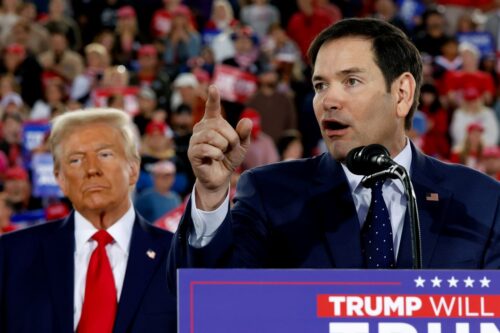
Two members of Congress who advocated for sanctions prior to Assad’s fall have since argued that easing them would “facilitate stabilization, reconstruction, international investment, [and] humanitarian recovery,” and improve “economic and financial access for ordinary Syrians.” Following Trump’s announcement, Secretary of State Rubio said that lifting sanctions would “facilitate the provision of electricity, energy, water, and sanitation, and enable a more effective humanitarian response across Syria.” He similarly told a Senate hearing that “nations in the region want to get aid in, want to start helping them, and they can’t because they are afraid of our sanctions.” Rubio here spells out how US sanctions function as a form of economic siege — they hinder humanitarian assistance and effectively isolate sanctioned countries from engaging with other nations economically and diplomatically. US Ambassador to the UN Dorothy Shea argued last month that, “The cessation of US sanctions against Syria will give the country a chance to succeed.”
It is difficult to reconcile such statements with the claim that sanctions don’t hurt civilians. If lifting sanctions will benefit the civilian population, then their imposition must have caused harm.
The dirty secret of sanctions policy is that these harms are intentional. The function of sanctions is to facilitate economic collapse. It is not collateral damage — it is the mechanism of pressure.
Occasionally, policymakers have admitted as much. A State Department memo from the inception of the embargo on Cuba suggested “denying money and supplies to Cuba, to decrease monetary and real wages, to bring about hunger, desperation and overthrow of government.” When asked about the efficacy of Trump administration sanctions on Iran, then–Secretary of State Mike Pompeo said, “Things are much worse for the Iranian people, and we’re convinced that will lead the Iranian people to rise up and change the behavior of the regime.” He spoke with similar approval of the suffering of the Venezuelan people under US sanctions — a sentiment echoed by Trump, who later gloated, “When I left [office], Venezuela was ready to collapse. We would have taken it over.”
While Trump officials have been particularly candid, policymakers in both parties regularly refer to macroeconomic factors such as GDP, oil output, foreign reserves, currency stability, and the cost of food — factors that directly affect the well-being of the entire population — as metrics of sanctions’ “success.”
Congressman Jim McGovern, a critic of many US sanctions, once remarked that, “Economic pain is the means by which the sanctions are supposed to work.” But there is a reason that few want to admit the reality of how sanctions work: because doing so would be an admission of violating international law. As dozens of legal organizations and over 200 lawyers wrote in a letter last year, the intentional targeting of civilians with sanctions amounts to collective punishment, which violates international humanitarian law and the UN Charter.
Major sanctions on Syria are on their way out. That’s good news.
But the justifications for their removal are admissions of what civil society critics and researchers have long argued: sanctions are killing the same people their advocates claim to protect. While Syria serves as a case study, this is equally true wherever there are broad economic sanctions regimes, from Cuba to Venezuela to Iran.
If sanctions depend on the suffering of civilians to function, they are not a diplomatic tool — they are a weapon of economic warfare. It is long past time to treat them as such.
Article

Article
Article