
Article • Data Bytes
Unemployment Rises to 4.6 Percent; Economy Sheds 41,000 Jobs in Oct-Nov

Article • Data Bytes
The labor market continues to weaken in the most recent jobs report, as the unemployment rate rose to 4.6 percent, the highest since September 2021. Job growth was actually negative over the last two months, but this was due to the loss of 168,000 federal government jobs. The reported loss of federal jobs should have been due primarily to an actual reduction in the workforce and not the shutdown, since federal employees still should have been on the payroll.
Over the longer period, the weakness in the establishment survey is unmistakable. Since April the economy has created just 119,000 jobs; 430,000 have been in health care and social assistance, which means everything else lost 310,000. Slower job growth is to be expected given the sharp reversal on immigration, but a pace of less than 20,000 a month since April is lower than almost any estimates of labor force growth.
Unemployment Rate for Black Workers Jumps to 8.3 Percent
Black workers tend to be hit hardest by a weak labor market and that is seen clearly in the November data. The 8.3 percent unemployment rate is the highest since August of 2021. It is 3.5 percentage points above the 4.8 percent low hit in April of 2023. By contrast, the unemployment rate for white workers has risen only modestly to 3.9 percent.
The unemployment rate for young workers (ages 20-24) did fall from the September level of 9.2 percent to 8.3 percent. It is still well above the 5.5 percent low also in April of 2023.
Unemployment of Native-Born Workers Rises
There has been considerable confusion around the employment data for native-born workers in recent months. Without getting into specifics, the levels are essentially meaningless (this will be corrected with the January data, when the BLS puts in new population controls), but the ratios do provide information.
That picture is not positive. The unemployment rate for native-born workers was 4.3 percent in November, up 0.4 percentage points from last year. The employment-to-population ratio (EPOP) was 62.8 percent, down 0.1 p.p. from last year and 0.8 p.p. from two years ago.
Unemployment for College Grads Rises to 2.9 Percent
College grads have been hit unusually hard by the weakening labor market. Their 2.9 percent unemployment rate is the highest since July 2021. By contrast, the unemployment rates for workers with just a high school degree and some college — at 4.4 percent and 3.5 percent, respectively — are down slightly from their year ago level.
Share of Multiple Job Holders Hits Highest Level This Century
The share of workers with multiple jobs rose to 5.8 percent, the highest level since December of 1999. There is always some ambiguity in looking at this figure since workers may take a second job because they have the opportunity or because they feel the need. The sharp rise in multiple job holding as other labor market measures have weakened certainly suggests the latter.
Share of Unemployment Due to Quits Falls to 11.0 Percent
Another indicator of a weakening labor market is that the percentage of unemployment due to people who quit a job before they had a new one lined up dropped to 11.0 percent. By comparison, it averaged 13.1 percent in the strong 2018-19 labor market.
On the plus side, the share of unemployment due to permanent layoffs fell from 35.8 percent to 32.7 percent. This is the lowest share since February 2023.
Involuntary Part-Time Jumps
One possible anomaly in the data was a jump of more than 900,000 in the number of people in the non-agricultural sector who report working part-time involuntarily. This would be a large jump in any case, but there was a reported drop of 91,000 in involuntary part-time for the economy as a whole, including agriculture. We will need December’s data to determine which figure is closer to the mark.
Goods Sector Is Shedding Jobs
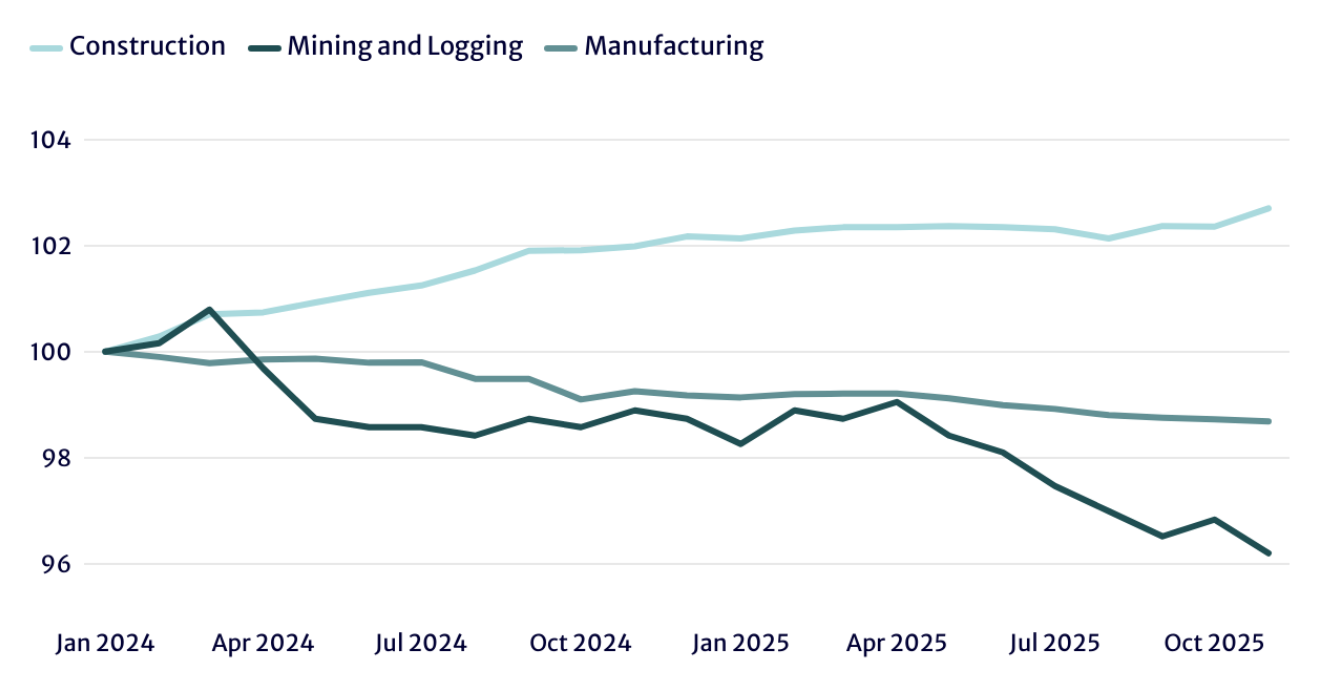
Manufacturing and the broad mining and logging sectors continue to shed jobs, losing 14,000 and 3,000 jobs, respectively, since September. Over the last year, they have lost 73,000 and 17,000 jobs, respectively. The job loss in the mining sector is just under 3.0 percent of total employment.
Construction is adding jobs, with a gain of 27,000 jobs over the last two months. Even here the growth has been weak, with the sector adding just 29,000 jobs since March, an average of 3,600 a month.
Health Care and Social Assistance Are Seeing Job Growth
The health care and social assistance category added 129,000 jobs since September, while the private sector as a whole added 121,000 jobs. This pattern goes back to April, with the private sector as a whole adding 333,000 jobs and the health care and social assistance sector adding 430,000 jobs. This means that the private sector is losing jobs outside of this sector.
The weakness is widespread. Beyond the goods producing sectors, the high-paying professional and technical services sector has added just 7,000 jobs since April. Retail has added 18,500 jobs over the last seven months. Trucking has lost 15,000 jobs over this period.
The one other sector that continues to create jobs at a healthy pace is the restaurant sector, which added 130,000 jobs since April. Employment in hotels fell by 21,000 over this period.
Wage Growth Slowed in November
The year-over-year rate of wage growth slowed to 3.5 percent in November. It had been close to 4.0 percent for most of 2023 and 2024. With inflation at 3.0 percent in the most recent data (November data are released Thursday), wages are only slightly outpacing inflation on average, and obviously many workers are falling behind.
The Labor Market Continues to Weaken
There is not much that is positive in the November report. The rise in unemployment is bad news, but the increase is still modest. But even modest rises that continue month after month are bad news. And the unemployment rate for Black workers would be a bad recession level for white workers.
The rise in involuntary part-time employment in the non-agricultural sector is concerning, as is the big jump in the number of multiple-job holders. That is consistent with the weakening of wage growth, as well as the low share of unemployment due to quits.
The lack of job growth outside of the health and social assistance category is also evidence of a struggling economy. The economy can make unexpected turns, but for now it looks to be on a downward track.
Article

Article

Article

Article

Article

Article

Article

Article