
Article • Expose the Heist: Power and Policy in Unprecedented Times
Privatizing the Post Office: A Terrible Idea That’s Still On the Table
Article • Expose the Heist: Power and Policy in Unprecedented Times
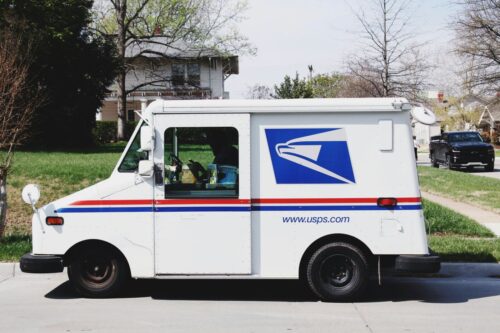
As soon as the second Trump term got underway, administration officials were raising the idea of privatizing the US Postal Service. While they’ve yet to make any formal moves in that direction, if we take Elon Musk at his word – “I think we should privatize the Post Office… We should privatize everything we possibly can”– it’s reasonable to assume that this bad idea still might be in play. This would be bad news for postal workers, would increase prices and decrease service, and would fundamentally undermine the very mission of the Postal Service.
The ominous privatization signs were especially notable in February, when there were reports that Trump would dismantle the governing board and place the agency under the control of the Commerce Department. That order never arrived, though Trump nonetheless described the Postal Service as a “tremendous loser for this country.”
Suspicions about privatization increased when a Wells Fargo memo laid out some possible scenarios, describing a “tricky but possible” path that would lead to “better parcel pricing” – a euphemism for massive rate hikes. The memo focused on selling off the more profitable parts of the service (“carved out and sold or IPOed”), and estimated that the value of the USPS’s real estate could be $85 billion. Even some sort of ‘partial privatization’ approach would amount to a massive transfer of public services to private hands.
Given the keen interest that Musk’s Department of Government Efficiency (DOGE) project has shown for slashing jobs, it’s not hard to imagine they would find the Postal Service an appealing target. And those cuts would almost certainly have a disparate racial impact, since many of the over 600,000 workers employed by the USPS are black. As a CEPR analysis found: “From 2017 to 2019, 26.8 percent of Postal Service workers were Black, compared to 11.5 percent of the private sector workforce during this time period. This means that Postal Service workers are more than twice as likely to be Black as workers in the private sector.”
The whole notion of privatizing USPS is not new, of course; it got a big push in the first Trump administration, before they ran into substantial public and political opposition.
At the time, CEPR challenged many of the core arguments in support of privatization – and those issues remain front and center now. For example, some argue that the largely privatized systems in Europe might indicate that this would be good policy. But as CEPR pointed out in 2018, it was not a model to emulate – what followed were job losses, price hikes and a diminished level of service.”
A 2020 CEPR report by Max Sawicky (“The US Postal Service Is a National Asset: Don’t Trash It”) takes a deeper look at the history of the Postal Service, and argues that much of the privatization talk is based on a totally flawed premise – namely, that it should ‘pay for itself’:
The bane of a thriving postal service is the principle that it should be self-financing. In other words, that its operations should be limited by the costs it can defray from the sale of stamps and the like directly to customers. Self-financing fundamentally undermines the USPS’s historic mission of serving every community in the nation, the traditional “universal service obligation” (USO) mandate that is a matter of federal law.
This idea that USPS should stand on its own financially speaking runs counter to the mission of basic, universal service for all, and would have broad repercussions :
A self-funding mandate would be the death knell of universal service, of particular importance for rural and low-income areas. It would entail the elimination of less-used postal facilities and more costly delivery routes (especially in Alaska and Hawaii). It would bring cutbacks in hours of operation, the end of weekend delivery, the end of uniform pricing (triggering increases for households and business firms in rural areas), and a reduction in labor standards that would have ripple effects for other workers.
The Postal Service operates as a public good; concepts like universal service and a consistent pricing structure would make no sense if it were a profit-seeking business, and these are the features that give rural, underserved areas the same level of service as dense, urban ones. Any privatization schemes would likely impact rural areas the most – which is one of the main reasons it remains politically unpopular.
So how serious is the current privatization threat? An unnamed senior White House told the Guardian recently that it “is not considering privatization,” but added that “DOGE is actively assessing ways to cut waste, fraud and abuse while eliminating the presence of DEI [Diversity, Equity and Inclusion] in the USPS.”
That is essentially the same rationale that has been used to justify all of DOGE’s efforts to slash jobs and eliminate vital public services across the government. So while it might not be called “privatization” per se, it still poses substantial risks – especially to postal workers, small businesses that rely on the postal service, and rural communities that would be most heavily impacted.
Article

Article
Article

Article
Article

Article
Article

Article