
Article • Expose the Heist: Power and Policy in Unprecedented Times
The Art of the Underwhelming Drug Deal
Article • Expose the Heist: Power and Policy in Unprecedented Times
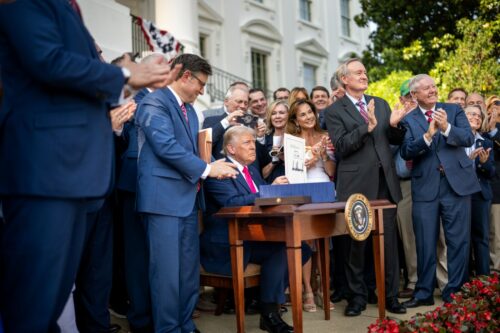
A big celebration is not the same as a big accomplishment. President Donald Trump, Health and Human Services (HHS) Secretary Robert F. Kennedy Jr., and several other administration officials held a press conference last Tuesday on their latest move to lower drug prices.
They correctly pointed out the massive discrepancy in prices that Americans pay for drugs compared to those in other countries. In 2022, Americans paid roughly three times more for the same prescription drugs as paid in the other 38 countries in the Organisation for Economic Co-operation and Development. Different estimates show that two-thirds to three-fourths of global pharmaceutical profits come from the US alone even though Americans account for just 8 percent of global volume.
Earlier this year, the president signed an executive order directing HHS “to bring prices for American patients in line with comparably developed nations.” The mechanism the order cites to lower prices is Most-Favored-Nation (MFN) pricing. In simple terms, the price for a drug in the US would have to equal or be lower than the lowest comparable price for the same drug among a group of peer nations.
While the idea behind the order certainly is great for Americans wanting to pay lower drug prices and for the overall effort of lowering health care costs, Congress has not passed legislation granting the government power to set prices across the board.
In other words, the executive order does not automatically grant the president the right to immediately lower drug prices. Rather, the order directs HHS to set pricing targets, meaning that compliance by pharmaceutical companies is completely voluntary.
The Trump administration’s current approach is to directly negotiate with individual companies to voluntarily lower prices in a limited manner. The Tuesday press conference showcased the first negotiated agreement between the government and Pfizer.
Under this voluntary agreement, Pfizer agreed to a variety of terms, such as planning to invest $70 billion to “research, development, and capital projects” in the United States – an effort aimed to reshore manufacturing of drugs in the US rather than making them abroad.
For lowering drug prices, the deal says that Pfizer would charge MFN prices to the Medicaid program specifically. This measure should save taxpayers money; however, it does not affect Medicare – which spends more on prescription drugs – or the majority of all Americans who have another form of insurance or no insurance.
Additionally, the deal includes a direct-to-consumer program, where Pfizer would sell drugs directly to Americans at MFN prices. However, the vast majority of Americans have drug coverage through private insurance, Medicare, or Medicaid. Only Americans without insurance coverage or those who choose to buy a drug without involving their insurer – there can be cases where this saves money, such as the insurer doesn’t cover the drug in question – would benefit from the direct-to-consumer purchasing program.
Furthermore, even for applicable situations, the out-of-pocket cost burden on Americans would still likely be much higher than in other countries, as other nations have universal health coverage, so individuals are predominantly not paying the full cost. Without insurance, a lower MFN price for an expensive drug, such as a cancer medication, could still leave everyone other than the wealthy priced out of receiving essential medications.
While this specific deal only pertains to Pfizer, the administration has made it clear that it is negotiating with other companies as well. Even though the pharmaceutical industry has consolidated over the last several decades, there are still thousands of companies, and more than 40 with a market capitalization of over $1 billion. So, it is unclear how many companies and drugs the administration’s strategy will affect.
The longevity of Trump’s deal with Pfizer and any future deal is also in question. The administration used the threat of tariffs against Pfizer to get the company to agree to the deal – as admitted by Pfizer CEO Albert Bourla during the Tuesday press conference. If future administrations do not share President Trump’s enthusiasm for using tariffs as a negotiating tool, nothing publicly stated shows that the deal prevents Pfizer or other companies from voluntarily exiting the limited MFN framework just as they voluntarily entered it.
Future administrations are not bound to set MFN pricing targets as President Trump has only issued an executive order. When Representative Ro Khanna (D-CA) introduced legislation with both Republican and Democratic cosponsors to simply codify the EO into law, Republican leadership chose not to include the bill in the large “One Big Beautiful Bill” signed into law in July.
Senators Josh Hawley (R-MO) and Peter Welch (D-VT) introduced the Fair Prescription Drug Prices for Americans Act in May which would actually institute civil monetary penalties for companies that fail to lower their drug prices to MFN targets. Congress has not seriously debated or considered the bill.
Aside from the extremely limited nature of the negotiated deal between the Trump Administration and Pfizer, the entire discourse from the government leaves out the reason other countries pay far less than the US for the same products: they negotiate drug prices for the population at large.
Other nations with universal health care systems negotiate drug prices with manufacturers with either the government directly doing the negotiating or heavily regulated institutions like the German Federal Association of Sickness Funds doing it. These negotiations set mandatory price ceilings for drugs.
In comparison, Congress in 2003 explicitly barred Medicare from directly negotiating drug prices with manufacturers. One of the Biden administration’s signature accomplishments was a very limited drug negotiation program scheduled to take effect in 2026 for a limited set of 10 medications, a number that gradually increases year over year. Even though these negotiations lowered drug prices, Medicare still will pay an estimated 78 percent more than the next highest price among 11 other wealthy countries.
While the press conference highlighted a desire to lower drug costs, Republicans in the federal government have attacked and sought to repeal the limited drug negotiation program that lowered prices in the Medicare program. In fact, the “One Big Beautiful Bill” increased the number of drugs exempt from such negotiations.
Ironically, while President Trump is pursuing an MFN-type model, other countries also use the prices of peer nations. However, rather than setting voluntary price targets, these countries use these prices in their drug negotiations.
Moreover, as CEPR has repeatedly pointed out, neither an MFN system nor drug negotiations address the root cause of high drug prices: the patent system.
The free market alone fails to protect innovators: if a company spends billions researching and developing a new drug, their competitors could just produce their own generic version without making the same investment. Thus, the government has chosen to institute a particular major intervention: government-enforced patent monopolies.
Patents reward drugmakers with years of monopoly pricing power – the ability to set arbitrarily high prices for their products without the threat of competition. While patents eventually expire, this process delays generic competition and lower prices for years. Additionally, companies often engage in the practice of evergreening or making minor modifications to their products to extend patent protection from competition.
Patents may solve the problem of drugmakers not having sufficient financial incentive to research, develop, and manufacture innovative products, but they leave patients and taxpayers to pay exorbitant prices. These prices do not reflect the cost of making a drug; rather, they demonstrate how each company can maximize profit without facing competition.
High monopoly prices similarly are not necessary to recoup the cost of research and development, as large pharmaceutical companies have spent more on marketing their products than on R&D. Additionally, top companies have even spent more on paying dividends and buying back their own stock than research and development.
The patent system is not the only way to reward innovators. CEPR’s Dean Baker has proposed a direct contracting model where the federal government directly contracts with companies to research and develop new drugs. That payment provides the reward for innovating upfront, and the medications would face competition immediately after the Food and Drug Administration (FDA) deems them safe and effective enough to go on the market. This public-contracting model could compete with rather than replace the patent system.
Senator Bernie Sanders (I-VT) and former Representative Dennis Kucinich (D-OH) have separately introduced legislation of different versions of a prize fund system. In this model, the government rewards innovators for their drugs with direct payments based on criteria for improving public health, such as significantly improving upon existing methods of treatment and/or addressing rare diseases. As with direct contracts, drugmakers would not get monopoly pricing power.
Both the direct contracting and prize fund models involve significant government action. However, the patent system itself is a major government intervention in the market where the penalty of the law prevents any competition for years, granting monopoly pricing power to drugmakers. Thus, the debate over these three systems or any other method of paying for medical innovation is not about whether the government should intervene but what method produces the best results for the American people.
Ultimately, the Trump Administration’s deal with Pfizer and potential future deals with other companies will have some positive impact on drug prices, however limited that impact may be. Yet, in the context of a nation that spends far more than any other country on prescription drugs, Americans should ask why that discrepancy exists in the first place and why the US doesn’t systematically negotiate drug prices. Americans should also question why the government employs an MFN policy that is completely voluntary for drugmakers and why Congress has not passed legislation to simply put President Trump’s executive order into law.
Most of all, however, Americans should ask whether the patent system of government-enforced monopolies is the best method to reward innovators, or if there are other ways to reward drugmakers without price gouging patients.
Article

Article
Article

Article
Article
Article
Article

Article