

Article
As Iran War Rages, Washington Opens a New Front in Ecuador
The Trump administration has joined the Ecuadoran government’s military campaign against so-called “narco-terrorists.
Mar 13, 2026
Article
The Trump administration has joined the Ecuadoran government’s military campaign against so-called “narco-terrorists.
Mar 13, 2026
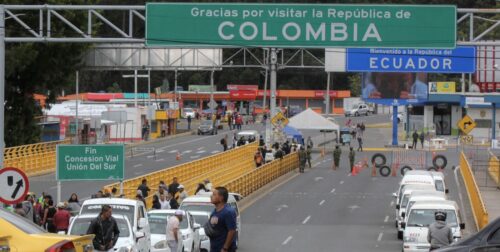
Article • Ecuador News Round-Up
Feb 20, 2026

Article
Jan 23, 2026
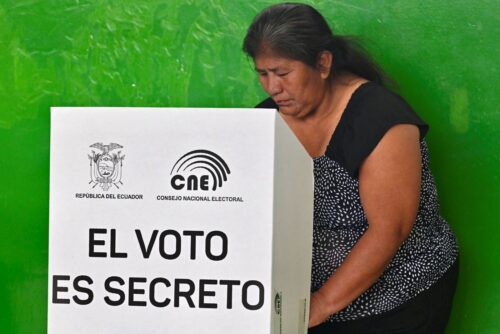
Article
Dec 4, 2025

Article • Ecuador News Round-Up
Nov 13, 2025
“The territory of a State is inviolable; it may not be the object, even temporarily, of military occupation or of other measures of force taken by another State, directly or indirectly, on any grounds whatever.” – Article 21, Charter of the Organization
A group of Latin America scholars have taken issue with the supposed “irony” of Edward Snowden’s requests for asylum in Ecuador, and acceptance of asylum in Venezuela. The authors debunk what they say “has become a media meme” that it is “ironic” that a whistle-blower and free press advocate like Snowden would seek asylum in those countries. The authors point out, “most media outlets in Ecuador and Venezuela are privately-owned, and opposition in their orientation.”
The letter also offers important context and corrections of reports that seem to discredit the governments of Ecuador under President Rafael Correa of Ecuador and Venezuela under Hugo Chávez (and now Nicolás Maduro), which “contribute to a climate of demonization that enables U.S. aggression against those countries and damages relations between the people of the U.S. and our foreign neighbors.” While the media contacts for the letter say they have received few responses from the reporters and editors to whom they sent the letter, it has received some attention, with Chicago Public Media station WBEZ interviewing Ecuador expert Steve Striffler (at 22:30) on their “World View” program yesterday and posting an article about the letter on their site here.
Here is the full text:
The supposed “irony” of whistle-blower Edward Snowden seeking asylum in countries such as Ecuador and Venezuela has become a media meme. Numerous articles, op-eds, reports and editorials in outlets such as the New York Times, the Washington Post, the Wall Street Journal, NPR, and MSNBC have hammered on this idea since the news first broke that Snowden was seeking asylum in Ecuador. It was a predictable retread of the same meme last year when Julian Assange took refuge in the Ecuadorian embassy in London and the Ecuadorian government deliberated his asylum request for months.
Of course, any such “ironies” would be irrelevant even if they were based on factual considerations. The media has never noted the “irony” of the many thousands of people who have taken refuge in the United States, which is currently torturing people in a secret prison at Guantanamo, and regularly kills civilians in drone strikes in Afghanistan, Pakistan, Yemen, and other countries. Nor has the press noted the “irony” of refugees who have fled here from terror that was actively funded and sponsored by the U.S. government, e.g. from Nicaragua, El Salvador, Chile, and other countries.
Rory Carroll has been reporting on Ecuador and the Snowden case for the Guardian, but not without serious criticism. Most outrageous was the headline on his most recent article, which may have not been the reporter’s doing: Rafael Correa not considering Snowden asylum: helping him was a ‘mistake.’

This is of course very misleading; Correa made it clear in his interview that providing travel documents was a “mistake,” since this is not Ecuador’s responsibility; and that he would consider asylum for Snowden if Snowden was in Ecuadorean territory. The headline tells the reader that Correa has abandoned Snowden, but anyone who reads it can see that if Snowden arrived at an Ecuadorean embassy, his application for asylum would be seriously considered, and very likely granted.
The Guardian has since corrected the headline.
Correa himself criticized Carroll’s reporting on the interview, saying:
Mis declaraciones para The Guardian totalmente descontextualizadas. Felizmente tenemos grabado. ¡A no caer en la trampa de los de siempre!
— Rafael Correa (@MashiRafael) July 3, 2013
Translation: “My statements for The Guardian totally decontextualized. Fortunately we have it taped. [We are] to not fall into the same trap of the very same as always!”
Al Jazeera English: Even the world’s most powerful media and Intelligence apparatus can’t always control public opinion.
The Guardian: This country has already been dragged through the mud for sheltering Julian Assange, and it is willing to stand up to the US.
Dozens of actors, directors, authors, former whistle-blowers, musicians, journalists, and activists have signed onto a letter addressed to President Correa urging him to grant political asylum to Edward Snowden. As Popwrapped! has noted, the many famous s
As we noted yesterday, there has been a chorus from policymakers, media outlets, and others urging a cutting of U.S. trade preferences for Ecuador if the Ecuadorean government grants Edward Snowden political asylum – despite that one of the main goals of the Andean Trade Promotion and Drug Eradication Act (ATPDEA) is to reduce coca cultivation. As the Wall Street Journal reported today, Senate Foreign Relations Committee Chair Robert Menendez issued a stern and patronizing warning to Ecuador:
“Our government will not reward countries for bad behavior,” said Mr. Menendez in a news release. If Ecuador grants Mr. Snowden asylum, Mr. Menendez said he would lead the effort to cut Ecuador’s duty-free access to the U.S. market. “I urge President [Rafael] Correa to do the right thing by the United States and Ecuador, and deny Snowden’s request for asylum.”
But now the Ecuadorean government has ruined Congress’ fun by giving up the ATPDEA benefits before Senator Menendez et al had a chance to take them away. The move is not merely symbolic. Before the whole Snowden issue came up the government of Ecuador and its embassy in the U.S. launched a large campaign to emphasize the importance of the ATPDEA, with events around Washington and ads like this one in the D.C. Metro:

| Amnesty International Condemns Violations of Snowden’s Human Rights By U.S. Government |
7/2/2013
|
In an important development today, Amnesty International stated that “The US authorities’ relentless campaign to hunt down and block whistleblower Edward Snowden’s attempts to seek asylum is deplorable and amounts to a gross violation of his human rights.”
This is significant because the international press coverage of the Snowden drama has almost completely ignored the question of whether Snowden’s rights are being violated by U.S. efforts to prevent him from seeking asylum under international law.
It will be interesting to see if any of the major media outlets covering these events will report on this important and apparently well-grounded legal argument, given that they have reported on the Obama administration’s arguments that countries are legally obligated to hand Snowden over to the United States. Also, Amnesty International is one of the most important human rights organizations in the world, and its statement should be relevant to news reporting on the Snowden case.
Read the full Amnesty International statement here.
| Snowden’s Revelations Go from Being a “Serious Breach” to Not “Significant” as Obama Administration Shifts Message |
7/2/2013 |
As we have previously noted, the Obama administration has reversed course, seeking to lower the profile of the Snowden case after its threats against Russia, Ecuador, and Hong Kong backfired and after apparently realizing that public support for Snowden remains high despite a U.S. government-led effort to demonize him in the media. This has resulted in a litany of mixed messages from senior administration officials.
Is the Obama administration simply disorganized, or has the strategy changed over time as information about the Snowden case and government surveillance reaches wider and wider audiences? Also, what is the overall strategy of the government as an international effort develops to protect the right to privacy and the right to asylum? We try to answer some of these questions here.
| Gentlemen Don’t Read Each Other’s Mail |
7/1/2013 |
A reporter went after State Department Spokesman Patrick Ventrell at the State Department’s Daily Press Briefing today about European anger in response to Snowden’s revelations of U.S. surveillance of European officials and citizens. Here we will quote at length because the exchange was amusing and revealing:
QUESTION: When discussing this issue, the – with the Europeans or others who might be upset or are saying that they’re upset, the U.S. position is that all countries engage in intelligence gathering and this shouldn’t come as a surprise to you?
MR. VENTRELL: Again, I’m not going to get into the content of that diplomatic exchange, other than to say that we’re going to have it very directly and privately with the countries concerned.
QUESTION: But —
QUESTION: Change topic?
QUESTION: Hold on, I’m just – but you’re not admitting any wrongdoing, though?
MR. VENTRELL: I didn’t say that. I said we’ll have our —
QUESTION: I know. I want to make sure that I understand, when these conversations happen, you’re not saying, “Oh, sorry.”
MR. VENTRELL: Again, I’m just not going to characterize —
QUESTION: You’re not – you’re explaining what you do, and you’re saying, “This isn’t unusual and you probably do it as well.”
MR. VENTRELL: To take the lens back a little bit, I think a number of these countries are countries we have a very strong relationship with on a number of fronts —
QUESTION: Or you did, at least, have a very strong relationship with.
Various U.S. media outlets suggest ulterior motives for why Ecuadorean president Rafael Correa may want to consider granting political asylum to whistle-blower Edward Snowden. The Christian Science Monitor, for example, writes “In championing Snowden, Pre
Bloomberg’s Nathan Gill wrote a particularly one-sided article on Thursday, in which he states that “Ecuador’s bid to reduce poverty by taxing its banks is threatening to deepen the nation’s economic slump.”
“Slump” seems somewhat dire to describe the state of the Ecuadorian economy. In 2012 the economy grew by 5 percent, and it is projected to grow by 4.45 percent for 2013.
The report also offers no convincing evidence that Ecuador’s taxation of its banks is hurting the economy.
The article specifically focuses on a set of reforms that took effect on January 1, including the elimination of banks’ tax deductions for reinvested profits and a 0.35 percent tax on assets held abroad. The reporter argues that a sharp drop in bank profits in the first quarter of this year was a result of the taxation. He then argues that an increase in the banks’ interest rates must also be due to the reforms:
Non-government banks, including Citigroup Inc (C).’s local unit, raised rates on corporate loans by an average 0.21 percentage point in the first quarter to 8.88 percent, the highest since November 2010, according to central bank data. That compares with a decline of 0.72 percentage point to 8.81 percent in Colombia and an increase of 0.01 percentage point to 5.79 percent for similar loans in Peru.
However, this causality is not at all clear. It is more likely that this modest increase in interest rates is attributable to a recent uptick in inflation. Consumer prices increased at an annualized rate of 4.6 percent in the first quarter of this year, as compared to a rate of 0.2 percent in the last quarter of last year.