Article • Dean Baker’s Beat the Press
Trump’s United States as Number Three
Article • Dean Baker’s Beat the Press
Donald Trump has problems with most things, including arithmetic. In addition to imagining his tiny victory margin in 2024 was a landslide (it was smaller than Hillary Clinton’s margin in 2016), he also keeps saying the US has the biggest economy on earth.
That has not been true for more than a decade, as the size of China’s economy exceeded the size of the US economy by the middle of the last decade. China’s growth has continued to outpace growth in the United States. For the current year, its GDP measured in purchasing power parity terms is projected by the I.M.F. to be $44.2 trillion, almost 40 percent larger than the $31.8 trillion GDP of the United States.
Western Europe, taken as a block, is also considerably larger than the United States. The European Union, plus the United Kingdom, Switzerland, and Norway, has a GDP of $36.3 trillion.
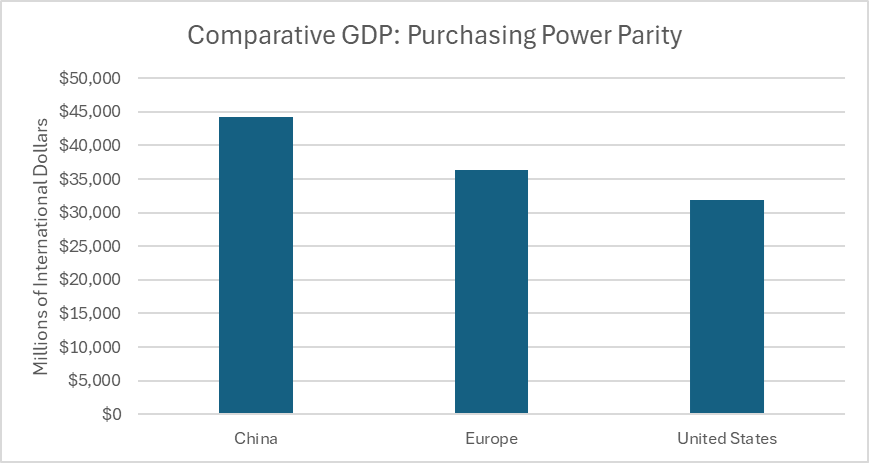
These numbers are not important just for a macho measuring exercise. They indicate the extent to which the United States has the ability to influence other countries through its economic power.
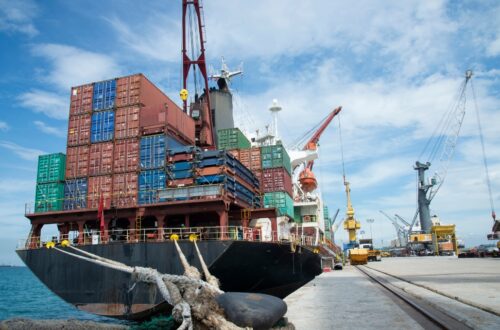
Donald Trump has often exaggerated his power in this area, most notably when he threatened China with triple digit tariffs. The prospect of a virtual embargo on trade with China terrified many US retailers and manufacturers dependent on Chinese intermediate goods. In addition, the prospect of a boycott of soybean purchases, along with restrictions on rare earth exports from China, sent Trump running back to negotiate a peace deal.
Similarly, the 50 percent tariffs Trump imposed on Brazil’s exports — because they prosecuted his friend for trying to overthrow the government — didn’t last long. When Trump realized that this tax was pushing up the price of coffee and other items here, he rolled back his tariffs.
Trump has hoped to get European countries to negotiate individually, rather than as a block. While he has had limited success in this effort, his invasion of Venezuela, followed by threats to invade Greenland, will likely provide a boost to collective action. Under Trump, the United States has moved from being a trusted NATO ally to a potential enemy.
In this respect, it might be appropriate to compare the size of the US economy to the economy of what used to be called the “free world,” minus the United States. In addition to the GDP of Europe, it would be appropriate to add the $6.9 trillion GDP of Japan, South Korea’s $3.5 trillion, Canada’s $2.8 trillion, and Australia’s $2.1 trillion GDP.
Taken together, the GDP of these countries comes to $51.6 trillion, more than 60 percent higher than US GDP. With Trump openly threatening countries around the world, these countries have considerable incentive act together. It is probably also worth adding in Brazil, another major country committed to democracy with a GDP of $5.2 trillion, as well as Mexico with a GDP of $3.6 trillion. That would bring the total to $60.4 trillion, nearly twice the size of the US economy.
It is also worth mentioning India with a GDP of $19.1 trillion. Its commitment to democracy is perhaps somewhat more ambiguous than the other countries on this list, but it is also a major economic power that cannot be expected to follow orders from Donald Trump. Adding in India, gets to $79.5 trillion, more than two and a half times the size of the US economy.
The long and short is that if the countries committed to democracy (sorry, I know I left out some) act collectively, they can easily deal with the economic threats posed by Donald Trump and, in time, potential military threats. The “if” that goes along with acting collectively is a huge qualification.
Ordinarily, the old line about herding cats would apply here, but a government that claims it can do anything it has the military force to do can help focus minds. Hitler managed to bring together Churchill, Roosevelt, and Stalin. Trump may have a comparable effect in uniting the world today.
Article
Article
Article
Article

Article
Article

Article
Article