Article • Dean Baker’s Beat the Press
Citizens United, Buckley v. Valejo, and Media Ownership: Turning Money into Power

Article • Dean Baker’s Beat the Press
The New York Times had an interesting piece marking the 50th anniversary of the Buckley v. Valeo Supreme Court ruling. This ruling effectively prohibited Congress from restricting the amount of money rich people could spend on elections. While Congress could limit their donations to specific candidates, it could not prevent the rich from spending as much as they want to get their favored candidates elected.
As the piece notes, this decision is far more important than the more widely known Citizens United case. That case allowed corporations to spend money supporting candidates or referendums. While many progressives rightly object to this decision, the issue is far less important than the ruling in Buckley v. Valeo.
From the standpoint of rich people, having corporations contribute directly to support political candidates is a convenience, sort of like Internet shopping. I can now buy coffee online, but I will still be able to get coffee if online sales were banned.
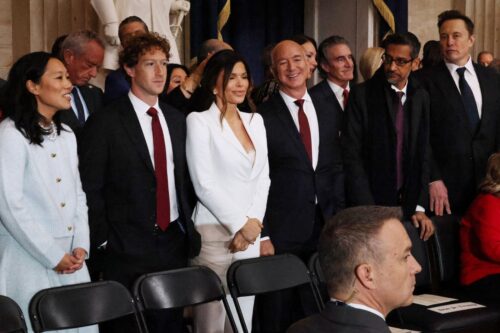
It’s the same story with rich people and corporate contributions. It might be somewhat easier for the rich to influence elections through the corporations in which they are shareholders than to do it directly with their own contributions. But banning corporate contributions will not prevent the rich from having a ridiculously outsized influence on elections, as Elon Musk so vividly demonstrated in the 2024 election.
It would be a real tragedy if progressives somehow managed to overturn Citizens United through a constitutional amendment or some other means, with the enormous effort this would take, only to see a parade of rich people following in Elon Musk’s footsteps.
The problems here go even deeper. Suppose, through some miracle, we are able to reverse not only Citizens United, but also Buckley v. Valeo. This would mean that not only can Congress ban corporate contributions in support of political campaigns, it could also limit the money that Elon Musk and his ilk can spend in support of candidates.
If anyone thinks this solves the problem of the rich dominating politics, think more carefully. Is it going to be illegal for rich people to own newspapers, television and radio stations, or social media platforms? If not, then there is nothing to stop the rich from using their control of these media outlets to push their political views on the public.
In this scenario, Congress will have effectively limited the ability of rich people to buy ads telling everyone to vote for a future version of Donald Trump, but they will not have prevented them from owning media outlets that tell people 24-7, between the ads, that they need to vote for this future version of Donald Trump, or we won’t have a country anymore.
If that sounds far-fetched to anyone, spend a few minutes watching Fox News. Or look at some of the Republican propaganda coming from CBS News now that it is controlled by Trump-friend Larry Ellison. We also have the massive social media platforms, X, Meta, and now TikTok, all controlled by right-wing allies of Donald Trump. And they use their control to push right-wing content and bury material from the left.
It is bizarre to imagine that campaign ads purchased by the rich will affect how people vote, but all the material people see between the ads doesn’t. Even if, through some political miracle, we can manage to restrict the amount of money rich people can spend on campaigns through direct contributions, and indirectly through superPACs and related entities, they can get around our efforts to limit the impact of money in politics by just taking control of the media, as they are already doing.
Attacking the power of the rich by reversing Citizens United or limiting spending in other ways may be useful as a feel-good exercise, but it will not fundamentally affect the balance of power. The rich will not agree to be as stupid as we might want them to be. If we close off one channel for them to use their money, they will just find another one.
We can say the moral of this story is that gross inequality in wealth and income leads to gross inequality in political power, which is true, but not very helpful. With the rich controlling the terms of debate, we are not going to be able to pass measures that directly attack their vast wealth.
But we can look to measures that incrementally boost the power of the not-rich. These do exist.
A great place to start is the sort of public financing measures that several states and cities have put in place. For example, New York City has a “super-match” campaign finance system, where small contributions up to $250 can be matched by a public contribution 8 times as large. This allows a candidate to accrue a respectable campaign budget even with little or no support from wealthy contributors.
Seattle has carried this even a step further, with democracy vouchers. The city allots two $50 vouchers to each voter to be used on the candidate of their choice. This allows people who feel they can’t afford even a small donation to contribute to a candidate.
It is possible to do the same thing with the media. There have been proposals in Seattle, DC, and elsewhere to allocate some amount of media vouchers, which are effectively tax credits, to allow people to support the local news outlets of their choice. These tax credits, say $100 per person, could support a vast amount of journalism that would not be answerable to the whims of rich people.
The system would be comparable to the deduction for charitable contributions in the current tax code. The difference is that everyone could get the tax credit, and it would be the same for everyone. Currently, the 90% of taxpayers who take the standard deduction get nothing from the charitable contribution deduction. And for those who do itemize, the deduction is worth much more for rich people in a higher tax bracket. With the case of a journalism tax credit, everyone would get the same $100, or whatever sum is decided upon.
The conditions for receiving it would be comparable to qualifying for tax-exempt status now. When a church or think tank applies to the I.R.S. for tax-exempt status, they simply tell the I.R.S. what they do. The I.R.S. doesn’t make an effort to determine if they are a good church or think tank, just that the organization is in fact what it claims to be. This should get around concerns about government interference with the freedom of the press, or at least raise no more concerns than the charitable contribution tax deduction does.
Local news may sound small-bore, it would be great to have this sort of credit nationally, but that is not likely to happen in the near future. We have to try to make advances where we can. It’s also important to remember that local news outlets can act collectively to have a national impact. That is the point of AP (originally Associated Press), which produces national and international news and makes it available to local news outlets.
The other worthwhile step on the media is to try to prevent mergers that would make it still worse. For example, stopping the proposed takeover of Warner, which owns CNN, by Trumper Larry Ellison’s Paramount, which owns CBS, is important. Also, it is important to stop the merger of Nexstar and Tegna, two huge media groups whose combination completely shatters longstanding Federal Communications Commission rules on concentration in broadcast television.
Similarly, the control of the huge social media platforms by Trump-friendly oligarchs is an incredible threat to democracy. An inherent problem with social media is that it tends to produce concentration. This is because of network effects. Everyone wants to be on Facebook or TikTok because everyone is on Facebook and TikTok.
It is not easy to combat these effects, but it is necessary to try. One possible mechanism would be to revise Section 230, the law that gives social media platforms immunity for harm caused by the third- party content it carries. This means that Elon Musk can’t be sued for hyping lies about people he doesn’t like on X.
That contrasts with the laws governing broadcast and print media. They are liable for third party content. The famous Times v. Sullivan case, which established the rules on defamation of public figures, was over an ad carried by the New York Times, not any of its own content.
Fox News was forced to pay $787 million to settle a defamation suit filed by Dominion over false claims that it rigged the 2020 presidential election. The suit charged Fox with carrying defamatory material, not necessarily producing it themselves. There could be no similar suit against Elon Musk or Larry Ellison for wholesaling defamatory material on their social media platforms.
I have suggested that Section 230 could be altered to have a take-down requirement, similar to what the Digital Millennium Copyright Act requires with alleged copyright infringement. Section 230 protection could remain in effect for platforms that do not rely on selling advertising or personal information. This would give smaller platforms, operating on a different model (subscriptions or donations), an advantage over the giant Trumper platforms.
Perhaps this is not the best way to downsize the giant social media platforms, but we really do need to be discussing how this can be done. Anyone who isn’t interested in that conversation doesn’t care about the excessive political power of billionaires because their control of these platforms is a major way in which they exercise it.
Finally, progressives need to take defamation law seriously. There seems to be a view that pressing a defamation suit is somehow gauche, even when a right-wing politician or media figure has made an assertion that is clearly false and defamatory.
Pursuing a defamation suit in such cases is not a matter of personal vanity. It is a public service. The Dominion lawsuit against Fox News was an enormous public service. In addition to many damning e-mail exchanges that were revealed in discovery, the $787 million settlement was effectively an admission by Fox that it spread lies about the 2020 election being stolen from Trump. It was great that Dominion was able to pocket $787 million in the deal, but it probably would have been worth paying $787 million to get this sort of admission from Fox.
Trump and other Republicans regularly make all sorts of absurd allegations against Democrats and progressive political figures. Many are obviously false and clearly damaging insofar as anyone believes them. It would be a great public service to force them to acknowledge they are spouting lies, and if they are forced to cough up some bucks in the process, it can be used to support progressive media.
Okay, this is a long trip from the excessive political power of the rich to defamation law. It’s a bit like a Simpsons episode. (One of my favorites went from a strike by supermarket workers to uncovering Jane Goodall running a diamond mine with slave chimpanzee labor.) But we have to start thinking differently if we want to be serious about challenging the billionaire’s grip on political power. Their outsized power is the reality, and they are horrible people, but saying this over and over will not change this reality. Maybe we all need to spend some time watching The Simpsons.
Article

Article
Article

Article

Article
Article
Article
Article