Article • Dean Baker’s Beat the Press
Everyone Knows Campaign Spending Influences Elections, Why Don’t They Understand the Media Do Also?

Article • Dean Baker’s Beat the Press
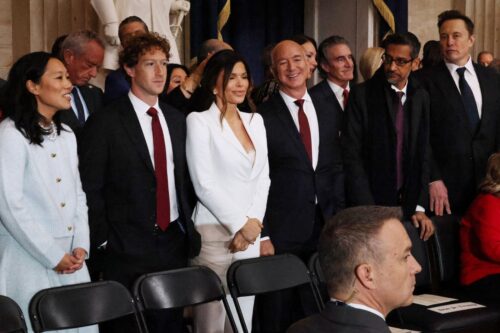
It is pretty much accepted wisdom that campaign spending affects elections — and in a context where billionaires have almost unlimited money to spend supporting the candidates they favor, this is a major factor corrupting democracy. This has led to many efforts to limit spending, even though the Supreme Court decision in Citizens United makes this a major uphill battle.
However, billionaires don’t just influence elections with the money they spend on campaigns. They also influence money with the media they own. This is most apparent with openly right-wing outlets like Fox News, but it also matters with more mainstream outlets. These outlets are run for profit. They do not want to offend major advertisers who pay the bills. This often means going easy in reporting in areas that could upset major advertisers, such as reporting on global warming.
There is also an issue of class solidarity. The rich people who own and control major media outlets are likely to see the world in a way that is similar to other rich people. If that sounds conspiratorial, imagine that all the people who owned and controlled media outlets were officers in labor unions. Most people would likely think this would have an impact on coverage.
Are we supposed to believe the rich are different? That seems hard to buy. It seems reasonable to think that the rich people who own media outlets think like other rich people.
We have seen the impact of the profit motive clearly in the Trump era. ABC and CBS both settled absurd lawsuits from Donald Trump — not because they were seriously worried about losing, but because they wanted to effectively bribe him for better treatment. This is an extreme case, since most politicians won’t so blatantly use the power of the government to punish political enemies. But it does show clearly that when there is tension between the bottom line and honest reporting, the bottom line wins out.
The need for better, fairer reporting to have honest elections should be evident to anyone concerned about the rich buying elections with campaign contributions. It is absurd to imagine that what people hear in the campaign ads purchased by the rich affects their votes, but what they see and hear between the ads somehow doesn’t matter.
There are many progressives who seem to hope for a rich savior. They seem to believe that a beneficent billionaire will fund a major television network or news operation. It’s always great news when a rich person does something for the good of society, but laying bets on this is not a good political strategy. We can do better.
We just saw Trump and the Republican Congress strip public broadcasting of the funding they had promised it. That is unfortunate, but at the end of the day this may prove to be a good thing. If the federal government had continued to support public broadcasting, Trump likely would have put himself in charge (you think the Supreme Court would have stopped him?) and we would have yet another MAGA news outlet.
There is a simple alternative to direct government funding, which some of us have long advocated. We can have individual tax credits designated to support media outlets. These tax credits, say $100 per person, could support a vast amount of journalism that would not be answerable to the whims of rich people.
The system would be comparable to the deduction for charitable contributions in the current tax code. The difference is that everyone could get the tax credit, and it would be the same for everyone. Currently, the 90 percent of taxpayers who take the standard deduction get nothing from the charitable contribution deduction. And for those who do itemize, the deduction is worth much more for rich people in a higher tax bracket. With the case of a journalism tax credit, everyone would get the same $100, or whatever sum is decided upon.
The conditions for receiving it would be comparable for qualifying for tax-exempt status now. When a church or think tank applies to the I.R.S. for tax-exempt status, they simply tell the I.R.S. what they do. The I.R.S. doesn’t make an effort to determine if they are a good church or think tank, just that the organization is in fact what it claims to be.
Outlets qualifying to receive the tax credit would similarly be required to say what it is they do. For example, they would have to say they report on government actions in the state of Illinois, or they more generally cover news topics in a state or city.
To my mind, there should also be a requirement that all the material produced with tax credit funding be outside a paywall and freely available to the public. Copyright monopolies are one way the government subsidizes creative work. (Sorry folks, copyrights are a government policy, not a gift from heaven.) There should be one subsidy, not two. A news outlet could separately support work through subscriptions and/or advertising that they keep paywalled, but if they take tax credit dollars from the public, the work supported through these dollars should be available to the public.
The neat thing about this system is that it can be started at the state or even local level. The idea of a national tax credit system to support journalism is undoubtedly far-fetched at this point, but it should be possible for a relatively progressive state, like Illinois or California, to go this route. Currently, a tax credit system for journalism is in the platform of Katie Wilson, a leading candidate for mayor in Seattle.
I have long been and continue to be a huge fan of labor unions. They have been the backbone of almost every drive for progressive change in this country, and really around the world. The social democratic countries in Scandinavia have unionization rates of 70-80 percent. However, unions have been shrinking in the United States under the relentless attack of the right. Just 10 percent of workers now belong to unions.
While we should do everything we can to protect and defend the right of workers to join unions, the reality is that we have been losing this battle over the last half century. We need to open up a second front.
The tax credit system can provide this second front. People will presumably value and identify with the news outlets they choose to support, just as they identify with a school or church that they choose to support with their charitable contributions.
These outlets can provide an alternative to mainstream corporate media, as well as the propaganda machines of the right. (Some of the tax credit money would go to right wing tripe, but lack of money is not a problem for that crew.) If people are not informed about the world, they cannot organize effectively to change it.
The journalism tax credit system can be a key tool for allowing effective organizing. If there is a better idea out there, I haven’t seen it.
Article

Article

Article

Article

Article

Article
Article

Article