Article • Dean Baker’s Beat the Press
Low-IQ Exporters Don’t Know to Eat the Tariffs: Non-Fuel Import Prices Up 3.7%
Article • Dean Baker’s Beat the Press
Donald Trump assured us that exporters would pay his tariffs; that it would effectively be free money to the United States. At times he even suggested a tariff dividend, where he would send us all checks of $1K to $2K with all the money that was pouring in from his tariffs.
Virtually all economists said this was nonsense. Based on extensive research, they argued that people in this country would pay the overwhelming majority of the tariffs, even if there is some question as to how much might be borne by importers and retailers, as opposed to consumers.
We quickly learned that the Trump story was wrong. Before Trump’s election, inflation had been headed down to the Fed’s 2.0 percent target. After Trump’s “Liberation Day” tariffs went into effect, inflation began rising, hitting 3.0 percent even before the Iran War. With the big war-related run-up in energy prices, inflation is now over 4 percent.
With everything else going on in the economy and the world, we shouldn’t lose sight of the impact of the Trump tariffs. We got new data on that today, when the Bureau of Labor Statistics released May data on import prices. The data showed non-fuel import prices rose 0.8 percent in the month of May and were up 3.7 percent over the last year.
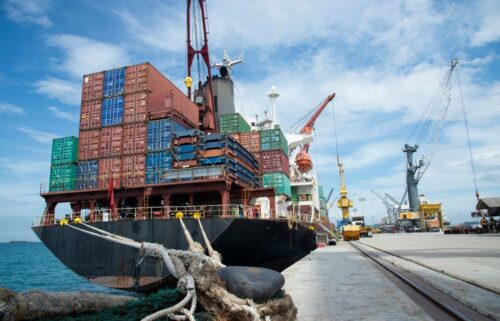
Just to be clear, these are the prices that are paid to exporters. They do not include the tariffs that are paid by importers. The tariffs are added on to these prices. If exporters were eating the tariffs, as Trump promised, import prices would fall.
To take a simple case: If Trump imposed a 10 percent tariff on shoes, in the exporters- eating-the-tariff story the price of imported shoes would fall 10 percent. That would leave businesses and consumers here unharmed and exporters getting 10 percent less for the price of their shoes.
This is clearly not happening. Trump’s tariffs may not be responsible for import prices rising (although his war might be), but they clearly are not falling. As every academic study has shown, and US consumers know, we are paying Trump’s tariffs.
The sharp rise in import prices will be another factor pushing inflation higher. The increase in import prices may not be fully passed on to consumers, but certainly much of it will.
To take the simple arithmetic here, imports of goods are roughly 10 percent of GDP. If import prices rise 3.7 percent, that would add a bit less than 0.4 percentage points to inflation, and that is before the impact of any Trump tariffs. The full story will be more complicated, but this should give us some idea of what we’re looking at.
These new data come out just as the Federal Reserve Board is having its first meeting under its new Trump-appointed chair, Kevin Warsh. Trump demanded that Jerome Powell, the prior chair, lower interest rates. When he refused, Trump threatened to fire him and then prosecute him.
Trump clearly wants lower interest rates and has said that he expects Warsh to give him what he wants. With the recent data all showing inflation on an upward path (we got bad news on both the Consumer Price Index and the Producer Price Index last week), it would be very hard to envision any of the other 11 members of the Fed’s Open Market Committee (FOMC) that determines interest rates voting for a rate cut.
This leaves Warsh with the option of either being the first Fed chair ever to be in the minority on an FOMC vote or incurring Trump’s wrath on Truth Social. Being an opportunistic sycophant can sometimes get people in trouble.
Article
Article
Article

Article

Article
Article

Article
Article