Article • Dean Baker’s Beat the Press
House Prices Are Falling and We Haven’t Solved the Problem of Restrictive Zoning
Article • Dean Baker’s Beat the Press
I happened to look at the Case-Shiller house price index, and I was struck by something that seems to be getting very little attention. It’s falling.
This is noteworthy because it seems the folks screaming about the need for zoning reform haven’t noticed. As readers may recall, a couple of weeks ago I had a little fun with New York Times columnist Binyamin Appelbaum (who is generally very insightful) because he thought he found the secret to curing the housing problem.
The remedy was in Vancouver, British Columbia, where an indigenous tribe had won a settlement that gave them control over a parcel of land in the city. Under the terms of the settlement, the tribe would be able to build whatever they wanted on the parcel and would not be subject to zoning restrictions. Appelbaum considered this great news because they were allowing a number of high-rise condominium buildings to be constructed there.
As I pointed out in my piece, building in Vancouver does not seem to have been excessively constrained by zoning restrictions.
“The problem is that it’s not clear how badly the city needs more housing right now. The city is actually considering a program to buy up vacant condo units to prop up their price. The city apparently views its problem as too much housing, not too little. Over the last year house prices in Vancouver have fallen 5.7 percent, somewhat more rapidly than the 4.3 percent average decline across Canada. Perhaps Appelbaum thinks prices should drop more rapidly, but they are clearly headed in the right direction for people who think housing costs too much.”
Vancouver has actually been very successful in accommodating a rapidly growing population over the last three and a half decades. The population of the city itself grew by more than 40 percent between 1991 and 2021. The metro area grew by more than 60 percent. Insofar as Vancouver has a problem, it’s that it is an incredibly desirable place to live. And there is likely an issue that more of the housing needs to be built to accommodate low- and moderate-income households.
Anyhow, it seems that the people yelling about zoning restrictions more generally apparently missed the fact that house prices are now falling in the nation as a whole. Adjusting for inflation, the Case-Shiller house price index has fallen by 3.5 percent from January 2025 to April 2026.
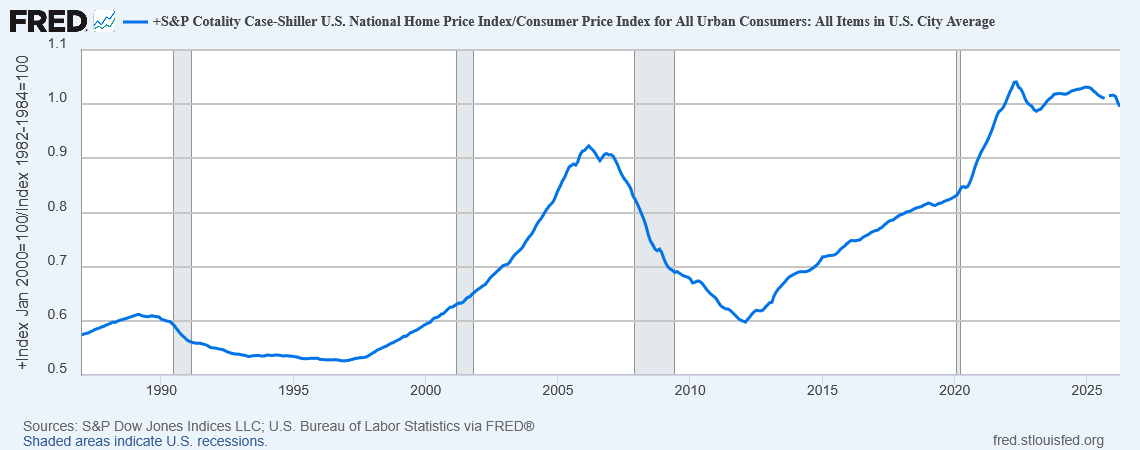
They still have a way to go to make up for the pandemic-driven run-up from 2020-2022. They would have to fall another 15 percent in real terms, which would take about five years at the current pace of decline. Arguably, the 2020 level was already too high, since the plunge in construction following the collapse of the housing bubble had left house prices well above their long-period average.
Perhaps the 2015 price would be better, since that was a time when many people were still yelling that prices were too low. That would require a price decline from current levels of a bit less than 30 percent, which could be accomplished in around ten years at the recent pace of decline.
This may be viewed as too long to restore affordability to the housing market. I’ll make two points on this one. First, we are currently building housing at the rate of roughly 1.4 million units a year. We had been building at an annual rate of 1.7 million units in late 2021 and early 2022. Zoning did not suddenly get more restrictive in 2022; the big change was the Fed raised interest rates. If we had continued to build housing at this pace, we would have another 1.2 million units today, and house prices would likely be substantially lower.
The other point is that we might want to ask how rapidly it would be desirable to have house prices fall. In this context, it helps to have inflation, since much of the real decline in prices can be accomplished without a drop in prices. But suppose we had a situation with little or no inflation and nominal prices were dropping 4-5 percent a year.
That would get us more affordable housing quickly, but I’m not sure many people would be happy with this story. This is often put as a generational issue, with baby boomers and other old-timers being upset about seeing the value of their house fall. That is undoubtedly true, but a substantial share of younger people are also homeowners.
According to the most recent data, 37 percent of households under age 35 already own a home. Most of these homeowners are likely to have relatively little equity in their homes. If prices fall 4-5 percent annually for 3-4 years, many of these young homeowners will see most or all of their equity wiped out. I’m not sure that a 35-year-old homeowner who now finds themselves underwater will be very happy about the policies that got them there.
Anyhow, this is not an argument that we should not want lower house prices. But it is an argument that it might be best not to get there all at once.
A couple of weeks ago I stumbled on a fact that I probably had once known but had long forgotten; homeowners’ insurance is not in the Consumer Price Index. This is a big deal, because homeowners’ insurance is a major expense, and also because its price has been rising rapidly. The cost of an average policy has risen 110 percent over the last decade. If it had just increased at the same pace as inflation, an average insurance policy would cost about $1,000 less today.
That makes a big difference in the affordability of homeownership. Paying an extra $1,000 a year in insurance is equivalent to the interest payment on $15,000 of a mortgage at 6.5 percent interest. That’s a bit less than 4.0 percent of the median house price. If we could snap our fingers and lower house prices by 4.0 percent, that would be a pretty good day’s work.
One of the main reasons the price of homeowners insurance has been rising rapidly is that global warming has exposed many areas to a much greater risk of wildfires, and the increased intensity of storms and hurricanes has increased damage from wind and flooding. In fact, the reported rise in insurance costs likely understates the true increase since homeowners in areas exposed to especially high risk may go without insurance. That would remove some of the largest implicit price increases from the sample.
This also matters very directly in the availability of housing. If areas become abandoned because the risk of wildfires is too great, as is the case in parts of California, or the risk from hurricanes and flooding is too large, as is the case in parts of Florida and elsewhere in the South, that means there is less housing. But raising this set of issues would make the fossil fuel industry the enemy, not just a bunch of cranky NIMBYs.
Article

Article

Article

Article

Article

Article

Article
Article