
Article • Expose the Heist: Power and Policy in Unprecedented Times
The Deadly Cost of Misguided Federal Wildfire Policy
Article • Expose the Heist: Power and Policy in Unprecedented Times
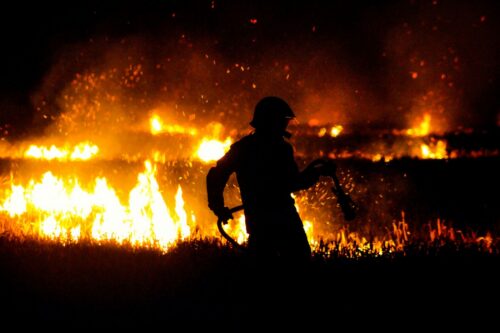
At the end of June, the deaths of three firefighters near the Colorado-Utah border put Trump’s new Wildland Fire Service into focus. The firefighters had been deployed by helicopter to a remote area to put out a brush fire and were overwhelmed. But among the tributes and reminders of how wildland firefighters put their lives on the line to protect communities was the question from Timothy Ingalsbee, a former federal firefighter and founder of the group Firefighters United For Safety, Ethics and Ecology: “Why were they attacking that fire in the first place?”
The reason is that the Trump administration has reinstated a full suppression strategy applied to every wildfire, resurrecting an almost 100-year-old debate over how to handle wildfires — a debate that science and long-standing indigenous practices had settled by the late 1970s. Combined with the establishment of the US Wildland Fire Service, such policies could cost more lives.
But first, you may be asking: what is the US Wildland Fire Service? In January, the administration announced it was taking steps to create the service, which unifies wildland fire management programs across the Department of the Interior (DOI). Previously, responsibilities were distributed among offices within the Bureau of Indian Affairs, the Bureau of Land Management, the Fish and Wildlife Service, the National Park Service, the Office of Aviation Services, and the Office of Wildland Fire.
The reorganization, however, does not include the US Forest Service (USFS) within the US Department of Agriculture, which is responsible for national forests and grasslands and oversees more than two-thirds of the nation’s federal wildland firefighting resources. But USFS and the Wildland Fire Service still coordinate through the National Wildfire Coordinating Group and the National Interagency Fire Center. The administration is also looking into merging USFS fire management into the newly formed Wildland Fire Service.
If you find all of this confusing, the National Smokejumper Association created an organizational flowchart (Figure 1).
Figure 1
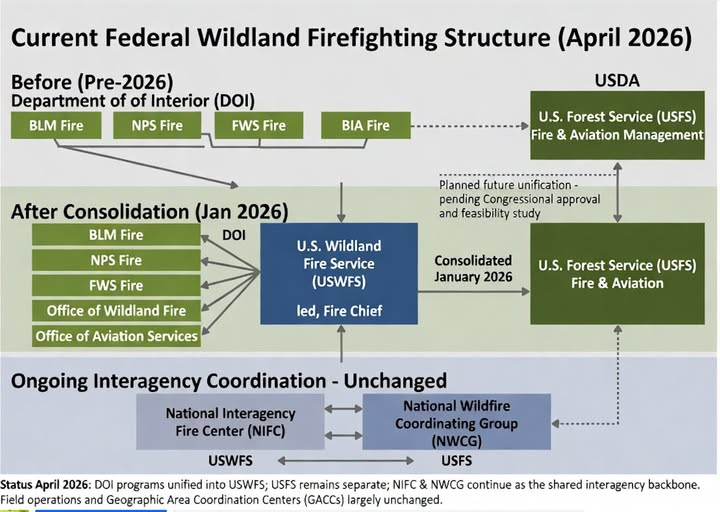
Source: National Smokejumper Association Facebook post, April 11, 2026.
To be clear, streamlining is not a bad thing. The mix of federal, state, and local firefighting agencies can present issues depending on where a fire starts and determining which entity is responsible, and when the command structure within one entity, such as the federal government, looks like a bowl of spaghetti after a toddler gets hold of it, that can create confusion. However, restructuring like this requires more thought and care. Under the new structure, for which the administration did not obtain Congressional approval or funding, the Wildland Fire Service is separating firefighters from land management experts.
In a letter to DOI Secretary Doug Bergum, ranking Democrats on committees that fund the department wrote: “While consolidation could be an effective strategy to improve efficiency and coordination, the Administration’s approach risks diverting critical resources and funding away from land management agencies without any public plan to replace those capabilities.” For example, the Bureau of Land Management requires a team of scientists, land managers, field staff, and firefighters to handle tasks like vegetation management, protecting endangered habitats, managing grazing, and helping the land recover after a fire. But the Department of Government Efficiency (DOGE) has eliminated a lot of those positions, and now, by removing the firefighters, various bureaus and services within DOI will suffer even more staffing shortages. As a result of these concerns, lawmakers have blocked funding and authorization for a Wildland Fire Service and USFS merger until a feasibility study can be conducted.
Then there are the current suppression policies of the Wildland Fire Service and USFS. In April, DOI Secretary Doug Burgum sent a memo to the heads of the various bureaus and services under the department calling for “the presumption of a full suppression strategy applied to every wildfire under DOI management.” In an oversight hearing by the House Committee on Natural Resources, Subcommittee on Federal Lands, USFS Chief Tom Schultz also confirmed and defended the new full-suppression policy.
To be blunt, full suppression is a product of settler colonialism that has no basis in science. Established in the West under various European colonizers and later adopted by the Mexican and American governments, full suppression initially was used to silence indigenous groups’ cultural practices, which often used fire. European colonizers saw fire as a nuisance. Driven by land expansion and an effort to assimilate indigenous groups through projects like Spanish missions and boarding schools, colonizers enacted strict laws to discourage these burning practices. This suppression directly targeted the cultural foundations that maintained native identity and hindered the ability to organize marginalized groups.
Though these measures originated as a means to erase indigenous culture, by the 1930s the USFS had pivoted to an economic justification, implementing the “10 a.m. rule,“ which mandated that every fire be suppressed by 10:00 the next morning. After several disastrous fire seasons, the government had determined that full suppression as policy would be cost-effective. It wasn’t. Research from the 1960s to the present, along with indigenous land practices, has long shown that failing to allow fire to naturally remove overgrown vegetation or insect-infested trees leaves more fuel for future fires. It’s not hyperbole to say that a major reason we have so many massive wildfires today is the 10 a.m. policy.
What is happening with federal wildfire management is another example of a recurring pattern with the administration: the marriage of hastily executed structural overhauls with a blatant disregard for established historical and scientific evidence. Other examples include the dismantling of federal support for renewable energy and the current debate over restructuring the Federal Emergency Management Agency. And the question is always: to what end? If the goal is to actually make DOI more efficient, such a restructuring needs to be carefully implemented to ensure changes don’t affect its capabilities, including its evidence-based fire management practices.
Instead, the US is stumbling blindly ahead, and it’s the American people who suffer as a result.
Article

Article

Article

Article

Article
Article

Article
Article