
Article • Dean Baker’s Beat the Press
California Wealth Tax Initiative: A Chance to Express Your Opinion of Billionaires

Article • Dean Baker’s Beat the Press
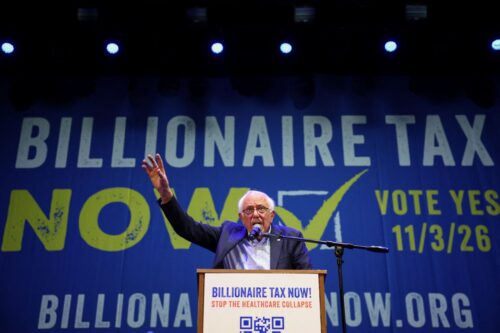
A coalition of progressive groups, led by the huge union SEIU-UHW, managed to get a one-time 5 percent wealth tax on the ballot this fall. The tax would apply to the assets over $1 billion held by the state’s 200 or so billionaires. This is a great opportunity for the people of California to tell billionaires what they think of them.
Over the last half-century, billionaires have become increasingly aggressive in stealing from the rest of us, as well as being more open in expressing their contempt for ordinary people who work for a living. It’s not uncommon to see billionaires like Peter Thiel and Elon Musk opining on issues like the need to deny the vote to inferior people, as in non-billionaires. And Elon Musk is, of course, best known for his boosterism of neo-Nazi political parties around the world.
In addition to pushing their hateful views on politics and society, the billionaire gang has also been using their wealth to increasingly dominate politics. Musk was the most open on this topic, spending almost $300 million to keep Donald Trump out of jail put Donald Trump in the White House. He promises to again be a big spender for Republicans in the midterms, as do many others in the billionaire club.
The billionaire crew has also been aggressively buying up media outlets and turning them into MAGA megaphones. Loyal Trump ally and Oracle founder Larry Ellison bought up Paramount and CBS and is now trying to buy Warner Brothers and CNN. He also was handed control of TikTok after Trump wrestled it away from a Chinese company. Newly registered Trump sycophants Mark Zuckerberg and Jeff Bezos own Facebook and the Washington Post, respectively. And Elon Musk bought Twitter, now “X,” to push his far-right politics.
And they use this power to give themselves big tax breaks and also government handouts. The latter take the form of government contracts as well as regulatory provisions to protect their companies.
The wealth tax is an opportunity to fight back against the billionaires. According to the proponents, the tax will raise over $100 billion over the next five years. (The billionaires have five years to pay the tax, but it is based on their assets as of December 31, 2025.) That calculation even allows for substantial avoidance.
This is real money even in the context of California’s budget. Its annual budget is currently a bit over $350 billion. If the state collects $100 billion over five years, it will be a bit less than 6 percent of projected spending. That will make a noticeable difference to the state budget, especially in a context where the federal government is making major cutbacks in state assistance in health care and other areas.
The referendum provides people with a clean vote on what they think of billionaires. The politicians who represent their interests are experts in providing smoke screens. They constantly warn people that if they vote against the billionaires’ candidates, their boys will be turned into girls in school at recess. Or that the immigrants who are mowing lawns or selling tacos from food trucks are actually rapists and murderers. But the referendum on the billionaire wealth tax allows even people who have these concerns to vote to reduce the wealth and power of the billionaires.
To my mind, this sort of wealth tax is not the perfect remedy for inequality. I was concerned that the tax would lead to an exodus of billionaires from the state. While California might be better off with fewer Elon Musk-types dominating public debate, it does collect substantial income tax revenue from the very rich. If too many billionaires fled the state to avoid the tax, it could end up a net revenue loser over the long run.
But the date for flight has already passed, so the state might as well impose its billionaire tax on the vast majority who have stayed. There is also the issue of the tax’s constitutionality. I have seen what seem like solid arguments from legal scholars that the tax does pass muster, but I don’t know anyone who will take a bet on how the MAGA Supreme Court will rule. In any case, it would be foolish to surrender prematurely.
In most of my writing, I have argued that it is best to structure the market differently so that we don’t end up with a small number of ridiculously rich people. Reducing the importance of government-granted patent and copyright monopolies is the most obvious way. That would prevent the fortunes of billionaires like Larry Ellison and Bill Gates, but there is a much longer list of reforms to finance and other sectors that would lead to a market that creates far less inequality.
Perhaps after the collapse of the AI bubble, we will be able to have a serious discussion of ways to structure the market that are both more efficient and lead to less inequality. But for now, we can focus on taking back some of the money we handed to the rich, and the California billionaire’s wealth tax is a good place to start.
Note:
I am off on vacation for the next week and a half, so posting will be limited. There will be an AI Bubble Monitor on Monday.
Article

Article

Article

Article

Article
Article

Article
Article