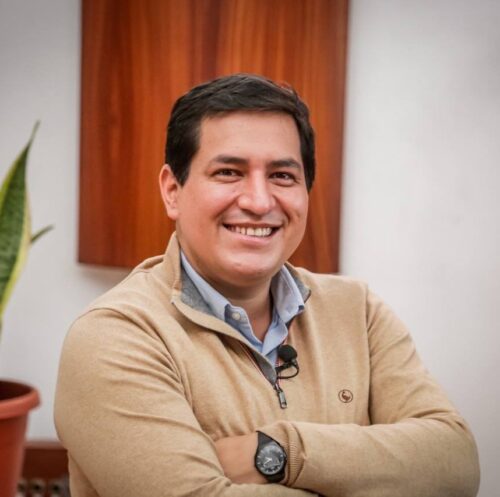

Andrés is a senior research fellow with CEPR. He is an academic and policy researcher with expertise on money and technology, government procurement, development planning macroeconomics, illicit financial flows, and finance and has authored several CEPR reports on Special Drawing Rights and Latin American economies. Andrés also has a broad policy background and experience in Ecuadorian government and electoral politics: he has served as balance of payments statistician for the Central Bank of Ecuador, financial policy advisor at the Ministry of Economic Policy of Ecuador, chief operating officer at the Central Bank of Ecuador, under secretary for public investment, deputy secretary for planning at the National Planning Secretariat of Ecuador, general director of the Ecuador’s National Service for Public Procurement Agency, and Minister of Knowledge and Human Talent of Ecuador. He has been a presidential and vice-presidential candidate.
Andrés has participated in international negotiations at the World Trade Organization, the Andean Community, MERCOSUR, UNASUR, and with the European Union, among others. He has participated in civil society forums at the World Trade Organization and the International Monetary Fund and has written reports and articles for several civil society organizations on tax justice, economic and social human rights, investor-state dispute settlement, and financial transparency. Andrés supports cooperative rural financial associations in Latin America and advises technology companies on monetary and financial issues. He is regularly invited to conferences and seminars organized by think tanks in Latin America, Europe, and the United States. Andrés is a University of Michigan alum, has a FLACSO Ecuador masters, and obtained his PhD in financial economics from the National Autonomous University of Mexico.
All from Andrés Arauz
Ecuador and the Pandora Papers: Death Threats and Impunity
Fighting for financial transparency is a fight for truth and social justice that we cannot afford to give up.

November Data Shows More Countries Are Using Special Drawing Rights; Over 30 Countries Have Actively Used Most of Their New SDRs
This post analyzes SDR holdings as reported by the IMF at the end of November and compares them to previous months’ reports.

October Data Shows Countries Are Using Special Drawing Rights More Than Ever; Caribbean Leader Calls For More Issuances
This post analyzes SDR holdings as reported by the IMF at the end of October and compares them to previous months’ reports.
September Data Shows Countries Continue to Use Special Drawing Rights to Stabilize Their Economies and Address the Pandemic
This post analyzes SDR holdings as reported by the IMF at the end of September and compares them to previous months’ reports.
The Pandora Papers Are Back in the Spotlight in Ecuador
Did Lasso break the law, known as the Ethical Agreement Law, which prohibits candidates and public officials from owning, directly or indirectly, assets or holdings in jurisdictions that Ecuador considers to be tax havens?

Transcript: “Making the Most of Special Drawing Rights: Approaches to Maximize Impact and Create a Sustainable and Just Recovery”
A transcript of Andrés Arauz speaking at an event on October 4th as part of the IMF Annual Meetings.

First Available Data Shows Countries Are Using Special Drawing Rights to Stabilize Their Economies and Address the Pandemic
Based on the IMF’s accounting of SDR holdings as well as media reporting on member countries, we can get a preliminary sense of what countries immediately used the additional allocation of SDRs and for what purposes.
IMF Surcharges: Counterproductive and Unfair
This report finds that International Monetary Fund (IMF) surcharges are inappropriate and unjustifiable, particularly during a pandemic combined with a very uneven recovery from a pandemic-driven world recession.
Why SDRs Belong to States, Not Central Banks
It would be a pity if, after all the efforts that civil society and numerous leaders put into this SDR allocation, the SDRs remain unused amid a pandemic because of faux technocratic obstacles.

Dinero Electrónico: Deployment Notes of the First CBDC
As policy makers try to assess the benefits and risks of Central Bank Digital Currencies (CBDC) researchers have contributed to the discussion with theoretical works on monetary policy, disintermediation, and financial stability implications.