
Article • Expose the Heist: Power and Policy in Unprecedented Times
Big Billionaire Bill Will Lead to Bigger Fire Risks
Article • Expose the Heist: Power and Policy in Unprecedented Times
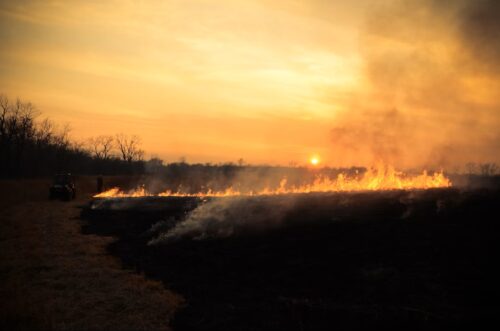
You could be forgiven for not reading the entirety of the GOP’s massive One Big Bill for Billionaires that Trump just signed into law. Yet right at the beginning of the table of contents is “Subtitle B — Forestry,” which might give the impression that the GOP is serious about investing in wildfire prevention and forest restoration. Instead, the new law strips critical funding that had been appropriated to the National Forest System under the Inflation Reduction Act. Contrary to Trump’s stated goal of preventing wildfires, two sections within the Big Billionaire Bill will, in fact, exacerbate the risk of fires across the US.
The first section concerns what can be done with National Forest System land and how quickly it can happen. The Inflation Reduction Act set aside $100 million through September 30, 2031, for the Chief of the Forest Service to conduct environmental reviews established under the National Environmental Policy Act (NEPA) of 1969, a bedrock law requiring agencies to assess the environmental impact of major projects. For example, the US Army Corps of Engineers conducts environmental reviews before starting flood control projects. When agencies conduct these reviews, they examine environmental impacts, including unavoidable ones, and practical and affordable alternatives, such as doing nothing at all. They also consider how short-term actions affect long-term productivity and the use of federal resources.
Since taking office, Trump has moved to narrow the scope of NEPA by eliminating the necessity of reviews in many cases — a move the Supreme Court reinforced in its Seven County Infrastructure Coalition v. Eagle County decision in June. The common complaint from developers is that the reviews take too long and can be used by activists to stall projects. According to NEPA, these impact reviews “should generally be completed within two years.” They often take much longer due to changes in the proposed project or funding, lawsuits, or community concerns over a project. According to the Council on Environmental Quality, the median time from notice of intent to final impact statement in 2019 was 3.6 years. But in 2024, the median time dropped to 2.2 years, a 48.3 percent difference. The council attributes these improvements to reforms and substantial cross-government investments aimed at speeding up permitting. But for Trump and his corporate supporters, the ideal scenario is no environmental review at all.
So which Forest Service projects would even need environmental reviews? In the very same section, the Big Billionaire Bill eliminates $50 million for the management and protection of old-growth forests on National Forest System land. These are the forests the USDA is hoping to go after with the rescission of the 2001 Roadless Rule, which prohibits road construction, road reconstruction, and timber harvesting across 58.5 million acres of inventoried roadless areas within the National Forest System. Trump’s plan here is simple, but the pieces of the puzzle are spread across different bills, laws, agency processes, and executive orders to obfuscate the overall intent: Cut the funding to protect the forests, open the areas for development, and then eliminate the environmental reviews. Again, there’s that tiny problem that logging increases fire risk.
If that wasn’t bad enough, the next cut in Subtitle B goes after a competitive grant program that helps states and private forest landowners carry out climate mitigation or forest resilience projects. States contain forests that are a mix of state, local, federal, tribal, and private land, and all these entities have to do their part to prevent massive wildfires. But states, local and tribal governments, and private landowners may not always have the budgets to manage these lands properly. Recognizing this, the 2018 Farm Bill amended the Cooperative Forestry Assistance Act of 1978 to create the Landscape Scale Restoration Program. This competitive grant program distributes resources to restore and improve forest health and resilience across large, connected areas that may cross ownership or jurisdictional boundaries.
The program provides grants for plans aimed at reducing the risk of uncharacteristic wildfires, enhancing fish and wildlife habitats, maintaining or improving water quality and watershed function, mitigating invasive species, insect infestation, and disease, and improving forest ecosystems. Examples of projects include $300K to support a new AmeriCorps project, the Wildland Restoration Academy, which will treat around 640 forested acres in Western Montana’s Blackfoot River watershed on former industrial timberland now owned and managed by The Nature Conservancy. Another grant provides $192K to establish a Woodland Stewardship Network in Virginia, which will connect 20 private landowners and provide them with forest management plans to improve 2,000 acres in the state. The Big Billionaire Bill cuts around $450 million in funding for the program. These grants are a mere fraction of the overall federal budget and should be considered spending priorities, not targets for cuts. Each year, wildfires cost the US between $394 billion and $893 billion, according to a 2023 finding by the Congressional Joint Economic Committee.
It’s not that difficult to understand that cutting funds from environmental reviews and critical grant programs for forest management, as proposed by the One Big Billionaire Bill, will inevitably increase the risk and severity of wildfires across the US. Coupled with the administration’s new approach to disaster management, this legislation paves the way for a future where people die preventable deaths and politicians refuse to be held accountable for their decisions.
Article
Article
Article

Article

Article
Article

Article
Article