Article • Ecuador News Round-Up
Ecuador News Round-Up No. 23: Noboa Enacts Controversial Laws in First Months of His New Administration
Article • Ecuador News Round-Up
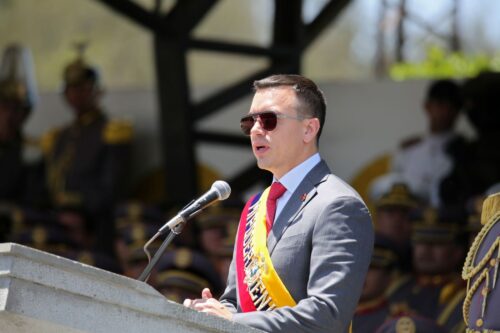
Daniel Noboa began his first full term as Ecuador’s president after an inauguration ceremony overshadowed by the absence of world leaders, who likely skipped the event due to international criticism of Noboa’s militarized security response to crime and his diplomatic missteps. Nevertheless, Noboa has secured near-total control of the legislature by gaining support from a majority of Indigenous Pachakutik party legislators while sidelining the progressive RC party — his main opposition and the second-largest bloc in the National Assembly.
Noboa has fast-tracked numerous sweeping laws on security, intelligence, environmental policy, criminal sentencing, and public-sector employment, which have triggered dozens of lawsuits over potential violations of human rights, privacy, labor protections, transparency, and the rule of law. In response, the Constitutional Court provisionally suspended parts of these laws, prompting Noboa to call on his supporters to protest the court despite widespread international criticism. In addition to the new laws, Noboa has used the first months of his new term to close and merge ministries and dismiss 5,000 public-sector workers. He has also proposed six constitutional amendments, which will be subject to a popular referendum, and has taken steps to grant new mining concessions, among other initiatives.
Meanwhile, Diana Salazar, the long-time prosecutor general who has been accused of politically persecuting the progressive movement, resigned at the end of her term to accept an appointment as ambassador to Argentina — a move that had been quietly in the works for over a year. In her final act as Ecuador’s top cop, Salazar announced what critics called politically motivated charges against an RC party leader.
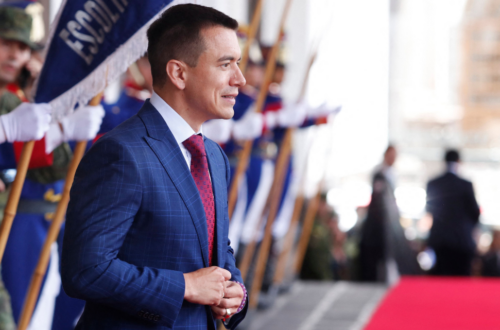
After winning the April 2025 election, a process marred by irregularities and unlawful practices, Daniel Noboa was sworn in for his first full term as president on May 24. In his inaugural address at the National Assembly, Noboa highlighted what he described as the achievements of his 18-month interim presidency and reaffirmed his controversial militarized security strategy. He pledged to strengthen and diversify Ecuador’s energy grid following widespread blackouts and an energy crisis in his previous term, and emphasized that the country remains open to foreign investment. Noboa also announced that his new vice president, María José Pinto, would focus her work on mental health, bilingual education, child malnutrition, and teenage pregnancy.
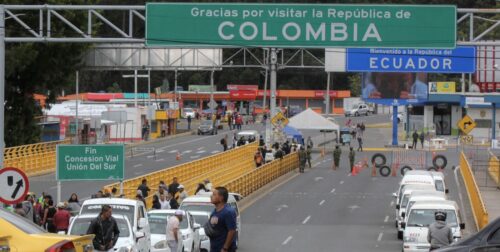
Legislators from the progressive Revolución Ciudadana (RC) party — to which Luisa González, Noboa’s main rival in the election, belongs — were absent from the ceremony, as were international heads of state. Unlike the inaugurations of former president Rafael Correa, which typically drew around a dozen world leaders, only the presidents of Ecuador’s two bordering neighbors, Peru and Colombia, attended Noboa’s swearing-in. This limited turnout was likely due to mounting international criticism over human rights abuses tied to President Noboa’s hard-line response to crime, as well as his diplomatic missteps. Chief among these was the April 2024 raid on the Mexican embassy in which Ecuadorian security forces abducted former vice president Jorge Glas after Mexico had granted him asylum. In fact, Colombian President Gustavo Petro used his visit to Ecuador to say Glas was a political prisoner. The United States, meanwhile, was represented by Health Secretary Robert F. Kennedy Jr., a long-time friend of the Noboa family.
Ecuador’s 151-member National Assembly was sworn in 10 days prior to Noboa’s inauguration. In the election’s first round on February 9, the RC won 67 seats, while Noboa’s National Democratic Action (ADN) party secured 66. However, by the time the legislature was inaugurated on May 14, the RC had lost a seat after legislator-elect Mónica Salazar left the RC, leaving the two parties tied with 66 seats. Since 77 seats are needed for a majority, neither party could boast control of the legislature, and the RC and ADN each had to seek support from smaller parties like the Indigenous Pachakutik party (which won 9 seats), and the traditionalist Social Christian Party (PSC) with its five seats.
In the end, Noboa’s ADN got backing from both Pachakutik and the PSC and secured top leadership positions across nearly all legislative committees, in addition to the National Assembly presidency itself. In contrast, the RC was largely sidelined, managing to win control of only 2 of the Assembly’s 15 permanent committees — focused on the protection of children and adolescents, and on constitutional guarantees and human rights, respectively — and no other leadership roles. This marginalization extended to the Legislative Administrative Council, a key body made up of representatives from the major legislative blocs. There, ADN and its allies appointed Mónica Salazar to occupy the RC’s designated seat, arguing that she was still legally a member of the party, despite her public resignation and her ideological differences with it.
Pachakutik’s support for ADN’s proposed leadership in the National Assembly was not entirely unexpected, as the government had previously announced an alliance with the party’s legislators in the lead-up to May 14. Still, it came as a broad surprise, so much so that the party itself publicly condemned the actions of its own legislators.
Pachakutik is the electoral arm of the CONAIE, Ecuador’s largest and most influential Indigenous organization, which in the last few years has gone back to its erstwhile policy of denouncing and mobilizing against neoliberal governments, including Noboa’s. In a historic move during the presidential elections, the party even endorsed Luisa González after its own candidate, Leonidas Iza, finished third in the first round, and agreed on a common platform with the RC that placed opposition to mining at its core. Since the vote on National Assembly leadership, a core group of six of Pachakutik’s nine legislators have openly and repeatedly sided with ADN and in support of Noboa’s legislative proposals. The party expelled these six legislators on July 19, though they may be readmitted following a recent leadership change in CONAIE. Pachakutik’s parliamentary backing of Noboa reflects the latest, post-electoral expression of long-standing internal divisions within the Indigenous movement, which has never been fully unified.
Meanwhile, the RC has seen its legislative seats fall to only 61 due to a combination of expulsions and defections. The party as a whole appears to be grappling with internal divisions after its third electoral loss since 2021, with some of its heavyweights calling for a “deep renovation.”
With near-total control of the National Assembly, President Noboa has pushed through a series of laws that have sparked concerns about human rights, privacy, labor protections, the environment, and rule of law. Most of these laws were introduced as so-called measures of economic urgency, which gives the legislature just one month to debate, amend, approve, or reject them. As the name suggests, this fast-track procedure is intended to address economic matters. But many of Noboa’s proposals have had little to do with the economy, prompting legal experts to argue that resorting to it for noneconomic issues violates the constitution.
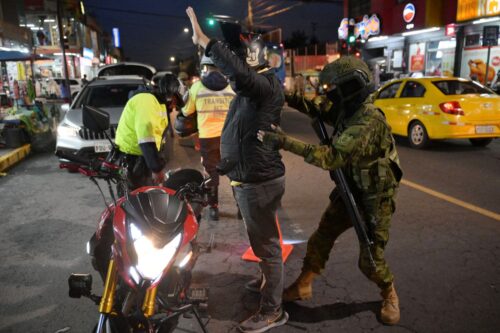
One of the most concerning “urgent economic laws” is the National Solidarity Law, which establishes a special legal regime triggered when the president declares, by decree, that Ecuador is experiencing an “internal armed conflict.” Under this regime, criminal hearings are expedited, criminal penalties are increased, pretrial detention becomes the default for those charged with crimes linked to the conflict, and alternatives to detention are sharply restricted. It also deploys the military to the streets to combat vaguely defined “organized armed groups,” sets aside restrictions on the lethal use of force, allows security forces to conduct warrantless raids, and grants preemptive pardons to members of the armed forces and police under investigation for crimes.
Observers widely view this law as an attempt by Noboa to sidestep the Constitutional Court’s oversight powers amid Ecuador’s unprecedented surge in violence and homicides since 2021. This wave of insecurity prompted Noboa to declare an “internal armed conflict” in January 2024 — a concept absent from Ecuadorian law. He has since relied on this justification to deploy the military to the streets via continuous states of emergency. The Constitutional Court, responsible for reviewing such emergency declarations, has repeatedly found that Noboa failed to substantiate the existence of such an “internal armed conflict,” yet has allowed the emergency measures to remain in effect. The new law, however, grants Noboa unilateral authority to activate this special “internal armed conflict” regime via decree, circumventing judicial review and unlocking broader powers than those permitted under ordinary emergency provisions.
Human rights organizations and legal experts warn that the law risks worsening the military’s existing patterns of human rights abuses — including arbitrary detentions, forced disappearances, and extrajudicial killings — by granting security forces even greater powers and impunity.
Another worrying piece of legislation is the Intelligence Law. Originally introduced before Noboa’s presidency, it was recently passed after extensive amendments by his ADN party. The law creates a new intelligence agency, the National Intelligence System (SNI), with centralized authority and oversight within the military, police, customs, and other government bodies. Under this law, the SNI can demand private citizen data from companies and other entities — including telecommunications providers — without a court order, leaving no right to refuse or appeal. The agency’s budget will remain largely confidential and exempt from tax regulations and public procurement laws. SNI agents may also be issued official identity documents to support false or undercover identities. The Comptroller General will be the only entity authorized to audit the agency’s collected materials and finances, and any resulting audit report must be destroyed.
The law has raised concerns among human rights organizations and journalists, who fear that, beyond disregarding privacy rights, the government could exploit these sweeping powers to target political opponents and carry out mass surveillance with no accountability.
Ecuador’s National Assembly has also passed Noboa’s Public Integrity Law, which introduces a new system of employee evaluations in the public sector. Critics argue that this system could be used to make public sector employment more precarious and to justify mass layoffs under the guise of “efficiency.” The law also increases criminal sentences for minors convicted of crimes (which UNICEF has condemned) and allows for an “emergency” to be declared in the judiciary, permitting the appointment and dismissal of judges outside ordinary legal procedures.
Finally, the Ecuadorian legislature approved the Protected Areas Law, which, among other provisions, allows private entities, including foreign companies, to participate in the management of conservation zones. The law is intended to promote “responsible” private investment in protected areas, but the Associated Press reports that it has “drawn sharp criticism from Indigenous groups, legal experts and environmental advocates who say it threatens Indigenous land rights and violates both national and international protections.”
These bills, signed into law by President Noboa, have been challenged by human rights and Indigenous organizations, environmental groups, and labor unions, who have filed nearly 40 lawsuits with the Constitutional Court.
On August 4, Ecuador’s Constitutional Court admitted several of these cases and temporarily suspended some, but not all, of the most controversial provisions of the National Solidarity, Intelligence, and Public Integrity laws until the legal process plays out. This outraged Noboa, prompting a minister and the president of the National Assembly to publicly reject the court ruling in a nationwide broadcast on all TV stations, delivered alongside armed soldiers. Noboa then urged his supporters to protest outside the Court on August 12 — a move that the UN Special Rapporteur on the Independence of Judges and Lawyers, the UN High Commissioner for Human Rights, the Inter-American Commission on Human Rights (IACHR), and Amnesty International denounced as a threat to judicial independence. Alongside these international statements, a number of Ecuadorian lawyers, judges, experts, and civil society organizations spoke out in defense of the Court and its judicial independence, warning that Noboa’s attacks pose a threat to democracy.
The affair has fueled an online campaign to discredit and pressure the Court, which has spilled into the streets with billboards and trucks displaying the judges’ faces and blaming them for violent deaths in the country. One of Noboa’s ministers called the judges “enemies of the people.”
On the day of the protests, the Court reported that the fencing normally surrounding its building had been removed without notice and that the area was unusually and heavily militarized. The IACHR also noted with concern that a military armored vehicle had been driven to the court. More than 700 buses brought in people from across the country, raising questions about the protests’ financing. President Noboa attended the demonstration and delivered a brief speech through a megaphone, declaring: “We are not going to allow change to be stalled by nine people who do not even show their faces, who seek to hide their names and faces from society. … Our police officers and military personnel feel unprotected and abandoned by a Constitutional Court that has decided to turn its back on them.”
Taking a page from Argentina’s chainsaw-wielding president, Javier Milei, President Noboa announced on July 24 the merger of six ministries and six secretariats. This action, which his administration claims will reduce the number of executive offices by 40 percent, involves fusing ministries with mandates that are unrelated or even conflicting. For example, the Ministry of the Environment, tasked with protecting natural resources and the environment, will be absorbed by the Ministry of Energy and Mines, which is responsible for their exploitation and sale — a change described in the New York Times as “a clear case of putting the fox in charge of the henhouse” that “leaves Ecuador without an independent institution to protect its extraordinary ecosystems.” Similarly, the Ministry of Women and Human Rights will be absorbed by the Ministry of Government, which manages the executive branch’s relationship with the National Assembly.
During the same press conference, the government also announced the firing of 5,000 public-sector workers — a decision separate from the ministry mergers, which the government said will lead to further job cuts. To justify the action, the administration cited the need for greater efficiency, claiming that those laid off had been underperforming in their roles. However, major unions have questioned the lack of transparency around the move.
According to EFE, “These cuts are being made within the framework of the goals set by Noboa to reduce the state deficit and meet the targets of the loan his administration signed last year with the International Monetary Fund,” which was just increased from $4 billion to $5 billion. These measures, coupled with the laws described above, have set off a wave of rejection and protests from unions, feminist groups, and other organizations.
In a bid to tighten control over nongovernmental, civil society, and other nonprofit organizations and their funding, Noboa has also introduced a new legislative proposal commonly referred to as the “Foundations Law.” The proposal aims to further regulate these organizations with financial controls, audits, and potential sanctions. Noboa argues the law is necessary to increase transparency, claiming that too many foundations, nonprofits, and international NGOs “destabilize the country” and “promote criminality” without any “control.” The bill has drawn concern from across the civil society sector — from unions and chambers of commerce to watchdog groups — who fear it could be used to target political opponents. Particularly troubling to critics is a provision allowing the government to dissolve organizations deemed to act against public order or national security. In a letter to the National Assembly, a UN Special Rapporteur warned that the bill could “unduly restrict the rights to privacy, freedom of expression, freedom of peaceful assembly, freedom of association, and participation.”
Noboa has also proposed seven questions for a popular referendum, six of which would amend the country’s constitution. As part of his electoral campaign, he had promised to substantially revise or even replace the notably progressive constitution, drawn up in 2008, arguing that it obstructs his security agenda and hampers economic growth. Of the proposed amendments, only two have gone through the mandatory step of legislative approval: one seeks to lift the constitutional ban on foreign military bases in Ecuador — primarily aimed at establishing a US military presence — and the other would eliminate the limited public financing of political parties, a measure designed to help level the electoral playing field.
The other proposals include reducing the number of National Assembly legislators to 71 — a measure similar to one that voters rejected in a 2023 referendum — allowing for the impeachment of Constitutional Court judges, and eliminating the Council for Citizen Participation and Social Control (CPCCS), the popularly elected body responsible for selecting various oversight authorities. Notably, the two final proposals call for legalizing gambling in 5-star hotels, reviving a similar question dropped from Noboa’s April 2024 referendum (casinos and gambling were banned in a 2011 referendum over concerns about money laundering and organized crime), and legalizing hourly employment contracts in the tourism sector, directly contradicting the 2024 referendum result in which voters rejected such contracts across the board.
All of these proposed questions — except for those regarding foreign military bases and party financing, which have already been approved — still require review by the Constitutional Court and, depending on the Court’s chosen approval process, potentially by the National Assembly as well. Once this process is complete, Ecuadorians will be called to vote on them in a popular referendum, which the government aims to hold in December. In the legislature, Noboa’s ADN party supports the measures, as does the PSC in broad terms. The RC opposes them, while Pachakutik’s legislators appear opposed to some, but not all, of the questions.
Noboa has also reopened Ecuador’s mining rights registry, paving the way for government-issued concessions to companies — mostly foreign — for mineral exploitation. The deputy mining minister has said the goal is to double the amount of concessioned land. While the government frames this as a way to combat illegal mining, CONAIE has voiced opposition, arguing that the initiative is merely a pretext to promote large-scale mining that, with the government’s complicity, violates prior popular consultation requirements and environmental protections, and harms Indigenous communities and the environment.
Professors César Rodríguez-Garavito and Robert Macfarlane criticized these actions and Noboa’s recent laws in a New York Times op-ed, writing:
ecological progress is under severe threat from a series of reforms steamrolled by Ecuador’s young populist president, Daniel Noboa. …His reforms will throw Ecuador’s stunning landscapes open to mining and drilling, dismantle government agencies in the name of “efficiency,” target public officials and civic organizations that he claims obstruct his agenda and concentrate broad emergency powers in his own hands. Together these measures amount to the most serious assault on environmental protection and constitutional integrity in Ecuador’s recent history.
Ecuador’s long-time prosecutor general, Diana Salazar, resigned on May 20 after six years in office. Her term had officially expired on April 8, but delays in selecting her successor had extended it. Salazar said she was stepping down to honor her promise not to remain beyond her term. The following day, President Noboa announced that she had been appointed ambassador to Argentina.
Salazar was a controversial figure throughout her tenure. Celebrated by the State Department and US foreign policy establishment with awards, she is also accused of using her office to politically persecute the RC movement. She has faced allegations of intervening in the 2021 elections against RC candidate Andrés Arauz, and in the 2023 elections against Luisa González (this time by enabling the spread of false rumors linking the RC to the assassination of presidential candidate Fernando Villavicencio). Villavicencio’s widow, a staunch opponent of the RC, has repeatedly alleged — most recently this month — that Salazar pressured her to publicly blame the RC for her husband’s murder just before the 2023 runoff. An August 2024 investigation by Drop Site News and The Intercept Brasil, along with leaked messages from Villavicencio’s phone, provides additional evidence of Salazar’s politicized actions and improper relations with the US government.
Salazar’s appointment as ambassador to Argentina revealed a piece of information that put into question her supposed independence as prosecutor general. According to Decree 634, which officially announced her appointment, the Argentine government had given its blessing to her nomination as early as January 29, 2024, 15 months before the public announcement and 2 months into Noboa’s term. Given the time required for internal processes within the foreign ministry, her appointment was likely in the works even earlier. This timeline raises concerns about a potential conflict of interest and casts doubt on Salazar’s impartiality as prosecutor general, as she served in that position for over a year while likely knowing of her pending role within the Noboa administration.
In her final act as prosecutor general, Salazar announced charges against Andrés Arauz, former presidential candidate, former cabinet minister, and current Executive Secretary of the RC. The charges, which Arauz claims are politically motivated, accuse him of the vague crime of “illicit association” as part of the Liga2 case, which itself has faced accusations of being politically motivated.
Arauz is alleged to have discussed strategies with CPCCS members and others to promote Raúl González as banking superintendent, even though the Constitutional Court had nullified González’s earlier dismissal from the same position. In an interview, Arauz said:
Illicit association is a pre-crime type of accusation, where the person accused is not accused of committing a crime, but of planning or conspiring or thinking about committing a crime. … They would have accused me of corruption if they had evidence, but they didn’t. They would have accused me of something violent or committing some type of economic crime, but they didn’t. They’re accusing me of political pre-crime.
As in many other legal cases in Ecuador in recent years, the proceedings against Arauz have been plagued by repeated violations of due process, including unlawful manipulation and erasure of evidence provided by the Prosecutor General’s Office. In June, former Spanish judge Baltasar Garzón and former Argentine judge and ex-member of the IACHR Raúl Zaffaroni jointly argued in a brief before the court that the charge of “illicit association” against Arauz should be dropped, asserting that it effectively criminalizes political opposition in Ecuador.
***
Disclosure: Andrés Arauz is currently affiliated with CEPR as a Senior Research Fellow.
Article

Article
Article
Article

Article

Article

Article
Article