Article • Dean Baker’s Beat the Press
May Trade Deficit Jumps to Highest Level Since March 2025
Article • Dean Baker’s Beat the Press
Donald Trump has made reducing the trade deficit a centerpiece of his economic agenda. As he has put it, the deficit means foreigners are ripping us off. Trump’s whole “Liberation Day” story was about putting an end to the rip-offs.
We can debate the extent to which the trade deficit means we are getting ripped off, but even accepting Trump’s claim, he is not doing a very good job by his own metric. On Tuesday, we got data from the Commerce Department showing that the monthly trade deficit jumped by $23 billion in May to $77.6 billion. The deficit would be $931 billion if this rate continued for a full year. This is the highest it’s been since March of 2025. If the trade deficit measures the extent to which we’re being ripped off, we’re going the wrong way.
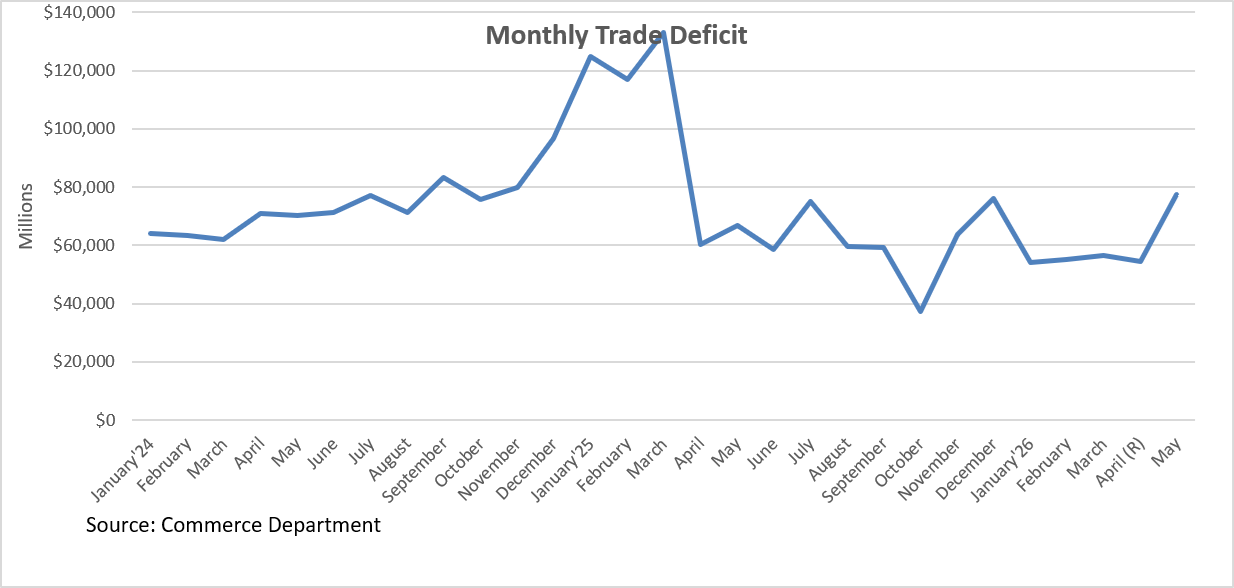
To be clear, the story is a bit more complicated. The trade deficit had averaged $70.9 billion through the first ten months of 2024. It then jumped after the election, hitting $96.9 billion in December, as people rushed to buy cars, appliances, and other big-ticket items, and businesses stocked their inventories, before Trump’s promised tariffs went into effect.
It rose further in the first three months of 2025 as people became more convinced that Trump was serious about his tariffs. The peak was $133 billion in March. The deficit then fell sharply in April. Part of this story was the impact of the tariffs themselves, and part was that people who had bought cars and other big-ticket items in anticipation of the tariffs were not about to buy them again.
The impact of people buying in anticipation of tariffs had probably worn off by the start of this year, so we could see the direct impact of tariffs on the trade deficit. The average for the first four months of 2026 was $55.1 billion. That would translate into an annual trade deficit of $661 billion, a bit more than 2.0% of GDP. That is down from the $850 billion annual rate we had in the first ten months of 2024, but still far from balanced trade for those who care about such things.
But we then took a big step in the other direction in May. It seems the main story here is imports of AI-related capital goods. Imports of capital goods were $1.1 billion higher in May than they had been in April and $17.2 billion higher than they had been in January.
Many of the computer chips and other items that the big AI companies need for their data centers are imported, mostly from Taiwan and South Korea. If we think the trade deficit means we are being ripped off by foreigners, the AI bubble is increasing the extent of the rip-off.
Monthly trade data are highly erratic, and it’s possible that the May jump will be reversed in June or subsequent months. But for now, the data make it look like Liberation Day didn’t have its intended effect.
Article

Article
Article
Article

Article

Article

Article
Article