
Article • Expose the Heist: Power and Policy in Unprecedented Times
Solidarity Strikes and Taft-Hartley’s Long Shadow
Article • Expose the Heist: Power and Policy in Unprecedented Times
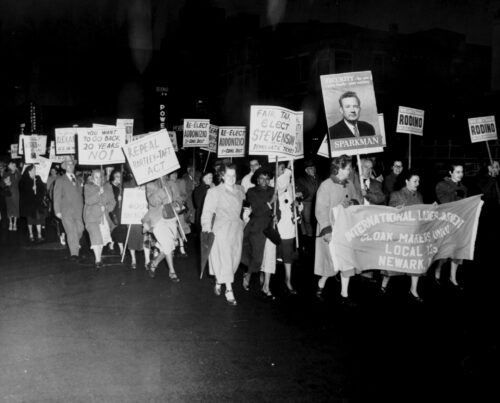
This week marks the anniversary of the enactment of one of the most consequential pieces of labor legislation in US history. The Labor Management Relations Act, better known as the Taft-Hartley Act, was passed over President Truman’s veto on June 23, 1947, and substantially narrowed the forms of collective action protected under federal labor law. The Taft-Hartley Act provided employers with a myriad of new legal weapons while suppressing some of organized labor’s most powerful tactics, dramatically reshaping the US labor landscape. Most of the provisions in the Taft-Hartley Act remain in effect nearly eight decades later.
For most private-sector workers, one of the costliest parts of the Taft-Hartley Act is its prohibition on secondary or “solidarity” actions. In a secondary action, workers at one company strike, picket, or boycott to support workers at another. Secondary actions enable workers across a supply chain to join forces and exert pressure, giving employees across different shops more leverage together than they would have individually. The Taft-Hartley Act, however, largely confined legal protections for strikes and picketing to actions directed at the “primary employer” involved in the labor dispute. Twelve years later, Congress would add Section 8(e), the “hot cargo” provision, which blocked unions from negotiating contractual solidarity with their employers. In practice, this meant unions could no longer blunt the Taft-Hartley restrictions through contract language requiring their employer to avoid doing business with a company involved in a labor dispute.
The Taft-Hartley Act’s restrictions on secondary actions represented a major change to the New Deal-era National Labor Relations Act (NLRA), which contained no such ban. The restrictions on solidarity strikes carry particular weight. The ability to withhold labor is the backbone of worker organizing; without it, workers have little leverage when negotiating with their employers. Solidarity strikes expand that leverage by making it harder for an employer to isolate a single bargaining unit, reroute work, or otherwise keep production moving despite a strike. Strike action of all kinds is associated with growth in union membership.
Workers in countries where solidarity actions are permitted have used them to great effect. In Finland, for example, striking postal workers found reinforcement from rail and aviation workers, among others. Solidarity actions disrupted rail, aviation, ferry, bus, and port operations, culminating in a successful agreement that preserved workers’ pay and conditions in their next contract.
While not the only factor, restrictions on solidarity actions almost certainly contributed to the weakening of organized labor in the US. Solidarity actions reinforce the idea of a labor movement that encompasses the entire working class, rather than siloing workers by employer or industry. The Taft-Hartley Act’s rules against solidarity actions weakened workers’ negotiating power. They also helped chip away at the burgeoning class consciousness that had powered many of the pre-1947 solidarity actions the Act was intended to curb.
Solidarity strikes would be especially useful now, given the Trump administration’s attacks on federal workers. The administration has attempted to remove collective bargaining rights for thousands of federal workers, a move which is still being fought in the courts. More recently, President Trump issued an executive order removing civil service protections for many federal workers, effectively converting about 8,000 employees to “at-will” status. Given that federal workers make up an outsized share of the labor movement, this would have been an opportune moment for private-sector unions to engage in solidarity actions to protect the movement as a whole.
Increasing unionization is part of CEPR’s Majority Agenda, a series which highlights broadly popular policy changes that would meaningfully improve the lives of working people. As one of the most effective mechanisms for workers to build power, unions are essential to that agenda. Unions are broadly popular in the US, and strong majorities agree that declines in unionization hurt both the country and working people. The US labor movement, however, is hamstrung by a system that is rigged against workers from the start. The Taft-Hartley Act helped rig that system and continues to reinforce it decades later. Its prohibitions against solidarity strikes were a political response to a labor movement that had demonstrated the capacity to disrupt entire industries. That is the kind of labor movement that the US needs today.
Article

Article
Article

Article
Article

Article

Article

Article