
Article • Dean Baker’s Beat the Press
The Cult of Affordability and the Labor Market

Article • Dean Baker’s Beat the Press
I know all the great minds are telling us that Tuesday’s elections were about affordability. But as usual, when the entire class of pundits is saying the same thing, it’s a safe bet they’re wrong.
To be clear, I’m sure many people are upset about prices and the fact that inflation is actually higher under Trump than it was at the end of the Biden administration. But this is only part of the story of people’s discontent.
This fact may have eluded our wise pundits, but most people work for a living. And for workers things look worse in November 2025 than they did in November 2024, and notably worse than they did in November 2023.
This is not just a story of unemployment, although that is part of the story. The unemployment rate was 4.3 percent in August. It likely had inched up to 4.4 percent or 4.5 percent by October. (The data for September was compiled before the shutdown, but Trump has chosen not to release it.) That compares to 4.1 percent last October and 3.7 percent in October of 2023.
By historical standards 4.3 percent — and even 4.5 percent — would be relatively low unemployment rates, but it is notably higher for many workers. For Black workers, the unemployment rate in August was 7.5 percent. That compares to 5.7 percent in October of 2024 and 5.9 percent in October of 2023. For young workers between the ages of 20-24, the unemployment rate was 9.2 percent in August — up from 7.8 percent last October and 6.9 percent in October of 2023.
These increases in unemployment are likely noticeable to the affected groups. And this is a story of disadvantaged groups more generally. When the unemployment rate rises, the workers at the bottom rung of the ladder feel it most intensely. Workers with disabilities and workers with criminal records are having much more difficulty finding jobs.
But the issue is not just employment, it’s also a question of having good jobs. One of the deliciously stupid things many pundits said back in the pandemic recovery, when unemployment was low and inflation was high, is that unemployment only affects a few million people, but everyone sees inflation.
The reason this comment is stupid is that unemployment is the less important part of the labor market story. In a healthy economy, close to 6 million workers lose or leave their jobs every month, the vast majority of whom look for new jobs. That comes to 70 million over the course of a year, if we just do the arithmetic.
Many of these people might change jobs two or three times, but the number of job switchers over the course of a year is still likely around 50 million. If we add in immediate family members, a very large share of the population is directly affected by the state of the labor market. The idea that unemployment matters only to a small portion of the population is just ungodly ignorant.
How workers assess the labor market can be clearly assessed by monthly quits. This figure peaked at almost 4.5 million in March of 2022. That was a time when employers were desperate to hire and retain workers. Many were offering hiring bonuses and even giving rewards for bringing in friends.
That rate of turnover was likely unsustainable and undoubtedly contributed to inflation at the time. By the end of the year the number of monthly quits had fallen to around 4 million and was down to a much more sustainable 3.6 million in the second half of 2023. The number of quits has continued to fall. It was under 3.1 million in August. Measured as a share of employment, this is roughly where the labor market stood in 2014, a time when it was not generally viewed as very strong.
The drop in quits means that workers do not feel that they can quit a job where they think the pay is low, the work is hard or dangerous, there are few opportunities for advancement and/or their boss is a jerk. In addition to meaning that people are less happy at their jobs, it also means that wages rise less rapidly.
In 2023, nominal wages grew 4.5 percent year-over-year. In August, the most recent month for which we have government data, the year-over-year increase was just 3.7 percent. There is a similar story in the data from Indeed, the job matching firm, where the pace of wage growth has slowed by more than a full percentage point from 2023. There is a similar story in the government data for the rate of pay growth for non-supervisory workers in the restaurant industry, one of the lowest paying sectors in the economy.
With such clear and unambiguous signs of weakening in the labor market, it is more than a bit bizarre that there has been essentially zero discussion of it in the election post-mortems. Flipping this question on its head, where did the obsession with affordability come from?
We know all the pundits, and therefore all the politicians, are talking about it, but why is “affordability” different from the talk about real wages and living standards that has been the bread and butter of politics for decades? I’m going to speculate a bit and give the Trump gang credit for manipulating the pundits and political debate.
Going into 2024, the Democrats had a great economic story to tell. Unemployment had been at or below 4.0 percent for most of the period from the end of 2021 to Election Day. This was the first time there had been such a long period of low unemployment since the early 1950s. Real wages had risen substantially from their pre-pandemic levels, with the largest gains going to those at the bottom end of the wage distribution. Real wages for the bottom decile of the wage distribution had risen 15 percent over the five years from 2019 to 2024, the largest increase since the 1960s.
Those higher up on the wage distribution were hugely benefited by the massive increase in the ability to work from home. They were able to save hundreds of hours a year in commuting time and thousands of dollars in work-related expenses. The increase in remote work was roughly 20 million, or almost one-eighth of the workforce.
Inflation in the United States had spiked in 2021-2022, as it had throughout the world. The pandemic created enormous supply chain problems as people unable to spend on services like restaurants and movies instead spent money on goods like appliances, household furniture, and cars. With pandemic shutdowns slowing production and shipping, and demand for goods going through the roof, prices soared. But by 2024, inflation had fallen sharply and was only slightly above the Fed’s 2.0 percent inflation target.
Since the data usually used to evaluate the economy all looked pretty good, the Trumpers came up with the line about high prices and affordability. I was skeptical of this at the time, since by any measure the vast majority of people were better off than in 2019, before the pandemic, when the conventional view was that the economy was very good.
The high prices story also didn’t resonate. I recall after the inflation of the 1970s and early 1980s, literally no one was talking about high prices. People were happy inflation had slowed to a more modest pace (3-4 percent), even though their pay had not kept pace. Unless people are hugely different in their perceptions today than they were 40 years ago, it didn’t make sense to me that people were actually upset about high prices, except insofar as political actors and the media sought to promote this concern.
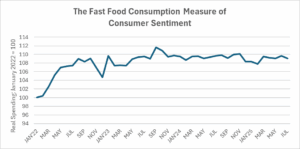
To get an assessment of people’s actual views on their financial situation I used my fast-food spending index. I consider this to be a useful barometer of how low and middle-income people actually viewed their situation. What people say about the economy when answering surveys or polls is influenced by the things they hear from the media and their friends. But what they spend is a good indicator of what they actually think.
Eating at a fast-food restaurant is very much a discretionary expenditure. If people feel stretched, they are likely to cut back on eating fast food.
Spending at these restaurants is also not likely to be driven by increased income to the rich. While rich people also eat at McDonalds and Taco Bell, it is unlikely they increase their spending there in response to rising stock prices. My fast-food spending index showed real spending rising rapidly through 2023, although growth did slow in 2024 and basically stopped this year. This is consistent with a strong labor market turning down.
Anyhow, the Trumpers endlessly pushed the high prices and affordability issue. Trump himself promised that he would get prices down on day one of his new term. On a lower level, I saw the affordability story pushed endlessly on X/Twitter.
My feeds were filled with people saying they were working two or three jobs and still couldn’t afford their rent or to put food on the table. I’m sure there are tens of millions of people in this situation, but that was also true in 2019, when I wasn’t seeing these stories in social media.
But the really remarkable part of the story is that all the hungry and homeless people on X/Twitter disappeared just after the election. I suppose some of them got high-paying jobs in the Trump administration, but the more likely story is this was an elaborate ruse.
I’m sure I was not the only person Elon Musk bombarded with endless stories of hardship. And I gather that these stories were spread elsewhere on other social media sites.
The stories also had the intended effect. They were embraced by the pundits, who were happy to overlook the objective data that we could measure about people’s economic situation and instead embraced the stories that people feel bad about their economic situation.
This became the absolute accepted truth about the economy. In fact, the pundits slammed Biden and his supporters when they made true statements about the positive aspects of the Biden economy. They were accused of being “tone-deaf.” It was so bad that many Democratic political analysts said that Biden, and then Harris, could not even talk about the economy because people were so negative on it.
They took away what should have been a winning issue for Democrats. They had the longest stretch of low unemployment in seventy years and the best record on real wage growth since the 1960s. But their political consultants told them not to talk about it.
If that sounds far-fetched, I remember a similar situation back in the 1990s. At that time, there was a huge drive by Republicans, and some Democrats, to privatize Social Security. The story was that the program was in crisis, so we had to do something to save it. At that point, even liberal Democrats who supported Social Security would say that the program faced a crisis.
I and some other progressive economists rejected the crisis story, based on the fact that under all projections it could pay full benefits for many decades into the future. That is pretty hard to call a “crisis.” I had discussions with the political consultants where they badgered me about denying the Social Security crisis, insisting that no one will take me seriously.
I ended up writing a book with Mark Weisbrot, Social Security: The Phony Crisis. Three decades later Social Security is still there.
The point is that Democratic political consultants were prepared to accept an absurd framing that was both factually wrong and hugely detrimental to the Democratic position. We saw this again with accepting the affordability framing in the 2024 election. Democrats had a great economic record. They should have been able to run on it. The standard measures of labor market strength and living standards still matter, and they mattered last Tuesday.
Article

Article

Article

Article

Article

Article
Article
Article