Article • Mark Weisbrot’s Columns
(Miami Herald) Trump Administration’s Extreme Anti-Labor Policies Could Determine the Impact of AI on Labor
Article • Mark Weisbrot’s Columns
What will be the impact of artificial intelligence (AI) on labor in the United States? The current government’s agenda for labor will certainly have an influence here.
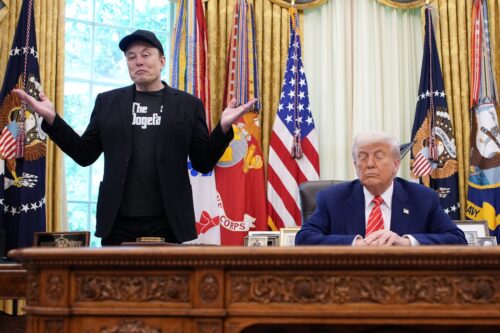
Last year, President Trump praised Elon Musk lavishly for telling his workers that he would fire them if they went on strike. “You are the greatest,” he said. This is reminiscent of the opening salvo in the unprecedented attack on labor launched by then President Ronald Reagan, in 1981. He fired 11,000 air traffic controllers who had gone on strike.
This assault jump-started a steady and accelerated erosion of the rights of workers — to organize, form unions, and bargain collectively under the law.
Donald Trump is aiming to finish the job. Amazingly, on August 19 a Republican-appointed Court of Appeals for the Fifth Circuit decided that the structure of the National Labor Relations Board (NLRB) was likely unconstitutional. In doing this, the court decided in favor of Elon Musk’s SpaceX and two other companies.
The NLRB has already been rendered powerless at the moment because Trump fired Board Chair Gwynne Wilcox illegally, leaving it with two members, less than a quorum.
In another unprecedented attack on organized labor, Trump canceled union contracts for about 400,000 federal workers in August.
This is the environment in which the owners of AI propose to work its magic, which is based on increasing productivity. It is likely that AI will raise productivity, and already has in some applications, although there is much uncertainty and disagreement about how much and how soon. Productivity — measured most simply as output per hour of labor — is the basis of rising living standards. Productivity advances in construction and manufacturing are what brought Americans homes with electricity, plumbing, and heating.
But modern economic history shows that it doesn’t always work that way. From 1948 to 1979, productivity rose by 122 percent. Labor compensation for the typical worker mostly followed, rising by 95 percent.
Then the new era began. From 1979 to 2025, productivity grew by 86 percent. But the typical worker got far less than half of those gains, with hourly pay rising by just 32 percent.
The fact that we are facing a regime that is so much more anti-labor than those who went before is not a good sign for the distribution of gains from AI productivity going forward. Neither are the reports of corruption: no other US president has ever used the office to generate billions of dollars in personal wealth while in power. And Trump’s contempt for working people is oozing out of his “Big Beautiful Bill.” What can you say about a regime that takes away health care (Medicaid) from more than 11 million people, cuts food assistance for 22 million people, and saddles working people with thousands of dollars per family annually in payment for tariffs? All while including trillions of dollars in tax cuts for the rich over the next decade.
Some have expressed concern that unemployment will result from the productivity increases that AI brings. The most important economic policies that could prevent unemployment from rising as productivity increases would be fiscal and monetary policies that promote full employment.
Unfortunately, these policies do not normally get the well-informed public debate that they so badly need. Right now, it looks like the Fed should cut interest rates due to the slowing of the US economy, and some weakening of the labor market. The Fed has historically been wrong about monetary policy quite a bit: most of the US recessions since World War II were actually caused by the Fed.
But Trump has made a reasonable discussion impossible by trying to bully Fed Chairman Jay Powell with all kinds of name calling and insults; and even worse, right now, by trying to fire Fed Governor Lisa Cook. It is clear that this firing is illegal. And it is a form of lawfare, a political persecution.
This is part of the authoritarianism that adds to observers’ fears of what the Trump administration will do with AI if advances are made, as they collect and abuse private data under their control.
On August 25, in the Oval Office answering questions about his military takeover of Washington, DC, Trump offered a chilling confirmation of many people’s worst fears: “A lot of people are saying maybe we’d like a dictator,” he said.
Article

Article
Article

Article

Article
Article
Article

Article