Article • Mark Weisbrot’s Columns
(Los Angeles Times) Sanctions Are Making Venezuela’s Earthquake Toll So Much Worse
Article • Mark Weisbrot’s Columns
Los Angeles Times
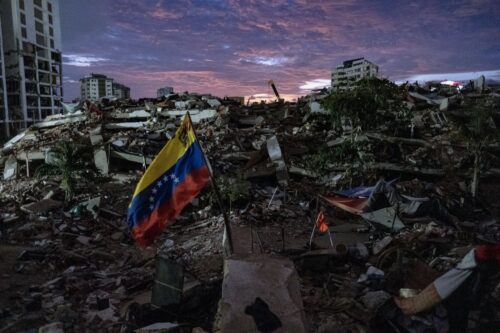
More than 3,800 people have died in Venezuela’s June 24 double earthquake, with 16,700 injured, according to current government reports. A medical crisis has emerged for thousands of survivors, and 17,800 are homeless.
There are heart-wrenching reports of people trying to dig survivors out of the rubble with their hands, with dozens of children suffering amputations because they could not be reached in time.
At a time like this, Venezuelans and the international community shouldn’t have to fight for an end to the sanctions that have destroyed the nation’s economy and hobble its recovery, nor for the country to have access to the billions of dollars worth of assets that belong to it. But we do, because the role of sanctions and frozen assets has received far too little public attention.
From 2012 to 2020, Venezuela suffered what is likely the most severe economic contraction in a depression that has occurred without a war. Data from the International Monetary Fund show a 74% decline in its GDP during that time. This is a loss of income about three times larger than what people here in the United States experienced during the Great Depression of the 1930s.
This was not a natural disaster like the earthquake, but a man-made one. IMF data show that 88% of this loss took place following U.S. economic sanctions that began in 2015. The destruction accelerated with the Trump sanctions, starting in 2017, that cut the country off from most international finance and then from the vast majority of its foreign exchange earnings. These shocks would have pushed almost any country into a severe crisis, and that’s exactly what happened, demonstrating to the world how sanctions really could destroy an economy.
As a result, Venezuela was already facing a humanitarian crisis before the earthquakes hit. According to data from the European Commission, before June 2026 there were 7.9 million people (of a population of 28.5 million) who were in need of humanitarian assistance. Forty percent of Venezuelans were facing moderate to severe food insecurity, and about 56% of the population was in extreme poverty. Eighty-six percent were dependent on contaminated water sources.
Nearly half of Venezuela’s doctors, and many health professionals and other skilled workers — including 200,000 teachers — left the country as the economy fell apart.
A study I co-authored with Francisco Rodríguez and Silvio Rendón, with results published last July in the Lancet Global Health, estimated that broad unilateral sanctions like these — the vast majority of which are imposed by the United States — cause an additional 564,000 deaths annually. This is comparable to the lives lost worldwide due to armed conflict. A majority of these deaths were estimated to be among children under 5 years old.
The death rate among Venezuelans grew throughout Venezuela’s depression, with more than 100,000 additional deaths during the years (2015-20) of the economic collapse that had sanctions.
Venezuela has crucial resources that it is not being allowed to access. The United States and Europe are blocking the nation from more than $11 billion dollars that Venezuela should legally have. About $4 billion is sitting at the Bank of England; it was frozen there from Venezuela’s Central Bank as part of a regime change effort in 2019, led by the United States. Of course the UK has no right to seize and hold these assets that belong to Venezuela.
About $4.5 billion is at the IMF in the form of international assets (called Special Drawing Rights), Venezuela’s share of an allocation made to member countries in 2021. Access was blocked as part of pressure for a regime change, but the United States removed the president of Venezuela in January and has since recognized the current government of Venezuela. The IMF followed. But it is not clear how much of these assets Caracas will be able to use, and when. Venezuelans need this money — and also the gold that the UK is holding — right now in order to save lives, avoid the spread of disease and rebuild.
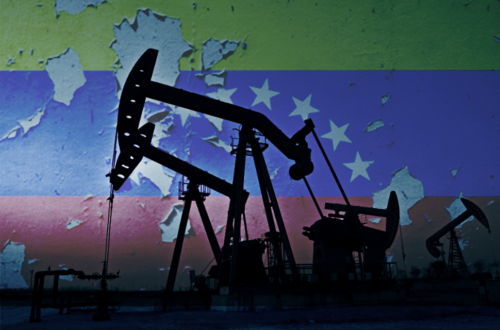
There are some billions of dollars more that are being held by the Trump administration, despite an executive order stating that these funds “constitute property of the Government of Venezuela.” This is cash from the sale of Venezuela’s oil, over which the Trump administration has taken control.
The United Nations now estimates that the post-earthquake reconstruction of Venezuela will cost about $37 billion, which is an enormous sum for this country, 33% of current GDP. Economists and other scholars have called for the lifting of Venezuela’s “ongoing economic and financial sanctions, asset freezes” and, via a debt jubilee, “onerous debt burdens.”
An end to the economic sanctions is needed. The U.S. Treasury has issued a license for four months that allows for earthquake relief, but that is not nearly enough. The central bank in Caracas is still under sanctions, and this will continue to interfere with the post-earthquake recovery.
It is also well-documented that important financial transactions and even relief work can be prevented because of what is called “overcompliance.” Banks, financial institutions and other companies avoid transactions because of real and perceived risk from sanctions, including the ambiguity of the U.S. executive orders that authorize them.
The largest life-saving action in the near future of post-earthquake Venezuela will come from getting the biggest players in the world — the United States along with its European partners — to stop blocking access to Venezuela’s billions of dollars of assets. And to stop causing further damage and loss of life through economic sanctions.
That is how these sanctions actually work. They target and punish the civilian population in pursuit of a political goal. Once relatively rare, they have become a “tool of first resort,” according to the U.S. Treasury — probably because the resulting fatalities are mostly unseen.
But more people each year, including members of Congress, are recognizing the economic violence, collective punishment and lethal human consequences of these sanctions and are pushing back. As the illegality and human toll of these sanctions become more widely known, the U.S. government will be increasingly forced to abandon them.
Mark Weisbrot is co-director of the Center for Economic and Policy Research and the author of “Failed: What the ‘Experts’ Got Wrong About the Global Economy.”
Article
Article

Article

Article
Article
Article
Article
Article