Article • Dean Baker’s Beat the Press
Trump’s “Big” Drug Savings Do Not Measure Up

Article • Dean Baker’s Beat the Press
The Trump White House is boasting about the savings from Trump’s “Most-Favored-Nation” drug pricing policy. The White House claims that we will be paying prices for drugs that are comparable to prices in other wealthy countries, which will save us $529 billion over the next decade.
Unfortunately, this story doesn’t quite add up. The country spent $720.2 billion on pharmaceuticals last year, according to the Commerce Department (National Income and Product Accounts, Table 2.4.5U, Line 122). The Center for Medicare and Medicaid Services projects that spending on prescription drugs will increase at an average rate of 4.9 percent annually over the next decade.
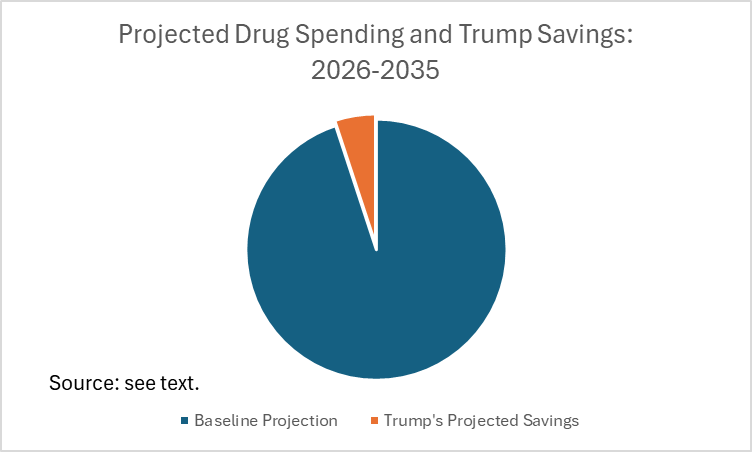
This means that over the decade from 2027 to 2036, the country would spend $9,922 billion on pharmaceuticals. The White House’s projected savings would be 5.3 percent of this amount.
While it would be good news if the rate of growth of spending on drugs were to slow slightly, as the Trump White House is claiming, this still does not leave us close to spending levels in other countries. According to the OECD, we spent $1,713 per person on pharmaceuticals in 2023, almost 50 percent more than Germany’s $1,168 per person spending. US spending was more than 60 percent higher than Canada’s and more than 90 percent higher than France’s.
For the more extreme cases, it was more than 175 percent more than what the United Kingdom spent per person and almost 250 percent higher than what Denmark spent on pharmaceuticals. In this context, the 5.3 percent reduction does not get the US anywhere close to what even Germany, the next biggest spender, pays for its drugs; it certainly does not get also in the ballpark of being the “most-favored-nation” in terms of drug prices, regardless of what Trump chooses to call his scheme.
There likely are more effective mechanisms to lower drug prices that are less focused on personal deal-making than the one Donald Trump has chosen to pursue. The results speak for themselves in this respect.
I have long argued that the biggest problem is making drugs expensive in the first place by giving drug companies patent monopolies. If all drugs were sold as generics in a free market, paying for drugs would not be a major problem. We would need to have far more public funding for drug research and development, but this would also have the advantage that it would take away drug companies’ incentive to lie about the safety and effectiveness of their drugs, as happened with enormous consequences in the opioid crisis.
In any case, it is encouraging to see the Trump administration continue President Biden’s effort to lower drug prices. It would be better to see more results, and even better to have a serious discussion of alternative mechanisms for financing the development of new drugs, such as was proposed by Michigan Rep. Rashida Tlaib. In any case, 5.3 percent is better than nothing.
Article
Article
Article
Article

Article
Article

Article
Article