
Article • Dean Baker’s Beat the Press
Monopolization in the Hospital Industry is a Problem, but Patent Monopolies Make It Worse
Article • Dean Baker’s Beat the Press
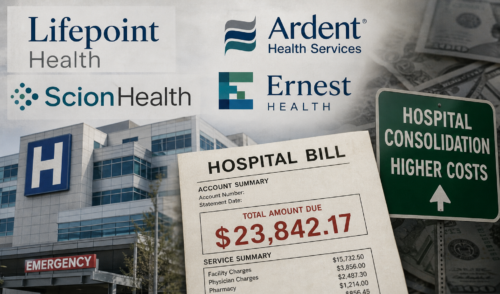
The New York Times had an interesting piece by Zack Cooper, a professor of economics and public health, that blamed hospitals for soaring health care costs. While there is much truth to Cooper’s argument, it is worth going a step further.
Cooper points to the enormous consolidation in the hospital sector, with many hospitals now having effective monopolies in their markets. The situation is made worse by private equity companies, which are now big actors in the industry. When private equity companies buy hospitals, they apply their standard bag of tricks: stripping assets, adding on debt, and often neglecting the quality of care to maximize profit.
While monopoly power is a big part of the story, it is not the whole picture. In addition to paying staff and for utilities like electricity and water, hospitals are also big purchasers of prescription drugs, medical devices, and medical equipment.
These items can be both expensive and have very opaque pricing. The reason is that the government grants patent monopolies to the producers. As a result, drugs and medical equipment can sell for tens, or even hundreds, of times the free market price.
This means that hospitals actually do have to pay large amounts of money for the cancer medications and MRI machines, and other drugs and medical equipment for which they bill insurers and/or patients. Since the actual prices paid by the hospital are generally not disclosed, it’s not possible for a patient or even an insurer to know the amount of profit a hospital is getting.
However, this story would be very different if the government did not give out patent monopolies and all these items were sold in a free market. The vast majority of drugs would sell for less than $30 a prescription, and many would cost just a few dollars. The same is true for a wide range of medical devices. And medical equipment, like high-end MRIs, which can sell for millions of dollars, would likely sell for around a fifth, or even a tenth as much in a free market without patent monopolies.
In addition to lower prices, there would also be much greater transparency. We would all know how much drugs and medical equipment cost. We could look them up on the web, just like we look up the list price for reams of paper or Dell computers. If a hospital tried to bill us 5 or 10 times the list price, we would know it immediately.
This doesn’t mean they still might not try to game the system. No two operations or procedures will be exactly the same. We have little ability to know if the complications they tell us occurred in a baby’s delivery or appendectomy really justified charging twice the normal price. But if the prices of all the drugs, medical devices, and medical equipment used were widely known, we would have removed a major source of corruption.
This would also eliminate one of the major sources of frustration for patients and their families. Insurers often ask for multiple opinions before agreeing to pay for an expensive drug or procedure. If the drugs and the physician-ordered scans were cheap, insurers would not bother trying to keep patients from getting the care their doctor thought best.
There is the issue of how we can finance the development of new drugs and medical equipment. I have argued for direct upfront funding, which we already do to the tune of $50 billion a year through NIH. We would have to triple or quadruple this spending to replace patent monopoly-supported research, but we would have the advantage that it could all be open source (a condition of getting the money). Also, we would have eliminated most of the incentive to lie about the safety and effectiveness of drugs, as happened in a very big way with the opioid crisis.
To be clear, we need to crack down on hospitals’ abuse of monopolistic power, as Cooper argues. But this would be a much easier task, and clear up other very big problems in our health care system, if we moved away from patent monopoly financing for the development of drugs and medical equipment.
Article

Article

Article

Article

Podcast

Article

Article

Article