
Article • Expose the Heist: Power and Policy in Unprecedented Times
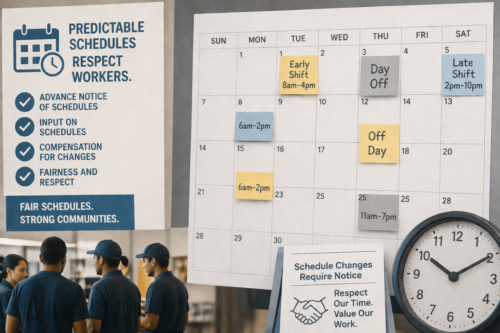
Fair Scheduling Laws Give Workers Real Protections
Article • Expose the Heist: Power and Policy in Unprecedented Times
Last month, Dunkin’ Donuts and Taco Bell workers won a nearly $2 million settlement in New York City (NYC) against their franchise’s management company for failing to provide reliable work hours, in accordance with the city’s Fair Workweek Law.
Enacted in 2017, and expanded several times since, NYC is one of the few places in the country with fair workplace scheduling provisions. These regulations entitle fast-food, retail chain, and utility safety workers in the city to predictable work schedules. The law prohibits corporations and franchisees from arbitrarily changing employees’ schedules and requires employers to pay wage premiums for back-to-back shifts. Since its enactment, the law gave predictable schedules to hundreds of thousands of workers, and expanded enforcement and significant settlements in recent years would deliver premium wage payments to over 35,000 workers in NYC, resulting in approximately $80 million in worker relief as of early 2026.
Fair scheduling laws, a crucial policy pathway to ease stress over unstable work hours and incomes for employees in lower-paying jobs, include provisions requiring employers to give sufficient advance notice of workers’ schedules, allow workers input on their schedules, and provide extra pay for schedule shifts. Earlier research has shown the law’s benefits in reducing short notice schedules in service sector jobs, though some provisions may have a limited response.
Compliance requirements vary by sector, employer size, and local administrative rules. Currently, nine cities and one state (Oregon) have adopted fair workweek regulations, and at least 10 others have legislative proposals in progress. Although laws such as the NYC Fair Workweek Act are not new, their effectiveness for employees depends largely on the commitment of local agencies to enforcement. When the city Department of Consumer and Worker Protection investigates and enforces employer compliance, it makes sure workplace laws are more than just words. This action brings real benefits to thousands of city workers and shows how important local efforts are in protecting workers.
Although there have been positive developments, evidence on enforcement efforts and employee-employer education remains mixed. A multi-city survey and interviews by Susan Lambert and colleagues found that, despite workplace laws and progress, compliance rates vary across localities. For instance, while half of workers in Seattle received two weeks’ notice of their schedules, fewer than one-third of workers in NYC and Chicago did. Additionally, slightly less than one-third of surveyed workers across all sites received partial compensation for last-minute reductions in work hours.
Similarly, even in states such as California — with comparatively progressive labor standards and worker protections — two out of five wage service sector employees reported employer violations related to paid time. These violations include not being compensated for all hours worked, being required to work off the clock, or not receiving overtime pay. Racial and ethnic disparities are evident in these labor standards violations, as more than half of Black workers in California reported experiencing at least one Fair Labor Standards Act (FLSA) violation.
Equally important is workers’ awareness of their rights. In addition to employer compliance, empowering workers to speak up without fear of retaliation leads to better outcomes. However, among hourly workers exposed to serious labor standards violations, only 35 percent filed a report or complaint. Encouraging workers to advocate for themselves and their colleagues is crucial, as it often prompts investigations and helps translate policy into real-world impact.
Although enforcement has been successful in some areas, many regions in the United States lack comparable legislation. For example, a recent survey conducted as part of the Advancing Black Workers in the South research initiative found that over half of workers surveyed in the South expressed employer scheduling violations as their primary workplace concern.
Without such laws and proper enforcement, two-thirds of hourly workers in low-wage jobs across the nation would suffer with work-schedule ambiguity, unpredictability, and instability in their economic lives overall. Amid the current affordability crisis, income security is primarily derived from employment. While local enforcement has been inconsistent, these efforts provide a model. Building momentum at both local and state levels is essential to influence the predominantly corporate landscape in the United States.
Article

Article

Article

Article
Article

Article
Article

Article