Article • Dean Baker’s Beat the Press
Industrial Policy Is Like Dieting: We Always Do It

Article • Dean Baker’s Beat the Press
Most discussion of industrial policy is a bit otherworldly. It is treated like something we can either do or not do, as though there is an on-off switch. This view should seem absurd to anyone who gives it a moment’s thought.
We always do industrial policy, in the sense of pursuing policies that favor certain industries to the detriment of others. In this sense, it is very much like dieting. Our diet is what we eat. We can think about it deliberately and try to consume a diet that limits our intake of calories or fat or accomplishes some other end, but we are not avoiding a diet by not thinking about it. We are likely just eating less healthy food.
It’s the same story with industrial policy. When we invested in the national highway system, we were adopting a policy that promoted cars and suburbs to the detriment of cities and mass transit. Similarly, building airports supported the airline industry, aircraft manufacturers, and tourism. This was at least partly at the expense of train travel and inter-city buses.
In the last few weeks, many people have endorsed the idea of having an AI sovereign wealth fund because they want to do industrial policy. This is about as wrongheaded as it gets.
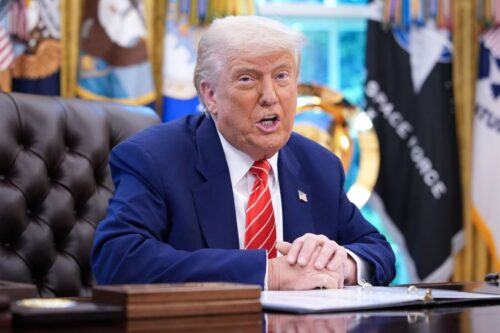
To start with, buying voting shares of AI will give Donald Trump yet another platform for his grift. He will dish out jobs and contracts to his friends and make sure that his political opponents are excluded. Anyone who doesn’t recognize this fact must have been asleep for the last year and a half.
And while you were sleeping, the Supreme Court just said that Congress doesn’t have the power to limit Trump’s abuses. Under the SCOTUS’s “unitary executive” invention, Trump can fire anyone any time he wants for any reason, or no reason whatsoever. So whatever power we think we are giving the government over AI companies by buying shares, is power we are giving Donald Trump.
As crazy as it might be to want to give more power to Donald Trump, the other part of a sovereign wealth fund as industrial policy is even crazier. Have we decided that we want to promote AI as a leading industry? If so, why?
And if we do want to promote it, on what planet have we determined that buying shares is the best way to do it? The AI sector will require thousands of highly skilled scientists. You know, the sort of people that Trump is chasing away with his immigration policy and reduced support for universities. Maybe reversing that policy would be more helpful.
It will also require cheap energy, of the sort that Trump is making scarce by cancelling wind energy projects that are well underway and doing everything he can to block further additions of wind and solar energy. It’s hard to see how owning shares helps with these issues.
There are also risks and costs associated with AI. In addition to electricity, data centers use a huge amount of water. Will owning shares in the major AI companies help to ensure that communities are not hard hit by the water or power usage of the data centers?
AI also scoops up vast amounts of copyrighted material, often without compensation. (I’m not a fan of copyrights, but in a system where creative workers rely on it for their income, it needs to be respected.) Will our shares in AI companies make it more likely that the people who produce the material that AI is trained on are treated fairly?
And what about when AI messes up? For example, if it gives wrong information that people rely upon to repair cars, and are subsequently in serious accidents. Will owning shares in the AI companies help us write the laws to ensure that the liability is assessed fairly?
Finally, suppose American AI proves to be far more expensive than Chinese AI, as seems to be the case now. In that case, US companies would be paying five or ten times as much for our AI as their competitors in the rest of the world pay for Chinese AI, putting them at a major competitive disadvantage. Will owning shares make it easier for us to make the right call on protecting domestic AI?
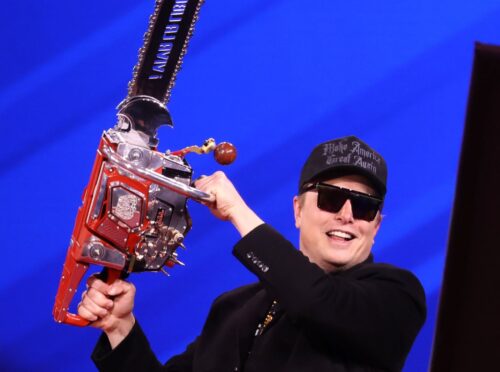
These and other questions are ones that need to be answered before jumping into public ownership of a stake in AI companies. We need to have a clear idea of what we hope to accomplish with this ownership. We do know for certain that it would mean giving tens or hundreds of billions of dollars to Elon Musk, Mark Zuckerberg, and the rest of the billionaire clique, quite possibly just before their bubble collapses. The question is whether we are accomplishing anything else?
Article

Article

Article
Article
Report

Article
Article

Article