
Article • Dean Baker’s Beat the Press
A Good News Story: Trial by Jury
Article • Dean Baker’s Beat the Press
I was going to write my usual depressing take on the economy and the AI bubble waiting to burst, but I was inspired by Paul Krugman’s account yesterday morning of his experience with potential jurors in New Jersey. I’m a step ahead of Paul on this one; I actually served on a jury. Although I’ve told friends about my experience, I’m pretty sure I never wrote it up anywhere.
This was about 25 years ago, when I was living in DC. Rather than trying to come up with an important person excuse for not serving on the jury, I agreed to do my time.
The facts of the case were interesting and not really in dispute. A young man had been convicted of a crime (we weren’t told what crime) and was serving the last six months of his sentence in a halfway house. The halfway house allowed people to sign out for two hours at a time. The guy had signed out, indicating he was going to have lunch at the food court at Union Station.
While he was there, he was arrested for shoplifting. He was taken into custody and held overnight, when his mother came and bailed him out in the morning. She indicated that the guy would be staying with her. After she got home, she called the halfway house, which had been informed of the arrest. They told her that her son was no longer their responsibility. The court told us the shoplifting charges were subsequently dropped.
His mother testified that he continued to live at home with her. The prosecution didn’t dispute this claim. He was then arrested doing something else (they didn’t tell us what), and they discovered that he had never completed his time at the halfway house. They then charged him with “escape,” based on the fact that he had not returned to the halfway house.
The guy testified in his own defense and essentially told the same story as his mother and what the prosecution had presented. The prosecutor’s most telling question was something to the effect of “you didn’t think you had completed your sentence, did you?” To which the guy said “no.”
The case concluded late afternoon, so the judge told us to come back and deliberate the next morning. I went home thinking there was no way on earth I was going to vote to convict this guy based on what we had heard.
His mother had told the court exactly where he was when she bailed him out, and there was no evidence whatsoever that he was staying anywhere other than with his mother. This means the police could have picked him up any time they wanted and have him serve out the rest of his sentence, wherever they considered appropriate.
How could this possibly be escape?
I had followed the judge’s orders and had not talked to anyone else on the jury about the case. As a result, I had no idea how anyone else viewed the case. However, I knew I was prepared to be an asshole holdout if need be. There was no way what this guy had done could be a crime.
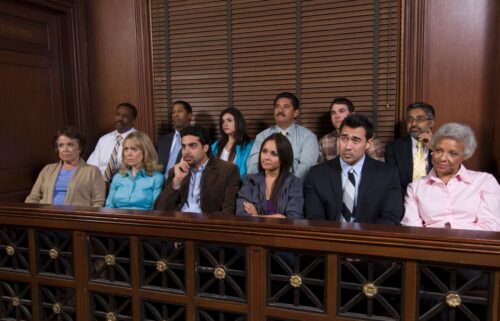
The jury looked to be a pretty representative DC group. It was half Black and half white. There were three lawyers (it’s DC, lawyers can sit on juries), but most of the jury did not look to be professionals.
The foreperson took a quick poll, and to my great relief, it was 9 for acquittal, 3 for guilty. We all went around the room and quickly explained how we had reached our conclusions. Two of the guilty people felt that the guy, who seemed to have committed some serious crimes, should not go free just because the court had messed up by not rearresting him after he had been bailed out.
We explained to these people that the guy had served, or would be serving, whatever time he was supposed to for his other crimes. We were only being asked if he had committed a new crime. While we all agreed that abstractly the guy should have made some effort to get his situation clarified, we didn’t think failing to call the police, when they in principle knew where you were, was a crime.
When two of those voting guilty understood clearly what was at issue, they shifted their vote to not guilty. The last person was still unhappy for reasons I didn’t understand but said he would not be the lone holdout. We turned in our not-guilty verdict after about two hours of deliberation, counting our introductions and selection of a foreperson.
What was so encouraging to me was that twelve people sat and listened attentively to the trial. Admittedly, it was only about four or five hours, not days or weeks, but people took their responsibility seriously. The deliberations were serious. People discussed the facts of the case and what it would mean to say he had committed the crime of escape.
I walked away thinking that if my freedom was on the line, I would be happy to think that I had a jury that was as responsible in assessing my case as this one.
I know this is a sample of one, and DC may be very different from the rest of the country. This was also a quarter century ago, when we only knew Donald Trump as a failed businessman and reality TV show star, so maybe times have changed. But this was an uplifting experience that I thought I would share at a time when we all could use some positive stories.
Article

Article

Article

Article

Article

Podcast

Article

Article