
Article • BUYOUTS: Private Equity Reshaping the Economy
BUYOUTS: Private Equity Reshaping the Economy – April 2026

Article • BUYOUTS: Private Equity Reshaping the Economy
ISSUE 2 – APRIL 2026
Private equity takeovers have wreaked havoc in health care and mass media, and have decimated major retail brands. These days private equity might be in a jam; its risky investment strategies are showing signs of stress, and investors are stuck with overvalued companies they cannot sell off.
This month’s edition of BUYOUTS takes a look at just some of what is happening in the world of private equity.
The big story in the buyout-adjacent world of private credit is about investors seeking to pull money out of these funds. Redemptions are soaring, and some big firms are enforcing caps to prevent investors from withdrawing more of their money.
This story is dominating the business press right now, though it’s still hard to say exactly how big of a problem it could be. CEPR co-director Eileen Appelbaum took a deep dive a few weeks ago with a piece – “You Bet Your Life (Insurance): Private Equity Comes For Your Annuity” – looking at how private equity investors moved in on the life insurance business, buying up annuities and investing them in private credit and other murky vehicles. As Appelbaum writes:
“The triggering event for the wave of redemptions at the end of 2025 was a fear that many software companies that have borrowed from PE-owned private credit funds are vulnerable to AI and may not be able to repay the loans they took out. The lack of transparency surrounding private credit funds makes it impossible to evaluate just how vulnerable they are. But some investors are not waiting to find out.”
Speaking of AI (everyone seems to be doing so these days), there are growing links between private equity and the AI bubble. Two of the biggest names – OpenAI and Anthropic – are reportedly trying to woo PE investors in deals that Axios describes as being ‘majority-owned subsidiaries’ or joint ventures of some sort. The idea is to craft deals with PE companies that would increase adoption of AI tools at the PE-owned companies. Reuters reports that Open AI stepped up its PE pitch by “offering private equity firms preferred equity stakes with a guaranteed minimum return of 17.5 percent, significantly higher than typical preferred instruments.”
How would such a return be guaranteed, exactly?
In other news: You might not be surprised to find out that private equity is heavily invested in the AI data center building boom. Truthout recently noted that PE is an “especially outsized force driving the data center boom, pouring billions into construction deals while also positioning itself to profit from supplying AI’s insatiable energy demands.”
A recent Wall Street Journal report looked at the booming market in autism services, where “companies have found lucrative opportunities to capitalize on the growing need for such care, sometimes outpacing regulators’ oversight.” Indeed, Medicaid payments to treatment providers have jumped significantly, and the Journal notes, “Entrepreneurs and investors, including some private-equity firms, have piled into the business.”
Indeed, this shift was tracked three years ago in a CEPR report, Pocketing Money Meant for Kids: Private Equity in Autism Services, which found that “private equity firms have become dominant players in the market for autism services. They have bought out many provider organizations across the country and created massive national chains with the primary purpose of extracting high returns in a short period of time.”
A pair of Democratic lawmakers – Rep. Robert Garcia (D-CA) and Oregon Senator Ron Wyden – are raising serious questions about Trump son-in-law Jared Kushner and his private equity firm Affinity Partners. As they wrote in a letter to the White House, “Mr. Kushner is simultaneously being paid millions of dollars by the Kingdom of Saudi Arabia and other Gulf monarchies while leading diplomatic negotiations with Iran and Russia. This corrupt arrangement is not only criminal but is endangering the lives of Americans and threatening our national security.”
Indeed, Affinity is closely connected to the Saudi Public Investment Fund; as CEPR has reported, Kushner’s PE firm and the Saudi government launched a takeover of the video game giant EA last year, the largest leveraged buyout in history. The deal raises substantial concerns for workers in the gaming industry as well as consumers, in addition to the obvious corruption angles.
The Economist attracted a lot of attention (not the good kind) with this piece:
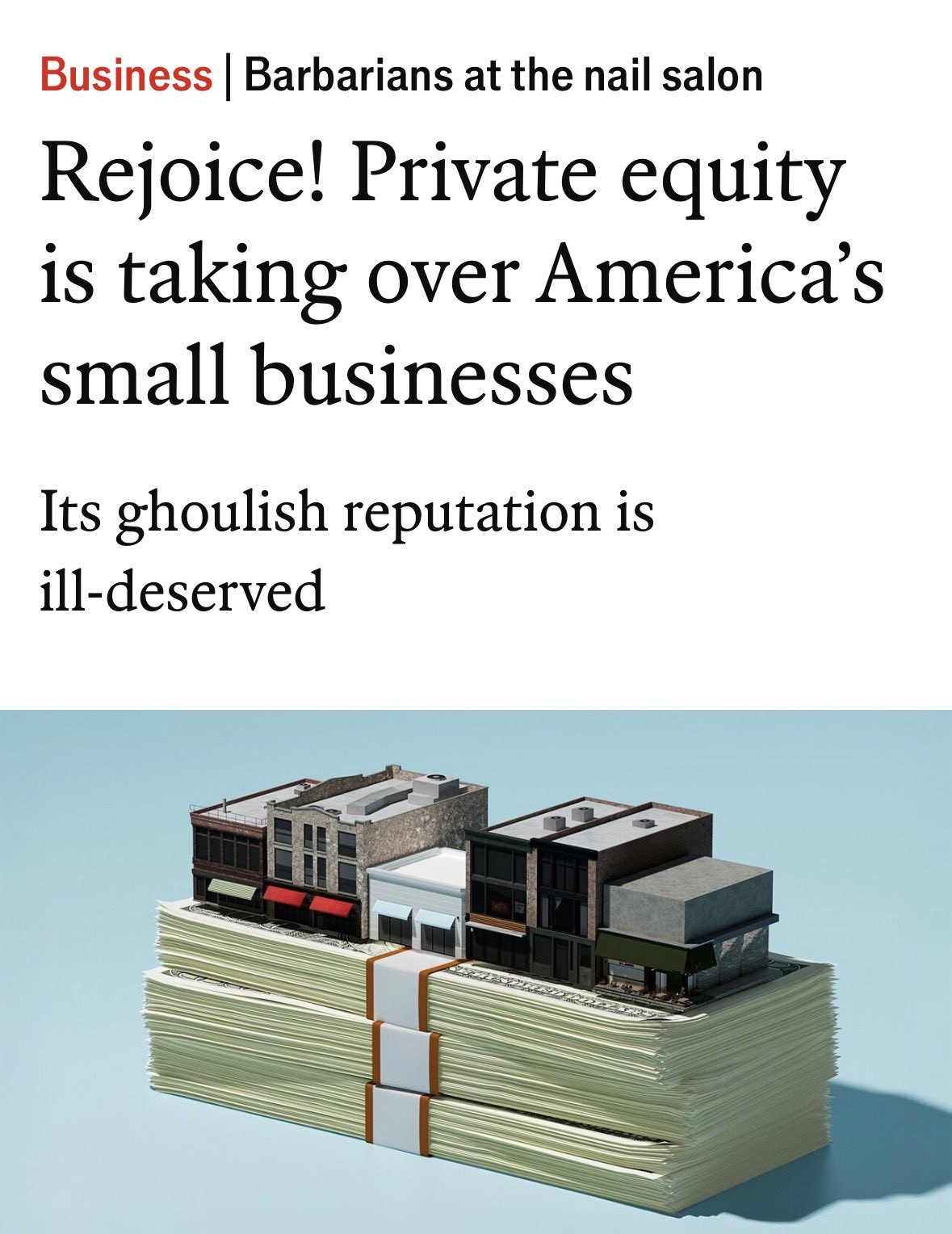
The magazine lamented that “the caricature of PE is that it loads companies with debt and sacks staff indiscriminately, resulting in juicy short-term profits but deteriorating service and, in the most egregious cases, failure of the business.”
The Economist doesn’t provide much evidence that this ‘caricature’ is unfair, but just a few weeks later, Bloomberg had a different take (“Small Businesses Are Pushing Back Against Private Equity”):
“For at least a decade, private equity has been encroaching on America’s mom and pop businesses, the backbone of the US economy, scooping up independent roofing contractors, veterinary practices, health clinics and other operators at a rapid clip. Now a PE pushback is brewing among small-business owners…who are increasingly refusing to take part — and making sure everybody knows it, loudly touting their anti-buyout stances and locally owned credentials.”
Instead of ‘rejoicing,’ Bloomberg senses that anti-PE sentiment “appears to be intensifying.”
In his annual letter to shareholders, BlackRock billionaire Larry Fink had an urgent warning about AI – namely, that it would worsen inequality: “The massive wealth created over the past several generations flowed mostly to people who already owned financial assets… AI threatens to repeat that pattern at an even larger scale.”
As a billionaire whose company manages trillions in investments, it is nice to know that inequality concerns him.
Article
Article
Article
Article
Podcast

Testimony
Article
Article