Article • BUYOUTS: Private Equity Reshaping the Economy
BUYOUTS: Private Equity Reshaping the Economy – March 2026

Article • BUYOUTS: Private Equity Reshaping the Economy
ISSUE 1 – MARCH 2026
Welcome to the first edition of BUYOUTS, CEPR’s new monthly round up of news and commentary from the world of private equity. Here’s some of what caught our attention over the past few weeks:
The Wall Street Journal reports that some of the country’s premiere universities are facing problems with their endowments, thanks to an overreliance on private equity. As the paper notes, the three year return on PE investments was a fraction of the gains in the S&P 500 over the same period. Princeton president Christopher Eisgruber explained that the weak returns would require “a major change” in spending choices.
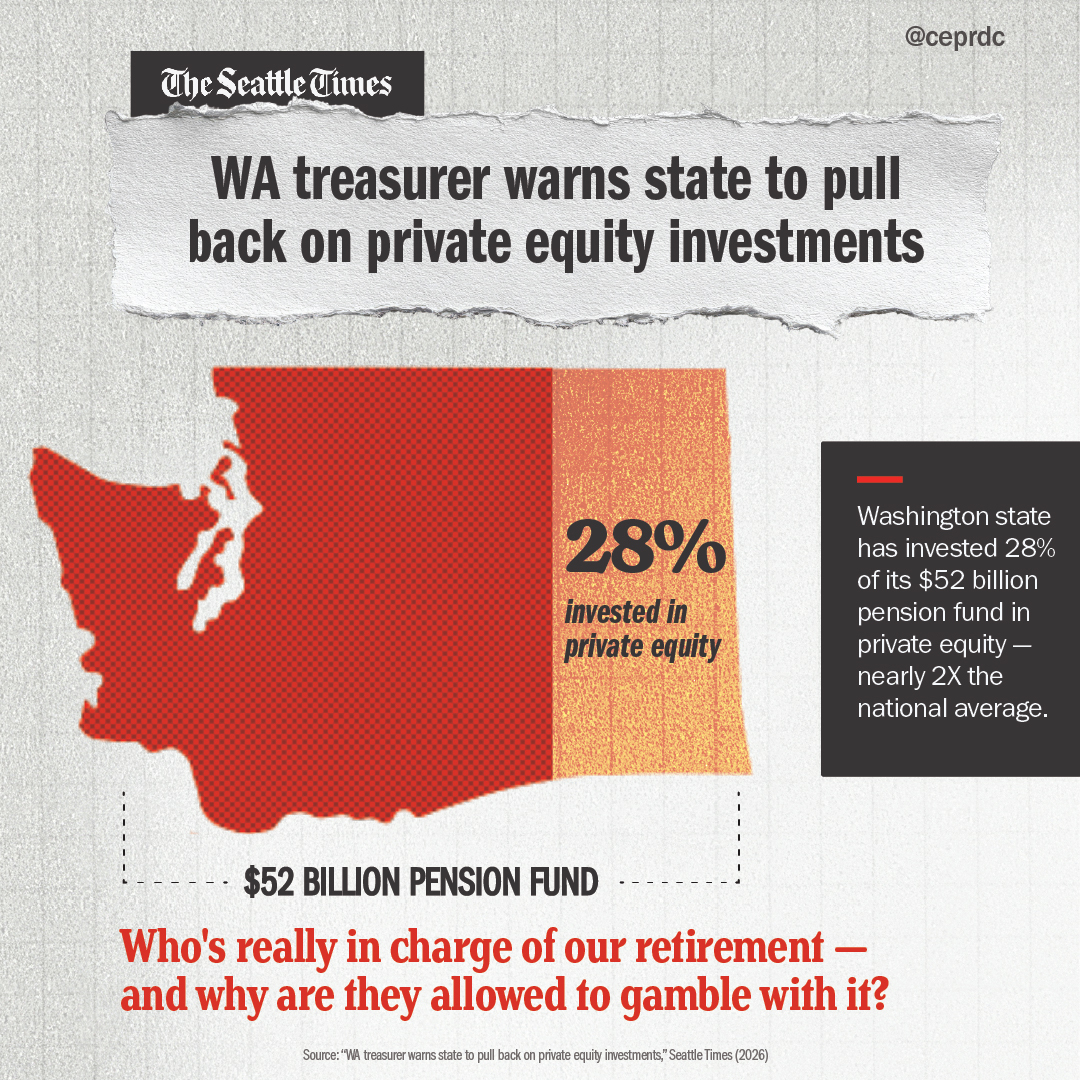
But it’s not just well-to-do private universities that are under stress. The Seattle Times noted recently that the Washington state pension fund has 28 percent of its $52 billion pension fund invested in private equity – roughly double the average across the country. The state’s treasurer worries that these unnecessary risks threaten the stability of the state’s retirement fund.
But you didn’t need to read about any of this in the newspapers. CEPR’s Eileen Appelbaum has been on this case for many years, most recently warning about the subpar return on PE investments:
The private equity industry has been relentlessly pursuing workers’ retirement accounts for desperately needed infusion of cash – an effort that ramped up after Trump was elected. The administration is crafting rules to encourage broader investment in alternative investments like private equity – which, as we have pointed out, is a highly risky move that would threaten small individual investors.
But don’t take our word for it – just look at what the PE bigshots are saying themselves. Billionaire mega investor Josh Harris told an investment conference recently that these accounts are “the last big pocket of capital” and added: “My own view is that it’s not going to end well.”
He’s not the only one expressing doubts. Hunter Lewis, the founder and former CEO of Cambridge Associates, wrote an opinion piece lamenting that “small investors may finally be invited into private deals, but probably only second-rate ones for confiscatory fees.” And how would he know this? He writes that he was one of the early proponents of finding so-called “alternative” investments for institutional clients. As for what might be coming next, he adds: “I bear some responsibility for what is happening. “
The Private Equity Stakeholder Project put together an excellent resource detailing hundreds of private equity deals in the health care industry. The report cites CEPR’s recent papers on health IT which trace the history of policies that created a health IT juggernaut, which “has become increasingly financialized and has failed to increase efficiencies across the US health system in any meaningful way.”
While action at the federal level remains elusive – especially under the current administration and the Republican majorities in Congress – there are many states stepping up to protect patients and health care systems from private equity greed. The Washington Post recently published a great overview of legislative efforts from California to Pennsylvania. On the latter, read Eileen Appelbaum’s piece, Private Equity Greed Doomed Prospect Hospitals.
Our friends at Americans for Financial Security put together a fantastic new resource detailing private equity’s involvement in child care – and what local policymakers and advocates can do about it. The “Children Before Profits State Playbook” is a great place to start learning the extent of the problems and the available tools to push back.
A recent news headline grabbed our attention: “Trump Wants Private Equity in 401(k)s. Voters Approve.” The article explained that while this idea is controversial, a new poll shows that “most rank-and-file Americans seem to like the idea.” But the poll in question comes from investment giant BlackRock, which would certainly play a huge role in facilitating such investments. So take it all with several grains of salt – especially since the poll may not have even asked about private equity. Their brief write-up states that almost two-thirds of respondents “support policy efforts to expand retirement plan investment options to include private market assets like real estate, infrastructure projects such as energy, transportation and data centers, and in private companies that do not trade on a public stock exchange.”
We’re used to hearing about private equity’s negative impacts on a wide range of sectors of our economy. But…. fonts? In a Substack post that drew a lot of attention, Ben Kaufman explained how private equity greed was behind some recent font changes at the Consumer Financial Protection Bureau. It turns out that the agency’s use of a previous font – Avenir Next – was based on paying a license to a company called Monotype, which itself was bought by a PE company called HGGC in 2019. The company went on a buying spree, ultimately consolidating much of the font business and massively increasing license fees. Kaufman sums it up to a “private equity making everything worse” story. Indeed.
Article
Article
Article
Testimony
Article
Article

Article