Article • Dean Baker’s Beat the Press
The Perfect Gift for Trump’s Friends in the Oil Industry: A Windfall Profits Tax
Article • Dean Baker’s Beat the Press
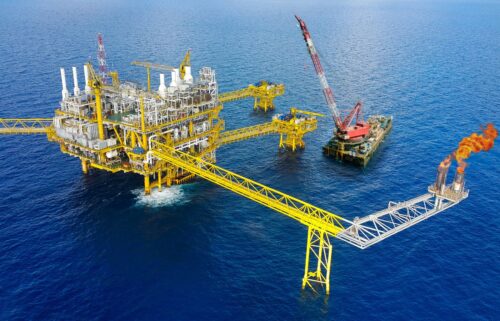
With Trump’s war in Iran having sent oil prices through the roof, Trump’s campaign donors in the industry are making out like bandits. While tens of millions of people are struggling to cope with the $1.50 rise in the price of a gallon of gas, the big shareholders at ExxonMobil, Chevron, and the rest are using wheelbarrows to deal with all the money coming in.
There is a simple and obvious mechanism to allow the rest of us to share in the industry’s good fortune: a windfall profits tax. We can simply tax back some of the money we’re handing over to the industry because of the Iran war and send it to people in the form of rebate checks, similar to the $2,000 pandemic checks we got in 2021.
A windfall profits tax is not new. We put one in place in the late 1970s following the surge in oil prices that resulted from the Iranian revolution. That tax was based on the prices of domestically consumed oil. But as Donald Trump is fond of boasting, our oil companies are profiting from the war by selling oil all over the world at inflated prices. There is no reason the rest of us shouldn’t share in the international part of the industry’s good fortune.
It’s not hard to structure a windfall tax to do the job. We can impose a tax of 50 percent on the industry’s excess profits. This would be determined by taking the average before-tax profit for the industry over the last five years and then adding a 15 percent inflation adjustment. Everything above this would be taxable excess profits.
We can get a rough idea of how much money this sort of windfall tax would generate by taking current production levels and projecting the extra profit per barrel. The United States was producing 13.6 million barrels of oil a day at the start of the war. That figure is likely to rise if the closure of Hormuz continues, but to be conservative, we can stick with the 13.6 million number.
Before the war, oil was selling at around $60 a barrel. The oil companies were making a profit at this price; otherwise, they would not have been pumping the oil. Prices in recent days have been hovering near $100 a barrel. Most projections have the price going much higher if the Strait remains closed. The price will likely creep higher even if it is opened in the near future, as the existing stock of oil is run down and it takes production some time to get back up to speed, and also for the oil from the region to reach its destination.
Again, being conservative, assume an excess profit of $40 a barrel, based on an average price of $100 a barrel. That comes to $544 million in excess profit per day. If it takes until September 1 for prices to get back somewhere close to pre-war levels, a very optimistic scenario, that means prices will have been inflated for 180 days. That comes to $98 billion in excess profits.
Taking half of this number for the windfall profit tax would mean $49 billion in excess profits. Dividing this among 250 million adults would get us all windfall profits checks of roughly $200 a person. That may not make anyone rich, but it would be some compensation for the higher gas prices caused by Trump’s war.
It’s also worth mentioning that the checks could be considerably larger if the Strait remains closed for a longer period of time and/or prices go as high as $150-$200 a barrel, as some economists project. That would be a very bad story for the economy and the world, but at least families here would get a share of the dividends.
It’s also worth noting that we don’t really have to worry about the tax damaging future economic prospects in any important way. With the ’70s tax, there was a concern that taking away industry profits would give them less money to drill for new oil. (Oil from newly drilled wells was not subject to the tax.) There probably was some truth to this story, even if the industry’s lobbyists hugely exaggerated it.
In the current situation, we really don’t want the companies to drill for new oil. Clean energy sources, like wind and solar, are far cheaper, and they don’t pollute the environment. Furthermore, it is unlikely that more profits would lead to much new drilling in any case, since the industry expects oil prices to plunge once the Strait is reopened. If the price is expected to drop back to $60 a barrel, no one is going to spend huge sums to drill for oil that costs them $70-$80 a barrel to produce.
A windfall profits tax is a perfect way to allow all of us to share to some extent in the bonanza the oil industry is enjoying due to the war. The fallout from the Iran War, most obviously the loss of life, is likely to be bad and long-lasting. But a windfall profits tax can make it a little less bad, at least for people in the United States, and will dampen the celebrations of Donald Trump’s big contributors in the oil industry.
Article
Article

Article

Article

Article
Article

Article
Article