
Article
The Price of NATO Membership: Growing Resistance to the Alliance’s Rearmament Agenda
Article
The North Atlantic Treaty Organization (NATO) held its annual summit in Ankara this week among growing dissatisfaction within its membership.
During the last few years, divisions inside NATO have emerged over a series of issues, including the level of support for the Ukrainian war effort; the issue of enlargement, with the accession of Sweden and Finland being initially opposed by Hungary and Türkiye; and, crucially, the United States’s insistence on the need for greater burden-sharing.
Despite indicating otherwise at the summit on Wednesday, President Trump had gone as far as to threaten to withdraw from NATO earlier this year if Europeans didn’t shoulder their share. He also promised to disengage thousands of troops stationed in Europe, and has repeatedly threatened to annex Greenland. For Europeans, such public threats create uncertainty about the solidity of US security commitments going forward and undermine NATO’s deterrent value.
More recently, disgruntlement over the US’s unpredictable military adventurism — especially in the context of a war with Iran which was never disclosed nor discussed with NATO partners — has further eroded the cohesion of the alliance. In March, even a very pro-NATO Italian premier Giorgia Meloni denied authorization for US bombers to use a Sicilian airbase. In April, President Trump threatened to “suspend” Spain from NATO for its opposition to the US-Israel war on Iran.
Yet despite these growing divisions, European governments have largely acquiesced to US demands for higher military spending. Most NATO countries, in fact, had already increased spending to meet the 2 percent target agreed in 2014. As of 2025, 31 out of 32 treaty members were estimated to be spending 2 percent or more of GDP annually on defense, up from 18 countries in 2024. According to NATO’s 2025 estimates, Italy had to almost double its annual military expenditures in real terms to meet US demands, while in Spain and Slovenia defense spending nearly tripled in real terms from 2014 to 2025.
But now much bigger hikes are on the horizon. At the 2025 NATO Summit, member countries committed a total 5 percent of GDP per annum on “defense and security-related spending” by 2035, composed of 3.5 percent for defense and 1.5 percent for critical infrastructure.
In Germany, the drive toward greater militarization has broken historic taboos, successfully overturning decades of both fiscal and strategic military restraint, culminating in the amendment of the Constitution’s borrowing cap to finance higher defense spending.
But the consensus over these bold defense commitments is far from unanimous, and has caused political conflict both in domestic politics and at the international level. Spain’s prime minister, Pedro Sánchez, rejected NATO’s 5 percent and capped the country’s commitment at 2.1 percent of GDP, calling a higher target “incompatible with the Welfare State and Spain’s worldview.” Only 37 percent of Spaniards supported hikes to military spending in 2024.
In Slovenia, palpable dissatisfaction with NATO came to a head last year when the government called for a nonbinding, national referendum on NATO membership, but parliament ultimately voted to prevent the referendum from taking place.
The rise in military budgets — especially since the onset of the war in Ukraine — has also revived a political opposition to NATO in the West which criticizes the social costs of militarization and, in some contexts, seeks to place a turn away from militarism once again at the center of its political project.
The growth of anti-NATO political currents is now further compounded by the unpopularity in Europe of the US-Israel war with Iran, where countries have spent an extra $32 billion for oil and gas imports during the conflict’s first 60 days. A recent poll shows the vast majority of Italians — 79 percent — have a negative opinion of president Trump’s handling of the Iran war, and only 29 percent supported a higher military budget last year.
Public opinion in Europe could sour further on NATO if higher defense spending is shown to negatively impact other budgetary priorities such as education and health care. But what does an additional 3 percent of GDP needed to meet the 2035 defense spending commitment look like in terms of government expenditure?
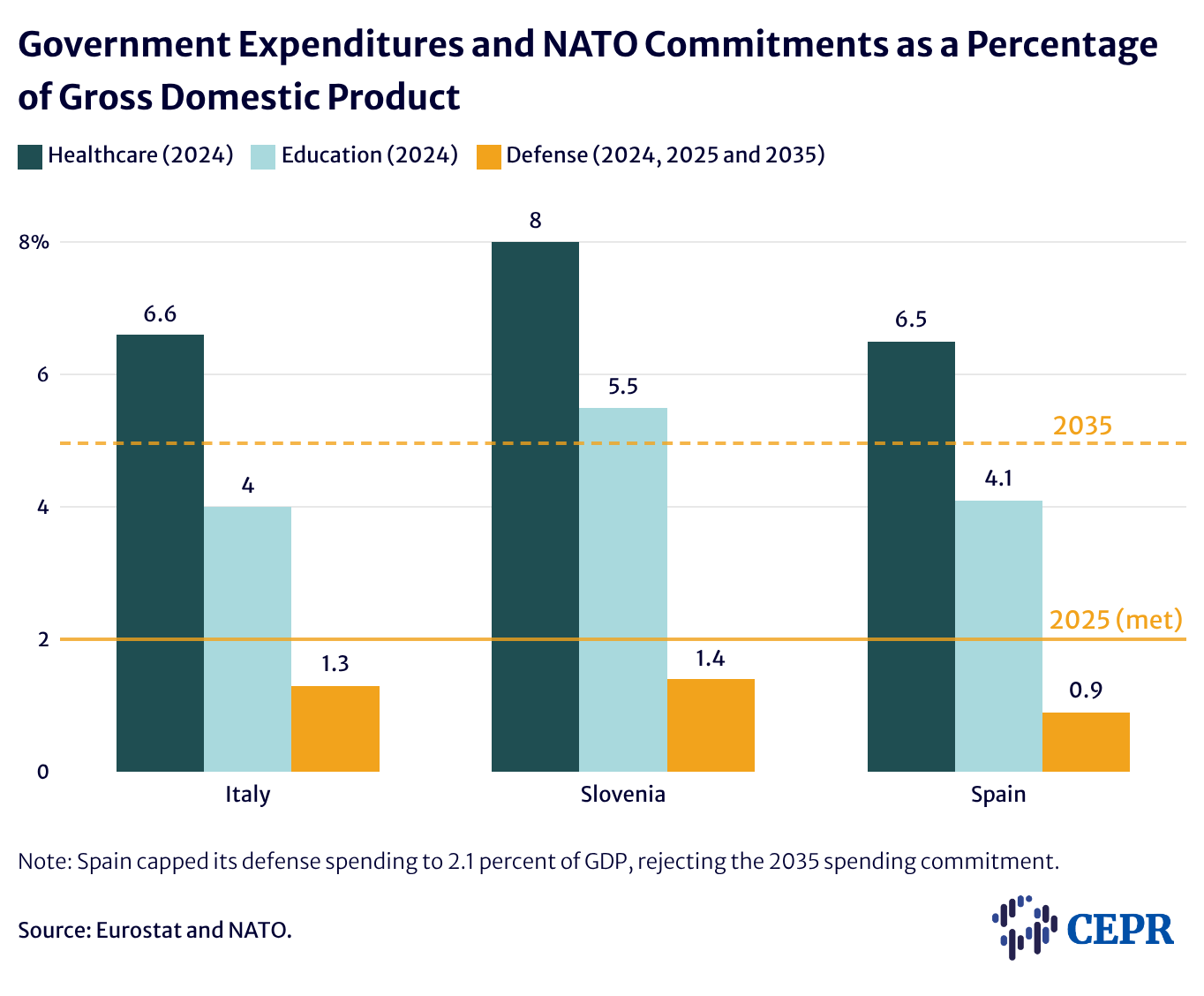
As shown in the figure above, in Italy, increasing military spending to 5 percent of GDP would mean surpassing the current budget for education by 1 percent of GDP, and would approach spending on health care, which sits at about 6.6 percent of GDP. In Slovenia, it would nearly match state spending on education, currently at 5.5 percent of GDP, and would amount to over 60 percent of health-care spending.
This is all assuming, perhaps incorrectly, that increased military spending wouldn’t result in decreases to these public services. The trade-off, however, will have to come from somewhere: budget cuts, the slashing of social provisions, tax hikes, or — in Slovakia’s case — creative accounting, like classifying new medical facilities as defense expenditure.
If these countries were to maintain military spending at 2025 levels through 2030 — about 2 percent of GDP — it would still cost an estimated additional €50 billion for Italy, €42 billion for Spain, and €1.7 billion for Slovenia compared to 2024 spending levels over the next five years.1
By rejecting the 5 percent commitment and capping defense expenditures at 2.1 percent, Spain will save €350 billion through 2035, according to Sánchez, and avoid “raising taxes on each worker by around €3,000 per year; eliminating unemployment, sickness and maternity benefits; reducing all pensions by 40%, or cutting state investment in education by half.”
This, of course, is to say nothing of the human, socioeconomic, and political costs of any future NATO military intervention that increased defense budgets may or may not encourage. More than 900 NATO soldiers from Europe perished in the war in Afghanistan, along with over 45,000 Afghan civilians — a war which became increasingly unpopular in most European countries, with public opinion favoring a complete or partial withdrawal of troops within a few years of the onset of the 20-year war.
Conspiciously, NATO has not released public opinion research for the past two years — breaking from the practice of publishing surveys of member country populations ahead of each annual summit. It’s no stretch to think that in 2026 even fewer Europeans would be willing to risk their lives for what NATO Secretary General Mark Rutte called a platform for the “US to project power on the world stage.”
Ivana Vasić-Lalović is a senior research associate at the Center for Economic and Policy Research (cepr.net) in Washington, DC.
Article
Article
Article
Article