Article • Dean Baker’s Beat the Press
Obamacare Lowered Health Care Cost Growth #34,706

Article • Dean Baker’s Beat the Press
I have written a couple of pieces before making the point that health care cost growth slowed sharply after Obamacare passed in 2010. It’s perhaps not surprising that Republicans insist on defying reality and saying the opposite, but it is surprising that very few Democrats are prepared to correct them on this obvious truth.
I can’t say I know exactly why, but I’m inclined to blame the Democratic political consultants. These are the people who told the Biden-Harris team that they couldn’t talk about things like the most rapid real wage growth for low-paid workers in a half a century, and the longest period of low unemployment since the early 1950s, a record low unemployment rate for Black workers, or an unprecedented doubling in real factory construction compared to the pre-pandemic level.
While Republicans boast about things that aren’t true, Democratic political consultants tell Democratic politicians that they can’t boast about things that are true. For better or worse, I don’t get advice from Democratic political consultants, so I will again give the basic facts on Obamacare and health care costs.
Health care costs had been far outpacing GDP growth prior to the passage of the ACA in 2010. Costs had increased by more than four percentage points as a share of GDP in the decade from 2000 to 2010. That’s equivalent to an increase in annual spending of $1.2 trillion in today’s economy.
They were projected to continue to rise rapidly, increasing by 2.2 percentage points of GDP by 2020, according to the Center for Medicare and Medicaid Services (CMS). The Congressional Budget Office had similar projections, projecting that cost of the government programs alone would rise by another 0.9 percentage points of GDP between 2020 and 2025.
Putting these two projections together, the cost of healthcare in 2010, when Obamacare was passed, was projected to be 20.7 percent of GDP in 2025, 3.1 percentage points higher than it was in 2010. The most recent CMS projections put healthcare costs this year at 18.5 percent of GDP, 2.2 percentage points of GDP less than what had been projected at the time Obamacare was signed into law.
I realize most people don’t think in terms of percentage points of GDP growth, so let’s look concretely at what the slower growth post-Obamacare meant. The projected 3.1 percentage point rise in health care costs would have come to roughly $1.0 trillion in additional spending for the year 2025. Instead, health care spending increased by 0.9 percentage points, which came to roughly $270 billion for 2025, compared to a scenario in which the health care share of spending didn’t rise at all after 2010. That increase is still a substantial chunk of change but nonetheless much smaller than what we were looking at when Obamacare passed.
Putting this into spending per household, the increase in spending over the period 2010-2025 projected when Obamacare passed would have come to $8,000 per household. The actual increase was $2,200 per household. The savings, relative to the level of spending projected in 2010, comes to $5,800 per household.
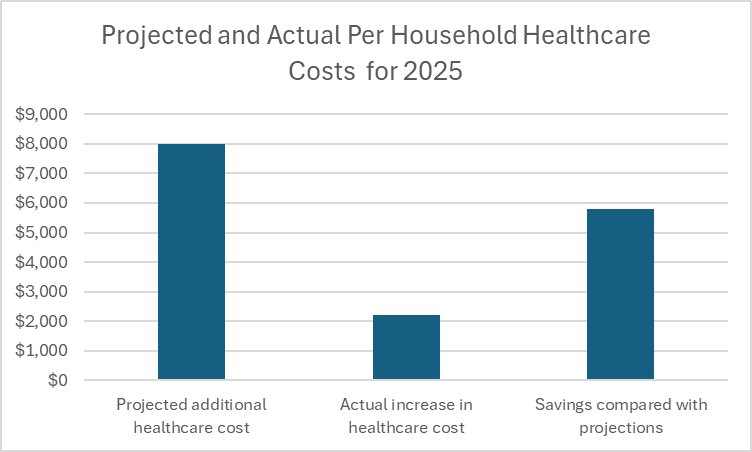
Perhaps the idea of savings relative to projected growth is hard to explain to people. I’m not a politician running for office, so I don’t have to know the answer to that one. It makes matters more complicated that much of this spending comes out of people’s pockets indirectly, either in the form of government programs or employer-provided health insurance. But as someone who learned arithmetic in grade school, I can see that people have hugely more money in their pockets today because healthcare costs rose far more slowly after Obamacare was passed.
Obamacare may not have been the only reason for slower health care cost growth. But we know with absolute certainty that Republicans would be blaming Obamacare for any increase in spending, even if it had nothing to do with Obamacare. It seems Democrats should be taking credit for the slower growth in health care costs, but I guess the Democrats’ political consultants don’t think so.
Article

Article

Article
Article

Article
Article

Article

Article