Article • Ecuador News Round-Up
Ecuador News Round-Up No. 25: Ecuador’s Security and Human Rights Crisis Deepens as the Government Renews Attacks on the Opposition
Article • Ecuador News Round-Up
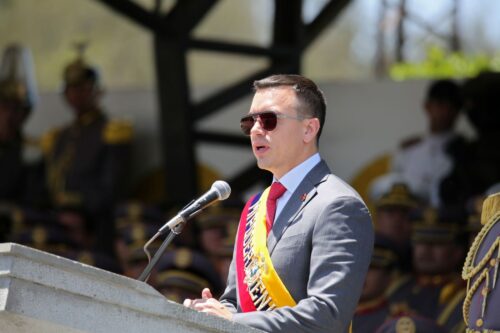
Ecuador ended 2025 with a record homicide rate of 51 deaths per 100,000 inhabitants, surpassing the previous peak of 46 in 2023 and representing a dramatic rise from just 5.8 per 100,000 inhabitants in 2017. Since his election in late 2023, President Daniel Noboa has responded with a policy of militarization, but this has only deepened the human rights crisis and triggered widespread reports of human rights violations. Since November 2025, the Inter-American Commission on Human Rights (IACHR) has issued two precautionary measures concerning Ecuador: one addressing the military’s alleged forced disappearance of 26 individuals and another related to a growing health crisis within the country’s prison system.
Noboa leveraged the security crisis to campaign for a four-question referendum he convened for November 16, 2025. Among other proposals, the referendum asked citizens whether they supported drafting a new constitution. To the surprise of many observers, voters overwhelmingly rejected all four of Noboa’s proposals. This outcome sparked various interpretations: Some viewed the results as a total repudiation of Noboa’s leadership, while others argued that voters still generally support the president but oppose the broad, sweeping manner in which he is attempting to implement change. Shortly after the vote, the Organized Crime and Corruption Reporting Project (OCCRP) published an investigative report with evidence suggesting that a company linked to Noboa and his family may be involved in trafficking cocaine to Europe.
At the same time, Noboa has increasingly aligned Ecuador’s foreign policy with the United States and has even expressed support for Washington’s recent military intervention in Venezuela. He has also emulated elements of the Trump administration’s trade policy by imposing 30 percent tariffs on Colombia and initiating a trade dispute that could jeopardize Ecuador’s long-term access to energy. Conversely, Noboa signed an investment agreement with the United Arab Emirates (UAE) that includes investor-state dispute settlement (ISDS) provisions that are banned under the Ecuadorian constitution. This agreement is now under review before the Constitutional Court of Ecuador, a court he has previously pressured and staffed with allies. Its approval may open the door for another ISDS-laden trade agreement with Canada.
Last year, Ecuador’s Council of the Judiciary controversially appointed an acting prosecutor general, Carlos Alarcón, a close Noboa ally. In a series of corruption and campaign finance probes, Alarcón raided the homes of several leaders from the opposition Revolución Ciudadana party, including former presidential candidates and the mayor of Guayaquil, one of the country’s largest cities. Those targeted say the raids are part of the government’s long-standing political persecution of the party. They further argue that the Noboa administration is using these investigations to distract from its efforts to capture key independent oversight institutions.
Ecuador currently has one of the highest homicide rates in the world, a situation that experts have attributed to the country’s growing role in the international drug trade and to austerity measures that have weakened the state and curtailed anti-crime social programs. In 2023, the country’s homicide rate reached a historic record of approximately 46 deaths per 100,000 inhabitants, up from 5.8 deaths per 100,000 in 2017, transforming Ecuador from one of the region’s most peaceful countries to one of its most violent. In 2024, the homicide rate fell by 16.5 percent, a decline President Noboa credited to his militarized security strategy, though the year still ranked as the second deadliest on record after 2023. With the end of 2025, however, the homicide rate eclipsed previous records to reach a new peak of 51 deaths per 100,000 inhabitants.
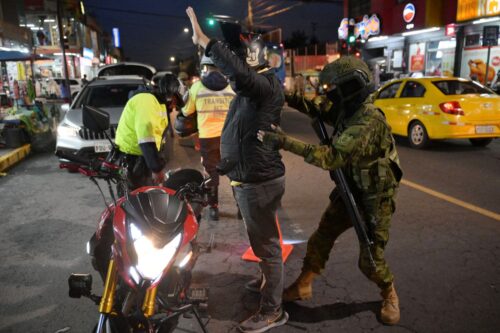
Noboa has attempted to address Ecuador’s security crisis through a militarized approach to law enforcement. In January 2024, Noboa declared an “internal armed conflict” against gangs, which he has enforced through a series of states of emergency that have allowed him to suspend certain rights and to deploy the military to the streets to combat so-called “narco-terrorists.” Over the summer, he also attempted to fast-track a law that would have significantly expanded his powers over security policy, but it was struck down by the Constitutional Court shortly after taking effect.
While these measures have not led to an improvement in the security situation, they have, since their inception, led to an increase in reports of grave human rights violations. Since CEPR’s last Ecuador News Round-Up, in November alone, the IACHR has granted two sets of precautionary measures in relation to Ecuador.
The first set of measures was issued on December 30 for 26 individuals who had been disappeared since the start of Noboa’s “internal armed conflict.” A statement from the IACHR reads:
According to the request for these precautionary measures, the 26 missing persons were allegedly arrested by members of Ecuador’s Armed Forces in various raids conducted in 2024. No official information has been provided so far about their whereabouts, although several formal complaints have been filed and several judicial decisions demanding information have been issued. The six female searchers have alleged that they are being subjected to threats and intimidation in connection with their search.
These measures follow a September 2025 report by Amnesty International documenting numerous cases of enforced disappearances. They also come on the heels of the conviction of 16 soldiers for the December 2024 disappearance of four children who were later found dead — a landmark case that has become emblematic of the human rights violations under the “internal armed conflict.”
The second set of precautionary measures was issued on January 5, this time for inmates at Ecuador’s Litoral Prison in Guayaquil. While Ecuador’s prisons have been the site of multiple riots and massacres — including one in early December that left 13 dead — these measures were granted in response to a health and malnutrition crisis at Litoral Prison. An El País article on the crisis highlights that:
Since 2024, when President Daniel Noboa assigned prison security to the military, Ecuador’s prisons have become sites of systematic torture, widely denounced by international bodies such as the United Nations Committee Against Torture. Their reports highlight the increasing number of deaths in state custody alongside the cruel, inhumane, and degrading practices within detention centres.
The famine affecting the roughly 35,000 prisoners in the country’s 36 prisons has severely deteriorated their health and triggered a tuberculosis outbreak that has already spread beyond the walls of the prison in Guayaquil.…
In 2025, at least 600 prisoners died from health and nutrition-related issues at the Litoral Prison alone, the epicenter of the crisis, according to documents from the Guayaquil Human Rights Committee (CDH), supported by data from the Forensic Science Department and the SNAI, the government agency in charge of prisons.
Following these measures, Ecuador’s military has taken steps to reduce transparency. Earlier this month, Ecuavisa reported that the armed forces will deny accreditation to journalists and media outlets critical of the military or to those that fail to follow its editorial line.
In a stunning rebuke to President Noboa — who had been reelected less than a year earlier — Ecuadorian citizens overwhelmingly voted down all four questions of a referendum that would have brought sweeping changes to the country.
The November 16 vote followed a bloody month of primarily Indigenous protests against the president’s austerity measures, during which security forces killed three protestors and injured hundreds. It was the culmination of a months-long process in which Noboa submitted multiple rounds of proposals to the Constitutional Court for review, only to have most of them struck down or sent back for modifications. This review process occurred amid the Noboa administration’s campaign of pressure and threats against the Constitutional Court, following its suspension and annulment of sweeping laws on security and “public integrity” that the president’s majority in the National Assembly had illegally fast-tracked over the summer (see Ecuador News Round-Up No. 24). Notably, the Organization of American States’s electoral observation mission expressed concern regarding Noboa’s attacks on the judiciary in its report about the referendum.
The referendum asked citizens four questions: whether they supported eliminating state financing for political parties, whether to reduce the number of lawmakers in the National Assembly by over 50 percent, whether to overturn the constitutional ban on foreign military bases in Ecuador, and whether to hold a popularly elected constituent assembly to rewrite the constitution.
Analysts expected that at least one of the first two proposals — if not both — would be approved, as they tapped into widespread antiestablishment sentiment and were presented as cost-cutting measures. Observers were less certain about the passage of the final two questions, although their approval was still considered quite possible. As a result, most of the campaigning focused on these latter proposals.
Noboa framed the military base question as a means of improving Ecuador’s security, particularly through the establishment of a US military base. The opposition raised concerns about sovereignty, human rights, and environmental impacts. They also portrayed the proposed constituent assembly as an unnecessary and costly initiative designed to benefit elites and large corporations at the expense of ordinary citizens’ well-being and rights, while Noboa argued that it was a necessary step to address Ecuador’s current economic and security challenges.
With “no” receiving between 53 and 61 percent of the vote on every question, Ecuadorians resoundingly rejected all of Noboa’s proposals to the astonishment of nearly every observer. The military base and constituent assembly questions were rejected in every one of Ecuador’s 24 provinces, except Tungurahua, which has become a right-wing stronghold. The state financing of political parties question received a “yes” vote in two additional provinces, while the reduced lawmakers question was successful in seven others; however, all of these were regions that Noboa had won in both rounds of the 2025 presidential election.
There are several interpretations of these results. Some argue that the referendum went beyond the four questions on the ballot and instead became a de facto plebiscite on Noboa’s administration up to that point. From this perspective, the results represent a broad rejection of both Noboa’s attempt to consolidate power and his policies — which have failed to curb insecurity and address crises in the health care and education sectors and have resulted in a significant number of human rights violations at the hands of security forces. This interpretation may be especially relevant in explaining Noboa’s losses in the country’s most violent cities as well as in the province of Imbabura, which experienced Noboa’s repression of Indigenous protests, and in the province of Azuay, where activists in the city of Cuenca have opposed the administration’s approval of mining projects.
Arguing that voters did not intend an overall repudiation of Noboa’s leadership, others point to Noboa’s approval ratings and his reelection less than a year earlier. As analyst Mauricio Alarcón has suggested, the outcome reflects a support for “change, yes, but not like this” — indicating that while a significant chunk of the country may continue to support Noboa, the country rejected the specific approach he took with the referendum. In this interpretation, a key factor behind Noboa’s loss was his campaign and communication strategy. Throughout the referendum campaign, Noboa declined to explain what concrete proposals he wanted included in a new constitution, fostering the perception that a vote in favor would grant him a “blank check” to reform the state. He also contradicted himself and repeatedly backtracked on statements on the campaign trail, further deepening confusion about his intentions.
The problem with this explanation is that it does not account for why, at the peak of his popularity, Noboa also lost two key proposals in an 11-question referendum in April 2024. That year, voters approved nine measures granting the government greater security powers but rejected efforts to lift the constitutional ban on ISDS and to allow fixed-term and hourly employment contracts. The 2024 and 2025 referendum results suggest that, while voters are willing to grant the government extraordinary powers to address insecurity, they remain skeptical of Noboa’s personal economic interests and his accumulation of power, which they see as undermining constitutional rights and Ecuador’s sovereignty.
What is clear is that Ecuadorians understood the stakes of the vote and analyzed each question with care. This is evidenced by the varying levels of rejection for each proposal, which indicates that this was not merely a straight-ticket rejection of the entire ballot; rather, citizens carefully weighed every option presented to them. Nevertheless, following the defeat, Noboa said he would press ahead with his reforms by proposing legislation and constitutional amendments to the National Assembly.
An investigative report published by the OCCRP in December has uncovered new evidence that suggests that a company linked to President Noboa and his family may be involved in trafficking cocaine to Europe.
This report follows revelations from the Colombian media outlet Revista Raya in March 2025 that Ecuadorian police found cocaine bricks in banana shipments belonging to the Noboa Trading Company. Raya’s report, which is based on police documents and photos, also detailed how a contractor, hired by Noboa Trading to inspect its banana shipments for drugs at a port in Guayaquil, was arrested three times in 2020, 2022, and 2024. Despite this, the contractor repeatedly walked free, allegedly due to legal representation from Edgar José Lama Von Buchwald, who was then-lawmaker Daniel Noboa’s closest advisor and who served as health minister and social security head in the Noboa administration.
The Noboa Trading scandal became even more serious when investigative reporter Claudia Jardim, who previously revealed evidence of Noboa’s offshore assets (which are illegal under Ecuadorian law for a public office holder to have), reported on another link between President Noboa and the cocaine busts. Jardim’s report showed that Noboa is also part-owner of an offshore company based in Panama, Lanfranco Holdings, which is the majority shareholder of Noboa Trading. Noboa denied owning the company on live TV during a presidential debate, stating that while members of his family are involved in it, they have cooperated with investigations into cocaine shipments.
OCCRP’s investigation is based on new evidence from encrypted messages among alleged organized crime figures in the Balkans, prosecutorial documents, shipping logs, and other material evidence. Investigative journalists were able to match specific deliveries that drug traffickers in Croatia were discussing in advance with Noboa Trading Company shipments that later departed from Ecuador. In messages examined by the journalists, a notorious Balkans organized crime figure discusses his group’s exclusive ability to smuggle cocaine in Noboa Trading shipments. While there is no evidence that Noboa Trading was aware of this activity, an organized crime expert told OCCRP that the evidence “indicate[s] that someone with control over the physical container-stuffing and departure process is complicit or has been captured by criminals.” OCCRP reports that at least €26 million worth of cocaine has been found in Noboa Trading banana shipments.
Since his election in 2023, President Noboa has closely followed Washington’s line on foreign policy. In the lead-up to the US military intervention in Venezuela on January 3, for example, he supported US boat strikes and refrained from protesting when one of the victims was confirmed to be an Ecuadorian citizen. Noboa also designated the Cartel de los Soles as a terrorist organization, as the US had done, and allowed US troops to station in Ecuador in late December for “temporary” joint antidrug operations. Following the US military intervention in Venezuela, Noboa applauded the move, tweeting: “All the criminal narco-Chavistas will have their moment. Their structure will finally collapse across the continent.”
Since then, Noboa and US Secretary of State Marco Rubio have discussed “regional efforts to promote stability in Venezuela,” Acting Assistant Secretary of Defense Joseph Humire has visited Ecuador “to reinforce the US government’s firm commitment to ongoing operations against transnational organized crime and narco‑terrorism,” and the country was selected to receive funding from the Millennium Challenge Corporation. Moreover, the White House invited Noboa to attend a summit with other right-wing Latin American leaders in Miami in March, and both countries concluded negotiations on a bilateral trade agreement that aims to eliminate the Trump administration’s tariffs on several Ecuadorian products.
Noboa has also sought to emulate Trump’s foreign policy, particularly on trade. Early last year, he imposed 27 percent tariffs on imports from Mexico, which had previously severed diplomatic ties with Ecuador after Ecuadorian police stormed the Mexican embassy in April 2024 and abducted former Vice President Jorge Glas, who had been granted diplomatic asylum by Mexico.
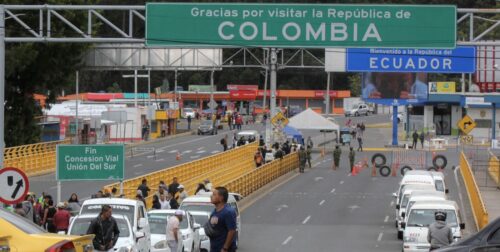
On January 21, Noboa took similar action against Ecuador’s neighbor Colombia by imposing a 30 percent tariff, arguing on social media that the country had not done enough to cooperate on security matters. Colombian President Gustavo Petro responded by highlighting the high level of security cooperation between the two countries and retaliated by cutting off energy exports to Ecuador and announcing a 30 percent tariff on Ecuadorian products. The Noboa administration then sharply increased the fees Colombia must pay to transport its oil through Ecuadorian pipelines.
The president’s tariff move is puzzling, as it harms Ecuador far more than Colombia. Ecuador has a nearly US$1 billion trade deficit with Colombia, which also represents an important market for Ecuadorian agricultural exports. Noboa’s decision has also angered business communities on both sides of the border, who warn that it poses a risk to employment and economic stability. In the longer term, the move could jeopardize Ecuador’s access to energy. The country relies primarily on hydroelectric power, and while water levels in its dams are currently sufficient to meet domestic demand, they are likely to fall during the dry season in September and October. This happened in 2024, when low water levels during the dry season, combined with authorities’ failure to maintain and improve the energy grid, triggered an energy crisis marked by blackouts lasting up to 14 hours a day. To weather the crisis, Ecuador partially relied on Colombia and, until the trade measures, continued to source between 6 and 9 percent of its electricity demand from its neighbor.
In addition to Noboa’s public justification of the move, his decision may be motivated by a combination of factors, including an attempt to shift blame for his failure to improve Ecuador’s security situation onto Colombia as well as a response to President Petro’s call the day prior for the release of former Ecuadorian vice president Glas, who is seen by Petro and others as a victim of judicial persecution in Ecuador. Noboa may also be seeking to trigger economic turbulence in Colombia ahead of their upcoming elections in May. Progressive candidate Iván Cepeda, a member of Petro’s coalition, is a front-runner in several polls.
Conversely, Noboa has sought to strengthen ties with the UAE, a key US and Israeli ally in the Middle East. In early December, the two nations signed a bilateral investment treaty that lawyers and activists argue violates the Ecuadorian constitution. The agreement includes ISDS mechanisms — provisions in trade agreements that allow foreign corporations to sue governments in shady and biased international tribunals, which have cost sued countries billions of dollars. Ecuador’s constitution explicitly prohibits ISDS under Article 422, a ban that voters reaffirmed in April 2024 after Noboa proposed repealing it in a national referendum.
Nevertheless, ISDS remains a central pillar of the president’s agenda. He is now banking on the prospect that the Constitutional Court, which is reviewing the agreement, may rule that the ISDS provisions can be fast-tracked without constitutional review. Noboa has repeatedly pressured and threatened the court in the past and has nominated a pro-ISDS judge who now sits on the bench. If the court finds no constitutional issue with ISDS in the UAE deal, it would open the door for the approval of another agreement — a free trade agreement (FTA) with Canada that also includes ISDS. The FTA would likely facilitate expanded mining activity by companies registered in Canada, since Canada is the most important investor in Ecuador’s mining sector and since mining surpasses all other Canadian investments in the country. This would come as Noboa is seeking to fast-track legislation that would loosen mining regulations and threaten the rights of Indigenous communities to prior consultation on large-scale projects that might affect them.
On January 28, Ecuador’s Prosecutor General’s Office, led by Acting Prosecutor General Carlos Alarcón, raided the home of Luisa González as part of a new investigation known as the “Little Box” case (Caja Chica in Spanish). González is a two-time 2023 and 2025 presidential candidate for the left-leaning opposition party, Revolución Ciudadana (RC), and served as its president until recently. Eight people are under investigation in total, including Patricio Chávez, an RC legislator, and Andrés Arauz, the party’s 2021 presidential candidate and González’s running mate in 2023. In a tweet, the Prosecutor General’s Office alleged “that illicit money (in cash) was brought in from Venezuela to finance the 2023 presidential campaign” for the purposes of money laundering. The party’s 2023 campaign manager, Santiago Díaz, who is cooperating with investigators, has claimed that he transferred US$20,000 from Venezuela to Ecuador in April 2023 on the orders of former President Rafael Correa, an influential figure within the party.
Separately, González and Arauz are also facing proceedings before Ecuador’s Electoral Dispute Tribunal over a complaint filed by the head of the National Electoral Council alleging that the party failed to submit all required financial reports from the 2023 snap election in violation of campaign finance rules. Both institutions played a politicized role during the 2025 elections, issuing rulings and decisions that favored Noboa.
The RC has said that these cases are part of a long-standing pattern of lawfare against the party. Its leaders argue that the investigations are politically motivated, noting that they follow recent accusations by President Noboa, his officials, and members of his party that the Nicolás Maduro government has been funding the RC. They also question Díaz’s credibility, arguing that he is cooperating with prosecutors because he is facing an upcoming trial for allegedly sexually abusing a minor. News outlets have reported that Díaz has received special treatment within the penitentiary system for months. Further, González’s lawyer noted that Díaz has not claimed that the money he allegedly transferred from Venezuela was illicitly used or sourced from Maduro and that the money transfer took place in April — before the 2023 snap elections were even called in late May. Moreover, González pointed out that the RC has fully disclosed its 2023 campaign finances, while Noboa’s party hasn’t — a fact confirmed by outlet Primicias. Additionally, the RC has challenged the legitimacy of Acting Prosecutor General Alarcón, whom they say is occupying the position unlawfully.
The previous prosecutor general, Diana Salazar — who has been accused of politically persecuting the RC — resigned in May after six years in office to become the ambassador to Argentina, a move that had been quietly in the works for over a year (in January 2024, the Argentine government approved Salazar’s ambassadorship, raising concerns about a potential conflict of interest and her impartiality during the 15 months she continued serving as prosecutor general). While her term officially ended on April 8, delays in selecting her successor had extended her tenure. On her departure, Deputy Prosecutor General Wilson Toainga took over as acting head, despite his own term having ended in April.
Ecuador’s Council of the Judiciary (CJ), a key independent body tasked with oversight and administrative duties relating to the judiciary, then appointed Alarcón as Toainga’s acting deputy. Legal experts argue, however, that this appointment exceeded the CJ’s authority, since a separate body, the Council for Citizen Participation (CPCCS), is legally responsible for the selection process of the prosecutor general, in addition to several other oversight authorities. Some also contend that Alarcón’s position, effectively “deputy to the deputy,” has no basis in law. His appointment has been challenged before the Constitutional Court, which is now set to review the case. Nonetheless, because the selection process for a permanent prosecutor general has been endlessly delayed, Alarcón — a Noboa ally who, as prosecutor, has acted in the interests of the president and his family — assumed the role of acting prosecutor general after Toainga resigned in November.
Two weeks after the raid on González and others, the Prosecutor General’s Office raided the home of Aquiles Álvarez, the mayor of Guayaquil, one of Ecuador’s largest cities. Apart from the mayor, two of his brothers and eight other people were also targeted in what officials labeled the “Landslide” case (Goleada in Spanish), an investigation into “alleged organized crime for the purposes of money laundering and tax fraud,” according to a tweet from prosecutors. Álvarez was elected mayor in 2023 on the RC’s ticket, and he has been a frequent and outspoken critic of President Noboa and his administration. Prosecutors moved for Álvarez to be placed in preventive detention while the investigation proceeds, a request that was granted by a judge who is himself under investigation for corruption.
This is the second prosecution of the Álvarez brothers. They were previously charged in April 2025 in another investigation led by Alarcón, dubbed the “Triple A” case, for allegedly running an illegal fuel-trafficking scheme through a gas station company in which all three are shareholders. The case is the result of a complaint filed by a Noboa administration official in July 2024, just days after Álvarez and the president had publicly feuded. A trial in this case, which has been repeatedly delayed, is set to begin soon. Although details of the Goleada case are scarce, the mayor’s lawyer has said that it is based on the same facts as the Triple A case. Notably, a year ago, Noboa’s family was involved in a similar scandal, known as the Petronoboa case. In that instance, a company founded by Noboa’s brother in December 2023 — shortly after Noboa’s first presidential election — was alleged to have irregularly purchased subsidized fuel from the state and resold it, including to businesses owned by the Noboa family. The Prosecutor General’s Office, however, did not take action in that case.
Álvarez and members of the RC claimed that, as in the Caja Chica case, the raid was an act of political persecution against the mayor for his criticisms of Noboa. They also argued that it was intended to distract the public from the ongoing impeachment proceedings against CJ President Mario Godoy and other events at the CJ. Godoy, another Noboa ally, had reportedly motioned for the CJ to appoint Alarcón as acting deputy prosecutor general. He was accused of being involved in pressuring and threatening a judge to rule in favor of a Serbian drug trafficker whom his wife, a lawyer, had represented.
Godoy’s legal troubles forced him to temporarily step away from the CJ. As the law dictates, his alternate, Alexandra Villacís, automatically assumed the presidency of the CJ in December. However, her continued leadership of the CJ was blocked on February 9 after the tax authority and the Ministry of Labor unexpectedly flagged her for alleged tax arrears. At midnight — before Villacís could resolve the issue — the CJ held an extraordinary session to appoint Councilor Damián Lacro as acting head. Even though Villacís later produced official documentation proving she owed no debt, the appointment stood, and the Ministry of Labor continued to list her as being in arrears. Lacro is a Noboa loyalist; he led Ecuador’s tax authority from 2023 to September 2025, a period during which the Noboa conglomerate — the country’s largest tax debtor — saw its debt nearly eliminated through a now-defunct law proposed by the president. By contrast, the administration views Villacís as aligned with the RC and reportedly launched a campaign to prevent her from permanently replacing Godoy.
As long as the Ministry of Labor continues to list Villacís as being in arrears, she cannot serve on the CJ. For this reason, on February 10, the CPCCS — which is in charge of the selection process for CJ councilors and has been controversially purged of its pro-RC members — convened an extraordinary session to request that the National Court of Justice submit a shortlist of candidates to permanently replace Villacís on the CJ. This step was necessary because the CJ president and their alternate must be chosen from candidates recommended by the court. The court complied, providing a list of three candidates on February 12. One is an official in the Noboa administration, and another is a judge who, in 2025, sentenced former Vice President Glas of the RC party to prison in a highly contentious case. Godoy resigned from the CJ on February 18, hours before being officially impeached, meaning the CPCCS will also have to request that the court submit a shortlist of candidates to replace him. Lacro will continue serving as acting CJ president until replacements for either Villacís or Godoy are selected, whichever comes first.
The raids against the RC come at a time of transition for the party. In late January, the RC selected new leadership, with González moving from party president to director of international affairs. Longtime party member and former National Assembly President Gabriela Rivadeneira was named president. At the same time, the RC has faced a series of internal disputes that led to the departure of heavyweight figure Marcela Aguiñaga, the governor of Guayas province. González and former President Rafael Correa had said Aguiñaga, having distanced herself from the party, was disloyal.
***
Full disclosure: Andrés Arauz is currently affiliated with CEPR as a Senior Research Fellow.
Article
Article
Article

Article
Article

Article

Article
Article