
Article • Dean Baker’s Beat the Press
BYD To Award Trump Salesman of the Year for Promoting its EVs
Article • Dean Baker’s Beat the Press
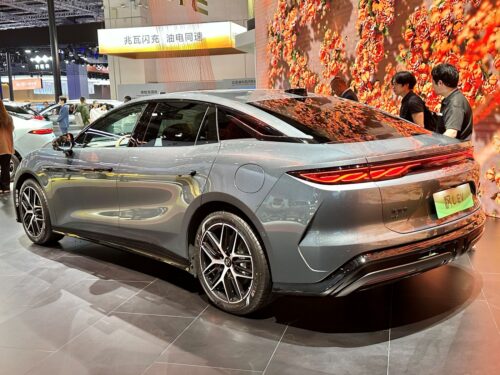
China exported 435,000 EVs in May, a 100% increase from its exports in 2025. Its total exports of cars was 809,000, an increase of 73% from last year. By comparison, domestic U.S. vehicle sales in May were 1,470,000. That means China’s exports of cars were equal to 55% of U.S. purchases in the month, while its EV exports were almost 30%.
Donald Trump can legitimately take credit for the surge in China’s EV exports. As he might say, “frankly, if it wasn’t for me, their EV exports would not be growing like that.”
Trump has lit a rocket under China’s EV industry. While EV sales by producers worldwide are rising, no one was better situated to benefit from the surge in demand created by Trump’s war on Iran than China’s producers. Chinese producers account for more than 70% of global EV sales. That share is likely to rise, even as the market expands rapidly.
Trump’s war helped to boost sales not only by raising the price of gas, it also created enormous uncertainty about future prices. With one of the world’s major superpowers run by a person who apparently gives no consideration to the impact his actions have on the world economy, driving a gas-powered car looks like a much riskier proposition.
What is neat about this surge in EVs is that it is irreversible. People who buy EVs rarely switch back to gas-powered cars, especially in countries that have the infrastructure and charging stations to support EVs. And more EVs on the road create political and economic pressure to upgrade the infrastructure to facilitate their use.
EVs can be thought of as being like a virus; the more that get sold, the more they spread. When a large segment of car users has EVs governments and businesses set up charging stations and repair shops. Also, when people see their co-workers, friends, and neighbors driving EVs, and saving a fortune on gas and maintenance, they become interested in owning one themselves. Once EVs get a big foot in the door, their spread is pretty much impossible to stop.
That is one reason why some of us have argued for allowing at least some number of high-quality, low-cost Chinese EVs into the U.S. market. People could then see the benefits of EVs. Ideally, we would work out an arrangement where China transferred the technology so that the cars could be produced here, with union labor.
Unfortunately, the Trump administration has zero interest in going this route. It would rather double down on archaic technology.
The story is actually getting worse. There has been legislation introduced in Congress that would prohibit Chinese cars from even entering the United States. This would prevent someone from Canada or Mexico from driving their car over the border for a visit.
Apparently, the bill’s sponsors, Senator Elissa Slotkin and Representative Haley Stevens, both from Michigan, are worried about allowing people in this country from even seeing Chinese cars. This shows that not all whack job stuff in U.S. politics originates with Donald Trump.
But getting back to Trump and the green transition, it’s not just China’s EV exports that Trump sent skyrocketing. Its exports of solar panels are up 60% year over year. China’s exports of wind turbines to the EU rose 66% over 2025, and its battery exports worldwide were up 42%.
The bottom line is that Donald Trump’s war in Iran has done far more to jumpstart the green transition that almost any conceivable policy than a Biden-Harris administration might have put in place. That is great news. The unfortunate part is that China is at the center of it, and that it had to come about through war.
Article

Article
Article

Article
Article
Podcast

Article

Article