
Article • Dean Baker’s Beat the Press
Trump Has the Grain of a Good Idea with His Intel Extortion

Article • Dean Baker’s Beat the Press
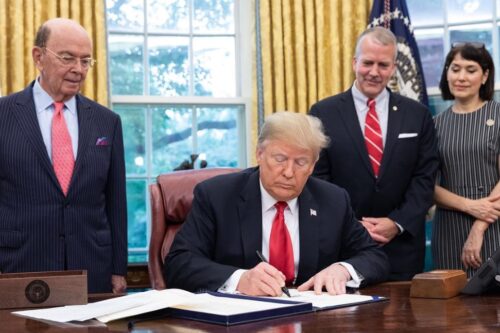
Not everything Trump does is all bad, and that is even true of his Intel extortion. To be clear, there is nothing positive about threatening a company because of the ethnic background of their CEO and then demanding a chunk of company stock to leave them in place. But the idea of getting non-voting shares in company’s stock (as with many things Trump does, the voting status of the shares is not clear) is actually a very good one. But instead of being the payoff for extortion, the shares should be in lieu of the corporate income tax.
The logic is straightforward. We currently have a 21 percent corporate tax rate. We collect less than 17 percent of profits in tax revenue, a figure that is likely to fall sharply under the Trump administration. (Tax collections were just 12.0 percent of profits in 2019.) The reason there is a large gap between the statutory tax rate and the percentage of profits paid to the government in taxes is that there is massive tax gaming industry that is extremely effective in designing tax avoidance strategies.
The key problem is that corporate profits are not an unambiguously defined concept. There are thousands of issues related to depreciation and other matters that have to be both determined by law and interpreted by lawyers and accountants.
At the end of the day, the government must rely on corporate accountants to tell them what a company’s profit is. They can review the corporation’s books, but they have no direct knowledge of corporate profits. And it is difficult and expensive to carefully review all the accounting of a major corporation. The problem becomes even harder when the resources of the I.R.S. have just been pillaged by the DOGE gang.
The Trump route of getting shares gives the government a way around this problem. (If we name it “the Trump route” maybe he’ll endorse it.) If the government got not-voting shares equal to 21 percent of the company’s outstanding stock, there would be no way for clever corporate accountants or tax lawyers to avoid paying what the company owes the government. Unless management ripped off all its shareholders, the government would get 21 percent of the value it generated for its shareholders that year.
This means that if the company paid out $10 billion in dividends to shareholders, the government would get $2.1 billion. If it bought back 5 percent of its outstanding shares for $20 billion, it would pay the government $4.2 billion, and the government would still hold 21 percent of the company’s stock. If another company wanted to buy the company for $400 billion, they would pay the government $84 billion for its non-voting shares. The basic story is the government gets whatever other shareholders get; there is no distinction.
In addition to ensuring the government collects the amount of revenue it intended from the income tax, this route also has the great advantage that it would put an end to the massive tax-gaming industry. There is a huge amount of money to be made by designing clever tricks to avoid paying income taxes.
The logic is straightforward. If an accountant has a way to save Apple $1 billion on its income taxes, Apple would be willing to pay that person $999 million to share the trick. Corporations pay out tens of billions of dollars to people finding ways to minimize their tax burden.
From an economic standpoint, this is a complete waste. It would be much better to see this money spent on new investment, paid out to workers in higher wages, or even paid out to shareholders in some form. The people designing clever tax schemes could in principle be doing something of value to the economy, ripping off the government is not adding value.
To be clear, this route would not eliminate all issues in collecting corporate income taxes. There would still be a question of allocating profits across countries. My route would be to make the allocation in proportion to sales, as many states do now, but this problem is no more difficult going the non-voting share route than under the current system.
States can also adopt the same route, taking a non-voting stake of 1.0 percent, or whatever their corporate income tax rate is. Actually, they can even do this now, without any change at the federal level.
Given his close ties to rich corporate donors, and his love of corruption, Trump is unlikely to embrace this tax reform route. But it is worth getting it on the table in case we ever have an administration interested in designing a corporate income tax that the government actually can collect.
Article

Article

Article

Article

Article
Article

Article
Article