Article • Dean Baker’s Beat the Press
When It Comes to the Stock Market, Trump Is a Loser

Article • Dean Baker’s Beat the Press
I have always been dismissive of the stock market as a measure of economic performance. In principle the stock market is a measure of future after-tax corporate profits, not the state of the economy.
I said, “in principle,” because the stock market can also be moved by irrational optimism or pessimism. The most recent example of the former was the tech bubble at the end of the 1990s when price-to-earnings ratios crossed 40 to 1 by some measures. An example of the latter was the collapse over the next three years when the S&P 500 lost nearly half of its value.
But even ignoring these extremes, the market is a projection of the value of future corporate earnings. It doesn’t go up because workers have higher wages or universal childcare, unless these developments are associated with higher expected future profits.
The stock market will go up if investors come to believe that profits will rise in future years at the expense of wages or that after-tax profits will be higher because corporations won’t have to pay any taxes.
For these reasons, I have never been one to applaud a rise in the stock market or fret over a drop. And in the current case, where I believe the market and the economy are being driven by an AI bubble, I would consider a drop to be good news.
But leaving my personal views aside, we know that Donald Trump is very interested in the stock market. He gets very upset when he sees it fall — for example when he announces a big new tariff — and boasts about its performance during his tenure in office.
In deference to our president, since he thinks the stock market is important, let’s see how he’s doing relative to the competition. Here are the returns in the major stock markets for Trump’s first year in office. (To be precise, this is from January 22, 2025 to January 22, 2026, it was easier to read today.)
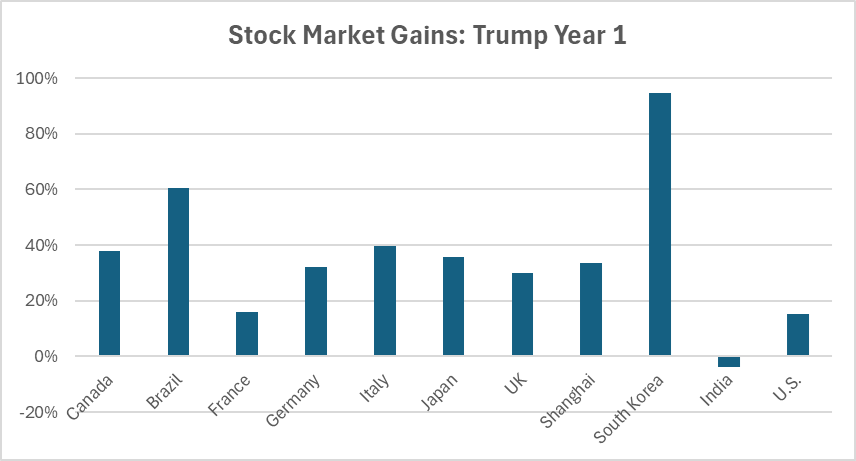
Compared to the increases in other major markets, it doesn’t look like Trump is doing very well. To be clear, the 15.3 percent increase in the S&P 500 is very good by historical standards and hardly cause for complaint in a country where tens of millions of workers are struggling, but it looks pretty weak compared to the 94.8 percent increase in South Korea’s market or 60.5 percent in Brazil’s market. (These calculations measure the rise in the market in the country’s currency and adjust for the change in the value of the currency against the dollar. They do not take into account dividends.)
Italy’s market had a 39.8 percent rise and the stock market in Canada, Trump’s current leading international enemy, rose more than twice as much as the S&P, with an increase of 37.8 percent. Even the “sclerotic” European countries had market increases that exceeded the S&P, with Germany’s market up 32.0 percent, the U.K. 30.0 percent, and France’s market just squeaking past with a gain of 16.0 percent.
The only major market to do worse than the S&P was India’s, which fell 3.7 percent measured in dollars. Trump had a falling out with India’s Prime Minister Narendra Modi, apparently because Modi wouldn’t nominate Trump for the Nobel Peace Prize. Maybe Trump should try to patch up the relationship given that Modi is the only one keeping him out of last place.
Anyhow, as I said, I don’t attach much importance to stock market performance. To my mind, what matters is how the economy is delivering for the people and the stock market at best is weakly related to this story. But hey, if Donald Trump wants to talk about stock markets, sure, let’s talk about stock markets. And it doesn’t look like he is doing very good by this metric.
Article

Article

Article

Article

Article

Article

Article
Article