
Article • Mark Weisbrot’s Columns
(Los Angeles Times) A Presidential Partnership With Trump Could Be Disastrous for Colombia
Article • Mark Weisbrot’s Columns
Los Angeles Times
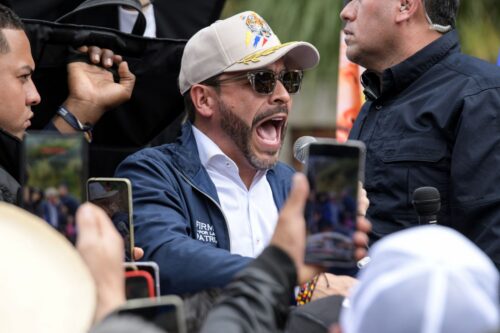
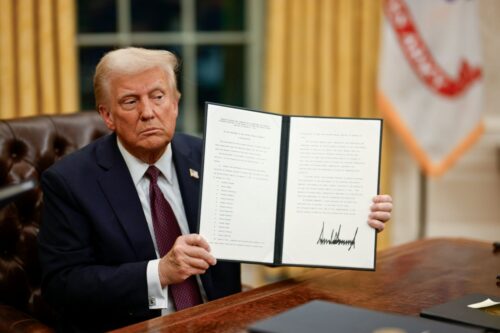
President Trump has given his “Complete and Total Endorsement” to the hard right-wing candidate for president in Colombia, Abelardo de la Espriella, for the second round of the presidential election this coming Sunday. More than expressing his personal preference, the US president also noted that the “results of this Election are very important to the future of Colombia and its relationship to the United States” and that Abelardo “will have the total support and strength of the United States behind him.”
For a president to intervene in this way in another country’s election violates international norms. Of course there could be some backlash from Colombian voters, who will see it as an assault on democracy and national sovereignty. Especially because Trump, with the most powerful armed forces in the world, threatened military action against Colombia less than five months ago.
“Come get me,” Colombian President Gustavo Petro responded. Whereupon Petro was invited to meet Trump at the White House, where the US president was decidedly much more friendly. Until he (or his advisors, led by Marco Rubio) decided to make a play for a right-wing president of Colombia who would do Trump’s bidding.
De la Espriella appears to be up for the job, welcoming an alliance of “two leaders who respect each other and share the same unshakable values and principles” and pledging to “join the Alliance of the Shield of the Americas.” The Shield of the Americas is a Trump-administration led, right-wing coalition of governments in the region formed in March.
In the first round, De la Espriella came in first by 2.8 percentage points against Iván Cepeda, a senator from the leftist Historic Pact that incumbent Petro leads.
During Petro’s presidency, from 2022 to 2025, the inflation-adjusted minimum wage was increased by 39 percent. The poverty rate has fallen substantially — by 23.5 percent since 2022. More than 3.9 million people have been pulled out of poverty. The rate of extreme poverty fell even more in percentage terms, by 30 percent, or 1.9 million people. Extreme poverty is defined as income that is too low to cover basic needs; Colombia’s extreme poverty line in 2025 was $58 per month, or about $1.90 per day.
Cepeda has pledged to continue the emphasis on reducing poverty and increasing income per person and the social safety net of the majority.
By contrast, De la Espriella has called for the right-wing “chainsaw” approach, including a 40 percent reduction in the size of government and cutting 70,000 jobs. This is not going to reduce poverty or raise most Colombians’ living standards.
But even worse things can happen under a president like De la Espriella, allied with Trump. Such a presidency would carry a high risk of death and destruction, in a country that has suffered enormously for decades from violence and armed conflict.
This danger can be seen in De la Espriella’s close and long-standing connections to, and support of, the Self-Defense Forces of Colombia (AUC). This was Colombia’s historically largest and deadliest paramilitary organization, responsible for tens of thousands of killings, overwhelmingly civilians.
De la Espriella first achieved prominence as a lawyer for the AUC but has also been close to its leaders and worked for them in other ways. For example, he led significant efforts to rebrand people who committed massacres and other crimes against humanity as political actors who should not be prosecuted.
Not surprisingly, De la Espriella has advocated against the 2016 peace accords in Colombia, as well as their implementation. He favors more military deployment and “megaprisons” for mass incarceration, on the model of El Salvador’s Nayib Bukele — another member of Trump’s Shield of the Americas — who has tripled the country’s prison population.
These are the “unshakable values and principles” we are looking at. In this mindset, war is the answer.
Trump shocked much of the world when he expressed these values in a threat to the 90 million people of Iran on April 7: “A whole civilization will die tonight, never to be brought back again,” he said.
The most generous way of describing leaders like Trump and De la Espriella is to say that they have lost most of their humanity. Hence the threat to Colombia of this alliance between them.
Trump’s team appears to have gone to great lengths in seeking violent conflict in this hemisphere since the beginning of his term. It began with the designation of “cartels and other organizations” as Foreign Terrorist Organizations on the first day of his presidency, then bombing and killing hundreds of people in small helpless boats in the Caribbean and the Western Pacific. This is murder, according to experts on military law, because the victims are not combatants. Evidence of alleged drug-running was generally not offered. There were some absurd allegations, such as transporting fentanyl, which does not even come to the US from South America. It culminated in Trump’s “victory” of capturing Venezuela’s oil and its president.
And now the constant threat to attack Cuba, which is already suffering enormously from a US blockade that is, by definition, a war crime under the Fourth Geneva Convention, which prohibits collective punishment when there is armed conflict. Even before the blockade this year cut off oil and most of Cuba’s electricity, Washington’s tightening of sanctions since 2019 had already increased Cuba’s infant mortality by 148 percent.
Trump seems determined to be a war president, and this hemisphere has been Rubio’s theater of choice.
De la Espriella has proposed bringing US military bases back to Colombia, creating Plan Colombia 2.0, he says.
He is reminding the people of Colombia that he does not care all that much about the immense human suffering that war has caused and can bring again.
Mark Weisbrot is co-director of the Center for Economic and Policy Research and the author of “Failed: What the ‘Experts’ Got Wrong About the Global Economy.”
Article

Article

Article
Article
Article

Article
Issue Brief
Article
