Article • Sanctions Watch
CEPR Sanctions Watch March 2026
Article • Sanctions Watch
In this edition of Sanctions Watch, covering March 2026:
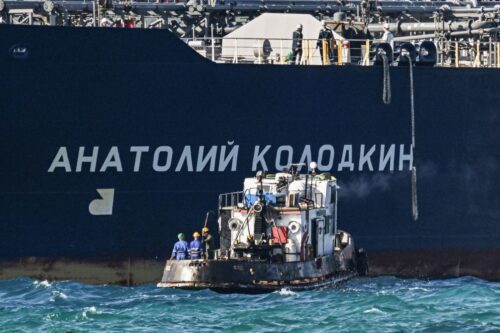
The Russian oil tanker Anatoly Kolodkin arrived in the Cuban port of Matanzas on March 31 carrying approximately 730,000 barrels of oil — the first major fuel shipment since the Trump administration imposed an oil blockade in January. It is unclear why the administration chose not to intercept the ship, though according to The New York Times, “the decision avoids a potential thorny confrontation with Russia just off the coast of Florida.” Russian officials had reportedly raised the issue of the ship’s passage during talks with the United States. Asked about the change, President Donald Trump said, “If a country wants to send some oil into Cuba right now, I have no problem with that. Whether it’s Russia or not,” potentially opening up the space for countries like Mexico to resume normal shipments. “The people need heat and cooling and all of the other things,” Trump added, recognizing the civilian impacts of the blockade, which some Republicans worry could lead to a surge in migration from the island.
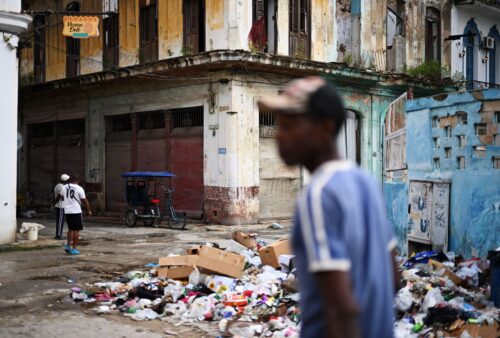
Days prior, UN officials warned that “Cuba’s already strained health system is approaching a critical point,” with food and water in increasingly short supply. The island was hit with three near-total blackouts in March. “The blackouts severely disrupt daily life, reducing working hours, making it difficult for people to cook or refrigerate food, and forcing hospitals to cancel some surgical operations,” writes the Associated Press. In The New York Times, reporters Ed Augustin and Jack Nicas outline the impacts of the US-imposed fuel crisis on Cuba’s once robust health-care system:
In interviews, six Cuban doctors said that rapidly deteriorating conditions at hospitals and clinics across Cuba were causing deaths that would otherwise be preventable.
“I can’t tell you how many deaths, but I’m sure there are more than in the same period last year,” said Dr. Alioth Fernandez, chief anesthesiologist at Havana’s largest pediatric hospital. “I see it in shift handovers, in colleagues’ comments and in children I’ve operated on.”
The blockade’s effects are cascading through the system. Hospitals are canceling surgeries and sending patients home because doctors and nurses can’t commute to work. Clinics are struggling to administer treatments like chemotherapy and dialysis because of power outages.
Many ambulances are parked because drivers can’t find gas. Pharmacies are largely empty because the virtually bankrupt state is struggling to buy medicine.
Production of medicine has been mostly halted because factories run on diesel. Vaccine makers are searching for ingredients because flights that once carried them are canceled because of a lack of jet fuel. And refrigerated vaccine stocks could soon spoil if the blackouts continue.
The director general of the World Health Organization expressed similar concerns about the health-care system, remarking:
Thousands of surgeries have been postponed during the last month, and people needing care, from cancer patients to pregnant women preparing for delivery, have been put at risk due to lack of power to operate medical equipment and cold chain storage for vaccines.
While I am encouraged by Cuba’s efforts to restore power to support services, people’s health, and the services that support them, cannot be left at the mercies of fluctuating power and geopolitics.
The Nuestra América convoy, a loosely coordinated coalition of organizations, activists, and journalists, traveled to Cuba this month carrying tons of humanitarian aid for the Cuban people and seeking to shine a light on the impacts of US policy on the island. “This type of economic warfare shouldn’t exist, this attitude of a pirate state that doesn’t respect international law,” commented Thiago Ávila, who arrived in Havana on March 24 on a boat carrying solar panels. British journalist Owen Jones, after traveling to Cuba as a part of the Nuestra América convoy, wrote, “While I was there, the city was plunged into darkness — the second national blackout in less than a week. Families cooked on charcoal stoves. Rubbish piled up in the streets, flies swarming, because there is not the fuel for collection. Water pumping systems were failing. Trump claimed he wanted ‘to promote a stable, prosperous and free country for the Cuban people’. In reality, this has always been a war on those people.” Kenneth Roth, former executive director of Human Rights Watch, similarly referred to the blockade as an “act of war.”
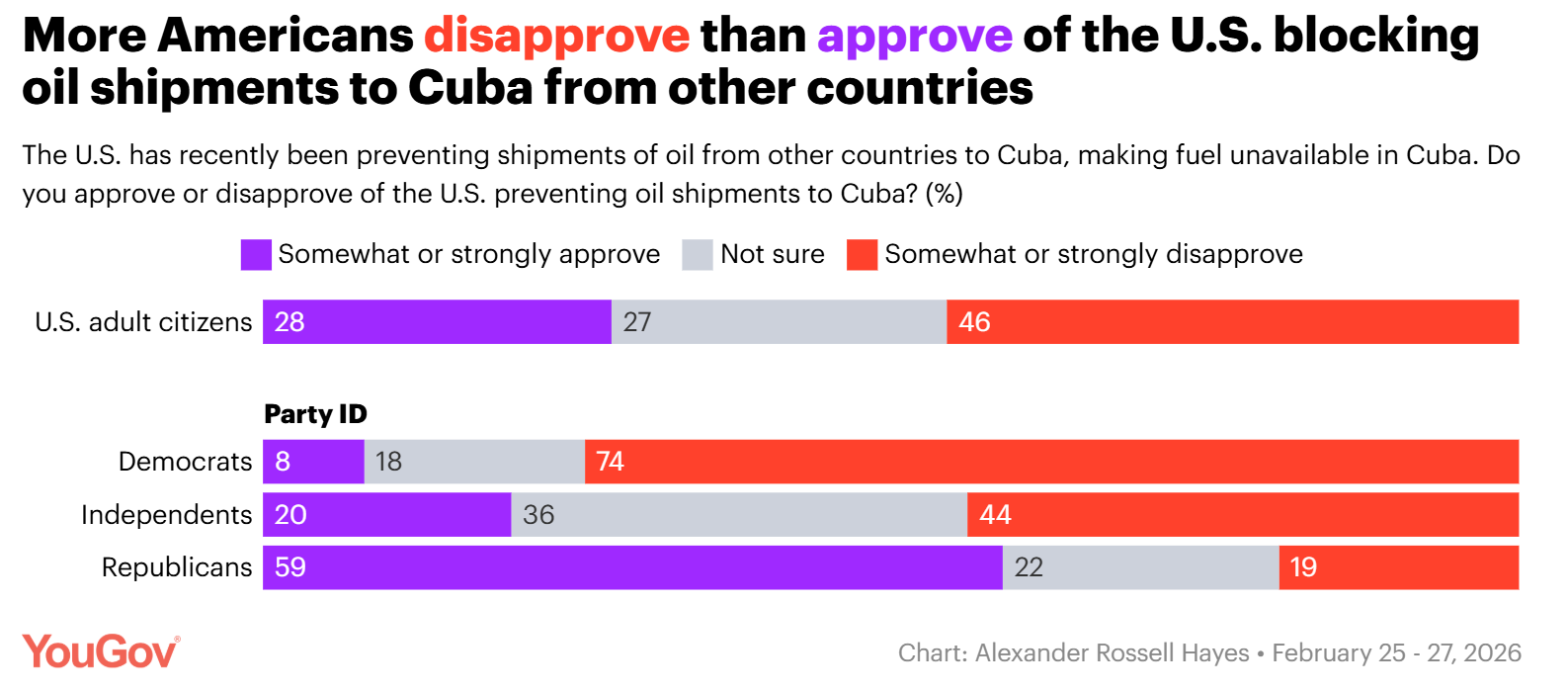
Asked about what the convoy would like to see changed, David Adler, one of its coordinators, told CNN, “We would like to see US-Cuba policy reflect US and Cuban public opinion.” Indeed, polling published by YouGov this month found that more US Americans disapprove than approve of the US’s blocking oil shipments to Cuba from other countries. The same is true of the embargo in general.
Asked of his plans for Cuba, President Trump told reporters, “I do believe I’ll be … having the honor of taking Cuba. That’s a big honor. Taking Cuba in some form.… I mean, whether I free it, take it.… I can do anything I want with it.” Cuban President Miguel Díaz-Canel acknowledged that the US and Cuban government are in talks, which include former president Raúl Castro, but cautioned that discussions are still in the “early stages.” Senators Tim Kaine (D-VA), Adam Schiff (D-CA), and Ruben Gallego (D-AZ) introduced a War Powers Resolution to block unauthorized military action against Cuba and to block the use of US armed forces to “to conduct a blockade or quarantine of Cuba.”
US suppliers have increased oil shipments to Cuba’s private sector under the Trump administration’s license for limited oil imports for private Cuban actors, which anonymous officials described as “part of a plan to make the island more reliant on the US for supplies, increasing Washington’s leverage.” According to Auge, a Cuban private sector consulting firm, the vast majority of even small- and medium-sized enterprises on the island face near-insurmountable barriers to importing their own fuel. Moreover, the license provides little relief for the vast majority of Cubans and does not alleviate the impacts of the blockade on the public power system, hospitals, schools, ambulances, or public transportation.
Finally, under US pressure, developing countries continue to terminate their relationships with Cuba’s medical missions. Honduras, Guatemala, Paraguay, Guyana, and Jamaica have all done so this year. Mexico, for its part, has committed to maintaining its agreement with the medical missions. A US Department of State memo released this month revealed that the US has used both carrots and sticks to encourage countries to end their programs and expel Cuban medical professionals. Cuba expert Helen Yaffe writes in The Conversation about what these expulsions of medical providers mean for the people in countries that had hosted the missions: “This contribution to developing nations has often been ignored or censored. But it translates into millions of lives saved and improved globally every year. Sabotaging medical internationalism would devastate Cuba. But it would also leave millions of people around the world without the vital medical attention that they had previously enjoyed.”
Read more:
On March 20, the Trump administration issued a general license permitting all but a few countries to purchase Iranian oil already at sea. The license is effective until April 19 and excludes North Korea, Cuba, and Russian-occupied areas of Ukraine. The measure, which Iran sanctions expert Esfandyar Batmanghelidj calls “really unusual,” appears aimed at easing oil prices and would apply to roughly $14 billion worth of oil at sea at the time the license was issued. Much of this oil was likely already purchased and accounted for; however, it remains unclear how much additional oil will actually make its way into global markets than otherwise would have or how much additional revenue Iran may receive. Days later, India’s Reliance Industries purchased five million barrels in Iranian crude — its first oil purchase from Iran since 2019. US Department of Treasury Secretary Scott Bessent claimed that, by bringing Iranian oil sales out of the shadow market, the US would be better able to follow the proceeds and block them from entering Iranian accounts. The license, however, does not prohibit the proceeds from being received by Iran. The Council on Foreign Relations’ Eddie Fishman remarked, “Iran got more sanctions relief from closing the Strait of Hormuz for a couple weeks than it got from all the nuclear concessions it made in the JCPOA [Joint Comprehensive Plan of Action].”
Three weeks into the US-Israeli war with Iran, the Trump administration reportedly sent Tehran (via Pakistan) a 15-point proposal to end the war. According to The Wall Street Journal, the plan “calls on Iran to dismantle its three main nuclear sites and end any enrichment on Iranian soil, suspend its ballistic-missile work, curb support for proxies and fully reopen the Strait of Hormuz.” It also calls for Iran to hand over existing stockpiles of enriched uranium to the International Atomic Energy Agency. In exchange, the US would lift sanctions, remove the UN sanctions snapback mechanism, and support the country’s nonmilitary nuclear energy program. Iran has not rejected the proposal outright but has said that it does not have immediate plans to negotiate with the United States. Iran has also laid out its own five conditions to end the war: “end to aggression by the enemy, concrete guarantees preventing the recurrence of war, clear determination, guaranteed payment of war damages and compensation, comprehensive end to the war across all fronts, incl. against all resistance groups, [and] recognition of Iran’s sovereignty over Strait of Hormuz.”
Read more:
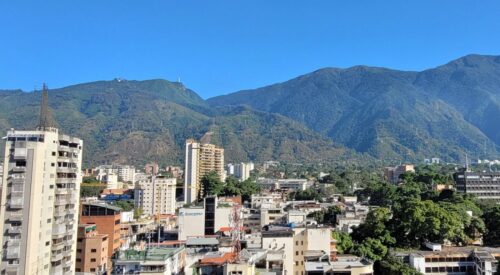
The Trump administration continued to ease sanctions on Venezuela’s oil sector this month, seemingly as part of an effort to increase production amid soaring prices. On March 13, the US Department of Treasury issued General License (GL) 46B — authorizing the importation of oil and petrochemical products, including fertilizer, from Venezuela; GL 48A — authorizing the export of technologies related to the oil and electrical sectors to Venezuela; and GL 49A — authorizing the negotiation and entry into contracts with Venezuelan actors related to oil, gas, and electricity. Days later, the administration issued GL 52, authorizing certain transactions with the state oil company Petróleos de Venezuela, S.A. (PdVSA) and its subsidiaries.
Earlier in the month, the US Department of Treasury had issued GL 51, authorizing transactions with Venezuela’s state mining company, Minerven. The move followed a visit to the country by US Department of the Interior Secretary Doug Burgum, who secured with Minerven a “multimillion-dollar deal to sell as many as 1,000 kilograms of gold destined for U.S. markets,” according to Axios. Burgum’s delegation reportedly returned to the United States with $100 million worth of physical gold in hand. Later in the month, the Department of Treasury issued GLs 51A, 54, and 55, authorizing transactions related to the mining sector beyond gold, the procurement of technologies needed for mining, and the negotiation of new mining contracts, respectively.
Also this month, the US Embassy in Venezuela formally reopened. On March 24, the administration issued GL 53, allowing transactions related to the establishment of an official diplomatic mission of Venezuela in the United States. That same day, President Delcy Rodríguez announced plans to send a diplomatic mission to Washington with the intention of reopening the Venezuelan embassy. Weeks earlier, according to Guacamaya, “The US Department of Justice sent an official letter … to Magistrate Judge Sarah Netburn of the Southern District of New York, formally recognizing Delcy Rodríguez as the ‘sole Head of State’ of Venezuela” — the Trump administration’s most significant formal recognition of the government to date.
Read more:
The US-Israeli war with Iran, and the resulting surge in oil prices, has prompted the United States to make a major — albeit temporary — shift in its Russia sanctions policy. Less than a week into the conflict, as oil prices began to climb, the US Department of Treasury announced a 30-day sanctions waiver allowing Indian firms to purchase Russian oil. For most of President Trump’s second administration, he had pressured India to move away from Russian oil, imposing 50 percent tariffs and warning of further measures. While these moves, combined with sanctions on Russian oil majors, had driven India to scale back its Russian oil imports, the desire to stabilize global supply and lower prices — particularly with the midterm elections approaching — has compelled Washington to reverse course.
The waiver drew criticism from European countries and members of Congress, who argued it provided an economic lifeline to the Russian government. Treasury Secretary Bessent maintained that the benefits to Russia would be minimal and that the measure applied only to shipments of Russian oil already at sea. The United States subsequently expanded the policy by issuing a general license authorizing all countries to purchase Russian oil currently at sea, though it was revised days later to exclude Cuba, Iran, North Korea, and Ukrainian regions under Russian occupation. With the Strait of Hormuz closed, the waiver has so far failed to significantly reduce global oil prices.
The European Union, for its part, has extended its sanctions on Russia for another six months. The bloc’s 20th sanctions package against the country, proposed last month, remains stalled due to opposition from Hungary and Slovakia. Meanwhile, arguing that Brussels’ indefinite freeze of $246 billion in Russian sovereign assets is illegal, the Central Bank of the Russian Federation has filed a lawsuit against the EU at the European Court of Justice. In addition, the United Kingdom has announced that it is “ready” to use its armed forces to board and seize ships linked to Russia’s so-called “shadow fleet.”
Read more:
This month, Israel used the US-Israeli war on Iran as justification to further restrict the entry of aid into Gaza. In the first days of the Iran conflict, all crossings into the Gaza Strip were closed, including the Rafah crossing, which Israel had reopened last month for the first time in two years to allow limited passage for people requiring medical treatment. While the Kerem Shalom crossing reopened three days into the war and Rafah resumed operations for people on March 19, both are currently operating at a lower capacity than before their closures. All other entry points, including the Zikim crossing, remain closed. Several news outlets, aid organizations, and UN agencies have reported that, as a result of Israel’s tightened aid restrictions amid the war, humanitarian assistance — including key medical supplies — has sharply declined, driving up prices and forcing aid groups to ration fuel. This crisis prompted the UN Working Group on Discrimination Against Women and Girls to highlight that:
“Women and girls are bearing a disproportionate share of deprivation as access to food, healthcare, shelter, water, and sanitation continues to collapse,” the experts said.…
According to the experts, the collapse of the healthcare system in Gaza has placed women’s lives in immediate danger. Maternal, sexual, and reproductive health services have been severely disrupted, leaving pregnant women without access to safe childbirth, emergency obstetric care, or essential medicines.
Haaretz, a major Israeli news outlet, published an analysis of aid entry data collected by the US-run Civil-Military Coordination Center, which shows that “the number of trucks entering the Gaza Strip has fallen by 80 percent since the war against Iran began.” Euro-Med Human Rights Monitor, a humanitarian organization, reported similar figures in its analysis of aid deliveries since a “cease-fire” was declared in October, noting that Israel has allowed only 41 percent of the agreed-on aid to enter. Despite these figures, Israeli authorities — alleging that they uncovered an attempt to smuggle tobacco in UNICEF shipments — have prohibited UNICEF from sending aid to Gaza from Egypt. The agency will not be allowed to resume deliveries until it investigates the matter. Moreover, Haaretz reported that the Supreme Court of Israel is likely to uphold a government order banning 37 aid organizations from operating in Gaza and the West Bank.
Read more:
On March 10, the Trump administration designated Afghanistan as a “State Sponsor of Wrongful Detention,” accusing it of “hostage diplomacy” and calling for the release of detained US citizens. The designation, created by the Trump administration in September, allows for sanctions against designated countries, though no details have been provided regarding any specific measures taken against Afghanistan under the designation. Afghanistan is the second country to receive this designation, following Iran in late February.
Meanwhile, at a UN Security Council meeting, the United States expressed doubt that the Afghan government was willing to engage meaningfully in the limited talks under the UN-backed Doha process. It also said that engagement and international assistance to the country should be “carefully evaluated.” During the same meeting, the acting head of the UN Assistance Mission in Afghanistan, Georgette Gagnon, stressed that the country is in urgent need of humanitarian assistance to address multiple ongoing crises, noting that its international isolation poses a serious challenge:
We stress, however, that Afghanistan’s continued alienation from the international system remains the central issue. It prevents other issues, such as economic self-sufficiency, security cooperation, counter-terrorism commitments, human rights concerns, and the humanitarian crisis, from being fully addressed. If these issues are not dealt with, Afghanistan could again become a driver of regional and global instability, in the form of out-migration, terrorism, narcotics and more.
In her intervention, Gagnon also spoke about the impacts of the Iran war on Afghanistan as well as Pakistan’s declaration late last month of a new “open war” against Afghanistan, which has further contributed to the country’s isolation through the closure of trade routes.
In a recent report, the humanitarian organization World Vision examined how Iran and Pakistan’s mass deportations of Afghans have affected remittances to the country. The report also highlights the role of sanctions in obstructing these transfers:
The hawala system is the main channel for remittances from Iran at 91% of transfers, thereby serving as a lifeline for poor, rural, financially excluded, or undocumented migrant-dependent families. These networks face systemic pressure from three concurrent shocks: mass deportations (fewer senders), sanctions-linked banking de-risking (avoidance of transactions), and tighter domestic regulation.
Read more:
Austin Headrick, the Asia regional advocacy coordinator at the American Friends Service Committee, wrote an article in 38 North arguing that the United States should lower barriers impeding aid delivery to North Korea by humanitarian nongovernmental organizations (NGOs). He contends that US efforts to restrict these activities ultimately harm North Korean citizens. Headrick states:
Despite the seeming lack of a formal [North Korean] policy, the administration continues to take actions that undermine the work of NGOs….
… A de facto block on licenses, exemptions, and special validation passports by the United States only further limits the few openings that do exist. This has detrimental impacts for millions of ordinary people in North Korea. An estimated 11.8 million people, over 45 percent of the population, were undernourished and require [sic] nutritional support between 2020–2022, according to a report from the World Food Program—a number that has likely risen following the COVID pandemic. For the United States to prohibit US NGOs from being able to provide assistance makes the North Korean people essentially collateral damage of a failed policy of maximum pressure on their leaders.
Headrick also discusses problems with the US’s current sanctions exemptions for North Korea:
In 2024, US Treasury amended the North Korea Sanctions Regulations (general license), adding some sanctions exemptions that ostensibly allow NGOs to use the new exemptions for a narrow list of authorized activities, such as delivering medical supplies, supporting agricultural projects, and undertaking clean water projects. However, the amendment also included a new pre-activity reporting mechanism that granted [the Department of State] authority to deny this privilege as it sees fit. For many NGOs utilizing the process, this created an arbitrary and opaque barrier to humanitarian work, essentially resulting in one step forward and two steps back for NGO engagement.
Amid the US-Israeli war on Iran, North Korean leader Kim Jong Un said this month that the country is irreversibly committed to strengthening its nuclear capabilities, regardless of potential offers of economic benefits in exchange for nuclear disarmament. Indeed, he has previously made clear that denuclearization is a nonstarter for negotiations with the United States. Reporting on the statements, Reuters added that “North Korea is one of the world’s poorest countries, with a heavily sanctioned economy and chronic shortages that have left much of its population dependent on state rations and informal markets.”
Read more:
According to a recent poll by YouGov, 68 percent of the US public — including majorities of Democrats, Independents, and Republicans — believe that economic sanctions hurt the people of targeted countries. Nearly a third of all respondents believe that they hurt the people more than the government. Only 9 percent of respondents believe that economic sanctions hurt the targeted country’s government but not its people.

Read more:
Economic sanctions have become one of the main tools of US foreign policy despite widespread evidence that they can cause severe harm to civilian populations (which may, in fact, be the point). Though now a defining feature of the global economic order, sanctions and their human costs receive relatively little attention in most US media outlets.
CEPR’s Sanctions Watch news bulletin aims to generate more awareness on the use and impact of sanctions through monthly round-ups of news and analysis on US sanctions policy.
Previous editions of the Sanctions Watch can be found here. CEPR’s US Sanctions Policy FAQ can be found here.
Article
Article
Article
Article
Article
Report
Article
Article