Article • Sanctions Watch
Sanctions Watch (May 2026)
Article • Sanctions Watch
In this edition of Sanctions Watch, covering May 2026:
The Trump administration further escalated its sanctions and threats of military action against Cuba this month. On May 1, President Donald Trump issued an executive order establishing new sanctions authorities, including broad powers to impose “secondary sanctions” — targeting non-US foreign actors that do business with Cuba. According to Reuters, “‘any foreign person’ operating in the ‘energy, defense and related materiel, metals and mining, financial services, or security sector of the Cuban economy’” could be at risk of being sanctioned under the new rules. One week later, US Secretary of State Marco Rubio announced that it would be invoking the new authority to sanction, among others, Moa Nickel SA — a joint Canadian-Cuban mining venture — and the Cuban military business conglomerate Grupo de Administración Empresarial S.A. (GAESA). Sherritt — the Canadian mining company that is part of the venture, which Reuters describes as “among the last companies to operate on a large scale in Cuba despite punishing U.S. sanctions” — announced the suspension of all Cuba operations shortly thereafter. Later, Bloomberg reported that Sherritt is instead in talks to sell a majority stake in the company to a former Trump advisor. Multiple European airlines have also halted flights to the island since the announcement, as have major shipping companies CMA CGM and Hapag-Lloyd. On May 18, the administration announced additional sanctions against 11 Cuban officials.
On May 21, federal prosecutors unsealed an indictment against former Cuban president Raúl Castro and five others in connection with the 1996 downing of two airplanes operated by the Miami-based exile group “Brothers to the Rescue,” which describes itself as a humanitarian organization dedicated to rescuing Cuban refugees. The Cuban government asserts that the organization had repeatedly violated Cuban airspace despite consistent warnings made both directly to the organization and to the US government, which was aware of the risk, records show. The organization was founded and led by José Basulto, who had previously been implicated in an attack on civilians at a Havana hotel. Four were killed in the incident, which became an impetus for the signing of the major Cuban sanctions legislation known as the Helms-Burton Act that same year.
On the same day as the indictment, both Secretary Rubio and President Trump released messages to the Cuban people indicating a forceful commitment to regime change and reiterating claims that Cuba represents a national security threat to the United States. Former CIA Director Robert Gates, however, told Face the Nation that the greatest threat posed to the United States by Cuba was “another Mariel evacuation … that has tens of thousands of Cubans heading to the United States out of desperation … Are they an imminent threat to the United States? Other than in these, if you will, peripheral ways, I think the main threat is, frankly, is [sic] collapse.” Shortly thereafter, a US aircraft carrier arrived in the waters around Cuba, prompting speculation that military action was imminent.
Also this month, the Supreme Court ruled in favor of the Havana Docks Corporation as it seeks compensation from Royal Caribbean Cruises Ltd. The claim hinges on the latter’s docking of cruise ships in Havana during the Obama-era thaw in relations between the countries. Under a provision of the Helms-Burton Act that had been waived by successive Democratic and Republican administrations but was activated under the presidencies of both Trump and Biden, actors can sue third parties for “trafficking” in assets expropriated during the Cuban Revolution. Prior to the Revolution, Havana Docks had a concession to operate Havana port facilities until 2004. The Supreme Court ruled that, even though Havana Docks’ concession would have expired in 2004, it did not mean that Havana Docks did not have a claim against the cruise lines. The decision opens the door to further lawsuits under the Helms-Burton Act, which is expected to further disincentivize companies from operating in Cuba.
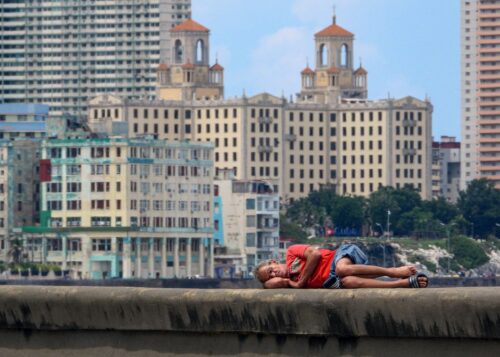
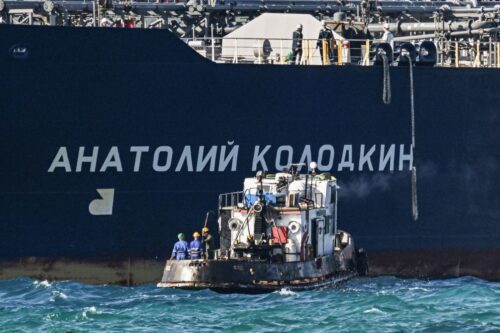
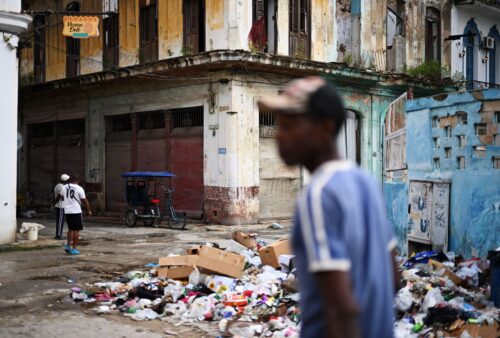
Meanwhile, tightened sanctions and the fuel blockade continue to take their toll on Cuban civilians. Midway through the month, the Cuban government announced that it had run out of oil reserves. An anticipated second shipment of fuel from Russia has reportedly been stalled mid-route. The New York Times reported “the blackouts have left some Cubans sleeping on rooftops to escape the heat. Others wake up at odd hours when the power is briefly on to make coffee, charge telephones and cook the next day’s meals. If the electricity goes out in the midst of cooking, they must turn to charcoal.” One Cuban told the Times, “It can’t be right — it’s not right. Here, it’s the people who are suffering.” Reporting by Ed Augustin and Lisette Poole González, also published in The New York Times, further describes the impacts on Cuban civilians:
Breakfast in Ms. Castellano’s home has become a rarity. With the elevator no longer functioning most of the time, the delivery boy who used to bring bread is unwilling to slog up 18 floors.
But the family has no choice. Five mornings a week, Ms. Castellano’s niece walks Ms. Castellano’s 87-year-old mother, Giorgina, who has dementia, downstairs and to a state-run day program for older people a few blocks away. In the afternoon, the two must trudge back upstairs.
“The country is being strangled,” said the niece, Yailen Menéndez, 38.
The Trump administration made a public offer to provide $100 million in direct humanitarian assistance to Cuba amid this crisis, conditioned on the Cuban government accepting unspecified political and economic demands. Critics argue that this offer is less a genuine humanitarian gesture than it is a part of Trump’s strategy to topple the Cuban government and that such aid is only needed because of humanitarian challenges caused in part by US policy.
Congressional Democrats have continued to push back on both the threat of military action and the fuel blockade. Reps. Jonathan Jackson (D-IL) and Pramila Jayapal (D-WA) penned an op-ed in The New York Times following their April delegation to Cuba. “We came away shocked by the inhumane effects of the [blockade] policy,” they wrote, “whose goal appears to be strangling the economy until the Cuban people are brought to ruin and the country is available, as President Trump put it, for the ‘taking.’” Senator Chris Van Hollen (D-MD) wrote, “Over 3 months ago, Trump & Rubio implemented an oil blockade of Cuba, with the hope of bringing about regime change. And yet the only change they’ve succeeded in forcing is a humanitarian crisis that is punishing the Cuban people, not the regime.” Rep. Chuy García (D-IL) said, “In Cuba the Trump administration is following the same playbook they used for Venezuela: impose sanctions, starve the population, and manufacture the pretext for regime change. We must oppose another illegal war before it starts.” And, citing CEPR research, Rep. Delia Ramirez (D-IL) wrote, “Since the start of the Trump administration’s sanctions in Cuba, the infant mortality rate has increased by 148%. Cutting Cubans off from healthcare, safe food, potable water, and security is dangerous and reckless.”
Senators Tim Kaine (D-VA), Adam Schiff (D-CA), and Ruben Gallego (D-AZ) have introduced a new War Powers Resolution to block unauthorized military action against Cuba, including the use of US armed forces to “to conduct a blockade or quarantine of Cuba.” A similar measure was blocked on a procedural vote in April.
Finally, new CEPR-sponsored polling by YouGov this month found that 64 percent of the US public opposes the US going to war against Cuba, while 15 percent support it. Another poll found that a plurality disapprove of the broader trade embargo against Cuba.
Read more:
The United States and Iran continue to try to work out the details of a potential peace agreement, with both sides expressing some indication of progress but also some caution about the distance that remains between the positions. The current discussions reportedly hinge on a 60-day memorandum of understanding under which Iran would be granted a sanctions waiver to sell oil and Iran and the US would take a phased approach to, respectively, opening the Strait of Hormuz and ending the naval blockade of Iran. The 60-day period would be used to continue negotiations over stickier parts of the negotiation, including Iran’s nuclear program, the release of frozen Iranian funds, and further sanctions relief. It had previously been reported that the Trump administration expressed openness to releasing up to a quarter of Iran’s frozen funds. The US position on long-term sanctions relief remains unclear, but sanctions relief appears to be contingent on Iran’s commitment to give up its existing stockpile of highly enriched uranium. Meanwhile, the Trump administration renewed air strikes against the country at the end of the month, in an apparent attempt to pressure Iran to finalize the deal. Iran, however, referred to the strikes as a sign of “bad faith and unreliability.”
As negotiations continue, the Trump administration has continued to use sanctions in an attempt to put additional pressure on Tehran. Earlier in the month, the US Department of Treasury sanctioned roughly a dozen individuals and companies in China allegedly linked to Iranian weapons and drone supply chains as well as to the provision of satellite imagery. Weeks later, the Department of Treasury imposed sanctions on over 50 individuals and entities that were allegedly tied to Iranian oil sales and financing in Iran, China, the UAE, and elsewhere. The administration has also threatened shipping firms with sanctions if they pay tolls to Iran to secure safe passage through the Strait of Hormuz and urged G7 finance ministers to levy additional sanctions against Iran. The United States and a number of Gulf nations also introduced a resolution at the UN Security Council that would target Iran with multilateral sanctions for obstructing freedom of navigation in the strait.
Read more:
On May 18, the Trump administration extended for an additional month a sanctions waiver allowing third countries — excluding Cuba, North Korea, and Iran — to purchase Russian oil that was already at sea as of April 17. The measure was originally issued in March to combat skyrocketing oil prices caused by the administration’s war on Iran and Tehran’s subsequent closure of the Strait of Hormuz. While the US Department of Treasury briefly let the waiver lapse in mid-April and Treasury Secretary Scott Bessent said it would not be extended, the administration reversed course days later following lobbying from countries such as India, Indonesia, and Türkiye, which found some relief from the measure even as oil prices remained high. In a social media post announcing the extension — which some Democrats in Congress have opposed — Bessent said:
This extension will provide additional flexibility, and we will work with these nations to provide specific licenses as needed. This general license will help stabilize the physical crude market and ensure oil reaches the most energy-vulnerable countries.
It will also help reroute existing supply to countries most in need by reducing China’s ability to stockpile discounted oil.
It is important to note, however, that while the extension allows countries to continue purchasing Russian oil, it does not expand the scope of oil eligible for sale. The waiver still narrowly applies only to Russian oil loaded onto ships by April 17 — not to any oil loaded after that date.
The United Kingdom took similar steps on May 20 by delaying the implementation of certain sanctions announced in October. Citing supply and price concerns, it issued licenses permitting the import of diesel and jet fuel derived from Russian oil refined in third countries as well as the maritime transport of Russian liquefied natural gas and the provision of related services. Although the move prompted criticism from opposition lawmakers, Prime Minister Keir Starmer asserted that the licenses are temporary and designed to protect consumers as the planned sanctions are gradually phased in.
At the same time, the UK imposed new sanctions on Russia in three separate rounds this month, targeting individuals and entities in Russia and elsewhere for allegedly recruiting migrants to fight in the war in Ukraine, forcibly deporting and indoctrinating Ukrainian children, and evading sanctions through cryptocurrency networks. The European Union and Canada quickly followed suit with their own sanctions over the alleged deportation of Ukrainian children. Reporting on the impact sanctions have had on the Russian economy thus far, Euronews quoted an official from the Finnish Central Bank, who stated:
The grinding effect of sanctions has transformed Russia “in multiple ways”, says Laura Solanko, a senior advisor at the Bank of Finland, even if it is not “very feasible” to separate the strain from the sanctions and the strain from the war policy.
“Access to global financial markets is practically closed, meaning all funding, both for the government and for the private sector, has to be found from domestic sources. Invoicing currencies of foreign trade have changed, the banking sector has de-dollarised both assets and liabilities, and access to many high-tech goods and supplies is restricted,” Solanko told Euronews.
Indeed, Russia lowered its projected annual economic growth forecast from 1.3 percent to 0.4 percent this month. According to the Financial Times, the country’s deputy prime minister “blamed labour shortages, excessive government spending and western sanctions against Russia for the stark downgrade.”
Read more:
Israeli restrictions on aid to Gaza, which have hardened since the start of the US and Israeli war on Iran, continued to have a devastating humanitarian impact. On May 7, Doctors Without Borders (Médecins Sans Frontières — MSF) issued a press release stating that “the deliberate restriction of food and aid led to alarming malnutrition levels in Gaza.” In the release, the organization focused primarily on the impact on pregnant women and children:
At four health facilities that were either run or supported by MSF between late 2024 and early 2026, our teams recorded higher levels of prematurity and mortality among infants born to mothers affected by malnutrition during their pregnancy, high levels of miscarriage, and observed sharp increases in treatment interruption among malnourished children.
MSF links these outcomes to Israel’s blockade of essential goods and attacks on civilian infrastructure, including medical facilities. Insecurity, displacement, restrictions on aid, and limited access to food and medical care have had devastating consequences for maternal and newborn health.
In its Humanitarian Situation Report of May 15, the United Nations Office for the Coordination of Humanitarian Affairs (OCHA) stated that “humanitarian operations continue to be undermined by restrictions on the import of critical spare parts, back-up generators and other equipment, as well as shortages of essential inputs, including fuel and engine oil.” OCHA also noted that in April, 4 percent more aid was off-loaded in Gaza than in March; however, overall, “only 86 per cent of the supplies manifested to the Israeli authorities for entry into Gaza” were off-loaded. At 69 percent, these rates were lower for supplies arriving from Egypt.
Meanwhile, Israeli authorities intercepted over 40 Gaza-bound aid vessels from the Global Sumud Flotilla in international waters. Reuters reported that authorities fired shots at at least two of the boats, although Israel denied using live ammunition. In a joint statement, 10 countries said Israel’s actions constituted a violation of international law, and Türkiye called them an “act of piracy.” In response, Israel’s foreign ministry said that the country would “not allow any breach of the lawful naval blockade on Gaza.” In addition, on May 19, the United States imposed sanctions on four activists linked to the organization of the flotilla, accusing them of being aligned with and supporting Hamas and the Muslim Brotherhood. The following day, May 20, Israeli Minister of National Security Itamar Ben Gvir published a video showing himself and security forces mistreating detained activists, prompting certain European governments and lawmakers to call for sanctions against him.
In a partial blow to the Trump administration, a federal judge temporarily blocked US sanctions on Francesca Albanese, the United Nations Special Rapporteur on the Occupied Palestinian Territories, on May 13. The United States had sanctioned Albanese in July following the publication of her report detailing the complicity of private companies in what she described as Israel’s genocide in Gaza. At the time, the US Department of State said that Albanese had “directly engaged” with the International Criminal Court (ICC) — whose prosecutor and judges have also been sanctioned by the Trump administration — “in efforts to investigate, arrest, detain, or prosecute nationals of the United States or Israel.” The federal judge argued that the sanctions likely violated Albanese’s free speech rights, writing in his decision that “Albanese has done nothing more than speak! It is undisputed that her recommendations have no binding effect on the ICC’s actions—they are nothing more than her opinion.” [Emphasis in the original.] While the Department of Treasury lifted the sanctions a week later in compliance with the ruling, the Department of State confirmed that the administration has appealed the order and plans to redesignate her if the injunction is overturned or stayed.
Read more:
At the start of the month, the US Department of Treasury issued General License 58, permitting the Venezuelan government to access legal and financial advisors related to debt restructuring talks. Shortly thereafter, the government announced plans to enter into restructuring talks with the country’s foreign creditors. Venezuela had halted payments on most of its debts in 2017 after US financial sanctions were first imposed and today has an estimated $150 billion in defaulted obligations. According to the Miami Herald, “the sanctions imposed by the Trump administration in 2017 effectively severed Venezuela’s access to U.S. capital markets by prohibiting American entities from purchasing new sovereign debt or new bonds issued by PDVSA. The restrictions also blocked dividend payments from CITGO, Venezuela’s most important foreign cash-generating asset, while international banks increasingly avoided processing Venezuelan transactions for fear of violating U.S. regulations.”
Researchers Miguel Angel Santos, José Morales-Arilla, and Zinedine Partipilo Cornielles published a report this month claiming, among other things, that economic sanctions did not play a significant role in Venezuela’s economic collapse. CEPR Senior Research Fellow and author of the book The Collapse of Venezuela: Scorched Earth Politics and Economic Decline, 2012–2020, Francisco Rodríguez, released a paper analyzing the report’s claims. He writes:
Santos, Morales-Arilla, and Partipilo Cornielles (2026) … base their argument on two factual and two analytical claims. The factual claims are that: (i) most of the country’s drop in income preceded sanctions, and (ii) the rate of economic contraction did not accelerate after the imposition of sanctions. The analytical claims are that: (iii) the post-sanctions share of the drop in income provides an upper bound on the economic effects of sanctions, and (iv) the lack of acceleration of the rate of output decline provides evidence against the effect of sanctions.
None of these claims withstand scrutiny. The factual claims are wrong and appear to derive from calculation or interpretational errors. The analytical claims are incorrect in that even if the mistaken factual claims on which they rely were true, they would not lend support to the authors’ conclusions without imposing additional assumptions that, in the Venezuelan case, are simply untenable.
According to the Financial Times, a “financial group with ties to US President Donald Trump’s family” is raising capital to “buy a business in Venezuela.” At the same time, a start-up bank backed by Trump ally Peter Thiel has begun pitching its services to Venezuelan officials and has highlighted its ability to navigate the fast-changing sanctions landscape. The two reports raise questions about potential conflicts of interest as the Trump administration wields both sanctions and sanctions licenses to retain significant control over Venezuela’s economy. Nevertheless, opening correspondent accounts abroad, as Thiel’s Erebor Bank is reportedly attempting to do, is a critical step in unwinding the economic damage caused by a decade-plus of US sanctions and economic warfare, especially for the Central Bank of Venezuela’s operations.
Read more:
This month, South Korea’s Unification Ministry released a white paper outlining the Lee Jae Myung administration’s North Korea policy. According to the Korea Times, the paper states that the government will focus on “a peaceful ‘two-state’ coexistence with North Korea, rather than pressure and confrontation.” This aligns with reports from February indicating that Seoul is reviewing some of its sanctions on Pyongyang.
A South Korean academic and former presidential foreign policy advisor said in an interview with The National Interest that sanctions are one of three major impediments to engagement with North Korea, the other two being nuclear issues and North Korea’s “hostile policy.”
The third issue is the international sanctions regime against North Korea. Whenever North Korea undertook nuclear testing or ballistic missile testing, the United Nations Security Council imposed a series of sanctions on North Korea. The United States, Japan, and the EU have imposed a series of unilateral sanctions on North Korea. But as long as those sanctions continue, engagement with North Korea will be harder, if not impossible.
Russia and China similarly pushed against North Korea sanctions during a United Nations Security Council meeting on North Korea’s nuclear capabilities, with the Russian ambassador saying they are counterproductive and calling for their removal and the Chinese delegate urging the US to “abandon its misguided fixation on sanctions and pressure.”
As part of its sanctions on Russia this month, the United Kingdom designated a North Korean international children’s camp for allegedly “engaging in and providing support for” the Russian government’s deportation and reeducation of Ukrainian children. In response, North Korea’s state media outlet said the sanctions were a “heinous unethical politically-motivated provocation to tarnish the external image of our state and disparage the DPRK-Russia relations of friendship,” according to Euronews.
Read more:
The European Union removed sanctions from seven Syrian entities — including the defense and interior ministries — as a part of its annual review of Syria sanctions. At the same time, it agreed to extend for another year individual sanctions on certain individuals and organizations allegedly linked to the former Bashar al-Assad government. Syrian Foreign Minister Asaad al-Shaibani welcomed both moves. The sanctions decisions came a week after the European Union announced that it would be resuming its trade cooperation agreement with Syria. Established in 1977, the agreement was suspended in 2011 at the start of the Syrian Civil War. While the majority of trade sanctions were lifted in 2025, the move will ease tariffs and remaining import restrictions on oil, petroleum products, and certain minerals.
Also this month, Syria saw the first major test payment of Visa and Mastercard networks in over a decade. For years, sanctions had isolated Syria from the global financial system, making access to international banking services nearly impossible and forcing most Syrians to operate solely in a cash economy. According to Wired, “The Syrian civil war and the sanctions imposed in response pushed 90% of the population below the poverty line. Financial exclusion became widespread, with an estimated 80 to 90% of Syrians unbanked, around 80% of daily transactions conducted in cash and remittances — which, at their peak, reached $350 million per month — flowing largely through an exploitative parallel market.” Even nominally permitted financial activities were typically precluded as international banks kept their distance from the country to decrease legal costs and risks. This month’s test was conducted by a private company that has gone through an extensive process of rebuilding payment infrastructure and navigating compliance standards. While the test was successful, numerous barriers — including the US’s State Sponsor of Terrorism designation — remain to Syria’s full reintegration into the global financial system.
Read more:
In an article for The New Humanitarian, Asia Editor Ali Latifi highlights the contradictory position of Western countries seeking to deport Afghans while not recognizing Afghanistan’s current leadership:
These governments that are willing to send Afghans back to a country whose leadership they do not recognise are using the existence of that same Islamic Emirate to maintain banking restrictions that turn foreign investment into a potential sanctions risk, and to deny funds for development projects that would improve infrastructure and provide much-needed civilian jobs.
Latifi’s article was published on the heels of news that the European Commission plans to meet with Taliban officials in Brussels to discuss the deportation of Afghan migrants from Europe, drawing backlash from the European Parliament. In a resolution passed on May 21, lawmakers stated that they “regret the decision to invite the Taliban to Brussels” and condemned the government’s oppressive gender policies and human rights violations. The nonbinding resolution also called for increased humanitarian assistance, the enforcement of International Criminal Court arrest warrants, and “expanded human rights sanctions against Taliban leaders responsible for the persecution of women and girls,” while urging the EU and member states to “maintain non recognition and non-normalisation of the Taliban regime.”
Read more:
China invoked its sanctions “blocking” statute this month for the first time since the authorizing law was passed in 2021. The law allows the government to order its citizens and companies not to comply with certain extraterritorial measures, such as sanctions, and creates a process whereby companies can sue foreign parties for profits that are lost as a result of their compliance with those measures. Affected parties may also be granted state support. The first invocation was made in response to last month’s sanctions imposed by the US on a number of Chinese independent “teapot” oil refineries accused of refining sanctioned Iranian oil. According to Drop Site News:
Beijing called the U.S. measures, imposed under two executive orders, an “unjustified” and “improper” use of extraterritorial law.
The move puts multinational companies operating in both markets in direct legal conflict: compliance with U.S. sanctions now risks violating Chinese law, and vice versa. Global banks and firms with dollar exposure face secondary sanctions risk if they continue dealing with the affected refineries.
Analysts describe the order as a significant step toward competing legal frameworks for global trade, accelerating the path to potential economic “decoupling” between the two powers.
Read more:
Economic sanctions have become one of the main tools of US foreign policy despite widespread evidence that they can cause severe harm to civilian populations (which may, in fact, be the point). Though now a defining feature of the global economic order, sanctions and their human costs receive relatively little attention in most US media outlets.
CEPR’s Sanctions Watch news bulletin aims to generate more awareness on the use and impact of sanctions through monthly round-ups of news and analysis on US sanctions policy.
Previous editions of the Sanctions Watch can be found here. CEPR’s US Sanctions Policy FAQ can be found here.
Article
Article
Article
Article
Article

Report
Article
Article