Article • Sanctions Watch
CEPR Sanctions Watch October 2025
Article • Sanctions Watch
In this edition of Sanctions Watch, covering October 2025:
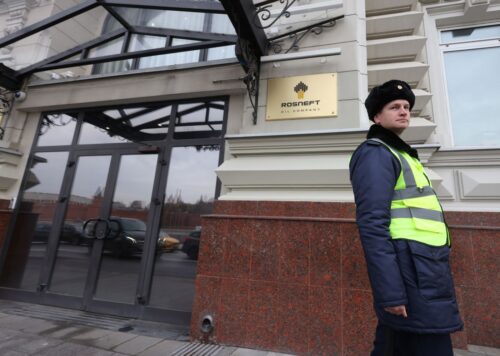
For the first time in his second term, President Donald Trump imposed sanctions on Russia on October 22. The measures target Lukoil and Rosneft, two of the country’s most important oil companies. Since taking office in January, Trump has repeatedly flip-flopped on Russian sanctions — threatening sweeping measures and secondary tariffs, only to eventually pull back, with his administration arguing that such steps would hinder diplomacy and harm the US economy. The move follows the collapse of a planned second bilateral summit with President Vladimir Putin in Hungary and is expected to reduce Moscow’s oil export revenues while increasing pressure on India and China’s oil supply chains and trading costs. Since 2022, both countries have been purchasing Russian oil at discounted prices and have become its largest customers, but the new sanctions leave them even more vulnerable to secondary sanctions targeting Russia’s energy trade. The Trump administration also allowed a sanctions waiver for NIS — Serbia’s sole refinery and largest oil company, which is majority owned by Gazprom, Russia’s state-owned oil and gas giant — to expire on October 9. The sanctions had been imposed as one of President Joe Biden’s final acts in office and, despite repeated waivers under Trump, had constrained the company’s operations. With the full sanctions now in effect, there are growing concerns that NIS may be forced to halt operations within weeks, which may significantly impact Serbia’s economy as a whole.
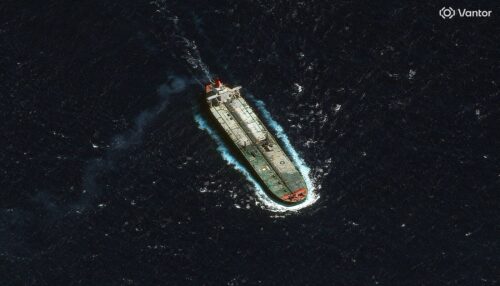
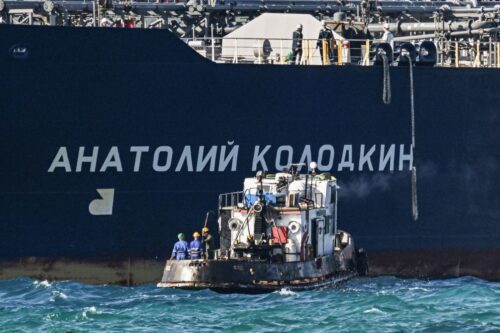
More than a week before Trump’s measures on Lukoil and Rosneft, the United Kingdom had sanctioned the same companies as well as two Chinese energy firms for their business dealings with Moscow. European Union leaders, for their part, voted to adopt the bloc’s 19th package of sanctions. The measures move up the deadline for a total ban on Russian liquefied natural gas imports by one year to January 1, 2027; sanction 117 vessels in Russia’s “shadow fleet” of oil tankers used to evade restrictions; impose full transaction bans on major Russian energy companies and certain Russian and emerging-country banks; and target refineries, oil traders, petrochemical firms, and crypto platforms in Russia and third countries, including China and Belarus.
Meanwhile, the European Commission’s (EC) rough proposal to use Russia’s frozen assets — most of which have matured into cash — to fund a $160 billion “reparations loan” to Ukraine gained traction throughout the month. France and Germany expressed their support, while Canada and the United Kingdom indicated their intention to join the EC. European Central Bank President Christine Lagarde, who has previously opposed seizing Russia’s assets, also signaled openness to the idea, provided that “countries around the world move in unison,” Bloomberg reported. Nevertheless, Belgium — where the majority of these assets are held and which has been apprehensive about the plan due to legal concerns, possible Russian retaliation, and financial risk — opposed allowing the EC to develop a concrete and detailed proposal during an EU leaders’ summit on October 23. The leaders instead postponed the decision and asked the EC to present “options for financial support” to Ukraine without explicitly mentioning the frozen assets. In addition, officials from the US, which initially pushed the EU to make greater use of these assets, have reportedly told their European counterparts that Washington will not be joining their effort to make this a wider G7 initiative at this stage.
Read more:
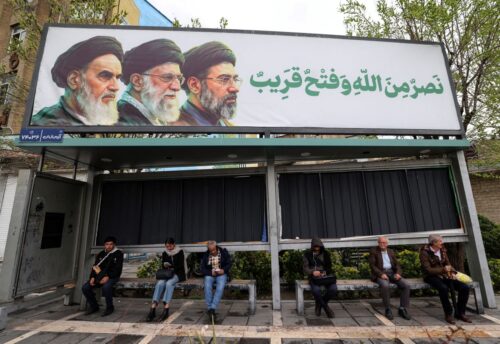
Over six years after the US unilaterally withdrew from the multilateral Iran nuclear agreement, Iran officially announced its departure from the agreement this month following the reimposition of “snapback” UN sanctions in late September. The UK, France, and Germany had pushed the sanctions through at the encouragement of US Secretary of State Marco Rubio, despite numerous Iranian diplomatic overtures. China and Russia strongly opposed the snapback at the UN Security Council, and Russia has announced its own “annulment” of the sanctions. Quincy Institute fellow Eldar Mamedov argues that “by pushing through a legal maneuver that a significant part of the Security Council considers illegitimate, they have ushered the world into a new and more dangerous state.” Noting that the nuclear deal had been successful in constraining Iran’s nuclear program, that the US withdrew from the deal first, and that — despite the US’s military strikes on its territory — Iran had appeared willing to continue negotiations until the snapback, Center for International Policy fellow Sina Toossi writes that the “snapback does not constrain Iran’s nuclear program; it accelerates the collapse of international monitoring.”
The snapback sanctions entail asset freezes, arms restrictions, and prohibitions on the trade of certain technologies and materials that can be used in weapons development. As such, some analysts suggest that their macroeconomic impact will be minimal compared with the deep and indiscriminate effects of US sectoral and secondary sanctions. Nevertheless, their reimposition sent the rial temporarily tumbling to all-time lows and will likely increase inflationary pressures in a context where 40 percent to 50 percent inflation has already eaten deeply into workers’ incomes. “Few Iranians can escape the attendant hardships,” reports Reuters. “A sense of desperation is rippling through society, affecting urban professionals, bazaar traders and rural farmers alike.”
A new study published in the European Journal of Political Economy finds that economic sanctions significantly contracted the size of Iran’s middle class. Using multiple econometric methods, the authors estimate that sanctions led to a 12–17 percent annual average reduction in the size of the middle class. Writing of their research in Al Jazeera, the authors point out that the middle class has historically been the base for more reformist tendencies in Iran. “Far from being a surgical strike,” they write, the sanctions were “a sledgehammer that smashed the very group that represents the best hope for a more moderate and stable future — the middle class.”
Read more:
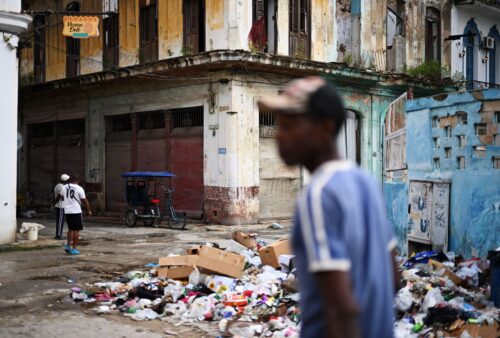
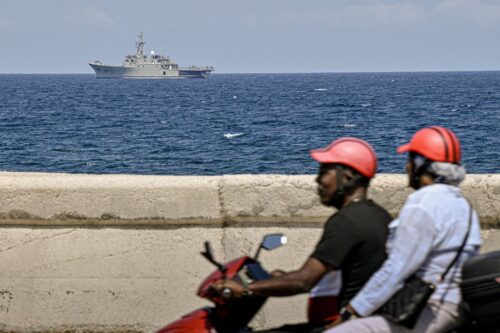
Citing its devastating effects on the civilian population and the fact that it is in violation of the UN Charter, the UN General Assembly voted overwhelmingly to condemn and call for the end of the US embargo of Cuba this month. This is the 33rd time the body has passed a similar nonbinding resolution, typically nearly unanimously. This year’s vote passed with 165 in favor and 7 opposed: the United States, Israel, Argentina, Hungary, North Macedonia, Paraguay, and Ukraine. In the weeks leading up to the vote, the US Department of State — headed for the first time in history by a Cuban-American hardliner (Rubio) — reportedly strongly urged dozens of countries to oppose the resolution. Cuban Foreign Minister Bruno Rodriguez claimed to have “reliable information” that this went beyond typical lobbying to include “intimidation” and “deception.”
Also this month, the US Supreme Court agreed to hear two cases brought by US-based companies under Title III of the Helms-Burton Act. Title III allows US nationals — including naturalized Cubans — to sue individuals and entities that “traffic” in properties expropriated by the Cuban government. Since the enactment of Helms-Burton, successive presidential administrations of both parties waived the controversial provision. It was only halfway through Trump’s first term that he allowed for its activation, a policy that was maintained by Biden until his final days in office and then quickly resumed in Trump’s second term. The two cases are brought by Exxon against Cuban state-owned companies alleged to profit off of expropriated oil and gas infrastructure and Havana Docks Corporation against four cruise lines that, for a period, used docks built by the corporation that had been expropriated under Fidel Castro. If the Supreme Court rules in favor of the plaintiffs, the door may be opened to additional such suits, further discouraging foreign investment in the country.
Finally, a new documentary produced by Belly of the Beast, by filmmakers Reed Lindsay and Ed Augustin, examines the brutal impacts of US sanctions on Cuba’s health care system, including obstacles to access to medicine and medical equipment. “They say these sanctions are against the regime. But we’re the ones who feel them,” notes one interviewed doctor, who adds, “It’s not a sick child’s fault.”
Read more:
The US Senate voted to repeal the Caesar Act this month as part of its version of the FY2026 National Defense Authorization Act. Senators Jeanne Shaheen (D-NH) and Rand Paul (R-KY) had championed a “clean” repeal but had faced a challenge from others — including Senators Lindsey Graham (R-SC) and Chris Van Hollen (D-MD) — who argued for the repeal to be made conditional on the new Syrian government’s meeting and maintaining certain conditions. The senators ultimately found a compromise by agreeing on the full repeal of the act while simultaneously requiring the president to report to Congress on Syria’s meeting certain policy targets and expressing the nonbinding “sense of Congress” that sanctions should be reimposed if these conditions are not met. The targets include protecting ethnic minorities, maintaining peaceful relations with Israel, and expelling individuals associated with groups that Washington has designated as terrorist organizations, including armed Palestinian resistance groups. The House version of the bill does not contain a repeal of the Caesar Act, meaning its ultimate fate will be left to negotiations between the chambers. President Trump suspended Caesar Act sanctions in June but can only do so temporarily.
Proponents of repeal argue that, so long as the Caesar Act is on the books, the possibility of the return of Caesar Act sanctions will deter long-term investment in Syria. This, as well as the other remaining sanctions — such as those associated with the State Sponsor of Terrorism designation — continue to undermine Syria’s efforts to rebuild. As Responsible Statecraft’s Connor Echols reports, the Caesar sanctions “left the country in near complete economic isolation” under Bashar al-Assad. The challenges of rebuilding while sanctions remain are immense and impact every part of Syrian society:
Rolling blackouts attest to the sorry state of the country’s electrical grid. Syrian banks, after years of toiling in isolation, are now struggling to return their practices to international standards in order to plug themselves into the global financial system. With gas stations in disrepair, most drivers now rely on roadside stops where workers dispense fuel from thin plastic water jugs. Supply chains for most industries will have to be rebuilt from scratch.
Read more:
On October 10, a 20-point ceasefire agreement between Hamas and Israel, brokered by the United States, Qatar, and Turkey, went into effect. The plan stipulates that “full aid will be immediately sent into the Gaza Strip,” though as of this writing, that has not occurred. While Israel has since allowed an increase in aid compared with most of the last two years — during which its weaponized blockade of aid caused famine — key crossings are still closed, and restrictions remain in place, severely limiting the amount of aid that enters the Gaza Strip. Israel has also temporarily curtailed aid deliveries twice, citing violations of the agreement, and is reportedly taking steps to shut down the operations of international aid organizations through new legal registration requirements. Two weeks into the ceasefire, the World Health Organization’s Director General said that “the situation still remains catastrophic because what’s entering is not enough.”
UNRWA — the UN’s primary humanitarian agency in the occupied Palestinian territories — remains barred from bringing in its supplies after Israel’s parliament voted to prohibit its activities in January. However, on October 22, the International Court of Justice (ICJ) issued a nonbinding advisory opinion stating that Israel must cooperate with UN agencies (including UNRWA), facilitate aid schemes, and ensure that civilians have access to “the essential supplies of daily life.” Israel rejected the ruling, while US Secretary of State Rubio described UNRWA as a “subsidiary of Hamas” and asserted that it “cannot play a role in Gaza,” despite the ICJ finding that “Israel has not substantiated its allegations that a significant part of UNRWA employees ‘are members of Hamas . . . or other terrorist factions.’” As of October 26, UNRWA aid deliveries continue to be denied, the agency said.
Before the ceasefire, on October 1, the United Nations reported that, according to Palestinian health authorities, 151 children in the Gaza Strip had died from acute malnutrition. A week later, UNRWA published a peer-reviewed study in The Lancet showing that rates of acute malnutrition had risen sharply following Israel’s introduction of aid restrictions in late 2024. A press release about the report warned that “more than 54,600 children are now acutely malnourished and face increased risk of death if untreated.” In response to figures like these, activists launched the Global Sumud Flotilla in August in an effort to break Israel’s siege of Gaza and establish a humanitarian corridor to deliver aid. Israeli forces unlawfully intercepted the flotilla early in the month and, according to Amnesty International, kidnapped, detained, and tortured several of the activists involved.
Read more:
As the Trump administration accelerates its apparent push for regime change in Venezuela, The New York Times reports that US sanctions are edging the country toward economic crisis. “The tightening of American sanctions this year has pushed inflation back into triple digits, sent the national currency into a free fall, worsened power cuts and led the government, companies and residents to hoard dollars and slash spending,” Anatoly Kurmanaev writes, citing estimates that inflation will soar from 50 to 600 percent this year and the economy may contract by 3 percent. The Times notes that these indiscriminate economic impacts are not incidental to US sanctions but are a deliberate strategy: “Venezuela’s main opposition movement and its allies in the Trump administration are betting that an economic crisis, combined with the aggressive U.S. military campaign in the Caribbean, will fracture the Venezuelan government and end 25 years of a regime now led by Mr. [Nicolás] Maduro. They see worsening living conditions in Venezuela as an unavoidable and short-term cost of re-establishing democracy.”
Kurmanaev had previously written that US economic sanctions have “slashed the purchasing power of most Venezuelans” and “caused inflation to soar.” Meanwhile, Antiwar.com editor Dave DeCamp — speaking with former Congressman Matt Gaetz and right-wing influencer Tim Pool — noted that “sanctions poured gasoline on the Venezuela migrant crisis” and warns that further destabilization of Venezuela risks doing the same.
Also this month, Venezuela’s oil exports hit one million barrels per day (bpd) for the first time since 2020. The spike may be temporary, however, as the country drains down oil stocks produced prior to Trump’s revocation of licenses for foreign oil companies to operate in the country. Eighty-four percent of these exports were destined for China, evidence — as Orinoco Research founder Elias Ferrer points out — that US policy is driving Venezuela closer to the country. Similarly, over the last few months, Venezuela has shifted its imports of naphtha — a product needed to dilute Venezuela’s extra-heavy crude — from the United States to Russia as a result of US restrictions.
Read more:
The International Crisis Group released a report this month examining the impact of aid cuts by the United States and other major donors to Afghanistan. The report argues that the withdrawal of aid, combined with the harmful effects of sanctions, is driving Afghans deeper into poverty and could increase regional instability. It urges donor countries to help make Afghanistan less dependent on foreign assistance — in part by easing sanctions that have contributed to the devastation of the country’s economy — arguing that “donors should not hold the country’s recovery hostage to the political demands of distant capitals, since inflicting economic pain will only hurt the most vulnerable people.” The report highlights how conditions to lift UN sanctions are “so out-of-date that the Security Council can no longer use them to change the Taliban’s behaviour,” adding that “there is no realistic way for targets to get off the sanctions list.” It identifies central banking as the “most pressing chokepoint” when it comes to the Afghan economy, noting that:
Da Afghanistan Bank, the central bank, remains cut off from billions of dollars in overseas reserves and banned from the SWIFT system of transactions. European and regional actors should object to any effort by the Trump administration to seize the Afghan state assets now sitting in Switzerland …
It concludes by stating:
At a minimum, donors should ease the legal and policy restrictions that stifle Afghanistan’s economic recovery. At best, countries that impose sanctions should rethink why those penalties are inflicted on Afghanistan and offer ways of ending the economic punishment. Doing so would save the livelihoods of countless people, and it might also reduce the chances – however remote it may be for now – of the crisis in Afghanistan spreading across borders.
Similarly, a World Food Programme report published on October 6 warns “Afghanistan’s food security and nutrition crisis is deepening fast, and humanitarian funding cuts are an important driver.” The UN agency highlights how “geopolitics further constrain recovery. Sanctions, frozen reserves, and lack of recognition of the [de facto authorities] limit fiscal and monetary flexibility” and cautions that “without renewed engagement from international actors, the macroeconomic environment will remain fragile, aid-dependent, and exposed to shocks.”
Read more:
As part of its 19th package of Russia sanctions, the EU targeted a North Korean general reportedly commanding North Korean troops in Russia. North Korea has been supporting Moscow in its war against Ukraine with equipment, weapons, and troops in exchange for funds and supplies that have bolstered its economy and helped it withstand international sanctions.
There was speculation about a potential meeting between President Trump and North Korean leader Kim Jong Un during Trump’s visit to South Korea for a summit late this month. When asked about the prospect, Trump said he would “love to meet” Kim and that he was open to visiting North Korea during his trip to discuss sanctions relief. However, he noted that he hadn’t said “anything” to Kim about a meeting, and the encounter did not ultimately occur. Nevertheless, while meeting with South Korea’s president, Trump expressed optimism about future engagement with North Korea, stating, “We really weren’t able to work out timing. … We’ll work very hard with Kim Jong-un and with everybody on getting things straightened out because that makes sense. May take a little time, [and] you have to have a little patience, but I feel absolutely certain that it will.”
Read more:
Colombian President Gustavo Petro’s outspoken opposition to the Trump administration’s illegal Caribbean boat strikes — which have likely killed Colombian citizens — and its efforts to promote regime change in Venezuela prompted President Trump to threaten Colombia with tariffs and a halt to all US aid to the country. Trump has baselessly alleged that Petro is involved in drug trafficking, and the administration claimed that one of the targeted boats was linked to the Colombian National Liberation Army (ELN) guerrilla group — claims that the Colombian government has firmly rejected. Should the tariffs materialize, they would represent the latest weaponized use of the measures as a form of sanctions.
However, Ohio Senator Bernie Moreno claimed on October 22 that he persuaded Trump to backtrack on the threats and instead consider designating Petro and his family members on what Moreno vaguely referred to as the “Kingpin” and “Clinton” lists. Indeed, two days later, the Trump administration added Petro, his family, and Interior Minister Armando Benedetti to the Specially Designated Nationals and Blocked Persons (SDN) list, subjecting them to asset freezes and other financial restrictions. A press release on the move alleges, without evidence, that Petro was designated for “having engaged in, or attempted to engage in, activities or transactions that have materially contributed to, or pose a significant risk of materially contributing to, the international proliferation of illicit drugs or their means of production.” The first apparent consequence of the sanctions came when, according to Petro, a US fuel company contracted by the Colombian Air Force at a Cape Verde airport refused to refuel his presidential plane during a technical stop in the country, fearing potential violations. It remains unclear whether the Trump administration will ultimately follow through on the tariff and funding threats.
Responding on X, President Petro wrote:
Fighting drug trafficking effectively for decades has brought me this measure from the government of the society we have helped so much to curb cocaine consumption. It’s quite a paradox, but we will not take a step back and we will never kneel.
According to Mexican officials interviewed by Reuters, the Trump administration revoked the visas of 50 Mexican politicians and officials as part of its “war on drugs” policy, which includes the recent boat strikes. Reuters reports:
The move has sent quiet shockwaves through Mexico’s political elite, who regularly travel to the U.S. and require a visa to do so. It also marks a significant broadening of U.S. anti-narcotics action, with the Trump administration targeting active politicians usually seen as too diplomatically sensitive …
In Mexico, the widespread visa revocations – especially of members of Sheinbaum’s ruling Morena party – threaten to complicate the country’s already uneasy relationship with the United States. Amid high-stakes trade negotiations and security talks, Sheinbaum has opted to collaborate closely with the U.S. to go after the cartels. Still, she has condemned repeated suggestions by Trump administration officials that the U.S. could take unilateral military action in Mexico, which she has said would violate Mexico’s sovereignty.
Read more:
Economic sanctions have become one of the main tools of US foreign policy despite widespread evidence that they can cause severe harm to civilian populations (which may, in fact, be the point). Though now a defining feature of the global economic order, sanctions and their human costs receive relatively little attention in most US media outlets.
CEPR’s Sanctions Watch news bulletin aims to generate more awareness on the use and impact of sanctions through monthly round-ups of news and analysis on US sanctions policy.
Previous editions of the Sanctions Watch can be found here. CEPR’s US Sanctions Policy FAQ can be found here.
Article
Article
Article
Article
Article
Article

Report
Article